EP2216482A2 - Dispositif d'ombrage pour ouvertures de portes ou de fenêtres - Google Patents
Dispositif d'ombrage pour ouvertures de portes ou de fenêtres Download PDFInfo
- Publication number
- EP2216482A2 EP2216482A2 EP10151375A EP10151375A EP2216482A2 EP 2216482 A2 EP2216482 A2 EP 2216482A2 EP 10151375 A EP10151375 A EP 10151375A EP 10151375 A EP10151375 A EP 10151375A EP 2216482 A2 EP2216482 A2 EP 2216482A2
- Authority
- EP
- European Patent Office
- Prior art keywords
- curtain
- rail
- shading device
- rails
- eyelets
- Prior art date
- Legal status (The legal status is an assumption and is not a legal conclusion. Google has not performed a legal analysis and makes no representation as to the accuracy of the status listed.)
- Withdrawn
Links
Images


Classifications
-
- E—FIXED CONSTRUCTIONS
- E06—DOORS, WINDOWS, SHUTTERS, OR ROLLER BLINDS IN GENERAL; LADDERS
- E06B—FIXED OR MOVABLE CLOSURES FOR OPENINGS IN BUILDINGS, VEHICLES, FENCES OR LIKE ENCLOSURES IN GENERAL, e.g. DOORS, WINDOWS, BLINDS, GATES
- E06B9/00—Screening or protective devices for wall or similar openings, with or without operating or securing mechanisms; Closures of similar construction
- E06B9/24—Screens or other constructions affording protection against light, especially against sunshine; Similar screens for privacy or appearance; Slat blinds
- E06B9/26—Lamellar or like blinds, e.g. venetian blinds
- E06B9/262—Lamellar or like blinds, e.g. venetian blinds with flexibly-interconnected horizontal or vertical strips; Concertina blinds, i.e. upwardly folding flexible screens
-
- E—FIXED CONSTRUCTIONS
- E06—DOORS, WINDOWS, SHUTTERS, OR ROLLER BLINDS IN GENERAL; LADDERS
- E06B—FIXED OR MOVABLE CLOSURES FOR OPENINGS IN BUILDINGS, VEHICLES, FENCES OR LIKE ENCLOSURES IN GENERAL, e.g. DOORS, WINDOWS, BLINDS, GATES
- E06B9/00—Screening or protective devices for wall or similar openings, with or without operating or securing mechanisms; Closures of similar construction
- E06B9/24—Screens or other constructions affording protection against light, especially against sunshine; Similar screens for privacy or appearance; Slat blinds
- E06B9/26—Lamellar or like blinds, e.g. venetian blinds
-
- E—FIXED CONSTRUCTIONS
- E06—DOORS, WINDOWS, SHUTTERS, OR ROLLER BLINDS IN GENERAL; LADDERS
- E06B—FIXED OR MOVABLE CLOSURES FOR OPENINGS IN BUILDINGS, VEHICLES, FENCES OR LIKE ENCLOSURES IN GENERAL, e.g. DOORS, WINDOWS, BLINDS, GATES
- E06B9/00—Screening or protective devices for wall or similar openings, with or without operating or securing mechanisms; Closures of similar construction
- E06B9/24—Screens or other constructions affording protection against light, especially against sunshine; Similar screens for privacy or appearance; Slat blinds
- E06B9/26—Lamellar or like blinds, e.g. venetian blinds
- E06B9/28—Lamellar or like blinds, e.g. venetian blinds with horizontal lamellae, e.g. non-liftable
- E06B9/30—Lamellar or like blinds, e.g. venetian blinds with horizontal lamellae, e.g. non-liftable liftable
- E06B9/32—Operating, guiding, or securing devices therefor
- E06B9/322—Details of operating devices, e.g. pulleys, brakes, spring drums, drives
-
- E—FIXED CONSTRUCTIONS
- E06—DOORS, WINDOWS, SHUTTERS, OR ROLLER BLINDS IN GENERAL; LADDERS
- E06B—FIXED OR MOVABLE CLOSURES FOR OPENINGS IN BUILDINGS, VEHICLES, FENCES OR LIKE ENCLOSURES IN GENERAL, e.g. DOORS, WINDOWS, BLINDS, GATES
- E06B9/00—Screening or protective devices for wall or similar openings, with or without operating or securing mechanisms; Closures of similar construction
- E06B9/24—Screens or other constructions affording protection against light, especially against sunshine; Similar screens for privacy or appearance; Slat blinds
- E06B9/26—Lamellar or like blinds, e.g. venetian blinds
- E06B9/262—Lamellar or like blinds, e.g. venetian blinds with flexibly-interconnected horizontal or vertical strips; Concertina blinds, i.e. upwardly folding flexible screens
- E06B2009/2622—Gathered vertically; Roman, Austrian or festoon blinds
Definitions
- the invention relates to a shading device for window or door openings with a vertically or horizontally at least one side freely slidable, arranged in cords curtain according to the features specified in the preamble of claim 1.
- Shading devices of the type mentioned are z. B. as a horizontal blind from the EP 1 489 258 B1 known.
- This horizontal blinds for window or door openings has an upper rail and a lower rail, between which a plurality of slats is arranged, wherein the upper rail and the lower rail in the vertical direction freely displaceable on clamping cords - also called running cords - are arranged.
- the tension cords are mounted in the four corners of the window or door opening to the frame and held with at least one spring mechanism, regardless of the position of the upper or lower rail in a tensioned state.
- the slats specified there may also be provided zigzag folded pleated curtains.
- the curtain can be moved into desired closed and open positions relative to the window or door opening. This applies both when using Venetian blind leaves as well as when using pleated blinds, in which the curtain consists of an accordion-folded fabric or foil. Pleated blinds, in contrast to blinds in the closed state, do not permit direct passage of light. Due to the possibility of independent shifting of the upper and lower rails, any light incidence variants are possible.
- a pleated curtain is known in which the top and bottom rails are along line guides are displaceable.
- This document also indicates that instead of a pleated curtain and a blind can be used as a curtain.
- Fig. 2 there are shown the course diagrams of the tension cords. Both shading devices described above also provide tensioning devices in the upper and lower rails for tensioning the tensioning or running cords. The cords themselves are fastened with their end sections in the corner areas on lace shoes on holders.
- a shading and / or insect repellent in the form of a sheet is known, which is also attached to cross rails, which have either individually or in multiple arrangement deflected tension cords, which are arranged so that the cross rails are slidable.
- the pull cords are guided by eyelets on the curtain.
- eyelet tapes are sewn on the back, for example, having a plurality of arranged in one side eyelets through which the running or tensioning cords can be pulled.
- These tensioning cords are then deflected in the transverse rail so that they can be led with their ends in pairs on one side of the curtain, while the other ends are led out on the other side.
- the ends are attached with the string shoes to holders that are fixed to the frame of the window or door openings.
- the detachable string shoes are z. B. attached to the holders in sliding or latching technology or by means of screw.
- a curtain can be passed through eyelets in the longitudinal direction of the curtain several strings. This can also be provided accordingly if the curtain is a concertina-folded curtain. In this case, it may also be provided that holes are punched in the individual slats of this curtain or introduced by laser cutting, through which the tufts are pulled. The deflection of the treads is done in the manner described in the cross rails to then be led out laterally up or down.
- the width of the curtain may be provided two, three, four, five, six, seven or more cord holes or eyelet rows, with a corresponding number of individual cords is provided or cords in the string shoes are deflected to be directed to the next eyelet guide.
- the curtains whether pleated blinds, which are folded or designed as Raffvor warmth be held on the crossbars usually by surface zipper elements, so that they can be detached therefrom.
- the strings can be threaded out of the eyelets of the curtain and the fabric can be removed through the Velcro-mounted operating profile.
- each eyelet is designed as a dependent of the running shoe eyelet and allows unhooking.
- the pull cord assembly thus remains after removal of the curtain of the rails firmly connected to the cross rails and attached to the attachment points on the frame with the Schnschnur myn. After this Washing or other cleaning a curtain this is again attached to the two rails and hung the eyelets with their openings on the tethers, so that an adjustment is made possible in the desired manner.
- a pleated curtain which is accordion-folded, a simple removal is practically impossible because the tethers are not removable without disassembling the shading device. For this reason, such curtains are usually rarely cleaned.
- the present invention has the object to enable an uncomplicated removal of the curtain from the cross rails to clean the curtain. Furthermore, the cleaned curtain should also be easily connectable to the cross rails again.
- the object is achieved by the invention by designing the shading device according to the technical teaching given in claim 1, according to which the curtain with the tethers after loosening the lace shoes and the deflection of the cords together with the eyelets and the deflection of the at least one actuating rod or rail and is removable from the frame.
- the invention also includes such curtains that are attached only on one side to a transverse rail and on another side, z. B. below, are releasably fixed to the frame of the window or door opening, so that not only a move from top to bottom or from bottom to top in the Abschattungsposition, but also a release of the frame after removal is possible.
- curtains according to the invention can be arranged both vertically extending and horizontally.
- the rails provided transversely to the longitudinal direction of the curtain are mounted at the top and bottom in longitudinal guide rails with bearings.
- the deflection means are holders which have at least one eye-shaped receptacle have, is passed through the at least one deflected cord, which holder are releasably secured to the actuating rod.
- the holder which has at least one transverse eyelet through which at least one pull cord section or at least one pull cord is pulled, causes the pull cord, which is passed through eyelets in the longitudinal direction of the curtain, to be deflected, that is to say parallel to the longitudinal axis of the actuation rail then be able to be led out at the side of the operating rail by deflection, for example a deflection roller, upwards or downwards.
- deflection for example a deflection roller
- the holder is fixedly attached to the curtain and is releasably fixed during assembly of the curtain to the running rail.
- the attachment may be a simple clamp attachment, so that the holder when removing the curtain is deducted from the surface zipper element with.
- the holder may also be a snap-in holder or be inserted into a receptacle which is locked in a profile strip of the actuating rail or fixed therein by clamping or can be held by a simple hooking. In any case, the holder can be easily removed from such a receptacle, for example by light pressure or train on the holder itself.
- the holder can be glued to a curtain, such as a film, it has a surface element and is made made of plastic, so that a gluing or welding with the film is possible. If it is a surface element of a soft plastic, sewing together with a face zipper counter element is possible, for. B. also on a pleated or other textile material, so that the holder with the deflection sleeve is an integral part of the curtain.
- the holder may also each have separate eye-shaped receptacles for the to be deflected tufts or Laufschnürabête and one or more extending in the longitudinal direction of the operating rod or slide through eyelets or holes, so that the other treadles and Laufschnürabroughe are performed separately, which are required if over Width of the curtain distributed several tufts are provided, which are guided over the length of the curtain in parallel eyelet rows.
- the eyelets may be eyelets of an eyelet tape, which is sewn on the back of the curtain, welded or glued, depending on the materials used.
- the holder can also be used by means of locking or clamping elements and / or hooks in recesses or receptacles or on the profiles of the actuating rod and / or rail or plugged directly thereto or releasably secured. You can also be carried on or on attached carriers or profiles. Conveniently, the holder is made of plastic, as well as the attached thereto and angularly extending fabric for attachment to the curtain.
- the mounting rod or rail can also be made of plastic or be an aluminum profile.
- already known profiles can also be used, since such profiles have longitudinal profiles in the form of slotted longitudinal grooves, which are accessible from the side, so that the holders can be pushed into them. If the profile is designed so that a bearing wall is provided, which can be engaged behind, the holder can also be attached thereto by means of a hook.
- At least laterally resilient elements can be used in such rail-shaped profiles, for example, have a deflection roller which is supported by a spring to tension the running line to cause length compensation under consideration of the tolerance ranges on the running line. Due to the constant tension of the running line, the self-holding displacement of the actuating rods on the running cords is only possible.
- a shading device may also have two actuating rods or rails, on which the ends of a curtain are fixed.
- the curtain can also consist of several partial curtains, which are arranged in cascade one behind the other, which at least partially span the window or door opening.
- the partial curtains can be freely adjustable independently of each other via tufts or arranged on common tethers, wherein the abutting operating rods or rails are removable from each other or auffactzu- movable.
- several partial curtains can be sewn together to form a scarf and connected to one another in the longitudinal direction via an eyelet strip.
- each partial curtain can also be guided separately by means of, for example, two operating rails on the pull cords, so that they can be displaced completely independently of each other.
- the individual partial curtains can also be arranged individually between two actuating rods or rails, so that they are displaceable independently of the others. As a result, any desired shading by staggering the individual curtains one behind the other and next to each other possible.
- the width of the curtain can be over the width - or height of the curtain with horizontal displacement - distributed more running cords in the longitudinal direction to the curtain extending and deflection corresponding thereto provided in a corresponding number.
- the ends of the pull cords are connected to the string shoes and led out running on the front sides of the actuating rod and / or rail and the string shoes in the corner areas of the window or door opening laterally releasably fixed or distributed next to the eyelets of the curtain releasably fixed to the frame.
- the outer tread lines so running on the outer sides tufts, parallel in the eyelets of the rows in the outer regions of the curtain are retracted running to the respective longitudinal edge. If the strings are thus guided along the front sides of the rails, they can be fixed directly with their string shoes at the attachment points on the frame.
- pulleys have proven to be supported against the force of a spring in a storage chamber on a bearing element.
- the bearing element can be used as a plastic part in the channel in a rail or forms the side finishes.
- the tread lines are only on the pulley, so that they are not bound in any way and when removing the curtain of the operating rail automatically take off. The same applies to the deflection or holder, which can be pulled out of its mounting hole in the receptacle or from the rail itself only by the force exerted on the curtain trigger force.
- clamping elements and deflecting pins may be provided from metal.
- Such deflecting bolts have the advantage that the abrasion of the pull cords is less than in the system of deflecting plastic pins. It goes without saying that the surfaces of such pulleys or deflecting bolts should be smoothed.
- the curtain is a pleated pleated curtain, so instead of eyelets at the back of the individual folding points and through holes can be punched or incorporated directly into the pleat strips, for example, be introduced by lasers through which the treads are passed.
- the respective end plate is then attached to the operating rod or rail or in one-sided execution on the frame part.
- releasable fastening means not only surface zipper elements or so-called Velcro tapes can be used, but also push button elements, zippers, knobs or other fastening means, which must be designed so that one part of the operating rail or the frame and the other part at the curtain end each attached.
- the corresponding means can be sewn, welded or glued. This depends on the particular design and the fastener itself.
- an actuating rod can also be provided.
- a rail instead of an actuating rail, an actuating rod can also be provided.
- the advantage of a rail is that the introduced longitudinal profiles can be used for easy attachment of the images for the holder or deflection, as well as for bearing elements for the Deflectors and other attachments. For example, lighting elements may be hooked into such rails as other attachments.
- the tensioning means can in principle also be provided on cord shoes, for example, the ends of the tethers to be attached to a string shoe, are attached thereto by a tension spring, the pull cord is attached to the shoe on the one hand and on the tethers on the other hand, so that the string shoe, for example, in a dovetail-shaped opening of a holder can be inserted, so that the spring is tensioned so as to exert a defined tension on the tether, thus in the desired manner and without additional braking means a secure hold, for example on a top and bottom rail for a Curtain according to the invention is possible, which is arranged vertically.
- the actuating rods or rails are guided at the window or door opening with their ends and bearing ends or bearing lugs are provided, which engage in top and bottom guide rails, so that the curtain does not occur can.
- This version is also recommended when the shading device is to be introduced in a sloping roofing. The tension of the pull cords is not sufficient to avoid sagging of the curtain. But this is guaranteed by the lateral guidance.
- either the holder is made of hard plastic, so that a high degree of sliding is provided is. It can also be provided laterally on the eyelets round metal parts over which the pull cords run. Such round metal parts may be wire sections of a spring wire bridge. This is shaped so that it is slidably pushed onto the holder or latching in recesses with its ends can be applied. In any case, it is ensured by the releasable attachment of the deflection of the actuating rods or rails that the curtain z. B. is easily removable for washing. This is also guaranteed, if this is a pleated curtain, which is executed folded and holes are introduced into the individual folds for receiving the tethers.
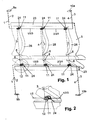
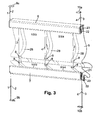
- FIGS. 1 . 3 and 4 show an example of a folding curtain of the shading device in the inventive design.
- the curtain 5, z. As a textile curtain, a pleated curtain, a film, a thin straw mat or a composite of such materials and / or in different imprints and colors curtain has top and bottom side sewed, welded or glued Yuphilr Strukturr Strukturver gleichmaschine 23, z. B. Velcro. Between the Velcro tape 23 and the curtain surface elements 24 are also interposed and firmly connected to the curtain 5, z. B. Nählappen, where above deflection means 11 are attached in the form of holders.
- Fig. 2 shows an enlarged section Fig.1 , This deflecting means 11 and the surface element 24 are made of plastic, the surface element 24 made of soft plastic.
- the deflection means 11 is in Fig. 6 shown as an item highlighted. It consists essentially of a clamping element 13, which has a larger breakthrough to save weight and is formed from the lower portion of the surface element.
- the clamping element 13 has a hook-shaped projection, at the end of a hook 14 is formed.
- This lead is with one Provided transverse bore, which forms a loop-shaped receptacle 12 for the running line.
- On both sides of the eye-shaped receptacle 12 extending the legs of a wire bracket 25 are arranged, which is pivotally mounted with its leg ends 27 in LagerungsausEnglish Institute on the nose-shaped projection of the holder formed as a deflection 11 and engages in the recess 26 frontally for fixing during assembly.
- the legs are angled and arranged to be flush with or slightly projecting into the bore wall of eyelet 12 so that the run line retracted into eyelet 12 exits the spring steel and minimizes abrasion.
- Fig. 1 It can be seen that three such deflecting means 11 or holder are provided both on the upper strip of the curtain 5 as well as on the lower strip of the curtain mirror image also three deflection means 11.
- treads 1, 2, 3, 4 out which are arranged in a known manner.
- the thread course is in Fig. 11 illustrated by the example of the left side of the curtain 5.
- the two tread lines 1, 2 are attached to the top left of a line shoe 9a and extend together through the eye-shaped receptacles 12 of the top left deflecting means 11 and parallel to the top of the curtain 5 through the central deflection 11.
- the tether 1 is down deflected, the tether 2, however, the third, so right arranged therefrom deflection means 11 and pulled through the eye-shaped receptacle 12 and then deflected downwards.
- the deflected by the second deflection 11 running cord 1 is again deflected by the central lower deflection 11 to the left and pulled through the eye-shaped receptacle 12 of the lower left deflecting means 11 and secured at the bottom running line shoe 9 b.
- the tether 2 is through the right lower deflection 11th deflected by threading into the eye-shaped receptacle 12 and passed through the eye-shaped receptacles 12 of the central and the left deflection means 11 and also attached to the tether shoe 9b.
- a single continuous thread can be used accordingly and be threaded through the eye-shaped receptacles 12 by return to form the two threads.
- the tethers 3 and 4 are laid. These are attached at the top right of the tether shoe 10a each with one end and passed through the eye-shaped receptacle 12 of the upper right deflecting means 11 and also through the eye-shaped receptacle 12 of the above central deflection means 11.
- the thread 4 is then deflected downwards and into the eye-shaped Inserted receiving 12 of the deflection means 11 provided at the bottom center and pulled to the right through the eye-shaped receptacle 12 of the deflecting means 11 provided at the bottom right and attached to the lower running-string shoe 10b.
- the running line 3 is continued and is deflected only after passing through the eye-shaped receptacle 12 of the upper left deflecting means 11 down and deflected by the lower left deflecting 11 by threading into the eye-shaped receptacle 12 again to the right and through the other eye-shaped receptacles 12 of passed through the lower central and right deflection 11 and secured to the tether shoe 10b.
- the curtain 5 it is possible to move the curtain 5 as desired over the length of the tufts 1, 2, 3, 4 up and down when the tether shoes are attached.
- Fig. 1 further shows that 5 eyelets 8 are attached to the back of the curtain. These may be attached to an eyelet strip 28, which is also sewn onto the curtain 5. Instead of such usually band or Yarn existing eyelets 8 can also plastic eyes, z. B. eyelets or spring eyelets, which have an opening gap for easy threading, are used. Likewise, the eye-shaped receptacle 12 may be designed on the deflection means 11 so that it has an insertion gap, but is designed so that the pull cords can not slip out of this eyelet. It is off Fig. 1 it can be seen that the curtain with the drawstrings is a unit that is attached to the in - line Figures 3 and 4 shown upper and lower actuating rails 6, 7 can be fastened. The two actuating rails 6, 7 have the same structure and are as profile rails z. B. made of aluminum and arranged in mirror image.
- a surface zipper element 20, z. B. a Kletthalter is applied on one side of the operating rail 6, 7 continuously on a surface.
- a surface zipper element 20, z. B. a Kletthalter is applied on one side of the operating rail 6, 7 continuously on a surface.
- Such a Velcro holder 20 is also located on the lower rail, so that the curtain 5 with the sewn on surface zipper elements 23 can be fastened thereto. He is only pressed for fixation.
- the running laces shoes 9a, 9b and 10a, 10b are formed in this embodiment as sliding shoes and can be inserted with their lateral dovetail guides in opposite directions of the holder on the frame. They are therefore easily removable by pulling out.
- the shoes can also be designed as Aufrastzol, so that the pull cords are stretched when snapped when relative to the pivot point of the connection point is shifted. This detent can be solved for example by a moving Mit Cyprushaken in a simple way again.
- the deflection means 11 must be attached to the operating unit so that it can be pulled out when removing the curtain 5 with out of the attachment.
- a receptacle 15 is provided, which has two laterally projecting legs 32 and 33, so that in the middle of a U-shaped recording arises in which, like out Fig. 8 it can be seen, the clamping element 13 can be used.
- the legs 32, 33 need not exert clamping force on the clamping element 13, it is sufficient a simple lateral guidance, since the curtain secures the deflection anyway on the rail through the solicitnr einverInstitutelement. All you have to do is make sure that you can not shift laterally.
- the recording 15 can in the Fig.
- the receptacle 15 may comprise a locking screw, with which the receptacle 15 is fixed in the longitudinal profile 21 at the desired location. Clamps can also take over this function.
- the receptacle downwardly projecting legs 34, 35 are provided behind the profile wall 16 of the longitudinal profile 21 in Fig. 5 grab and are held in the longitudinal profile 21. After positioning and fixing the clamping element 13 is inserted with the nose-shaped projection and the wire bracket 25 in the receptacle, wherein the hook 14, the profile wall 16 engages behind locking. This is done in the attachment of the curtain 5.
- the inventive principle can be performed on all shading devices of the generic type, regardless of whether 3, 4, 5, 8 or more tethers are attached to the curtain 5.
- the invention can also be used if the treads are only led out in pairs and attached to a corresponding number of Laufschnurschuhbefestisten on the frame. The invention ensures in each case that a simple attachment and a simple detachment of the curtain is ensured and thus easy cleaning.
Landscapes
- Engineering & Computer Science (AREA)
- Structural Engineering (AREA)
- Architecture (AREA)
- Civil Engineering (AREA)
- Curtains And Furnishings For Windows Or Doors (AREA)
Applications Claiming Priority (1)
| Application Number | Priority Date | Filing Date | Title |
|---|---|---|---|
| DE200920000093 DE202009000093U1 (de) | 2009-02-06 | 2009-02-06 | Beschattungseinrichtung für Fenster- oder Türöffnungen |
Publications (2)
| Publication Number | Publication Date |
|---|---|
| EP2216482A2 true EP2216482A2 (fr) | 2010-08-11 |
| EP2216482A3 EP2216482A3 (fr) | 2010-10-06 |
Family
ID=40586283
Family Applications (1)
| Application Number | Title | Priority Date | Filing Date |
|---|---|---|---|
| EP10151375A Withdrawn EP2216482A3 (fr) | 2009-02-06 | 2010-01-22 | Dispositif d'ombrage pour ouvertures de portes ou de fenêtres |
Country Status (2)
| Country | Link |
|---|---|
| EP (1) | EP2216482A3 (fr) |
| DE (1) | DE202009000093U1 (fr) |
Cited By (1)
| Publication number | Priority date | Publication date | Assignee | Title |
|---|---|---|---|---|
| US10641038B2 (en) | 2016-12-01 | 2020-05-05 | Hunter Douglas Industries B.V. | Rail for an architectural opening covering |
Families Citing this family (3)
| Publication number | Priority date | Publication date | Assignee | Title |
|---|---|---|---|---|
| DE102011053648A1 (de) * | 2011-09-15 | 2013-03-21 | Achim Lienert | Schnurspanner zum Spannen einer Schnur an Beschattungsanlagen |
| DE102011057147A1 (de) * | 2011-12-29 | 2013-07-04 | Achim Lienert | Beschattungsanlage mit horizontalen Faltlamellen |
| CN112586964B (zh) * | 2020-12-16 | 2022-04-08 | 宁波星宏智能技术有限公司 | 一种智能窗帘 |
Citations (7)
| Publication number | Priority date | Publication date | Assignee | Title |
|---|---|---|---|---|
| US4733710A (en) | 1985-10-09 | 1988-03-29 | Haines Richard K | Vehicular shade |
| US4733711A (en) | 1985-09-20 | 1988-03-29 | Schoen Siegfried | Folding blind, composite folding blind and coupling strip therefore |
| EP1022428A1 (fr) | 1999-01-25 | 2000-07-26 | VELUX Industri A/S | Dispositif d'obturation de fenêtre et dispositif de freinage pour celui-ci |
| DE202006008048U1 (de) * | 2006-05-19 | 2006-08-17 | Lienert, Achim | Vorrichtung zur Führung von u-förmigen Zugschnüren eines Raffvorhangs |
| DE202006009738U1 (de) | 2006-02-10 | 2006-09-21 | PARAT Automotive Schönenbach GmbH + Co. KG | Führungsanordnung für einen Querriegel eines Abschattungsmittels |
| EP1489258B1 (fr) | 2003-06-20 | 2008-11-05 | MHZ HACHTEL GmbH & Co. KG | Jalousie horizontale |
| DE102007040518A1 (de) | 2007-08-28 | 2009-03-05 | Mhz Hachtel Gmbh & Co. Kg | Raffvorhang |
Family Cites Families (2)
| Publication number | Priority date | Publication date | Assignee | Title |
|---|---|---|---|---|
| IT1248570B (it) * | 1991-06-28 | 1995-01-19 | Silent Gliss Italia Srl | Tenda a pacchetto con mezzi di rimozione rapida dell'impianto |
| US7114544B2 (en) * | 2004-09-07 | 2006-10-03 | Hunter Douglas Inc. | Cord tensioner for covering for architectural openings |
-
2009
- 2009-02-06 DE DE200920000093 patent/DE202009000093U1/de not_active Expired - Lifetime
-
2010
- 2010-01-22 EP EP10151375A patent/EP2216482A3/fr not_active Withdrawn
Patent Citations (7)
| Publication number | Priority date | Publication date | Assignee | Title |
|---|---|---|---|---|
| US4733711A (en) | 1985-09-20 | 1988-03-29 | Schoen Siegfried | Folding blind, composite folding blind and coupling strip therefore |
| US4733710A (en) | 1985-10-09 | 1988-03-29 | Haines Richard K | Vehicular shade |
| EP1022428A1 (fr) | 1999-01-25 | 2000-07-26 | VELUX Industri A/S | Dispositif d'obturation de fenêtre et dispositif de freinage pour celui-ci |
| EP1489258B1 (fr) | 2003-06-20 | 2008-11-05 | MHZ HACHTEL GmbH & Co. KG | Jalousie horizontale |
| DE202006009738U1 (de) | 2006-02-10 | 2006-09-21 | PARAT Automotive Schönenbach GmbH + Co. KG | Führungsanordnung für einen Querriegel eines Abschattungsmittels |
| DE202006008048U1 (de) * | 2006-05-19 | 2006-08-17 | Lienert, Achim | Vorrichtung zur Führung von u-förmigen Zugschnüren eines Raffvorhangs |
| DE102007040518A1 (de) | 2007-08-28 | 2009-03-05 | Mhz Hachtel Gmbh & Co. Kg | Raffvorhang |
Cited By (1)
| Publication number | Priority date | Publication date | Assignee | Title |
|---|---|---|---|---|
| US10641038B2 (en) | 2016-12-01 | 2020-05-05 | Hunter Douglas Industries B.V. | Rail for an architectural opening covering |
Also Published As
| Publication number | Publication date |
|---|---|
| EP2216482A3 (fr) | 2010-10-06 |
| DE202009000093U1 (de) | 2009-04-30 |
Similar Documents
| Publication | Publication Date | Title |
|---|---|---|
| DE69126147T2 (de) | Befestigungsvorrichtung für eine plane | |
| EP0861040B1 (fr) | Rideau, notamment rideau a resserrer | |
| WO2014071534A1 (fr) | Ensemble de guidage pour tenture | |
| EP2216482A2 (fr) | Dispositif d'ombrage pour ouvertures de portes ou de fenêtres | |
| DE102005026447A1 (de) | Befestigermodul für eine Fensterabdeckung und Verfahren | |
| DE102011053648A1 (de) | Schnurspanner zum Spannen einer Schnur an Beschattungsanlagen | |
| DE3526745C2 (fr) | ||
| DE202014104192U1 (de) | Beschattungsanlage mit horizontalen Faltlamellen | |
| EP2905414B1 (fr) | Installation d'ombrage dotée de lamelles pliantes horizontales | |
| DE69805233T2 (de) | Abdeckung für eine architektonische Öffnung | |
| DE3225099C2 (fr) | ||
| DE102013019243B4 (de) | Seilbremse, Spannset und Vorhangsystem | |
| DE102012203945A1 (de) | Horizontal-Jalousie | |
| DE20109240U1 (de) | Raffvorhang mit einer einzigen Zugschnur | |
| EP0282957B1 (fr) | Rideau plissé | |
| EP1081326B1 (fr) | Système de fixation d'un élément de construction comme un rouleau ou un support de rideau plissé à une barre de fixation pour la décoration de fenêtre | |
| DE19946170C2 (de) | Schiebe-Vorhangsystem | |
| EP1840319A2 (fr) | Dispositif d'enroulement d'un store | |
| EP2920397B1 (fr) | Ensemble de guidage pour tenture | |
| DE29619408U1 (de) | Raffvorhang, Plisseevorhang, Jalousie, Jalousette oder eine andere, mittels Zugschnüren zu bedienende Fensterdekoration | |
| DE8602319U1 (de) | Arretiervorrichtung für etwa bahnartige Sonnen-, Licht- oder Wetterschutzeinrichtungen, insbesondere für Rollos | |
| DE202004014172U1 (de) | Raffvorhang | |
| DE202005012420U1 (de) | Flächenvorhangschiene | |
| DE8415177U1 (de) | Hochziehbarer fensterbehang, wie faltrollo oder wolkenstore | |
| DE10257512A1 (de) | Raffvorhang |
Legal Events
| Date | Code | Title | Description |
|---|---|---|---|
| PUAI | Public reference made under article 153(3) epc to a published international application that has entered the european phase |
Free format text: ORIGINAL CODE: 0009012 |
|
| AK | Designated contracting states |
Kind code of ref document: A2 Designated state(s): AT BE BG CH CY CZ DE DK EE ES FI FR GB GR HR HU IE IS IT LI LT LU LV MC MK MT NL NO PL PT RO SE SI SK SM TR |
|
| AX | Request for extension of the european patent |
Extension state: AL BA RS |
|
| PUAL | Search report despatched |
Free format text: ORIGINAL CODE: 0009013 |
|
| AK | Designated contracting states |
Kind code of ref document: A3 Designated state(s): AT BE BG CH CY CZ DE DK EE ES FI FR GB GR HR HU IE IS IT LI LT LU LV MC MK MT NL NO PL PT RO SE SI SK SM TR |
|
| AX | Request for extension of the european patent |
Extension state: AL BA RS |
|
| RIC1 | Information provided on ipc code assigned before grant |
Ipc: E06B 9/322 20060101ALI20100830BHEP Ipc: E06B 9/26 20060101AFI20100426BHEP |
|
| 17P | Request for examination filed |
Effective date: 20110406 |
|
| 17Q | First examination report despatched |
Effective date: 20110513 |
|
| STAA | Information on the status of an ep patent application or granted ep patent |
Free format text: STATUS: THE APPLICATION IS DEEMED TO BE WITHDRAWN |
|
| 18D | Application deemed to be withdrawn |
Effective date: 20160105 |