EP2216731A2 - Système et procédé pour la gestion sécurisée d'objets à plusieurs niveaux - Google Patents
Système et procédé pour la gestion sécurisée d'objets à plusieurs niveaux Download PDFInfo
- Publication number
- EP2216731A2 EP2216731A2 EP10152803A EP10152803A EP2216731A2 EP 2216731 A2 EP2216731 A2 EP 2216731A2 EP 10152803 A EP10152803 A EP 10152803A EP 10152803 A EP10152803 A EP 10152803A EP 2216731 A2 EP2216731 A2 EP 2216731A2
- Authority
- EP
- European Patent Office
- Prior art keywords
- data
- key
- user
- authorisation
- encrypted data
- Prior art date
- Legal status (The legal status is an assumption and is not a legal conclusion. Google has not performed a legal analysis and makes no representation as to the accuracy of the status listed.)
- Withdrawn
Links
Images


Classifications
-
- G—PHYSICS
- G06—COMPUTING OR CALCULATING; COUNTING
- G06F—ELECTRIC DIGITAL DATA PROCESSING
- G06F21/00—Security arrangements for protecting computers, components thereof, programs or data against unauthorised activity
- G06F21/10—Protecting distributed programs or content, e.g. vending or licensing of copyrighted material ; Digital rights management [DRM]
-
- G—PHYSICS
- G06—COMPUTING OR CALCULATING; COUNTING
- G06F—ELECTRIC DIGITAL DATA PROCESSING
- G06F21/00—Security arrangements for protecting computers, components thereof, programs or data against unauthorised activity
- G06F21/60—Protecting data
- G06F21/62—Protecting access to data via a platform, e.g. using keys or access control rules
- G06F21/6218—Protecting access to data via a platform, e.g. using keys or access control rules to a system of files or objects, e.g. local or distributed file system or database
-
- H—ELECTRICITY
- H04—ELECTRIC COMMUNICATION TECHNIQUE
- H04L—TRANSMISSION OF DIGITAL INFORMATION, e.g. TELEGRAPHIC COMMUNICATION
- H04L63/00—Network architectures or network communication protocols for network security
- H04L63/06—Network architectures or network communication protocols for network security for supporting key management in a packet data network
- H04L63/062—Network architectures or network communication protocols for network security for supporting key management in a packet data network for key distribution, e.g. centrally by trusted party
-
- H—ELECTRICITY
- H04—ELECTRIC COMMUNICATION TECHNIQUE
- H04L—TRANSMISSION OF DIGITAL INFORMATION, e.g. TELEGRAPHIC COMMUNICATION
- H04L63/00—Network architectures or network communication protocols for network security
- H04L63/10—Network architectures or network communication protocols for network security for controlling access to devices or network resources
- H04L63/105—Multiple levels of security
Definitions
- the present invention relates to secure protection of data, for example, in Digital Rights Management (DRM) applications.
- DRM Digital Rights Management
- Secure distribution of digital content from producers to consumers has traditionally been implemented by setting up a secure channel between the producer and the consumer.
- SSL Secure Socket Layer
- IPsec Internet Protocol Security
- SSL Secure Socket Layer
- IPsec Internet Protocol Security
- Such technologies suffer from the disadvantage that a significant overhead is required in setting up the secure channel, and this limits its scalability. This overhead is particularly significant when only a small amount of content is to be transferred in a single transaction (a microtransaction), or when the same data is to be sent to a large number of consumers at the same time.
- Security and privacy issues may arise from the fact that the producer must be directly involved in authorising the consumer.
- An alternative approach to secure distribution of digital content is the use of a digital container system.
- protection is applied directly to the content by means of a data encryption process, which removes the need for a secure session.
- the digital container can be delivered to any number of customers. On receipt by a customer, the data can be decrypted only if the customer has access to the decryption key.
- the present invention is concerned with new systems and methods of using digital containers for protection of data.
- a first aspect of the present invention provides a method and corresponding system for secure transport of data, the method comprising: sharing of key information with a key distributor, the key distributor being for making one or more decryption keys available to an authorised user, wherein the key information is for enabling decryption of first and second encrypted data; creating a digital container object, the digital container object comprising: first encrypted data having a first encryption based on at least a part of said key information; second encrypted data having a second encryption based on at least a part of said key information, wherein the second encryption is different to the first encryption; and metadata relating to the first encrypted data and the second encrypted data; and sending the digital container object to, for example, a data store, or otherwise making the container object available, for allowing user access to the digital container object.
- This method may be performed on a data provider's computer.
- the data provider may be the originator of the data, or may be an intermediate distributor and packager of the data.
- the data provider may also perform the encryption of the data.
- the data distributors may distribute digital containers by any means, for example, via a data store, streamed directly, or via a computer readable medium such as a CD, DVD, memory card, memory stick or portable disk.
- creating a container object further comprises including at least one authorisation policy and/or at least one security attribute in the container object, the authorisation policy comprising one or more rules relating to decryption rights of users to decrypt said encrypted data.
- the authorisation policy comprising one or more rules relating to decryption rights of users to decrypt said encrypted data.
- At least one of said first encrypted data and said second encrypted data may use a type of encryption that is dependent on said authorisation policy.
- the key information may be shared with a key distributor in a form that can be converted to a valid decryption key by processing the key information using an authorisation policy and/or security attributes that were originally used during encryption of the corresponding encrypted data.
- the key information may be in a form that will convert to an invalid decryption key if an incorrect authorisation policy or security attributes are used with the key information to derive a decryption key.
- the key information may be in a form that will convert to a decryption key if processed using a checksum value or other data set that has a smaller size than the authorisation policy and/or security attributes and is derived from the authorisation policy and/or security attributes.
- one or more general authorisation policies are sent to the key distributor, the general authorisation policies relating to a plurality of different container objects.
- the key information is used to encrypt the first data with a first encryption, and to encrypt the second data with a second encryption.
- sharing of key information comprises sending at least some of the key information to the key server. In some embodiments, sharing of key information comprises receiving at least some of the key information from the key server. In some embodiments, sharing of key information comprises generating the key information in co-operation with the key server.
- the container object further comprises further data that is not encrypted.
- At least one of said first and second encrypted data is a container object comprising a plurality of encrypted data objects.
- the first encrypted data corresponds to a first section of a document and the second encrypted data corresponds to a second section of the same document, to allow the document to be distributed to a plurality of users with different authorisation levels by distribution of the digital container to said plurality of users, wherein users of a first authorisation level are authorised to decrypt both the first and second encrypted data, and users of a second authorisation level are authorised to decrypt the first encrypted data but not the second encrypted data.
- the container object further comprises a digital signature for allowing a recipient of the container object to check the integrity of the digital container before requesting a key from the key distributor.
- the key distributor is provided at a first broker computer in a broker computer network, the key distributor being configured to pass a decryption key or key information to further broker computer in the broker computer network, in order to make the decryption key available to an authorised user.
- the further broker computer receives key information from the first broker computer, allowing the further broker computer to generate further keys without further data transfer from the first broker computer.
- the sharing of key information comprises sharing of multiple sets of key information.
- the container object may include at least one security attribute of the contained data, such as a classification label, a time of creation, a location of creation, priority marking, etc.
- the key information may be used directly to encrypt or decrypt data, e.g. it may itself be an encryption key.
- the key information may be processed further, and/or used together with additional data, to generate one or more keys.
- the key information may be kept secret from other parties, for security of the encrypted data.
- the encryption key is generated using the key information and one or more of security attributes of the data and authorisation policy information defining decryption rights for the data.
- the key distributor is an authorisation server, which checks the identity of a user who has requested a key. In other embodiments, a separate authorisation server may be used to verify the identities of users.
- the key information may be generated by the data provider, or otherwise obtained by the data provider, and sent from the data provider to the key distributor. This allows both the data provider and the key distributor to use the key information, in some cases together with further information such as one or more authorisation policies, to generate keys for encryption and decryption.
- the key information may be generated by the key distributor, or otherwise obtained by the key distributor, and sent from the key distributor to the data provider, to allow the keys to be generated for encryption and decryption of data.
- the process of generating the key information may be shared between the data owner and the authorisation server, for example, by using cryptographic techniques such as Diffie-Hellman, so that neither has complete control over the key information generation.
- the container object may include additional data that is not encrypted, and can be viewed by any user without the need for an encryption key.
- At least one of the first and second encrypted data may itself be a container object comprising a plurality of encrypted data objects.
- a set of nested digital containers may be provided, with encryption at one level or at multiple levels.
- the container object may also include at least one authorisation policy, where the authorisation policy comprises one or more rules relating to decryption rights of users to decrypt said encrypted data.
- the rules attached to the encrypted data in the digital container may only be simple rules based on classification labels, in some embodiments. In other embodiments, more sophisticated rules for the release of data may be included. For example, the rules may state what authorisation type or level a user would be required to have in order to be permitted to decrypt the data. They may also or alternatively specify different access levels for particular users, or for users in different network locations, different physical locations, or with certain types of hardware, or other criteria.
- the container object may comprise at least one security attribute, e.g. relating to security clearance levels for one or more user.
- any type of data encryption may be used, for example, in some embodiments the encryption type may include any of AES (Advanced Encryption Standard), DES (Data Encryption Standard), and 3-DES (Triple DES), or any symmetric encryption algorithm.
- a CBC (Cipher Block Chaining) mode or any other mode, may be used for encryption.
- a symmetric type of encryption is used.
- digital signatures are used, for example, using an algorithm such as DSA (Digital Signature Algorithm) or ECDSA (Elliptic Curve DSA). Alternative algorithms are also possible.
- DSA Digital Signature Algorithm
- ECDSA Elliptic Curve DSA
- the use of digital signatures is not essential. The use of digital signatures allows users to check the integrity of digital containers before requesting a key from the key distributor. This is particularly useful in situations where decrypting the digital containers may incur significant cost, e.g. where the encrypted content is charged for.
- any of at least the following options could be used for security protection of containers:
- a user with a high level of access rights would receive a number of different keys, to allow them to decrypt data at a number of different levels, within their rights.
- Some of the keys may be the same as the keys for users who have lower access rights, and some of the keys may be provided only to users with at least the same level of security clearance.
- a user with more than a minimum level of access rights may be provided with a single key that is capable of decrypting multiple levels of encryption. For example, the higher the user's access rights, the greater the number of levels of encryption the user's key may decrypt.
- More privileged users are given a key or keys higher in the hierarchy and hence get access to more containers. Because of the one-wayness of the hash function, knowledge of keys associated with a node does not enable the derivation of keys associated with parent, or higher, nodes in the tree.
- At least one of the first encrypted data and second encrypted data may use a type of encryption that is dependent on one or more of said authorisation policy and/or said security attributes. This may prevent any user or third party tampering with the authorisation policy or security attributes. It may result in the decryption failing to operate correctly if the authorisation policy or security attributes have been tampered with.
- the key information sent to a key distributor may be in a form that can be converted to a valid decryption key by processing the key information using an authorisation policy and security attributes that were originally used during encryption of the corresponding encrypted data.
- the use of incorrect authorisation policy or security attributes with the key information to derive a decryption key may result in an incorrect decryption key being generated, which does not correctly decrypt the data, or it may result in an error in the key generation process.
- the key information may not be the key itself, but data that can be processed to generate the key.
- the key information may be the key itself, and this embodiment may be used, for example, when a lower level of key security is required.
- the key information may be in a form that will convert to a decryption key if converted using data derived from one or more of the authorisation policy and security attributes, for example, a checksum value or other data that is derived from the authorisation policy and has a smaller data size than the authorisation policy itself.
- keys are generated by the concatenation (or otherwise combining) of information from the digital container header with the key information, which is then input into a hash function (e.g. SHA-1).
- the output of the hash function may be truncated to the right length for the encryption algorithm.
- the information from the digital container header that is integrity protected in this way may include any combination of the following: authorisation policies in the header, references to authorisation policies which may not be in the header but may be stored at the authorisation server, security attributes of the data, the content ID of the data to be decrypted, the data owner ID of the data to be decrypted, an ID for the key information that is shared between the data owner and the authorisation server, and possibly other information e.g. application dependent information.
- different hash functions are used with the same key information to provide different key generation algorithms, generating different keys, e.g. for different documents.
- Completely different key generation algorithms may also be used e.g. key generation algorithms having a common set of properties would be particularly suited.
- the data distributor may send one or more general authorisation policies to the key distributor.
- These general authorisation policies may contain rules that relate to a number of different container objects and/or a number of different users.
- a general authorisation policy may comprise a rule defining a set of network locations for which no user is authorised to decrypt the data, or a set of network locations for which all users are authorised to decrypt the data, or another criteria that applies to a particular category of users or a particular category of encrypted data, etc.
- the first encrypted data may correspond to a first section of a document and the second encrypted data may correspond to a second section of the same document, to allow the document to be distributed to a plurality of users with different authorisation levels for viewing sections of the document, by distribution of the digital container to the plurality of users.
- Users of a first authorisation level may be authorised to decrypt both the first and second encrypted data
- users of a second authorisation level may be authorised to decrypt the first encrypted data but not the second encrypted data.
- This same concept can be extended to include more than two different authorisation levels. More than two different sections of the document may each be encrypted and each assigned an authorisation level.
- a further aspect of the invention provides a method and corresponding system for managing secure transport of data, the method comprising: sharing of key information with a data distributor, the key information relating to first and second encrypted data for distribution to users from the data distributor; receiving a user request for a key to decrypt at least one of said first and second encrypted data from the data distributor, the user request including one or more of authorisation policy information and security attributes of the data; authenticating the user and determining a level of authorisation assigned to the user; comparing said determined authorisation level assigned to the user with one or more of the authorisation policy information and data security attributes received from the user; if the user has a required level of authorisation, using the key information and one or more of the authorisation policy information and the data security attributes to generate a key, and sending the key to the user.
- This method may be performed by a server acting as a key distributor and authentication server.
- This method may further include receiving one or more general authorisation policies from the data distributor, and using one or more general authorisation policies in addition to the authorisation policy information and/or data security attributes received from the user and the key information to generate a key.
- generating the key comprises: generating with a hash function a hash of a combined function of the key information and at least one of authorisation policy information and data security attributes; and selecting at least a part of the resulting hash.
- sharing of key information comprises sending at least some of the key information to the key server. In some embodiments, sharing of key information comprises receiving at least some of the key information from the key server. In some embodiments, sharing of key information comprises generating the key information in co-operation with the key server.
- security attributes are stored for a plurality of users, wherein users connect to the authentication server to have their ID verified, their security attributes determined, and the key or keys to which they are entitled are then sent to them.
- Embodiments of the invention may be performed by a broker computer in a broker computer network, wherein the data distributor comprises another broker computer in the broker computer network.
- the sharing of key information with the data distributor comprises receiving key information from the data distributor, the method further comprising generating keys from said key information without further data transfer from the first broker computer.
- the sharing of key information comprises sharing one or more of multiple sets of key information.
- the server may also receive one or more general authorisation policies from the data distributor, and use one or more general authorisation policies in addition to the authorisation policy information received from the user and the key information to generate a key.
- the server may store security attributes (e.g. clearance levels) for a plurality of users. Users may connect to the authentication server to have their ID verified, their clearance level (or other security attribute) determined, and the key or keys to which they are entitled are then sent to them.
- a further aspect of the invention comprises a method and corresponding system for securely obtaining data from a data provider, the method comprising: receiving a container object containing first encrypted data having a first level of encryption, second encrypted data having a second level of encryption, and a header including at least one of rules for use of the encrypted content and security attributes of the content; requesting a decryption key from a server, the request including sending at least a part of the header information from the container object to the server; obtaining a decryption key from a server, to allow decryption of the first encrypted data; and using the decryption key with the container object to decrypt the first encrypted data.
- This method may be performed by a user's computer.
- sets of containers could be encrypted with the same key, and a key could be returned which would enable the decryption of multiple containers. This could be particularly useful for efficiency reasons where a stream of containers is being received, in order to avoid the situation of having to request a key for every single one received.
- the container object may comprise at least one Message Authentication Code, where at least one Message Authentication Code is used to check the integrity of data in the container object, after obtaining said decryption key.
- the container object may further comprises a digital signature, and the integrity of the digital container may be checked before requesting a key from the server.
- a yet further aspect of the invention comprises a method and corresponding system for rendering a document to a user, wherein the document has multiple sections with different security levels, the method comprising requesting authentication of the user at a remote server; receiving one or more decryption keys from the remote server according to an authentication level assigned to the user; decrypting parts of the document for which the decryption key or keys allows decryption, and rendering the document to the user where only the parts for which the user can decrypt, and any parts not requiring decryption, are rendered and any other parts of the document are not rendered.
- Another aspect of the invention comprises a data object for secure transport of data, the data object comprising: first encrypted data content, having a first level or type of encryption; and second encrypted data content, having a second level or type of encryption; wherein the first and second levels or types of encryption are different to each other; and a header including at least one of rules for use of the content and security attributes of the content.
- digital containers could contain any kind of data, for example, documents (e.g. text, still pictures, web pages, video, etc) or real-time data (e.g. sensor data, voice, live video, etc). Access control to the data could be based on user authentication (e.g. biometrics, smart card use), user role/identity and entitlements.
- documents e.g. text, still pictures, web pages, video, etc
- real-time data e.g. sensor data, voice, live video, etc.
- Access control to the data could be based on user authentication (e.g. biometrics, smart card use), user role/identity and entitlements.
- Some embodiments of the invention are particularly useful for distribution of documents in which only a part of the document is restricted for viewing, or in which different parts of the document have different levels of authorisation requirement to view them.
- documents are assigned classifications in their entirety.
- a document may receive a high classification level simply because one paragraph within it is highly sensitive, whereas the rest of it may be unclassified.
- it In order to release the document to someone with a slightly lower clearance level than the document's classification, it has to be manually examined and sanitised by removing sensitive text. This has to be repeated for all possible end-users, and is a difficult and potentially error-prone task.
- Such sanitised documents have to be manually transferred between networks and/or workstations at different security levels to make them available to those with lower clearance levels. The need for separate networks and workstations also means that it is difficult for users with lower clearance levels to know of the existence of such potentially useful data.
- a broker network may be used for the key distribution.
- a data producer's broker may receive the key information from the data producer, then send it to the data consumer's broker, who may pass it on to the data consumer.
- This means that the processing may be divided between the brokers in a beneficial way, e.g. the user's brokers may handle all user authentication tasks, and information may be shared between different combinations of brokers, e.g. the user's broker can obtain decryption keys or key information from a number of different sources via a number of different producer's brokers.
- the producer's broker could return the key information (assuming that the consumer's broker could be trusted with it) so that the consumer's broker could generate further keys without referring to the producer's broker.
- the producer and producer's broker could share multiple sets of key information to make sure that access to only some of its containers can be given in this way. Even in embodiments without a direct exchange of key information amongst brokers, the producer could use multiple sets of key information for this purpose.
- embodiments of the invention may provide at least the following benefits:
- Embodiments of the present invention provide an object based multilevel security architecture.
- Embodiments of the invention may combine encrypted object distribution, user authentication and the ability to construct and render documents containing multiple secured objects.
- Documents or container objects may be decrypted or partially decrypted according to the particular rights (e.g. clearance level or other security attribute) of the current user. This allows documents or container objects to contain any granularity of encrypted data as required, and documents to be created containing sections at multiple different security levels. Such documents can be obtained by any user, but only those sections for which the user has clearance will be rendered to them.
- Figure 1 shows an example of a digital container transport architecture, using a broker network to exchange decryption key information for the encrypted data.
- a data producer 100 is registered with a broker 101, and uses this broker 101 for distribution of key information.
- a consumer 102 also registers with a broker 103, which will not, in general be the same as the producer's broker 101. After the registration, the consumer 102 only ever needs to deal with their own broker 103. Keys are obtained from the producers' brokers 101 by the consumer's own broker 103.
- the encrypted data may be sent to the consumer 102 by any route, and in the example of figure 1 , it is sent directly from the producer 100 to the consumer 102.
- This type of system allows simplification of the authentication and authorisation, since the consumer 102 only ever has to deal with a single broker 103.
- the consumer 102 only has to provide potentially sensitive details to one broker 103, and this can be a broker of their choosing. Consumer anonymity is possible, as consumers provide no details of themselves to producers.
- the system also allows scalability where users set up one secure connection with a broker which can handle all further key requests
- FIG. 2 shows a further example of a secure content distribution architecture.
- this architecture there are three main parties.
- Data producers 200 encrypt their data, and then append authorisation policies (rules) relating to the rights required to decrypt the data, security attributes of the data and sanitised metadata describing the contents of the data to form a so-called 'digital container'.
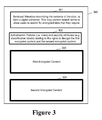
- An example of a structure of a digital container is shown in figure 3 .
- the block diagram of a digital container 300 in figure 3 shows two encrypted data sections 303, 304. In alternative embodiments, a larger number of encrypted data sections may be included. In some embodiments, all of the data sections are encrypted, but in other embodiments, there may be non-encrypted sections in addition to the encrypted sections.
- the encrypted sections may each be encrypted in a different way or at a different security level. Alternatively, some of the data sections may be encrypted using the same type and level of encryption. However, at least two different levels or types of encryption are used, for at least two different data sections respectively.
- Figure 3 also shows that the digital container 300 includes authorisation policies and security attributes of the data 302, and sanitised metadata 301 describing the contents of the data in the digital container 300.
- the data is encrypted with a key that directly depends on the authorisation policies and security attributes, for example, the key being generated using the authorisation policies and security attributes. This may provide integrity protection for these policies and attributes, as any attempt to modify them will then lead to an incorrect decryption key being generated.
- the digital containers can either be sent directly to the computers of data users 207, or, as shown in figure 2 , stored on servers or databases 205.
- the heavy arrows in figure 2 show the path of the encrypted data as it is transferred within the container objects from the data owner's computer 200 to the server 204, then to the data store 205, to the user's service provider 206, and finally to the user's computer 207.
- the metadata may allow data users to search for and retrieve information that they require. This can be particularly useful if the digitals containers are stored on servers or databases.
- digital containers can be stored in common servers or databases, meaning that, in theory, all data users have access to all possible data (subject, of course, to the authorisation policies being satisfied).
- FIG 2 shows that there may be a network of authorisation servers 201, 203, 204. This may be advantageous for scalability reasons and also for security reasons.
- an authorisation server may only be responsible for authorising users that it knows about. Users in other domains may be able to get access to encrypted content as long as appropriate trust relationships have been set up between the authorisation servers of the respective domains.
- the network of authorisation servers is arranged as a hierarchy of brokers dealing with the authorisation process.
- the "External Authorisation” broker 201 is responsible for generating keys and releasing the keys to secure sites.
- a separate “Internal Authorisation” broker 203 performs fine-grained access control within the site.
- the communications between the external broker 201 and the internal broker 203, and the communications between the data owner 200 and the data store 205, are regulated by a server 204.
- the actual decryption of content is handled by an assured device located at each user's workstation 207.
- the centralised logging and auditing of access to classified data that this architecture provides would be a significant advantage.
- storing of data in encrypted form reduces the risk of exposure and the architecture potentially provides cryptographic separation for multilevel security on the same network.
- this request contains the authorisation policies and security attributes from the digital container, or information derived from the authorisation policies and security attributes.
- the user's rights may be retrieved by the authorisation server from an internal database or by some other technique.
- the authorisation rules in the container may be supplemented by a set of common, domain-wide, authorisation rules held at the authorisation server. This provides scalability by reducing the number of rules that need to be transferred with the containers.
- the retrieved rights are checked against the authorisation policies and data security attributes, and if acceptable, the authorisation server generates the appropriate decryption key.
- this key is generated using the authorisation policies and security attributes as an input to the key derivation process.
- the authorisation policies and security attributes may be used directly to generate the key, or else a checksum or other intermediate may be calculated or derived from the authorisation policies and security attributes, and this checksum or intermediate may be used to generate the key.
- only the checksum or intermediate is sent by the user to the authorisation server, instead of the full authorisation policy or security attributes that were included in the digital container, to reduce the amount of data transfer that is necessary.
- the key is then sent to the requesting user's computer 207, and the content of the digital container is decrypted.
- the lighter arrows in figure 2 show the path of an authorisation request, from the user's computer 207 via the user's service provider 206 to the internal authorisation server 203. From there, it is forwarded via the server 204 to the external authorisation server 201.
- the lighter arrows in the opposite direction show the return path of the key to the user's computer, from the external authorisation server 201 via the server 204 to the internal authorisation server 203, and then via the user's service provider 206 to the user's computer 207.
- rendering applications which in some embodiments are located on the user's computer 207.
- These rendering applications consist of a content handling part and a rendering part.
- applications need to be able to recognise the addition of protected objects to their standard data formats. On detecting such objects, they are passed to the decryption handler. This handler will obtain the decryption key (if possible) and return the decrypted content, or a message saying that decryption was not possible if the user does not have the appropriate rights.
- This decrypted content will then be substituted for the protected objects by the rendering applications, or suitable placeholder data will be substituted in the case that decryption was not possible.
- the content handling part of the application needs to allow digital containers to be inserted from other documents, and to be created for new content.
- documents are modified and saved in their encrypted form, and this mitigates some of the risk of saving data with inappropriate classification labels.
- Implementation may use a combination of XACML (Extensible Access Control Markup Language), which is a declarative access control policy language implemented in XML (Extensible Markup Language), and XMLenc, which is an XML encryption standard, to define the container format.
- XACML Extensible Access Control Markup Language
- XMLenc Extensible Markup Language
- a different technology may be used, for example, an ASN.1-based (Abstract Syntax Notation One) format.
- Some embodiments of the invention extend the XMLenc standard to include the ability to specify XACML authorisation rules with encrypted data.
- XACML allows generic authorisation policies to be specified.
- the use of XMLenc, with suitable modifications, allows encrypted XML data elements with associated authorisation rules, written in XACML, to be defined.
- Documents in this case may be XML documents containing multiple protected data objects. This is similar to the current XMLenc standard, and only requires a small extension to allow the addition of authorisation policies specified in XACML.
- a parser scans the document for protected objects. Any discovered protected objects would be passed to the decryption handling system (e.g.
- a secure hardware crypto to obtain the unencrypted contents.
- iterated parsing and decryptions may be required if the protected object contains another XML document with other protected objects. After complete decryption, the protected objects are replaced with the decrypted data, or a suitable placeholder (e.g. blank space) if the current user does not have the rights to see that content.
- Documents may be edited by adding new digital containers, or by copying digital containers from one document to another. The design of the XML standards allows this to take place in a simple way.
- User authentication could be achieved using any appropriate mechanism, from passwords for relatively low sensitivity data up to strong authentication techniques such as smart cards and biometrics for more important information.
- Other authorisation techniques such as the use of tokens, e.g. with SAML (Security Assertion Markup Language), may also be used.
- SAML Security Assertion Markup Language
- a secure hardware device is used to handle the decryption of digital containers and the obtaining of decryption keys from the authorisation server.
- the user could strongly authenticate to the hardware device, which would then authenticate on the user's behalf to the authorisation server.
- the rules attached to the encrypted data in the digital container may specify a privacy policy of the data originator and/or of the consumer.
- the broker can check to make sure that they satisfy this privacy policy before granting access to the data.
- the broker may also keep a record of this access as a deterrent against misuse.
- a digital containers architecture can be used for distributing of and charging for "Infotainment".
- the content may be audio and video, streamed live events (e.g. a sports match) or even stock market quotes or web pages.
- Consumers provide payment information to their broker in addition to identification information. Payment between consumers and content providers are cleared using the broker networks.
- the broker network may allow efficient user account based billing to be used. Consumers hold an account at their broker, and payment for content involves the broker altering the balance for this account, with a corresponding alteration being made at the content provider's broker. This can make even very low payments, e.g. micropayments, feasible without undue overheads.
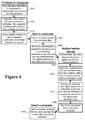
- Figure 4 is a flowchart showing an example process of encryption, transport and decryption, in an embodiment of the invention.
- the flowchart has three columns of boxes, where the left column corresponds to the data producer's computer, the middle column corresponds to the user's computer, and the right column corresponds to the authorisation server.
- the process starts at step S401, where the data producer's computer encrypts data, using a key that is dependent on the authorisation policies and security attributes for that data. Then, at step S402, the data producer's computer appends authorisation policies, security attributes and sanitised meta-data to form a digital container. At step S403, the data producer's computer sends the digital container to the user's computer. It may be sent directly, or it may be sent via a storage database or server.
- the user's computer receives the encrypted data, and at step S405, it sends an authentication request for the decryption key to the authorisation server.
- the authentication request in this example includes authorisation policies and security attributes from the digital container.
- the authorisation server receives the request from the user's computer, and authenticates the user. It then retrieves the user's rights, e.g. from an internal database.
- the authentication server supplements the authorisation rules that it received from the user's computer with a set of common authorisation rules for use with a plurality of different users, e.g. all users within the same domain or sub-domain, or from the same network location, or with certain other characteristics. In other embodiments, this step is omitted.
- the authorisation server checks the retrieved user rights against the authorisation policies data security attributes. If the check matches up correctly, the authorisation server generates the appropriate decryption key.
- the authorisation server sends the decryption key to the user's computer.
- the user's computer receives the key, and decrypts the content within the digital container. It may then proceed to render all sections of the document that the key is capable of decrypting.
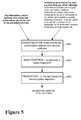
- Figure 5 shows a more detailed example of how the authorisation server may generate a key to allow decryption of the data by the user.
- the authorisation server and the data provider may share some secret key information, which may originate at either the authorisation server, the data provider, a third party, or at a combination of two or more of these.
- this key information is concatenated with information provided by the user to the authorisation server, at step S501.
- This information provided by the user may include one or more authorisation policies and security attributes. It may also or alternatively include any of the following: references to authorisation policies, content ID relating to the content the user wishes to decrypt, the data owner ID, an ID of the secret key information, and other information which may be application dependent.
- the concatenation at step S501 may be replaced by different ways of combining the data, in alternative embodiments.
- the output of step S501 is then input to generate a hash function at step S502, such as SHA-1, or some other hash function.
- the hash function provides a "digital fingerprint" of the input data, to give a suitably unique string of data.
- an alternative to a hash function can be used to generate unique data for the encryption and decryption algorithms.
- the output of the hash function is then truncated to the right length for the encryption algorithm.
- the truncation may be a straightforward discarding of the latter part of the string of data, or it may be more selective, for example, discarding some data at the beginning of the hash function output, or using an algorithm to select parts of the data string according to a particular selection criteria, which may be dependent on the encryption algorithm used.
- the present invention can be implemented in dedicated hardware, using a programmable digital controller suitably programmed, or using a combination of hardware and software.
- the present invention can be implemented by software or programmable computing apparatus.
- PDAs personal digital assistants
- the code for each process in the methods according to the invention may be modular, or may be arranged in an alternative way to perform the same function.
- the methods and apparatus according to the invention are applicable to any computer with a network connection.
- the present invention encompasses a carrier medium carrying machine readable instructions or computer code for controlling a programmable controller, computer or number of computers as the apparatus of the invention.
- the carrier medium can comprise any storage medium such as a floppy disk, CD ROM, DVD ROM, hard disk, magnetic tape, or programmable memory device, or a transient medium such as an electrical, optical, microwave, RF, electromagnetic, magnetic or acoustical signal.
- An example of such a signal is an encoded signal carrying a computer code over a communications network, e.g. a TCP/IP signal carrying computer code over an IP network such as the Internet, an intranet, or a local area network.
Landscapes
- Engineering & Computer Science (AREA)
- Computer Security & Cryptography (AREA)
- Theoretical Computer Science (AREA)
- Software Systems (AREA)
- Computer Hardware Design (AREA)
- General Engineering & Computer Science (AREA)
- Physics & Mathematics (AREA)
- General Physics & Mathematics (AREA)
- Signal Processing (AREA)
- Computer Networks & Wireless Communication (AREA)
- Computing Systems (AREA)
- Multimedia (AREA)
- Technology Law (AREA)
- Databases & Information Systems (AREA)
- Health & Medical Sciences (AREA)
- Bioethics (AREA)
- General Health & Medical Sciences (AREA)
- Storage Device Security (AREA)
Applications Claiming Priority (1)
| Application Number | Priority Date | Filing Date | Title |
|---|---|---|---|
| GB0902029.8A GB2467580B (en) | 2009-02-06 | 2009-02-06 | System and method for multilevel secure object management |
Publications (2)
| Publication Number | Publication Date |
|---|---|
| EP2216731A2 true EP2216731A2 (fr) | 2010-08-11 |
| EP2216731A3 EP2216731A3 (fr) | 2013-05-29 |
Family
ID=40469741
Family Applications (1)
| Application Number | Title | Priority Date | Filing Date |
|---|---|---|---|
| EP10152803.2A Withdrawn EP2216731A3 (fr) | 2009-02-06 | 2010-02-05 | Système et procédé pour la gestion sécurisée d'objets à plusieurs niveaux |
Country Status (3)
| Country | Link |
|---|---|
| US (1) | US8683602B2 (fr) |
| EP (1) | EP2216731A3 (fr) |
| GB (1) | GB2467580B (fr) |
Cited By (9)
| Publication number | Priority date | Publication date | Assignee | Title |
|---|---|---|---|---|
| CN105493436A (zh) * | 2013-08-29 | 2016-04-13 | 瑞典爱立信有限公司 | 用于向授权用户分发内容项目的方法、内容拥有者设备、计算机程序和计算机程序产品 |
| WO2016119900A1 (fr) * | 2015-01-30 | 2016-08-04 | Nec Europe Ltd. | Procédé et système de gestion de données chiffrées de dispositifs |
| US9419945B2 (en) | 2010-12-31 | 2016-08-16 | Regify S.A. | Systems and methods for providing and operating a secure communication network |
| US9633015B2 (en) | 2012-07-26 | 2017-04-25 | Telefonaktiebolaget Lm Ericsson (Publ) | Apparatus and methods for user generated content indexing |
| US9846696B2 (en) | 2012-02-29 | 2017-12-19 | Telefonaktiebolaget Lm Ericsson (Publ) | Apparatus and methods for indexing multimedia content |
| EP3132565A4 (fr) * | 2014-04-17 | 2017-12-20 | Echarge 2 Corporation | Systèmes et procédés d'utilisation d'objets de chiffrement pour protéger des données |
| EP3355193A1 (fr) * | 2017-01-31 | 2018-08-01 | Hewlett-Packard Enterprise Development LP | Planification de conteneur basée sur la sécurité |
| US10311038B2 (en) | 2013-08-29 | 2019-06-04 | Telefonaktiebolaget Lm Ericsson (Publ) | Methods, computer program, computer program product and indexing systems for indexing or updating index |
| US10445367B2 (en) | 2013-05-14 | 2019-10-15 | Telefonaktiebolaget Lm Ericsson (Publ) | Search engine for textual content and non-textual content |
Families Citing this family (44)
| Publication number | Priority date | Publication date | Assignee | Title |
|---|---|---|---|---|
| US8874477B2 (en) | 2005-10-04 | 2014-10-28 | Steven Mark Hoffberg | Multifactorial optimization system and method |
| US8589673B2 (en) | 2011-01-12 | 2013-11-19 | Virtru Corporation | Methods and systems for distributing cryptographic data to authenticated recipients |
| US8776249B1 (en) * | 2011-04-11 | 2014-07-08 | Google Inc. | Privacy-protective data transfer |
| US12072989B2 (en) | 2011-12-09 | 2024-08-27 | Sertainty Corporation | System and methods for using cipher objects to protect data |
| SG11201402874PA (en) * | 2011-12-09 | 2014-07-30 | Echarge2 Corp | Systems and methods for using cipher objects to protect data |
| US9792451B2 (en) | 2011-12-09 | 2017-10-17 | Echarge2 Corporation | System and methods for using cipher objects to protect data |
| US8856957B1 (en) * | 2011-12-22 | 2014-10-07 | Amazon Technologies, Inc. | Federated identity broker |
| US10462108B1 (en) | 2012-05-08 | 2019-10-29 | Andrew J. Hacker | Enhanced data container with extensible characteristics and a system and method of processing and communication of same |
| US9454398B2 (en) * | 2013-05-08 | 2016-09-27 | Andrew John Hacker | Enhanced data container with extensible characteristics and a system and method of processing and communication of same |
| US9846861B2 (en) * | 2012-07-25 | 2017-12-19 | Visa International Service Association | Upstream and downstream data conversion |
| US8707450B2 (en) * | 2012-08-03 | 2014-04-22 | Intel Corporation | Digital rights management (DRM) locker |
| US8892872B2 (en) * | 2012-08-07 | 2014-11-18 | Appsense Limited | Secure redacted document access |
| US8868905B2 (en) * | 2012-08-07 | 2014-10-21 | Appsense Limited | Adaptive document redaction |
| US9202020B2 (en) * | 2012-08-21 | 2015-12-01 | Appsense Limited | File protection using session-based digital rights management |
| US9373001B2 (en) | 2012-12-26 | 2016-06-21 | Barracuda Networks, Inc. | Distributed encryption and access control scheme in a cloud environment |
| AU2014332244A1 (en) * | 2013-10-07 | 2016-05-05 | Fornetix Llc | System and method for encryption key management, federation and distribution |
| KR102223609B1 (ko) * | 2014-05-09 | 2021-03-05 | 삼성전자주식회사 | 전자 기기간 콘텐트 공유 방법 및 장치 |
| US9773117B2 (en) | 2014-06-04 | 2017-09-26 | Microsoft Technology Licensing, Llc | Dissolvable protection of candidate sensitive data items |
| WO2016015141A1 (fr) * | 2014-07-28 | 2016-02-04 | Infosec Global Inc. | Système et procédé de gestion de suites cryptographiques |
| CN104584509A (zh) * | 2014-12-31 | 2015-04-29 | 深圳大学 | 一种共享数据的访问控制方法、装置及系统 |
| US10032044B2 (en) * | 2015-08-08 | 2018-07-24 | Airwatch Llc | Multi-party authentication and authorization |
| US10523646B2 (en) | 2015-08-24 | 2019-12-31 | Virtru Corporation | Methods and systems for distributing encrypted cryptographic data |
| US11386409B2 (en) | 2016-03-04 | 2022-07-12 | Sertintyone Corporation | Systems and methods for media codecs and containers |
| US20180115512A1 (en) * | 2016-10-25 | 2018-04-26 | American Megatrends, Inc. | Methods and systems for downloading a file |
| US10484354B2 (en) * | 2017-02-15 | 2019-11-19 | Telefonaktiebolaget Lm Ericsson (Publ) | Data owner restricted secure key distribution |
| US11068453B2 (en) * | 2017-03-09 | 2021-07-20 | data.world, Inc | Determining a degree of similarity of a subset of tabular data arrangements to subsets of graph data arrangements at ingestion into a data-driven collaborative dataset platform |
| US10693640B2 (en) | 2017-03-17 | 2020-06-23 | International Business Machines Corporation | Use of key metadata during write and read operations in a dispersed storage network memory |
| US11005829B1 (en) * | 2017-10-16 | 2021-05-11 | Fuze, Inc. | Providing secure end-to-end data encryption between devices |
| US20190138339A1 (en) * | 2017-11-07 | 2019-05-09 | Andrew John Hacker | System and Method of Distributed Information Processing using an enhanced data container |
| CN108182095A (zh) * | 2018-01-16 | 2018-06-19 | 湖北省楚天云有限公司 | 一种应用部署方法、装置及设备 |
| US10078759B1 (en) * | 2018-01-19 | 2018-09-18 | Griffin Group Global, LLC | System and method for data sharing via a data structure having different-scheme-derived portions |
| US10068099B1 (en) * | 2018-01-19 | 2018-09-04 | Griffin Group Global, LLC | System and method for providing a data structure having different-scheme-derived portions |
| US11681781B2 (en) * | 2018-02-21 | 2023-06-20 | Comcast Cable Communications, Llc | Systems and methods for content security |
| US11321476B2 (en) * | 2018-06-26 | 2022-05-03 | SRI Intemational | Selectively sharing data in unstructured data containers using attribute based encryption |
| US11507676B2 (en) * | 2018-06-26 | 2022-11-22 | Sri International | Selectively sharing data in unstructured data containers |
| US11531777B2 (en) | 2019-01-30 | 2022-12-20 | Virtru Corporation | Methods and systems for restricting data access based on properties of at least one of a process and a machine executing the process |
| US20210377018A1 (en) * | 2020-05-29 | 2021-12-02 | Electric Power Research Institute, Inc. | Secure remote access to industrial control systems using hardware based authentication |
| EP4160450A1 (fr) * | 2021-09-30 | 2023-04-05 | Palantir Technologies Inc. | Système de cryptographie convivial, sécurisé et auditable |
| EP4483529A4 (fr) * | 2022-02-25 | 2026-02-25 | Cryptography Res Inc | Techniques et dispositifs de chiffrement et d'authentification de mémoire configurables |
| CN116055144A (zh) * | 2022-12-29 | 2023-05-02 | 电子科技大学 | 基于物联网的数据安全性分析方法、装置、设备及存储 |
| CN116089981A (zh) * | 2023-02-07 | 2023-05-09 | 浙江华忆芯科技有限公司 | 基于秘钥的信息处理方法和装置、存储介质和电子装置 |
| CN116611035B (zh) * | 2023-04-24 | 2024-08-16 | 苏州魔视智能科技有限公司 | 应用软件的运行方法、管理方法、设备及可读存储介质 |
| CN116861451B (zh) * | 2023-05-24 | 2025-05-02 | 北京计算机技术及应用研究所 | 一种基于数据分类分级的数据加解密方法 |
| US20250272419A1 (en) * | 2024-02-23 | 2025-08-28 | Micro Focus Llc | Tying Access/Redaction to Authentication Levels |
Citations (1)
| Publication number | Priority date | Publication date | Assignee | Title |
|---|---|---|---|---|
| US20020162104A1 (en) * | 2001-02-21 | 2002-10-31 | Raike William Michael | Encrypted media key management |
Family Cites Families (17)
| Publication number | Priority date | Publication date | Assignee | Title |
|---|---|---|---|---|
| CN1312549C (zh) * | 1995-02-13 | 2007-04-25 | 英特特拉斯特技术公司 | 用于安全交易管理和电子权利保护的系统和方法 |
| US6519700B1 (en) * | 1998-10-23 | 2003-02-11 | Contentguard Holdings, Inc. | Self-protecting documents |
| US6598161B1 (en) * | 1999-08-09 | 2003-07-22 | International Business Machines Corporation | Methods, systems and computer program products for multi-level encryption |
| US7107462B2 (en) * | 2000-06-16 | 2006-09-12 | Irdeto Access B.V. | Method and system to store and distribute encryption keys |
| EP1374009A2 (fr) * | 2000-06-29 | 2004-01-02 | Koninklijke Philips Electronics N.V. | Cryptage multiple d'un document unique fournissant des privileges d'acces a niveaux multiples |
| US20020031230A1 (en) * | 2000-08-15 | 2002-03-14 | Sweet William B. | Method and apparatus for a web-based application service model for security management |
| US20020114453A1 (en) * | 2001-02-21 | 2002-08-22 | Bartholet Thomas G. | System and method for secure cryptographic data transport and storage |
| US20030120928A1 (en) * | 2001-12-21 | 2003-06-26 | Miles Cato | Methods for rights enabled peer-to-peer networking |
| US7634659B2 (en) * | 2002-09-20 | 2009-12-15 | Cable Television Laboratories, Inc. | Roaming hardware paired encryption key generation |
| JP2004157864A (ja) | 2002-11-07 | 2004-06-03 | Canon Inc | コンテンツ配信システム |
| GB2398712B (en) * | 2003-01-31 | 2006-06-28 | Hewlett Packard Development Co | Privacy management of personal data |
| US7003117B2 (en) * | 2003-02-05 | 2006-02-21 | Voltage Security, Inc. | Identity-based encryption system for secure data distribution |
| JP2006526204A (ja) * | 2003-03-13 | 2006-11-16 | ディーアールエム テクノロジーズ、エルエルシー | セキュアストリーミングコンテナ |
| CN100499450C (zh) * | 2003-04-22 | 2009-06-10 | 国际商业机器公司 | 数字资源的分层密钥生成方法及其设备 |
| GB0410180D0 (en) * | 2004-05-07 | 2004-06-09 | Hewlett Packard Development Co | An adaptive privacy management system for data repositories |
| GB2437558B (en) | 2006-04-19 | 2010-12-15 | Thales Holdings Uk Plc | Privacy protection system |
| US8296569B2 (en) * | 2006-10-09 | 2012-10-23 | Microsoft Corporation | Content protection interoperability infrastructure |
-
2009
- 2009-02-06 GB GB0902029.8A patent/GB2467580B/en active Active
-
2010
- 2010-02-05 EP EP10152803.2A patent/EP2216731A3/fr not_active Withdrawn
- 2010-02-05 US US12/701,164 patent/US8683602B2/en active Active
Patent Citations (1)
| Publication number | Priority date | Publication date | Assignee | Title |
|---|---|---|---|---|
| US20020162104A1 (en) * | 2001-02-21 | 2002-10-31 | Raike William Michael | Encrypted media key management |
Cited By (14)
| Publication number | Priority date | Publication date | Assignee | Title |
|---|---|---|---|---|
| US9419945B2 (en) | 2010-12-31 | 2016-08-16 | Regify S.A. | Systems and methods for providing and operating a secure communication network |
| US9846696B2 (en) | 2012-02-29 | 2017-12-19 | Telefonaktiebolaget Lm Ericsson (Publ) | Apparatus and methods for indexing multimedia content |
| US9633015B2 (en) | 2012-07-26 | 2017-04-25 | Telefonaktiebolaget Lm Ericsson (Publ) | Apparatus and methods for user generated content indexing |
| US10445367B2 (en) | 2013-05-14 | 2019-10-15 | Telefonaktiebolaget Lm Ericsson (Publ) | Search engine for textual content and non-textual content |
| US10311038B2 (en) | 2013-08-29 | 2019-06-04 | Telefonaktiebolaget Lm Ericsson (Publ) | Methods, computer program, computer program product and indexing systems for indexing or updating index |
| EP3039811A4 (fr) * | 2013-08-29 | 2016-08-24 | Ericsson Telefon Ab L M | Méthode, dispositif propriétaire de contenu, programme informatique, et produit programme informatique de distribution d'éléments de contenu à des utilisateurs autorisés |
| US10289810B2 (en) | 2013-08-29 | 2019-05-14 | Telefonaktiebolaget Lm Ericsson (Publ) | Method, content owner device, computer program, and computer program product for distributing content items to authorized users |
| CN105493436A (zh) * | 2013-08-29 | 2016-04-13 | 瑞典爱立信有限公司 | 用于向授权用户分发内容项目的方法、内容拥有者设备、计算机程序和计算机程序产品 |
| CN105493436B (zh) * | 2013-08-29 | 2019-09-10 | 瑞典爱立信有限公司 | 用于向授权用户分发内容项目的方法、内容拥有者设备 |
| EP3132565A4 (fr) * | 2014-04-17 | 2017-12-20 | Echarge 2 Corporation | Systèmes et procédés d'utilisation d'objets de chiffrement pour protéger des données |
| WO2016119900A1 (fr) * | 2015-01-30 | 2016-08-04 | Nec Europe Ltd. | Procédé et système de gestion de données chiffrées de dispositifs |
| US10567511B2 (en) | 2015-01-30 | 2020-02-18 | Nec Corporation | Method and system for managing encrypted data of devices |
| EP3355193A1 (fr) * | 2017-01-31 | 2018-08-01 | Hewlett-Packard Enterprise Development LP | Planification de conteneur basée sur la sécurité |
| US10567397B2 (en) | 2017-01-31 | 2020-02-18 | Hewlett Packard Enterprise Development Lp | Security-based container scheduling |
Also Published As
| Publication number | Publication date |
|---|---|
| US20110040967A1 (en) | 2011-02-17 |
| US8683602B2 (en) | 2014-03-25 |
| GB0902029D0 (en) | 2009-03-11 |
| GB2467580B (en) | 2013-06-12 |
| EP2216731A3 (fr) | 2013-05-29 |
| GB2467580A (en) | 2010-08-11 |
Similar Documents
| Publication | Publication Date | Title |
|---|---|---|
| US8683602B2 (en) | System and method for multilevel secure object management | |
| GB2472491A (en) | Distributing secure container decryption keys using networks of brokers | |
| US7200230B2 (en) | System and method for controlling and enforcing access rights to encrypted media | |
| US8301884B2 (en) | Method of managing metadata | |
| US8799981B2 (en) | Privacy protection system | |
| US12353519B2 (en) | Digital rights management authorization token pairing | |
| RU2718689C2 (ru) | Управление конфиденциальной связью | |
| US9148283B1 (en) | Storing encrypted objects | |
| US20080209231A1 (en) | Contents Encryption Method, System and Method for Providing Contents Through Network Using the Encryption Method | |
| US11997075B1 (en) | Signcrypted envelope message | |
| US20100017599A1 (en) | Secure digital content management using mutating identifiers | |
| US20070079381A1 (en) | Method and devices for the control of the usage of content | |
| US20080098227A1 (en) | Method of enabling secure transfer of a package of information | |
| KR20070112091A (ko) | 메타데이터 관리 방법 | |
| US20130046988A1 (en) | Systems and methods for providing a cryptographic key manager for an application server | |
| JP2008118653A (ja) | メタデータの管理方法 | |
| CN121037115B (zh) | 请求参数值权限认证方法及系统 | |
| Pham et al. | On the current state of interoperable content protection for internet video streaming | |
| US20250286710A1 (en) | Method and system for encoding media transmitted and received in streaming form between users | |
| Alderman et al. | Cryptographic tools for cloud environments | |
| Simpson et al. | Digital Key Management for Access Control of Electronic Records. | |
| US20070220585A1 (en) | Digital rights management system with diversified content protection process | |
| EP1280295A1 (fr) | Procédé pour le transfert securisé d'un paquet d'informations | |
| Divya et al. | An Efficient Authentication System for Data Forwarding Under Cloud Environment | |
| WO2001030041A2 (fr) | Systeme et procede de manipulation sure de donnees sur un reseau |
Legal Events
| Date | Code | Title | Description |
|---|---|---|---|
| PUAI | Public reference made under article 153(3) epc to a published international application that has entered the european phase |
Free format text: ORIGINAL CODE: 0009012 |
|
| AK | Designated contracting states |
Kind code of ref document: A2 Designated state(s): AT BE BG CH CY CZ DE DK EE ES FI FR GB GR HR HU IE IS IT LI LT LU LV MC MK MT NL NO PL PT RO SE SI SK SM TR |
|
| AX | Request for extension of the european patent |
Extension state: AL BA RS |
|
| PUAL | Search report despatched |
Free format text: ORIGINAL CODE: 0009013 |
|
| AK | Designated contracting states |
Kind code of ref document: A3 Designated state(s): AT BE BG CH CY CZ DE DK EE ES FI FR GB GR HR HU IE IS IT LI LT LU LV MC MK MT NL NO PL PT RO SE SI SK SM TR |
|
| AX | Request for extension of the european patent |
Extension state: AL BA RS |
|
| RIC1 | Information provided on ipc code assigned before grant |
Ipc: G06F 21/00 20130101AFI20130422BHEP |
|
| 17P | Request for examination filed |
Effective date: 20131128 |
|
| RBV | Designated contracting states (corrected) |
Designated state(s): AT BE BG CH CY CZ DE DK EE ES FI FR GB GR HR HU IE IS IT LI LT LU LV MC MK MT NL NO PL PT RO SE SI SK SM TR |
|
| 17Q | First examination report despatched |
Effective date: 20131219 |
|
| STAA | Information on the status of an ep patent application or granted ep patent |
Free format text: STATUS: THE APPLICATION IS DEEMED TO BE WITHDRAWN |
|
| 18D | Application deemed to be withdrawn |
Effective date: 20151113 |