EP2216962A1 - Procédé pour déployer et gérer une application sip servlet et la plate-forme de services osgi de celle-ci - Google Patents
Procédé pour déployer et gérer une application sip servlet et la plate-forme de services osgi de celle-ci Download PDFInfo
- Publication number
- EP2216962A1 EP2216962A1 EP08861489A EP08861489A EP2216962A1 EP 2216962 A1 EP2216962 A1 EP 2216962A1 EP 08861489 A EP08861489 A EP 08861489A EP 08861489 A EP08861489 A EP 08861489A EP 2216962 A1 EP2216962 A1 EP 2216962A1
- Authority
- EP
- European Patent Office
- Prior art keywords
- sip
- servlet application
- osgi
- container
- sip servlet
- Prior art date
- Legal status (The legal status is an assumption and is not a legal conclusion. Google has not performed a legal analysis and makes no representation as to the accuracy of the status listed.)
- Granted
Links
Images




Classifications
-
- H—ELECTRICITY
- H04—ELECTRIC COMMUNICATION TECHNIQUE
- H04L—TRANSMISSION OF DIGITAL INFORMATION, e.g. TELEGRAPHIC COMMUNICATION
- H04L65/00—Network arrangements, protocols or services for supporting real-time applications in data packet communication
- H04L65/10—Architectures or entities
- H04L65/102—Gateways
-
- H—ELECTRICITY
- H04—ELECTRIC COMMUNICATION TECHNIQUE
- H04L—TRANSMISSION OF DIGITAL INFORMATION, e.g. TELEGRAPHIC COMMUNICATION
- H04L65/00—Network arrangements, protocols or services for supporting real-time applications in data packet communication
- H04L65/1066—Session management
- H04L65/1101—Session protocols
- H04L65/1104—Session initiation protocol [SIP]
-
- H—ELECTRICITY
- H04—ELECTRIC COMMUNICATION TECHNIQUE
- H04L—TRANSMISSION OF DIGITAL INFORMATION, e.g. TELEGRAPHIC COMMUNICATION
- H04L67/00—Network arrangements or protocols for supporting network services or applications
- H04L67/34—Network arrangements or protocols for supporting network services or applications involving the movement of software or configuration parameters
-
- H—ELECTRICITY
- H04—ELECTRIC COMMUNICATION TECHNIQUE
- H04L—TRANSMISSION OF DIGITAL INFORMATION, e.g. TELEGRAPHIC COMMUNICATION
- H04L67/00—Network arrangements or protocols for supporting network services or applications
- H04L67/50—Network services
- H04L67/51—Discovery or management thereof, e.g. service location protocol [SLP] or web services
-
- H—ELECTRICITY
- H04—ELECTRIC COMMUNICATION TECHNIQUE
- H04L—TRANSMISSION OF DIGITAL INFORMATION, e.g. TELEGRAPHIC COMMUNICATION
- H04L67/00—Network arrangements or protocols for supporting network services or applications
- H04L67/50—Network services
- H04L67/56—Provisioning of proxy services
- H04L67/565—Conversion or adaptation of application format or content
Definitions
- the present invention relates to an SIP container and SIP Servlet application technology, and more particularly to a technology of integrating an SIP container and an OSGI service platform to jointly manage an SIP Servlet application.
- the Open Services Gateway Initiative (OSGI) service platform is an open plug-in system framework which provides a uniform interface standard. Based on the system framework, service providers, program developers, software providers, service network operators, and equipment providers can cooperate to jointly develop, deploy, and manage services provided to users.
- the OSGI service platform is a Java-based platform. The OSGI was originally proposed and developed for flexible, convenient, and remote management of interconnected network embedded devices.
- routers support the hot swap of modules, that is, functional modules having certain functions can be dynamically added or unloaded when a router operates.
- the hot swap technology in the hardware industry is also desired by the software industry, while the OSGI realizes the hot swap technology in the software industry.
- the OSGI supports dynamic expansion and modification of system functions and change of system.
- Many OSGI components that is, OSGI Bundles, can be deployed on the OSGI service platform.
- the OSGI has a complete mechanism for dynamically changing the system behaviors.
- a new Bundle can be installed, or an existing Bundle can be updated or stopped, so as to implement the swap of system functions.
- the system functions are swappable, and the system can be changed dynamically, it is ensured that the system is flexible and expandable enough in operation.
- the Bundle is a jar file, which is different from a normal jar file in terms of the content in the MANIFEST.MF file under the Meta-inf directory. All information about the Bundle is described in MANIFEST.MF, so the MANIFEST.MF file can be referred to as metadata of the Bundle. For example, the information includes the name of the Bundle, description of the Bundle, developer of the Bundle, classpath of the Bundle, packages to be imported, and packages to be exported.
- the OSGI service platform invokes a Bundle activator of each Bundle to control a life cycle of the Bundle.
- the Bundle activator is a program named BundleActivator.
- the work content to be performed when the Bundle is started or stopped is specified in the BundleActivator, and event status information of the framework is also published or monitored in the BundleActivator, so that the BundleActivator determines the operation status of the framework according to the event status information and make corresponding adjustment.
- each of Bundles can register BundleContext on the OSGI service platform, so as to register services available to the outside, and obtain services to be referred to through the BundleContext.
- the basic structure of the OSGI service platform is described above.
- the OSGI service platform grants a system based on the platform with the capability of dynamically changing the system.
- a user can deploy a plurality of hot swappable OSGI Bundles on the OSGI service platform, and may install, update, or stop the OSGI Bundles when the system is in operation.
- the Session Initiation Protocol is an Internet Protocol (IP)-based application layer control protocol defined by the Internet Engineering Task Force.
- IP Internet Protocol
- the SIP manages sessions on different access networks.
- the sessions may be any type of communication between terminals, for example, video sessions, instant messaging sessions, or collaboration sessions.
- This protocol does not define or limit usable services, and the problems such as transmission, quality of service (QoS), charging, and security are all processed by the basic core network and other protocols.
- QoS quality of service
- An SIP Servlet application is a servlet based on the SIP. Theoretically, the SIP Servlet application can realize all functions that can be realized through the Java language. In practice, the SIP Servlet applications are used to implement the background logic operations of web applications.
- the SIP Servlets specifications provide a series of Java Application Programming Interfaces (APIs) and a development model based on the SIP container or application server, so as to improve the development efficiency of the server applications.
- the SIP Servlets are also based on the Java Servlet architecture.
- SIP container provided in the SIP Servlets specifications
- developers can easily develop complex SIP Servlet applications.
- a plurality of SIP Servlet applications forms a group of SIP Servlets. After the group of SIP Servlets is packaged with resources and deployment description files, the package is deployed and run in an SIP container.
- the SIP container provides services such as session state management, transaction management, retransmission, network connection, message scheduling, thread management, resource management, and application management.
- the application only needs to contain advanced message handling and service logic. Thus, the developers no longer need to make too much effort on the protocols, so the development of SIP services becomes easier.
- Each SIP Servlet application is a component of the SIP container, and is managed and scheduled by the SIP container. For example, when the SIP container receives an SIP request, the SIP container makes a series of judgments to determine the SIP Servlet application to be invoked to process the request.
- the SIP Servlet application developed and applied in the SIP container is not hot swappable and cannot dynamically change the system.
- the SIP Servlet application is not an OSGI Bundle on the OSGI service platform, the SIP Servlet application cannot communicate with the OSGI Bundles in a standard manner.
- Embodiments of the present invention are directed to a method for deploying an SIP Servlet application, a method and an OSGI service platform for managing an SIP Servlet application, so as to enable the SIP Servlet application to be managed and scheduled by an SIP container, and to have the hot swap performance of an OSGI Bundle.
- a method for deploying an SIP Servlet application includes: deploying an SIP Servlet application on an OSGI service platform as an OSGI Bundle, and deploying the SIP Servlet application in an SIP container.
- An OSGI service platform for managing an SIP Servlet application which includes an SIP container and an SIP Servlet application.
- the SIP Servlet application is deployed on the OSGI service platform as an OSGI Bundle, and is deployed in the SIP container.
- the SIP Servlet application communicates with other OSGI Bundles on the OSGI service platform through a mechanism of the OSGI service platform.
- a method for managing an SIP Servlet application includes: deploying, by an OSGI service platform, the SIP Servlet application, and invoking a Bundle activator of the SIP Servlet application; and deploying the SIP Servlet application in an SIP container when the Bundle activator of the SIP Servlet application is invoked.
- a method for managing an SIP Servlet application based on an OSGI service platform includes: deploying an SIP container on an OSGI service platform as an OSGI Bundle; and deploying an SIP Servlet application on the OSGI service platform as another OSGI Bundle, and deploying the SIP Servlet application in the SIP container.
- the SIP Servlet application is deployed onto the OSGI service platform as an OSGI Bundle, such that the SIP Servlet application has better dynamic performance, is hot swappable, and can communicate with other OSGI Bundles through a Bundle communication mode defined in OSGI specifications.
- the SIP Servlet application is further registered to the SIP container, and a method of a class, which is used for the SIP container to load the SIP Servlet application, is invoked.
- the SIP container can manage and schedule the SIP Servlet application
- the OSGI service platform is integrated with the SIP container to jointly manage the SIP Servlet application, such that the SIP Servlet application is managed and scheduled by the SIP container, and has the hot swap performance of the OSGI Bundle.
- an SIP container and an SIP Servlet application are deployed on an OSGI service platform as OSGI Bundles.
- the SIP container and the SIP Servlet application have characteristics of the OSGI Bundle, and the OSGI service platform can manage their life cycles, for example, by activation, registration, and deactivation.
- the SIP container can manage and schedule the SIP Servlet application.
- the OSGI service platform and the SIP container are integrated to jointly manage the SIP Servlet application.
- the meaning of integrating the OSGI service platform and the SIP container to jointly manage the SIP Servlet application is explained as follows.
- the OSGI mainly manages the life cycle of the Bundle, and manages the communication between the Bundle and other Bundles.
- the SIP Servlet application becomes hot swappable and the OSGI service platform controls the life cycle of the Bundle (i.e. the SIP Servlet application) by invoking a BundleActivator of the Bundle, i.e. the interface of the Bundle.
- the OSGI service platform does not care the functions of the Bundle, i.e. the SIP Servlet application.
- the OSGI service platform does not manage the operations for scheduling and invoking the SIP Servlet application.
- the scheduling and invocation operations are managed by the SIP container.
- the SIP container After receiving an SIP request from an external source, the SIP container determines whether to invoke the SIP Servlet application to process the task corresponding to the SIP request according to the registration information of SIP Servlet application(s).
- deploying the SIP container and the SIP Servlet application on the OSGI service platform as OSGI Bundles and registering the SIP Servlet application to the SIP container are described.
- deploying the SIP container and the SIP Servlet application on the OSGI service platform as OSGI Bundles and registering the SIP Servlet application to the SIP container by referring to a Bundle of a deployment service are described.
- the method for deploying the SIP container and SIP Servlet application on the OSGI service platform as OSGI Bundles includes the following steps.
- Step S101 the SIP container is deployed on the OSGI service platform as an OSGI Bundle.
- a BundleActivator of the SIP container serving as a Bundle on the OSGI service platform is complied, and a MANIFEST.MF configuration file of the SIP container is added.
- the configuration file is a Bundle configuration file of the SIP container.
- Bytecode of the SIP container is packaged into a Jar file.
- the BundleActivator of the SIP container contains operations of starting, updating, and stopping the SIP container.
- the Bundle configuration file of the SIP container contains the Bundle name, description, developer, and classpath of the SIP container.
- Step S102 the SIP Servlet application is deployed on the OSGI service platform as an OSGI Bundle, and then deployed in the SIP container.
- Step S102 The detail steps of Step S102 are as shown in FIG. 2 .
- Step S201 after an SIP Servlet application is written, an SIP configuration file is compiled according to the SIP Servlet specification, and a directory structure is organized according to the specification of the OSGI service platform.
- a WEB-INF directory is set under the root directory of the SIP Servlet application, and classes and lib directories are arranged under the WEB-INF directory.
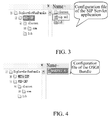
- a file with an extension of xml, that is, sip.xml, is the configuration file of the SIP Servlet application.
- the configuration file describes the functions that the SIP Servlet application can realize, and the SIP configuration file is used by the SIP container to recognize the functions that can be realized by the SIP Servlet application.
- Step S202 according to requirements of the OSGI service platform, a META-INF directory and a MANIFEST.MF configuration file are added under the root directory of the SIP Servlet application.
- a Bundle of the OSGI service platform must have a directory structure and a Bundle configuration file satisfying the requirements of the OSGI service platform, such that the OSGI service platform can manage the Bundle.
- a META-INF directory is added under the root directory of the SIP Servlet application, and a MANIFEST.MF file is added into the META-INF directory.
- the MANIFEST.MF file is a configuration file of the SIP Servlet application serving as a Bundle on the OSGI service platform.
- the information in the configuration file contains the name, description, developer, classpath, packages to be imported, and packages to be exported of the Bundle, i.e. the SIP Servlet application.
- Step S203 implementing code of a BundleActivator of the SIP Servlet application is compiled, such that the SIP Servlet application can be deployed on the OSGI service platform as an OSGI Bundle.
- a BundleActivator of the SIP Servlet application is compiled.
- the BundleActivator is invoked to implement the activation, registration, and deactivation of the SIP Servlet application.
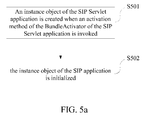
- the SIP Servlet application needs to be register to the SIP container, and a class, which is used for the SIP container to load the SIP Servlet application, needs to be invoked at the same time, as shown in FIG. 5a .
- Step S203 further includes the following steps.
- Step S501 an instance object of the SIP Servlet application is created when an activation method of the BundleActivator of the SIP Servlet application is invoked.
- the activation method of the BundleActivator of the SIP Servlet application is a start method.
- an instance object of SIP Servlet application namely OSGISipApplication, is created when the start method is invoked, and the OSGISipApplication object is used to indicate an instance object of the SIP Servlet in the SIP container.
- Step S502 the instance object of the SIP application is initialized.
- the SIP container cannot invoke the SIP Servlet application through the OSGISipApplication object unless the OSGISipApplication object is initialized.
- the OSGISipApplication object is used to describe an SIP Servlet application.
- an SIP Servlet application is to be deployed in the SIP container, an object must be created to represent the SIP Servlet application.
- the SIP Servlet application needs to be deployed in the SIP container, and a method of a class, which is used for the SIP container to load the SIP Servlet application, needs to be invoked.
- a deployApplication method of the SIP container is invoked to deploy the SIP Servlet application in the SIP container.
- many technical measures may be used to invoke the deployApplication method of the SIP container.
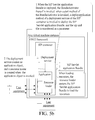
- the deployApplication method of the SIP container may be invoked by obtaining an instance of the deployment service of the SIP container based on the BundleContext of the OSGI service platform, as shown in FIG. 5b . If the SIP container is not deployed on the OSGI service platform as an OSGI Bundle, the deployApplication method, which is used for deploying service, may be invoked by directly obtaining a class of the deployment service of the SIP container through a singleton pattern or a naming service, as shown in FIG. 5c .
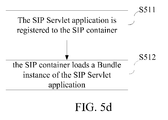
- the SIP Servlet application is deployed in the SIP container, as shown in FIG. 5d , which further includes the following steps:
- the content in the SIP configuration file of the SIP Servlet application is registered to the SIP container, and the SIP container determines whether to invoke the SIP Servlet application according to the registered content.
- Step S512 the SIP container loads a Bundle instance of the SIP Servlet application.
- the SIP container cannot manage the classes and resources of the SIP Servlet application unless the SIP container loads the Bundle instance of the SIP Servlet application.
- the process of registering the SIP Servlet application to the SIP container in Step S511 further includes the following steps, as shown in FIG. 6a .
- Step S601 the SIP configuration file of the SIP Servlet application is parsed.
- the sip.xml file is the SIP configuration file of the SIP Servlet application, which describes Servlet class information, pattern information, and other information of the SIP Servlet application.
- the pattern information describes an expression in a text format and the expression is the main function of the SIP Servlet application.
- the SIP configuration file of the SIP Servlet application is parsed to obtain the expression in a text format (or, simply, the text expression).
- Step S602 a rule expression object is created, a rule expression is parsed and obtained according to the text expression in the SIP configuration file, and the SIP Servlet application instance object is injected into the rule expression object.
- a Rule object is created.
- the Rule object is invoked to convert the text expression into a format that can be recognized and used by the SIP container, that is, the rule expression. Then, by invoking a setter method of the rule expression object, the reference of the SIP Servlet application instance object is injected into the rule expression object.
- Step S603 the rule expression is registered to a manager of the SIP container.
- the rule expression is registered to the manager of the SIP container by invoking a Rule Manager method in the SIP container.
- the method of a class which is used for the SIP container to load the SIP Servlet application in Step S512, is implemented through the process, which further includes the following steps, as shown in FIG. 6b .
- Step S611 a load object is created.
- a load object OSGIAppClassLoader is created, which is invoked by the SIP container to load the resources of the SIP Servlet application.
- Step S612 a Bundle instance of the SIP Servlet application is obtained, and then transferred into constructor parameters of the load object.
- the Bundle instance of the SIP Servlet application is obtained, that is, the Bundle of the previously created OSGISipApplication object is obtained.
- the Bundle instance is transferred into constructor parameters of the OSGIAppClassLoader object.
- the SIP container can the obtain Bundle instance of the SIP Servlet application, so as to manage and use the resources of the Bundle of the SIP Servlet application.
- the SIP Servlet application is deployed in the SIP container.
- the SIP container queries the rule expression registered to the manager according to the message content in the SIP request, and obtains a matching rule expression object.
- the SIP Servlet application instance object(s) is extracted from the matching rule expression object.
- the load object of the SIP Servlet application is invoked, from the SIP Servlet application instance object(s), to load the resources and class of the SIP Servlet application corresponding to the rule expression object, and an instance is created for the class of the SIP Servlet application to process the SIP request.
- the present invention further provides an OSGI service platform.
- An SIP container and an SIP Servlet application are deployed on the OSGI service platform as OSGI Bundles, and the SIP Servlet application is deployed in the SIP container, such that the OSGI service platform and the SIP container jointly manage the SIP Servlet application based on the OSGI service platform.
- the SIP Servlet application is registered to the SIP container, and the SIP container invokes the OSGIAppClassLoader to load the classes of the SIP Servlet application, such that the OSGI service platform is integrated with the SIP container to jointly manage the SIP Servlet application.
- the SIP Servlet application has the hot swap performance of an OSGI Bundle, and meanwhile, can be scheduled and managed by the SIP container, that is, the SIP Servlet application integrates the advantages of the two.
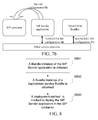
- FIG. 7a is a schematic diagram of the OSGI service platform and the SIP container integrated for jointly managing the SIP Servlet application.
- the SIP container is deployed on the OSGI service platform as a standard OSGI Bundle, and the SIP Servlet application is also deployed on the OSGI service platform as a standard OSGI Bundle. Therefore, as standard OSGI Bundles, the SIP Servlet application and the SIP container can communicate with other Bundles through a mechanism of the OSGI service platform.
- the SIP container grants relevant management functions of each SIP Servlet application to the OSGI service platform.
- the BundleActivator of the SIP Servlet application is invoked automatically by the OSGI service platform.
- the BundleActivator of the SIP Servlet application realizes the function of automatically deploying the SIP Servlet application in the SIP container.
- the SIP container loads the resources of the SIP Servlet application, it is unnecessary to load the resources from the path of the SIP Servlet application, and the resources of the SIP Servlet application are loaded through the SIP Servlet application.
- a deactivator program of the BundleActivator of the SIP Servlet application is invoked to automatically uninstall the SIP Servlet application from the SIP container.
- the SIP Servlet Container needs to grant the management functions (ClassLoader and a dynamic deployment and uninstall mechanism of APP) of each SIP Servlet APP to an OSGI framework through an adaptation mechanism, so as to avoid conflicts between the Container and the OSGI framework in the same management function.
- Management functions ClassLoader and a dynamic deployment and uninstall mechanism of APP
- persons skilled in the art may also enable the OSGI service platform and the SIP container to jointly manage the SIP Servlet application, without deploying the SIP container on the OSGI service platform, as shown in FIG. 7b .
- the BundleActivator of the SIP Servlet application is invoked automatically.
- the deployApplication method of the SIP container is invoked through a singleton pattern or a naming service and the deployApplication method is used for deploying service, thus realizing the function of automatically deploying the SIP Servlet application in the SIP container.
- the SIP container loads the resources of the SIP Servlet application, it is unnecessary to load the resources from the path of the SIP Servlet application, and the resources of the SIP Servlet application are loaded through the SIP Servlet application.
- the SIP Servlet application is deployed on the OSGI service platform as an OSGI Bundle, such that the SIP Servlet application has better dynamic performance, is hot swappable, and can communicate with other OSGI Bundles in a standard manner.
- the SIP Servlet application is deployed on the OSGI service platform as an OSGI Bundle, the SIP Servlet application is registered to the SIP container, and a method of a class, which is used for the SIP container to load the SIP Servlet application, is invoked.
- the SIP container can manage the SIP Servlet application
- the OSGI service platform is integrated with the SIP container to jointly manage the SIP Servlet application.
- an OSGI Bundle which is used for deploying service that is, a deployment service Bundle
- the deployment service Bundle is used to deploy the SIP Servlet application in the SIP container.
- Processes for deploying the SIP Servlet application on the OSGI service platform as an OSGI Bundle and deploying the SIP Servlet application in the SIP container in this embodiment of the present invention are the same as those in the first embodiment, as shown in FIG. 2 .
- Processes for compiling the implementing code of the BundleActivator of the SIP Servlet application in this embodiment of the present invention are as shown in FIG. 8 .
- Step S801 a Bundle instance of the SIP Servlet application is obtained.
- the Bundle instance of the SIP Servlet application is obtained from the BundleContext, and then transferred to a deployment service Bundle as a constructor parameter and obtained by the deployment service Bundle.
- Step S802 a Bundle instance of the deployment service Bundle is obtained.
- the Bundle instance of the deployment service Bundle is obtained from the BundleContext.
- the Bundle instance of the deployment service Bundle cannot be obtained unless the deployment service is deployed on the OSGI service platform as an OSGI Bundle.
- Persons skilled in the art are familiar with the technical measure of packaging the implementation code of the deployment service Bundle into ajar file, and deploying the jar file on the OSGI service platform. The functions of the implementation code of the deployment service Bundle will be described later.
- Step S803 a deployment method, which is used for deploying service, is invoked to deploy the SIP Servlet application in the SIP container.
- the deployment method of the deployment service is invoked according to the Bundle instance of the deployment service Bundle to deploy the SIP Servlet application in the SIP container.
- the deployment task completed in the deployment method is the same as Step S203 in the first embodiment, as shown in FIGs. 5a and 5b .
- the SIP container and the SIP Servlet application are deployed on the OSGI service platform, and the SIP Servlet application is deployed in the SIP container by referring to the deployment service, such that the SIP container and the OSGI service platform jointly manage the SIP Servlet based on the OSGI service platform.
- the method for deploying the SIP Servlet application in the SIP container by using the deployment service is similar to compiling a subroutine. Each time the same step is performed, it is unnecessary to re-compile a code segment for performing the step, and the subroutine can be invoked directly to perform the step.
- the deployment service Bundle is to provide a service of deploying the SIP Servlet application to the SIP container. Thus, each time a new SIP Servlet application is to be deployed, the deployment service Bundle can be directly referred to, so as to deploy the SIP Servlet application in the SIP container.
- the SIP Servlet application is deployed on the OSGI service platform as an OSGI Bundle, such that the SIP Servlet application has better dynamic performance, is hot swappable, and can communicate with other OSGI Bundles in a standard manner.
- the SIP Servlet application is deployed on the OSGI service platform as an OSGI Bundle, the SIP Servlet application is registered to the SIP container, and a method of a class, which is used for the SIP container to load the SIP Servlet application, is invoked.
- the SIP container can manage the SIP Servlet application
- the OSGI service platform is integrated with the SIP container to jointly manage the SIP Servlet application.
- the program may be stored in a computer readable storage medium.
- the storage medium may be a magnetic disk, an optical disk, a read-only memory (ROM), or a random access memory (RAM).
Landscapes
- Engineering & Computer Science (AREA)
- Computer Networks & Wireless Communication (AREA)
- Signal Processing (AREA)
- Multimedia (AREA)
- Business, Economics & Management (AREA)
- General Business, Economics & Management (AREA)
- Telephonic Communication Services (AREA)
- Stored Programmes (AREA)
Applications Claiming Priority (2)
| Application Number | Priority Date | Filing Date | Title |
|---|---|---|---|
| CN200710199571.2A CN101459740B (zh) | 2007-12-14 | 2007-12-14 | 部署SIP Servlet应用、管理SIP Servlet应用的方法及其系统 |
| PCT/CN2008/073386 WO2009076877A1 (fr) | 2007-12-14 | 2008-12-09 | Procédé pour déployer et gérer une application sip servlet et la plate-forme de services osgi de celle-ci |
Publications (3)
| Publication Number | Publication Date |
|---|---|
| EP2216962A1 true EP2216962A1 (fr) | 2010-08-11 |
| EP2216962A4 EP2216962A4 (fr) | 2011-02-23 |
| EP2216962B1 EP2216962B1 (fr) | 2013-10-23 |
Family
ID=40770355
Family Applications (1)
| Application Number | Title | Priority Date | Filing Date |
|---|---|---|---|
| EP08861489.6A Active EP2216962B1 (fr) | 2007-12-14 | 2008-12-09 | Procédé pour déployer et gérer une application sip servlet et la plate-forme de services osgi de celle-ci |
Country Status (3)
| Country | Link |
|---|---|
| EP (1) | EP2216962B1 (fr) |
| CN (1) | CN101459740B (fr) |
| WO (1) | WO2009076877A1 (fr) |
Cited By (1)
| Publication number | Priority date | Publication date | Assignee | Title |
|---|---|---|---|---|
| EP3134812A4 (fr) * | 2014-04-25 | 2017-12-06 | Alibaba Group Holding Limited | Exécution d'une application tierce |
Families Citing this family (5)
| Publication number | Priority date | Publication date | Assignee | Title |
|---|---|---|---|---|
| CN101834868B (zh) * | 2010-04-30 | 2012-10-17 | 中国科学院地理科学与资源研究所 | 一种Web空间分析服务中空间分析方法包的部署和管理方法 |
| CN101977274A (zh) * | 2010-10-25 | 2011-02-16 | 中兴通讯股份有限公司 | 一种进行业务平台部署的系统及方法 |
| CN102316163B (zh) * | 2011-09-07 | 2014-01-15 | 山东中创软件工程股份有限公司 | 一种实现Web容器扩展的方法及实现Web容器扩展的装置 |
| CN104407904B (zh) * | 2014-12-15 | 2018-01-02 | 深圳市科漫达智能管理科技有限公司 | 一种模块信息配置的方法及系统 |
| CN105511902B (zh) * | 2015-11-09 | 2019-11-12 | Tcl集团股份有限公司 | 一种安卓平台模块动态加载的方法及系统 |
Family Cites Families (6)
| Publication number | Priority date | Publication date | Assignee | Title |
|---|---|---|---|---|
| AU2003299301A1 (en) * | 2003-12-01 | 2005-06-24 | France Telecom | System for providing services in response to a communications session message |
| CN100558099C (zh) * | 2004-02-27 | 2009-11-04 | 华为技术有限公司 | 一种实现会话发起协议应用服务器多业务处理的方法 |
| US8549541B2 (en) * | 2004-03-26 | 2013-10-01 | Intellectual Ventures Ii Llc | Bridging local device communications across the wide area |
| EP1835690B1 (fr) * | 2006-03-15 | 2014-10-22 | Alcatel Lucent | Interface de service basés sur TR69 pour un faisceau OSGi |
| US7865607B2 (en) * | 2006-04-04 | 2011-01-04 | Movius Interactive Corporation | Servlet model for media rich applications |
| JP4844205B2 (ja) * | 2006-04-05 | 2011-12-28 | 富士ゼロックス株式会社 | ソフトウェアコンポーネントのインストール方法、インストーラ、及び複合機 |
-
2007
- 2007-12-14 CN CN200710199571.2A patent/CN101459740B/zh active Active
-
2008
- 2008-12-09 EP EP08861489.6A patent/EP2216962B1/fr active Active
- 2008-12-09 WO PCT/CN2008/073386 patent/WO2009076877A1/fr not_active Ceased
Cited By (2)
| Publication number | Priority date | Publication date | Assignee | Title |
|---|---|---|---|---|
| EP3134812A4 (fr) * | 2014-04-25 | 2017-12-06 | Alibaba Group Holding Limited | Exécution d'une application tierce |
| TWI650650B (zh) * | 2014-04-25 | 2019-02-11 | 阿里巴巴集團服務有限公司 | 第三方應用的執行方法及系統 |
Also Published As
| Publication number | Publication date |
|---|---|
| WO2009076877A1 (fr) | 2009-06-25 |
| EP2216962B1 (fr) | 2013-10-23 |
| EP2216962A4 (fr) | 2011-02-23 |
| CN101459740A (zh) | 2009-06-17 |
| CN101459740B (zh) | 2011-09-14 |
Similar Documents
| Publication | Publication Date | Title |
|---|---|---|
| US7640542B2 (en) | Managing midlet suites in OSGI environment | |
| US8347318B2 (en) | Application component communication apparatus of SCA-based system and method thereof | |
| CN105404524A (zh) | Java应用中的类加载隔离方法及装置 | |
| US20100242020A1 (en) | Sca-based system, and file parsing method and application generation method thereof | |
| EP2216962B1 (fr) | Procédé pour déployer et gérer une application sip servlet et la plate-forme de services osgi de celle-ci | |
| CN103501308A (zh) | 分布式云应用部署系统和/或相关的方法 | |
| CN112698930B (zh) | 一种获取服务器标识的方法、装置、设备及介质 | |
| CN104636122B (zh) | 一种能力组件的共享方法和设备 | |
| CN111427557A (zh) | 应用微服务化方法、装置、电子设备及可读存储介质 | |
| Cervantes et al. | Beanome: A component model for the osgi framework | |
| CN110389791B (zh) | 组件调度方法、装置、设备及存储介质 | |
| US20120054326A1 (en) | Remotely Managing an Application on a Device by a Management Server | |
| Gui et al. | A Hybrid real-time component model for reconfigurable embedded systems | |
| Frei et al. | A dynamic lightweight platform for ad-hoc infrastructures | |
| EP1782598A1 (fr) | Reconfiguration dynamique d'automates finis composites distribues | |
| Irmert et al. | Towards Runtime Adaptation in a SOA Environment. | |
| US7584302B1 (en) | Business integration component for containers | |
| Kim et al. | SCA-based component framework for software defined radio | |
| Messina et al. | Design and evaluation of a high‐level Grid communication infrastructure | |
| Timm et al. | Dynamic web service orchestration applied to the device profile for web services in hierarchical networks | |
| Göbel et al. | The COMQUAD component container architecture and contract negotiation | |
| Parker et al. | A P2P approach to classloading in Java | |
| Frei et al. | A dynamic lightweight Architecture for Ad-hoc Infrastructures | |
| Hayes | Software communications architecture | |
| Zachariadis | Adapting mobile systems using logical mobility primitives |
Legal Events
| Date | Code | Title | Description |
|---|---|---|---|
| PUAI | Public reference made under article 153(3) epc to a published international application that has entered the european phase |
Free format text: ORIGINAL CODE: 0009012 |
|
| 17P | Request for examination filed |
Effective date: 20100608 |
|
| AK | Designated contracting states |
Kind code of ref document: A1 Designated state(s): AT BE BG CH CY CZ DE DK EE ES FI FR GB GR HR HU IE IS IT LI LT LU LV MC MT NL NO PL PT RO SE SI SK TR |
|
| AX | Request for extension of the european patent |
Extension state: AL BA MK RS |
|
| A4 | Supplementary search report drawn up and despatched |
Effective date: 20110126 |
|
| RIC1 | Information provided on ipc code assigned before grant |
Ipc: H04L 12/28 20060101ALI20110120BHEP Ipc: H04L 29/08 20060101ALI20110120BHEP Ipc: H04L 29/06 20060101AFI20090708BHEP |
|
| DAX | Request for extension of the european patent (deleted) | ||
| 17Q | First examination report despatched |
Effective date: 20130117 |
|
| GRAP | Despatch of communication of intention to grant a patent |
Free format text: ORIGINAL CODE: EPIDOSNIGR1 |
|
| INTG | Intention to grant announced |
Effective date: 20130613 |
|
| GRAS | Grant fee paid |
Free format text: ORIGINAL CODE: EPIDOSNIGR3 |
|
| GRAA | (expected) grant |
Free format text: ORIGINAL CODE: 0009210 |
|
| AK | Designated contracting states |
Kind code of ref document: B1 Designated state(s): AT BE BG CH CY CZ DE DK EE ES FI FR GB GR HR HU IE IS IT LI LT LU LV MC MT NL NO PL PT RO SE SI SK TR |
|
| REG | Reference to a national code |
Ref country code: GB Ref legal event code: FG4D |
|
| REG | Reference to a national code |
Ref country code: CH Ref legal event code: EP |
|
| REG | Reference to a national code |
Ref country code: AT Ref legal event code: REF Ref document number: 638101 Country of ref document: AT Kind code of ref document: T Effective date: 20131115 |
|
| REG | Reference to a national code |
Ref country code: IE Ref legal event code: FG4D |
|
| REG | Reference to a national code |
Ref country code: DE Ref legal event code: R096 Ref document number: 602008028367 Country of ref document: DE Effective date: 20131219 |
|
| REG | Reference to a national code |
Ref country code: NL Ref legal event code: VDEP Effective date: 20131023 |
|
| REG | Reference to a national code |
Ref country code: AT Ref legal event code: MK05 Ref document number: 638101 Country of ref document: AT Kind code of ref document: T Effective date: 20131023 |
|
| REG | Reference to a national code |
Ref country code: LT Ref legal event code: MG4D |
|
| PG25 | Lapsed in a contracting state [announced via postgrant information from national office to epo] |
Ref country code: SE Free format text: LAPSE BECAUSE OF FAILURE TO SUBMIT A TRANSLATION OF THE DESCRIPTION OR TO PAY THE FEE WITHIN THE PRESCRIBED TIME-LIMIT Effective date: 20131023 Ref country code: IS Free format text: LAPSE BECAUSE OF FAILURE TO SUBMIT A TRANSLATION OF THE DESCRIPTION OR TO PAY THE FEE WITHIN THE PRESCRIBED TIME-LIMIT Effective date: 20140223 Ref country code: NO Free format text: LAPSE BECAUSE OF FAILURE TO SUBMIT A TRANSLATION OF THE DESCRIPTION OR TO PAY THE FEE WITHIN THE PRESCRIBED TIME-LIMIT Effective date: 20140123 Ref country code: BE Free format text: LAPSE BECAUSE OF FAILURE TO SUBMIT A TRANSLATION OF THE DESCRIPTION OR TO PAY THE FEE WITHIN THE PRESCRIBED TIME-LIMIT Effective date: 20131023 Ref country code: HR Free format text: LAPSE BECAUSE OF FAILURE TO SUBMIT A TRANSLATION OF THE DESCRIPTION OR TO PAY THE FEE WITHIN THE PRESCRIBED TIME-LIMIT Effective date: 20131023 Ref country code: NL Free format text: LAPSE BECAUSE OF FAILURE TO SUBMIT A TRANSLATION OF THE DESCRIPTION OR TO PAY THE FEE WITHIN THE PRESCRIBED TIME-LIMIT Effective date: 20131023 Ref country code: LT Free format text: LAPSE BECAUSE OF FAILURE TO SUBMIT A TRANSLATION OF THE DESCRIPTION OR TO PAY THE FEE WITHIN THE PRESCRIBED TIME-LIMIT Effective date: 20131023 Ref country code: FI Free format text: LAPSE BECAUSE OF FAILURE TO SUBMIT A TRANSLATION OF THE DESCRIPTION OR TO PAY THE FEE WITHIN THE PRESCRIBED TIME-LIMIT Effective date: 20131023 |
|
| PG25 | Lapsed in a contracting state [announced via postgrant information from national office to epo] |
Ref country code: LV Free format text: LAPSE BECAUSE OF FAILURE TO SUBMIT A TRANSLATION OF THE DESCRIPTION OR TO PAY THE FEE WITHIN THE PRESCRIBED TIME-LIMIT Effective date: 20131023 Ref country code: CY Free format text: LAPSE BECAUSE OF FAILURE TO SUBMIT A TRANSLATION OF THE DESCRIPTION OR TO PAY THE FEE WITHIN THE PRESCRIBED TIME-LIMIT Effective date: 20131023 Ref country code: AT Free format text: LAPSE BECAUSE OF FAILURE TO SUBMIT A TRANSLATION OF THE DESCRIPTION OR TO PAY THE FEE WITHIN THE PRESCRIBED TIME-LIMIT Effective date: 20131023 Ref country code: ES Free format text: LAPSE BECAUSE OF FAILURE TO SUBMIT A TRANSLATION OF THE DESCRIPTION OR TO PAY THE FEE WITHIN THE PRESCRIBED TIME-LIMIT Effective date: 20131023 |
|
| PG25 | Lapsed in a contracting state [announced via postgrant information from national office to epo] |
Ref country code: PT Free format text: LAPSE BECAUSE OF FAILURE TO SUBMIT A TRANSLATION OF THE DESCRIPTION OR TO PAY THE FEE WITHIN THE PRESCRIBED TIME-LIMIT Effective date: 20140224 |
|
| REG | Reference to a national code |
Ref country code: DE Ref legal event code: R097 Ref document number: 602008028367 Country of ref document: DE |
|
| PG25 | Lapsed in a contracting state [announced via postgrant information from national office to epo] |
Ref country code: EE Free format text: LAPSE BECAUSE OF FAILURE TO SUBMIT A TRANSLATION OF THE DESCRIPTION OR TO PAY THE FEE WITHIN THE PRESCRIBED TIME-LIMIT Effective date: 20131023 |
|
| REG | Reference to a national code |
Ref country code: CH Ref legal event code: PL |
|
| PG25 | Lapsed in a contracting state [announced via postgrant information from national office to epo] |
Ref country code: SK Free format text: LAPSE BECAUSE OF FAILURE TO SUBMIT A TRANSLATION OF THE DESCRIPTION OR TO PAY THE FEE WITHIN THE PRESCRIBED TIME-LIMIT Effective date: 20131023 Ref country code: LU Free format text: LAPSE BECAUSE OF FAILURE TO SUBMIT A TRANSLATION OF THE DESCRIPTION OR TO PAY THE FEE WITHIN THE PRESCRIBED TIME-LIMIT Effective date: 20131209 Ref country code: MC Free format text: LAPSE BECAUSE OF FAILURE TO SUBMIT A TRANSLATION OF THE DESCRIPTION OR TO PAY THE FEE WITHIN THE PRESCRIBED TIME-LIMIT Effective date: 20131023 Ref country code: IT Free format text: LAPSE BECAUSE OF FAILURE TO SUBMIT A TRANSLATION OF THE DESCRIPTION OR TO PAY THE FEE WITHIN THE PRESCRIBED TIME-LIMIT Effective date: 20131023 Ref country code: CZ Free format text: LAPSE BECAUSE OF FAILURE TO SUBMIT A TRANSLATION OF THE DESCRIPTION OR TO PAY THE FEE WITHIN THE PRESCRIBED TIME-LIMIT Effective date: 20131023 Ref country code: RO Free format text: LAPSE BECAUSE OF FAILURE TO SUBMIT A TRANSLATION OF THE DESCRIPTION OR TO PAY THE FEE WITHIN THE PRESCRIBED TIME-LIMIT Effective date: 20131023 Ref country code: PL Free format text: LAPSE BECAUSE OF FAILURE TO SUBMIT A TRANSLATION OF THE DESCRIPTION OR TO PAY THE FEE WITHIN THE PRESCRIBED TIME-LIMIT Effective date: 20131023 |
|
| PLBE | No opposition filed within time limit |
Free format text: ORIGINAL CODE: 0009261 |
|
| STAA | Information on the status of an ep patent application or granted ep patent |
Free format text: STATUS: NO OPPOSITION FILED WITHIN TIME LIMIT |
|
| REG | Reference to a national code |
Ref country code: IE Ref legal event code: MM4A |
|
| PG25 | Lapsed in a contracting state [announced via postgrant information from national office to epo] |
Ref country code: DK Free format text: LAPSE BECAUSE OF FAILURE TO SUBMIT A TRANSLATION OF THE DESCRIPTION OR TO PAY THE FEE WITHIN THE PRESCRIBED TIME-LIMIT Effective date: 20131023 |
|
| 26N | No opposition filed |
Effective date: 20140724 |
|
| PG25 | Lapsed in a contracting state [announced via postgrant information from national office to epo] |
Ref country code: IE Free format text: LAPSE BECAUSE OF NON-PAYMENT OF DUE FEES Effective date: 20131209 Ref country code: CH Free format text: LAPSE BECAUSE OF NON-PAYMENT OF DUE FEES Effective date: 20131231 Ref country code: LI Free format text: LAPSE BECAUSE OF NON-PAYMENT OF DUE FEES Effective date: 20131231 |
|
| REG | Reference to a national code |
Ref country code: DE Ref legal event code: R097 Ref document number: 602008028367 Country of ref document: DE Effective date: 20140724 |
|
| PG25 | Lapsed in a contracting state [announced via postgrant information from national office to epo] |
Ref country code: SI Free format text: LAPSE BECAUSE OF FAILURE TO SUBMIT A TRANSLATION OF THE DESCRIPTION OR TO PAY THE FEE WITHIN THE PRESCRIBED TIME-LIMIT Effective date: 20131023 |
|
| PG25 | Lapsed in a contracting state [announced via postgrant information from national office to epo] |
Ref country code: TR Free format text: LAPSE BECAUSE OF FAILURE TO SUBMIT A TRANSLATION OF THE DESCRIPTION OR TO PAY THE FEE WITHIN THE PRESCRIBED TIME-LIMIT Effective date: 20131023 |
|
| PG25 | Lapsed in a contracting state [announced via postgrant information from national office to epo] |
Ref country code: BG Free format text: LAPSE BECAUSE OF FAILURE TO SUBMIT A TRANSLATION OF THE DESCRIPTION OR TO PAY THE FEE WITHIN THE PRESCRIBED TIME-LIMIT Effective date: 20131023 Ref country code: HU Free format text: LAPSE BECAUSE OF FAILURE TO SUBMIT A TRANSLATION OF THE DESCRIPTION OR TO PAY THE FEE WITHIN THE PRESCRIBED TIME-LIMIT; INVALID AB INITIO Effective date: 20081209 |
|
| PG25 | Lapsed in a contracting state [announced via postgrant information from national office to epo] |
Ref country code: GR Free format text: LAPSE BECAUSE OF NON-PAYMENT OF DUE FEES Effective date: 20131023 Ref country code: MT Free format text: LAPSE BECAUSE OF FAILURE TO SUBMIT A TRANSLATION OF THE DESCRIPTION OR TO PAY THE FEE WITHIN THE PRESCRIBED TIME-LIMIT Effective date: 20131023 |
|
| REG | Reference to a national code |
Ref country code: FR Ref legal event code: PLFP Year of fee payment: 8 |
|
| PG25 | Lapsed in a contracting state [announced via postgrant information from national office to epo] |
Ref country code: GR Free format text: LAPSE BECAUSE OF FAILURE TO SUBMIT A TRANSLATION OF THE DESCRIPTION OR TO PAY THE FEE WITHIN THE PRESCRIBED TIME-LIMIT Effective date: 20140124 |
|
| REG | Reference to a national code |
Ref country code: FR Ref legal event code: PLFP Year of fee payment: 9 |
|
| REG | Reference to a national code |
Ref country code: FR Ref legal event code: PLFP Year of fee payment: 10 |
|
| REG | Reference to a national code |
Ref country code: DE Ref legal event code: R079 Ref document number: 602008028367 Country of ref document: DE Free format text: PREVIOUS MAIN CLASS: H04L0029060000 Ipc: H04L0065000000 |
|
| REG | Reference to a national code |
Ref country code: GB Ref legal event code: 732E Free format text: REGISTERED BETWEEN 20220203 AND 20220209 |
|
| REG | Reference to a national code |
Ref country code: DE Ref legal event code: R081 Ref document number: 602008028367 Country of ref document: DE Owner name: XFUSION DIGITAL TECHNOLOGIES CO., LTD., ZHENGZ, CN Free format text: FORMER OWNER: HUAWEI TECHNOLOGIES CO., LTD., SHEN ZHEN, GUANGDONG, CN |
|
| PGFP | Annual fee paid to national office [announced via postgrant information from national office to epo] |
Ref country code: DE Payment date: 20251014 Year of fee payment: 18 |
|
| PGFP | Annual fee paid to national office [announced via postgrant information from national office to epo] |
Ref country code: GB Payment date: 20251016 Year of fee payment: 18 |
|
| PGFP | Annual fee paid to national office [announced via postgrant information from national office to epo] |
Ref country code: FR Payment date: 20251008 Year of fee payment: 18 |