EP2216974A1 - Verfahren zur Bereitstellung eines Kommunikationsdienstes - Google Patents
Verfahren zur Bereitstellung eines Kommunikationsdienstes Download PDFInfo
- Publication number
- EP2216974A1 EP2216974A1 EP09290080A EP09290080A EP2216974A1 EP 2216974 A1 EP2216974 A1 EP 2216974A1 EP 09290080 A EP09290080 A EP 09290080A EP 09290080 A EP09290080 A EP 09290080A EP 2216974 A1 EP2216974 A1 EP 2216974A1
- Authority
- EP
- European Patent Office
- Prior art keywords
- user
- virtual call
- call room
- room
- speaker
- Prior art date
- Legal status (The legal status is an assumption and is not a legal conclusion. Google has not performed a legal analysis and makes no representation as to the accuracy of the status listed.)
- Withdrawn
Links
- 230000006854 communication Effects 0.000 title claims abstract description 64
- 238000004891 communication Methods 0.000 title claims abstract description 64
- 238000000034 method Methods 0.000 title claims abstract description 48
- 230000007175 bidirectional communication Effects 0.000 claims abstract description 7
- 230000003595 spectral effect Effects 0.000 claims description 10
- 230000003993 interaction Effects 0.000 claims description 7
- 230000002123 temporal effect Effects 0.000 claims description 4
- 238000010586 diagram Methods 0.000 description 6
- 238000000926 separation method Methods 0.000 description 6
- 230000003068 static effect Effects 0.000 description 5
- 238000012546 transfer Methods 0.000 description 5
- 230000008859 change Effects 0.000 description 4
- 238000011038 discontinuous diafiltration by volume reduction Methods 0.000 description 4
- 238000007596 consolidation process Methods 0.000 description 3
- 238000012217 deletion Methods 0.000 description 3
- 230000037430 deletion Effects 0.000 description 3
- 230000007246 mechanism Effects 0.000 description 3
- 230000003321 amplification Effects 0.000 description 2
- 230000001419 dependent effect Effects 0.000 description 2
- 238000003199 nucleic acid amplification method Methods 0.000 description 2
- 238000000638 solvent extraction Methods 0.000 description 2
- 230000002269 spontaneous effect Effects 0.000 description 2
- 206010011469 Crying Diseases 0.000 description 1
- 230000009471 action Effects 0.000 description 1
- 230000003213 activating effect Effects 0.000 description 1
- 238000013459 approach Methods 0.000 description 1
- 210000004556 brain Anatomy 0.000 description 1
- 230000019771 cognition Effects 0.000 description 1
- 239000012141 concentrate Substances 0.000 description 1
- 238000012790 confirmation Methods 0.000 description 1
- 230000003247 decreasing effect Effects 0.000 description 1
- 230000006870 function Effects 0.000 description 1
- 238000010413 gardening Methods 0.000 description 1
- 239000003999 initiator Substances 0.000 description 1
- 238000005259 measurement Methods 0.000 description 1
- 230000003287 optical effect Effects 0.000 description 1
- 210000000056 organ Anatomy 0.000 description 1
- 230000002265 prevention Effects 0.000 description 1
- 230000008569 process Effects 0.000 description 1
- 238000009877 rendering Methods 0.000 description 1
- 230000005236 sound signal Effects 0.000 description 1
- 238000001228 spectrum Methods 0.000 description 1
- 230000001755 vocal effect Effects 0.000 description 1
Images



Classifications
-
- H—ELECTRICITY
- H04—ELECTRIC COMMUNICATION TECHNIQUE
- H04M—TELEPHONIC COMMUNICATION
- H04M3/00—Automatic or semi-automatic exchanges
- H04M3/42—Systems providing special services or facilities to subscribers
- H04M3/56—Arrangements for connecting several subscribers to a common circuit, i.e. affording conference facilities
-
- G—PHYSICS
- G10—MUSICAL INSTRUMENTS; ACOUSTICS
- G10L—SPEECH ANALYSIS TECHNIQUES OR SPEECH SYNTHESIS; SPEECH RECOGNITION; SPEECH OR VOICE PROCESSING TECHNIQUES; SPEECH OR AUDIO CODING OR DECODING
- G10L15/00—Speech recognition
- G10L15/08—Speech classification or search
- G10L15/18—Speech classification or search using natural language modelling
- G10L15/1815—Semantic context, e.g. disambiguation of the recognition hypotheses based on word meaning
-
- G—PHYSICS
- G10—MUSICAL INSTRUMENTS; ACOUSTICS
- G10L—SPEECH ANALYSIS TECHNIQUES OR SPEECH SYNTHESIS; SPEECH RECOGNITION; SPEECH OR VOICE PROCESSING TECHNIQUES; SPEECH OR AUDIO CODING OR DECODING
- G10L21/00—Speech or voice signal processing techniques to produce another audible or non-audible signal, e.g. visual or tactile, in order to modify its quality or its intelligibility
- G10L21/003—Changing voice quality, e.g. pitch or formants
- G10L21/007—Changing voice quality, e.g. pitch or formants characterised by the process used
- G10L21/013—Adapting to target pitch
- G10L2021/0135—Voice conversion or morphing
-
- G—PHYSICS
- G10—MUSICAL INSTRUMENTS; ACOUSTICS
- G10L—SPEECH ANALYSIS TECHNIQUES OR SPEECH SYNTHESIS; SPEECH RECOGNITION; SPEECH OR VOICE PROCESSING TECHNIQUES; SPEECH OR AUDIO CODING OR DECODING
- G10L21/00—Speech or voice signal processing techniques to produce another audible or non-audible signal, e.g. visual or tactile, in order to modify its quality or its intelligibility
- G10L21/02—Speech enhancement, e.g. noise reduction or echo cancellation
- G10L21/0208—Noise filtering
- G10L21/0264—Noise filtering characterised by the type of parameter measurement, e.g. correlation techniques, zero crossing techniques or predictive techniques
-
- H—ELECTRICITY
- H04—ELECTRIC COMMUNICATION TECHNIQUE
- H04M—TELEPHONIC COMMUNICATION
- H04M1/00—Substation equipment, e.g. for use by subscribers
- H04M1/60—Substation equipment, e.g. for use by subscribers including speech amplifiers
- H04M1/6033—Substation equipment, e.g. for use by subscribers including speech amplifiers for providing handsfree use or a loudspeaker mode in telephone sets
- H04M1/6041—Portable telephones adapted for handsfree use
- H04M1/6058—Portable telephones adapted for handsfree use involving the use of a headset accessory device connected to the portable telephone
-
- H—ELECTRICITY
- H04—ELECTRIC COMMUNICATION TECHNIQUE
- H04M—TELEPHONIC COMMUNICATION
- H04M1/00—Substation equipment, e.g. for use by subscribers
- H04M1/64—Automatic arrangements for answering calls; Automatic arrangements for recording messages for absent subscribers; Arrangements for recording conversations
- H04M1/65—Recording arrangements for recording a message from the calling party
- H04M1/656—Recording arrangements for recording a message from the calling party for recording conversations
-
- H—ELECTRICITY
- H04—ELECTRIC COMMUNICATION TECHNIQUE
- H04M—TELEPHONIC COMMUNICATION
- H04M2203/00—Aspects of automatic or semi-automatic exchanges
- H04M2203/50—Aspects of automatic or semi-automatic exchanges related to audio conference
- H04M2203/5081—Inform conference party of participants, e.g. of change of participants
-
- H—ELECTRICITY
- H04—ELECTRIC COMMUNICATION TECHNIQUE
- H04M—TELEPHONIC COMMUNICATION
- H04M2242/00—Special services or facilities
- H04M2242/30—Determination of the location of a subscriber
-
- H—ELECTRICITY
- H04—ELECTRIC COMMUNICATION TECHNIQUE
- H04M—TELEPHONIC COMMUNICATION
- H04M3/00—Automatic or semi-automatic exchanges
- H04M3/42—Systems providing special services or facilities to subscribers
- H04M3/42221—Conversation recording systems
-
- H—ELECTRICITY
- H04—ELECTRIC COMMUNICATION TECHNIQUE
- H04M—TELEPHONIC COMMUNICATION
- H04M3/00—Automatic or semi-automatic exchanges
- H04M3/42—Systems providing special services or facilities to subscribers
- H04M3/436—Arrangements for screening incoming calls, i.e. evaluating the characteristics of a call before deciding whether to answer it
-
- H—ELECTRICITY
- H04—ELECTRIC COMMUNICATION TECHNIQUE
- H04M—TELEPHONIC COMMUNICATION
- H04M3/00—Automatic or semi-automatic exchanges
- H04M3/42—Systems providing special services or facilities to subscribers
- H04M3/56—Arrangements for connecting several subscribers to a common circuit, i.e. affording conference facilities
- H04M3/568—Arrangements for connecting several subscribers to a common circuit, i.e. affording conference facilities audio processing specific to telephonic conferencing, e.g. spatial distribution, mixing of participants
- H04M3/569—Arrangements for connecting several subscribers to a common circuit, i.e. affording conference facilities audio processing specific to telephonic conferencing, e.g. spatial distribution, mixing of participants using the instant speaker's algorithm
Definitions
- the present invention relates to a method of providing a communication service in a telecommunication system, and a virtual call room module to execute said method.
- a special type of group communication also involves a lot of limitations. Participants of a conference call initially have to agree on a common time for starting and terminating the conference call.
- a conference call may have to be arranged in advance with a provider of a conference call service. Furthermore, it may be necessary for the participants of the conference call to dial a specific code, e.g., issued by a provider of a conference call service, in order to be admitted to the conference call.
- a specific code e.g., issued by a provider of a conference call service
- the object of the present invention is achieved by a method of providing a communication service in a telecommunication system, the method comprising the steps of receiving, from a user of the communication service, a request for creation of a virtual call room, creating the requested virtual call room associated with the user as an owner of the virtual call room, allocating one or more telecommunication devices of the telecommunication system to the created virtual call room, as one or more telecommunication devices associated with the user; receiving from another user of the telecommunication system one or more requests to connect one or more telecommunication devices with the virtual call room of the user, and after connection of the other user's one or more telecommunication devices with the virtual call room of the user, establishing a bi-directional communication connection with perspicuity control between at least one of the user's one or more telecommunication devices and at least one of the other user's one or more telecommunication devices by means of the virtual call room.
- a virtual call room module for providing a communication service in a telecommunication system
- the virtual call room module comprising a control unit adapted to receive, from a user of the communication service, a request for creation of a virtual call room, create the requested virtual call room associated with the user as an owner of the virtual call room, allocate one or more telecommunication devices of the telecommunication system with the created virtual call room, as one or more telecommunication devices associated with the user, receive from another user of the telecommunication system one or more requests to connect one or more telecommunication devices with the virtual call room of the user, as one or more telecommunication devices associated with the other user, and, after connection of the other user's one or more telecommunication devices with the virtual call room of the user, establish a bi-directional communication connection with perspicuity control between at least one of the user's one or more telecommunication devices and at least one of the other user's one or more telecommunication devices by means of the virtual call room.
- a virtual call room is "associated with a user as an owner" of said virtual call room or the statement that a virtual call room is "owned by a user” is not meant to imply that the user possesses the virtual call room or has the virtual call room as property. Instead this statement is meant to express that the user, as the initiator of the virtual call room, has, preferably exclusive, rights to change the state of the virtual call room, e.g., to delete the virtual call room.
- a user may be an owner of a virtual call room or not.
- a user of the communication service is automatically also a user of the telecommunication system.
- the virtual call room hereinafter also shortly referred to as "call room" is an abstract telecommunication entity placed anywhere in a memory of a telecommunication equipment or implemented as a piece of a telecommunication hardware. From the software point of view, the virtual call room is a software object constituting of a number of member data elements and methods.
- a virtual call room may be a permanent call room or a temporary call room.
- the present invention allows a ubiquitous and task-focused information exchange in small and huge participant groups.
- the present invention presents a flexible and cost effective telecommunication service and allows spontaneous evolving of a communication group.
- the present invention improves the way of communicating via telecommunication systems. Users of the present invention are able to stay in touch with each other without the hitherto existing limitations.
- the communication partners are there as long as the users wish and with a feeling that they are close, i.e. the communication connection between two users is maintained as long as the users want to. This makes the "busy" ring tone superfluous.
- the present invention enables a user of a telecommunication network to stay in a flexible but permanent contact with single or multiple groups of interest.
- the present invention is suited for collaborative working in teams spread across wide area or based on a home office environment. It also allows communication partners living or located at different locations, e.g., family members, members of an interest group, or friends, to keep a close contact.
- the invention offers an improved pervasive communication opportunity to a society which shows a need for this kind of communication, as is shown, e.g., by today's trends of chat rooms (cf. Skype), blogs, etc.
- the method of providing a communication service in a telecommunication system comprises the steps of
- the virtual call room module for providing a communication service in a telecommunication system comprises
- an application to subscribe to the communication service is received from the user of the communication service.
- the user may use the identifier for his identification when requesting creation of one or more virtual call rooms. It is possible that the user makes use of the identifier for his identification when connecting to another virtual call room associated with another user as owner of the other virtual call room. This will be appropriate, e.g., for the cost transfer from the owner of the call room to the user.
- costs caused by communications via a virtual call room are charged to the owner of the virtual call room.
- a user can also use his ID to automatically invite himself to a virtual call room while connecting to the virtual call room from a non-associated terminal.
- the virtual call room module keeps alive the virtual call room in a state where allocation and/or connection requests can be received.
- an allocation request a user of the communication service can request that any terminal of the telecommunication system will be allocated to an existing virtual call room associated with the user as owner of the said existing virtual call room for a purpose of notification.
- a connection request of a user a user of the telecommunication network can request that any terminal of the telecommunication system will be connected to any existing virtual call room for a purpose of communication.
- a connection request of a user a user of the telecommunication network can request that any terminal of the telecommunication system will be connected to his existing virtual call room for a purpose of communication.
- one or more users already connected with the virtual call room and/or the user as owner of the virtual call room are informed when a user enters and/or leaves the virtual call room.
- This notification may be performed as an announcement, e.g. an audio signal, a verbal notification, a voice announcement, or as a multimedia file, e.g. an optical indication, a video message, an Instant Messaging file.
- the present invention provides an automatic announcement of an incoming call.
- the present invention enables a user to behave in a virtual call room as if in real life: before talking to someone, you "knock at the door" and go into a room. If no user is connected to a virtual call room, the user of the virtual call room can wait for another user while doing something else, e.g. walking the dog, reading, gardening, until he is notified when a user "enters" the virtual call room.
- a speaker group is a special type of virtual call room, e.g., a call room on a lower hierarchy level than a normal virtual call room. Further, it is possible that a speaker group is a virtual sub-call room. It is possible that, particularly in order to execute the perspicuity control, the speaker group is merged with another speaker group to a combined speaker group and signals are routed to the combined speaker group based on a routing policy.
- the routing policy may be determined by a service provider and/or a service subscriber, stored in a storage unit of the virtual call room module and referred to when a routing decision must be made.
- a call room can be split into sub-call rooms to allow some hierarchy.
- the difference between the speaker groups and the sub-call rooms is that the speaker groups are created dynamically and the sub-call rooms are static.
- the separation/split decision algorithm can also use a more complex function as, e.g., a determination of a perceptibility of vowels and consonants under consideration of their spectral redundancy as well as a determination of a perceptibility of whole words or sentences in consideration of linguistic redundancy.
- a number of interruptions per second and/or a spectral perceptibility of single vowels and consonants and/or a perceptibility of words or sentences may be referred to as an understandability coefficient.
- the speaker group is merged with another speaker group to a combined speaker group based on one or more of the following values measured in the first and/or the second speaker group: ratio of silent time to speaking time, number of aborted conversations, number of questions without answer.
- a consolidation decision to combine and merge, respectively, two or more speaker groups into one bigger speaker group can be controlled by coefficient determined based on one or more of the following: silent time to speaking time, aborted conversations, or questions without answer.
- a consolidation/merge decision algorithm of the inventive method can be based on a measurement of a disparity between an active time, i.e. the time where at least one person is speaking, and a passive time, i.e.
- the need of a group consolidation is based on the assumption that the probability for an increase of conversation grows with a number of potential speakers.
- a treatment regarding one or more of the signal-related properties volume, time shift, frequency shift, and spectral characteristics is applied to the signals targeted to be routed to the multiple speaker groups or the combined speaker group.
- This treatment may provide to shift a speaker's voice into the acoustic foreground.
- a method to shift a speaker's voice to an acoustic foreground is to boost the volume of his voice or, contrary, to attenuate voices of other speakers.
- the level of amplification and attenuation, respectively can be selected in such a way that a selected speaker can be heard clearly and can be well understood.
- the level of amplification or attenuation, respectively can be controlled by a relative distance between a speaker and all the listeners or, preferably, between a speaker and the listener group.
- the time shift is based on a theoretical approach and can only be used if shifting of a spoken text in time makes sense.
- the goal of a speaker's voice frequency shift is to enhance the understandability of spoken text by adopting of the speaker's voice spectrum to a hearing characteristic of listeners, e.g. a statistically averaged one. It is possible that the aforementioned adoption is done separately for each individual user of a speaker room.
- a distribution of audio data among two or more users connected to the virtual call room is controlled based on one or more of the following criteria, whereby the two or more users are referred to as speakers: speakers' location, i.e. positions of the two or more users, speakers' time of entry into a conversation, speakers' interaction based on a semantic or a temporal correlation, a set of speaker-related attributes.
- the present invention provides a control over the loudness of the speech of a specific participant.
- the present invention provides a control over how clearly a specific participant can be heard in a group communication and improves, also in case of multiple call rooms, the way the voice of a specific participant is perceived.
- Separation criteria to be used for partitioning of a speaker community into smaller groups, or group creation criteria can be one or more of the following grouping attributes: speaker's location, speaker's time of entry into the conversation, speaker interaction by semantic or time correlation, speaker context understood as a any set of speaker related attributes.
- the distribution of audio data among two or more users connected to a virtual call room may be effected by distributing the audio data associated with the users connected to the virtual call room to two or more speaker groups generated within the virtual call room, e.g., in the form of speaker rooms or speaker areas. It is possible that each user of the virtual call room is allocated to at least one of the speaker group. It is possible that a user in a first speaker group of the virtual call room can hear audio data from the other users within the first speaker group in an acoustic foreground, i.e., loud and clear, and audio data from users within a second speaker group of the virtual call room in an acoustic background, i.e. muted and unclear. It is possible that each user connected to the virtual call room changes, at his own request, to another speaker group or be integrated to one or more additional speaker group.
- the speaking time allocated to a speaker within the virtual call room is limited based on one or more of the following methods: flexibly sharing the conversation time, automatically reducing the speaking volume for all speakers not marked as speaking, fixed time slicing in case of small groups, dynamic speaker lists.
- a speaker interruption control provides a means to avoid interruptions of speakers by other speakers in the same group, e.g. a speaker room or a virtual call room.
- the method of flexible conversation time sharing is based on dynamic assignment of a specific amount of speaking time to each one speaker at the beginning of his speech. During this time speaker can freely speak and cannot be disturbed by other.
- Another speaker can start to speak freely. If the current speaker stops speaking earlier, other speakers are free to speak. Another possibility is to automatically reduce the sound volume for all speakers not marked as speaking. This will allow other speaker candidates so signalise their will to speak, but will not be able to drown the current speaker down.
- the system dynamically assigns speaking time intervals to speakers and informs them with the help of a short sound or another signal. If selected, a speaker can start to speak or he can hand over to the next speaker.
- a dynamic speaker list the system remembers if a speaker has tried to say something and puts him on a speaker list. Once the speaker has moved to the first place on the list he will be informed about that fact and is invited to start speaking.
- perspicuity control - can be used to improve perspicuity, i.e., the understandability of audio data/signals within a virtual call room.
- the inventive method allows to control perspicuity in case there is a big number of speakers speaking simultaneously in a common room.
- perspicuity control allows multiple speakers to use the same communication medium or resource as frequency channel, phone number or other identification and speak one with other without a risk of decreasing perspicuity. Even when multiple speakers use the same room understandability is assured.
- the present invention also works in case of common rooms with hundreds or more speakers.
- the inventive idea of perspicuity control harnesses human acoustic organ characteristics and a language cognition capability of the brain.
- the perspicuity control according to the invention separates speakers depending on situation, into groups small enough to allow user-acceptable interaction and gains perspicuity inside of groups by shifting of speaker voices being in a same group into foreground while avoiding uncontrolled speaker interruption.
- a speaker room/speaker area may represent a telecommunication facility where users of a telecommunication network, even if widespread around the world, can receive (hear) one another independently of a distance between them. It is possible that a speaker room/speaker area is represented by a virtual call room and a virtual call sub-room, respectively.
- grouping attributes which determine a grouping decision are selected dependent on an application and can be adopted by a self-acting process.
- a speaker location attribute is best suited for an application where a user location decides on a content of a conversation in a speaker group as, e.g. in a traffic related information exchange.
- criteria based on speakers' time of entry into the conversation within the speaker group or speaker interaction by semantic or time correlation may be used.
- the allocation between the one or more telecommunication devices of the user and the virtual call room associated with the user as an owner of said virtual call room is changed to an allocation of one or more telecommunication devices of the user to another virtual call room associated with the user as an owner of the other virtual call room.
- the present invention avoids a static person - phone assignment where each user is bound to a specific terminal address, e.g. a phone number.
- a user has not a fixed binding to a terminal, e.g. phone.
- the present invention manages an allocation of a terminal equipment to any number of different call rooms.
- a users can flexibly change the allocation between his one or more terminals, or any other terminal, and one or more call rooms that he owns at any time.
- a user can maintain different identities, preferably without additional cost, by creating different call rooms dedicated to different areas of life, e.g. family, work, leisure, traffic, etc.
- IMEI International Mobile Equipment Identity
- a fee charged for the communication service is based on data that have been transmitted by means of the virtual call room, i.e. based on resource utilisation.
- fees charged for the communication service are charged to the owner of the virtual call room. Additional mechanisms, where the user identifies himself while connecting to a virtual call room and assumes fee charged for resources consumed by his connection, exist. It is possible that communication costs are assigned to the virtual call room wherein the communication is executed.
- the charge for a telecommunication service is associated with a call room of the user. The present invention enables a user of the communication service to use any terminal as if it would be his own terminal because the communication costs are charged on his virtual call room, not on the terminal used.
- a personal virtual call room i.e. if a virtual call room is owned by a user, at last the bill for the communication costs arising from communication over the virtual call room is sent to the user, the owner of the virtual call room.
- the billing may be realised on a monthly fee that is requested from the users of the public virtual call room.
- users of a permanent public virtual call room can identify themselves on connecting to that virtual call room and can be individually charged for their own resource utilisation.
- a terminal which is used to connect to a virtual call room is allocated to another virtual call room, the user can be identified based on the data associated with that other virtual call room. If a terminal which is used to connect to a virtual call room has no allocation to any virtual call room, the user can identify himself using his personal identifier.
- control unit has access to rules specifying how the connection is to be set up, because the charging is associated with the virtual call room and finally the virtual call room with the user.
- control unit is further adapted to enable the user of the telecommunication system to be connected to more than one virtual call room at the same time.
- the functional range, in particular at least a part of it, of the telecommunication system according to the invention may be subject to one or more of the following set of rules:
- a user can set up an outgoing call to a user who has already created a virtual call room and has allocated a terminal to that virtual call room.
- a terminal i.e., being able to accept incoming calls
- the user must have allocated at least one terminal to his virtual call room.
- the user receives a user ID from his service provider.
- the user can create one or more call rooms.
- the user cannot be reached if he has not allocated a terminal, e.g. a phone, to a virtual call room. So, after the user has created a virtual call room, he allocates a terminal with one of his own one or more virtual call rooms. From this point, the user is able to accept incoming calls. Also, after the user has created a virtual call room, he can connect a terminal with the virtual call room and wait for any call.
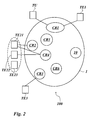
- the telecommunication system 100 further comprises telecommunication devices TE1, TE2, TE3, e.g., fixed telephones, mobile telephones, audio-video devices, personal computers, devices for Instant Messaging, etc.
- the telecommunication devices TE1, TE2, TE3 represent those communication terminals which are used by subscribers of a communication service provided in the telecommunication system 100.
- the telecommunication system 100 further comprises virtual call rooms CR1 to CR6 and a virtual call room module 1 for managing these virtual call rooms CR1 to CR6.
- the virtual call room module 1 may be represented by a call room execution engine 1.
- the call room execution engine 1 implemented either as a software or as dedicated hardware, further comprises a call room management subsystem 10.
- Each virtual call room CR1 to CR6 is identified by an unambiguous identifier such as a number, a name or any other symbol, e.g. bitmap, vector drawing, fingerprint, etc.
- a virtual call room enables and manages a bi-directional broadcasting of speech and other data between all user terminals connected to that call room in consideration of informational perceivability.
- the telecommunication device TE1 owned by a first subscriber, is allocated to the virtual call room CR1.
- the virtual call rooms CR4 to CR6 currently have not allocated telecommunication devices TE1, TE2, TE3.
- the statement that a virtual call room or a telecommunication device is owned by a subscriber/user does not obligatorily mean that the subscriber/user possesses the virtual call room or has the virtual call room as property. This statement is simply meant to express that the subscriber/user has the right to use the call room for the telecommunication service, to change its attributes or to delete it.
- the virtual call rooms CR1, CR2, CR3 represent a meeting room where the users can be met by other users of the telecommunication system 100.
- Fig. 2 shows the telecommunication system 100 of Fig. 1 , with the difference that the telecommunication device TE2 has been replaced by a set of telecommunication devices TE21, TE22, and TE23, allocated to the second subscriber.
- the second subscriber has allocated the telecommunication device TE21 to the virtual call rooms CR2 and CR4 and the telecommunication device TE22 to the virtual call room CR4.
- the simultaneous allocation of the second subscriber's telecommunication device TE21 with the two virtual call rooms CR2 and CR4, e.g., the one call room associated with private life and the other call room associated with work life, means that the second subscriber can be reached on his terminal at the same time by users calling either one of the two call rooms.
- a user owning a telecommunication device TU wishes to contact the first subscriber associated with the virtual call room CR1, i.e., said first subscriber is a callee, i.e., a called user. Therefore, the caller enters an identifier of the callee's virtual call room CR1 on the caller's terminal TU, and the call room management subsystem 10 creates a link between the caller's terminal TU and the callee's virtual call room CR1, i.e. the telecommunication system 100 starts to transfer data between the virtual call room CR1 of the callee and the caller's terminal TU, using either a connectionless or connection oriented link.
- the telecommunication system 100 will inform the user, owner of the virtual call room CR1, i.e. the callee using the telecommunication device TE1, that someone has entered the virtual call room CR1, so that the callee can also enter this virtual call room CR1 by activating the terminal TE1 and then start a conversation with the caller.
- the telecommunication device TU used by the caller is connected to the virtual call room CR1 which has terminal TE1 allocated, i.e., which is owned by the first subscriber. That means that a communication between the first subscriber's telecommunication device TE1 and the user's telecommunication device TU is possible.
- the virtual call room behaviour can simulate a typical conference room or can, for example, behave as a star-pipe where the owner of the virtual call room CR1 can hear and speak to all other users/subscribers involved in conversation in the virtual call room CR1, but all other users/subscribers can only hear and speak to the owner of the virtual call room CR1.
- Global communication for discussions and information exchange as, for example, news on a traffic situation can be implemented with a help of a public virtual call room.
- a subscriber driving in a car from town A to town B can dial on his terminal TE1 an address associated with the traffic information room and so will be able to speak with other drivers and/or hear their comments on the current traffic situation on this route.
- a virtual call room may be responsible for understandability of messages exchanged via the virtual call room.
- the virtual call room for traffic information can use an algorithm based on current positions of particular subscribers and the distance of one subscriber to another subscriber. In this case, the loudness of a voice the subscribers hears in the earphone will depend on his distance to the speaker and the number of subscribers in the virtual call room per unit of covered area. In other words, if there are only a few subscribers in the virtual call room, e.g., three subscribers, one in Hamburg, one in Berlin and one in Stuttgart, each of the three subscribers will excellent hear the other two subscribers.
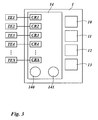
- Fig. 3 shows a call room execution engine 1 comprising a call room management subsystem 10, a data transport subsystem 11, a subscriber management subsystem 12, a resource management subsystem 13, and a call room unit 14.
- the call room unit 14 comprises a static call room policy unit 140, a static call room traffic 141, and a plurality of virtual call rooms CR1, CR2, CR3, CR4, ..., CRx.
- a plurality of terminals TE1, TE2, TE3, TE4, ..., TEx are connected to the virtual call rooms CR1, CR2, CR3, CR4, ..., CRx.
- the data transport subsystem 11 allows connection oriented or connectionless data transfer between the terminals TE1, TE2, TE3, TE4, ..., TEx associated with subscribers and the virtual call rooms CR1, CR2, CR3, CR4, ..., CRx.
- the call room management subsystem 10 allows operator and/or user controlled creation and deletion of virtual call rooms and static or dynamic binding of one or more virtual call rooms CR1, CR2, CR3, CR4, ..., CRx to any subscriber.
- the subscriber management subsystem 12 manages subscribers, charges, and the terminals TE1, TE2, TE3, TE4, ..., TEx.
- the telecommunication system wherein the call room execution engine 1 is implemented comprises a number of access points to which subscribers and/or users can connect their terminals to.
- the call room execution engine 1 is composed of one or several inter-linked computers, i.e., a hardware platform, a software platform based on the hardware platform and several application programs executed by the system platform formed by the software and hardware platform.
- the functionality of the call room execution engine 1 is provided by the execution of these application programs.
- the application programs or a selected part of these application programs constitute a computer software product providing a communication service as described in the this description, when executed on the system platform. Further, such computer software product is constituted by a storage medium storing these application programs or said selected part of application programs.
- Fig. 4 shows a message flow diagram of a communication service between a subscriber owning the first terminal TE1 and a user owning a second terminal TU.
- the subscriber has to submit to the carrier of the telecommunication system, preferably to the call room execution engine 1, a written or electronic application 401 for a virtual call room service.
- the subscriber receives then a subscription confirmation 402 comprising a user ID, e.g., the ID number "123".
- the subscriber creates two virtual call rooms by dialling a creation code on his terminal TE1, e.g. by dialling a call creating code ("#1"), his ID ("123"), and identifiers/addresses ("456", "789") of the virtual call rooms to be created, preceded by an asterisk (“*456 *789”), and sending the creation code as a message 403 to the call room execution engine 1.
- the call room management subsystem 10 of the call room execution engine 1 creates the call room CR1, as shown in Fig. 4 , and the call room CR2, not shown in Fig. 4 .
- the subscriber allocates his terminal TE1 with the first call room CR1 by dialling an allocation code comprising a code for telephone allocation ("#2") and the identifier/address 456 of the virtual call room, preceded by an asterisk ("*456").
- the subscriber sends the allocation code as an allocation message 404 from the terminal TE1 to be associated to the call room management subsystem 10 of the call room execution engine 1. Now the subscriber can be reached in the virtual call room CR1.
- the user owning the terminal TU contacts the virtual call room CR1, i.e. the user enters the call room CR1.
- the user dials an enter code on his terminal TU, e.g., dialling the identifier/address ("456") of the virtual call room to be reached, preceded by an asterisk ("*456"), and sending this enter code as a message 405 to the call room execution engine 1.
- the call room policy requires that a caller has to identify himself, e.g.
- the user dials a contact code on his terminal TU, e.g., dialling his user ID ("656") and the identifier/address ("456") of the virtual call room to be reached, preceded by an asterisk ("*456"), and sending this contact code as a message 407 to the call room execution engine 1.
- CID Caller Identification
- the call room management subsystem 10 informs the subscriber using the terminal TE1, which is allocated to that virtual call room CR1, that someone has entered the call room CR1. If the subscriber accepts the call, the call room management subsystem 10 creates a communication connection 408 and the data transport subsystem 11 starts to broadcast voice data between the terminals TE1 and UE.
- FIG. 5 shows a schematic illustration of the communication service according to an embodiment of the present invention.
- a (one) user 510 is an owner 511 of 0 to M devices 520, i.e., the user 510 may own 511 none, one or more than one devices 520.
- a (one) user 510 uses 512 0 to N devices 520, i.e., the user may use 512 none, one or more than one devices 520.
- a lot of (K) devices 520 belong 513 to a (one) telecommunication system 501.
- the telecommunication system 501 comprises a call room 502.
- the term "belong” is meant to express that the devices 520 are part of the telecommunication system 501.
- a lot of (L) devices 520 are allocated 514 to 0 to (Q) virtual call rooms 502, i.e., the (L) devices 520 are allocated 514 to none, one or more than one virtual call rooms 502.
- a lot of (R) devices 520 is connected to 517 to a call room 502.
- a (one) user 510 is an owner 516 of 0 to P virtual call rooms 502, i.e., the user 510 may own 516 none, one or more than one virtual call rooms 502.
- a (one) user 510 is a subscriber 515 of the (one) telecommunication system 501.
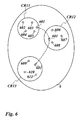
- Fig. 6 shows a virtual call room 6 defined as a global call room, i.e. freely accessible by users 601 to 611 of a telecommunication network.
- the virtual call room 6 is dedicated to users of the telecommunication network who are interested in the exchange of information on current traffic situations, i.e. especially car drivers.
- John a user 601 of the telecommunication network, wants to drive in his car from Pforzheim to the Hahn airport to reach a plane there.
- John 601 enters the motorway at the junction Pforzheim-West.
- John 601 is late and the gate time for his plane at the Hahn airport closes in three hours.
- John 601 enters the global call room 6 and sees on a display of his navigation system which is used as a telecommunication device different coloured areas CR11, CR12, CR13 depicting currently active speaker groups of the virtual call room 6.
- John 601 hears well few speakers in the vicinity of Düsseldorf, members of a first sub-room CR11, and an acoustically far background of speakers from other speaker groups CR12, CR13.
- He asks the driver community of the first sub-room CR11 for the current traffic situation and gets an answer from a driver on the motorway A5 driving to Basel that there is no traffic jam between Frankfurt and Düsseldorf. Calmed down, John 601 slows a little bit the speed of his car. Now he is sure he will get his plane at time.
- Fig. 6 shows the user 601 in between and connected with slashed lines to the active speaker groups CR11, CR12, CR13. This illustrates that the association of the user 601 to one or more of the active speaker groups CR11, CR12, CR13 be can changed based on the user's 601 request and/or based on a user attribute of the user 601, e.g. his location.
Landscapes
- Engineering & Computer Science (AREA)
- Multimedia (AREA)
- Signal Processing (AREA)
- Telephonic Communication Services (AREA)
- Circuit For Audible Band Transducer (AREA)
Priority Applications (3)
| Application Number | Priority Date | Filing Date | Title |
|---|---|---|---|
| EP09290080A EP2216974A1 (de) | 2009-02-04 | 2009-02-04 | Verfahren zur Bereitstellung eines Kommunikationsdienstes |
| EP09290242A EP2216975A1 (de) | 2009-02-04 | 2009-03-31 | Telekommunikationsvorrichtung |
| EP09290249.3A EP2216976B1 (de) | 2009-02-04 | 2009-04-02 | Audiokonferenz mit Verständlichkeitskontrolle |
Applications Claiming Priority (1)
| Application Number | Priority Date | Filing Date | Title |
|---|---|---|---|
| EP09290080A EP2216974A1 (de) | 2009-02-04 | 2009-02-04 | Verfahren zur Bereitstellung eines Kommunikationsdienstes |
Publications (1)
| Publication Number | Publication Date |
|---|---|
| EP2216974A1 true EP2216974A1 (de) | 2010-08-11 |
Family
ID=40792594
Family Applications (3)
| Application Number | Title | Priority Date | Filing Date |
|---|---|---|---|
| EP09290080A Withdrawn EP2216974A1 (de) | 2009-02-04 | 2009-02-04 | Verfahren zur Bereitstellung eines Kommunikationsdienstes |
| EP09290242A Withdrawn EP2216975A1 (de) | 2009-02-04 | 2009-03-31 | Telekommunikationsvorrichtung |
| EP09290249.3A Not-in-force EP2216976B1 (de) | 2009-02-04 | 2009-04-02 | Audiokonferenz mit Verständlichkeitskontrolle |
Family Applications After (2)
| Application Number | Title | Priority Date | Filing Date |
|---|---|---|---|
| EP09290242A Withdrawn EP2216975A1 (de) | 2009-02-04 | 2009-03-31 | Telekommunikationsvorrichtung |
| EP09290249.3A Not-in-force EP2216976B1 (de) | 2009-02-04 | 2009-04-02 | Audiokonferenz mit Verständlichkeitskontrolle |
Country Status (1)
| Country | Link |
|---|---|
| EP (3) | EP2216974A1 (de) |
Cited By (3)
| Publication number | Priority date | Publication date | Assignee | Title |
|---|---|---|---|---|
| CN104980931A (zh) * | 2015-05-25 | 2015-10-14 | 中国科学院沈阳自动化研究所 | 多跳认知无线网络的空时联合接入方法 |
| CN109801634A (zh) * | 2019-01-31 | 2019-05-24 | 北京声智科技有限公司 | 一种声纹特征的融合方法及装置 |
| CN112822609A (zh) * | 2019-11-15 | 2021-05-18 | 珍尼雷克公司 | 扬声器和扬声器控制系统 |
Families Citing this family (1)
| Publication number | Priority date | Publication date | Assignee | Title |
|---|---|---|---|---|
| JP6392161B2 (ja) * | 2015-04-13 | 2018-09-19 | 日本電信電話株式会社 | 音声会議システム、音声会議装置、その方法及びプログラム |
Citations (5)
| Publication number | Priority date | Publication date | Assignee | Title |
|---|---|---|---|---|
| WO2000048379A1 (en) * | 1999-02-10 | 2000-08-17 | Telefonaktiebolaget Lm Ericsson (Publ) | Method and system for providing spatialized audio in conference calls |
| EP1414227A1 (de) * | 2002-10-24 | 2004-04-28 | Hewlett-Packard Company | Erkennung von Ereignissen bei der Kommunikation mit mehreren Sprachkanälen |
| US20040172255A1 (en) * | 2003-02-28 | 2004-09-02 | Palo Alto Research Center Incorporated | Methods, apparatus, and products for automatically managing conversational floors in computer-mediated communications |
| US20060067499A1 (en) * | 2004-09-30 | 2006-03-30 | Marcelo Oliveira | Method and apparatus for querying a list of participants in a conference |
| JP2007300240A (ja) * | 2006-04-27 | 2007-11-15 | Kyocera Corp | 携帯電話端末及びサーバ |
Family Cites Families (4)
| Publication number | Priority date | Publication date | Assignee | Title |
|---|---|---|---|---|
| AUPR989802A0 (en) * | 2002-01-09 | 2002-01-31 | Lake Technology Limited | Interactive spatialized audiovisual system |
| US20050018838A1 (en) * | 2003-03-03 | 2005-01-27 | Shure Incorporated | Communications headset with isolating in-ear driver |
| JP4546151B2 (ja) * | 2004-05-26 | 2010-09-15 | 株式会社日立製作所 | 音声コミュニケーション・システム |
| JP4608400B2 (ja) * | 2005-09-13 | 2011-01-12 | 株式会社日立製作所 | 音声通話システムおよび音声通話中におけるコンテンツの提供方法 |
-
2009
- 2009-02-04 EP EP09290080A patent/EP2216974A1/de not_active Withdrawn
- 2009-03-31 EP EP09290242A patent/EP2216975A1/de not_active Withdrawn
- 2009-04-02 EP EP09290249.3A patent/EP2216976B1/de not_active Not-in-force
Patent Citations (5)
| Publication number | Priority date | Publication date | Assignee | Title |
|---|---|---|---|---|
| WO2000048379A1 (en) * | 1999-02-10 | 2000-08-17 | Telefonaktiebolaget Lm Ericsson (Publ) | Method and system for providing spatialized audio in conference calls |
| EP1414227A1 (de) * | 2002-10-24 | 2004-04-28 | Hewlett-Packard Company | Erkennung von Ereignissen bei der Kommunikation mit mehreren Sprachkanälen |
| US20040172255A1 (en) * | 2003-02-28 | 2004-09-02 | Palo Alto Research Center Incorporated | Methods, apparatus, and products for automatically managing conversational floors in computer-mediated communications |
| US20060067499A1 (en) * | 2004-09-30 | 2006-03-30 | Marcelo Oliveira | Method and apparatus for querying a list of participants in a conference |
| JP2007300240A (ja) * | 2006-04-27 | 2007-11-15 | Kyocera Corp | 携帯電話端末及びサーバ |
Non-Patent Citations (1)
| Title |
|---|
| AOKI P M ET AL: "The Mad Hatter's Cocktail Party: A Social Mobile Audio Space Supporting Multiple Simultaneous Conversations", CHI 2003. CONFERENCE PROCEEDINGS. CONFERENCE ON HUMAN FACTORS IN COMPUTING SYSTEMS. FORT LAUDERDALE, FL, APRIL 5 - 10, 2003; [CHI CONFERENCE PROCEEDINGS. HUMAN FACTORS IN COMPUTING SYSTEMS], NEW YORK, NY : ACM, US, 5 April 2003 (2003-04-05), pages 425 - 432, XP002276417, ISBN: 978-1-58113-630-2 * |
Cited By (6)
| Publication number | Priority date | Publication date | Assignee | Title |
|---|---|---|---|---|
| CN104980931A (zh) * | 2015-05-25 | 2015-10-14 | 中国科学院沈阳自动化研究所 | 多跳认知无线网络的空时联合接入方法 |
| CN104980931B (zh) * | 2015-05-25 | 2019-03-05 | 中国科学院沈阳自动化研究所 | 多跳认知无线网络的空时联合接入方法 |
| CN109801634A (zh) * | 2019-01-31 | 2019-05-24 | 北京声智科技有限公司 | 一种声纹特征的融合方法及装置 |
| CN112822609A (zh) * | 2019-11-15 | 2021-05-18 | 珍尼雷克公司 | 扬声器和扬声器控制系统 |
| EP3823309A1 (de) * | 2019-11-15 | 2021-05-19 | Genelec OY | Lautsprecher und lautsprechersteuerungssystem |
| US11461073B2 (en) | 2019-11-15 | 2022-10-04 | Genelec Oy | Loudspeaker and loudspeaker control system |
Also Published As
| Publication number | Publication date |
|---|---|
| EP2216976A1 (de) | 2010-08-11 |
| EP2216975A1 (de) | 2010-08-11 |
| EP2216976B1 (de) | 2017-11-22 |
Similar Documents
| Publication | Publication Date | Title |
|---|---|---|
| US8219616B2 (en) | Use of information channels to provide communications in a virtual environment | |
| US5471318A (en) | Multimedia communications network | |
| US7742587B2 (en) | Telecommunications and conference calling device, system and method | |
| US8175243B2 (en) | Systems and methods for facilitating teleconferencing without pre-reservation of conference resources | |
| US20040125933A1 (en) | Managing and initiating conference calls | |
| US11546467B2 (en) | Method for establishing a telecommunication connection | |
| MXPA05008436A (es) | Instalacion para llamadas de conferencia. | |
| RU2542577C2 (ru) | Сеть доставки услуг | |
| KR20120099477A (ko) | 전화 회의의 위치 의존적 셋업을 위한 시스템 | |
| US20140357226A1 (en) | Zone Based Radio Communication System | |
| US20050031110A1 (en) | System and method of an improved conference call service feature in a telecommunications network | |
| RU2700272C2 (ru) | Контроллер коммутации для распределения голосовых пакетов | |
| US20090061832A1 (en) | System and method for wireless call parking | |
| EP1329091A1 (de) | Einrichten einer konferenzverbindung zwischen mitgliedern einer chat-gruppe | |
| JP3752932B2 (ja) | 通信システムおよび通信方法 | |
| CN101115240A (zh) | 实现短信会议的系统和方法、以及会话消息处理方法 | |
| US20100162122A1 (en) | Method and System for Playing a Sound Clip During a Teleconference | |
| WO2016209824A1 (en) | Communication environment with unified communication interfaces | |
| US20070004384A1 (en) | Method and apparatus for providing personalized audio content delivery during telephony hold | |
| EP2216974A1 (de) | Verfahren zur Bereitstellung eines Kommunikationsdienstes | |
| KR102131820B1 (ko) | 다자간 통신을 위한 시스템 및 방법 | |
| US8155632B2 (en) | Systems and methods for voting in a teleconference using a mobile device | |
| CN1937663A (zh) | 实现变声通话业务的方法、系统及装置 | |
| US20100189240A1 (en) | Contacting a person outside of a teleconference without leaving the teleconference | |
| US20070147343A1 (en) | Voice communication system and a server apparatus |
Legal Events
| Date | Code | Title | Description |
|---|---|---|---|
| PUAI | Public reference made under article 153(3) epc to a published international application that has entered the european phase |
Free format text: ORIGINAL CODE: 0009012 |
|
| AK | Designated contracting states |
Kind code of ref document: A1 Designated state(s): AT BE BG CH CY CZ DE DK EE ES FI FR GB GR HR HU IE IS IT LI LT LU LV MC MK MT NL NO PL PT RO SE SI SK TR |
|
| AX | Request for extension of the european patent |
Extension state: AL BA RS |
|
| 17P | Request for examination filed |
Effective date: 20110125 |
|
| 17Q | First examination report despatched |
Effective date: 20110211 |
|
| AKX | Designation fees paid |
Designated state(s): AT BE BG CH CY CZ DE DK EE ES FI FR GB GR HR HU IE IS IT LI LT LU LV MC MK MT NL NO PL PT RO SE SI SK TR |
|
| RAP1 | Party data changed (applicant data changed or rights of an application transferred) |
Owner name: ALCATEL LUCENT |
|
| 111Z | Information provided on other rights and legal means of execution |
Free format text: AT BE BG CH CY CZ DE DK EE ES FI FR GB GR HR HU IE IS IT LI LT LU LV MC MK MT NL NO PL PT RO SE SI SK TR Effective date: 20130410 |
|
| RAP1 | Party data changed (applicant data changed or rights of an application transferred) |
Owner name: ALCATEL LUCENT |
|
| D11X | Information provided on other rights and legal means of execution (deleted) | ||
| STAA | Information on the status of an ep patent application or granted ep patent |
Free format text: STATUS: THE APPLICATION IS DEEMED TO BE WITHDRAWN |
|
| 18D | Application deemed to be withdrawn |
Effective date: 20160105 |