EP2217439B1 - Selbstheilende salzwassersperre - Google Patents
Selbstheilende salzwassersperre Download PDFInfo
- Publication number
- EP2217439B1 EP2217439B1 EP08799119A EP08799119A EP2217439B1 EP 2217439 B1 EP2217439 B1 EP 2217439B1 EP 08799119 A EP08799119 A EP 08799119A EP 08799119 A EP08799119 A EP 08799119A EP 2217439 B1 EP2217439 B1 EP 2217439B1
- Authority
- EP
- European Patent Office
- Prior art keywords
- water
- copolymer
- geotextile
- powdered
- granular
- Prior art date
- Legal status (The legal status is an assumption and is not a legal conclusion. Google has not performed a legal analysis and makes no representation as to the accuracy of the status listed.)
- Active
Links
Images



Classifications
-
- E—FIXED CONSTRUCTIONS
- E21—EARTH OR ROCK DRILLING; MINING
- E21D—SHAFTS; TUNNELS; GALLERIES; LARGE UNDERGROUND CHAMBERS
- E21D11/00—Lining tunnels, galleries or other underground cavities, e.g. large underground chambers; Linings therefor; Making such linings in situ, e.g. by assembling
- E21D11/38—Waterproofing; Heat insulating; Soundproofing; Electric insulating
- E21D11/383—Waterproofing; Heat insulating; Soundproofing; Electric insulating by applying waterproof flexible sheets; Means for fixing the sheets to the tunnel or cavity wall
-
- B—PERFORMING OPERATIONS; TRANSPORTING
- B32—LAYERED PRODUCTS
- B32B—LAYERED PRODUCTS, i.e. PRODUCTS BUILT-UP OF STRATA OF FLAT OR NON-FLAT, e.g. CELLULAR OR HONEYCOMB, FORM
- B32B27/00—Layered products comprising a layer of synthetic resin
- B32B27/12—Layered products comprising a layer of synthetic resin next to a fibrous or filamentary layer
-
- B—PERFORMING OPERATIONS; TRANSPORTING
- B32—LAYERED PRODUCTS
- B32B—LAYERED PRODUCTS, i.e. PRODUCTS BUILT-UP OF STRATA OF FLAT OR NON-FLAT, e.g. CELLULAR OR HONEYCOMB, FORM
- B32B27/00—Layered products comprising a layer of synthetic resin
- B32B27/14—Layered products comprising a layer of synthetic resin next to a particulate layer
-
- B—PERFORMING OPERATIONS; TRANSPORTING
- B32—LAYERED PRODUCTS
- B32B—LAYERED PRODUCTS, i.e. PRODUCTS BUILT-UP OF STRATA OF FLAT OR NON-FLAT, e.g. CELLULAR OR HONEYCOMB, FORM
- B32B27/00—Layered products comprising a layer of synthetic resin
- B32B27/30—Layered products comprising a layer of synthetic resin comprising vinyl (co)polymers; comprising acrylic (co)polymers
- B32B27/304—Layered products comprising a layer of synthetic resin comprising vinyl (co)polymers; comprising acrylic (co)polymers comprising vinyl halide (co)polymers, e.g. PVC, PVDC, PVF, PVDF
-
- B—PERFORMING OPERATIONS; TRANSPORTING
- B32—LAYERED PRODUCTS
- B32B—LAYERED PRODUCTS, i.e. PRODUCTS BUILT-UP OF STRATA OF FLAT OR NON-FLAT, e.g. CELLULAR OR HONEYCOMB, FORM
- B32B3/00—Layered products comprising a layer with external or internal discontinuities or unevennesses, or a layer of non-planar shape; Layered products comprising a layer having particular features of form
- B32B3/02—Layered products comprising a layer with external or internal discontinuities or unevennesses, or a layer of non-planar shape; Layered products comprising a layer having particular features of form characterised by features of form at particular places, e.g. in edge regions
-
- B—PERFORMING OPERATIONS; TRANSPORTING
- B32—LAYERED PRODUCTS
- B32B—LAYERED PRODUCTS, i.e. PRODUCTS BUILT-UP OF STRATA OF FLAT OR NON-FLAT, e.g. CELLULAR OR HONEYCOMB, FORM
- B32B5/00—Layered products characterised by the non- homogeneity or physical structure, i.e. comprising a fibrous, filamentary, particulate or foam layer; Layered products characterised by having a layer differing constitutionally or physically in different parts
- B32B5/02—Layered products characterised by the non- homogeneity or physical structure, i.e. comprising a fibrous, filamentary, particulate or foam layer; Layered products characterised by having a layer differing constitutionally or physically in different parts characterised by structural features of a fibrous or filamentary layer
- B32B5/022—Non-woven fabric
-
- B—PERFORMING OPERATIONS; TRANSPORTING
- B32—LAYERED PRODUCTS
- B32B—LAYERED PRODUCTS, i.e. PRODUCTS BUILT-UP OF STRATA OF FLAT OR NON-FLAT, e.g. CELLULAR OR HONEYCOMB, FORM
- B32B5/00—Layered products characterised by the non- homogeneity or physical structure, i.e. comprising a fibrous, filamentary, particulate or foam layer; Layered products characterised by having a layer differing constitutionally or physically in different parts
- B32B5/02—Layered products characterised by the non- homogeneity or physical structure, i.e. comprising a fibrous, filamentary, particulate or foam layer; Layered products characterised by having a layer differing constitutionally or physically in different parts characterised by structural features of a fibrous or filamentary layer
- B32B5/024—Woven fabric
-
- B—PERFORMING OPERATIONS; TRANSPORTING
- B32—LAYERED PRODUCTS
- B32B—LAYERED PRODUCTS, i.e. PRODUCTS BUILT-UP OF STRATA OF FLAT OR NON-FLAT, e.g. CELLULAR OR HONEYCOMB, FORM
- B32B7/00—Layered products characterised by the relation between layers; Layered products characterised by the relative orientation of features between layers, or by the relative values of a measurable parameter between layers, i.e. products comprising layers having different physical, chemical or physicochemical properties; Layered products characterised by the interconnection of layers
- B32B7/04—Interconnection of layers
- B32B7/05—Interconnection of layers the layers not being connected over the whole surface, e.g. discontinuous connection or patterned connection
-
- B—PERFORMING OPERATIONS; TRANSPORTING
- B32—LAYERED PRODUCTS
- B32B—LAYERED PRODUCTS, i.e. PRODUCTS BUILT-UP OF STRATA OF FLAT OR NON-FLAT, e.g. CELLULAR OR HONEYCOMB, FORM
- B32B7/00—Layered products characterised by the relation between layers; Layered products characterised by the relative orientation of features between layers, or by the relative values of a measurable parameter between layers, i.e. products comprising layers having different physical, chemical or physicochemical properties; Layered products characterised by the interconnection of layers
- B32B7/04—Interconnection of layers
- B32B7/12—Interconnection of layers using interposed adhesives or interposed materials with bonding properties
-
- E—FIXED CONSTRUCTIONS
- E02—HYDRAULIC ENGINEERING; FOUNDATIONS; SOIL SHIFTING
- E02D—FOUNDATIONS; EXCAVATIONS; EMBANKMENTS; UNDERGROUND OR UNDERWATER STRUCTURES
- E02D31/00—Protective arrangements for foundations or foundation structures; Ground foundation measures for protecting the soil or the subsoil water, e.g. preventing or counteracting oil pollution
- E02D31/002—Ground foundation measures for protecting the soil or subsoil water, e.g. preventing or counteracting oil pollution
- E02D31/004—Sealing liners
-
- B—PERFORMING OPERATIONS; TRANSPORTING
- B32—LAYERED PRODUCTS
- B32B—LAYERED PRODUCTS, i.e. PRODUCTS BUILT-UP OF STRATA OF FLAT OR NON-FLAT, e.g. CELLULAR OR HONEYCOMB, FORM
- B32B2255/00—Coating on the layer surface
- B32B2255/02—Coating on the layer surface on fibrous or filamentary layer
-
- B—PERFORMING OPERATIONS; TRANSPORTING
- B32—LAYERED PRODUCTS
- B32B—LAYERED PRODUCTS, i.e. PRODUCTS BUILT-UP OF STRATA OF FLAT OR NON-FLAT, e.g. CELLULAR OR HONEYCOMB, FORM
- B32B2262/00—Composition or structural features of fibres which form a fibrous or filamentary layer or are present as additives
- B32B2262/02—Synthetic macromolecular fibres
- B32B2262/0246—Acrylic resin fibres
-
- B—PERFORMING OPERATIONS; TRANSPORTING
- B32—LAYERED PRODUCTS
- B32B—LAYERED PRODUCTS, i.e. PRODUCTS BUILT-UP OF STRATA OF FLAT OR NON-FLAT, e.g. CELLULAR OR HONEYCOMB, FORM
- B32B2262/00—Composition or structural features of fibres which form a fibrous or filamentary layer or are present as additives
- B32B2262/02—Synthetic macromolecular fibres
- B32B2262/0253—Polyolefin fibres
-
- B—PERFORMING OPERATIONS; TRANSPORTING
- B32—LAYERED PRODUCTS
- B32B—LAYERED PRODUCTS, i.e. PRODUCTS BUILT-UP OF STRATA OF FLAT OR NON-FLAT, e.g. CELLULAR OR HONEYCOMB, FORM
- B32B2262/00—Composition or structural features of fibres which form a fibrous or filamentary layer or are present as additives
- B32B2262/02—Synthetic macromolecular fibres
- B32B2262/0261—Polyamide fibres
-
- B—PERFORMING OPERATIONS; TRANSPORTING
- B32—LAYERED PRODUCTS
- B32B—LAYERED PRODUCTS, i.e. PRODUCTS BUILT-UP OF STRATA OF FLAT OR NON-FLAT, e.g. CELLULAR OR HONEYCOMB, FORM
- B32B2262/00—Composition or structural features of fibres which form a fibrous or filamentary layer or are present as additives
- B32B2262/02—Synthetic macromolecular fibres
- B32B2262/0276—Polyester fibres
-
- B—PERFORMING OPERATIONS; TRANSPORTING
- B32—LAYERED PRODUCTS
- B32B—LAYERED PRODUCTS, i.e. PRODUCTS BUILT-UP OF STRATA OF FLAT OR NON-FLAT, e.g. CELLULAR OR HONEYCOMB, FORM
- B32B2262/00—Composition or structural features of fibres which form a fibrous or filamentary layer or are present as additives
- B32B2262/02—Synthetic macromolecular fibres
- B32B2262/0292—Polyurethane fibres
-
- B—PERFORMING OPERATIONS; TRANSPORTING
- B32—LAYERED PRODUCTS
- B32B—LAYERED PRODUCTS, i.e. PRODUCTS BUILT-UP OF STRATA OF FLAT OR NON-FLAT, e.g. CELLULAR OR HONEYCOMB, FORM
- B32B2262/00—Composition or structural features of fibres which form a fibrous or filamentary layer or are present as additives
- B32B2262/04—Cellulosic plastic fibres, e.g. rayon
-
- B—PERFORMING OPERATIONS; TRANSPORTING
- B32—LAYERED PRODUCTS
- B32B—LAYERED PRODUCTS, i.e. PRODUCTS BUILT-UP OF STRATA OF FLAT OR NON-FLAT, e.g. CELLULAR OR HONEYCOMB, FORM
- B32B2262/00—Composition or structural features of fibres which form a fibrous or filamentary layer or are present as additives
- B32B2262/10—Inorganic fibres
- B32B2262/101—Glass fibres
-
- B—PERFORMING OPERATIONS; TRANSPORTING
- B32—LAYERED PRODUCTS
- B32B—LAYERED PRODUCTS, i.e. PRODUCTS BUILT-UP OF STRATA OF FLAT OR NON-FLAT, e.g. CELLULAR OR HONEYCOMB, FORM
- B32B2262/00—Composition or structural features of fibres which form a fibrous or filamentary layer or are present as additives
- B32B2262/10—Inorganic fibres
- B32B2262/105—Ceramic fibres
-
- B—PERFORMING OPERATIONS; TRANSPORTING
- B32—LAYERED PRODUCTS
- B32B—LAYERED PRODUCTS, i.e. PRODUCTS BUILT-UP OF STRATA OF FLAT OR NON-FLAT, e.g. CELLULAR OR HONEYCOMB, FORM
- B32B2307/00—Properties of the layers or laminate
- B32B2307/70—Other properties
- B32B2307/714—Inert, i.e. inert to chemical degradation, corrosion
-
- B—PERFORMING OPERATIONS; TRANSPORTING
- B32—LAYERED PRODUCTS
- B32B—LAYERED PRODUCTS, i.e. PRODUCTS BUILT-UP OF STRATA OF FLAT OR NON-FLAT, e.g. CELLULAR OR HONEYCOMB, FORM
- B32B2307/00—Properties of the layers or laminate
- B32B2307/70—Other properties
- B32B2307/714—Inert, i.e. inert to chemical degradation, corrosion
- B32B2307/7145—Rot proof, resistant to bacteria, mildew, mould, fungi
-
- B—PERFORMING OPERATIONS; TRANSPORTING
- B32—LAYERED PRODUCTS
- B32B—LAYERED PRODUCTS, i.e. PRODUCTS BUILT-UP OF STRATA OF FLAT OR NON-FLAT, e.g. CELLULAR OR HONEYCOMB, FORM
- B32B2307/00—Properties of the layers or laminate
- B32B2307/70—Other properties
- B32B2307/726—Permeability to liquids, absorption
-
- B—PERFORMING OPERATIONS; TRANSPORTING
- B32—LAYERED PRODUCTS
- B32B—LAYERED PRODUCTS, i.e. PRODUCTS BUILT-UP OF STRATA OF FLAT OR NON-FLAT, e.g. CELLULAR OR HONEYCOMB, FORM
- B32B2307/00—Properties of the layers or laminate
- B32B2307/70—Other properties
- B32B2307/726—Permeability to liquids, absorption
- B32B2307/7265—Non-permeable
-
- B—PERFORMING OPERATIONS; TRANSPORTING
- B32—LAYERED PRODUCTS
- B32B—LAYERED PRODUCTS, i.e. PRODUCTS BUILT-UP OF STRATA OF FLAT OR NON-FLAT, e.g. CELLULAR OR HONEYCOMB, FORM
- B32B2307/00—Properties of the layers or laminate
- B32B2307/70—Other properties
- B32B2307/728—Hydrophilic
-
- B—PERFORMING OPERATIONS; TRANSPORTING
- B32—LAYERED PRODUCTS
- B32B—LAYERED PRODUCTS, i.e. PRODUCTS BUILT-UP OF STRATA OF FLAT OR NON-FLAT, e.g. CELLULAR OR HONEYCOMB, FORM
- B32B2307/00—Properties of the layers or laminate
- B32B2307/70—Other properties
- B32B2307/762—Self-repairing, self-healing
-
- B—PERFORMING OPERATIONS; TRANSPORTING
- B32—LAYERED PRODUCTS
- B32B—LAYERED PRODUCTS, i.e. PRODUCTS BUILT-UP OF STRATA OF FLAT OR NON-FLAT, e.g. CELLULAR OR HONEYCOMB, FORM
- B32B2419/00—Buildings or parts thereof
-
- B—PERFORMING OPERATIONS; TRANSPORTING
- B32—LAYERED PRODUCTS
- B32B—LAYERED PRODUCTS, i.e. PRODUCTS BUILT-UP OF STRATA OF FLAT OR NON-FLAT, e.g. CELLULAR OR HONEYCOMB, FORM
- B32B2581/00—Seals; Sealing equipment; Gaskets
-
- B—PERFORMING OPERATIONS; TRANSPORTING
- B32—LAYERED PRODUCTS
- B32B—LAYERED PRODUCTS, i.e. PRODUCTS BUILT-UP OF STRATA OF FLAT OR NON-FLAT, e.g. CELLULAR OR HONEYCOMB, FORM
- B32B2607/00—Walls, panels
-
- Y—GENERAL TAGGING OF NEW TECHNOLOGICAL DEVELOPMENTS; GENERAL TAGGING OF CROSS-SECTIONAL TECHNOLOGIES SPANNING OVER SEVERAL SECTIONS OF THE IPC; TECHNICAL SUBJECTS COVERED BY FORMER USPC CROSS-REFERENCE ART COLLECTIONS [XRACs] AND DIGESTS
- Y10—TECHNICAL SUBJECTS COVERED BY FORMER USPC
- Y10T—TECHNICAL SUBJECTS COVERED BY FORMER US CLASSIFICATION
- Y10T156/00—Adhesive bonding and miscellaneous chemical manufacture
- Y10T156/10—Methods of surface bonding and/or assembly therefor
-
- Y—GENERAL TAGGING OF NEW TECHNOLOGICAL DEVELOPMENTS; GENERAL TAGGING OF CROSS-SECTIONAL TECHNOLOGIES SPANNING OVER SEVERAL SECTIONS OF THE IPC; TECHNICAL SUBJECTS COVERED BY FORMER USPC CROSS-REFERENCE ART COLLECTIONS [XRACs] AND DIGESTS
- Y10—TECHNICAL SUBJECTS COVERED BY FORMER USPC
- Y10T—TECHNICAL SUBJECTS COVERED BY FORMER US CLASSIFICATION
- Y10T428/00—Stock material or miscellaneous articles
- Y10T428/23—Sheet including cover or casing
-
- Y—GENERAL TAGGING OF NEW TECHNOLOGICAL DEVELOPMENTS; GENERAL TAGGING OF CROSS-SECTIONAL TECHNOLOGIES SPANNING OVER SEVERAL SECTIONS OF THE IPC; TECHNICAL SUBJECTS COVERED BY FORMER USPC CROSS-REFERENCE ART COLLECTIONS [XRACs] AND DIGESTS
- Y10—TECHNICAL SUBJECTS COVERED BY FORMER USPC
- Y10T—TECHNICAL SUBJECTS COVERED BY FORMER US CLASSIFICATION
- Y10T428/00—Stock material or miscellaneous articles
- Y10T428/24—Structurally defined web or sheet [e.g., overall dimension, etc.]
- Y10T428/24942—Structurally defined web or sheet [e.g., overall dimension, etc.] including components having same physical characteristic in differing degree
-
- Y—GENERAL TAGGING OF NEW TECHNOLOGICAL DEVELOPMENTS; GENERAL TAGGING OF CROSS-SECTIONAL TECHNOLOGIES SPANNING OVER SEVERAL SECTIONS OF THE IPC; TECHNICAL SUBJECTS COVERED BY FORMER USPC CROSS-REFERENCE ART COLLECTIONS [XRACs] AND DIGESTS
- Y10—TECHNICAL SUBJECTS COVERED BY FORMER USPC
- Y10T—TECHNICAL SUBJECTS COVERED BY FORMER US CLASSIFICATION
- Y10T442/00—Fabric [woven, knitted, or nonwoven textile or cloth, etc.]
- Y10T442/30—Woven fabric [i.e., woven strand or strip material]
-
- Y—GENERAL TAGGING OF NEW TECHNOLOGICAL DEVELOPMENTS; GENERAL TAGGING OF CROSS-SECTIONAL TECHNOLOGIES SPANNING OVER SEVERAL SECTIONS OF THE IPC; TECHNICAL SUBJECTS COVERED BY FORMER USPC CROSS-REFERENCE ART COLLECTIONS [XRACs] AND DIGESTS
- Y10—TECHNICAL SUBJECTS COVERED BY FORMER USPC
- Y10T—TECHNICAL SUBJECTS COVERED BY FORMER US CLASSIFICATION
- Y10T442/00—Fabric [woven, knitted, or nonwoven textile or cloth, etc.]
- Y10T442/60—Nonwoven fabric [i.e., nonwoven strand or fiber material]
Definitions
- the present invention is directed to methods and articles of manufacture useful as waterproofing membranes for waterproofing surfaces against the penetration of high conductivity salt- containing water, e.g., bay water, groundwater, marsh water, brackish water, ocean water, mining waste water, such as in the formation of waterproofed construction areas subjected to contact with high conductivity waters such as lagoons, hazardous or toxic waste containment areas, subterranean foundation surfaces and the like. More particularly, the present invention is directed to salt-water waterproofing articles of manufacture formed by confining a partially cross-linked polyacrylamide/partially neutralized polyacrylic acid copolymer in a mat. Alternatively, the copolymer can be forced into the non-woven fabric mat after formation of the mat or produced directly in the structure via polymerization or other processes.
- U.K. published Patent Application GB 2,202,185A discloses a layer of water-swellable bentonite between flexible fabric layers that have been needle punched together in a needle loom that secures the upper and lower layers together, wherein at least one of the fabric layers is a non-woven textile material.
- Another waterproofing barrier disclosed in Blais U.S. Pat. No. 4,344,722 , is constructed in the field by applying a first flexible, water-permeable fabric layer, overlaying a thickness of water-swellable clay material and applying an overlay of the same flexlble, water-permeable fabric thereover.
- Other patents disclosing the use of water barrier layers for protecting a soil surface include British Patent Specification 1,059, 363 ; British Patent Specification 1,029,513 and British Patent Specification 1,129,840 .
- German Patent DE 37 04 503 C2 discloses an article having two fabric layers including one non-woven fabric, surrounding a bentonite clay layer wherein the two fabric layers are needle punched together.
- Crawford U.S. Pat. No. 4,565,468 discloses an article including two fabric layers surrounding a bentonite clay layer wherein the two fabric layers are quilted together in a pattern forming four sided compartments.
- a partially cross-linked copolymer of acrylamide/partially neutralized polyacrylic acid preferably acrylamide/potassium acrylate or sodium acrylate/acrylic acid copolymer (CAS# 312-12-13-2), e.g., STOCKOSORB, or STOCKOSORB S, from Stockhausen, Inc. of Greensboro, NC, will waterproof surfaces against the penetration of high conductivity water.
- the articles described herein are most useful to provide a water barrier against multivalent ion-containing water having a conductivity of at least 1 mS/cm, preferably at least 10 mS/cm, more preferably at least 30 mS/cm, even more preferably at least 40 mS/cm, and most preferably at least 50 mS/cm.
- SAPs Super absorbent polymers
- SAPs are produced from a variety of components by a variety of processes.
- SAPs are often made from monomers such as acrylamide, acrylic acid and acrylate, which are particularly suitable for application in hygiene products.
- swelling clays such as sodium smectite clays, e.g., sodium bentonite may be used to provide water-absorbency to a product.
- the cost of swelling clays tends to be minimal compared to that of the chemical monomers described above.
- swelling clays are relatively stable compared to chemical monomers and are not as subject to degradation.
- swelling clays have a water absorption capacity significantly less than that of SAP, and like the common partially cross-linked partially neutralized acrylic acid copolymer SAPs, sodium smectites do not have sufficient free-swell when contacted by high conductivity salt water to act as a salt water barrier.
- Some products include both an SAP and a swelling clay, as described in U.S. Patent No. 6,610,780 and this assignee's U.S. Patent No. 6,783,802 , hereby incorporated by reference.
- the SAPs nor the water-swellable clays have been capable of waterproofing surfaces against the penetration of high conductivity ion-contaminated water, such as ocean water.
- the montmorillonite group of clays hydrate and swell in fresh water but the swelling is substantially inhibited in salt contaminated water.
- Salt contaminated water is often encountered in the environments of use of bentonite clays where bentonite is advantageously employed for its swelling capacity, for example, as an additive in drilling muds for the purpose of sealing fissures in earthen formations surrounding the drill hole to prevent loss of drilling fluid; and in the sealing of lagoons and landfills.
- the swelling capacity and stability of common montmorillonite clays are severely inhibited making it necessary to use much greater quantities of the clay to achieve the degree of swelling needed for sealing purposes.
- the palygorskite clays are used instead of the montmorillonite clays because of their better dispersing properties in salt water, as disclosed in U.S. Patent No. 4,202,413 .
- modified bentonite clays have been developed by this assignee having a swelling capacity substantially less inhibited in salt water.
- modified bentonites are the polymer treated bentonites disclosed in the Clem U.S. Patent Nos. 3,949,560 ; 4,021,402 ; 4,048,373 and 4,103,499 .
- Partially cross-linked acrylamide/sodium or potassium acrylate/acrylic acid copolymers have been used for retention of water and plant nutrients in agriculture by mixing the copolymers in soil for contact with, and as a water and nutrient source for, plants roots, but have not been recognized to provide sufficient free swell when in contact with salt-contaminated (high conductivity) water for purposes of waterproofing salt-contaminated water-contacting surfaces, as described in U.S. Patent Publication No. 2007-0044528 -awl and U.S. Patent No. 5,317,834 .
- the articles and methods described herein are based on the discovery that agricultural grade superabsorbent polymers partially cross-linked (water insoluble) copolymers of acrylamide/partially neutralized acrylic acid, particularly potassium and/or sodium acrylate, have exceptional and unexpected free swell when in contact with high conductivity water or multivalent ion-containing-contaminated water
- the articles of manufacture described herein all include a partially cross-linked acrylamide/acrylate/acrylic acid copolymer and are used for waterproofing against high conductivity salt-containing water.
- the partially cross-linked acrylamide/acrylate/acrylic acid copolymers, described herein, in accordance with a preferred embodiment of the present invention are incorporated into sheet or roll form as waterproofing geotextile articles; or are incorporated into reformable, putty-like consistency articles for waterproofing concrete joints and the like (see U.S. Patent No. 4,534,926 , hereby incorporated by reference) by substituting the agricultural grade SAPs described herein for the bentonite clay of the 4,534,926 patent.
- the sheet or roll form geotextile articles of manufacture described herein are self-healing (will seal cuts, cracks and fissures caused in adjacent water barrier sheets or films during or after installation) and are particularly effective in sealing seems between two water barrier substrates, e.g., concrete sections and between adjacent, geocomposite liners in contact with high conductivity salt water.
- the partially cross-linked acrylamide/acrylate/acrylic acid copolymers are included as a safety layer under a separate, water barrier sheet material or membrane layer.
- one aspect of the articles and method described herein is to provide an acrylamide/acrylate/acrylic acid copolymer that has sufficient free swell when in contact with high conductivity water such that the copolymer can provide a barrier to seal against penetration of the contaminated water.
- Another aspect of the articles and methods described herein is to provide multi-layer geocomposite articles including a polymeric barrier layer, a woven or non-woven layer, and an intermediate layer of a partially cross-linked acrylamide/acrylate/acrylic acid copolymer that has sufficient free-swell when contacted by high conductivity water such that if a crack or rupture occurs in the polymeric barrier layer, the confined copolymer will swell sufficiently upon salt water contact to fill the crack or rupture to heal the crack or rupture and prevent further salt water leakage.
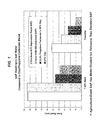
- FIG. 1 is a graph showing the free swell volume (2 grams of material in an excess of the aqueous salt solution) of the partially cross-linked acrylamide/acrylate/acrylic acid copolymers in aqueous 1.0% NaCl and 4.5% sea salt compared to a standard, partially cross-linked acrylate/acrylic acid copolymer SAP (Favor SXM 880) and a water swellable sodium bentonite (SPV) clay;
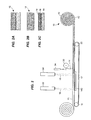
- FIGS. 2 and 3 are schematic views of apparatus and methods of manufacture used to make the geocomposite articles useful as salt water barriers in accordance with the present invention
- FIGS. 2A, 2B, and 2C are enlarged partially broken-away side views of various waterproofing geocomposite articles made in accordance with different embodiments of the present invention.
- FIG. 4 is a perspective view of a geocomposite article described herein oriented vertically, adjacent to a sea/soil interface.
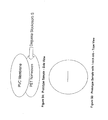
- FIGS. 5A and 5B are schematic views of test geocomposite articles with and without 1 inch slits that were tested under four meters of head salt water pressure comparing salt water barrier properties of articles with and without the partially cross-linked acrylamide/acrylate/acrylic acid copolymer, resulting in the data shown in the graphs of FIGS. 6 and 7 ;
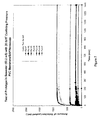
- FIGS. 6 and 7 are graphs showing that test geocomposite articles, as described herein, containing a 1 inch slit therethrough, will provide copolymer healing of the slit by the confined copolymer swelling under a 4 meter head of high conductivity salt water.
- Ranges may be expressed herein as from “about” or “approximately” one particular value and/or to “about” or “approximately” another particular value. When such a range is expressed, another embodiment includes from the one particular value and/or to the other particular value. Similarly, when values are expressed as approximations, by use of the antecedent "about,” it will be understood that the particular value forms another embodiment.
- Conductivity is a measure of the level of ion concentration of a solution. The more salts, acids or bases are dissociated, the greater the conductivity of the solution. In water or wastewater it is mainly a matter of the ions of dissolved salts, and consequently the conductivity is an index of the salt load in wastewater.
- the measurement of conductivity is generally expressed in S/cm (or mS/cm) which is the product of the conductance of the test solution and the geometric factor of the measuring cell.
- high conductivity waters are defined as waters with conductivity greater than 1 mS/cm. Conductivity can be measured using a variety of commercially available test instruments such as the Waterproof PC 300 hand-held meter made by Eutech Instruments/Oakton Instruments.
- the partially cross-linked acrylamide/acrylate/acrylic acid copolymer is incorporated as a layer between a water barrier sheet or film barrier layer, preferably a polymer sheet material or membrane layer, and a woven or non-woven geotextile sheet material fabric layer.
- the polymer sheet material layer would be disposed in contact with the high conductivity water and the copolymer is disposed adjacent to the polymer sheet material layer between the membrane and the fabric layers to perform the function of a safety layer to prevent the flow of high conductivity water through the article if the polymer sheet material layer is defective or develops a crack or hole during installation or during use.
- the copolymer can be incorporated into the intersticies of the geotextile fabric layer to create a fabric/copolymer composite layer that serves as the safety layer attached to the membrane layer to prevent the flow of high conductivity water through the article if the polymer sheet material layer is defective or develops a crack or hole during installation or during use.
- the partially cross-linked acrylamide partially neutralized acrylic acid copolymers e.g., STOCKOSORBT M and/or STOCKOSORB STM, have been found to have substantial free swell when contacted by high conductivity solutions.
- high conductivity aqueous solutions are 1% NaCl (conductivity of 18 mS/cm) and synthetic seawater (4.5% sea salt; conductivity of 53.2 mS/cm).
- the partially cross-linked acrylamide/partially neutralized acrylic acid copolymers provide substantial free swells when in contact with aqueous solutions contaminated with any, or a combination of, Na + , Ca ++ , Mg + , Al +++ and other multivalent cations in combination with anions that are common in sea water and other wastewaters.
- the partially cross-linked acrylamide/acrylate/acrylic acid copolymers used in the geocomposite articles should have a free swell in 4.5% salt water of at least 35 ml per 2 grams of copolymer, preferably at least about 40 ml/2 grams, more preferably at least about 50 ml/2 grams.
- Free swells are determined by sprinkling 2 grams of powdered copolymer into a 100 ml graduated cylinder and filling the cylinder to 100 ml with 4.5% salt water. The volume of copolymer that settles to the bottom of the graduated cylinder is then measured and is the free swell.
- the geocomposite mat includes a pre-formed woven or non-woven geotextile fabric material, having a thickness of about 0.5 mm to about 200 mm, preferably about I mm to about 100 mm, having a layer of powdered or granular partially cross-linked acrylamide/partially neutralized acrylic acid copolymer, either in at least an upper portion of its thickness across its entire major surface, or provided in a separate layer on the geotextile sheet or fabric material.
- the powdered or granular copolymer is at least partially disposed within the pores of the geotextile fabric or mat material to surround the upper fibers, e.g., by vacuum suction, by vibrating during deposition of the copolymer thereon to allow the powdered or granular copolymer to flow by gravity and vibrational forces into the pores of the geotextile sheet or mat, or simply by virtue of being sized to be received within the pores of the contacting surface of the woven or non-woven (preferably non-woven) geotextile fabric or mat.
- a liquid-impermeable cover sheet (membrane layer) is adhered to the upper major surface of the copolymer-containing geotextile fabric or mat to prevent the powdered or granular copolymer from escaping from the geotextile sheet or mat during transportation and installation, and to provide a primary water-impermeable layer to the article.
- the edges of the copolymer-containing geotextile sheet or mat can be sealed, such as by providing the upper water-impermeable cover sheet slightly larger than the dimensions of the geotextile sheet or mat and gluing or otherwise adhering the extra cover sheet material to the edges of the copolymer-containing geotextile, such as by heat sealing them together.
- edge sealing options include sewing, needlepunching, and ultrasonic welding of the cover sheet to the edge of the geotextile sheet or mat, or by applying a separate, edge-covering material that can be glued, heat sealed or ultrasonically welded to the water-impenneable cover sheet and/or to the geotextile sheet or mat.
- Edge sealing materials preferably are liquid-impermeable.
- powdered or granular materials can be admixed with the copolymer or can be applied as a separate layer.
- the additional powdered or granular materials include water-swellable sodium smectite clay, organophilic clay, activated carbon, coke breeze, zero-valent iron, apatite, zeolite, peat moss, polymeric ion exchange resins, polymeric adsorbents and mixtures thereof.
- the copolymer is disposed adjacent to the water-impermeable sheet or film barrier layer, and also may contain other materials, admixed therewith in an amount up to about 80% by weight of the mixture.
- the method of manufacture permits the manufacture of a geocomposite article that includes the partially cross-linked acrylamide/acrylate /acrylic acid copolymer that is structurally secure, without substantial lateral movement, and contains the swelling material either as a discrete layer between the impermeable sheet and the geotextile, uniformly distributed throughout the geotextile, or distributed as a gradient throughout the geocomposite article.
- the multi-layer geocomposite article can be manufactured to provide either a flexible or a rigid geocomposite article, and permits the manufacture of various modified geocomposite articles that include the salt water barrier swelling copolymer in addition to a zeolite or an organophilic clay with or without a sodium smectite water-absorbent material; the application of layer(s) of liquid-impermeable films or sheets of material over not only one, but over both major surfaces of the geocomposite article to Confine the granular or powdered copolymer material in place within the geotextile sheet or mat; the application of solid or liquid adhesive materials or compositions to glue a major unclersurface of the barrier layer to the copolymer or to the geotextile sheet material containing the copolymer for complete retention.
- the materials can be bonded together either mechanically (sewing, needlepunching or gluing), chemically, or physically (i.e., melting, or the like).
- the structure can be strengthened or reinforced by inserting one or more rigidifying materials into, or onto, the geocomposite article during manufacture, such as a sheet of perforated fiberglass; rope; cardboard; relatively rigid, liquid-penneable corrugated materials, e.g., corrugated cardboard, and the like at some point at or between the top and bottom major surfaces of the geocomposite article to provide various degrees of flexibility or rigidity; the capability of manufacturing the geocomposite articles without the necessity of a consolidation step; and providing various sizes, shapes and weights of geotextiles to achieve the benefits of each.
- the copolymers described herein are lightly cross-linked, i.e., have a crosslinking density of less than about 20%, preferably less than about 10%, and most preferably about 0.01% to about 7%.
- the crosslinking agent most preferably is used in an amount of less than about 7 wt%, and typically about 0.1 wt%, based on the total weight of monomers.
- Examples of crosslinking polyvinyl monomers include, but are not limited to, di, tri or other multifunctional acrylic, methacrylic, vinyl ether or acrylamido functional compounds that are well known in the art.
- the relative amounts of the acrylamide; acrylate; and acrylic acid in the salt water-waterproofing copolymers described herein can vary widely from about 1 mole percent to about 99 mole percent of each in the copolymer. Best results for achieving excellent free swells in high conductivity water are achieved where acrylamide forms about 5% to about 90 mole % of the copolymer, preferably about 15% to about 60 mole %; sodium and/or potassium acrylate forms about 2% to about 50% mole % of the copolymer, preferably about 5% to about 25 mole % of the copolymer; and acrylic acid forms about 2% to about 50% of the copolymer, preferably about 1% to about 10% mole of the copolymer.
- the apparatus generally includes a conveyor belt 17 that travels continuously around a pair of rollers 18 and 20, at least one of which is motor driven at a desired speed; and one or more powdered or granular material feeding devices, generally designated by reference numerals 22 and 24.
- a liquid-impermeable sheet material layer 14, used to provide a primary salt water barrier sheet is applied to an upper major surface of a pre-formed, geotextile sheet or mat 15 after loading the geotextile sheet or mat 15 with the a partially cross-linked acrylamide/acrylate/acrylic acid copolymer 16 from one or both feeding devices 22 and/or 24.
- the powdered or granular copolymer 16 penetrates the geotextile sheet or mat 15 by vibrating the geotextile 15 with vibrator 140.
- vacuum can be applied under the geotextile sheet or mat 15.
- the copolymer 16 minimally penetrates into an upper surface of the geotextile sheet or mat 15 to form a distinct copolymer layer disposed between the geotextile sheet or mat 15 and the primary waterproofing barrier layer 14.
- Additional granular or powdered materials can be applied to the geotextile sheet or mat 15 from feeding conduits 22 or 24 to provide one or more surface concentrations of copolymer 16 or to apply a different powdered or granular material, prior to applying the water-impenneable cover layers 14.
- the primary barrier layer 14 preferably is adhered to the upper major surface of the copolymer-containing geotextile sheet or mat 15 using a water-insoluble adhesive, applied from adhesive supply vessel 34.
- Other nonlimiting methods of introduction of the copolymer into the composite structure can be envisioned.
- Alternative methods could include: the coating or spraying of a paste or dispersion of the copolymer onto the sheet via extrusion or roll coating; preassembling a copolymer/fabric composite to be later combined with a water-impenneahte layer to form the final composite; or other methods to achieve the desired structure.
- FIG. 2A shows at geotextile sheet or mat 15 filled only on an upper major surface with the powdered or granular copolymer material 16.
- FIG. 2B shows the geotextile sheet or mat 15 filled with the copolymer 16 incorporated throughout the geotextile sheet or mat 15.
- FIG. 2C shows the partially embedding of the copolymer 16 into an upper surface of the geotextile (preferably non-woven) sheet or mat 15, a distinct intermediate layer of copolymer, and an adhesively secured upper, primary, water-impermeable sheet material layer 14.
- Other layers of material could be envisioned to assist in improvement of the mechanical strength of the composite, to assist with the containment of the copolymer in the structure, or improve the bonding of the different layers of the structure.
- FIG. 3 there is shown a schematic diagram of one method of loading the pre-formed, high loft geotextile mat 115 with powdered or granular copolymer in a dry state.
- the dry material feeding apparatus generally designated by reference numeral 100 is useful for depositing the partially cross-linked acrylamide/acrylate/acrylic acid copolymer, with or without other powdered or granular materials, such as an organophillic clay or other materials, from a receiving hopper 102.
- An auger 104 is disposed at a lower end of the receiving hopper 102, and in fluid communication therewith, to force the copolymer material through conduit 106 to an inlet 108 of elevator 110.
- the copolymer is discharged from the elevator 110 at elevator outlet opening 112, through conduit 114 into a receiving hopper 116.
- a pair of augers 118 and 120 in fluid communication with a lower portion of hopper 116 force the copolymer into one, two or three feeding mechanisms, generally designated by reference numerals 122, 124 and 126, for feeding the copolymer in a controlled manner to one, two or three continuous feed conveyor belts 128, 130 and 132 successively aligned above an elongated product conveyor belt 134.
- the copolymer generally is applied over the geotextile sheet or mat 115 in an amount of about 0.1 ounce to 3 pounds of powdered or granular copolymer per square foot of finished article major surface area, preferably about 0.1 ounce to about 5 pounds of powdered or granular copolymer per square foot of article major surface area.
- a supply of a liquid-impermeable flexible sheet material 136 in roll form 138 may be disposed above the continuous product conveyor belt 134 to provide a continuous supply of liquid-impermeable flexible sheet material onto an upper surface of the product conveyor belt 134.
- the upper surface of sheet material 136 from roll 138 may be sprayed with liquid adhesive from adhesive vessel 139 to adhere the sheet material to an undersurface of the geotextile sheet or mat 115, and the powdered or granular copolymer then is deposited onto the geotextile sheet or mat 1 15 from one, two or all three of the feed conveyor belts 128, 130 and 132. Any one, two or all three of the feed conveyor belts 228, 230 and 232 can be used to incor-porate the same or different powdered or granular materials throughout a portion of, or the entire thickness of the geotextile sheet or mat 115.
- Vibration apparatus 140 may be connected to the product conveyor belt directly below the feed conveyor belts 128, 130, and 132 to vibrate the powdered or granular contaminant-reactant materials into the geotextile sheet or mat 115.
- the powdered or granular copolymer is deposited across the entire width of the geotextile sheet or mat 115, as the particles drop from the feeders 122, 124 and/or 126. In this manner, the entire thickness or any portion of the thickness of the fibrous mat 115 may be filled with the copolymer.
- Dust collection suction devices 144, 146 and 148 may be disposed near each continuous feed conveyor belt 128, 130 and 132 to clear the air of fine particles emanating from feeding mechanisms 122, 124 and 126 and return the particles back to a dust collector 167 for disposal and/or back to the receiving hopper 102, via conduit 149.
- a second flexible, water-impermeable sheet material 150, from roll 151, is disposed on a downstream side of the copolymer feeding mechanisms 122, 124, and 126 and above the product conveyor belt 134.
- the second flexible sheet material 150 is fed by power driven roller 152, power rollers 154 and 156 and wind up rollers 158 and 160 to dispose a flexible, water-impermeable sheet material 150 on top of the contaminant-reactant-containing article to dispose the geotextile sheet or mat 115 and the separate, or geotextile-contained copolymer, between lower flexible sheet material 136 between the geotextile sheet or mat 115 and the upper flexible, water-impermeable primary barrier layer 150.
- Adhesive vessel 161 preferably applies adhesive to a surface of sheet material 150 to adhere the sheet material 150 to an upper surface of the copolymer-containing geotextile sheet or mat 115.
- the copolymer functions to absorb high conductivity multivalent ion-containing salt water regardless of its particle size.
- the powdered or granular copolymer preferably has a particle size in the range of about 10 ⁇ m to about 500 ⁇ m, preferably about 50 ⁇ m to about 1,000 ⁇ m, more preferably about 50 ⁇ m to about 800 um, and most preferably a particle size distribution of about 50 ⁇ m to about 800 ⁇ m containing up to 100% of the particles in the 50 ⁇ m to 200 ⁇ m range, preferably about 10wt% to about 50wt% in the 50 ⁇ m to 200 ⁇ m range, with 50 to 90wt.% of the particles in the 200 ⁇ m to 800 ⁇ m size range..
- the geocomposite articles 10 containing the partially cross-linked acrylamide/acrylate/acrylic acid copolymers described herein are particularly effective for vertical disposition adjacent to a sea/soil interface 200 for protecting the soil interface from salt water penetration by ocean 202 which would otherwise penetrate the sea/soil interface 200 into soil 204.
- the geotextile sheet or mat 15 or 115 can be woven or non-woven, preferably non-woven.
- Suitable fibers of construction of the geotextile mat 15 or 115 include fibers made from rayon, polypropylene, polyesters, nylon, acrylic polymers and copolymers, ceramic fiber, fiberglass, propylene-ethylene copolymers, polypropylene-polyamide copolymers, a single monofilament, polyethylene, polyurethane, cotton, jute and any other non-biodegradable, or very slowly biodegradable, fibers preferably having both bacteriological, hydrolytic and chemical resistance.
- the thickness of the article is not important and such articles can be formed with any desired thickness, e.g., 3 mils to about 4 inches containing about 0.1 oz to about 30 pounds per square foot of contaminant-reactant material.
- the geocomposite products described herein can be loaded with a heavy material such as metal screen, or a heavy mineral such as Barite, iron oxide or the like, relatively uniformly, together with the powdered or granular copolymer so that the overall product has a specific gravity greater than 1.0 thereby enabling the material to submerge easily in water. Accordingly, the product can be applied to the soil surface at the bottom of a filled lagoon, waste containment area, and the like, without first draining the lagoon or waste containment area.
- a heavy material such as metal screen, or a heavy mineral such as Barite, iron oxide or the like
- the product containing a heavy mineral can be rolled out over the water or waste containment upper level and allowed to sink to cover the soil surface at the bottom of the water or liquid waste material, thereby saving substantial time, effort and expense in sealing a pre-existing lagoon, waste containment area, and the like, without first draining the lagoon or waste containment area.
- the products described herein can have incorporated therein a very light material such as expanded vermiculite or expanded perlite, so that the product has substantial buoyancy in water, liquid waste materials, and the like, to form a cover over a liquid waste containment area, such as a toxic waste lagoon, to prevent external compounds, dust, and dirt from entering the waste containment area.
- a cover material can be adapted for removal or rolling back so that additional toxic waste and the like may be added to the covered containment area while maintaining a water-impervious cover to prevent further filling of the waste containment area with rain water.
- the products described herein can be essentially a single copolymer-containing, non-woven fabric material, adhered to a water-impermeable cover layer, e.g., polyvinyl chloride (PVC) primary barrier sheet.
- the geocomposite article includes an upper barrier layer, such as a polyvinyl chloride (PVC) sheet material adhesively secured to a woven or non-woven sheet material containing the partially cross-linked acrylamide/acrylate/acrylic acid copolymer.
- PVC polyvinyl chloride
- drainage structures and other articles used in the water drainage arts can be virtually incorporated into the interior of this product during manufacture, e.g., under the upper cover sheet.
- the product is particularly effective in shored wall conditions for application against steel sheet piling; soldier beam and lagging; soldier beam and earth installations; concrete caissons; earthen stabilized wall structures and diaphragm wall structures.
- the uses for the powdered or granular material-filled or partially-filled products described herein are virtually infinite since the product can be made completely flexible, relatively rigid or rigid and can be applied against very contoured and slopping surfaces, rough or smooth, as well as vertical surfaces, such as foundation walls, dams, along the sides of canals and below grades such as in tank farms, and for irrigation and water conservation techniques.
- geocomposite test articles were prepared from a PVC sheet material geomembrane having a thickness of .045 inch adhesively secured (using 2.30 grams of Bostik Supertak Aerosol Adhesive) to a non-woven polyethylene terephthalate (PET) fabric material containing 2.96 grams of STOCKOSORB S (partially cross-linked acrylamide/acrylate/acrylic acid copolymer) sandwiched between the geomembrane and the fabric layers.
- the PVC and PET sheet materials were circular sheets each 10 cm in diameter, having a surface area of 78.54 cm 2 .
- the geocomposite test articles were cut with a 1 inch slit through all layers, as shown in FIG. 5 .
- the geocomposite test articles were cut into 10 cm diameter circles.
- the test samples were then were cut with a 1-inch slit through all layers, as shown in Figure 5 , to simulate damage to the geomembrane.
- the slit samples were then placed in a circular test cell, sealed at its edges, at the bottom of a water tower to provide 4 meters of salt water (4.5 wt. % Sea Salt; 53.2 mS/cm Conductivity) head pressure.
- a porous stone and weight were placed on top of the slit to simulate a confining pressure on the sample of 20lbs/ft 2 without preventing the access of the sea salt solution to the slit.
- the test cell is then filled with the test solution exposing the test sample to the saltwater under the specified conditions.
- the amount of salt water that flows through the slit in the test sample is collected and measured at regular time intervals. Testing is conducted for as long as is practical for samples that exhibit poor self healing and for a minimum of 24 hours for samples that exhibit good self healing. Typical results of the testing are shown in FIG. 6 .
- the fluid flow vs. time is plotted for the geocomposite test article sample and the data is evaluated to determine the slope of the curve (flow rate in mL/min) once the fluid flow has reached steady state.
- the fluid flow of a geocomposite control sample is also measured.
- the geocomposite control sample consists of the water-impermeable membrane employed with the test sample without an active self healing layer.
- the test apparatus is evaluated after the test to make sure that test cell failure did not compromise results.
- SPI self-healing performance index
- S T Flow rate of fluid through the slit in the sample (mL/min) after steady state flow has been achieved
- S C the Flow rate through a control sample (mL/min) after steady state flow has been achieved.
- the articles tested as described above should have an SPI less than 0.1, preferably less than .01, more preferably less than 0.015, even more preferably less than 0.005 and most preferably less than 0.001.
- a control test geocomposite article containing the PVC layer adhesively secured to the non-woven PET layer, with no copolymer carried by the non-woven, had rapid, linear salt-water leakage of about 139.4 ml/min.
- FIG. 7 shows the results of the control of FIG. 6 (PVC plus non-woven without copolymer) and Run #1 through Run #7 over 1440 minutes.
- the control sample shows continued leakage while the Runs #1 - 7 show essentially no salt water leakage after 20-30 minutes.
Landscapes
- Engineering & Computer Science (AREA)
- Structural Engineering (AREA)
- Mining & Mineral Resources (AREA)
- Life Sciences & Earth Sciences (AREA)
- Environmental & Geological Engineering (AREA)
- Textile Engineering (AREA)
- Civil Engineering (AREA)
- General Life Sciences & Earth Sciences (AREA)
- Hydrology & Water Resources (AREA)
- Geology (AREA)
- Geochemistry & Mineralogy (AREA)
- Paleontology (AREA)
- General Engineering & Computer Science (AREA)
- Architecture (AREA)
- Laminated Bodies (AREA)
- Revetment (AREA)
- Pharmaceuticals Containing Other Organic And Inorganic Compounds (AREA)
- Processing Of Solid Wastes (AREA)
- Mechanical Engineering (AREA)
- Acyclic And Carbocyclic Compounds In Medicinal Compositions (AREA)
Claims (15)
- Selbstheilender Geoverbundmaterialgegenstand, umfassend:a) mindestens eine wasserundurchlässige Membranschicht; undb) eine aktive salzwasserquellbare selbstheilende Schicht, bestehend aus teilweise vernetztem, wasserunlöslichem Acrylamid/Acrylsäure/Acrylatcopolymer; undc) gegebenenfalls einen Gewebe- oder Vliesgeotextilstoff, enthaltend mindestens einen Teil der selbstheilenden Schicht, geklebt auf die Membranschicht, um die aktive selbstheilende Schicht zwischen der Membran und dem Stoff zwischenzuschieben,
wobei der Geoverbundmaterialgegenstand einen Selbstheilungsleistungsindex von weniger als 0,1 beim Test durch Anbringen eines Schlitzes von 1 Inch durch alle Schichten des Geoverbundmaterialgegenstands, verschlossen an seinen Kanten, unter 4 Metern Wasser mit einer Leitfähigkeit von 1 mS/cm oder mehr zeigt. - Selbstheilender Geoverbundmaterialgegenstand gemäß Anspruch 1, wobei die aktive selbstheilende Schicht ein gepulvertes oder granuläres wasserabsorbierendes Material mit hoher Leitfähigkeit ist, das in der Lage zur Absorption von Wasser mit einer Leitfähigkeit von mindestens 1 mS/cm ist, wobei das gepulverte oder granuläre wasserabsorbierende Material mit hoher Leitfähigkeit gegebenenfalls im Gegenstand in einer Menge von 0,1 Unzen bis 30 Pounds per ft2, vorzugsweise 0,1 Unzen bis 5 Pounds per ft2 eines größeren Oberflächengebiets des Gegenstands ist, und wobei das wasserabsorbierende Material gegebenenfalls freies Quellen von mehr als 35 mL/2, Gramm Material in 4,5% Seesalz in Wasserlösung aufweist.
- Selbstheilender Geoverbundmaterialgegenstand gemäß Anspruch 2, wobei die aktive selbstheilende Schicht ein zum Teil neutralisiertes, zum Teil vernetztes wasserunlösliches Acrylsäurecopolymer umfasst, und wobei gegebenenfalls das zweite gepulverte oder granuläre Material im Copolymer in einer Menge von weniger als 50 Gew.-% umfasst ist, bezogen auf das Gesamtgewicht des Copolymers und des zweiten gepulverten oder granulären Materials.
- Selbstheilender Geoverbundmaterialgegenstand gemäß Anspruch 2, wobei die aktive selbstheilende Schicht eine Kombination des Copolymers gemeinsam mit einem zweiten gepulverten oder granulären Material umfasst, ausgewählt aus der Gruppe, bestehend aus Natriumsmektitton; organophilem Ton; Aktivkohle; Koksgrus; nullwertigem Eisen; Apatit; Zeolith; Torf; polymerem Ionenaustauscherharz; polymerem Adsorbens; und einer Mischung davon, oder wobei die aktive selbstheilende Schicht ein teilweises vernetztes, wasserunlösliches Acrylamid/Acrylsäure/Acrylatcopolymer ist, identifiziert durch die CAS # 31212-13-2.
- Geoverbundmaterialgegenstand gemäß Anspruch 3, wobei das Copolymer etwa 0-95 Mol% Acrylamid; etwa 5-95 Mol% Natrium-oder Kalium- oder Lithium- oder Ammoniumacrylat enthält; und 5-95 Mol% Acrylsäure.
- Geoverbundmaterialgegenstand gemäß Anspruch 4, wobei das Copolymer etwa 25-50 Mol% Acrylamid enthält; etwa 25-50 Mol% Natrium- oder Kalium- oder Lithium- oder Ammoniumacrylat; und etwa 25-50 Mol% Acrylsäure, und wobei gegebenenfalls das gepulverte oder granuläre Copolymer weniger als 5000 ppm Acrylamidmonomer umfasst, vorzugsweise weniger als 1000 ppm Acrylamidmonomer und stärker bevorzugt weniger als 100 ppm Acrylamidmonomer.
- Geoverbundmaterialgegenstand gemäß Anspruch 1, wobei der Geotextilstoff vor Aufnahme des gepulverten oder granulären Copolymers eine scheinbare Öffnungsgröße im Bereich von etwa 0,5 mm bis etwa 6 mm besitzt, und wobei gegebenenfalls das gepulverte oder granuläre Copolymer etwa 50 Volumenprozent bis etwa 99,9 Volumenprozent des Geotextilstoffs umfasst, oder wobei der Geotextilstoff ein Vlies ist.
- Geoverbundmaterialgegenstand gemäß Anspruch 2, wobei das gepulverte oder granuläre Copolymer eine Partikelgröße besitzt, so dass mindestens 90% der Partikel eine Größe im Bereich von etwa 6 Mesh bis etwa 325 Mesh besitzen.
- Geoverbundmaterialgegenstand gemäß Anspruch 1, wobei das gepulverte oder granuläre reaktive Material etwa 50 Volumenprozent bis etwa 99,9 Volumenprozent des Geotextilstoffs umfasst, und der Geoverbundmaterialgegenstand einen Selbstheilungs-Leistungsindex weniger als 0,01 aufweist.
- Verfahren zur Herstellung eines Geoverbundmaterialgegenstands, der eine Sperre gegenüber Wasser mit einer Leitfähigkeit von mindestens 1 mS/cm liefert, umfassend:Bereitstellen eines Gewebe- oder Vliesgeotextilstoffs als Folie oder Matte;Inkontaktbringen der Geotextilfolie oder -matte mit einer salzwasserquellbaren Schicht, bestehend aus einem gepulverten oder granulären teilweise vernetzten wasserunlöslichen Acrylamid/Acrylat/Acrylsäurecopolymer und Veranlassen mindestens eines Teils des gepulverten oder granulären Copolymers dazu, dass es in die Geotextilmatte fließt, um zumindest einen Teil der Geotextilfolie oder -matte in deren Öffnungen zu füllen; sowieKleben einer flüssigkeitsundurchlässigen Abdeckfolie auf eine Hauptoberfläche der Geotextilmatte, die dem Copolymer benachbart ist, nachdem die Matte das gepulverte oder granuläre Copolymer aufgenommen hat, des Weiteren gegebenenfalls umfassend den Schritt des Befestigens einer flüssigkeitsundurchlässigen Abdeckfolie auf einer unteren Hauptoberfläche der Geotextilfolie oder -matte vor dem Inkontaktbringen der Geotextilfolie oder -matte mit dem gepulverten oder granulären Copolymer, oder des Weiteren umfassend den Schritt des Abdeckens von Kanten der vorgeformten Geotextilmatte mit einer wasserundurchlässigen Schicht aus Folienmaterial.
- Verfahren gemäß Anspruch 10, wobei die Kanten der Geotextilfolie oder -matte abgedeckt werden mit überschüssigem Material aus der wasserundurchlässigen Abdeckfolie, und gegebenenfalls wobei das überschüssige Material der Abdeckfolie befestigt wird, so dass es die Kanten des Geotextilstoffs durch Klebebefestigen der Abdeckfolie über die Kanten des Geotextilstoffs, oder Einschweißen der Abdeckfolie, die die Kanten des Geotextilstoffs umgibt, abdeckt.
- Verfahren gemäß Anspruch 10, wobei das gepulverte oder granuläre Copolymer zum Fließen in den Geotextilstoff gebracht wird durch Vibrieren des Geotextilstoffs, während er in Kontakt ist mit dem gepulverten oder granulären Copolymer, oder durch Anlegen eines Vakuums an eine untere Oberfläche des Geotextilstoffs, um das gepulverte oder granuläre Copolymer in die Folie oder die Matte von einer oberen Oberfläche zu ziehen, gegebenenfalls umfassend den Schritt des Abdeckens aller Kantenoberflächen mit überschüssigem Abdeckmaterial, und Befestigen des überschüssigen Abdeckmaterials an dem Geoverbundmaterialgegenstand, wobei das Austreten gepulverten oder granulären Copolymers durch alle Kantenoberflächen des Geotextilstoffs verringert oder eliminiert wird.
- Verfahren gemäß Anspruch 10, des Weiteren umfassend den Schritt des Bereitstellens der wasserundurchlässigen Abdeckfolie mit einer Größe, die über der Hauptoberfläche des Geotextilstoffs liegt, um überschüssiges Abdeckmaterial bereitzustellen, so dass das überschüssige Abdeckmaterial sich über eine Kantenoberfläche des Geoverbundmaterialgegenstands erstreckt, und Befestigen des überschüssigen Abdeckmaterials am Geoverbundmaterialgegenstand, um die Kantenoberfläche abzudecken, wodurch das Austreten von gepulvertem oder granulärem Copolymer durch die abgedeckte Kantenoberfläche des Geoverbundmaterialgegenstands verringert oder eliminiert wird.
- Verfahren gemäß Anspruch 12, wobei die Abdeckfolie über der Kantenoberfläche befestigt wird durch ein Hilfsmittel, ausgewählt aus der Gruppe, bestehend aus Klebebefestigung, Thermoschweißtechniken, Vibrationsschweißen und Ultraschallschweißen.
- Verfahren zum Wasserdichtmachen einer Oberfläche vom Kontakt mit einer Quelle von Wasser mit einer Leitfähigkeit von mindestens 1 mS/cm, umfassend Anordnen des Geoverbundmaterialgegenstands gemäß Anspruch 1 oder 5, so dass die wasserundurchlässige Abdeckfolie zuerst mit der Wasserquelle in Kontakt kommt.
Priority Applications (1)
| Application Number | Priority Date | Filing Date | Title |
|---|---|---|---|
| PL08799119T PL2217439T3 (pl) | 2007-11-19 | 2008-09-04 | Samonaprawiająca się bariera dla słonej wody |
Applications Claiming Priority (2)
| Application Number | Priority Date | Filing Date | Title |
|---|---|---|---|
| US11/942,638 US10012079B2 (en) | 2007-11-19 | 2007-11-19 | Self healing salt water barrier |
| PCT/US2008/075162 WO2009067286A1 (en) | 2007-11-19 | 2008-09-04 | Self healing salt water barrier |
Publications (2)
| Publication Number | Publication Date |
|---|---|
| EP2217439A1 EP2217439A1 (de) | 2010-08-18 |
| EP2217439B1 true EP2217439B1 (de) | 2011-06-29 |
Family
ID=40032658
Family Applications (1)
| Application Number | Title | Priority Date | Filing Date |
|---|---|---|---|
| EP08799119A Active EP2217439B1 (de) | 2007-11-19 | 2008-09-04 | Selbstheilende salzwassersperre |
Country Status (9)
| Country | Link |
|---|---|
| US (1) | US10012079B2 (de) |
| EP (1) | EP2217439B1 (de) |
| AT (1) | ATE514550T1 (de) |
| CA (1) | CA2705548C (de) |
| CL (1) | CL2008002881A1 (de) |
| ES (1) | ES2366362T3 (de) |
| PL (1) | PL2217439T3 (de) |
| TW (1) | TWI365909B (de) |
| WO (1) | WO2009067286A1 (de) |
Families Citing this family (11)
| Publication number | Priority date | Publication date | Assignee | Title |
|---|---|---|---|---|
| KR101389222B1 (ko) | 2009-07-31 | 2014-04-24 | 도요보 가부시키가이샤 | 가스 배리어성 적층 필름 |
| US8318616B2 (en) * | 2009-08-19 | 2012-11-27 | Amcol International Corporation | Salt water swellable compositions and articles |
| JP5668459B2 (ja) | 2009-12-24 | 2015-02-12 | 東洋紡株式会社 | ガスバリア性積層フィルム |
| CA2742200A1 (en) * | 2010-06-07 | 2011-12-07 | Strad Energy Services Ltd. | A rig mat system and method of making the same |
| US8454773B2 (en) | 2010-11-08 | 2013-06-04 | Amcol International Corporation | Induction welded waterproofing |
| ES2585334T3 (es) * | 2011-03-31 | 2016-10-05 | Amcol International Corporation | Barrera autorreparadora contra el agua salada |
| HUE058910T2 (hu) * | 2014-06-04 | 2022-09-28 | Zeon Corp | Kötõanyag-összetétel lítiumion-akkumulátor elektród-alkalmazáshoz, zagyösszetétel lítiumion-akkumulátor elektród-alkalmazáshoz, elektród lítiumakkumulátor elektród-alkalmazáshoz, és lítiumion-akkumulátor |
| WO2018075524A1 (en) * | 2016-10-18 | 2018-04-26 | Phoenix Services, Llc | Reactive geocomposite mat |
| EP3802106B1 (de) | 2018-05-24 | 2024-04-03 | Officine Maccaferri S.p.A. | Geokomposit und verfahren zur herstellung davon |
| CN112060722B (zh) * | 2020-09-29 | 2025-04-08 | 安徽宝翔建设集团有限责任公司 | 一种抗变形锁水型压花工地用布 |
| CN118288645A (zh) * | 2024-04-23 | 2024-07-05 | 浙江万汇新材料科技有限公司 | 一种板桩用塑钢材料及其制备方法 |
Family Cites Families (45)
| Publication number | Priority date | Publication date | Assignee | Title |
|---|---|---|---|---|
| US3343370A (en) | 1962-10-18 | 1967-09-26 | Kalle Ag | Earth embankment with internal water barrier |
| BE653548A (de) | 1963-10-03 | |||
| DE1634087B2 (de) | 1965-02-02 | 1973-09-13 | Kalle Ag, 6202 Wiesbaden-Biebrich | Verfahren zum Schutz brandungs gefährdeter Kustenabschnitte |
| US3949560A (en) * | 1973-02-07 | 1976-04-13 | American Colloid Company | Method and composition for preventing water contaminated with industrial waste from seeping through soil containing said water |
| US4048373A (en) * | 1974-05-23 | 1977-09-13 | American Colloid Company | Water barrier panel |
| US4021402A (en) * | 1974-05-23 | 1977-05-03 | American Colloid Company | Method and composition for preventing water contaminated with industrial waste seeping through soil containing said water |
| US3986365A (en) * | 1975-02-20 | 1976-10-19 | American Colloid Company | Soil sealing method |
| PH13790A (en) * | 1975-10-28 | 1980-10-01 | American Colloid Co | Water barrier panel and method |
| US4202413A (en) * | 1978-11-15 | 1980-05-13 | Mobil Oil Corporation | Well cementing process using presheared water swellable clays |
| CA1143957A (en) * | 1981-01-13 | 1983-04-05 | Bemalux Inc. | Waterproofing barrier |
| US4501788A (en) * | 1981-02-27 | 1985-02-26 | Clem Environmental Corp. | Waterproofing soil |
| US4467015A (en) * | 1981-11-02 | 1984-08-21 | Clem Arthur G | Waterproofing structure |
| US4787780A (en) * | 1982-11-22 | 1988-11-29 | American Colloid Company | Method of waterproofing with a self-healing bentonite sheet material composite article |
| US4534926A (en) * | 1982-11-22 | 1985-08-13 | American Colloid Company | Uninhibited bentonite composition |
| US4565468A (en) * | 1983-10-24 | 1986-01-21 | Crawford Leslie A | Moisture impervient barrier and method for making same |
| US4656062A (en) * | 1984-04-27 | 1987-04-07 | American Colloid Company | Self-healing bentonite sheet material composite article |
| US4634538A (en) * | 1984-08-13 | 1987-01-06 | American Colloid Company | Water swellable clay composition and method to maintain stability in salt contaminated water |
| US4693923A (en) * | 1985-11-22 | 1987-09-15 | Mcgroarty Bryan M | Water barrier |
| US4872911A (en) * | 1986-12-30 | 1989-10-10 | Walley David H | Stop leak composition |
| US5171781A (en) * | 1987-01-30 | 1992-12-15 | Allied Colloids Limited | Polymeric compositions |
| DE3704503C3 (de) | 1987-02-13 | 1998-02-26 | Naue Fasertechnik | Wasserundurchlässige Dichtungsmatte |
| US5022182A (en) * | 1988-08-22 | 1991-06-11 | Promac Industries, Ltd. | Agricultural processes and products |
| DE3843780A1 (de) * | 1988-12-24 | 1990-07-05 | Basf Ag | Verfahren zur herstellung von feinteiligen, gelfoermigen, wasserquellbaren copolymerisaten |
| US5132021A (en) * | 1989-08-11 | 1992-07-21 | American Colloid Company | In situ treatment of waste water to prevent ground water contamination |
| US5164459A (en) * | 1990-04-02 | 1992-11-17 | Nippon Shokubai Kagaku Kogyo Co., Ltd. | Method for treating the surface of an absorbent resin |
| US5237945A (en) * | 1990-12-17 | 1993-08-24 | American Colloid Company | Water barrier formed from a clay-fiber mat |
| US5389166A (en) * | 1990-12-17 | 1995-02-14 | American Colloid Company | Water barrier formed from a clay-fiber mat |
| JPH06154596A (ja) * | 1992-11-18 | 1994-06-03 | Sanyo Chem Ind Ltd | 耐塩安定性吸収剤及びその製法 |
| US5407879A (en) * | 1993-09-29 | 1995-04-18 | American Colloid Company | Method of improving the contaminant resistance of a smectite clay by rewetting and impregnating the clay with a water-soluble polymer, and redrying the polymer-impregnated clay |
| US5501753A (en) * | 1994-09-01 | 1996-03-26 | Geosynthetics, Inc. | Stabilized fluid barrier member and method for making and using same |
| US5679364A (en) | 1995-06-07 | 1997-10-21 | Lee County Mosquito Control District | Compositions and methods for reducing the amount of contaminants in aquatic and terrestrial environments |
| AU7296396A (en) * | 1995-10-24 | 1997-05-15 | Camelot Superabsorbents Limited | Absorption of water |
| ATE255661T1 (de) | 1999-05-26 | 2003-12-15 | Alberta Res Council | Verstärkter verbundwerkstoff aus vernetzter polymer/ton legierung |
| US6610781B1 (en) * | 1999-05-26 | 2003-08-26 | Alberta Research Council Inc. | Reinforced networked polymer/clay alloy composite |
| US6610780B1 (en) * | 1999-05-26 | 2003-08-26 | Alberta Research Council Inc. | Networked polymer/clay alloy |
| DE60102353T2 (de) * | 2000-07-28 | 2004-08-19 | Dainippon Ink & Chemicals, Inc. | Wasserabsorbierendes material und absorbierender gegenstand der dieses verwendet |
| EP1534515A2 (de) | 2002-08-15 | 2005-06-01 | Paul Vogt | Dichtungsmatte und dichtungsbahn mit einer superabsorbierenden schicht, verfahren zu deren herstellung und verwendung derselben |
| US6852813B2 (en) * | 2002-09-25 | 2005-02-08 | Amcol International Corporation | Polymer-filled sheet material |
| US6783802B2 (en) * | 2002-09-25 | 2004-08-31 | Amcol International Corporation | Hydraulic barrier |
| US7193006B2 (en) * | 2002-12-06 | 2007-03-20 | Nippon Shokubai Co., Ltd. | Process for continuous production of water-absorbent resin product |
| US6802672B2 (en) * | 2003-01-30 | 2004-10-12 | Gse Lining Technology | Leachate distribution system |
| US20050103707A1 (en) * | 2003-11-19 | 2005-05-19 | Amcol International Corporation | Contaminant-reactive geocomposite mat and method of manufacture and use |
| US20070044528A1 (en) * | 2005-09-01 | 2007-03-01 | American Soil Technologies, Inc. | Soil Amendment |
| US10016954B2 (en) | 2007-11-19 | 2018-07-10 | Amcol International Corporation | Self healing salt water barrier |
| ES2585334T3 (es) | 2011-03-31 | 2016-10-05 | Amcol International Corporation | Barrera autorreparadora contra el agua salada |
-
2007
- 2007-11-19 US US11/942,638 patent/US10012079B2/en active Active
-
2008
- 2008-09-04 WO PCT/US2008/075162 patent/WO2009067286A1/en not_active Ceased
- 2008-09-04 AT AT08799119T patent/ATE514550T1/de not_active IP Right Cessation
- 2008-09-04 EP EP08799119A patent/EP2217439B1/de active Active
- 2008-09-04 PL PL08799119T patent/PL2217439T3/pl unknown
- 2008-09-04 CA CA2705548A patent/CA2705548C/en active Active
- 2008-09-04 ES ES08799119T patent/ES2366362T3/es active Active
- 2008-09-15 TW TW097135376A patent/TWI365909B/zh not_active IP Right Cessation
- 2008-09-26 CL CL2008002881A patent/CL2008002881A1/es unknown
Also Published As
| Publication number | Publication date |
|---|---|
| TW200925256A (en) | 2009-06-16 |
| US10012079B2 (en) | 2018-07-03 |
| ES2366362T3 (es) | 2011-10-19 |
| US20090130368A1 (en) | 2009-05-21 |
| PL2217439T3 (pl) | 2011-11-30 |
| CA2705548C (en) | 2015-03-31 |
| CL2008002881A1 (es) | 2009-03-20 |
| TWI365909B (en) | 2012-06-11 |
| EP2217439A1 (de) | 2010-08-18 |
| WO2009067286A1 (en) | 2009-05-28 |
| ATE514550T1 (de) | 2011-07-15 |
| CA2705548A1 (en) | 2009-05-28 |
Similar Documents
| Publication | Publication Date | Title |
|---|---|---|
| CA2705548C (en) | Self healing salt water barrier | |
| EP2505719B1 (de) | Selbstheilende Salzwasserbarriere | |
| US10016954B2 (en) | Self healing salt water barrier | |
| US8042696B2 (en) | Contaminant-reactive geocomposite mat and method of manufacture and use | |
| US7854330B2 (en) | Contaminant-reactive geocomposite mat and method of manufacture and use | |
| US8454773B2 (en) | Induction welded waterproofing | |
| JPH06240571A (ja) | 粘土・繊維マットから形成された防水材 | |
| AU2010284574A1 (en) | Salt water swellable compositions and articles |
Legal Events
| Date | Code | Title | Description |
|---|---|---|---|
| PUAI | Public reference made under article 153(3) epc to a published international application that has entered the european phase |
Free format text: ORIGINAL CODE: 0009012 |
|
| 17P | Request for examination filed |
Effective date: 20100604 |
|
| AK | Designated contracting states |
Kind code of ref document: A1 Designated state(s): AT BE BG CH CY CZ DE DK EE ES FI FR GB GR HR HU IE IS IT LI LT LU LV MC MT NL NO PL PT RO SE SI SK TR |
|
| AX | Request for extension of the european patent |
Extension state: AL BA MK RS |
|
| RIN1 | Information on inventor provided before grant (corrected) |
Inventor name: MOSIEWICZ, MAREK, R. Inventor name: LARIONOVA, NATALIYA, V. Inventor name: BEIHOFFER, THOMAS, W. |
|
| GRAP | Despatch of communication of intention to grant a patent |
Free format text: ORIGINAL CODE: EPIDOSNIGR1 |
|
| DAX | Request for extension of the european patent (deleted) | ||
| GRAS | Grant fee paid |
Free format text: ORIGINAL CODE: EPIDOSNIGR3 |
|
| GRAA | (expected) grant |
Free format text: ORIGINAL CODE: 0009210 |
|
| RIN1 | Information on inventor provided before grant (corrected) |
Inventor name: LARIONOVA, NATALIYA, V. Inventor name: MOSIEWICZ, MAREK, R. Inventor name: BEIHOFFER, THOMAS, W. |
|
| AK | Designated contracting states |
Kind code of ref document: B1 Designated state(s): AT BE BG CH CY CZ DE DK EE ES FI FR GB GR HR HU IE IS IT LI LT LU LV MC MT NL NO PL PT RO SE SI SK TR |
|
| REG | Reference to a national code |
Ref country code: GB Ref legal event code: FG4D |
|
| REG | Reference to a national code |
Ref country code: CH Ref legal event code: EP |
|
| REG | Reference to a national code |
Ref country code: IE Ref legal event code: FG4D |
|
| REG | Reference to a national code |
Ref country code: DE Ref legal event code: R096 Ref document number: 602008007969 Country of ref document: DE Effective date: 20110818 |
|
| REG | Reference to a national code |
Ref country code: ES Ref legal event code: FG2A Ref document number: 2366362 Country of ref document: ES Kind code of ref document: T3 Effective date: 20111019 Ref country code: NL Ref legal event code: VDEP Effective date: 20110629 |
|
| PG25 | Lapsed in a contracting state [announced via postgrant information from national office to epo] |
Ref country code: HR Free format text: LAPSE BECAUSE OF FAILURE TO SUBMIT A TRANSLATION OF THE DESCRIPTION OR TO PAY THE FEE WITHIN THE PRESCRIBED TIME-LIMIT Effective date: 20110629 Ref country code: LT Free format text: LAPSE BECAUSE OF FAILURE TO SUBMIT A TRANSLATION OF THE DESCRIPTION OR TO PAY THE FEE WITHIN THE PRESCRIBED TIME-LIMIT Effective date: 20110629 Ref country code: SE Free format text: LAPSE BECAUSE OF FAILURE TO SUBMIT A TRANSLATION OF THE DESCRIPTION OR TO PAY THE FEE WITHIN THE PRESCRIBED TIME-LIMIT Effective date: 20110629 Ref country code: NO Free format text: LAPSE BECAUSE OF FAILURE TO SUBMIT A TRANSLATION OF THE DESCRIPTION OR TO PAY THE FEE WITHIN THE PRESCRIBED TIME-LIMIT Effective date: 20110929 |
|
| PG25 | Lapsed in a contracting state [announced via postgrant information from national office to epo] |
Ref country code: GR Free format text: LAPSE BECAUSE OF FAILURE TO SUBMIT A TRANSLATION OF THE DESCRIPTION OR TO PAY THE FEE WITHIN THE PRESCRIBED TIME-LIMIT Effective date: 20110930 Ref country code: FI Free format text: LAPSE BECAUSE OF FAILURE TO SUBMIT A TRANSLATION OF THE DESCRIPTION OR TO PAY THE FEE WITHIN THE PRESCRIBED TIME-LIMIT Effective date: 20110629 Ref country code: SI Free format text: LAPSE BECAUSE OF FAILURE TO SUBMIT A TRANSLATION OF THE DESCRIPTION OR TO PAY THE FEE WITHIN THE PRESCRIBED TIME-LIMIT Effective date: 20110629 Ref country code: AT Free format text: LAPSE BECAUSE OF FAILURE TO SUBMIT A TRANSLATION OF THE DESCRIPTION OR TO PAY THE FEE WITHIN THE PRESCRIBED TIME-LIMIT Effective date: 20110629 Ref country code: LV Free format text: LAPSE BECAUSE OF FAILURE TO SUBMIT A TRANSLATION OF THE DESCRIPTION OR TO PAY THE FEE WITHIN THE PRESCRIBED TIME-LIMIT Effective date: 20110629 |
|
| REG | Reference to a national code |
Ref country code: PL Ref legal event code: T3 |
|
| PG25 | Lapsed in a contracting state [announced via postgrant information from national office to epo] |
Ref country code: BE Free format text: LAPSE BECAUSE OF FAILURE TO SUBMIT A TRANSLATION OF THE DESCRIPTION OR TO PAY THE FEE WITHIN THE PRESCRIBED TIME-LIMIT Effective date: 20110629 |
|
| PG25 | Lapsed in a contracting state [announced via postgrant information from national office to epo] |
Ref country code: PT Free format text: LAPSE BECAUSE OF FAILURE TO SUBMIT A TRANSLATION OF THE DESCRIPTION OR TO PAY THE FEE WITHIN THE PRESCRIBED TIME-LIMIT Effective date: 20111031 Ref country code: EE Free format text: LAPSE BECAUSE OF FAILURE TO SUBMIT A TRANSLATION OF THE DESCRIPTION OR TO PAY THE FEE WITHIN THE PRESCRIBED TIME-LIMIT Effective date: 20110629 Ref country code: CZ Free format text: LAPSE BECAUSE OF FAILURE TO SUBMIT A TRANSLATION OF THE DESCRIPTION OR TO PAY THE FEE WITHIN THE PRESCRIBED TIME-LIMIT Effective date: 20110629 Ref country code: IS Free format text: LAPSE BECAUSE OF FAILURE TO SUBMIT A TRANSLATION OF THE DESCRIPTION OR TO PAY THE FEE WITHIN THE PRESCRIBED TIME-LIMIT Effective date: 20111029 Ref country code: NL Free format text: LAPSE BECAUSE OF FAILURE TO SUBMIT A TRANSLATION OF THE DESCRIPTION OR TO PAY THE FEE WITHIN THE PRESCRIBED TIME-LIMIT Effective date: 20110629 |
|
| PG25 | Lapsed in a contracting state [announced via postgrant information from national office to epo] |
Ref country code: CY Free format text: LAPSE BECAUSE OF FAILURE TO SUBMIT A TRANSLATION OF THE DESCRIPTION OR TO PAY THE FEE WITHIN THE PRESCRIBED TIME-LIMIT Effective date: 20110629 Ref country code: RO Free format text: LAPSE BECAUSE OF FAILURE TO SUBMIT A TRANSLATION OF THE DESCRIPTION OR TO PAY THE FEE WITHIN THE PRESCRIBED TIME-LIMIT Effective date: 20110629 Ref country code: SK Free format text: LAPSE BECAUSE OF FAILURE TO SUBMIT A TRANSLATION OF THE DESCRIPTION OR TO PAY THE FEE WITHIN THE PRESCRIBED TIME-LIMIT Effective date: 20110629 |
|
| PG25 | Lapsed in a contracting state [announced via postgrant information from national office to epo] |
Ref country code: MC Free format text: LAPSE BECAUSE OF NON-PAYMENT OF DUE FEES Effective date: 20110930 |
|
| PLBE | No opposition filed within time limit |
Free format text: ORIGINAL CODE: 0009261 |
|
| STAA | Information on the status of an ep patent application or granted ep patent |
Free format text: STATUS: NO OPPOSITION FILED WITHIN TIME LIMIT |
|
| 26N | No opposition filed |
Effective date: 20120330 |
|
| REG | Reference to a national code |
Ref country code: IE Ref legal event code: MM4A |
|
| PG25 | Lapsed in a contracting state [announced via postgrant information from national office to epo] |
Ref country code: DK Free format text: LAPSE BECAUSE OF FAILURE TO SUBMIT A TRANSLATION OF THE DESCRIPTION OR TO PAY THE FEE WITHIN THE PRESCRIBED TIME-LIMIT Effective date: 20110629 |
|
| PG25 | Lapsed in a contracting state [announced via postgrant information from national office to epo] |
Ref country code: IE Free format text: LAPSE BECAUSE OF NON-PAYMENT OF DUE FEES Effective date: 20110904 |
|
| REG | Reference to a national code |
Ref country code: DE Ref legal event code: R097 Ref document number: 602008007969 Country of ref document: DE Effective date: 20120330 |
|
| PG25 | Lapsed in a contracting state [announced via postgrant information from national office to epo] |
Ref country code: MT Free format text: LAPSE BECAUSE OF FAILURE TO SUBMIT A TRANSLATION OF THE DESCRIPTION OR TO PAY THE FEE WITHIN THE PRESCRIBED TIME-LIMIT Effective date: 20110629 |
|
| REG | Reference to a national code |
Ref country code: CH Ref legal event code: PL |
|
| PG25 | Lapsed in a contracting state [announced via postgrant information from national office to epo] |
Ref country code: LU Free format text: LAPSE BECAUSE OF NON-PAYMENT OF DUE FEES Effective date: 20110904 |
|
| PG25 | Lapsed in a contracting state [announced via postgrant information from national office to epo] |
Ref country code: BG Free format text: LAPSE BECAUSE OF FAILURE TO SUBMIT A TRANSLATION OF THE DESCRIPTION OR TO PAY THE FEE WITHIN THE PRESCRIBED TIME-LIMIT Effective date: 20110929 |
|
| PG25 | Lapsed in a contracting state [announced via postgrant information from national office to epo] |
Ref country code: LI Free format text: LAPSE BECAUSE OF NON-PAYMENT OF DUE FEES Effective date: 20120930 Ref country code: CH Free format text: LAPSE BECAUSE OF NON-PAYMENT OF DUE FEES Effective date: 20120930 |
|
| PG25 | Lapsed in a contracting state [announced via postgrant information from national office to epo] |
Ref country code: TR Free format text: LAPSE BECAUSE OF FAILURE TO SUBMIT A TRANSLATION OF THE DESCRIPTION OR TO PAY THE FEE WITHIN THE PRESCRIBED TIME-LIMIT Effective date: 20110629 |
|
| PG25 | Lapsed in a contracting state [announced via postgrant information from national office to epo] |
Ref country code: HU Free format text: LAPSE BECAUSE OF FAILURE TO SUBMIT A TRANSLATION OF THE DESCRIPTION OR TO PAY THE FEE WITHIN THE PRESCRIBED TIME-LIMIT Effective date: 20110629 |
|
| REG | Reference to a national code |
Ref country code: FR Ref legal event code: PLFP Year of fee payment: 8 |
|
| REG | Reference to a national code |
Ref country code: FR Ref legal event code: PLFP Year of fee payment: 9 |
|
| REG | Reference to a national code |
Ref country code: FR Ref legal event code: PLFP Year of fee payment: 10 |
|
| REG | Reference to a national code |
Ref country code: FR Ref legal event code: PLFP Year of fee payment: 11 |
|
| P01 | Opt-out of the competence of the unified patent court (upc) registered |
Effective date: 20230504 |
|
| PGFP | Annual fee paid to national office [announced via postgrant information from national office to epo] |
Ref country code: PL Payment date: 20250617 Year of fee payment: 18 |
|
| PGFP | Annual fee paid to national office [announced via postgrant information from national office to epo] |
Ref country code: DE Payment date: 20250808 Year of fee payment: 18 |
|
| PGFP | Annual fee paid to national office [announced via postgrant information from national office to epo] |
Ref country code: IT Payment date: 20250911 Year of fee payment: 18 |
|
| PGFP | Annual fee paid to national office [announced via postgrant information from national office to epo] |
Ref country code: GB Payment date: 20250814 Year of fee payment: 18 |
|
| PGFP | Annual fee paid to national office [announced via postgrant information from national office to epo] |
Ref country code: FR Payment date: 20250808 Year of fee payment: 18 |
|
| PGFP | Annual fee paid to national office [announced via postgrant information from national office to epo] |
Ref country code: ES Payment date: 20251003 Year of fee payment: 18 |