EP2220988A2 - Procédé de commande d'un lave-vaisselle - Google Patents
Procédé de commande d'un lave-vaisselle Download PDFInfo
- Publication number
- EP2220988A2 EP2220988A2 EP10001060A EP10001060A EP2220988A2 EP 2220988 A2 EP2220988 A2 EP 2220988A2 EP 10001060 A EP10001060 A EP 10001060A EP 10001060 A EP10001060 A EP 10001060A EP 2220988 A2 EP2220988 A2 EP 2220988A2
- Authority
- EP
- European Patent Office
- Prior art keywords
- wash water
- steam
- washing
- supplying
- dishwasher
- Prior art date
- Legal status (The legal status is an assumption and is not a legal conclusion. Google has not performed a legal analysis and makes no representation as to the accuracy of the status listed.)
- Withdrawn
Links
- 238000000034 method Methods 0.000 title claims abstract description 49
- XLYOFNOQVPJJNP-UHFFFAOYSA-N water Substances O XLYOFNOQVPJJNP-UHFFFAOYSA-N 0.000 claims abstract description 173
- 238000005406 washing Methods 0.000 claims abstract description 137
- 230000004308 accommodation Effects 0.000 claims description 39
- 239000003599 detergent Substances 0.000 claims description 21
- 238000004851 dishwashing Methods 0.000 claims description 12
- 238000005507 spraying Methods 0.000 description 14
- 239000000356 contaminant Substances 0.000 description 8
- 230000008901 benefit Effects 0.000 description 6
- 239000010794 food waste Substances 0.000 description 5
- 230000007423 decrease Effects 0.000 description 3
- 238000013021 overheating Methods 0.000 description 3
- 230000008569 process Effects 0.000 description 3
- 230000008859 change Effects 0.000 description 2
- 230000005611 electricity Effects 0.000 description 2
- 238000010438 heat treatment Methods 0.000 description 2
- 238000012986 modification Methods 0.000 description 2
- 230000004048 modification Effects 0.000 description 2
- 230000002265 prevention Effects 0.000 description 2
- 230000001174 ascending effect Effects 0.000 description 1
- 238000001816 cooling Methods 0.000 description 1
- 238000010586 diagram Methods 0.000 description 1
- 230000009467 reduction Effects 0.000 description 1
- 238000002791 soaking Methods 0.000 description 1
- 239000007921 spray Substances 0.000 description 1
- 239000000126 substance Substances 0.000 description 1
- 239000008400 supply water Substances 0.000 description 1
Images



Classifications
-
- A—HUMAN NECESSITIES
- A47—FURNITURE; DOMESTIC ARTICLES OR APPLIANCES; COFFEE MILLS; SPICE MILLS; SUCTION CLEANERS IN GENERAL
- A47L—DOMESTIC WASHING OR CLEANING; SUCTION CLEANERS IN GENERAL
- A47L15/00—Washing or rinsing machines for crockery or tableware
- A47L15/0018—Controlling processes, i.e. processes to control the operation of the machine characterised by the purpose or target of the control
- A47L15/0021—Regulation of operational steps within the washing processes, e.g. optimisation or improvement of operational steps depending from the detergent nature or from the condition of the crockery
- A47L15/0023—Water filling
-
- A—HUMAN NECESSITIES
- A47—FURNITURE; DOMESTIC ARTICLES OR APPLIANCES; COFFEE MILLS; SPICE MILLS; SUCTION CLEANERS IN GENERAL
- A47L—DOMESTIC WASHING OR CLEANING; SUCTION CLEANERS IN GENERAL
- A47L15/00—Washing or rinsing machines for crockery or tableware
- A47L15/0018—Controlling processes, i.e. processes to control the operation of the machine characterised by the purpose or target of the control
- A47L15/0021—Regulation of operational steps within the washing processes, e.g. optimisation or improvement of operational steps depending from the detergent nature or from the condition of the crockery
- A47L15/0026—Rinsing phases
-
- A—HUMAN NECESSITIES
- A47—FURNITURE; DOMESTIC ARTICLES OR APPLIANCES; COFFEE MILLS; SPICE MILLS; SUCTION CLEANERS IN GENERAL
- A47L—DOMESTIC WASHING OR CLEANING; SUCTION CLEANERS IN GENERAL
- A47L15/00—Washing or rinsing machines for crockery or tableware
- A47L15/0018—Controlling processes, i.e. processes to control the operation of the machine characterised by the purpose or target of the control
- A47L15/0021—Regulation of operational steps within the washing processes, e.g. optimisation or improvement of operational steps depending from the detergent nature or from the condition of the crockery
- A47L15/0031—Water discharge phases
-
- A—HUMAN NECESSITIES
- A47—FURNITURE; DOMESTIC ARTICLES OR APPLIANCES; COFFEE MILLS; SPICE MILLS; SUCTION CLEANERS IN GENERAL
- A47L—DOMESTIC WASHING OR CLEANING; SUCTION CLEANERS IN GENERAL
- A47L15/00—Washing or rinsing machines for crockery or tableware
- A47L15/0018—Controlling processes, i.e. processes to control the operation of the machine characterised by the purpose or target of the control
- A47L15/0021—Regulation of operational steps within the washing processes, e.g. optimisation or improvement of operational steps depending from the detergent nature or from the condition of the crockery
- A47L15/0036—Steam or sterilizing phases
-
- A—HUMAN NECESSITIES
- A47—FURNITURE; DOMESTIC ARTICLES OR APPLIANCES; COFFEE MILLS; SPICE MILLS; SUCTION CLEANERS IN GENERAL
- A47L—DOMESTIC WASHING OR CLEANING; SUCTION CLEANERS IN GENERAL
- A47L15/00—Washing or rinsing machines for crockery or tableware
- A47L15/0018—Controlling processes, i.e. processes to control the operation of the machine characterised by the purpose or target of the control
- A47L15/0055—Metering or indication of used products, e.g. type or quantity of detergent, rinse aid or salt; for measuring or controlling the product concentration
-
- A—HUMAN NECESSITIES
- A47—FURNITURE; DOMESTIC ARTICLES OR APPLIANCES; COFFEE MILLS; SPICE MILLS; SUCTION CLEANERS IN GENERAL
- A47L—DOMESTIC WASHING OR CLEANING; SUCTION CLEANERS IN GENERAL
- A47L15/00—Washing or rinsing machines for crockery or tableware
- A47L15/42—Details
- A47L15/4234—Steam generating arrangements
-
- A—HUMAN NECESSITIES
- A47—FURNITURE; DOMESTIC ARTICLES OR APPLIANCES; COFFEE MILLS; SPICE MILLS; SUCTION CLEANERS IN GENERAL
- A47L—DOMESTIC WASHING OR CLEANING; SUCTION CLEANERS IN GENERAL
- A47L2601/00—Washing methods characterised by the use of a particular treatment
- A47L2601/04—Steam
Definitions
- the present invention relates to a controlling method of a dishwasher, more particularly, to a controlling method of a dishwasher that allows for an enhanced washing efficiency and a reduction in washing time.
- dishwashers are home appliances that are used to wash dishes such as cups, plates, bowls, and the like.
- Dishwashers receive dishes and wash the dishes by using wash water supplied thereto.
- Such a dishwasher may have a disadvantage of deteriorated washing efficiency or long washing time.
- the present invention is directed to dishwasher.
- At least one advantage and feature of the present invention is to provide a controlling method of a dishwasher able to improve washing efficiency.
- At least another advantage and feature of the present invention is to provide a controlling method of a dishwasher able to reduce washing time.
- a controlling method of a dishwasher including a wash water supplying step and a steam supplying step may comprise a washing step having the wash water supplying step and the steam supplying step, wherein, for a predetermined amount of time, the wash water supplying step is simultaneously performed with the steam supplying step.
- FIG. 1 is a perspective view illustrating a dishwasher according to an exemplary embodiment of the present invention.
- FIG. 2 is a longitudinal-sectional view of the dishwasher of FIG. 1 .
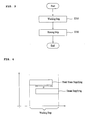
- FIG. 3 is a flow chart illustrating a controlling method of a dishwasher according to an exemplary embodiment of the present invention.
- FIG. 4 is a graph illustrating an embodiment of a washing step having a steam supplying step and a wash water supplying step that are overlapped for a predetermined period of time according to an embodiment of the invention.
- FIG. 5 is a graph illustrating a washing step having a steam supplying step and a wash water supplying step that are overlapped in at least a predetermined period, all according to another exemplary embodiment of the present invention.
- FIG. 6 is a graph illustrating a washing step having a steam supplying step and a wash water supplying step that are overlapped in at least a predetermined period, all according to yet another exemplary embodiment of the present invention.
- FIG. 7 is a graph illustrating a washing step having a steam supplying step and a wash water supplying step that are overlapped in at least a predetermined period, all according to still another exemplary embodiment of the present invention.
- FIG. 8 is a flow chart illustrating a non-detergent course according to a controlling method of a dishwasher according to an exemplary embodiment of the present invention.
- FIG. 9 is a flow chart illustrating a detergent course according to a controlling method of a dishwasher according to another exemplary embodiment of the present invention.
- FIG. 10 is a graph illustrating temperature change in washing objects according to the controlling method of FIG. 8 .
- FIG. 1 is a perspective view illustrating a dishwasher according to an exemplary embodiment of the present invention.
- a dishwasher in reference to FIG. 1 , includes a cabinet 1, a door 2, and a control panel 3.
- the cabinet 1 has an open front and the door 2 opens and closes the open front of the cabinet 1.
- the control panel 3 is provided in an upper portion of the door 2 to display and control an overall operation of the dishwasher.
- the cabinet 1 defines an exterior appearance of the dishwasher and includes various components that will be described later.
- the door 2 is coupled to the front of the cabinet 1 and a user opens the door to gain access to the cabinet, for example, to put washing objects into, or to take washing objects out of, the dishwasher.
- the control panel 3 includes a power switch 5 for powering on and off the dishwasher, an operation selection part 7 for a user to select operation courses of the dishwasher and a display part 8 for displaying an operational state of the dishwasher.
- a door handle 4 may be provided in the front of the cabinet 1.
- the door handle 4 may be used to open and close the door 2.
- An outlet 6 may be further provided in the front of the cabinet 1 and hot air inside the dishwasher may be discharged from the dishwasher via the outlet 6.
- FIG. 2 is a longitudinal-sectional view of the dishwasher of FIG. 1 .
- the dishwasher includes a tub 18 and a sump 16.
- the tub 18 is provided in the cabinet 1 and it forms an accommodation space 9 where washing objects, such as dishes, are washed.
- the sump 16 is provided underneath the tub 18 to supply wash water to the accommodation space 9 in the tub 18 and to re-supply wash water to the accommodation space 9 after food substances contained in the wash water are filtered therefrom.
- a pump (not shown), such as an impeller to pump the wash water, may be provided in the sump 16. It is preferable that the sump 16 includes a first heater 13 configured to heat the wash water received in the sump 16.
- the wash water heated by the first heater 13 may be injected toward washing objects in the accommodation space 9 in the tub 18.
- detergent product (which improves washing efficiency) dissolved in the heated wash water (which also improves washing efficiency) may come into contact with food scraps or other contaminants remaining on the washing objects, thoroughly soaking the same.
- the heated wash water containing detergent sprayed onto the washing objects removes the food scraps or other contaminants from the washing objects.
- a plurality of racks 11, 12 and a plurality of spraying arms 14, 15, 24 may be provided in the accommodation space 9 formed in the tub 18 .
- the racks 11 and 12 in the exemplary embodiment are separated into upper and lower racks, respectively.
- the spraying arms 14, 15, 24 spray wash water toward each of the racks 11, 12.
- a filter 17 may be provided in a lower portion of the tub 18 and food scraps contained in the wash water may be filtered therefrom as wash water passes through the filter 17.
- a wash water path 19 may be provided in a predetermined portion of the tub 18 to supply the wash water to an uppermost spraying arm 24 and an upper spraying arm 14.
- the wash water path may be configured as two paths corresponding to the uppermost spraying arm and the upper spraying arm, respectively.
- the dishwasher may include a steam generating device 100, a steam path 110, and at least one nozzle combination 200.
- the steam generating device 100 generates steam supplied to the accommodation space 9 in the tub 18.
- the steam generated by the steam generating device 100 passes through the steam path 110 into the tub 18.
- the steam passing through the steam path 110 is supplied to the tub 18 via the at least one nozzle combination 200.
- the position of the steam generating device 100 is not limited to any specific place mentioned above.
- the steam generating device 100 is provided under the tub 18.
- the steam generated by the steam generating device 100 may be supplied to the tub 18 efficiently, because generally the steam has a property of ascending upward with its high temperature.
- the steam generating device 100 may be provided on a side of the tub 18.
- the steam generating device 100 may include a housing 102, a second heater 104, a water level sensor 106, and an overheating prevention means (not shown).
- the housing 102 receives water and the second heater 104 heats the water received in the housing 102.
- the water level sensor 106 measures water levels of the water in the housing 102.
- the overheating prevention means prevents the second heater 104 from overheating.
- water is supplied to the housing 102.
- the water level sensor 106 indicates the level of water within the housing 102, and therefore, it can be determined whether an appropriate amount of water is supplied.
- the water in the housing 102 is heated by the second heater 104 to generate steam.
- the generated steam is supplied to the tub 18 via the steam path 110 and the nozzle combination 200.
- the dishwasher may further include a water supply line 22, a water drain line 23, a first water supply valve 40, and a second water supply valve 41.
- the first water supply valve 40 may control the supply of water to the sump 16.
- the second water supply valve 41 may control the supply of water to the steam generating device 100.
- the water supply line 22 may be branched to supply water to both of the sump 16 and the steam generating device 100 from an external water source.
- the contaminated water used in washing the washing objects may be drained via the water drain line 23.
- the water supply valve 40 opens or closes the path to the water supply line 22 to control the amount of water supplied to the sump 16.
- the second water supply valve 41 opens or closes the path to the steam generating device 100 to control the amount of water supplied to the steam generating device 100.
- the water supply valve 40 controls the amount of water supplied to the sump 16 and the second water supply valve 41 controls the amount of water supplied to the steam generating device 100.
- Water in the housing 102 is heated by the second heater 104 to generate steam, which is sprayed toward the washing objects in the dishwasher having the above configuration.
- Wash water in the sump 16 is heated by the first heater 13 to provide heated wash water, which is sprayed toward the washing objects in the dishwasher having the above configuration.
- a predetermined period of time is required for a process of changing heated water in the housing 102 into steam. Also, a predetermined period of time is required for a process of heating wash water in the sump 16 to a predetermined temperature.
- the overall operation time of the dishwasher is inconveniently increased, at least by the time taken to heat water and to generate steam.
- washing a washing object such as a cup with a relatively low pollution level, which does not present much of a washing load but requires frequent washings
- a long or increased washing time is very inconvenient to the user. Consequently, Because of that, at least in the case of the washing objects presenting a relatively low washing load but requiring frequent washings, it is desirable to reduce the washing time.
- the temperature of the washing objects in the accommodation space 9 in the tub 18 may increase gradually. That is, if the steam is sprayed into the tub, the temperature of the washing objects may increase. After the heated wash water is sprayed, the temperature of the washing objects may be maintained at a predetermined value. This is because the temperature of the heated wash water, even after heating, is lower than the temperature of the steam. If the temperature of the washing objects increases gradually, removal of the contaminants attached to the washing objects in the accommodation space 9 in the tub is made difficult, which therefore decreases washing efficiency.
- washing efficiency increases.
- FIG. 3 is a flow chart illustrating a controlling method of a dishwasher according to an exemplary embodiment of the present invention.
- the controlling method of the dishwasher may be included in courses of the dishwasher, such as washing or rinsing, or it may form a separate course selectable from the operation selection part 7 ( FIG. 1 ), such as a 'cup washing course' or a 'small washing course'.
- the controlling method of the dishwasher includes a washing step (S310), which includes simultaneously supplying steam and wash water to washing objects for a predetermined time period and a rinsing step (S330) including rinsing the washing objects.
- the washing step according to this embodiment includes a wash water supplying step and a steam supplying step.
- FIG. 4 is a graph illustrating an embodiment of a washing step having a steam supplying step and a wash water supplying step that are overlapped for a predetermined period of time according to an embodiment of the invention.
- the wash water supplying step and the steam supplying step are performed simultaneously for at least a predetermined time period ( ⁇ ), during which the wash water supplying step and the steam supplying step are overlapped in time.
- the steam and the wash water may be simultaneously supplied to the washing objects for at least the predetermined time period ( ⁇ ).
- a control part such as a controller, supplies water to both the sump 16 and the steam generating device 100. Then, the control part operates the first heater 13 of the sump 16 and the second heater 104 of the steam generating device 100. Because of this, the wash water in the sump 16 is heated and steam is generated in the steam generating device 100. Hence, the control part starts the washing step.
- the process of supplying steam and heated wash water simultaneously may be embodied variously. Examples of various embodiments are presented in FIGS. 5 to 7 .
- FIG. 5 is a graph illustrating a washing step having a steam supplying step and a wash water supplying step that are overlapped in at least a predetermined period, all according to another exemplary embodiment of the present invention.
- the control part causes the execution of the steam supplying step at least one time during the wash water supplying step in a washing step.
- FIG. 6 is a graph illustrating a washing step having a steam supplying step and a wash water supplying step that are overlapped in at least a predetermined period, all according to yet another exemplary embodiment of the present invention.
- the control part causes the execution of the washing water supplying step at least one time during the steam supplying step in a washing step.
- FIG. 7 is a graph illustrating a washing step having a steam supplying step and a wash water supplying step that are overlapped in at least a predetermined period, all according to still another exemplary embodiment of the present invention.
- the control part causes the execution of both the steam supplying step and the washing water supplying step at least one time in a washing step.
- the steam and the heated wash water may be sprayed toward the washing objects in the accommodation space 9 in the tub 18 at the same time.
- both the steam and the heated wash water supplying steps are performed simultaneously, at least over a common period of time, the washing efficiency of the dishwasher increases, and the overall length of time required to complete a washing step is reduced.
- the temperature of the washing objects within the tub 18 may be increased over time, as previously described, and as illustrated, for example, in FIG. 10 .
- FIG. 10 is a graph illustrating temperature change in washing objects in the accommodation space 9 in the tub 18, according to an exemplary embodiment of the present invention, which is itself illustrated in the flow diagram of FIG. 8 .
- 'A' section corresponds to the washing step
- 'B' section corresponds to the rinsing step
- 'C' section corresponds to an intermediate step between the washing and rinsing steps, for example, a draining step.
- Both the steam and the heated wash water are simultaneously supplied during the overall section of the washing step 'A' shown in FIG. 10 .
- the method of FIG. 8 , and the time versus temperature graph illustrated in FIG. 10 represent only one possible embodiment according to the present invention; the present invention is not limited by the embodiment of FIG. 8 or the illustration of FIG. 10 .
- both the steam and the wash water are simultaneously supplied to the accommodation space 9 in the tub 18 during the washing step according to this embodiment.
- the temperature of the washing objects in the accommodation space 9 in the tub 18 increases with a roughly uniform slope over time.
- the slope may be predetermined.
- this washing step may include a step of supplying the heated wash water from the upper and lower portions of the accommodation space 9 alternately at a predetermined interval.
- the heated wash water is sprayed from the upper portion of the accommodation space 9 via the uppermost spraying arm 24 and the upper spraying arm 14 of the spraying arms provided in the tub 18.
- the heated wash water is supplied from the lower portion of the accommodation space 9 via the lower spraying arm 15.
- the heated wash water may be sprayed from the upper and lower portions of the accommodation space 9 alternately at a predetermined interval.
- the time of the step alternately supplying the wash water may include steps of supplying the wash water from the upper portion of the accommodation space 9 is one minute, specifically, from the lower portion for one minute, from the upper portion for one minute, from the lower portion for one minute and from the upper portion for 6 minutes.
- the steam is continuously sprayed upward from the lower portion of the tub 18 via the nozzle combination 200 provided in the lower portion of the tub 18.
- the controlling method according to this embodiment may be applicable to washing objects such as cups, which present a small washing load and require often washings. Because the washing objects such as cups are washed often, and because cups typically have a low pollution level, a non-detergent course may be used. In this case, if performing a rinsing step, a dishwashing rinse aide product may be supplied.
- FIG. 8 is a flow chart illustrating a non-detergent course according to a controlling method of a dishwasher according to an exemplary embodiment of the present invention.
- the control part of the dishwasher supplies dishwashing rinse aide product to the accommodation space 9 in a predetermined time period after the above washing step starts (S810).
- control part may not supply the dishwashing rinse aide product to the washing objects when the rinsing step starts.
- the control part may introduce the dishwashing rinse aide product to the washing objects at a predetermined time such as, for example, five minutes after the washing step begins. If dishwashing rinse aide product is introduced during the washing step, the dishwashing rinse aide product may attach to surfaces of the washing objects with the help of the steam and the heated wash water supplied during the washing step. Accordingly, rinsing efficiency of the rinsing step may be improved.
- the controlling method according to this embodiment may further include a water draining step (C) to drain the wash water from the tub 18 to, for example, a drain outside of the dishwasher.
- a water draining step (C) to drain the wash water from the tub 18 to, for example, a drain outside of the dishwasher.
- the wash water is drained during the 'C' section, corresponding to the water draining step, such that the temperature of washing objects in the accommodation space 9 in the tub 18 may not increase because the heated wash water and the steam are not supplied.
- the rinsing step (S830) is performed after the water draining step (C) of FIG. 10 .
- the rinsing step may include steps of supplying wash water to the dishwasher (S831), simultaneously supplying steam and heated water to the washing objects for a predetermined time period (S833), and supplying only the heated wash water to the washing objects (S835).
- the wash water is supplied to the dishwasher to rinse the washing objects (S831).
- wash water is supplied to the sump 16 and then sprayed toward the washing objects via the spraying arms 14, 15, and 24.
- the wash water may be sprayed via all spraying arms 14, 15, and 24 or it may be sprayed toward the upper and lower portions of the accommodation space 9 alternately as mentioned above.
- the first heater 13 of the sump 16 and the second heater 104 of the steam generating device 100 are operated to simultaneously supply both steam and heated wash water to the washing objects for a predetermined time period (S833).
- the controlling method according to this embodiment may be performed in a 'non-detergent course' (where no detergent product is introduced into the accommodation space 9) used to wash the washing objects. If so, the rinsing step may be performed even though the contaminants may not have been removed completely during the washing step.
- a step of supplying the heated wash water and the steam during an initial period of the rinsing step may be provided.
- the step of supplying steam and heated wash water simultaneously during the rinsing step is similar to the washing step mentioned above.
- steam supplying is performed at least once during the heated wash water supplying step or the heated wash water supply is performed at least once during the steam supplying step. Moreover, the heated wash water supplying and the steam supplying are performed simultaneously at least once in the simultaneously supplying step.
- the operation time of the step of simultaneously supplying the steam and the wash water included in the rinsing step may be substantially shorter than that of the washing step. For example, if the washing step is preset to operate for 10 minutes, the step of simultaneously supplying the steam and the heated wash water may be preset to operate for 7 minutes.
- the second heater 104 of the steam generating device 100 is turned off and only the first heater 13 of the sump 16 is operated to continue to heat water that is sprayed toward the washing objects (S835).
- a primary rinse for the washing objects may be performed.
- a secondary rinse including heated water without steam, may also be performed.
- the electricity consumed by the dishwasher may be reduced.
- the step of supplying only the heated water may be performed approximately for 6 minutes, for example.
- the temperature of the washing objects in the accommodation space 9 in the tub 18 may increase. If the user touches the washing objects at this time, there could be a danger of getting burned.
- the rinsing step may further include a step of supplying only wash water to the accommodation space 9 in the tub 18, after turning off the first heater 13 of the sump 16 and the second heater 104 of the steam generating device 100. That is, wash water that is not heated may be sprayed toward the washing objects to decrease the temperature of the washing objects.
- the step of supplying unheated wash water may be performed for approximately 2 minutes, for example.
- the 'B' section corresponding to the rinsing step is classified into a 'B1' section (where steam and heated wash water are provided simultaneously), a 'B2' section (where only heated wash water is provided), and a 'B3' section (where only unheated wash water is provided).
- the temperature of the washing objects in the accommodation space 9 in the tub 18 may increase continuously, according to a roughly constant slope. Consequently, contaminants that were not removed during the washing step may be removed during primary rinsing.
- the temperature of the washing objects in the accommodation space 9 in the tub 18 may not increase. Consequently, the temperature of the washing objects in the accommodation space 9 in the tub 18 may be maintained at a predetermined temperature value.
- secondary rinsing is performed using only heated wash water as mentioned above.
- the controlling method according to this embodiment corresponds to the 'non-detergent course'; however, a controlling method according to another embodiment may be performed to correspond to a 'detergent course', where detergent product is introduced into the accommodation space 9.
- the controlling method performed in the detergent course may include a step of supplying detergent product during the washing step. Additionally, the step of simultaneously supplying steam and heated wash water may not be performed during the rinsing step.
- FIG. 9 is a flow chart illustrating a detergent course according to a controlling method of a dishwasher according to another exemplary embodiment of the present invention.
- the controlling method performed in the detergent course includes a washing step and a rinsing step as in the above described embodiments.
- the washing step detergent product and dishwashing rinse aide product are introduced at predetermined times (S910).
- detergent product is introduced into the tub 18 simultaneously with the beginning of the performance of the washing step.
- the other configuration of this embodiment is similar to the configuration of the above embodiment except that the dishwashing rinse aide product is supplied after the detergent product is supplied.
- the controlling method may further include an unheated wash water supplying step that supplies unheated wash water to the washing objects.
- the step of simultaneously supplying steam and heated wash water is not performed and this is different from the above embodiment. Because detergent product is introduced in the washing step according to this embodiment, there would be little probability contaminants remain on the washing objects after the washing step. As a result, the step of simultaneously supplying steam and heated wash water is not performed in the rinsing step and thus less electricity may be consumed by the dishwasher.
- the time taken to operate each of the steps described in the controlling method according to this embodiment may be different from the time taken according to the previous embodiment.
- the washing step according to this embodiment may be preset to operate approximately for seventeen minutes.
- the step of supplying steam and heated wash water may alternately be preset to perform from the upper portion of the accommodation space 9 for one minute, specifically, from the lower portion of the accommodation space 9 for one minute, from the upper portion for one minute, from the lower portion for one minute and from the upper portion for thirteen minutes.
- the first heater 13 may be operated approximately for six minutes, for example, and the unheated wash water may be supplied for approximately two minutes, for example.
Landscapes
- Washing And Drying Of Tableware (AREA)
Applications Claiming Priority (1)
| Application Number | Priority Date | Filing Date | Title |
|---|---|---|---|
| KR1020090015105A KR20100096300A (ko) | 2009-02-24 | 2009-02-24 | 식기세척기의 제어방법 |
Publications (2)
| Publication Number | Publication Date |
|---|---|
| EP2220988A2 true EP2220988A2 (fr) | 2010-08-25 |
| EP2220988A3 EP2220988A3 (fr) | 2014-01-22 |
Family
ID=42269704
Family Applications (1)
| Application Number | Title | Priority Date | Filing Date |
|---|---|---|---|
| EP10001060.2A Withdrawn EP2220988A3 (fr) | 2009-02-24 | 2010-02-02 | Procédé de commande d'un lave-vaisselle |
Country Status (4)
| Country | Link |
|---|---|
| US (1) | US20100212697A1 (fr) |
| EP (1) | EP2220988A3 (fr) |
| KR (1) | KR20100096300A (fr) |
| CN (1) | CN101810459A (fr) |
Cited By (1)
| Publication number | Priority date | Publication date | Assignee | Title |
|---|---|---|---|---|
| DE102018214071A1 (de) * | 2018-08-21 | 2020-02-27 | Meiko Maschinenbau Gmbh & Co. Kg | Reinigungsvorrichtung und ein Verfahren zur Reinigung von Reinigungsgut |
Families Citing this family (1)
| Publication number | Priority date | Publication date | Assignee | Title |
|---|---|---|---|---|
| CN110063699A (zh) * | 2019-05-13 | 2019-07-30 | 珠海格力电器股份有限公司 | 一种蒸汽发生器、洗碗机及其洗涤方法 |
Family Cites Families (10)
| Publication number | Priority date | Publication date | Assignee | Title |
|---|---|---|---|---|
| US2597359A (en) * | 1947-02-19 | 1952-05-20 | Mcdonald Company | Dishwashing apparatus |
| US3043724A (en) * | 1958-04-24 | 1962-07-10 | Dishmaster Appliances Ltd | Method of washing glasses or the like |
| US3888269A (en) * | 1973-07-17 | 1975-06-10 | Whirlpool Co | Control system for dishwasher |
| US4246916A (en) * | 1979-02-02 | 1981-01-27 | Norris Industries, Inc. | Dishwasher with steam generating heater and cold water input |
| AU2001297751A1 (en) * | 2001-01-30 | 2002-10-03 | The Procter And Gamble Company | Coatings for modifying hard surfaces and processes for applying the same |
| CA2443113C (fr) * | 2001-05-14 | 2009-12-01 | The Procter & Gamble Company | Produit de nettoyage comprenant trois zones distinctes |
| CN101161181A (zh) * | 2006-10-13 | 2008-04-16 | 乐金电子(天津)电器有限公司 | 洗碗机及其控制方法 |
| GB0700920D0 (en) * | 2007-01-18 | 2007-02-28 | Reckitt Benckiser Nv | Dosage element and a method of manufacturing a dosage element |
| KR101314617B1 (ko) * | 2007-03-31 | 2013-10-07 | 엘지전자 주식회사 | 식기 세척기의 제어 방법 |
| KR101366262B1 (ko) * | 2007-07-05 | 2014-02-20 | 엘지전자 주식회사 | 식기 세척기의 제어방법 |
-
2009
- 2009-02-24 KR KR1020090015105A patent/KR20100096300A/ko not_active Ceased
-
2010
- 2010-02-02 EP EP10001060.2A patent/EP2220988A3/fr not_active Withdrawn
- 2010-02-22 CN CN201010120450.6A patent/CN101810459A/zh active Pending
- 2010-02-23 US US12/659,026 patent/US20100212697A1/en not_active Abandoned
Non-Patent Citations (1)
| Title |
|---|
| None |
Cited By (2)
| Publication number | Priority date | Publication date | Assignee | Title |
|---|---|---|---|---|
| DE102018214071A1 (de) * | 2018-08-21 | 2020-02-27 | Meiko Maschinenbau Gmbh & Co. Kg | Reinigungsvorrichtung und ein Verfahren zur Reinigung von Reinigungsgut |
| DE102018214071B4 (de) | 2018-08-21 | 2020-07-09 | Meiko Maschinenbau Gmbh & Co. Kg | Reinigungsvorrichtung und ein Verfahren zur Reinigung von Reinigungsgut |
Also Published As
| Publication number | Publication date |
|---|---|
| EP2220988A3 (fr) | 2014-01-22 |
| US20100212697A1 (en) | 2010-08-26 |
| KR20100096300A (ko) | 2010-09-02 |
| CN101810459A (zh) | 2010-08-25 |
Similar Documents
| Publication | Publication Date | Title |
|---|---|---|
| US7909936B2 (en) | Dishwasher final steam rinse method | |
| EP2081479B1 (fr) | Machine à laver la vaisselle et procédé de commande de celle-ci | |
| EP2158832B1 (fr) | Lave-vaisselle | |
| US7909940B2 (en) | Dish washing machine with steam generator and method of controlling same | |
| WO2008047981A1 (fr) | Procédé de commande de lave-vaisselle | |
| EP2727511A2 (fr) | Lave-vaisselle | |
| EP2052661B1 (fr) | Lave-vaisselle et son procédé de commande | |
| US8506721B2 (en) | Dish washer and controlling method thereof | |
| CN101808562B (zh) | 控制具有蒸汽产生器的洗碗机的方法 | |
| US9272314B2 (en) | Dishwasher steam purge method | |
| EP2220988A2 (fr) | Procédé de commande d'un lave-vaisselle | |
| EP2079354B1 (fr) | Procédé de commande d'une machine à laver | |
| US8657965B2 (en) | Controlling method of dishwasher | |
| WO2006028356A1 (fr) | Lave-vaisselle et procede pour commander un lave-vaisselle | |
| CN101090663A (zh) | 洗碗机和用于洗碗机的蒸汽供应装置 | |
| EP2156780A2 (fr) | Lave-vaisselle et son procédé de commande | |
| CN106963316A (zh) | 洗碟机及其控制方法 | |
| JP2007215882A (ja) | 食器洗浄機 | |
| JP3340334B2 (ja) | 飯米処理機能を備えた食器洗浄機 | |
| JP2002177190A (ja) | 食器洗い乾燥機 | |
| CN101203168A (zh) | 洗碗机及其控制方法 | |
| EP2133019B1 (fr) | Procédé pour raccourcir le rinçage dans un lave-vaisselle et lave-vaisselle adapté pour réaliser un tel procédé | |
| JP4347793B2 (ja) | 食器洗浄機 | |
| JP2007260017A (ja) | 食器洗浄乾燥装置および食器洗浄乾燥方法 | |
| KR20240007707A (ko) | 식기 세척기 및 식기 세척기의 제어방법 |
Legal Events
| Date | Code | Title | Description |
|---|---|---|---|
| PUAI | Public reference made under article 153(3) epc to a published international application that has entered the european phase |
Free format text: ORIGINAL CODE: 0009012 |
|
| AK | Designated contracting states |
Kind code of ref document: A2 Designated state(s): AT BE BG CH CY CZ DE DK EE ES FI FR GB GR HR HU IE IS IT LI LT LU LV MC MK MT NL NO PL PT RO SE SI SK SM TR |
|
| AX | Request for extension of the european patent |
Extension state: AL BA RS |
|
| PUAL | Search report despatched |
Free format text: ORIGINAL CODE: 0009013 |
|
| AK | Designated contracting states |
Kind code of ref document: A3 Designated state(s): AT BE BG CH CY CZ DE DK EE ES FI FR GB GR HR HU IE IS IT LI LT LU LV MC MK MT NL NO PL PT RO SE SI SK SM TR |
|
| AX | Request for extension of the european patent |
Extension state: AL BA RS |
|
| RIC1 | Information provided on ipc code assigned before grant |
Ipc: A47L 15/00 20060101AFI20131217BHEP Ipc: A47L 15/42 20060101ALI20131217BHEP |
|
| 17P | Request for examination filed |
Effective date: 20140324 |
|
| RBV | Designated contracting states (corrected) |
Designated state(s): AT BE BG CH CY CZ DE DK EE ES FI FR GB GR HR HU IE IS IT LI LT LU LV MC MK MT NL NO PL PT RO SE SI SK SM TR |
|
| STAA | Information on the status of an ep patent application or granted ep patent |
Free format text: STATUS: EXAMINATION IS IN PROGRESS |
|
| 17Q | First examination report despatched |
Effective date: 20161103 |
|
| STAA | Information on the status of an ep patent application or granted ep patent |
Free format text: STATUS: THE APPLICATION IS DEEMED TO BE WITHDRAWN |
|
| 18D | Application deemed to be withdrawn |
Effective date: 20170314 |