EP2223686A2 - Flicken und Flickenherstellung - Google Patents
Flicken und Flickenherstellung Download PDFInfo
- Publication number
- EP2223686A2 EP2223686A2 EP10153152A EP10153152A EP2223686A2 EP 2223686 A2 EP2223686 A2 EP 2223686A2 EP 10153152 A EP10153152 A EP 10153152A EP 10153152 A EP10153152 A EP 10153152A EP 2223686 A2 EP2223686 A2 EP 2223686A2
- Authority
- EP
- European Patent Office
- Prior art keywords
- patch
- adhesive layer
- support
- outer shape
- circular arc
- Prior art date
- Legal status (The legal status is an assumption and is not a legal conclusion. Google has not performed a legal analysis and makes no representation as to the accuracy of the status listed.)
- Granted
Links
Images



Classifications
-
- A—HUMAN NECESSITIES
- A61—MEDICAL OR VETERINARY SCIENCE; HYGIENE
- A61F—FILTERS IMPLANTABLE INTO BLOOD VESSELS; PROSTHESES; DEVICES PROVIDING PATENCY TO, OR PREVENTING COLLAPSING OF, TUBULAR STRUCTURES OF THE BODY, e.g. STENTS; ORTHOPAEDIC, NURSING OR CONTRACEPTIVE DEVICES; FOMENTATION; TREATMENT OR PROTECTION OF EYES OR EARS; BANDAGES, DRESSINGS OR ABSORBENT PADS; FIRST-AID KITS
- A61F13/00—Bandages or dressings; Absorbent pads
- A61F13/02—Adhesive bandages or dressings
-
- A—HUMAN NECESSITIES
- A61—MEDICAL OR VETERINARY SCIENCE; HYGIENE
- A61K—PREPARATIONS FOR MEDICAL, DENTAL OR TOILETRY PURPOSES
- A61K9/00—Medicinal preparations characterised by special physical form
- A61K9/70—Web, sheet or filament bases ; Films; Fibres of the matrix type containing drug
- A61K9/7023—Transdermal patches and similar drug-containing composite devices, e.g. cataplasms
- A61K9/703—Transdermal patches and similar drug-containing composite devices, e.g. cataplasms characterised by shape or structure; Details concerning release liner or backing; Refillable patches; User-activated patches
-
- A—HUMAN NECESSITIES
- A61—MEDICAL OR VETERINARY SCIENCE; HYGIENE
- A61F—FILTERS IMPLANTABLE INTO BLOOD VESSELS; PROSTHESES; DEVICES PROVIDING PATENCY TO, OR PREVENTING COLLAPSING OF, TUBULAR STRUCTURES OF THE BODY, e.g. STENTS; ORTHOPAEDIC, NURSING OR CONTRACEPTIVE DEVICES; FOMENTATION; TREATMENT OR PROTECTION OF EYES OR EARS; BANDAGES, DRESSINGS OR ABSORBENT PADS; FIRST-AID KITS
- A61F13/00—Bandages or dressings; Absorbent pads
- A61F13/01—Non-adhesive bandages or dressings
- A61F13/01021—Non-adhesive bandages or dressings characterised by the structure of the dressing
- A61F13/01029—Non-adhesive bandages or dressings characterised by the structure of the dressing made of multiple layers
-
- A—HUMAN NECESSITIES
- A61—MEDICAL OR VETERINARY SCIENCE; HYGIENE
- A61F—FILTERS IMPLANTABLE INTO BLOOD VESSELS; PROSTHESES; DEVICES PROVIDING PATENCY TO, OR PREVENTING COLLAPSING OF, TUBULAR STRUCTURES OF THE BODY, e.g. STENTS; ORTHOPAEDIC, NURSING OR CONTRACEPTIVE DEVICES; FOMENTATION; TREATMENT OR PROTECTION OF EYES OR EARS; BANDAGES, DRESSINGS OR ABSORBENT PADS; FIRST-AID KITS
- A61F13/00—Bandages or dressings; Absorbent pads
- A61F13/02—Adhesive bandages or dressings
- A61F13/0269—Tapes for dressing attachment
-
- A—HUMAN NECESSITIES
- A61—MEDICAL OR VETERINARY SCIENCE; HYGIENE
- A61K—PREPARATIONS FOR MEDICAL, DENTAL OR TOILETRY PURPOSES
- A61K9/00—Medicinal preparations characterised by special physical form
- A61K9/70—Web, sheet or filament bases ; Films; Fibres of the matrix type containing drug
- A61K9/7023—Transdermal patches and similar drug-containing composite devices, e.g. cataplasms
- A61K9/703—Transdermal patches and similar drug-containing composite devices, e.g. cataplasms characterised by shape or structure; Details concerning release liner or backing; Refillable patches; User-activated patches
- A61K9/7038—Transdermal patches of the drug-in-adhesive type, i.e. comprising drug in the skin-adhesive layer
- A61K9/7046—Transdermal patches of the drug-in-adhesive type, i.e. comprising drug in the skin-adhesive layer the adhesive comprising macromolecular compounds
- A61K9/7053—Transdermal patches of the drug-in-adhesive type, i.e. comprising drug in the skin-adhesive layer the adhesive comprising macromolecular compounds obtained by reactions only involving carbon to carbon unsaturated bonds, e.g. polyvinyl, polyisobutylene, polystyrene
- A61K9/7061—Polyacrylates
-
- A—HUMAN NECESSITIES
- A61—MEDICAL OR VETERINARY SCIENCE; HYGIENE
- A61L—METHODS OR APPARATUS FOR STERILISING MATERIALS OR OBJECTS IN GENERAL; DISINFECTION, STERILISATION OR DEODORISATION OF AIR; CHEMICAL ASPECTS OF BANDAGES, DRESSINGS, ABSORBENT PADS OR SURGICAL ARTICLES; MATERIALS FOR BANDAGES, DRESSINGS, ABSORBENT PADS OR SURGICAL ARTICLES
- A61L15/00—Chemical aspects of, or use of materials for, bandages, dressings or absorbent pads
- A61L15/16—Bandages, dressings or absorbent pads for physiological fluids such as urine or blood, e.g. sanitary towels, tampons
- A61L15/42—Use of materials characterised by their function or physical properties
- A61L15/58—Adhesives
-
- A—HUMAN NECESSITIES
- A61—MEDICAL OR VETERINARY SCIENCE; HYGIENE
- A61P—SPECIFIC THERAPEUTIC ACTIVITY OF CHEMICAL COMPOUNDS OR MEDICINAL PREPARATIONS
- A61P43/00—Drugs for specific purposes, not provided for in groups A61P1/00-A61P41/00
-
- A—HUMAN NECESSITIES
- A61—MEDICAL OR VETERINARY SCIENCE; HYGIENE
- A61F—FILTERS IMPLANTABLE INTO BLOOD VESSELS; PROSTHESES; DEVICES PROVIDING PATENCY TO, OR PREVENTING COLLAPSING OF, TUBULAR STRUCTURES OF THE BODY, e.g. STENTS; ORTHOPAEDIC, NURSING OR CONTRACEPTIVE DEVICES; FOMENTATION; TREATMENT OR PROTECTION OF EYES OR EARS; BANDAGES, DRESSINGS OR ABSORBENT PADS; FIRST-AID KITS
- A61F13/00—Bandages or dressings; Absorbent pads
- A61F2013/00361—Plasters
- A61F2013/00544—Plasters form or structure
- A61F2013/00553—Plasters form or structure with detachable parts
- A61F2013/00561—Plasters form or structure with detachable parts with adhesive connecting means
-
- A—HUMAN NECESSITIES
- A61—MEDICAL OR VETERINARY SCIENCE; HYGIENE
- A61F—FILTERS IMPLANTABLE INTO BLOOD VESSELS; PROSTHESES; DEVICES PROVIDING PATENCY TO, OR PREVENTING COLLAPSING OF, TUBULAR STRUCTURES OF THE BODY, e.g. STENTS; ORTHOPAEDIC, NURSING OR CONTRACEPTIVE DEVICES; FOMENTATION; TREATMENT OR PROTECTION OF EYES OR EARS; BANDAGES, DRESSINGS OR ABSORBENT PADS; FIRST-AID KITS
- A61F13/00—Bandages or dressings; Absorbent pads
- A61F2013/00361—Plasters
- A61F2013/00544—Plasters form or structure
- A61F2013/00646—Medication patches, e.g. transcutaneous
- A61F2013/00651—Medication patches, e.g. transcutaneous tapered, bevelled or chamfered
Definitions
- the present invention relates to a patch and a patch preparation having a support and an adhesive layer. More particularly, the present invention relates to a patch and a patch preparation having low stretchability, which can be continuously adhered to the skin for a long time without undesirable detachment and marked falling off from the skin due to various factors during adhesion.
- Patch preparations having a rectangular outer shape are conventionally known.
- the patch may be undesirably detached and markedly fall off from the skin due to various factors during adhesion.
- references dealing with the problems of undesirable detachment for example, the following references can be mentioned.
- JP-A-2000-109427 discloses a patch having a water-containing adhesive layer formed on one surface of a support and a support having an atypical outer shape, and teaches that such patch shows good adhesiveness even on a curved skin surface and is not easily detached therefrom.
- JP-A-2000-297033 discloses a patch having a water-containing adhesive layer formed on one surface of a support, and a rectangular outer shape with round corners. It is taught therein that such roundness prevents easy detachment.
- the patches of the above-mentioned references have high stretchability, and a detach operation necessary when detachment is desired is relatively troublesome.
- the references do not teach any solving means for providing a patch with low stretchability wherein the detachment from the skin is sufficiently suppressed even when it is adhered for a long time to the skin covered with clothes.
- the present invention has been made in view of such situation, and the problem to be solved is provision of a patch and a patch preparation having low stretchability, which can be continuously adhered to the skin for a long time without undesirable detachment and marked falling off from the skin due to various factors during adhesion.
- the present inventors have worked on the problem that a low stretchable patch cannot avoid undesirable detachment even when the outer shape thereof have round corners, and unexpectedly found that an undesirable detachment of the patch can be sufficiently suppressed by ensuring the straight-line section of its outer shape, which resulted in the completion of the present invention.
- the patch has low stretchability
- the outer shape of the patch has a total length of the straight-line sections and a total length of the curved sections at a predetermined ratio.
- undesirable detachment of the patch does not occur easily even when it is adhered to the skin under clothes for a long time.
- the patch since the patch has low stretchability, it has a certain level of rigidity, can be adhered to the skin with ease, and can be detached easily when so desired. Since such patch permits strict control of the timing of adhesion and detachment, it can be widely used for a patch, as well as particularly superior for a patch preparation intended to strictly control the dose of a drug.
- a preferable embodiment of the present invention is shown in the following, wherein detailed explanations and particular examples are only for exemplification purposes, and do not limit the scope of the present invention.
- the explanation of the preferable embodiment below is only for exemplification purposes, and does not limit the scope of the present invention, application thereof and use thereof.
- Fig. 1 is a schematic sectional view of an embodiment of the patch of the present invention, wherein a release liner 3 is included for the purpose of explanation.
- the "patch" of the present invention means a laminate of a support and an adhesive layer.
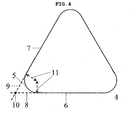
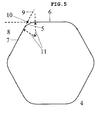
- Fig. 2 and the planar outer shape of the patch of the present invention when adjacent two straight-line sections 6 and 7 sandwiching a curved section 5 of the planar outer shape are extended and a point 10 at which two extensions cross is assumed to be a corner of the outer shape of the patch, the outer shape forms a polygon.
- polygon includes a shape in a strict sense which has corners, as well as the above-mentioned shape (e.g., quadrangle (for example, square, rectangle), triangle, pentagon, hexagon etc.).
- the embodiment of Fig. 2 is a square.
- the planar outer shape of the patch is a rectangle.
- the planar outer shape of the patch is a triangle.
- the planar outer shape of the patch is a hexagon.
- the planar outer shape of the patch is preferably a rectangle from the aspects of utilization efficiency of materials and handling of the patch.
- the patch of the present invention is explained by referring to Fig. 2 again.
- the patch tends to start detaching from a non-straight-line section of the outer shape thereof, i.e., a corner or a curved section.
- the conventional patch has a corner.
- Such patch tends to start detaching from a corner during adhesion to the skin.
- the conventional patch does not have a corner in the planar outer shape and is constituted with curved sections alone. Such patch tends to start detaching from any curved section during adhesion to the skin.
- Fig. 2 shows an embodiment of the patch of the present invention.
- a ratio P of the total length W (mm) of curved sections of a planar outer shape of the patch to the total length S (mm) of straight-line sections of the planar outer shape of the patch (W/S) needs to be not more than 1.22.
- P is not particularly limited as long as it is not more than 1.22. Since complete absence of a curved section conversely facilitates detachment, P is preferably higher than 0, more preferably higher than 0.01.
- the radius R (mm) of the circular arc needs to be 0.5 mm or above.
- R (mm) is preferably not less than 0.75 mm, more preferably not less than 1.00 mm.
- the radius of the circular arc of all the curved sections of the outer shape of the patch is preferably not less than 0.5 mm. While R is not particularly limited as long as it is not less than 0.5 mm, since P tends to increase as R becomes higher, it is preferably smaller than 40, more preferably smaller than 20, most preferably not more than 19.5.
- the patch needs to be low stretchable.
- the patch acquires rigidity, and easily adhered to the skin.
- the stretchability of the patch can be achieved by the selection of a support.
- the "low stretchability" means a 5% modulus of not less than 0.5 N, preferably not less than 1.0 N.
- 5% modulus means the force [N] necessary for expanding a test piece by 5% while affording at least a width of 10 mm and a chuck interval of 10 mm.
- the test piece does not have a release liner.
- the influence of the size of the test piece on the 5% modulus is neglectably small as long as the size is within the size range of conventional patches.
- the stretchability of the patch can be adjusted by a method known to those of ordinary skill in the art. Since the support can be an important factor to define the stretchability of the patch since the stretchability of a flexible adhesive layer can be almost ignored.
- Such a support is not particularly limited, it desirably has a certain level of rigidity to enable easy adhesion of a patch to the skin.
- the support examples include single films such as resin films (e.g., polyester, nylon, Saran (registered trade mark), polyethylene, polypropylene, polyvinyl chloride, ethylene-ethyl acrylate copolymer, polytetrafluoroethylene, Surlyn (registered trade mark) and the like), metal foil and the like; laminate films thereof, and the like.
- the thickness of the support is generally 10 - 500 ⁇ m, preferably 10 - 300 ⁇ m.
- the support is preferably a laminate film of a non-porous plastic film and a porous film produced from the above-mentioned materials.
- an adhesive layer is preferably formed on the porous film side.
- the porous film surface is desirably exposed.
- the adhesive layer is preferably formed on the plastic film side.
- the porous film include paper, woven fabric, non-woven fabric, knitted fabric, mechanically perforated sheet and the like, which can be laminated on the aforementioned film.
- paper and non-woven fabric are particularly preferable from among those.
- the support preferably contains a resin film or a metal foil.
- the fabric weight is 5 - 30 g/m 2 , preferably 6 - 20 g/m 2 .
- the most preferable support in the present invention is a laminate film of a 1.5 - 6 ⁇ m thick polyester film (preferably, polyethylene terephthalate film) and a polyester (preferably, polyethylene terephthalate) non-woven fabric (fabric weight 6 - 12 g/m 2 ).
- the thickness of the aforementioned support can be calculated by photographing the section of a support using a digital microscope manufactured by KEYENCE (VHX-600, with VH-100 lens, magnification x200), measuring the thickness of the support in the image at 3 or more points using a digital microscope with a built-in image processing software, and taking the average.
- KEYENCE VHX-600, with VH-100 lens, magnification x200
- the coefficient of static friction of the surface of the outermost layer of the support is preferably 0.01 or more and 1.0 or less.
- the coefficient of static friction in such preferable range can be achieved by appropriately selecting the material of the elements constituting the support.
- the coefficient of static friction is too high, the patch is easily detached due to the friction with the clothes.
- the material thereof is difficult to select.
- the coefficient of static friction here is measured by the measurement method described in JIS P 8147-1994.
- the adhesive to be used for an adhesive layer is not particularly limited, and examples include acrylic adhesive comprising an acrylic polymer; rubber adhesives such as styrene-diene-styrene block copolymer (e.g., styrene-isoprene-styrene block copolymer, styrene-butadiene-styrene block copolymer and the like), polyisoprene, polyisobutylene, polybutadiene and the like; silicone adhesives such as silicone rubber, dimethylsiloxane base, diphenylsiloxane base and the like; vinyl ether adhesives such as polyvinyl methylether, polyvinyl ethylether, polyvinyl isobutylether and the like; vinyl ester adhesives such as vinyl acetate-ethylene copolymer and the like; polyester adhesives comprising an carboxylic acid component and ethylene glycol and the like such as dimethylterephthalate, dimethyliso
- an acrylic adhesive particularly an acrylic adhesive which can easily be crosslinked, is preferable.
- Such an acrylic adhesive layer can thereby retain a large amount of liquid component, which can provide a soft feeling with skin during adhesion to the skin.
- a rubber adhesive is preferable for ensuring the drug stability.
- acrylic adhesive examples include an acrylic acid ester adhesive containing, as a main component, a polymer obtained by polymerization of (meth)acrylic acid C 2-18 alkyl ester as a polymerizable component.
- An acrylic acid ester adhesive using an acrylic acid as a copolymerizable component is preferable since adhesiveness to the human skin is fine, and an adhesive obtained by copolymerization of a mixture of 2-ethylhexyl acrylate as a (meth)acrylic acid alkyl ester and acrylic acid and N-vinyl-2-pyrrolidone at a weight ratio of 40 - 99.9:0.1 - 10:0 - 50 is preferable since adhesion and detachment can be repeated easily.
- these adhesives may be applied to physical crosslinking by irradiation such as ultraviolet irradiation, electron beam irradiation and the like, or chemical crosslinking treatment using an isocyanate compound such as trifunctional isocyanate and the like and various crosslinking agents such as organic peroxide, organic metal salt, metal alcoholate, metal chelate compound, multifunctional compound (multifunctional external crosslinking agent, or multifunctional internal crosslinkable monomer such as diacrylate, dimethacrylate and the like) and the like.
- irradiation such as ultraviolet irradiation, electron beam irradiation and the like
- chemical crosslinking treatment using an isocyanate compound such as trifunctional isocyanate and the like and various crosslinking agents such as organic peroxide, organic metal salt, metal alcoholate, metal chelate compound, multifunctional compound (multifunctional external crosslinking agent, or multifunctional internal crosslinkable monomer such as diacrylate, dimethacrylate and the like) and the like.
- the rubber adhesive examples include a rubber adhesive comprising, as a main component, at least one kind of elastomer selected from polyisobutylene, polyisoprene and styrene-diene-styrene copolymer. Since high drug stability, and necessary adhesion force and cohesion force can be simultaneously afforded, an adhesive obtained by blending high molecular weight polyisobutylene having a viscosity average molecular weight of 500,000 - 5,500,000, and low molecular weight polyisobutylene having a viscosity average molecular weight of 10,000 - 200,000 at a weight ratio of 95:5 - 5:95 and, where necessary, adding a tackifier is preferable.
- the rubber adhesive means a rubber elastomer which is adhesive by itself, or an adhesive polymer composition comprising a rubber elastomer and a tackifier.
- tackifier examples include polybutenes, petroleum resin (e.g., aromatic petroleum resin, aliphatic petroleum resin), terpene resin, rosin resin, coumarone indene resin, styrene resin (e.g., styrene resin, ⁇ -methylstyrene), hydrogenated petroleum resin (e.g., alicyclic saturated hydrocarbon resin) and the like.
- petroleum resin e.g., aromatic petroleum resin, aliphatic petroleum resin
- terpene resin rosin resin
- coumarone indene resin e.g., styrene resin, ⁇ -methylstyrene
- hydrogenated petroleum resin e.g., alicyclic saturated hydrocarbon resin
- Tackifiers can be used in a combination of one or more kinds thereof.
- the amount of the tackifier is preferably 30 - 90 wt%, more preferably 50 - 70 wt%, relative to the total weight of an adhesive.
- the amount of the tackifier is less than 30 wt%, the tackiness is sometimes low, and when it exceeds 90 wt%, the adhesive layer becomes hard and the skin adhesiveness tends to decrease.
- the thickness of the adhesive layer is generally 10 - 500 ⁇ m, preferably 10 - 300 ⁇ m.
- a release liner is preferably laminated on the adhesive face of the adhesive layer to protect the adhesive face until use.
- a non-aqueous adhesive layer is preferable.
- the non-aqueous adhesive layer here is not necessarily limited to one completely free of water, but includes those containing a slight amount of water derived from humidity in the air, skin and the like.
- a patch having an adhesive layer with a low water content is preferable, wherein the water content of the patch is preferably not more than 10 wt%, more preferably not more than 5 wt%, most preferably not more than 2 wt%.
- the water content of a patch is a weight ratio of water contained in a patch after detachment of a release liner when present (weight ratio of water relative to the total weight of the patch) as measured according to the Karl Fischer coulometric titration method and, in the present specification, measured under the measurement conditions described in the below-mentioned Examples.
- the release liner is not particularly limited as long as sufficiently light detachability can be secured and, for example, films of polyester, polyvinyl chloride, polyvinylidene chloride, polyethylene terephthalate and the like, paper such as high quality paper, glassine paper and the like, a laminate film of high quality paper or glassine paper and polyolefin, and the like, wherein the surface to be in contact with an adhesive layer is release-treated by applying silicone resin, fluororesin and the like, can be mentioned.
- the thickness of the release liner is generally 10 - 200 ⁇ m, preferably 25 - 100 ⁇ m.
- a liner produced from a polyester (particularly, polyethylene terephthalate) resin is preferable in view of the barrier property and cost.
- a liner having a thickness of about 25 - 100 ⁇ m is more preferable from the aspects of handling property.
- the planar outer shape of the release liner may be the same as that of the other parts of the patch (support and adhesive layer), it may protrude from the planar outer shape of the patch (support and adhesive layer) (i.e., dry edge) to suppress protrusion of the adhesive layer (i.e., glue extrusion).
- the adhesive layer can contain a drug to form a skin patch preparation.
- the drug herein is not particularly limited, and a drug that can be administered to a mammal such as human and the like through the skin thereof, i.e., a transdermally absorbable drug, is preferable.
- Such a drug include general anesthetics, hypnotic sedatives, antiepileptic drugs, antipyretic analgesic antiphlogistic drugs, anti-vertiginous drugs, psychoneurotic drugs, topical anesthetics, skeletal muscle relaxants, autonomic drugs, antiepileptic drugs, anti-Parkinsonian drugs, anti-histamine drugs, cardiac stimulants, drugs for arrhythmia, diuretic, hypotensive drug, vasoconstrictor, coronary vasodilator, peripheral vasodilators, arteriosclerosis drugs, drugs for circulatory organ, anapnoics, antitussive expectorant, hormone drugs, external drugs for mattery diseases, analgesic-antipruritic-styptic-antiphlogistic drugs, drugs for parasitic dermatic diseases, drugs for arrest of bleeding, gout treatment drugs, drugs for diabetes, anti-malignant tumor drugs for, antibiotic, chemical therapy drugs, narcotic, quit smoking aids, anti-Alz
- the content of the drug is not particularly limited as long as the effect of the transdermally absorbable drug is provided and the adhesive property of the adhesive is not impaired, it is preferably 0.1 - 60 wt%, more preferably 0.5 - 40 wt%, of the adhesive layer.
- the content is less than 0.1 wt%, the treatment effect may be insufficient.
- it is more than 60 wt%, skin irritation may be developed and economical disadvantage may be caused.
- the patch preparation may contain various additives in, for example, an adhesive layer thereof.
- additives include plasticizer, transdermal absorption promoter and the like, and various other additives, such as antioxidant and the like. From the aspects of compatibility with an adhesive, a hydrophobic component is preferable.
- Plasticizer can adjust the adhesive force to the adhesion site by plasticizing an adhesive.
- the plasticizer include diisopropyladipate, diacetylsebacate and the like, and the plasticizers can be used in a combination of one or more kinds thereof.
- transdermal absorption enhancer a compound which has a function to improve solubility and diffusability of a drug in an adhesive layer and improve transdermal absorption of a drug and the like can be used.
- transdermal absorption enhancer examples include a compound that mainly enhances dissolution property of a drug such as glycols (e.g., ethylene glycol, diethylene glycol, propylene glycol, triethylene glycol, polyethylene glycol, polypropylene glycol and the like), a compound that mainly enhances diffusability of a drug such as fats and oils (e.g., olive oil, castor oil, squalane, lanolin and the like) and the like.
- glycols e.g., ethylene glycol, diethylene glycol, propylene glycol, triethylene glycol, polyethylene glycol, polypropylene glycol and the like
- fats and oils e.g., olive oil, castor oil, squalane, lanolin and the like
- hydrocarbons such as liquid paraffin, various surfactants, ethoxylated stearyl alcohol, glycerol monoesters such as oleic acid monoglyceride, caprylic acid monoglyceride and lauryl acid monoglyceride, glycerol diester, glycerol triester and a mixture thereof, higher fatty acid esters such as ethyl laurate, isopropyl myristate, isotridecyl myristate, octyl palmitate, isopropyl palmitate, ethyl oleate and diisopropyl adipate, higher fatty acids such as oleic acid and caprylic acid, as well as N-methylpyrrolidone, 1,3-butanediol and the like.
- glycerol monoesters such as oleic acid monoglyceride, caprylic acid monoglyceride and lauryl acid monoglyceride
- High molecular weight polyisobutylene (viscosity average molecular weight 900000, 28.5 parts), low molecular weight polyisobutylene (viscosity average molecular weight 60000, 43 parts), polybutene (number average molecular weight 1400, 8.5 parts), and alicyclic petroleum resin (softening point 100°C, 20 parts) were dissolved in hexane to give a polyisobutylene adhesive solution (solid concentration 25%).
- the laminated sheet after aging was cut such that, when adjacent two straight-line sections of the curved sections of the planar outer shape are extended and the point at which two extensions cross is assumed to be a corner of the outer shape of the patch, the outer shape of the patch formed a square, the length of the side of the square containing the extension was 63 mm, and the curved sections form a circular arc with a radius of 0.5 mm, whereby the patch of Example 1 was obtained.
- the patch of Example 1 was obtained by cutting into a square of length and width 63 mm (corner is a circular arc with radius 0.5 mm).
- a patch was obtained in the same manner as in Example 1 except that the laminated sheet after aging was cut such that the corner was a circular arc with radius of 1.0 mm.
- a patch was obtained in the same manner as in Example 1 except that the laminated sheet after aging was cut into length and width 63.5 mm (corner was a circular arc with radius 5 mm).
- a patch was obtained in the same manner as in Example 1 except that the laminated sheet after aging was cut into length and width 63.5 mm (corner was a circular arc with radius 10 mm).
- a patch was obtained in the same manner as in Example 1 except that the laminated sheet after aging was cut into length and width 64.5 mm (corner was a circular arc with radius 15 mm).
- a patch was obtained in the same manner as in Example 1 except that the laminated sheet after aging was cut into length and width 65.5 mm (corner was a circular arc with radius 19.5 mm).
- a patch was obtained in the same manner as in Example 1 except that the laminated sheet after aging was cut into length and width 63 mm (corner was not a circular arc).
- a patch was obtained in the same manner as in Example 1 except that the laminated sheet after aging was cut into length and width 65.5 mm (corner was a circular arc with radius 20 mm).
- a patch was obtained in the same manner as in Example 1 except that the laminated sheet after aging was cut into length and width 65.5 mm (corner was a circular arc with radius 20.5 mm).
- a patch was obtained in the same manner as in Example 1 except that the laminated sheet after aging was cut into length and width 69 mm (corner was a circular arc with radius 30 mm).
- a patch was obtained in the same manner as in Example 1 except that the laminated sheet after aging was cut into a circle with radius 35.7 mm.
- a polyisobutylene adhesive solution was laminated on a PET film (75 ⁇ m-thick) such that the thickness after drying was 20 ⁇ m, and dried to form an adhesive layer. This was adhered to a PET film surface side of a support ((total) thickness 71 ⁇ m) consisting of 6 ⁇ m-thick PET film/PET non-woven fabric (fabric weight 20 g/m 2 ), and aged at 25°C for 7 days.
- the laminated sheet after aging was cut into length and width 16 mm (corner was a circular arc with radius 0.5 mm) to give the patch of Example 7.
- a patch was obtained in the same manner as in Example 7 except that the laminated sheet after aging was cut such that the corner was a circular arc with radius 1.0 mm.
- a patch was obtained in the same manner as in Example 7 except that the laminated sheet after aging was cut such that the corner was a circular arc with radius 2.4 mm.
- a patch was obtained in the same manner as in Example 7 except that the laminated sheet after aging was cut into length and width 16.5 mm (corner was a circular arc with radius 5 mm).
- a patch was obtained in the same manner as in Example 7 except that the laminated sheet after aging was cut into length and width 16 mm (corner was not a circular arc).
- a patch was obtained in the same manner as in Example 7 except that the laminated sheet after aging was cut into length and width 17 mm (corner was a circular arc with radius 6.7 mm).
- a patch was obtained in the same manner as in Example 7 except that the laminated sheet after aging was cut into a circle with radius 9 mm.
- a patch was obtained in the same manner as in Example 1 except that the support was a knitted fabric (thickness 565 ⁇ m) of stretchable polyester and the laminated sheet after aging was cut into a square with length and width 63.5 mm (corner was a circular arc with radius 5 mm).
- a patch was obtained in the same manner as in Example 1 except that the support was a knitted fabric (thickness 565 ⁇ m) of stretchable polyester and the laminated sheet after aging was cut into a square with length and width 16 mm (corner was a circular arc with radius 2.4 mm).
- the water content of the patch was 1.0 wt% or less in all cases.
- the adhesive layer was adhered to a non-woven fabric side of a support consisting of 2 ⁇ m-thick PET film/PET non-woven fabric (fabric weight 8 g/m 2 ), and aged (crosslinking treatment of adhesive layer) at 25°C for 24 hr.
- the laminated sheet after aging was cut into rectangles shown in the Table, whereby the patches of Examples 11 - 13, Comparative Examples 11 - 14 were obtained.
- the patch preparations (patches containing such drugs) showed an effect similar to that of a patch.
- the outer shape of the patch forms a rectangle having a long side and a short side.
- the lengths of the long side and short side of the rectangle containing the extensions are shown in the Table.
- 5% modulus was measured according to the test method described in JIS Z 0237-2000.
- the test piece used was a patch with width 25 mm, length 100 mm.
- the drug-containing patches of Examples 11 - 17 and Comparative Examples 11 - 18 are also subjected to an adhesion test, and the detached area relative to the patch area and peelability after adhesion are evaluated. Consequently, results similar to those of a patch without a drug are obtained.
- a patch having a release liner was punched into 7.5 cm 2 to give a test piece. Then, a release liner was removed from the test piece and the piece was placed in a water evaporation apparatus. The test piece was heated at 140°C in the apparatus, the water developed thereby was introduced into a titration flask with nitrogen as a carrier, and the water content of the patch (wt%; weight ratio of water to the total weight of the patch) was measured by the Karl Fischer coulometric titration method.
- the "side” in the description of the present Examples means a distance between the adjacent two corners when adjacent two straight-line sections are extended and the point at which two extensions cross is assumed to be a corner in the polygon in paragraph [0013].
- the areas in the description of the present Examples are actual areas.
Landscapes
- Health & Medical Sciences (AREA)
- Engineering & Computer Science (AREA)
- Bioinformatics & Cheminformatics (AREA)
- Animal Behavior & Ethology (AREA)
- Veterinary Medicine (AREA)
- Public Health (AREA)
- General Health & Medical Sciences (AREA)
- Life Sciences & Earth Sciences (AREA)
- Dermatology (AREA)
- Chemical & Material Sciences (AREA)
- Epidemiology (AREA)
- Medicinal Chemistry (AREA)
- Pharmacology & Pharmacy (AREA)
- Biomedical Technology (AREA)
- Heart & Thoracic Surgery (AREA)
- Vascular Medicine (AREA)
- Organic Chemistry (AREA)
- Nuclear Medicine, Radiotherapy & Molecular Imaging (AREA)
- General Chemical & Material Sciences (AREA)
- Chemical Kinetics & Catalysis (AREA)
- Hematology (AREA)
- Materials Engineering (AREA)
- Medicinal Preparation (AREA)
- Materials For Medical Uses (AREA)
Applications Claiming Priority (1)
| Application Number | Priority Date | Filing Date | Title |
|---|---|---|---|
| JP2009028903 | 2009-02-10 |
Publications (3)
| Publication Number | Publication Date |
|---|---|
| EP2223686A2 true EP2223686A2 (de) | 2010-09-01 |
| EP2223686A3 EP2223686A3 (de) | 2011-06-22 |
| EP2223686B1 EP2223686B1 (de) | 2017-09-13 |
Family
ID=42342705
Family Applications (1)
| Application Number | Title | Priority Date | Filing Date |
|---|---|---|---|
| EP10153152.3A Active EP2223686B1 (de) | 2009-02-10 | 2010-02-10 | Flicken und Flickenherstellung |
Country Status (8)
| Country | Link |
|---|---|
| US (1) | US9040077B2 (de) |
| EP (1) | EP2223686B1 (de) |
| JP (2) | JP2010207571A (de) |
| KR (1) | KR20100091920A (de) |
| CN (1) | CN101797240A (de) |
| CA (1) | CA2692536C (de) |
| ES (1) | ES2644590T3 (de) |
| RU (1) | RU2010104566A (de) |
Cited By (1)
| Publication number | Priority date | Publication date | Assignee | Title |
|---|---|---|---|---|
| WO2024223146A1 (en) * | 2023-04-28 | 2024-10-31 | Lts Lohmann Therapie-Systeme Ag | Pentagonal self-adhesive layer structure |
Families Citing this family (7)
| Publication number | Priority date | Publication date | Assignee | Title |
|---|---|---|---|---|
| JP5810418B2 (ja) * | 2010-12-28 | 2015-11-11 | アルケア株式会社 | 貼付材 |
| KR101054317B1 (ko) * | 2011-01-28 | 2011-08-08 | 신신제약 주식회사 | 리바스티그민을 함유하는 경피흡수제제 |
| EP2693509A4 (de) * | 2011-03-30 | 2015-03-25 | Oceans King Lighting Science | Substrat, herstellungsverfahren dafür und organo-elektrolumineszentes bauelement damit |
| WO2014171538A1 (ja) * | 2013-04-18 | 2014-10-23 | 興和株式会社 | 貼付剤用支持体及びこれを用いた貼付剤 |
| CN114007583A (zh) * | 2019-06-28 | 2022-02-01 | 欧莱雅 | 抗衰老组合物和含有抗衰老组合物的皮肤面膜 |
| JP7753917B2 (ja) * | 2022-02-18 | 2025-10-15 | 大日本印刷株式会社 | 肌意匠シート及び肌意匠シートの製造方法 |
| EP4680208A1 (de) * | 2023-03-15 | 2026-01-21 | LTS Lohmann Therapie-Systeme AG | Hexagonaler haftklebeschichtaufbau |
Citations (10)
| Publication number | Priority date | Publication date | Assignee | Title |
|---|---|---|---|---|
| US3528416A (en) | 1967-11-06 | 1970-09-15 | Lawrence J Chamberlain | Protective bandage |
| JPS49112900U (de) | 1972-11-28 | 1974-09-26 | ||
| EP0144891A2 (de) | 1983-12-08 | 1985-06-19 | Lohmann GmbH & Co. KG | Folienförmige Bandage |
| EP0569862A2 (de) | 1992-05-12 | 1993-11-18 | Nitto Denko Corporation | Medizinische Selbstklebefolie und Arzneimittelzubereitung |
| JP2000109427A (ja) | 1998-10-01 | 2000-04-18 | Lion Corp | 皮膚貼付剤 |
| JP2000297033A (ja) | 1999-04-14 | 2000-10-24 | Hisamitsu Pharmaceut Co Inc | パップ剤 |
| EP1491219A2 (de) | 2003-06-24 | 2004-12-29 | Nitto Denko Corporation | Druckempfindliche Klebstoffzubereitung zur Anwendung auf die Haut und Erste-Hilfe-Pflaster |
| EP1716850A1 (de) | 2005-04-13 | 2006-11-02 | Nitto Denko Corporation | Transdermales Pflaster |
| WO2007065427A1 (en) | 2005-12-08 | 2007-06-14 | Fertin Pharma | Transdermal tobacco alkaloid patch |
| JP2009022730A (ja) | 2007-06-18 | 2009-02-05 | Kyoritsu Yakuhin Kogyo Kk | 貼付剤 |
Family Cites Families (14)
| Publication number | Priority date | Publication date | Assignee | Title |
|---|---|---|---|---|
| JPS4613598Y1 (de) * | 1968-12-10 | 1971-05-14 | ||
| JPS49112900A (de) | 1973-02-28 | 1974-10-28 | ||
| JPS5615431B2 (de) * | 1973-04-11 | 1981-04-10 | ||
| JPH03145046A (ja) | 1989-10-30 | 1991-06-20 | Kobe Steel Ltd | 大立体角静電分析器 |
| JP3145046B2 (ja) | 1996-12-11 | 2001-03-12 | 松下電送システム株式会社 | ファクシミリ通信の全二重モデムより半二重モデムへの切替え終結方法 |
| US6177482B1 (en) * | 1996-12-23 | 2001-01-23 | The Proctor & Gamble Company | Adhesive for secure topical attachment to the skin and comfortable removal |
| JPH119623A (ja) | 1997-06-23 | 1999-01-19 | Nichiban Co Ltd | 医療用粘着テープ |
| JP3321394B2 (ja) | 1997-09-19 | 2002-09-03 | 株式会社アテックス | ベッド |
| DE19746913C2 (de) * | 1997-10-23 | 2002-04-25 | Beiersdorf Ag | Trägermaterial für medizinische Zwecke |
| JP2005224981A (ja) | 2004-02-10 | 2005-08-25 | Bando Chem Ind Ltd | 積層支持体及び皮膚貼付薬シート |
| JP4799874B2 (ja) * | 2005-01-25 | 2011-10-26 | 日東電工株式会社 | 貼付剤 |
| JP4806935B2 (ja) | 2005-01-31 | 2011-11-02 | 東洋紡績株式会社 | 伸縮性シートおよび貼付剤ならびにそれらの製造方法 |
| JP5193674B2 (ja) * | 2007-06-01 | 2013-05-08 | 日東電工株式会社 | 貼付剤および貼付製剤 |
| JP3145046U (ja) * | 2008-07-10 | 2008-09-25 | ニチバン株式会社 | かかと用貼付材 |
-
2010
- 2010-02-08 JP JP2010025498A patent/JP2010207571A/ja active Pending
- 2010-02-09 CA CA2692536A patent/CA2692536C/en active Active
- 2010-02-09 RU RU2010104566/14A patent/RU2010104566A/ru not_active Application Discontinuation
- 2010-02-10 CN CN201010116576A patent/CN101797240A/zh active Pending
- 2010-02-10 ES ES10153152.3T patent/ES2644590T3/es active Active
- 2010-02-10 KR KR1020100012474A patent/KR20100091920A/ko not_active Ceased
- 2010-02-10 EP EP10153152.3A patent/EP2223686B1/de active Active
- 2010-02-12 US US12/656,700 patent/US9040077B2/en active Active
-
2014
- 2014-02-05 JP JP2014020319A patent/JP2014087704A/ja active Pending
Patent Citations (10)
| Publication number | Priority date | Publication date | Assignee | Title |
|---|---|---|---|---|
| US3528416A (en) | 1967-11-06 | 1970-09-15 | Lawrence J Chamberlain | Protective bandage |
| JPS49112900U (de) | 1972-11-28 | 1974-09-26 | ||
| EP0144891A2 (de) | 1983-12-08 | 1985-06-19 | Lohmann GmbH & Co. KG | Folienförmige Bandage |
| EP0569862A2 (de) | 1992-05-12 | 1993-11-18 | Nitto Denko Corporation | Medizinische Selbstklebefolie und Arzneimittelzubereitung |
| JP2000109427A (ja) | 1998-10-01 | 2000-04-18 | Lion Corp | 皮膚貼付剤 |
| JP2000297033A (ja) | 1999-04-14 | 2000-10-24 | Hisamitsu Pharmaceut Co Inc | パップ剤 |
| EP1491219A2 (de) | 2003-06-24 | 2004-12-29 | Nitto Denko Corporation | Druckempfindliche Klebstoffzubereitung zur Anwendung auf die Haut und Erste-Hilfe-Pflaster |
| EP1716850A1 (de) | 2005-04-13 | 2006-11-02 | Nitto Denko Corporation | Transdermales Pflaster |
| WO2007065427A1 (en) | 2005-12-08 | 2007-06-14 | Fertin Pharma | Transdermal tobacco alkaloid patch |
| JP2009022730A (ja) | 2007-06-18 | 2009-02-05 | Kyoritsu Yakuhin Kogyo Kk | 貼付剤 |
Cited By (1)
| Publication number | Priority date | Publication date | Assignee | Title |
|---|---|---|---|---|
| WO2024223146A1 (en) * | 2023-04-28 | 2024-10-31 | Lts Lohmann Therapie-Systeme Ag | Pentagonal self-adhesive layer structure |
Also Published As
| Publication number | Publication date |
|---|---|
| EP2223686A3 (de) | 2011-06-22 |
| RU2010104566A (ru) | 2011-08-20 |
| ES2644590T3 (es) | 2017-11-29 |
| JP2010207571A (ja) | 2010-09-24 |
| KR20100091920A (ko) | 2010-08-19 |
| US9040077B2 (en) | 2015-05-26 |
| US20100203108A1 (en) | 2010-08-12 |
| CN101797240A (zh) | 2010-08-11 |
| JP2014087704A (ja) | 2014-05-15 |
| CA2692536C (en) | 2017-02-07 |
| CA2692536A1 (en) | 2010-08-10 |
| EP2223686B1 (de) | 2017-09-13 |
Similar Documents
| Publication | Publication Date | Title |
|---|---|---|
| CA2692536C (en) | Patch and patch preparation | |
| RU2489141C2 (ru) | Адгезионная накладка | |
| EP2206759B1 (de) | Klebstoffherstellung und Pflasterherstellung | |
| EP2025310A1 (de) | Flicken und Haftvorrichtung dafür | |
| EP2110125B1 (de) | Vorrichtung zur transdermalen Arzneimittelverabreichung | |
| RU2489140C2 (ru) | Адгезионная накладка | |
| JP5396208B2 (ja) | 耐水性貼付製剤 | |
| EP1696013B1 (de) | Haftkleber und Klebepflaster | |
| JP7257410B2 (ja) | 含水系貼付剤 | |
| EP2609913A1 (de) | Pflasterpräparat | |
| JP2003277256A (ja) | 貼付製剤 | |
| JP7219177B2 (ja) | 非水系貼付剤 | |
| JP2005281202A (ja) | 経皮吸収型貼付剤用支持体及び経皮吸収型貼付剤 | |
| JP6318356B2 (ja) | ビソプロロール含有貼付製剤およびその包装体 | |
| HK40043594A (zh) | 含水贴剂 |
Legal Events
| Date | Code | Title | Description |
|---|---|---|---|
| PUAI | Public reference made under article 153(3) epc to a published international application that has entered the european phase |
Free format text: ORIGINAL CODE: 0009012 |
|
| AK | Designated contracting states |
Kind code of ref document: A2 Designated state(s): AT BE BG CH CY CZ DE DK EE ES FI FR GB GR HR HU IE IS IT LI LT LU LV MC MK MT NL NO PL PT RO SE SI SK SM TR |
|
| AX | Request for extension of the european patent |
Extension state: AL BA RS |
|
| PUAL | Search report despatched |
Free format text: ORIGINAL CODE: 0009013 |
|
| AK | Designated contracting states |
Kind code of ref document: A3 Designated state(s): AT BE BG CH CY CZ DE DK EE ES FI FR GB GR HR HU IE IS IT LI LT LU LV MC MK MT NL NO PL PT RO SE SI SK SM TR |
|
| AX | Request for extension of the european patent |
Extension state: AL BA RS |
|
| 17P | Request for examination filed |
Effective date: 20111220 |
|
| 17Q | First examination report despatched |
Effective date: 20120301 |
|
| TPAC | Observations filed by third parties |
Free format text: ORIGINAL CODE: EPIDOSNTIPA |
|
| GRAP | Despatch of communication of intention to grant a patent |
Free format text: ORIGINAL CODE: EPIDOSNIGR1 |
|
| STAA | Information on the status of an ep patent application or granted ep patent |
Free format text: STATUS: GRANT OF PATENT IS INTENDED |
|
| INTG | Intention to grant announced |
Effective date: 20161121 |
|
| GRAJ | Information related to disapproval of communication of intention to grant by the applicant or resumption of examination proceedings by the epo deleted |
Free format text: ORIGINAL CODE: EPIDOSDIGR1 |
|
| STAA | Information on the status of an ep patent application or granted ep patent |
Free format text: STATUS: EXAMINATION IS IN PROGRESS |
|
| GRAP | Despatch of communication of intention to grant a patent |
Free format text: ORIGINAL CODE: EPIDOSNIGR1 |
|
| STAA | Information on the status of an ep patent application or granted ep patent |
Free format text: STATUS: GRANT OF PATENT IS INTENDED |
|
| INTC | Intention to grant announced (deleted) | ||
| INTG | Intention to grant announced |
Effective date: 20170407 |
|
| GRAS | Grant fee paid |
Free format text: ORIGINAL CODE: EPIDOSNIGR3 |
|
| GRAA | (expected) grant |
Free format text: ORIGINAL CODE: 0009210 |
|
| STAA | Information on the status of an ep patent application or granted ep patent |
Free format text: STATUS: THE PATENT HAS BEEN GRANTED |
|
| AK | Designated contracting states |
Kind code of ref document: B1 Designated state(s): AT BE BG CH CY CZ DE DK EE ES FI FR GB GR HR HU IE IS IT LI LT LU LV MC MK MT NL NO PL PT RO SE SI SK SM TR |
|
| REG | Reference to a national code |
Ref country code: GB Ref legal event code: FG4D |
|
| REG | Reference to a national code |
Ref country code: CH Ref legal event code: EP |
|
| REG | Reference to a national code |
Ref country code: IE Ref legal event code: FG4D |
|
| REG | Reference to a national code |
Ref country code: AT Ref legal event code: REF Ref document number: 927485 Country of ref document: AT Kind code of ref document: T Effective date: 20171015 |
|
| REG | Reference to a national code |
Ref country code: DE Ref legal event code: R096 Ref document number: 602010045157 Country of ref document: DE |
|
| REG | Reference to a national code |
Ref country code: FR Ref legal event code: PLFP Year of fee payment: 9 |
|
| REG | Reference to a national code |
Ref country code: NL Ref legal event code: MP Effective date: 20170913 |
|
| REG | Reference to a national code |
Ref country code: LT Ref legal event code: MG4D |
|
| PG25 | Lapsed in a contracting state [announced via postgrant information from national office to epo] |
Ref country code: LT Free format text: LAPSE BECAUSE OF FAILURE TO SUBMIT A TRANSLATION OF THE DESCRIPTION OR TO PAY THE FEE WITHIN THE PRESCRIBED TIME-LIMIT Effective date: 20170913 Ref country code: HR Free format text: LAPSE BECAUSE OF FAILURE TO SUBMIT A TRANSLATION OF THE DESCRIPTION OR TO PAY THE FEE WITHIN THE PRESCRIBED TIME-LIMIT Effective date: 20170913 Ref country code: SE Free format text: LAPSE BECAUSE OF FAILURE TO SUBMIT A TRANSLATION OF THE DESCRIPTION OR TO PAY THE FEE WITHIN THE PRESCRIBED TIME-LIMIT Effective date: 20170913 Ref country code: NO Free format text: LAPSE BECAUSE OF FAILURE TO SUBMIT A TRANSLATION OF THE DESCRIPTION OR TO PAY THE FEE WITHIN THE PRESCRIBED TIME-LIMIT Effective date: 20171213 Ref country code: FI Free format text: LAPSE BECAUSE OF FAILURE TO SUBMIT A TRANSLATION OF THE DESCRIPTION OR TO PAY THE FEE WITHIN THE PRESCRIBED TIME-LIMIT Effective date: 20170913 |
|
| REG | Reference to a national code |
Ref country code: AT Ref legal event code: MK05 Ref document number: 927485 Country of ref document: AT Kind code of ref document: T Effective date: 20170913 |
|
| PG25 | Lapsed in a contracting state [announced via postgrant information from national office to epo] |
Ref country code: LV Free format text: LAPSE BECAUSE OF FAILURE TO SUBMIT A TRANSLATION OF THE DESCRIPTION OR TO PAY THE FEE WITHIN THE PRESCRIBED TIME-LIMIT Effective date: 20170913 Ref country code: GR Free format text: LAPSE BECAUSE OF FAILURE TO SUBMIT A TRANSLATION OF THE DESCRIPTION OR TO PAY THE FEE WITHIN THE PRESCRIBED TIME-LIMIT Effective date: 20171214 Ref country code: BG Free format text: LAPSE BECAUSE OF FAILURE TO SUBMIT A TRANSLATION OF THE DESCRIPTION OR TO PAY THE FEE WITHIN THE PRESCRIBED TIME-LIMIT Effective date: 20171213 |
|
| PG25 | Lapsed in a contracting state [announced via postgrant information from national office to epo] |
Ref country code: NL Free format text: LAPSE BECAUSE OF FAILURE TO SUBMIT A TRANSLATION OF THE DESCRIPTION OR TO PAY THE FEE WITHIN THE PRESCRIBED TIME-LIMIT Effective date: 20170913 |
|
| PG25 | Lapsed in a contracting state [announced via postgrant information from national office to epo] |
Ref country code: RO Free format text: LAPSE BECAUSE OF FAILURE TO SUBMIT A TRANSLATION OF THE DESCRIPTION OR TO PAY THE FEE WITHIN THE PRESCRIBED TIME-LIMIT Effective date: 20170913 Ref country code: CZ Free format text: LAPSE BECAUSE OF FAILURE TO SUBMIT A TRANSLATION OF THE DESCRIPTION OR TO PAY THE FEE WITHIN THE PRESCRIBED TIME-LIMIT Effective date: 20170913 Ref country code: PL Free format text: LAPSE BECAUSE OF FAILURE TO SUBMIT A TRANSLATION OF THE DESCRIPTION OR TO PAY THE FEE WITHIN THE PRESCRIBED TIME-LIMIT Effective date: 20170913 |
|
| PG25 | Lapsed in a contracting state [announced via postgrant information from national office to epo] |
Ref country code: IS Free format text: LAPSE BECAUSE OF FAILURE TO SUBMIT A TRANSLATION OF THE DESCRIPTION OR TO PAY THE FEE WITHIN THE PRESCRIBED TIME-LIMIT Effective date: 20180113 Ref country code: SM Free format text: LAPSE BECAUSE OF FAILURE TO SUBMIT A TRANSLATION OF THE DESCRIPTION OR TO PAY THE FEE WITHIN THE PRESCRIBED TIME-LIMIT Effective date: 20170913 Ref country code: AT Free format text: LAPSE BECAUSE OF FAILURE TO SUBMIT A TRANSLATION OF THE DESCRIPTION OR TO PAY THE FEE WITHIN THE PRESCRIBED TIME-LIMIT Effective date: 20170913 Ref country code: SK Free format text: LAPSE BECAUSE OF FAILURE TO SUBMIT A TRANSLATION OF THE DESCRIPTION OR TO PAY THE FEE WITHIN THE PRESCRIBED TIME-LIMIT Effective date: 20170913 Ref country code: EE Free format text: LAPSE BECAUSE OF FAILURE TO SUBMIT A TRANSLATION OF THE DESCRIPTION OR TO PAY THE FEE WITHIN THE PRESCRIBED TIME-LIMIT Effective date: 20170913 |
|
| REG | Reference to a national code |
Ref country code: DE Ref legal event code: R097 Ref document number: 602010045157 Country of ref document: DE |
|
| PLBE | No opposition filed within time limit |
Free format text: ORIGINAL CODE: 0009261 |
|
| STAA | Information on the status of an ep patent application or granted ep patent |
Free format text: STATUS: NO OPPOSITION FILED WITHIN TIME LIMIT |
|
| PG25 | Lapsed in a contracting state [announced via postgrant information from national office to epo] |
Ref country code: DK Free format text: LAPSE BECAUSE OF FAILURE TO SUBMIT A TRANSLATION OF THE DESCRIPTION OR TO PAY THE FEE WITHIN THE PRESCRIBED TIME-LIMIT Effective date: 20170913 |
|
| 26N | No opposition filed |
Effective date: 20180614 |
|
| REG | Reference to a national code |
Ref country code: CH Ref legal event code: PL |
|
| PG25 | Lapsed in a contracting state [announced via postgrant information from national office to epo] |
Ref country code: MC Free format text: LAPSE BECAUSE OF FAILURE TO SUBMIT A TRANSLATION OF THE DESCRIPTION OR TO PAY THE FEE WITHIN THE PRESCRIBED TIME-LIMIT Effective date: 20170913 |
|
| REG | Reference to a national code |
Ref country code: IE Ref legal event code: MM4A |
|
| REG | Reference to a national code |
Ref country code: BE Ref legal event code: MM Effective date: 20180228 |
|
| PG25 | Lapsed in a contracting state [announced via postgrant information from national office to epo] |
Ref country code: LU Free format text: LAPSE BECAUSE OF NON-PAYMENT OF DUE FEES Effective date: 20180210 Ref country code: LI Free format text: LAPSE BECAUSE OF NON-PAYMENT OF DUE FEES Effective date: 20180228 Ref country code: CH Free format text: LAPSE BECAUSE OF NON-PAYMENT OF DUE FEES Effective date: 20180228 Ref country code: SI Free format text: LAPSE BECAUSE OF FAILURE TO SUBMIT A TRANSLATION OF THE DESCRIPTION OR TO PAY THE FEE WITHIN THE PRESCRIBED TIME-LIMIT Effective date: 20170913 |
|
| PG25 | Lapsed in a contracting state [announced via postgrant information from national office to epo] |
Ref country code: IE Free format text: LAPSE BECAUSE OF NON-PAYMENT OF DUE FEES Effective date: 20180210 |
|
| PG25 | Lapsed in a contracting state [announced via postgrant information from national office to epo] |
Ref country code: BE Free format text: LAPSE BECAUSE OF NON-PAYMENT OF DUE FEES Effective date: 20180228 |
|
| PG25 | Lapsed in a contracting state [announced via postgrant information from national office to epo] |
Ref country code: MT Free format text: LAPSE BECAUSE OF NON-PAYMENT OF DUE FEES Effective date: 20180210 |
|
| PG25 | Lapsed in a contracting state [announced via postgrant information from national office to epo] |
Ref country code: TR Free format text: LAPSE BECAUSE OF FAILURE TO SUBMIT A TRANSLATION OF THE DESCRIPTION OR TO PAY THE FEE WITHIN THE PRESCRIBED TIME-LIMIT Effective date: 20170913 |
|
| PG25 | Lapsed in a contracting state [announced via postgrant information from national office to epo] |
Ref country code: HU Free format text: LAPSE BECAUSE OF FAILURE TO SUBMIT A TRANSLATION OF THE DESCRIPTION OR TO PAY THE FEE WITHIN THE PRESCRIBED TIME-LIMIT; INVALID AB INITIO Effective date: 20100210 Ref country code: PT Free format text: LAPSE BECAUSE OF FAILURE TO SUBMIT A TRANSLATION OF THE DESCRIPTION OR TO PAY THE FEE WITHIN THE PRESCRIBED TIME-LIMIT Effective date: 20170913 |
|
| PG25 | Lapsed in a contracting state [announced via postgrant information from national office to epo] |
Ref country code: MK Free format text: LAPSE BECAUSE OF NON-PAYMENT OF DUE FEES Effective date: 20170913 Ref country code: CY Free format text: LAPSE BECAUSE OF FAILURE TO SUBMIT A TRANSLATION OF THE DESCRIPTION OR TO PAY THE FEE WITHIN THE PRESCRIBED TIME-LIMIT Effective date: 20170913 |
|
| P01 | Opt-out of the competence of the unified patent court (upc) registered |
Effective date: 20230515 |
|
| PGFP | Annual fee paid to national office [announced via postgrant information from national office to epo] |
Ref country code: FR Payment date: 20251231 Year of fee payment: 17 |
|
| PGFP | Annual fee paid to national office [announced via postgrant information from national office to epo] |
Ref country code: GB Payment date: 20260106 Year of fee payment: 17 |
|
| PGFP | Annual fee paid to national office [announced via postgrant information from national office to epo] |
Ref country code: ES Payment date: 20260304 Year of fee payment: 17 |
|
| PGFP | Annual fee paid to national office [announced via postgrant information from national office to epo] |
Ref country code: DE Payment date: 20251230 Year of fee payment: 17 |
|
| PGFP | Annual fee paid to national office [announced via postgrant information from national office to epo] |
Ref country code: IT Payment date: 20260122 Year of fee payment: 17 |