EP2226564A2 - Chemise de chambre de combustion avec patron de refroidissement - Google Patents
Chemise de chambre de combustion avec patron de refroidissement Download PDFInfo
- Publication number
- EP2226564A2 EP2226564A2 EP10155193A EP10155193A EP2226564A2 EP 2226564 A2 EP2226564 A2 EP 2226564A2 EP 10155193 A EP10155193 A EP 10155193A EP 10155193 A EP10155193 A EP 10155193A EP 2226564 A2 EP2226564 A2 EP 2226564A2
- Authority
- EP
- European Patent Office
- Prior art keywords
- annular
- liner
- end portion
- downstream end
- combustor liner
- Prior art date
- Legal status (The legal status is an assumption and is not a legal conclusion. Google has not performed a legal analysis and makes no representation as to the accuracy of the status listed.)
- Withdrawn
Links
- 238000002485 combustion reaction Methods 0.000 claims abstract description 23
- 238000001816 cooling Methods 0.000 claims description 47
- 230000007704 transition Effects 0.000 claims description 27
- 238000000034 method Methods 0.000 claims description 19
- 230000004323 axial length Effects 0.000 claims description 9
- 239000010432 diamond Substances 0.000 claims description 5
- 229910003460 diamond Inorganic materials 0.000 claims description 3
- 239000000446 fuel Substances 0.000 description 26
- 238000011144 upstream manufacturing Methods 0.000 description 18
- 239000000567 combustion gas Substances 0.000 description 12
- 239000007789 gas Substances 0.000 description 11
- 239000000203 mixture Substances 0.000 description 6
- 238000012546 transfer Methods 0.000 description 6
- 230000008878 coupling Effects 0.000 description 5
- 238000010168 coupling process Methods 0.000 description 5
- 238000005859 coupling reaction Methods 0.000 description 5
- 230000002093 peripheral effect Effects 0.000 description 4
- 238000005266 casting Methods 0.000 description 3
- 238000003698 laser cutting Methods 0.000 description 3
- 238000010329 laser etching Methods 0.000 description 3
- 238000003801 milling Methods 0.000 description 3
- 238000000465 moulding Methods 0.000 description 3
- 238000013461 design Methods 0.000 description 2
- 238000011161 development Methods 0.000 description 2
- 230000018109 developmental process Effects 0.000 description 2
- 238000010586 diagram Methods 0.000 description 2
- 238000004519 manufacturing process Methods 0.000 description 2
- VNWKTOKETHGBQD-UHFFFAOYSA-N methane Chemical compound C VNWKTOKETHGBQD-UHFFFAOYSA-N 0.000 description 2
- UFHFLCQGNIYNRP-UHFFFAOYSA-N Hydrogen Chemical compound [H][H] UFHFLCQGNIYNRP-UHFFFAOYSA-N 0.000 description 1
- 230000008901 benefit Effects 0.000 description 1
- 230000005465 channeling Effects 0.000 description 1
- 238000004891 communication Methods 0.000 description 1
- 238000007599 discharging Methods 0.000 description 1
- 230000007613 environmental effect Effects 0.000 description 1
- 239000012530 fluid Substances 0.000 description 1
- 239000001257 hydrogen Substances 0.000 description 1
- 229910052739 hydrogen Inorganic materials 0.000 description 1
- 239000007788 liquid Substances 0.000 description 1
- 230000007246 mechanism Effects 0.000 description 1
- 239000003345 natural gas Substances 0.000 description 1
- 238000007789 sealing Methods 0.000 description 1
Images




Classifications
-
- F—MECHANICAL ENGINEERING; LIGHTING; HEATING; WEAPONS; BLASTING
- F23—COMBUSTION APPARATUS; COMBUSTION PROCESSES
- F23R—GENERATING COMBUSTION PRODUCTS OF HIGH PRESSURE OR HIGH VELOCITY, e.g. GAS-TURBINE COMBUSTION CHAMBERS
- F23R3/00—Continuous combustion chambers using liquid or gaseous fuel
- F23R3/42—Continuous combustion chambers using liquid or gaseous fuel characterised by the arrangement or form of the flame tubes or combustion chambers
- F23R3/46—Combustion chambers comprising an annular arrangement of several essentially tubular flame tubes within a common annular casing or within individual casings
-
- F—MECHANICAL ENGINEERING; LIGHTING; HEATING; WEAPONS; BLASTING
- F23—COMBUSTION APPARATUS; COMBUSTION PROCESSES
- F23R—GENERATING COMBUSTION PRODUCTS OF HIGH PRESSURE OR HIGH VELOCITY, e.g. GAS-TURBINE COMBUSTION CHAMBERS
- F23R3/00—Continuous combustion chambers using liquid or gaseous fuel
- F23R3/005—Combined with pressure or heat exchangers
-
- F—MECHANICAL ENGINEERING; LIGHTING; HEATING; WEAPONS; BLASTING
- F23—COMBUSTION APPARATUS; COMBUSTION PROCESSES
- F23R—GENERATING COMBUSTION PRODUCTS OF HIGH PRESSURE OR HIGH VELOCITY, e.g. GAS-TURBINE COMBUSTION CHAMBERS
- F23R3/00—Continuous combustion chambers using liquid or gaseous fuel
- F23R3/02—Continuous combustion chambers using liquid or gaseous fuel characterised by the air-flow or gas-flow configuration
- F23R3/04—Air inlet arrangements
-
- F—MECHANICAL ENGINEERING; LIGHTING; HEATING; WEAPONS; BLASTING
- F23—COMBUSTION APPARATUS; COMBUSTION PROCESSES
- F23R—GENERATING COMBUSTION PRODUCTS OF HIGH PRESSURE OR HIGH VELOCITY, e.g. GAS-TURBINE COMBUSTION CHAMBERS
- F23R2900/00—Special features of, or arrangements for continuous combustion chambers; Combustion processes therefor
- F23R2900/03044—Impingement cooled combustion chamber walls or subassemblies
-
- F—MECHANICAL ENGINEERING; LIGHTING; HEATING; WEAPONS; BLASTING
- F23—COMBUSTION APPARATUS; COMBUSTION PROCESSES
- F23R—GENERATING COMBUSTION PRODUCTS OF HIGH PRESSURE OR HIGH VELOCITY, e.g. GAS-TURBINE COMBUSTION CHAMBERS
- F23R2900/00—Special features of, or arrangements for continuous combustion chambers; Combustion processes therefor
- F23R2900/03045—Convection cooled combustion chamber walls provided with turbolators or means for creating turbulences to increase cooling
-
- Y—GENERAL TAGGING OF NEW TECHNOLOGICAL DEVELOPMENTS; GENERAL TAGGING OF CROSS-SECTIONAL TECHNOLOGIES SPANNING OVER SEVERAL SECTIONS OF THE IPC; TECHNICAL SUBJECTS COVERED BY FORMER USPC CROSS-REFERENCE ART COLLECTIONS [XRACs] AND DIGESTS
- Y02—TECHNOLOGIES OR APPLICATIONS FOR MITIGATION OR ADAPTATION AGAINST CLIMATE CHANGE
- Y02T—CLIMATE CHANGE MITIGATION TECHNOLOGIES RELATED TO TRANSPORTATION
- Y02T50/00—Aeronautics or air transport
- Y02T50/60—Efficient propulsion technologies, e.g. for aircraft
Definitions
- the subject matter disclosed herein relates to gas turbine engines and, more specifically, to a system for cooling a combustor liner used in a combustor of a gas turbine engine.
- Gas turbine engines typically include a combustor having a combustor liner defining a combustion chamber. Within the combustion chamber, a mixture of compressed air and fuel is combusted to produce hot combustion gases. The combustion gases may flow through the combustion chamber to one or more turbine stages to generate power for driving a load and/or a compressor. Typically, the combustion process heats the combustor liner due to the hot combustion gases. Unfortunately, existing cooling systems may not adequately cool the combustor liner in all conditions.
- a system in one embodiment, includes a turbine engine.
- the turbine engine includes a combustor having an annular liner.
- the annular liner includes a downstream end portion relative to a downstream direction of combustion along a longitudinal axis of the combustor.
- the downstream end portion includes a pattern surface having a non-linear arrangement of surface features relative to the longitudinal axis of the turbine combustion liner.
- a system in another embodiment, includes a turbine combustor liner.
- the combustor liner includes a patterned surface at a downstream end portion relative to a downstream direction of combustion along a longitudinal axis of the turbine combustor liner.
- the patterned surface includes a plurality of discrete protrusions in both axial and circumferential directions about the downstream end portion relative to the longitudinal axis of the turbine combustion liner.
- a method includes cooling a turbine combustor liner by way of an airflow along a flow path through a patterned surface having a plurality of discrete protrusions in both axial and circumferential directions about a downstream end portion of the turbine combustor liner.
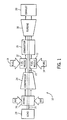
- FIG. 1 is a block diagram of a turbine system having a combustor liner with a patterned surface for enhanced cooling, in accordance with an embodiment of the present technique
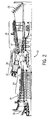
- FIG. 2 is a cutaway side view of the turbine system, as shown in FIG. 1 , in accordance with an embodiment of the present technique;
- FIG. 3 is a cutaway side view of the combustor, as shown in FIG. 1 , having a combustor liner with a patterned surface at a downstream end portion in accordance with an embodiment of the present technique;
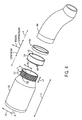
- FIG. 4 is an exploded perspective view of certain components of the combustor, as shown in FIG. 3 , in accordance with an embodiment of the present technique.
- FIG. 5 is a partial perspective view of a portion of the patterned surface on the downstream end portion of the combustor liner, as shown in FIG. 4 , in accordance with an embodiment of the present technique;
- FIG. 6 is a partial cross-sectional side view of the downstream end portion of the combustor liner, as shown in FIG. 3 , in accordance with an embodiment of the present technique;
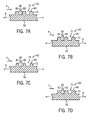
- FIGS. 7A-7D are partial cross-sectional side views of the patterned surface on the downstream end portion of the combustor liner, in accordance with several embodiments of the present technique.
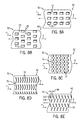
- FIGS. 8A-8E are partial top views of the patterned surface on the downstream end portion of a combustor liner, in accordance with several embodiments of the present techniques.
- FIGS. 9A and 9B are partial top and corresponding cutaway side views, respectively, of a patterned surface on the downstream end portion of the combustor, liner in accordance with a further embodiment of the present technique.
- upstream and downstream when discussed in conjunction with a combustor liner, shall be understood to mean the proximal end of the combustor liner and the distal end of the combustor liner, respectively, with respect to the fuel nozzles. That is, unless otherwise indicated, the terms “upstream” and “downstream” are generally used with respect to the flow of combustion gases inside the combustor liner.
- a downstream direction refers to the direction in which a fuel-air mixture combusts and flows from the fuel nozzles towards a turbine
- an upstream direction refers to the direction opposite the downstream direction, as defined above.
- downstream end portion shall be understood to refer to an aft-most (downstream most) portion of the combustor liner.
- the axial length of the downstream end portion of the combustor liner in certain embodiments, may be the as much as 20 percent the total axial length of the combustor liner.
- downstream end portion may also be understood to be the portion of the liner that is configured to couple to a downstream transition piece of the combustor, generally in a telescoping, concentric, or coaxial overlapping annular relationship.
- liner may also be understood to be the portion of the liner that is configured to couple to a downstream transition piece of the combustor, generally in a telescoping, concentric, or coaxial overlapping annular relationship.
- the present disclosure is directed towards a combustor liner capable of providing for more effective cooling during the operation of a turbine engine.
- the liner has a downstream end portion that includes a patterned surface having a plurality of surface features formed thereon.
- the surface features may include a plurality of discrete protrusions and/or recesses in various configurations and shapes.
- the discrete protrusions and/or recesses may be formed in both axial and circumferential directions about the downstream end portion of the liner with respect to the longitudinal axis of the liner.
- the discrete protrusions and/or recesses may be formed using any suitable technique, including but not limited to milling, casting, molding, and laser etching/cutting.
- the surface features may define a non-linear flow path relative to a longitudinal flow path along the liner.
- an annular wrapper having a plurality of openings extending radially therethrough may be configured to couple to the liner generally about the downstream end portion.
- the inner surface of the wrapper and the surface features on the downstream end portion collectively form a cooling channel which may receive an air flow through the plurality of inlets.
- the air flow may be a portion of the compressed air supplied to the combustor for combustion of fuel.
- heat is transferred away from the combustor liner, particularly the downstream end portion of the liner, via forced air convection.
- embodiments of the present invention may provide for enhanced heat transfer, thus improving uniformity in cooling (e.g., lower thermal gradients) with reduced overall pressure drop.
- this may improve overall turbine performance and increase the life of the combustor and/or combustor liner.
- FIG. 1 a block diagram of an embodiment of a turbine system 10 is illustrated.
- the disclosed turbine system 10 may employ a combustor liner having a plurality of surface features formed about a downstream end portion to provide for improved and more uniform cooling of the liner.
- the turbine system 10 may use liquid or gas fuel, such as natural gas and/or a hydrogen rich synthetic gas, to run the turbine system 10.
- a plurality of fuel nozzles 12 intakes a fuel supply 14, mixes the fuel with air, and distributes the air-fuel mixture into a combustor 16.
- the air-fuel mixture combusts in a chamber within combustor 16, thereby creating hot pressurized exhaust gases.
- the combustor 16 directs the exhaust gases through a turbine 18 toward an exhaust outlet 20. As the exhaust gases pass through the turbine 18, the gases force one or more turbine blades to rotate a shaft 22 along an axis of system 10. As illustrated, the shaft 22 is connected to various components of turbine system 10, including a compressor 24. The compressor 24 also includes blades that may be coupled to shaft 22. Thus, blades within compressor 24 rotate as shaft 22 rotates, thereby compressing air from an air intake 26 through compressor 24 and into fuel nozzles 12 and/or combustor 16.
- the shaft 22 may also be connected to a load 28, which may be a vehicle or a stationary load, such as an electrical generator in a power plant or a propeller on an aircraft. As will be understood, the load 28 may include any suitable device that capable of being powered by the rotational output of turbine system 10.
- FIG. 2 illustrates a cutaway side view of an embodiment of the turbine system 10 schematically depicted in FIG. 1 .
- the turbine system 10 includes one or more fuel nozzles 12 located inside one or more combustors 16.
- the combustors 16 may include one or more combustor liners disposed within one or more respective flow sleeves.
- the combustor liner (or liners) may include a patterned surface about a downstream end portion of the liner.
- the patterned surface may include a plurality of surface features.
- the surface features may include a plurality of discrete protrusions and/or recesses arranged both axially and circumferentially with respect to a longitudinal axis of the liner about the downstream end portion.
- the compressed air may then be mixed with gas for combustion within combustor 16.
- the fuel nozzles 12 may inject a fuel-air mixture into the combustor 16 in a suitable ratio for optimal combustion, emissions, fuel consumption, and power output.
- the combustion generates hot pressurized exhaust gases, which then drive one or more blades 17 within the turbine 18 to rotate the shaft 22 and, thus, the compressor 24 and the load 28.
- the rotation of the turbine blades 17 causes rotation of shaft 22, thereby causing the blades 19 within the compressor 22 to draw in and pressurize the air received by the intake 26.
- the surface features on the downstream end portion of the liner may form a cooling channel with the inner surface of an annular wrapper mated (disposed) about the downstream end portion of a liner.
- the cooling channel may receive a portion of the air supplied to the combustor 16 through the air intake 26. In one embodiment, the cooling channel may receive approximately 2 percent of the total air supplied to the combustor 16 from the compressor 24.
- the portion of the compressor-supplied air (which is generally substantially cooler relative to the combustion gases within the combustor 16) flows through the cooling channel and contacts the surface features, heat transfer occurs in which heat is removed from the combustor liner. By way of example, this heat transfer may occur via forced convection.
- the combustor 16 is generally fluidly coupled to the compressor 24 and the turbine 18.
- the compressor 24 may include a diffuser 29 and a discharge plenum 31 that are coupled to each other in fluid communication as to facilitate the channeling of air downstream to the combustor 16.
- the combustor 16 includes a cover plate 30 coupled to the upstream head end of the combustor 16.
- the cover plate 30 may at least partially support the fuel nozzles 12 and provide a path through which air and fuel are directed to the fuel nozzles 12.
- the combustor 16 includes a combustor liner 34 disposed within a flow sleeve 32.
- the interior of the liner 34 may define a substantially cylindrical or annular combustion chamber 38.
- the arrangement of the liner 34 and the flow sleeve 32, as shown in FIG. 3 is generally concentric and may define an annular passage 36.
- the flow sleeve 32 may include a plurality of inlets 40, which provide a flow path for at least a portion of the air from the compressor 24 into the annular passage 36. In other words, the flow sleeve 32 may be perforated with a pattern of openings.
- a second flow sleeve 42 Downstream from the liner 34 and the flow sleeve 32 (e.g. in the direction C), a second flow sleeve 42, which may be referred to as an "impingement sleeve,” may be coupled to the flow sleeve 32.
- the direction C may represent a downstream direction with respect to the flow of combustion gases away from the fuel nozzles 12 inside the liner 34.
- the terms "upstream” and "downstream,” when discussed in conjunction with a combustor liner shall be understood to mean the proximal end of the combustor liner and the distal end of the combustor liner, respectively, with respect to the fuel nozzles.
- upstream and downstream are generally used with respect to the flow of combustion gases inside the combustor liner.
- a downstream direction refers to the direction in which a fuel-air mixture combusts and flows from the fuel nozzles towards a turbine
- an upstream direction refers to the direction opposite the downstream direction, as defined above.
- the flow sleeve 32 may include a mounting flange 44 configured to receive a portion of the impingement sleeve 42.
- a transition piece 46 (which may be referred to as a "transition duct") may be disposed within the impingement sleeve 42.
- a concentric arrangement of the impingement sleeve 42 and the transition piece 46 may define an annular passage 47. As shown, the annular passage 47 is fluidly coupled to the annular passage 36.
- the impingement sleeve 42 may include a plurality of inlets 48, which may provide a flow path for at least a portion of the air from the compressor 24 into the annular passage 47.
- An interior cavity 50 of the transition piece 46 generally provides a flow path (as shown by the arrow C) by which combustion gases from the combustion chamber 38 may be directed to the turbine 18.
- the transition piece 46 may be coupled to the downstream end of the liner 34 (in the direction C), generally about a downstream end portion 52 (coupling portion), as discussed above.
- An annular wrapper 54 and a seal may be disposed between the downstream end portion 52 and the transition piece 46.
- the inner surface of the wrapper 54 may form a cooling channel with the outer surface of the downstream end portion 52, which may include a patterned surface having a plurality of surface features to enhance cooling.
- a seal may secure the outer surface of the wrapper 54 to inner surface of the transition piece 46.
- the turbine system 10 in operation, may intake air through the air intake 26.
- the compressed air is discharged into the diffuser 29, as indicated by the arrows shown in FIG. 3 .
- the majority of the compressed air is further discharged from the compressor 24, by way of the diffuser 29, through a plenum 31 into the combustor 16.
- a smaller portion of the compressed air may be channeled downstream for cooling of other components of the turbine engine 10.
- a portion of the compressed air within the plenum 31 may enter the annular passage 47 by way of the inlets 48.
- the air in the annular passage 47 is then channeled upstream (e.g., in the direction of fuel nozzles 12) towards the annular passage 36, such that the air flows over the downstream end portion 52 of the liner 34.
- a portion of this air flow is directed into the cooling channel formed by the wrapper 54 and the downstream end portion 52 in order to facilitate cooling of the combustor liner 34.
- a plurality of inlets on the wrapper 54 may provide a flow path into the cooling channel. The portion of the air flow that is not discharged into the cooling channel continues to flow upstream into the annular passage 36 toward the cover plate 30 and fuel nozzles 12. Accordingly, the annular passage 36 may receive air from the annular passage 47 and the inlets 40.
- the air flowing into the annular passage 36 is then channeled upstream towards the fuel nozzles 12, wherein the air is mixed with fuel and ignited within the combustion chamber 38.
- the resulting combustion gases are channeled from the chamber 38 into the transition piece cavity 50 and through the turbine nozzle 60 to the turbine 18.
- FIG. 4 is an exploded perspective view intended to provide a better understanding of the relationship between the liner 34, the wrapper 54, and the transition piece 46.
- the liner 34 may have a length of L1 when measured along a longitudinal axis A.
- a radius R1 of the upstream end of the liner 34 may be greater than a radius R2 of the downstream end of the liner 34.
- the radii R1 and R2 may be equal or the radius R2 may be greater than the radius R1.
- the liner 34 includes the downstream end portion 52.
- the downstream end portion 52 is a portion of the liner having an axial length L2 which, when measured from the downstream (aft-most) end of the liner 34, is less than the total length L1 of the liner 34.
- the length L2 of the downstream end portion 52 may be approximately 10-20 percent of the total length L1 of the liner.
- the length L2 could be greater than 20 percent or less than 10 percent of L1.
- the longitudinal length L2 of the downstream end portion 52 may be at least less than 5, 10, 15, 20, 25, 30, or 35 percent of the total length L1.
- the wrapper 54 is configured to mate with the liner 34 generally about the downstream end portion 52 in a telescoping, coaxial, or concentric overlapping relationship.
- An inner surface 55 of the wrapper 54 and the patterned outer surface 62 of the downstream end portion 52 may form an annular cooling channel.
- the wrapper 54 may include a plurality of inlets 68 generally near the upstream end of the wrapper 54.
- the inlets 68 are depicted as a plurality of openings disposed circumferentially (relative to the axis A) about the upstream end of the wrapper 54 and also extending radially therethrough.
- the openings defined by the inlets 68 may include holes, slots, or a combination of holes and slots, for example.
- the inlets 68 provide a flow path into the cooling channel.
- the compressed air which is substantially cooler relative to the temperature of the combustion gases within the combustion chamber 38, flows over the patterned surface 62 and contacts the surface features, which may include a plurality of discrete protrusions (and/or recesses) and, in doing so, enhances the heat transfer away from the liner 34 to cool the liner 34.
- the transition piece 46 is coupled to the liner 34 generally about the downstream end portion 52 and the wrapper 54.
- a sealing ring 66 may be disposed between the wrapper 54 and the transition piece 46 to facilitate the coupling.
- FIG. 5 is a partial perspective view of one embodiment of the patterned surface 62 on the downstream end portion 52 of the liner 34 within the circular region defined by the arcuate line 5-5, as shown in FIG. 4 .
- the patterned surface 62 may include a plurality of surface features 72.
- the surface features 72 may be a plurality of discrete substantially diamond-shaped protrusions arranged axially and circumferentially with respect to the longitudinal axis A of the liner 34.
- the diamond shaped protrusions may be defined by a plurality of grooves 70 configured in a criss-cross pattern across the length L2 of the downstream end portion 52 such that the diamond-shaped protrusions are the raised portions between the grooves 70.
- the grooves 70 may criss-cross in a non-parallel manner relative to the axis A, or in a parallel manner relative to the axis A.
- the illustrated grooves 70 are non-parallel to the axis A and thus are transverse to the axis A.
- the term "groove” shall be understood to mean the portion of the outer surface of the downstream end portion 52 of the liner 34 that is recessed or removed in order to define discrete protruding surface features 72.
- the grooves 70 may be formed in any suitable manner, including milling, casting, molding, and laser etching/cutting. In the present embodiment, the grooves 70 define a non-linear flow path relative to the longitudinal axis A of the liner 34. In other embodiments, the grooves may define a linear flow path relative to the longitudinal axis A. Further, it shall be appreciated that the grooves 70 may be configured to define protrusions having different geometric shapes, as will be shown in the additional figures below.
- the grooves 70 may have a depth of at least less than approximately 1, 2, 3, 4, or 5 millimeters with respect to the surface features 72. In additional embodiments, the grooves 70 may have a depth of greater than 5 millimeters. Further, the width of the grooves 70, in one embodiment, may be at least less than approximately 1, 2, 3, 4, 5, 6, 7, 8, 9, or 10 millimeters. The width of the grooves 70, in another embodiment, may have a range of approximately 2 to 8 millimeters. Still further, in yet another embodiment, the grooves 70 may have a width of greater than 10 millimeters. Additionally, protruding surface features 72 may be formed having various lengths and widths.
- each edge 71 may be at least less than approximately 5, 6, 7, 8, 9, 10, 11, 12, or 13 millimeters. In additional embodiments, the edge 71 may also be less than 5 millimeters or greater than 13 millimeters.
- FIG. 6 a partial cross-sectional side view of the combustor 16 within the circular region defined by the arcuate line 6-6 in FIG. 3 is illustrated. Particularly, FIG. 6 shows in more detail the air flow into the cooling channel 78 formed by the wrapper 54 and the downstream end portion 52 of the liner 34.
- Compressed air discharged by the compressor 24 may be received in the annular passage 47 (defined by the impingement sleeve 42 and the transition piece 46) through the inlets 48.
- the inlets 48 are circular-shaped holes, although in other implementations, the inlets 48 may be slots, or a combination of holes and slots of other geometries.
- the flow sleeve 32 may include the mounting flange 44 at the downstream end 65 configured to receive a member 76 extending radially outward from the upstream end 73 of the impingement sleeve 42, thereby coupling the flow sleeve 32 and impingement sleeve 42.
- the annular passage 36 also receives a portion 74 of the compressed air from the plenum 31 by way of the inlets 40.
- the airflow within the annular passage 36 may include air 64 discharged from the annular passage 47 and air 74 flowing through the inlets 40.
- the inlets 40 may also include holes, slots, or a combination thereof, of various shapes.
- the flow path F may define an airflow through surface features 72 within the channel 78. As shown, the flow path F is opposite to the flow path through the annular passages 36 and 47. In other words, flow path F is directed downstream and away from (as opposed to upstream and towards) the end cover 30 and the fuel nozzles 12.
- the air 75 directed into the cooling channel 78 may represent at least less than approximately 1, 2, 3, 4, 5, 6, 7, 8, 9, or 10 percent of the total compressed air supplied to the combustor 16. In other embodiments, the air 75 directed into the cooling channel 78 may be more than 10 percent of the total compressed air supplied to the combustor 16.
- the air 75 entering the cooling channel 78 flows along the flow path F and contacts a plurality of surface features 72 on the downstream end portion 52 of the liner 34. As discussed above, the surface features 72 may be defined as a plurality of discrete protrusions between the grooves 70. Further, as will be understood, the airflow within the cooling channel 78 is generally substantially cooler relative to the temperature of the combustion gases within the combustion chamber 38.
- the mechanism employed in cooling the liner 34 may be forced convective heat transfer resulting from the contact between the cooling air 75 and the surface features 72.
- the flow path F may continue along the length of the cooling channel 78 (substantially the length L2), wherein the cooling air exits the cooling channel 78 at a downstream end (not shown), thereby discharging into the transition piece cavity 50, whereby the cooling air 75 is directed towards combustion gases flowing downstream (away from the fuel nozzles 12) through the transition piece cavity 50.
- the surface features 72 may be defined by forming a plurality of grooves 70 on the downstream end portion 52 of the liner 34. That is, the surface features 72 protrude from the outer surface of the downstream end portion 52 of the liner 34 generally between the grooves 70.
- FIGS. 7A-7D several embodiments are shown in which the grooves 70 are formed having different shapes. Particularly, these figures illustrate in more detail the grooves 70 and the surface features 72 on the downstream end portion 52 of the liner 34 within the circular region defined by the arcuate line 7-7 in FIG. 6 .
- the grooves 70 may be formed such that the bottom surface 80 of the each groove 70 has a substantially flat surface and such that the walls 82 of each groove are adjoined to the bottom surface 80 to form a substantially right angle (90 degrees) with respect to the bottom surface 80.
- the walls 82 concurrently serve as the sidewalls of each surface feature 72 and are substantially straight such that the surface 84 of each of the surface features 72 is substantially flat.
- each groove 70 may have a substantially flat bottom surface 80 forming substantially right angles with each wall 82.
- an upper portion of the walls 82 is rounded.
- each surface feature 72 may be formed with a rounded top surface 84.
- each groove 70 has a substantially flat bottom surface 80.
- each of the walls 82 may form angles greater than 90 degrees (e.g., diverging) with respect to the bottom surface 80. That is, the width of the groove 70 measured from bottom surface 80 may be less than the width of the groove 70 measured at the top of each wall 82 (e.g., planar with the surface 84 of each surface feature 72).
- each groove 70 may be formed such that the bottom surface 80 is adjoined to each of the walls 82 via a rounded edge.
- the grooves 70 may be formed in any suitable manner, including casting, milling, molding, and laser cutting/etching.
- the grooves 70 may define a flow path F through the patterned surface on the downstream end portion 52 of the combustor liner 34.
- the flow path F defined by the grooves 70 may be linear or non-linear with respect to an axial flow path (e.g. along the longitudinal axis A) of the liner 34.
- the surface features 72 in other embodiments may be formed in a variety of configurations and shapes.
- FIGS. 8A-8E top views of different embodiments showing the surface features 72, which act as convective heat transfer members, in a variety of alternate shape configurations are illustrated.
- the surface features 72 may be formed as generally rectangular-shaped or square-shaped fins protruding from the surface of the downstream end portion 52 of the liner 34.
- the grooves 70 are formed such that the flow path F is linear relative to an axial flow path along the liner 34 (e.g., axial with respect to longitudinal axis A).
- the surface features 72 are directly in line with one another axially in series along the axis A.
- FIG. 8B an embodiment similar to that of FIG. 8A is shown, except that the fin surface features 72 are arranged such that the flow path F is non-linear in the axial direction with respect to the longitudinal axis A. That is, the surface features are staggered with respect to one another or overlap one another along the axis A.
- a circumferential flow path 85 (orthogonal with respect to F) is linear through the fin surface features 72.
- the axial flow path (F) and the circumferential flow path 85 may both be non-linear.
- FIG. 8C illustrates another embodiment of the patterned surface in which the surface features 72 are formed as cylindrical members protruding from the surface of the downstream end portion 52 of the liner 34.
- the grooves 70 are the non-raised portions of the downstream end portion 52 between each of the cylindrical members 70.
- FIG. 8D shows yet another embodiment in which the surface features 72 are generally chevron-shaped.
- the chevron-shaped surface features 72 are arranged to define a linear flow path F with respect to the longitudinal axis A, although in other embodiments, the chevron-shaped surface features 72 may be arranged in a staggered or overlapping relationship, such that the flow path F is non-linear with respect to the longitudinal axis A.
- the chevron-shaped surface features 72 are shown as pointing towards the downstream end of the combustor liner 34. Other embodiments may utilize chevron-shaped surface features 72 pointing in the opposite direction (e.g., towards the upstream end of the liner 34). In another embodiment, the chevron-shaped surface features 72 may be broken and staggered, as shown in FIG. 8E . Each portion 72A and 72B of the broken chevron may be spaced axially with respect to the longitudinal axis A by a distance, referred to in the figure by the reference number 86.
- a further embodiment of the patterned surface 62 is illustrated in which the surface features 72 are formed as a plurality of circular ring-shaped protrusions extending from the outer surface of the downstream end portion 52 of the liner 34.
- the ring-shaped surface features 72 may be arranged such that the flow path F through the patterned surface 62 is linear or non-linear with respect to the axis A.
- Each ring-shaped surface feature 72 is defined by a raised peripheral edge 88 that creates an enclosed area 90 within the ring.
- the ring-shaped surface feature 72 is a hollow annular structure defining a cylindrical enclosed area 90.
- FIG. 9B illustrates a cross-sectional view of a ring-shaped protrusion taken along the line 9B-9B, as shown in FIG. 9A .
- the peripheral edge 88 defining the enclosed area 90 may be substantially square-shaped in cross-section, which defines the hollow annular structure 360 degrees about the cylindrical enclosed area 90. In other embodiments, however, it should be appreciated that the peripheral edge 88 may have alternate cross-sectional shapes. For example, the peripheral edge 88 may have a generally trapezoidal cross-sectional shape.
- a patterned surface 62 may cover the entire outer surface of the combustor liner 34, rather than just the downstream end portion 52. Likewise, the patterned surface may be disposed on the liner 34, the transition piece 46, or both.
Landscapes
- Engineering & Computer Science (AREA)
- Chemical & Material Sciences (AREA)
- Combustion & Propulsion (AREA)
- Mechanical Engineering (AREA)
- General Engineering & Computer Science (AREA)
- Turbine Rotor Nozzle Sealing (AREA)
Applications Claiming Priority (1)
| Application Number | Priority Date | Filing Date | Title |
|---|---|---|---|
| US12/398,131 US20100223931A1 (en) | 2009-03-04 | 2009-03-04 | Pattern cooled combustor liner |
Publications (1)
| Publication Number | Publication Date |
|---|---|
| EP2226564A2 true EP2226564A2 (fr) | 2010-09-08 |
Family
ID=42229599
Family Applications (1)
| Application Number | Title | Priority Date | Filing Date |
|---|---|---|---|
| EP10155193A Withdrawn EP2226564A2 (fr) | 2009-03-04 | 2010-03-02 | Chemise de chambre de combustion avec patron de refroidissement |
Country Status (4)
| Country | Link |
|---|---|
| US (1) | US20100223931A1 (fr) |
| EP (1) | EP2226564A2 (fr) |
| JP (1) | JP2010203440A (fr) |
| CN (1) | CN101865466A (fr) |
Cited By (8)
| Publication number | Priority date | Publication date | Assignee | Title |
|---|---|---|---|---|
| CN102628596A (zh) * | 2011-02-03 | 2012-08-08 | 通用电气公司 | 用于冷却燃烧器中的燃烧器衬里的方法和装置 |
| CN103032890A (zh) * | 2011-10-07 | 2013-04-10 | 通用电气公司 | 薄膜冷却的燃烧衬套组件 |
| EP2481983A3 (fr) * | 2011-02-01 | 2013-05-01 | General Electric Company | Ensemble de revêtement de fond arrière générant des turbulences et procédé de refroidissement pour une chambre de combustion de turbine à gaz |
| WO2013096591A3 (fr) * | 2011-12-21 | 2013-08-15 | Siemens Energy, Inc. | Agencement de combustion turbo-annulaire avec dispositif de déclenchement de flux |
| WO2015032936A1 (fr) * | 2013-09-09 | 2015-03-12 | Siemens Aktiengesellschaft | Chambre de combustion d'une turbine à gaz et outil et procédé permettant de produire des canaux de refroidissement dans un composant d'une turbine à gaz |
| EP3040516A1 (fr) * | 2014-12-31 | 2016-07-06 | General Electric Company | Composant de turbomachine avec générateur de vortex |
| WO2017029090A1 (fr) * | 2015-08-20 | 2017-02-23 | Siemens Aktiengesellschaft | Turbine à gaz comprenant au moins une chambre de combustion tubulaire, et procédé servant à fabriquer une paroi de chambre de combustion |
| EP4675174A1 (fr) * | 2024-07-03 | 2026-01-07 | Doosan Enerbility Co., Ltd. | Chambre de combustion et turbine à gaz comprenant celle-ci |
Families Citing this family (41)
| Publication number | Priority date | Publication date | Assignee | Title |
|---|---|---|---|---|
| US8245514B2 (en) * | 2008-07-10 | 2012-08-21 | United Technologies Corporation | Combustion liner for a gas turbine engine including heat transfer columns to increase cooling of a hula seal at the transition duct region |
| US8707705B2 (en) * | 2009-09-03 | 2014-04-29 | General Electric Company | Impingement cooled transition piece aft frame |
| US8359867B2 (en) * | 2010-04-08 | 2013-01-29 | General Electric Company | Combustor having a flow sleeve |
| US8647053B2 (en) * | 2010-08-09 | 2014-02-11 | Siemens Energy, Inc. | Cooling arrangement for a turbine component |
| US9097117B2 (en) * | 2010-11-15 | 2015-08-04 | Siemens Energy, Inc | Turbine transition component formed from an air-cooled multi-layer outer panel for use in a gas turbine engine |
| US9133721B2 (en) * | 2010-11-15 | 2015-09-15 | Siemens Energy, Inc. | Turbine transition component formed from a two section, air-cooled multi-layer outer panel for use in a gas turbine engine |
| US20120180492A1 (en) * | 2011-01-14 | 2012-07-19 | General Electric Company | Apparatus for vibration support in combustors and method for forming apparatus |
| US20120192545A1 (en) * | 2011-01-28 | 2012-08-02 | General Electric Company | Pulse Detonation Combustor Nozzles |
| US8955330B2 (en) * | 2011-03-29 | 2015-02-17 | Siemens Energy, Inc. | Turbine combustion system liner |
| US9447971B2 (en) * | 2012-05-02 | 2016-09-20 | General Electric Company | Acoustic resonator located at flow sleeve of gas turbine combustor |
| US9121613B2 (en) * | 2012-06-05 | 2015-09-01 | General Electric Company | Combustor with brief quench zone with slots |
| US9222672B2 (en) * | 2012-08-14 | 2015-12-29 | General Electric Company | Combustor liner cooling assembly |
| US9322560B2 (en) * | 2012-09-28 | 2016-04-26 | United Technologies Corporation | Combustor bulkhead assembly |
| US20140130504A1 (en) * | 2012-11-12 | 2014-05-15 | General Electric Company | System for cooling a hot gas component for a combustor of a gas turbine |
| WO2014123850A1 (fr) | 2013-02-06 | 2014-08-14 | United Technologies Corporation | Composant de turbine à gaz avec trous de film de refroidissement orientés vers l'amont |
| EP2954261B1 (fr) | 2013-02-08 | 2020-03-04 | United Technologies Corporation | Chambre de combustion de turbine à gaz |
| US10690348B2 (en) * | 2013-11-04 | 2020-06-23 | Raytheon Technologies Corporation | Turbine engine combustor heat shield with one or more cooling elements |
| EP3189277B1 (fr) | 2014-09-05 | 2020-04-15 | Siemens Aktiengesellschaft | Tube de jonction |
| JP6481978B2 (ja) * | 2015-03-10 | 2019-03-13 | 三菱重工業株式会社 | 燃焼室の冷却機構、冷却機構を備えるロケットエンジン、及び、冷却機構の製造方法 |
| US20170138595A1 (en) * | 2015-11-18 | 2017-05-18 | General Electric Company | Combustor Wall Channel Cooling System |
| EP3225914A1 (fr) * | 2016-03-31 | 2017-10-04 | Siemens Aktiengesellschaft | Composant de turbomachine avec une paroi refroidie ondulée et procédé de fabrication |
| JP6735605B2 (ja) * | 2016-06-01 | 2020-08-05 | 川崎重工業株式会社 | ガスタービンエンジンの冷却構造 |
| KR101986729B1 (ko) * | 2017-08-22 | 2019-06-07 | 두산중공업 주식회사 | 실 영역 집중냉각을 위한 냉각유로 구조 및 이를 포함하는 가스 터빈용 연소기 |
| US10619852B2 (en) | 2017-08-25 | 2020-04-14 | United Technologies Corporation | Heat shield with round top pin fins and flat top pin fins for improved manufacturing processes |
| US11078847B2 (en) | 2017-08-25 | 2021-08-03 | Raytheon Technologies Corporation | Backside features with intermitted pin fins |
| US20190072276A1 (en) * | 2017-09-06 | 2019-03-07 | United Technologies Corporation | Float wall combustor panels having heat transfer augmentation |
| KR102099307B1 (ko) * | 2017-10-11 | 2020-04-09 | 두산중공업 주식회사 | 라이너 냉각을 촉진하는 난류 생성 구조 및 이를 포함하는 가스 터빈용 연소기 |
| EP3874204B1 (fr) * | 2018-11-02 | 2025-12-10 | Chromalloy Gas Turbine LLC | Géométrie de turbulateur pour une chemise de combustion |
| US11306918B2 (en) * | 2018-11-02 | 2022-04-19 | Chromalloy Gas Turbine Llc | Turbulator geometry for a combustion liner |
| KR102377720B1 (ko) | 2019-04-10 | 2022-03-23 | 두산중공업 주식회사 | 압력 강하가 개선된 라이너 냉각구조 및 이를 포함하는 가스터빈용 연소기 |
| DE102019214667A1 (de) * | 2019-09-25 | 2021-03-25 | Siemens Aktiengesellschaft | Komponente mit einem zu kühlenden Bereich und Mittel zur additiven Herstellung derselben |
| FR3106653B1 (fr) * | 2020-01-23 | 2022-01-07 | Safran Aircraft Engines | Ensemble pour une turbomachine |
| US11371702B2 (en) | 2020-08-31 | 2022-06-28 | General Electric Company | Impingement panel for a turbomachine |
| US11994293B2 (en) | 2020-08-31 | 2024-05-28 | General Electric Company | Impingement cooling apparatus support structure and method of manufacture |
| US11614233B2 (en) | 2020-08-31 | 2023-03-28 | General Electric Company | Impingement panel support structure and method of manufacture |
| US11460191B2 (en) | 2020-08-31 | 2022-10-04 | General Electric Company | Cooling insert for a turbomachine |
| US11994292B2 (en) | 2020-08-31 | 2024-05-28 | General Electric Company | Impingement cooling apparatus for turbomachine |
| US11255545B1 (en) | 2020-10-26 | 2022-02-22 | General Electric Company | Integrated combustion nozzle having a unified head end |
| US12454912B2 (en) * | 2020-12-03 | 2025-10-28 | Rtx Corporation | Supplemental thrust system for a gas turbine engine |
| US11828226B2 (en) * | 2022-04-13 | 2023-11-28 | General Electric Company | Compressor bleed air channels having a pattern of vortex generators |
| US11767766B1 (en) | 2022-07-29 | 2023-09-26 | General Electric Company | Turbomachine airfoil having impingement cooling passages |
Family Cites Families (23)
| Publication number | Priority date | Publication date | Assignee | Title |
|---|---|---|---|---|
| US3623711A (en) * | 1970-07-13 | 1971-11-30 | Avco Corp | Combustor liner cooling arrangement |
| US4168348A (en) * | 1974-12-13 | 1979-09-18 | Rolls-Royce Limited | Perforated laminated material |
| GB1550368A (en) * | 1975-07-16 | 1979-08-15 | Rolls Royce | Laminated materials |
| US4719748A (en) * | 1985-05-14 | 1988-01-19 | General Electric Company | Impingement cooled transition duct |
| US5327727A (en) * | 1993-04-05 | 1994-07-12 | General Electric Company | Micro-grooved heat transfer combustor wall |
| US5337568A (en) * | 1993-04-05 | 1994-08-16 | General Electric Company | Micro-grooved heat transfer wall |
| US5724816A (en) * | 1996-04-10 | 1998-03-10 | General Electric Company | Combustor for a gas turbine with cooling structure |
| US20020066273A1 (en) * | 2000-12-04 | 2002-06-06 | Mitsubishi Heavy Industries, Ltd. | Plate fin and combustor using the plate fin |
| JP4140774B2 (ja) * | 2002-03-16 | 2008-08-27 | エクソンモービル・ケミカル・パテンツ・インク | バーナー性能最適化のためのバーナー先端及びシール |
| US7086232B2 (en) * | 2002-04-29 | 2006-08-08 | General Electric Company | Multihole patch for combustor liner of a gas turbine engine |
| US6761031B2 (en) * | 2002-09-18 | 2004-07-13 | General Electric Company | Double wall combustor liner segment with enhanced cooling |
| US7104067B2 (en) * | 2002-10-24 | 2006-09-12 | General Electric Company | Combustor liner with inverted turbulators |
| US6681578B1 (en) * | 2002-11-22 | 2004-01-27 | General Electric Company | Combustor liner with ring turbulators and related method |
| CA2476803C (fr) * | 2003-08-14 | 2010-10-26 | Mitsubishi Heavy Industries, Ltd. | Paroi d'echange de chaleur, turbine a gaz ainsi equipee, et engin volant avec turbine a gaz |
| US7051532B2 (en) * | 2003-10-17 | 2006-05-30 | General Electric Company | Methods and apparatus for film cooling gas turbine engine combustors |
| US7096668B2 (en) * | 2003-12-22 | 2006-08-29 | Martling Vincent C | Cooling and sealing design for a gas turbine combustion system |
| US7302990B2 (en) * | 2004-05-06 | 2007-12-04 | General Electric Company | Method of forming concavities in the surface of a metal component, and related processes and articles |
| US7269957B2 (en) * | 2004-05-28 | 2007-09-18 | Martling Vincent C | Combustion liner having improved cooling and sealing |
| US7007482B2 (en) * | 2004-05-28 | 2006-03-07 | Power Systems Mfg., Llc | Combustion liner seal with heat transfer augmentation |
| US7010921B2 (en) * | 2004-06-01 | 2006-03-14 | General Electric Company | Method and apparatus for cooling combustor liner and transition piece of a gas turbine |
| US7373778B2 (en) * | 2004-08-26 | 2008-05-20 | General Electric Company | Combustor cooling with angled segmented surfaces |
| US7386980B2 (en) * | 2005-02-02 | 2008-06-17 | Power Systems Mfg., Llc | Combustion liner with enhanced heat transfer |
| US7571611B2 (en) * | 2006-04-24 | 2009-08-11 | General Electric Company | Methods and system for reducing pressure losses in gas turbine engines |
-
2009
- 2009-03-04 US US12/398,131 patent/US20100223931A1/en not_active Abandoned
-
2010
- 2010-03-02 EP EP10155193A patent/EP2226564A2/fr not_active Withdrawn
- 2010-03-02 JP JP2010044833A patent/JP2010203440A/ja not_active Withdrawn
- 2010-03-04 CN CN201010143142A patent/CN101865466A/zh active Pending
Cited By (12)
| Publication number | Priority date | Publication date | Assignee | Title |
|---|---|---|---|---|
| EP2481983A3 (fr) * | 2011-02-01 | 2013-05-01 | General Electric Company | Ensemble de revêtement de fond arrière générant des turbulences et procédé de refroidissement pour une chambre de combustion de turbine à gaz |
| CN102628596A (zh) * | 2011-02-03 | 2012-08-08 | 通用电气公司 | 用于冷却燃烧器中的燃烧器衬里的方法和装置 |
| CN103032890A (zh) * | 2011-10-07 | 2013-04-10 | 通用电气公司 | 薄膜冷却的燃烧衬套组件 |
| EP2578937A3 (fr) * | 2011-10-07 | 2014-04-02 | General Electric Company | Ensemble tube de combustion refroidi par film |
| WO2013096591A3 (fr) * | 2011-12-21 | 2013-08-15 | Siemens Energy, Inc. | Agencement de combustion turbo-annulaire avec dispositif de déclenchement de flux |
| CN104204678A (zh) * | 2011-12-21 | 2014-12-10 | 西门子公司 | 具有断流装置的环管式燃烧布置 |
| US9297532B2 (en) | 2011-12-21 | 2016-03-29 | Siemens Aktiengesellschaft | Can annular combustion arrangement with flow tripping device |
| WO2015032936A1 (fr) * | 2013-09-09 | 2015-03-12 | Siemens Aktiengesellschaft | Chambre de combustion d'une turbine à gaz et outil et procédé permettant de produire des canaux de refroidissement dans un composant d'une turbine à gaz |
| EP3040516A1 (fr) * | 2014-12-31 | 2016-07-06 | General Electric Company | Composant de turbomachine avec générateur de vortex |
| US9777635B2 (en) | 2014-12-31 | 2017-10-03 | General Electric Company | Engine component |
| WO2017029090A1 (fr) * | 2015-08-20 | 2017-02-23 | Siemens Aktiengesellschaft | Turbine à gaz comprenant au moins une chambre de combustion tubulaire, et procédé servant à fabriquer une paroi de chambre de combustion |
| EP4675174A1 (fr) * | 2024-07-03 | 2026-01-07 | Doosan Enerbility Co., Ltd. | Chambre de combustion et turbine à gaz comprenant celle-ci |
Also Published As
| Publication number | Publication date |
|---|---|
| CN101865466A (zh) | 2010-10-20 |
| JP2010203440A (ja) | 2010-09-16 |
| US20100223931A1 (en) | 2010-09-09 |
Similar Documents
| Publication | Publication Date | Title |
|---|---|---|
| EP2226564A2 (fr) | Chemise de chambre de combustion avec patron de refroidissement | |
| EP2228602B1 (fr) | Système de refroidissement de chemise de chambre de combustion | |
| EP2587153B1 (fr) | Ensemble de buses de carburant pour moteurs de turbine et procédés d'assemblage correspondants | |
| JP6190567B2 (ja) | 燃焼器ライナー螺旋状冷却装置 | |
| EP2613083B1 (fr) | Ensemble de buse à combustible à utiliser avec un moteur à turbine et son procédé d'assemblage | |
| EP2481983B1 (fr) | Ensemble de revêtement de fond arrière générant des turbulences et procédé de refroidissement pour une chambre de combustion de turbine à gaz | |
| EP2578943B1 (fr) | Système de refroidissement d'une buse à combustible à tubes multiples | |
| EP2669580B1 (fr) | Ensemble d'injection de carburant à utiliser dans les moteurs à turbine et procédé d'assemblage correspondant | |
| US7757492B2 (en) | Method and apparatus to facilitate cooling turbine engines | |
| US20090120093A1 (en) | Turbulated aft-end liner assembly and cooling method | |
| EP2489937B1 (fr) | Ensemble de chambre de combustion pour un moteur de turbine et son procédé de fabrication | |
| KR20080065551A (ko) | 에어포일, 슬리브 및 연소기 조립체를 조립하기 위한 방법 | |
| EP3290805A1 (fr) | Ensemble de buse de combustible comportant un résonateur | |
| CN102251857B (zh) | 用于冷却涡轮机燃烧器过渡件的系统 | |
| US20120031099A1 (en) | Combustor assembly for use in a turbine engine and methods of assembling same | |
| EP2634489A1 (fr) | Ensemble de buse de combustible destiné à être utilisé dans des moteurs à turbine et son procédé d'assemblage |
Legal Events
| Date | Code | Title | Description |
|---|---|---|---|
| PUAI | Public reference made under article 153(3) epc to a published international application that has entered the european phase |
Free format text: ORIGINAL CODE: 0009012 |
|
| AK | Designated contracting states |
Kind code of ref document: A2 Designated state(s): AT BE BG CH CY CZ DE DK EE ES FI FR GB GR HR HU IE IS IT LI LT LU LV MC MK MT NL NO PL PT RO SE SI SK SM TR |
|
| STAA | Information on the status of an ep patent application or granted ep patent |
Free format text: STATUS: THE APPLICATION IS DEEMED TO BE WITHDRAWN |
|
| 18D | Application deemed to be withdrawn |
Effective date: 20131001 |