EP2227060A2 - Réseaux et dispositifs de télécommunications - Google Patents
Réseaux et dispositifs de télécommunications Download PDFInfo
- Publication number
- EP2227060A2 EP2227060A2 EP10151842A EP10151842A EP2227060A2 EP 2227060 A2 EP2227060 A2 EP 2227060A2 EP 10151842 A EP10151842 A EP 10151842A EP 10151842 A EP10151842 A EP 10151842A EP 2227060 A2 EP2227060 A2 EP 2227060A2
- Authority
- EP
- European Patent Office
- Prior art keywords
- server
- mobile terminal
- hnb
- ims
- network
- Prior art date
- Legal status (The legal status is an assumption and is not a legal conclusion. Google has not performed a legal analysis and makes no representation as to the accuracy of the status listed.)
- Granted
Links
Images




Classifications
-
- H—ELECTRICITY
- H04—ELECTRIC COMMUNICATION TECHNIQUE
- H04W—WIRELESS COMMUNICATION NETWORKS
- H04W60/00—Affiliation to network, e.g. registration; Terminating affiliation with the network, e.g. de-registration
- H04W60/04—Affiliation to network, e.g. registration; Terminating affiliation with the network, e.g. de-registration using triggered events
-
- H—ELECTRICITY
- H04—ELECTRIC COMMUNICATION TECHNIQUE
- H04L—TRANSMISSION OF DIGITAL INFORMATION, e.g. TELEGRAPHIC COMMUNICATION
- H04L63/00—Network architectures or network communication protocols for network security
- H04L63/06—Network architectures or network communication protocols for network security for supporting key management in a packet data network
- H04L63/062—Network architectures or network communication protocols for network security for supporting key management in a packet data network for key distribution, e.g. centrally by trusted party
-
- H—ELECTRICITY
- H04—ELECTRIC COMMUNICATION TECHNIQUE
- H04L—TRANSMISSION OF DIGITAL INFORMATION, e.g. TELEGRAPHIC COMMUNICATION
- H04L63/00—Network architectures or network communication protocols for network security
- H04L63/10—Network architectures or network communication protocols for network security for controlling access to devices or network resources
- H04L63/108—Network architectures or network communication protocols for network security for controlling access to devices or network resources when the policy decisions are valid for a limited amount of time
-
- H—ELECTRICITY
- H04—ELECTRIC COMMUNICATION TECHNIQUE
- H04W—WIRELESS COMMUNICATION NETWORKS
- H04W60/00—Affiliation to network, e.g. registration; Terminating affiliation with the network, e.g. de-registration
- H04W60/001—Registration rejection or failure
-
- H—ELECTRICITY
- H04—ELECTRIC COMMUNICATION TECHNIQUE
- H04W—WIRELESS COMMUNICATION NETWORKS
- H04W80/00—Wireless network protocols or protocol adaptations to wireless operation
- H04W80/08—Upper layer protocols
- H04W80/10—Upper layer protocols adapted for application session management, e.g. SIP [Session Initiation Protocol]
-
- H—ELECTRICITY
- H04—ELECTRIC COMMUNICATION TECHNIQUE
- H04W—WIRELESS COMMUNICATION NETWORKS
- H04W84/00—Network topologies
- H04W84/02—Hierarchically pre-organised networks, e.g. paging networks, cellular networks, WLAN [Wireless Local Area Network] or WLL [Wireless Local Loop]
- H04W84/04—Large scale networks; Deep hierarchical networks
- H04W84/042—Public Land Mobile systems, e.g. cellular systems
- H04W84/045—Public Land Mobile systems, e.g. cellular systems using private Base Stations, e.g. femto Base Stations, home Node B
Definitions
- the present invention relates to a telecommunications network and more particularly to a method of controlling a micro base station, such as an IMS home base station, in the network.
- the invention also relates to a micro base station for use in a mobile telecommunications network and a network element for controlling a micro base station.
- the conventional manner is by signalling between a mobile terminal and a conventional base station (macro base station) that has a connection to Base Station Controller (BSC) which in turn has a connection to a Mobile Switching Centre (MSC).
- BSC Base Station Controller
- MSC Mobile Switching Centre
- the BSC is a component of the network which controls radio resource management, in order to ensure that a user is connected to the best base station in terms of signal strength or quality.
- HNBs Home Node Bs
- LTE Long Term Evolution
- These home base stations may be dedicated network access points, or may be enhanced wireless internet hubs (i.e. providing wireless internet access, as well as wireless telecommunications network access).
- the range of home base stations is significantly smaller than macro base stations, typically providing coverage to a range much less than 100 metres.
- An advantage of introducing home base stations in existing telecommunications networks is that, where sufficient numbers of them are implemented, the power level of the macro coverage could be reduced, due to a lower demand for the macro-base stations. Power reductions of course result in energy and financial savings, for instance due to less spectrum being required and also less hardware.
- a further advantage of using a home base stations connected to the core network via an IP network is that existing broadband Digital Subscriber Line (DSL) connections can be used to link mobile terminals with the network core without using the capacity of the radio access network or transmission network of a mobile telecommunications network.
- the home base station can be integrated into a DSL modem/router so as to use DSL connections to backhaul the traffic to the communication network.
- a still further advantage is that home base stations are able to provide "mobile" network access to areas where there is no macro radio access network coverage. For example, a home base station could provide 3G coverage in an area where there is no macro 3G coverage at all, perhaps only macro GSM coverage.
- the use of home base stations as an additional or alternative means for accessing the network therefore advantageously increases the network capacity and coverage.
- IMS IP Multimedia Subsystem
- IP Internet Protocol
- the IMS Home Node B needs to register each mobile terminal it is serving with the IMS system, which is a SIP server.
- the IMS registration from the IMS HNB is performed at the same time as a UMTS location area (LA)/Routing Area (RA) update (or a GSM LA/RA update in a Dual Transfer Mode (DTM) capable GSM system).
- LA UMTS location area
- RA Radio Access Area
- DTM Dual Transfer Mode
- HNBs contain some RNC functionality, and so, when UEs attach via a HNB, the HNB stores the UE's IMSI/TMSI along with the wireless ciphering and integrity protection keys. These keys will remain valid as long as the UE stays in its current Location Area (LA)/Routing Area (RA). Therefore, from the HNB's viewpoint, these keys can then be used for subsequent communications with the UE without contacting the MSC/SGSN, until a point in time when the UE subsequently performs a LA update (LAU)/RA update (RAU).
- LA Location Area
- RA Radio Service
- the HNB to be in a LA/RA different to that of its surrounding/overlaying cells (being either other "home cells" or cells from the traditional PLMN).
- TMSI Temporary Mobile Subscriber Identity
- the HNB will not be notified of the changes. Therefore, if the UE subsequently returns to the HNB, having stayed with the LA/RA but changing its TMSI and/or security keys since it was last attached to the HNB, the HNB will not be aware of the new cipher keys. Therefore the HNB is likely to attempt communication with the UE using its saved, but not current, cipher keys. Its only once this has occurred, and signalling resources wasted, that it may become evident to the HNB that a LAU/RAU is required.
- TMSI Temporary Mobile Subscriber Identity
- each HNB is allocated its own LA/RA for this technique to function correctly, so that the UE always performs a LAU/RAU when it moves away from the HNB.
- a Home Node B it is desirable for a Home Node B to be in the same LA and/or RA as its surrounding cells, and so this is not really feasible. Therefore there is a need to ensure the HNB has the most up-to-date information, but without unduly increasing the signalling load.
- a still further problem in relation to the compatibility between SIP signalling and 3GPP TS 24.008 is that whilst entry into an IMS HNB causes IMS registration, idle mode movement away from the HNB does not lead to deregistration in most situations. This is problematic, particularly in terms of the increased signalling load that is likely to occur when attempting to route calls/communications towards a mobile terminal that has in fact moved away.
- the present invention provides, in a telecommunications network including a radio access network comprising a plurality of base stations, each defining a cell, for wirelessly transmitting data that is receivable by one or more mobile terminals, wherein at least one of the base stations is an IMS-enabled Home Node B (HNB) in communication with a core component of the telecommunication network via an IP server, a method of validating a request to register a mobile terminal with the HNB, the method including: obtaining an identifier of the last known cell location in which the mobile terminal was registered, together with an age associated with that registration; comparing the last known cell location identifier and the associated age with the HNB identity; and using the comparison to decide whether or not to accept the mobile terminal registration request.
- HNB IMS-enabled Home Node B
- This method may be performed by various components of the telecommunications network, including the HNB itself, the IP server, a separate authentication server, or any combination thereof.
- this aspect of the invention enables the validity of a mobile terminal registration request to be verified, using existing network information. This ensures that both the HNB is not falsely registering a mobile terminal in order to surreptitiously incorrectly divert communications intended for the mobile terminal, and also that the HNB is not able to falsely allocate call charges to the mobile terminal's account.
- the present invention provides in a telecommunications network including a radio access network comprising a plurality of base stations, each defining a cell, for wirelessly transmitting data that is receivable by one or more mobile terminals, wherein at least one of the base stations is a Home Node B (HNB) in communication with a core component of the telecommunication network via an IP server, a method of routing calls in the network, the method including: receiving an incoming call for a mobile terminal at a network server that has the option of sending the communication via a CS route or via an IMS route; checking an IMS server database to determine if the mobile terminal is registered at a HNB, and where registered, obtaining the HNB identity and an age associated with the registration; interrogating the core network component to obtain data defining the last known location of the mobile terminal and an age associated with the last known location; and comparing the data obtained from the IMS server database with the data obtained from the core network component to decide whether to route the call via the CS route or via the
- HNB Home No
- This aspect of the invention again makes use of existing information in the network in order to select the most appropriate route in the network.
- this aspect recognises that many HNBs are not notified of the movement of UEs away from them as serving base stations, and accordingly serves to save signalling resources.
- the method also entails a notification to the HNB to deregister the UE where the CS route is selected.
- the present invention provides in a telecommunications network including a radio access network comprising a plurality of base stations, each defining a cell, for wirelessly transmitting data that is receivable by one or more mobile terminals, wherein at least one of the base stations is an IMS-enabled Home Node B (HNB) in communication with the telecommunication network via an IMS server, and a routing server, associated with the IMS server, being configured to route all calls on a CS route, a method of routing calls in the network including: receiving a paging message for a mobile terminal at the HNB, the paging message being transmitted on a CS route by the routing server; and upon the mobile terminal being successfully paged, the HNB initiating an IMS session with the IMS server including data to notify the routing server so that the call is routed to the mobile terminal via the IMS session.
- HNB IMS-enabled Home Node B
- the present invention provides, i n a telecommunications network including a radio access network comprising a plurality of base stations, each defining a cell, for wirelessly transmitting data that is receivable by one or more mobile terminals, wherein at least one of the base stations is an IMS-enabled Home Node B (HNB) in communication with an MSC of the telecommunication network, a method of routing calls in the network, the method including: the MSC receiving a notification upon the HNB being successfully registered with a mobile terminal; the MSC maintaining the notification until receipt of: a) a LAU for the mobile terminal; b) an indication of an IMS registration of the mobile terminal on another HNB; c) a cancel location communication from the network; and then sending a cancel IMS registration message to the HNB.
- HNB IMS-enabled Home Node B
- the notification is received from the HNB or an IMS server.
- This aspect of the invention addresses the existing problem of HNBs not being sufficiently integrated into the mobile telecommunications network, and accordingly not necessarily being notified of a mobile terminal moving away from its location.
- the present invention provides i n a GSM telecommunications network including a radio access network comprising a plurality of base stations, each defining a cell, for wirelessly transmitting data that is receivable by one or more mobile terminals, wherein at least one of the base stations is a home base station in communication with a core component of the telecommunication network via an IP server, a method of validating a mobile terminal request to register with the home base station, the method including: transmitting a request to the mobile terminal for an identity indication, the request transmitted a plurality of times, dependent on the number of bits utilised by the MSC to detect duplicated messages in the network layer.
- the identity indication requested is the mobile terminal's IMSI.
- This aspect of the invention facilitates the integration of home base stations into GSM networks by enabling the home base stations to gather information required, without conflicting with existing GSM signalling.
- the present invention provides in a telecommunications network including a radio access network comprising a plurality of base stations, each defining a cell, for wirelessly transmitting data that is receivable by one or more mobile terminals, wherein at least one of the base stations is a home base station, with mobile terminal registration data for communicating with a given mobile terminal as its serving base station, a method of the home base station recognising changes in the registration data, the method including: receiving a communication from the mobile terminal; comparing a key sequence identifier included in the communication with a key sequence identifier saved in relation to the registration data; where the key sequence identifiers differ, transmitting a location area update request to the network in relation to the mobile terminal.
- this aspect of the invention enables a home base station to recognise instances when a mobile terminal changed its TMSI and/or security keys since it was last attached to the home base station.
- This is a procedure that makes use of existing signalling, but signalling not to date utilised by base stations, instead being intended for core network components such as the MSC.
- this aspect of the invention results in a reduction of the usage in signalling resources.
- a number of base stations are arranged in groups and each group of base stations is controlled by one BSC/RNC which in turn is controlled by a mobile switching centre (MSC), such as MSC 2 for Base Station Subsystem 3.
- MSC mobile switching centre
- the network will incorporate many more MSCs and base stations than shown in Figure 1 .
- Each BTS 22 corresponds to a respective cell of its cellular or mobile telecommunications network and receives calls from and transmits calls to a mobile terminal in that cell by wireless radio communication in one or both of the circuit switched or packet switched domains.
- a subscriber's mobile terminal UE
- the mobile terminal may be a handheld mobile telephone, a personal digital assistance (PDA) or a laptop computer equipped with a datacard.
- each base station 3 comprises a base transceiver station (BTS) (22) and a base station controller (BSC) (26).
- BTS base transceiver station
- BSC base station controller
- a BSC may control more than one BTS.
- the BTSs and BSCs comprise the radio access network.
- each base station comprises a node B (22) and a radio network controller (RNC) (26).
- RNC may control more than one node B.
- the node Bs and RNCs comprise the radio access network.
- each base station comprises an eNode B.
- the base stations are connected to one or more Mobility Management Entities (MMEs) and a Serving Gateways (SGW).
- MMEs Mobility Management Entities
- SGW Serving Gateways
- Each subscriber to the network is provided with a smart card or SIM/USIM which, when associated with the user's mobile terminal identifies the subscriber to the network.
- the SIM/USIM card is pre-programmed with a unique identification number, the "International Mobile Subscriber Identity" (IMSI).
- IMSI International Mobile Subscriber Identity
- the subscriber is issued with a publicly known number, that is, the subscriber's telephone number, by means of which calls to the subscriber are initiated by callers. This number is the MSISDN.
- the network includes a home location register (HLR) 10 which, for each subscriber to the network, stores the IMSI and the corresponding MSISDN together with other subscriber data, such as the current or last known MSC or SGSN of the subscriber's mobile terminal.
- HLR home location register
- TMSI Temporary IMSI
- the mobile terminal 1 When the subscriber wishes to activate their mobile terminal in a network (so that it may make or receive calls subsequently), the mobile terminal 1 transmits the IMSI (read from an associated SIM/USIM card) to the Base Station Subsystem 3 associated with the particular cell in which the terminal 1 is located. In a traditional network, the BSS 3 then transmits this IMSI towards the MSC 2 with which the BSS 3 is connected. In a network using the functionality described in 3GPP TS 23.236, the BSS follows prescribed rules to select which MSC to use, and then transmits this IMSI to the selected MSC.
- the IMSI read from an associated SIM/USIM card
- MSC 2 now accesses the appropriate storage location in the HLR 10 present in the network core 12 and extracts the corresponding subscriber MSISDN and other subscriber data from the appropriate storage location, and stores it temporarily in a storage location in a visitor location register (VLR).
- VLR visitor location register
- a call may be made by entering the telephone number of the called party in the usual way.
- This information is received by the BSS 3 and passed on to MSC 2.
- MSC 2 routes the call towards the called party.
- MSC 2 can associate the call with a particular subscriber and thus record information for charging purposes.
- MSCs 2 and 25 support communications in the circuit switched domain - typically voice calls.
- Corresponding SGSNs 16 and 24 are provided to support communications in the packet switched domain - such as GPRS data transmissions.
- the SGSNs function in an analogous way to the MSCs.
- the coverage area of a mobile telecommunications network is divided into a plurality of cells, each of which is served by a respective base station.
- Paging is a process of broadcasting a message which alerts a specific mobile terminal to take some action - in this example, to notify the terminal that there is an incoming call to be received. If the network knows in which cell the mobile terminal is located, it is only necessary to page in that cell. However, if the mobile terminal is moving within the network, the precise cell in which the mobile terminal is located may not be known. It will therefore be necessary to perform paging in a number of cells. The greater the number of cells in which paging must occur, the more use of valuable signalling capacity within the network.
- each cell has a unique cell global identity (CGI), whereby the CGI is a concatenation of the Location Area ID and a Cell ID and uniquely identifies a given cell.
- CGI cell global identity
- a UMTS/GSM network the problems of excessive use of signalling capacity by paging a multiplicity of cells or performing a multiplicity of frequent location updates is solved in a known manner by dividing the coverage area of the mobile telecommunications network into a plurality of location areas (LAs) and into a plurality of routing areas (RAs).
- LAs location areas
- RAs routing areas
- the equivalent areas in the proposed LTE network are described as tracking areas (TAs).
- a location area relates to a particular geographical area for communications in the circuit-switched domain.
- a location area is larger than the area of a single cell but is smaller than the area covered by one MSC.
- Each cell within the network broadcasts data indicative of the identity of its location area.
- the mobile terminal uses this data to determine when it has moved into a new location area.
- the terminal stores its last known location area on its SIM/USIM. This information stored on the SIM/USIM is regularly compared with the location area information broadcast by its local cell. The identities of the two location areas are compared. If they are different, the mobile terminal determines that it has entered a new location area. The mobile terminal then gains access to a radio channel and requests a location update.
- the network can immediately authenticate the mobile terminal and note the change of location area. However, if the mobile terminal is moved to a different MSC/VLR, the MSC/VLR addresses a message to the HLR. The HLR notes the new location and downloads security parameters to allow the network to authenticate the mobile. It also passes on subscription details of the user to the new VLR and informs the old VLR to delete its records.
- a routing area relates to a particular geographical area for communications in the packet-switched domain.
- the procedure performed for routing areas is analogous to that just described for location areas.
- a Home Node B (AP 20) is shown.
- the Home Node B 20 provides a radio link 21 to mobile terminal (UE) 1.
- the radio link 21 from the Home Node B 20 to the mobile terminal 1 uses the same cellular telecommunication transport protocols as the conventional BTS 22 but with a smaller range - for example 25m.
- the Home Node B 20 appears to the mobile terminal 1 as a conventional base station, and no modification to the mobile terminal 1 is required to operate with the Home Node B 20.
- the Home Node B 20 performs a role corresponding to that of a GSM BTS 22 and BSC 26 and/or UMTS Node B and RNC and/or an LTE eNode B.
- Communications between the Home Node B 20 and the MSC 25/SGSN 24 are IP based communications, and may be, for example, transmitted over a broadband IP network (and routed via the Internet).
- the Home Node B 20 converts the cellular telecommunications transport protocols used between the mobile terminal 1 and the Home Node B 20 to IP based signalling.
- the Home Node B is connected to the core network via an IMS server (not shown).
- IMS Internet Protocol
- IP Internet Protocol
- IMS Internet Protocol
- VoIP Voice over IP
- IP Session Initiation Protocol
- IP Internet Protocol
- PS packet-switched
- CS circuit switched
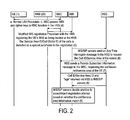
- an operational mobile terminal (1) will perform LAUs as necessary. This involves the UE (1) opening up a Radio Resource Control (RRC) connection, and passing its IMSI or TMSI to the MSC controlling the LA/RA in which it is located (4).
- the MSC will convert the TMSI to the IMSI (where necessary) and then pass information (e.g. IMSI, cipher keys) to the base station that the UE is using.
- the base station is a HNB.
- the HNB registers that UE with the IMS. According to this embodiment of the invention, this involves the HNB sending the registered UE's IMSI along with its own identity (ID) information, such as the service area ID and/or CGI of the cell (5). This additional identity information may be provided as a special parameter in this IMS registration procedure.
- ID identity
- the IMS server is able to validate the legitimacy of the HNB and its association with the "registered" UE.
- the IMS sends an "Any Time Interrogation" message to the core network (i.e. the Home Subscriber Server (HSS)/Home Location Register (HLR)) to request the Cell ID/Service Area of the UE (6).
- the HSS/HLR Upon receipt of this request, the HSS/HLR sends a Provide Subscriber Information message to the MSC, requesting the last known cell/service area of the UE (7).
- the MSC provides this information, typically in conjunction with a time indication denoting the age/currency of the information (8).
- the HSS/HLR then forwards this information to the IMS server.
- the IMS server then has information from both the HNB and the core network in relation to the UE and it uses this information to decide whether to accept or reject the registration (9). For instance, where the cell ID received from the HNB matches that received from the HSS/HLR, then this is a good indication that the request from the HNB is valid. If however, there is no match, the IMS server may decide that the possibility exists that the HNB is trying to falsely obtain communications intended for the particular UE, and not accept the registration request from the HNB (as well as any other actions considered appropriate).
- the IMS server may also check the "age" of the last known cell information, and where the age information indicates that the last known location of the UE was not in the recent past, then the IMS server may decide to reject the registration request, as the LAU procedure (the one that caused the IMS HNB to register the UE to IMS) should have caused the MSC to update its "last known location" information.
- the IMS/SIP server performs a security check by matching the cell ID of the HNB against information in the MSC/SGSN.
- This embodiment therefore provides a network-based security binding solution in relation to a HNB in the telecommunications network.
- An alternative embodiment of the invention relates to the use of a network-initiated verification to the UE.
- This embodiment makes use of the fact that many UEs (e.g. Blackberry TM and iPhone TM terminals) currently, as a matter of course, set up a Packet Switched connection (i.e. a PS attach) when registered in a network in order to send and receive information, even when idle.
- UEs e.g. Blackberry TM and iPhone TM terminals
- a PS attach Packet Switched connection
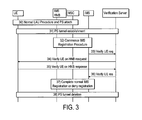
- the UE when the UE performs a LAU update, and establishes a circuit switched attachment to the MSC managing its LA/RA by sending its IMSI and cipher keys to the MSC, as per step (4) in the previous embodiment, it additionally sends a PS attach request in order to set up a PS tunnel to a Verification Server (30).
- the base station through which the UE performs its LAU is a HNB.
- the PS tunnel that is established (31) can be based upon a GPRS/3G PS/EPS attach or a WLAN attach (i.e. different attach signalling depending upon the type of network being used by the UE).
- EPS is the Evolved Packet System (EPS) currently being developed by 3GPP.
- the PS tunnel is established to a verification server, which could be a component of the IMS server, another server in the network (e.g. the S-CSCF, SCC AS (Service Centralisation and Continuity Application Server)) or a separate server.
- the UE knows the address/location of the verification server by means of a predefined server discovery mechanism (e.g. DNS lookup using a preconfigured IP address of the HNB or a fully qualified domain name (preconfigured or automatically generated)).
- the Tunnel could be established using the OMA SUPL standard (to a SUPL server). Alternatively it could use RADIUS or Diameter protocols.
- the HNB After seeing the CS attach successfully completed, the HNB commences a registration procedure with the IMS server (32). Upon receiving the IMS server receiving the IMS registration request from the HNB, which includes identification information for the UE, the IMS server, before accepting the IMS registration, sends a message to the verification server to see if the UE really is on the IMS HNB attempting to register the UE.
- This UE verification request (33) includes the HNB identity.
- the verification server Upon receiving this verification request, the verification server sends a message to the UE over the established PS tunnel requesting the identity of the base station upon which it is camped (e.g. the Cell ID) (34). If the PS tunnel is not available, then the IMS registration is typically denied. If the PS tunnel is available, and the UE receives the cell identity request (34), the UE sends a message back to the verification server over the PS tunnel containing its current cell ID (35). It is to be appreciated that from the UE's perspective, these instructions could be received and processed by an application on the (U)SIM card, ISIM or by the UE itself. Where the application is located on the (U)SIM, this could be provisioned using the (U)SIM Toolkit provisioned on the (U)SIM for facilitating value added services.
- the verification server Upon receiving this response from the UE, the verification server compares the cell identity information received from the UE with that previously received from the HNB in its UE verification request. If they match, then a positive verification response is sent to the HNB (36).
- the matching performed by the verification server may be facilitated using a Cell ID and IMS HNB mapping table, stored either locally or accessed remotely.
- the verification server upon completing the communication exchange with the UE, may tear down the PS tunnel. This tearing down of the PS tunnel may also be performed independently of whether or not the verification was successful.
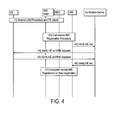
- Figure 4 illustrates a still further embodiment of this invention.
- the UE performs a CS attach to the MSC through the IMS HNB as normal.
- the UE may additionally perform a PS attach, such as through either GPRS/3G PS/EPS attach or WLAN attach (41).
- the IMS HNB Upon seeing the successful CS attach, the IMS HNB commences IMS registration as normal (42). As part of this registration procedure, a server in the IMS (such as the S-CSCF), sends a message to a verification server to see if the UE really is on the IMS HNB attempting to register the UE (43). This UE verification request includes the IMS HNB identity.
- a server in the IMS such as the S-CSCF
- the verification server Upon receiving this verification request, the verification server sends a message to the UE requesting its serving cell ID using the CS connection (44).
- This CS connection message could be an SMS, a network initiated USSD (Unstructured Supplementary Service Data) or using User-to-User signalling. If the message cannot be sent (e.g. due to absent subscriber), the IMS registration is typically denied and no further steps processed. Alternatively, if the message is successful sent, the UE will send a reply back to the verification server over the same CS connection method as the received message (45). This message contains the UE's current serving cell ID.
- the verification server then performs the verification between the serving cell ID and the applicable IMS HNB (e.g. using a table mapping the cell IDs with HNB identities) and sends an appropriate reply to the IMS HNB (46). If the verification server acknowledges that the UE is on the identified IMS HNB, then IMS registration is allowed to proceed. Otherwise the IMS registration is denied (47).
- a combination of the Figure 3 and 4 embodiment may be implemented, whereby upon the verification server receiving the verification request (33) from the HNB, the verification server has a choice of utilising a PS access tunnel, or it may use a CS connection (i.e. send the request to the UE via the MSC).
- This choice may be based upon the availability of the connections, the known capabilities of the UE (e.g. it may be located in a GSM network and unable to establish a PS access tunnel), the local operator policy and/or the requirements of the application on the (U)SIM within the UE.
- These embodiments therefore enable the core network to provide enhanced mechanisms for independently verifying the combination of a HNB and a UE in order to ensure, inter alia, that the HNB is validly to receive communications intended for the UE, and that charges accrued through the HNB for a particular UE are genuinely attributable to that UE.
- the embodiments described above in relation to Figures 2 to 4 have assumed that the HNB is in a 3G network. It is to be appreciated that the embodiments may equally be applied to a HNB in a GSM network, with some adaptations. For instance, if the UE is performing a LAU to the HNB in a GSM network, where the serving MSC supports Dual Transfer Mode (DTM: a GSM mechanism which enables simultaneous transfer of CS and PS data), then the MSC will send the IMSI to the BSS (in this case being the HNB).
- DTM Dual Transfer Mode
- the HNB can be configured to send an identity request to the mobile to obtain its IMSI.
- Layer 3 is the network layer that handles signalling relating to radio resource management, mobility management and call control.
- the HNB sends multiple identity requests to the UE, the number being dependent upon whether the MSC is using 1 or 2 bits for the layer 3 message number. More specifically, if the MSC is using 1 bit for the layer 3 message, the HNB will send 2 identity requests, and if the MSC is using 2 bits, the HNB sends 4 identity requests. In this way, the multiple requests cycle the layer 3 message number back to the value that the MSC deems "correct".
- the HNB is configured to check the Key Sequence Identifier (KSI - as used in UMTS) or Cipher Key Sequence Number (CKSN - as used in GSM) upon receiving a communication from the UE.
- the HNB is also configured to store, for each UE registered with it, the UE's IMSI together with the allocated TMSI, cipher/integrity keys in association with the KSI/CKSN. Then, upon receiving a communication from the UE, the HNB will check to see if the KSI/CKSN matches the corresponding number it has stored for the UE.
- the HNB is able to assume that nothing has changed and the UE is still registered with it. If there is not a match, the HNB will know that the UE has reregistered with another base station, and that it will need to perform a LAU/RAU in order to obtain new keys and/or TMSI from the core network.
- the IMS registration procedure is extended still further in order to address the problem of routing mobile terminating calls.
- the UE will perform a LAU procedure to an MSC when leaving the HNB whilst in idle mode.
- the HNB does not know about this outbound mobility and hence the HNB does not have the opportunity to perform an IMS deregistration for the UE. This means that incoming calls may get incorrectly routed to the HNB (i.e. after the UE has moved away from that HNB's coverage).
- a solution is suggested which records and makes use of the "age" of a UE's cell registration data in deciding how to route an incoming call.
- T-ADS Terminating Access Domain selection
- the incoming call is therefore directed to the IMS/T-ADS.
- the IMS/T-ADS Upon receiving the call, the IMS/T-ADS sends a request to the HSS/HLR for information concerning the last serving base station ID (cell ID/service area ID) for the UE as well as the "age" of that last location information.
- This request can ideally be sent as an "Any Time Interrogate" (ATI) message (54).
- ATI Any Time Interrogate
- the HSS/HLR In response to this request from the IMS/T-ADS, the HSS/HLR sends a "provide subscriber Information" (PSI) message to the MSC, to access the requested information (55). The MSC then sends a reply containing the requested information (56). Note that if the UE has moved away from the IMS HNB, it will be camped on a cell in a different LA and hence will perform a Location Update to the MSC, and this causes the MSC to update the "last known cell ID and timestamp" for that UE. The requested information is in turn forwarded by the HSS/HLR to the IMS/T-ADS (57).
- PSI subscriber Information
- ATI/PSI messages are established messages in 3GPP as part of CAMEL (Customised Applications for Mobile network Enhanced Logic).
- the T-ADS Once the T-ADS has received the last known activity of the UE from the MSC, it compares this information with the data it received via the IMS registration procedure (i.e. during step 52). That is, the T-ADS compares the received "age” with the "age” of the IMS registration made by the HNB. Based upon this comparison, the T-ADS makes a decision whether or not to route the incoming call to the UE via the IMS/HNB or whether to route the incoming call via CS (i.e. via the MSC) (58). Essentially the T-ADS will select the route with the least "age” and route the call accordingly.
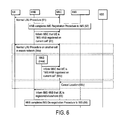
- FIG. 6 An alternative embodiment of this invention is shown in relation to Figure 6 .
- This embodiment again assumes that the UE performs a normal LAU procedure with the serving MSC (61).
- the HNB also performs an IMS registration procedure with the IMS server (62).
- the IMS HNB when the IMS HNB registers the UE with the IMS server, it additionally sends a new message to the MSC informing the MSC that the UE is registered in its cell (63).
- the MSC stores this information as current until it receives either:
- the MSC When the MSC receives one of these messages, it sends a "cancel IMS Registration" message to the old IMS HNB which causes that IMS HNB to perform an IMS deregistration for that UE (65).
- the HNB is integrated into the network, and informed of the movements/activity of the UE, as they become known. This therefore reduces signalling resources utilised during routing of mobile terminating calls.
- FIG. 7 A further alternative embodiment is illustrated in Figure 7 .
- This embodiment is similar to that of Figure 6 , and so like numerals have been utilised where the steps undertaken are the same. The difference between these two embodiments is that, rather than the HNB informing the MSC that the UE is registered with it (step 63 in Figure 6 ), the IMS server informs the MSC of such (new step 67 in Figure 7 ).
- FIG. 8 A still further alternative embodiment is illustrated in Figure 8 .
- This embodiment again assumes that the UE performs a normal LAU procedure with the serving MSC (81).
- the HNB also performs an IMS registration procedure with the IMS server (82).
- the T-ADS is configured to always route the call to the CS domain. Therefore, upon the IMS/T-ADS receiving an incoming call (83), the call is automatically routed to the MSC (84).
- the MSC will page the UE in one or more cells.
- the UE is registered as being located at the HNB, and so the MSC will only need to page the UE there (85).
- the HNB will in turn send a page to the UE. If the UE responds to this page, then the HNB will send an acknowledgement to the UE that it has successful received its paging response (86). Additionally the HNB will positively respond to the MSC regarding the successful page (87).
- the MSC in turn sends a CS call setup message (88) in order to establish the call over CS.
- the MSC sends the CS setup message (i.e. according to 3GPP TS 24.008)
- the HNB instead of forwarding this message to the UE to establish the CS connection, the HNB instead initiates a new "special" IMS/SIP session to the IMS, using the details from the CS setup message (89).
- This IMS session message has a special destination number that ensures the IMS routes the session to the correct T-ADS function (and that the T-ADS function can identify that this incoming session relates to the call it initiated to the MSC - as per the existing 3GPP standards).
- the IMS HNB sends a CS Release Complete message (90) to the MSC in order to terminate the CS call with the MSC. This avoids the MSC's resources needlessly being consumed for long periods, and advantageously does not disturb network statistics (e.g. on paging success rates).
- the MSC In response to this CS release complete message (90), the MSC, as per the standards, sends an incoming call cancellation message to the T-ADS (91). Provided the T-ADS has received the IMS/SIP session set up from the IMS server, the incoming call will not actually be cancelled by the T-ADS, but instead, routed to the "special" IMS/SIP session from the IMS HNB.
- the IMS HNB initiates a call using CS signalling the UE using the received data from the original CS call from the MSC (93). The call then goes ahead if/when the user answers.
- This embodiment of the invention therefore enables an IMS HNB to fully utilise its IMS capabilities without requiring wholesale changes to the existing standards and network operation.
- the HNB is configured to appear to the UE as a conventional base station that communicates with the UE using GSM/UMTS/LTE protocols in accordance with the Standards (where they exist) and the licensed radio spectrum.
- the HNB could communicate with the UE by any other suitable technology - for example, by a Bluetooth (RTM) connection, WiFi or another unlicensed mobile access (UMA) protocol, which allows the GSM/UMTS/LTE features to be provided using a non-GSM/UMTS/LTE bearer technology.
- RTM Bluetooth
- UMA unlicensed mobile access
Landscapes
- Engineering & Computer Science (AREA)
- Computer Networks & Wireless Communication (AREA)
- Signal Processing (AREA)
- Computer Hardware Design (AREA)
- Computer Security & Cryptography (AREA)
- Computing Systems (AREA)
- General Engineering & Computer Science (AREA)
- Mobile Radio Communication Systems (AREA)
Applications Claiming Priority (1)
| Application Number | Priority Date | Filing Date | Title |
|---|---|---|---|
| GBGB0901314.5A GB0901314D0 (en) | 2009-01-27 | 2009-01-27 | IMS home cell |
Publications (3)
| Publication Number | Publication Date |
|---|---|
| EP2227060A2 true EP2227060A2 (fr) | 2010-09-08 |
| EP2227060A3 EP2227060A3 (fr) | 2010-12-29 |
| EP2227060B1 EP2227060B1 (fr) | 2015-05-13 |
Family
ID=40469144
Family Applications (1)
| Application Number | Title | Priority Date | Filing Date |
|---|---|---|---|
| EP20100151842 Not-in-force EP2227060B1 (fr) | 2009-01-27 | 2010-01-27 | Réseaux et dispositifs de télécommunications |
Country Status (4)
| Country | Link |
|---|---|
| US (1) | US8401552B2 (fr) |
| EP (1) | EP2227060B1 (fr) |
| ES (1) | ES2544764T3 (fr) |
| GB (1) | GB0901314D0 (fr) |
Cited By (1)
| Publication number | Priority date | Publication date | Assignee | Title |
|---|---|---|---|---|
| WO2015034408A1 (fr) * | 2013-09-09 | 2015-03-12 | Telefonaktiebolaget L M Ericsson (Publ) | Acquisition d'identité imsi par un contrôleur de station de base |
Families Citing this family (17)
| Publication number | Priority date | Publication date | Assignee | Title |
|---|---|---|---|---|
| EP2296350B1 (fr) * | 2009-09-14 | 2018-11-07 | Alcatel Lucent | Gestion de données utilisateur liées à un serveur d'application |
| JP5615194B2 (ja) * | 2011-01-13 | 2014-10-29 | 株式会社Nttドコモ | 移動通信方法及びノード |
| JP5456708B2 (ja) * | 2011-02-14 | 2014-04-02 | 株式会社Nttドコモ | 移動通信方法及び呼セッション制御ノード |
| CN102647700B (zh) * | 2011-02-22 | 2016-03-02 | 阿尔卡特朗讯 | 一种获取并使用位置信息的方法及装置 |
| US8848701B2 (en) * | 2011-06-30 | 2014-09-30 | Verizon Patent And Licensing Inc. | Split usage of radio access networks with IMS |
| EP2571310B1 (fr) * | 2011-09-16 | 2017-05-31 | OCT Circuit Technologies International Limited | Communication dans un réseau cellulaire tenant compte de la charge de retour |
| US8797902B2 (en) * | 2012-05-29 | 2014-08-05 | Alcatel Lucent | Routing decision context objects |
| US8929238B2 (en) * | 2012-05-29 | 2015-01-06 | Alcatel Lucent | Subscriber record context objects |
| US8879476B2 (en) * | 2013-03-04 | 2014-11-04 | Vonage Network Llc | Method and apparatus for performing network registration |
| US9674233B2 (en) | 2013-03-04 | 2017-06-06 | Vonage Business Inc. | Method and apparatus for performing network registration |
| CN104303530B (zh) * | 2013-04-03 | 2019-03-08 | 华为技术有限公司 | 获取ue能力的方法、终端及基站 |
| US9681412B2 (en) | 2014-04-23 | 2017-06-13 | At&T Intellectual Property I, L.P. | Method and device for providing a mobile device with service continuity over multiple access networks |
| US9826370B2 (en) * | 2014-10-10 | 2017-11-21 | T-Mobile Usa, Inc. | Location identifiers in mobile messaging |
| US10237847B2 (en) * | 2015-10-02 | 2019-03-19 | Intel IP Corporation | Enhanced paging mechanism for cellular internet of things |
| IN201621030296A (fr) * | 2016-09-05 | 2019-10-11 | Reliance Jio Infocomm Limited | |
| US10237681B2 (en) * | 2017-02-06 | 2019-03-19 | Samsung Electronics Co., Ltd. | Registration management method for terminal accessing 5G network on non-3GPP access |
| RU2683524C1 (ru) * | 2018-01-17 | 2019-03-29 | Хуавей Текнолоджиз Ко., Лтд. | Способ для получения возможностей ue, оконечное устройство и базовая станция |
Citations (2)
| Publication number | Priority date | Publication date | Assignee | Title |
|---|---|---|---|---|
| US20060128383A1 (en) | 2004-10-19 | 2006-06-15 | Suzanne Arcens | User equipment cellular identification |
| US20080318551A1 (en) | 2007-06-25 | 2008-12-25 | Lucent Technologies, Inc. | Method and apparatus for provisioning and authentication/registration for femtocell user on ims core network |
Family Cites Families (4)
| Publication number | Priority date | Publication date | Assignee | Title |
|---|---|---|---|---|
| WO2006102850A1 (fr) * | 2005-03-30 | 2006-10-05 | Huawei Technologies Co., Ltd. | Procede et systeme de mise en oeuvre d'une commande de chemin |
| KR101100316B1 (ko) * | 2006-06-23 | 2011-12-30 | 엘지전자 주식회사 | Ip 멀티미디어 서브시스템 네트워크에서 등록 제어방법및 그 방법을 사용하는 통신시스템 |
| US8743887B2 (en) * | 2007-10-09 | 2014-06-03 | Qualcomm Incorporated | Methods and apparatus for mobility support and IP multimedia subsystem (IMS) registration in a multimode network environment |
| US8711846B2 (en) * | 2008-09-18 | 2014-04-29 | Futurewei Technologies, Inc. | Network attachment for IMS systems for legacy CS UE with home node B access |
-
2009
- 2009-01-27 GB GBGB0901314.5A patent/GB0901314D0/en not_active Ceased
-
2010
- 2010-01-27 ES ES10151842.1T patent/ES2544764T3/es active Active
- 2010-01-27 EP EP20100151842 patent/EP2227060B1/fr not_active Not-in-force
- 2010-01-27 US US12/657,789 patent/US8401552B2/en not_active Expired - Fee Related
Patent Citations (2)
| Publication number | Priority date | Publication date | Assignee | Title |
|---|---|---|---|---|
| US20060128383A1 (en) | 2004-10-19 | 2006-06-15 | Suzanne Arcens | User equipment cellular identification |
| US20080318551A1 (en) | 2007-06-25 | 2008-12-25 | Lucent Technologies, Inc. | Method and apparatus for provisioning and authentication/registration for femtocell user on ims core network |
Cited By (2)
| Publication number | Priority date | Publication date | Assignee | Title |
|---|---|---|---|---|
| WO2015034408A1 (fr) * | 2013-09-09 | 2015-03-12 | Telefonaktiebolaget L M Ericsson (Publ) | Acquisition d'identité imsi par un contrôleur de station de base |
| US10117276B2 (en) | 2013-09-09 | 2018-10-30 | Telefonaktiebolaget Lm Ericsson (Publ) | IMSI acquisition by base station controller |
Also Published As
| Publication number | Publication date |
|---|---|
| EP2227060B1 (fr) | 2015-05-13 |
| GB0901314D0 (en) | 2009-03-11 |
| US20100215001A1 (en) | 2010-08-26 |
| EP2227060A3 (fr) | 2010-12-29 |
| US8401552B2 (en) | 2013-03-19 |
| ES2544764T3 (es) | 2015-09-03 |
Similar Documents
| Publication | Publication Date | Title |
|---|---|---|
| EP2227060B1 (fr) | Réseaux et dispositifs de télécommunications | |
| EP2399405B1 (fr) | Appels en urgence non validés pour réseaux 3gpp ims tout ip non-validated emergency calls for all-ip 3gpp ims networks | |
| CN104244367B (zh) | 电信网络和装置 | |
| CN110099052B (zh) | 无线通信系统中用于支持语音服务的方法和设备 | |
| US9019887B2 (en) | Access admission control method and system for mobile communication system | |
| KR101091300B1 (ko) | 이동통신 네트워크 내에서 제어 평면(Control Plane) 을 담당하는 서버 및 LIPA(Local IP Access) 서비스를 제어하는 방법 | |
| JP5379232B2 (ja) | Utranフェムト・システムにおける端末のアクセス制御 | |
| US9191387B2 (en) | Communication system for checking for unauthorized use of a terminal | |
| CN108401036B (zh) | 通信系统 | |
| US20070130471A1 (en) | Apparatus and method for authenticating a user when accessing to multimedia services | |
| EP2297985B1 (fr) | Procede de soutien d appel d urgence dans un systeme de communication mobile | |
| KR20110091305A (ko) | Mocn에서 긴급 호를 위한 plmn 선택 방법 및 장치 | |
| US20240340834A1 (en) | Establishing a Multiple Access Connection | |
| US8893231B2 (en) | Multi-access authentication in communication system | |
| CN101647302A (zh) | 电信网络和装置 | |
| EP2482597B1 (fr) | Procédé d'accès d'une station de base domestique, système de station de base domestique et station de base domestique | |
| CN115517007B (zh) | 对独立非公共接入网络的公共陆地移动网络支持 | |
| CN105704716A (zh) | VoWi-Fi网络的接入方法及接入装置 | |
| US20230362862A1 (en) | Multi-usim device accessing services of a second cellular network through a first cellular network via a gateway | |
| KR101795787B1 (ko) | 이동통신 시스템에서 코어 네트워크를 선택하는 방법 및 장치 | |
| WO2013183316A1 (fr) | Système de communication | |
| KR20180027152A (ko) | 전용망 정책에 대응하여 휴대용 단말기에 네트워크 연결을 제공하는 방법 및 장치 |
Legal Events
| Date | Code | Title | Description |
|---|---|---|---|
| PUAI | Public reference made under article 153(3) epc to a published international application that has entered the european phase |
Free format text: ORIGINAL CODE: 0009012 |
|
| AK | Designated contracting states |
Kind code of ref document: A2 Designated state(s): AT BE BG CH CY CZ DE DK EE ES FI FR GB GR HR HU IE IS IT LI LT LU LV MC MK MT NL NO PL PT RO SE SI SK SM TR |
|
| AX | Request for extension of the european patent |
Extension state: AL BA RS |
|
| PUAL | Search report despatched |
Free format text: ORIGINAL CODE: 0009013 |
|
| AK | Designated contracting states |
Kind code of ref document: A3 Designated state(s): AT BE BG CH CY CZ DE DK EE ES FI FR GB GR HR HU IE IS IT LI LT LU LV MC MK MT NL NO PL PT RO SE SI SK SM TR |
|
| AX | Request for extension of the european patent |
Extension state: AL BA RS |
|
| 17P | Request for examination filed |
Effective date: 20110909 |
|
| GRAP | Despatch of communication of intention to grant a patent |
Free format text: ORIGINAL CODE: EPIDOSNIGR1 |
|
| INTG | Intention to grant announced |
Effective date: 20141204 |
|
| GRAS | Grant fee paid |
Free format text: ORIGINAL CODE: EPIDOSNIGR3 |
|
| GRAA | (expected) grant |
Free format text: ORIGINAL CODE: 0009210 |
|
| AK | Designated contracting states |
Kind code of ref document: B1 Designated state(s): AT BE BG CH CY CZ DE DK EE ES FI FR GB GR HR HU IE IS IT LI LT LU LV MC MK MT NL NO PL PT RO SE SI SK SM TR |
|
| RAP1 | Party data changed (applicant data changed or rights of an application transferred) |
Owner name: VODAFONE IP LICENSING LIMITED |
|
| REG | Reference to a national code |
Ref country code: GB Ref legal event code: FG4D |
|
| REG | Reference to a national code |
Ref country code: CH Ref legal event code: EP |
|
| REG | Reference to a national code |
Ref country code: IE Ref legal event code: FG4D |
|
| REG | Reference to a national code |
Ref country code: AT Ref legal event code: REF Ref document number: 727201 Country of ref document: AT Kind code of ref document: T Effective date: 20150615 |
|
| REG | Reference to a national code |
Ref country code: DE Ref legal event code: R096 Ref document number: 602010024604 Country of ref document: DE Effective date: 20150625 |
|
| REG | Reference to a national code |
Ref country code: ES Ref legal event code: FG2A Ref document number: 2544764 Country of ref document: ES Kind code of ref document: T3 Effective date: 20150903 |
|
| REG | Reference to a national code |
Ref country code: AT Ref legal event code: MK05 Ref document number: 727201 Country of ref document: AT Kind code of ref document: T Effective date: 20150513 |
|
| REG | Reference to a national code |
Ref country code: NL Ref legal event code: MP Effective date: 20150513 |
|
| REG | Reference to a national code |
Ref country code: LT Ref legal event code: MG4D |
|
| PG25 | Lapsed in a contracting state [announced via postgrant information from national office to epo] |
Ref country code: LT Free format text: LAPSE BECAUSE OF FAILURE TO SUBMIT A TRANSLATION OF THE DESCRIPTION OR TO PAY THE FEE WITHIN THE PRESCRIBED TIME-LIMIT Effective date: 20150513 Ref country code: HR Free format text: LAPSE BECAUSE OF FAILURE TO SUBMIT A TRANSLATION OF THE DESCRIPTION OR TO PAY THE FEE WITHIN THE PRESCRIBED TIME-LIMIT Effective date: 20150513 Ref country code: NO Free format text: LAPSE BECAUSE OF FAILURE TO SUBMIT A TRANSLATION OF THE DESCRIPTION OR TO PAY THE FEE WITHIN THE PRESCRIBED TIME-LIMIT Effective date: 20150813 Ref country code: PT Free format text: LAPSE BECAUSE OF FAILURE TO SUBMIT A TRANSLATION OF THE DESCRIPTION OR TO PAY THE FEE WITHIN THE PRESCRIBED TIME-LIMIT Effective date: 20150914 Ref country code: FI Free format text: LAPSE BECAUSE OF FAILURE TO SUBMIT A TRANSLATION OF THE DESCRIPTION OR TO PAY THE FEE WITHIN THE PRESCRIBED TIME-LIMIT Effective date: 20150513 |
|
| PG25 | Lapsed in a contracting state [announced via postgrant information from national office to epo] |
Ref country code: GR Free format text: LAPSE BECAUSE OF FAILURE TO SUBMIT A TRANSLATION OF THE DESCRIPTION OR TO PAY THE FEE WITHIN THE PRESCRIBED TIME-LIMIT Effective date: 20150814 Ref country code: LV Free format text: LAPSE BECAUSE OF FAILURE TO SUBMIT A TRANSLATION OF THE DESCRIPTION OR TO PAY THE FEE WITHIN THE PRESCRIBED TIME-LIMIT Effective date: 20150513 Ref country code: IS Free format text: LAPSE BECAUSE OF FAILURE TO SUBMIT A TRANSLATION OF THE DESCRIPTION OR TO PAY THE FEE WITHIN THE PRESCRIBED TIME-LIMIT Effective date: 20150913 Ref country code: BG Free format text: LAPSE BECAUSE OF FAILURE TO SUBMIT A TRANSLATION OF THE DESCRIPTION OR TO PAY THE FEE WITHIN THE PRESCRIBED TIME-LIMIT Effective date: 20150813 Ref country code: AT Free format text: LAPSE BECAUSE OF FAILURE TO SUBMIT A TRANSLATION OF THE DESCRIPTION OR TO PAY THE FEE WITHIN THE PRESCRIBED TIME-LIMIT Effective date: 20150513 |
|
| REG | Reference to a national code |
Ref country code: FR Ref legal event code: PLFP Year of fee payment: 7 |
|
| PG25 | Lapsed in a contracting state [announced via postgrant information from national office to epo] |
Ref country code: EE Free format text: LAPSE BECAUSE OF FAILURE TO SUBMIT A TRANSLATION OF THE DESCRIPTION OR TO PAY THE FEE WITHIN THE PRESCRIBED TIME-LIMIT Effective date: 20150513 Ref country code: DK Free format text: LAPSE BECAUSE OF FAILURE TO SUBMIT A TRANSLATION OF THE DESCRIPTION OR TO PAY THE FEE WITHIN THE PRESCRIBED TIME-LIMIT Effective date: 20150513 |
|
| REG | Reference to a national code |
Ref country code: DE Ref legal event code: R097 Ref document number: 602010024604 Country of ref document: DE |
|
| PG25 | Lapsed in a contracting state [announced via postgrant information from national office to epo] |
Ref country code: SK Free format text: LAPSE BECAUSE OF FAILURE TO SUBMIT A TRANSLATION OF THE DESCRIPTION OR TO PAY THE FEE WITHIN THE PRESCRIBED TIME-LIMIT Effective date: 20150513 Ref country code: PL Free format text: LAPSE BECAUSE OF FAILURE TO SUBMIT A TRANSLATION OF THE DESCRIPTION OR TO PAY THE FEE WITHIN THE PRESCRIBED TIME-LIMIT Effective date: 20150513 Ref country code: RO Free format text: LAPSE BECAUSE OF NON-PAYMENT OF DUE FEES Effective date: 20150513 Ref country code: CZ Free format text: LAPSE BECAUSE OF FAILURE TO SUBMIT A TRANSLATION OF THE DESCRIPTION OR TO PAY THE FEE WITHIN THE PRESCRIBED TIME-LIMIT Effective date: 20150513 |
|
| PLBE | No opposition filed within time limit |
Free format text: ORIGINAL CODE: 0009261 |
|
| STAA | Information on the status of an ep patent application or granted ep patent |
Free format text: STATUS: NO OPPOSITION FILED WITHIN TIME LIMIT |
|
| 26N | No opposition filed |
Effective date: 20160216 |
|
| PGFP | Annual fee paid to national office [announced via postgrant information from national office to epo] |
Ref country code: ES Payment date: 20160112 Year of fee payment: 7 Ref country code: IT Payment date: 20160127 Year of fee payment: 7 |
|
| PG25 | Lapsed in a contracting state [announced via postgrant information from national office to epo] |
Ref country code: SI Free format text: LAPSE BECAUSE OF FAILURE TO SUBMIT A TRANSLATION OF THE DESCRIPTION OR TO PAY THE FEE WITHIN THE PRESCRIBED TIME-LIMIT Effective date: 20150513 Ref country code: BE Free format text: LAPSE BECAUSE OF NON-PAYMENT OF DUE FEES Effective date: 20160131 |
|
| PG25 | Lapsed in a contracting state [announced via postgrant information from national office to epo] |
Ref country code: LU Free format text: LAPSE BECAUSE OF FAILURE TO SUBMIT A TRANSLATION OF THE DESCRIPTION OR TO PAY THE FEE WITHIN THE PRESCRIBED TIME-LIMIT Effective date: 20160127 Ref country code: BE Free format text: LAPSE BECAUSE OF FAILURE TO SUBMIT A TRANSLATION OF THE DESCRIPTION OR TO PAY THE FEE WITHIN THE PRESCRIBED TIME-LIMIT Effective date: 20150513 |
|
| REG | Reference to a national code |
Ref country code: CH Ref legal event code: PL |
|
| PG25 | Lapsed in a contracting state [announced via postgrant information from national office to epo] |
Ref country code: MC Free format text: LAPSE BECAUSE OF FAILURE TO SUBMIT A TRANSLATION OF THE DESCRIPTION OR TO PAY THE FEE WITHIN THE PRESCRIBED TIME-LIMIT Effective date: 20150513 |
|
| PG25 | Lapsed in a contracting state [announced via postgrant information from national office to epo] |
Ref country code: LI Free format text: LAPSE BECAUSE OF NON-PAYMENT OF DUE FEES Effective date: 20160131 Ref country code: CH Free format text: LAPSE BECAUSE OF NON-PAYMENT OF DUE FEES Effective date: 20160131 |
|
| REG | Reference to a national code |
Ref country code: IE Ref legal event code: MM4A |
|
| REG | Reference to a national code |
Ref country code: FR Ref legal event code: PLFP Year of fee payment: 8 |
|
| PG25 | Lapsed in a contracting state [announced via postgrant information from national office to epo] |
Ref country code: IE Free format text: LAPSE BECAUSE OF NON-PAYMENT OF DUE FEES Effective date: 20160127 |
|
| PG25 | Lapsed in a contracting state [announced via postgrant information from national office to epo] |
Ref country code: NL Free format text: LAPSE BECAUSE OF FAILURE TO SUBMIT A TRANSLATION OF THE DESCRIPTION OR TO PAY THE FEE WITHIN THE PRESCRIBED TIME-LIMIT Effective date: 20150513 Ref country code: SE Free format text: LAPSE BECAUSE OF FAILURE TO SUBMIT A TRANSLATION OF THE DESCRIPTION OR TO PAY THE FEE WITHIN THE PRESCRIBED TIME-LIMIT Effective date: 20150513 |
|
| PG25 | Lapsed in a contracting state [announced via postgrant information from national office to epo] |
Ref country code: MT Free format text: LAPSE BECAUSE OF FAILURE TO SUBMIT A TRANSLATION OF THE DESCRIPTION OR TO PAY THE FEE WITHIN THE PRESCRIBED TIME-LIMIT Effective date: 20150513 |
|
| REG | Reference to a national code |
Ref country code: FR Ref legal event code: PLFP Year of fee payment: 9 |
|
| PG25 | Lapsed in a contracting state [announced via postgrant information from national office to epo] |
Ref country code: IT Free format text: LAPSE BECAUSE OF NON-PAYMENT OF DUE FEES Effective date: 20170127 |
|
| PG25 | Lapsed in a contracting state [announced via postgrant information from national office to epo] |
Ref country code: HU Free format text: LAPSE BECAUSE OF FAILURE TO SUBMIT A TRANSLATION OF THE DESCRIPTION OR TO PAY THE FEE WITHIN THE PRESCRIBED TIME-LIMIT; INVALID AB INITIO Effective date: 20100127 Ref country code: CY Free format text: LAPSE BECAUSE OF FAILURE TO SUBMIT A TRANSLATION OF THE DESCRIPTION OR TO PAY THE FEE WITHIN THE PRESCRIBED TIME-LIMIT Effective date: 20150513 Ref country code: ES Free format text: LAPSE BECAUSE OF NON-PAYMENT OF DUE FEES Effective date: 20170128 Ref country code: SM Free format text: LAPSE BECAUSE OF FAILURE TO SUBMIT A TRANSLATION OF THE DESCRIPTION OR TO PAY THE FEE WITHIN THE PRESCRIBED TIME-LIMIT Effective date: 20150513 |
|
| PG25 | Lapsed in a contracting state [announced via postgrant information from national office to epo] |
Ref country code: TR Free format text: LAPSE BECAUSE OF FAILURE TO SUBMIT A TRANSLATION OF THE DESCRIPTION OR TO PAY THE FEE WITHIN THE PRESCRIBED TIME-LIMIT Effective date: 20150513 Ref country code: MK Free format text: LAPSE BECAUSE OF FAILURE TO SUBMIT A TRANSLATION OF THE DESCRIPTION OR TO PAY THE FEE WITHIN THE PRESCRIBED TIME-LIMIT Effective date: 20150513 Ref country code: MT Free format text: LAPSE BECAUSE OF FAILURE TO SUBMIT A TRANSLATION OF THE DESCRIPTION OR TO PAY THE FEE WITHIN THE PRESCRIBED TIME-LIMIT Effective date: 20160131 |
|
| REG | Reference to a national code |
Ref country code: ES Ref legal event code: FD2A Effective date: 20181107 |
|
| PGFP | Annual fee paid to national office [announced via postgrant information from national office to epo] |
Ref country code: DE Payment date: 20240119 Year of fee payment: 15 Ref country code: GB Payment date: 20240123 Year of fee payment: 15 |
|
| PGFP | Annual fee paid to national office [announced via postgrant information from national office to epo] |
Ref country code: FR Payment date: 20240124 Year of fee payment: 15 |
|
| REG | Reference to a national code |
Ref country code: DE Ref legal event code: R119 Ref document number: 602010024604 Country of ref document: DE |
|
| GBPC | Gb: european patent ceased through non-payment of renewal fee |
Effective date: 20250127 |
|
| PG25 | Lapsed in a contracting state [announced via postgrant information from national office to epo] |
Ref country code: DE Free format text: LAPSE BECAUSE OF NON-PAYMENT OF DUE FEES Effective date: 20250801 |
|
| PG25 | Lapsed in a contracting state [announced via postgrant information from national office to epo] |
Ref country code: GB Free format text: LAPSE BECAUSE OF NON-PAYMENT OF DUE FEES Effective date: 20250127 |
|
| PG25 | Lapsed in a contracting state [announced via postgrant information from national office to epo] |
Ref country code: FR Free format text: LAPSE BECAUSE OF NON-PAYMENT OF DUE FEES Effective date: 20250131 |