EP2228608A2 - Afficheur de présence pour habitations - Google Patents
Afficheur de présence pour habitations Download PDFInfo
- Publication number
- EP2228608A2 EP2228608A2 EP09175807A EP09175807A EP2228608A2 EP 2228608 A2 EP2228608 A2 EP 2228608A2 EP 09175807 A EP09175807 A EP 09175807A EP 09175807 A EP09175807 A EP 09175807A EP 2228608 A2 EP2228608 A2 EP 2228608A2
- Authority
- EP
- European Patent Office
- Prior art keywords
- transmitter
- memory
- receiver
- state
- presence detector
- Prior art date
- Legal status (The legal status is an assumption and is not a legal conclusion. Google has not performed a legal analysis and makes no representation as to the accuracy of the status listed.)
- Withdrawn
Links
- 238000004891 communication Methods 0.000 claims description 27
- 238000000034 method Methods 0.000 claims description 8
- 230000007704 transition Effects 0.000 claims description 5
- 230000004308 accommodation Effects 0.000 claims 1
- 238000012545 processing Methods 0.000 abstract description 2
- 238000002604 ultrasonography Methods 0.000 abstract description 2
- 238000010438 heat treatment Methods 0.000 description 8
- 230000008901 benefit Effects 0.000 description 6
- 230000004913 activation Effects 0.000 description 4
- 230000001419 dependent effect Effects 0.000 description 4
- 238000013459 approach Methods 0.000 description 3
- 230000000694 effects Effects 0.000 description 3
- 230000010354 integration Effects 0.000 description 3
- 230000008569 process Effects 0.000 description 3
- 230000009471 action Effects 0.000 description 2
- 238000004378 air conditioning Methods 0.000 description 2
- 230000005540 biological transmission Effects 0.000 description 2
- 238000012790 confirmation Methods 0.000 description 2
- 239000013078 crystal Substances 0.000 description 2
- 238000009434 installation Methods 0.000 description 2
- 230000001052 transient effect Effects 0.000 description 2
- 108010076504 Protein Sorting Signals Proteins 0.000 description 1
- 108010001267 Protein Subunits Proteins 0.000 description 1
- 230000006978 adaptation Effects 0.000 description 1
- 230000003542 behavioural effect Effects 0.000 description 1
- 230000015572 biosynthetic process Effects 0.000 description 1
- 235000021152 breakfast Nutrition 0.000 description 1
- 238000004364 calculation method Methods 0.000 description 1
- 238000006243 chemical reaction Methods 0.000 description 1
- 238000001514 detection method Methods 0.000 description 1
- 238000010616 electrical installation Methods 0.000 description 1
- 238000005516 engineering process Methods 0.000 description 1
- 230000003203 everyday effect Effects 0.000 description 1
- 239000000295 fuel oil Substances 0.000 description 1
- 230000006870 function Effects 0.000 description 1
- 230000005021 gait Effects 0.000 description 1
- 230000000977 initiatory effect Effects 0.000 description 1
- 230000003993 interaction Effects 0.000 description 1
- 238000004519 manufacturing process Methods 0.000 description 1
- 230000000422 nocturnal effect Effects 0.000 description 1
- 230000003287 optical effect Effects 0.000 description 1
- 238000002360 preparation method Methods 0.000 description 1
- 238000003825 pressing Methods 0.000 description 1
- 108090000623 proteins and genes Proteins 0.000 description 1
- 230000005855 radiation Effects 0.000 description 1
- 230000000284 resting effect Effects 0.000 description 1
- 238000012546 transfer Methods 0.000 description 1
Images

Classifications
-
- H—ELECTRICITY
- H04—ELECTRIC COMMUNICATION TECHNIQUE
- H04L—TRANSMISSION OF DIGITAL INFORMATION, e.g. TELEGRAPHIC COMMUNICATION
- H04L12/00—Data switching networks
- H04L12/28—Data switching networks characterised by path configuration, e.g. LAN [Local Area Networks] or WAN [Wide Area Networks]
- H04L12/2803—Home automation networks
- H04L12/2823—Reporting information sensed by appliance or service execution status of appliance services in a home automation network
- H04L12/2827—Reporting to a device within the home network; wherein the reception of the information reported automatically triggers the execution of a home appliance functionality
- H04L12/2829—Reporting to a device within the home network; wherein the reception of the information reported automatically triggers the execution of a home appliance functionality involving user profiles according to which the execution of a home appliance functionality is automatically triggered
-
- G—PHYSICS
- G05—CONTROLLING; REGULATING
- G05B—CONTROL OR REGULATING SYSTEMS IN GENERAL; FUNCTIONAL ELEMENTS OF SUCH SYSTEMS; MONITORING OR TESTING ARRANGEMENTS FOR SUCH SYSTEMS OR ELEMENTS
- G05B15/00—Systems controlled by a computer
- G05B15/02—Systems controlled by a computer electric
-
- F—MECHANICAL ENGINEERING; LIGHTING; HEATING; WEAPONS; BLASTING
- F24—HEATING; RANGES; VENTILATING
- F24F—AIR-CONDITIONING; AIR-HUMIDIFICATION; VENTILATION; USE OF AIR CURRENTS FOR SCREENING
- F24F11/00—Control or safety arrangements
- F24F11/30—Control or safety arrangements for purposes related to the operation of the system, e.g. for safety or monitoring
-
- F—MECHANICAL ENGINEERING; LIGHTING; HEATING; WEAPONS; BLASTING
- F24—HEATING; RANGES; VENTILATING
- F24F—AIR-CONDITIONING; AIR-HUMIDIFICATION; VENTILATION; USE OF AIR CURRENTS FOR SCREENING
- F24F2120/00—Control inputs relating to users or occupants
- F24F2120/10—Occupancy
-
- G—PHYSICS
- G05—CONTROLLING; REGULATING
- G05B—CONTROL OR REGULATING SYSTEMS IN GENERAL; FUNCTIONAL ELEMENTS OF SUCH SYSTEMS; MONITORING OR TESTING ARRANGEMENTS FOR SUCH SYSTEMS OR ELEMENTS
- G05B2219/00—Program-control systems
- G05B2219/20—Pc systems
- G05B2219/26—Pc applications
- G05B2219/2642—Domotique, domestic, home control, automation, smart house
-
- H—ELECTRICITY
- H04—ELECTRIC COMMUNICATION TECHNIQUE
- H04L—TRANSMISSION OF DIGITAL INFORMATION, e.g. TELEGRAPHIC COMMUNICATION
- H04L12/00—Data switching networks
- H04L12/28—Data switching networks characterised by path configuration, e.g. LAN [Local Area Networks] or WAN [Wide Area Networks]
- H04L12/2803—Home automation networks
- H04L2012/284—Home automation networks characterised by the type of medium used
- H04L2012/2841—Wireless
-
- H—ELECTRICITY
- H04—ELECTRIC COMMUNICATION TECHNIQUE
- H04L—TRANSMISSION OF DIGITAL INFORMATION, e.g. TELEGRAPHIC COMMUNICATION
- H04L12/00—Data switching networks
- H04L12/28—Data switching networks characterised by path configuration, e.g. LAN [Local Area Networks] or WAN [Wide Area Networks]
- H04L12/2803—Home automation networks
- H04L2012/2847—Home automation networks characterised by the type of home appliance used
- H04L2012/285—Generic home appliances, e.g. refrigerators
Definitions
- the invention relates to a presence detector for residential units.
- the prior art teaches presence detectors which are fixed in a building space and turn on or off an electrical load when a person enters, neither being able to distinguish the different entering and leaving persons, nor being able to to put the consumers connected to them in a different state than to turn them on or off.
- the prior art teaches in the DE 20 2008 005338.2 a location system for furnishings, according to which a location signal generator and a location signal receiver cooperate in such a way that by this interaction, the spatial position of the furniture object in the building is identifiable.
- a presence detector for residential units comprising at least one transmitter, wherein the transmitter comprises remote communication means, at least one receiver, wherein the receiver is located in the housing unit, and wherein the receiver is adapted to receive the remote communication means of the transmitter Memory in which operating conditions, located in a residential unit electrical consumers, can be stored, the transmitter with the help of its remote communication means with the receiver is able to automatically get in touch, and automatically retrieve these stored in the memory operating conditions for the unit in question is capable of, whereby this retrieval the state of located in the housing Strommérhrauchern based on the stored in memory automatically changes data.
- the transmitter which is preferably mobile and comprises means of distance communication, has two uses: once such a particularly mobile transmitter can remain with its owner and is therefore suitable for announcing and identifying the owner, or more specifically for announcing and initiating the preferred home environment to be set up in the home, then these are stored in a memory. Secondly, the transmitter, with the aid of its means of distance communication, already announces itself remotely, and not only when it is e.g. directly into a residential unit, or a dwelling unit, such as enters a room, as is the case for example with IR-controlled stationary mounted presence detectors.
- the at least one receiver wherein the receiver is located in the housing unit, and wherein the receiver is adapted to receive the remote commutation means of the transmitter causes the transmitter to have an on-site communication partner by means of its remote communication means.
- This has the advantage that this receiver can be permanently installed in the residential unit and even in the present case can not be installed visible, which is particularly advantageous for listed buildings or aesthetically sophisticated designs.
- the communication between transmitter and receiver with the help of the use of an encryption technique protected so as to ensure that this communication and its contents remain under the full control of the owner of the sender and / or receiver.
- the at least one memory in which operating states of electrical consumers located in a housing unit, can be stored, causes data to be stored in the housing unit itself, in particular such status data / operating data of consumers.
- This memory can be both directly coupled to the transmitter, and be located away from it. Although this memory could be distributed in their own transponders in the respective living spaces, in each of these transponders, the preferred states of individual residents are stored, which are accessed and realized upon entry of these residents, which memory / transponder can also be fixed to the receiver. It is more advantageous, however, to store all this information in as much as possible a single central memory per housing unit, which is linked to the receivers such that memory and receiver, as well as memory and electrical consumers can exchange their data. It is particularly advantageous if this data exchange between memory and receiver takes place via wireless remote communication means, such as IR, Bluetooth, radio, WLAN, bus systems.
- wireless remote communication means such as IR, Bluetooth, radio, WLAN, bus systems.
- the present presence detector for residential units can, in the event that a central memory exists thus a plurality of transmitters, for example, using an identifiable memory ID numbers (identification number) of the transmitter are deposited, which these stations are then recognized again when they are in the Reception area of the receiver and whereby the person who carries this station, for example, with himself can remain anonymous.
- ID numbers identification number
- individual desired operating states and / or individual idle operating states and / or transitional operating states can be dependent on the transmitter ID and / or dependent from the time and / or depending on the season and / or depending on individual wishes of people or depending on other parameters are deposited.
- individual desired operating states are those states which are to be realized if the individual transmitter approaches or enters the housing unit depending on the default setting.
- individual transient operating states may be states which should prevail if it can be expected that third parties will also use this housing unit and that they do not want to find the housing unit in a state of rest, such as the kitchen at the breakfast, lunch or dinner time, or the bath at the time of getting up.
- individual idle operating states may be states that are to prevail when the individual transmitter leaves the dwelling unit, such as for example. switching off the stand-by mode and / or shutting down the heater and / or closing shutters and / or switching on the alarm system.
- this presence detector for residential units differs from the common concepts in that an operator does not have to perform any start-up actions to initiate or terminate these processes, but rather they automatically do so with (adjustable in terms of distance predefined) approximation of the sender or person the transmitter or when the transmitter enters the receiver area.
- Lighting, heating, kitchen appliances, blinds, consumer electronics, household appliances, security systems, access systems, etc. are primarily used for controlling purposes. in question
- the transmitter is able to make contact with the receiver by means of its remote communication means, and these operating conditions stored in the memory for the based on the data stored in the memory, this causes that if a transmitter or more specifically a person with such a transmitter in this reception area of a Receiver comes from this memory belonging to the respective transmitter respective operating states of electrical consumers are retrieved in the respective predefined living area and that with their help, the actual state of these consumers is adapted to this predefined desired state in the memory. If a living area comprises several rooms, then the actual state is approximated to the predefined desired state in each room on the basis of the stored data.
- One of these features comprehensive inventive presence detector for residential units thus causes the most pleasant for a person housing condition with this person, or more concretely mitwandert with their transmitter through the rooms of the housing unit, which causes an increase in living comfort.
- a comprehensive presence detector for residential units also causes that when leaving a living room this can be automatically placed in an energy-saving state, which causes an additional economic advantage by reducing energy costs.
- the remote communication means is WLAN causes an already common and established standard to be utilized.
- use can be made of the WLAN-proven encryptions, which brings with it advantages for the protection of the privacy of the owner of the sender or receiver.
- other remote communication means such as e.g. Bluetooth, IR or similar or a combination of them.
- the individual means of distance communication can hereby be located in a single transmitter and, for example, with the support of GPS or a comparatively acting navigation system (de) be activated whenever their special properties are to be used.
- a WLAN-capable device might be too strong and too far-transmitting and therefore the WLAN could be switched off and IR switched on.
- the corresponding receiver for receiving the alternative Fernkommunikationsmittel must be activated.
- An embodiment wherein the transmitter incorporating the remote communication means is a WLAN enabled device causes the already available and proven devices to be used as the transmitter.
- the WLAN-capable device is a mobile phone and / or a laptop, and / or a PDA, causes devices to be used as transmitters, which almost every homeowner already owns. Compared to RFID or own chips, which an operator would have to carry with it has the advantage that in this case no additional equipment is required and that, conversely, these everyday devices can be more difficult lost.
- the system according to the invention also also acts as a detector for a lost transmitting device (eg mobile phone), because a mobile phone acting as a transmitter according to the invention can easily be found again in that space in which the condition prevailing, that for the ID, which transmits the mobile phone was predefined. It can therefore be seen in the spatial state where this device must be located.
- An embodiment in which the current consumer to be switched on access to the respective residential unit is switched and / or changed in its existing state, accordingly, that when a station enters residential units or rooms there set the memory stored in the desired state of the electrical consumers to be addressed is turned on by the there located and addressed electrical consumers (eg lamps or heating) or changed in their possibly already switched on and existing state in a predefined way, so that eg an already switched light source or heating control in their intensity (light intensity or room temperature) of the deposit following be increased.
- the intensity light intensity or room temperature
- consumers eg lamps or heating
- this target state to be reached can be made dependent on additional parameters, e.g. a temperature corridor, the year or time, or even the age of the transmitter owners, since older people estimate other public or lighting conditions, as younger.
- additional parameters e.g. a temperature corridor, the year or time, or even the age of the transmitter owners, since older people estimate other public or lighting conditions, as younger.
- the garage door can be opened automatically, ie without pressing a button and the lights are turned on in the garage, which switches off automatically when leaving the garage while the sidewalk lighting is switched from the garage to the front door and on reaching the front door this, when it is electrically operated, automatically opens and, when you come home first, the aisle light is turned on and entering the aisle, the front door is closed, while already on arrival due to the signal of the transmitter, the heating begins in the predefined rooms to bring the room temperature closer to the set reference value.
- housing unit is a single living space, allows the operations described for smaller housing units, ie for each floor, or take place in a floor in each room individually.
- each building subunit such as floor
- each building space has its own receiver causes the reception signals to be more accurately identified.
- each room can also have a corresponding receiver.
- An embodiment in which the data is transferred between the memory and the electrical load via the household power network has the advantage that the Fernkommunikationsmittd communicates with which of the transmitter with the receivers and other Fernkommunikationssch, with which the electrical consumers are adjusted to the stored state in the memory, do not interfere with each other.
- the transmission of data between memory and receiver via the house power network respectively.
- the transmission over the house power network in turn can in particular in the in the in the WO06034866A or in the EP 1 675 274 presented way.
- At least two transmitters each comprise at least one location signal handler, wherein the location signal generator is capable of emitting at least one location signal and / or wherein the transmitter comprises at least one location signal receiver, wherein the location signal receiver is able to receive at least one of these location signals, and one of the transmitters in the memory is known, the other but not, and wherein locating signal and locating signal receiver cooperate such that the transmitter known in the memory opens the memory not known in the transmitter access to the memory, causes the second transmitter using the first Sender's recording finds its way into the community of permitted broadcasters, for which behavioral patterns for electrical consumers are also stored in the memory.
- the location signal generator is capable of emitting at least one location signal and / or wherein the transmitter comprises at least one location signal receiver, wherein the location signal receiver is able to receive at least one of these location signals, and one of the transmitters in the memory is known, the other but not, and wherein locating signal and locating signal receiver cooperate such that the transmitter known in the memory opens the memory not known in the transmitter access to the memory,
- “Location signal” is in a first alternative, only one of the remote communication signal of the transmitter different signal, such as another signal with which two mobile phones to contact each other in a position are able. If an authorized transmitter (eg mobile telephone 1) now wants to allow access to an unauthorized transmitter (mobile telephone 2), then mobile telephone 1 and mobile telephone 2 come into contact with each other via their "positioning signals” and mobile telephone 1 accesses the memory area when entering the reception area an ID number for the unauthorized device (mobile phone 2) and forwards them via the locating signal to the unauthorized device, whereby it is authorized and will then be recognized under the new ID in the memory and then in principle trigger the erfindggsgernä touch effects.
- an authorized transmitter eg mobile telephone 1 now wants to allow access to an unauthorized transmitter (mobile telephone 2)
- mobile telephone 1 and mobile telephone 2 come into contact with each other via their "positioning signals” and mobile telephone 1 accesses the memory area when entering the reception area an ID number for the unauthorized device (mobile phone 2) and forwards them via the locating signal to
- an ID profile eg for children with TV prohibition from 20 clock, which is disabled when they enter the nursery of the local TV
- An alternative, second approach would be: If the second station in the memory is unknown, but still with the help of an ID that he previously received, for example, from the homeowner and in the example cell phone has entered as the transmitter to recognize, this ID acts as locating signal. This locating signal is detected by the receiver but rejected as unknown.
- a message is sent to a preset ID or to the locally closest ID, or more specifically to the associated sender.
- This message can be linked to a list of selectable access states. Now, if the sender with the known ID accepts the foreign ID and selects one of the access states proposed in the list, access to the memory from that time on is also granted to the second sender or its second ID, to the extent of the selected status.
- the transmitter comprises a navigation system causes states to be introduced in advance.
- the heater can already be activated half an hour before arrival, if the transmitter falls below a predefined distance.
- the transmitter includes a navigation system, eg in the form of a GPS system, then the transmitter always knows how large the distance to the destination is.
- the transmitter falls below a predefined distance to the destination, which exceeds the range of the means of distance communication, such as 10 km for heating, 500 meters built area for the garage door and 100 meters built area for outdoor lighting, and is the transmitter (eg the mobile phone ) capable of a message (eg an SMS) and the receiver is able to receive this message with the help of a receiving unit (eg an SMS) and to process it (eg by means of a processing unit) and to be able to initiate a message corresponding to the message ( For example, by the message simulating the entry of the transmitter in the (eg outer) receiving range of the receiver), the effective radius of Fernkommunikationsffens is considerably increased.
- additional functions can be made possible, such as an information mode (for example, another station that just the transmitter 1 has fallen below the predefined radius and is expected to arrive shortly, so that, for example, preparations for dinner can be initiated.
- the task is also solved by buildings, ships, aircraft, including residential units and a described presence detector for residential units.
- the object is also achieved by a method comprising a described occupancy detector for residential units, wherein in a first step, the transmitter using its Fernkommunikationsffens the receiver logs, the receiver using the memory identifies this transmitter and wherein in a further step Based on the identification those data are retrieved from the memory, which are stored in the memory for the identified transmitter and which are stored in the memory for the relevant housing unit and based on this data, the current state of electrical consumers in the housing unit to the imaged by the data Target state of these electrical consumers is approximated.
- a check routine can be interposed, for example, that for the second step in some Constellations has its own release to make. For example, if, for example, children enter the TV room after 10 pm, in which the light and TV set can only be switched on by carrying a transmitter and if they are not allowed to turn on the television, for example because there is no data in the memory for this case.
- Such a sequential activation after an already made identification allows the parents to receive a request on eg their transmitter. On Based on this request, they can then make the decision to allow or deny children access to the TV.
- this signal is transmitted by remote communication, as in the case of eg WLAN to the next access point, from there, for example via the power network to the memory, in which then the associated action is called and initiated, such as the activation of the manual operation of the TV.
- a building unit e.g. an entire building, a building sub-unit, such as a floor or a corridor, or the entire staircase
- the adaptation of the current state of electrical consumers in the housing unit to the desired state of these electrical consumers represented by the data begins and placed in a further step at the exit from this unit in a predefined state is caused that when leaving not the idle state is set, but a predefined transition state.
- a WLAN-enabled electrical appliance as a presence detector for residential units wherein the presence detector for residential units in particular comprises the features described above.
- the object is also achieved by a method comprising a described occupancy detector for residential units, wherein in a first step, the transmitter using its Fernkommunikationsffens the receiver logs, the receiver using the memory identifies this transmitter and wherein in a further step Based on the identification of those data are retrieved from the memory, which are stored in the memory for the identified transmitter and which are stored in the memory for the relevant housing unit and based on this data, the actual state of electrical consumers in the housing unit is approximated to the imaged by the data desired state of these electrical consumers.
- the transmitter is merely the impetus to initiate processes stored in the memory and run, the transmitter just does not need to be operated by an operator.
- Fig. 1 shows a presence detector according to the invention for residential units and a transmitter "S", which is coming from the garden just in the entrance area of the house.
- This transmitter was identified as known and trustworthy via the remote communication means WiFi with its 3 access points distributed on the ground floor and therefore the electrically operable front door was opened and the light anteroom was switched on.
- the electrically operated toilet door and front door is now closed and opened the electrically operated doors and the living room.
- the TV and a standard lamp were switched on.
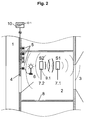
- Fig. 2 schematically illustrates the exemplary possibility of the invention detection of a new transmitter, for example in the form of a mobile phone 7.2.
- the ID1 of the transmitter 7.1 is stored, as well as various conditions for the environment of the room 2, including, among other things, the condition that the connected to the socket 5 lamp 6 has to burn and that the window 3 is open ,
- the transmitter 7.1 communicates with the connected to the power line 4 receiver 11 via Fernkommunikationsstoff WiFi in contact.
- Sender S1 7.1 has transmitted its ID to the receiver 5 via WLAN.
- the WLAN which is connected to the power line, passed this data over the power network 1 in the WO 06034866A described manner to the memory 10 and thus transmitted the ID of the transmitter S1 to the memory SP 10.
- the stored for the ID of the transmitter 7.1 states of the room 2 were activated, which consist in the present case that the lamp 6 was switched on, and the window 3 was opened.
- the transmitter 7.2. In the form of a second mobile phone.
- the ID of the second mobile phone is not yet stored in the memory 10, which is why no space conditions are associated with it.
- the second transmitter S2 7.2. now enters via remote communication means (WiFi) in contact with the first transmitter S1 7.1. and transmits its ID2 to the transmitter S1.
- This ID2 is from the transmitter S1 7.1. displayed and at the same time a selection list of known states of rooms is listed and offered for selection.
- the owner of the transmitter S1 will select the craftsman option, whereby the owner of the transmitter S1 on the deposited conditions, such as in the working hours of 7-16 : 00 clock and the deposited conditions, such as the entertainment media are switched off and private areas are electronically secured, for example, by a partial activation of the alarm system, access to the building receives, even if the host himself is not in the house.
- the ID2 By a confirmation of the ID2 by the transmitter S 1 and by the link with the relevant building state, the ID2, and the selected link in the memory 10 was deposited.
- the owner of the transmitter S2 7.2 is now opened in the context of the opened and stored in the memory 10 conditions access to the building.
- Fig. 2 shows a mobile phone 7, for example, which can be powered by a battery, or can be connected to the power supply for operation. In addition, it is small and therefore easily lost and it is mobile and therefore usable in various rooms.
- Fig. 2 Furthermore, it can be seen that in the area of the corridor 1 a power line 4 runs, which supplies various sockets 5, also of the room 2, with power.
- the room 2 points in addition, an open window 3 on.
- the present room 2 does not have its own circuit, which is at least helpful for electrical building installations, especially for smart home systems, but often also a prerequisite for the installation of such a system. However, especially in the old building stock, these conditions are not always met, or without conversion can not be fulfilled.
- the electrical installation ie the existing circuits in the building are therefore, especially in old buildings often independent of the spatial conditions on site.
- the arrangement shown can organize the connection logic of the devices to be connected and the formation of device groups independent of the physical wiring.
- the system according to the invention is suitable for newly incorporating transmitters (such as mobile telephones) into the system and retrieving lost transmitters.
- transmitters such as mobile telephones
- Another possibility is to generate another locating signal 9, e.g. Chips, which are attached to the furnishings to equip with a piezoelectric crystal, the piezo-crystal acts either as a speaker, or as a microphone.
- the mobile phone 7 is connected, for example, by plugging into a socket 5 in the room 2, so this will send out a Ortungssinnsignal in the form of a sound from the / the already installed devices / n in the room 2 with the help whose piezo element is received.
- the new device (mobile phone 7) in the system can be registered and the mobile phone is this as confirmation, for example. assigned an ID without an operator having to coordinate this assignment.
- the limitation to the space 2 is advantageously effected by a locating signal is used, which walls 8 can not penetrate. It is also advantageous to locate at least a portion of this locating signal 9 in the audible range, so that the operator can follow the executive recognition and integration signal. Alternatively or additionally, an infrared signal would also be possible.
- An exemplary integration routine could thus be designed as follows: registration of the furniture to be incorporated by issuing a locating signal 9, opening the group of furnishings by releasing the requested application, incorporating the new furniture into the group.
- the registration of the new furnishing by the locating signal 9 can be done by switching the already known elements of the group to readiness to receive, acknowledge the receipt and integrate the new device in this way.
Landscapes
- Engineering & Computer Science (AREA)
- Automation & Control Theory (AREA)
- General Engineering & Computer Science (AREA)
- Physics & Mathematics (AREA)
- General Physics & Mathematics (AREA)
- Computer Networks & Wireless Communication (AREA)
- Signal Processing (AREA)
- Selective Calling Equipment (AREA)
- Mobile Radio Communication Systems (AREA)
- Rotary Switch, Piano Key Switch, And Lever Switch (AREA)
- Switch Cases, Indication, And Locking (AREA)
Applications Claiming Priority (2)
| Application Number | Priority Date | Filing Date | Title |
|---|---|---|---|
| DE202008015014 | 2008-11-12 | ||
| DE202008015069U DE202008015069U1 (de) | 2008-11-12 | 2008-11-13 | Präsenzmelder für Wohneinheiten |
Publications (2)
| Publication Number | Publication Date |
|---|---|
| EP2228608A2 true EP2228608A2 (fr) | 2010-09-15 |
| EP2228608A3 EP2228608A3 (fr) | 2013-09-11 |
Family
ID=42105503
Family Applications (1)
| Application Number | Title | Priority Date | Filing Date |
|---|---|---|---|
| EP09175807.8A Withdrawn EP2228608A3 (fr) | 2008-11-12 | 2009-11-12 | Afficheur de présence pour habitations |
Country Status (2)
| Country | Link |
|---|---|
| EP (1) | EP2228608A3 (fr) |
| DE (3) | DE202008015069U1 (fr) |
Cited By (2)
| Publication number | Priority date | Publication date | Assignee | Title |
|---|---|---|---|---|
| CN108645042A (zh) * | 2018-06-12 | 2018-10-12 | 江西理工大学 | 一种热水器控制装置、方法和热水器 |
| CN111796529A (zh) * | 2020-07-27 | 2020-10-20 | 珠海格力电器股份有限公司 | 识别空间的方法、装置、系统和家电设备 |
Families Citing this family (5)
| Publication number | Priority date | Publication date | Assignee | Title |
|---|---|---|---|---|
| DE102009041171A1 (de) * | 2009-09-11 | 2011-04-07 | Siemens Aktiengesellschaft | System und Verfahren zur Lokalisierung mobiler Objekte |
| DE102011012336A1 (de) * | 2011-02-24 | 2012-08-30 | Dula-Werke Dustmann & Co. Gmbh | Verfahren zur automatisierten Einstellung von Umgebungsparametern an Präsentationsflächen sowie Vorrichtung hierzu |
| DE102013226390A1 (de) | 2013-12-18 | 2015-06-18 | BSH Hausgeräte GmbH | Verfahren zum Umschalten von Haushaltsgeräten zwischen einem Zuhause-Modus und einem Nicht-Zuhause-Modus, tragbare Bedienvorrichtung, System und Computerprogrammprodukt |
| EP3869922A1 (fr) | 2014-08-22 | 2021-08-25 | Lutron Technology Company LLC | Système de commande de charge sensible à l'emplacement d'un occupant et de dispositifs mobile |
| CA3080452C (fr) | 2015-08-05 | 2024-01-02 | Lutron Technology Company Llc | Systeme de regulation de la charge qui repond a l`emplacement du passager et/ou du dispositif mobile |
Citations (4)
| Publication number | Priority date | Publication date | Assignee | Title |
|---|---|---|---|---|
| US20030149576A1 (en) | 2001-04-19 | 2003-08-07 | Sunyich Steven L. | Personalized smart room |
| WO2006034866A1 (fr) | 2004-09-29 | 2006-04-06 | Wilfried Beck | Procede et systeme de transmission de donnees pour reseaux a tension alternative |
| EP1675274A1 (fr) | 2004-12-22 | 2006-06-28 | Wilfried Beck | Procédé de transmission de données sur une ligne de puissance à courant alternatif |
| US20080034766A1 (en) | 2006-08-14 | 2008-02-14 | Cohand Technology Co., Ltd. | Method for controlling selection of air conditioning environmental modes according to user's requirements |
Family Cites Families (5)
| Publication number | Priority date | Publication date | Assignee | Title |
|---|---|---|---|---|
| DE10046748C1 (de) | 2000-09-21 | 2001-11-15 | Kostal Leopold Gmbh & Co Kg | Wipptastenanordnung |
| FI117180B (fi) * | 2001-04-11 | 2006-07-14 | Audio Riders Oy | Personalisoitu informaation jakelujärjestelmä |
| KR100651737B1 (ko) * | 2005-06-17 | 2006-12-01 | 한국전자통신연구원 | Plc 망과 무선망을 연동하는 액세스 포인터 및 그 방법 |
| DE202007003293U1 (de) * | 2007-03-02 | 2007-08-16 | Alre-It Regeltechnik Gmbh | Steckdosen-Funksender |
| DE202008005338U1 (de) | 2008-04-17 | 2009-08-27 | Aizo Ag | Ortungssystem für Einrichtungsgegenstände in einem Gebäude |
-
2008
- 2008-11-13 DE DE202008015069U patent/DE202008015069U1/de not_active Expired - Lifetime
-
2009
- 2009-11-11 DE DE102009052657A patent/DE102009052657A1/de not_active Withdrawn
- 2009-11-12 EP EP09175807.8A patent/EP2228608A3/fr not_active Withdrawn
- 2009-11-12 DE DE102009052952A patent/DE102009052952A1/de not_active Withdrawn
Patent Citations (4)
| Publication number | Priority date | Publication date | Assignee | Title |
|---|---|---|---|---|
| US20030149576A1 (en) | 2001-04-19 | 2003-08-07 | Sunyich Steven L. | Personalized smart room |
| WO2006034866A1 (fr) | 2004-09-29 | 2006-04-06 | Wilfried Beck | Procede et systeme de transmission de donnees pour reseaux a tension alternative |
| EP1675274A1 (fr) | 2004-12-22 | 2006-06-28 | Wilfried Beck | Procédé de transmission de données sur une ligne de puissance à courant alternatif |
| US20080034766A1 (en) | 2006-08-14 | 2008-02-14 | Cohand Technology Co., Ltd. | Method for controlling selection of air conditioning environmental modes according to user's requirements |
Cited By (3)
| Publication number | Priority date | Publication date | Assignee | Title |
|---|---|---|---|---|
| CN108645042A (zh) * | 2018-06-12 | 2018-10-12 | 江西理工大学 | 一种热水器控制装置、方法和热水器 |
| CN111796529A (zh) * | 2020-07-27 | 2020-10-20 | 珠海格力电器股份有限公司 | 识别空间的方法、装置、系统和家电设备 |
| CN111796529B (zh) * | 2020-07-27 | 2021-09-17 | 珠海格力电器股份有限公司 | 识别空间的方法、装置、系统和家电设备 |
Also Published As
| Publication number | Publication date |
|---|---|
| DE102009052657A1 (de) | 2010-09-16 |
| EP2228608A3 (fr) | 2013-09-11 |
| DE102009052952A1 (de) | 2010-09-02 |
| DE202008015069U1 (de) | 2010-04-15 |
Similar Documents
| Publication | Publication Date | Title |
|---|---|---|
| CN105159107B (zh) | 一种智能家居控制方法、控制装置及控制系统 | |
| EP2228608A2 (fr) | Afficheur de présence pour habitations | |
| Robles et al. | Applications, systems and methods in smart home technology: A | |
| CN105182767B (zh) | 一种智能家居控制方法、控制装置及控制系统 | |
| EP2717517B1 (fr) | Réseau de détection de la présence de personnes doté d'une pluralité d'appareils / systèmes domotiques | |
| CN204925662U (zh) | 一种智能家居控制装置、终端及控制系统 | |
| EP2561413A1 (fr) | Système immotique | |
| CN204832939U (zh) | 一种智能家居控制装置及控制系统 | |
| US20260009285A1 (en) | Electronic door system | |
| EP3384733B1 (fr) | Dispositif de commande de puissance | |
| CN113885343A (zh) | 智能锁、智能家居控制系统及其方法 | |
| US20250140046A1 (en) | Electronic door system | |
| RU106482U1 (ru) | Система обеспечения комфорта | |
| DE102006061705A1 (de) | Gebäudetechnisches Steuersystem | |
| CN105388778A (zh) | 一种基于互联网+智慧小区管理集成系统 | |
| EP3313149B1 (fr) | Procédé de communication | |
| EP3820732A1 (fr) | Procédé pour coordonner deux ensembles actionneurs, ensemble interface, ensemble serveur pour un fonctionnement sur internet, véhicule automobile et système | |
| EP3905208B1 (fr) | Mise à niveau d'une porte électromécanique | |
| DE102012217963B4 (de) | Interaktive Steckdose und Haussteuerungssystem | |
| EP3511482B1 (fr) | Élément de revêtement et système comprenant au moins un élément de revêtement | |
| KR101824670B1 (ko) | 무선태그를 이용한 전원공급장치 자동 온/오프 제어시스템 및 방법 | |
| Ofoegbu et al. | A microcontroller based building automation system for real time sensing and control | |
| DE102012224391A1 (de) | Lokaler Funkzugang zur Steuerung eines Infrastruktur-Abschnitts | |
| Swathika et al. | 7 An Approach to Realize Luxury Transit Residential Tower Aided with State-of-the-Art Automation | |
| DE212024000249U1 (de) | Gebäudeautomationssystem |
Legal Events
| Date | Code | Title | Description |
|---|---|---|---|
| PUAI | Public reference made under article 153(3) epc to a published international application that has entered the european phase |
Free format text: ORIGINAL CODE: 0009012 |
|
| 17P | Request for examination filed |
Effective date: 20091112 |
|
| AK | Designated contracting states |
Kind code of ref document: A2 Designated state(s): AT BE BG CH CY CZ DE DK EE ES FI FR GB GR HR HU IE IS IT LI LT LU LV MC MK MT NL NO PL PT RO SE SI SK SM TR |
|
| AX | Request for extension of the european patent |
Extension state: AL BA RS |
|
| PUAL | Search report despatched |
Free format text: ORIGINAL CODE: 0009013 |
|
| AK | Designated contracting states |
Kind code of ref document: A3 Designated state(s): AT BE BG CH CY CZ DE DK EE ES FI FR GB GR HR HU IE IS IT LI LT LU LV MC MK MT NL NO PL PT RO SE SI SK SM TR |
|
| AX | Request for extension of the european patent |
Extension state: AL BA RS |
|
| RIC1 | Information provided on ipc code assigned before grant |
Ipc: F24F 11/00 20060101AFI20130806BHEP |
|
| 17Q | First examination report despatched |
Effective date: 20170131 |
|
| STAA | Information on the status of an ep patent application or granted ep patent |
Free format text: STATUS: THE APPLICATION IS DEEMED TO BE WITHDRAWN |
|
| 18D | Application deemed to be withdrawn |
Effective date: 20170613 |