EP2228618A2 - Projectile d'exercice - Google Patents
Projectile d'exercice Download PDFInfo
- Publication number
- EP2228618A2 EP2228618A2 EP10156081A EP10156081A EP2228618A2 EP 2228618 A2 EP2228618 A2 EP 2228618A2 EP 10156081 A EP10156081 A EP 10156081A EP 10156081 A EP10156081 A EP 10156081A EP 2228618 A2 EP2228618 A2 EP 2228618A2
- Authority
- EP
- European Patent Office
- Prior art keywords
- projectile
- core
- section
- projectile according
- caliber
- Prior art date
- Legal status (The legal status is an assumption and is not a legal conclusion. Google has not performed a legal analysis and makes no representation as to the accuracy of the status listed.)
- Withdrawn
Links
- 229910000994 Tombac Inorganic materials 0.000 claims abstract description 8
- 229910000831 Steel Inorganic materials 0.000 claims abstract description 5
- 239000010959 steel Substances 0.000 claims abstract description 5
- XEEYBQQBJWHFJM-UHFFFAOYSA-N Iron Chemical compound [Fe] XEEYBQQBJWHFJM-UHFFFAOYSA-N 0.000 claims description 14
- 239000007787 solid Substances 0.000 claims description 9
- 229910052742 iron Inorganic materials 0.000 claims description 5
- 230000007704 transition Effects 0.000 claims description 3
- 230000037431 insertion Effects 0.000 claims 1
- 238000003780 insertion Methods 0.000 claims 1
- 235000000396 iron Nutrition 0.000 abstract 1
- 239000011257 shell material Substances 0.000 description 17
- 230000001681 protective effect Effects 0.000 description 6
- RYGMFSIKBFXOCR-UHFFFAOYSA-N Copper Chemical compound [Cu] RYGMFSIKBFXOCR-UHFFFAOYSA-N 0.000 description 3
- 230000015556 catabolic process Effects 0.000 description 3
- 229910052802 copper Inorganic materials 0.000 description 3
- 239000010949 copper Substances 0.000 description 3
- 230000007423 decrease Effects 0.000 description 2
- 239000003344 environmental pollutant Substances 0.000 description 2
- 231100000719 pollutant Toxicity 0.000 description 2
- 229910001369 Brass Inorganic materials 0.000 description 1
- OKTJSMMVPCPJKN-UHFFFAOYSA-N Carbon Chemical compound [C] OKTJSMMVPCPJKN-UHFFFAOYSA-N 0.000 description 1
- 229910000881 Cu alloy Inorganic materials 0.000 description 1
- 241001465754 Metazoa Species 0.000 description 1
- 238000005299 abrasion Methods 0.000 description 1
- 229910045601 alloy Inorganic materials 0.000 description 1
- 239000000956 alloy Substances 0.000 description 1
- 239000010951 brass Substances 0.000 description 1
- 229910052799 carbon Inorganic materials 0.000 description 1
- 239000000470 constituent Substances 0.000 description 1
- 230000001419 dependent effect Effects 0.000 description 1
- 238000006073 displacement reaction Methods 0.000 description 1
- 230000000694 effects Effects 0.000 description 1
- 230000002349 favourable effect Effects 0.000 description 1
- 230000003116 impacting effect Effects 0.000 description 1
- 239000002184 metal Substances 0.000 description 1
- 229910052751 metal Inorganic materials 0.000 description 1
- 238000012986 modification Methods 0.000 description 1
- 230000004048 modification Effects 0.000 description 1
- 230000035515 penetration Effects 0.000 description 1
Images
Classifications
-
- F—MECHANICAL ENGINEERING; LIGHTING; HEATING; WEAPONS; BLASTING
- F42—AMMUNITION; BLASTING
- F42B—EXPLOSIVE CHARGES, e.g. FOR BLASTING, FIREWORKS, AMMUNITION
- F42B30/00—Projectiles or missiles, not otherwise provided for, characterised by the ammunition class or type, e.g. by the launching apparatus or weapon used
- F42B30/02—Bullets
-
- F—MECHANICAL ENGINEERING; LIGHTING; HEATING; WEAPONS; BLASTING
- F42—AMMUNITION; BLASTING
- F42B—EXPLOSIVE CHARGES, e.g. FOR BLASTING, FIREWORKS, AMMUNITION
- F42B12/00—Projectiles, missiles or mines characterised by the warhead, the intended effect, or the material
- F42B12/02—Projectiles, missiles or mines characterised by the warhead, the intended effect, or the material characterised by the warhead or the intended effect
- F42B12/34—Projectiles, missiles or mines characterised by the warhead, the intended effect, or the material characterised by the warhead or the intended effect expanding before or on impact, i.e. of dumdum or mushroom type
Definitions
- the invention relates to a projectile for practice cartridges, which has a sheath made of Tombak and a core of soft iron.
- practice cartridges are used by the police to train at the shooting range.
- the projectiles should therefore be pollutant, so in particular have no lead.
- Another requirement is that the exercise cartridges in the case of the removal should represent a lower risk to the security forces, so should have the lowest possible projectile energy and breakdown capacity. In particular, it should be possible to be able to shoot at persons wearing a protective vest without these being able to be injured by an impacting projectile.
- projectiles with ballistic hood There are also so-called projectiles with ballistic hood known. These are used for example for hunting purposes, in which a hollow ballistic hood, for example made of plastic or copper is placed on the tip of the hollow point projectile. In flight, the projectile therefore has the advantageous aerodynamics of a bullet. At the finish, the hood is simply deformed and the projectile behaves like a normal hollow point bullet.
- EFMJ Expanding Full Metal Jacket
- the bullet has a soft tip before his lead core z. B. made of rubber. When hitting a target, the tip gives way and the mantle deforms. Again, the ballistic properties of a solid shell projectile with the man stopping effect of a hollow point bullet are connected. These bullets are not pollutant because of the use of lead.
- the object of the present invention is to be able to meet the requirements for exercise cartridges in a particularly advantageous manner and inexpensively.
- the projectile according to the invention has a jacket made of Tombak for the protection of the trains and fields in the course of the weapons, from which such projectiles are fired.
- the bullet also has a soft iron core. It is therefore a low-emission bullet.
- a soft iron core in the sense of the invention is such a low alloyed iron that it is sufficiently deformable to reduce the here mentioned rebound and Ricochetgefahr. Even the smallest alloy constituents, such as carbon, do not change the substantially soft iron-like properties of the core in the sense of the invention.
- the term "soft iron” is used as the common name for low-alloyed or unalloyed steels.
- the special feature of this projectile is that there is a cavity between the bullet tip and the soft iron core inside the shell.
- This cavity serves as a crumple zone and prevents the penetration of the bullet through a protective vest as used, for example, the police.
- a protective vest as used, for example, the police.
- PFA-Münster for police purposes.
- the projectile according to the invention acts as a conventional solid shell (FMJ) projectile in the soft target and can be used as lead-free insert ammunition. International legal provisions are not affected.
- the soft iron core has a substantially flat end face, which faces forward and is aligned perpendicular to the projectile longitudinal axis.
- the core and the Cavities are sized so that the following conditions are met:
- the cavity is sufficiently large so that a sufficient deformation behavior can be achieved on impact with sufficient resistance.
- the cavity end face of the bullet basically takes the shape of the core and thus the surface load / specific energy (J / mm 2) decreases in the projectile nose such that a breakdown is not longer possible.
- This condition is particularly satisfied when the ratio of the end surface of the core to the caliber surface corresponds to the following condition 0 . 20 ⁇ A face .
- the cavity must not be too large, so that sufficient bullet remains. This is necessary for the weapon function with fully or semi-automatic weapons.
- the bullet according to the invention deforms in the described and desired manner not only when hitting a protective vest, but also when hitting other sufficiently resisting targets or other objects, such as in particular protective vests from protection class I according to Technical Directive. According to the invention, rebounds on hard surfaces, such as walls or concrete walls, are reduced and the risk of ricochet is reduced.
- the jacket of the projectile according to the invention is designed as a solid shell.
- the projectile therefore looks like a normal full-jacketed projectile and behaves in the same way.
- a solid shell bullet is a bullet type for weapons up to 20 mm bullet diameter, usually with a copper, brass, Tombak or steel shell around a core, usually made of hard lead.
- the coat protects the barrel of the weapon from abrasion of the core and also prevents deformation or even splitting of the core when hitting a soft target such as a human or animal body,
- the solid shell has the shape "Ogival"
- the training bullet in caliber 9 mm, in particular 9 mm para, a weight of 5-7 grams, preferably 6-7 grams, on.
- the core in the cylindrical rear guide portion of the projectile on a Quer bainredu fashionen section such that in this section of the press-in resistance at the entrance of the fired projectiles is reduced in the barrel.
- the coat still has the normal shape of a conventional solid shell projectile.
- in the region of this section is a gap between the shell and the core.
- the cross-section reduced section is tapered like a truncated cone.
- the portion extends over the transition region between the cylindrical rear part and the ogive.
- the cross-section reduced portion is short enough to prevent jamming in the barrel.
- the cross-section reduced portion has a length of 15-40%, preferably 25-35 % of the length of the cylindrical part. This does not necessarily mean that the cross-section reduced section runs exclusively in the area of the cylindrical part.
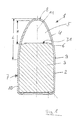
- Fig. 1 On an enlarged scale projectile 1 for practice purposes has formed as a hollow body shell 2 Tombak, in the lower or rear part of a core 3 is arranged made of soft iron, which only partially fills the space within the shell 2.
- a cavity 5 which allows the impact of the bullet on a target, the ogive 6 of the projectile mushroom-shaped, whereby the cross section of the projectile is extended, the kinetic Energy of the flying and striking bullet is converted into deformation energy and the bullet is thus stopped in the target.
- the projectile substantially assumes the shape of the core 3 and the surface load / specific energy (J / mm 2), here especially important decreases in the projectile nose such that a breakdown is not longer possible. Namely, it is essentially the flat and comparatively large end face 31 of the core 3 in the target, z. B. a bulletproof vest, effective and not a comparatively sharp projectile nose.
- the substantially flat end face 31 of the core 3 points to the front and is aligned perpendicular to the projectile longitudinal axis 11.
- the shell 2 of the projectile is cylindrically shaped in its lower or rear region 7, while its ogive 6 tapers conically towards the flattened front end-here rounded-end 8.
- the mantle 2 can dissolve during mushrooming in the area of the Ogive 6 also from the core 3, which favors the mushroom-like expansion in addition.
- the length L of the ogive 6 of the projectile 1 d. H. the length of the jacket 2 from its front end 8 to the point 9, where the cylindrical rear part 10 of the projectile 1 stops and passes into the top, slightly more than 50% of the total length of the projectile. This corresponds approximately to a caliber length or the diameter of the projectile.
- the height H of the displacement 5 within the shell 2 is slightly less than the length L of the ogive. 6
- a full coat in the sense of the invention does not necessarily mean that the back of the core 3 is closed by the jacket. This is not necessary here because the core is not made of lead.
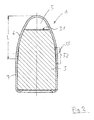
- Fig. 2 shows a comparable projectile 1 with a smaller, but according to the invention sufficient cavity 5. Notwithstanding Fig. 1
- the core 3 in the cylindrical rear part 7 of the projectile 1 a queritesredu fashionen section 32, such that in this section of the press-in resistance at the entrance of the fired projectiles is reduced in not shown the run.
- a gap 33 between shell 2 and core 3 remains in this section 32.
- the cross-section reduced portion 32 of the core 3 is tapered in a frustoconical manner towards the front.
- the section 32 or gap 33 extends over the transition area between the cylindrical rear part and the ogive 6.
- the length of the Querterrorismsschnedtredu afford section 32 is about 30% of the length of the cylindrical part.
Landscapes
- Engineering & Computer Science (AREA)
- General Engineering & Computer Science (AREA)
- Chemical & Material Sciences (AREA)
- Combustion & Propulsion (AREA)
- Aiming, Guidance, Guns With A Light Source, Armor, Camouflage, And Targets (AREA)
- Professional, Industrial, Or Sporting Protective Garments (AREA)
- Catching Or Destruction (AREA)
- Toys (AREA)
Applications Claiming Priority (1)
| Application Number | Priority Date | Filing Date | Title |
|---|---|---|---|
| DE200910001454 DE102009001454A1 (de) | 2009-03-10 | 2009-03-10 | Geschoss für Übungspatronen |
Publications (2)
| Publication Number | Publication Date |
|---|---|
| EP2228618A2 true EP2228618A2 (fr) | 2010-09-15 |
| EP2228618A3 EP2228618A3 (fr) | 2012-05-09 |
Family
ID=42237064
Family Applications (1)
| Application Number | Title | Priority Date | Filing Date |
|---|---|---|---|
| EP10156081A Withdrawn EP2228618A3 (fr) | 2009-03-10 | 2010-03-10 | Projectile d'exercice |
Country Status (2)
| Country | Link |
|---|---|
| EP (1) | EP2228618A3 (fr) |
| DE (1) | DE102009001454A1 (fr) |
Cited By (1)
| Publication number | Priority date | Publication date | Assignee | Title |
|---|---|---|---|---|
| GB2522787A (en) * | 2014-01-31 | 2015-08-05 | Oleksandr Kalachev | Cartridge for small arms |
Families Citing this family (1)
| Publication number | Priority date | Publication date | Assignee | Title |
|---|---|---|---|---|
| DE102011005389B3 (de) * | 2011-03-10 | 2012-03-01 | Metallwerk Elisenhütte GmbH | Geschoss für Übungspatronen |
Family Cites Families (3)
| Publication number | Priority date | Publication date | Assignee | Title |
|---|---|---|---|---|
| DE1008152B (de) * | 1954-06-01 | 1957-05-09 | Guenther Voss Dr Ing | Mantelgeschoss, insbesondere fuer Grosswild |
| CH347454A (de) * | 1956-03-21 | 1960-06-30 | Dipag Ltd | Geschoss |
| US20050183617A1 (en) * | 2004-02-23 | 2005-08-25 | Macdougall John | Jacketed ammunition |
-
2009
- 2009-03-10 DE DE200910001454 patent/DE102009001454A1/de not_active Withdrawn
-
2010
- 2010-03-10 EP EP10156081A patent/EP2228618A3/fr not_active Withdrawn
Non-Patent Citations (1)
| Title |
|---|
| None |
Cited By (2)
| Publication number | Priority date | Publication date | Assignee | Title |
|---|---|---|---|---|
| GB2522787A (en) * | 2014-01-31 | 2015-08-05 | Oleksandr Kalachev | Cartridge for small arms |
| GB2522787B (en) * | 2014-01-31 | 2016-06-15 | Kalachev Oleksandr | Cartridge for small arms |
Also Published As
| Publication number | Publication date |
|---|---|
| EP2228618A3 (fr) | 2012-05-09 |
| DE102009001454A1 (de) | 2010-09-16 |
Similar Documents
| Publication | Publication Date | Title |
|---|---|---|
| DE69512118T2 (de) | Geschoss, insbesondere nicht tötende Patrone | |
| DE10257590B4 (de) | Büchsengeschoss für Jagdzwecke | |
| DE1428690A1 (de) | Gewehrgeschoss | |
| WO2006086902A1 (fr) | Projectile | |
| WO2021063613A1 (fr) | Pénétrateur, utilisation d'un pénétrateur et projectile | |
| DE102011005389B3 (de) | Geschoss für Übungspatronen | |
| DE2757666A1 (de) | Zerfallgeschoss | |
| EP1759163B1 (fr) | Balle a pointe creuse | |
| EP2228618A2 (fr) | Projectile d'exercice | |
| DE102004035385A1 (de) | Teilzerlegungsgeschoss mit massivem Kern und Kern aus gepresstem Pulver | |
| DE211778C (fr) | ||
| EP1196734A1 (fr) | Projectile a decomposition partielle pourvu d'un penetrateur dans sa partie avant | |
| DE69514496T2 (de) | Flintenlaufgeschoss mit doppeleindringung und reduzierter schussweite | |
| EP0636853B1 (fr) | Balle pour armes de poing | |
| DE202012010484U1 (de) | Geschoss mit verringertem Penetrationsvermögen | |
| DE202018104528U1 (de) | Vollmantelgeschoß mit Kernen | |
| DE2535704A1 (de) | Patrone fuer faust- und schulterwaffen | |
| AT334787B (de) | Teilmanteljagdgeschoss | |
| DE19903395C1 (de) | Büchsengeschoss für Jagdzwecke | |
| DE2506776A1 (de) | Projektil | |
| EP1656533A1 (fr) | Projectile a desagregation partielle comprenant un noyau massif et un noyau en poudre comprimee | |
| DE2650136A1 (de) | Geschoss, insbesondere fuer faustfeuer- und langwaffen | |
| DE102010025829A1 (de) | Leitwerkstabilisiertes Impulsgeschoss | |
| DE10109720B4 (de) | Umformungsgeschoß. Geschoßkonstruktion für Pistolen-, Revolver- und Gewehrmunition usw. | |
| DE102016121558A1 (de) | Hochleistungs-Vollkaliber-Geschoss |
Legal Events
| Date | Code | Title | Description |
|---|---|---|---|
| PUAI | Public reference made under article 153(3) epc to a published international application that has entered the european phase |
Free format text: ORIGINAL CODE: 0009012 |
|
| AK | Designated contracting states |
Kind code of ref document: A2 Designated state(s): AT BE BG CH CY CZ DE DK EE ES FI FR GB GR HR HU IE IS IT LI LT LU LV MC MK MT NL NO PL PT RO SE SI SK SM TR |
|
| AX | Request for extension of the european patent |
Extension state: AL BA ME RS |
|
| PUAL | Search report despatched |
Free format text: ORIGINAL CODE: 0009013 |
|
| AK | Designated contracting states |
Kind code of ref document: A3 Designated state(s): AT BE BG CH CY CZ DE DK EE ES FI FR GB GR HR HU IE IS IT LI LT LU LV MC MK MT NL NO PL PT RO SE SI SK SM TR |
|
| AX | Request for extension of the european patent |
Extension state: AL BA ME RS |
|
| RIC1 | Information provided on ipc code assigned before grant |
Ipc: F42B 30/02 20060101ALN20120403BHEP Ipc: F42B 12/34 20060101AFI20120403BHEP |
|
| STAA | Information on the status of an ep patent application or granted ep patent |
Free format text: STATUS: THE APPLICATION IS DEEMED TO BE WITHDRAWN |
|
| 18D | Application deemed to be withdrawn |
Effective date: 20121110 |