EP2231682B1 - Sulfonierte organophosphin-verbindungen und ihre verwendung in hydroformylierungsverfahren - Google Patents
Sulfonierte organophosphin-verbindungen und ihre verwendung in hydroformylierungsverfahren Download PDFInfo
- Publication number
- EP2231682B1 EP2231682B1 EP09701652.1A EP09701652A EP2231682B1 EP 2231682 B1 EP2231682 B1 EP 2231682B1 EP 09701652 A EP09701652 A EP 09701652A EP 2231682 B1 EP2231682 B1 EP 2231682B1
- Authority
- EP
- European Patent Office
- Prior art keywords
- ligand
- transition metal
- composition
- group
- carbon atoms
- Prior art date
- Legal status (The legal status is an assumption and is not a legal conclusion. Google has not performed a legal analysis and makes no representation as to the accuracy of the status listed.)
- Active
Links
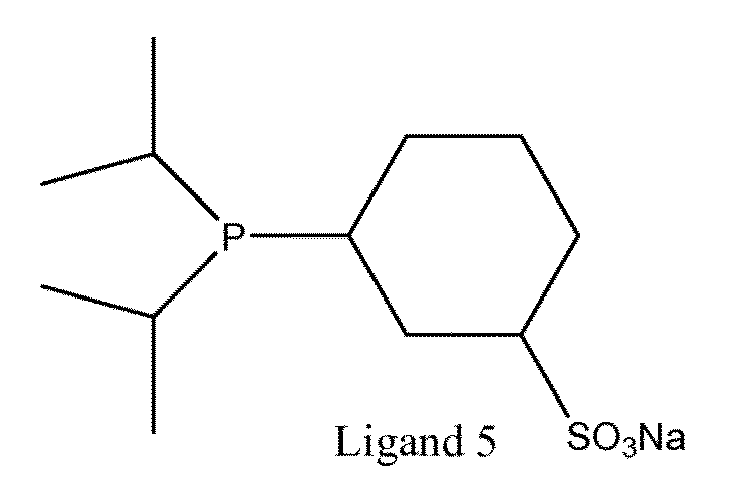
- SLUGBMRFQPCKMI-UHFFFAOYSA-N CC(C)P(C(C)C)C(CCC1)CC1[S]([Na])(=O)(=O)(=O)#C Chemical compound CC(C)P(C(C)C)C(CCC1)CC1[S]([Na])(=O)(=O)(=O)#C SLUGBMRFQPCKMI-UHFFFAOYSA-N 0.000 description 2
- XAZKFISIRYLAEE-UHFFFAOYSA-N CC1CC(C)CC1 Chemical compound CC1CC(C)CC1 XAZKFISIRYLAEE-UHFFFAOYSA-N 0.000 description 2
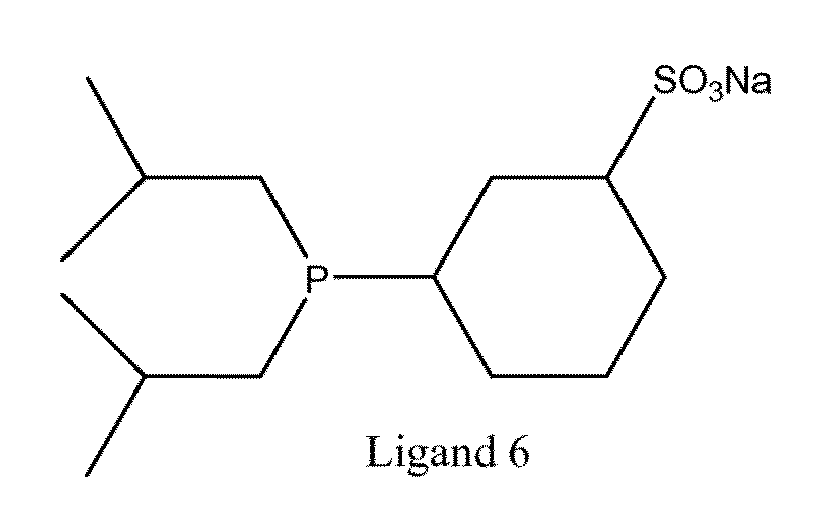
- IOSMPSWCQGHRAE-UHFFFAOYSA-N CC(C)CP(CC(C)C)C(CCC1)CC1[S]([Na])(=C)(=O)(=O)=O Chemical compound CC(C)CP(CC(C)C)C(CCC1)CC1[S]([Na])(=C)(=O)(=O)=O IOSMPSWCQGHRAE-UHFFFAOYSA-N 0.000 description 1
- ODNRTOSCFYDTKF-UHFFFAOYSA-N CC1CC(C)CC(C)C1 Chemical compound CC1CC(C)CC(C)C1 ODNRTOSCFYDTKF-UHFFFAOYSA-N 0.000 description 1
- QRMPKOFEUHIBNM-UHFFFAOYSA-N CC1CCC(C)CC1 Chemical compound CC1CCC(C)CC1 QRMPKOFEUHIBNM-UHFFFAOYSA-N 0.000 description 1
- XAOIERRBOBAGBG-UHFFFAOYSA-N O=NC(CCC1)CC1C(C1CCCCC1)C1CCCCC1 Chemical compound O=NC(CCC1)CC1C(C1CCCCC1)C1CCCCC1 XAOIERRBOBAGBG-UHFFFAOYSA-N 0.000 description 1
Images

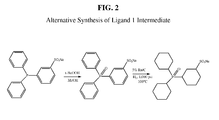

Classifications
-
- C—CHEMISTRY; METALLURGY
- C07—ORGANIC CHEMISTRY
- C07F—ACYCLIC, CARBOCYCLIC OR HETEROCYCLIC COMPOUNDS CONTAINING ELEMENTS OTHER THAN CARBON, HYDROGEN, HALOGEN, OXYGEN, NITROGEN, SULFUR, SELENIUM OR TELLURIUM
- C07F9/00—Compounds containing elements of Groups 5 or 15 of the Periodic Table
- C07F9/02—Phosphorus compounds
- C07F9/28—Phosphorus compounds with one or more P—C bonds
- C07F9/50—Organo-phosphines
- C07F9/5004—Acyclic saturated phosphines
-
- C—CHEMISTRY; METALLURGY
- C07—ORGANIC CHEMISTRY
- C07F—ACYCLIC, CARBOCYCLIC OR HETEROCYCLIC COMPOUNDS CONTAINING ELEMENTS OTHER THAN CARBON, HYDROGEN, HALOGEN, OXYGEN, NITROGEN, SULFUR, SELENIUM OR TELLURIUM
- C07F9/00—Compounds containing elements of Groups 5 or 15 of the Periodic Table
- C07F9/02—Phosphorus compounds
- C07F9/28—Phosphorus compounds with one or more P—C bonds
- C07F9/50—Organo-phosphines
- C07F9/5018—Cycloaliphatic phosphines
Definitions
- This invention pertains to a novel class of sulfonated organophosphine compounds and their use as ligands in metal-ligand complex catalysts that are capable of catalyzing hydroformylation processes.
- Hydroformylation processes are well known in the art, for example, as described in " Applied Homogeneous Catalysis with Organometallic Compounds," edited by B. Cornils and W. A. Herrmann, VCH, New York, 1996, vol. 1, pp. 29-104 .
- Hydroformylation involves conversion of an olefinically-unsaturated reactant with carbon monoxide and hydrogen (syngas) to produce one or more corresponding formyl-substituted products (aldehydes).
- Hydroformylation processes are known to be catalyzed by metal-ligand complex catalysts, preferably, a transition metal-organophosphorus ligand complex catalyst.
- hydroformylation catalysts comprising a variety of triorganophosphine, triorganophosphite, diorganophosphite, and bisphosphite ligands is found in the following reference "Rhodium Catalyzed Hydroformylation,” edited by P. W. N. M. van Leeuwen and C. Claver, Kluwer Academic Publisher, USA Edition, 2002.
- the formyl-substituted products can be subjected to downstream functionalization processes, for example, reduction of the aldehyde to form an alcohol; or reductive amination of the aldehyde to form an amine; or oxidation of the aldehyde to form a carboxylic acid; or aldolization of the aldehyde followed by oxidation to form an hydroxyacid.
- Alcohols, amines, carboxylic acids, and hydroxyacids obtained via hydroformylation of an olefinically-unsaturated reactant find utility as solvents, surfactants, and monomers for the preparation of polymers, and as intermediates in the synthesis of pharmaceuticals and other industrially-useful chemicals.
- mono-, di-, and trialcohols and corresponding amines obtained directly from hydroformylation can be converted via transesterification into polyester polyols and polyester polyamines, respectively, which are especially useful in the manufacture of polyurethane polymers.
- long-chain olefinically-unsaturated reactants having from about 6 to about 60 carbon atoms
- one class of long-chain olefinically-unsaturated reactants comprises a mixture of mono-, di-, and tri-unsaturated fatty acids or fatty acid esters having from about 10 to about 50 carbon atoms, preferably, the olefinically-unsaturated fatty acid esters of lower alkanols, preferably, C 1-8 alkanols (mono-alkanols), for example, methanol.
- Olefinically-unsaturated fatty acid esters of the lower alkanols are themselves derived by transesterifying a seed oil, for example, a soy, castor, or canola vegetable oil, with the C 1-8 alkanol.
- seed oils can provide renewable alternative feedstocks of olefinically-unsaturated fatty acids or fatty esters, which are capable, in part, of replacing petroleum in the manufacture of industrially-useful chemicals.
- the present day hydroformylation of olefinically-unsaturated fatty acids or fatty esters and other long chain olefinically-unsaturated compounds is conducted in a rhodium-catalyzed one-phase process containing a water-soluble ionic ligand, preferably, an alkali metal salt of a dihydrocarbylarylphosphine monosulfonate compound wherein the hydrocarbyl comprises an alkyl or aryl group, and further containing a solubilizing solvent, such as N-methyl-2-pyrrolidinone (NMP), as disclosed for example in WO 2004/096744 .
- NMP N-methyl-2-pyrrolidinone
- Separation of the resulting aldehyde-containing reaction product fluid is advantageously effected by addition of water, as disclosed for example in US 5,180,854 , under conditions sufficient to obtain a non-polar phase containing one or more aldehyde products and optionally non-polar solvent(s) as may be present and a polar phase containing the rhodium-ligand catalyst, optional free ionically-charged ligand, water, and solubilizing solvent.
- ligands containing an aryl-phosphorus bond tend to undergo alkyl-aryl exchange by way of reaction of the phosphine ligand with the olefinically-unsaturated compound, as disclosed in US 4,283,304 and by A. G. Abatjoglou, et al., in Organometallics, 1984, 3, 923-926 .
- Ligand alkyl-aryl exchange generates three undesirable results.
- alkyl-aryl exchange consumes the particular species of ligand active in the hydroformylation process, which then needs to be replaced.
- alkyl-aryl exchange produces non-ionic or neutral ligands, which are insoluble in water and which can remain as free ligands or as coordinated ligands in rhodium complexes in the non-polar phase containing the aldehyde product(s), rather than being extracted into the polar phase.
- alkyl-aryl exchange produces sodium benzenesulfonate, which accumulates in the polar phase and can eventually precipitate onto the walls of the reactor equipment and foul the same. Sodium benzenesulfonate may also induce undesirable separation of the water/NMP polar phase.
- US 5,773,666 discloses a hydroformylation process using P(X 1 )(X 2 )(X 3 -SO 3 M) as a ligand, wherein X 1 and X 2 are monovalent hydrocarbon groups with 1-15 carbon atoms, X 3 is a divalent hydrocarbon group with 1-15 carbon atoms, and M is an alkali metal.
- X 3 is disclosed to be specifically 1,3-phenylene or a tri- or tetra-methylene, such that the phenylene or the tri- or tetra-methylene is substituted with a sulfonate group.
- US 5,180,854 discloses sulfonated organophosphine ligands of the following generic formula: wherein R 3 represents a divalent alkylene radical having from 2 to 12 carbon atoms or a divalent 1,3-phenylene radical. Preferably, when R 3 is a divalent alkylene radical, R 3 has from 2 to 5 carbon atoms; more preferably, R 3 is, 1,3-propylene or 1,4-butylene.
- T. Bartik, et al. discloses in Organometallics, 12 (1993), 164-170 , water-soluble phosphines prepared by sulfonating one or more phenyl groups on a tri(aralkyl)phosphine of the formula P[(CH 2 ) x (C 6 H 5 )] 3 , wherein x is 1, 2, 3, or 6.
- US 4,625,068 and US 4,642,388 disclose the use of non-ionic tricycloalkylphosphines, such as tricyclohexylphosphine, in hydroformylation of internal olefins or hindered terminal vinylidenes, respectively.
- US 4,689,437 A discloses an olefin oligomerization/cooligomerization catalyst comprising (i) an organophosphorus sulfonate ligand containing one benzene ring with trivalent phosphorus P(III) group and SO 3 M group at ortho-positions, or one benzene ring with CH 2 -P(III) and CH 2 -SO 3 M groups at ortho-positions, or a bridging or fused aromatic ring system with P(III) or CH 2 -P(III) group and SO 3 M or CH 2 -SO 3 M group at adjacent positions on different rings, or any aromatic ring having the P(III) and SO 3 M groups at adjacent positions, where M is H, Group IA or Group IIA metals, quaternary ammonium or phosphonium (NR 4 , PR 4 ) radical, or (ii) a P(III) component connected through -(A)x-(CR 2 R 3 )y- group to an SO 3 M group,
- US 4,731,486 A discloses a non-aqueous hydroformylation process for producing aldehydes using low volatile, organic solubilized monosulfonated tertiary phosphine metal salt ligands.
- EP 0 350 921 A1 discloses a cobalt catalyzed oxo reaction process for producing alcohols and aldehydes which comprises employing a monosulfonated tertiary metal salt ligand and phase separating the alcohol and aldehyde reaction products from the oxo reaction product composition by the use of added water or both added water and an added non-polar hydrocarbon compound.
- J. Am. Chem. Soc., 2000, 122, 6601-9 discloses ruthenium alkylidenes bearing cationically functionalized phosphine ligands that are soluble and stable in protic solvents and initiate olefin metathesis reactions in methanol, water, and aqueous emulsions.
- this invention provides for a novel class of sulfonated triorganophosphine compounds represented by Formula I: wherein R 1 and R 2 each individually represent a monovalent hydrocarbyl radical selected from alkyl radicals containing from 3 to 12 carbon atoms, aralkyl radicals containing from 6 to 12 carbon atoms, and alicyclic radicals containing from 3 to 10 carbon atoms exclusive of carbon-containing substituents on the ring(s), wherein R 1 and R 2 are optionally substituted with one or more substituents selected from cyano, fluoro, trifluoromethyl, trialkylsilyl, alkoxy, carboalkoxy (ester), dialkyl amino, and dialkylamido; wherein R 3 represents a divalent or polyvalent alkylene or a divalent or polyvalent alicyclic radical (hereinafter, "alkylene radical”), said alkylene radical having greater than 3 and less than 10 carbon atoms, and being optionally substituted by halide,
- each of R 1 , R 2 , and R 3 are "bulky" radicals, which means that in each of R 1 , R 2 , and R 3 the carbon atom attached to the phosphorus atom is additionally bonded to at least 2 other carbon atoms.
- the aforementioned requirement ensures that R 1 , R 2 , and R 3 have branching carbon chains that provide for steric bulk.
- this invention provides for a novel complex catalyst or complex catalyst precursor composition
- a novel complex catalyst or complex catalyst precursor composition comprising a Group 8-10 (formerly Group VIII) transition metal bonded to at least one molecule of ligand comprising Formula I hereinabove, the transition metal optionally being further bonded to carbon monoxide, hydrogen, or both carbon monoxide and hydrogen.
- this invention provides for a novel complex catalyst solution or complex catalyst precursor solution comprising a solvent, a complex catalyst or catalyst precursor composition comprising a Group 8-10 transition metal bonded to at least one molecule of ligand, and optionally further comprising free ligand, wherein the bonded and free ligands are represented by Formula I hereinabove; and wherein optionally the Group 8-10 transition metal can be further bonded to carbon monoxide, hydrogen, or both carbon monoxide and hydrogen.
- the ionically-charged class of compounds claimed herein possesses sufficient water solubility or solubility in appropriate mixtures of water and non-aqueous polar solvents, such that said ionically-charged compound(s) can be easily separated from one or more non-polar reaction products.
- the separation involves addition of water to the product fluid with subsequent formation of two immiscible liquid phases, one of which is the product phase and the other of which is the catalyst-containing phase.
- novel catalyst composition and novel solution claimed herein comprising the ionically-charged ligand composition of this invention find utility, particularly, in the hydroformylation of long-chain olefinically-unsaturated compounds having from 6 to 60 carbon atoms, preferably, from 10 to 50 carbon atoms, such as, olefinically-unsaturated fatty acids or fatty esters derived from seed oils.
- the novel hydroformylation catalyst of this invention provides for comparable olefin conversion and product selectivity as compared with prior art catalysts containing ionically-charged ligands.
- the novel composition provides for improved ligand stability and improved ligand and rhodium recovery and recycling, as compared with prior art ligands containing one or more aryl-phosphorus bonds.
- one of the essential decomposition mechanisms of the prior art ligands involves alkyl-aryl exchange by reaction of an olefin with the aryl radical directly attached to the phosphorus atom.
- the class of compounds claimed in this invention does not comprise an aryl-phosphorus bond, but rather contains phosphorus bonded only to bulky alkyl groups, thereby essentially eliminating the possibility of alkyl-aryl exchange.
- the bulky alkyl groups R 1 , R 2 , and R 3 provide for acceptable ligand concentration effect on process reaction rate, which means that a change in ligand concentration does not unacceptably alter the reaction rate.
- this invention provides for a novel hydroformylation process comprising contacting one or more olefinically-unsaturated compounds with carbon monoxide and hydrogen in the presence of a Group 8-10 transition metal-ligand complex catalyst, wherein the ligand is represented by the composition of Formula I hereinabove, the contacting being conducted under process conditions sufficient to prepare one or more corresponding aldehyde products.
- the novel hydroformylation process of this invention finds utility in the production of useful organic intermediates, solvents, and monomers, particularly, mono-, di-, and tri- alcohols and amines. These monomers can be converted via transesterification into polyester polyols and polyester polyamines that find utility in the manufacture of polyurethane polymers.
- a non-polar solvent means with or without a non-polar solvent.
- the number of carbon atoms or a range thereof forming a moiety or compound is defined by prefixing the moiety or compound with a formula "C m " or "C m -C n ,” respectively, wherein m and n are integers.
- a C 1 -C 10 hydrocarbyl means the hydrocarbyl has a number of carbon atoms in a range from one (1) to ten (10) carbon atoms.
- hydrocarbyl refers to univalent organic radicals comprised of carbon and hydrogen atoms and containing from 1 to 30 carbon atoms, preferably, from 1 to 12 carbon atoms, including linear, branched, cyclic, saturated and unsaturated species, such as alkyl, alicyclic, alkenyl, aryl, alkaryl, and aralkyl groups.
- substituted hydrocarbyl refers to a hydrocarbyl radical that is substituted with one or more substituents disclosed hereinafter.
- hydrocarbylene refers to a divalent hydrocarbyl radical.
- alkyl refers to a saturated monovalent hydrocarbyl radical, which can be linear, branched, or cyclic (alicyclic). If linear or branched, the radical advantageously contains from 1 to 30 carbon atoms, for example, methyl, ethyl, propyl, isopropyl, butyl, iso-butyl, tert-butyl, and the like. If cyclic (alicyclic), the radical advantageously contains from 4 to 8 carbon atoms, such as cyclobutyl, cyclopentyl, cyclohexyl, cycloheptyl, and cyclooctyl. Preferably, the linear or branched alkyl radical contains from 1 to 12 carbon atoms; and the alicyclic radical contains from 5 to 7 carbon atoms, exclusive of carbon-containing substituents.
- alkylene refers to a linear, branched, or cyclic divalent alkyl radical.
- aromatic refers to a polyatomic, cyclic, conjugated ring system containing (4 ⁇ +2) ⁇ -electrons, wherein ⁇ is an integer greater than or equal to 1.
- fused as used herein with respect to a ring system containing two or more polyatomic, cyclic rings means that with respect to at least two rings thereof, at least one pair of adjacent atoms is included in both rings.
- aryl refers to a monovalent aromatic substituent which may be a single aromatic ring or multiple aromatic rings that are fused together, linked covalently, or linked to a common group such as a methylene or ethylene moiety. Examples of aromatic ring(s) include phenyl, naphthyl, anthracenyl, and biphenyl, among others. Preferred aryl radicals contain one aromatic ring.
- arylene refers to a divalent aryl radical.
- aralkyl or "arylalkyl” refers to a monovalent alkyl radical substituted with at least one aryl radical.
- aralkylene refers to a divalent alkylene radical substituted with at least one aryl radical.
- arylalicyclic refers to an alicyclic radical substituted with at least one aryl group.
- An example of an arylalicyclic radical is "phenylcyclohexyl” or “phenylcyclopentyl.”
- the arylalicyclic radical contains greater than 10 carbon atoms and less than 20 carbon atoms.
- alkaryl refers to a monovalent aryl radical with one or more alkyl substituents.
- alkarylene refers to a divalent aryl radical with one or more alkyl substituents.
- hydrocarbyl As used herein, any and all of the terms “hydrocarbyl,” “hydrocarbylene,” “alkyl,” “aromatic,” “alkylene,” “aryl,” “arylene,” “alkaryl,” “alkarylene,” “aralkyl,” “aralkylene,” “alicyclic,” and “arylalicyclic” are intended to include substituted variants thereof.
- substituted or the words “substituted variants thereof” refer to the replacement of at least one hydrogen atom that is bonded to a carbon atom, for example, an alkyl or aryl carbon atom, with a non-hydrogen moiety, preferably, a heteroatom or heteroatom-containing substituent, more preferably selected from halogens (preferably F) nitrogen, oxygen, and phosphorus.
- any particular radical will increase the valency of that radical by one or more.
- a divalent alkylene radical e.g., R 3
- the valency of the alkylene radical will increase to trivalent or polyvalent, respectively.
- substituents that can be present, besides the sulfonate, on any of the radicals include, without limitation, halogen (more preferably, F), phosphonyl, C 1-20 alkylamido, imino, hydroxyl, C 1-20 alkoxy, C 5-20 aryloxy, C 2-20 alkoxycarbonyl, C 5-20 aryloxycarbonyl, formyl, acyl, cyano, cyanato, carbamoyl, epoxy, silyl, silyloxy, silanyl, siloxazanyl, and the hydrocarbyl moieties C 1-20 alkyl, C 2-20 alkenyl, C 2-20 alkynyl, C 5-20 aryl, C 5-30 aralkyl, and C 5-30 alkaryl; preferably, cyano, fluoro, trifluoromethyl, trialkylsilyl, alkoxy, carboalkoxy (ester), dialkylamino, dialkylamido, more preferably,
- this invention provides for a novel class of sulfonated triorganophosphine compounds represented by Formula I: wherein R 1 and R 2 each individually represent a monovalent hydrocarbyl radical selected from alkyl radicals containing from 3 to 12 carbon atoms, aralkyl radicals containing from 6 to 12 carbon atoms, and alicyclic radicals containing from 3 to 10 carbon atoms exclusive of carbon-containing substituents on the ring(s), wherein R 1 and R 2 are optionally substituted with one or more substituents selected from cyano, fluoro, trifluoromethyl, trialkylsilyl, alkoxy, carboalkoxy (ester), dialkyl amino, and dialkylamido; wherein R 3 represents a divalent or polyvalent alkylene or a divalent or polyvalent alicyclic radical (hereinafter, "alkylene radical”), said alkylene radical having greater than 3 and less than 10 carbon atoms, and being optionally substituted by halide,
- each of R 1 , R 2 , and R 3 are "bulky" radicals, which means that in each of R 1 , R 2 , and R 3 the carbon atom attached to the phosphorus atom is additionally bonded to at least 2 other carbon atoms.
- the aforementioned requirement ensures that R 1 , R 2 , and R 3 have branching carbon chains that provide for steric bulk. While not intending to bind the invention to any theory, it is believed that the bulky radicals may provide for hydroformylation catalysts comprising only one organophosphine ligand per transition metal atom (as opposed to a plurality of ligands per transition metal atom), which in turn may lead to improved catalyst activity.
- R 1 and R 2 are each individually a monovalent hydrocarbyl radical containing from 3 to 30 carbon atoms selected from alkyl, aralkyl, and alicyclic monovalent radicals, with branching at the carbon attached to the phosphorus atom so as to provide for steric bulk.
- the alkyl radicals contain from 3 to 12 carbon atoms, while the aralkyl radical contains from 6 to 12 carbon atoms.
- the alicyclic radical can be mono-cyclic, bi-cyclic, or poly-cyclic and contains from 3 to 10 carbon atoms, exclusive of carbon-containing substituents on the ring(s).
- alkyl radicals represented by the R 1 and R 2 includes iso- propyl, iso -butyl, sec -butyl, tert -butyl, 2,2-dimethylpropyl, 2-methylbutyl, 1,1-dimethylpropyl, 2-ethylhexyl.
- Arylalkyl radicals include, without limitation, benzyl, 2-methylbenzyl, 2,6-dimethylbenzyl, 1-phenylethyl, phenylcyclohexyl, 1,2,3,4-tetrahydronaphthyl, phenylcyclopentyl; alicyclic radicals include, without limitation, cyclopentyl, cyclohexyl, cycloheptyl, cyclooctyl, ethylcyclohexyl, norbornyl, adamantyl, and dicyclopentyl. Moreover, such monovalent hydrocarbon radicals can be substituted with any substituent that does not adversely change the desired result(s) of this invention.
- substituents that can be bound to the monovalent hydrocarbyl radical include those substituents mentioned hereinabove, preferably, cyano, fluoro, trifluoromethyl, trialkylsilyl, alkoxy, carboalkoxy (ester), dialkyl amino, and dialkylamido, preferably, having 1 to 15 carbon atoms where appropriate.
- R 1 and R 2 are each individually selected from branched chain alkyl radicals having from 3 to 10 carbon atoms or alicyclic radicals having from 6 to 10 carbon atoms, including iso-propyl, iso-butyl, neo-pentyl, cyclohexyl, norbornyl, and adamantyl.
- R 1 and R 2 each individually represent a cyclohexyl or iso-propyl radical, especially, cyclohexyl.
- R 3 in Formula I is selected from divalent and polyvalent, alicyclic radicals having from 6 to 10 carbon atoms and alkylene radicals having greater than 3 and less than 10 carbon atoms, which optionally can be substituted with substituents such as those mentioned above, preferably, halide (F), alkoxy, cyano, and/or alkyl groups.
- R 3 is further required to have at least one sulfonate (-SO 3 - ) ion attached directly to the R 3 group.
- a non-limiting list of R 3 diradicals (polyradicals) suitable for this invention is set forth hereinafter:
- n in Formula I is 1 or 2.
- M in Formula I represents a metal cation selected from the group consisting of alkali metal ions.
- Illustrative alkali metal ions include lithium (Li + ), sodium (Na + ), potassium (K + ), rubidium (Rb + ), and cesium (Cs + ). More preferably, M is sodium or potassium ion.
- Preferred sulfonated tertiary phosphine metal salt compounds of Formula I include the following.
- any other monovalent metal cation more preferably, another alkali metal ion, may replace the alkali ion illustrated.
- Ligand 1 is most preferred, because it structurally mimics sodium 3-(dicyclohexylphosphino)benzene sulfonate which is a preferred prior art ligand for hydroformylation catalysts; however, Ligand 1 contains a cyclohexyl ring in place of the phenyl ring of the prior art ligand thereby eliminating the possibility of alkyl-aryl exchange.
- the ligand of this invention retains most of the physical and chemical properties of the prior art ligand essential for catalyst separation and recycling, namely, solubility, partitioning between different phases, and acceptable surfactant properties, but without the detrimental alkyl-aryl exchange feature.
- the synthesis of the ionically-charged triorganophosphine compound of this invention depends upon whether R 3 is chosen to be an alicyclic group or a branched alkylene group. The synthesis is first described for the case wherein R 3 is a divalent alicyclic group, such as cyclohexylene.
- a first step comprises preparation of a precursor organophosphine compound R 4 R 5 PR 6 -(SO 3 M) n , wherein R 4 is either R 1 or its aromatic analog, R 5 is either R 2 or its aromatic analog, and R 6 is a divalent or polyvalent arylene radical corresponding to its divalent or polyvalent saturated analog R 3 , wherein R 1 , R 2 , and R 3 are defined hereinbefore; and wherein M and n have the definitions given hereinabove.
- R 1 and R 2 are each independently cyclohexyl and R 3 is desirably cyclohexylene
- R 4 and R 5 are each independently cyclohexyl (1 st case) or phenyl (2 nd case) and R 6 is phenylene.
- the preparation of the precursor organophosphine in the first case is known in the art, as described for example, in International Patent Application Publication WO 2007035540 .
- the precursor organophosphine in the second case preferably, 3-(diphenylphosphino)benzenesulfonate, is available from commercial sources.
- R 6 it is desired to convert R 6 to its saturated analog R 3 in the first case and R 4 , R 5 , and R 6 to their saturated analogs R 1 , R 2 , and R 3 , respectively, in the second case, via hydrogenation.
- a hydrogenation catalyst such as a platinum metal
- the second step of the synthesis converts the organophosphine precursor R 4 R 5 PR 6 -(SO 3 M) n to its corresponding phosphine oxide (phosphinyl).
- the organophosphine precursor is contacted with an organic hydroperoxide, such as t-butyl hydroperoxide, ethylbenzene hydroperoxide, or cumene hydroperoxide, at a temperature ranging from 0°C to 50°C and advantageously atmospheric pressure to obtain the corresponding phosphine oxide R 4 R 5 P(O)R 6 (SO 3 M) n , wherein R 4 , R 5 , R 6 , M, and n have the same definitions as given hereinbefore.
- an organic hydroperoxide such as t-butyl hydroperoxide, ethylbenzene hydroperoxide, or cumene hydroperoxide
- the aryl ring R 6 in case 1 and aryl rings R 4 , R 5 , and R 6 in case 2 are now hydrogenated to form a phosphinyl compound having the corresponding saturated radicals R 1 , R2, and R 3 , respectively; that is to yield a compound of formula R 1 R 2 P(O)R 3 (SO 3 M) n , wherein R 1 , R 2 , R 3 , M, and n have the definitions given hereinbefore.
- the hydrogenation is advantageously conducted under hydrogen gas in the presence of a hydrogenation catalyst, such as a Group 8, 9, and/or 10 metal supported on a suitable support.
- Group 8-10 metals include iron, cobalt, nickel, ruthenium, rhodium, palladium, osmium, iridium, and platinum.
- Suitable supports include carbon, silica, alumina, and aluminosilicates.
- a preferred catalyst comprises ruthenium supported on carbon.
- the Group 8-10 metal is loaded onto the support in a quantity ranging from 1 to 10, more preferably 5, weight percent.
- the hydrogenation is advantageously conducted at a temperature ranging from 50°C to 200°C, preferably, from 80°C to 150°C, under a hydrogen at a pressure ranging from 200 psia (1,379 kPa) to 2000 psia (13,790 kPa), preferably, from 700 psia (4,826 kPa) to 1,500 psia (10,342 kPa).
- the reaction can be followed by 1 H NMR by observing the disappearance of the aromatic protons attributed to R 6 and, optionally, R 4 and R 5 depending upon whether these are also aryl groups, and the appearance of saturated ring protons attributed to R 3 , and optionally, R 1 and R 2 .
- the alkali metal salt of the phosphinyl sulfonate R 1 R 2 P(O)R 3 (SO 3 M) n is converted to the corresponding alkyl sulfonate ester of formula R 1 R 2 P(O)R 3 (SO 3 R 7 ) n , wherein each R 7 comprises a monovalent C 1-5 alkyl radical.
- a conventional protocol for converting sulfonic acids to sulfonate alkyl esters is readily adapted to the present case. Such protocols have been described by C. Larpent, et al., Synthesis Communications, 1991, 21, 495-503 , and J. I. Trujillo and A. S.
- the procedure involves contacting the sulfonated salt R 1 R 2 P(O)R 3 (SO 3 M) n with "n" equivalents of trialkylorthoacetate or equivalent alkyl-transfer reagent.
- a preferred trialkylorthoacetate is a tri-(C 1-3 alkyl)orthoacetate, more preferably, triethylorthoacetate.
- the sulfonated salt is advantageously dissolved in an appropriate solvent, such as an alcohol, acidified with a conventional acid, such as hydrochloric acid; after which the trialkylorthoacetate dissolved in a suitable organic solvent, such as a chlorinated hydrocarbon, for example, dichloromethane, is added to the solution containing the sulfonated salt. Refluxing the resulting solution at a temperature from 15°C to 100°C under atmospheric pressure for a time from 3 hours to 20 hours is advantageously sufficient to effect complete esterification.
- an appropriate solvent such as an alcohol
- a conventional acid such as hydrochloric acid
- a suitable organic solvent such as a chlorinated hydrocarbon, for example, dichloromethane
- the product is worked up via conventional techniques that first involve neutralization of the acid, then extraction of the reaction solution with water to obtain the esterified product R 1 R 2 P(O)R 3 (SO 3 R 7 ) n from the organic phase. Later, the ester group(s), which is(are) inert with respect to the subsequent synthesis steps, is(are) readily cleaved under non-oxidizing conditions according an acceptable solubility of the product in organic solvents.
- the esterified product R 1 R 2 P(O)R 3 (SO 3 R 7 ) n is subjected to reduction to convert the phosphine oxide (phosphinyl) back to the corresponding phosphine R 1 R 2 PR 3 (SO 3 R 7 ) n .
- the art describes similar reductions, as found for example in K. Yamamoto and S.-U. Rehman, Chemical Letters, 1984, 1603-1606 , and H. Yamamoto, et al., Chemical Letters, 1989, 349-352 .
- the reduction involves reaction of the phosphine oxide sulfonic ester, dissolved in an appropriate hydrocarbon solvent, such as benzene, with an excess of a reducing agent, such as, sodium borohydride or a trihalosilane.
- a reducing agent such as, sodium borohydride or a trihalosilane.
- Trichlorosilane is preferred.
- the silane is used advantageously in a 2 to 15 mole excess with respect to the phosphine oxide sulfonic ester.
- the reaction is advantageously conducted under an oxygen-free atmosphere, such as a blanket of nitrogen or helium or argon, to protect the oxygen-sensitive phosphine product. Cooling may be required, or slight heating to a temperature no higher than reflux at atmospheric pressure can be used; and the reaction is advantageously quenched with water.
- the phosphine product is recovered by conventional techniques, for example, extraction and drying.
- the phosphine sulfonic ester R 1 R 2 PR 3 (SO 3 R 7 ) n is converted via treatment with a conventional acid, such as sulfuric or hydrochloric acid, to cleave the ester group yielding the corresponding sulfonic acid R 1 R 2 PR 3 (SO 3 H) n , which can be extracted into a suitable hydrocarbon or chlorinated hydrocarbon solvent, such as methylene chloride.
- a conventional acid such as sulfuric or hydrochloric acid
- zwitterion refers to a chemical compound that is electrically neutral but carries formal positive and negative charges on different atoms. In this instance, the phosphorus atom is protonated and carries a +1 charge, while the sulfonate ion is deprotonated and carries a -1 charge.
- the phosphine sulfonic acid is converted into its corresponding alkali metal salt via titration of the acid with the appropriate alkali metal hydroxide, preferably, sodium hydroxide, dissolved in a suitable alcoholic solvent, such as a C 1-3 alcohol, preferably, methanol or ethanol.
- a suitable alcoholic solvent such as a C 1-3 alcohol, preferably, methanol or ethanol.
- the alcoholic solvent is then concentrated or removed to yield a solid precipitate identified as the composition of this invention: R 1 R 2 PR 3 (SO 3 M) n .
- 3-methyl-1,3-propane sultone can be prepared by heating crotyl sulfonic acid under vacuum according to US 2,900,393 , incorporated herein by reference.
- This methodology can be further enhanced by using borane-protected intermediates, as illustrated in Figure 3(b) , as described for example by J. McNulty and Y. Zhou in Tetrahedron Letters, 2004, 45, 407-409 .
- borane-protected phosphines are resistant to oxidation, and the borane-protected sequence makes the preparation overall more efficient.
- the intermediates in the above synthetic schemes and the product of this invention can be identified by standard analytical techniques known to the skilled person, for example, 31 P and/or 1 H and/or 13 C NMR, mass spectrometry (MS), and/or infrared spectroscopy.
- the purity of the product and any intermediates of the synthesis can be verified by gas chromatography (GC), thin layer chromatography (TLC), high performance liquid chromatography (HPLC), any suitable NMR spectroscopy, including 1 H, 13 C, and 31 P NMR, and ionic chromatography (IC).
- composition of this invention of Formula I finds application as a ligand in transition metal-ligand complex catalysts and catalyst precursors that are used in carbonylation processes, preferably, hydroformylation processes. Accordingly, in a second aspect this invention provides for an entirely new class of complex catalysts and complex catalyst precursor compositions that comprise a Group 8, 9, or 10 transition metal bonded to at least one ligand represented by Formula I.
- the Group 8-10 transition metal can also be bonded to carbon monoxide, hydrogen, or both carbon monoxide and hydrogen.
- the Group 8-10 transition metal that makes up the complex catalyst or catalyst precursor composition of this invention includes transition metals selected from the group consisting of rhodium (Rh), cobalt (Co), iridium (Ir), ruthenium (Ru), iron (Fe), nickel (Ni), palladium (Pd), platinum (Pt), and osmium (Os), and mixtures thereof, with the preferred metals being ruthenium, rhodium, cobalt, and iridium, more preferably, rhodium and cobalt, and most preferably, rhodium.
- transition metals selected from the group consisting of rhodium (Rh), cobalt (Co), iridium (Ir), ruthenium (Ru), iron (Fe), nickel (Ni), palladium (Pd), platinum (Pt), and osmium (Os), and mixtures thereof, with the preferred metals being ruthenium, rhodium, cobalt, and iridium
- complex as used herein shall be taken to mean a coordination compound formed by the union of one or more ligands, herein one or more ligands of Formula I, with a Group 8-10 metal.
- the ligand(s) is/are electronically rich, since each ligand possesses one phosphorus donor atom having one available or unshared pair of electrons that is capable of forming a coordinate covalent bond with the Group 8-10 transition metal.
- the oxidation state of the Group 8-10 metal can be any available oxidation state, both electronically neutral (zero) or electronically deficient (positive valence) that allows for bonding to the ligand.
- the oxidation state of the Group 8-10 transition metal as well as the overall oxidation state of the coordination complex or complex precursor can vary during use in the hydroformylation process.
- the number of available coordination sites on the Group 8-10 transition metal is well known in the art and can range advantageously from 4 to 6.
- the Group 8-10 transition metal can be additionally bonded to carbon monoxide, hydrogen, or both carbon monoxide and hydrogen.
- this invention can be described as a novel transition metal complex catalyst or catalyst precursor solution comprising an organic solvent, a solubilized Group 8-10 transition metal-ligand complex, and optionally, free ligand, wherein the free and bound ligands are represented by Formula I hereinabove.
- novel solutions can be prepared by forming a solution comprising an organic solvent, free ligand, and a Group 8-10 transition metal source material, such as the corresponding transition metal oxide, hydride, carbonyl, salt, or organotransition metal complex described hereinafter; and thereafter subjecting such solution to reaction conditions sufficient to bind at least a portion of the ligand to the Group 8-10 transition metal.
- carbon monoxide and hydrogen can be dissolved in the solution and bonded to the Group 8-10 transition metal.
- the Group 8-10 transition metal-ligand complex catalyst of this invention can be synthesized by methods known in the art. For instance, a Group 8-10 transition metal hydridocarbonyl(ligand) catalyst can be preformed and introduced into the reaction medium of a hydroformylation process. Standard identification methods can be used to identify the complex catalyst or catalyst precursor composition, including for example, elemental analysis, mass spectroscopy, infrared spectroscopy, and 1 H, 31 P, and/or 13 C NMR spectroscopy, and the like.
- the Group 8-10 transition metal-ligand complex catalyst of this invention is derived from a Group 8-10 transition metal source material that is introduced into the carbonylation reaction medium for in situ formation of the active catalyst.
- rhodium source materials such as, rhodium acetylacetonate, rhodium dicarbonyl acetylacetonate, Rh 2 O 3 , Rh 4 (CO) 12 , [RhCl(CO) 2 ] 2 , Rh 6 (CO) 16 , Rh(NO 3 ) 3 , and the like can be introduced into the carbonylation reaction medium along with the ligand for the in situ formation of the active catalyst.
- rhodium dicarbonyl acetylacetonate is employed as a rhodium source material and reacted with the ligand in the presence of a solvent to form a rhodium-ligand complex catalyst precursor composition, which is introduced into the reactor along with excess free ligand for the in situ formation of the active catalyst.
- carbon monoxide, hydrogen, and ligand are all ligands that are capable of being complexed with the Group 8-10 transition metal, for example, rhodium, and that an active Group 8-10 transition metal-ligand complex catalyst is present in the reaction medium under the conditions of the hydroformylation process.
- the reaction conditions sufficient for formation of the complex catalyst or catalyst precursor in most cases will be similar to the hydroformylation reaction conditions described hereinbelow.
- this invention provides for a carbonylation process, which comprises contacting an organic compound capable of being carbonylated with carbon monoxide under reaction conditions in the presence of the aforementioned Group 8-10 transition metal-ligand complex catalyst wherein the ligand is represented by Formula I.
- Such processes can include the carbonylation of organic compounds, such as olefins, acetylenes, alcohols, and activated chlorides, with carbon monoxide, and optionally, either hydrogen, alcohol, amine, or water, as well as ring closure reactions of functionally unsaturated compounds, for example, unsaturated amides, with carbon monoxide.
- Exemplary carbonylation processes include, for example, simple carbonylation (insertion of carbonyl in absence of other reactants), hydroformylation, hydroacylation (intermolecular and intramolecular), hydrocyanation, hydroamidation, hydroesterification, and hydrocarboxylation processes.
- the carbonylation process also contains free ligand in addition to the ligand bonded to the Group 8-10 transition metal.
- the carbonylation process involves a hydroformylation process, more preferably, the hydroformylation of an olefinically-unsaturated compound with carbon monoxide in the presence of hydrogen and the transition metal-ligand complex catalyst under reaction conditions to prepare one or more corresponding aldehydes (or formyl-substituted product(s)).
- Hydroformylation is also known under various other names including the "oxo” process, the "oxo" reaction, "oxonation,” the "Roelen reaction.”
- the processing techniques employed in the hydroformylation process of this invention correspond to any of the known processing techniques employed in conventional hydroformylation processes as described hereinafter.
- the successful practice of the hydroformylation process of this invention does not depend and is not predicated upon the precise formula of the catalytically active metal complex species, which can be present in a mononuclear, dinuclear, or higher nuclearity form. Indeed, the precise formula of the catalytically active metal ligand complex can be difficult to determine analytically. Although not intended to be bound to any theory or mechanistic discourse, it appears that the active catalytic species in its generic form comprises the Group 8-10 transition metal in complex combination with one ligand of Formula I, optionally, further in combination with carbon monoxide.
- the ultimate composition of the active complex can also contain one or more additional ligands, such as hydrogen, or an anion satisfying the coordination sites or nuclear charge of the Group 8-10 transition metal obtained advantageously from the starting transition metal material.
- the active complex species is preferably free of any additional organic ligand or anion that might poison the catalyst and have an unacceptable adverse effect on the catalyst performance, such as possibly halogen atoms and sulfur atoms with a low degree of oxidation, such as mercaptanes, that may poison the catalyst.
- the concentration of complex catalyst provides for a concentration of Group 8-10 transition metal of greater than 10 parts per million (ppm), preferably, greater than 25 ppm, by weight calculated as free metal.
- the concentration of complex catalyst provides for a concentration of Group 8-10 transition metal of less than 1,000 ppm, preferably, less than 800 ppm, and more preferably, less than 600 ppm, by weight calculated as free metal.
- the olefinic reactants to be used in the hydroformylation process of this invention can be any terminally or internally olefinically-unsaturated aliphatic hydrocarbon, including straight chain, branched chain, and cyclic formulas.
- Long-chain olefinically-unsaturated aliphatic hydrocarbons having from 6 to 60 carbon atoms are preferred, and more, preferably, from 10 to 50 carbon atoms.
- such olefins can contain substituents that essentially do not adversely interfere with the hydroformylation process, including, for example, carbonyl, carbonyloxy, hydroxy, oxycarbonyl, halo (preferably F), alkyoxy, aryl, haloalkyl, and cyano substituents.
- substituents that essentially do not adversely interfere with the hydroformylation process, including, for example, carbonyl, carbonyloxy, hydroxy, oxycarbonyl, halo (preferably F), alkyoxy, aryl, haloalkyl, and cyano substituents.
- Non-limiting examples of suitable olefinic unsaturated reactants include, for example, alpha olefins, internal olefins, alkyl alkenoates, alkenyl alkanoates, alkenyl alkyl ethers, alkenols, olefinically-unsaturated fatty acids, and olefinically-unsaturated fatty acid esters; the latter unsaturated fatty acid and ester species being founding naturally-occurring and genetically modified seed oils.
- a non-limiting list of suitable olefinically-unsaturated compounds includes ethylene, propylene, 1-butene, 1-pentene, 1-hexene, 1-octene, 1-decene, 1-dodecene, 1-octadecene, 2-butene, 2-methyl propene (isobutylene), isoamylene, 2-pentene, 2-hexene, 3-hexene, 2-heptene, cyclohexene, propylene dimers, propylene trimers, propylene tetramers, 2-ethylhexene, styrene, 3-phenyl-1-propene, butadiene, 1,3-cyclohexadiene, 1,4-cyclohexadiene, 1,7-octadiene, 3-cyclohexyl-1-butene, allyl alcohol, hex-1-en-4-ol, oct-1-ene-4-ol,
- the hydroformylation is useful for the production of aldehydes by the hydroformylation of alpha olefins containing from 2 to 60 carbon atoms, or internal olefins containing from 6 to 50 carbon atoms, and more preferably, from 10 to 50 carbon atoms as found in unsaturated fatty acids and unsaturated fatty esters derived from seed oils.
- the hydroformylation process of this invention is preferably conducted in the presence of an organic solvent for the Group 8-10 transition metal complex catalyst.
- an organic solvent for the Group 8-10 transition metal complex catalyst Any suitable solvent that does not unduly interfere with the hydroformylation process can be used including those types of solvents commonly used in prior art carbonylation processes.
- suitable solvents for rhodium-catalyzed hydroformylation processes include those disclosed, for example, in US 3,527,809 ; US 4,148,830 ; US 5,180,854 , and US 5,929,289 .
- Non-limiting examples of suitable solvents include saturated hydrocarbons (e.g., pentane, octane, decane), aromatic hydrocarbons (e.g., benzene, toluene, xylene), ethers (e.g., tetrahydrofuran), nitriles (e.g., benzonitrile, acetonitrile, propionitrile), aldehydes (including higher boiling hydroformylation products and aldehyde liquid condensation products), ketones broadly including piperidones, pyrrolidones and pyrrolidinones (e.g., N-methyl pyrrolidinone, N-methyl piperidone, 1,5-dimethyl-2-pyrrolidone, 2-hydroxyethyl pyrrolidone, N-cyclohexyl pyrrolidone), amides (e.g., dimethylformamide, dimethylacetamide, N-dimethylpropionamide), sulfoxides
- ligand employed is an ionic ligand, like the one disclosed in this invention, it is preferred to use a non-aqueous, aprotic, polar solvent selected from any in the list hereinabove, more preferably, N-methylpyrrolidinone (NMP).
- NMP N-methylpyrrolidinone
- the ligand employed is a non-ionic ligand, like a non-ionic analog of the ionic ligand of this invention, it is preferred to use a nonpolar solvent selected from any in the list hereinabove.
- the amount of solvent is not especially critical and need only be sufficient to provide the reaction medium with the desired amount of Group 8-10 transition metal concentration.
- the amount of solvent ranges from 5 percent to 95 percent by weight, based on the total weight of the reaction medium.
- the hydroformylation process of this invention can be conducted in the presence of free ligand of Formula I, that is, ligand that is not complexed with the Group 8-10 transition metal.
- free ligand is preferred. While it can be preferred in some instances to employ a free ligand that is identical to the ligand complexed to the transition metal in the Group 8-10-ligand complex catalyst, it is not absolutely required for the free and complexed ligands to be identical.
- the free and complexed ligands can be different species falling within the scope of Formula I. While the carbonylation process of this invention can be carried out in any excess amount of free ligand, advantageously at least one mole of free ligand per mole of Group 8-10 transition metal is present in the reaction medium.
- the amount of ligand per mole of Group 8-10 transition metal is greater than 1.1/1, more preferably, greater than 1.3/1 is employed.
- the amount of ligand per mole of Group 8-10 transition metal is less than 100/1, more preferably, less than 50/1.
- the aforementioned ratios correspond to the sum of both the free and complexed ligand.
- Make-up ligand can be added during the hydroformylation process at any time and in any suitable manner, so as to maintain a predetermined concentration of free ligand in the reaction medium.
- the reaction conditions for effecting hydroformylation can be chosen from any of those conditions conventionally used for such processes.
- the total gas pressure of hydrogen, carbon monoxide, and olefinic unsaturated reactant in the hydroformylation process can range from greater than 1 psia (7 kPa) to less than 10,000 psia (68,948 kPa).
- the total pressure of hydrogen, carbon monoxide, and olefinic unsaturated reactant is less than 2,000 psia (13,790 kPa), and more preferably, less than 1,500 psia (10,342 kPa).
- the carbon monoxide partial pressure of the hydroformylation process of this invention is advantageously greater than 1 psia (7 kPa), preferably, greater than 3 psia (21 kPa).
- the carbon monoxide partial pressure of the hydroformylation process of this invention is advantageously less than 1,000 psia (6,8948 kPa), preferably, less than 750 psia (5171 kPa).
- the hydrogen partial pressure is advantageously greater than 5 psia (35 psia), preferably, greater than 10 psia (69 kPa).
- the hydrogen partial pressure is advantageously less than 1,000 psia (6,8948 kPa), preferably, less than 750 psia (5171 kPa).
- the H 2 /CO molar ratio of gaseous hydrogen to carbon monoxide can be greater than 1/10, and preferably, equal to or greater than 1/1.
- the H 2 /CO molar ratio can be less than 100/1, and preferably, equal to or less than 10/1.
- reaction temperature will depend upon the particular olefinic reagent and carbonylation (e.g., hydroformylation) catalyst employed, as well as the efficiency desired.
- hydroformylations at reaction temperatures of greater than 30°C, and preferably, greater than 40°C are suitable.
- hydroformylations at reaction temperatures of less than 150°C, and preferably, less than 130°C are suitable.
- the hydroformylation process of this invention can be carried out in the liquid or gas phase, preferably, in one liquid phase, which can more preferably involve a continuous liquid phase recycle stream comprising the transition metal-ligand complex catalyst and any free ligand back to the hydroformylation reactor.
- the olefin conversion is advantageously greater than 70 mole percent, preferably, greater than 80 mole percent.
- "olefin conversion” is defined as the mole percentage of olefin feed converted to all products. Olefin conversion will vary depending upon the specific olefin reactant, the specific form of the catalyst, and the specific process conditions employed.
- the selectivity to aldehyde product(s) is advantageously greater than 60 mole percent, preferably, greater than 70 mole percent, and more preferably, greater than 80 mole percent.
- "selectivity” is defined as the mole percentage of aldehyde product produced, based on the moles of olefin converted. Again, the selectivity to aldehyde(s) will vary depending upon the specific olefin reactant, the specific form of the catalyst, and the specific process conditions employed.
- the effluent stream from the hydroformylation reactor can be treated with water so as to induce phase separation to produce a polar phase comprising water, non-aqueous organic solvent, e.g., N-methyl pyrrolidinone, the transition metal-ligand complex catalyst, and optional free ligand, wherein the complexed and free ligands are ionically-charged ligands of Formula I, and a non-polar phase comprising one or more formyl-substituted products, preferably one or more formyl-substituted fatty acids or fatty acid esters, and optionally any non-polar solvent(s) as may be present.
- a polar phase comprising water, non-aqueous organic solvent, e.g., N-methyl pyrrolidinone, the transition metal-ligand complex catalyst, and optional free ligand, wherein the complexed and free ligands are ionically-charged ligands of Formula I, and a non-polar phase comprising
- DCHPPS-Na Sodium 3-(dicyclohexylphosphino)benzenesulfate
- DCHPOPS-Na (3.00g), prepared as above, is dissolved in dry methanol (50 mL) and placed into a Parr reactor (80 mL) containing 3g of catalyst comprising Ru (5 wt percent) on carbon. Hydrogenation is carried out at 1,000 psi (6,895 kPa) hydrogen and at 100°C. The reaction is monitored by 31 P and 1 H NMR. After 2 weeks, resonances for the aromatic protons in the 1 H NMR spectrum disappear, and new resonances appear in the 31 P NMR spectrum. The mixture is filtered; a black solid on the filter is washed with methanol.
- DCHPOCHS-Et (1.0g; 2.47 mmoL) is dissolved in benzene (25 mL) and triethylamine (1.6 mL;11.6 mmoL), and the resulting solution is placed into a 250 mL three-neck flask under nitrogen and cooled to 0°C.
- Trichlorosilane (1.3 mL; 12.6 mmoL) dissolved in benzene (5 mL) is slowly added to the solution. The mixture is warmed to room temperature and then refluxed for 1.5 hours. The solution turns yellow with a precipitate.
- 31 P NMR indicates that reduction of the phosphorus atom from valence V to III is complete.
- DCHPCHS-Et (0.75g; 1.93 mmoL) is placed in a flask containing sulfuric acid (0.227g; 2.32 mmoL) in water (4 mL) and THF (9 mL), and the resulting mixture is stirred under nitrogen overnight. THF is removed in vacuum. A residue is extracted with methylene chloride (15 mL) twice and then dried over sodium sulfate. Solvent is evaporated under rotary vacuum. The residue is dried in vacuum for 1 hour to give 0.29g (42%) 3-(Dicyclohexylphosphine)-cyclohexane-1-sulfonic acid, DCHPCHSH. 31 P ⁇ 1 H ⁇ NMR (CH 2 Cl 2 , ppm): 28.65 (major) and 26.42 (minor).
- DCHPCHSH (170 mg; 0.472 mmoL) is mixed under nitrogen with sodium hydroxide (18.9 mg; 0.472 mmoL) in methanol (5 mL). The solution is filtered; methanol is evaporated; and the solid residue is dried in vacuum for 1 hour. Yield of sodium 3-(dicyclohexylphosphino)-cyclohexane-1-sulfonic acid, DCHPCHS-Na, 90 mg (50%); pH for a 5% water solution is about 10. 31 P ⁇ 1 H ⁇ NMR (CD 3 OD, ppm): 12.30 (major) and 11.63 (minor).
- Sodium 3-(diphenylphosphino)benzenesulfate is commercially available from TCI America Organic Chemicals or Strem Chemicals Inc.
- the commercial material (27.3 g; 75 mmoL) is dissolved in methanol (250 mL) and stirred for 3 hours at room temperature with slowly added tert -butyl hydroperoxide (11.6 ml of 70 wt% solution in water; 84 mmoL). Reaction completion is established by HPLC.
- the solvent is removed on a rotary evaporator, and the residue is washed twice with hexane (25 mL) and then dried in vacuum to yield sodium 3-(diphenylphosphinyl)benzenesulfonate (DPPOBS-Na). Yield 28.2 g (99%).
- DPPOBS-Na (7.0g; 18.4 mmoL), prepared as above, is dissolved in dry methanol (70 mL) and placed into a Parr reactor (150 mL) containing 7g of catalyst comprising Ru (5 wt percent) on carbon. Hydrogenation is carried out at 1,000 psi (6,895 kPa) hydrogen and at 100°C. The reaction is monitored by 31 P and 1 H NMR. After 2 weeks, resonances for the aromatic protons in the 1 H NMR spectrum disappear, and new resonances appear in the 31 P NMR spectrum. The mixture is filtered; a black solid on the filter is washed with methanol.
- Dicyclohexyl phosphine (49.6 g, 0.25 moles) and 250 ml of dry THF are placed under nitrogen in a dry one-liter four-neck flask equipped with a thermometer, mechanical stirrer, reflux condenser, pressure-equalized dropping funnel, and nitrogen inlet.
- the solution is cooled to 0°C and 250 ml of a 0.1 M solution of borane in THF is added dropwise.
- the colorless solution is stirred briefly at 0°C and then at room temperature for 1 hour.
- the solution from (1) is cooled to -60°C and n-butyl lithium in hexane (164 ml of 1.6 normal solution, 0.262 moles) is added dropwise. After the end of the addition, the mixture is allowed to warm up to room temperature and stirred for 2 more hours. 3-Methyl-1,3-propane sultone (35.7 g, 0.262 moles) is dissolved in dry THF (40 ml) and the obtained solution is added dropwise at 0°C to the reaction mixture above. After the end of addition, the mixture is stirred at room temperature for 1 hour, sampled for 31 P NMR, and allowed to stand overnight.
- the reaction mixture from (2) is evaporated to dryness under vacuum.
- the oily residue is dissolved in morpholine (300 ml) at 110°C and stirred overnight. After cooling to room temperature, the product crystallizes.
- the crystals are filtered off in the nitrogen box, washed with nitrogen-sparged acetone, and thoroughly dried in a Kugelrohr distillation apparatus under vacuum and 120°C. Such thorough drying removes any residual morpholine and/or morpholine-borane contaminants adsorbed on the isolated solid product.
Landscapes
- Chemical & Material Sciences (AREA)
- Organic Chemistry (AREA)
- Health & Medical Sciences (AREA)
- Life Sciences & Earth Sciences (AREA)
- Biochemistry (AREA)
- General Health & Medical Sciences (AREA)
- Molecular Biology (AREA)
- Organic Low-Molecular-Weight Compounds And Preparation Thereof (AREA)
- Low-Molecular Organic Synthesis Reactions Using Catalysts (AREA)
- Catalysts (AREA)
Claims (15)
- Eine Zusammensetzung, die eine Klasse von sulfonierten Triorganophosphinverbindungen beinhaltet, dargestellt durch die folgende Formel:
 wobei R1 und R2 jeweils einzeln einen monovalenten Hydrocarbylrest darstellen, ausgewählt aus Alkylresten, enthaltend von 3 bis 12 Kohlenstoffatome, Aralkylresten, enthaltend von 6 bis 12 Kohlenstoffatome, und alicyclischen Resten, enthaltend von 3 bis 10 Kohlenstoffatome, ausschließlich Kohlenstoff enthaltender Substituenten an dem Ring/den Ringen, wobei R1 und R2 optional mit einem oder mehreren Substituenten, ausgewählt aus Cyano, Fluor, Trifluormethyl, Trialkylsilyl, Alkoxy, Carboalkoxy(ester), Dialkylamino und Dialkylamido, substituiert sind;wobei R3 einen bivalenten oder polyvalenten Alkylenrest oder bivalenten oder polyvalenten alicyclischen Rest darstellt, wobei der Alkylenrest oder der alicyclische Rest mehr als 3 und weniger als 10 Kohlenstoffatome aufweist und optional durch Halogenid-, Alkoxy-, Cyano- und/oder Alkylgruppen substituiert ist,wobei der Alkylenrest oder der alicyclische Rest an das Phosphoratom und an einen oder mehrere Sulfonatsubstituenten gebunden ist; wobei ferner R3 keine Aryleinheiten enthält;wobei M ein monovalentes Kation beinhaltetund n von 1 bis 3 ist und eine Gesamtzahl von Sulfonatsubstituenten darstellt;und wobei in jedem von R1, R2 und R3 das mit dem Phosphoratom verbundene Kohlenstoffatom zusätzlich an mindestens 2 andere Kohlenstoffatome gebunden ist.
 - Zusammensetzung gemäß Anspruch 1, wobei R1 und R2 jeweils einzeln aus iso-Propyl, iso-Butyl, sec-Butyl, tert-Butyl, 2,2-Dimethylpropyl, 2-Methylbutyl, 1,1-Dimethylpropyl, 2-Ethylhexyl, Benzyl, 2-Methylbenzyl, 2,6-Dimethylbenzyl, 1-Phenylethyl, Phenylcyclohexyl, 1,2,3,4-Tetrahydronaphthyl, Phenylcyclopentyl, Cyclopentyl, Cyclohexyl, Cycloheptyl, Cyclooctyl, Ethylcyclohexyl, Norbornyl, Adamantyl und Dicyclopentyl ausgewählt sind.
- Zusammensetzung gemäß einem der Ansprüche 1 bis 2, wobei R1 und R2 mit einem oder mehreren Substituenten, ausgewählt aus Cyano, Fluor, Trifluormethyl, Trialkylsilyl, Alkoxy, Carboalkoxy(ester), Dialkylamino und Dialkylamido, substituiert sind.
- Zusammensetzung gemäß Anspruch 1, wobei R1 und R2 jeweils einzeln aus iso-Propyl, iso-Butyl, neo-Pentyl, Cyclohexyl, Norbornyl und Adamantyl ausgewählt sind.
- Zusammensetzung gemäß einem der Ansprüche 1 bis 4, wobei R3 optional mit einem oder mehreren Substituenten, ausgewählt aus Fluorid-, Alkoxy-, Cyano- und/oder Alkylgruppen, substituiert ist.
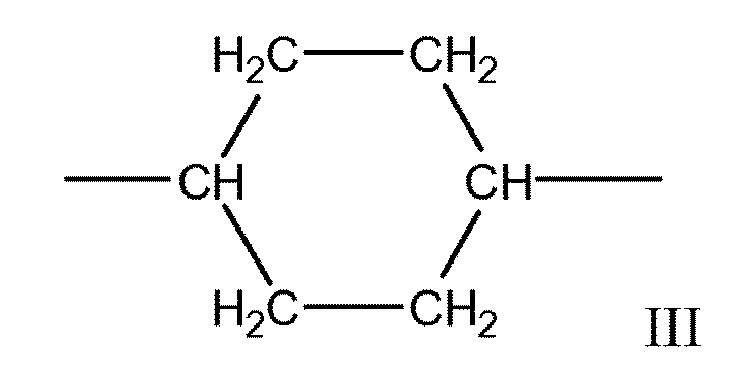
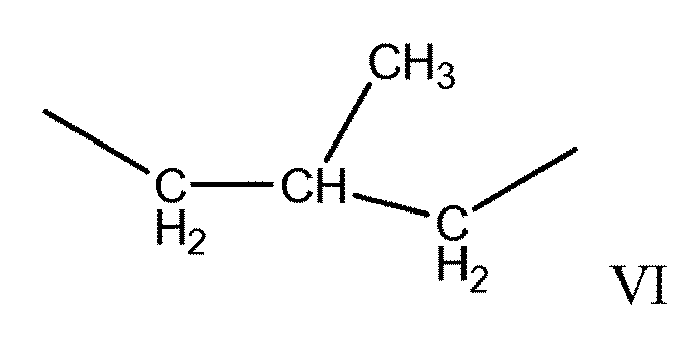
- Zusammensetzung gemäß einem der Ansprüche 1 bis 5, wobei R3 aus den folgenden Resten ausgewählt ist:(DIESER BEREICH WURDE ABSICHTLICH LEER GELASSEN)




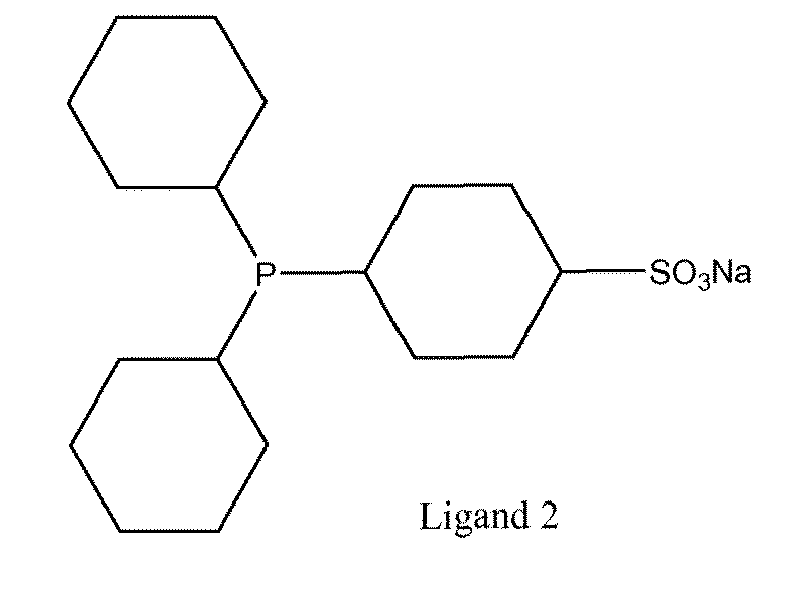
- Eine Zusammensetzung, die eine Klasse von sulfonierten Triorganophosphinverbindungen beinhaltet, dargestellt durch die folgenden Formeln:





- Ein neuartiger Komplexkatalysator oder eine neuartige Komplexkatalysatorvorläuferzusammensetzung, beinhaltend ein Übergangsmetall der Gruppen 8, 9 oder 10, das an mindestens einen Liganden, dargestellt durch die Zusammensetzung gemäß einem der Ansprüche 1 bis 7, gebunden ist, wobei das Übergangsmetall optional ferner an Kohlenmonoxid, Wasserstoff oder sowohl Kohlenmonoxid als auch Wasserstoff gebunden ist.
- Komplexkatalysator gemäß Anspruch 8, wobei das Übergangsmetall aus Ruthenium, Rhodium, Cobalt und Iridium ausgewählt ist.
- Eine neuartige Komplexkatalysatorlösung oder eine neuartige Komplexkatalysatorvorläuferlösung, beinhaltend ein Lösemittel, einen Komplexkatalysator oder eine Komplexkatalysatorvorläuferzusammensetzung, beinhaltend ein Übergangsmetall der Gruppen 8, 9 oder 10, das an mindestens einen Liganden gebunden ist, wobei die Lösung optional ferner freien Ligand beinhaltet; wobei die gebundenen und freien Liganden durch die Zusammensetzung gemäß einem der Ansprüche 1 bis 7 dargestellt sind; und wobei optional das Übergangsmetall der Gruppen 8, 9 oder 10 ferner an Kohlenmonoxid, Wasserstoff oder sowohl Kohlenmonoxid als auch Wasserstoff gebunden sein kann.
- Ein Hydroformylierungsverfahren, beinhaltend das In-Kontakt-Bringen einer oder mehrerer olefinisch ungesättigter Verbindungen mit Kohlenmonoxid und Wasserstoff in Gegenwart eines Übergangsmetall-Ligand-Komplexkatalysators, und optional von freiem Ligand, wobei der Ligand durch die Zusammensetzung gemäß einem der Ansprüche 1 bis 7 dargestellt ist, wobei das In-Kontakt-Bringen unter Verfahrensbedingungen ausgeführt wird, die ausreichen, um ein oder mehrere entsprechende Aldehydprodukte herzustellen.
- Verfahren gemäß Anspruch 11, wobei das Olefin aus olefinisch ungesättigten aliphatischen Kohlenwasserstoffen mit von 10 bis 50 Kohlenstoffatomen ausgewählt ist.
- Verfahren gemäß Anspruch 11 oder 12, wobei das Olefin aus der Gruppe ausgewählt ist, die aus alpha-Olefinen, internen Olefinen, Alkylalkenoaten, Alkenylalkanoaten, Alkenylalkylethern, Alkenolen, olefinisch ungesättigten Fettsäuren und olefinisch ungesättigten Fettsäureestern besteht.
- Verfahren gemäß einem der Ansprüche 11 bis 13, wobei das Übergangsmetall der Gruppen 8, 9 oder 10 in einer Konzentration von mehr als 0 Teilen pro Million (ppm) und weniger als 1000 ppm nach Gewicht, berechnet als freies Metall, vorhanden ist.
- Verfahren gemäß einem der Ansprüche 11 bis 14, wobei die Temperatur mehr als 30 °C und weniger als 150 °C beträgt.
Applications Claiming Priority (2)
| Application Number | Priority Date | Filing Date | Title |
|---|---|---|---|
| US2107008P | 2008-01-15 | 2008-01-15 | |
| PCT/US2009/030560 WO2009091671A1 (en) | 2008-01-15 | 2009-01-09 | Sulfonated organophosphine compounds and use thereof in hydroformylation processes |
Publications (2)
| Publication Number | Publication Date |
|---|---|
| EP2231682A1 EP2231682A1 (de) | 2010-09-29 |
| EP2231682B1 true EP2231682B1 (de) | 2016-01-06 |
Family
ID=40524946
Family Applications (1)
| Application Number | Title | Priority Date | Filing Date |
|---|---|---|---|
| EP09701652.1A Active EP2231682B1 (de) | 2008-01-15 | 2009-01-09 | Sulfonierte organophosphin-verbindungen und ihre verwendung in hydroformylierungsverfahren |
Country Status (5)
| Country | Link |
|---|---|
| US (1) | US8394978B2 (de) |
| EP (1) | EP2231682B1 (de) |
| AR (1) | AR070172A1 (de) |
| BR (1) | BRPI0905699A2 (de) |
| WO (1) | WO2009091671A1 (de) |
Families Citing this family (4)
| Publication number | Priority date | Publication date | Assignee | Title |
|---|---|---|---|---|
| CN102627667B (zh) * | 2012-03-20 | 2015-07-22 | 河南省科学院化学研究所有限公司 | 一种生产三环己基膦的方法 |
| CN104558029B (zh) * | 2014-12-19 | 2016-07-06 | 河南省科学院化学研究所有限公司 | 一种合成双(二环己基膦)烷烃的方法 |
| EP3281973A1 (de) * | 2016-08-11 | 2018-02-14 | Borealis AG | Polypropylenzusammensetzung mit flammhemmender wirkung |
| CN113289695B (zh) * | 2021-06-21 | 2022-07-12 | 万华化学集团股份有限公司 | 一种氢甲酰化催化剂的回收方法 |
Family Cites Families (33)
| Publication number | Priority date | Publication date | Assignee | Title |
|---|---|---|---|---|
| US2900393A (en) * | 1956-12-11 | 1959-08-18 | Rohm & Haas | Preparation of 3-methyl 1,3-propane sultone |
| US3527809A (en) * | 1967-08-03 | 1970-09-08 | Union Carbide Corp | Hydroformylation process |
| US4148830A (en) * | 1975-03-07 | 1979-04-10 | Union Carbide Corporation | Hydroformylation of olefins |
| US4247486A (en) * | 1977-03-11 | 1981-01-27 | Union Carbide Corporation | Cyclic hydroformylation process |
| US4283304A (en) * | 1979-05-21 | 1981-08-11 | Union Carbide Corporation | Process for removing triorganophosphine from a liquid composition |
| DE3235030A1 (de) * | 1982-09-22 | 1984-03-22 | Ruhrchemie Ag, 4200 Oberhausen | Verfahren zur herstellung von sulfonierten arylphosphinen |
| US4625068A (en) * | 1985-03-20 | 1986-11-25 | Exxon Chemical Patents Inc. | Rhodium catalyzed hydroformylation of internal olefins |
| US4642388A (en) * | 1985-08-30 | 1987-02-10 | Exxon Chemical Patents Inc. | Rhodium catalyzed hydroformylation of alpha-substituted alpha-olefins |
| US4689437A (en) * | 1986-07-21 | 1987-08-25 | Union Carbide Corporation | Oligomerization to alpha-olefins |
| US4822915A (en) * | 1986-07-21 | 1989-04-18 | Union Carbide Corporation | Phosphine and sulfonate bearing ligands |
| US4716138A (en) * | 1986-07-21 | 1987-12-29 | Union Carbide Corporation | Oligomerization to alpha-olefins |
| US4731486A (en) * | 1986-11-18 | 1988-03-15 | Union Carbide Corporation | Hydroformylation using low volatile phosphine ligands |
| KR950000633B1 (ko) | 1988-07-14 | 1995-01-26 | 유니온 카바이드 케미칼즈 앤드 플라스틱스 캄파니 인코포레이티드 | 알콜 및 알데하이드의 제조방법 |
| US5180854A (en) * | 1988-07-14 | 1993-01-19 | Union Carbide Chemicals & Plastics Technology Corporation | Process for catalyst aldehyde product separation |
| US5300617A (en) * | 1993-01-21 | 1994-04-05 | Exxon Chemical Patents Inc. | Potassium para-diphenyl phosphino benzene sulfonate ligand |
| TW248563B (de) * | 1993-06-29 | 1995-06-01 | Hoechst Ag | |
| DE4325816A1 (de) * | 1993-07-31 | 1995-02-02 | Hoechst Ag | Sekundäre und tertiäre Phosphane und Verfahren zu ihrer Herstellung |
| DE4427836A1 (de) * | 1994-08-05 | 1996-02-08 | Hoechst Ag | Verbindungen aus der Reihe der Phosphane, Verfahren zu ihrer Herstellung sowie ihre Verwendung |
| US5756855A (en) * | 1994-08-19 | 1998-05-26 | Union Carbide Chemicals & Plastics Technology Corporation | Stabilization of phosphite ligands in hydroformylation process |
| DE4435189A1 (de) * | 1994-09-30 | 1996-04-04 | Hoechst Ag | Neue sulfonierte Phosphine, Verfahren zu ihrer Herstellung und ihre Verwendung als Bestandteil von Katalysatorsystemen |
| DE69607937T2 (de) * | 1995-09-26 | 2001-01-18 | Kuraray Co., Ltd | Hydroformylierungsverfahren |
| US5760286A (en) * | 1997-04-02 | 1998-06-02 | Uop Llc | Preparation of tertiary phosphine sulfonic acids |
| DE19740672A1 (de) * | 1997-09-16 | 1999-03-18 | Hoechst Ag | Verfahren zur Herstellung von Aldehyden durch Hydroformylierung |
| DE19756945C2 (de) * | 1997-12-22 | 2000-08-03 | Celanese Chem Europe Gmbh | Nichtwäßrige ionogene Ligandflüssigkeiten, Verfahren zu ihrer Herstellung und ihre Verwendung als Katalysatorbestandteil |
| US5952530A (en) * | 1998-02-02 | 1999-09-14 | Union Carbide Chemicals & Plastics Technology Corporation | Separation processes |
| US5932772A (en) * | 1998-02-02 | 1999-08-03 | Union Carbide Chemicals & Plastics Technology Corporation | Separation processes |
| FR2787786B1 (fr) * | 1998-12-23 | 2001-02-02 | Rhone Poulenc Fibres | Procede de preparation de composes organophosphores sulfones hydrosolubles et la realisation de reactions organiques avec catalyse biphasique |
| DE19918284C1 (de) * | 1999-04-22 | 2000-12-14 | Celanese Chem Europe Gmbh | Verfahren zur Herstellung von sulfonierten Arylphosphinen |
| CA2424225C (en) | 2003-03-31 | 2008-08-05 | Cytec Canada Inc. | Tertiary phosphines and their methods of preparation |
| WO2004096744A2 (en) | 2003-04-25 | 2004-11-11 | Dow Global Technolgies Inc. | Aldehyde and alcohol compositions derived from seed oils |
| AR058048A1 (es) | 2005-09-15 | 2008-01-23 | Dow Global Technologies Inc | Procedimiento para la monosulfonacion de fosfinas aromaticas y producto zwitterionico derivado del mismo |
| US7663002B2 (en) * | 2006-05-15 | 2010-02-16 | Dow Global Technologies, Inc. | Hydroformylation process and product separation with improved recovery of rhodium |
| EP1894938A1 (de) * | 2006-08-31 | 2008-03-05 | Evonik Degussa GmbH | Neue cyclopentadienyl-, indenyl- und fluorenyl-substituierte Phosphanverbindungen und ihre Verwenduing in katalytischen Reaktionen |
-
2009
- 2009-01-09 EP EP09701652.1A patent/EP2231682B1/de active Active
- 2009-01-09 US US12/812,985 patent/US8394978B2/en active Active
- 2009-01-09 BR BRPI0905699-8A patent/BRPI0905699A2/pt not_active Application Discontinuation
- 2009-01-09 WO PCT/US2009/030560 patent/WO2009091671A1/en not_active Ceased
- 2009-01-14 AR ARP090100115A patent/AR070172A1/es not_active Application Discontinuation
Also Published As
| Publication number | Publication date |
|---|---|
| US8394978B2 (en) | 2013-03-12 |
| WO2009091671A1 (en) | 2009-07-23 |
| BRPI0905699A2 (pt) | 2015-07-14 |
| EP2231682A1 (de) | 2010-09-29 |
| US20110054205A1 (en) | 2011-03-03 |
| AR070172A1 (es) | 2010-03-17 |
Similar Documents
| Publication | Publication Date | Title |
|---|---|---|
| KR930001327B1 (ko) | 비스-포스파이트 화합물 | |
| EP1960409B1 (de) | Tetraphosphorliganden für katalytische hydroformylierung und entsprechende reaktionen | |
| EP1485392B1 (de) | Bisphosphit-ligande für carbonylierungsverfahren | |
| US6018081A (en) | Process to prepare a terminal aldehyde | |
| CN104837853A (zh) | 双亚磷酸酯混合物及其作为催化剂混合物在加氢甲酰化中的用途 | |
| KR20020080416A (ko) | 디아릴-아넬레이트화된 비시클로[2.2.n] 원료 물질에기초한 인, 비소 및 안티몬 화합물 및 그를 포함하는 촉매 | |
| US8394978B2 (en) | Sulfonated organophosphine compounds and use thereof in hydroformylation processes | |
| EP2231683B1 (de) | Sulfonierte organophosphin-verbindungen und ihre verwendung in hydroformylierungsverfahren | |
| EP1312598A1 (de) | Verfahren zur Herstellung von Aldehyden | |
| EP0793636A1 (de) | Verfahren zur herstellung eines aldehyds | |
| US8466306B2 (en) | Sulfonated organophosphine compounds and use in hydroformylation processes | |
| KR101075727B1 (ko) | 3차 포스핀과 그 제조 방법 | |
| Errington et al. | Transition metal–carbon bonds. Part 54. Complexes of palladium, platinum, rhodium, and iridium with Bu t 2 PCH 2 CHMe (CH 2) 3 PBu t 2. Crystal structures of [PdCl (Bu t 2 PCH 2 CHMeCHCH 2 CH 2 PBu t 2)] and [IrH (Cl)(Bu t 2 PCH 2 CHMeCHCH 2 CH 2 PBu t 2)] | |
| Yiğit et al. | In situ generated rhodium‐based catalyst for addition of phenylboronic acid to aldehydes | |
| Odinets et al. | Novel α-fluorinated cyclic phosphite and phosphinite ligands and their Rh-complexes as suitable catalysts in hydroformylation | |
| KR20210115271A (ko) | 하이드로포밀화 반응용 헤테로 리간드 배위결합 촉매 조성물 및 이의 용도 | |
| Liu et al. | Highly Regioselective and Active Rh–2, 2′-Bis (dipyrrolylphosphinooxy)-1, 1′-(±)-binaphthyl Catalyst for Hydroformylation of 2-Octene | |
| KR100870360B1 (ko) | 다자리 포스핀 화합물의 제조 방법 | |
| KR930001342B1 (ko) | 카보닐화 방법 | |
| JP3928315B2 (ja) | アルデヒドの製造方法 | |
| Bronger | Selective Hydroformylation of Internal Alkenes to Linear Aldehydes: Novel Phosphacyclic Diphosphines and Their Applications | |
| US20160318959A1 (en) | Novel monophosphite compounds having a methyl group |
Legal Events
| Date | Code | Title | Description |
|---|---|---|---|
| PUAI | Public reference made under article 153(3) epc to a published international application that has entered the european phase |
Free format text: ORIGINAL CODE: 0009012 |
|
| 17P | Request for examination filed |
Effective date: 20100816 |
|
| AK | Designated contracting states |
Kind code of ref document: A1 Designated state(s): AT BE BG CH CY CZ DE DK EE ES FI FR GB GR HR HU IE IS IT LI LT LU LV MC MK MT NL NO PL PT RO SE SI SK TR |
|
| AX | Request for extension of the european patent |
Extension state: AL BA RS |
|
| DAX | Request for extension of the european patent (deleted) | ||
| RAP1 | Party data changed (applicant data changed or rights of an application transferred) |
Owner name: DOW GLOBAL TECHNOLOGIES LLC |
|
| 17Q | First examination report despatched |
Effective date: 20120413 |
|
| GRAP | Despatch of communication of intention to grant a patent |
Free format text: ORIGINAL CODE: EPIDOSNIGR1 |
|
| INTG | Intention to grant announced |
Effective date: 20150708 |
|
| RIN1 | Information on inventor provided before grant (corrected) |
Inventor name: ABATJOGLOU, ANTHONY, G. Inventor name: TULCHINSKY, MICHAEL, L. |
|
| GRAS | Grant fee paid |
Free format text: ORIGINAL CODE: EPIDOSNIGR3 |
|
| GRAA | (expected) grant |
Free format text: ORIGINAL CODE: 0009210 |
|
| AK | Designated contracting states |
Kind code of ref document: B1 Designated state(s): AT BE BG CH CY CZ DE DK EE ES FI FR GB GR HR HU IE IS IT LI LT LU LV MC MK MT NL NO PL PT RO SE SI SK TR |
|
| REG | Reference to a national code |
Ref country code: GB Ref legal event code: FG4D |
|
| REG | Reference to a national code |
Ref country code: CH Ref legal event code: EP |
|
| REG | Reference to a national code |
Ref country code: FR Ref legal event code: PLFP Year of fee payment: 8 |
|
| REG | Reference to a national code |
Ref country code: IE Ref legal event code: FG4D |
|
| REG | Reference to a national code |
Ref country code: AT Ref legal event code: REF Ref document number: 768782 Country of ref document: AT Kind code of ref document: T Effective date: 20160215 |
|
| REG | Reference to a national code |
Ref country code: DE Ref legal event code: R096 Ref document number: 602009035543 Country of ref document: DE |
|
| REG | Reference to a national code |
Ref country code: NL Ref legal event code: FP |
|
| REG | Reference to a national code |
Ref country code: LT Ref legal event code: MG4D |
|
| REG | Reference to a national code |
Ref country code: AT Ref legal event code: MK05 Ref document number: 768782 Country of ref document: AT Kind code of ref document: T Effective date: 20160106 |
|
| PG25 | Lapsed in a contracting state [announced via postgrant information from national office to epo] |
Ref country code: BE Free format text: LAPSE BECAUSE OF NON-PAYMENT OF DUE FEES Effective date: 20160131 |
|
| PG25 | Lapsed in a contracting state [announced via postgrant information from national office to epo] |
Ref country code: FI Free format text: LAPSE BECAUSE OF FAILURE TO SUBMIT A TRANSLATION OF THE DESCRIPTION OR TO PAY THE FEE WITHIN THE PRESCRIBED TIME-LIMIT Effective date: 20160106 Ref country code: GR Free format text: LAPSE BECAUSE OF FAILURE TO SUBMIT A TRANSLATION OF THE DESCRIPTION OR TO PAY THE FEE WITHIN THE PRESCRIBED TIME-LIMIT Effective date: 20160407 Ref country code: IT Free format text: LAPSE BECAUSE OF FAILURE TO SUBMIT A TRANSLATION OF THE DESCRIPTION OR TO PAY THE FEE WITHIN THE PRESCRIBED TIME-LIMIT Effective date: 20160106 Ref country code: ES Free format text: LAPSE BECAUSE OF FAILURE TO SUBMIT A TRANSLATION OF THE DESCRIPTION OR TO PAY THE FEE WITHIN THE PRESCRIBED TIME-LIMIT Effective date: 20160106 Ref country code: NO Free format text: LAPSE BECAUSE OF FAILURE TO SUBMIT A TRANSLATION OF THE DESCRIPTION OR TO PAY THE FEE WITHIN THE PRESCRIBED TIME-LIMIT Effective date: 20160406 Ref country code: HR Free format text: LAPSE BECAUSE OF FAILURE TO SUBMIT A TRANSLATION OF THE DESCRIPTION OR TO PAY THE FEE WITHIN THE PRESCRIBED TIME-LIMIT Effective date: 20160106 |
|
| PG25 | Lapsed in a contracting state [announced via postgrant information from national office to epo] |
Ref country code: IS Free format text: LAPSE BECAUSE OF FAILURE TO SUBMIT A TRANSLATION OF THE DESCRIPTION OR TO PAY THE FEE WITHIN THE PRESCRIBED TIME-LIMIT Effective date: 20160506 Ref country code: PT Free format text: LAPSE BECAUSE OF FAILURE TO SUBMIT A TRANSLATION OF THE DESCRIPTION OR TO PAY THE FEE WITHIN THE PRESCRIBED TIME-LIMIT Effective date: 20160506 Ref country code: LV Free format text: LAPSE BECAUSE OF FAILURE TO SUBMIT A TRANSLATION OF THE DESCRIPTION OR TO PAY THE FEE WITHIN THE PRESCRIBED TIME-LIMIT Effective date: 20160106 Ref country code: LT Free format text: LAPSE BECAUSE OF FAILURE TO SUBMIT A TRANSLATION OF THE DESCRIPTION OR TO PAY THE FEE WITHIN THE PRESCRIBED TIME-LIMIT Effective date: 20160106 Ref country code: SE Free format text: LAPSE BECAUSE OF FAILURE TO SUBMIT A TRANSLATION OF THE DESCRIPTION OR TO PAY THE FEE WITHIN THE PRESCRIBED TIME-LIMIT Effective date: 20160106 Ref country code: AT Free format text: LAPSE BECAUSE OF FAILURE TO SUBMIT A TRANSLATION OF THE DESCRIPTION OR TO PAY THE FEE WITHIN THE PRESCRIBED TIME-LIMIT Effective date: 20160106 Ref country code: PL Free format text: LAPSE BECAUSE OF FAILURE TO SUBMIT A TRANSLATION OF THE DESCRIPTION OR TO PAY THE FEE WITHIN THE PRESCRIBED TIME-LIMIT Effective date: 20160106 |
|
| REG | Reference to a national code |
Ref country code: CH Ref legal event code: PL |
|
| REG | Reference to a national code |
Ref country code: DE Ref legal event code: R097 Ref document number: 602009035543 Country of ref document: DE |
|
| PG25 | Lapsed in a contracting state [announced via postgrant information from national office to epo] |
Ref country code: LI Free format text: LAPSE BECAUSE OF NON-PAYMENT OF DUE FEES Effective date: 20160131 Ref country code: EE Free format text: LAPSE BECAUSE OF FAILURE TO SUBMIT A TRANSLATION OF THE DESCRIPTION OR TO PAY THE FEE WITHIN THE PRESCRIBED TIME-LIMIT Effective date: 20160106 Ref country code: DK Free format text: LAPSE BECAUSE OF FAILURE TO SUBMIT A TRANSLATION OF THE DESCRIPTION OR TO PAY THE FEE WITHIN THE PRESCRIBED TIME-LIMIT Effective date: 20160106 Ref country code: CH Free format text: LAPSE BECAUSE OF NON-PAYMENT OF DUE FEES Effective date: 20160131 Ref country code: MC Free format text: LAPSE BECAUSE OF FAILURE TO SUBMIT A TRANSLATION OF THE DESCRIPTION OR TO PAY THE FEE WITHIN THE PRESCRIBED TIME-LIMIT Effective date: 20160106 |
|
| REG | Reference to a national code |
Ref country code: IE Ref legal event code: MM4A |
|
| PLBE | No opposition filed within time limit |
Free format text: ORIGINAL CODE: 0009261 |
|
| STAA | Information on the status of an ep patent application or granted ep patent |
Free format text: STATUS: NO OPPOSITION FILED WITHIN TIME LIMIT |
|
| PG25 | Lapsed in a contracting state [announced via postgrant information from national office to epo] |
Ref country code: CZ Free format text: LAPSE BECAUSE OF FAILURE TO SUBMIT A TRANSLATION OF THE DESCRIPTION OR TO PAY THE FEE WITHIN THE PRESCRIBED TIME-LIMIT Effective date: 20160106 Ref country code: SK Free format text: LAPSE BECAUSE OF FAILURE TO SUBMIT A TRANSLATION OF THE DESCRIPTION OR TO PAY THE FEE WITHIN THE PRESCRIBED TIME-LIMIT Effective date: 20160106 Ref country code: RO Free format text: LAPSE BECAUSE OF FAILURE TO SUBMIT A TRANSLATION OF THE DESCRIPTION OR TO PAY THE FEE WITHIN THE PRESCRIBED TIME-LIMIT Effective date: 20160106 |
|
| 26N | No opposition filed |
Effective date: 20161007 |
|
| REG | Reference to a national code |
Ref country code: FR Ref legal event code: PLFP Year of fee payment: 9 |
|
| GBPC | Gb: european patent ceased through non-payment of renewal fee |
Effective date: 20160406 |
|
| PG25 | Lapsed in a contracting state [announced via postgrant information from national office to epo] |
Ref country code: BE Free format text: LAPSE BECAUSE OF FAILURE TO SUBMIT A TRANSLATION OF THE DESCRIPTION OR TO PAY THE FEE WITHIN THE PRESCRIBED TIME-LIMIT Effective date: 20160106 |
|
| PG25 | Lapsed in a contracting state [announced via postgrant information from national office to epo] |
Ref country code: IE Free format text: LAPSE BECAUSE OF NON-PAYMENT OF DUE FEES Effective date: 20160109 Ref country code: GB Free format text: LAPSE BECAUSE OF NON-PAYMENT OF DUE FEES Effective date: 20160406 |
|
| PG25 | Lapsed in a contracting state [announced via postgrant information from national office to epo] |
Ref country code: BG Free format text: LAPSE BECAUSE OF FAILURE TO SUBMIT A TRANSLATION OF THE DESCRIPTION OR TO PAY THE FEE WITHIN THE PRESCRIBED TIME-LIMIT Effective date: 20160406 Ref country code: SI Free format text: LAPSE BECAUSE OF FAILURE TO SUBMIT A TRANSLATION OF THE DESCRIPTION OR TO PAY THE FEE WITHIN THE PRESCRIBED TIME-LIMIT Effective date: 20160106 |
|
| PG25 | Lapsed in a contracting state [announced via postgrant information from national office to epo] |
Ref country code: MT Free format text: LAPSE BECAUSE OF FAILURE TO SUBMIT A TRANSLATION OF THE DESCRIPTION OR TO PAY THE FEE WITHIN THE PRESCRIBED TIME-LIMIT Effective date: 20160106 |
|
| REG | Reference to a national code |
Ref country code: FR Ref legal event code: PLFP Year of fee payment: 10 |
|
| PG25 | Lapsed in a contracting state [announced via postgrant information from national office to epo] |
Ref country code: CY Free format text: LAPSE BECAUSE OF FAILURE TO SUBMIT A TRANSLATION OF THE DESCRIPTION OR TO PAY THE FEE WITHIN THE PRESCRIBED TIME-LIMIT Effective date: 20160106 Ref country code: HU Free format text: LAPSE BECAUSE OF FAILURE TO SUBMIT A TRANSLATION OF THE DESCRIPTION OR TO PAY THE FEE WITHIN THE PRESCRIBED TIME-LIMIT; INVALID AB INITIO Effective date: 20090109 |
|
| PG25 | Lapsed in a contracting state [announced via postgrant information from national office to epo] |
Ref country code: MK Free format text: LAPSE BECAUSE OF FAILURE TO SUBMIT A TRANSLATION OF THE DESCRIPTION OR TO PAY THE FEE WITHIN THE PRESCRIBED TIME-LIMIT Effective date: 20160106 Ref country code: MT Free format text: LAPSE BECAUSE OF FAILURE TO SUBMIT A TRANSLATION OF THE DESCRIPTION OR TO PAY THE FEE WITHIN THE PRESCRIBED TIME-LIMIT Effective date: 20160131 Ref country code: TR Free format text: LAPSE BECAUSE OF FAILURE TO SUBMIT A TRANSLATION OF THE DESCRIPTION OR TO PAY THE FEE WITHIN THE PRESCRIBED TIME-LIMIT Effective date: 20160106 Ref country code: LU Free format text: LAPSE BECAUSE OF NON-PAYMENT OF DUE FEES Effective date: 20160109 |
|
| PGFP | Annual fee paid to national office [announced via postgrant information from national office to epo] |
Ref country code: FR Payment date: 20201210 Year of fee payment: 13 |
|
| PGFP | Annual fee paid to national office [announced via postgrant information from national office to epo] |
Ref country code: NL Payment date: 20210113 Year of fee payment: 13 |
|
| REG | Reference to a national code |
Ref country code: NL Ref legal event code: MM Effective date: 20220201 |
|
| PG25 | Lapsed in a contracting state [announced via postgrant information from national office to epo] |
Ref country code: NL Free format text: LAPSE BECAUSE OF NON-PAYMENT OF DUE FEES Effective date: 20220201 |
|
| PG25 | Lapsed in a contracting state [announced via postgrant information from national office to epo] |
Ref country code: FR Free format text: LAPSE BECAUSE OF NON-PAYMENT OF DUE FEES Effective date: 20220131 |
|
| P01 | Opt-out of the competence of the unified patent court (upc) registered |
Effective date: 20230525 |
|
| PGFP | Annual fee paid to national office [announced via postgrant information from national office to epo] |
Ref country code: DE Payment date: 20251203 Year of fee payment: 18 |