EP2232190B1 - Schutzpanzer - Google Patents
Schutzpanzer Download PDFInfo
- Publication number
- EP2232190B1 EP2232190B1 EP08865141A EP08865141A EP2232190B1 EP 2232190 B1 EP2232190 B1 EP 2232190B1 EP 08865141 A EP08865141 A EP 08865141A EP 08865141 A EP08865141 A EP 08865141A EP 2232190 B1 EP2232190 B1 EP 2232190B1
- Authority
- EP
- European Patent Office
- Prior art keywords
- armor
- ceramic
- major surface
- tile
- depression
- Prior art date
- Legal status (The legal status is an assumption and is not a legal conclusion. Google has not performed a legal analysis and makes no representation as to the accuracy of the status listed.)
- Not-in-force
Links
- 238000000034 method Methods 0.000 claims abstract description 10
- 239000000463 material Substances 0.000 claims description 162
- 239000000919 ceramic Substances 0.000 claims description 97
- 239000002131 composite material Substances 0.000 claims description 40
- 229910010293 ceramic material Inorganic materials 0.000 claims description 26
- 229910052751 metal Inorganic materials 0.000 claims description 11
- 239000002184 metal Substances 0.000 claims description 11
- PNEYBMLMFCGWSK-UHFFFAOYSA-N aluminium oxide Inorganic materials [O-2].[O-2].[O-2].[Al+3].[Al+3] PNEYBMLMFCGWSK-UHFFFAOYSA-N 0.000 claims description 8
- 229920001187 thermosetting polymer Polymers 0.000 claims description 8
- -1 cermets Chemical compound 0.000 claims description 7
- 229910052580 B4C Inorganic materials 0.000 claims description 5
- INAHAJYZKVIDIZ-UHFFFAOYSA-N boron carbide Chemical compound B12B3B4C32B41 INAHAJYZKVIDIZ-UHFFFAOYSA-N 0.000 claims description 5
- 229920000647 polyepoxide Polymers 0.000 claims description 5
- 229920001169 thermoplastic Polymers 0.000 claims description 5
- 239000004416 thermosoftening plastic Substances 0.000 claims description 5
- VYPSYNLAJGMNEJ-UHFFFAOYSA-N Silicium dioxide Chemical compound O=[Si]=O VYPSYNLAJGMNEJ-UHFFFAOYSA-N 0.000 claims description 4
- 239000002241 glass-ceramic Substances 0.000 claims description 4
- 239000004973 liquid crystal related substance Substances 0.000 claims description 4
- 229920000728 polyester Polymers 0.000 claims description 4
- HBMJWWWQQXIZIP-UHFFFAOYSA-N silicon carbide Chemical compound [Si+]#[C-] HBMJWWWQQXIZIP-UHFFFAOYSA-N 0.000 claims description 4
- 229910010271 silicon carbide Inorganic materials 0.000 claims description 4
- QYEXBYZXHDUPRC-UHFFFAOYSA-N B#[Ti]#B Chemical compound B#[Ti]#B QYEXBYZXHDUPRC-UHFFFAOYSA-N 0.000 claims description 3
- 229910052581 Si3N4 Inorganic materials 0.000 claims description 3
- 229910033181 TiB2 Inorganic materials 0.000 claims description 3
- MCMNRKCIXSYSNV-UHFFFAOYSA-N ZrO2 Inorganic materials O=[Zr]=O MCMNRKCIXSYSNV-UHFFFAOYSA-N 0.000 claims description 3
- CSDREXVUYHZDNP-UHFFFAOYSA-N alumanylidynesilicon Chemical compound [Al].[Si] CSDREXVUYHZDNP-UHFFFAOYSA-N 0.000 claims description 3
- PMHQVHHXPFUNSP-UHFFFAOYSA-M copper(1+);methylsulfanylmethane;bromide Chemical compound Br[Cu].CSC PMHQVHHXPFUNSP-UHFFFAOYSA-M 0.000 claims description 3
- RVTZCBVAJQQJTK-UHFFFAOYSA-N oxygen(2-);zirconium(4+) Chemical compound [O-2].[O-2].[Zr+4] RVTZCBVAJQQJTK-UHFFFAOYSA-N 0.000 claims description 3
- HQVNEWCFYHHQES-UHFFFAOYSA-N silicon nitride Chemical compound N12[Si]34N5[Si]62N3[Si]51N64 HQVNEWCFYHHQES-UHFFFAOYSA-N 0.000 claims description 3
- 229910052814 silicon oxide Inorganic materials 0.000 claims description 3
- 230000009466 transformation Effects 0.000 claims description 3
- 239000004696 Poly ether ether ketone Substances 0.000 claims description 2
- 239000002657 fibrous material Substances 0.000 claims description 2
- 229920000515 polycarbonate Polymers 0.000 claims description 2
- 239000004417 polycarbonate Substances 0.000 claims description 2
- 229920002530 polyetherether ketone Polymers 0.000 claims description 2
- 238000012360 testing method Methods 0.000 description 11
- 238000010276 construction Methods 0.000 description 9
- 230000035515 penetration Effects 0.000 description 9
- 239000000835 fiber Substances 0.000 description 8
- 239000004760 aramid Substances 0.000 description 7
- 239000004744 fabric Substances 0.000 description 7
- 239000011152 fibreglass Substances 0.000 description 7
- 229920005989 resin Polymers 0.000 description 7
- 239000011347 resin Substances 0.000 description 7
- 239000004593 Epoxy Substances 0.000 description 6
- 239000010432 diamond Substances 0.000 description 6
- 229910003460 diamond Inorganic materials 0.000 description 6
- 239000004698 Polyethylene Substances 0.000 description 5
- 229920003235 aromatic polyamide Polymers 0.000 description 5
- 229910052574 oxide ceramic Inorganic materials 0.000 description 5
- 239000011224 oxide ceramic Substances 0.000 description 5
- 229920000573 polyethylene Polymers 0.000 description 5
- 239000010935 stainless steel Substances 0.000 description 5
- 229910001220 stainless steel Inorganic materials 0.000 description 5
- 229910000831 Steel Inorganic materials 0.000 description 4
- 239000007769 metal material Substances 0.000 description 4
- 239000000203 mixture Substances 0.000 description 4
- 239000008188 pellet Substances 0.000 description 4
- 229920003023 plastic Polymers 0.000 description 4
- 239000004033 plastic Substances 0.000 description 4
- 239000010959 steel Substances 0.000 description 4
- RTAQQCXQSZGOHL-UHFFFAOYSA-N Titanium Chemical compound [Ti] RTAQQCXQSZGOHL-UHFFFAOYSA-N 0.000 description 3
- 239000000853 adhesive Substances 0.000 description 3
- 230000001070 adhesive effect Effects 0.000 description 3
- WUKWITHWXAAZEY-UHFFFAOYSA-L calcium difluoride Chemical compound [F-].[F-].[Ca+2] WUKWITHWXAAZEY-UHFFFAOYSA-L 0.000 description 3
- 239000003822 epoxy resin Substances 0.000 description 3
- 239000012530 fluid Substances 0.000 description 3
- 238000009472 formulation Methods 0.000 description 3
- 230000001788 irregular Effects 0.000 description 3
- 230000013011 mating Effects 0.000 description 3
- 238000005259 measurement Methods 0.000 description 3
- 238000002844 melting Methods 0.000 description 3
- 230000008018 melting Effects 0.000 description 3
- 150000002739 metals Chemical class 0.000 description 3
- 238000012856 packing Methods 0.000 description 3
- 230000003014 reinforcing effect Effects 0.000 description 3
- 238000007789 sealing Methods 0.000 description 3
- 230000035939 shock Effects 0.000 description 3
- VTYYLEPIZMXCLO-UHFFFAOYSA-L Calcium carbonate Chemical compound [Ca+2].[O-]C([O-])=O VTYYLEPIZMXCLO-UHFFFAOYSA-L 0.000 description 2
- 229920000049 Carbon (fiber) Polymers 0.000 description 2
- 229910052782 aluminium Inorganic materials 0.000 description 2
- XAGFODPZIPBFFR-UHFFFAOYSA-N aluminium Chemical compound [Al] XAGFODPZIPBFFR-UHFFFAOYSA-N 0.000 description 2
- 229910052586 apatite Inorganic materials 0.000 description 2
- 229920006231 aramid fiber Polymers 0.000 description 2
- 239000004917 carbon fiber Substances 0.000 description 2
- 238000006243 chemical reaction Methods 0.000 description 2
- 238000004132 cross linking Methods 0.000 description 2
- 238000000354 decomposition reaction Methods 0.000 description 2
- 238000009826 distribution Methods 0.000 description 2
- 230000000694 effects Effects 0.000 description 2
- 238000002474 experimental method Methods 0.000 description 2
- 239000010436 fluorite Substances 0.000 description 2
- 239000011521 glass Substances 0.000 description 2
- 238000007373 indentation Methods 0.000 description 2
- 229910052500 inorganic mineral Inorganic materials 0.000 description 2
- 239000003562 lightweight material Substances 0.000 description 2
- 239000007788 liquid Substances 0.000 description 2
- 239000011159 matrix material Substances 0.000 description 2
- 239000011707 mineral Substances 0.000 description 2
- 229910052652 orthoclase Inorganic materials 0.000 description 2
- VSIIXMUUUJUKCM-UHFFFAOYSA-D pentacalcium;fluoride;triphosphate Chemical compound [F-].[Ca+2].[Ca+2].[Ca+2].[Ca+2].[Ca+2].[O-]P([O-])([O-])=O.[O-]P([O-])([O-])=O.[O-]P([O-])([O-])=O VSIIXMUUUJUKCM-UHFFFAOYSA-D 0.000 description 2
- 239000004645 polyester resin Substances 0.000 description 2
- 229920001225 polyester resin Polymers 0.000 description 2
- 239000000126 substance Substances 0.000 description 2
- 229920002994 synthetic fiber Polymers 0.000 description 2
- 239000012209 synthetic fiber Substances 0.000 description 2
- 229910052623 talc Inorganic materials 0.000 description 2
- 239000010936 titanium Substances 0.000 description 2
- 229910052719 titanium Inorganic materials 0.000 description 2
- 229920000785 ultra high molecular weight polyethylene Polymers 0.000 description 2
- WKBPZYKAUNRMKP-UHFFFAOYSA-N 1-[2-(2,4-dichlorophenyl)pentyl]1,2,4-triazole Chemical compound C=1C=C(Cl)C=C(Cl)C=1C(CCC)CN1C=NC=N1 WKBPZYKAUNRMKP-UHFFFAOYSA-N 0.000 description 1
- KXGFMDJXCMQABM-UHFFFAOYSA-N 2-methoxy-6-methylphenol Chemical compound [CH]OC1=CC=CC([CH])=C1O KXGFMDJXCMQABM-UHFFFAOYSA-N 0.000 description 1
- 229920000178 Acrylic resin Polymers 0.000 description 1
- 239000004925 Acrylic resin Substances 0.000 description 1
- 229910000838 Al alloy Inorganic materials 0.000 description 1
- 229920001342 Bakelite® Polymers 0.000 description 1
- 229910021532 Calcite Inorganic materials 0.000 description 1
- 229920002430 Fibre-reinforced plastic Polymers 0.000 description 1
- 229920000271 Kevlar® Polymers 0.000 description 1
- 239000004640 Melamine resin Substances 0.000 description 1
- 229920000877 Melamine resin Polymers 0.000 description 1
- 239000004642 Polyimide Substances 0.000 description 1
- 229920005830 Polyurethane Foam Polymers 0.000 description 1
- 238000007550 Rockwell hardness test Methods 0.000 description 1
- 229920010741 Ultra High Molecular Weight Polyethylene (UHMWPE) Polymers 0.000 description 1
- 239000004699 Ultra-high molecular weight polyethylene Substances 0.000 description 1
- 239000011358 absorbing material Substances 0.000 description 1
- 238000004026 adhesive bonding Methods 0.000 description 1
- 239000004637 bakelite Substances 0.000 description 1
- 229910000019 calcium carbonate Inorganic materials 0.000 description 1
- 229910001634 calcium fluoride Inorganic materials 0.000 description 1
- 239000003054 catalyst Substances 0.000 description 1
- 230000000295 complement effect Effects 0.000 description 1
- 238000010205 computational analysis Methods 0.000 description 1
- 239000012141 concentrate Substances 0.000 description 1
- 239000013013 elastic material Substances 0.000 description 1
- 229920001971 elastomer Polymers 0.000 description 1
- 238000005538 encapsulation Methods 0.000 description 1
- 230000032050 esterification Effects 0.000 description 1
- 238000005886 esterification reaction Methods 0.000 description 1
- 239000011554 ferrofluid Substances 0.000 description 1
- 239000011151 fibre-reinforced plastic Substances 0.000 description 1
- 239000003365 glass fiber Substances 0.000 description 1
- 239000010440 gypsum Substances 0.000 description 1
- 229910052602 gypsum Inorganic materials 0.000 description 1
- 238000010438 heat treatment Methods 0.000 description 1
- XLYOFNOQVPJJNP-ZSJDYOACSA-N heavy water Substances [2H]O[2H] XLYOFNOQVPJJNP-ZSJDYOACSA-N 0.000 description 1
- 239000011796 hollow space material Substances 0.000 description 1
- 238000002347 injection Methods 0.000 description 1
- 239000007924 injection Substances 0.000 description 1
- 229910010272 inorganic material Inorganic materials 0.000 description 1
- 239000011147 inorganic material Substances 0.000 description 1
- 229910052909 inorganic silicate Inorganic materials 0.000 description 1
- 229910003480 inorganic solid Inorganic materials 0.000 description 1
- 239000004761 kevlar Substances 0.000 description 1
- 238000003475 lamination Methods 0.000 description 1
- 239000000395 magnesium oxide Substances 0.000 description 1
- CPLXHLVBOLITMK-UHFFFAOYSA-N magnesium oxide Inorganic materials [Mg]=O CPLXHLVBOLITMK-UHFFFAOYSA-N 0.000 description 1
- AXZKOIWUVFPNLO-UHFFFAOYSA-N magnesium;oxygen(2-) Chemical compound [O-2].[Mg+2] AXZKOIWUVFPNLO-UHFFFAOYSA-N 0.000 description 1
- 229910001092 metal group alloy Inorganic materials 0.000 description 1
- 229910052651 microcline Inorganic materials 0.000 description 1
- 239000000615 nonconductor Substances 0.000 description 1
- 239000004745 nonwoven fabric Substances 0.000 description 1
- 150000002894 organic compounds Chemical class 0.000 description 1
- TWNQGVIAIRXVLR-UHFFFAOYSA-N oxo(oxoalumanyloxy)alumane Chemical compound O=[Al]O[Al]=O TWNQGVIAIRXVLR-UHFFFAOYSA-N 0.000 description 1
- 230000000149 penetrating effect Effects 0.000 description 1
- 229920001568 phenolic resin Polymers 0.000 description 1
- 239000011120 plywood Substances 0.000 description 1
- 238000006068 polycondensation reaction Methods 0.000 description 1
- 229920001721 polyimide Polymers 0.000 description 1
- 229920000642 polymer Polymers 0.000 description 1
- 239000002861 polymer material Substances 0.000 description 1
- ODGAOXROABLFNM-UHFFFAOYSA-N polynoxylin Chemical compound O=C.NC(N)=O ODGAOXROABLFNM-UHFFFAOYSA-N 0.000 description 1
- 239000011496 polyurethane foam Substances 0.000 description 1
- 238000012545 processing Methods 0.000 description 1
- 230000001681 protective effect Effects 0.000 description 1
- 238000007712 rapid solidification Methods 0.000 description 1
- 238000004064 recycling Methods 0.000 description 1
- 239000012925 reference material Substances 0.000 description 1
- 239000011819 refractory material Substances 0.000 description 1
- 238000003303 reheating Methods 0.000 description 1
- 239000002990 reinforced plastic Substances 0.000 description 1
- 239000012783 reinforcing fiber Substances 0.000 description 1
- 238000011160 research Methods 0.000 description 1
- 230000000717 retained effect Effects 0.000 description 1
- 239000005060 rubber Substances 0.000 description 1
- 229910052654 sanidine Inorganic materials 0.000 description 1
- 239000007787 solid Substances 0.000 description 1
- 239000011343 solid material Substances 0.000 description 1
- 239000007921 spray Substances 0.000 description 1
- 239000000454 talc Substances 0.000 description 1
- 239000012815 thermoplastic material Substances 0.000 description 1
- 230000008719 thickening Effects 0.000 description 1
- 239000011031 topaz Substances 0.000 description 1
- 229910052853 topaz Inorganic materials 0.000 description 1
- WFKWXMTUELFFGS-UHFFFAOYSA-N tungsten Chemical compound [W] WFKWXMTUELFFGS-UHFFFAOYSA-N 0.000 description 1
- 229910052721 tungsten Inorganic materials 0.000 description 1
- 239000010937 tungsten Substances 0.000 description 1
- 229920006337 unsaturated polyester resin Polymers 0.000 description 1
- 239000004639 urea-formaldehyde foam Substances 0.000 description 1
- 238000009489 vacuum treatment Methods 0.000 description 1
- 239000004636 vulcanized rubber Substances 0.000 description 1
Images


Classifications
-
- F—MECHANICAL ENGINEERING; LIGHTING; HEATING; WEAPONS; BLASTING
- F41—WEAPONS
- F41H—ARMOUR; ARMOURED TURRETS; ARMOURED OR ARMED VEHICLES; MEANS OF ATTACK OR DEFENCE, e.g. CAMOUFLAGE, IN GENERAL
- F41H5/00—Armour; Armour plates
- F41H5/02—Plate construction
- F41H5/04—Plate construction composed of more than one layer
- F41H5/0414—Layered armour containing ceramic material
-
- F—MECHANICAL ENGINEERING; LIGHTING; HEATING; WEAPONS; BLASTING
- F41—WEAPONS
- F41H—ARMOUR; ARMOURED TURRETS; ARMOURED OR ARMED VEHICLES; MEANS OF ATTACK OR DEFENCE, e.g. CAMOUFLAGE, IN GENERAL
- F41H5/00—Armour; Armour plates
- F41H5/02—Plate construction
- F41H5/04—Plate construction composed of more than one layer
- F41H5/0414—Layered armour containing ceramic material
- F41H5/0421—Ceramic layers in combination with metal layers
-
- F—MECHANICAL ENGINEERING; LIGHTING; HEATING; WEAPONS; BLASTING
- F41—WEAPONS
- F41H—ARMOUR; ARMOURED TURRETS; ARMOURED OR ARMED VEHICLES; MEANS OF ATTACK OR DEFENCE, e.g. CAMOUFLAGE, IN GENERAL
- F41H5/00—Armour; Armour plates
- F41H5/02—Plate construction
- F41H5/04—Plate construction composed of more than one layer
- F41H5/0414—Layered armour containing ceramic material
- F41H5/0428—Ceramic layers in combination with additional layers made of fibres, fabrics or plastics
Definitions
- the present invention relates to improved protection armor for providing protection against high impact projectiles, said armor having improved resistance at a reduced overall weight.
- the invention further relates to methods of producing such armor and to objects protected by such armor.
- steel armor is heavier than ceramic armor.
- Steel armor has a number of significant disadvantages. In the case of body or vehicle armor, higher weight reduces mobility. Heavier armor also tends to be bulkier and less flexible, which is a problem in particular with armored vests.
- armor that employs light-weight materials such as fabrics comprised of aramid fibers, ultra-high molecular weight polyethylene fibers, carbon fibers and liquid crystal polyester fibers, as well as high density, light-weight, hard materials, such as titanium, alumina oxide ceramic, boron carbide ceramic, silicon carbide ceramic, glass ceramic and metal-matrix ceramics, and ultra hard metals. To achieve maximum efficiency, these materials are frequently stacked upon one another to progressively destroy the penetrator.
- One of the most successful multi-layer types of materials for use against high-energy impacts, such as those caused by high-velocity rifle bullets employs a strike-face comprising the hardest available material such as light-weight ceramics. The strike-face layer is applied (e.g.
- a stiff energy absorbing material which may be material such as the fabrics mentioned above, or combinations thereof.
- the most commonly employed material is boron carbide ceramic tiles arranged side by side, in a multiple tile configuration with mating edges affixed to an ultra-high molecular weight polyethylene (UHMWPE) laminate.
- UHMWPE ultra-high molecular weight polyethylene
- ceramic armor is generally of two basic geometries: single large monolithic tiles or smaller tiles arranged in a manner that minimizes gaps between the tiles. In all cases, the ceramic is expected to be penetrated, therefore an energy-absorbing component is integrated behind the ceramic to capture and dissipate the remaining energy of the penetrator and any remnants of the penetrator.
- Contained ceramic has significantly increased impact resistance than the same ceramic uncontained. In actual practice and application in the field, containment of ceramics in such a manner is impractical except in the largest vehicles or structures.
- the measure of the impact resistance is usually characterized by the energy required to penetrate or destroy the material being impacted.
- the projectiles typically are lower in hardness than the ceramic element, but with a much higher resistance to brittle fracture.
- 'interface defeat' A DETAILED COMPUTATIONAL ANALYSIS OF INTERFACE DEFEAT, DWELL AND PENETRATION FOR A VARIETY OF CERAMIC TARGETS; T.J.HOLQUIST and G.R.JOHNSON; U.S. ARMY HIGH PERFORMANCE COMPUTING RESEARCH CENTER. Sept. 2002 ).
- Contained ceramic tiles tested in this manner typically exhibit a resistance to penetration approximately 1.3 to 1.8 times that of an uncontained tile ( AMPTIAC QUARTERLY VOL. 8 NUMBER 4 2004 ARMY MATERIALS RESEARCH , http://ammtiac.alionscience.com).
- Ceramic structures in protection armor typically use have parallel flat surfaces. Recently however, ceramic pellets encapsulated in a metallic or plastic matrix material have been used (EP 1 363 101 , US 6,575,075 , US 2006/0243127 , US 2004/0083880 ). These systems typically exhibit increased thickness, weight and processing requirements, compared to conventional parallel-surfaced ceramic armor systems.
- US 5,221,807 discloses protection armor comprising an armor plate for stopping projectiles with an auxiliary plate disposed in front thereof, the auxiliary plate being constituted by a ceramic plate pierced by a large number of blind holes distributed in a regular mesh extending perpendicularly from the impact side towards the rear side.
- the effect of the auxiliary plate is to destabilize and to score the projectiles so as to enhance their tendency to shatter on striking the armor plate.
- the auxiliary plates disclosed in US 5,221,807 are distinguished from armor plates of the present invention in that the multiple depressions of the auxiliary plate are not filled with a second material, and are not sealed by a rigid layer of a third material.
- US 4,665,794 discloses an armor plate comprising multiple depressions, which are filled with a plurality of packing bodies in an irregular or regular fashion.
- the packing bodies are hollow-bodied and consist of a non-metallic material such as glass or ceramic.
- the interspaces between the packing bodies are filled out with plastic material, preferably polyurethane foam.
- the armor plate of US 4,665,794 is distinguished from armor plates of the present invention, in that the plates of US 4,665,794 are metal plates, and no rigid layer of a third material is provided.
- US 6,575,075 discloses a composite armor construction for absorbing and dissipating kinetic energy from high velocity projectiles.
- the construction includes an internal layer of pellets, which are bound and retained by a solidified material.
- the pellets may contain holes which can optionally be filled with a solidified material.
- the present invention is distinguished from the construction of US 6,575,075 in that the ceramic material disclosed therein is in form of pellets, and not in form of a rigid monolithic tile. No rigid layer of a third material, fixedly attached to the ceramic plate is disclosed.
- GB 2147977 discloses a ceramic tile with a filleted area at its edges designed to strengthen the edges of the tile. The resulting depression is optionally filled with a second material, such as epoxy, polyester or acrylic resin. GB 2147977 , however, does not disclose a rigid layer of a third material, sealing the second material between the ceramic tile and the rigid layer.
- WO 99/11997 discloses an armor according to the preamble of claim 1. This document, however, does not disclose the characterizing part of the claim, i.e. it does not disclose at least one depression at a side opposite the strike-face of the armor.
- the present invention relates to armor comprising a ceramic tile, said ceramic tile having a first and a second major surface, said ceramic tile further having at least one depression in said first major surface, said depression being at least partially filled with a second material, said armor further comprising a rigid layer of a third material, said rigid layer being fixedly attached to said first major surface of the ceramic tile and contacting said second material, so as to seal said second material between said ceramic tile and said rigid layer.
- the ceramic tile is arranged in said armor, such that the second major surface is at the strike-face of the armor.
- tiles of the present invention show improved protective properties as compared to conventional ceramic tiles (of the same thickness), and the weight of the armor can be significantly reduced. This is achieved by replacing some of the ceramic material with a second material.
- multiple depressions at least partially filled with a second, preferably light-weight material are provided in the ceramic tile.
- Ceramic material within the present invention, shall be understood to be a non-metallic, inorganic solid having a crystalline or glassy structure.
- Preferred ceramic materials within the context of the invention are alumina oxide, boron carbide, silicon carbide, glass ceramics of all formulations, cermets, titanium diboride, silicon oxide, silicon nitride, magnesium oxide, silicon aluminum oxynitride in both alpha and beta form and mixtures thereof, aluminum nitride, metal matrix-ceramics, transformation toughened zirconium dioxide, any ceramic material containing reinforcing fibers or any other refractory material.
- Other ceramic materials are metallic alloys with a structure at least partially crystalline giving a high hardness with low impact loading.
- Composite material within the context of the present invention is to be understood as being a material in which two or more dissimilar substances, preferably metals, ceramics, glass, and polymers, are combined to produce structural or functional properties not present in any of the individual components.
- a “continuous ceramic material”, according to the invention shall be understood to be a ceramic material which extension in space is uninterrupted by other materials.
- a “depression” within the context of the present invention shall be understood to be a deepening, indentation, cavity, or hollow space in the surface of a solid object.
- a depression, according to the invention can also be an elongated depression, such as a channel.
- the "Mohs scale hardness”, within the context of the present invention, shall be understood to be the scratch resistance of a material, measured through the ability of a harder material to scratch a softer material.
- the Mohs scale created in 1812 by the German mineralogist Friedrich Mohs applies. This scale is based the scale on ten minerals that are all readily available. As the hardest known naturally occurring substance, diamond is at the top of the scale. The hardness of a material is measured against the scale by finding the hardest material that the given material can scratch, and/or the softest material that can scratch the given material. For example, if some material is scratched by apatite but not by fluorite, its hardness on the Mohs scale would fall between 4 and 5.
- Table 1 Mohs scale hardness of materials Mohs Hardness Mineral Absolute Hardness 1 Talc (Mg 3 Si 4 O 10 (OH) 2 ) 1 2 Gypsum (CaSo 4 ⁇ 2H 2 O) 2 3 Calcite (CaCO 3 ) 9 4 Fluorite (CaF 2 ) 21 5 Apatite (Ca 5 (PO 4 ) 3 (OH - , Cl - , F - ) 48 6 Orthoclase Feldspar (KAlSi 3 O 8 ) 72 7 Quartz (SiO 2 ) 100 8 Topaz (Al 2 SiO 4 (OH - , F - ) 2 ) 200 9 Corundum (Al 2 O 3 ) 400 10 Diamond (C) 1500
- a “monolithic” object in the present context, is a single continuous piece of material.
- a monolithic object is of a homogeneous material.
- a "mesh”, within the context of the present invention, is a net, a fabric or a woven material.
- a mesh can be used to provide a thin cover for armor plates on either or both sides of the armor plate.
- a mesh of the present invention is preferably made of stainless steel, aluminum or titanium wire but can also be made from polyethylene fibers, such as fibers sold under the trademark DYNEEMA ® or tough light aramid synthetic fibers, such as fibers sold under the trademark KEVLAR ® or of similar material, to form a multi-layered armored panel.
- a "resin”, within the present context, is a viscous liquid capable of hardening, or the hardened material thereby obtained. Resins may be obtained by esterification or soaping of organic compounds.
- a preferred resin of the present invention is epoxy resin, manufactured through polymerization-polyaddition or polycondensation reactions. Another preferred resin is unsaturated polyester resin.
- the “Rockwell C hardness”, in the context of the present invention, is the indentation hardness of materials through the depth of penetration of an indenter, loaded on a material sample and compared to the penetration in some reference material.
- the Rockwell C hardness is the hardness as defined International Standard ISO 6508-1: "Metallic materials, Rockwell hardness test, Part 1", scale C.
- a "strike-face" of an armor is meant the side of the armor which has been designed to tolerate the expected impact.
- the strike-face will be first struck by the projectile.
- the tile must be arranged within said armor such that said major surface is directed towards the side of the armor from which the impact or threat, i.e. projectiles, are expected.
- Thermosets are polymer materials that cure, through the addition of energy, to a stronger form.
- the energy may be in the form of heat (generally above 200 degrees Celsius), through a chemical reaction (two-part epoxy, for example), or irradiation.
- Thermoset materials are usually liquid or malleable prior to curing, and designed to be molded into their final form, or used as adhesives.
- the curing process transforms the resin into a plastic or rubber by a cross-linking process.
- Energy and/or catalysts are added that cause the molecular chains to react at chemically active sites (unsaturated or epoxy sites, for example), linking into a rigid, 3-D structure.
- the cross-linking process forms a molecule with a larger molecular weight, resulting in a material with a higher melting point.
- the material forms into a solid material.
- Subsequent uncontrolled reheating of the material results in reaching the decomposition temperature before the melting point is obtained.
- a thermoset material cannot be melted and reshaped after it is cured.
- Thermoset materials are generally stronger than thermoplastic materials due to this 3-D network of bonds, and are also better suited to high-temperature applications up to the decomposition temperature of the material. They do not lend themselves to recycling like thermoplastics, which can be melted and re-molded.
- Thermosets are: Vulcanized rubber, Bakelite, a Phenol Formaldehyde Resin (used in electrical insulators and plastic wear), Ureaformaldehyde foam (used in plywood, particleboard and medium-density fibreboard), melamine resin (used on worktop surfaces), polyester resin (used in glass-reinforced plastics/fibreglass (GRP)), epoxy resin (used as an adhesive and in fibre reinforced plastics such as glass reinforced plastic and graphite-reinforced plastic), polyimides used in printed circuit boards and in body parts of modern airplanes
- a "tile” within the context of the present invention is an object made of a single continuous piece of ceramic material, said object having an upper (first) and lower (second) surface which are preferably parallel to one another.
- a tile according to the invention can assume a cuboid form which is significantly (at least 2, 4, 8, 20 times) greater in length and in width compared to its thickness.
- a tile, according to the invention may also be of a rounded or irregular geometry, provided there are substantially parallel upper and lower surfaces that have substantially greater measures in comparison to the thickness.
- a curved tile with essentially parallel surfaces is an example.
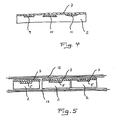
- the present invention relates to an armor 1 comprising a tile 2 of a ceramic material, said tile having a first and a second major surface (3 and 4), said ceramic tile 2 further having at least one depression 5 in said first major surface 3, said depression 5 being at least partially filled with a second material 6, said armor 1 further comprising a rigid layer 7 of a third material, said rigid layer 7 being fixedly attached to said first major surface 3 of said tile 2 and contacting said second material 6, so as to seal said second material 6 between said ceramic material and said rigid layer 7.
- the first and second major surfaces 3 and 4 may be substantially parallel surfaces, and they may be substantially flat (planar) surfaces.
- tile 2 is a monolithic tile.
- the ceramic material may be a continuous ceramic material.
- Tiles of the invention are preferably of a square, round, triangular, or hexagonal shape. Any other geometry with at least two substantially parallel surfaces can also be applied.
- the ceramic tile may have multiple depressions 5 in said first major surface 3.
- a tile may comprise at least two, at least four, at least six, at least eight, or at least sixteen depressions.
- Preferred armors of the invention comprise a tile 2 having a thickness of 4 to 60 mm, preferably 5 to 30 mm, or 6 to 20 mm, or most preferred 7 to 10 mm.
- said second major surface 4 is at the (i.e. arranged in the direction of the) strike-face. Hence, said second major surface 4 is facing towards the side of the expected impact.
- said ceramic material and said second material and said third material are distinct materials.
- the ceramic material has a Mohs scale hardness of larger than 6, or 7 or most preferred larger than 8.
- the ceramic material preferably has a Rockwell C hardness greater than 60.
- said ceramic material has a sound wave propagation velocity of greater than 5000 meters per second.
- Preferred ceramic materials for tiles of the invention are alumina oxide, boron carbide, silicon carbide, glass ceramics, cermets, titanium diboride, silicon oxide, silicon nitride, silicon aluminum oxynitride, aluminum nitride or transformation toughened zirconium dioxide.
- the ceramic material of the tile may contain reinforcing elements, e.g. , tungsten fibers.
- the second material 6 is a non-gaseous material.
- said second material 6 has a specific weight smaller than that of the ceramic material of the tile.
- the second material 6 may be a resin, e.g ., a polyepoxide, polyether-etherketone, polycarbonate, or a liquid crystal polyester.
- the second material 6 is preferably homogeneous.
- the second material 6, however, may also be a composite material. It may, e.g ., contain a metal mesh and a resin. It may contain multiple layers.
- said second material 6 is a material with a Mohs scale hardness analogous to the said first material.
- said at least one depression 5 is completely filled with said second material 6.
- Completely filled in this context, means that the depressions are filled with the second material up to a level which is in the same plane as the respective major surface 3 or 4 of the ceramic tile.
- the second material may also completely fill the said at least one depression and occupy a space above the plane of the major surface 3 or 4 of the ceramic tile.
- said second material is fixedly connected to said ceramic material and to said rigid layer of a third material.
- the second material 6 may also be a non-newtonian fluid, such as a shear thickening fluid, or may be a gel.
- the second material 6 may also be a ferro fluid or a magneto-rheological fluid.
- Several other appropriate materials for filling said depressions are thermoplastic or thermoset plastics, rapid-solidification (RSM) materials, non-newtonian material formulations, inorganic materials in any state, cermets, metals, woven and non-woven materials, multi-layered configurations of any of these materials, or composite formulations of any of these materials.
- the third material of the invention is preferably a homogeneous, rigid material. It may be metal, such as aluminum, titanium, or another light-weight metal.
- the third material may also be any high tensile strength material that when punctured by a projectile does not shatter and allow ejection of either the second or third material from the point of projectile impact - that is a ductile and elastic material such as thermoplastic or thermoset plastic, reinforced or not reinforced.
- the third material of the invention may be a composite material.
- This composite material may be a composite material comprising the second material and additional material.
- the third material comprises the second material and a mesh.
- Such composite materials provide the strength and rigidity required from a covering layer in the context of the present invention. Strength and rigidity of this composite third material is preferably significantly greater than strength and rigidity of the second material.
- the third material can also be a fibrous material or a mesh.
- plugs may be formed directly in the depressions sequentially by an appropriate application technique such as injection or spray.
- a more preferred method is to form both the plugs and the hard third layers into a sheet that conforms to the array of depressions and covers the entire surface of the tile. This sheet would then be affixed to the tile with an appropriate adhesive or in the case of a thermoplastic sheet, heat and vacuum treatment for bonding to the tile.
- the depressions 5 may have a depths of 5-70%, 10-60%, 20-50% of the thickness of the ceramic tile 2.
- the depths shall be understood to be the maximum orthogonal distance of a point on the inner surface of the depression from the plane of the relevant major surface.
- the at least one depression filled with a second material and the rigid layer of a third material may be provided only on said first major surface of the ceramic tile, and not on the second major surface (i.e. the strike-face).
- the invention also relates to an armor 8 in which said at least one depression filled with a second material and said rigid layer 7 of a third material are provided on said first major surface 3 and on said second major surface 4 of ceramic tile 2.
- the depressions are preferably distributed over said first major surface and/or over said second major surface in form of a regular lattice ( i.e. at the points where lines of a regular lattice would intersect).
- the present invention further relates to armor of the above described kind, wherein at least one further depression and a rigid layer of said third material is provided on one or more surfaces other than the first and second major surfaces, wherein said at least one further depression is at least partially filled with said second material.
- armor of the invention may have at least one layer of a flexible material 12, 13 in contact with said upper surface and/or with said lower surface of the armor.
- the armor may comprise at least one layer of a flexible material fixedly attached to said ceramic tile and/or to said rigid layer of a third material.
- the flexible material may comprise at least one of aramid fibers, polyethylene fibers, glass fibers, carbon fibers, liquid crystal polyester fibers, or synthetic fibers.
- the flexible material may also be a metal mesh.
- the flexible material may also be composite layerings of any of the above.
- Figure 6 shows an armor of the invention and a bullet 14 at the side of the expected impact.
- the at least one depression may be of rectangular, quadratic, round, triangular, diamond, or hexagonal shape.
- a depression of the invention may have a flat bottom as shown under reference numeral 9 and 10, or the depression may assume a spherical shape, as shown under reference numeral 11. Frustum shaped depressions, or truncated cones are also envisaged.
- the at least one depression may comprise a protrusion of said ceramic material.
- the at least one depression may be 0.5 to 30 mm, or 1.0 to 20 mm, or 1.0 to 10 mm, or 1.0 to 5 mm deep.
- the least one depression may have a quadratic cross-sectional area with edges of 5 to 500 mm, or 10 to 300 mm, or 20 to 150 mm, or 30 to 75 mm in length.
- the at least one depression may also have an irregular shape with a longest diameter of 5 to 500 mm, 10 to 300 mm, 20 to 150 mm, or 30 to 75 mm in length.
- the longest diameter in this context, is the largest distance between two points on the upper rim of the depression.
- Depressions may have a depth which is significantly smaller than at least its width or length or diameter. Preferably, the depth is 2, or 4, or 8, or 20, or 50 times smaller than any one of width, or length, or diameter of the depression.
- depressions are characterized by an absence of sharp intersections that concentrate stress waves within the ceramic material.
- Preferred depression geometry has a minimum of intersecting internal angles.
- a diamond depression with vertical walls is an example. More preferred depression geometries have angled internal walls.
- a diamond depression with 45 degree inclined walls is an example. Most preferred geometries have curved interior walls.
- a circular depression with sloping interior walls forming a progressively thinner web is an example.
- depression distribution examples include but are not limited to: circular depressions with multiple smaller depressions dispersed around the larger depression; circular depressions offset in rows and columns; circular depressions in rows and columns with triangular or diamond shaped depressions between said rows and columns; non-circular depressions arranged in a complementary fashion optimizing depression area; other depression distributions maximizing depression volume while maintaining desired structural and impact resistance.
- Depressions may be directly opposite one another on parallel surfaces of the material forming a thin section or web between them. Depressions may be offset from one another on the first and second major surfaces of the tile so that the web is formed from more than two depressions on parallel surfaces. Depressions may be longitudinal, forming a channel in one or both parallel surfaces. These channel depressions may be discrete and separate from one another or multiple channels may intersect at any angle forming a larger depression.
- Depressions may incorporate reinforcing structural features such as pillars or ridges or domes. These reinforcing projections may occur in one or more places within a given depression. Although these projections increase the surface area hence weight, they have a significant contribution in retaining the plug since surface area is increased perpendicular to the web.
- the tile may be of rectangular shape and may have a length of 1 to 50 cm and a width of 1 to 50 cm, or a length of 5 to 30 cm and a width of 5 to 30 cm, or a length of 8 to 20 cm and a width of 4 to 15 cm, or a length of 10 to 15 cm and a width of 8 to 12 cm.
- Multiple ceramic tiles may be arranged in a two dimensional array of ceramic tiles.
- the tiles would then be fixedly attached to a supporting layer of composite or metallic material to hold the multiple tiles in close proximity of each other. This ensures that gaps between the individual tiles are minimized.
- Multiple ceramic tiles may also be arranged in a three dimensional array of ceramic tiles. This provides for improved impact resistance of the armor.
- the multiple ceramic tiles can be connected by a composite or metallic supporting structure or completely encapsulated by said composite or metallic material providing necessary rigidity to the tile array.
- the invention further relates to a personal armor, a ship, an aircraft or to a vehicle comprising an armor as described above. Also buildings comprising an armor of the invention are envisaged.
- An armor plate with overall dimensions of 25 cm square was constructed of 97% pure alumina oxide ceramic tiles, 8 mm thick and 50 mm square which were reduced in thickness on both the first and second major surfaces directly opposite each other and the depressions were filled with a high-strength epoxy, which was considered appropriate for the expected threat of the 7.62mm NATO Ball Type MEN projectile (a non-armor-piercing lead bullet).
- the ceramic tiles measured between 3.9-4.5 mm at the thinnest sections at the depressions.
- the tiles were consolidated on a rigid woven stainless steel mesh of 2.3 kg per square meter on the second major surface which rendered the array of tiles stiff and inflexible providing the necessary rigidity for high velocity impacts.
- a rigid third material of woven stainless steel mesh of 1.3 kg per square meter was applied to the first major surface to seal the epoxy material.
- the plate was given a primary composite backing of 6 layers of laminated aramid fabric and a second removable aramid composite of equivalent construction which was removed upon observation of the plates' resistance after the first shot.
- the square meter areal weight of this composite was 6.5 kg which is consistent with state-of-the-art aramid composite backings for ceramic plates of full thickness (8 mm) designed to resist the specific projectile tested.
- a ceramic armor can be constructed of reduced thickness of the ceramic layer with less backing material that reliably defeats the USNIJ Level III threat and provides an improved ability to defeat multiple impacts.
- An armor plate with overall dimensions of 25 cm square was constructed of 97% pure alumina oxide ceramic tiles, 10 mm thick and 50 mm square which were reduced in thickness on the first major surfaces and the depressions were filled with a composite material incorporating multiple layers of metallic mesh, non-woven fabrics, aluminum alloys and consolidated with high-strength epoxy, which was considered appropriate for the expected threat of the 7.62 mm NATO AP (Armor-Piercing) Type P80 projectile.
- the ceramic tiles measured between 6.0 and 6.5 mm at the thinnest sections at the depressions.
- the tiles were consolidated on a third material of a rigid woven stainless steel mesh of 900 grams per square meter and multiple layers of fiberglass fabric on the second major surface which rendered the array of tiles stiff and inflexible providing the necessary rigidity for high velocity impacts. Again, an extreme efficiency in defeating multiple impacts was observed.
- Current specifications such as USNIJ 0101.04 Rev. A require a maximum of 1 shot on a plate of dimensions 254 mm x 305 mm with no penetration.
- the test plate of 250 mm x 250 mm exhibited an ability to reliably defeat eight (8) shots.
- a ceramic armor can be constructed of reduced thickness of the ceramic layer with less backing material that reliably defeats the NATO Armor-Piercing threat and provides a significantly greater ability to defeat multiple impacts.
- This example employs cavities on the non-strike face of 5 cm square tiles where the third material is adhered both to the ceramic sealing the second material within, and to the pressed polyethylene laminate backing material.
- the weight of the ceramic tiles including second material and the layer of 3rd material was 2.8 kg thereby a square meter weight of 44.8 kg per square meter was achieved.
- An armor plate with overall dimensions of 25 cm square was constructed of 97% pure alumina oxide ceramic tiles, 10 mm thick and 50 mm square which were reduced in thickness on the first major surfaces and the depressions were filled with a composite material incorporating composite elements of chopped fiberglass and fiberglass fabrics and consolidated with high-strength epoxy, which was considered appropriate for the expected threat of the 7.62mm NATO AP (Armor-Piercing) Type P80 projectile.
- the ceramic tile measured between 6.0 and 6.5 mm at the thinnest sections at the depressions.
- the tiles were consolidated on a third material of a rigid woven stainless steel mesh of 900 grams per square meter and multiple layers of fiberglass fabric on the second major surface which rendered the array of tiles stiff and inflexible providing the necessary rigidity for high velocity impacts.
- a ceramic armor can be constructed of reduced thickness of the ceramic layer with less backing material that reliably defeats the NATO Armor-Piercing threat and provides a significantly greater ability to defeat multiple impacts.
- the example employs cavities on the non-strike face of 5 cm square tiles where the third material is adhered both to the ceramic sealing the second material within, and to the pressed polyethylene laminate backing material.
- the weight of the ceramic tiles including second material and the layer of 3rd material was 2.5 Kilos thereby a square meter weight of 40.0 Kilos per square meter was achieved.
Landscapes
- Engineering & Computer Science (AREA)
- Chemical & Material Sciences (AREA)
- Ceramic Engineering (AREA)
- General Engineering & Computer Science (AREA)
- Aiming, Guidance, Guns With A Light Source, Armor, Camouflage, And Targets (AREA)
- Laminated Bodies (AREA)
Claims (18)
- Panzer (1), umfassend eine Keramikplatte (2), wobei die Keramikplatte eine erste Hauptoberfläche (3) und eine zweite Hauptoberfläche (4) aufweist, wobei die Keramikplatte ferner mindestens eine Vertiefung (5) in der ersten Hauptoberfläche aufweist, wobei die Vertiefung mindestens teilweise mit einem zweiten Material (6) gefüllt ist, wobei der Panzer ferner eine steife Schicht (7) eines dritten Materials umfasst, wobei die steife Schicht an die erste Hauptoberfläche (3) der Keramikplatte fest gebunden ist und mit dem zweiten Material (6) in Kontakt steht, um so das zweite Material zwischen der Keramikplatte (2) und der steifen Schicht (7) abzudichten, dadurch gekennzeichnet, dass die zweite Hauptoberfläche (4) an der Beschussseite des Panzers angeordnet ist.
- Panzer nach Anspruch 1, wobei die Platte eine Vielzahl solcher Vertiefungen in der ersten Hauptoberfläche aufweist.
- Panzer nach einem der vorstehenden Ansprüche, wobei das Keramikmaterial ausgewählt ist aus der Liste, bestehend aus Aluminiumoxid, Borcarbid, Siliziumcarbid, Glaskeramik, Cermets, Titandiborid, Siliziumoxid, Siliziumnitrid, Siliziumaluminiumoxynitrid, Aluminiumnitrid und umwandlungsverstärktem Zirkondioxid.
- Panzer nach einem der vorstehenden Ansprüche, wobei das zweite Material ein spezifisches Gewicht aufweist, das kleiner als das des Keramikmaterials ist.
- Panzer nach einem der vorstehenden Ansprüche, wobei das zweite Material ein Polyepoxid, Polyetheretherketon, ein Polycarbonat, ein Leichtmetall, ein Verbundstoff oder ein Flüssigkristall-Polyester ist.
- Panzer nach einem der vorstehenden Ansprüche, wobei das dritte Material eine Metallfolie, ein Metallblech oder eine thermoplastische Schicht oder eine Duroplast-Kunststoffschicht oder ein Verbundmaterial oder ein Fasermaterial ist.
- Panzer nach einem der vorstehenden Ansprüche, wobei das zweite Material an das Keramikmaterial und an die steife Schicht eines dritten Materials fest gebunden ist.
- Panzer nach einem der vorstehenden Ansprüche, wobei die Vertiefungen eine Tiefe von 5 bis 70 %, 10 bis 60 %, 20 bis 50 % der Dicke der Keramikplatte aufweisen.
- Panzer nach einem der vorstehenden Ansprüche, wobei die mindestens eine Vertiefung und die steife Schicht eines dritten Materials auf der ersten (3) und auf der zweiten Hauptoberfläche (4) der Keramikplatte (2) bereitgestellt sind.
- Panzer nach einem der vorstehenden Ansprüche, wobei mindestens eine weitere Vertiefung und eine steife Schicht des dritten Materials auf einer oder mehreren Oberflächen, die nicht die erste und die zweite Hauptoberfläche sind, bereitgestellt sind, wobei die mindestens eine weitere Vertiefung mindestens teilweise mit dem zweiten Material gefüllt ist.
- Panzer nach einem der vorstehenden Ansprüche, ferner umfassend mindestens eine Schicht eines flexiblen Materials (12, 13), das an die Keramikplatte oder an die steife Schicht eines dritten Materials fest gebunden ist.
- Panzer nach einem der vorstehenden Ansprüche, wobei die mindestens eine Vertiefung eine kugelförmige Vertiefung (11) ist.
- Panzer nach einem der vorstehenden Ansprüche, wobei eine Vielzahl von Keramikplatten in einer zweidimensionalen Anordnung oder in einer dreidimensionalen Anordnung angeordnet ist.
- Gegenstand, umfassend einen Panzer nach einem der Ansprüche 1 bis 13, wobei der Gegenstand ein Fahrzeug, ein Gebäude, ein Schiff oder ein Flugzeug sein kann.
- Verwendung einer Keramikplatte (2) in einem Panzer (1), wobei die Keramikplatte (2) eine erste Hauptoberfläche (3) und eine zweite Hauptoberfläche (4) aufweist, wobei die Keramikplatte ferner mindestens eine Vertiefung (5) in der ersten Hauptoberfläche aufweist, wobei die Vertiefung mindestens teilweise mit einem zweiten Material (6) gefüllt ist, wobei der Panzer ferner eine steife Schicht (7) eines dritten Materials umfasst, wobei die steife Schicht an die erste Hauptoberfläche (3) der Keramikplatte fest gebunden ist und mit dem zweiten Material (6) in Kontakt steht, um so das zweite Material zwischen der Keramikplatte (2) und der steifen Schicht (7) abzudichten, wobei die Platte derart angeordnet ist, dass ihre zweite Hauptoberfläche an der Beschussseite des Panzers (1) angeordnet ist.
- Verwendung nach Anspruch 15, wobei die Platte des Panzers eine Vielzahl von Vertiefungen in der ersten Hauptoberfläche aufweist.
- Verfahren zum Schützen eines Gegenstandes mit einem Panzer (1) nach einem der Ansprüche 1 bis 13, wobei der Panzer derart angeordnet wird, dass die zweite Hauptoberfläche (4) der Platte (2) an der Beschussseite des Panzers angeordnet ist.
- Verfahren nach Anspruch 17, wobei die Platte eine Vielzahl solcher Vertiefungen in der ersten Hauptoberfläche aufweist.
Priority Applications (1)
| Application Number | Priority Date | Filing Date | Title |
|---|---|---|---|
| EP08865141A EP2232190B1 (de) | 2007-12-20 | 2008-12-19 | Schutzpanzer |
Applications Claiming Priority (3)
| Application Number | Priority Date | Filing Date | Title |
|---|---|---|---|
| EP07024859A EP2072943A1 (de) | 2007-12-20 | 2007-12-20 | Schutzpanzer |
| EP08865141A EP2232190B1 (de) | 2007-12-20 | 2008-12-19 | Schutzpanzer |
| PCT/EP2008/010921 WO2009080311A1 (en) | 2007-12-20 | 2008-12-19 | Protection armor |
Publications (2)
| Publication Number | Publication Date |
|---|---|
| EP2232190A1 EP2232190A1 (de) | 2010-09-29 |
| EP2232190B1 true EP2232190B1 (de) | 2012-02-08 |
Family
ID=39509847
Family Applications (2)
| Application Number | Title | Priority Date | Filing Date |
|---|---|---|---|
| EP07024859A Withdrawn EP2072943A1 (de) | 2007-12-20 | 2007-12-20 | Schutzpanzer |
| EP08865141A Not-in-force EP2232190B1 (de) | 2007-12-20 | 2008-12-19 | Schutzpanzer |
Family Applications Before (1)
| Application Number | Title | Priority Date | Filing Date |
|---|---|---|---|
| EP07024859A Withdrawn EP2072943A1 (de) | 2007-12-20 | 2007-12-20 | Schutzpanzer |
Country Status (4)
| Country | Link |
|---|---|
| US (1) | US8646371B2 (de) |
| EP (2) | EP2072943A1 (de) |
| AT (1) | ATE545001T1 (de) |
| WO (1) | WO2009080311A1 (de) |
Cited By (2)
| Publication number | Priority date | Publication date | Assignee | Title |
|---|---|---|---|---|
| US8950140B1 (en) | 2013-08-12 | 2015-02-10 | Dimensional Tile Backer, LLC | Dimensional tile backing |
| CN110066175A (zh) * | 2019-05-13 | 2019-07-30 | 中南大学 | 超轻碳化物陶瓷泡沫的制备方法 |
Families Citing this family (17)
| Publication number | Priority date | Publication date | Assignee | Title |
|---|---|---|---|---|
| US8105510B1 (en) * | 2007-10-05 | 2012-01-31 | The United States Of America As Represented By The Secretary Of The Navy | Method for making ballistic armor using low-density ceramic material |
| US8424442B2 (en) * | 2009-02-12 | 2013-04-23 | Raytheon Company | Tile grid substructure for pultruded ballistic screens |
| US20120024138A1 (en) * | 2010-07-30 | 2012-02-02 | Schott Diamondview Armor Products, Llc | Armor panels having strip-shaped protection elements |
| US11015903B2 (en) * | 2011-06-08 | 2021-05-25 | American Technical Coatings, Inc. | Enhanced ballistic protective system |
| GB2504497B (en) * | 2012-07-27 | 2014-07-30 | Np Aerospace Ltd | Armour |
| US10609843B2 (en) * | 2012-10-04 | 2020-03-31 | Compass Datacenters, Llc | Magnetic blocking tiles for a datacenter facility |
| US9726459B2 (en) * | 2013-02-21 | 2017-08-08 | Rma Armament, Inc. | Multi-layer multi-impact ballistic body armor and method of manufacturing the same |
| US20180010890A1 (en) * | 2013-02-21 | 2018-01-11 | Blake Lockwood Waldrop | Multi-layer multi-impact ballistic body armor and method of manufacturing the same |
| US20140259251A1 (en) * | 2013-03-15 | 2014-09-18 | Moor Innovative Technologies, Llc | Bullet proof vest |
| ITBS20130166A1 (it) * | 2013-11-14 | 2015-05-15 | Petroceramics S P A | Indumento antibalistico |
| WO2015179013A2 (en) * | 2014-03-18 | 2015-11-26 | American Technical Coatings, Inc. | Lightweight enhanced ballistic armor system |
| US10457355B2 (en) | 2016-09-26 | 2019-10-29 | Renoun, Llc | Motile buoyancy device including non-Newtonian material |
| US11162556B2 (en) * | 2016-10-27 | 2021-11-02 | Colorado School Of Mines | Non-uniform truss hybrid material system |
| CN112414219B (zh) * | 2020-09-30 | 2025-01-28 | 北京深海回声科技有限公司 | 一种基于非牛顿流体的防弹片及其制备方法 |
| US20230307314A1 (en) * | 2022-03-24 | 2023-09-28 | Texas Instruments Incorporated | Direct bond copper substrate with metal filled ceramic substrate indentations |
| CN117029579A (zh) * | 2023-07-21 | 2023-11-10 | 中航装甲科技有限公司 | 一种新型防弹装甲及其制备方法 |
| US12320621B1 (en) * | 2023-12-05 | 2025-06-03 | John Guzman | Bulletproof shielding devices and methods |
Family Cites Families (17)
| Publication number | Priority date | Publication date | Assignee | Title |
|---|---|---|---|---|
| US2718829A (en) * | 1952-10-11 | 1955-09-27 | Atlas Mineral Products Company | Protective surface |
| US3592942A (en) * | 1968-05-02 | 1971-07-13 | Norton Co | Composite ceramic armor |
| DE2344222A1 (de) * | 1972-12-06 | 1974-06-12 | Feldmuehle Anlagen Prod | Bekleidungsstueck zum schutz gegen energiereiche projektile |
| FR2405455A1 (fr) * | 1977-10-06 | 1979-05-04 | Wahl Verschleiss Tech | Element en particulier sous forme de plaque, resistant au bombardement |
| US4665794A (en) | 1982-03-12 | 1987-05-19 | Georg Fischer Aktiengesellschaft | Armor and a method of manufacturing it |
| GB2147977B (en) | 1983-10-11 | 1987-04-01 | Rogers Browne & Richards | Ceramic armour |
| US4655794A (en) | 1986-03-20 | 1987-04-07 | Sybron Chemicals Holdings Inc. | Liquid cleaner containing viable microorganisms |
| FR2655413B1 (fr) | 1989-12-06 | 1994-06-03 | Europ Propulsion | Blindage de protection balistique. |
| DE19643745A1 (de) * | 1996-10-23 | 1998-04-30 | Etec Energieoptimierung | Personen- oder Objekt-Schutzeinrichtung |
| WO1999011997A1 (de) * | 1997-09-04 | 1999-03-11 | Akzo Nobel Nv | Verbundsystem für kugel- und splitterschutz |
| IL138897A0 (en) | 2000-10-05 | 2004-08-31 | Cohen Michael | Composite armor panel |
| US7543523B2 (en) * | 2001-10-01 | 2009-06-09 | Lockheed Martin Corporation | Antiballistic armor |
| IL149591A (en) | 2002-05-12 | 2009-09-22 | Moshe Ravid | Ballistic armor |
| US6860186B2 (en) | 2002-09-19 | 2005-03-01 | Michael Cohen | Ceramic bodies and ballistic armor incorporating the same |
| US7383762B2 (en) | 2005-04-03 | 2008-06-10 | Michael Cohen | Ceramic pellets and composite armor panel containing the same |
| US7866248B2 (en) * | 2006-01-23 | 2011-01-11 | Intellectual Property Holdings, Llc | Encapsulated ceramic composite armor |
| US20080236378A1 (en) * | 2007-03-30 | 2008-10-02 | Intellectual Property Holdings, Llc | Affixable armor tiles |
-
2007
- 2007-12-20 EP EP07024859A patent/EP2072943A1/de not_active Withdrawn
-
2008
- 2008-12-19 AT AT08865141T patent/ATE545001T1/de active
- 2008-12-19 WO PCT/EP2008/010921 patent/WO2009080311A1/en not_active Ceased
- 2008-12-19 EP EP08865141A patent/EP2232190B1/de not_active Not-in-force
- 2008-12-19 US US12/808,804 patent/US8646371B2/en not_active Expired - Fee Related
Cited By (3)
| Publication number | Priority date | Publication date | Assignee | Title |
|---|---|---|---|---|
| US8950140B1 (en) | 2013-08-12 | 2015-02-10 | Dimensional Tile Backer, LLC | Dimensional tile backing |
| CN110066175A (zh) * | 2019-05-13 | 2019-07-30 | 中南大学 | 超轻碳化物陶瓷泡沫的制备方法 |
| CN110066175B (zh) * | 2019-05-13 | 2020-10-27 | 中南大学 | 超轻碳化物陶瓷泡沫的制备方法 |
Also Published As
| Publication number | Publication date |
|---|---|
| ATE545001T1 (de) | 2012-02-15 |
| US8646371B2 (en) | 2014-02-11 |
| US20110036234A1 (en) | 2011-02-17 |
| EP2232190A1 (de) | 2010-09-29 |
| WO2009080311A1 (en) | 2009-07-02 |
| EP2072943A1 (de) | 2009-06-24 |
Similar Documents
| Publication | Publication Date | Title |
|---|---|---|
| EP2232190B1 (de) | Schutzpanzer | |
| EP1925903B1 (de) | Panzerung | |
| US7866248B2 (en) | Encapsulated ceramic composite armor | |
| US6826996B2 (en) | Structural composite armor and method of manufacturing it | |
| EP1090264B1 (de) | Flexibles, schlagfestes material | |
| US5435226A (en) | Light armor improvement | |
| US9207048B1 (en) | Multi-ply heterogeneous armor with viscoelastic layers and hemispherical, conical, and angled laminate strikeface projections | |
| AU2012267563B2 (en) | Enhanced ballistic protective system | |
| EP1666829A1 (de) | Panzerplatte für Verwendung als Körperschutz oder Fahrzeugschutz | |
| US20090169855A1 (en) | Armor Panel System | |
| WO2013002865A1 (en) | Multilayer armor | |
| US20120216668A9 (en) | Ballistic lightweight ceramic armor with cross-pellets | |
| CN107000345A (zh) | 用高度性能不匹配界面材料来降低冲击力和损伤的装甲,盾牌和头盔 | |
| MX2014001902A (es) | Arreglo multicapa de balistica. | |
| US20120186434A1 (en) | Ballistic Lightweight ceramic armor with resistant devices based on geometric shapes | |
| JP2005164071A (ja) | 防弾部材 | |
| WO2008097375A2 (en) | Encapsulated ceramic composite armor | |
| CN110375583B (zh) | 一种缓冲式防弹方法、防弹复合板 | |
| US8069770B1 (en) | Modular spaced armor assembly | |
| KR102884674B1 (ko) | 고효율 받침판을 갖는 공간계면파쇄장갑 및 그 제조방법 | |
| KR20130091121A (ko) | 타일형 보호 패널 및 그 제조방법 |
Legal Events
| Date | Code | Title | Description |
|---|---|---|---|
| PUAI | Public reference made under article 153(3) epc to a published international application that has entered the european phase |
Free format text: ORIGINAL CODE: 0009012 |
|
| 17P | Request for examination filed |
Effective date: 20100716 |
|
| AK | Designated contracting states |
Kind code of ref document: A1 Designated state(s): AT BE BG CH CY CZ DE DK EE ES FI FR GB GR HR HU IE IS IT LI LT LU LV MC MT NL NO PL PT RO SE SI SK TR |
|
| AX | Request for extension of the european patent |
Extension state: AL BA MK RS |
|
| DAX | Request for extension of the european patent (deleted) | ||
| GRAP | Despatch of communication of intention to grant a patent |
Free format text: ORIGINAL CODE: EPIDOSNIGR1 |
|
| GRAS | Grant fee paid |
Free format text: ORIGINAL CODE: EPIDOSNIGR3 |
|
| GRAA | (expected) grant |
Free format text: ORIGINAL CODE: 0009210 |
|
| AK | Designated contracting states |
Kind code of ref document: B1 Designated state(s): AT BE BG CH CY CZ DE DK EE ES FI FR GB GR HR HU IE IS IT LI LT LU LV MC MT NL NO PL PT RO SE SI SK TR |
|
| REG | Reference to a national code |
Ref country code: GB Ref legal event code: FG4D |
|
| REG | Reference to a national code |
Ref country code: CH Ref legal event code: EP Ref country code: AT Ref legal event code: REF Ref document number: 545001 Country of ref document: AT Kind code of ref document: T Effective date: 20120215 |
|
| REG | Reference to a national code |
Ref country code: DE Ref legal event code: R096 Ref document number: 602008013374 Country of ref document: DE Effective date: 20120405 |
|
| REG | Reference to a national code |
Ref country code: NL Ref legal event code: T3 |
|
| REG | Reference to a national code |
Ref country code: SE Ref legal event code: TRGR |
|
| LTIE | Lt: invalidation of european patent or patent extension |
Effective date: 20120208 |
|
| PG25 | Lapsed in a contracting state [announced via postgrant information from national office to epo] |
Ref country code: NO Free format text: LAPSE BECAUSE OF FAILURE TO SUBMIT A TRANSLATION OF THE DESCRIPTION OR TO PAY THE FEE WITHIN THE PRESCRIBED TIME-LIMIT Effective date: 20120508 Ref country code: LT Free format text: LAPSE BECAUSE OF FAILURE TO SUBMIT A TRANSLATION OF THE DESCRIPTION OR TO PAY THE FEE WITHIN THE PRESCRIBED TIME-LIMIT Effective date: 20120208 Ref country code: HR Free format text: LAPSE BECAUSE OF FAILURE TO SUBMIT A TRANSLATION OF THE DESCRIPTION OR TO PAY THE FEE WITHIN THE PRESCRIBED TIME-LIMIT Effective date: 20120208 Ref country code: IS Free format text: LAPSE BECAUSE OF FAILURE TO SUBMIT A TRANSLATION OF THE DESCRIPTION OR TO PAY THE FEE WITHIN THE PRESCRIBED TIME-LIMIT Effective date: 20120608 |
|
| PG25 | Lapsed in a contracting state [announced via postgrant information from national office to epo] |
Ref country code: PL Free format text: LAPSE BECAUSE OF FAILURE TO SUBMIT A TRANSLATION OF THE DESCRIPTION OR TO PAY THE FEE WITHIN THE PRESCRIBED TIME-LIMIT Effective date: 20120208 Ref country code: FI Free format text: LAPSE BECAUSE OF FAILURE TO SUBMIT A TRANSLATION OF THE DESCRIPTION OR TO PAY THE FEE WITHIN THE PRESCRIBED TIME-LIMIT Effective date: 20120208 Ref country code: LV Free format text: LAPSE BECAUSE OF FAILURE TO SUBMIT A TRANSLATION OF THE DESCRIPTION OR TO PAY THE FEE WITHIN THE PRESCRIBED TIME-LIMIT Effective date: 20120208 Ref country code: PT Free format text: LAPSE BECAUSE OF FAILURE TO SUBMIT A TRANSLATION OF THE DESCRIPTION OR TO PAY THE FEE WITHIN THE PRESCRIBED TIME-LIMIT Effective date: 20120608 Ref country code: BE Free format text: LAPSE BECAUSE OF FAILURE TO SUBMIT A TRANSLATION OF THE DESCRIPTION OR TO PAY THE FEE WITHIN THE PRESCRIBED TIME-LIMIT Effective date: 20120208 Ref country code: GR Free format text: LAPSE BECAUSE OF FAILURE TO SUBMIT A TRANSLATION OF THE DESCRIPTION OR TO PAY THE FEE WITHIN THE PRESCRIBED TIME-LIMIT Effective date: 20120509 |
|
| REG | Reference to a national code |
Ref country code: AT Ref legal event code: MK05 Ref document number: 545001 Country of ref document: AT Kind code of ref document: T Effective date: 20120208 |
|
| PG25 | Lapsed in a contracting state [announced via postgrant information from national office to epo] |
Ref country code: CY Free format text: LAPSE BECAUSE OF FAILURE TO SUBMIT A TRANSLATION OF THE DESCRIPTION OR TO PAY THE FEE WITHIN THE PRESCRIBED TIME-LIMIT Effective date: 20120208 |
|
| PG25 | Lapsed in a contracting state [announced via postgrant information from national office to epo] |
Ref country code: DK Free format text: LAPSE BECAUSE OF FAILURE TO SUBMIT A TRANSLATION OF THE DESCRIPTION OR TO PAY THE FEE WITHIN THE PRESCRIBED TIME-LIMIT Effective date: 20120208 Ref country code: SI Free format text: LAPSE BECAUSE OF FAILURE TO SUBMIT A TRANSLATION OF THE DESCRIPTION OR TO PAY THE FEE WITHIN THE PRESCRIBED TIME-LIMIT Effective date: 20120208 Ref country code: CZ Free format text: LAPSE BECAUSE OF FAILURE TO SUBMIT A TRANSLATION OF THE DESCRIPTION OR TO PAY THE FEE WITHIN THE PRESCRIBED TIME-LIMIT Effective date: 20120208 Ref country code: EE Free format text: LAPSE BECAUSE OF FAILURE TO SUBMIT A TRANSLATION OF THE DESCRIPTION OR TO PAY THE FEE WITHIN THE PRESCRIBED TIME-LIMIT Effective date: 20120208 Ref country code: RO Free format text: LAPSE BECAUSE OF FAILURE TO SUBMIT A TRANSLATION OF THE DESCRIPTION OR TO PAY THE FEE WITHIN THE PRESCRIBED TIME-LIMIT Effective date: 20120208 |
|
| PG25 | Lapsed in a contracting state [announced via postgrant information from national office to epo] |
Ref country code: SK Free format text: LAPSE BECAUSE OF FAILURE TO SUBMIT A TRANSLATION OF THE DESCRIPTION OR TO PAY THE FEE WITHIN THE PRESCRIBED TIME-LIMIT Effective date: 20120208 |
|
| PLBE | No opposition filed within time limit |
Free format text: ORIGINAL CODE: 0009261 |
|
| STAA | Information on the status of an ep patent application or granted ep patent |
Free format text: STATUS: NO OPPOSITION FILED WITHIN TIME LIMIT |
|
| 26N | No opposition filed |
Effective date: 20121109 |
|
| PG25 | Lapsed in a contracting state [announced via postgrant information from national office to epo] |
Ref country code: AT Free format text: LAPSE BECAUSE OF FAILURE TO SUBMIT A TRANSLATION OF THE DESCRIPTION OR TO PAY THE FEE WITHIN THE PRESCRIBED TIME-LIMIT Effective date: 20120208 |
|
| REG | Reference to a national code |
Ref country code: DE Ref legal event code: R097 Ref document number: 602008013374 Country of ref document: DE Effective date: 20121109 |
|
| PG25 | Lapsed in a contracting state [announced via postgrant information from national office to epo] |
Ref country code: ES Free format text: LAPSE BECAUSE OF FAILURE TO SUBMIT A TRANSLATION OF THE DESCRIPTION OR TO PAY THE FEE WITHIN THE PRESCRIBED TIME-LIMIT Effective date: 20120519 |
|
| PG25 | Lapsed in a contracting state [announced via postgrant information from national office to epo] |
Ref country code: BG Free format text: LAPSE BECAUSE OF FAILURE TO SUBMIT A TRANSLATION OF THE DESCRIPTION OR TO PAY THE FEE WITHIN THE PRESCRIBED TIME-LIMIT Effective date: 20120508 Ref country code: MC Free format text: LAPSE BECAUSE OF NON-PAYMENT OF DUE FEES Effective date: 20121231 |
|
| REG | Reference to a national code |
Ref country code: CH Ref legal event code: PL |
|
| REG | Reference to a national code |
Ref country code: IE Ref legal event code: MM4A |
|
| PG25 | Lapsed in a contracting state [announced via postgrant information from national office to epo] |
Ref country code: IE Free format text: LAPSE BECAUSE OF NON-PAYMENT OF DUE FEES Effective date: 20121219 Ref country code: CH Free format text: LAPSE BECAUSE OF NON-PAYMENT OF DUE FEES Effective date: 20121231 Ref country code: LI Free format text: LAPSE BECAUSE OF NON-PAYMENT OF DUE FEES Effective date: 20121231 |
|
| PG25 | Lapsed in a contracting state [announced via postgrant information from national office to epo] |
Ref country code: MT Free format text: LAPSE BECAUSE OF FAILURE TO SUBMIT A TRANSLATION OF THE DESCRIPTION OR TO PAY THE FEE WITHIN THE PRESCRIBED TIME-LIMIT Effective date: 20120208 |
|
| PGFP | Annual fee paid to national office [announced via postgrant information from national office to epo] |
Ref country code: SE Payment date: 20131220 Year of fee payment: 6 Ref country code: GB Payment date: 20131218 Year of fee payment: 6 Ref country code: DE Payment date: 20131217 Year of fee payment: 6 |
|
| PGFP | Annual fee paid to national office [announced via postgrant information from national office to epo] |
Ref country code: IT Payment date: 20131224 Year of fee payment: 6 Ref country code: NL Payment date: 20131213 Year of fee payment: 6 |
|
| PG25 | Lapsed in a contracting state [announced via postgrant information from national office to epo] |
Ref country code: TR Free format text: LAPSE BECAUSE OF FAILURE TO SUBMIT A TRANSLATION OF THE DESCRIPTION OR TO PAY THE FEE WITHIN THE PRESCRIBED TIME-LIMIT Effective date: 20120208 |
|
| PG25 | Lapsed in a contracting state [announced via postgrant information from national office to epo] |
Ref country code: LU Free format text: LAPSE BECAUSE OF NON-PAYMENT OF DUE FEES Effective date: 20121219 |
|
| PGFP | Annual fee paid to national office [announced via postgrant information from national office to epo] |
Ref country code: FR Payment date: 20131231 Year of fee payment: 6 |
|
| PG25 | Lapsed in a contracting state [announced via postgrant information from national office to epo] |
Ref country code: HU Free format text: LAPSE BECAUSE OF FAILURE TO SUBMIT A TRANSLATION OF THE DESCRIPTION OR TO PAY THE FEE WITHIN THE PRESCRIBED TIME-LIMIT Effective date: 20081219 |
|
| REG | Reference to a national code |
Ref country code: DE Ref legal event code: R119 Ref document number: 602008013374 Country of ref document: DE |
|
| REG | Reference to a national code |
Ref country code: NL Ref legal event code: V1 Effective date: 20150701 |
|
| REG | Reference to a national code |
Ref country code: NL Ref legal event code: V1 Effective date: 20150701 |
|
| PG25 | Lapsed in a contracting state [announced via postgrant information from national office to epo] |
Ref country code: SE Free format text: LAPSE BECAUSE OF NON-PAYMENT OF DUE FEES Effective date: 20141220 |
|
| REG | Reference to a national code |
Ref country code: SE Ref legal event code: EUG |
|
| GBPC | Gb: european patent ceased through non-payment of renewal fee |
Effective date: 20141219 |
|
| REG | Reference to a national code |
Ref country code: FR Ref legal event code: ST Effective date: 20150831 |
|
| PG25 | Lapsed in a contracting state [announced via postgrant information from national office to epo] |
Ref country code: NL Free format text: LAPSE BECAUSE OF NON-PAYMENT OF DUE FEES Effective date: 20150701 |
|
| PG25 | Lapsed in a contracting state [announced via postgrant information from national office to epo] |
Ref country code: GB Free format text: LAPSE BECAUSE OF NON-PAYMENT OF DUE FEES Effective date: 20141219 Ref country code: DE Free format text: LAPSE BECAUSE OF NON-PAYMENT OF DUE FEES Effective date: 20150701 |
|
| PG25 | Lapsed in a contracting state [announced via postgrant information from national office to epo] |
Ref country code: FR Free format text: LAPSE BECAUSE OF NON-PAYMENT OF DUE FEES Effective date: 20141231 |
|
| PG25 | Lapsed in a contracting state [announced via postgrant information from national office to epo] |
Ref country code: IT Free format text: LAPSE BECAUSE OF NON-PAYMENT OF DUE FEES Effective date: 20141219 |