EP2236078A1 - Verarbeitung eines biologisch/physiologischen Signals - Google Patents
Verarbeitung eines biologisch/physiologischen Signals Download PDFInfo
- Publication number
- EP2236078A1 EP2236078A1 EP09157183A EP09157183A EP2236078A1 EP 2236078 A1 EP2236078 A1 EP 2236078A1 EP 09157183 A EP09157183 A EP 09157183A EP 09157183 A EP09157183 A EP 09157183A EP 2236078 A1 EP2236078 A1 EP 2236078A1
- Authority
- EP
- European Patent Office
- Prior art keywords
- signal
- output signal
- bio
- processing unit
- sensor
- Prior art date
- Legal status (The legal status is an assumption and is not a legal conclusion. Google has not performed a legal analysis and makes no representation as to the accuracy of the status listed.)
- Ceased
Links
Images


Classifications
-
- A—HUMAN NECESSITIES
- A61—MEDICAL OR VETERINARY SCIENCE; HYGIENE
- A61B—DIAGNOSIS; SURGERY; IDENTIFICATION
- A61B5/00—Measuring for diagnostic purposes; Identification of persons
- A61B5/48—Other medical applications
- A61B5/4806—Sleep evaluation
- A61B5/4812—Detecting sleep stages or cycles
-
- A—HUMAN NECESSITIES
- A61—MEDICAL OR VETERINARY SCIENCE; HYGIENE
- A61B—DIAGNOSIS; SURGERY; IDENTIFICATION
- A61B5/00—Measuring for diagnostic purposes; Identification of persons
- A61B5/0059—Measuring for diagnostic purposes; Identification of persons using light, e.g. diagnosis by transillumination, diascopy, fluorescence
- A61B5/0077—Devices for viewing the surface of the body, e.g. camera, magnifying lens
-
- A—HUMAN NECESSITIES
- A61—MEDICAL OR VETERINARY SCIENCE; HYGIENE
- A61B—DIAGNOSIS; SURGERY; IDENTIFICATION
- A61B5/00—Measuring for diagnostic purposes; Identification of persons
- A61B5/24—Detecting, measuring or recording bioelectric or biomagnetic signals of the body or parts thereof
- A61B5/316—Modalities, i.e. specific diagnostic methods
- A61B5/369—Electroencephalography [EEG]
- A61B5/372—Analysis of electroencephalograms
-
- A—HUMAN NECESSITIES
- A61—MEDICAL OR VETERINARY SCIENCE; HYGIENE
- A61B—DIAGNOSIS; SURGERY; IDENTIFICATION
- A61B5/00—Measuring for diagnostic purposes; Identification of persons
- A61B5/24—Detecting, measuring or recording bioelectric or biomagnetic signals of the body or parts thereof
- A61B5/316—Modalities, i.e. specific diagnostic methods
- A61B5/389—Electromyography [EMG]
-
- A—HUMAN NECESSITIES
- A61—MEDICAL OR VETERINARY SCIENCE; HYGIENE
- A61B—DIAGNOSIS; SURGERY; IDENTIFICATION
- A61B5/00—Measuring for diagnostic purposes; Identification of persons
- A61B5/24—Detecting, measuring or recording bioelectric or biomagnetic signals of the body or parts thereof
- A61B5/316—Modalities, i.e. specific diagnostic methods
- A61B5/398—Electrooculography [EOG], e.g. detecting nystagmus; Electroretinography [ERG]
-
- A—HUMAN NECESSITIES
- A61—MEDICAL OR VETERINARY SCIENCE; HYGIENE
- A61B—DIAGNOSIS; SURGERY; IDENTIFICATION
- A61B5/00—Measuring for diagnostic purposes; Identification of persons
- A61B5/48—Other medical applications
- A61B5/4806—Sleep evaluation
-
- A—HUMAN NECESSITIES
- A61—MEDICAL OR VETERINARY SCIENCE; HYGIENE
- A61B—DIAGNOSIS; SURGERY; IDENTIFICATION
- A61B5/00—Measuring for diagnostic purposes; Identification of persons
- A61B5/68—Arrangements of detecting, measuring or recording means, e.g. sensors, in relation to patient
- A61B5/6887—Arrangements of detecting, measuring or recording means, e.g. sensors, in relation to patient mounted on external non-worn devices, e.g. non-medical devices
-
- A—HUMAN NECESSITIES
- A61—MEDICAL OR VETERINARY SCIENCE; HYGIENE
- A61B—DIAGNOSIS; SURGERY; IDENTIFICATION
- A61B5/00—Measuring for diagnostic purposes; Identification of persons
- A61B5/74—Details of notification to user or communication with user or patient; User input means
- A61B5/7405—Details of notification to user or communication with user or patient; User input means using sound
-
- A—HUMAN NECESSITIES
- A61—MEDICAL OR VETERINARY SCIENCE; HYGIENE
- A61B—DIAGNOSIS; SURGERY; IDENTIFICATION
- A61B5/00—Measuring for diagnostic purposes; Identification of persons
- A61B5/74—Details of notification to user or communication with user or patient; User input means
- A61B5/742—Details of notification to user or communication with user or patient; User input means using visual displays
-
- A—HUMAN NECESSITIES
- A61—MEDICAL OR VETERINARY SCIENCE; HYGIENE
- A61B—DIAGNOSIS; SURGERY; IDENTIFICATION
- A61B5/00—Measuring for diagnostic purposes; Identification of persons
- A61B5/74—Details of notification to user or communication with user or patient; User input means
- A61B5/742—Details of notification to user or communication with user or patient; User input means using visual displays
- A61B5/743—Displaying an image simultaneously with additional graphical information, e.g. symbols, charts, function plots
-
- A—HUMAN NECESSITIES
- A61—MEDICAL OR VETERINARY SCIENCE; HYGIENE
- A61B—DIAGNOSIS; SURGERY; IDENTIFICATION
- A61B5/00—Measuring for diagnostic purposes; Identification of persons
- A61B5/72—Signal processing specially adapted for physiological signals or for diagnostic purposes
- A61B5/7271—Specific aspects of physiological measurement analysis
- A61B5/7285—Specific aspects of physiological measurement analysis for synchronizing or triggering a physiological measurement or image acquisition with a physiological event or waveform, e.g. an ECG signal
Definitions
- the invention relates to the field of processing bio-physiological signals, and more specifically to an apparatus for processing a bio-physiological signal and to a method of processing a bio-physiological signal.
- the bio-physiological signal may be a brain wave signal.
- different sleep stages are distinguished by typical bio-physiological signals or signal patterns associated with the respective sleep stages.
- beta waves are present in electroencephalography signals
- other patterns of brain wave signals are observed in respective sleep stages.
- An alert person generates beta waves which are about twice as fast as alpha waves.
- stage 1 sleep being a transition stage between wake and sleep
- theta waves having a frequency typically in the range of 3.5 to 7 Hz are present.
- stage 2 sleep so called sleep spindles having a frequency of 12 to 16 Hz and "K-complexes" are observed.
- stage 3 and stage 4 sleep In slow wave sleep, also known as stage 3 and stage 4 sleep, delta waves, typically in the range of 0.5 to 4 Hz, are present. Moreover, the amplitude of the brain wave signal is increased as compared to other sleep stages. This sleep stage is also called delta sleep and is the "deepest stage of sleep".
- the sleep stages 1, 2, and slow wave sleep may be summarized as non-rapid eye movement (NREM) or "non-REM” sleep, and are distinguished from rapid eye movement (REM) sleep.
- NREM non-rapid eye movement
- REM rapid eye movement
- This sleep stage is generally associated with the sleeping person experiencing dreams.
- the REM sleep stage may also be distinguished from other sleep stages from the associated electro-oculogram signals and electro-myogram signals.
- the sleeping person looses his ability to use postural or skeletal muscles, and this muscle inactivity can be determined from electro-myogram signals.
- the REM sleep stage is also characterised by rapid movements of the eyes, which clearly distinguishes REM sleep from NON-REM sleep in the electro-oculogram signals.
- a device and a method for waking a user in a desired sleep state are known.
- the user's sleep state may be monitored during the night or sleep experience.
- Electrodes may be placed against the skin of the user to monitor an electroencephalogram (EEG) signal, an electro-oculogram (EOG) signal and/or an electro-myogram (EMG) signal.
- EEG electroencephalogram
- EOG electro-oculogram
- EMG electro-myogram
- the sleep state of the user is determined using a sleep state detection algorithm to process information from the electrodes.
- the device may predict an occurrence when the user will be in the desired sleep state, such as light sleep, and wake the user during that predicted occurrence.
- an apparatus for processing a bio-physiological signal comprises:
- the term “sleeping object” covers human beings and animals, in particular endotherms, and, more specifically, mammals.
- the sleeping object may be a sleeping person.
- the bio-physiological signal is, for example, a brain wave signal or electroencephalography (EEG) signal, an electro-oculogram (EOG) signal, or an electro-myogram (EMG) signal.
- EEG electroencephalography
- EOG electro-oculogram
- EMG electro-myogram
- muscle tone may be measured as an electro-myogram signal
- eye movement may be measured as an electro-oculogram signal.
- the bio-physiological signal is a brain wave signal.
- brain wave signal is to be understood to mean an electromagnetic signal produced by or correlated to electrical activity of the brain, i.e., the firing of neurons within the brain.
- the brain wave signal may be an electroencephalography signal.
- the term “capturing a bio-physiological signal” covers measuring an electrical signal using electrodes on the skin of the sleeping object as well as contactlessly detecting an electromagnetic signal in the vicinity of the sleeping object. Further, the term “capturing a brain wave signal” covers measuring an electrical signal using electrodes on the scalp of the sleeping object as well as contactlessly detecting an electromagnetic signal in the vicinity of the head of the sleeping object. Since the bio-physio logical signals are not captured for clinical applications, contactless measurements of the bio-physiological signals are possible.
- a temporally varying output signal pattern is to be understood as an output signal or an output signal component having a temporally varying characteristic, for example a pattern of varying output signal intensity, a pattern of varying color and/or intensity at least one position of a two-dimensional graphical signal, or a two-dimensional graphical pattern that varies in time.
- a temporally varying characteristic for example a pattern of varying output signal intensity, a pattern of varying color and/or intensity at least one position of a two-dimensional graphical signal, or a two-dimensional graphical pattern that varies in time.
- the term is not limited to these examples.
- the temporally varying output signal pattern depends on a current sleep state of the sleeping object, for example, different sleep states may be recognized or distinguished by an observer to which the output signal is reproduced in a human-perceptible form. Furthermore, for example, an observer may be entertained by or may enjoy perceiving the output signal. For example, for at least two different sleep states of the sleeping object, different temporally varying output signal patterns of the output signal are generated. For example, the output signal may reflect whether the sleeping object is dreaming or whether the sleeping object is deeply asleep.
- the apparatus preferably is a consumer product, in particular an entertainment device.
- the apparatus is a portable apparatus.
- the processing unit is adapted to permanently output the output signal and/or to permanently output the output signal at least during one sleep state of the sleeping object.
- the processing unit is adapted to permanently output the output signal at least during two different sleep states of the sleeping object, wherein a respective output signal pattern depends on the current sleep state of the sleeping object.
- the apparatus comprises an output unit for reproducing the output signal in human-perceptible form.
- human-perceptible form covers a signal that can be directly perceived by a person, e.g. an audible signal and/or a visible signal.
- the output unit may visualize a bio-physiological signal in a form that provides meaning to a person that observes it. This may be done in an aesthetic manner.
- the output signal is synchronized to or correlated to at least one bio-physiological signal captured by at least one sensor.
- the output signal may be synchronized or correlated with a brain wave signal in so far as a currently present main frequency of a brain wave signal, such as the frequency of theta waves or delta waves, may be present or detectable in the output signal.
- correlated is to be understood as requiring that momentary slight variations of wave frequency of a currently present main frequency of the bio-physiological signal are reproduced as slight variations of wave frequency of that same frequency being present or detectable in the output signal. In particular, these variations may be concurrently reproduced in the output signal, wherein a time lag e.g. caused by digitalization of signals or digital processing may nevertheless be present.
- an intensity pattern of a brain wave signal such as a wave pattern during slow wave sleep, may have a base frequency within a range of less than 3.5 Hz, and said frequency may also appear in the output signal.
- a direct visualization of brain activity may be provided combined with aesthetic features of the output signal.
- the apparatus further comprises a pliable device that comprises said at least one sensor.
- a pliable device may be positioned at, around or below the head of the sleeping object, for example, without causing discomfort to the sleeping object.
- the apparatus may comprise a single pliable device for each sleeping object, said single pliable device comprising one or more sensors for capturing a least one brain wave signal of the sleeping object.
- requirements on the quality of the captured brain wave signal(s) may be less strict for an apparatus of the invention. Therefore, wet electrodes placed on the scalp of the sleeping object can be dispensed with, and a more flexible positioning and usage of the at least one sensor is possible.
- the apparatus comprises a pliable headgear that comprises said at least one sensor.
- the headgear is a tight-fitting headgear.
- the term headgear is to be understood to include a headband, a cap, or other head-covering, in particular a tight-fitting head-covering.
- the apparatus comprises a pillow that comprises said at least one sensor.
- the term pillow is to be understood to include any support for the head of a reclining sleeping object.
- the pillow may be integrated in a bed or a couch.
- the pillow is a pliable pillow.
- the at least one sensor comprises at least one contactless sensor.
- the at least one sensor is at least one contactless sensor. That is, the sensor is adapted to capture a bio-physiological signal of a sleeping object without electrical contact to the sleeping object, in particular, without electrical contact to the skin of the sleeping object.
- the sensor allows to capture a bio-physiological signal of a sleeping object while there is a non-conducting space or gap between the sensor and the sleeping object.
- the gap may contain hair.
- the apparatus may allow to capture a brain wave signal through the hair of a sleeping object.
- the at least one bio-physiological signal is captured through a non conductive space above the skin of the sleeping object.
- the senor may comprise an electrode for contacting the skin of the sleeping object.
- the at least one sensor is covered by a surface layer of the pliable device mentioned above.
- the surface layer is, for example, a lining, a pillow case, or a similar cloth, or a pliable sheet.
- the pliable device may provide increased comfort.
- the output signal is a two-dimensional graphical signal, e.g. a visual signal in analogue or digital form.
- the output unit may comprise a display for displaying the output signal.
- the output signal may be visualized. Reproducing the output signal on a display of an output unit is one example of reproducing the output signal in a human-perceptible form.
- the two-dimensional graphical signal may comprise a temporally varying color pattern and/or intensity pattern.
- the graphical signal may be synchronized and/or correlated to at least one bio-physio logical signal, such as a brain wave signal.
- the output signal comprises a color signal having a temporally varying intensity and/or hue.
- such output signal may be reproduced in a human-perceptibly form by a light source.
- the output unit may be a light source.
- the output unit may be adapted to control an intensity and/or a hue of light emitted by the light source.
- a color pattern and/or an intensity pattern of the signal may be synchronized and/or correlated to a bio-physio logical signal, such as a brain wave signal.
- the output signal comprises an audio signal or is an audio signal.
- the audio signal is an analog or digital audio signal.
- the output unit may comprise a speaker, headset, earphone, headphone or similar.
- a bio-physiological signal may be made audible.
- a method of processing a bio-physiological signal comprising the steps of:
- the bio-physiological signal is a brain wave signal.
- the method comprises the step of reproducing the output signal in a human-perceptibly form.
- the output signal is correlated to at least one bio-physiological signal captured by said at least one sensor.
- the at least one bio-physiological signal is captured using a pliable device comprising at least one sensor, such as a pliable headgear.
- the at least one bio-physiological signal is captured using a pillow comprising at least one sensor.
- the at least one bio-physiological signal is captured using at least one contactless sensor. That is, the sensor is adapted to capture a bio-physiological signal of a sleeping object without requiring contact to the sleeping object.
- the output signal is a two-dimensional graphical signal.
- the output signal comprises a color signal having a temporally varying intensity and/or hue.
- the output signal is an audio signal.
- the method is a method of processing a bio-physiological signal using an apparatus as described above, wherein said at least one sensor captures said at least one bio-physiological signal of a sleeping object, and wherein the processing unit performs the processing step.
- a computer program or computer program product for performing the steps of the method as described above when executed on a computer.
- the computer program or computer program product may be adapted for performing the processing step and, optionally, the output step, when executed on a computer, at least one sensor for capturing at least one bio-physiological signal of a sleeping object being connected to the computer.
- FIG. 1 A method of processing a bio-physio logical signal will now be described in conjunction with an apparatus for processing a bio-physiological signal shown in Fig. 1 .
- signal paths and/or signal connections are indicated by arrows.
- the apparatus comprises a pliable device in the form of a pillow 10 that comprises multiple sensors 12 for capturing brain wave signals of a sleeping person, whose head rests on the pillow 10.
- the sensors 12 are contactless sensors, so that it is not required that the sensors 12 are in direct contract with the skin of the person.
- the sensors 12 are arranged in rows and columns below a cloth surface layer 14 of the pillow 10.
- the pillow 10 further comprises a communication unit 16 to which the sensors 12 are connected.
- the communication unit 16 is a wireless communication unit adapted to transmit the brain wave signals captured by the sensors 12 to a processing unit 18 of the apparatus.
- the processing unit 18 may comprise a computer or may be a computer.
- electro-myogram sensors 20 for example in the form of conducting foils, are integrated in a pliable device in the form of a bed sheet 22.
- the electro-myogram sensors 20 are adapted to capture electro-myogram signals of a person sleeping on the bed sheet 22.
- the electro-myogram sensors 20 are contactless sensors.
- the sensors 20 are covered by a cloth surface layer 24 of the bed sheet 22.
- the bed sheet 22 comprises a communication unit 26, to which the electro-myogram sensors 20 are connected.
- the communication unit 26 is adapted to transmit electro-myogram signals to the processing unit 18 by wireless communication.
- a wire connection may be provided between the communication unit 26 and the processing unit 18.
- the communication unit 26 may be connected to the processing unit 28 via a wireless connection or a wired or wire connection.
- the pillow 10 and the bed sheet 22 are two examples of devices comprising sensors for capturing at least one bio-physiological signal of the sleeping object.
- Other devices and sensors may be provided additionally or alternatively for capturing a bio-physiological signal of the sleeping object.
- only brain wave signal sensors may be present, or only electro-myogram sensors 20 may be present, optionally combined with at least one sensor for capturing a different bio-physiological signal.
- the processing unit 18 is adapted to process the at least one bio-physiological signal captured by the sensors 12 and/or the sensors 20 and generate an output signal as will be described below.
- One or more brain wave signals may be captured by the sensors 12. For example, signal readings of more than one sensor 12 may be combined to provide a combined brain wave signal. Additionally or alternatively, one or more sensors 12 may be selected for providing at least one brain wave signal transmitted to the processing unit 18. Further, for example, the processing unit 18 may select and/or combine signal readings from different sensors 12 and/or different sensors 20 for processing. For example, sensors or sensor readings/signals may be selected depending on their respective signal amplitude or intensity.
- the processing unit 18 may generate an output signal 28 in the form of a two-dimensional graphical signal that is transmitted to an output unit 30 comprising a display 32.
- the output signal 28 comprises, for at least one position or for a subset of spatial positions in the two-dimensional signal, a color signal having a temporally varying intensity and/or hue.
- brain wave signals captured by the sensors 12 may be transformed into the output signal 28 and visualised on the display 32 using a visualisation algorithm similar to visualisation algorithms for visualising music, which are known from current music players, e.g. software music players.
- the graphical output signal may be synchronized with a brain wave signal, so that the graphical output signal is at least partially correlated with a brain wave signal captured by the sensors 12.
- graphical patterns may be generated in the processing unit and may be synchronised with the brain wave signal.
- the output signal is generated based on at least one brain wave signal captured by the sensors 12 and the signal pattern generated in the processing unit 18. Because the output signal is synchronised or correlated with a brain wave signal, a temporally varying output signal pattern depends on the brain wave pattern and, thus, on a current sleep state of the sleeping person.
- the output signal and, thus, the brain wave signal(s) captured by the sensors 12 are reproduced in a human-perceptible form. For example, during non-REM sleep, steadily evolving or substantially uniformly repeating signal patterns may be generated by the processing unit 18, whereas during REM sleep, rather irregular or uneven animated patterns may be generated, reflecting, for example, a vivid dream activity.
- an output unit 34 having a speaker 36 may be provided, and additionally or alternatively to generating the output signal 28, the processing unit 18 may generate an output signal 38, which may be transmitted to the output unit 34.
- the output signal 38 is an audio signal and is reproduced by the output unit 34 in a human-perceptible form by making it audible.
- One example for generating an audio output signal based on at least one brain wave signal captured by the sensors 12 and based on a signal pattern stored in the processing unit 18 is modulating a noise signal by at least one brain wave signal captured by the sensors 12.
- pink noise which may be generated in the processing unit 18 or which may be stored as a digital sound in the processing unit 18, may be multiplied with a brain wave signal, thereby generating the output signal.
- an output signal pattern e.g. an amplitude pattern or intensity pattern of the pink noise may directly correspond to a temporally varying brain wave signal pattern.
- the audio output signal pattern also depends on the current sleep state.
- the audio output signal is synchronised and correlated with a brain wave signal.
- the audio output signal may be a slowly changing waveform, similar to the sound of waves in the sea, with a deep modulation of the resulting envelope. While the person is awake, there is, for example, a faster modulation.
- the amplitude of the output signal 38 may be controlled in amplitude and/or in dynamic range etc.
- an output unit 40 comprising at least one light source 42 such as a lamp may be provided.
- an output signal 44 may be generated by the processing unit 18 as follows and transmitted to the output unit 40.
- the output signal 44 may be a color signal and/or intensity signal for controlling the hue and/or intensity of light emitted by the light source(s) 42 of the output unit 40.
- the output signal 44 may comprise RGB values.
- the light source 42 may comprise one or more LEDs.
- the output unit 40 is, for example, a device for creating ambient light.
- a color and/or intensity signal component of the output signal 44 will be generated in a manner similar to generating the output signal 28 as described above.
- the color and/or intensity may correspond to an instantaneous average color or intensity of the output signal 28, e.g. a mean color or intensity of a two-dimensional image or video frame.
- the processing unit 18 may perform a frequency analysis of brain wave signals captured by sensors 12, and, depending on the occurrence of frequencies that are characteristic for a specific sleep stage, the processing unit 18 may select a color and/or intensity output signal pattern assigned to that sleep state. For example, a frequency of an intensity variation of the output signal 44 may be selected depending on a detected sleep state. For example, a deep sleep stage may be indicated by green or blue light of a slowly varying intensity, whereas, when an REM sleep stage is detected, the output signal 44 may comprise a color-changing pattern.
- the frequency analysis or sleep stage detection may be performed by a sleep stage detection unit 46 of the processing unit 18, such as a sleep stage detection algorithm in the processing unit 18. Detecting the sleep stage may be based on characteristic features of brain wave signals detected by the sensors 12 and/or characteristic features of electro-myogram signals detected by the sensors 20 and/or characteristic features of other suitable bio-physiological signals captured by other sensors. As described above, the output signal 44 comprising a temporally varying output signal pattern is selected depending on a current sleep state of the sleeping person. Thus, the output signal 44 is generated based on at least one bio-physiological signal and based on a signal pattern stored or generated in the process unit 18.
- the processing unit 18 may select a two-dimensional graphical output signal 28, which is stored or generated in the processing unit 18.
- pre-defined patterns or pattern generating algorithms may be selected by the processing unit 18 dependent on the detected sleep stage.
- a temporally varying output signal pattern of the output signal 28 depends on a current sleep state of the sleeping person.
- the output signal is not necessarily synchronised or correlated with a bio-physiological signal.
- the processing unit 18 may select an audio signal pattern stored or generated in the processing unit 18 depending on a detected sleep stage.
- a temporally varying output signal pattern of the audio output signal 38 depends on the current sleep state of the sleeping person, whereas, however, the output signal 38 is not necessarily synchronized or correlated with a bio-physio logical signal.
- the output signals 28, 38, 44 may be transmitted via a wireless connection or a wire connection to the respective output unit. Further, for example, an output unit, such as the output unit 30, 34 or 40, may be integrated into the processing unit 18.
- a contactless respiration and/or heart rate sensor 47 is provided and is connected by a wire connection or a wireless connection to the processing unit 18.
- the heart rate may be determined from the respiratory signal.
- the respiration and/or heart rate sensor 47 is a photoplethysmographic imager (PPGI) including an infrared light source and, for example, a camera with an IR filter.
- PPGI photoplethysmographic imager
- the respiration rate may be captured even if the person lays with his mouth on a pillow.
- the sensor 47 determines a bio-physio logical signal in the form of the heart rate and/or a bio-physiological signal in the form of the respiratory rate for processing by the processing unit 18.
- the heart rate and the respiratory rate may depend in a characteristic manner on a sleep state. For example, when entering REM sleep, respiration and heart rate increases substantially.
- the processing unit 18 may, for example, be adapted to process the at least one bio-physiological signal captured by the sensor 47 and generate an output signal as described above, similar to processing the signals from the sensors 12 and/or 20.
- detecting the sleep stage may be based, in addition to or alternatively to the signals mentioned above, on characteristic features of the heart rate signal and/or characteristic features of the respiratory rate signal captured by the sensor 47.
- the heart rate and/or the respiratory rate may be used as input or as additional input to the sleep stage detection unit 46.
- an output signal 44 comprising a temporally varying output signal pattern may be selected depending on a current sleep state of the sleeping person.
- the sensor 47 may be present instead of the sensors 12 and/or 20, optionally combined with at least one sensor for capturing a different bio-physiological signal.
- the respiration and/or heart rate sensor 47 may, for example, alternatively or additionally include a micro wave Doppler radar sensor adapted to provide a heart rate signal and/or a respiration rate signal, for example, by non-contact, through-clothing measurement of chest wall motion of the sleeping person.
- a micro wave Doppler radar sensor adapted to provide a heart rate signal and/or a respiration rate signal, for example, by non-contact, through-clothing measurement of chest wall motion of the sleeping person.
- an image acquisition device in the form of a camera 48 is provided and is connected by a wire connection or wireless connection to the processing unit 18.
- the camera 48 is arranged above the pillow 10.
- the processing unit 18 may be adapted to determine, from an image signal of the image acquisition device, whether there is a head on the pillow 10, and/or to determine an orientation and/or position of the head.
- the processing unit 18 may select sensors 12, the sensor readings of which are to be processed, based on a detection of an orientation and/or position of a head on the pillow 10.
- this camera may as well form the image acqusition device and may be used instead of the camera 48.
- Fig. 2 shows another example of a pillow 10' which, for example, may be provided instead of the pillow 10 in the embodiment of Fig. 1 .
- the pillow 10' is similar to the pillow 10 described above and comprises, for example, the same sensors 12, cloth surface layer 14 and communication unit 16 arranged and connected as described above.
- the pillow 10' comprises pressure sensors 50 connected to the communication unit 16. Pressure signals of the pressure sensors 50 may be transmitted to the processing unit 18.
- the processing unit 18 is, for example, adapted to determine whether there is a head on the pillow 10' based on the pressure signals. Further, for example, the processing unit 18 may be adapted to determine an orientation and/or position of a head on the pillow 10' based on the pressure signals.
- pressure signals of the pressure sensors 50 may be used to determine an orientation and/or a position of a head on the pillow 10'.
- sensors 12, the captured signals of which are to be processed, may be selected based on the determined orientation and/or position of a head.
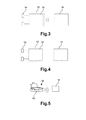
- Figs. 3 and 4 schematically show a device 52 comprising at least one sensor 54 for capturing at least one bio-physiological signal of a sleeping object, and a connection of said device 52 to the processing unit 18.
- the sensors 54 are connected to a communication unit 56 for transmitting the bio-physio logical signals to the processing unit 18.
- the connection is a wireless connection
- the connection is a wire connection.
- More than one device 52 may be connected to the processing unit 18.
- the device 52 may be the pillow 10 and the sensors 54 may be the sensors 12, and the communication unit 56 may be the communication unit 16.
- the device 52 may be the bed sheet 22, the sensors 54 may be the sensors 20, and the communication unit 56 may be the communication unit 26.
- the processing unit 18 may also be included in the device 52.
- the processing unit 18 may be included in the pillow 10.
- Fig. 5 shows an example of a pliable device 52 in the form of a head band 58 comprising sensors 12 for capturing at least one brain wave signal of a sleeping person wearing the headband 58. Further, the headband 58 comprises at least one electro-oculogram sensor 60 for capturing an electro-oculogram signal of the person. For example, the person places the headband 58 such that the EOG sensor 60 is positioned above an eye.
- the sensors 12 and the at least one EOG sensor 60 are connected to a communication unit 56 integrated in the head band 58 for transmitting the signals captured by the respective sensors 12, 60 to the processing unit 18 similar to the example of Fig. 3 .
- the headband 58 is one example of pliable headgear containing at least one sensor for capturing at least one bio-physiological signal of a sleeping object.
- the sensors 12 and 60 are contactless sensors.
- the sensors 12 and 60 are covered by a cloth surface layer 62 of the pliable headband 58.
- the headband 58 may be provided instead of or additionally to the pillow 10 and/or the bed sheet 22 of the embodiment of Fig. 1 .
- the signals of the sensors 12 of the headband 58 and/or the signals of the at least one EOG sensor 60 may be processed by the processing unit 18, thereby generating an output signal as described above.
- Providing a headband 58 has the advantage that the capturing of the signals is less dependent on the sleeping object's position on a pillow.
- the rapid eye movements of the sleeping person may be made visible and/or audible.
- a varying output signal pattern may reflect the varying eye movements during the REM sleep stage.
- the processing unit 18 may be integrated in the device 52, such as the headband 58.
- the device 52 such as the headband 58
- the device 52 may comprise the processing unit 18 as well as an output unit, such as the output unit 34.
- the headband 58 may comprise speakers 36 in the form of earphones or headphones in order to make an audio output signal audible.
- the apparatus for processing a bio-physiological signal may be a headband 58 comprising the processing unit 18 and, optionally, an output unit.
- the headband 58 may comprise batteries for powering the apparatus.
- the headband 58 is one example for a portable apparatus for processing a bio-physiological signal.
- a system for processing bio-physiological signals comprising two headbands 58, 58', each having the sensors 12 and 60 as described for the embodiment of Fig. 5 .
- the communication unit 18 for processing the signals of the sensors of the headband 58 is included in the headband 58'.
- a processing unit 18' for processing the signals of the sensors of the headband 58' is included in the headband 58.
- the sensor signals are transmitted via a wireless connection between respective communication units 56 of the respective headbands 58, 58'.
- output units 34 and/or output units 40 may be included in the respective headbands 58, 58'.
- brain wave signals and/or electro-oculogram signals of a sleeping person wearing a headband 58 may be wirelessly transmitted to a headband 58' of a partner in order to visualise them or make them audible.
- the processing unit 18, 18' for processing the sensor signals of the respective headband 58, 58' may be included in said headband 58, 58', and the output signal generated by the respective processing unit may be wirelessly transmitted to an output unit 34 or 40 included in the other headband 58', 58.
- a system for processing bio-physiological signals comprising two processing units for processing at least one bio-physiological signal captured by a respective at least one sensor associated with said processing unit.
- the system combines two apparatuses for processing a bio-physiological signal as described above in conjunction with Fig. 1 .
- Fig. 7 shows an embodiment where the device 52 is a pliable baby cap 64 comprising sensors 12 for capturing at least one brain wave signal of a sleeping baby wearing the baby cap.
- the sensors 12 are covered by a cloth surface layer 66 of the baby cap 64.
- a communication unit 56 may be included in the baby cap 12 for communication with the processing unit 18.
- the processing unit 18 and at least one output unit, such as an output unit 40 may be included in a baby crib.
- the baby cap 64 may be provided additionally or alternatively to the pillow 10.
- the visualisation of an output signal of the processing unit 18 may be done by using lighting elements of the output unit 40 embedded in the crib.
- the crib could light up a green glow light pattern, and if the baby is restless, the crib could light up in a different pattern and/or a differently colored pattern.
- the invention may allow to visualise a sleep state, make it audible or, in general, produce a human-perceptible output signal related to a sleep state or dream of the sleeping object.
- the invention may enable people to see that their baby, child or loved-one is sleeping well.
- the invention may allow making their sleep and/or dreams tangible in some way.
- an apparatus for consumer use that enables a person to monitor another person's sleep in an interesting and/or entertaining manner is provided.
Landscapes
- Health & Medical Sciences (AREA)
- Life Sciences & Earth Sciences (AREA)
- Surgery (AREA)
- Animal Behavior & Ethology (AREA)
- Pathology (AREA)
- Engineering & Computer Science (AREA)
- Biomedical Technology (AREA)
- Heart & Thoracic Surgery (AREA)
- Medical Informatics (AREA)
- Molecular Biology (AREA)
- Physics & Mathematics (AREA)
- Biophysics (AREA)
- General Health & Medical Sciences (AREA)
- Public Health (AREA)
- Veterinary Medicine (AREA)
- Psychiatry (AREA)
- Psychology (AREA)
- Ophthalmology & Optometry (AREA)
- Nuclear Medicine, Radiotherapy & Molecular Imaging (AREA)
- Radiology & Medical Imaging (AREA)
- Measurement Of The Respiration, Hearing Ability, Form, And Blood Characteristics Of Living Organisms (AREA)
- Measurement And Recording Of Electrical Phenomena And Electrical Characteristics Of The Living Body (AREA)
Priority Applications (7)
| Application Number | Priority Date | Filing Date | Title |
|---|---|---|---|
| EP09157183A EP2236078A1 (de) | 2009-04-02 | 2009-04-02 | Verarbeitung eines biologisch/physiologischen Signals |
| EP10712982A EP2413792A1 (de) | 2009-04-02 | 2010-03-24 | Verarbeitung eines biologisch-physiologischen signals |
| US13/262,277 US20120029322A1 (en) | 2009-04-02 | 2010-03-24 | Processing a bio-physiological signal |
| KR1020117025836A KR20120022844A (ko) | 2009-04-02 | 2010-03-24 | 바이오?생리학적 신호의 처리 |
| JP2012502847A JP2012522559A (ja) | 2009-04-02 | 2010-03-24 | 生体生理信号の処理 |
| PCT/IB2010/051276 WO2010113077A1 (en) | 2009-04-02 | 2010-03-24 | Processing a bio-physiological signal |
| CN201080014502.XA CN102378596B (zh) | 2009-04-02 | 2010-03-24 | 处理生物生理信号 |
Applications Claiming Priority (1)
| Application Number | Priority Date | Filing Date | Title |
|---|---|---|---|
| EP09157183A EP2236078A1 (de) | 2009-04-02 | 2009-04-02 | Verarbeitung eines biologisch/physiologischen Signals |
Publications (1)
| Publication Number | Publication Date |
|---|---|
| EP2236078A1 true EP2236078A1 (de) | 2010-10-06 |
Family
ID=40957651
Family Applications (2)
| Application Number | Title | Priority Date | Filing Date |
|---|---|---|---|
| EP09157183A Ceased EP2236078A1 (de) | 2009-04-02 | 2009-04-02 | Verarbeitung eines biologisch/physiologischen Signals |
| EP10712982A Withdrawn EP2413792A1 (de) | 2009-04-02 | 2010-03-24 | Verarbeitung eines biologisch-physiologischen signals |
Family Applications After (1)
| Application Number | Title | Priority Date | Filing Date |
|---|---|---|---|
| EP10712982A Withdrawn EP2413792A1 (de) | 2009-04-02 | 2010-03-24 | Verarbeitung eines biologisch-physiologischen signals |
Country Status (6)
| Country | Link |
|---|---|
| US (1) | US20120029322A1 (de) |
| EP (2) | EP2236078A1 (de) |
| JP (1) | JP2012522559A (de) |
| KR (1) | KR20120022844A (de) |
| CN (1) | CN102378596B (de) |
| WO (1) | WO2010113077A1 (de) |
Cited By (4)
| Publication number | Priority date | Publication date | Assignee | Title |
|---|---|---|---|---|
| WO2012153263A1 (en) * | 2011-05-11 | 2012-11-15 | Koninklijke Philips Electronics N.V. | Sleep stage annotation device |
| CN107421077A (zh) * | 2017-08-18 | 2017-12-01 | 青岛海尔空调器有限总公司 | 一种基于人体睡眠状态的空调器控制方法及空调器 |
| CN107708547A (zh) * | 2015-06-12 | 2018-02-16 | 皇家飞利浦有限公司 | 表面肌电图系统、记录器和方法 |
| CN116035536A (zh) * | 2023-03-14 | 2023-05-02 | 安徽星辰智跃科技有限责任公司 | 一种睡眠行为活跃水平检测量化的方法、系统和装置 |
Families Citing this family (78)
| Publication number | Priority date | Publication date | Assignee | Title |
|---|---|---|---|---|
| US10226209B2 (en) | 2010-10-15 | 2019-03-12 | Brain Sentinel, Inc. | Method and apparatus for classification of seizure type and severity using electromyography |
| JP5624488B2 (ja) * | 2011-02-01 | 2014-11-12 | パナソニック株式会社 | 運動機能測定システム |
| GB201114406D0 (en) | 2011-08-22 | 2011-10-05 | Isis Innovation | Remote monitoring of vital signs |
| KR101832264B1 (ko) * | 2011-08-25 | 2018-04-13 | 삼성전자주식회사 | 생체 신호를 측정하는 장치 및 방법 |
| US8870764B2 (en) * | 2011-09-06 | 2014-10-28 | Resmed Sensor Technologies Limited | Multi-modal sleep system |
| US20150297142A1 (en) * | 2012-07-30 | 2015-10-22 | Koninklijke Philips N.V. | Device and method for extracting physiological information |
| US8755879B2 (en) * | 2012-10-12 | 2014-06-17 | Forty Winks, LLC | Sleep tracking and waking optimization system and method therefor |
| US10528135B2 (en) | 2013-01-14 | 2020-01-07 | Ctrl-Labs Corporation | Wearable muscle interface systems, devices and methods that interact with content displayed on an electronic display |
| CN103040463B (zh) * | 2013-01-15 | 2014-12-24 | 乔丹洋 | 监测睡眠脑电波的装置及其监测方法 |
| CN105190578A (zh) | 2013-02-22 | 2015-12-23 | 赛尔米克实验室公司 | 用于基于手势控制的组合肌肉活动传感器信号和惯性传感器信号的方法和设备 |
| WO2014186370A1 (en) | 2013-05-13 | 2014-11-20 | Thalmic Labs Inc. | Systems, articles and methods for wearable electronic devices that accommodate different user forms |
| WO2014200433A1 (en) * | 2013-06-11 | 2014-12-18 | Agency For Science, Technology And Research | Sound-induced sleep method and a system therefor |
| US20150033259A1 (en) | 2013-07-24 | 2015-01-29 | United Video Properties, Inc. | Methods and systems for performing operations in response to changes in brain activity of a user |
| US20150124566A1 (en) | 2013-10-04 | 2015-05-07 | Thalmic Labs Inc. | Systems, articles and methods for wearable electronic devices employing contact sensors |
| US12504816B2 (en) | 2013-08-16 | 2025-12-23 | Meta Platforms Technologies, Llc | Wearable devices and associated band structures for sensing neuromuscular signals using sensor pairs in respective pods with communicative pathways to a common processor |
| US11426123B2 (en) | 2013-08-16 | 2022-08-30 | Meta Platforms Technologies, Llc | Systems, articles and methods for signal routing in wearable electronic devices that detect muscle activity of a user using a set of discrete and separately enclosed pod structures |
| US10042422B2 (en) | 2013-11-12 | 2018-08-07 | Thalmic Labs Inc. | Systems, articles, and methods for capacitive electromyography sensors |
| US11921471B2 (en) | 2013-08-16 | 2024-03-05 | Meta Platforms Technologies, Llc | Systems, articles, and methods for wearable devices having secondary power sources in links of a band for providing secondary power in addition to a primary power source |
| US9788789B2 (en) | 2013-08-30 | 2017-10-17 | Thalmic Labs Inc. | Systems, articles, and methods for stretchable printed circuit boards |
| US9372535B2 (en) * | 2013-09-06 | 2016-06-21 | Thalmic Labs Inc. | Systems, articles, and methods for electromyography-based human-electronics interfaces |
| MX2016003051A (es) * | 2013-09-09 | 2016-06-10 | Procter & Gamble | Proceso para elaborar una composicion liquida de limpieza. |
| US9483123B2 (en) | 2013-09-23 | 2016-11-01 | Thalmic Labs Inc. | Systems, articles, and methods for gesture identification in wearable electromyography devices |
| WO2015081113A1 (en) | 2013-11-27 | 2015-06-04 | Cezar Morun | Systems, articles, and methods for electromyography sensors |
| US20180325409A1 (en) * | 2013-12-12 | 2018-11-15 | Brain Sentinel, Inc. | Data-Integrated Interface and Methods of Reviewing Electromyography and Audio Data |
| CN106102504A (zh) | 2014-02-14 | 2016-11-09 | 赛尔米克实验室公司 | 用于弹性电力缆线的系统、制品和方法以及采用弹性电力缆线的可佩戴电子装置 |
| US10199008B2 (en) | 2014-03-27 | 2019-02-05 | North Inc. | Systems, devices, and methods for wearable electronic devices as state machines |
| US10368802B2 (en) | 2014-03-31 | 2019-08-06 | Rovi Guides, Inc. | Methods and systems for selecting media guidance applications based on a position of a brain monitoring user device |
| US9436279B2 (en) | 2014-03-31 | 2016-09-06 | Rovi Guides, Inc. | Systems and methods for controlling user devices based on brain activity |
| US9185447B2 (en) | 2014-03-31 | 2015-11-10 | Rovi Guides, Inc. | Methods and systems for selecting customized control schemes based on brain activity |
| US10327019B2 (en) | 2014-04-28 | 2019-06-18 | Rovi Guides, Inc. | Methods and systems for preventing a user from terminating a service based on the accessibility of a preferred media asset |
| US9531708B2 (en) | 2014-05-30 | 2016-12-27 | Rovi Guides, Inc. | Systems and methods for using wearable technology for biometric-based recommendations |
| KR101639286B1 (ko) * | 2014-06-10 | 2016-07-13 | 주식회사 지오클라비스 | 스마트 베개 시스템 및 그 제작 방법 |
| US9880632B2 (en) | 2014-06-19 | 2018-01-30 | Thalmic Labs Inc. | Systems, devices, and methods for gesture identification |
| US9710071B2 (en) | 2014-09-22 | 2017-07-18 | Rovi Guides, Inc. | Methods and systems for recalibrating a user device based on age of a user and received verbal input |
| US9778736B2 (en) | 2014-09-22 | 2017-10-03 | Rovi Guides, Inc. | Methods and systems for calibrating user devices |
| WO2016070653A1 (en) * | 2014-11-07 | 2016-05-12 | Beijing Zhigu Rui Tuo Tech Co., Ltd. | Dominant eye determining method and device |
| CN104375644A (zh) * | 2014-11-07 | 2015-02-25 | 北京智谷睿拓技术服务有限公司 | 主导眼确定方法和设备 |
| CN104360739A (zh) * | 2014-11-07 | 2015-02-18 | 北京智谷睿拓技术服务有限公司 | 主导眼确定方法和设备 |
| US9807221B2 (en) | 2014-11-28 | 2017-10-31 | Thalmic Labs Inc. | Systems, devices, and methods effected in response to establishing and/or terminating a physical communications link |
| EP4306041A1 (de) * | 2015-01-06 | 2024-01-17 | David Burton | Mobile, am körper tragbare überwachungssysteme |
| TWI669102B (zh) * | 2015-01-26 | 2019-08-21 | 神仙科學股份有限公司 | Wearable physiological detection device |
| US10610148B2 (en) | 2015-04-17 | 2020-04-07 | Brain Sentinel, Inc. | Method of monitoring a patient for seizure activity |
| US10078435B2 (en) | 2015-04-24 | 2018-09-18 | Thalmic Labs Inc. | Systems, methods, and computer program products for interacting with electronically displayed presentation materials |
| US10232139B1 (en) | 2015-06-12 | 2019-03-19 | Chrona Sleep, Inc. | Smart pillow cover and alarm to improve sleeping and waking |
| CN104921535B (zh) * | 2015-07-14 | 2016-08-24 | 成都市伺服液压设备有限公司 | 一种多功能枕头 |
| CN105163180A (zh) * | 2015-08-21 | 2015-12-16 | 小米科技有限责任公司 | 播放控制方法、装置及终端 |
| CN105105948A (zh) * | 2015-09-29 | 2015-12-02 | 成都愚创科技有限公司 | 一种具有心率与呼吸检测的床位 |
| CN107647847A (zh) * | 2016-07-26 | 2018-02-02 | 纽沃凯生物科技(深圳)有限公司 | 睡眠深度监测方法和睡眠深度监测仪 |
| CN105771092A (zh) * | 2016-04-01 | 2016-07-20 | 深圳市前海安测信息技术有限公司 | 基于电磁场改善睡眠的系统及方法 |
| CN105853083A (zh) * | 2016-04-13 | 2016-08-17 | 苏州海神联合医疗器械有限公司 | 肌电检测移动病床以及肌电检测方法 |
| JP6295290B2 (ja) * | 2016-05-09 | 2018-03-14 | 東芝電波プロダクツ株式会社 | 睡眠の質向上装置 |
| WO2018022602A1 (en) | 2016-07-25 | 2018-02-01 | Ctrl-Labs Corporation | Methods and apparatus for predicting musculo-skeletal position information using wearable autonomous sensors |
| US11216069B2 (en) | 2018-05-08 | 2022-01-04 | Facebook Technologies, Llc | Systems and methods for improved speech recognition using neuromuscular information |
| US12554325B2 (en) | 2016-07-25 | 2026-02-17 | Meta Platforms Technologies, Llc | Methods and apparatuses for low latency body state prediction based on neuromuscular data |
| CN106236079A (zh) * | 2016-08-18 | 2016-12-21 | 中山衡思健康科技有限公司 | 用于脑电与眼电复合检测的睡眠监测眼罩及睡眠监测方法 |
| US10178969B2 (en) | 2016-09-19 | 2019-01-15 | Intel Corporation | Stress detection method and apparatus |
| CN112040858B (zh) | 2017-10-19 | 2024-06-07 | 元平台技术有限公司 | 用于识别与神经肌肉源信号相关的生物结构的系统和方法 |
| CN107647849A (zh) * | 2017-11-02 | 2018-02-02 | 成都吱吖科技有限公司 | 一种提高睡眠质量及睡眠质量检测的智能家居装置 |
| US12579768B2 (en) | 2018-01-25 | 2026-03-17 | Meta Platforms Technologies, Llc | Wearable electronic devices, extended reality systems including neuromuscular sensors, and methods for generating text from speech input and modifying the generated text based on neuromuscular data |
| US11907423B2 (en) | 2019-11-25 | 2024-02-20 | Meta Platforms Technologies, Llc | Systems and methods for contextualized interactions with an environment |
| US10937414B2 (en) | 2018-05-08 | 2021-03-02 | Facebook Technologies, Llc | Systems and methods for text input using neuromuscular information |
| US11481030B2 (en) | 2019-03-29 | 2022-10-25 | Meta Platforms Technologies, Llc | Methods and apparatus for gesture detection and classification |
| US11150730B1 (en) | 2019-04-30 | 2021-10-19 | Facebook Technologies, Llc | Devices, systems, and methods for controlling computing devices via neuromuscular signals of users |
| US11493993B2 (en) | 2019-09-04 | 2022-11-08 | Meta Platforms Technologies, Llc | Systems, methods, and interfaces for performing inputs based on neuromuscular control |
| US11961494B1 (en) | 2019-03-29 | 2024-04-16 | Meta Platforms Technologies, Llc | Electromagnetic interference reduction in extended reality environments |
| US10592001B2 (en) | 2018-05-08 | 2020-03-17 | Facebook Technologies, Llc | Systems and methods for improved speech recognition using neuromuscular information |
| KR102021701B1 (ko) * | 2018-06-15 | 2019-09-16 | 선문대학교 산학협력단 | 수면행동장애 모니터링 장치 |
| US10905350B2 (en) | 2018-08-31 | 2021-02-02 | Facebook Technologies, Llc | Camera-guided interpretation of neuromuscular signals |
| WO2020049624A1 (ja) * | 2018-09-03 | 2020-03-12 | 株式会社ファーストアセント | 寝かしつけ支援装置 |
| EP3853698A4 (de) | 2018-09-20 | 2021-11-17 | Facebook Technologies, LLC | Neuromuskuläre texteingabe, schreiben und zeichnen in systemen mit erweiterter realität |
| EP3886693A4 (de) | 2018-11-27 | 2022-06-08 | Facebook Technologies, LLC. | Verfahren und vorrichtung zur autokalibrierung eines tragbaren elektrodensensorsystems |
| CN109589484A (zh) * | 2018-11-29 | 2019-04-09 | 中国地质大学(武汉) | 一种梦境影响的宠物智能交互装置及方法 |
| US11439348B1 (en) * | 2019-03-19 | 2022-09-13 | Lena Saleh | Apparatus, systems and methods for affecting the physiological condition of a user |
| WO2021067860A1 (en) * | 2019-10-03 | 2021-04-08 | DawnLight Technologies Inc. | Systems and methods for contactless sleep monitoring |
| US11583218B2 (en) * | 2019-11-20 | 2023-02-21 | Advancer Technologies, Llc | EMG device |
| US11868531B1 (en) | 2021-04-08 | 2024-01-09 | Meta Platforms Technologies, Llc | Wearable device providing for thumb-to-finger-based input gestures detected based on neuromuscular signals, and systems and methods of use thereof |
| CN113251623A (zh) * | 2021-04-30 | 2021-08-13 | 青岛海尔空调器有限总公司 | 用于空调的控制方法及控制装置、空调 |
| CN113368365A (zh) * | 2021-05-21 | 2021-09-10 | 苏州声动医疗科技有限公司 | 脑功能监测的声音振动调控设备、方法、头枕及头戴设备 |
Citations (8)
| Publication number | Priority date | Publication date | Assignee | Title |
|---|---|---|---|---|
| US3855998A (en) * | 1973-03-14 | 1974-12-24 | Hidalgo A De | Entertainment device |
| WO1997049333A1 (en) * | 1996-06-26 | 1997-12-31 | The Mind Connection | Device and method for the interactive generation of sensorially perceptible signals |
| US6468234B1 (en) * | 2000-07-14 | 2002-10-22 | The Board Of Trustees Of The Leland Stanford Junior University | SleepSmart |
| US20040030224A1 (en) * | 2002-08-07 | 2004-02-12 | Apneos Corporation | Service center system and method as a component of a population diagnostic for sleep disorders |
| WO2005084538A1 (en) | 2004-02-27 | 2005-09-15 | Axon Sleep Research Laboratories, Inc. | Device for and method of predicting a user’s sleep state |
| US20060258930A1 (en) * | 2004-05-18 | 2006-11-16 | Jianping Wu | Device for use in sleep stage determination using frontal electrodes |
| WO2008056691A1 (en) * | 2006-11-07 | 2008-05-15 | Aisin Seiki Kabushiki Kaisha | Physical condition management system |
| US20080191885A1 (en) * | 2004-01-09 | 2008-08-14 | Loree Iv Leonor F | Easy wake device |
Family Cites Families (16)
| Publication number | Priority date | Publication date | Assignee | Title |
|---|---|---|---|---|
| US4454886A (en) * | 1981-09-14 | 1984-06-19 | Lee Arnold S J | EEG With audio output |
| JPH03268737A (ja) * | 1990-03-19 | 1991-11-29 | Nec San-Ei Instr Co Ltd | 生体モニタリング収録装置 |
| DE19649991A1 (de) * | 1996-11-21 | 1998-06-04 | Axon Gmbh Schmalkalden | Verfahren zur Ermittlung von Schlaf- und Wachprofilen |
| JPH1199140A (ja) * | 1997-09-26 | 1999-04-13 | Toshiba Corp | 就寝状態異常検知装置 |
| US7666151B2 (en) * | 2002-11-20 | 2010-02-23 | Hoana Medical, Inc. | Devices and methods for passive patient monitoring |
| US20040210159A1 (en) * | 2003-04-15 | 2004-10-21 | Osman Kibar | Determining a psychological state of a subject |
| JP3960298B2 (ja) * | 2003-11-19 | 2007-08-15 | 株式会社デンソー | 寝姿及び体位検出装置 |
| US7524279B2 (en) * | 2003-12-31 | 2009-04-28 | Raphael Auphan | Sleep and environment control method and system |
| CN1736327A (zh) * | 2005-07-21 | 2006-02-22 | 高春平 | 脑电信号控制的健康及治疗装置 |
| JP4822796B2 (ja) * | 2005-10-17 | 2011-11-24 | 財団法人大阪バイオサイエンス研究所 | 睡眠計及び睡眠状態判定方法 |
| US7848795B2 (en) * | 2006-05-22 | 2010-12-07 | General Electric Company | Determination of sleep depth |
| US9591995B2 (en) * | 2006-09-06 | 2017-03-14 | J. Seth Blumberg | Digital bed system |
| WO2008032234A1 (en) * | 2006-09-11 | 2008-03-20 | Philips Intellectual Property & Standards Gmbh | System and method for positioning electrodes on a patient body |
| US20080077020A1 (en) * | 2006-09-22 | 2008-03-27 | Bam Labs, Inc. | Method and apparatus for monitoring vital signs remotely |
| WO2008129446A1 (en) * | 2007-04-24 | 2008-10-30 | Philips Intellectual Property & Standards Gmbh | Sensor arrangement and method for monitoring physiological parameters |
| WO2009036327A1 (en) * | 2007-09-14 | 2009-03-19 | Corventis, Inc. | Adherent device for respiratory monitoring and sleep disordered breathing |
-
2009
- 2009-04-02 EP EP09157183A patent/EP2236078A1/de not_active Ceased
-
2010
- 2010-03-24 CN CN201080014502.XA patent/CN102378596B/zh not_active Expired - Fee Related
- 2010-03-24 KR KR1020117025836A patent/KR20120022844A/ko not_active Withdrawn
- 2010-03-24 US US13/262,277 patent/US20120029322A1/en not_active Abandoned
- 2010-03-24 EP EP10712982A patent/EP2413792A1/de not_active Withdrawn
- 2010-03-24 JP JP2012502847A patent/JP2012522559A/ja not_active Ceased
- 2010-03-24 WO PCT/IB2010/051276 patent/WO2010113077A1/en not_active Ceased
Patent Citations (8)
| Publication number | Priority date | Publication date | Assignee | Title |
|---|---|---|---|---|
| US3855998A (en) * | 1973-03-14 | 1974-12-24 | Hidalgo A De | Entertainment device |
| WO1997049333A1 (en) * | 1996-06-26 | 1997-12-31 | The Mind Connection | Device and method for the interactive generation of sensorially perceptible signals |
| US6468234B1 (en) * | 2000-07-14 | 2002-10-22 | The Board Of Trustees Of The Leland Stanford Junior University | SleepSmart |
| US20040030224A1 (en) * | 2002-08-07 | 2004-02-12 | Apneos Corporation | Service center system and method as a component of a population diagnostic for sleep disorders |
| US20080191885A1 (en) * | 2004-01-09 | 2008-08-14 | Loree Iv Leonor F | Easy wake device |
| WO2005084538A1 (en) | 2004-02-27 | 2005-09-15 | Axon Sleep Research Laboratories, Inc. | Device for and method of predicting a user’s sleep state |
| US20060258930A1 (en) * | 2004-05-18 | 2006-11-16 | Jianping Wu | Device for use in sleep stage determination using frontal electrodes |
| WO2008056691A1 (en) * | 2006-11-07 | 2008-05-15 | Aisin Seiki Kabushiki Kaisha | Physical condition management system |
Cited By (6)
| Publication number | Priority date | Publication date | Assignee | Title |
|---|---|---|---|---|
| WO2012153263A1 (en) * | 2011-05-11 | 2012-11-15 | Koninklijke Philips Electronics N.V. | Sleep stage annotation device |
| CN103635134A (zh) * | 2011-05-11 | 2014-03-12 | 皇家飞利浦有限公司 | 睡眠阶段注释设备 |
| CN107708547A (zh) * | 2015-06-12 | 2018-02-16 | 皇家飞利浦有限公司 | 表面肌电图系统、记录器和方法 |
| CN107421077A (zh) * | 2017-08-18 | 2017-12-01 | 青岛海尔空调器有限总公司 | 一种基于人体睡眠状态的空调器控制方法及空调器 |
| WO2019034126A1 (zh) * | 2017-08-18 | 2019-02-21 | 青岛海尔空调器有限总公司 | 一种基于人体睡眠状态的空调器控制方法及空调器 |
| CN116035536A (zh) * | 2023-03-14 | 2023-05-02 | 安徽星辰智跃科技有限责任公司 | 一种睡眠行为活跃水平检测量化的方法、系统和装置 |
Also Published As
| Publication number | Publication date |
|---|---|
| CN102378596B (zh) | 2015-01-14 |
| WO2010113077A1 (en) | 2010-10-07 |
| KR20120022844A (ko) | 2012-03-12 |
| CN102378596A (zh) | 2012-03-14 |
| JP2012522559A (ja) | 2012-09-27 |
| EP2413792A1 (de) | 2012-02-08 |
| US20120029322A1 (en) | 2012-02-02 |
Similar Documents
| Publication | Publication Date | Title |
|---|---|---|
| EP2236078A1 (de) | Verarbeitung eines biologisch/physiologischen Signals | |
| US11458279B2 (en) | Sleep enhancement system and wearable device for use therewith | |
| CN210811043U (zh) | 穿戴式生理活动感测装置及感测系统 | |
| JP3217017U (ja) | ウェアラブル生理検査機器 | |
| CN101467875B (zh) | 耳戴式生理反馈装置 | |
| CN205612470U (zh) | 穿戴式生理检测装置 | |
| US7769439B2 (en) | Brain balancing by binaural beat | |
| JP6605958B2 (ja) | 睡眠を誘発するための脳波ベースの閉ループ感覚刺激 | |
| CN110049714B (zh) | 用于促进觉醒的系统和方法 | |
| JP2023505204A (ja) | ウェアラブルデバイス | |
| US10685577B2 (en) | Systems and methods for delivering sensory input during a dream state | |
| US20170007173A1 (en) | System for polyphasic sleep management, method of its operation, device for sleep analysis, method of current sleep phase classification and use of the system and the device in polyphasic sleep management | |
| EP3181041A1 (de) | System und verfahren zur eeg-messung im ohr und audiobereitstellung zur schlafverbesserung | |
| JP2022532849A (ja) | 睡眠生理システム及び睡眠警告方法 | |
| JP2022059140A (ja) | 情報処理装置及びプログラム | |
| TW202042219A (zh) | 睡眠生理系統及睡眠警示方法 | |
| KR20200074797A (ko) | 졸음 방지 및 숙면 유도 헤어밴드 | |
| US20240408345A1 (en) | Device for inducing sleep and method for operating same | |
| KR20250119564A (ko) | 수면 케어 장치 및 그 제어 방법 | |
| US20260014345A1 (en) | System and method for inducing a sensation of motion in a subject using auditory stimuli to facilitate sleep | |
| KR20220124410A (ko) | 뉴로피드백을 기반으로 하는 원격제어 및 자동화 두뇌훈련 시스템 | |
| US20260007851A1 (en) | Electrical stimulation device and electrical stimulation method using same | |
| JP2022176453A (ja) | 刺激出力システムおよび刺激出力方法 |
Legal Events
| Date | Code | Title | Description |
|---|---|---|---|
| PUAI | Public reference made under article 153(3) epc to a published international application that has entered the european phase |
Free format text: ORIGINAL CODE: 0009012 |
|
| AK | Designated contracting states |
Kind code of ref document: A1 Designated state(s): AT BE BG CH CY CZ DE DK EE ES FI FR GB GR HR HU IE IS IT LI LT LU LV MC MK MT NL NO PL PT RO SE SI SK TR |
|
| AX | Request for extension of the european patent |
Extension state: AL BA RS |
|
| STAA | Information on the status of an ep patent application or granted ep patent |
Free format text: STATUS: THE APPLICATION HAS BEEN REFUSED |
|
| 18R | Application refused |
Effective date: 20101030 |