EP2236110A9 - Etoffe d'enveloppement pour un tampon - Google Patents
Etoffe d'enveloppement pour un tampon Download PDFInfo
- Publication number
- EP2236110A9 EP2236110A9 EP10002541.0A EP10002541A EP2236110A9 EP 2236110 A9 EP2236110 A9 EP 2236110A9 EP 10002541 A EP10002541 A EP 10002541A EP 2236110 A9 EP2236110 A9 EP 2236110A9
- Authority
- EP
- European Patent Office
- Prior art keywords
- fleece
- envelope
- enveloping
- nonwoven
- tampon
- Prior art date
- Legal status (The legal status is an assumption and is not a legal conclusion. Google has not performed a legal analysis and makes no representation as to the accuracy of the status listed.)
- Withdrawn
Links
Images



Classifications
-
- A—HUMAN NECESSITIES
- A61—MEDICAL OR VETERINARY SCIENCE; HYGIENE
- A61F—FILTERS IMPLANTABLE INTO BLOOD VESSELS; PROSTHESES; DEVICES PROVIDING PATENCY TO, OR PREVENTING COLLAPSING OF, TUBULAR STRUCTURES OF THE BODY, e.g. STENTS; ORTHOPAEDIC, NURSING OR CONTRACEPTIVE DEVICES; FOMENTATION; TREATMENT OR PROTECTION OF EYES OR EARS; BANDAGES, DRESSINGS OR ABSORBENT PADS; FIRST-AID KITS
- A61F13/00—Bandages or dressings; Absorbent pads
- A61F13/15—Absorbent pads, e.g. sanitary towels, swabs or tampons for external or internal application to the body; Supporting or fastening means therefor; Tampon applicators
- A61F13/20—Tampons, e.g. catamenial tampons; Accessories therefor
- A61F13/2051—Tampons, e.g. catamenial tampons; Accessories therefor characterised by the material or the structure of the inner absorbing core
-
- A—HUMAN NECESSITIES
- A61—MEDICAL OR VETERINARY SCIENCE; HYGIENE
- A61F—FILTERS IMPLANTABLE INTO BLOOD VESSELS; PROSTHESES; DEVICES PROVIDING PATENCY TO, OR PREVENTING COLLAPSING OF, TUBULAR STRUCTURES OF THE BODY, e.g. STENTS; ORTHOPAEDIC, NURSING OR CONTRACEPTIVE DEVICES; FOMENTATION; TREATMENT OR PROTECTION OF EYES OR EARS; BANDAGES, DRESSINGS OR ABSORBENT PADS; FIRST-AID KITS
- A61F13/00—Bandages or dressings; Absorbent pads
- A61F13/15—Absorbent pads, e.g. sanitary towels, swabs or tampons for external or internal application to the body; Supporting or fastening means therefor; Tampon applicators
- A61F13/20—Tampons, e.g. catamenial tampons; Accessories therefor
- A61F13/2002—Tampons, e.g. catamenial tampons; Accessories therefor characterised by the use
- A61F13/202—Catamenial tampons
-
- A—HUMAN NECESSITIES
- A61—MEDICAL OR VETERINARY SCIENCE; HYGIENE
- A61F—FILTERS IMPLANTABLE INTO BLOOD VESSELS; PROSTHESES; DEVICES PROVIDING PATENCY TO, OR PREVENTING COLLAPSING OF, TUBULAR STRUCTURES OF THE BODY, e.g. STENTS; ORTHOPAEDIC, NURSING OR CONTRACEPTIVE DEVICES; FOMENTATION; TREATMENT OR PROTECTION OF EYES OR EARS; BANDAGES, DRESSINGS OR ABSORBENT PADS; FIRST-AID KITS
- A61F13/00—Bandages or dressings; Absorbent pads
- A61F13/15—Absorbent pads, e.g. sanitary towels, swabs or tampons for external or internal application to the body; Supporting or fastening means therefor; Tampon applicators
- A61F13/51—Absorbent pads, e.g. sanitary towels, swabs or tampons for external or internal application to the body; Supporting or fastening means therefor; Tampon applicators characterised by the outer layers of the pads
- A61F13/511—Topsheet, i.e. the permeable cover or layer facing the skin
- A61F13/51121—Topsheet, i.e. the permeable cover or layer facing the skin characterised by the material
Definitions
- the present invention relates to nonwoven envelopes for tampons which are used for feminine hygiene.
- Tampons of the generic type consist of an enveloping fleece, an absorbent core and a return thread.
- the enveloping fleece has several functions: for example, it must ensure that the tampon can be easily inserted, body fluids must pass through to the absorbent core, hold back protruding fibers of the absorbent core and it must not become detached from the absorbent core towards the end of its useful life.
- a card sliver made of viscose or blends of viscose and cotton is usually connected to one another with a nonwoven fabric made of synthetic fibers using the heat-sealing process.
- fleece constructions made of bicomponent staple fibers made of polyethylene in the jacket and polypropylene or polyethylene terephthalate are used in the core.
- the low-melting jacket component is used for gluing.
- a particularly smooth enveloping fleece is still preferred.
- tampon which comprises a single-layer tampon covering made of fibers which are thermally connected to one another with a powder binding agent and pressed onto an absorbent cotton pad which acts as a tampon core.
- the tampon core consists of a mixture of viscose filament fibers and cotton.
- the complex manufacturing process is disadvantageous, since this requires an additional, precise powder metering and the cost-intensive use of powder binder. If the amount of powder applied is too low, the softness is increased too much and the strength of the fleece is too low, while if the amount of powder applied is too high, the loss of goods is too stiff, which ultimately results in unsatisfactory tampon suction performance.
- the powder compound that the powder must be introduced into the fiber structure absolutely homogeneously, i. In other words, insufficient or only partial melting of the powdery compound and the associated too weak solidification can lead to the tampon casing being torn open or torn at high processing speeds.
- the DE 202008006229 U1 treats enveloping nonwovens for tampons in feminine hygiene.
- a thermally bonded nonwoven made of bicomponent filament nonwovens serves as the covering material.
- the inventors did not recognize that an improvement in the adhesive force between the tampon core and the covering nonwoven fabric is of absolute relevance for ensuring the necessary comfort during the entire wearing time and for avoiding delamination when removing the tampon.
- the covering nonwoven material will detach from the body cavity and remain therein when the tampon is removed.
- the EP 0685213 A2 describes the in-situ application of a covering layer made of thermoplastic fiber and / or filaments directly onto the absorbent core of the later tampon. During the subsequent thermal pressing of the combination of the covering layer and the absorbent core, the covering layer melts and connects to the absorbent core.
- the disadvantage here is that the porosity of the coating layer after thermal pressing cannot be exactly predetermined, so that part of the surface becomes impenetrable to body fluids.
- the object of the invention was therefore to provide an enveloping fleece (1) for a tampon (5) which avoids the disadvantages of the prior art.
- the enveloping nonwoven (1) according to the invention consists of a combination of nonwovens produced by dry processes, which come to lie on the side (2) facing the body in later use, with fine-fiber spunbonded nonwovens, which lie on the side facing the absorbent layer in later use (3 ) are arranged.
- nonwovens produced using a dry process are Nonwovens ", Wiley VCH Verlag, D-69469 Weinheim, published in 2000 To understand fiber nonwovens and extrusion nonwovens.
- the nonwovens produced by a dry process consist of thermoplastic staple fibers or filaments with a diameter of> 10 ⁇ m. Common processes for the production of such nonwovens can be found in the book " Nonwovens "on pages 139-228 be removed.
- fine-fiber spunbonded nonwoven is used for nonwovens that consist of thermoplastic polymers, have a fiber diameter of ⁇ 10 ⁇ m and are produced by a meltblown or electrostatic spunbonded nonwoven process.
- the basic procedures for this are described in the book " Nonwovens "on pages 219-222 explained.
- the nonwoven forming the later side (2) is first prefabricated using a drying process.
- Filament spunbonded nonwovens and particularly preferably nonwoven fabrics made from staple fibers are preferably used. These nonwovens can be formed from both monocomponent and bicomponent fibers or filaments and, depending on the course of the process, can be consolidated, for example by calendering or hot air binding, but also, in the case of a spunbonded fabric within a spunbonded fabric - meltblown system, initially not consolidated.
- fiber diameters> 10 ⁇ m are used or are produced in filament spunbonded nonwovens, with diameters of 14-25 ⁇ m being shown to be particularly suitable.
- thermoplastic fibers can be used, but mixtures of thermoplastic with non-thermoplastic fibers, for example viscose, are also conceivable.
- a carded, thermally calender-strengthened staple fiber nonwoven is used for the nonwoven that forms the later ropes (2), which consists of 100% bicomponent core-sheath staple fibers made of polyethylene terephthalate in the core and polyethylene as sheath in a volume ratio of 50% to 50%. consists.
- the fiber diameter of this cylindrical extruded fiber is 14 ⁇ m, corresponding to a fiber titer of 2.2dtex, the stack length is 51mm.
- a fiber web is first produced from these fibers and then consolidated by means of a heated, engraved calender. A pressing area of 23% and a temperature of 135 ° C are used, the basis weight is 12 g / sqm.
- the later side (2) forming nonwoven is now fed to a meltblowing device and coated with a fine fiber spunbonded nonwoven which forms the side (3) of the nonwoven envelope according to the invention.
- meltblowing but also electrostatic spunbonding processes are used.
- the process setting for the production of the fine fibers forming the side (3) is to be selected such that an average fiber diameter of ⁇ 10 ⁇ m is obtained; a process control is preferred which produces fine fibers with an average diameter of less than 5 ⁇ m.
- Granules made of polypropylene with a melt flow index of greater than 300 g / 10 min, measured at 2.16 kg and 230 ° C. in accordance with DIN 1133 are preferred. However, it is also conceivable to use other granules or modified polymers whose melting behavior is only obtained in the extruder by adding granules becomes.
- polypropylene granules with a melt flow index of approximately 1200 g / 10 min are used.
- the basis weight ratio of the sides (2) and (3) is to be selected according to the invention in such a way that the side (3) makes up at most the same proportion by weight of the total basis weight.
- a ratio of 3: 1 to 6: 1 is preferred.
- the fleece forming the side (2) has a basis weight of 12 g / m 2
- the fleece forming the side (3) has a basis weight of 3 g / m 2
- the basis weight ratio from side (2) to side (3) is therefore 4 :1.
- Higher proportions from side (3), i.e. Ratios of 1: 2 or larger are of no use since the swelling of the tampon is then restricted in later use. Ratios of less than 15: 1 do not hinder swelling, but the nonwoven's adhesion to the absorbent core is then insufficient.
- connection of the nonwovens forming the two sides of the enveloping nonwoven (1) according to the invention is preferably accomplished by mechanical knitting of the two layers during the application of the fine fiber spunbonded nonwoven.
- a fusion of the fibers forming the fine fiber spunbonded nonwoven with the fibers of the nonwoven on the side (2) can also take place, provided that these fine fibers still occur in the molten state.
- connection of the two layers can also be supported by a calender treatment at temperatures between 80 and 50 ° C, calender pressures of 20-80daN / cm and a press area share of 4-30%.
- a carding tape made of viscose or mixtures of viscose and cotton is usually formed as the absorbent body.
- the card sliver consists, for example, of 80% viscose fibers, 1.7 dtex / 40 mm stack length and 20% viscose trilobal 3.3 dtex / 40 mm stack length. It has a width of 50mm and a length weight of 8 g / m.
- a 50mm wide and 125mm long section of the enveloping nonwoven (1) is placed with the side (3) on the carding tape which will later become the absorbent body (4).
- the enveloping fleece (1) is attached to the card sliver over a length of 85 mm by means of a heated, engraved press roller such that the enveloping fleece (1) protrudes 30-40 mm at the end of the card sliver section.
- the resulting blank is provided with a return thread (6) and wound into a tampon blank, so that the absorbent body (4) lies inside and is enveloped by the enveloping fleece (1).
- the side (2) of the enveloping fleece (1) lies outwards, the side (3) of the enveloping fleece (1) towards the absorbent body (4).
- the tampon blank covered in this way with the envelope fleece (1) according to the invention is now fed to the final sealing process.
- the blank is pressed into the later shape. Due to the simultaneous temperature, only the polymer forming the side (3) and melts in the enveloping nonwoven (1) according to the invention combines intensively with the absorbent body (4) due to the high melt flow index.
- the permeability to body fluids which mainly depends on the nonwoven fabric forming the side (2), remains largely unaffected .
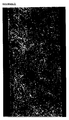
- illustration 1 shows comparative example 1: an enveloping nonwoven made of a thermally calendered staple fiber nonwoven fabric according to the state of the art, consisting of 100% PE / PET bicomponent fibers with a fineness of 2.2dtex, corresponding to a diameter of 14 ⁇ m and with a basis weight of 14 g / sqm.
- the calender's pressing area was 22%.
- Figure 2 shows comparative example 2: likewise an enveloping nonwoven made of a thermally calendered staple fiber nonwoven fabric according to the prior art, consisting of 100% PE / PET bicomponent fibers with a fineness of 2.2dtex, corresponding to a diameter of 14 ⁇ m and a basis weight of 14g / sqm.
- the compression area here was 100% during consolidation.
- Figure 3 now shows a nonwoven according to the invention (1), the side (2) being formed from a 12 g / m2 heavy staple fiber non-woven fabric consisting of 100% polyethylene / polyethylene terephthalate bicomponent fibers and the diameter of which is 14 ⁇ m.
- the hardening area was 22%.
- the side (3) is made of a fine fiber spunbonded nonwoven with a basis weight of 3 g / sqm and consists of polypropylene granulate with a melt flow index of approx. 1100g / 10min.
- the average fiber diameter of the fibers forming the side (3) is 3 ⁇ m.
- the enveloping fleece (1) according to the invention appears Figure 3 significantly more even when assessing the fiber distribution.
- This uniform distribution of the fine fibers forming the side (3) favors the bond between the side (3) and the absorbent body (4).
- a constant connecting force is achieved over the width and length of the connection area of the side (3) with the absorbent body (4), which ultimately is only insignificantly influenced by the swelling of the absorbent body occurring in later use.
- a suction core made of a card sliver consisting of 80% viscose fibers, 1.7 dtex / 40 mm stack length and 20% viscose trilobal 3.3 dtex / 40 mm stack length was used.
- the card sliver had a width of 50 mm and a length weight of 8 g / m.
- a 50mm wide and 250mm long piece of card sliver was used as the suction core.
- the enveloping fleece was pressed with the absorbent core in a Ruggli CL 3 tampon machine at a temperature of 190 ° C and an output of 120 tampons / minute. Standard press jaws were used.
- the tampons with enveloping fleece according to the invention and prior art tampon were immersed in 0.9% saline solution for 1 second and the adhesion of the enveloping fleece to the absorbent core was then measured.
- Another important aspect when evaluating the material according to the invention in comparison with the materials known from the prior art is the prevention of fiber migration out of the absorbent body (4).
- the air permeability was measured according to DIN 53887 at 100 Pa differential pressure of enveloping fleece according to the invention (1) in comparison to the prior art.
- tampons produced using the above-mentioned materials with enveloping fleece (1) according to the invention and enveloping fleece according to the prior art were inserted into a commercially available tube made of polycarbonate with a diameter of 14 mm and a length of 100 mm.
- the tampons have a diameter of 12mm and a length of 50mm.
- the tampons are located with the tip at the opening on one side of the tube, so that the tip can be wetted with 0.9% saline solution, the return thread protrudes from the other opening of the tube.
Landscapes
- Health & Medical Sciences (AREA)
- Life Sciences & Earth Sciences (AREA)
- Engineering & Computer Science (AREA)
- Biomedical Technology (AREA)
- Heart & Thoracic Surgery (AREA)
- Vascular Medicine (AREA)
- Epidemiology (AREA)
- Animal Behavior & Ethology (AREA)
- General Health & Medical Sciences (AREA)
- Public Health (AREA)
- Veterinary Medicine (AREA)
- Absorbent Articles And Supports Therefor (AREA)
- Nonwoven Fabrics (AREA)
Applications Claiming Priority (1)
| Application Number | Priority Date | Filing Date | Title |
|---|---|---|---|
| DE102009015127A DE102009015127A1 (de) | 2009-03-31 | 2009-03-31 | Hüllvlies für einen Tampon |
Publications (3)
| Publication Number | Publication Date |
|---|---|
| EP2236110A2 EP2236110A2 (fr) | 2010-10-06 |
| EP2236110A3 EP2236110A3 (fr) | 2016-08-17 |
| EP2236110A9 true EP2236110A9 (fr) | 2020-05-27 |
Family
ID=42262010
Family Applications (1)
| Application Number | Title | Priority Date | Filing Date |
|---|---|---|---|
| EP10002541.0A Withdrawn EP2236110A3 (fr) | 2009-03-31 | 2010-03-11 | Etoffe d'enveloppement pour un tampon |
Country Status (2)
| Country | Link |
|---|---|
| EP (1) | EP2236110A3 (fr) |
| DE (1) | DE102009015127A1 (fr) |
Families Citing this family (2)
| Publication number | Priority date | Publication date | Assignee | Title |
|---|---|---|---|---|
| DE102018107634A1 (de) * | 2018-03-29 | 2019-10-02 | Rauscher Consumer Products Gmbh | Tampon |
| DE202019102949U1 (de) * | 2019-05-24 | 2019-06-05 | H Y G I E N E Oederan Produktionsgesellschaft mbH Herstellung von Damen- und Erwachsenenhygiene | Tampon |
Family Cites Families (8)
| Publication number | Priority date | Publication date | Assignee | Title |
|---|---|---|---|---|
| US5006116A (en) * | 1988-12-21 | 1991-04-09 | Kimberly-Clark Corporation | Tampon with single layer powder bonded wrap |
| CA2145893A1 (fr) | 1994-05-31 | 1995-12-01 | Leon Eugene Chambers, Jr. | Tampon a enveloppe integrale |
| DE19753665C2 (de) | 1997-12-03 | 2000-05-18 | Johnson & Johnson Gmbh | Tampon für die Frauenhygiene oder medizinische Zwecke sowie Verfahren zur Herstellung desselben |
| KR20020020761A (ko) | 1999-06-30 | 2002-03-15 | 추후제출 | 섬유질 흡수성 구조체에 가열 접합되는 천공된 필름커버를 갖는 탐폰 |
| US7553532B2 (en) * | 2002-12-20 | 2009-06-30 | The Procter & Gamble Company | Tufted fibrous web |
| US7549982B2 (en) * | 2003-11-21 | 2009-06-23 | The Procter & Gamble Company | Tampon with recessed portions having multiple widths |
| DE102006020590A1 (de) * | 2006-05-02 | 2007-11-08 | Sandler Ag | Tampon mit verbesserter Haftung zwischen Hülle & Kern |
| DE102007021374B4 (de) | 2007-05-04 | 2010-06-17 | Carl Freudenberg Kg | Vliesstoffüberzug mit niedrigem Reibungskoeffizienten für die Frauenhygiene, insbesondere für Tampons, oder für medizinische Zwecke, sowie dessen Verwendung |
-
2009
- 2009-03-31 DE DE102009015127A patent/DE102009015127A1/de not_active Ceased
-
2010
- 2010-03-11 EP EP10002541.0A patent/EP2236110A3/fr not_active Withdrawn
Also Published As
| Publication number | Publication date |
|---|---|
| EP2236110A2 (fr) | 2010-10-06 |
| EP2236110A3 (fr) | 2016-08-17 |
| DE102009015127A1 (de) | 2010-10-07 |
Similar Documents
| Publication | Publication Date | Title |
|---|---|---|
| EP3054042B1 (fr) | Procédé de fabrication d'un laminé et laminé | |
| EP2503974B1 (fr) | Structure absorbante | |
| DE3877434T2 (de) | Absorbierende matte, insbesondere fuer hygieneartikel und verfahren zu ihrer kontinuierlichen herstellung. | |
| DE3305406C2 (fr) | ||
| EP2692321B1 (fr) | Matelas d'accumulateur intermédiaire | |
| EP3058127B1 (fr) | Composite non-tissé volumineux et procédé de fabrication de celui-ci | |
| DE69401819T2 (de) | Verbundvliesstoff, verfahren zu dessen herstellung und dessen verwendung in allen absorbierenden hygieneartikeln | |
| DE68913516T2 (de) | Tampon mit durch pulverbindung hergestellter einschichtiger faserhülle. | |
| DE69402420T2 (de) | Verbundvliesstoff, herstellungsverfahren und seine anwendung für alle saugfähigen hygienischen artikel | |
| DE102005030484B4 (de) | Elastischer Vliesstoff, Verfahren zu dessen Herstellung und dessen Verwendung | |
| EP3108051B1 (fr) | Tissu non-tissé microfibre | |
| EP1988202B1 (fr) | Revêtement en tissu non tissé avec un coefficient de friction bas pour l'hygiène féminine, en particulier pour des tampons, ou à des fins médicales, et article en étant équipé | |
| EP3520758B1 (fr) | Non-tissé de distribution et de réception de liquide pour articles d'hygiène | |
| EP3238680A1 (fr) | Non-tissé de distribution et de réception de liquide pour article d'hygiène | |
| EP2236110A2 (fr) | Etoffe d'enveloppement pour un tampon | |
| EP1852098B1 (fr) | Tampon doté d'une adhérence améliorée entre l'enveloppe et le coeur | |
| DE10155482B4 (de) | Verbundmaterial für das Management von Körperflüssigkeiten | |
| DE202009004264U1 (de) | Hüllvlies für einen Tampon | |
| DE102015010105B4 (de) | Dehnbarer Vliesstoff, Verfahren zur Herstellung eines dehnbaren Vliesstoffes und Verwendung desselben | |
| EP2926788B1 (fr) | Feuille de garde | |
| DE69400153T2 (de) | Verbundvliesstoff aus mindestens zwei Schichten und Verfahren zur Herstellung eines solchen Vliesstoff | |
| WO2018158351A1 (fr) | Semelle intérieure | |
| DE102010006228A1 (de) | Flexibles, stark absorbierendes Material | |
| EP2732800B1 (fr) | Non-tissé de distribution et de transmission | |
| EP2006007B1 (fr) | Filtre à air doté d'une structure multicouche |
Legal Events
| Date | Code | Title | Description |
|---|---|---|---|
| PUAI | Public reference made under article 153(3) epc to a published international application that has entered the european phase |
Free format text: ORIGINAL CODE: 0009012 |
|
| 17P | Request for examination filed |
Effective date: 20100322 |
|
| AK | Designated contracting states |
Kind code of ref document: A2 Designated state(s): AT BE BG CH CY CZ DE DK EE ES FI FR GB GR HR HU IE IS IT LI LT LU LV MC MK MT NL NO PL PT RO SE SI SK SM TR |
|
| AX | Request for extension of the european patent |
Extension state: AL BA ME RS |
|
| PUAL | Search report despatched |
Free format text: ORIGINAL CODE: 0009013 |
|
| AK | Designated contracting states |
Kind code of ref document: A3 Designated state(s): AT BE BG CH CY CZ DE DK EE ES FI FR GB GR HR HU IE IS IT LI LT LU LV MC MK MT NL NO PL PT RO SE SI SK SM TR |
|
| AX | Request for extension of the european patent |
Extension state: AL BA ME RS |
|
| RIC1 | Information provided on ipc code assigned before grant |
Ipc: A61F 13/20 20060101ALI20160712BHEP Ipc: A61F 13/511 20060101ALI20160712BHEP Ipc: A61F 13/15 20060101AFI20160712BHEP |
|
| STAA | Information on the status of an ep patent application or granted ep patent |
Free format text: STATUS: EXAMINATION IS IN PROGRESS |
|
| 17Q | First examination report despatched |
Effective date: 20180810 |
|
| GRAP | Despatch of communication of intention to grant a patent |
Free format text: ORIGINAL CODE: EPIDOSNIGR1 |
|
| STAA | Information on the status of an ep patent application or granted ep patent |
Free format text: STATUS: GRANT OF PATENT IS INTENDED |
|
| STAA | Information on the status of an ep patent application or granted ep patent |
Free format text: STATUS: THE APPLICATION HAS BEEN WITHDRAWN |
|
| INTG | Intention to grant announced |
Effective date: 20230203 |
|
| RIN1 | Information on inventor provided before grant (corrected) |
Inventor name: DIE ERFINDER HABEN AUF IHR RECHT VERZICHTET, ALS SOLCHE BEKANNT GEMACHT ZU WERDEN. |
|
| 18W | Application withdrawn |
Effective date: 20230215 |