EP2236471A1 - Emailüberzug, überzogener Gegenstand und Verfahren zum Überziehen eines Gegenstands - Google Patents
Emailüberzug, überzogener Gegenstand und Verfahren zum Überziehen eines Gegenstands Download PDFInfo
- Publication number
- EP2236471A1 EP2236471A1 EP20090003255 EP09003255A EP2236471A1 EP 2236471 A1 EP2236471 A1 EP 2236471A1 EP 20090003255 EP20090003255 EP 20090003255 EP 09003255 A EP09003255 A EP 09003255A EP 2236471 A1 EP2236471 A1 EP 2236471A1
- Authority
- EP
- European Patent Office
- Prior art keywords
- enamel
- coating
- article
- catalytic
- pyrolytic
- Prior art date
- Legal status (The legal status is an assumption and is not a legal conclusion. Google has not performed a legal analysis and makes no representation as to the accuracy of the status listed.)
- Withdrawn
Links
- 239000002320 enamel (paints) Substances 0.000 title claims abstract description 64
- 238000000576 coating method Methods 0.000 title claims abstract description 35
- 239000011248 coating agent Substances 0.000 title claims abstract description 28
- 238000000034 method Methods 0.000 title claims description 37
- 210000003298 dental enamel Anatomy 0.000 claims abstract description 74
- 230000003197 catalytic effect Effects 0.000 claims abstract description 32
- 239000002184 metal Substances 0.000 claims abstract description 29
- 230000003746 surface roughness Effects 0.000 claims abstract description 28
- 239000000203 mixture Substances 0.000 claims abstract description 9
- 238000005524 ceramic coating Methods 0.000 claims description 38
- 239000000463 material Substances 0.000 claims description 23
- 238000010411 cooking Methods 0.000 claims description 10
- 239000007921 spray Substances 0.000 claims description 4
- 238000002156 mixing Methods 0.000 claims description 3
- 238000007750 plasma spraying Methods 0.000 claims description 3
- 239000002002 slurry Substances 0.000 claims description 3
- 238000007751 thermal spraying Methods 0.000 claims description 3
- 238000007749 high velocity oxygen fuel spraying Methods 0.000 claims 1
- 230000003993 interaction Effects 0.000 abstract description 11
- 239000011247 coating layer Substances 0.000 abstract description 3
- 238000004140 cleaning Methods 0.000 description 9
- 238000010304 firing Methods 0.000 description 7
- 239000000126 substance Substances 0.000 description 7
- 230000003670 easy-to-clean Effects 0.000 description 6
- 239000010410 layer Substances 0.000 description 6
- 239000000758 substrate Substances 0.000 description 5
- 238000005422 blasting Methods 0.000 description 4
- 238000005530 etching Methods 0.000 description 4
- 238000007788 roughening Methods 0.000 description 4
- 238000005488 sandblasting Methods 0.000 description 4
- 238000005507 spraying Methods 0.000 description 4
- 230000000694 effects Effects 0.000 description 3
- 239000002103 nanocoating Substances 0.000 description 3
- 230000006978 adaptation Effects 0.000 description 2
- QVGXLLKOCUKJST-UHFFFAOYSA-N atomic oxygen Chemical compound [O] QVGXLLKOCUKJST-UHFFFAOYSA-N 0.000 description 2
- 239000000919 ceramic Substances 0.000 description 2
- 239000006119 easy-to-clean coating Substances 0.000 description 2
- 239000000446 fuel Substances 0.000 description 2
- 229910052760 oxygen Inorganic materials 0.000 description 2
- 239000001301 oxygen Substances 0.000 description 2
- 238000005245 sintering Methods 0.000 description 2
- 239000000725 suspension Substances 0.000 description 2
- 229910010293 ceramic material Inorganic materials 0.000 description 1
- 230000001419 dependent effect Effects 0.000 description 1
- 230000002708 enhancing effect Effects 0.000 description 1
- 238000009776 industrial production Methods 0.000 description 1
- 238000011031 large-scale manufacturing process Methods 0.000 description 1
- 239000007788 liquid Substances 0.000 description 1
- 238000004519 manufacturing process Methods 0.000 description 1
- 239000011253 protective coating Substances 0.000 description 1
- 230000001681 protective effect Effects 0.000 description 1
- 230000003678 scratch resistant effect Effects 0.000 description 1
- 238000010561 standard procedure Methods 0.000 description 1
Images

Classifications
-
- F—MECHANICAL ENGINEERING; LIGHTING; HEATING; WEAPONS; BLASTING
- F24—HEATING; RANGES; VENTILATING
- F24C—DOMESTIC STOVES OR RANGES ; DETAILS OF DOMESTIC STOVES OR RANGES, OF GENERAL APPLICATION
- F24C15/00—Details
- F24C15/005—Coatings for ovens
-
- C—CHEMISTRY; METALLURGY
- C03—GLASS; MINERAL OR SLAG WOOL
- C03C—CHEMICAL COMPOSITION OF GLASSES, GLAZES OR VITREOUS ENAMELS; SURFACE TREATMENT OF GLASS; SURFACE TREATMENT OF FIBRES OR FILAMENTS MADE FROM GLASS, MINERALS OR SLAGS; JOINING GLASS TO GLASS OR OTHER MATERIALS
- C03C8/00—Enamels; Glazes; Fusion seal compositions being frit compositions having non-frit additions
-
- C—CHEMISTRY; METALLURGY
- C23—COATING METALLIC MATERIAL; COATING MATERIAL WITH METALLIC MATERIAL; CHEMICAL SURFACE TREATMENT; DIFFUSION TREATMENT OF METALLIC MATERIAL; COATING BY VACUUM EVAPORATION, BY SPUTTERING, BY ION IMPLANTATION OR BY CHEMICAL VAPOUR DEPOSITION, IN GENERAL; INHIBITING CORROSION OF METALLIC MATERIAL OR INCRUSTATION IN GENERAL
- C23D—ENAMELLING OF, OR APPLYING A VITREOUS LAYER TO, METALS
- C23D5/00—Coating with enamels or vitreous layers
-
- F—MECHANICAL ENGINEERING; LIGHTING; HEATING; WEAPONS; BLASTING
- F24—HEATING; RANGES; VENTILATING
- F24C—DOMESTIC STOVES OR RANGES ; DETAILS OF DOMESTIC STOVES OR RANGES, OF GENERAL APPLICATION
- F24C15/00—Details
-
- Y—GENERAL TAGGING OF NEW TECHNOLOGICAL DEVELOPMENTS; GENERAL TAGGING OF CROSS-SECTIONAL TECHNOLOGIES SPANNING OVER SEVERAL SECTIONS OF THE IPC; TECHNICAL SUBJECTS COVERED BY FORMER USPC CROSS-REFERENCE ART COLLECTIONS [XRACs] AND DIGESTS
- Y10—TECHNICAL SUBJECTS COVERED BY FORMER USPC
- Y10T—TECHNICAL SUBJECTS COVERED BY FORMER US CLASSIFICATION
- Y10T428/00—Stock material or miscellaneous articles
- Y10T428/26—Web or sheet containing structurally defined element or component, the element or component having a specified physical dimension
- Y10T428/263—Coating layer not in excess of 5 mils thick or equivalent
- Y10T428/264—Up to 3 mils
- Y10T428/265—1 mil or less
-
- Y—GENERAL TAGGING OF NEW TECHNOLOGICAL DEVELOPMENTS; GENERAL TAGGING OF CROSS-SECTIONAL TECHNOLOGIES SPANNING OVER SEVERAL SECTIONS OF THE IPC; TECHNICAL SUBJECTS COVERED BY FORMER USPC CROSS-REFERENCE ART COLLECTIONS [XRACs] AND DIGESTS
- Y10—TECHNICAL SUBJECTS COVERED BY FORMER USPC
- Y10T—TECHNICAL SUBJECTS COVERED BY FORMER US CLASSIFICATION
- Y10T428/00—Stock material or miscellaneous articles
- Y10T428/26—Web or sheet containing structurally defined element or component, the element or component having a specified physical dimension
- Y10T428/266—Web or sheet containing structurally defined element or component, the element or component having a specified physical dimension of base or substrate
-
- Y—GENERAL TAGGING OF NEW TECHNOLOGICAL DEVELOPMENTS; GENERAL TAGGING OF CROSS-SECTIONAL TECHNOLOGIES SPANNING OVER SEVERAL SECTIONS OF THE IPC; TECHNICAL SUBJECTS COVERED BY FORMER USPC CROSS-REFERENCE ART COLLECTIONS [XRACs] AND DIGESTS
- Y10—TECHNICAL SUBJECTS COVERED BY FORMER USPC
- Y10T—TECHNICAL SUBJECTS COVERED BY FORMER US CLASSIFICATION
- Y10T428/00—Stock material or miscellaneous articles
- Y10T428/31504—Composite [nonstructural laminate]
- Y10T428/31678—Of metal
Definitions
- the present invention relates to an enamel coating, a coated article and a method of coating an article.
- coating layers on metal surfaces is known in the field of cooking or baking appliances such as cooking or baking trays or muffles of baking ovens.
- coatings aim at providing resistant and easy to clean surfaces, especially in the field of cooking and baking appliances.
- the aforementioned coating layers usually are applied by techniques that require a mechanical bonding interaction between the respective surface and the coating material used. For example, ceramic coatings applied by thermal spray techniques do not establish a chemical bonding but rather are bonded mechanically to the respective surface.
- the surface to be coated is sufficiently rough.
- an enamel coating for coating a metal surface of an article comprises a mixture of a catalytic enamel and at least one of a normal enamel and pyrolytic enamel.
- a catalytic enamel shall comprise all types of enamel able to produce catalytic effects when exclusively applied to a metal surface.
- a pyrolytic enamel shall comprise all types of enamel able to produce pyrolytic effects when exclusively applied to a metal surface.
- a normal enamel shall comprise all types of enamel except for catalytic and pyrolytic enamels according to the aforementioned definitions. Note that pyrolytic and catalytic enamels are used with cooking and/or baking appliances, especially baking muffles of baking appliances. Appliances having pyrolytic or catalytic enamel layers make it possible to remove dirt resulting from steam, baking or cooking remnants, for example, via self cleaning processes making use of pyrolytic or catalytic effects.
- layers of exclusively normal or pyrolytic enamel show very smooth and glassy surfaces. Such smooth and glassy surfaces are generally not suitable for applying additional coating materials, such as ceramic coatings, which require a higher surface roughness to firmly bind to the surface via mechanical bonding interactions.
- Catalytic enamels have extremely rough surfaces with very large specific surface areas required for catalytic processes to take place. This is however to the other extreme precluding catalytic enamel layers from being used as substrates for self cleaning or easy to clean coating layers either.
- an enamel coating comprising a mixture of catalytic enamel and at least one of normal and pyrolytic enamel.
- Such an enamel coating has a surface roughness between that of normal or pyrolytic enamel and catalytic enamel. The surface roughness thus obtained is suitable for establishing adequate mechanical bonding interactions required for a variety of additional coatings, particularly ceramic coatings.
- the final surface roughness of the enamel coating can be easily adjusted and adapted to respective requirements by varying the percentage of catalytic enamel and at least one of normal and pyrolytic enamel.
- a variety of additional coatings require a surface roughness in the range of 2 to 8 ⁇ m which can be achieved using the enamel coating according to the first aspect.
- the surface roughness can be tuned to 2 to 5 ⁇ m, suitable for certain ceramic coatings, and to 2 to 3 ⁇ m, particularly suitable for certain nanostructured ceramic coatings. Note that the surface roughness is given according to the mean roughness index (R a ).
- a surface roughness in the range of 2 to 8 ⁇ m, covering the range suitable for bonding ceramic coatings can for example be obtained by using an enamel coating comprising a mixture of at least one of between 5 to 50 per cent by volume of catalytic enamel and between 50 and 95 per cent by volume of at least one of normal and pyrolytic enamel.
- Comparatively thin layers of enamel coating in the range of 10 to 50 ⁇ m, especially on metal surfaces, may be sufficient to attain a surface roughness in the desired range.
- a second aspect of the invention is related to an article.
- the article has a metal surface at least partially being coated with an enamel coating according to the first aspect of the invention.
- the metal surface of the article can be part of a sheet, i.e. the article can have a sheet like geometry or basically be of metal sheet like design, or a sheet like section of the article.
- the article can have a sheet like geometry or basically be of metal sheet like design, or a sheet like section of the article.
- mechanical impacts and related deformations and disruptions are greatly avoided when applying the enamel coating to the article in order to generate a desired surface roughness. Therefore it is possible to use metal sheets and metal sheet like sections having a thickness of 2 mm or even less. This means that the overall geometry, particularly the overall surface geometry of the article will not be disrupted, which is of particular importance if strict manufacturing tolerances have to be observed or if outer appearance of the article is of major importance.
- the enamel coated article, or at least the section of the article being enamel coated can be coated with a further or additional coating requiring mechanical bonding interactions.
- the additional coating can be firmly and reliably bonded to the enamel coating.
- Additional coatings may provide easy to clean or self cleaning surfaces. Such surfaces may be obtained by using ceramic coatings or nanostructured ceramic coatings.
- the term "nanostructured” shall mean that the ceramic coating has structures, preferably surface structures, in the nano-scale range. Nanostructured surfaces are known in the context of shelf cleaning effects. Note that apart from ceramic coatings, any additional coating or nanostructured coating requiring mechanical bonding can be applied as well.
- the proposed way for generating a predefined surface roughness is universal. It can in principle be applied to a variety of articles.
- the article can be a cooking and/or baking appliance or baking tray suitable for household or industrial use respectively.
- the article can be a muffle of a baking oven, for household or industrial application for example.
- the coatings can be applied to the inner walls of the muffle.
- the invention provides fundamentals for producing such surfaces in a comparatively easy way open for large-scale production even for thin-walled articles and articles with reduced mechanical rigidity.
- a method of at least partially coating a metal surface of an article comprises the steps of:
- the method provides a possibility to generate surfaces having a roughness to mechanically bond additional coating materials, such as ceramic coating materials.
- additional coating materials such as ceramic coating materials.
- mechanical impacts on the article occurring with state of the art roughening methods such as sandblasting or grid blasting can be avoided.
- chemical baths used for phosphatising or etching can be circumvented.
- the proposed method is universal and susceptible to large-scale industrial production. Additional advantages are readily apparent from details given in connection with the first and second aspect of the invention.
- the step of preparing the enamel coating material can comprise the step of adding at least one of 5 to 50 per cent by volume of catalytic enamel and 50 to 95 per cent by volume of at least one of normal and pyrolytic enamel.
- a percentage of the catalytic enamel and at least one of the normal and pyrolytic enamel can be selected such that a final surface roughness of the enamel coating is in the range of 2 to 8 ⁇ m, preferably 2 to 5 ⁇ m, preferably 2 to 3 ⁇ m.
- the enamel coating material can be applied such that a resulting thickness of the enamel coating is between 10 to 50 ⁇ m.
- the enamel coating applied to the metal surface can be fired at temperatures up to 850 °C.
- state of the art processes using firing temperatures from 800 to 850 °C can be used at least for firing the proposed enamel coating material. Therefore, the proposed method can easily be implemented with known firing and enamel coating methods without being forced to specific adaptation. However, some degree of adaptation may still be necessary, depending inter alia on the characteristics of the enamel coating material.
- a ceramic coating preferably a nanostructured ceramic coating
- the ceramic coating or nanostructured ceramic coating thus applied can be fired at temperatures in the range of 200 to 300 °C.
- the ceramic coatings can be applied by thermal spraying, plasma spraying, High Velocity Oxygen Fuel (HVOF) spraying or other suitable techniques.
- HVOF High Velocity Oxygen Fuel
- the additional coating is not restricted to ceramic materials. Other materials can be chosen according to respective needs. For example, any adequate material for providing easy to clean, hard, scratch resistant surfaces and the may be considered.
- the coating can be applied in that a, preferably wet, suspension of the coating material is applied by spraying. Firing or sintering in this case may be done in a temperature range between 180 °C and 340 °C.
- FIG 1 shows a section 1 of a household baking oven. Details of the baking oven, such as the oven's door and manual operating elements and the like, not necessarily required for fully understanding the invention have been omitted. This shall however not limit the scope of the invention.
- Section 1 comprises a housing 2 surrounding a muffle 3 of the baking oven.
- the muffle 3 constitutes a cavity for receiving, via a front opening 4, food items to be baked or roasted.
- inner surfaces 5 of side, bottom, top and back muffle walls become soiled during baking or roasting the food item due to steam, liquid splashes, food remnants and the like.
- Such surfaces can be obtained by coating the muffle walls with appropriate materials, for example.
- One possibility is to provide a ceramic or nanostructured ceramic coating.
- Such coatings - inter alia - are bonded to a substrate via mechanical bonding interactions. In order to establish a stable, firm and permanent bonding, the surface of the substrate must be sufficiently rough for properly establishing mechanical interaction between the substrate surface and the coating material.
- Muffles 3 of baking ovens are generally made from thin metal sheets.
- the surface roughness of the metal sheets used is generally not adequate to establish proper mechanical interaction. Therefore, it is known to roughen the surface of the metal sheets by sandblasting, grid blasting, phosphatising or etching.
- the known techniques however have several disadvantages as already discussed in more detail above.
- a substrate suitable for adequate mechanical bonding can be produced by using a mixture of certain enamels, which will be described in more detail below.
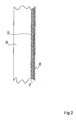
- FIG 2 shows a sectional view of an enlarged portion of a metal sheet muffle wall 6 of the muffle 3. Note that Fig. 2 is not true to scale.
- the inner surface 5 is coated with an enamel coating 7.
- the enamel coating 7 in turn is coated with a ceramic coating 8, preferably a nanostructured ceramic coating.
- the enamel coating 7 comprises a mixture of catalytic enamel and a normal enamel.
- a pyrolytic enamel can be used instead of the normal enamel or in addition to the normal enamel.
- the percentage of catalytic enamel and normal enamel is selected such that the surface roughness of the enamel coating 7 is in the range of 2 to 5 ⁇ m. Such surface roughness is an excellent basis for establishing adequate mechanical bonding to ceramic coating 8.
- the surface roughness of the enamel coating 7 is a result of mixing the two types of enamel. If applied alone, normal enamel, and likewise pyrolytic enamel, generally leads to very smooth, glassy surfaces which are not sufficiently rough to establish adequate mechanical bonding to the ceramic coating 8. Catalytic enamel however leads to extremely rough surfaces with a very large specific surface if applied alone, not suitable for establishing adequate mechanical bonding either.
- the inventors have recognized, that a mixture comprising both catalytic enamel and normal enamel, and - as the case may be - pyrolytic enamel, leads to a surface roughness above that.of normal or pyrolytic enamel and below that of catalytic enamel.
- the overall surface roughness of the enamel coating 7 can be adjusted by varying the percentage of catalytic enamel and normal enamel, and - as the case may be - pyrolytic enamel. This is of particular advantage, as the surface roughness of the enamel coating 7 can easily be adjusted to the bonding characteristics of the ceramic coating 8.
- the surface roughness can be adjusted in the range of 2 to 8 ⁇ m, for example.
- a surface roughness of 2 to 3 ⁇ m is required, which can be obtained by accordingly choosing the percentage of each of the different enamel types.
- a percentage of catalytic enamel may lie in the range of 5 to 50 per cent by volume.
- a percentage of normal enamel, and - as the case may be - pyrolytic enamel may lie in the range of 50 to 95 per cent by volume.
- the enamel coating 7 can be applied to the muffle wall 6 using standard techniques, and fired at temperatures in the range of 800 to 850 °C, but also at lower temperatures.
- the enamel coating 7 can be applied such that a resulting thickness is in the range of 10 to 50 ⁇ m.
- Such enamel coatings 7 generally are sufficient for bonding ceramic coatings 8.
- Other ranges pertaining to the thickness of the enamel coating 7 are possible. It is possible to choose the layer thickness according to respective needs that may result from the type of coating material to be applied to the enamel coating 7, rigidity and other criteria.
- the ceramic coating 8, or - as the case may be - a nanostructured ceramic coating can be applied to the enamel coating 7 by appropriate techniques, such as thermal spraying, plasma spraying, High Velocity Oxygen Fuel (HVOF) spraying and others. Firing of ceramic coatings can take place at temperatures in the range of 200 to 300 °C. Further, it is possible to use slurry spray techniques to apply the nanostructured coating. In this case, the coating can be applied in that a, preferably wet, suspension of the coating material is applied by spraying. Firing or sintering in this case may be done in a temperature range between 180 °C and 340 °C.
- HVOF High Velocity Oxygen Fuel
- the invention has been described in connection with a muffle 3 of a household baking oven, the invention is not restricted to that kind of cooking appliance. Rather, the invention can be applied to all articles to be provided with a coating requiring mechanical bonding interactions. For example all kind of cooking or baking appliances or utensils, cookware and the like, having a surface suitable for applying the enamel coating according to the invention may be contemplated.
Landscapes
- Chemical & Material Sciences (AREA)
- Engineering & Computer Science (AREA)
- Mechanical Engineering (AREA)
- Materials Engineering (AREA)
- Organic Chemistry (AREA)
- Metallurgy (AREA)
- Combustion & Propulsion (AREA)
- General Engineering & Computer Science (AREA)
- Life Sciences & Earth Sciences (AREA)
- Chemical Kinetics & Catalysis (AREA)
- General Chemical & Material Sciences (AREA)
- Geochemistry & Mineralogy (AREA)
- Cookers (AREA)
- Application Of Or Painting With Fluid Materials (AREA)
- Laminated Bodies (AREA)
- Glass Compositions (AREA)
- Coating By Spraying Or Casting (AREA)
- Other Surface Treatments For Metallic Materials (AREA)
Priority Applications (11)
| Application Number | Priority Date | Filing Date | Title |
|---|---|---|---|
| EP20090003255 EP2236471A1 (de) | 2009-03-06 | 2009-03-06 | Emailüberzug, überzogener Gegenstand und Verfahren zum Überziehen eines Gegenstands |
| KR1020117018098A KR20110133469A (ko) | 2009-03-06 | 2010-03-01 | 에나멜 코팅, 코팅된 물품 및 물품의 코팅 방법 |
| JP2011552353A JP2012519771A (ja) | 2009-03-06 | 2010-03-01 | エナメル被覆物、被覆された物品、および物品の被覆方法 |
| BRPI1009217A BRPI1009217A2 (pt) | 2009-03-06 | 2010-03-01 | revestimento de esmalte, artigo revestido e método de revestimento de um artigo |
| RU2011140493/02A RU2536305C2 (ru) | 2009-03-06 | 2010-03-01 | Эмалевое покрытие, изделие с покрытием и способ нанесения покрытия на изделие |
| CN201080009358.0A CN102333734B (zh) | 2009-03-06 | 2010-03-01 | 搪瓷涂层、带涂层的物品和涂覆物品的方法 |
| PCT/EP2010/001240 WO2010099912A1 (en) | 2009-03-06 | 2010-03-01 | Enamel coating, coated article and method of coating an article |
| US13/148,103 US20120034472A1 (en) | 2009-03-06 | 2010-03-01 | Enamel coating, coated article and method of coating an article |
| CA 2752706 CA2752706A1 (en) | 2009-03-06 | 2010-03-01 | Enamel coating, coated article and method of coating an article |
| AU2010220620A AU2010220620B2 (en) | 2009-03-06 | 2010-03-01 | Enamel coating, coated article and method of coating an article |
| MX2011008560A MX2011008560A (es) | 2009-03-06 | 2010-03-01 | Recubrimiento de esmalte, articulo recubierto y metodo para recubrir un articulo. |
Applications Claiming Priority (1)
| Application Number | Priority Date | Filing Date | Title |
|---|---|---|---|
| EP20090003255 EP2236471A1 (de) | 2009-03-06 | 2009-03-06 | Emailüberzug, überzogener Gegenstand und Verfahren zum Überziehen eines Gegenstands |
Publications (1)
| Publication Number | Publication Date |
|---|---|
| EP2236471A1 true EP2236471A1 (de) | 2010-10-06 |
Family
ID=40857412
Family Applications (1)
| Application Number | Title | Priority Date | Filing Date |
|---|---|---|---|
| EP20090003255 Withdrawn EP2236471A1 (de) | 2009-03-06 | 2009-03-06 | Emailüberzug, überzogener Gegenstand und Verfahren zum Überziehen eines Gegenstands |
Country Status (11)
| Country | Link |
|---|---|
| US (1) | US20120034472A1 (de) |
| EP (1) | EP2236471A1 (de) |
| JP (1) | JP2012519771A (de) |
| KR (1) | KR20110133469A (de) |
| CN (1) | CN102333734B (de) |
| AU (1) | AU2010220620B2 (de) |
| BR (1) | BRPI1009217A2 (de) |
| CA (1) | CA2752706A1 (de) |
| MX (1) | MX2011008560A (de) |
| RU (1) | RU2536305C2 (de) |
| WO (1) | WO2010099912A1 (de) |
Cited By (1)
| Publication number | Priority date | Publication date | Assignee | Title |
|---|---|---|---|---|
| EP3026349A1 (de) * | 2014-11-26 | 2016-06-01 | Miele & Cie. KG | Gargerätkomponente und verfahren zur herstellung einer gargerätkomponente |
Families Citing this family (5)
| Publication number | Priority date | Publication date | Assignee | Title |
|---|---|---|---|---|
| RU2647710C1 (ru) * | 2016-12-29 | 2018-03-19 | Автономная некоммерческая организация высшего образования "Белгородский университет кооперации, экономики и права" | Способ получения стемалита |
| CN112570239A (zh) * | 2019-09-29 | 2021-03-30 | 浙江绍兴苏泊尔生活电器有限公司 | 内锅的制备方法和内锅 |
| CN111096655A (zh) * | 2019-09-29 | 2020-05-05 | 浙江苏泊尔家电制造有限公司 | 内锅和烹饪器具 |
| JP7410401B2 (ja) * | 2020-04-28 | 2024-01-10 | タイガー魔法瓶株式会社 | 容器 |
| US12529478B2 (en) | 2023-03-17 | 2026-01-20 | Whirlpool Corporation | Selectively detachable handle assemblies for a door of an oven |
Citations (4)
| Publication number | Priority date | Publication date | Assignee | Title |
|---|---|---|---|---|
| US4084975A (en) * | 1975-04-07 | 1978-04-18 | Ferro Corporation | Volatilizable frit composition forming oxidation-inhibiting vapors |
| EP0453897A1 (de) * | 1990-04-25 | 1991-10-30 | Bayer Ag | Selbstreinigende Beschichtungen für Ofenwandungen |
| DE19654077A1 (de) * | 1996-12-23 | 1998-06-25 | Bayer Ag | Emailzusammensetzungen, Verfahren zu ihrer Herstellung sowie ihre Verwendung |
| US20050014625A1 (en) * | 2000-06-28 | 2005-01-20 | Sophie Espargilliere | Enamel composition |
Family Cites Families (12)
| Publication number | Priority date | Publication date | Assignee | Title |
|---|---|---|---|---|
| US3566855A (en) * | 1969-10-21 | 1971-03-02 | Fedders Corp | Self-cleaning cooking apparatus |
| US3791995A (en) * | 1971-11-24 | 1974-02-12 | Du Pont | Braunite-glass catalytic particles and method of preparation |
| US3846011A (en) * | 1971-12-17 | 1974-11-05 | Hamilton Of Indiana Inc | Chalkboard usable as a rear projection screen |
| JPS54122322A (en) * | 1978-03-15 | 1979-09-21 | Matsushita Electric Industrial Co Ltd | Producing selffcleaning type coating layer |
| JPS55155738A (en) * | 1979-05-24 | 1980-12-04 | Sharp Corp | Film for self-cleaning and its production |
| JPS5752425A (en) * | 1980-09-11 | 1982-03-27 | Hitachi Netsu Kigu Kk | Self-cleaning type coating layer for heat cooker |
| JPH03111583A (ja) * | 1989-09-26 | 1991-05-13 | Matsushita Electric Works Ltd | 無機質被覆ステンレス鋼 |
| DE4212691A1 (de) * | 1992-04-16 | 1993-12-16 | Merck Patent Gmbh | Katalytisch wirksame Überzugsmasse |
| RU2038418C1 (ru) * | 1992-08-17 | 1995-06-27 | Людиновский тепловозостроительный завод | Способ эмалирования чугунных и стальных изделий |
| RU2123541C1 (ru) * | 1997-06-17 | 1998-12-20 | Научно-технический центр Предприятия "Кубаньгазпром" | Способ формирования шероховатого стеклоэмалевого покрытия |
| RU2154036C2 (ru) * | 1998-03-25 | 2000-08-10 | Акционерное общество закрытого типа "Базальт - Мост" | Способ получения эмалевого покрытия |
| US20040069764A1 (en) * | 2002-07-23 | 2004-04-15 | Matsushita Electric Industrial Co., Ltd | Heat cooking apparatus and self-cleaning functional material and manufacturing method thereof |
-
2009
- 2009-03-06 EP EP20090003255 patent/EP2236471A1/de not_active Withdrawn
-
2010
- 2010-03-01 CN CN201080009358.0A patent/CN102333734B/zh not_active Expired - Fee Related
- 2010-03-01 AU AU2010220620A patent/AU2010220620B2/en not_active Expired - Fee Related
- 2010-03-01 MX MX2011008560A patent/MX2011008560A/es not_active Application Discontinuation
- 2010-03-01 WO PCT/EP2010/001240 patent/WO2010099912A1/en not_active Ceased
- 2010-03-01 CA CA 2752706 patent/CA2752706A1/en not_active Abandoned
- 2010-03-01 US US13/148,103 patent/US20120034472A1/en not_active Abandoned
- 2010-03-01 JP JP2011552353A patent/JP2012519771A/ja not_active Ceased
- 2010-03-01 BR BRPI1009217A patent/BRPI1009217A2/pt not_active IP Right Cessation
- 2010-03-01 RU RU2011140493/02A patent/RU2536305C2/ru not_active IP Right Cessation
- 2010-03-01 KR KR1020117018098A patent/KR20110133469A/ko not_active Withdrawn
Patent Citations (4)
| Publication number | Priority date | Publication date | Assignee | Title |
|---|---|---|---|---|
| US4084975A (en) * | 1975-04-07 | 1978-04-18 | Ferro Corporation | Volatilizable frit composition forming oxidation-inhibiting vapors |
| EP0453897A1 (de) * | 1990-04-25 | 1991-10-30 | Bayer Ag | Selbstreinigende Beschichtungen für Ofenwandungen |
| DE19654077A1 (de) * | 1996-12-23 | 1998-06-25 | Bayer Ag | Emailzusammensetzungen, Verfahren zu ihrer Herstellung sowie ihre Verwendung |
| US20050014625A1 (en) * | 2000-06-28 | 2005-01-20 | Sophie Espargilliere | Enamel composition |
Cited By (1)
| Publication number | Priority date | Publication date | Assignee | Title |
|---|---|---|---|---|
| EP3026349A1 (de) * | 2014-11-26 | 2016-06-01 | Miele & Cie. KG | Gargerätkomponente und verfahren zur herstellung einer gargerätkomponente |
Also Published As
| Publication number | Publication date |
|---|---|
| BRPI1009217A2 (pt) | 2016-03-15 |
| JP2012519771A (ja) | 2012-08-30 |
| WO2010099912A1 (en) | 2010-09-10 |
| MX2011008560A (es) | 2011-09-09 |
| CA2752706A1 (en) | 2010-09-10 |
| KR20110133469A (ko) | 2011-12-12 |
| AU2010220620B2 (en) | 2015-02-19 |
| RU2536305C2 (ru) | 2014-12-20 |
| RU2011140493A (ru) | 2013-04-20 |
| AU2010220620A1 (en) | 2011-08-04 |
| CN102333734B (zh) | 2015-01-14 |
| CN102333734A (zh) | 2012-01-25 |
| US20120034472A1 (en) | 2012-02-09 |
Similar Documents
| Publication | Publication Date | Title |
|---|---|---|
| AU2010220620B2 (en) | Enamel coating, coated article and method of coating an article | |
| US20110139141A1 (en) | cleanability of ovens and cooktops | |
| EP1597406B1 (de) | Nahrungsmittelbehälter mit mehrlagiger keramischer antihaftbeschichtung und verfahren zu seiner herstellung | |
| US8501289B2 (en) | Cooking item comprising a non-stick coating with improved properties of adhesion to the substrate | |
| EP2206801A1 (de) | Verbundstoff-Kochgeschirr mit einer glasartigen Schutzbeschichtung | |
| CN101384201A (zh) | 瓷釉电镀烹饪器具以及用于制造该器具的方法 | |
| US20140305948A1 (en) | Culinary Article Comprising a Fluorocarbon-Resin Based Non-Stick Coating Having Improved Properties of Adhesion to the Support, and Method for the Production Thereof | |
| JP2006521176A (ja) | 耐変色性セラミックコーティングを有する食物用器具およびその製法 | |
| DK2515729T3 (en) | KITCHEN EQUIPMENT INCLUDING AN EXTERNAL NONSTICK COATING INCLUDING AN EXTERNAL BASE DECORATION AND PROCEDURE FOR ITS MANUFACTURING | |
| US20070272231A1 (en) | Oven rack having an integral lubricious, dry porcelain surface | |
| CN101189355A (zh) | 有涂层的物品基体及方法 | |
| EP2916701B1 (de) | Kochvorrichtung mit einer kochfläche mit einer nichthaftenden nichtoxidischen oder zumindest teilweise nichtoxidischen keramikbeschichtung sowie küchenelement oder elektrische kochanwendung mit solch einer kochvorrichtung | |
| HK1163049A (en) | Enamel coating, coated article and method of coating an article | |
| CN116555760A (zh) | 一种耐腐蚀防锈不粘锅的生产方法 | |
| US12290076B2 (en) | Baking tray or baking grid having a non-stick and/or non-wetting coating, cooking appliance comprising such a baking tray or baking grid and method for manufacturing a baking tray or baking grid | |
| KR20000060651A (ko) | 세라믹 조리용기 및 그 제조방법 | |
| US20220202234A1 (en) | Cavity having a non-stick and/or non-wetting coating, cooking appliance comprising such a cavity and method for manufacturing a cavity | |
| KR101710475B1 (ko) | 가열조리기구용 법랑 및 넌스틱 코팅 방법 및 가열조리기구 | |
| CN220045631U (zh) | 一种耐腐蚀防锈不粘锅 | |
| KR101737018B1 (ko) | 멘홀의 법랑 코팅 방법 | |
| CN118680418A (zh) | 一种具有电磁感应的铝搪瓷锅具及其制造方法 | |
| CN121293015A (zh) | 一种具有食品级陶瓷釉包覆层的石墨锅具及其制备方法 | |
| EP2837892A1 (de) | Küchenherd und kochfeld | |
| TWM599251U (zh) | 包含抗刮疏水效果的金屬器具 | |
| JP2016190244A (ja) | アルミニウム被覆鋼板 |
Legal Events
| Date | Code | Title | Description |
|---|---|---|---|
| PUAI | Public reference made under article 153(3) epc to a published international application that has entered the european phase |
Free format text: ORIGINAL CODE: 0009012 |
|
| 17P | Request for examination filed |
Effective date: 20091028 |
|
| AK | Designated contracting states |
Kind code of ref document: A1 Designated state(s): AT BE BG CH CY CZ DE DK EE ES FI FR GB GR HR HU IE IS IT LI LT LU LV MC MK MT NL NO PL PT RO SE SI SK TR |
|
| AX | Request for extension of the european patent |
Extension state: AL BA RS |
|
| RAP1 | Party data changed (applicant data changed or rights of an application transferred) |
Owner name: ELECTROLUX HOME PRODUCTS CORPORATION N.V. |
|
| AKX | Designation fees paid |
Designated state(s): AT BE BG CH CY CZ DE DK EE ES FI FR GB GR HR HU IE IS IT LI LT LU LV MC MK MT NL NO PL PT RO SE SI SK TR |
|
| RAP1 | Party data changed (applicant data changed or rights of an application transferred) |
Owner name: ELECTROLUX HOME PRODUCTS CORPORATION N.V. |
|
| STAA | Information on the status of an ep patent application or granted ep patent |
Free format text: STATUS: THE APPLICATION IS DEEMED TO BE WITHDRAWN |
|
| 18D | Application deemed to be withdrawn |
Effective date: 20161001 |