EP2237627A1 - Verfahren zur Lösung der Netzwerkkonkurrenz - Google Patents
Verfahren zur Lösung der Netzwerkkonkurrenz Download PDFInfo
- Publication number
- EP2237627A1 EP2237627A1 EP09157128A EP09157128A EP2237627A1 EP 2237627 A1 EP2237627 A1 EP 2237627A1 EP 09157128 A EP09157128 A EP 09157128A EP 09157128 A EP09157128 A EP 09157128A EP 2237627 A1 EP2237627 A1 EP 2237627A1
- Authority
- EP
- European Patent Office
- Prior art keywords
- parameters
- transmit power
- values
- starvation
- power
- Prior art date
- Legal status (The legal status is an assumption and is not a legal conclusion. Google has not performed a legal analysis and makes no representation as to the accuracy of the status listed.)
- Granted
Links
Images

Classifications
-
- H—ELECTRICITY
- H04—ELECTRIC COMMUNICATION TECHNIQUE
- H04W—WIRELESS COMMUNICATION NETWORKS
- H04W52/00—Power management, e.g. Transmission Power Control [TPC] or power classes
- H04W52/04—Transmission power control [TPC]
- H04W52/18—TPC being performed according to specific parameters
- H04W52/26—TPC being performed according to specific parameters using transmission rate or quality of service QoS [Quality of Service]
- H04W52/267—TPC being performed according to specific parameters using transmission rate or quality of service QoS [Quality of Service] taking into account the information rate
-
- H—ELECTRICITY
- H04—ELECTRIC COMMUNICATION TECHNIQUE
- H04L—TRANSMISSION OF DIGITAL INFORMATION, e.g. TELEGRAPHIC COMMUNICATION
- H04L43/00—Arrangements for monitoring or testing data switching networks
- H04L43/08—Monitoring or testing based on specific metrics, e.g. QoS, energy consumption or environmental parameters
- H04L43/0876—Network utilisation, e.g. volume of load or congestion level
- H04L43/0888—Throughput
-
- H—ELECTRICITY
- H04—ELECTRIC COMMUNICATION TECHNIQUE
- H04W—WIRELESS COMMUNICATION NETWORKS
- H04W52/00—Power management, e.g. Transmission Power Control [TPC] or power classes
- H04W52/04—Transmission power control [TPC]
- H04W52/18—TPC being performed according to specific parameters
- H04W52/28—TPC being performed according to specific parameters using user profile, e.g. mobile speed, priority or network state, e.g. standby, idle or non-transmission
- H04W52/286—TPC being performed according to specific parameters using user profile, e.g. mobile speed, priority or network state, e.g. standby, idle or non-transmission during data packet transmission, e.g. high speed packet access [HSPA]
-
- H—ELECTRICITY
- H04—ELECTRIC COMMUNICATION TECHNIQUE
- H04W—WIRELESS COMMUNICATION NETWORKS
- H04W52/00—Power management, e.g. Transmission Power Control [TPC] or power classes
- H04W52/04—Transmission power control [TPC]
- H04W52/38—TPC being performed in particular situations
- H04W52/50—TPC being performed in particular situations at the moment of starting communication in a multiple access environment
Definitions
- the present invention generally relates to data transmission in wireless networks. More in particular, it relates to a method and device for resolving network contention in wireless networks.
- the IEEE 802.11 MAC protocol uses physical carrier sensing to schedule non-simultaneous transmissions.
- carrier sense range i.e. the range within which they can detect the presence of a signal of another station
- this assumption is clearly not always true.
- nodes are distributed over an area that is larger than one carrier sense range
- certain prominent inefficiencies arise when a terminal is not able to sense transmissions from all other terminals. This can lead to the hidden terminal problem, the exposed terminal problem, asymmetric starvation or neighbourhood starvation.
- the hidden terminal problem arises when a terminal able to interfere with an ongoing transmission is not silenced by this transmission. Since the terminal is not silenced, it can start transmitting and thus cause a collision at the receiver. In some cases, this problem can be handled by using the optional Request-to-Send/Clear-to-Send (RTS/CTS) handshake, defined in the 802.11 MAC protocol. However, many researchers have since noted the inefficacy of this algorithm.
- the exposed terminal problem can be seen as the opposite of the hidden terminal problem.
- a terminal is silenced, even when it forms no threat to the ongoing transmission, i.e., when a transmission from this node would not cause a collision at the receiver side.
- the exposed terminal problem is wasteful since it results in a suboptimal use of the spectrum over space.
- Asymmetric starvation describes the following asymmetric situation that might occur when using different powers and/or carrier sense thresholds. If the signal strength detected at a transmitter terminal is below the carrier sense threshold, said terminal can attempt to proceed with the transmission. Transmitter A is listening to transmitter B and silencing its transmissions when transmitter B sends. However, transmitter B has its carrier sense threshold set so that it doesn't silence when transmitter A transmits. This can lead to unfairness or in the worst case complete starvation (when B is a hidden node for link A).
- Neighbourhood starvation is not so widely known.
- a link is starved (i.e., deprived of channel access) when two or more of its neighbours, that can't hear each other, are transmitting simultaneously. Due to a loss of synchronization, those simultaneous transmissions can shift causing a partial overlap. As a result, the number of packets involved in such a collision train might be very large (because of continuous overlap) and the considered link can sense the channel busy for very long periods.
- System parameters that can be tuned for maximizing the throughput of an IEEE 802.11 network comprise the transmission rate, the carrier sense threshold and the transmission power and others.
- Increasing the transmission rate increases the number of packets sent, but more packets will be lost at the receiver due to a lower interference tolerance.
- Lowering the carrier sense threshold protects a packet against interference, but decreases transmission opportunities by silencing the transmitter more often.
- Increasing the transmission power decreases packet losses at the receiver, but also reduces spatial reuse in the network.
- Patent application US2007/214247 goes further, disclosing an algorithm for the joint tuning of two parameters, namely transmission rate and carrier sense threshold, in order to optimize the throughput in IEEE 802.11 networks. It introduces the concept of spatial backoff (SB). Spatial backoff assumes that the IEEE 802.11 MAC protocol has a set of discrete rates available.
- SB spatial backoff
- T CS T Rx SINR i
- T Rx the receiver sensitivity (meaning that no packets with a receive power below T Rx can be received)
- SINR[i] is the signal-to-interference-noise threshold for the discrete rate R[i]. Only when the SINR at the receiver exceeds SINR[i], packets can be received. It is assumed that when using a T CS equal to or lower than T CS [i] to transmit at rate i, it is unlikely that the transmitter overestimate the interference tolerance at the receiver. Hence, one is looking for a T CS ⁇ T CS [i].
- Transmitters start at the lowest rate R[0] and its associated T CS [0]. When a certain number S of consecutive transmissions succeed, the rate is increased to R[i + 1], unless it is already transmitting at the highest rate. Likewise, when a certain number F of consecutive failures is seen, transmitters try to compensate by first lowering their T CS . This is done as long as the T CS is higher than T CS [i]. When the current T CS of the transmitter is equal to T CS [i] and transmission continue to fail, the rate is decreased to R[i- 1]. When decreasing to a lower rate, T CS is reset to its last known successful value for R[i-1].
- SB Spatial backoff
- the approach presented in US2007/214247 suffers from some important limitations.
- Spatial backoff (SB) only considers collisions.
- collisions are not always a good indicator for throughput as a node might increase its throughput by using a lower rate and a higher carrier sense threshold as this can significantly increase transmission opportunities.
- the proposed converging method can be quite slow, when the transmitter has a lot of neighbours and occasionally a packet fails through a coordinated collision.
- SB uses a starvation detection mechanism to avoid a complete loss of transmission opportunities. This mechanism (with no transmission during a certain period of time) is quite slow and only detects the most severe cases of starvation, where a transmitter is deprived of all access to the medium.
- the selection of T CS [i] in SB is also quite defensive. Indeed, when the received power is high, the transmitter doesn't need to be as protective as when the received power is equal to T Rx .
- the present invention aims to provide a method and device for resolving network contention wherein at least three parameters are jointly controlled.
- the present invention relates to a method for resolving network contention in a wireless network having a plurality of communication devices.
- the method comprises the steps of :
- the gain measure takes into account the parameter indicative of the transmit power by using a cost function wherein the transmit power is weighed.
- the weights are determined such that lower transmit power values are favoured over higher transmit power values.
- the at least three parameters determine a state of the first device, whereby said state is at least dependent on an indication on the receive power at a further device of the plurality with which the first device is communicating.
- the method then advantageously comprises a step of conveying information on the receive power to the first device.
- the at least three parameters also comprise a transmission rate and a carrier sense threshold related to said first device.
- the step of determining a gain measure is advantageously performed by means of a learning algorithm arranged for yielding an output partially determined by feedback from at least one earlier output.
- the output is dependent on the impact of at least one earlier output.
- the gain measure is performed by means of a heuristic technique.
- a step is performed of determining operational communication conditions prior to applying the heuristic technique.
- the heuristic approach is then selected according to the determined operational communication conditions.
- the determined operational conditions correspond to a scenario selected from the group ⁇ hidden terminal starvation, asymmetric starvation, neighbourhood starvation ⁇ .
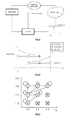
- Fig. 1 illustrates the solution proposed in the present invention.
- Fig. 2 illustrates the effect of the path loss in the selection of the carrier sense threshold.
- Fig. 3 illustrates possible actions for each state defined by rate and carrier sense threshold.
- Fig. 4 illustrates different types of starvation mechanisms.
- Fig. 5 illustrates an example to show the benefits of each contribution.
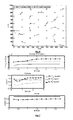
- Fig. 6 illustrates a centralized topology
- Fig. 7 plots Spatial Backoff and Spatial Learning results.
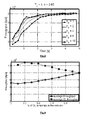
- Fig. 8 illustrates the impact of the heuristics on convergence speed.
- Fig. 9 illustrates the performance of 802.11 terminals enhanced with Spatial Learning.
- the algorithm of the present invention exhibits the following desired properties for an 802.11 control algorithm. It is a single-channel solution and maintains interoperability with other standards. Furthermore it is backward compatible with all IEEE 802.11 protocols as long as a terminal has a tuneable power, rate and carrier sense threshold selection.
- the learner interprets how the environment reacts to the selected actions and adapts his actions based on this feedback. As shown in Fig.1 , the learner may be assisted by heuristics to speed up convergence. The heuristic action suggestions are based on scenario identification, taken from local observations of the environment.
- the set of possible state parameter configurations for the control algorithm is selected at design time by the operator.
- the state space is restricted to allow faster convergence of the algorithm. Increasing the number of possible configurations decreases convergence speed, but possibly allows more optimal results.
- the rate is the least flexible parameter and hence does not need any design-time restriction. All rates that the platform supports are used to bound the more flexible parameters, namely carrier sense thresholds and power.
- the number of transmission powers is selected equal to the number of available rates and they are distributed these uniformly over the interval [max(P t )/ ⁇ R , max(P t )], where ⁇ R is the number of available rates and max(Pt) the maximum available transmission power.
- the operator can choose the parameter k from the interval [-1, 1].
- the aggressive point, k -1, assumes that the interference power suffers from the same path loss as the link between transmitter and receiver.
- a suitable learning scheme is Q-learning, which does not need a model of the environment and can be used online.
- the Q-learning algorithm works by estimating the values of state-action pairs.
- an action is the transition from the current state ( s c ) to a new state ( s n ).
- the value Q( s c , Sn ) is defined as the expected discounted sum of future payoffs obtained by going to the new state and following an optimal policy thereafter. Once these values have been learned, the optimal action from any state is the one with the highest Q-value.
- the standard procedure for Q-learning is as follows.
- All Q-values are initialized to 0.
- the Q-values are updated as follows: Q s c ⁇ s n ⁇ 1 - ⁇ ⁇ Q s c ⁇ s n + ⁇ ⁇ 1 - ⁇ ⁇ r + ⁇ max s ⁇ A s n ⁇ Q s c ⁇ s n where ⁇ is a forget factor, ⁇ a learning parameter and A denotes the set of candidate new states.
- the actions within the state space need to be defined first. The possible actions in each state can be seen in Fig. 3 for an example with three rates available. In each state the transmitter can decide (if possible) to remain in that state (i.e.
- the states where T CS is smaller than T CS [i] have been pruned as explained later on.
- an instantiation of simulated annealing as follows can be used.
- annealing the algorithm (cooling it down) the policy becomes more and more greedy.
- the following annealing scheme is used, whereby ⁇ denotes the annealing factor: T k + 1 ⁇ ⁇ ⁇ T k
- transmitters are allowed to tune their power.
- the optimal decision is always to send at the maximum power.
- So terminals need to be given (a small) incentive to scale down the power.
- ⁇ ⁇ l ⁇ ⁇ l : l ⁇ 0 , n p - 1
- ⁇ is an element of (0, 1]
- n p is the number of available transmission powers.
- the throughput is calculated based on five parameters: the collision probability p c , the busy probability p b , the length of a collision slot t c , the length of a busy slot t b and the length of a successful slot t s .
- the transmissions as a probing for p c , t s and t c and observing p b and t b when the transmitter is not sending, a theoretical throughput can be calculated, which is no longer dependent on the actual instantiations of the backoff value. However, not all unwanted correlations are removed. Indeed, the throughput is also dependent on the backoff values and actions of other transmitters in the neighbourhood.
- SL compensates for this and reaches the same levels of fairness as the T Rx -states.
- SL is shown to outperform SB by 33% in throughput using the P r -based states.
- the impact of heuristics on the convergence of SL is illustrated in Fig.8 . Again, the topology of Fig.6 is used and averaged over 100 seeds. It can be clearly seen that the use of domain knowledge in the form of heuristics results in a significant increase in convergence speed.
- the performance of SL is shown in a legacy 802.11 network in Fig.9 .
- top, bottom, over, under, and the like are introduced for descriptive purposes and not necessarily to denote relative positions. It is to be understood that the terms so used are interchangeable under appropriate circumstances and embodiments of the invention are capable of operating according to the present invention in other sequences, or in orientations different from the one(s) described or illustrated above.
Landscapes
- Engineering & Computer Science (AREA)
- Computer Networks & Wireless Communication (AREA)
- Signal Processing (AREA)
- Quality & Reliability (AREA)
- Environmental & Geological Engineering (AREA)
- Mobile Radio Communication Systems (AREA)
Priority Applications (3)
| Application Number | Priority Date | Filing Date | Title |
|---|---|---|---|
| AT09157128T ATE542384T1 (de) | 2009-04-01 | 2009-04-01 | Verfahren zur lösung der netzwerkkonkurrenz |
| EP09157128A EP2237627B1 (de) | 2009-04-01 | 2009-04-01 | Verfahren zur Lösung der Netzwerkkonkurrenz |
| US12/751,840 US20100302961A1 (en) | 2009-04-01 | 2010-03-31 | Method for resolving network contention |
Applications Claiming Priority (1)
| Application Number | Priority Date | Filing Date | Title |
|---|---|---|---|
| EP09157128A EP2237627B1 (de) | 2009-04-01 | 2009-04-01 | Verfahren zur Lösung der Netzwerkkonkurrenz |
Publications (2)
| Publication Number | Publication Date |
|---|---|
| EP2237627A1 true EP2237627A1 (de) | 2010-10-06 |
| EP2237627B1 EP2237627B1 (de) | 2012-01-18 |
Family
ID=41037760
Family Applications (1)
| Application Number | Title | Priority Date | Filing Date |
|---|---|---|---|
| EP09157128A Not-in-force EP2237627B1 (de) | 2009-04-01 | 2009-04-01 | Verfahren zur Lösung der Netzwerkkonkurrenz |
Country Status (3)
| Country | Link |
|---|---|
| US (1) | US20100302961A1 (de) |
| EP (1) | EP2237627B1 (de) |
| AT (1) | ATE542384T1 (de) |
Cited By (2)
| Publication number | Priority date | Publication date | Assignee | Title |
|---|---|---|---|---|
| CN110291741A (zh) * | 2017-02-10 | 2019-09-27 | 高通股份有限公司 | 侧链路中的反馈干扰管理 |
| CN110933713A (zh) * | 2019-12-03 | 2020-03-27 | 西安邮电大学 | 一种工业无线传感器网络的通信实现方法 |
Families Citing this family (6)
| Publication number | Priority date | Publication date | Assignee | Title |
|---|---|---|---|---|
| WO2014044415A1 (en) * | 2012-09-24 | 2014-03-27 | Nec Europe Ltd. | Method and system for operating stations in a cooperative station network |
| WO2014054762A1 (ja) * | 2012-10-03 | 2014-04-10 | グリー株式会社 | オンラインゲームの同期方法及びサーバ装置 |
| US9288709B2 (en) | 2013-02-10 | 2016-03-15 | Qualcomm Incorporated | Adjustable carrier sense threshold for wireless broadcast |
| US11568236B2 (en) | 2018-01-25 | 2023-01-31 | The Research Foundation For The State University Of New York | Framework and methods of diverse exploration for fast and safe policy improvement |
| CN111225380A (zh) * | 2020-01-13 | 2020-06-02 | 东方红卫星移动通信有限公司 | 一种空天地海一体化多用户协作学习动态接入方法 |
| CN112584527B (zh) * | 2020-12-14 | 2023-07-07 | 中国人民解放军军事科学院国防科技创新研究院 | 多节点视频传输的带宽分配方法、装置及电子设备 |
Citations (1)
| Publication number | Priority date | Publication date | Assignee | Title |
|---|---|---|---|---|
| US20070214247A1 (en) | 2006-03-13 | 2007-09-13 | Xue Yang | System for spatial backoff contention resolution for wireless networks |
-
2009
- 2009-04-01 EP EP09157128A patent/EP2237627B1/de not_active Not-in-force
- 2009-04-01 AT AT09157128T patent/ATE542384T1/de active
-
2010
- 2010-03-31 US US12/751,840 patent/US20100302961A1/en not_active Abandoned
Patent Citations (1)
| Publication number | Priority date | Publication date | Assignee | Title |
|---|---|---|---|---|
| US20070214247A1 (en) | 2006-03-13 | 2007-09-13 | Xue Yang | System for spatial backoff contention resolution for wireless networks |
Non-Patent Citations (4)
| Title |
|---|
| M. TIMMERS ET AL.: "Exploring versus Exploiting: Enhanced Distributed Cognitive Coexistence between IEEE 802.11 and IEEE 802.15.4", PROC. OF THE IEEE CONFERENCE ON SENSORS, October 2008 (2008-10-01) |
| X.YANG; N.VAIDYA: "A Spatial Backoff Algorithm using the joint control of carrier sense threshold and transmission rate", IEEE COMMUNICATIONS SOCIETY CONFERENCE ON SENSOR, MESH AND AD HOC COMMUNICATIONS AND NETWORKS (SECON), 2007, pages 501 - 511 |
| XUE YANG ET AL: "A Spatial Backoff Algorithm Using the Joint Control of Carrier Sense Threshold and Transmission Rate", SENSOR, MESH AND AD HOC COMMUNICATIONS AND NETWORKS, 2007. SECON &APOS ;07. 4TH ANNUAL IEEE COMMUNICATIONS SOCIETY CONFERENCE ON, IEEE, PI, 1 June 2007 (2007-06-01), pages 501 - 511, XP031128741, ISBN: 978-1-4244-1268-6 * |
| XUE YANG ET AL: "Spatial backoff contention resolution for wireless networks", WIRELESS MESH NETWORKS, 2006. WIMESH 2006. 2ND IEEE WORKSHOP ON, IEEE, PI, 1 January 2006 (2006-01-01), pages 13 - 22, XP031012159, ISBN: 978-1-4244-0732-3 * |
Cited By (3)
| Publication number | Priority date | Publication date | Assignee | Title |
|---|---|---|---|---|
| CN110291741A (zh) * | 2017-02-10 | 2019-09-27 | 高通股份有限公司 | 侧链路中的反馈干扰管理 |
| CN110291741B (zh) * | 2017-02-10 | 2022-05-10 | 高通股份有限公司 | 侧链路中的反馈干扰管理 |
| CN110933713A (zh) * | 2019-12-03 | 2020-03-27 | 西安邮电大学 | 一种工业无线传感器网络的通信实现方法 |
Also Published As
| Publication number | Publication date |
|---|---|
| US20100302961A1 (en) | 2010-12-02 |
| ATE542384T1 (de) | 2012-02-15 |
| EP2237627B1 (de) | 2012-01-18 |
Similar Documents
| Publication | Publication Date | Title |
|---|---|---|
| EP2237627B1 (de) | Verfahren zur Lösung der Netzwerkkonkurrenz | |
| Motamedi et al. | MAC protocol design for spectrum-agile wireless networks: Stochastic control approach | |
| KR101038804B1 (ko) | 무선 랜의 협력 통신 방법 | |
| Li et al. | Cooperative multi-hop relaying via network formation games in cognitive radio networks | |
| Ghazvini et al. | Game theory applications in CSMA methods | |
| US7872977B2 (en) | Multi-criteria optimization for relaying in multi-hop wireless ad hoc and sensor networks | |
| Liu et al. | TALENT: Temporal adaptive link estimator with no training | |
| Choe et al. | Multiple channel access using deep reinforcement learning for congested vehicular networks | |
| Motamedi et al. | Optimal channel selection for spectrum-agile low-power wireless packet switched networks in unlicensed band | |
| Yang et al. | Channel access scheme with alignment reference interval adaptation (ARIA) for frequency reuse in unlicensed band LTE: Fuzzy Q-learning approach | |
| Zhang et al. | Cooperative anti-jamming for infrastructure-less wireless networks with stochastic relaying | |
| Peng et al. | Interference-constrained scheduling of a cognitive multihop underwater acoustic network | |
| Ma et al. | A novel contention-based MAC protocol with channel reservation for wireless LANs | |
| Timmers et al. | Accumulative interference modeling for cognitive radios with distributed channel access | |
| Benslimane et al. | Rate adaptation scheme for IEEE 802.11-based MANETs | |
| Hirzallah et al. | Provisioning QoS in Wi-Fi systems with asymmetric full-duplex communications | |
| WO2006003568A1 (en) | Method for fairly distribution of spectrum in contention-based protocols | |
| Elmachkour et al. | The greening of spectrum sensing: A minority game-based mechanism design | |
| Prasad Joshi et al. | Adaptive Window Size‐Based Medium Access Control Protocol for Cognitive Radio Wireless Sensor Networks | |
| Bedi et al. | Analysis of QoS parameters using different back off window algorithm in the IEEE 802.11 e networks | |
| Papadimitratos et al. | A cross-layer design approach to enhance 802.15. 4 | |
| Hosseinabadi et al. | Concurrent-MAC: Increasing concurrent transmissions in dense wireless LANs | |
| KR101341669B1 (ko) | 무선 로컬 영역 네트워크의 에너지 효율을 극대화하는 단말 및 액세스 포인트의 동작 방법 | |
| Timmers et al. | A spatial learning algorithm for IEEE 802.11 networks | |
| Giang et al. | Cooperation between channel access control and TCP rate adaptation in multi-hop ad hoc networks |
Legal Events
| Date | Code | Title | Description |
|---|---|---|---|
| PUAI | Public reference made under article 153(3) epc to a published international application that has entered the european phase |
Free format text: ORIGINAL CODE: 0009012 |
|
| AK | Designated contracting states |
Kind code of ref document: A1 Designated state(s): AT BE BG CH CY CZ DE DK EE ES FI FR GB GR HR HU IE IS IT LI LT LU LV MC MK MT NL NO PL PT RO SE SI SK TR |
|
| 17P | Request for examination filed |
Effective date: 20110406 |
|
| GRAP | Despatch of communication of intention to grant a patent |
Free format text: ORIGINAL CODE: EPIDOSNIGR1 |
|
| GRAS | Grant fee paid |
Free format text: ORIGINAL CODE: EPIDOSNIGR3 |
|
| GRAA | (expected) grant |
Free format text: ORIGINAL CODE: 0009210 |
|
| AK | Designated contracting states |
Kind code of ref document: B1 Designated state(s): AT BE BG CH CY CZ DE DK EE ES FI FR GB GR HR HU IE IS IT LI LT LU LV MC MK MT NL NO PL PT RO SE SI SK TR |
|
| REG | Reference to a national code |
Ref country code: GB Ref legal event code: FG4D |
|
| REG | Reference to a national code |
Ref country code: CH Ref legal event code: EP |
|
| REG | Reference to a national code |
Ref country code: AT Ref legal event code: REF Ref document number: 542384 Country of ref document: AT Kind code of ref document: T Effective date: 20120215 Ref country code: IE Ref legal event code: FG4D |
|
| REG | Reference to a national code |
Ref country code: DE Ref legal event code: R096 Ref document number: 602009004681 Country of ref document: DE Effective date: 20120322 |
|
| REG | Reference to a national code |
Ref country code: NL Ref legal event code: VDEP Effective date: 20120118 |
|
| LTIE | Lt: invalidation of european patent or patent extension |
Effective date: 20120118 |
|
| PG25 | Lapsed in a contracting state [announced via postgrant information from national office to epo] |
Ref country code: BE Free format text: LAPSE BECAUSE OF FAILURE TO SUBMIT A TRANSLATION OF THE DESCRIPTION OR TO PAY THE FEE WITHIN THE PRESCRIBED TIME-LIMIT Effective date: 20120118 Ref country code: BG Free format text: LAPSE BECAUSE OF FAILURE TO SUBMIT A TRANSLATION OF THE DESCRIPTION OR TO PAY THE FEE WITHIN THE PRESCRIBED TIME-LIMIT Effective date: 20120418 Ref country code: HR Free format text: LAPSE BECAUSE OF FAILURE TO SUBMIT A TRANSLATION OF THE DESCRIPTION OR TO PAY THE FEE WITHIN THE PRESCRIBED TIME-LIMIT Effective date: 20120118 Ref country code: NO Free format text: LAPSE BECAUSE OF FAILURE TO SUBMIT A TRANSLATION OF THE DESCRIPTION OR TO PAY THE FEE WITHIN THE PRESCRIBED TIME-LIMIT Effective date: 20120418 Ref country code: NL Free format text: LAPSE BECAUSE OF FAILURE TO SUBMIT A TRANSLATION OF THE DESCRIPTION OR TO PAY THE FEE WITHIN THE PRESCRIBED TIME-LIMIT Effective date: 20120118 Ref country code: LT Free format text: LAPSE BECAUSE OF FAILURE TO SUBMIT A TRANSLATION OF THE DESCRIPTION OR TO PAY THE FEE WITHIN THE PRESCRIBED TIME-LIMIT Effective date: 20120118 Ref country code: IS Free format text: LAPSE BECAUSE OF FAILURE TO SUBMIT A TRANSLATION OF THE DESCRIPTION OR TO PAY THE FEE WITHIN THE PRESCRIBED TIME-LIMIT Effective date: 20120518 |
|
| PG25 | Lapsed in a contracting state [announced via postgrant information from national office to epo] |
Ref country code: GR Free format text: LAPSE BECAUSE OF FAILURE TO SUBMIT A TRANSLATION OF THE DESCRIPTION OR TO PAY THE FEE WITHIN THE PRESCRIBED TIME-LIMIT Effective date: 20120419 Ref country code: FI Free format text: LAPSE BECAUSE OF FAILURE TO SUBMIT A TRANSLATION OF THE DESCRIPTION OR TO PAY THE FEE WITHIN THE PRESCRIBED TIME-LIMIT Effective date: 20120118 Ref country code: PT Free format text: LAPSE BECAUSE OF FAILURE TO SUBMIT A TRANSLATION OF THE DESCRIPTION OR TO PAY THE FEE WITHIN THE PRESCRIBED TIME-LIMIT Effective date: 20120518 Ref country code: PL Free format text: LAPSE BECAUSE OF FAILURE TO SUBMIT A TRANSLATION OF THE DESCRIPTION OR TO PAY THE FEE WITHIN THE PRESCRIBED TIME-LIMIT Effective date: 20120118 Ref country code: LV Free format text: LAPSE BECAUSE OF FAILURE TO SUBMIT A TRANSLATION OF THE DESCRIPTION OR TO PAY THE FEE WITHIN THE PRESCRIBED TIME-LIMIT Effective date: 20120118 |
|
| REG | Reference to a national code |
Ref country code: AT Ref legal event code: MK05 Ref document number: 542384 Country of ref document: AT Kind code of ref document: T Effective date: 20120118 |
|
| PG25 | Lapsed in a contracting state [announced via postgrant information from national office to epo] |
Ref country code: CY Free format text: LAPSE BECAUSE OF FAILURE TO SUBMIT A TRANSLATION OF THE DESCRIPTION OR TO PAY THE FEE WITHIN THE PRESCRIBED TIME-LIMIT Effective date: 20120118 |
|
| PG25 | Lapsed in a contracting state [announced via postgrant information from national office to epo] |
Ref country code: DK Free format text: LAPSE BECAUSE OF FAILURE TO SUBMIT A TRANSLATION OF THE DESCRIPTION OR TO PAY THE FEE WITHIN THE PRESCRIBED TIME-LIMIT Effective date: 20120118 Ref country code: CZ Free format text: LAPSE BECAUSE OF FAILURE TO SUBMIT A TRANSLATION OF THE DESCRIPTION OR TO PAY THE FEE WITHIN THE PRESCRIBED TIME-LIMIT Effective date: 20120118 Ref country code: RO Free format text: LAPSE BECAUSE OF FAILURE TO SUBMIT A TRANSLATION OF THE DESCRIPTION OR TO PAY THE FEE WITHIN THE PRESCRIBED TIME-LIMIT Effective date: 20120118 Ref country code: SE Free format text: LAPSE BECAUSE OF FAILURE TO SUBMIT A TRANSLATION OF THE DESCRIPTION OR TO PAY THE FEE WITHIN THE PRESCRIBED TIME-LIMIT Effective date: 20120118 Ref country code: SI Free format text: LAPSE BECAUSE OF FAILURE TO SUBMIT A TRANSLATION OF THE DESCRIPTION OR TO PAY THE FEE WITHIN THE PRESCRIBED TIME-LIMIT Effective date: 20120118 Ref country code: EE Free format text: LAPSE BECAUSE OF FAILURE TO SUBMIT A TRANSLATION OF THE DESCRIPTION OR TO PAY THE FEE WITHIN THE PRESCRIBED TIME-LIMIT Effective date: 20120118 |
|
| PLBE | No opposition filed within time limit |
Free format text: ORIGINAL CODE: 0009261 |
|
| STAA | Information on the status of an ep patent application or granted ep patent |
Free format text: STATUS: NO OPPOSITION FILED WITHIN TIME LIMIT |
|
| PG25 | Lapsed in a contracting state [announced via postgrant information from national office to epo] |
Ref country code: IT Free format text: LAPSE BECAUSE OF FAILURE TO SUBMIT A TRANSLATION OF THE DESCRIPTION OR TO PAY THE FEE WITHIN THE PRESCRIBED TIME-LIMIT Effective date: 20120118 Ref country code: SK Free format text: LAPSE BECAUSE OF FAILURE TO SUBMIT A TRANSLATION OF THE DESCRIPTION OR TO PAY THE FEE WITHIN THE PRESCRIBED TIME-LIMIT Effective date: 20120118 Ref country code: MC Free format text: LAPSE BECAUSE OF NON-PAYMENT OF DUE FEES Effective date: 20120430 |
|
| 26N | No opposition filed |
Effective date: 20121019 |
|
| REG | Reference to a national code |
Ref country code: IE Ref legal event code: MM4A |
|
| PG25 | Lapsed in a contracting state [announced via postgrant information from national office to epo] |
Ref country code: AT Free format text: LAPSE BECAUSE OF FAILURE TO SUBMIT A TRANSLATION OF THE DESCRIPTION OR TO PAY THE FEE WITHIN THE PRESCRIBED TIME-LIMIT Effective date: 20120118 Ref country code: IE Free format text: LAPSE BECAUSE OF NON-PAYMENT OF DUE FEES Effective date: 20120401 |
|
| REG | Reference to a national code |
Ref country code: DE Ref legal event code: R097 Ref document number: 602009004681 Country of ref document: DE Effective date: 20121019 |
|
| PG25 | Lapsed in a contracting state [announced via postgrant information from national office to epo] |
Ref country code: MK Free format text: LAPSE BECAUSE OF FAILURE TO SUBMIT A TRANSLATION OF THE DESCRIPTION OR TO PAY THE FEE WITHIN THE PRESCRIBED TIME-LIMIT Effective date: 20120118 |
|
| PG25 | Lapsed in a contracting state [announced via postgrant information from national office to epo] |
Ref country code: ES Free format text: LAPSE BECAUSE OF FAILURE TO SUBMIT A TRANSLATION OF THE DESCRIPTION OR TO PAY THE FEE WITHIN THE PRESCRIBED TIME-LIMIT Effective date: 20120429 |
|
| PGFP | Annual fee paid to national office [announced via postgrant information from national office to epo] |
Ref country code: GB Payment date: 20130326 Year of fee payment: 5 |
|
| PG25 | Lapsed in a contracting state [announced via postgrant information from national office to epo] |
Ref country code: MT Free format text: LAPSE BECAUSE OF FAILURE TO SUBMIT A TRANSLATION OF THE DESCRIPTION OR TO PAY THE FEE WITHIN THE PRESCRIBED TIME-LIMIT Effective date: 20120118 |
|
| PGFP | Annual fee paid to national office [announced via postgrant information from national office to epo] |
Ref country code: DE Payment date: 20130322 Year of fee payment: 5 |
|
| PGFP | Annual fee paid to national office [announced via postgrant information from national office to epo] |
Ref country code: FR Payment date: 20130603 Year of fee payment: 5 |
|
| REG | Reference to a national code |
Ref country code: CH Ref legal event code: PL |
|
| PG25 | Lapsed in a contracting state [announced via postgrant information from national office to epo] |
Ref country code: LI Free format text: LAPSE BECAUSE OF NON-PAYMENT OF DUE FEES Effective date: 20130430 Ref country code: CH Free format text: LAPSE BECAUSE OF NON-PAYMENT OF DUE FEES Effective date: 20130430 |
|
| PG25 | Lapsed in a contracting state [announced via postgrant information from national office to epo] |
Ref country code: TR Free format text: LAPSE BECAUSE OF FAILURE TO SUBMIT A TRANSLATION OF THE DESCRIPTION OR TO PAY THE FEE WITHIN THE PRESCRIBED TIME-LIMIT Effective date: 20120118 |
|
| PG25 | Lapsed in a contracting state [announced via postgrant information from national office to epo] |
Ref country code: LU Free format text: LAPSE BECAUSE OF NON-PAYMENT OF DUE FEES Effective date: 20120401 |
|
| PG25 | Lapsed in a contracting state [announced via postgrant information from national office to epo] |
Ref country code: HU Free format text: LAPSE BECAUSE OF FAILURE TO SUBMIT A TRANSLATION OF THE DESCRIPTION OR TO PAY THE FEE WITHIN THE PRESCRIBED TIME-LIMIT Effective date: 20090401 |
|
| REG | Reference to a national code |
Ref country code: DE Ref legal event code: R119 Ref document number: 602009004681 Country of ref document: DE |
|
| GBPC | Gb: european patent ceased through non-payment of renewal fee |
Effective date: 20140401 |
|
| REG | Reference to a national code |
Ref country code: FR Ref legal event code: ST Effective date: 20141231 |
|
| REG | Reference to a national code |
Ref country code: DE Ref legal event code: R119 Ref document number: 602009004681 Country of ref document: DE Effective date: 20141101 |
|
| PG25 | Lapsed in a contracting state [announced via postgrant information from national office to epo] |
Ref country code: DE Free format text: LAPSE BECAUSE OF NON-PAYMENT OF DUE FEES Effective date: 20141101 Ref country code: GB Free format text: LAPSE BECAUSE OF NON-PAYMENT OF DUE FEES Effective date: 20140401 |
|
| PG25 | Lapsed in a contracting state [announced via postgrant information from national office to epo] |
Ref country code: FR Free format text: LAPSE BECAUSE OF NON-PAYMENT OF DUE FEES Effective date: 20140430 |