EP2239680A1 - Systèmes informatiques - Google Patents
Systèmes informatiques Download PDFInfo
- Publication number
- EP2239680A1 EP2239680A1 EP10006442A EP10006442A EP2239680A1 EP 2239680 A1 EP2239680 A1 EP 2239680A1 EP 10006442 A EP10006442 A EP 10006442A EP 10006442 A EP10006442 A EP 10006442A EP 2239680 A1 EP2239680 A1 EP 2239680A1
- Authority
- EP
- European Patent Office
- Prior art keywords
- client
- server
- code
- data
- user
- Prior art date
- Legal status (The legal status is an assumption and is not a legal conclusion. Google has not performed a legal analysis and makes no representation as to the accuracy of the status listed.)
- Withdrawn
Links
Images
Classifications
-
- G—PHYSICS
- G06—COMPUTING OR CALCULATING; COUNTING
- G06F—ELECTRIC DIGITAL DATA PROCESSING
- G06F21/00—Security arrangements for protecting computers, components thereof, programs or data against unauthorised activity
- G06F21/30—Authentication, i.e. establishing the identity or authorisation of security principals
- G06F21/31—User authentication
- G06F21/34—User authentication involving the use of external additional devices, e.g. dongles or smart cards
-
- H—ELECTRICITY
- H04—ELECTRIC COMMUNICATION TECHNIQUE
- H04L—TRANSMISSION OF DIGITAL INFORMATION, e.g. TELEGRAPHIC COMMUNICATION
- H04L63/00—Network architectures or network communication protocols for network security
- H04L63/04—Network architectures or network communication protocols for network security for providing a confidential data exchange among entities communicating through data packet networks
- H04L63/0428—Network architectures or network communication protocols for network security for providing a confidential data exchange among entities communicating through data packet networks wherein the data content is protected, e.g. by encrypting or encapsulating the payload
- H04L63/0485—Networking architectures for enhanced packet encryption processing, e.g. offloading of IPsec packet processing or efficient security association look-up
-
- G—PHYSICS
- G06—COMPUTING OR CALCULATING; COUNTING
- G06F—ELECTRIC DIGITAL DATA PROCESSING
- G06F21/00—Security arrangements for protecting computers, components thereof, programs or data against unauthorised activity
- G06F21/30—Authentication, i.e. establishing the identity or authorisation of security principals
- G06F21/31—User authentication
-
- H—ELECTRICITY
- H04—ELECTRIC COMMUNICATION TECHNIQUE
- H04L—TRANSMISSION OF DIGITAL INFORMATION, e.g. TELEGRAPHIC COMMUNICATION
- H04L63/00—Network architectures or network communication protocols for network security
- H04L63/04—Network architectures or network communication protocols for network security for providing a confidential data exchange among entities communicating through data packet networks
- H04L63/0428—Network architectures or network communication protocols for network security for providing a confidential data exchange among entities communicating through data packet networks wherein the data content is protected, e.g. by encrypting or encapsulating the payload
-
- H—ELECTRICITY
- H04—ELECTRIC COMMUNICATION TECHNIQUE
- H04L—TRANSMISSION OF DIGITAL INFORMATION, e.g. TELEGRAPHIC COMMUNICATION
- H04L63/00—Network architectures or network communication protocols for network security
- H04L63/10—Network architectures or network communication protocols for network security for controlling access to devices or network resources
Definitions
- This disclosure relates to computer systems.
- a networked computer system comprising: a network including: a server, and at least one client for use by at least one user for communication with said server, at which client client data may be input into the system for processing by said server, each said client having a station code associated therewith, and each said user having a user code required for logging into the system, each said client having an encryption engine adapted to combine and encrypt the station code and the user code when a said user logs into the system at a particular said client to provide an encrypted log-on signal, the client being coupled to transmit said encrypted log-on signal to the server, and the server including a decryption engine, and an access controller; the system being characterised in that the server includes memory storing a table of permitted combinations of station code and user code, in that the decryption engine is adapted to decrypt received encoded log-on signals and to configure said access controller to allow access from a particular client to and manipulation of data in said server only when the decrypted log-
- the station code may consist of a Licence Number or, where a number of clients are covered by a single licence, of a Licence Number combined with a station identifier.
- the Licence Number may be embedded in a device that may be fitted to an existing personal computer.
- the said device may also include the encryption engine.
- the said device may be arranged for coupling to a personal computer by an internal or external slot, including a USB connection.
- the user code may be required to be manually input by use of a keyboard, or may be embedded in a device that may be carried by the user and arranged to be coupled by a user to the client, for example by a USB connection or via a card reader, or may comprise biometric or biometrically derived data.
- the decryption engine and/or the memory may be embedded in a device that may be fitted to the server via an internal or external slot.
- code words are randomly or pseudo-randomly chosen from the client code word table.
- the server includes an encryption engine so that any data transmitted from the server to a selected client is similarly encoded using a code word selected for each data package or for a train of said packages from a plurality of code words associated with the selected client and held in an encryption table by the server, the client having a corresponding decryption engine adapted to identify from each data package received by said server whether the particular said package was encoded using a code word associated with the particular client and present in a decryption table held by the client and to decrypt said package using the particular said code word.
- the encryption engine (and the decryption engine, when present) and memory storing the respective said table(s) may be embedded in one or more devices that may be fitted to the client via external or internal slots.
- the decryption engine of the server (and the server encryption engine, when present) and memory storing the respective table(s) may be embedded in one or more devices that may be fitted to the client via external or internal slots.
- the server may have one or more devices fitted thereto via external or internal slots, the device(s) embedding both the said decryption engine and the said memory, and the said decryption engine of the server (and the server encryption engine, when present) and memory storing the respective table(s).
- each client may have one or more devices fitted thereto via external or internal slots, the said device(s) embedding both the encryption engine of the client (and the client decryption engine, when present) and memory storing the respective table(s), and a said Licence Number combined with a station identifier and serving as the said station code for the said client.
- a method of operating a networked computer system comprising a server, and at least one client authorised for communication with said server, at which client data for said server may be input into the system; the method comprising the steps of: a) controlling access from at least one user via the at least one client to said server, each said client having a station code associated therewith, and each said user having a user code required for logging into the system, said access control comprising combining and encrypting the station code and the user code when a said user logs into the system at a particular said client to provide an encrypted log-on signal, transmitting the said encrypted log-on signal to the server; decrypting the said signal; checking whether the combination of station code and user code is an allowed combination stored in memory at the server; and, if so, allowing access from the said client for the said user to, and manipulation of, data in said data processor; and b) for each user allowed access via a said client to input client data for processing by said server,
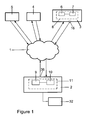
- the illustrated embodiment of computer system comprises a network 1 connecting a server 2 to a plurality of clients 3, 4, 5....
- the network may comprise a private network, for example an Ethernet, or a public network such as the Internet.
- Each of the clients is arranged to serve as a data input station for inputting data to the system.
- Each client includes an encryption engine 6 and a memory 7.
- the encryption engine and the memory may be embedded in a device 8 that may be fitted to an existing client/data input station, for example to an internal PCI slot for a personal computer or to an external PC Card slot for a laptop.
- Server 2 includes a decryption engine 9 and a memory 10, which may both be embedded in a device 11 that may be fitted to an internal or external slot of an existing server, preferably an internal slot, such as a high speed PCI slot. Another alternative is a USB slot. Multiple devices (cards) may be employed to balance the load, enabling a larger throughput.
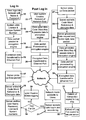
- Fig. 2 illustrates the logical steps involved in a log-on procedure.
- An intending User seeks to log on to a selected client at step 12. This may be by manually inputting a conventional User Name and Password, as indicated in step 12 in Fig. 2.
- each User may have their User Name and/or Password embedded in a device which must be connected to the client at step 12, for example by connection to a USB socket or by means of a card reader.
- the User identifying data may be biometric data or biometrically derived data.
- the client adds a Licence Number (for use of a system in accordance with the present invention) and a code identifying the specific client/data input station at step 13. These together define a station code.
- the Licence Number, and optionally the station identifier, may be embedded in device 8 in memory 7.
- a Licence/program card when a Licence/program card is first fitted to a particular client device and the driver(s) loaded, the card stores in its memory an identifier derived from the client, for example the serial number of its motherboard. This has the added security that it prevents cards being moved from an authorised client to one that is not. Thereafter, as part of the User verification procedure, the client data stored on the card is checked against that same data in the client itself. Further steps are only permitted if they match.
- a data packet comprising a user code identifying the User associated with the User Name and Password, or biometric data
- the station code is passed to encryption engine 6 in step 14, where the data is encrypted.
- the encryption engine passes the encrypted data to an outlet port 16 ( Fig. 1 ), for example an Ethernet port, connected to network 1.
- the station code could be any suitable code or unique number, for example the MAC address of the Ethernet card connecting the client to the network.
- the server 2 picks up the data packet from network 1 at step 17.
- Decryption engine 9 extracts the code word reference from the packet and decrypts the data on the basis of that code word in step 18. It does this by checking in memory 10 for a table of code words. If the particular code word is found in that Table it is employed for decrypting the packet to extract the User identifier (for example User Name and Password) and the client identifier (for example: Licence Number and the station identifier).
- the decryption engine 9 is adapted to configure an access controller that effectively controls access to data in server 2, so that such access is denied unless the combination of identification data for the User and client (for example: User Name, Password, Licence Number and station identifier) is a permitted combination.
- the combination is tested at step 19 to check whether it is a permitted combination. Such permitted combinations may be stored in memory 10. If the combination is not permitted, an error routine is initiated at step 20 and the submission of the non-permitted combination is logged. However, if the combination is permitted, the server 2 accepts the log-in as a valid log-in in step 21 and makes the network and the server available to the User concerned from client station 3 in step 22.
- a User creates a request of network data, for example using a conventional keyboard.
- This causes code words to be selected from a table of code words in memory 7 and to be passed with the data to encryption engine 6 in step 24.
- the data is encrypted by encryption engine 6 in step 25 so that each packet of data is encrypted with a code word chosen for that particular packet from the table of code words in memory 7.
- a train of packets is encrypted using a single code word chosen for that train.
- the code words may be randomly or pseudo-randomly chosen.
- the encryption engine 6 passes the encrypted data to outlet port 16 connected to network 1.
- the server 2 picks up the data packet from network 1 at step 27.
- Decryption engine 9 extracts the code word reference from the packet and decrypts the data on the basis of that code word in step 28. It does this by checking in memory 10 for a table of code words. If the particular code word is found in that Table it is employed for decrypting the packet to extract the data.
- the server 2 then processes the data request in step 29 and builds a reply data packet if appropriate. Details of the transaction are copied to a log file in step 30 and an extract of the log file is copied at step 31 to a secure server 32 ( Fig. 1 ).
- a particular code word is chosen from a table of code words in memory 10 in step 33 and passed to an encryption engine to encrypt the reply data package in step 34, using its particular code word.
- a single code word may be selected for a train of packets.
- the decryption engine 9 is arranged to serve as this encryption engine.
- the encrypted data is passed, in step 35, to an outlet port 36 from server 2 to the network 1.
- the data is then decrypted on reaching client 3.
- a decryption engine extracts the code word reference from the packet and decrypts the data on the basis of that code word. It does this by checking in memory 7 for a table of code words. If the particular code word is found in that Table it is employed for decrypting the packet to extract the data.
- the encryption engine 6 is arranged to serve as this decryption engine.
- each individual data packet or train of packets in the described system has a particular code word chosen for that specific package, the system is very secure.
- An attempt to use an embedded device containing the code words, but taken from another system or from another server or client, in an attempt to intercept and read data packets, will be frustrated, as the described system requires a permitted combination of User and client identifiers at log on, before access to the system can be obtained.
Landscapes
- Engineering & Computer Science (AREA)
- Computer Security & Cryptography (AREA)
- Computer Hardware Design (AREA)
- General Engineering & Computer Science (AREA)
- Computing Systems (AREA)
- Theoretical Computer Science (AREA)
- Computer Networks & Wireless Communication (AREA)
- Signal Processing (AREA)
- Software Systems (AREA)
- Physics & Mathematics (AREA)
- General Physics & Mathematics (AREA)
- Storage Device Security (AREA)
Applications Claiming Priority (2)
| Application Number | Priority Date | Filing Date | Title |
|---|---|---|---|
| GB0604887A GB2436670B (en) | 2006-03-10 | 2006-03-10 | Computer systems |
| EP07712860A EP2005357A2 (fr) | 2006-03-10 | 2007-03-08 | Systèmes informatiques |
Related Parent Applications (1)
| Application Number | Title | Priority Date | Filing Date |
|---|---|---|---|
| EP07712860.1 Division | 2007-03-08 |
Publications (1)
| Publication Number | Publication Date |
|---|---|
| EP2239680A1 true EP2239680A1 (fr) | 2010-10-13 |
Family
ID=36241398
Family Applications (2)
| Application Number | Title | Priority Date | Filing Date |
|---|---|---|---|
| EP10006442A Withdrawn EP2239680A1 (fr) | 2006-03-10 | 2007-03-08 | Systèmes informatiques |
| EP07712860A Ceased EP2005357A2 (fr) | 2006-03-10 | 2007-03-08 | Systèmes informatiques |
Family Applications After (1)
| Application Number | Title | Priority Date | Filing Date |
|---|---|---|---|
| EP07712860A Ceased EP2005357A2 (fr) | 2006-03-10 | 2007-03-08 | Systèmes informatiques |
Country Status (3)
| Country | Link |
|---|---|
| EP (2) | EP2239680A1 (fr) |
| GB (1) | GB2436670B (fr) |
| WO (1) | WO2007104931A2 (fr) |
Citations (1)
| Publication number | Priority date | Publication date | Assignee | Title |
|---|---|---|---|---|
| US5657388A (en) | 1993-05-25 | 1997-08-12 | Security Dynamics Technologies, Inc. | Method and apparatus for utilizing a token for resource access |
Family Cites Families (7)
| Publication number | Priority date | Publication date | Assignee | Title |
|---|---|---|---|---|
| JPS63301350A (ja) * | 1987-06-01 | 1988-12-08 | Hitachi Ltd | 端末装置からのホストコンピユ−タ情報不正アクセス防止方式 |
| JP2001282736A (ja) * | 2000-03-28 | 2001-10-12 | Japan Aviation Electronics Industry Ltd | 個人認証システム |
| CN1299222C (zh) * | 2001-03-14 | 2007-02-07 | 诺基亚有限公司 | 存在管理的实现 |
| JP3785640B2 (ja) * | 2002-02-25 | 2006-06-14 | ソニー株式会社 | サービス提供装置及びサービス提供方法 |
| JP2005085090A (ja) * | 2003-09-10 | 2005-03-31 | Konica Minolta Business Technologies Inc | 遠隔処理装置 |
| JP2005085154A (ja) * | 2003-09-10 | 2005-03-31 | Ricoh Co Ltd | ネットワークシステムおよび端末装置 |
| NO20050152D0 (no) * | 2005-01-11 | 2005-01-11 | Dnb Nor Bank Asa | Fremgangsmate ved frembringelse av sikkerhetskode og programmbar anordning for denne |
-
2006
- 2006-03-10 GB GB0604887A patent/GB2436670B/en not_active Expired - Fee Related
-
2007
- 2007-03-08 WO PCT/GB2007/000809 patent/WO2007104931A2/fr not_active Ceased
- 2007-03-08 EP EP10006442A patent/EP2239680A1/fr not_active Withdrawn
- 2007-03-08 EP EP07712860A patent/EP2005357A2/fr not_active Ceased
Patent Citations (1)
| Publication number | Priority date | Publication date | Assignee | Title |
|---|---|---|---|---|
| US5657388A (en) | 1993-05-25 | 1997-08-12 | Security Dynamics Technologies, Inc. | Method and apparatus for utilizing a token for resource access |
Non-Patent Citations (2)
| Title |
|---|
| AVISHAI WOOL: "Lightweight key management for IEEE 802.11 wireless LANs with key refresh and host revocation", ACM, 2 PENN PLAZA, SUITE 701 - NEW YORK USA, November 2005 (2005-11-01), XP040046709 * |
| MENEZES A ET AL: "Handbook of Applied Cryptography , IDENTIFICATION AND ENTITY AUTHENTICATION", 1 January 1997, HANDBOOK OF APPLIED CRYPTOGRAPHY; [CRC PRESS SERIES ON DISCRETE MATHEMATICES AND ITS APPLICATIONS], CRC PRESS, BOCA RATON, FL, US, PAGE(S) 385 - 424, ISBN: 978-0-8493-8523-0, XP002262234 * |
Also Published As
| Publication number | Publication date |
|---|---|
| GB2436670A (en) | 2007-10-03 |
| GB2436670B (en) | 2010-12-22 |
| EP2005357A2 (fr) | 2008-12-24 |
| GB0604887D0 (en) | 2006-04-19 |
| WO2007104931A3 (fr) | 2007-11-15 |
| WO2007104931A2 (fr) | 2007-09-20 |
Similar Documents
| Publication | Publication Date | Title |
|---|---|---|
| US20020087857A1 (en) | Security system for high level transactions between devices | |
| US8707049B2 (en) | Authentication method and key device | |
| US8572392B2 (en) | Access authentication method, information processing unit, and computer product | |
| CN102521165B (zh) | 安全优盘及其识别方法和装置 | |
| EP1629624B1 (fr) | Systeme de securite en-circuit et procedes de commande d'acces a et d'utilisation de donnees sensibles | |
| US7926090B2 (en) | Separate secure networks over a non-secure network | |
| US20070223685A1 (en) | Secure system and method of providing same | |
| EP1394655A2 (fr) | Système et méthode sécurisés d'accès à des fichiers d'ordinateur à partir d'empreintes digitales | |
| US20040088541A1 (en) | Digital-rights management system | |
| US8181223B2 (en) | Electronic apparatus conducting two-port authentication, method of authenticating and receiving job data, an recording medium containing job data authentication-reception program | |
| CN101375259A (zh) | 数据保全系统 | |
| CA2106574A1 (fr) | Interface d'ordinateur sure | |
| CN1551003A (zh) | 用于正在处理中的加密/解密usb数据的动态置换 | |
| HUP0204161A2 (en) | Method of controlling access to a resource in a computer system by a body of code and computer system for executing the method | |
| KR20060127080A (ko) | 생체 인식 기술의 사용에 기초한 사용자 인증 방법 및 관련구조 | |
| US20130179940A1 (en) | Protection of Safety Token Against Malware | |
| CN107563213A (zh) | 一种防存储设备数据提取的安全保密控制装置 | |
| CN109716725A (zh) | 无密码用户登录和认证 | |
| US20080010453A1 (en) | Method and apparatus for one time password access to portable credential entry and memory storage devices | |
| CN117424709B (zh) | 终端设备的登录方法、设备以及可读存储介质 | |
| CN101222334B (zh) | 一种采用图片干扰的密码令牌安全认证方法 | |
| JP2010182070A (ja) | 情報処理装置及び情報処理方法及びプログラム | |
| WO2000075755A1 (fr) | Dispositif d'identification destine a l'authentification d'un utilisateur | |
| WO2005117527A2 (fr) | Dispositif electronique destine a securiser une authentification pour un proprietaire et procedes de mise en oeuvre d'un systeme mondial d'authentification hautement securisee | |
| EP2239680A1 (fr) | Systèmes informatiques |
Legal Events
| Date | Code | Title | Description |
|---|---|---|---|
| PUAI | Public reference made under article 153(3) epc to a published international application that has entered the european phase |
Free format text: ORIGINAL CODE: 0009012 |
|
| AC | Divisional application: reference to earlier application |
Ref document number: 2005357 Country of ref document: EP Kind code of ref document: P |
|
| AK | Designated contracting states |
Kind code of ref document: A1 Designated state(s): AT BE BG CH CY CZ DE DK EE ES FI FR GB GR HU IE IS IT LI LT LU LV MC MT NL PL PT RO SE SI SK TR |
|
| 17P | Request for examination filed |
Effective date: 20110808 |
|
| STAA | Information on the status of an ep patent application or granted ep patent |
Free format text: STATUS: EXAMINATION IS IN PROGRESS |
|
| RIC1 | Information provided on ipc code assigned before grant |
Ipc: G06F 21/31 20130101AFI20190319BHEP Ipc: G06F 21/44 20130101ALI20190319BHEP Ipc: H04L 29/06 20060101ALI20190319BHEP Ipc: G06F 21/34 20130101ALI20190319BHEP |
|
| 17Q | First examination report despatched |
Effective date: 20190416 |
|
| STAA | Information on the status of an ep patent application or granted ep patent |
Free format text: STATUS: THE APPLICATION IS DEEMED TO BE WITHDRAWN |
|
| 18D | Application deemed to be withdrawn |
Effective date: 20191001 |