EP2241282A2 - Système de support pour récipient destiné au matériel chirurgical auxiliaire - Google Patents
Système de support pour récipient destiné au matériel chirurgical auxiliaire Download PDFInfo
- Publication number
- EP2241282A2 EP2241282A2 EP10171104A EP10171104A EP2241282A2 EP 2241282 A2 EP2241282 A2 EP 2241282A2 EP 10171104 A EP10171104 A EP 10171104A EP 10171104 A EP10171104 A EP 10171104A EP 2241282 A2 EP2241282 A2 EP 2241282A2
- Authority
- EP
- European Patent Office
- Prior art keywords
- carrier
- cover
- container
- auxiliary material
- carrier system
- Prior art date
- Legal status (The legal status is an assumption and is not a legal conclusion. Google has not performed a legal analysis and makes no representation as to the accuracy of the status listed.)
- Withdrawn
Links
- 229940074731 ophthalmologic surgical aids Drugs 0.000 title 1
- 239000000463 material Substances 0.000 claims description 71
- 210000000988 bone and bone Anatomy 0.000 claims description 10
- 229920003023 plastic Polymers 0.000 claims description 8
- 239000000969 carrier Substances 0.000 description 31
- 210000003414 extremity Anatomy 0.000 description 5
- 239000007943 implant Substances 0.000 description 5
- 230000001954 sterilising effect Effects 0.000 description 5
- 238000004659 sterilization and disinfection Methods 0.000 description 4
- 230000007704 transition Effects 0.000 description 4
- 208000027418 Wounds and injury Diseases 0.000 description 3
- 230000003993 interaction Effects 0.000 description 3
- 238000011084 recovery Methods 0.000 description 3
- 230000008901 benefit Effects 0.000 description 2
- 230000007850 degeneration Effects 0.000 description 2
- 210000003811 finger Anatomy 0.000 description 2
- 238000001746 injection moulding Methods 0.000 description 2
- 208000014674 injury Diseases 0.000 description 2
- 238000002360 preparation method Methods 0.000 description 2
- 230000001681 protective effect Effects 0.000 description 2
- 230000015572 biosynthetic process Effects 0.000 description 1
- 239000003086 colorant Substances 0.000 description 1
- 230000008094 contradictory effect Effects 0.000 description 1
- 230000008878 coupling Effects 0.000 description 1
- 238000010168 coupling process Methods 0.000 description 1
- 238000005859 coupling reaction Methods 0.000 description 1
- 230000006378 damage Effects 0.000 description 1
- 230000001419 dependent effect Effects 0.000 description 1
- 230000000694 effects Effects 0.000 description 1
- 230000003203 everyday effect Effects 0.000 description 1
- 230000002349 favourable effect Effects 0.000 description 1
- 210000005224 forefinger Anatomy 0.000 description 1
- 238000009432 framing Methods 0.000 description 1
- 230000005484 gravity Effects 0.000 description 1
- 210000004247 hand Anatomy 0.000 description 1
- 238000003780 insertion Methods 0.000 description 1
- 230000037431 insertion Effects 0.000 description 1
- 230000005865 ionizing radiation Effects 0.000 description 1
- 238000002955 isolation Methods 0.000 description 1
- 238000004519 manufacturing process Methods 0.000 description 1
- 230000007246 mechanism Effects 0.000 description 1
- 230000003340 mental effect Effects 0.000 description 1
- 238000003801 milling Methods 0.000 description 1
- 230000036961 partial effect Effects 0.000 description 1
- 230000002093 peripheral effect Effects 0.000 description 1
- 230000002265 prevention Effects 0.000 description 1
- 230000002829 reductive effect Effects 0.000 description 1
- 230000000717 retained effect Effects 0.000 description 1
- 230000035939 shock Effects 0.000 description 1
- 238000001356 surgical procedure Methods 0.000 description 1
- 210000003813 thumb Anatomy 0.000 description 1
Images


Classifications
-
- A—HUMAN NECESSITIES
- A61—MEDICAL OR VETERINARY SCIENCE; HYGIENE
- A61B—DIAGNOSIS; SURGERY; IDENTIFICATION
- A61B50/00—Containers, covers, furniture or holders specially adapted for surgical or diagnostic appliances or instruments, e.g. sterile covers
- A61B50/30—Containers specially adapted for packaging, protecting, dispensing, collecting or disposing of surgical or diagnostic appliances or instruments
-
- A—HUMAN NECESSITIES
- A61—MEDICAL OR VETERINARY SCIENCE; HYGIENE
- A61B—DIAGNOSIS; SURGERY; IDENTIFICATION
- A61B50/00—Containers, covers, furniture or holders specially adapted for surgical or diagnostic appliances or instruments, e.g. sterile covers
- A61B50/20—Holders specially adapted for surgical or diagnostic appliances or instruments
-
- A—HUMAN NECESSITIES
- A61—MEDICAL OR VETERINARY SCIENCE; HYGIENE
- A61B—DIAGNOSIS; SURGERY; IDENTIFICATION
- A61B50/00—Containers, covers, furniture or holders specially adapted for surgical or diagnostic appliances or instruments, e.g. sterile covers
- A61B50/20—Holders specially adapted for surgical or diagnostic appliances or instruments
- A61B50/24—Stands
-
- A—HUMAN NECESSITIES
- A61—MEDICAL OR VETERINARY SCIENCE; HYGIENE
- A61B—DIAGNOSIS; SURGERY; IDENTIFICATION
- A61B17/00—Surgical instruments, devices or methods
- A61B17/56—Surgical instruments or methods for treatment of bones or joints; Devices specially adapted therefor
- A61B17/58—Surgical instruments or methods for treatment of bones or joints; Devices specially adapted therefor for osteosynthesis, e.g. bone plates, screws or setting implements
- A61B17/68—Internal fixation devices, including fasteners and spinal fixators, even if a part thereof projects from the skin
- A61B17/84—Fasteners therefor or fasteners being internal fixation devices
- A61B17/86—Pins or screws or threaded wires; nuts therefor
- A61B17/865—Packages or dispensers for bone screws or threaded wires
-
- A—HUMAN NECESSITIES
- A61—MEDICAL OR VETERINARY SCIENCE; HYGIENE
- A61B—DIAGNOSIS; SURGERY; IDENTIFICATION
- A61B50/00—Containers, covers, furniture or holders specially adapted for surgical or diagnostic appliances or instruments, e.g. sterile covers
- A61B50/30—Containers specially adapted for packaging, protecting, dispensing, collecting or disposing of surgical or diagnostic appliances or instruments
- A61B50/33—Trays
Definitions
- the invention relates to a carrier system for containers according to the preamble of the independent claims for auxiliary surgical material.
- the implants and ancillary materials for securing the implants in and on the patient must be sterilized and kept as long as possible and sterile. In their storage or in their containers, the auxiliary materials should also be able to be washed without having to take them extra out of the container.
- DE-A1-41 22 045 Known that bone screws can be stored in sterilization containers.
- DE-A1-41 22 045 proposed to use a perforated plate on which several containers are stably positioned. Such a container can accommodate ten bone screws.
- a perforated plate which also from the DE-A1-41 22 045 is known, is located in one of the compartments. In the perforated plate is directly a large number of screws, especially bone screws. The screws can all be picked up at the same time. Once such a tray slips in hospital routine, or comes in head position, the screws can fall to the floor.
- a plastic system is offered by the same provider, which also represents a sterilizable tray.
- the screw compartment consists of a variety of elongated, oval slots, can be plugged into the screw brackets or support for screws.
- Each screw holder or carrier is provided with a lid, under which, in the filled state, a group of similar screws, usually of five similar screws, is located.
- a surgeon or his surgical team is often under tremendous mental strain during complicated operations. Each handle should be precisely executable. Especially with the small tools needed to attach the implants, surgeons have problems as their hands are often larger, such as the screws that are to be used on the patient and which are to secure the implants to the underlying bone.
- the surgeon always wants to be able to pick up only that screw with his tool that he really needs at the moment.
- the rest of the auxiliary material should be able to remain secured until it is needed. It should be allowed to be in the secured state even slight shocks without losing their sterile property, for example, by falling to the ground. Because as soon as something falls to the ground, it is usually unsterile even in the secured state. Preferably, therefore, the carriers should not leave the tray unintentionally.
- a carrier system In preparation for an operation corresponding carrier systems can be put together. In particular, in emergency operations for the compilation is only a very short time dimensioned. In the spirit of a quick compilation, a carrier system should be easily equippable in the right amounts, and it should be able to survive the harsh hospital routine after loading without being able to fall from the tray to the ground. At the same time, the above apparently contradictory requirement must not be neglected that the auxiliary material can be easily accessible or removed and optionally re-sterilized during a preparation.
- the container has a carrier for the storage and presentation of surgical auxiliary material, in particular screws such as bone screws, in receiving or mounting position, and at least one removable cover for loss of security of the auxiliary material.
- surgical auxiliary material is occasionally presented.
- at least two such containers are separably connected to one another via the cover and / or over the carrier.
- auxiliary material can be offered to the surgeon individually. This is in contrast to loose auxiliary material, as it is contained for example in a box. In it, the screws are unsorted and randomly distributed. However, isolated screws have been isolated to the surgeon prior to presentation, i. H. from the loose bandage in which the auxiliary material is usually delivered, loosened and arranged. Preferably, the auxiliary material is not only occasionally darbietbar but even presented individually. This means that in each container only a single or single auxiliary material, d. H. only one piece of auxiliary material per container is offered.
- An embodiment of the invention provides that the surgical auxiliary material can be presented singly by the fact that the carrier has only one receiving position for receiving a single auxiliary material.
- Another embodiment provides that the auxiliary material can be presented singly by providing a removable cover for each individual receiving position.
- the isolated Darbiet sadness is therefore ensured on the one hand, that in each carrier of a container only a single auxiliary material can be added.
- each carrier has only a single shot. Isolated and single presentation of the auxiliary material thus coincide in this embodiment.
- the isolated performance is guaranteed by the fact that every single piece of auxiliary material covered by a single cover.
- a plurality of auxiliary materials may also be contained in a container, of course occasionally offered.
- the carrier can have a plurality of receiving positions, in each of which an auxiliary material can be received. These are covered by one cover each.
- the term "separably connected” is understood herein to mean that the containers are initially connected to one another. However, this connection can be solved by the surgeon.
- the containers are therefore separable.
- One embodiment provides that at least two containers are separably connected via their covers.
- at least two containers are separably connected via the carrier.
- the connection already takes place in the production of the container.
- multiple carriers or multiple covers may be interconnected, i. H. be made in one piece.
- the connection between the carriers or the covers is comparatively weak, so that individual carriers or covers can be broken off, whereby they are separated.
- a predetermined breaking point is provided.
- the separable connection is made via a plug on one element and a corresponding opening on the other element.
- a further embodiment of a container in turn has a support for the storage and presentation of surgical auxiliary material, in particular screws such as bone screws, in receiving or mounting position, and at least one removable cover for securing the loss of the auxiliary material.
- the auxiliary surgical material can be presented singly, in that at least two containers, each for a single auxiliary material, are separably connected to one another via the cover and / or over the carrier.
- the surgical auxiliary material can be presented singly by providing a separate removable cover for each individual receiving position for receiving a single auxiliary material in a container in which a plurality of auxiliary materials can be received, wherein the individual covers are separably connected to each other.
- a carrier for auxiliary surgical material such as pins, nails, but especially screws such as bone screws, in particular has a bearing surface and at least one leg or at least two legs.
- the carrier is in the form of a table whose bearing surface, which is the upwardly facing surface of the bearing surface, is intended to be a surgical screw or pair of screws or the like. to wear.
- the legs protrude substantially at right angles out of the opposite side of the bearing support surface.
- a carrier is designed so that it can accommodate only a scattered auxiliary material, in particular a scattered screw or a pair of screws pair, in a holder so that the head of the auxiliary material or the head of the screw lies on the bearing support surface and the shaft between the legs or parallel to the legs.
- the bearing surface is in particular provided with at least one regression, which can also be referred to as a recess or recess, which is dimensioned so that a matching tooth of the cover can slide over the regression on the bearing support surface opposite side. This anchors the cover on the carrier.
- the carrier is designed by its inventive features so that it can singulate the surgical auxiliary material favorable.
- Each individual auxiliary material is thus picked up separately in the corresponding single or individual recording.
- each carrier can take up and store a total of only one (or a few, in particular two or a pair) of the auxiliary materials. Due to the location of the center of gravity and the shielding of the legs and the bearing surface, the auxiliary material sits securely in and on the carrier under ordinary circumstances. Almost the entire surface of the auxiliary material is freely accessible and can be sterilized, except where the carrier comprises the screw. Again, the screw or the auxiliary material is easily sterile because it has game there. In practice, the carriers are washed with the screws over and over again in a washing-dishwasher and then sterilized.
- the regressions according to the invention which are present on the sides of the carrier, fulfill two functions.
- the teeth of the cover can latch under the deformations.
- the recoveries make it easier to grasp the small object. But in everyday hospital life is usually grasped with tweezers, so that it is particularly advantageous to provide attack surfaces for the forceps by means of regressions.
- the legs of the carrier open into runners, which can also be referred to as locking rails. Overall, these have a rounded shape and point laterally outwards. In an alternative embodiment (depending on the design of the slide rails), the legs can also point inwards.
- the skids improve - with the formation of at least two legs - the staying power of the wearer when the runners are longer than the screws. In cases where the carriers are shorter than the screws, the runners take on another function together with the carrier system. If the carriers are connected to a carrier system, the carriers lock in accordance with the invention by means of the runners.
- the legs of the carrier at least each have a projection as a stop lug, which is resiliently mounted.
- a tab is formed in the leg, of which the projection is surrounded.
- the projection is resiliently mounted therein.
- a projection with the leg may be integrally formed or mounted on the leg and the leg itself be designed resiliently. In any case, it is provided that the carrier with the aid of this projection can be latched into a carrier system.
- the holder is an opening or a hole with a diameter which is larger than the shaft and smaller than the head of the male auxiliary material, in particular the screw.
- the screw can sink so far between the legs of the wearer, until the head of the screw rests on the bearing support surface.
- the corners of the storage area are rounded. Tips and sharp edges are avoided; so the risk of injury, in particular surgical gloves or the like. reduced.
- the legs provide flat stop sections, where several carriers can be lined up in a row, which stabilize and group each other.
- the carriers are also integrally connected or injection-molded with adjacent carriers via thin ridges and can be separated by force,
- the carrier is made of a sterilizable plastic. This is chosen so that above all ionizing radiation, gas and optionally steam sterilization is possible.
- the cover is a preferably domed cover having at least one tooth that spans the bearing support surface from a short side to a second short side of the bearing surface.
- the tooth can also be called a projection.
- the curvature of the cover provides a cavity of at least the size of the head of the female screw. The curvature follows, for example, a circle radius, which forms almost a semicircle.
- the cover is preferably made of a transparent, sterilizable plastic.
- the cover of the carrier has in the region of the highest elevation of the curvature a handle, which is preferably provided with four sides - which are optionally handle friendly - is equipped, and in the opposite direction than the male screw has. Two sides, each facing a tooth, are bounded. From one side emerges according to a particular embodiment, a stopper. On another side, an opening is provided. Plug and opening form a plug-in system.
- plug-in system with plug and opening, as already indicated above, it is also provided in an alternative embodiment to use a predetermined breaking system.
- the plug-in system is made of a material that can break at its transition points, which are comparable to the plug and opening system.
- Such a carrier with or without lid forms the inventive container.
- This can interact with a carrier system.
- Conceivable are different carrier systems.
- An inventive carrier system has an extended tray-like shape which is provided at regular intervals with slide rails, the sliding surfaces are present on the undersides, and all parallel to each other, in particular equally spaced.
- stop lugs are further provided according to a further embodiment, which are present between the slide rails at the edges of the carrier system.
- Such carrier systems together with inventive carriers are therefore designed to latch between the slides by vertical downward movement carrier.
- the latched carriers are displaceable in the carrier system in the horizontal direction on the slide rails. If the carriers are equipped with screws, they are held back by the stop lug on the carrier system. However, when the screw has been removed from the carrier, the surgeon or his assistant can easily remove the carrier from the carrier system to the side of the track of the track. The empty carrier can be pushed over the stop lug, while the still loaded carriers are automatically retained.
- alternative restraint systems are formed in that nubs or constrictions in the region of the slide rail allow lateral removal of a carrier only after force application against a latching or frictional resistance.
- carriers can be removed with or without auxiliary material.
- This carrier system comprises a U-shaped base, with a cavity between the inwardly recessed extremities, the ends of the U-shape. Their uppermost surfaces serve as carriages for the underside of the bearing support surface of a carrier. Even such a system can be sterilized very well. It is more compact and therefore easier to specify and assemble than the first described carrier system. For removal, the surgeon can remove the covers as a whole, as well as move the covers on the slide, thus gaining access to only a few auxiliary materials.
- flaps can be hinged to the carrier or integrally formed (molded) with this.
- they can be provided for individual carriers with individual receptacles or for carriers with a plurality of receptacles.
- Such a system would also be inventive irrespective of the other details in this application. It could e.g. replace the removable covers of the specified systems of KLS Martin.
- the advantage of such fold-away flaps is that they always remain on the carrier and the manipulation thus u.U. is easier than with lids that are completely removable. Another alternative would be sliding covers.
- Fig. 1 forms a carrier 1 for a surgical screw, which is adapted to receive a surgical screw in isolation in the sterile state to store and present.
- the carrier 1 comprises a bearing surface 3, at the two outer, spaced-apart end portions 4a, 4b are each a leg 7, 9 is located.
- Each leg extends on the side 3b opposite the bearing support surface 3a, which is also referred to as the bottom, beginning almost at right angles to the direction of the bearing surface 3.
- the first leg 7 has an upper portion 7b and a lower portion 7a
- the second Leg 9 has a lower portion 9a and an upper portion 9b.
- the respective leg open into a skids 20, 22nd
- the first runner 20 is the runner for the first leg 7
- the second runner 22 is the runner for the second leg 9.
- the legs 7, 9 are shaped in a shape similar to each other, and have in their upper regions 7b, 9b about the same thickness as the thickness of the bearing surface 3. Only in the lower region 7a, 9a go the legs 7, 9 in their thickness to form the runners 20, 22.
- the skids 20, 22 have undersides 24, 26 which are rounded overall and form approximately a quarter circle, which merges into the rounded surfaces 28, 30 in the surfaces 36, 38.
- the runners 20, 22 run along the legs 7, 9 and are parallel to the short sides 40, 42 of the bearing surface 3.
- the skids 7, 9 have more curves 32, 34 which are opposite convex to the transition areas 28, 30 inclined.
- the carrier 1 for the fingers or surgical gloves of a surgeon and the wound of a patient is injury-hazardous.
- the bevels 11, 13 form the legs 7, 9 in the lower areas, ie where the runners 20, 22 formed are protruding sections. Below and above the slopes, the legs 7, 9 are flat.
- the bearing surface 3 is provided with a hole 5, which may be arranged in the middle of the bearing surface 3 as a recess.
- the hole 5 is preferably arranged centrally, thus has the same distance to all similar edges of the bearing surface 3.
- the hole is arranged eccentrically.
- the hole 5 is intended to receive an auxiliary material. Under auxiliary material screws, pins, rivets or the like. to understand.
- This term can also include drills, milling cutters or other tools.
- the hole partially surrounds the screw thread and surrounds it. At the same time, it is so small that the screw head of the surgical screw can not slip.
- Each carrier is preferably equipped with only one hole 5.
- the carriers may be of different colors, for example, to signal a surgeon which auxiliary materials are stored by them. Accordingly, the holes may have different sizes.
- holes in particular two, holes 5. In the illustrated preferred embodiment, only one hole 5 is provided.
- the sides 40, 42 of the bearing surface 3 have deformations 15, 17, which are placed approximately halfway along the short sides 40, 42.
- the recoveries 15, 17 have dimensions such that teeth 44, 46, the one piece from a cover 48 after Fig. 2A and Fig. 2B emerge, can engage in the deformations to anchor the cover 48 on the bearing support surface 3a opposite side 3b.
- the cover 48 has a curved shape that can span the head of a surgical screw and against vertical contact protects.
- a handle 50 emerging from the cover with four sides 50a, 50b, 50c, 50d, which may have the same dimensions in pairs.
- FIG. 3 the interaction of the carrier 1 with the cover 48 is shown.
- Carrier 1 and cover 48 form a complete container 100.
- the teeth 44, 46 are engaged.
- the plug 52 which protrudes from the side 50 a of the handle 50, takes over the task of forming a fastening for a second cover, so that one side of a handle of the second cover is located in large parts parallel to the side 50 a of the first handle 50 and Together, a larger handle, which consists of the handles 50, 50a forms.
- the state becomes clear after coupling several containers 100 from the illustration of FIG Fig. 4 ,
- the plug 52 is associated with a corresponding opening 54 on the opposite side 50d of each handle 50.
- connection of several containers is thus carried out by means of the plug 52 and the corresponding openings 54.
- the carriers 1 are thus connected to other carriers via the covers. This has the advantage that filled containers can be connected via the covers to several, which facilitates their handling. However, if the cover 48 for the removal of the auxiliary material has been removed, the empty carrier 1 can now be separated individually from the other carriers.
- another preferred embodiment of the invention provides a predetermined breaking point between the covers or the carriers.
- the unit of covers or straps is made in one piece, z. B. by injection molding. Between the individual elements of the unit thereby a weak connection is created, the z. B. only exists at one point.
- the plug 52 in 3 and 4 Also regarded as this weak connection, ie as a predetermined breaking point.
- the covers are interconnected above. However, the surgeon separates the covers by severing the predetermined breaking point.
- the cover 48 is provided on its inner sides with support surfaces 58, which can form a support of the cover 48 with the associated end portions 4a, 4b of the carrier 1. In their midst the teeth 44, 46 protrude.
- the container 100 is formed when the cover 48 via the teeth 44, 46 fixed to the carrier 1 in the region of the recoveries 15, 17 on the short sides 40, 42 is engaged and the cover 48 rests on their support surfaces 58. It is important for the sterilization that the surgical screw is still accessible despite the cover, so that sterilizing steam can enter and leave.
- plug 52 and opening 54 is a pluggable system, as in Fig. 4 shown, created for numerous surgical screws, which are each protected against vertical contact. However, the screws are present per carrier 1 in each container 100, 100 ', 100 ", 100"' isolated and captive.
- Fig. 5 represents a further inventive cover 48 ', which in many parts similar to a cover after Fig. 2A or Fig. 2B is.
- the cover 48 ' has two teeth 44, 46, a first tooth 44 and a second tooth 46, which are designed to engage with corresponding deformations 15, 17, such as in FIG Fig. 1 represented, fit together and can engage.
- the handle 50 'of the cover 48' has a different shape than the handle 50 after Fig. 2A , In the Fig. 5 from the handle 50 'the two sides 50a' and 50b 'can be seen.
- the page 50b ' is bounded.
- the edge has the effect that the fingers of a user can better attack the handle 50 '.
- the surface may be ripped or with nubs or the like. be provided.
- the page 50a 'and the page opposite this page can also be labeled or - for example, machine-readable - coded. It also makes sense to label the support surface 3, z. B. with lengths of the screws.
- Fig. 6 is a cover 48 'with handle 50' with a support 1 'to see, wearing a surgical tool, such as a stylistically illustrated screw 80.
- the screw 80 includes a screw head 82 and a screw shank 84 loosely suspended in the hole.
- Fig. 7 illustrates a carrier system 56 according to the invention from a plan view Fig. 8 this is shown in cross section and in Fig. 10 in perspective view.
- Fig. 9 illustrates a section through a (further) support system 56 '.
- the support system 56, 56' is provided with slide rails 90, 90 ', which are spaced from one another via a free space 94.
- the clearance has the dimensions that a carrier 1 between the slide rails 90, 90 'can engage.
- At one end of each free space 94 each have a stop lug 92 are provided.
- the carriers 1 are in the normal state of stocking in the region of the free space 94, which begins behind the stop lugs 92.
- the carrier system 56, 56 ' has a peripheral edge 96, 96' on three sides.
- Fig. 7, 8 and 10 on the one hand and the Fig. 9 On the other hand, they differ, inter alia, in that the slide rails 90, 90 'have different heights.
- a carrier system 56 with higher slide rails 90 ' is to be selected, whereas in cases where only short screws 80 are used, a carrier system 56 with shorter slide rails 90 is to be used is.
- a modified carrier system 56 which has a certain number of high slide rails 90 'and a certain number of short slide rails 90 - each for receiving different carriers or carriers with different tools.
- the support systems 56, 56 ' are provided with a protective frame 96, 96' such that the frame builds higher than the bearing support surface 3a of the support 1 projects upwards.
- the runners 20, 22 engage laterally below the slide rails 90, 90 ', thus providing a slidable latchable mechanism so that the clips are not vertically removable from the carrier system after latching, but in a horizontal plane parallel to the slide rails 90, 90 'given direction are displaced.
- Fig. 10 is the carrier system 56 from Fig. 7 to see in a perspective view.
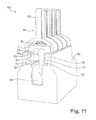
- the support system 56 carries various supports 1 which are partially empty, have partial covers 48 'and are partially provided with screws 80.
- the stop lugs 92 hold the carrier 1 back, with screws 80th are equipped because they prevent the free-running horizontal path from the support system 56 by a stop of the screws on the stop lugs 92.
- the covers 48 with their handles 50 let the isolated screws 80 back and slide easily by z. For example, a surgeon only has to reach for a cover and then through the stopper and opening system can move an entire prepared group of multiple containers 100, 100 ', 100 ", 100"' along the slide rails 90, 90 '.
- a possible holding body 60 which consists of a carriage 62 and at least one carrier 1 'and a cover 48'.
- the carriage 62 has the shape of a clip or the shape of a common clip which forms a U-piece, and at its extremities 64, 66, the side 3b of the carrier 1 ', which faces the bearing support surface 3a, touches and holds.
- the cavity 68 of the U-piece is matched in its height and width to the carrier 1, so that a screw 80 can be accommodated in the cavity 68.
- Notches 70, 72 are provided on the insides of the extremities 64, 66 to provide stability to the carriage 62 while providing the space for the runners 20, 22 to slide in the notches.
- a further alternative embodiment of a carrier provides that it has only one leg or differently shaped legs.
- the one leg may be formed as such and be supported for example in the carrier system.
- the other "leg" is designed as an engagement element which engages under the slide rails and engages in the carrier system.
- Such a carrier is easier to remove from the slide rails upwards - ie against the insertion - again or unclip.
- the carriers are made of sterilizable plastic, and can be color-coded. On the basis of the color code, the surgeon can recognize which screw he has in front of him. It is particularly advantageous if the carrier carries an easily recognizable color code, such as a complete coloration, while the cover is made of a transparent plastic.
- the transparent plastic allows the user, for. As the surgeon, can easily take a look at the covered screw, and so again make sure that under the cover is actually the auxiliary material for his operation, which he expects to find there. Because the carrier and the carrier system can be produced by plastic injection molding, the system can be produced very inexpensively.
Landscapes
- Health & Medical Sciences (AREA)
- Life Sciences & Earth Sciences (AREA)
- Surgery (AREA)
- Molecular Biology (AREA)
- General Health & Medical Sciences (AREA)
- Biomedical Technology (AREA)
- Heart & Thoracic Surgery (AREA)
- Medical Informatics (AREA)
- Nuclear Medicine, Radiotherapy & Molecular Imaging (AREA)
- Animal Behavior & Ethology (AREA)
- Engineering & Computer Science (AREA)
- Public Health (AREA)
- Veterinary Medicine (AREA)
- Packages (AREA)
- Accommodation For Nursing Or Treatment Tables (AREA)
- Surgical Instruments (AREA)
- Apparatus For Disinfection Or Sterilisation (AREA)
- Details Of Rigid Or Semi-Rigid Containers (AREA)
- Supplying Of Containers To The Packaging Station (AREA)
Applications Claiming Priority (2)
| Application Number | Priority Date | Filing Date | Title |
|---|---|---|---|
| CH3932004 | 2004-03-07 | ||
| EP04736428A EP1725180B1 (fr) | 2004-03-07 | 2004-06-09 | Recipient |
Related Parent Applications (1)
| Application Number | Title | Priority Date | Filing Date |
|---|---|---|---|
| EP04736428.6 Division | 2004-06-09 |
Publications (2)
| Publication Number | Publication Date |
|---|---|
| EP2241282A2 true EP2241282A2 (fr) | 2010-10-20 |
| EP2241282A3 EP2241282A3 (fr) | 2010-12-01 |
Family
ID=34957730
Family Applications (2)
| Application Number | Title | Priority Date | Filing Date |
|---|---|---|---|
| EP04736428A Expired - Lifetime EP1725180B1 (fr) | 2004-03-07 | 2004-06-09 | Recipient |
| EP10171104A Withdrawn EP2241282A3 (fr) | 2004-03-07 | 2004-06-09 | Système de support pour récipient destiné au matériel chirurgical auxiliaire |
Family Applications Before (1)
| Application Number | Title | Priority Date | Filing Date |
|---|---|---|---|
| EP04736428A Expired - Lifetime EP1725180B1 (fr) | 2004-03-07 | 2004-06-09 | Recipient |
Country Status (11)
| Country | Link |
|---|---|
| US (1) | US7857129B2 (fr) |
| EP (2) | EP1725180B1 (fr) |
| JP (1) | JP4603577B2 (fr) |
| CN (1) | CN1925810B (fr) |
| AT (1) | ATE478625T1 (fr) |
| AU (1) | AU2004317517B2 (fr) |
| BR (1) | BRPI0418621A (fr) |
| CA (1) | CA2558781A1 (fr) |
| NZ (1) | NZ550345A (fr) |
| WO (1) | WO2005092231A1 (fr) |
| ZA (1) | ZA200606746B (fr) |
Families Citing this family (34)
| Publication number | Priority date | Publication date | Assignee | Title |
|---|---|---|---|---|
| JP5192371B2 (ja) * | 2005-04-20 | 2013-05-08 | キナメッド・インコーポレーテッド | 滅菌処理と適合可能な外科用ねじの保持体及び方法 |
| DE102006062688A1 (de) * | 2006-04-07 | 2007-10-11 | Medicon Eg, Chirurgiemechaniker-Genossenschaft | Lagerungssystem für chirurgische Instrumente, Implantate und Schraubenverpackungen |
| DE102006016866A1 (de) * | 2006-04-07 | 2007-10-11 | Medicon Eg, Chirurgiemechaniker-Genossenschaft | Verpackungsvorrichtung für Implantatschrauben und Lagerungssystem für chirurgische Instrumente, Implantate und Schraubenverpackungen |
| DE102007015154A1 (de) * | 2007-03-22 | 2008-09-25 | Aesculap Ag & Co. Kg | Haltevorrichtung für ein Implantat |
| DE202007007409U1 (de) * | 2007-05-16 | 2008-09-25 | Kögel GmbH | Sterilisatorenschraubenaufnahme |
| DE202009002639U1 (de) | 2009-02-26 | 2009-05-07 | Medartis Ag | Träger und Halterung für chirurgische Gegenstände |
| US8470003B2 (en) | 2009-10-30 | 2013-06-25 | DePuy Synthes Products, LLC | Laminoplasty plates and methods of expanding the spinal canal |
| US8425515B2 (en) | 2009-10-30 | 2013-04-23 | Depuy Spine, Inc. | Bone graft loading instruments and methods of connecting a bone graft to a bone plate |
| US8425520B2 (en) | 2009-10-30 | 2013-04-23 | Depuy Spine, Inc. | Bone plate holder |
| DE202010007487U1 (de) * | 2010-06-01 | 2010-09-30 | Richard Martin Medizintechnik Gmbh | Kennzeichnungssystem für medizinische Implantate |
| EP2392286B1 (fr) | 2010-06-03 | 2015-05-20 | Medartis AG | Unité de stockage de vis à os, ensemble et récipient chirurgical |
| US9975679B2 (en) | 2010-07-27 | 2018-05-22 | DePuy Synthes Products, Inc. | Multi packaging system for medical implants |
| US20120132663A1 (en) | 2010-11-30 | 2012-05-31 | Tyco Healthcare Group Lp | Jaw Restraint |
| CN106005680A (zh) * | 2016-06-17 | 2016-10-12 | 苏州华驰机械有限公司 | 一种托盘支撑杆 |
| US20190133590A1 (en) | 2017-11-03 | 2019-05-09 | Covidien Lp | Ligation clip with controlled tissue compression |
| US10391190B1 (en) | 2018-02-21 | 2019-08-27 | K1 Medical Technologies, LLC | Modular tray and bracket assembly for equipment sterilization |
| US10932789B2 (en) | 2018-04-11 | 2021-03-02 | Covidien Lp | Ligation clip with latching and retention features |
| US10932788B2 (en) | 2018-04-11 | 2021-03-02 | Covidien Lp | Ligation clip with latching and retention features |
| US11033279B2 (en) | 2018-04-24 | 2021-06-15 | Covidien Lp | Ligation clip with retention features |
| US11304703B2 (en) | 2018-05-25 | 2022-04-19 | Covidien Lp | Ligation clip removal device |
| US11317923B2 (en) | 2018-08-13 | 2022-05-03 | Covidien Lp | Ligation clip with improved hinge |
| US11304704B2 (en) | 2018-08-22 | 2022-04-19 | Covidien Lp | Surgical clip applier and ligation clips |
| US10987205B2 (en) * | 2018-10-08 | 2021-04-27 | Biomet 3I, Llc | Surgical systems and trays |
| CA3057492A1 (fr) | 2018-10-08 | 2020-04-08 | Biomet 3I, Llc | Systemes et plateaux de chirurgie dentaire |
| US11083295B2 (en) * | 2019-04-02 | 2021-08-10 | DePuy Synthes Products, Inc. | Tube rack apparatus |
| US11471165B2 (en) | 2019-05-08 | 2022-10-18 | Covidien Lp | Ligation clip cartridge |
| US11707282B2 (en) | 2019-07-02 | 2023-07-25 | Covidien Lp | Multi-piece ligation clip |
| USD907203S1 (en) | 2019-08-02 | 2021-01-05 | Covidien Lp | Ligation clip |
| USD907204S1 (en) | 2019-08-02 | 2021-01-05 | Covidien Lp | Ligation clip |
| USD907200S1 (en) | 2019-08-05 | 2021-01-05 | Covidien Lp | Ligation clip |
| US11395660B2 (en) | 2019-08-05 | 2022-07-26 | Covidien Lp | Stackable ligation clip |
| US11696764B2 (en) | 2020-01-31 | 2023-07-11 | Covidien Lp | Ligation clip with controlled tissue compression |
| JP2023515388A (ja) * | 2020-02-14 | 2023-04-13 | メダルティス・ホールディング・アクチェンゲゼルシャフト | 外科用物体のための保持体、ならびにそのような保持体を含むセットおよび容器 |
| US12114866B2 (en) | 2020-03-26 | 2024-10-15 | Covidien Lp | Interoperative clip loading device |
Citations (1)
| Publication number | Priority date | Publication date | Assignee | Title |
|---|---|---|---|---|
| DE4122045A1 (de) | 1991-07-03 | 1993-01-07 | Leibinger Oswald Gmbh | Vorrichtung zum sterilen bereithalten von chirurgischen implantaten |
Family Cites Families (24)
| Publication number | Priority date | Publication date | Assignee | Title |
|---|---|---|---|---|
| US3624867A (en) * | 1968-09-20 | 1971-12-07 | Amp Inc | Plastic locking nut in strip form |
| US4685564A (en) * | 1986-07-30 | 1987-08-11 | Hacker Instruments, Inc. | Blade-holder magazine |
| US5040676A (en) * | 1990-06-29 | 1991-08-20 | Codman & Shurtleff, Inc. | Container and dispenser for an aneurysm clip |
| US5046611A (en) * | 1990-10-22 | 1991-09-10 | Edward Weck Incorporated | Hemostatic clip cartridge |
| JPH0475214U (fr) * | 1990-11-13 | 1992-06-30 | ||
| US5384103A (en) * | 1992-03-17 | 1995-01-24 | Micromedics, Inc. | Instrument tray |
| US5279416A (en) * | 1992-06-05 | 1994-01-18 | Edward Weck Incorporated | Ligating device cartridge with separable retainer |
| JPH06321268A (ja) * | 1993-05-07 | 1994-11-22 | Matsutani Seisakusho Co Ltd | 医療器具容器 |
| CN2192296Y (zh) | 1994-07-08 | 1995-03-22 | 苏州华夏针灸医疗器械有限公司 | 分隔针床针灸针包装盒 |
| US5551214A (en) * | 1994-07-20 | 1996-09-03 | Ethicon, Inc. | Ligaclip loading machine and process |
| US5490975A (en) * | 1994-12-14 | 1996-02-13 | Poly-Vac Incorporated | Sterilization and storage container tray |
| IT1278836B1 (it) * | 1995-06-06 | 1997-11-28 | Orthofix Srl | Contenitore multifunzionale particolarmente per fili filettati per operazioni di chirurgia ortopedica |
| DE29620636U1 (de) * | 1996-11-27 | 1997-01-16 | Lohmann Gmbh & Co Kg, 56567 Neuwied | Vorratseinrichtung für medizinische Tupfer |
| DE29705944U1 (de) | 1997-04-03 | 1997-05-28 | Karl Leibinger Medizintechnik GmbH & Co. KG, 78570 Mühlheim | Implantat-Lagerungssystem |
| DE19730696B4 (de) * | 1997-07-17 | 2011-06-01 | Rösler, Peter | Vorrichtung zur Aufnahme von langgestreckten Gegenständen |
| US5979643A (en) * | 1997-09-05 | 1999-11-09 | Nobel Biocare Usa, Inc. | Dental implant prosthesis component display system |
| US6044971A (en) * | 1997-10-10 | 2000-04-04 | United States Surgical Corporation | Clip cartridge |
| US5979634A (en) | 1997-10-17 | 1999-11-09 | Paper Converting Machine Company | Infeed section for packaging apparatus |
| AU5558099A (en) * | 1998-08-12 | 2000-03-06 | Nobel Biocare Ab | One-step threaded implant |
| JP3062490B1 (ja) * | 1999-03-16 | 2000-07-10 | 日本イーライリリー株式会社 | 針ユニット保持板 |
| US6561805B2 (en) * | 1999-08-12 | 2003-05-13 | Nobel Biocare Ab | Universal implant delivery system |
| DE69921864T2 (de) * | 1999-12-30 | 2005-10-27 | Biotech International (S.A.R.L.) | Vorrichtung zur handhabung und zur identifizierung kleiner implantate |
| US6382575B1 (en) * | 2000-07-28 | 2002-05-07 | Paragon Medical, Inc. | Instrument holder for use in conjunction with a mounting plate |
| JP3638869B2 (ja) * | 2000-09-06 | 2005-04-13 | ダイヤシステム株式会社 | 医療用補助具の収容体 |
-
2004
- 2004-06-09 NZ NZ550345A patent/NZ550345A/en unknown
- 2004-06-09 EP EP04736428A patent/EP1725180B1/fr not_active Expired - Lifetime
- 2004-06-09 AU AU2004317517A patent/AU2004317517B2/en not_active Expired - Fee Related
- 2004-06-09 AT AT04736428T patent/ATE478625T1/de active
- 2004-06-09 EP EP10171104A patent/EP2241282A3/fr not_active Withdrawn
- 2004-06-09 WO PCT/IB2004/001882 patent/WO2005092231A1/fr not_active Ceased
- 2004-06-09 JP JP2007502420A patent/JP4603577B2/ja not_active Expired - Fee Related
- 2004-06-09 US US10/591,547 patent/US7857129B2/en not_active Expired - Fee Related
- 2004-06-09 CN CN200480042327XA patent/CN1925810B/zh not_active Expired - Fee Related
- 2004-06-09 BR BRPI0418621-4A patent/BRPI0418621A/pt not_active IP Right Cessation
- 2004-06-09 CA CA002558781A patent/CA2558781A1/fr not_active Abandoned
-
2006
- 2006-08-14 ZA ZA200606746A patent/ZA200606746B/en unknown
Patent Citations (1)
| Publication number | Priority date | Publication date | Assignee | Title |
|---|---|---|---|---|
| DE4122045A1 (de) | 1991-07-03 | 1993-01-07 | Leibinger Oswald Gmbh | Vorrichtung zum sterilen bereithalten von chirurgischen implantaten |
Also Published As
| Publication number | Publication date |
|---|---|
| US20080302688A1 (en) | 2008-12-11 |
| ATE478625T1 (de) | 2010-09-15 |
| CN1925810A (zh) | 2007-03-07 |
| EP1725180B1 (fr) | 2010-08-25 |
| JP2007527762A (ja) | 2007-10-04 |
| EP2241282A3 (fr) | 2010-12-01 |
| WO2005092231A1 (fr) | 2005-10-06 |
| AU2004317517A1 (en) | 2005-10-06 |
| US7857129B2 (en) | 2010-12-28 |
| NZ550345A (en) | 2009-11-27 |
| JP4603577B2 (ja) | 2010-12-22 |
| BRPI0418621A (pt) | 2007-05-02 |
| AU2004317517B2 (en) | 2010-10-07 |
| CN1925810B (zh) | 2010-11-10 |
| CA2558781A1 (fr) | 2005-10-06 |
| ZA200606746B (en) | 2007-05-30 |
| EP1725180A1 (fr) | 2006-11-29 |
Similar Documents
| Publication | Publication Date | Title |
|---|---|---|
| EP1725180B1 (fr) | Recipient | |
| EP1842505B1 (fr) | Dispositif d'emballage pour vis d'implant | |
| EP2400913B1 (fr) | Support et fixation pour des objets chirurgicaux | |
| EP1089783B1 (fr) | Dispositif pour le vidage par aspiration de cavites contenant de la poudre | |
| DE2841119A1 (de) | Wegwerfeinheit zur aufnahme von benutzten klingenfoermigen gegenstaenden | |
| DE1541176B1 (de) | Behaelter zur Aufnahme und Abgabe von Klammern zum Naehen von Organen mittels eines chirurgischen Instruments | |
| DE1975313U (de) | Instrumentenlagerungsgestell. | |
| CH637816A5 (de) | Vorrichtung zum zerkleinern von nahrungsmitteln. | |
| EP1274362B1 (fr) | Dispositif permettant de stocker des objets | |
| DE202006004099U1 (de) | Modul-Wannensystem | |
| EP0365936B1 (fr) | Disposition d'armoire | |
| DE102004046984B4 (de) | Vorrichtung und System zum Bereithalten von lang gestreckten chirurgischen Befestigungselementen | |
| DE102014101658A1 (de) | Skalpellhalter | |
| EP3866721B1 (fr) | Emballage résorbable pour produit médico-technique | |
| DE102005047097B4 (de) | Chirurgisches Profilelement, Satz chirurgischer Profilelemente und chirurgischer Behälter dazu | |
| DE102008028399A1 (de) | Vorrichtung zur Aufbereitung von medizinischen Instrumenten | |
| DE102004053355A1 (de) | Wanne zur Aufnahme medizinischer Gegenstände | |
| DE202013104206U1 (de) | Behälter für medizinischen Abfall | |
| DE202005015414U1 (de) | Chirurgisches Profilelement | |
| DE102006016866A1 (de) | Verpackungsvorrichtung für Implantatschrauben und Lagerungssystem für chirurgische Instrumente, Implantate und Schraubenverpackungen | |
| DE10297121T5 (de) | Ausgabesystem für sterile Schrauben | |
| AT500130B1 (de) | Magnetische ablage für chirurgisches material und besteck | |
| DE102006029061B4 (de) | Halteelement für ein Haltesystem für medizinische Gegenstände und Haltesystem für medizinische Gegenstände | |
| DE3884792T2 (de) | Klingenabnahme- und/oder -befestigungsmechanismus sowie diesen Mechanismus enthaltende Spender- und Extraktions-/Wegwerfvorrichtung. | |
| DE202022102177U1 (de) | Verpackungsanordnung, insbesondere zur Verwendung als Adventskalender |
Legal Events
| Date | Code | Title | Description |
|---|---|---|---|
| PUAI | Public reference made under article 153(3) epc to a published international application that has entered the european phase |
Free format text: ORIGINAL CODE: 0009012 |
|
| AC | Divisional application: reference to earlier application |
Ref document number: 1725180 Country of ref document: EP Kind code of ref document: P |
|
| AK | Designated contracting states |
Kind code of ref document: A2 Designated state(s): AT BE BG CH CY CZ DE DK EE ES FI FR GB GR HU IE IT LI LU MC NL PL PT RO SE SI SK TR |
|
| PUAL | Search report despatched |
Free format text: ORIGINAL CODE: 0009013 |
|
| AK | Designated contracting states |
Kind code of ref document: A3 Designated state(s): AT BE BG CH CY CZ DE DK EE ES FI FR GB GR HU IE IT LI LU MC NL PL PT RO SE SI SK TR |
|
| RIN1 | Information on inventor provided before grant (corrected) |
Inventor name: IACONI-FORRER, RUTH Inventor name: FURRER, ANDRE Inventor name: CANDRIAN, KARINA |
|
| STAA | Information on the status of an ep patent application or granted ep patent |
Free format text: STATUS: THE APPLICATION IS DEEMED TO BE WITHDRAWN |
|
| 18D | Application deemed to be withdrawn |
Effective date: 20110602 |