EP2241879A1 - Procede de surveillance non invasive par micro-ondes du durcissement d'une matiere plastique thermostable et dispositif a micro-ondes destine a la mise en oeuvre du procede - Google Patents
Procede de surveillance non invasive par micro-ondes du durcissement d'une matiere plastique thermostable et dispositif a micro-ondes destine a la mise en oeuvre du procede Download PDFInfo
- Publication number
- EP2241879A1 EP2241879A1 EP09708078A EP09708078A EP2241879A1 EP 2241879 A1 EP2241879 A1 EP 2241879A1 EP 09708078 A EP09708078 A EP 09708078A EP 09708078 A EP09708078 A EP 09708078A EP 2241879 A1 EP2241879 A1 EP 2241879A1
- Authority
- EP
- European Patent Office
- Prior art keywords
- resonator sensor
- microwave
- unloaded
- plastic material
- resonance frequency
- Prior art date
- Legal status (The legal status is an assumption and is not a legal conclusion. Google has not performed a legal analysis and makes no representation as to the accuracy of the status listed.)
- Withdrawn
Links
Images






Classifications
-
- G—PHYSICS
- G01—MEASURING; TESTING
- G01N—INVESTIGATING OR ANALYSING MATERIALS BY DETERMINING THEIR CHEMICAL OR PHYSICAL PROPERTIES
- G01N22/00—Investigating or analysing materials by the use of microwaves or radio waves, i.e. electromagnetic waves with a wavelength of one millimetre or more
-
- G—PHYSICS
- G01—MEASURING; TESTING
- G01R—MEASURING ELECTRIC VARIABLES; MEASURING MAGNETIC VARIABLES
- G01R27/00—Arrangements for measuring resistance, reactance, impedance, or electric characteristics derived therefrom
- G01R27/02—Measuring real or complex resistance, reactance, impedance, or other two-pole characteristics derived therefrom, e.g. time constant
- G01R27/26—Measuring inductance or capacitance; Measuring quality factor, e.g. by using the resonance method; Measuring loss factor; Measuring dielectric constants ; Measuring impedance or related variables
Definitions
- This invention belongs to the technical field of methods employed to monitor the curing process of a thermoset plastic material.
- the invention uses microwaves to obtain readings through which the evolution of the material in the curing process can be monitored.
- Curing is a chemical reaction which converts a certain polymer or combination of polymers into a thermoset plastic.
- PUR polyurethane
- curing is based on two basic components, liquids at nearly ambient temperature, which are mixed in specific proportions and react in a mould with a predetermined shape, giving a solid piece.
- PUR is essentially based on a polyol (known as component A) and a prepolymerised isocyanate (known as component B).
- component A polyol
- component B prepolymerised isocyanate
- other additives are normally added to the mixture to aid the development of the reaction, such as chain extenders, cross-linking agents, catalysts, blowing agents, light stabilises, anti-static additives, anti-hydrolysers, etc.
- thermoset material From the moment the components are mixed, a more or less simultaneous series of reactions start which give the end result of the thermoset material. Examples of these are polymerisation reactions, cross-linking reactions and foaming reactions. All these reactions take place inside the mould, which acts as a reactor, and once the process is finished the material takes on a thermoset nature which makes further moulding impossible. If during the production process small alterations occur in the dosing or mixture of the components, or even ageing of the components for different causes, the reactions which should be carried out inside the mould may not be those desired, producing a defective material which can not always be detected by sight alone. In some processes, the wasted material can be up to 10%. This has repercussions on additional costs and the environment.
- thermoset plastics are generally carried out over a very short time period (in some cases even less than 3 seconds) and are very difficult to control, as they depend on numerous factors such as the dosing of the components, temperature, pressure, humidity, ageing of the components, etc. Because of this, currently the only way of ensuring good quality in thermoset plastics such as polyurcthane is to carry out a series of tests on the material once the curing process has finished - i.e. a posterior controls.
- the process is based on specifications from the polymer manufacturer concerning the time/temperature/pressure recommended, obtained from hypotheses about the state of the materials before/during/after the process. Normally conservative estimations are used, which means that the curing process is much less efficient than it could be.
- Procedures are known in the state-of-the-art which allow monitoring of the curing process, the most relevant being those based on temperature sensors ( US 6,490,501 ), ultrasound" ( US 5,009,104 , US 5,911,159 ), optical fibre based sensors ( US 5,158,720 ) piezotransducers ( us 2006/123914 ), mass spectrometry ( JP 6344366 ), nuclear magnetic resonance ( US 5,321,358 ) and low frequency microdielectrometry ( US 5,158,720 ).
- the temperature sensors are characterised by the fact that they can only monitor exo/endothermic reactions, and the shape, weight and size of samples must be carefully controlled to obtain precise measurements. Moreover, the temperature measurement must be carried out at one point only, generally on the surface, if the process is to be non-invasive.
- optical fibre sensors are very fragile and are drastically affected by changes in temperature or pressure, which means that these are not suitable for monitoring the curing of most thermoset plastics, for instance polyurethane.
- the IR spectrometry requires the use of destructive methods, as the sensor penetrates and perforates the material to take measurements. It is also very expensive and requires qualified staff.
- the present invention describes a new method and a device, as an example of the application of said method, for the non-invasive monitoring of the curing process of a thermoset plastic material.
- the present invention relates to a method for non invasive monitoring of the chemical reaction linked to the curing process of a thermoset plastic material through the use of microwaves.
- This thermoset plastic material could be polyurethane, for example.
- this method includes the following stages.
- the polymeric components are poured into a mould for shaping and curing.
- the components adopt the form of the mould as the curing process progresses, to become a thermoset plastic in the predefined shape of the mould.
- Signals are generated on the microwave frequency spectrum, within a frequency range of 300 MHz and 100 GHz, for example, between 1 GHz and 3 GHz.
- thermoset plastic material reflects a part of the signal conducted towards it and absorbs the other part of the conducted signal, depending on the state of the thermoset material at that moment.
- the resonator sensor is a resonant microwave structure which is in contact with the thermoset plastic material.
- thermoset plastic material The signal reflected by the thermoset plastic material will be received by the same microwave cable. From this reflected signal the reflection coefficient can be obtained, both its modulus and its phase. This reflection coefficient is defined as the relation or quotient between the conducted signal, also known as incident signal, and the reflected signal.
- the unloaded resonance frequency is determined, as well as the coupling factor and/or the unloaded quality factor.
- the unloaded values for resonance frequency and quality factor correspond to thesae values for which disturbances in the resonator sensor coupling network have been eliminated, and which represent the real or typical resonance frequency and quality factor of the resonator sensor without distortion due to the effect of the coupling network.
- the coupling network can disturb the measurements taken of the resonance frequency and the quality factor, and because of this, using directly calculated values without making adjustments can lead to incorrect results if coupling is not taken into account.
- Using the electromagnetic relationship between the unloaded resonance frequency and quality factor from the resonator sensor it is possible to determine the value of the complex permittivity of the thermoset material.
- thermoset plastic material With the values obtained in real time, monitoring in real time of the curing process of a thermoset plastic material can be carried out.
- this control or monitoring either the unloaded resonance frequency and quality factor obtained or the real and imaginary parts of the complex permittivity can be used.
- the method of the invention can include a procedure to obtain the complex permittivity of the thermoset material from the previous determination of the unloaded resonance frequency, coupling factor and quality factor extracted from the measurement of the reflection coefficient from a resonator sensor in contact with the thermoset plastic material.
- This procedure includes the previous numerical obtaining of a relationship between unloaded resonance frequencies and quality factors, which correspond to the specific shape of the resonator sensor, and complex permittivity values of the thermoset plastic material with which the resonator is in contact, covering the possible values of variation of the thermoset plastic materials during its curing process.
- thermoset plastic material and resonator sensor for each combination of thermoset plastic material and resonator sensor, a matrix relating unloaded resonance frequencies and quality factors with complex permittivity values (real and imaginary part) can be created, making it possible to obtain each of these values, the other two being tabulated.
- complex permittivity values real and imaginary part
- the coupling network can produce distortion in the measurement obtained. Because of this, within the process to obtain the complex permittivity of the thermoset material a pre-calibration of the resonator sensor can be carried out using materials of known permittivity and with different coupling networks, strongly and weakly coupled, to determine in all cases the detuning produced by the coupling network.
- This detuning can be defined as the deviation of the unloaded resonance frequency as compared with the measured resonance frequency, the measured resonance frequency being the frequency at which the smallest peak is produced for the reflection coefficient.
- a strong coupling is understood as the one that allows the injection of a large quantity of energy to the resonator and therefore, the resonator sensor can be applied to materials with high losses or high conductivities, which however greatly disturb the unloaded resonance frequency of the resonator sensor; a weak coupling is the one that causes little disturbance to the resonator sensor but limits its application to materials with low losses or low conductivities.
- This procedure also comprises the measurement in real time of the modulus and the phase of the reflected signal and the reflection coefficient, the real-time obtaining of the unloaded quality factor, the coupling factor and the resonance frequency of the smallest peak from the modulus and the phase of the reflection coefficient.
- the invention in a second aspect, relates to a device for non-invasive, real-time monitoring of the chemical reaction linked to the curing process of a thermoset plastic material, i.e. polyurethane, inside a mould using microwaves.
- This device comprises a resonator sensor, a microwave generator for the generation of a microwave signal connected to the resonator sensor through a microwave cable through which the signal generated circulates, and a circuit for the coupling of energy to the resonator. It also comprises a microwave receptor for the reception of the reflected signal through the same microwave cable, which is separated from the generator's incident signal by a separating network.
- the resonators sensor is embedded in the mould, and comprises a coaxial structure, of length proportional to the wavelength of the signal emitted, with a first end that features a metallic wall acting as a short circuit, and the second end is contained within the mould surface.
- the second end of the resonator sensor adapts to the shape of the inside of the mould and does not change the inside surface of said mould, in other words, the presence of the resonator sensor does not alter the shape of the mould and is able to take non-invasive measurements.
- the resonator sensor is connected to the microwave generator and the microwave receptor through the first end of the resonator sensor.
- the second end of the resonator sensor is configured to conduct the microwave signal generated towards the thermoset plastic material. This process whereby the signal is conducted can take place when the resonator sensor is in direct contact with the thermoset plastic material, or when they are situated close enough for the signal to travel from the resonator sensor to the thermoset plastic material without there being contact between the two.
- the length of the resonator sensor can be proportional in a integer odd multiple of a quarter of the wavelength of the signal emitted.
- the length of the resonator sensor can be, for example, an eight, a quarter or three eighths of the wavelength.
- the microwave generator can generate microwave signals at a frequency range from 300 MHz to 100 GHz, for example between 1 GHz and 3 CHz.
- the device can include a separating network to separate both signals and thus ensure that the receptor only receives the reflected signal.
- the microwave receptor can comprise an element selected from: a system to measure the modulus and phase of the reflected signal in real time, a calibrated reflectometer with 5 or 6 ports, and a network analyser connected to monitoring software to automatically obtain the resonance frequency and the quality factor of the reflected signal.
- the energy coupling circuit can be capacitive or inductive.
- the separating network can comprise a circuit selected from: a divider and an isolator, a divider and a directional coupler, a dual directional coupler and a directional coupler, and an isolator.
- thermoset plastic material in another aspect of the invention, as an example of the application of the method, it relates to a device for the non-invasive determination of the degree of cure undergone by a thermoset plastic material using microwaves.
- the invention proposes a method for the determination of the unloaded resonance frequency and the unloaded quality factor of a resonant microwave sensor, with a very strong coupling.
- the invention proposes a method for the determination of the complex permittivity of a material undergoing changes in hardness, such as those produced in polymer curing processes, from the 2D interpolation of the unloaded resonance frequencies and quality factors measured and complex permittivity values, both real and imaginary parts, previously obtained by a thorough electromagnetic analysis of the resonator sensor in contact witch a material having a curved surface, adapted to the shape of the mould where the curing takes place.
- the invention proposes a procedure through which this characterisation of complex permittivity is carried out in real time whilst the curing process is taking place.
- Another object of the invention is to propose a process and device for monitoring complex permittivity, where permittivity does not depend on approximations, closed expressions or iterative methods of related variables.
- a further object of the invention is to provide a procedure and device for monitoring the curing process on viscous materials, with different degrees of viscosity.
- a further object of the invention is to provide a procedure and device for monitoring the curing process where the material used is polyurethane.
- thermoset plastic material (2) using microwaves and of a microwave device for the application of this method according to the present invention.
- FIG. 1 shows an operation scheme for the measurement process of the non-invasive monitoring of the curing of a thermoset plastic material (2).
- thermoset plastic material (2) is placed inside a metallic mould (1).
- the mould (1) is normally metallic, it can also be made of any other material.
- the polymeric components which will transform into a thermoset plastic material (2) start the curing process, which goes through stages of evolution, modifying its properties and hardening until the mould (1) is filled and it takes on its predefined shape.
- thermoset plastic material (2) In one wall of said mould (1) an access is made and the resonator sensor (4) is placed in contact with the thermoset plastic material (2), without faltering the shape of the inner surface of the mould (1).
- the contact between the resonator sensor (4) and the thermoset plastic material (2) is such that it permits the resonator sensor (4) to emit microwaves. These waves penetrate the thermoset plastic material (2) where one part is absorbed and the other part reflected and detected by the same resonator sensor (4).
- a protective covering (3) will be situated.
- This protective covering (3) must be made from a material that is transparent to microwaves, that is to say that it does not absorb or weaken the energy emitted to the thermoset plastic material (2).
- Preferred materials for the protective covering (3) are those made from Teflon or ceramics.
- thermoset plastic material (2) receives the signals coming from the microwave generator (7) through a feeding circuit (5), which is connected to a microwave cable (6).
- the supply circuit (5) of the resonator sensor (4) is an essential element in the operation of the process, as described in the following figures.
- This supply circuit (5) can be inductive, implemented with equipment such as current loops or couplings by openings, or capacitive, implemented with electrical probes, for example.
- the reflected response from the thermoset plastic material (2) is conducted towards the microwave receptor (8) through the microwave cable (6) through which the signals were initially generated. So that the microwave generator (7) can distinguish the reflected signal from the incident signal, at the end of the microwave cable (6) a separating network (9) is situated, which allows the separation of the reflected signal from the signal emitted by the generator.
- the microwave receptor (8) consists of a modulus and phase detector, for example of the type AD8302, capable of detecting signals in real time. Commercial network analysers can carry out this function but generally these are not suitable as they present difficulties when worming in real time, being generic devices.
- thermoset plastic material (2) for example polyurethane
- This control unit (10) carries out tasks to achieve the constant measurement in real time of the microwaves reflection from the thermoset plastic material (2) provided by the resonator sensor (4) as changes happen due to the chemical reaction linked to the curing process.
- the method comprises the following stages:
- thermoset material i.e. polyurethane or any other tested material
- the physical-chemical properties of the thermoset material can be obtained from the experimentally obtained correlations, in particular the properties as they change from the base components to the later hard form as a consequence of curing.
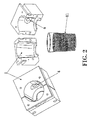
- Figure 2 shows a possible embodiment of the resonator sensor (4) for the non-invasive determination of the degree of cure of a thermoset plastic material (2), where the previously described method is applied.
- the device comprises a metallic mould (1), a resonator sensor (4) configured as a reflection resonator, and the elements mentioned in the description of figure 1 , a microwave generator (7) for the generation of a microwave signal which is transmitted to the resonator sensor (4) through a supply circuit (5) and a microwave cable (6), a separating network (9) and a microwave receptor (8) for reception by the resonator sensor (4) of the modulus and the phase of the reflected signal.
- the metallic mould (1) where the curing process of the thermoset plastic material (2) is carried out has a truncated-conical or vessel shape.
- the resonator sensor (4) is embedded in one of the sides of the mould (1).
- This resonator sensor (4) is based on a coaxial structure, of a length proportional to the wavelength of the signal emitted, specifically proportional to 1/4, 1/2 or 3/8 of the wavelength. Its inner and outer radial dimensions have been conceived in such a way that the response from the resonator sensor (4) is as sensitive as possible to variations in complex permittivity of the thermoset plastic material (2) in its curing process, as described in the publication; Beatriz Garc ⁇ a-Ba ⁇ os et al 2005, Meas. Sci. Technol. 16 1186-1192, "Design rules for the optimization of the sensitivity of open-ended coaxial microwave sensors for monitoring changes in dielectric materials ".
- the polymeric components - for instance, the polyurethane components - are mixed and poured into the mould (1), and from this moment on the real-time reflection from the resonator sensor (4) is received.
- the configuration of the resonator sensor (4) with an opening in the mould (1) requires a protective covering (3) a few microns thick, to prevent the shape of the thermoset plastic material (2) from being altered by the shape of the resonator sensor (4).
- the configuration of the resonator sensor (4) is not limited to coaxial resonators but can extend to other types of resonators which can adapt to the inner shape of the mould (1), such as for example, special planar sensors such as curved microstrips, curved or straight coplanar sensors, etc., or waveguide sensors with various sections: circular, rectangular, elliptical, etc.
- Figure 3 shows detail from the instrument described in figure 2 , where it can be seen that the coaxial structure of the resonator sensor (4) comprises two ends (12, 13).
- the first end (12) features a metallic wall (14) which acts as a short circuit for microwaves and defines their dimensions, as well as the range of frequencies at which it works.
- Said first end (12) is also used to supply the resonator sensor (4) through a supply circuit (5).
- the second end (13) is made in such a way that, as can be observed in figures 1 and 3 , it adapts to the inner shape of the mould (1) without altering the profile, outline or inner surface of said mould (1).
- the resonator sensor (4) receives microwaves from the microwave generator (7), in this case preferably between 1 and 3 GHz, through the supply circuit or coupling network (5) and the microwave cable (6), emits them to the thermoset plastic material (2) and collects the response from the thermoset plastic material (2) using the same microwave cable (6).
- This response manifests itself as a reflection which is received by the microwave receptor (8), after being separated by the separating network (9) from the signal emitted by the microwave generator (7). All this is synchronised by the control unit (10) to carry out control in real time, able to obtain several points per second.
- thermoset plastic material (2) changes its complex permittivity, which in turn changes the reflected signal detected by the resonator sensor (4) and conducted to the microwave receptor (8).
- Figure 4 shows 5 of these reflected signals, specifically the reflection coefficient ⁇ m , received by the microwave receptor (8) after being separated by a separating network (9) from the signal emitted by the generator, in different moments of the curing process.
- the different states of the thermoset plastic material (2) during the curing process are represented in this figure by the different signals received.
- This figure depicts four of the signals received during the curing process (15) and a final signal characterising the thermoset plastic once the curing process is over (16).
- Each one of the signals received in figure 4 shows a peak which corresponds to the frequencies absorbed by the thermoset plastic material (2) at that precise moment, known as resonance frequency, while the rest are completely reflected.
- connection of a resonator sensor (4) to other external element, such as the microwave generator (7) and the microwave receptor (8) by means of a supply circuit or a coupling network (5) and a microwave cable (6) causes a detuning effect on the resonator sensor (4), therefore the frequency at which the minimum reflection is produced, henceforth referred to as f min , does not match the real resonance frequency of the resonator sensor (4), referred to as unloaded resonance frequency and expressed as f u , which is exactly what is related to the complex permittivity of the thermoset plastic material (2).
- the connection of the resonator sensor (4) with the rest of the elements causes a reduction in the quality factor of the resonance.
- the whole system presents a quality factor, known as the loaded quality factor and referred to here as Q L , which is related to the bandwidth of the resonance.
- this loaded quality factor includes also the effects of elements outside of the resonator sensor (4) and is always lower than the real quality factor presented by the resonator sensor (4) known as unloaded quality factor Q u , which is related to the permittivity of the thermoset plastic material (2). Therefore a procedure is necessary to eliminate the effects of the elements outside of the resonator sensor (4) on the resonance so as to be able to obtain the values for the unloaded resonance frequency and quality factor and to correctly determine the permittivity of the thermoset plastic material (2). This procedure, not carried out in other patents, is implemented in this invention.
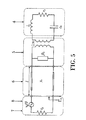
- Figure 5 depicts a circuit equivalent to the resonator sensor (4), together with the supply circuit (5) used to supply the sensor with the signal coming from the microwave generator (7) through a microwave cable (6), whose reflection is returned through the same microwave cable (6) towards the microwave receptor (8), where it is measured to determine the reflection coefficient, I m .
- This electric diagram allows the reduction of the quality factor and the detuning of the resonator sensor (4) to be modelled when connected to the rest of the elements (5, 6, 7, 8), as previously mentioned.
- the resonator sensor (4) is very weakly coupled, i.e. k is much smaller than 1, the effect of the elements outside the resonator sensor (4) on the resonance can be neglected and the unloaded quality factor, although it will never coincide, can be close to the loaded quality factor and can later be used for the determination of the complex permittivity without any excessive loss of precision.
- the coupling is not weak, as is necessary, especially at the start of the curing process in thermoset materials, for example, where the material normally presents moderate to high losses and requires strong coupling, the influence of the supply circuit is so important that the use of the value of the loaded quality factor to determine the permittivity would lead to very serious errors.
- the loaded quality factor, Q L can be obtained by means of scalar microwave receptors which measure the modulus of the reflection coefficient,
- the determination of the coupling factor k , and consequently the unloaded quality factor, Q u requires the measurement of the phase of the signal, for which it is necessary to use microwave detectors which provide both the modulus and the phase of the reflection.
- the loaded quality factor, Q L can be obtained from the bandwidth of the reflection around the resonance peak, as carried out in other patents.
- an alternative procedure is described which offers more precise results.
- the procedure basically consists of an automatic adjustment of curves on the complex plane of the reflection signal received on the vectorial receptor, ⁇ m , based on the rigorous formulation of the resonant system model shown in Figure 5 , and a rapid algorithm to work in real time, which is very important for an industrial application of this type. This new procedure allows:
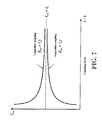
- Figure 7 shows the deviations in the resonance frequency measured through the minimum reflection, f min , in relation to the unloaded or real resonance frequency of the cavity, f u , according to the type of coupling.
- the equivalent circuit of the supply circuit can be disregarded and the resonance frequency, although it will never coincide, can be close to the minimum of the reflection peak of the resonator sensor (4) and can be used later to determine the complex permittivity without any great loss of precision.
- the unloaded frequency value, f u can be obtained using the expression (ii), thereby eliminating the effect of the elements outside the resonator sensor (4) on the resonance frequency.
- the determination of the parameter b e in (ii) requires exact knowledge of the equivalent length of the microwave cable (6), in other words, value 1 in Figure 5 , which in practice is not possible as the supply circuit (5), sometimes also known as the coupling network, adds extra length to the microwave cable (6) which is, in general, unknown and dependent on the electromagnetic fields inside the resonator sensor (4). Because of this, the previously mentioned curve adjustment procedure does not provide unloaded frequency values, f u , but minimum reflection frequency values, f min .
- thermoset plastic materials (2) are thermoset plastic materials (2), owing to the fact that at the beginning of the curing process the polymeric materials present high conductivities or high losses, which forces resonator sensors (4) to be very strongly coupled in order to obtain a correct reading.
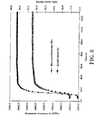
- FIG. 8 shows typical evolution of the resonance frequency, f u , and the quality factor, Q u , obtained from the signals shown in figure 4 , using the procedure described in figures 5 and 6 and the pre-calibration of figure 7 , with the evolution of the curing process, and these constitute a curve representative of the evolution process. It can be seen that after some initial changes, the reading becomes stable, which indicates that the thermoset plastic material (2) has finished the process and will stay stable.
- the unloaded resonance frequency and the unloaded quality factor can be used to determine the complex permittivity of thermoset plastic materials (2) and the complex permittivity (real and imaginary parts) can be used as a parameter for monitoring the curing process, although this invention does not refer to a specific method for determining the permittivity.
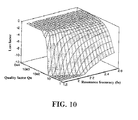
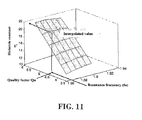
- What is proposed in this invention as a data obtaining method for the permittivity in real time is an alternative to closed expression based on approximations or more rigorous iterative methods, and which essentially consists of the 2D interpolation of previously calculated tables, matrixes, which relate unloaded resonance frequencies and unloaded quality factors to the real and imaginary parts of the permittivity.
- Figures 9 referring to the real part, and 10, referring to imaginary part, show the value of the matrixes calculated for the configuration of the resonator sensor (4) shown in figures 2 and 3 ; and figure 11 shows the 2D interpolation process used to determine, for example, the dielectric constant, in other words the real part, from specific measurements of the resonance frequency and the quality factor corresponding to a specific moment during the curing process.
- the procedure used to generate the matrixes uses electromagnetic simulators due to the complexity of obtaining these matrixes when the configuration of the end of the resonator sensor (4) in contact with the thermoset plastic material (2) is not regular.
- Figure 12 shows the evolution over ti.me of the dielectric constant or real part of the permittivity and the loss factor or imaginary part of the permittivity during the evolution of the curing process of a thermoset plastic material. Said values calculated using the aforementioned procedures, from the measurement of the resonance frequency and the unloaded quality factor, and the 2D interpolation process make their own particular imprint on the monitoring of a specific curing process.
Landscapes
- Physics & Mathematics (AREA)
- General Physics & Mathematics (AREA)
- Electromagnetism (AREA)
- Health & Medical Sciences (AREA)
- Life Sciences & Earth Sciences (AREA)
- Chemical & Material Sciences (AREA)
- Analytical Chemistry (AREA)
- Biochemistry (AREA)
- General Health & Medical Sciences (AREA)
- Immunology (AREA)
- Pathology (AREA)
- Measurement Of Resistance Or Impedance (AREA)
- Investigating Or Analyzing Materials By The Use Of Electric Means (AREA)
Applications Claiming Priority (2)
| Application Number | Priority Date | Filing Date | Title |
|---|---|---|---|
| ES200800285A ES2335635A1 (es) | 2008-02-04 | 2008-02-04 | Metodo para la monitorizacion no invasiva del curado de un material plastico termoestable mediante el uso de microondas y dispositivo microondas para la aplicacion de dicho metodo. |
| PCT/ES2009/000061 WO2009098336A1 (fr) | 2008-02-04 | 2009-02-04 | Procédé de surveillance non invasive par micro-ondes du durcissement d'une matière plastique thermostable et dispositif à micro-ondes destiné à la mise en oeuvre du procédé |
Publications (1)
| Publication Number | Publication Date |
|---|---|
| EP2241879A1 true EP2241879A1 (fr) | 2010-10-20 |
Family
ID=40951802
Family Applications (1)
| Application Number | Title | Priority Date | Filing Date |
|---|---|---|---|
| EP09708078A Withdrawn EP2241879A1 (fr) | 2008-02-04 | 2009-02-04 | Procede de surveillance non invasive par micro-ondes du durcissement d'une matiere plastique thermostable et dispositif a micro-ondes destine a la mise en oeuvre du procede |
Country Status (4)
| Country | Link |
|---|---|
| US (1) | US20110043223A1 (fr) |
| EP (1) | EP2241879A1 (fr) |
| ES (2) | ES2335635A1 (fr) |
| WO (1) | WO2009098336A1 (fr) |
Cited By (2)
| Publication number | Priority date | Publication date | Assignee | Title |
|---|---|---|---|---|
| WO2018017039A1 (fr) * | 2016-07-18 | 2018-01-25 | Compagnie Generale Des Etablissements Michelin | Surveillance de l'état de durcissement d'un pneu par l'utilisation de micro-ondes |
| EP3922985A1 (fr) | 2020-06-12 | 2021-12-15 | Covestro Deutschland AG | Procédé et dispositif de surveillance de la progression de réaction d'une réaction de polymérisation au moyen d'un rayonnement de micro-ondes ou d'ondes de l'ordre du sous-millimètre |
Families Citing this family (7)
| Publication number | Priority date | Publication date | Assignee | Title |
|---|---|---|---|---|
| US8473093B2 (en) * | 2011-02-04 | 2013-06-25 | Massachusetts Institute Of Technology | Methods and apparatus for online calorimetry |
| US9068894B2 (en) * | 2012-11-26 | 2015-06-30 | The Boeing Company | Device for emulating temperature of a composite structure through a thermal cure cycle |
| CN110530898B (zh) * | 2019-08-13 | 2024-03-15 | 北海市产品检验检测中心 | 岩石试件内外起裂非接触实时检测装置 |
| CN111351807A (zh) * | 2020-04-18 | 2020-06-30 | 李赞 | 使用近场微波的介电谱显微测量 |
| CN112578006B (zh) * | 2020-12-28 | 2023-03-24 | 盐城师范学院 | 固相反应体系的测试方法及装置 |
| CN114965510B (zh) * | 2022-04-22 | 2024-12-06 | 吉林大学 | 一种微波气体传感器及其制备方法、分析方法和应用 |
| DE102023124270A1 (de) * | 2023-09-08 | 2025-03-13 | Rheinmetall Air Defence Ag | Verfahren und gussformanordnung mit einer sensorvorrichtung zur detektion der präsenz von einer metallschmelze |
Family Cites Families (6)
| Publication number | Priority date | Publication date | Assignee | Title |
|---|---|---|---|---|
| US5334941A (en) * | 1992-09-14 | 1994-08-02 | Kdc Technology Corp. | Microwave reflection resonator sensors |
| US5227730A (en) * | 1992-09-14 | 1993-07-13 | Kdc Technology Corp. | Microwave needle dielectric sensors |
| US5872447A (en) * | 1997-09-10 | 1999-02-16 | Hager, Iii; Nathaniel E. | Method and apparatus for in-situ measurement of polymer cure status |
| US6617861B1 (en) * | 2000-11-22 | 2003-09-09 | National Research Development Corporation | Apparatus and method for measuring and monitoring complexpermittivity of materials |
| JP4757664B2 (ja) * | 2006-03-07 | 2011-08-24 | スタンレー電気株式会社 | マイクロ波供給源装置 |
| ITMO20060143A1 (it) * | 2006-05-08 | 2007-11-09 | Ats Microtech S R L | Sensore |
-
2008
- 2008-02-04 ES ES200800285A patent/ES2335635A1/es active Granted
- 2008-02-04 ES ES200800285D patent/ES2335635B2/es active Active
-
2009
- 2009-02-04 WO PCT/ES2009/000061 patent/WO2009098336A1/fr not_active Ceased
- 2009-02-04 EP EP09708078A patent/EP2241879A1/fr not_active Withdrawn
- 2009-02-04 US US12/866,081 patent/US20110043223A1/en not_active Abandoned
Non-Patent Citations (1)
| Title |
|---|
| See references of WO2009098336A1 * |
Cited By (4)
| Publication number | Priority date | Publication date | Assignee | Title |
|---|---|---|---|---|
| WO2018017039A1 (fr) * | 2016-07-18 | 2018-01-25 | Compagnie Generale Des Etablissements Michelin | Surveillance de l'état de durcissement d'un pneu par l'utilisation de micro-ondes |
| WO2018017516A1 (fr) * | 2016-07-18 | 2018-01-25 | Compagnie Generale Des Etablissements Michelin | Surveillance d'un état de durcissement par l'utilisation de micro-ondes |
| EP3922985A1 (fr) | 2020-06-12 | 2021-12-15 | Covestro Deutschland AG | Procédé et dispositif de surveillance de la progression de réaction d'une réaction de polymérisation au moyen d'un rayonnement de micro-ondes ou d'ondes de l'ordre du sous-millimètre |
| WO2021249924A1 (fr) | 2020-06-12 | 2021-12-16 | Covestro Deutschland Ag | Procédé et dispositif de surveillance de la progression d'une réaction de polymérisation au moyen d'un rayonnement d'ondes hyperfréquence ou sous-millimétriques |
Also Published As
| Publication number | Publication date |
|---|---|
| ES2335635B2 (es) | 2011-01-17 |
| ES2335635A1 (es) | 2010-03-30 |
| US20110043223A1 (en) | 2011-02-24 |
| WO2009098336A1 (fr) | 2009-08-13 |
Similar Documents
| Publication | Publication Date | Title |
|---|---|---|
| EP2241879A1 (fr) | Procede de surveillance non invasive par micro-ondes du durcissement d'une matiere plastique thermostable et dispositif a micro-ondes destine a la mise en oeuvre du procede | |
| Anderson et al. | Dielectric measurements using a rational function model | |
| Bois et al. | Dielectric plug-loaded two-port transmission line measurement technique for dielectric property characterization of granular and liquid materials | |
| US8212573B2 (en) | High frequency analysis of a device under test | |
| US6617861B1 (en) | Apparatus and method for measuring and monitoring complexpermittivity of materials | |
| EP2530458B1 (fr) | Procédé et dispositif pour la mesure du poids de base et de la quantité de teneur en eau | |
| Andrieu et al. | Performance comparison and critical examination of the most popular stirring techniques in reverberation chambers using the “well-stirred” condition method | |
| Andrieu et al. | Complete framework for frequency and time-domain performance assessment of vibrating intrinsic reverberation chambers | |
| Andreev et al. | Measurement of dielectric material properties using coupled biconical resonators | |
| US10156615B2 (en) | Magnetic resonance imaging apparatus, Q-value calculation method, and specific absorption rate management method | |
| Maode et al. | An improved open-ended waveguide measurement technique on parameters/spl epsiv//sub/spl gamma//and/spl mu//sub/spl gamma//of high-loss materials | |
| Hussain et al. | Design of resonator cavity for liquid material characterization | |
| Mongia et al. | Accurate measurement of Q-factors of isolated dielectric resonators | |
| Esposito et al. | Stirrer performance of reverberation chambers evaluated by time domain fidelity | |
| Marín et al. | Improvement in the accuracy of dielectric measurement of open-ended coaxial resonators by an enhanced de-embedding of the coupling network | |
| Gu et al. | Measurement accuracy and repeatability in near-field scanning microwave microscopy | |
| CN115453437B (zh) | 一种非侵入式时域反射探头标定方法及系统 | |
| García-Baños et al. | Noninvasive monitoring of polymer curing reactions by dielectrometry | |
| Pham et al. | Concept to evaluate and quantify field inhomogeneities in coaxial TEM-cells | |
| RU2579644C2 (ru) | Способ бесконтактного измерения отклонений от номинального значения внутренних размеров металлических изделий и устройство для его осуществления | |
| Akhtar et al. | Measurement of dielectric constant and loss tangent of epoxy resins using a waveguide approach | |
| García-Baños et al. | 14 Microwave Sensors for Non-Invasive Monitoring of Industrial Processes | |
| Groh et al. | Design, calibration and validation of 24 GHz resonators for epoxy resin cure monitoring systems in the fibre-reinforced plastics fabrication | |
| Anderson | Determining the complex permittivity of materials with the Waveguide-Cutoff method. | |
| Drobakhin et al. | Measurement of dielectric material properties using coupled biconical resonators |
Legal Events
| Date | Code | Title | Description |
|---|---|---|---|
| PUAI | Public reference made under article 153(3) epc to a published international application that has entered the european phase |
Free format text: ORIGINAL CODE: 0009012 |
|
| 17P | Request for examination filed |
Effective date: 20100825 |
|
| AK | Designated contracting states |
Kind code of ref document: A1 Designated state(s): AT BE BG CH CY CZ DE DK EE ES FI FR GB GR HR HU IE IS IT LI LT LU LV MC MK MT NL NO PL PT RO SE SI SK TR |
|
| AX | Request for extension of the european patent |
Extension state: AL BA RS |
|
| DAX | Request for extension of the european patent (deleted) | ||
| STAA | Information on the status of an ep patent application or granted ep patent |
Free format text: STATUS: THE APPLICATION IS DEEMED TO BE WITHDRAWN |
|
| 18D | Application deemed to be withdrawn |
Effective date: 20130903 |