EP2242057A2 - Fernvideobearbeitung für mehrere Benutzer - Google Patents
Fernvideobearbeitung für mehrere Benutzer Download PDFInfo
- Publication number
- EP2242057A2 EP2242057A2 EP10159684A EP10159684A EP2242057A2 EP 2242057 A2 EP2242057 A2 EP 2242057A2 EP 10159684 A EP10159684 A EP 10159684A EP 10159684 A EP10159684 A EP 10159684A EP 2242057 A2 EP2242057 A2 EP 2242057A2
- Authority
- EP
- European Patent Office
- Prior art keywords
- server
- client
- media file
- editing
- bandwidth
- Prior art date
- Legal status (The legal status is an assumption and is not a legal conclusion. Google has not performed a legal analysis and makes no representation as to the accuracy of the status listed.)
- Ceased
Links
Images


Classifications
-
- G—PHYSICS
- G11—INFORMATION STORAGE
- G11B—INFORMATION STORAGE BASED ON RELATIVE MOVEMENT BETWEEN RECORD CARRIER AND TRANSDUCER
- G11B27/00—Editing; Indexing; Addressing; Timing or synchronising; Monitoring; Measuring tape travel
- G11B27/02—Editing, e.g. varying the order of information signals recorded on, or reproduced from, record carriers
- G11B27/031—Electronic editing of digitised analogue information signals, e.g. audio or video signals
- G11B27/034—Electronic editing of digitised analogue information signals, e.g. audio or video signals on discs
-
- G—PHYSICS
- G06—COMPUTING OR CALCULATING; COUNTING
- G06F—ELECTRIC DIGITAL DATA PROCESSING
- G06F11/00—Error detection; Error correction; Monitoring
- G06F11/07—Responding to the occurrence of a fault, e.g. fault tolerance
- G06F11/0703—Error or fault processing not based on redundancy, i.e. by taking additional measures to deal with the error or fault not making use of redundancy in operation, in hardware, or in data representation
- G06F11/0751—Error or fault detection not based on redundancy
- G06F11/0754—Error or fault detection not based on redundancy by exceeding limits
- G06F11/0757—Error or fault detection not based on redundancy by exceeding limits by exceeding a time limit, i.e. time-out, e.g. watchdogs
-
- H—ELECTRICITY
- H04—ELECTRIC COMMUNICATION TECHNIQUE
- H04N—PICTORIAL COMMUNICATION, e.g. TELEVISION
- H04N21/00—Selective content distribution, e.g. interactive television or video on demand [VOD]
- H04N21/20—Servers specifically adapted for the distribution of content, e.g. VOD servers; Operations thereof
- H04N21/23—Processing of content or additional data; Elementary server operations; Server middleware
- H04N21/234—Processing of video elementary streams, e.g. splicing of video streams or manipulating encoded video stream scene graphs
- H04N21/2343—Processing of video elementary streams, e.g. splicing of video streams or manipulating encoded video stream scene graphs involving reformatting operations of video signals for distribution or compliance with end-user requests or end-user device requirements
- H04N21/23439—Processing of video elementary streams, e.g. splicing of video streams or manipulating encoded video stream scene graphs involving reformatting operations of video signals for distribution or compliance with end-user requests or end-user device requirements for generating different versions
-
- H—ELECTRICITY
- H04—ELECTRIC COMMUNICATION TECHNIQUE
- H04N—PICTORIAL COMMUNICATION, e.g. TELEVISION
- H04N21/00—Selective content distribution, e.g. interactive television or video on demand [VOD]
- H04N21/20—Servers specifically adapted for the distribution of content, e.g. VOD servers; Operations thereof
- H04N21/25—Management operations performed by the server for facilitating the content distribution or administrating data related to end-users or client devices, e.g. end-user or client device authentication, learning user preferences for recommending movies
- H04N21/266—Channel or content management, e.g. generation and management of keys and entitlement messages in a conditional access system, merging a VOD unicast channel into a multicast channel
- H04N21/2662—Controlling the complexity of the video stream, e.g. by scaling the resolution or bitrate of the video stream based on the client capabilities
-
- H—ELECTRICITY
- H04—ELECTRIC COMMUNICATION TECHNIQUE
- H04N—PICTORIAL COMMUNICATION, e.g. TELEVISION
- H04N21/00—Selective content distribution, e.g. interactive television or video on demand [VOD]
- H04N21/60—Network structure or processes for video distribution between server and client or between remote clients; Control signalling between clients, server and network components; Transmission of management data between server and client, e.g. sending from server to client commands for recording incoming content stream; Communication details between server and client
- H04N21/63—Control signaling related to video distribution between client, server and network components; Network processes for video distribution between server and clients or between remote clients, e.g. transmitting basic layer and enhancement layers over different transmission paths, setting up a peer-to-peer communication via Internet between remote STB's; Communication protocols; Addressing
- H04N21/647—Control signaling between network components and server or clients; Network processes for video distribution between server and clients, e.g. controlling the quality of the video stream, by dropping packets, protecting content from unauthorised alteration within the network, monitoring of network load, bridging between two different networks, e.g. between IP and wireless
- H04N21/64784—Data processing by the network
- H04N21/64792—Controlling the complexity of the content stream, e.g. by dropping packets
Definitions
- Computers running editing software may be used to edit media containing video and/or audio by performing operations including but not limited to cutting, resizing, layering, compositing, tiling, and/or looping.
- the source material may be, for example, a digital media file encoded in any of a variety of formats; moreover, an analog source medium may be converted into a digital file, edited, and optionally converted back to an analog format.
- Traditional computer-based video editing systems may be configured to accommodate single or multiple users, though each configuration may have undesirable characteristics.
- a single-user editing system does not permit collaboration or resource-sharing among users and may suffer from underutilization, i.e., may be idle during the times that the single user is not performing editing operations or may be nearly idle when the performed editing operations are not computationally expensive. Because a single-user system must be robust enough to handle the most complex editing tasks the user may execute, and because this robustness may come with an associated expense, any idle time the single-user system encounters wastes the capital invested in the system.
- a multi-user system may permit its users to share centrally-located media.
- a file server may host a single copy of a media file and distribute it to client workstations connected over a local-area network.
- an http server may stream a media file to client workstations connected via the Internet.
- the centralized storage of the media file may increase the overall efficiency of the video-editing application.
- a file or http server lacks the ability to intelligently process a file or stream before sending it to a client.
- a complex, professional-quality editing project may layer several audio and video clips together simultaneously to create composited media.
- the file or http server must transmit the entirety of each layer to the requesting client, thereby further taxing system resources.
- the client may edit the proxy, and the sequence of editing commands performed on the proxy (the "timeline") may be applied (or “relinked”) to the source media.
- Offline editing suffers from the disadvantage that a significant amount of network bandwidth and client processing power is still required to transmit and edit the proxy, in addition to the wasted time, processing resources and storage required to pre-generate these proxies.
- the source media may be changed by, for example, replacing the original media or adding new source media to the project thus necessitating the laborious task of keeping track of pre-generated proxy and continuously synchronizing them with the original media.
- complicated editing functions such as certain high-end effects, cannot be performed offline and must be executed online.
- a given frame may be a fully-specified picture frame known as an intra-coded picture frame or 1-frame.
- Other frames are not fully specified, and instead capture only differences between the current frame and the last 1-frame.
- These frames are known as predicted-picture frames ("P-frames") or bipredicted-picture frames (“B-frames").
- Embodiments of the invention may include an application server connected via a high-speed link to local storage and one or more thin clients remotely connected to the server.
- a user accesses media located on the server through a thin client.
- the server may access that portion of the media, reduce its size, and deliver it to the thin client on the fly, i.e., as a real-time response to the request.
- a sequence of low-bandwidth instructions representing the editing commands are transmitted back to the server.
- the server executes these commands and reflects their execution in updated streams sent back to the client.
- a system for remote video editing includes: a storage device for storing a source media file; an input for receiving, over a network (preferably but not necessarily a low-bandwidth network), video editing commands pertaining to the source media file; a virtual representation of the source media file, the virtual representation comprising the editing commands and a link to the source media file; a media delivery engine that reads the source media file over a link (preferably but not necessarily a high-bandwidth link), applies the editing commands thereto, and produces a proxy representation of the edited source media file; and an output for transmitting the proxy representation over the (preferably low-bandwidth) network.
- a network preferably but not necessarily a low-bandwidth network
- low-bandwidth and “high-bandwidth” as used herein preferably merely indicate differences in bandwidth in relative terms (e.g. between a wide area network and local storage network), and do not necessarily imply any particular absolute bandwidth value or range of values (though particular embodiments may be associated with particular bandwidths or bandwidth ranges).
- the invention includes embodiments having networks and links with any amounts of bandwidth suitable for transferring the relevant data.
- the media delivery engine may be a streaming engine and the proxy representation may be a media stream.
- the system preferably includes a plurality of virtual representations, each of the virtual representations comprising one of a plurality of sets of editing commands.
- the system may include a load-balancing module for allocating each of the plurality of virtual representations to one of a plurality of processing devices. A plurality of the video editing commands may be applied to the virtual representation simultaneously.
- the low-bandwidth network may be a local-area network, a wide-area network, or the Internet.
- the media delivery engine may adjust the bandwidth of the proxy representation in response at least one of a load on the low-bandwidth network or a load on the high-bandwidth link.
- the system may further include a watchdog module for recovering from an interruption of service.
- a system for remote video editing includes a client comprising: an input for receiving a proxy representation of media; a processor for decoding the proxy representation; a graphical user interface for displaying content represented by the decoded proxy representation; a user input for facilitating entry of commands for editing the decoded proxy representation; and an output for transmitting the editing commands, and a server for receiving the editing commands, applying the editing commands to a source media file, and generating the proxy representation of the media in accordance with the source media file and the editing commands.
- the client and server components of the system, the processes carried out respectively at the client and server, and computer program products implementing such processes, may all be provided as separate aspects of the invention.
- the client may be a thin client.
- the client may be a desktop computer, workstation, laptop computer, netbook, or a smartphone.
- a method for remotely editing a video file includes: receiving, at a server, a video editing command from a remote client; modifying, at the server, a virtual representation of a media file in accordance with the received command, the virtual representation comprising a reference to a source media file stored on a storage device, the storage device preferably being connected to the server over a high-speed link; and transmitting, to the thin client, a data stream comprising the source media file modified by the editing commands.
- the method may further include receiving text-based video editing commands from a plurality of remote thin clients.
- the server may be connected to the thin client over a low-bandwidth network, which may be a local-area network, a wide-area network, or the Internet.
- a method for streaming a video frame to a remote client includes: receiving, at a server, a request from a remote client for a video frame; searching a media file for the requested frame, the media file being stored on a storage device connected to the server via a high-speed link; and streaming, from the server, the video frame to the client.
- the requested video frame may be one of a P-frame and a B-frame.
- the method may further comprise seeking backward in the media file to an I-frame and reconstructing the requested frame.
- the server may be connected to the client via a low-bandwidth network.
- the invention also provides an apparatus, server or system having means for performing the above method.
- Figure 1 is a high level block diagram of a system for multi-user remote video editing.
- Figure 2 is a block diagram illustrating the interaction between a server and a client in the multi-user remote video editing system of Figure 1 .
- Figure 3 is a conceptual representation of a video editing project.
- Figure 4 is a screen shot of a graphical user interface for client in the multi-user remote video editing system of Figure 1 .
- Figure 5 is an illustration of a top level application window accessible by a client in the multi-user remote video editing system of Figure 1 .
- Figure 6 illustrates a server architecture of in a multi-user video editing system.
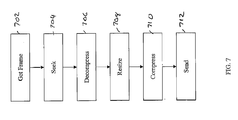
- Figure 7 is a flow diagram showing the steps involved in frame-by-frame streaming.
- the processing and storage of media files are centralized on a server, and clients may access the server over modest network connections.
- the clients may be configured to rely on the server for the bulk of the required processing (i.e., they may be configured as "thin clients.")
- the server may create, on the fly, reduced-size, low-bandwidth portions of a source media file and deliver individual frames or stream portions of the created portions out to a client on demand.
- a client transmits low-bandwidth editing commands back to the server.
- the server instead of first downloading an entire proxy copy of a source media file to a client, the server delivers only that portion of the source media file currently being viewed and/or edited on the client. Thus, there is no need to wait for a time-consuming and bandwidth-intensive download to complete before editing may begin.
- FIG. 1 illustrates one embodiment of a client/server architecture in accordance with the invention.
- Server 102 is connected to storage controller 104 via high-bandwidth link 106, and the storage controller manages one or more storage devices 108.
- the high-bandwidth link may be implemented using such protocols as Fibre Channel, InfiniBand, or 10 Gb Ethernet, and may support bandwidths on the order of gigabits per second.
- the server communicates with one or more remotely located clients 110 over low-bandwidth network 112.
- the low-bandwidth network may be, for example, an Ethernet or wireless network (limited to bandwidths on the order of megabits per second) or an Internet connection (limited to bandwidths less than one megabit per second).
- the server may be a single device or a plurality of devices connected in parallel.
- the server is a dedicated machine with a known address. In other embodiments, the server comprises one or machines accessed over a network, for example server forming part of a leased computing and storage resource in the "cloud.” Other server configurations are possible. In one embodiment, the server is a video-editing application server.
- the storage controller and storage device may be any of numerous commercially available storage solutions, such as direct-attached storage or network-attached storage.
- High-bandwidth network 106 may be optimized for use in particular implementations depending on the requirements of the system. For example, a lower-speed, lower-priced storage solution may be used for applications that require a large storage volume but are able to tolerate slower transfer speeds. Higher-speed storage may be appropriate for systems using high-resolution media files and/or having many users.
- Low-bandwidth network 112 may have less throughput than the high-bandwidth link between the server and storage and may be consequently less expensive to implement. There is no upper limit on the bandwidth of the low-bandwidth network, however, and any appropriate network may be used.
- the low-bandwidth network is a local-area network, a wide-area network, and/or the Internet. Communication between the server and the clients on the low-bandwidth network may be managed by a dedicated-purpose device, such as a switch.
- a router implemented in hardware and/or software, may be used to communicate to clients on the Internet.
- Clients 110 may be any appropriate type of computing device, including but not limited to desktop computers, workstations, laptop computers, netbooks, and smartphones. Because the clients are configured to be thin clients, the processing power required to run the client-side editing application is minimal.
- the client-side application runs inside a standard web browser, such as Microsoft INTERNET EXPLORER, Mozilla FIREFOX, or Apple SAFARI, and is implemented in a browser-embeddable language such as Java or Flash.
- the client may therefore be any computing device capable of running a standard web browser.
- the client-side application is implemented as a stand-alone application native to a particular operating system and/or device.
- an installment of the current invention includes the server, storage, and thin clients connected locally (e.g., in the same building or campus) by a network.
- an installment of the current invention includes only the thin clients.
- the thin clients connect to a remotely located server through the Internet.
- the server may host thin clients connecting from separate entities, persons, businesses, and/or organizations.
- FIG. 2 conceptually illustrates the basic interaction between server 102 and a client 202.
- the server may include original media files 204 and an engine 206 for editing and compositing the media files and for generating an on-the-fly proxy representation of the content at any point within the media files.
- the server transmits this proxy representation to the client over low bandwidth network 112, and a user may view the proxy representation at the client using media viewer 208.
- the proxy representation is a stream, and the media viewer displays the media stream.
- the client includes editing graphical user interface ("GUI") 210 for accepting the user's editing commands.
- the commands entered by the user may be transmitted back to the server, which collects the commands in an edited media project file 212 and adjusts the outgoing media stream accordingly. Neither the entire original media file nor any entire reduced-size version thereof need be transmitted to the client, and the client itself may not process any editing commands.
- GUI graphical user interface
- FIG. 3 in order to better explain the functions of the server and the client, a conceptual representation of an editing project is illustrated.
- the media clips may represent portions of one or more source files, and each clip may contain audio and/or video.
- Time is represented on the x-axis (a "timeline") and may be delineated according to frames of video.
- timeline a "timeline"
- timeline may be delineated according to frames of video.
- clip 4 ends at time t t3.
- the beginning and end of each clip may be accompanied by a transition effect, for example, a fade.
- the rest of the session plays accordingly.
- the server hosts an original media file.
- the media file may represent audio and/or video data uncompressed, compressed, and/or encoded in any of a variety of formats, such as MPEG, DV, WMV, and H.264.
- the media file represents a standard-definition ("SD") video signal (e.g., having a resolution of 720 by 480 pixels), a high-definition (“HD”) video signal (e.g., having a resolution of 1920 by 1080 pixels, 1280 by 720 pixels, or other HD resolution), or 2K-resolution film scanned material (e.g., having a resolution of 2048 by 1556 pixels).
- SD standard-definition
- HD high-definition
- 2K-resolution film scanned material e.g., having a resolution of 2048 by 1556 pixels.
- the original media files may not be locked upon access by a user or users. Instead, because an editing project references an original media file without altering it, multiple users may use the same original media file in parallel. Moreover, multiple users may edit and/or reference the original media files while the files are still being ingested (copied) to the storage.
- the editing system automatically manages exclusive access to the part of the media file that is already stored, hence providing the editing capabilities of editing during ingest, such as for live news feeds of media files.
- On-the-fly media delivery engine 206 may, in response to input from the client, access the requested part of the media file and stream it to the client.
- the media delivery engine may send only the particular frames of audio and video necessary for the client to view the media in real time.
- the server does not pregenerate the streaming data, but instead generates the data on demand as user requests are received. For example, if a user, through a client, selects or "seeks to" frame 50 of a media file and requests playing of the media from that point onward, the server accesses the original media file at that frame, translates the frame data into an appropriate streaming format, and begins sending the translated stream data to the client. Once the stream data is sent to the client, the server may not retain a copy of it. Instead, if, for example, the user seeks back to frame 50 and requests a replay of that frame, the server will simply regenerate the streaming data from the source media file at that frame and send it again to the client.
- proxy representations may be generated and sent to the client over low bandwidth network 112.
- individual frames of video may be sent as JPEG images, or a portion of a video file may be sent as a series of JPEG images.
- Server 102 may resize the streaming data before sending it to the client.
- the original media file may be encoded in a high-resolution format, the real-time streaming of which may require a very fast and expensive network link.
- the server may reduce the throughput required on the client/server network, allowing for the use of less robust networks.
- the client may adjust the level of resizing. A larger size may be more suitable for close-ups and detailed editing, for example, while a smaller size may be more suitable for coarse-grained editing commands.
- the user may adjust the size of the stream on the fly, i.e., during an editing session, to customize the detail of the viewed stream for specific editing commands and/or to account for variances in network latency.
- the server may also include a user's edited media project 212.
- This project such as the editing project illustrated in FIG. 3 , may contain an edited version of one or more source media files. Instead of actually altering the source media files, however, a virtual representation of the user-specific project may be created.
- This "time-based object" may contain all of the information relevant to the user's alterations and edits, including, for example, the name of the source file or files, the number of layers, the placement of the source files on the layers, crops, cuts, edits, and similar information.
- a separate time-based object may be created for each of the user's editing projects and for the projects of other users.
- the time-based object is represented as a text-based file written in, for example, extensible markup language ("XML") or written as an edit decision list (“EDL”) file.
- XML extensible markup language
- EDL edit decision list
- the time-based object may be saved for further editing, shared with other users, and/or played back as if it were an ordinary media file.
- An arbitrary number of users may create simultaneous time-based objects, each one different, and each time-based object may reference the same source media file or different media files.
- the server may export the time-based object into a monolithic media file, such as a .mpg, .dv, or .avi file.
- the exported media file may then be distributed to viewers who are outside the domain of the described client/server network and who may not have access to the original media file or files on the server.
- the exported media file may be copied to a DVD or served over an Internet connection.
- implementations of the present invention may stream out production-quality copies of the time-based object to viewers without ever creating an exported file.
- a television news station may broadcast an edited news story directly from the server using only the original source media and the editing information contained in the time-based object.
- the server "composites" or flattens any layers present in the time-based object before its contents are streamed to the client. Doing so collapses the layers-which may be of arbitrary number and complexity-into a stream of known size. In one embodiment, the bandwidth required for the composited stream is approximately 800 kb/s to 1 Mb/s. Even though the client views a composited stream, however, the client may still manipulate the layers in the time-based object as if the stream were not flattened.
- the original layer information may be maintained at the client and/or at the server, and if the client edits an existing layer, the layer information is updated and the server adjusts the layer data sent to the client accordingly.
- media viewer 208 may be used to decode and display the stream data or individual frames sent from the server. Because the server may send a low-bandwidth, reduced-size version of the original source media, the processing demand placed on the client to decode the stream may be light.
- a very lightweight client with limited processing power requests a stream small enough to play back in real time.
- the stream size may be set manually by a user or negotiated automatically between the server and the client, and may be changed dynamically as the client's processing resources for playback rise and fall.
- the stream size may be adjusted by changing the horizontal-by-vertical resolution of the video image displayed at the client, by changing the frame rate of the displayed video, and/or by changing the type and level of compression used to encode the video.
- the bandwidth of an audio portion of the stream may be similarly adjusted.
- the client may request different sizes and qualities of streaming data from the server to better perform various editing tasks.
- FIGS. 4 and 5 show two examples of GUIs used by the client.
- FIG. 4 an example of editing GUI 210, the media is displayed in the upper half of the window, and a representation of the layers used in editing the media is displayed in the lower half of the window.
- Layer display 402 is similar to the exemplary layers shown in FIG. 3 . Here, seven layers are depicted: video layers V1-V4 and audio layers A1-A3. A vertical red line in the layer display represents the location of current playback. As the GUI indicates, video layers V1, V2, and V3 and audio layers A1 and A2 are currently being played.
- the three video layers may represent three different media files, and the two audio layers may represent left-and right-channel stereo sound.
- Each audio or video clip may be accompanied by transition effects, such as fades or wipes, depicted in the GUI by black-and-white rectangles at the beginning or end of each clip.
- transition effects such as fades or wipes
- a portion of the timeline may be selected by a user, as depicted in the GUI by a lightened area of the layer display, and an editing operation may be applied to the selected portion.
- the upper-left corner 404 of the GUI in FIG. 4 shows the contents of a directory of media files depicted as thumbnail images.
- the thumbnails may be static or may depict the portion of the media file currently being viewed, displaying a progress bar to indicate the relative location, within the file, of a currently viewed frame.
- the GUI may also include window 406 to depict one of the source media files used during editing in one window and the result of the current edits in a separate window.
- FIG. 4 illustrates snapshot 408 of an editing session wherein three video clips, depicted on layers V1-V3, are cropped and positioned side-by-side in the upper-right EDIT window. An unedited version of one of the clips is shown in the upper-center SOURCE window.
- FIG. 4 illustrates that different thin clients (i.e., different interfaces) may edit the same media using the same editing server.
- FIG. 5 depicts a top-level application window accessible via the client.
- the application window features toolbar 502 with various functions, including: Projects for storing projects in progress; Shares for accessing data on shared storage; Members and Teams for viewing and managing users of the editing a media resources; Messages; MAXedit for accessing locally or remotely the multiuser media editor; Browser; MAXcut for logging rough cut editing and review and approval tool; and Tasks.
- a user may use this toolbar to launch, for example, the editing application depicted in FIG. 4 .
- the application window may also be used to play back source media as depicted in central display portion 504, and edited media as shown in bottom portion 506 of FIG. 5 .
- FIG. 6 illustrates, in greater detail, one embodiment of the server architecture.
- One or more physical servers here, m physical servers 602, 604, 606 may be connected (e.g., in parallel) to communicate with clients connected to network 608.
- the physical servers may act in concert to present a single virtual server to the clients or may be configured to grant the clients the ability to log into specific physical servers.
- the term server as used herein, may refer to either a physical or virtual server device or a group of physical or virtual servers.
- the server may communicate directly with the network, or may do so through a switch.
- Log-in service routine 610 handles incoming authentication requests from the clients, and may be located on a single server or across multiple servers. The log-in service may check a user's name and password against a list of known users to determine the legitimacy of a request, and may also verify that the user has a paid-up license to use the service. Administrative and/or system-level tasks may be run or managed by admin service 612, which may similarly be located on a single server or across servers.
- Each physical server includes standard hardware and software necessary for its operation, such as central-processing units 614, graphics processors 616, an operating system 618, and user- and system-level libraries 620.
- the server's hardware and software may be customized beyond that which is standard to improve the performance of video-editing tasks, such as, for example, encoding or decoding processing-intensive media compression schemes.
- a load-balancing module may automatically determine which of the m servers is best suited to execute a new user request.
- the load balancing module uses as input parameters that express the processing power of the servers being balanced, together with user-defined parameters that express desired weighting of the various factors in the load balancer. For each server, CPU usage, memory usage is tracked, as well as the total number of active connections to system across all servers.
- the load balancer computes the load on a server as a function of the processing capacity of the server and the current CPU and memory usage, and selects the server with the lowest load to take on a new user connection.
- the server may accept new user requests from an arbitrarily large number of users; nothing in the system architecture of the present invention sets a maximum number of users. In some embodiments, however, the number of users may exceed the resources available on a given system. For example, the bandwidth to or from the server-side storage may become saturated or the processing power of the server may be exceeded. A long-term solution may be to increase the appropriate resources of the server. In the short term, however, the server may throttle back the bandwidth and/or processing resources used to host each client without affecting editing accuracy. For example, the server may temporarily reduce the frame rate and/or size of the streams sent to each client. Alternatively, a client requesting a complicated editing task may be informed that the result of the task is not viewable in real time. Once the resource shortage is resolved, the server may return to normal operation.
- the server and clients may be implemented to be tolerant of faults. For example, if one user's process crashes, because it is compartmentalized with respect to the processes of other users, it may not affect those other processes. Furthermore, the crashing process may be recovered. Two copies of a user's current state may exist: one on the client and one on the server.
- a watchdog process running on the server may monitor each client/server connection for crashes. If a server process crashes, for example, the watchdog process may restart the process on the server, and upon reconnection with the client, may synchronize the latest state of the user's commands from the client. If a client process crashes, the watchdog process may copy the server's version of the editing state back to the client. In one embodiment, once the client is back on-line, the user is given a choice between restoring the crashed session, reverting to a saved session, or starting a new session.
- the server may be implemented as a stateless server.
- the server does not maintain a history of editing commands sent from the client. Instead, each request received from a client contains all of the state information necessary to reconstruct the client's entire editing session.
- the client sends an XML file representing the time-based object currently being edited.
- a user may create a timeline, such as the one depicted in FIG. 3 , containing multiple layers of clips.
- the server combines the clips into a flattened stream on the fly and transmits the flattened stream to the client.
- the server preprocesses or "renders" the timeline into a flattened temporary file and streams the contents of the file to the user.
- the server may perform the rendering opportunistically, e.g., during a period of low resource utilization, and later stream the rendered timeline to a client during a period of high resource utilization (i.e., when it may not have been possible to flatten and transmit the stream on the fly).
- the server renders a timeline in accordance with the frame rate and resolution currently being used by a user. In another embodiment, the server renders the timeline at a maximum allowable frame rate and resolution, and the server reduces the size of the render to the user's requested size and frame rate upon streaming. In this embodiment, the server need not re-render the timeline if the user reconfigures the client to display the stream at a different size and/or frame rate.
- Trusted users working together using the same source media may choose to share data, such as rendered timelines or configurations of clips and layers.
- a client may present a user with a list of other, trusted users and a description of their work, and the first user may opt to incorporate some or all of the shared work.
- shared work such as rendered timelines is automatically incorporated.
- Co-users on a trusted local- or wide-area network may be automatically authenticated, while co-users connected via an untrusted network, such as the Internet, must complete an invitation/acceptance handshake before their work may be shared.
- Server architectures in accordance with the present invention may allow the server to parallelize editing requests sent from a client. For example, different portions of a timeline may be rendered in parallel and combined. Also, a user may play back portions of a timeline while the timeline is being rendered. In general, any editing tasks within a user's process that do not depend upon the completion of other tasks may be parallelized up to the limits of the server's resources. In one embodiment, the server parallelizes tasks as resources are available. In another embodiment, a user may request a certain level of parallelization.
- a hybrid video streaming technique is used to rapidly seek to arbitrary frames within the source media.
- the server streams out the media in accordance with standard streaming techniques.
- the stream may represent one or more media files that are composited (flattened) on the fly.
- the server transitions into a frame-by-frame streaming mode. In this mode, the server identifies the type of the requested frame, backtracks to the last 1-frame and reconstructs the requested frame, if necessary, and streams the reconstructed requested frame to the client.
- the client need not have downloaded any portion of the original media file in order to seek to the requested frame.
- FIG. 7 illustrates one embodiment of the steps included in the frame-by-frame streaming mode.
- the server first receives a Get Frame request (702) from a client that has seeked to a position in a media file other than the normal playback position.
- the server then Seeks (704) to the appropriate position in the original media file.
- the server reads the header information of the original media file to determine the position of the requested frame in the file.
- the server estimates the position of the requested frame in the original media file based on the file size, encoding type, and frame rate.
- the server may search the original media file using an appropriate search algorithm, or may use any combination of these techniques to find the position of the requested frame.
- the requested frame may be Decompressed (706), Resized (708), and Compressed (710) if the pixel size of the requested frame is different from the pixel size of the media being streamed to the client. Finally, the frame itself is Sent (712), along with any audio data associated with the frame. Multiple frames may be streamed.
- the media may be "scrubbed" by rapidly seeking forward and backward through the file by, for example, clicking and dragging a slider bar coupled to media playback.
- the scrubbed frames are served out as fast as the server can seek and stream them to the client, at which point the server streams a representative selection of frames.
- the frame-by-frame streaming mode permits playback speeds and directions not normally possible with traditional streaming including, for example, 2x or 4x (or more) forward or reverse playback.
- embodiments of the present invention may be provided as one or more computer-readable programs embodied on or in one or more articles of manufacture.
- the article of manufacture may be any suitable hardware apparatus, such as, for example, a floppy disk, a hard disk, a CD ROM, a CD-RW, a CD-R, a DVD ROM, a DVD-RW, a DVD-R, a flash memory card, a PROM, a RAM, a ROM, or a magnetic tape.
- the computer-readable programs may be implemented in any programming language. Some examples of languages that may be used include C, C++, or JAVA.
- the software programs may be further translated into machine language or virtual machine instructions and stored in a program file in that form. The program file may then be stored on or in one or more of the articles of manufacture.
Landscapes
- Engineering & Computer Science (AREA)
- Multimedia (AREA)
- Signal Processing (AREA)
- Computer Networks & Wireless Communication (AREA)
- Theoretical Computer Science (AREA)
- Quality & Reliability (AREA)
- Databases & Information Systems (AREA)
- Physics & Mathematics (AREA)
- General Engineering & Computer Science (AREA)
- General Physics & Mathematics (AREA)
- Computer Security & Cryptography (AREA)
- Television Signal Processing For Recording (AREA)
- Two-Way Televisions, Distribution Of Moving Picture Or The Like (AREA)
- Management Or Editing Of Information On Record Carriers (AREA)
Applications Claiming Priority (3)
| Application Number | Priority Date | Filing Date | Title |
|---|---|---|---|
| US16912509P | 2009-04-14 | 2009-04-14 | |
| US23960009P | 2009-09-03 | 2009-09-03 | |
| US12/754,826 US8818172B2 (en) | 2009-04-14 | 2010-04-06 | Multi-user remote video editing |
Publications (2)
| Publication Number | Publication Date |
|---|---|
| EP2242057A2 true EP2242057A2 (de) | 2010-10-20 |
| EP2242057A3 EP2242057A3 (de) | 2010-12-01 |
Family
ID=42341525
Family Applications (1)
| Application Number | Title | Priority Date | Filing Date |
|---|---|---|---|
| EP10159684A Ceased EP2242057A3 (de) | 2009-04-14 | 2010-04-12 | Fernvideobearbeitung für mehrere Benutzer |
Country Status (3)
| Country | Link |
|---|---|
| US (1) | US8818172B2 (de) |
| EP (1) | EP2242057A3 (de) |
| JP (2) | JP2010252327A (de) |
Cited By (4)
| Publication number | Priority date | Publication date | Assignee | Title |
|---|---|---|---|---|
| WO2012094124A1 (en) * | 2011-01-04 | 2012-07-12 | Thomson Licensing | Sequencing content |
| US9661047B2 (en) | 2012-04-30 | 2017-05-23 | Mobilatv Ltd. | Method and system for central utilization of remotely generated large media data streams despite network bandwidth limitations |
| GB2580665A (en) * | 2019-01-22 | 2020-07-29 | Sony Corp | A method, apparatus and computer program |
| ES2957182A1 (es) * | 2022-05-31 | 2024-01-12 | Pronoide S L | Sistema y metodo para la creacion de videos instructivos mediante el empleo de secuencias de comandos |
Families Citing this family (65)
| Publication number | Priority date | Publication date | Assignee | Title |
|---|---|---|---|---|
| US7827491B2 (en) * | 2006-05-12 | 2010-11-02 | Tran Bao Q | Systems and methods for video editing |
| US8527646B2 (en) * | 2009-04-14 | 2013-09-03 | Avid Technology Canada Corp. | Rendering in a multi-user video editing system |
| US8867901B2 (en) * | 2010-02-05 | 2014-10-21 | Theatrics. com LLC | Mass participation movies |
| US8892632B2 (en) * | 2010-06-04 | 2014-11-18 | Microsoft Corporation | Client-server interaction frequency control |
| KR101843902B1 (ko) * | 2010-06-25 | 2018-04-02 | 톰슨 라이센싱 | 높은 동적 범위 비디오를 톤 맵핑하기 위한 그래픽 사용자 인터페이스 |
| JP5625642B2 (ja) * | 2010-09-06 | 2014-11-19 | ソニー株式会社 | 情報処理装置、データ分割方法及びデータ分割プログラム |
| JP5635850B2 (ja) * | 2010-09-16 | 2014-12-03 | 任天堂株式会社 | 情報処理装置、情報処理プログラム、情報処理システムおよび情報処理方法 |
| JP4681685B1 (ja) * | 2010-11-25 | 2011-05-11 | 株式会社イマジカ・ロボットホールディングス | 映像編集システムおよび映像編集方法 |
| US10739941B2 (en) | 2011-03-29 | 2020-08-11 | Wevideo, Inc. | Multi-source journal content integration systems and methods and systems and methods for collaborative online content editing |
| US20120251083A1 (en) * | 2011-03-29 | 2012-10-04 | Svendsen Jostein | Systems and methods for low bandwidth consumption online content editing |
| US20120263439A1 (en) * | 2011-04-13 | 2012-10-18 | David King Lassman | Method and apparatus for creating a composite video from multiple sources |
| US9396757B2 (en) * | 2011-06-21 | 2016-07-19 | Nokia Technologies Oy | Video remixing system |
| JP2013009218A (ja) * | 2011-06-27 | 2013-01-10 | Sony Corp | 編集装置及び方法、並びにプログラム |
| US8903908B2 (en) | 2011-07-07 | 2014-12-02 | Blackberry Limited | Collaborative media sharing |
| EP2544184B1 (de) * | 2011-07-07 | 2017-04-12 | BlackBerry Limited | Auf Kooperation beruhende gemeinsame Nutzung von Medien |
| US8515241B2 (en) | 2011-07-07 | 2013-08-20 | Gannaway Web Holdings, Llc | Real-time video editing |
| US8768924B2 (en) | 2011-11-08 | 2014-07-01 | Adobe Systems Incorporated | Conflict resolution in a media editing system |
| US9373358B2 (en) | 2011-11-08 | 2016-06-21 | Adobe Systems Incorporated | Collaborative media editing system |
| US8898253B2 (en) | 2011-11-08 | 2014-11-25 | Adobe Systems Incorporated | Provision of media from a device |
| US9288248B2 (en) | 2011-11-08 | 2016-03-15 | Adobe Systems Incorporated | Media system with local or remote rendering |
| JP2013125346A (ja) * | 2011-12-13 | 2013-06-24 | Olympus Imaging Corp | サーバ装置及び処理方法 |
| US9032020B2 (en) | 2011-12-29 | 2015-05-12 | Google Inc. | Online video enhancement |
| US9438883B2 (en) * | 2012-04-09 | 2016-09-06 | Intel Corporation | Quality of experience reporting for combined unicast-multicast/broadcast streaming of media content |
| US9185470B2 (en) * | 2012-05-03 | 2015-11-10 | Nuance Communications, Inc. | Remote processing of content |
| US9208819B1 (en) * | 2012-06-20 | 2015-12-08 | Google Inc. | Dynamic split-frame preview of video editing effects |
| US9049330B2 (en) * | 2012-08-16 | 2015-06-02 | Berkeley Information Technology Pty Ltd | Device configured to manage secure ingestion of documents into an information system, and methods for operating such a device |
| US20140099080A1 (en) * | 2012-10-10 | 2014-04-10 | International Business Machines Corporation | Creating An Abridged Presentation Of A Media Work |
| US9432711B2 (en) | 2012-11-19 | 2016-08-30 | John D. Steinberg | System and method for creating customized, multi-platform video programming |
| CN103873944B (zh) * | 2012-12-18 | 2017-04-12 | 瑞昱半导体股份有限公司 | 建立不同待播放内容间的播放时序关系的方法和装置 |
| US9781223B2 (en) * | 2012-12-28 | 2017-10-03 | Facebook, Inc. | Conserving battery and data usage |
| CN103973728B (zh) * | 2013-01-25 | 2019-02-05 | 新华三技术有限公司 | 一种多数据中心环境下负载均衡的方法及装置 |
| US9530452B2 (en) | 2013-02-05 | 2016-12-27 | Alc Holdings, Inc. | Video preview creation with link |
| US9237322B2 (en) * | 2013-02-07 | 2016-01-12 | Cyberlink Corp. | Systems and methods for performing selective video rendering |
| US11748833B2 (en) | 2013-03-05 | 2023-09-05 | Wevideo, Inc. | Systems and methods for a theme-based effects multimedia editing platform |
| WO2014178461A1 (en) * | 2013-05-03 | 2014-11-06 | Kt Corporation | Method and apparatus for providing social interactive video service |
| WO2014197354A1 (en) | 2013-06-05 | 2014-12-11 | Snakt, Inc. | Methods and systems for creating, combining, and sharing time-constrained videos |
| US20160307599A1 (en) * | 2013-06-05 | 2016-10-20 | Snakt, Inc. | Methods and Systems for Creating, Combining, and Sharing Time-Constrained Videos |
| US10397630B2 (en) * | 2013-07-26 | 2019-08-27 | Veaver, Inc. | Apparatus for providing, editing and playing video contents and the method thereof |
| US9336685B2 (en) * | 2013-08-12 | 2016-05-10 | Curious.Com, Inc. | Video lesson builder system and method |
| US9653117B2 (en) * | 2013-08-29 | 2017-05-16 | Avid Technology, Inc. | Interconnected multimedia systems with synchronized playback of media streams |
| US11348616B2 (en) | 2013-11-26 | 2022-05-31 | Google Llc | Collaborative video editing in a cloud environment |
| US9448789B2 (en) * | 2014-04-04 | 2016-09-20 | Avid Technology, Inc. | Method of consolidating, synchronizing, and streaming production content for distributed editing of media compositions |
| US11184580B2 (en) | 2014-05-22 | 2021-11-23 | Microsoft Technology Licensing, Llc | Automatically curating video to fit display time |
| CN112449253B (zh) * | 2014-10-22 | 2022-12-13 | 华为技术有限公司 | 交互式视频生成 |
| US20180063372A1 (en) * | 2014-11-18 | 2018-03-01 | Elwha Llc | Imaging device and system with edge processing |
| US10534525B1 (en) * | 2014-12-09 | 2020-01-14 | Amazon Technologies, Inc. | Media editing system optimized for distributed computing systems |
| US20170076752A1 (en) * | 2015-09-10 | 2017-03-16 | Laura Steward | System and method for automatic media compilation |
| US9773524B1 (en) * | 2016-06-03 | 2017-09-26 | Maverick Co., Ltd. | Video editing using mobile terminal and remote computer |
| US9852768B1 (en) * | 2016-06-03 | 2017-12-26 | Maverick Co., Ltd. | Video editing using mobile terminal and remote computer |
| US20180139408A1 (en) * | 2016-11-17 | 2018-05-17 | Parrotty, LLC | Video-Based Song Comparison System |
| US10360942B1 (en) * | 2017-07-13 | 2019-07-23 | Gopro, Inc. | Systems and methods for changing storage of videos |
| US20190069006A1 (en) * | 2017-08-29 | 2019-02-28 | Western Digital Technologies, Inc. | Seeking in live-transcoded videos |
| JP6900044B2 (ja) * | 2018-10-04 | 2021-07-07 | 株式会社ラムダシステムズ | 情報処理装置、情報処理方法および情報処理プログラム |
| CN109640168B (zh) * | 2018-11-27 | 2020-07-24 | Oppo广东移动通信有限公司 | 视频处理方法、装置、电子设备和计算机可读介质 |
| US10631047B1 (en) | 2019-03-29 | 2020-04-21 | Pond5 Inc. | Online video editor |
| JP2021078040A (ja) * | 2019-11-12 | 2021-05-20 | パナソニックIpマネジメント株式会社 | 仮想サーバ、動画編集方法、および動画編集システム |
| US11917237B2 (en) * | 2020-02-14 | 2024-02-27 | Intel Corporation | Move stream content from point to point over the existing IP gateway |
| CN112437342B (zh) * | 2020-05-14 | 2022-09-23 | 上海哔哩哔哩科技有限公司 | 一种视频编辑的方法及设备 |
| CN111901535A (zh) * | 2020-07-23 | 2020-11-06 | 北京达佳互联信息技术有限公司 | 视频编辑方法、装置、电子设备、系统及存储介质 |
| JP2022167830A (ja) * | 2021-04-22 | 2022-11-04 | マイグナー, インク. | アクセスのための装置、方法及びコンピュータ可読媒体 |
| WO2023014428A1 (en) * | 2021-08-03 | 2023-02-09 | Qualcomm Incorporated | Supporting inter-media synchronization in wireless communications |
| CN115278051B (zh) * | 2022-06-20 | 2024-08-13 | 北京字跳网络技术有限公司 | 用于内容拍摄的方法、装置、设备和存储介质 |
| CN116204371B (zh) * | 2022-12-13 | 2023-11-24 | 远峰科技股份有限公司 | 摄像头图像数据流的监控方法及装置 |
| US12592257B1 (en) * | 2023-05-04 | 2026-03-31 | Meta Platforms, Inc. | Media editing with client-side edits and server-side edits |
| WO2025085180A1 (en) * | 2023-10-16 | 2025-04-24 | Centurylink Intellectual Property Llc | Real-time access to remote media production editing functionality |
Citations (2)
| Publication number | Priority date | Publication date | Assignee | Title |
|---|---|---|---|---|
| US20050025454A1 (en) * | 2003-07-28 | 2005-02-03 | Nobuo Nakamura | Editing system and control method thereof |
| US20080193100A1 (en) * | 2007-02-12 | 2008-08-14 | Geoffrey King Baum | Methods and apparatus for processing edits to online video |
Family Cites Families (24)
| Publication number | Priority date | Publication date | Assignee | Title |
|---|---|---|---|---|
| WO2000079799A2 (en) | 1999-06-23 | 2000-12-28 | Sarnoff Corporation | Method and apparatus for composing image sequences |
| JP4681786B2 (ja) * | 1999-12-16 | 2011-05-11 | イーストマン コダック カンパニー | ビデオ編集ワークフロー方法及びその装置 |
| JP2002232827A (ja) * | 1999-12-21 | 2002-08-16 | Matsushita Electric Ind Co Ltd | 映像音声編集システム |
| US20010004417A1 (en) * | 1999-12-21 | 2001-06-21 | Ageishi Narutoshi | Video editing system |
| WO2002008948A2 (en) * | 2000-07-24 | 2002-01-31 | Vivcom, Inc. | System and method for indexing, searching, identifying, and editing portions of electronic multimedia files |
| US20020116716A1 (en) * | 2001-02-22 | 2002-08-22 | Adi Sideman | Online video editor |
| US20030028680A1 (en) * | 2001-06-26 | 2003-02-06 | Frank Jin | Application manager for a content delivery system |
| US7970260B2 (en) * | 2001-06-27 | 2011-06-28 | Verizon Business Global Llc | Digital media asset management system and method for supporting multiple users |
| US8005345B2 (en) * | 2001-06-27 | 2011-08-23 | Verizon Business Network Services Inc. | Method and system for dynamic control of digital media content playback and advertisement delivery |
| US20070089151A1 (en) * | 2001-06-27 | 2007-04-19 | Mci, Llc. | Method and system for delivery of digital media experience via common instant communication clients |
| JP3535489B2 (ja) * | 2001-10-12 | 2004-06-07 | エヌ・ティ・ティ・コムウェア株式会社 | 同期マルチメディアプレゼンテーションの編集方法、編集プログラム、編集サーバ及び編集プログラムが記録された記録媒体 |
| JP4058308B2 (ja) * | 2002-08-30 | 2008-03-05 | 株式会社エヌ・ティ・ティ・ドコモ | サービス中断復元システム、サービス中断復元方法、通信端末、サービス中断復元装置及びサービス中断復元プログラム |
| JP3987025B2 (ja) * | 2002-12-12 | 2007-10-03 | シャープ株式会社 | マルチメディアデータ処理装置およびマルチメディアデータ処理プログラム |
| JP4369434B2 (ja) * | 2002-12-12 | 2009-11-18 | シャープ株式会社 | マルチメディアデータ処理装置、マルチメディアデータ処理プログラム、およびマルチメディアコンテンツデータのデータ構造 |
| JP2004357035A (ja) | 2003-05-29 | 2004-12-16 | Matsushita Electric Ind Co Ltd | 携帯情報端末装置、映像サーバ装置及び編集システム |
| JP2007065928A (ja) * | 2005-08-30 | 2007-03-15 | Toshiba Corp | 情報記憶媒体、情報処理方法、情報転送方法、情報再生方法、情報再生装置、情報記録方法、情報記録装置、及びプログラム |
| JP2006157389A (ja) | 2004-11-29 | 2006-06-15 | Tdk Corp | コンテンツ編集システム、編集サーバ装置、コンテンツ編集方法およびプログラム |
| JP2007150994A (ja) | 2005-11-30 | 2007-06-14 | Hitachi Ltd | 映像編集システム及び映像編集装置 |
| US8214516B2 (en) * | 2006-01-06 | 2012-07-03 | Google Inc. | Dynamic media serving infrastructure |
| US20080100694A1 (en) * | 2006-10-27 | 2008-05-01 | Microsoft Corporation | Distributed caching for multimedia conference calls |
| WO2008094533A2 (en) | 2007-01-26 | 2008-08-07 | Flektor, Inc. | Video downloading and scrubbing system and method |
| US20080294721A1 (en) * | 2007-05-21 | 2008-11-27 | Philipp Christian Berndt | Architecture for teleconferencing with virtual representation |
| US8086902B2 (en) * | 2007-04-16 | 2011-12-27 | Microsoft Corporation | Method and apparatus for testing media player software applications |
| US8265457B2 (en) * | 2007-05-14 | 2012-09-11 | Adobe Systems Incorporated | Proxy editing and rendering for various delivery outlets |
-
2010
- 2010-04-06 US US12/754,826 patent/US8818172B2/en active Active
- 2010-04-09 JP JP2010090088A patent/JP2010252327A/ja active Pending
- 2010-04-12 EP EP10159684A patent/EP2242057A3/de not_active Ceased
-
2013
- 2013-02-04 JP JP2013019330A patent/JP5596808B2/ja active Active
Patent Citations (2)
| Publication number | Priority date | Publication date | Assignee | Title |
|---|---|---|---|---|
| US20050025454A1 (en) * | 2003-07-28 | 2005-02-03 | Nobuo Nakamura | Editing system and control method thereof |
| US20080193100A1 (en) * | 2007-02-12 | 2008-08-14 | Geoffrey King Baum | Methods and apparatus for processing edits to online video |
Non-Patent Citations (1)
| Title |
|---|
| ANONYMOUS: "Maximum Throughput's MAXedit Server Edition Multi-user Editing Solution Now Shipping | Computer Graphics World", 16 January 2009 (2009-01-16), XP055468684, Retrieved from the Internet <URL:http://www.cgw.com/Press-Center/News/2009/Maximum-Throughputs-MAXedit-Server-Edition-Multi.aspx> [retrieved on 20180419] * |
Cited By (9)
| Publication number | Priority date | Publication date | Assignee | Title |
|---|---|---|---|---|
| WO2012094124A1 (en) * | 2011-01-04 | 2012-07-12 | Thomson Licensing | Sequencing content |
| US9170704B2 (en) | 2011-01-04 | 2015-10-27 | Thomson Licensing | Sequencing content |
| TWI571868B (zh) * | 2011-01-04 | 2017-02-21 | 湯普生證照公司 | 用於定序內容之方法及裝置 |
| US9661047B2 (en) | 2012-04-30 | 2017-05-23 | Mobilatv Ltd. | Method and system for central utilization of remotely generated large media data streams despite network bandwidth limitations |
| US10123070B2 (en) | 2012-04-30 | 2018-11-06 | Mobilatv Ltd. | Method and system for central utilization of remotely generated large media data streams despite network bandwidth limitations |
| GB2580665A (en) * | 2019-01-22 | 2020-07-29 | Sony Corp | A method, apparatus and computer program |
| WO2020152450A1 (en) * | 2019-01-22 | 2020-07-30 | Sony Corporation | A method, apparatus and computer program for providing edited video content |
| US11699462B2 (en) | 2019-01-22 | 2023-07-11 | Sony Corporation | Method, apparatus and computer program |
| ES2957182A1 (es) * | 2022-05-31 | 2024-01-12 | Pronoide S L | Sistema y metodo para la creacion de videos instructivos mediante el empleo de secuencias de comandos |
Also Published As
| Publication number | Publication date |
|---|---|
| JP2013118678A (ja) | 2013-06-13 |
| JP5596808B2 (ja) | 2014-09-24 |
| US8818172B2 (en) | 2014-08-26 |
| US20100260468A1 (en) | 2010-10-14 |
| EP2242057A3 (de) | 2010-12-01 |
| JP2010252327A (ja) | 2010-11-04 |
Similar Documents
| Publication | Publication Date | Title |
|---|---|---|
| US8818172B2 (en) | Multi-user remote video editing | |
| US9329745B2 (en) | Rendering in a multi-user video editing system | |
| JP5112287B2 (ja) | ネットワーク上でデジタルメディアの分散編集及び記憶を提供するための方法及びシステム | |
| US8411758B2 (en) | Method and system for online remixing of digital multimedia | |
| CA3037307C (en) | Methods and systems for instantaneous asynchronous media sharing | |
| US20070169158A1 (en) | Method and system for creating and applying dynamic media specification creator and applicator | |
| US20090103835A1 (en) | Method and system for combining edit information with media content | |
| US9633694B2 (en) | Full fidelity remote video editing | |
| EP1929405A2 (de) | Verfahren und system zum aufzeichnen von bearbeitungen von medieninhalten | |
| CN101395918B (zh) | 用于创建和应用动态媒体规范创建器和应用器的方法和系统 | |
| KR102440794B1 (ko) | Pod 기반의 영상 컨텐츠 전송 방법 및 장치 | |
| KR102414301B1 (ko) | Pod 기반의 영상 관제 시스템 및 pod 기반의 영상 처리 방법 | |
| Kimball et al. | RSvp: Ridiculously scalable video playback on clustered tiled displays | |
| Salvi | Storage and retrieval of multimodal 3D tele-immersion data | |
| HK1130137A (en) | Method and system for combining edit information with media content | |
| HK1130138A (en) | Method and system for recording edits to media content | |
| HK1130099A (en) | Method and system for online remixing of digital multimedia |
Legal Events
| Date | Code | Title | Description |
|---|---|---|---|
| PUAI | Public reference made under article 153(3) epc to a published international application that has entered the european phase |
Free format text: ORIGINAL CODE: 0009012 |
|
| AK | Designated contracting states |
Kind code of ref document: A2 Designated state(s): AT BE BG CH CY CZ DE DK EE ES FI FR GB GR HR HU IE IS IT LI LT LU LV MC MK MT NL NO PL PT RO SE SI SK SM TR |
|
| AX | Request for extension of the european patent |
Extension state: AL BA ME RS |
|
| PUAL | Search report despatched |
Free format text: ORIGINAL CODE: 0009013 |
|
| AK | Designated contracting states |
Kind code of ref document: A3 Designated state(s): AT BE BG CH CY CZ DE DK EE ES FI FR GB GR HR HU IE IS IT LI LT LU LV MC MK MT NL NO PL PT RO SE SI SK SM TR |
|
| AX | Request for extension of the european patent |
Extension state: AL BA ME RS |
|
| RIC1 | Information provided on ipc code assigned before grant |
Ipc: G06F 11/00 20060101ALI20101028BHEP Ipc: G11B 27/034 20060101AFI20100802BHEP Ipc: H04L 1/00 20060101ALI20101028BHEP Ipc: H04N 7/24 20060101ALI20101028BHEP |
|
| RAP1 | Party data changed (applicant data changed or rights of an application transferred) |
Owner name: AVID TECHNOLOGY, INC. |
|
| 17P | Request for examination filed |
Effective date: 20110531 |
|
| 17Q | First examination report despatched |
Effective date: 20120521 |
|
| STAA | Information on the status of an ep patent application or granted ep patent |
Free format text: STATUS: THE APPLICATION HAS BEEN REFUSED |
|
| 18R | Application refused |
Effective date: 20181015 |