EP2242092A1 - Verfahren und system zur plasmaverarbeitung - Google Patents
Verfahren und system zur plasmaverarbeitung Download PDFInfo
- Publication number
- EP2242092A1 EP2242092A1 EP09705243A EP09705243A EP2242092A1 EP 2242092 A1 EP2242092 A1 EP 2242092A1 EP 09705243 A EP09705243 A EP 09705243A EP 09705243 A EP09705243 A EP 09705243A EP 2242092 A1 EP2242092 A1 EP 2242092A1
- Authority
- EP
- European Patent Office
- Prior art keywords
- plasma processing
- bias power
- film
- substrate
- processing method
- Prior art date
- Legal status (The legal status is an assumption and is not a legal conclusion. Google has not performed a legal analysis and makes no representation as to the accuracy of the status listed.)
- Withdrawn
Links
Images


Classifications
-
- H—ELECTRICITY
- H10—SEMICONDUCTOR DEVICES; ELECTRIC SOLID-STATE DEVICES NOT OTHERWISE PROVIDED FOR
- H10P—GENERIC PROCESSES OR APPARATUS FOR THE MANUFACTURE OR TREATMENT OF DEVICES COVERED BY CLASS H10
- H10P14/00—Formation of materials, e.g. in the shape of layers or pillars
- H10P14/60—Formation of materials, e.g. in the shape of layers or pillars of insulating materials
- H10P14/69—Inorganic materials
- H10P14/694—Inorganic materials composed of nitrides
- H10P14/6943—Inorganic materials composed of nitrides containing silicon
- H10P14/69433—Inorganic materials composed of nitrides containing silicon the material being a silicon nitride not containing oxygen, e.g. SixNy or SixByNz
-
- C—CHEMISTRY; METALLURGY
- C23—COATING METALLIC MATERIAL; COATING MATERIAL WITH METALLIC MATERIAL; CHEMICAL SURFACE TREATMENT; DIFFUSION TREATMENT OF METALLIC MATERIAL; COATING BY VACUUM EVAPORATION, BY SPUTTERING, BY ION IMPLANTATION OR BY CHEMICAL VAPOUR DEPOSITION, IN GENERAL; INHIBITING CORROSION OF METALLIC MATERIAL OR INCRUSTATION IN GENERAL
- C23C—COATING METALLIC MATERIAL; COATING MATERIAL WITH METALLIC MATERIAL; SURFACE TREATMENT OF METALLIC MATERIAL BY DIFFUSION INTO THE SURFACE, BY CHEMICAL CONVERSION OR SUBSTITUTION; COATING BY VACUUM EVAPORATION, BY SPUTTERING, BY ION IMPLANTATION OR BY CHEMICAL VAPOUR DEPOSITION, IN GENERAL
- C23C16/00—Chemical coating by decomposition of gaseous compounds, without leaving reaction products of surface material in the coating, i.e. chemical vapour deposition [CVD] processes
- C23C16/22—Chemical coating by decomposition of gaseous compounds, without leaving reaction products of surface material in the coating, i.e. chemical vapour deposition [CVD] processes characterised by the deposition of inorganic material, other than metallic material
- C23C16/30—Deposition of compounds, mixtures or solid solutions, e.g. borides, carbides, nitrides
- C23C16/34—Nitrides
- C23C16/345—Silicon nitride
-
- C—CHEMISTRY; METALLURGY
- C23—COATING METALLIC MATERIAL; COATING MATERIAL WITH METALLIC MATERIAL; CHEMICAL SURFACE TREATMENT; DIFFUSION TREATMENT OF METALLIC MATERIAL; COATING BY VACUUM EVAPORATION, BY SPUTTERING, BY ION IMPLANTATION OR BY CHEMICAL VAPOUR DEPOSITION, IN GENERAL; INHIBITING CORROSION OF METALLIC MATERIAL OR INCRUSTATION IN GENERAL
- C23C—COATING METALLIC MATERIAL; COATING MATERIAL WITH METALLIC MATERIAL; SURFACE TREATMENT OF METALLIC MATERIAL BY DIFFUSION INTO THE SURFACE, BY CHEMICAL CONVERSION OR SUBSTITUTION; COATING BY VACUUM EVAPORATION, BY SPUTTERING, BY ION IMPLANTATION OR BY CHEMICAL VAPOUR DEPOSITION, IN GENERAL
- C23C16/00—Chemical coating by decomposition of gaseous compounds, without leaving reaction products of surface material in the coating, i.e. chemical vapour deposition [CVD] processes
- C23C16/44—Chemical coating by decomposition of gaseous compounds, without leaving reaction products of surface material in the coating, i.e. chemical vapour deposition [CVD] processes characterised by the method of coating
- C23C16/50—Chemical coating by decomposition of gaseous compounds, without leaving reaction products of surface material in the coating, i.e. chemical vapour deposition [CVD] processes characterised by the method of coating using electric discharges
- C23C16/505—Chemical coating by decomposition of gaseous compounds, without leaving reaction products of surface material in the coating, i.e. chemical vapour deposition [CVD] processes characterised by the method of coating using electric discharges using radio frequency discharges
-
- H—ELECTRICITY
- H01—ELECTRIC ELEMENTS
- H01J—ELECTRIC DISCHARGE TUBES OR DISCHARGE LAMPS
- H01J37/00—Discharge tubes with provision for introducing objects or material to be exposed to the discharge, e.g. for the purpose of examination or processing thereof
- H01J37/32—Gas-filled discharge tubes
- H01J37/32009—Arrangements for generation of plasma specially adapted for examination or treatment of objects, e.g. plasma sources
- H01J37/32082—Radio frequency generated discharge
- H01J37/321—Radio frequency generated discharge the radio frequency energy being inductively coupled to the plasma
-
- H—ELECTRICITY
- H01—ELECTRIC ELEMENTS
- H01J—ELECTRIC DISCHARGE TUBES OR DISCHARGE LAMPS
- H01J37/00—Discharge tubes with provision for introducing objects or material to be exposed to the discharge, e.g. for the purpose of examination or processing thereof
- H01J37/32—Gas-filled discharge tubes
- H01J37/32431—Constructional details of the reactor
- H01J37/32697—Electrostatic control
- H01J37/32706—Polarising the substrate
-
- H—ELECTRICITY
- H10—SEMICONDUCTOR DEVICES; ELECTRIC SOLID-STATE DEVICES NOT OTHERWISE PROVIDED FOR
- H10P—GENERIC PROCESSES OR APPARATUS FOR THE MANUFACTURE OR TREATMENT OF DEVICES COVERED BY CLASS H10
- H10P14/00—Formation of materials, e.g. in the shape of layers or pillars
- H10P14/60—Formation of materials, e.g. in the shape of layers or pillars of insulating materials
- H10P14/63—Formation of materials, e.g. in the shape of layers or pillars of insulating materials characterised by the formation processes
- H10P14/6326—Deposition processes
- H10P14/6328—Deposition from the gas or vapour phase
- H10P14/6334—Deposition from the gas or vapour phase using decomposition or reaction of gaseous or vapour phase compounds, i.e. chemical vapour deposition
- H10P14/6336—Deposition from the gas or vapour phase using decomposition or reaction of gaseous or vapour phase compounds, i.e. chemical vapour deposition in the presence of a plasma [PECVD]
Definitions
- the present invention relates to a plasma processing method and a plasma processing system.
- Non-patent Document 1 Tatsuru Shirafuji, "Gas phase/surface reactions of plasma-enhanced CVD", [online], [searched on January 16, 2008], the Internet ⁇ URL: http://shira.iic.kyoto-u.ac.jp/2006-09-02-PECVD-Lecture.pdf >
- an object of the present invention is to provide a plasma processing method and a plasma processing system, which are capable of embedding a SiN film while suppressing an increase in compression stress and a decrease in Si-H/N-H bonding due to application of bias power.
- a plasma processing method for solving the above problem is a plasma processing method for depositing a silicon nitride film on a substrate, which is a target for plasma processing, by using plasma of a raw material gas containing silicon and hydrogen and of a gas containing nitrogen, the plasma processing method characterized in that, bias power to inject ions into the substrate is set equal to or higher than a threshold to increase a Si-H bonding amount, thereby reducing compression stress.
- a plasma processing method according to a second invention for solving the above problem is the plasma processing method according to the first invention characterized in that RF power to be applied to generate the plasma is reduced to increase the Si-H bonding amount, thereby reducing the compression stress
- a plasma processing method according to a third invention for solving the above problem is the plasma processing method according to the first invention characterized in that pressure is raised to increase the Si-H bonding amount, thereby reducing the compression stress.
- a plasma processing method according to a fourth invention for solving the above problem is the plasma processing method according to the first invention characterized in that amounts of supply of the gas containing nitrogen are increased to increase the Si-H bonding amount, thereby reducing the compression stress.
- a plasma processing method according to a fifth invention for solving the above problem is the plasma processing method according to the first invention characterized in that a plasma processing temperature is lowered to increase the Si-H bonding amount, thereby reducing the compression stress.
- a plasma processing method according to a sixth invention for solving the above problem is the plasma processing method according to the first invention characterized in that the threshold is set to 1.2 kW in a case of a 200-mm wafer.
- a plasma processing system for solving the above problem is a plasma processing system characterized by comprising: gas supply amount controlling means for controlling gas supply amounts of a raw material gas containing silicon and hydrogen and a gas containing nitrogen to be supplied into a vacuum chamber; pressure controlling means for controlling pressure inside the vacuum chamber; plasma generating means for generating plasma by applying RF power to the raw material gas and the nitrogen gas inside the vacuum chamber; substrate holding means for holding a substrate, which is a target for plasma processing, inside the vacuum chamber; temperature controlling means for controlling a temperature during the plasma processing of the substrate; bias power applying means for applying bias power to the substrate; and parameter controlling means for setting the bias power to inject ions into the substrate equal to or higher than a threshold to increase a Si-H bonding amount, thereby reducing compression stress.
- a plasma processing method of depositing a silicon nitride film on a substrate, which is a target for plasma processing by using plasma of a raw material gas containing silicon and hydrogen and a gas containing nitrogen, compression stress in the silicon nitride film can be reduced by increasing a Si-H bonding amount in the silicon nitride film. This suppresses film detachment attributable to an increase of the compression stress in the SiN film at the time of bias power application. Therefore, it is possible to embed a SiN film by applying the bias power.
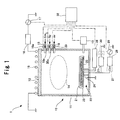
- Fig. 1 is a configuration diagram of the plasma processing system according to the embodiment of the present invention.
- the plasma processing system 1 includes a vacuum chamber 10 capable of maintaining a high degree of vacuum.
- This vacuum chamber 10 includes a cylindrical container 11 and a ceiling plate 12 and forms a space which is hermetically sealed from outside air by fitting the ceiling plate 12 onto an upper portion of the cylindrical container 11.
- the vacuum chamber 10 is provided with a vacuum device 13 to establish a vacuum state inside the vacuum chamber 10.
- a RF antenna 15 configured to generate plasma 14 is located at an upper portion of the ceiling plate 12.
- a RF power source 17 being a high-frequency power source is connected to this RF antenna 15 via a rectifier 16. Specifically, RF power supplied from the RF power source 17 is supplied to the plasma 14 through the RF antenna 15.
- a raw material gas supply tube 18 configured to supply raw material gas being a material of a film to be deposited into the vacuum chamber 10 is disposed at an upper portion of a side wall of the cylindrical container 11.
- the raw material gas supply tube 18 is provided with a raw material gas supply amount control valve 18a configured to control a supply amount of the raw material gas.
- SiH 4 is supplied as the raw material gas.
- a N 2 gas supply tube 19 configured to supply N 2 gas into the vacuum chamber 10 is disposed at the upper portion of the side wall of the cylindrical container 11.
- the N 2 gas supply tube 19 is provided with a N 2 gas supply amount control valve 19a configured to control a supply amount of the N 2 gas.
- An Ar supply tube 20 configured to supply Ar gas into the vacuum chamber 10 is disposed at the upper portion of the side wall of the cylindrical container 11.
- the Ar gas supply tube 20 is provided with an Ar gas supply amount control valve 20a configured to control a supply amount of the Ar gas.
- a substrate support table 22 configured to hold a substrate 21 being a target for film deposition is disposed in a lower portion inside the cylindrical container 11.
- This substrate support table 22 includes a substrate holding portion 23 configured to hold the substrate 21 and a support shaft 24 configured to support this substrate holding portion 23.
- a heater 25 for heating is disposed inside the substrate holding portion 23.
- a heater control device 26 adjusts the temperature of this heater 25. Accordingly, it is possible to control the temperature of the substrate 21 during the plasma processing.
- a bias power source 29 is connected to the substrate holding portion 23 via a capacitor 27 and a rectifier 28 so that bias power can be applied to the substrate 21. This makes it possible to draw ions from the plasma 14 to a surface of the substrate 21.
- an electrostatic power source 30 is connected to the substrate holding portion 23 so that the substrate 21 can be held by an electrostatic force.
- the electrostatic power source 30 is connected to the substrate holding portion 22 via a low-pass filter 31 (LPF) so that power from the RF power source 17 and the bias power source 29 does not flow into the electrostatic power source 30.
- LPF low-pass filter
- a parameter control device 32 is provided which is capable of controlling the bias power of the bias power source 29, the RF power of the RF power source 17, pressure of the vacuum device 13, the heater control device 26, and the gas supply amounts of the raw material gas supply valve 18a, the N 2 gas supply valve 19a, and the Ar gas supply valve 20a, respectively.
- dashed lines in Fig. 1 represent signal lines for transmitting control signals from the parameter control device to the bias power source 29, the RF power source 17, the vacuum device 13, the heater control device 26, the raw material gas supply valve 18a, the N 2 gas supply valve 19a, and the Ar gas supply valve 20a.
- the parameter control device 32 which controls the bias power, the RF power, the pressure, a film deposition temperature, and the gas supply amounts on the basis of conditions to be described later.
- the parameter control device 32 particularly sets the bias power for injecting ions into the substrate 21 equal to or higher than a threshold to increase a Si-H bonding amount, thereby performing control to reduce compression stress.
- the reason why it is possible to reduce the compression stress by setting the bias power for injecting ions into the substrate 21 equal to or higher than the threshold to increase the Si-H bonding amount will be described below in detail.
- experiment results of various experiments carried out by using the plasma processing system according to this embodiment will be described to begin with.
- An experiment was performed as a first experiment in which compression stresses, a Si-H bonding amounts, and a N-H bonding amounts in respective SiN films were measured, the SiN films each applied with different bias power while being formed.
- the substrate 21 (see Fig. 1 ) as the target for film deposition processing is assumed to be a wafer having a diameter of 200 mm.
- the RF power 13.56 MHz
- flow rates of SiH 4 , N 2 , and Ar were all set to 50 sccm
- the pressure was set to 25 mTorr
- the film deposition temperature was set to 250°C
- a film thickness of the SiN film to be deposited was set to 350 nm.
- Table 1 is a table showing the experiment result of the experiment to measure the compression stresses in the respective SiN films formed with variation in the bias power to be applied.
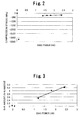
- Fig. 2 is a view showing, in the form of a graph, the experiment result shown in Table 1.
- Table 1 Bias power [kW] 0 0.1 1.4 1.6 1.8 2.4 Compression Stress [Mpa] -44 -3251 -307 -274 -259 -225
- the compression stress is increased by application of the bias power as similar to the conventional case up to the bias power of 0.1 kW (0.1 kW is maximal).
- the compression stress becomes smaller when the bias power is increased further.
- the state of the SiN film was observed in each bias power levels, and it was found out that film detachment occurred at bias power level of 1. 6 kW or lower, but film detachment did not occur at bias power level of 1.8 kW or higher. Accordingly, it is apparent that the bias power needs to be set equal to or higher than a predetermined threshold in order to suppress occurrence of film detachment.
- Table 2 is a table showing the experiment result of the experiment to measure the Si-H bonding amounts and the N-H bonding amounts in the SiN films formed with variation in the bias power to be applied.
- Fig. 3 is a view showing, in the form of a graph, the measurement result of the Si-H amounts/N-H amounts in the SiN films formed with variation in the bias power to be applied, which are shown Table 2.
- the Si-H/N-H is decreased as similar to the conventional case up to the bias power of 0.1 kW.
- the Si-H bonding amount is increased in proportion to the bias power and the Si-H amount/N-H amount are increased.
- Fig. 4 is a view showing a micrograph of the SiN film deposited with a bias power set to 0.5 kW
- Fig. 5 is a view showing a micrograph of the SiN film deposited with a bias power set to 1.6 kW
- Fig. 6 is a view showing the micrograph of a SiN film deposited with a bias power set to 2.4 kW.
- Fig. 4 when the bias power is set to 0.5 kW, film detachment occurs across a front surface of the substrate 21 (see Fig. 1 ). Note that portions which seem like patterns in Fig. 4 represent portions where the film is detached. Meanwhile, as shown in Fig. 5 , when the bias power is set to 1.6 kW, there is minor film detachment. Note that portions which seem like small dots as surrounded by broken lines in Fig. 5 represent portions where the film is detached.
- the film detachment occurs when the bias power is lower than about 1.6 kW, but does not occur when the bias power is about 2.4 kW.
- the compression stress in the SiN film is reduced and the Si-H amount/N-H amount increases when the bias power is set higher than the threshold.
- the bias power (ion impact) lower than the threshold causes enhancement in film density and increase in the compression stress, while the compression stress is reduced due to a drawing effect of hydrogen which occurs when the bias power higher than the threshold is applied.
- the conventional technique has the problem of film detachment due to the increase in the compression stress which occurs when the bias power is increased to embed a SiN film.
- the present invention it has been found out that, by controlling the bias power to be equal to or higher than the threshold, the compression stress is reduced due to the drawing effect of hydrogen. This allows the embedding of a film.
- the bias power (4 MHz) was set to 2.4 kW
- the RF power 13.56 MHz is set to 2 kW
- the flow rates of SiH 4 , N 2 , and Ar were all set to 50 sccm
- the pressure was set to 25 mTorr
- the film deposition temperature is set to 250°C.
- Table 3 is a table showing an experiment result of the experiment to measure the compression stresses of the respective SiN films having the film thicknesses of 350 nm and 10000 nm, respectively.
- Fig. 7 is a view showing, in the form of a graph, the experiment result of the compression stresses in the respective SiN films having different film thicknesses of the SiN film between 350 nm and 10000 nm, respectively, as shown in Table 3.
- the compression stress in the SiN film becomes smaller when the film thickness of the SiN film is increased. This is because the Si-H bonding amount of the entire SiN film increases when the film thickness becomes thicker. Accordingly, the Si-H bonding amount can be controlled by controlling the film thickness, thereby allowing the control of the compression stress in the SiN film.
- the embedding of the film is possible even in a hole having a depth of 1 ⁇ m or more.
- the bias power (4 MHz) was set to 2.4 kW
- the RF power 13.56 MHz was set to 2 kW
- the flow rates of N 2 and Ar were both set to 50 sccm
- the pressure is set to 25 mTorr
- the film deposition temperature was set to 250°C
- the film thickness of the SiN film to be deposited was set to 350 nm.
- Table 4 is a table showing an experiment result of the experiment to measure the compression stresses in the respective SiN films deposited with variation in film deposition rate.
- Fig. 8 is a view showing, in the form of a graph, the experiment result of the compression stresses in the respective SiN films deposited with variation in film deposition rate as shown in Table 4.
- the compression stress in the SiN film becomes larger when the film deposition rate becomes larger. Accordingly, by setting the film deposition rate smaller, it is possible to suppress occurrence of film detachment even when the bias power to be applied is set lower than the above-described threshold of the bias power.
- Table 5 is a table showing an experiment result of the experiment to measure the Si-H bonding amounts in the respective SiN films deposited with variation in film deposition temperature.
- Film deposition 250 430 temperature [C°] Si-H bonding amount 15.8 7.5 [*10 21 /cm 3 ] N-H bonding amount 12.9 10.1 [*10 21 /cm 3 ] Si-H/N-H 1.2 0.74
- the Si-H bonding amount is increased when the film deposition temperature becomes lower. Accordingly, the Si-H bonding amount can be controlled by controlling the film deposition temperature, thereby allowing the control of the compression stress in the SiN film. In other words, the Si-H bonding amount can be increased by lowering the film deposition temperature, thereby allowing reduction of the compression stress in the SiN.
- the bias power (4 MHz) was set to 2.4 kW
- the RF power 13.56 MHz was set to 2 kW
- the flow rate of Ar was set to 50 sccm
- the pressure was set to 25 mTorr
- the film deposition temperature was set to 250°C
- the film thickness of the SiN film to be deposited was set to 350 nm.
- Table 6 is a table showing an experiment result of the experiment to measure the Si-H bonding amounts in the respective SiN films deposited with variation in SiH 4 flow rate/N 2 flow rate.
- SiH 4 flow rate/N 2 flow rate 0.5 1.0 Si-H bonding amount [*10 21 /cm 3 ] 5.1 15.8 N-H bonding amount [*10 21 /cm 3 ] 17.1 12.9 Si-H/N-H 0.3 1.2
- the Si-H bonding amount is increased when the SiH 4 flow rate/N 2 flow rate becomes larger. Accordingly, the Si-H bonding amount can be controlled by controlling the SiH 4 flow rate/N 2 flow rate, thereby allowing the control of the compression stress in the SiN film. In other words, the Si-H bonding amount can be increased by increasing the SiH 4 flow rate/N 2 flow rate, thereby allowing the reduction of the compression stress in the SiN.
- Table 7 is a table showing an experiment result of the experiment to measure the Si-H bonding amounts in the respective SiN films deposited with variation in RF power to be applied.
- RF power [kW] 3.0 4.0 Si-H bonding amount [*10 21 /cm 3 ] 17.1 13.9
- N-H bonding amount [*10 21 /cm 3 ] 6.7 11.4 Si-H/N-H 2.6 1.2
- the Si-H bonding amount is increased when the RF power becomes smaller. Accordingly, the Si-H bonding amount can be controlled by controlling the RF power, thereby allowing the control of the compression stress in the SiN film. In other words, the Si-H bonding amount can be increased by decreasing the RF power, thereby allowing the reduction of the compression stress in the SiN.
- Table 8 is a table showing an experiment result of the experiment to measure the Si-H bonding amounts in the respective SiN films deposited with variation in pressure to be applied.
- Pressure [Pa] 1.3 3.3 Si-H bonding amount [*10 21 /cm 3 ] 8.9 15.8 N-H bonding amount [*10 21 /cm 3 ] 11.1 12.9 Si-H/N-H 0.8 1.2
- the Si-H bonding amount is increased when the pressure becomes higher. Accordingly, the Si-H bonding amount can be controlled by controlling the pressure, thereby allowing the control of the compression stress in the SiN film. In other words, the Si-H bonding amount can be increased by raising the pressure, thereby allowing the reduction of the compression stress in the SiN.
- the Si-H bonding amount in the SiN film can be increased by causing the parameter control device 32 (see Fig. 1 ) to control the bias power, the RF power, the pressure, the film thickness, the gas mixture ratio, and the film deposition temperature, thereby reducing the compression stress in the SiN film. This allows embedding of the SiN film by applying the bias power.
- the process conditions at the time of deposition of the SiN film are set as follows.
- the RF power (13.56 MHz) is 2 kW
- the flow rates of the SiH 4 , N 2 , and Ar are 50 sccm
- the pressure is 25 mTorr
- the film deposition temperature is 250°C
- the film thickness of the SiN film to be deposited is 350 nm.
- This SiN film embedded by applying the bias power can be applied to, for example, an image sensor (CCD/CMOS) lens and a waveguide utilizing a high refractive index and high permeability of the SiN film, a final protective film for wiring utilizing a barrier property of the SiN film.
- an application to the image sensor is effective whose dark current is known to be reduced by terminating dangling-bond of Si atom with hydrogen.
- the present invention is applicable to a plasma processing method capable of embedding SiN film while applying bias power and to a plasma processing system.
Landscapes
- Chemical & Material Sciences (AREA)
- Engineering & Computer Science (AREA)
- Physics & Mathematics (AREA)
- Plasma & Fusion (AREA)
- Mechanical Engineering (AREA)
- General Chemical & Material Sciences (AREA)
- Chemical Kinetics & Catalysis (AREA)
- Materials Engineering (AREA)
- Analytical Chemistry (AREA)
- Metallurgy (AREA)
- Organic Chemistry (AREA)
- Inorganic Chemistry (AREA)
- Chemical Vapour Deposition (AREA)
- Formation Of Insulating Films (AREA)
- Internal Circuitry In Semiconductor Integrated Circuit Devices (AREA)
- Plasma Technology (AREA)
Applications Claiming Priority (2)
| Application Number | Priority Date | Filing Date | Title |
|---|---|---|---|
| JP2008015894A JP5297048B2 (ja) | 2008-01-28 | 2008-01-28 | プラズマ処理方法及びプラズマ処理装置 |
| PCT/JP2009/050703 WO2009096259A1 (ja) | 2008-01-28 | 2009-01-20 | プラズマ処理方法及びプラズマ処理装置 |
Publications (2)
| Publication Number | Publication Date |
|---|---|
| EP2242092A1 true EP2242092A1 (de) | 2010-10-20 |
| EP2242092A4 EP2242092A4 (de) | 2014-02-05 |
Family
ID=40912612
Family Applications (1)
| Application Number | Title | Priority Date | Filing Date |
|---|---|---|---|
| EP09705243.5A Withdrawn EP2242092A4 (de) | 2008-01-28 | 2009-01-20 | Verfahren und system zur plasmaverarbeitung |
Country Status (6)
| Country | Link |
|---|---|
| US (2) | US20100310791A1 (de) |
| EP (1) | EP2242092A4 (de) |
| JP (1) | JP5297048B2 (de) |
| KR (1) | KR101158377B1 (de) |
| TW (1) | TW200947551A (de) |
| WO (1) | WO2009096259A1 (de) |
Cited By (3)
| Publication number | Priority date | Publication date | Assignee | Title |
|---|---|---|---|---|
| EP2579301A4 (de) * | 2010-05-28 | 2013-12-18 | Mitsubishi Heavy Ind Ltd | Verfahren und vorrichtung zur herstellung eines siliciumnitridfilms |
| EP2573803A4 (de) * | 2010-05-21 | 2013-12-18 | Mitsubishi Heavy Ind Ltd | Siliciumnitridfilm für ein halbleiterbauelement sowie verfahren und vorrichtung zur herstellung des siliciumnitridfilms |
| EP2579300A4 (de) * | 2010-05-28 | 2013-12-18 | Mitsubishi Heavy Ind Ltd | Siliciumnitridfilm für ein halbleiterbauelement sowie verfahren und vorrichtung zur herstellung eines siliciumnitridfilms |
Families Citing this family (51)
| Publication number | Priority date | Publication date | Assignee | Title |
|---|---|---|---|---|
| JP5069597B2 (ja) * | 2008-03-27 | 2012-11-07 | 富士フイルム株式会社 | ガスバリアフィルムの製造方法 |
| US9997357B2 (en) | 2010-04-15 | 2018-06-12 | Lam Research Corporation | Capped ALD films for doping fin-shaped channel regions of 3-D IC transistors |
| US9076646B2 (en) | 2010-04-15 | 2015-07-07 | Lam Research Corporation | Plasma enhanced atomic layer deposition with pulsed plasma exposure |
| US9257274B2 (en) | 2010-04-15 | 2016-02-09 | Lam Research Corporation | Gapfill of variable aspect ratio features with a composite PEALD and PECVD method |
| US8956983B2 (en) | 2010-04-15 | 2015-02-17 | Novellus Systems, Inc. | Conformal doping via plasma activated atomic layer deposition and conformal film deposition |
| US9892917B2 (en) | 2010-04-15 | 2018-02-13 | Lam Research Corporation | Plasma assisted atomic layer deposition of multi-layer films for patterning applications |
| US9390909B2 (en) | 2013-11-07 | 2016-07-12 | Novellus Systems, Inc. | Soft landing nanolaminates for advanced patterning |
| US9611544B2 (en) | 2010-04-15 | 2017-04-04 | Novellus Systems, Inc. | Plasma activated conformal dielectric film deposition |
| US8637411B2 (en) | 2010-04-15 | 2014-01-28 | Novellus Systems, Inc. | Plasma activated conformal dielectric film deposition |
| US8728956B2 (en) | 2010-04-15 | 2014-05-20 | Novellus Systems, Inc. | Plasma activated conformal film deposition |
| US9373500B2 (en) | 2014-02-21 | 2016-06-21 | Lam Research Corporation | Plasma assisted atomic layer deposition titanium oxide for conformal encapsulation and gapfill applications |
| US9685320B2 (en) | 2010-09-23 | 2017-06-20 | Lam Research Corporation | Methods for depositing silicon oxide |
| US8844793B2 (en) * | 2010-11-05 | 2014-09-30 | Raytheon Company | Reducing formation of oxide on solder |
| US8592328B2 (en) | 2012-01-20 | 2013-11-26 | Novellus Systems, Inc. | Method for depositing a chlorine-free conformal sin film |
| US20140038421A1 (en) * | 2012-08-01 | 2014-02-06 | Taiwan Semiconductor Manufacturing Company, Ltd. | Deposition Chamber and Injector |
| JP2014060378A (ja) * | 2012-08-23 | 2014-04-03 | Tokyo Electron Ltd | シリコン窒化膜の成膜方法、有機電子デバイスの製造方法及びシリコン窒化膜の成膜装置 |
| US9355839B2 (en) | 2012-10-23 | 2016-05-31 | Lam Research Corporation | Sub-saturated atomic layer deposition and conformal film deposition |
| SG2013083241A (en) | 2012-11-08 | 2014-06-27 | Novellus Systems Inc | Conformal film deposition for gapfill |
| SG2013083654A (en) | 2012-11-08 | 2014-06-27 | Novellus Systems Inc | Methods for depositing films on sensitive substrates |
| US9214334B2 (en) | 2014-02-18 | 2015-12-15 | Lam Research Corporation | High growth rate process for conformal aluminum nitride |
| US9478438B2 (en) | 2014-08-20 | 2016-10-25 | Lam Research Corporation | Method and apparatus to deposit pure titanium thin film at low temperature using titanium tetraiodide precursor |
| US9478411B2 (en) | 2014-08-20 | 2016-10-25 | Lam Research Corporation | Method to tune TiOx stoichiometry using atomic layer deposited Ti film to minimize contact resistance for TiOx/Ti based MIS contact scheme for CMOS |
| US9214333B1 (en) | 2014-09-24 | 2015-12-15 | Lam Research Corporation | Methods and apparatuses for uniform reduction of the in-feature wet etch rate of a silicon nitride film formed by ALD |
| US9564312B2 (en) | 2014-11-24 | 2017-02-07 | Lam Research Corporation | Selective inhibition in atomic layer deposition of silicon-containing films |
| US9589790B2 (en) | 2014-11-24 | 2017-03-07 | Lam Research Corporation | Method of depositing ammonia free and chlorine free conformal silicon nitride film |
| US10566187B2 (en) | 2015-03-20 | 2020-02-18 | Lam Research Corporation | Ultrathin atomic layer deposition film accuracy thickness control |
| US9502238B2 (en) | 2015-04-03 | 2016-11-22 | Lam Research Corporation | Deposition of conformal films by atomic layer deposition and atomic layer etch |
| US10526701B2 (en) | 2015-07-09 | 2020-01-07 | Lam Research Corporation | Multi-cycle ALD process for film uniformity and thickness profile modulation |
| US9601693B1 (en) | 2015-09-24 | 2017-03-21 | Lam Research Corporation | Method for encapsulating a chalcogenide material |
| US9773643B1 (en) | 2016-06-30 | 2017-09-26 | Lam Research Corporation | Apparatus and method for deposition and etch in gap fill |
| US10062563B2 (en) | 2016-07-01 | 2018-08-28 | Lam Research Corporation | Selective atomic layer deposition with post-dose treatment |
| CN107665800B (zh) * | 2016-07-28 | 2019-06-07 | 中微半导体设备(上海)股份有限公司 | 一种用于等离子处理器的射频电源控制装置及其控制方法 |
| US10629435B2 (en) | 2016-07-29 | 2020-04-21 | Lam Research Corporation | Doped ALD films for semiconductor patterning applications |
| US10037884B2 (en) | 2016-08-31 | 2018-07-31 | Lam Research Corporation | Selective atomic layer deposition for gapfill using sacrificial underlayer |
| US10074543B2 (en) | 2016-08-31 | 2018-09-11 | Lam Research Corporation | High dry etch rate materials for semiconductor patterning applications |
| US9865455B1 (en) | 2016-09-07 | 2018-01-09 | Lam Research Corporation | Nitride film formed by plasma-enhanced and thermal atomic layer deposition process |
| US10832908B2 (en) | 2016-11-11 | 2020-11-10 | Lam Research Corporation | Self-aligned multi-patterning process flow with ALD gapfill spacer mask |
| US10454029B2 (en) | 2016-11-11 | 2019-10-22 | Lam Research Corporation | Method for reducing the wet etch rate of a sin film without damaging the underlying substrate |
| US10134579B2 (en) | 2016-11-14 | 2018-11-20 | Lam Research Corporation | Method for high modulus ALD SiO2 spacer |
| US10269559B2 (en) | 2017-09-13 | 2019-04-23 | Lam Research Corporation | Dielectric gapfill of high aspect ratio features utilizing a sacrificial etch cap layer |
| KR102899918B1 (ko) | 2018-03-02 | 2025-12-12 | 램 리써치 코포레이션 | 가수분해를 사용한 선택적인 증착 |
| SG11202111962QA (en) | 2019-05-01 | 2021-11-29 | Lam Res Corp | Modulated atomic layer deposition |
| US12237175B2 (en) | 2019-06-04 | 2025-02-25 | Lam Research Corporation | Polymerization protective liner for reactive ion etch in patterning |
| JP2022534793A (ja) | 2019-06-07 | 2022-08-03 | ラム リサーチ コーポレーション | 原子層堆積時における膜特性の原位置制御 |
| KR20220042442A (ko) | 2019-08-06 | 2022-04-05 | 램 리써치 코포레이션 | 실리콘-함유 막들의 열적 원자 층 증착 (thermal atomic layer deposition) |
| JP7240517B2 (ja) * | 2019-09-20 | 2023-03-15 | 株式会社Kokusai Electric | 半導体装置の製造方法、基板処理方法、プログラム、および基板処理装置 |
| US12598930B2 (en) | 2020-07-23 | 2026-04-07 | Lam Research Corporation | Conformal thermal CVD with controlled film properties and high deposition rate |
| CN115735261A (zh) | 2020-07-28 | 2023-03-03 | 朗姆研究公司 | 含硅膜中的杂质减量 |
| JP2022080674A (ja) * | 2020-11-18 | 2022-05-30 | 東京エレクトロン株式会社 | プラズマ処理装置 |
| US12473633B2 (en) | 2021-07-09 | 2025-11-18 | Lam Research Corporation | Plasma enhanced atomic layer deposition of silicon-containing films |
| US20240110284A1 (en) * | 2022-09-30 | 2024-04-04 | Applied Materials, Inc. | Selective Deposition of Thin Films with Improved Stability |
Family Cites Families (50)
| Publication number | Priority date | Publication date | Assignee | Title |
|---|---|---|---|---|
| US6068784A (en) * | 1989-10-03 | 2000-05-30 | Applied Materials, Inc. | Process used in an RF coupled plasma reactor |
| JPH04297033A (ja) * | 1990-05-28 | 1992-10-21 | Fuji Electric Co Ltd | 窒化シリコン膜の形成方法 |
| US6090303A (en) * | 1991-06-27 | 2000-07-18 | Applied Materials, Inc. | Process for etching oxides in an electromagnetically coupled planar plasma apparatus |
| US6024826A (en) * | 1996-05-13 | 2000-02-15 | Applied Materials, Inc. | Plasma reactor with heated source of a polymer-hardening precursor material |
| KR100281345B1 (ko) * | 1992-12-01 | 2001-03-02 | 조셉 제이. 스위니 | 전자기 결합성 플래너 플라즈마 장치에서의 산화물 에칭 공정 |
| KR100276736B1 (ko) * | 1993-10-20 | 2001-03-02 | 히가시 데쓰로 | 플라즈마 처리장치 |
| US5777289A (en) * | 1995-02-15 | 1998-07-07 | Applied Materials, Inc. | RF plasma reactor with hybrid conductor and multi-radius dome ceiling |
| JPH08115912A (ja) * | 1994-10-14 | 1996-05-07 | Nippon Telegr & Teleph Corp <Ntt> | 窒化ケイ素薄膜の作製方法 |
| US6270617B1 (en) * | 1995-02-15 | 2001-08-07 | Applied Materials, Inc. | RF plasma reactor with hybrid conductor and multi-radius dome ceiling |
| JPH0982495A (ja) * | 1995-09-18 | 1997-03-28 | Toshiba Corp | プラズマ生成装置およびプラズマ生成方法 |
| JPH09106899A (ja) * | 1995-10-11 | 1997-04-22 | Anelva Corp | プラズマcvd装置及び方法並びにドライエッチング装置及び方法 |
| EP0777258A3 (de) * | 1995-11-29 | 1997-09-17 | Applied Materials Inc | Selbstreinigungsfähiger Plasmabearbeitungsreaktor |
| US5965034A (en) * | 1995-12-04 | 1999-10-12 | Mc Electronics Co., Ltd. | High frequency plasma process wherein the plasma is executed by an inductive structure in which the phase and anti-phase portion of the capacitive currents between the inductive structure and the plasma are balanced |
| US6902683B1 (en) * | 1996-03-01 | 2005-06-07 | Hitachi, Ltd. | Plasma processing apparatus and plasma processing method |
| US5683548A (en) * | 1996-02-22 | 1997-11-04 | Motorola, Inc. | Inductively coupled plasma reactor and process |
| TW335517B (en) * | 1996-03-01 | 1998-07-01 | Hitachi Ltd | Apparatus and method for processing plasma |
| JP3141805B2 (ja) * | 1997-01-20 | 2001-03-07 | 日本電気株式会社 | 半導体装置の製造方法 |
| US6009830A (en) * | 1997-11-21 | 2000-01-04 | Applied Materials Inc. | Independent gas feeds in a plasma reactor |
| US6136165A (en) * | 1997-11-26 | 2000-10-24 | Cvc Products, Inc. | Apparatus for inductively-coupled-plasma-enhanced ionized physical-vapor deposition |
| CN1161820C (zh) * | 1998-07-31 | 2004-08-11 | 佳能株式会社 | 半导体层制造方法和制造设备、光生伏打电池的制造方法 |
| TW465017B (en) * | 1999-04-13 | 2001-11-21 | Applied Materials Inc | A corrosion-resistant protective coating for an apparatus and method for processing a substrate |
| US6318384B1 (en) * | 1999-09-24 | 2001-11-20 | Applied Materials, Inc. | Self cleaning method of forming deep trenches in silicon substrates |
| US7141757B2 (en) * | 2000-03-17 | 2006-11-28 | Applied Materials, Inc. | Plasma reactor with overhead RF source power electrode having a resonance that is virtually pressure independent |
| US7220937B2 (en) * | 2000-03-17 | 2007-05-22 | Applied Materials, Inc. | Plasma reactor with overhead RF source power electrode with low loss, low arcing tendency and low contamination |
| US7294563B2 (en) * | 2000-08-10 | 2007-11-13 | Applied Materials, Inc. | Semiconductor on insulator vertical transistor fabrication and doping process |
| US7223676B2 (en) * | 2002-06-05 | 2007-05-29 | Applied Materials, Inc. | Very low temperature CVD process with independently variable conformality, stress and composition of the CVD layer |
| US6939434B2 (en) * | 2000-08-11 | 2005-09-06 | Applied Materials, Inc. | Externally excited torroidal plasma source with magnetic control of ion distribution |
| US7037813B2 (en) * | 2000-08-11 | 2006-05-02 | Applied Materials, Inc. | Plasma immersion ion implantation process using a capacitively coupled plasma source having low dissociation and low minimum plasma voltage |
| US7137354B2 (en) * | 2000-08-11 | 2006-11-21 | Applied Materials, Inc. | Plasma immersion ion implantation apparatus including a plasma source having low dissociation and low minimum plasma voltage |
| US7320734B2 (en) * | 2000-08-11 | 2008-01-22 | Applied Materials, Inc. | Plasma immersion ion implantation system including a plasma source having low dissociation and low minimum plasma voltage |
| US20020197402A1 (en) * | 2000-12-06 | 2002-12-26 | Chiang Tony P. | System for depositing a film by modulated ion-induced atomic layer deposition (MII-ALD) |
| US7871676B2 (en) * | 2000-12-06 | 2011-01-18 | Novellus Systems, Inc. | System for depositing a film by modulated ion-induced atomic layer deposition (MII-ALD) |
| US6667248B2 (en) * | 2001-09-05 | 2003-12-23 | Applied Materials Inc. | Low-bias-deposited high-density-plasma chemical-vapor-deposition silicate glass layers |
| US6926926B2 (en) * | 2001-09-10 | 2005-08-09 | Applied Materials, Inc. | Silicon carbide deposited by high density plasma chemical-vapor deposition with bias |
| TWI253478B (en) * | 2001-11-14 | 2006-04-21 | Mitsubishi Heavy Ind Ltd | Barrier metal film production apparatus, barrier metal film production method, metal film production method, and metal film production apparatus |
| US7169255B2 (en) * | 2002-02-15 | 2007-01-30 | Hitachi High-Technologies Corporation | Plasma processing apparatus |
| US6962644B2 (en) * | 2002-03-18 | 2005-11-08 | Applied Materials, Inc. | Tandem etch chamber plasma processing system |
| JP2003297830A (ja) * | 2002-04-03 | 2003-10-17 | Hitachi Kokusai Electric Inc | 半導体装置の製造方法 |
| JP3840147B2 (ja) * | 2002-06-21 | 2006-11-01 | キヤノン株式会社 | 成膜装置、成膜方法およびそれを用いた電子放出素子、電子源、画像形成装置の製造方法 |
| US20040188240A1 (en) * | 2003-03-28 | 2004-09-30 | Taiwan Semiconductor Manufacturing Co., Ltd. | Process for in-situ nitridation of salicides |
| JP3881973B2 (ja) * | 2003-08-29 | 2007-02-14 | 三菱重工業株式会社 | 窒化シリコン膜の成膜方法 |
| JP4796965B2 (ja) * | 2004-07-02 | 2011-10-19 | 株式会社アルバック | エッチング方法及び装置 |
| US7399943B2 (en) * | 2004-10-05 | 2008-07-15 | Applied Materials, Inc. | Apparatus for metal plasma vapor deposition and re-sputter with source and bias power frequencies applied through the workpiece |
| US7271110B2 (en) * | 2005-01-05 | 2007-09-18 | Chartered Semiconductor Manufacturing, Ltd. | High density plasma and bias RF power process to make stable FSG with less free F and SiN with less H to enhance the FSG/SiN integration reliability |
| US20060162661A1 (en) * | 2005-01-22 | 2006-07-27 | Applied Materials, Inc. | Mixing energized and non-energized gases for silicon nitride deposition |
| US20060172536A1 (en) * | 2005-02-03 | 2006-08-03 | Brown Karl M | Apparatus for plasma-enhanced physical vapor deposition of copper with RF source power applied through the workpiece |
| US20070091541A1 (en) * | 2005-10-20 | 2007-04-26 | Applied Materials, Inc. | Method of processing a workpiece in a plasma reactor using feed forward thermal control |
| US7473623B2 (en) * | 2006-06-30 | 2009-01-06 | Advanced Micro Devices, Inc. | Providing stress uniformity in a semiconductor device |
| JP2008047620A (ja) * | 2006-08-11 | 2008-02-28 | Mitsubishi Heavy Ind Ltd | プラズマ処理方法、及び、プラズマ処理装置 |
| US7871828B2 (en) * | 2007-02-06 | 2011-01-18 | Applied Materials, Inc. | In-situ dose monitoring using optical emission spectroscopy |
-
2008
- 2008-01-28 JP JP2008015894A patent/JP5297048B2/ja not_active Expired - Fee Related
-
2009
- 2009-01-20 EP EP09705243.5A patent/EP2242092A4/de not_active Withdrawn
- 2009-01-20 US US12/812,653 patent/US20100310791A1/en not_active Abandoned
- 2009-01-20 WO PCT/JP2009/050703 patent/WO2009096259A1/ja not_active Ceased
- 2009-01-20 KR KR1020107016842A patent/KR101158377B1/ko not_active Expired - Fee Related
- 2009-01-22 TW TW098102593A patent/TW200947551A/zh not_active IP Right Cessation
-
2013
- 2013-10-22 US US14/059,502 patent/US20140057459A1/en not_active Abandoned
Cited By (3)
| Publication number | Priority date | Publication date | Assignee | Title |
|---|---|---|---|---|
| EP2573803A4 (de) * | 2010-05-21 | 2013-12-18 | Mitsubishi Heavy Ind Ltd | Siliciumnitridfilm für ein halbleiterbauelement sowie verfahren und vorrichtung zur herstellung des siliciumnitridfilms |
| EP2579301A4 (de) * | 2010-05-28 | 2013-12-18 | Mitsubishi Heavy Ind Ltd | Verfahren und vorrichtung zur herstellung eines siliciumnitridfilms |
| EP2579300A4 (de) * | 2010-05-28 | 2013-12-18 | Mitsubishi Heavy Ind Ltd | Siliciumnitridfilm für ein halbleiterbauelement sowie verfahren und vorrichtung zur herstellung eines siliciumnitridfilms |
Also Published As
| Publication number | Publication date |
|---|---|
| TW200947551A (en) | 2009-11-16 |
| KR20100098575A (ko) | 2010-09-07 |
| EP2242092A4 (de) | 2014-02-05 |
| JP5297048B2 (ja) | 2013-09-25 |
| JP2009177046A (ja) | 2009-08-06 |
| WO2009096259A1 (ja) | 2009-08-06 |
| KR101158377B1 (ko) | 2012-06-25 |
| US20140057459A1 (en) | 2014-02-27 |
| TWI373807B (de) | 2012-10-01 |
| US20100310791A1 (en) | 2010-12-09 |
Similar Documents
| Publication | Publication Date | Title |
|---|---|---|
| EP2242092A1 (de) | Verfahren und system zur plasmaverarbeitung | |
| TWI439562B (zh) | 金屬硬罩幕、其製造方法及氮化鈦硬罩幕之製造方法 | |
| EP1064416B1 (de) | Verfahren zum beschichten und ätzen einer dielektrischen schicht | |
| US20090242511A1 (en) | Seasoning method for film-forming apparatus | |
| JP2016503966A (ja) | 高密度プラズマを実施する窒化ケイ素間隙充填 | |
| CN109477212A (zh) | 用于填充间隙的方法和设备 | |
| TWI358088B (de) | ||
| KR20130130035A (ko) | Hdp-cvd에 의한 폴리실리콘 필름 | |
| KR20250041199A (ko) | H2 플라즈마를 사용하는 유동성 막 경화 | |
| KR101422981B1 (ko) | 질화 규소막의 제조 방법 및 장치 | |
| EP3617342A1 (de) | Verfahren zur abscheidung von siliciumnitrid | |
| US10593543B2 (en) | Method of depositing doped amorphous silicon films with enhanced defect control, reduced substrate sensitivity to in-film defects and bubble-free film growth | |
| TWI904621B (zh) | 緻密的無縫矽間隙填充製程 | |
| US20250037996A1 (en) | Seam removal in high aspect ratio gap-fill | |
| EP2573803A1 (de) | Siliciumnitridfilm für ein halbleiterbauelement sowie verfahren und vorrichtung zur herstellung des siliciumnitridfilms | |
| US7666480B2 (en) | Method for forming PECVD silicon nitride film | |
| EP2579300A1 (de) | Siliciumnitridfilm für ein halbleiterbauelement sowie verfahren und vorrichtung zur herstellung eines siliciumnitridfilms | |
| CN114846578A (zh) | 高硼含量硬掩模材料 | |
| KR102179281B1 (ko) | 박막 증착 장치, 이를 포함하는 기판 처리 시스템 및 박막 증착 방법 | |
| CN120569803A (zh) | 用于硅填隙工艺的方向性选择性填充 | |
| US9721798B2 (en) | Method and apparatus for depositing amorphous silicon film | |
| EP4343019A1 (de) | Abscheidung von dicken schichten aus siliciumdioxid | |
| TWI916810B (zh) | 緻密無縫之含矽材料間隙填充製程 | |
| JP7819196B2 (ja) | 低誘電率の炭窒化ホウ素膜 | |
| KR100763690B1 (ko) | 층간절연막 형성을 위한 고밀도 플라즈마 화학기상증착장비의 제어방법 |
Legal Events
| Date | Code | Title | Description |
|---|---|---|---|
| PUAI | Public reference made under article 153(3) epc to a published international application that has entered the european phase |
Free format text: ORIGINAL CODE: 0009012 |
|
| 17P | Request for examination filed |
Effective date: 20100716 |
|
| AK | Designated contracting states |
Kind code of ref document: A1 Designated state(s): AT BE BG CH CY CZ DE DK EE ES FI FR GB GR HR HU IE IS IT LI LT LU LV MC MK MT NL NO PL PT RO SE SI SK TR |
|
| AX | Request for extension of the european patent |
Extension state: AL BA RS |
|
| DAX | Request for extension of the european patent (deleted) | ||
| A4 | Supplementary search report drawn up and despatched |
Effective date: 20140108 |
|
| RIC1 | Information provided on ipc code assigned before grant |
Ipc: H01J 37/32 20060101ALI20140102BHEP Ipc: H01L 21/31 20060101ALI20140102BHEP Ipc: H01L 21/318 20060101AFI20140102BHEP Ipc: C23C 16/505 20060101ALI20140102BHEP Ipc: H05H 1/46 20060101ALI20140102BHEP Ipc: C23C 16/42 20060101ALI20140102BHEP Ipc: H01L 21/768 20060101ALI20140102BHEP Ipc: H01L 23/522 20060101ALI20140102BHEP Ipc: C23C 16/34 20060101ALI20140102BHEP |
|
| STAA | Information on the status of an ep patent application or granted ep patent |
Free format text: STATUS: THE APPLICATION HAS BEEN WITHDRAWN |
|
| 18W | Application withdrawn |
Effective date: 20140307 |