EP2242591B1 - Verfahren für exotherme behandlung und rückgewinnung von festem, halbfestem, pastösem und/oder feuchtem abfall - Google Patents
Verfahren für exotherme behandlung und rückgewinnung von festem, halbfestem, pastösem und/oder feuchtem abfall Download PDFInfo
- Publication number
- EP2242591B1 EP2242591B1 EP08724394.5A EP08724394A EP2242591B1 EP 2242591 B1 EP2242591 B1 EP 2242591B1 EP 08724394 A EP08724394 A EP 08724394A EP 2242591 B1 EP2242591 B1 EP 2242591B1
- Authority
- EP
- European Patent Office
- Prior art keywords
- mass
- treated
- treatment
- reaction
- temperature
- Prior art date
- Legal status (The legal status is an assumption and is not a legal conclusion. Google has not performed a legal analysis and makes no representation as to the accuracy of the status listed.)
- Not-in-force
Links
Images



Classifications
-
- B—PERFORMING OPERATIONS; TRANSPORTING
- B09—DISPOSAL OF SOLID WASTE; RECLAMATION OF CONTAMINATED SOIL
- B09B—DISPOSAL OF SOLID WASTE NOT OTHERWISE PROVIDED FOR
- B09B3/00—Destroying solid waste or transforming solid waste into something useful or harmless
- B09B3/70—Chemical treatment, e.g. pH adjustment or oxidation
-
- B—PERFORMING OPERATIONS; TRANSPORTING
- B09—DISPOSAL OF SOLID WASTE; RECLAMATION OF CONTAMINATED SOIL
- B09C—RECLAMATION OF CONTAMINATED SOIL
- B09C1/00—Reclamation of contaminated soil
- B09C1/08—Reclamation of contaminated soil chemically
-
- C—CHEMISTRY; METALLURGY
- C02—TREATMENT OF WATER, WASTE WATER, SEWAGE, OR SLUDGE
- C02F—TREATMENT OF WATER, WASTE WATER, SEWAGE, OR SLUDGE
- C02F11/00—Treatment of sludge; Devices therefor
- C02F11/12—Treatment of sludge; Devices therefor by de-watering, drying or thickening
- C02F11/14—Treatment of sludge; Devices therefor by de-watering, drying or thickening with addition of chemical agents
- C02F11/143—Treatment of sludge; Devices therefor by de-watering, drying or thickening with addition of chemical agents using inorganic substances
- C02F11/145—Treatment of sludge; Devices therefor by de-watering, drying or thickening with addition of chemical agents using inorganic substances using calcium compounds
-
- C—CHEMISTRY; METALLURGY
- C10—PETROLEUM, GAS OR COKE INDUSTRIES; TECHNICAL GASES CONTAINING CARBON MONOXIDE; FUELS; LUBRICANTS; PEAT
- C10B—DESTRUCTIVE DISTILLATION OF CARBONACEOUS MATERIALS FOR PRODUCTION OF GAS, COKE, TAR, OR SIMILAR MATERIALS
- C10B53/00—Destructive distillation, specially adapted for particular solid raw materials or solid raw materials in special form
Definitions
- the present invention relates to a process for exothermal treatment and recovery of:
- said process uses an exothermal reaction generated by an appropriate reagent such as a mixture of calcium oxides (CaO) and /or calcium hydroxides Ca(OH) 2 in the presence of an inert catalyst moistened with water, in the absence of oxygen using the charcoal-pile technique.
- an appropriate reagent such as a mixture of calcium oxides (CaO) and /or calcium hydroxides Ca(OH) 2
- this process could be said to be a process of "Cold Thermal Oxidation" (CTO) and in what follows will be referred to as CTO.
- Sludge may be classified into two types: hazardous sludge and non-hazardous sludge.
- Non-hazardous sludge which is generated by urban installations for water treatment, undergoes:
- Hazardous sludge generated by industrial water-treatment installations, contains metals and non-metabolized compounds, and undergoes:
- Industrial residue may be solid, semi-solid, pasty and/or damp.
- the existing patent documents regard techniques that may be classified in the sector of inertization and that use the exothermal reaction with calcium oxides CaO and/or calcium hydroxides Ca(OH) 2 to declass the hazardous waste into non-hazardous waste.
- the patent protection basically regards the type and grain size of the calcium oxide used as reagent, or else regards the treatment of only the hydrocarbon organic fraction as contaminant or residue that can be subjected to treatment, or else regards the duration of the treatment.
- the European Patent No. 0306430 claims use of granulated anhydrous calcium oxide with a grain size of up to 140 mm to produce an exothermal reaction which lasts from fifteen (15) minutes to three (3) hours in order to declass the hydrocarbon residue to non-hazardous waste prior to disposal in landfills by converting said waste into a non-hazardous water-repellent product with low organic content, in accordance with the current standards for disposal in landfills.
- the main purpose of the present invention is to overcome the aforesaid disadvantages, by providing a CTO process for exothermal treatment of: urban waste, sludges, residues of industrial processes, soil and inert materials contaminated by organic matrices, whether these be solid, semi-solid, pasty or damp in order to produce, as residue, a dry mass that can be completely recovered and re-utilized, said process being able to reach the necessary temperature for the type of treatment required, without ignition of the mass and without giving rise to emissions into the atmosphere.
- the process according to the present invention basically envisages control and modulation of the exothermal reaction within given temperature ranges, which are a function of the material to be treated, as appears in Table 1 below, in order to generate the temperature required for the specific type of treatment, without causing ignition of the mass and without giving rise to emissions into the atmosphere.
- Table 1 also gives the average duration of the treatment, and the specific type of treatment for the type of waste.
- TABLE 1 Temperature Reaction time Type of treatment Nature of waste 60-100°C 15-60 min Sterilization Desiccation Biological sludge from non-industrial water treatment 80-120°C 15-60 min Sterilization Desiccation Fixation USW, including damp waste and/or non-differentiated solid waste and non-differentiated vegetable waste 150-250°C 1.5-24 h Oxidation Desiccation Fixation Biological sludge from industrial water treatment 150-250°C 8-48 h Oxidation Desiccation Fixation Residue from industrial processes Soils and inert materials contaminated by organic matrices >250°C 12-72 h Oxidation Desiccation Fixation Residue* from hydrocarbon and organic-chemical compounds * In the treatment of hydrocarbon compounds, including asphalt compounds, with the exothermal reaction in the absence of oxygen, temperatures of up to 400-500°C may be reached given that the reaction is sustained
- the material by pyrolysis undergoes breaking of the original molecular bonds, with the formation of simpler molecules.
- the process according to the invention may be applied with a specific procedure described in a protocol purposely drawn up according to the data acquired in the course of an appropriate not claimed preliminary feasibility test which must be carried out on the waste to be treated, a general procedure being illustrated in what follows.
- the reagent is a mixture of calcium oxides (CaO) and/or calcium hydroxides Ca(OH)2 in granular form, selected and classified according to their specific reactivity as a function of the grain size or mixtures thereof.
- the temperature required for the type of treatment determines the composition of the mixture of the granulate of the reagent.
- Table 2 Summarized in Table 2 below are the temperatures that can be reached by the type of mixture of granulate.
- the data appearing in Table 2 are purely indicative and may vary according to the reactivity of the reagent, which is conditioned by the mineral structure of the lime, the method, and the temperature of calcining in the kiln.
- the reactivity of the reagent is to be characterized according to grain size and origin of the oxide in order to be able to define the mixtures and the amounts to be administered and in order to fix the protocol of the process to be applied.
- the catalyst is a moistened inert material that enables release of an amount of water sufficient to liberate the entire specific reactivity of the reagent.
- the moisture may range from 20% to 50% according to the nature of the catalyst itself, as well as to the reactivity and the grain size of the reagent.
- the moisture is defined during the preliminary phase of characterization of the reagent and subsequently verified with the feasibility test referred to previously.
- the inert matter of the catalyst moreover has the function of fixing, within its porosity which is dilated by the temperature, the contaminants that are released in the reaction phase.
- the catalyst may be basically constituted by an inert material or a mixture of inert materials such as sand, soil, cement, bentonite, ash, or inert matter resulting from other batches or treatments, the latter being particularly indicated for the insulating action exerted in the charcoal pile.
- the charcoal-pile technique is applied to obtain, with the exothermal reaction in the absence of oxygen, the temperature necessary for the type of treatment, without ignition of the mass and without giving rise to any emission into the atmosphere.
- the control of the exothermal reaction in the absence of oxygen is such as to bring the mass up to the temperature of self-ignition, i.e., higher than 250°C. Then, given that the action is self-sustaining, according to the organic charge, high temperatures of up to 400-500°C are developed.
- the charcoal-pile technique moreover enables control and containment of emissions into the atmosphere and their possible release.
- the charcoal-pile technique may be used to obtain desiccation and/or oxidation of all the mineral, animal and vegetable organic compounds, as well as to obtain fixation of leachate and of the metals dissolved and/or present in the fine sediments, inside the porosities of the inert material to be treated and/or of the catalyst opened up by the temperature.
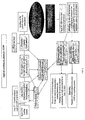
- the aforesaid inert material obtained with the process according to the invention presents characteristics of a calcinate which is dry, sandy, thermally insulating and sound-proofing, water-repellent, oil-absorbing with a specific weight lower than unity (see Table 4 and Figure 1 ).
- the residue can be riddled and selected in order to separate the inert materials in the sandy fine state from the solid coarse parts, which can be recovered and differentiated for reuse, as in the case of urban solid waste (USW).
- USW urban solid waste
- the inert fraction can in turn be sent on for recovery, with final fixation in concrete-mixing plants or cement factories, or else reused as bulk inert material after a pre-set period of maturation, which, according to current Italian regulatory standards (Ministerial Decree of February 05, 1998, Legislative Decree 471 and Legislative Decree 152/2006), is at least 16 days, or else again reused in agriculture as fertilizer for soil amendment and/or compost, which is the inert material originating from urban biological sludge and/or materials of animal or vegetable origin.
- the tests comprise a pilot test, during which approximately 120 m 3 of tank bottoms of crude oil in the pasty, pitch-like state mixed with sediments of iron particles, sand, plastics, burlap, bags, paper, and waste of vegetable origin were treated.
- the reaction was obtained with natural calcium oxides CaO and calcium hydroxides Ca(OH) 2 , selected and balanced with the inert catalyst and thoroughly homogenized, following the specific procedure.
- the pilot test was carried out with the aid of a backhoe, the bucket of which had been specifically adapted to facilitate the operation of homogenization, and turning-over in the period of maturation of the residue, followed by riddling in the final riddling step.
- the process described herein is conclusive because it enables recovery of resources, including the materials used for the treatment.
- the inert matter resulting from the treatment is, as has been said, a sandy, dry material with low permeability, water-repellent, compressible, oleophilic, basic, and insulating, having a specific weight lower than unity.
- the residual contaminant falls within the limit concentrations allowed both for the residue as such and for the leachate.
- a first advantage of the invention lies in the minimization of the waste, which is incentivized by current regulatory standards in force in all countries, with substantial benefits of an environmental, economical, and social nature.
- a second advantage is that of favouring production activities induced by recycling the recovered materials.
- a third advantage is represented by the possibility of recovering the resources dispersed in the waste and the materials themselves necessary for treatment, namely, the calcined spent reagent and the catalyst as inert residue (Table 3).
- a fourth advantage is represented by the possibility of reducing the problems of environmental and social impact deriving from the collection and disposal of urban solid waste.
- a fifth advantage is represented by the possibility of applying the invention according to batch or continuous modalities, both for modest amounts and for large amounts using materials and machinery that are widely used in agriculture, quarries, or for civil works.
- a sixth advantage is that of avoiding, as for most petrochemical compounds, the need to resort to treatments that may have a negative impact on the soil, subsoil, and air, such as, for example, incineration, physical or chemical oxidation, washing, and physical and chemical desorption, which also entail high costs.
- the not claimed CTO (cold thermal oxidation) process is implemented with a specific in-batch or in-line treatment, the protocol of which, as already mentioned, varies according to the type of contaminant and type of waste, industrial residue, soil or sludge that is to undergo treatment.
- the process basically comprises three phases:
- Each of the aforesaid phases in turn comprises a plurality of substeps or operations.
- PHASES AND CORRESPONDING STEPS Phase I Step 1 Selection and characterization of available reagents
- Step 2 Characterization of the mass to be treated and of the contaminant Preliminary activities
- Step 3 Feasibility test
- Step 4 Process protocols and preliminary project Phase II Pre-operative activities
- Step 6 Executive project Planning of intervention Step 7 Structural and operative arrangements
- Step 8 Pre-commissioning and commissioning Phase III Step 9 Conditioning of the mass to be treated Step 10 Reaction Implementation of process Step 11 Recovery of resources: - dry fine treated residue - dry coarse treated residue
- the efficiency of the treatment strictly depends upon the chemico-physical characteristics of the reagent (CaO and/or Ca(OH) 2 ).
- the reactivity of the oxides and hydroxides may vary according to the chemico-physical structure of the geological formation of the limestone and the type of process in the kiln: type of kiln and calcining temperature.
- the reagent is constituted by granulate having a reactivity such as to require an amount of mixture not higher than 25% of the material to be treated.
- oxides and/or hydroxides are obtained from a limestone source rich in silicates and magnesium, for the stone to be roasted at a temperature higher than 1000°C, and for the granulate selected to be free from lime in powder form.
- the above test according to the purpose that it is intended to achieve with the treatment (oxidation, fixation, desiccation, sterilization) has the function of determining: the temperature and duration of the reaction required by the type of treatment; the most appropriate catalyst and its relative humidity; and the grain size and mixture of the granulate of the reagent to be applied.
- the executive project of the intervention is drawn up.
- all the design and planning activities are developed, which include: selection of the machinery, detailed projects, type of arrangements, selection of the materials, plan for valorization of recoverable resources, and stipulation of orders with suppliers.
- the operations of indicative arrangement may comprise, among other things: preparation of a manoeuvring yard and provisional-storage area, fixed or mobile roofings of a greenhouse type, control and treatment of atmospheric air for the dust, vapours, odours, and water treatment, where necessary.
- the process will be implemented on the basis of the activities performed in the preliminary phase and set down in the process protocol.
- the conditioning of the mass to be treated envisages a series of operations to be performed in sequence.
- the reaction starts to take place, in the terminal stage of conditioning, on account of the contact of the reagent with the moist content of the mass. Consequently, the administration of the reagent must be made at a certain speed, with uniform distribution within the conditioned mass, after which it is necessary to isolate the mass immediately from the atmospheric air in order to create the conditions of absence of oxygen.
- the conditions of absence of oxygen, i.e., of isolation of the already conditioned mass, ready for the reaction, from the atmosphere can be obtained in two different ways: musing the reactor which falls not within the scope of the claims or else using the pile according to the invention.
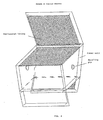
- Reactor - the conditioned mass for the reaction is stowed in a reactor, i.e., a double-bodied hermetically sealed container (see Figure 4 ), provided with thermocouples for monitoring the temperatures generated by the mass owing to the exothermal reaction.
- a reactor i.e., a double-bodied hermetically sealed container (see Figure 4 ), provided with thermocouples for monitoring the temperatures generated by the mass owing to the exothermal reaction.
- Said reactor is basically made up of an outer casing, equipped with a closing lid, the internal surface of said casing being completely lined with a perforated lining in order to reduce adhesion of the mass to be treated to the inner surface of the reactor (this is particularly useful if the mass comprises hydrocarbon residue or the like).
- Said outer casing is also provided with means for facilitating handling thereof using handling means of a known type.
- the reactor technique is indicated for fixed plants or mobile plants for enabling large volumes to be treated.
- the reactors provided for treatment of hydrocarbon residue and residue that may potentially generate temperatures higher than 200°C for appreciable reaction times may be equipped with heat exchangers. Said heat exchangers will enable recovery of the heat produced by the high level of energy liberated by the exothermal reaction.
- the heat recovered may be used, among other things, in the pre-treatment of hydrocarbon residue that is to undergo treatment and in other utilities.
- the conditioned mass is according to the invention set in a pile for the reaction. It is covered with a layer having a thickness of a few centimetres (minimum 2 to 3 cm) of inert material for the first batch, and subsequently the mass will be covered with the residue resulting from batches previously treated.
- penetration thermometers having a scale adequate for the nature of the treatment will be positioned on the periphery and in the central part of the pile.
- the pile technique is indicated for small quantities or sporadic activities.
- the reaction will be monitored by thermometers or thermocouples by detection of the parabolic curve described by the temperature produced by the exothermal reaction in the body of the mass.
- the reaction can last from 15 minutes up to 72 hours, as indicated in Table 1.
- Said duration which is determined in the feasibility test and is set down in the process protocol, depends upon the specific reactivity of the reagent, the specific humidity of the catalyst, the nature of the contaminant, the nature of the contaminated matrix to be treated, and the purpose of the treatment (oxidation, fixation, desiccation, sterilization).
- monitoring is necessary to control and adapt the process to the real situations, which are variable and dynamic.
- the exothermal reaction is interrupted when the production of heat is exhausted, i.e., when the temperature curve has dropped to 50-60°C, in the case of desiccation and sterilization treatments, or to 80-100°C, in the case of oxidation and fixation treatments.
- the interruption of the reaction occurs with emptying-out of the reactor into the purposely designed selective riddle or with breaking-up of the pile.
- the CTO (cold thermal oxidation) process enables recovery of resources and energy.
- the liquid phase of the hydrocarbons or other reusable liquids are recovered with the adoption of the HSS system, whilst the heat recovered by the reactors is distributed in the utilities.
- the residue coming from the process, immediately after interruption of the reaction, is passed through a riddle to be cooled, demixed, and separated into a dry, sandy, inert, calcined residue for reuse and coarse materials to be differentiated and sent on for recovery and recycling.
- the dry, sandy, calcined, compressible, inert material can be reused either immediately after the process in concrete-mixing plants, in cement factories, or as compost for agricultural purposes (if it comes from the treatment of biological sludge), or, after the period of maturation of at least 16 days and after release and leachate tests in compliance with the regulatory standards, in civil and public works, as filler material and as thermally insulating and sound-proofing, water-repellent, herbicidal material for foundations and subgrades, or, in maintenance operations, as oil-absorbent, antiskid, and herbicidal substrate.
- the coarse materials of the dry treated residue can be sent on for reuse.
- the materials recovered from USW may be sent on for recycling, the materials of animal or vegetable origin can be used as compost for agricultural purposes, whilst the coarse inert matter can be sent to cement factories or disposed of in inert landfills.
- HSS head-separator-sedimentator
- the HSS is an apparatus that incorporates three techniques, which are currently applied separately, in a single system, thus advantageously obtaining a considerable saving in terms of energy, machinery, and space.
- This unit comprises: a heat generator (heat exchanger); an oil/water separator; and a sedimentator (IMHOFF tank) for enabling precipitation and settlement of sludge.
- the above system enables heating of the residue to be treated in order to fluidify it and favour the other treatment phases. It can use the heat produced by the energy released by the exothermal reaction if it is adopted in the pre-treatment steps in CTO (cold thermal oxidation) plants. If it is used on its own, it can be supplied by external heat generators.
- the HSS enables recovery of the liquid phase from the hydrocarbon residue to be treated, which, since it has a specific weight lower than unity, flows through the separators over the liquid that ensures the hydrostatic level.
- the HSS enables decantation of the residue by separating the water from the oil in an effective and fast way by means of the demixers installed between one separator and another.
- the HSS favours sedimentation of the sludge and solid matter that accumulate in the Imhoff sectors so that they can be controlled and discharged automatically, with restoration of the hydrostatic level.
Landscapes
- Chemical & Material Sciences (AREA)
- Engineering & Computer Science (AREA)
- Environmental & Geological Engineering (AREA)
- Life Sciences & Earth Sciences (AREA)
- Chemical Kinetics & Catalysis (AREA)
- General Chemical & Material Sciences (AREA)
- Oil, Petroleum & Natural Gas (AREA)
- Organic Chemistry (AREA)
- General Health & Medical Sciences (AREA)
- Hydrology & Water Resources (AREA)
- Water Supply & Treatment (AREA)
- Toxicology (AREA)
- Soil Sciences (AREA)
- Health & Medical Sciences (AREA)
- Materials Engineering (AREA)
- Processing Of Solid Wastes (AREA)
- Treatment Of Sludge (AREA)
Claims (5)
- Verfahren zur exothermen Behandlung und Wiedergewinnung von festem, halbfestem, pastösem oder feuchtem Abfall, um als Reststoff eine vollständig wiedergewinnbare und wiederverwendbare trockene Masse zu erzeugen, wobei vorgesehen wird, die zu behandelnde Masse einer exothermen Reaktion zu unterziehen, die durch ein geeignetes Reagens erzeugt wird, das in Gegenwart eines inerten Katalysators verwendet wird, wobei die zu behandelnde Masse für diesen Zweck homogen mit dem Reagens und dem Katalysator gemischt wird, dadurch gekennzeichnet, dass das geeignete Reagens absichtlich mit Wasser und in Abwesenheit von Sauerstoff angefeuchtet wird, unter Verwendung der Kohlenmeiler-Technik mit einem oder mehreren Meilern.
- Verfahren nach dem vorhergehenden Anspruch, dadurch gekennzeichnet, dass hauptsächlich die Kontrolle und Modulation der exothermen Reaktion innerhalb vorbestimmter Temperaturbereiche vorgesehen wird, die vom zu behandelnden Material abhängen, um die für die spezifische Behandlungsart erforderliche Temperatur zu erzeugen, ohne ein Zünden der Masse zu bewirken und ohne irgend eine Emission in die Atmosphäre hervorzurufen; wobei in dem Fall, in dem die zu behandelnde Masse im Wesentlichen aus biologischen Schlämmen besteht, die von einer nicht-industriellen Wasserbehandlung stammen, die Reaktion so moduliert wird, dass eine Temperatur von 60 bis 100°C für 15 bis 60 Minuten erhalten wird, wodurch die Sterilisierung und Trocknung der Masse erhalten werden; wobei in dem Fall, in dem die zu behandelnde Masse im Wesentlichen aus feuchtem festem Hausmüll (USW) oder nicht getrenntem festem Abfall oder nicht getrenntem Abfall pflanzlichen Ursprungs besteht, die Reaktion so moduliert wird, dass eine Temperatur von 80 bis 120°C für 15 bis 60 Minuten erhalten wird, so dass die Fixierung, Sterilisierung und Trocknung der Masse erhalten wird; wobei in dem Fall, in dem die zu behandelnde Masse im Wesentlichen aus biologischen Schlämmen besteht, die von industrieller Wasseraufbereitung stammen, die Reaktion so moduliert wird, dass eine Temperatur von 150 bis 250°C für 1,5 bis 24 Stunden erhalten wird, so dass die Sterilisierung, Trocknung und Fixierung der Masse erhalten wird; wobei in dem Fall, in dem die zu behandelnde Masse im Wesentlichen aus Reststoffen von industriellen Verfahren oder aus durch organische Matrizen verunreinigten Böden und inerten Stoffen besteht, die Reaktion so moduliert wird, dass eine Temperatur von 150 bis 250°C für 8 bis 48 Stunden erhalten wird, so dass die Sterilisierung, Trocknung und Fixierung der Masse erhalten wird; wobei in dem Fall, in dem die zu behandelnde Masse im Wesentlichen aus Reststoffen besteht, die von Kohlenwasserstoff und organisch-chemischen Zusammensetzungen stammen, die Reaktion so moduliert wird, dass eine Temperatur gleich oder höher als 250°C für 12 bis 72 Stunden erhalten wird, so dass die Oxidierung, Trocknung und Fixierung der Masse erhalten wird.
- Verfahren nach Anspruch 1, dadurch gekennzeichnet, dass der Katalysator aus angefeuchtetem inertem Stoff besteht, der fähig ist, genug Wasser auszuscheiden, um die ganze spezifische Reaktionsfähigkeit des Reagens freizugeben.
- Verfahren nach Anspruch 1, dadurch gekennzeichnet, dass der inerte Katalysator auch die Funktion der Fixierung, innerhalb seiner von der Temperatur erweiterten Porosität, der Verunreinigungen hat, die von der Masse während des Reaktionsschritts ausgeschieden werden.
- Verfahren nach Anspruch 1, dadurch gekennzeichnet, dass die exotherme Reaktion gestoppt wird, wenn die Wärmeerzeugung aufgebraucht ist, d.h., wenn die Temperatur im Fall von Trocknungs- und Sterilisierungsbehandlungen auf 50-60°C oder sonst im Fall von Oxidierungs- und Fixierungsbehandlungen auf 80-100°C gefallen ist.
Applications Claiming Priority (2)
| Application Number | Priority Date | Filing Date | Title |
|---|---|---|---|
| SM200800002A SM200800002B (it) | 2008-01-14 | 2008-01-14 | Processo per il trattamento esotermico ed il recupero di rifiuti solidi, semisolidi, pastosi e/o umidi |
| PCT/SM2008/000006 WO2009091343A2 (en) | 2008-01-14 | 2008-03-12 | Process for exothermal treatment and recovery of solid, semi-solid, pasty and/or damp waste |
Publications (2)
| Publication Number | Publication Date |
|---|---|
| EP2242591A2 EP2242591A2 (de) | 2010-10-27 |
| EP2242591B1 true EP2242591B1 (de) | 2016-03-09 |
Family
ID=40756912
Family Applications (1)
| Application Number | Title | Priority Date | Filing Date |
|---|---|---|---|
| EP08724394.5A Not-in-force EP2242591B1 (de) | 2008-01-14 | 2008-03-12 | Verfahren für exotherme behandlung und rückgewinnung von festem, halbfestem, pastösem und/oder feuchtem abfall |
Country Status (7)
| Country | Link |
|---|---|
| US (1) | US8366941B2 (de) |
| EP (1) | EP2242591B1 (de) |
| AU (1) | AU2008348216B8 (de) |
| CA (1) | CA2712100C (de) |
| IT (1) | IT1390901B1 (de) |
| SM (1) | SM200800002B (de) |
| WO (1) | WO2009091343A2 (de) |
Families Citing this family (6)
| Publication number | Priority date | Publication date | Assignee | Title |
|---|---|---|---|---|
| CN102303944B (zh) * | 2011-08-22 | 2014-08-27 | 广州新致晟环保科技机械设备有限公司 | 脱水污泥再处理方法 |
| CN103286123B (zh) * | 2013-05-21 | 2014-07-30 | 江苏上田环境修复有限公司 | 一种用于治理重金属污染土壤的工艺 |
| EA023365B1 (ru) * | 2013-11-27 | 2016-05-31 | Каграман Союн Оглы Гасанов | Способ обезвреживания токсичных почвогрунтов, загрязненных фенолом |
| CN104016556B (zh) * | 2014-06-16 | 2016-07-06 | 杨斯智 | 大型垃圾废物资源化处理系统 |
| EP3228454A1 (de) | 2016-04-08 | 2017-10-11 | Services Pétroliers Schlumberger | Latexgebundenes metall und zementelemente |
| CN109365496A (zh) * | 2018-12-05 | 2019-02-22 | 辽宁石油化工大学 | 生物炭负载氧化助剂耦合微生物植物修复石油污染土壤的方法 |
Family Cites Families (12)
| Publication number | Priority date | Publication date | Assignee | Title |
|---|---|---|---|---|
| US4384923A (en) * | 1980-07-03 | 1983-05-24 | Deutsche Kommunal-Anlagen Miete Gmbh | Process for the hygienization of carbonation sludges |
| DE3826520A1 (de) * | 1988-08-04 | 1990-02-08 | Energas Gmbh | Verfahren und vorrichtung zur pyrolyse von klaerschlamm |
| NL9101655A (nl) * | 1991-10-01 | 1993-05-03 | Pelt & Hooykaas | Fixeermiddel voor gemengde organisch en anorganisch verontreinigde materialen en werkwijze ter bereiding en toepassing daarvan. |
| US5414207A (en) * | 1991-12-09 | 1995-05-09 | Ritter; Robert A. | Method for rendering waste substances harmless |
| US5238583A (en) * | 1992-03-09 | 1993-08-24 | Derrick's Enterprise, Inc. | Method for converting a contaminated waste material to an innocuous granular substance |
| DK0602293T3 (da) * | 1992-12-07 | 1998-02-02 | Blangy Gerard De | Fremgangsmåde og indretning til behandling og valorisering af affald ved omdannelse deraf til ikke-forurenende og genanvendelige materialer |
| US5931773A (en) * | 1995-06-09 | 1999-08-03 | Entact, Inc. | Method for treatment of solid waste to minimize permeability of the waste |
| US5788623A (en) * | 1995-06-09 | 1998-08-04 | Entact, Inc. | Method for treatment of solid waste to minimize permeability of the waste |
| WO1997027903A1 (en) | 1996-01-30 | 1997-08-07 | Vial Jean Luc | Apparatus and method for treating solids |
| US6668947B2 (en) * | 2001-09-25 | 2003-12-30 | Ramon Perez Cordova | Drill cutting treatment method |
| US6857998B1 (en) * | 2002-05-10 | 2005-02-22 | Free Flow Technologies, Inc. | Compositions and methods for treatment of solid waste |
| DE102007006137A1 (de) | 2007-02-07 | 2008-08-21 | First Vandalia Luxembourg Holding S.A. | Misch-Produkt |
-
2008
- 2008-01-14 SM SM200800002A patent/SM200800002B/it unknown
- 2008-03-12 US US12/438,398 patent/US8366941B2/en not_active Expired - Fee Related
- 2008-03-12 WO PCT/SM2008/000006 patent/WO2009091343A2/en not_active Ceased
- 2008-03-12 CA CA2712100A patent/CA2712100C/en not_active Expired - Fee Related
- 2008-03-12 EP EP08724394.5A patent/EP2242591B1/de not_active Not-in-force
- 2008-03-12 AU AU2008348216A patent/AU2008348216B8/en not_active Ceased
- 2008-08-27 IT ITRM2008A000469A patent/IT1390901B1/it active
Also Published As
| Publication number | Publication date |
|---|---|
| AU2008348216A8 (en) | 2013-07-18 |
| AU2008348216B2 (en) | 2013-03-21 |
| US20100282672A1 (en) | 2010-11-11 |
| CA2712100A1 (en) | 2009-07-23 |
| AU2008348216A1 (en) | 2009-07-23 |
| AU2008348216B8 (en) | 2013-07-18 |
| WO2009091343A2 (en) | 2009-07-23 |
| EP2242591A2 (de) | 2010-10-27 |
| SM200800002B (it) | 2010-09-10 |
| WO2009091343A3 (en) | 2010-06-17 |
| SM200800002A (it) | 2009-09-07 |
| US8366941B2 (en) | 2013-02-05 |
| IT1390901B1 (it) | 2011-10-19 |
| CA2712100C (en) | 2015-06-23 |
| ITRM20080469A1 (it) | 2009-07-15 |
Similar Documents
| Publication | Publication Date | Title |
|---|---|---|
| Rubinos et al. | Utilization of waste products as alternative landfill liner and cover materials–A critical review | |
| EP2242591B1 (de) | Verfahren für exotherme behandlung und rückgewinnung von festem, halbfestem, pastösem und/oder feuchtem abfall | |
| Song et al. | Leaching behavior of heavy metals from sewage sludge solidified by cement-based binders | |
| Mulligan et al. | An evaluation of technologies for the heavy metal remediation of dredged sediments | |
| CN109607999A (zh) | 一种石油油泥环保处理方法 | |
| Tack et al. | Overview of soil and groundwater remediation | |
| Marchiori et al. | Critical review of industrial solid wastes as barrier material for impermeabilization of storage waste facilities | |
| EP2087947A2 (de) | Verfahren zur Regenerierung von aus mit Schwermetallen sowie gefährlichen und giftigen organischen Verbindungen verseuchten Wasserläufen ausgebaggerter Erde, Sedimenten und Schlamm | |
| Hopper | Cleaning up contaminated waste sites | |
| Donthi et al. | Assessment of the geotechnical and environmental reuse potential of soil-like material recovered from Anantapur dumpsite, South India | |
| Safari et al. | Removal of manganese and zinc from Kahrizak landfill leachate using daily cover soil and lime | |
| Wang et al. | Advances in the Remediation of Metal Finishing Brownfield Sites | |
| Boelsing | DCR technology in the field of environmental remediation | |
| KR101386441B1 (ko) | 유기성 잔재물 연료화 방법 | |
| Hassan et al. | Investigation of permeability and leaching of hot mix asphalt concrete containing oil-contaminated soils | |
| Somani et al. | Factors affecting the intensity of color released in water extract by soil-like material obtained from mining of old MSW dumps | |
| Vaccari et al. | Reuse of hydrocarbon-contaminated sludge from soil washing process: issues and perspectives | |
| Lassalle et al. | Remediation of crude oil impacted soils with electron beam irradiation | |
| Dillard | Solidification/stabilization | |
| Rahim et al. | Utilisation of Organic Waste Materials as Biocover for Landfills | |
| KR200399605Y1 (ko) | 폐수 슬러지를 이용한 생태복원용 복토재 | |
| Ghazizade et al. | Landfilling of produced spent pot liner in aluminum industries: proposed method in developing countries | |
| Kamil et al. | Treatment of petroleum sludge | |
| Rupakheti et al. | Containment and Dewatering of Heavy Metal Contaminated Slurries Using Reactive Minerals and Cellulose Materials in Geotextile Tubes | |
| Shammas | 13 Management and Removal of Heavy Metals from Contaminated Soil |
Legal Events
| Date | Code | Title | Description |
|---|---|---|---|
| PUAI | Public reference made under article 153(3) epc to a published international application that has entered the european phase |
Free format text: ORIGINAL CODE: 0009012 |
|
| 17P | Request for examination filed |
Effective date: 20100812 |
|
| AK | Designated contracting states |
Kind code of ref document: A2 Designated state(s): AT BE BG CH CY CZ DE DK EE ES FI FR GB GR HR HU IE IS IT LI LT LU LV MC MT NL NO PL PT RO SE SI SK TR |
|
| AX | Request for extension of the european patent |
Extension state: AL BA MK RS |
|
| DAX | Request for extension of the european patent (deleted) | ||
| 17Q | First examination report despatched |
Effective date: 20110913 |
|
| GRAP | Despatch of communication of intention to grant a patent |
Free format text: ORIGINAL CODE: EPIDOSNIGR1 |
|
| INTG | Intention to grant announced |
Effective date: 20150918 |
|
| GRAS | Grant fee paid |
Free format text: ORIGINAL CODE: EPIDOSNIGR3 |
|
| GRAA | (expected) grant |
Free format text: ORIGINAL CODE: 0009210 |
|
| AK | Designated contracting states |
Kind code of ref document: B1 Designated state(s): AT BE BG CH CY CZ DE DK EE ES FI FR GB GR HR HU IE IS IT LI LT LU LV MC MT NL NO PL PT RO SE SI SK TR |
|
| REG | Reference to a national code |
Ref country code: GB Ref legal event code: FG4D |
|
| REG | Reference to a national code |
Ref country code: AT Ref legal event code: REF Ref document number: 779103 Country of ref document: AT Kind code of ref document: T Effective date: 20160315 Ref country code: CH Ref legal event code: EP |
|
| REG | Reference to a national code |
Ref country code: IE Ref legal event code: FG4D |
|
| REG | Reference to a national code |
Ref country code: DE Ref legal event code: R096 Ref document number: 602008042690 Country of ref document: DE |
|
| REG | Reference to a national code |
Ref country code: FR Ref legal event code: PLFP Year of fee payment: 9 |
|
| REG | Reference to a national code |
Ref country code: LT Ref legal event code: MG4D |
|
| REG | Reference to a national code |
Ref country code: NL Ref legal event code: MP Effective date: 20160309 |
|
| PG25 | Lapsed in a contracting state [announced via postgrant information from national office to epo] |
Ref country code: NO Free format text: LAPSE BECAUSE OF FAILURE TO SUBMIT A TRANSLATION OF THE DESCRIPTION OR TO PAY THE FEE WITHIN THE PRESCRIBED TIME-LIMIT Effective date: 20160609 Ref country code: HR Free format text: LAPSE BECAUSE OF FAILURE TO SUBMIT A TRANSLATION OF THE DESCRIPTION OR TO PAY THE FEE WITHIN THE PRESCRIBED TIME-LIMIT Effective date: 20160309 Ref country code: FI Free format text: LAPSE BECAUSE OF FAILURE TO SUBMIT A TRANSLATION OF THE DESCRIPTION OR TO PAY THE FEE WITHIN THE PRESCRIBED TIME-LIMIT Effective date: 20160309 Ref country code: ES Free format text: LAPSE BECAUSE OF FAILURE TO SUBMIT A TRANSLATION OF THE DESCRIPTION OR TO PAY THE FEE WITHIN THE PRESCRIBED TIME-LIMIT Effective date: 20160309 Ref country code: GR Free format text: LAPSE BECAUSE OF FAILURE TO SUBMIT A TRANSLATION OF THE DESCRIPTION OR TO PAY THE FEE WITHIN THE PRESCRIBED TIME-LIMIT Effective date: 20160610 |
|
| REG | Reference to a national code |
Ref country code: AT Ref legal event code: MK05 Ref document number: 779103 Country of ref document: AT Kind code of ref document: T Effective date: 20160309 |
|
| PG25 | Lapsed in a contracting state [announced via postgrant information from national office to epo] |
Ref country code: LV Free format text: LAPSE BECAUSE OF FAILURE TO SUBMIT A TRANSLATION OF THE DESCRIPTION OR TO PAY THE FEE WITHIN THE PRESCRIBED TIME-LIMIT Effective date: 20160309 Ref country code: BE Free format text: LAPSE BECAUSE OF NON-PAYMENT OF DUE FEES Effective date: 20160331 Ref country code: SE Free format text: LAPSE BECAUSE OF FAILURE TO SUBMIT A TRANSLATION OF THE DESCRIPTION OR TO PAY THE FEE WITHIN THE PRESCRIBED TIME-LIMIT Effective date: 20160309 Ref country code: LT Free format text: LAPSE BECAUSE OF FAILURE TO SUBMIT A TRANSLATION OF THE DESCRIPTION OR TO PAY THE FEE WITHIN THE PRESCRIBED TIME-LIMIT Effective date: 20160309 Ref country code: NL Free format text: LAPSE BECAUSE OF FAILURE TO SUBMIT A TRANSLATION OF THE DESCRIPTION OR TO PAY THE FEE WITHIN THE PRESCRIBED TIME-LIMIT Effective date: 20160309 Ref country code: PL Free format text: LAPSE BECAUSE OF FAILURE TO SUBMIT A TRANSLATION OF THE DESCRIPTION OR TO PAY THE FEE WITHIN THE PRESCRIBED TIME-LIMIT Effective date: 20160309 |
|
| PG25 | Lapsed in a contracting state [announced via postgrant information from national office to epo] |
Ref country code: IS Free format text: LAPSE BECAUSE OF FAILURE TO SUBMIT A TRANSLATION OF THE DESCRIPTION OR TO PAY THE FEE WITHIN THE PRESCRIBED TIME-LIMIT Effective date: 20160709 Ref country code: EE Free format text: LAPSE BECAUSE OF FAILURE TO SUBMIT A TRANSLATION OF THE DESCRIPTION OR TO PAY THE FEE WITHIN THE PRESCRIBED TIME-LIMIT Effective date: 20160309 |
|
| PG25 | Lapsed in a contracting state [announced via postgrant information from national office to epo] |
Ref country code: RO Free format text: LAPSE BECAUSE OF FAILURE TO SUBMIT A TRANSLATION OF THE DESCRIPTION OR TO PAY THE FEE WITHIN THE PRESCRIBED TIME-LIMIT Effective date: 20160309 Ref country code: CZ Free format text: LAPSE BECAUSE OF FAILURE TO SUBMIT A TRANSLATION OF THE DESCRIPTION OR TO PAY THE FEE WITHIN THE PRESCRIBED TIME-LIMIT Effective date: 20160309 Ref country code: AT Free format text: LAPSE BECAUSE OF FAILURE TO SUBMIT A TRANSLATION OF THE DESCRIPTION OR TO PAY THE FEE WITHIN THE PRESCRIBED TIME-LIMIT Effective date: 20160309 Ref country code: PT Free format text: LAPSE BECAUSE OF FAILURE TO SUBMIT A TRANSLATION OF THE DESCRIPTION OR TO PAY THE FEE WITHIN THE PRESCRIBED TIME-LIMIT Effective date: 20160711 Ref country code: SK Free format text: LAPSE BECAUSE OF FAILURE TO SUBMIT A TRANSLATION OF THE DESCRIPTION OR TO PAY THE FEE WITHIN THE PRESCRIBED TIME-LIMIT Effective date: 20160309 |
|
| REG | Reference to a national code |
Ref country code: DE Ref legal event code: R097 Ref document number: 602008042690 Country of ref document: DE |
|
| REG | Reference to a national code |
Ref country code: IE Ref legal event code: MM4A |
|
| PG25 | Lapsed in a contracting state [announced via postgrant information from national office to epo] |
Ref country code: BE Free format text: LAPSE BECAUSE OF FAILURE TO SUBMIT A TRANSLATION OF THE DESCRIPTION OR TO PAY THE FEE WITHIN THE PRESCRIBED TIME-LIMIT Effective date: 20160309 Ref country code: IT Free format text: LAPSE BECAUSE OF FAILURE TO SUBMIT A TRANSLATION OF THE DESCRIPTION OR TO PAY THE FEE WITHIN THE PRESCRIBED TIME-LIMIT Effective date: 20160309 |
|
| PLBE | No opposition filed within time limit |
Free format text: ORIGINAL CODE: 0009261 |
|
| STAA | Information on the status of an ep patent application or granted ep patent |
Free format text: STATUS: NO OPPOSITION FILED WITHIN TIME LIMIT |
|
| PG25 | Lapsed in a contracting state [announced via postgrant information from national office to epo] |
Ref country code: DK Free format text: LAPSE BECAUSE OF FAILURE TO SUBMIT A TRANSLATION OF THE DESCRIPTION OR TO PAY THE FEE WITHIN THE PRESCRIBED TIME-LIMIT Effective date: 20160309 Ref country code: IE Free format text: LAPSE BECAUSE OF NON-PAYMENT OF DUE FEES Effective date: 20160312 |
|
| 26N | No opposition filed |
Effective date: 20161212 |
|
| PG25 | Lapsed in a contracting state [announced via postgrant information from national office to epo] |
Ref country code: BG Free format text: LAPSE BECAUSE OF FAILURE TO SUBMIT A TRANSLATION OF THE DESCRIPTION OR TO PAY THE FEE WITHIN THE PRESCRIBED TIME-LIMIT Effective date: 20160609 |
|
| REG | Reference to a national code |
Ref country code: FR Ref legal event code: PLFP Year of fee payment: 10 |
|
| PG25 | Lapsed in a contracting state [announced via postgrant information from national office to epo] |
Ref country code: SI Free format text: LAPSE BECAUSE OF FAILURE TO SUBMIT A TRANSLATION OF THE DESCRIPTION OR TO PAY THE FEE WITHIN THE PRESCRIBED TIME-LIMIT Effective date: 20160309 |
|
| PG25 | Lapsed in a contracting state [announced via postgrant information from national office to epo] |
Ref country code: MT Free format text: LAPSE BECAUSE OF FAILURE TO SUBMIT A TRANSLATION OF THE DESCRIPTION OR TO PAY THE FEE WITHIN THE PRESCRIBED TIME-LIMIT Effective date: 20160309 |
|
| REG | Reference to a national code |
Ref country code: FR Ref legal event code: PLFP Year of fee payment: 11 |
|
| PGFP | Annual fee paid to national office [announced via postgrant information from national office to epo] |
Ref country code: DE Payment date: 20180323 Year of fee payment: 11 Ref country code: GB Payment date: 20180322 Year of fee payment: 11 Ref country code: CH Payment date: 20180327 Year of fee payment: 11 |
|
| PG25 | Lapsed in a contracting state [announced via postgrant information from national office to epo] |
Ref country code: CY Free format text: LAPSE BECAUSE OF FAILURE TO SUBMIT A TRANSLATION OF THE DESCRIPTION OR TO PAY THE FEE WITHIN THE PRESCRIBED TIME-LIMIT Effective date: 20160309 Ref country code: HU Free format text: LAPSE BECAUSE OF FAILURE TO SUBMIT A TRANSLATION OF THE DESCRIPTION OR TO PAY THE FEE WITHIN THE PRESCRIBED TIME-LIMIT; INVALID AB INITIO Effective date: 20080312 |
|
| PGFP | Annual fee paid to national office [announced via postgrant information from national office to epo] |
Ref country code: FR Payment date: 20180322 Year of fee payment: 11 |
|
| PG25 | Lapsed in a contracting state [announced via postgrant information from national office to epo] |
Ref country code: MT Free format text: LAPSE BECAUSE OF FAILURE TO SUBMIT A TRANSLATION OF THE DESCRIPTION OR TO PAY THE FEE WITHIN THE PRESCRIBED TIME-LIMIT Effective date: 20160331 Ref country code: MC Free format text: LAPSE BECAUSE OF FAILURE TO SUBMIT A TRANSLATION OF THE DESCRIPTION OR TO PAY THE FEE WITHIN THE PRESCRIBED TIME-LIMIT Effective date: 20160309 Ref country code: LU Free format text: LAPSE BECAUSE OF NON-PAYMENT OF DUE FEES Effective date: 20160312 Ref country code: TR Free format text: LAPSE BECAUSE OF FAILURE TO SUBMIT A TRANSLATION OF THE DESCRIPTION OR TO PAY THE FEE WITHIN THE PRESCRIBED TIME-LIMIT Effective date: 20160309 |
|
| REG | Reference to a national code |
Ref country code: DE Ref legal event code: R119 Ref document number: 602008042690 Country of ref document: DE |
|
| REG | Reference to a national code |
Ref country code: CH Ref legal event code: PL |
|
| GBPC | Gb: european patent ceased through non-payment of renewal fee |
Effective date: 20190312 |
|
| PG25 | Lapsed in a contracting state [announced via postgrant information from national office to epo] |
Ref country code: CH Free format text: LAPSE BECAUSE OF NON-PAYMENT OF DUE FEES Effective date: 20190331 Ref country code: LI Free format text: LAPSE BECAUSE OF NON-PAYMENT OF DUE FEES Effective date: 20190331 Ref country code: DE Free format text: LAPSE BECAUSE OF NON-PAYMENT OF DUE FEES Effective date: 20191001 Ref country code: GB Free format text: LAPSE BECAUSE OF NON-PAYMENT OF DUE FEES Effective date: 20190312 |
|
| PG25 | Lapsed in a contracting state [announced via postgrant information from national office to epo] |
Ref country code: FR Free format text: LAPSE BECAUSE OF NON-PAYMENT OF DUE FEES Effective date: 20190331 |