EP2243022B1 - Vorrichtung und verfahren zum nachweis von triacetontriperoxid - Google Patents
Vorrichtung und verfahren zum nachweis von triacetontriperoxid Download PDFInfo
- Publication number
- EP2243022B1 EP2243022B1 EP09709690A EP09709690A EP2243022B1 EP 2243022 B1 EP2243022 B1 EP 2243022B1 EP 09709690 A EP09709690 A EP 09709690A EP 09709690 A EP09709690 A EP 09709690A EP 2243022 B1 EP2243022 B1 EP 2243022B1
- Authority
- EP
- European Patent Office
- Prior art keywords
- tatp
- coated
- hff
- quartz crystal
- quartz
- Prior art date
- Legal status (The legal status is an assumption and is not a legal conclusion. Google has not performed a legal analysis and makes no representation as to the accuracy of the status listed.)
- Not-in-force
Links
Images





Classifications
-
- G—PHYSICS
- G01—MEASURING; TESTING
- G01N—INVESTIGATING OR ANALYSING MATERIALS BY DETERMINING THEIR CHEMICAL OR PHYSICAL PROPERTIES
- G01N29/00—Investigating or analysing materials by the use of ultrasonic, sonic or infrasonic waves; Visualisation of the interior of objects by transmitting ultrasonic or sonic waves through the object
- G01N29/02—Analysing fluids
- G01N29/036—Analysing fluids by measuring frequency or resonance of acoustic waves
-
- G—PHYSICS
- G01—MEASURING; TESTING
- G01N—INVESTIGATING OR ANALYSING MATERIALS BY DETERMINING THEIR CHEMICAL OR PHYSICAL PROPERTIES
- G01N33/00—Investigating or analysing materials by specific methods not covered by groups G01N1/00 - G01N31/00
- G01N33/0004—Gaseous mixtures, e.g. polluted air
- G01N33/0009—General constructional details of gas analysers, e.g. portable test equipment
- G01N33/0027—General constructional details of gas analysers, e.g. portable test equipment concerning the detector
- G01N33/0036—General constructional details of gas analysers, e.g. portable test equipment concerning the detector specially adapted to detect a particular component
- G01N33/0057—Warfare agents or explosives
-
- G—PHYSICS
- G01—MEASURING; TESTING
- G01N—INVESTIGATING OR ANALYSING MATERIALS BY DETERMINING THEIR CHEMICAL OR PHYSICAL PROPERTIES
- G01N2291/00—Indexing codes associated with group G01N29/00
- G01N2291/02—Indexing codes associated with the analysed material
- G01N2291/025—Change of phase or condition
- G01N2291/0256—Adsorption, desorption, surface mass change, e.g. on biosensors
- G01N2291/0257—Adsorption, desorption, surface mass change, e.g. on biosensors with a layer containing at least one organic compound
-
- Y—GENERAL TAGGING OF NEW TECHNOLOGICAL DEVELOPMENTS; GENERAL TAGGING OF CROSS-SECTIONAL TECHNOLOGIES SPANNING OVER SEVERAL SECTIONS OF THE IPC; TECHNICAL SUBJECTS COVERED BY FORMER USPC CROSS-REFERENCE ART COLLECTIONS [XRACs] AND DIGESTS
- Y10—TECHNICAL SUBJECTS COVERED BY FORMER USPC
- Y10T—TECHNICAL SUBJECTS COVERED BY FORMER US CLASSIFICATION
- Y10T436/00—Chemistry: analytical and immunological testing
- Y10T436/14—Heterocyclic carbon compound [i.e., O, S, N, Se, Te, as only ring hetero atom]
- Y10T436/142222—Hetero-O [e.g., ascorbic acid, etc.]
-
- Y—GENERAL TAGGING OF NEW TECHNOLOGICAL DEVELOPMENTS; GENERAL TAGGING OF CROSS-SECTIONAL TECHNOLOGIES SPANNING OVER SEVERAL SECTIONS OF THE IPC; TECHNICAL SUBJECTS COVERED BY FORMER USPC CROSS-REFERENCE ART COLLECTIONS [XRACs] AND DIGESTS
- Y10—TECHNICAL SUBJECTS COVERED BY FORMER USPC
- Y10T—TECHNICAL SUBJECTS COVERED BY FORMER US CLASSIFICATION
- Y10T436/00—Chemistry: analytical and immunological testing
- Y10T436/20—Oxygen containing
- Y10T436/200833—Carbonyl, ether, aldehyde or ketone containing
- Y10T436/202499—Formaldehyde or acetone
-
- Y—GENERAL TAGGING OF NEW TECHNOLOGICAL DEVELOPMENTS; GENERAL TAGGING OF CROSS-SECTIONAL TECHNOLOGIES SPANNING OVER SEVERAL SECTIONS OF THE IPC; TECHNICAL SUBJECTS COVERED BY FORMER USPC CROSS-REFERENCE ART COLLECTIONS [XRACs] AND DIGESTS
- Y10—TECHNICAL SUBJECTS COVERED BY FORMER USPC
- Y10T—TECHNICAL SUBJECTS COVERED BY FORMER US CLASSIFICATION
- Y10T436/00—Chemistry: analytical and immunological testing
- Y10T436/20—Oxygen containing
- Y10T436/206664—Ozone or peroxide
-
- Y—GENERAL TAGGING OF NEW TECHNOLOGICAL DEVELOPMENTS; GENERAL TAGGING OF CROSS-SECTIONAL TECHNOLOGIES SPANNING OVER SEVERAL SECTIONS OF THE IPC; TECHNICAL SUBJECTS COVERED BY FORMER USPC CROSS-REFERENCE ART COLLECTIONS [XRACs] AND DIGESTS
- Y10—TECHNICAL SUBJECTS COVERED BY FORMER USPC
- Y10T—TECHNICAL SUBJECTS COVERED BY FORMER US CLASSIFICATION
- Y10T436/00—Chemistry: analytical and immunological testing
- Y10T436/25—Chemistry: analytical and immunological testing including sample preparation
- Y10T436/25875—Gaseous sample or with change of physical state
Definitions
- the present invention relates to an apparatus and method for the rapid and safe on-line detection of triacetone triperoxide (TATP).
- TATP triacetone triperoxide
- Triacetontriperoxide is a very easily manufactured explosive whose starting materials are readily available from drugstore articles ( J. Zabicky, The chemistry of peroxides, John Wiley & Sons, Ltd .; (2006 ); JP Agrawal, RD Hodgson, Organic Chemistry of Explosives, John Wiley & Sons, Ltd .; (2007 )).
- the ingredients hydroogen peroxide, acetone and acid
- TNT Triacetontriperoxide
- Photometric treatment of a sample solution with peroxidase to destroy traces of hydrogen peroxide present, subsequent irradiation of this solution with a UV lamp, decomposition of TATP to hydrogen peroxide, and finally reagent photometry with a UV / Vis spectrometer examined.
- This method is portable, but the generation of a sample solution is necessary. In addition, it is analytically and technically complex and not suitable for online examinations.
- E-3500 In this method, the sample is collected by manual wiping! (possibly first explosion hazard) After application to a metal disc, the analyte is thermally decomposed. The resulting oxidative decomposition products produce chemoluminescence with luminol, which can be measured. Due to the necessary manual effort, no online measurement is possible and the application for mass person control is questionable. This system does not have sufficient chemical selectivity as there is no separation of the analytes. As a result, any substance that releases fire-promoting decomposition products when heated is considered TATP.
- the z-Nose is a miniature version of gas chromatography with a downstream surface acoustic wave (SAW) sensor as a mass-sensitive detector.
- SAW surface acoustic wave
- the detection of the substances is done by comparing the retention times with an alkane standard. Also in this method, a pre-enrichment of the sample before the actual analysis, whereby no online measurement is possible.
- Mini-Nose The mini-nose is a system that consists of two modules. The first of these modules is used to collect and enrich the sample. The second module analyzes the collected sample. The second module contains a sensor array consisting of several coated HFF quartz crystals. For measurement, the initially collected analyte is desorbed from module one out into module two. After a further 60 s measurement time, the substance is identified by means of principal component analysis. In this case, too, it is clear that no online investigation is possible due to the necessary enrichment step.
- WO02 / 103340 describes the use of a quartz crystal array with high-frequency quartz so-called HFF crystals.
- the sensor array used in that method is so insensitive that an enrichment step is necessary before the actual detection.
- the apparatus and method of the invention enables rapid (i.e., direct, "on line") and continuous detection of the explosive TATP from the ambient air. This allows fast on - site examinations of persons and objects on TATP tracks.
- the sensors are coated to achieve a chemical selectivity with affine acceptor substances, in defined layer thicknesses.
- affine acceptor substances in defined layer thicknesses.
- FIG. 2 a preselection of the analyte molecules.
- sensors address not only a single substance but also chemically similar substances.
- several sensors are combined in one sensor array. Corresponding systems are already described in the literature as "chemical noses”.
- the invention uses a technology similar to that described, but eliminates - due to the special sensor combination - a time-consuming enrichment. In combination with powerful evaluation routines, rapid detection in a single measuring step without additional enrichment is possible.
- the present invention is based on the development of a combination of coatings which yield a measurement signal highly selectively and reversibly on TATP traces. This selectivity as well as sensitivity makes the detection of TATP considerably easier.
- the combination of affinity materials used in the sensors of the present invention consists of a cyclodextrin derivative, a dimensionally stable dendrimer and a cholic acid derivative.
- the amount of affinity material applied to the sensitive surface of the quartz depends on the type of affinity material, preferably the sensitive surfaces of the quartzes are 10 to 350 ng; preferably 25 to 150 ng of detector substance coated, which corresponds to a frequency reduction of 100 to 300 kHz.
- the cyclodextrin derivative is a ⁇ - or ⁇ -cyclodextrin derivative, preferably perallyl- ⁇ -cyclodextrin.
- the dimensionally stable dendrimer comprises a phenylene dendrimer, preferably a pyridine-containing terphenylene dendrimer of the 4th generation ( Shifrina et al., Macromolecules 38 (24): 9920-9932 (2005 )).
- the cholic acid derivative is a cholic acid salt, preferably sodium cholate.
- the most powerful combination has a composition of sodium cholate (preferably with a coating of quartz of about 70 ng), Octakis (2,3,6-tri- O -allyl) -y-cyclodextrin (preferably with a Coating of the quartz of about 35 ng) and the pyridine-containing terphenylendendrimer MPI-7, ie the in Shifrina et al., Macromolecules 38 (24): 9920-9932 (2005 )) described fourth generation dendrimer having the formula shown below (Td-Gr-Ph) (preferably with a coating of quartz of about 105 ng), which is referred to in the following and the experimental examples as an optimal sensor array.
- Td-Gr-Ph preferably with a coating of quartz of about 105 ng
- quartz crystal sensors can be used, for example, with non-cross-linked polyurethanes (for example those prepared from conventional diisocyanates such as toluene-2,4-diisocyanate and polyethylene glycol or polypropylene glycol), triphenylene ketals (eg triketals of hexahydroxytriphenylene (cf. Waldvogel et al., Angew. Chem. 112 (14), 2580-83 (2000 )) and / or porphyrins (eg metalloporphyrins such as Zn porphyrins).
- non-cross-linked polyurethanes for example those prepared from conventional diisocyanates such as toluene-2,4-diisocyanate and polyethylene glycol or polypropylene glycol
- triphenylene ketals eg triketals of hexahydroxytriphenylene (cf. Waldvogel et al., Angew. Chem. 112 (14), 2580-
- the sensor array of the present invention is very selective and very sensitive.
- the combination with HFF quartz crystal technology and powerful evaluation algorithms allows fast online measurement. This makes it very easy to distinguish between TATP and both chemically similar (bis- tert-butyl peroxide) as well as structurally dissimilar cross-sensitivities ( FIG. 4 ).
- the invention is thus fast, continuous and selective.
- Specific embodiments are characterized, for example, in that the signals of the individual sensors are used to reduce the cross-sensitivity (for example acetone or other peroxides).
- the evaluation algorithm then provides a selective measurement signal for the quantification of TATP.
- the arrays (measuring units) are very small, so that they can be integrated into existing systems. Also a mass production is conceivable, since the valid material price incl. Electronics is probably under € 500, - will lie.
- Fig. 5 the schematic structure of a suitable for such a method coating unit for quartz crystal (QCM) is shown.
- QCM quartz crystal
- the process is carried out as follows: The substance to be applied is first dissolved in a volatile, polar solvent, usually methanol, the solution is taken up in a Hamilton syringe (7) and then fixed on a stepper motor (12). Typically, concentrations of 30 ⁇ g / L are used in a 100 ⁇ l syringe.
- the positive pole is applied to the syringe cannula and the minus pole at the electrode of the target quartz (15).
- the HFF crystals used are subject to another slightly different procedure.
- the spray cone is produced as described above, placing the quartz which is actually to be coated 10 - 15 cm next to the center of the spray cone. This is always necessary if the large mass sensitivity of the HFF crystals during direct coating would lead to the immediate collapse of the oscillation.
- the coating thickness can be monitored continuously with a frequency counter (13). This allows highly reproducible and comparable coatings.
- the electrospray coating is carried out at reduced pressure (at about 200 mbar), whereby the drop formation is reduced.
- a gas mixing plant constructed from two assemblies (I, II), which ensures this reproducibility.
- the first part of Appendix (I) is used to generate strictly defined analyte gas streams (20) and Part II is a tempered measuring cell (28) for six quartz microbalances connected to the analyte gas stream (20).
- two controllable nitrogen gas streams with a volume of between 1 and 200 ml / min can be taken from a nitrogen cylinder (16). While stream (17) remains unchanged in temperature and composition, stream (18) is heated to 20 ° C (26) and passed through the gas washing bottle (25). By recombining both gas streams, an analyte gas stream (17) can be produced with a wide spectrum of analyte concentrations.
- the exact composition of the gas flow is controllable by means of a serial interface via a personal computer.
- Sample gas generation (20) by passing the nitrogen stream (18) through the analyte-filled gas wash bottle and mixing it with the pure nitrogen stream (17) behind it.
- the gas wash bottle (25) is heated to 20 ° C, since for most substances only at this temperature the exact vapor pressure is known, whereby calculations of the concentration are possible.
- concentrations with a volume fraction between 0.5% and 100% of the maximum analyte saturation of the gas stream can be generated. From the mixing ratio, the volume-related concentration in ppm can be calculated very easily.
- the actual sensor unit ( Fig. 8 , III) consists of a steel tube (V) and six sensor modules (IV).
- the sensor modules each contain an oscillator circuit, with the help of which mounted quartz (29) is excited to vibrate. Furthermore, they consist of digitally readable frequency meters via the USB interface. These sensor modules are inserted into the metal body and tightly bolted.
- the measuring cell formed in this way has Swagelok connections (30) at the outputs, via which it can be connected to module I. Since the quartz microbalances (29) show a temperature dependence, the measuring cell is kept constant at 35 ° C. The choice of this temperature ensures that it is always above room temperature. This measure prevents condensation effects and at the same time the dynamics of the sorption processes remain comparable.
- the electronics used consist of a holder for the quartz (29), an oscillator (31), which stimulates the quartz to oscillate, and a measuring unit (31), which can determine the exact oscillation frequency of the quartz by means of a processor ( G. Sauerbrey, Using quartz crystals for weighing thin layers and for weighing, Z. Phys. 155, 206-222 (1959 ); Neubig, W. Briese, Das Grosse Quarzkochbuch, Franzis-Verlag Feldmaschinen (1997 )).
- the components can be connected in series via RJ 45 connections and read out using a USB adapter with a personal computer.
- two frequency counters are provided per quartz. It turned out that at Frequency counters available today require a one-second gate time to accurately specify integer frequencies. In order to achieve a higher sampling rate, therefore, the frequency counters provided per quartz are started at intervals of 0.5 seconds and read out with a time delay. Of course, it is possible to provide more than two frequency counters per quartz, which are started at different intervals to achieve an even higher sampling rate.
- a FPGA field-programmable gate array
- the counting algorithm and the further processing of the counting results are implemented within the FPGA by the combination of a Very High Speed Integrated Circuit Hardware Description Language (VHDL) design and an IP softcore.
- VHDL Very High Speed Integrated Circuit Hardware Description Language
- Such a circuit allows for example, the parallel, asynchronous 28-bit count of three sensors with an accuracy of ⁇ one bit. This allows a resolution of up to one hertz.
- the apparatus for on-line detection of triacetontriperoxide may comprise a housing with an internal air duct, the air duct being connected to an opening in the housing. Through this opening, the analyte afflicted air can be admitted.
- the quartz crystals may be located, which are connected to the electronics.
- a suction device which generates a negative pressure in the housing.
- the suction device can be made possible, for example, from a fan attached to the housing back or by an external pump connected to the housing.
- the housing Since it is necessary that incoming air is added exclusively to the quartz crystals via the air duct, the housing should be made as airtight as possible.
- the device according to the invention can also be provided as a mobile device which has a mobile power supply and a wireless data transmission for the transmission of data to a computer, for example a WLAN adapter.
- an essay is arranged, which allows a temperature compensation of the incoming air.
- This attachment can be heated, for example, so that the air flowing into the air duct is brought to a constant temperature by supplying external energy.
- a heat-conducting material is introduced with a large surface, so that the air flowing through the essay over a large area contact with the material, whereby small temperature fluctuations can be successfully reduced by intensive heat exchange between individual areas of the incoming air.
- several perforated plates made of metal, such as aluminum are arranged, through which the incoming air is passed.
- Quartz crystals used HFF crystals in the AT cut with a fundamental frequency of 195 MHz on a HC-52 / U socket.
- Product name Quartz * XA 1600 (ed. 06/05) RoHS-compliant Product, HC-52 / U, QF: 195 MHz, Manufacturer: KVG Quartz Crystal Technology GmbH, Neckarbischofsheim
- Coating process The coating was carried out using a modified electrospray method ( DE-A-103 44 135 ) with the in Fig. 5 shown coating unit for quartz crystals (QCM).
- the substance to be applied was first dissolved in a volatile, polar solvent (methanol) and the solution was taken up in a Hamilton syringe at a concentration of 30 ⁇ g / l in a 100 ⁇ l syringe.
- the positive pole was applied to the syringe cannula and the negative pole to the electrode of the target quartz. Between these, a high voltage of about 5 - 6 kV was applied via potentiometer, whereby the stepper motor slowly pushes the solution out of the syringe.
- the solution was positively charged by the applied voltage and accelerated to the electrode of the quartz.
- the quartz to be coated was placed 10 - 15 cm next to the center of the spray cone. This is necessary because the high mass sensitivity of the HFF crystals in direct coating for immediate collapse of the would cause vibration. The coverage was monitored continuously with a frequency counter.
- the coating process described above has the problem that it can lead to significant drop formation, which ultimately results in an inhomogeneous coating image. Since this can not be beneficial to the quality and reproducibility of the quartz, the coating was carried out under reduced pressure.
- the syringe cannula is brought into the inlet of an evacuable glass vessel, which is brought by a continuously running pump to a pressure of 200 mbar.
- this glass vessel is to be coated quartz and the counter electrode.
- the further structure remains like the conventional coating method described above.
- Fig. 12 For example, a quartz coated by this modified method is compared to that produced by the conventional method. Coatings produced by the modified process are characterized by a significantly lower number of large drop marks on the surface.
- Test gas was adjusted by dilution to concentrations between 0.5% and 100% of the maximum possible analyte-saturated gas flow. This made it possible to determine the isotherm at 35 ° C, whose slope in Hz / vol.ppm could be compared with the isotherms of other analytes.
- TATP sample generation The TATP source used was "real substance microsphere test specimen (EMPK)" from the company “Dülsnerhavetechnik (Cologne)” in two versions - 0.5 mg and 2.0 mg TATP. Because of this small amount of substance in combination with the slow desorption rate of the EMPK, it was necessary to generate gas samples of a defined concentration. For this purpose, in the case of the 0.5 mg TATP-coated EMPK, two test specimens were placed in a closed glass vessel (solvent sphere from column chromatography) with a volume of 2.3 l for at least 6 h.
- Affine materials A Komibination of sensors are used, with sodium cholate (70 ng; commercially available from Fluka), octakis (2,3,6-tri-O-allyl) - ⁇ -cyclodextrin (35 ng; Leydet et al., J. Med. Chem. 41, 4927-4932 (1998 ) and J. Ni et al., Carbohydr. Res. 337, 217-220 (2002 ) or phenylene-end-dendrimer MPI-7 (105 ng; Shifrina et al., Macromolecules 38, 9920-9932 (2005 )) are coated.
- Measurement results For the measurement, the signals of the individual sensor elements were continuously recorded and the frequency change observed in comparison to the baseline.
- concentration series for the analytes were measured with the receptor substances, in the described measuring system, and the signal in equilibrium was determined in each case.
- a concentration series of a 10 ng octakis (2,3,6-tri- O- allyl) -y-cyclodextrin coated quartz sensor TATP is in Fig. 9 shown.
- TATP triacetontriperoxide
- Water Hydrogen peroxide solution (30%)
- acetone as potential cross-sensitivities and also considered bis-tert-butyl peroxide due to its structural similarity to the TATP.
- Concentration series at a sensor temperature of 35 ° C were measured for these five analytes and the isotherms were determined in each case.
- the concentration range in which the analytes were measured results mainly from its vapor pressure at 20 ° C.
- An overview of the analytes used, their vapor pressure and the measured concentration ranges is shown in Table 1.
- Table 1 Overview of the analyzed analytes analyte Vapor pressure [Vol. ppm] Conc. Range [Vol.
- an open system For measurements in an open system with a distance between analyte source and sensor array, an open system was designed. In this case, a fan is installed in a corridor or a lock opposite the sensor and an air flow directed to the sensor is generated (about 2 m / s). This air flow delivers analytes to the sensor very quickly and with a relatively small dilution over a distance of ⁇ 1 m.
- the model analyte phenol which has a comparable vapor pressure to TATP, is shown below.
- the investigations show a signal structure within 2-4 seconds almost independent of the distance ( Fig. 10 ).
- the sensor array described in this patent has very fast response times to safely identify a signal.
- Three seconds after the addition (s) a first response (t) of the sensors is already visible. at These three seconds are the apparatus-related dead time of the system.
- time (u) (5 s later), the signals are already far enough pronounced for secure identification. This time is well before the equilibrium of storage, (v).
- the results are in FIG. 11 summarized.
Landscapes
- Chemical & Material Sciences (AREA)
- Physics & Mathematics (AREA)
- Health & Medical Sciences (AREA)
- Life Sciences & Earth Sciences (AREA)
- Pathology (AREA)
- Engineering & Computer Science (AREA)
- Biochemistry (AREA)
- General Health & Medical Sciences (AREA)
- General Physics & Mathematics (AREA)
- Immunology (AREA)
- Analytical Chemistry (AREA)
- Food Science & Technology (AREA)
- Combustion & Propulsion (AREA)
- Acoustics & Sound (AREA)
- Medicinal Chemistry (AREA)
- Investigating Or Analyzing Materials By The Use Of Electric Means (AREA)
- Investigating Or Analyzing Materials By The Use Of Fluid Adsorption Or Reactions (AREA)
- Safety Devices In Control Systems (AREA)
- Hardware Redundancy (AREA)
- Maintenance And Management Of Digital Transmission (AREA)
- Sampling And Sample Adjustment (AREA)
Description
- Die vorliegende Erfindung betrifft eine Vorrichtung und ein Verfahren zum schnellen und sicheren Online-Nachweis von Triacetontriperoxid (TATP).
- Triacetontriperoxid (TATP) ist ein sehr einfach herstellbarer Sprengstoff, dessen Ausgangsstoffe aus Drogerieartikeln leicht verfügbar sind (J. Zabicky, The chemistry of peroxides, John Wiley & Sons, Ltd; (2006); J.P. Agrawal, R.D. Hodgson, Organic Chemistry of Explosives, John Wiley & Sons, Ltd; (2007)). Zudem, lassen sich die Zutaten (Wasserstoffperoxid, Aceton und Säure) leicht in großer Menge beschaffen. Weil er sehr empfindlich auf Hitze, Stoß und Elektrostatik reagiert sowie keine Initialzündung benötigt und zudem eine vergleichbare Sprengkraft wie TNT besitzt, hat er keine kommerzielle oder militärische Bedeutung. Er wird allerdings aufgrund der leichten Zugänglichkeit häufig zur terroristischen Zwecken (z.B. Madrid März 2004, London Juli 2005) eingesetzt. Aus diesem Grunde ist ein einfacher und schneller Online-Nachweis zur Gefahrenabwehr notwendig. Zurzeit sind folgende Nachweismethoden bekannt (J.W. Gardner, J. Yinon (Eds.), Electronic Noses & Sensors for the Detection of Explosives, Kluwer Academic Publishers (2003);
US 7,159,463 ; Z. Lin et al., Anal. Chem. 65, 1546-1551 (1993); E. Uttenthaler et al., Biosensors & Bioelectronics 16, 735-743 (2001);DE-A-10109534 ):
Trennung über RP-HPLC: Auftrennung einer Probenlösung über eine RP-HPLC, Zersetzung des TATP zu Wasserstoffperoxid mit einer UV-Lampe und Bestimmung der Wasserstoffperoxid-Konzentration mittels Fluoreszenzspektroskopie. Mit dieser Methode ist keine Onlinemessung möglich, da erst eine Probenlösung erstellt werden muss, welche nur mit großem analytischem Aufwand weiter untersucht werden kann. - Photometrisch: Behandlung einer Probenlösung mit Peroxidase, um vorhandene Spuren an Wasserstoffperoxid zu zerstören, nachfolgende Bestrahlung dieser Lösung mit einer UV-Lampe, zur Zersetzung von TATP zu Wasserstoffperoxid, nach dem Zusatz einer Reagenzlösung wird die Probe abschließend photometrisch mit einem UV/Vis-Spektrometer untersucht. Diese Methode ist portabel, aber die Erzeugung einer Probenlösung notwendig. Außerdem ist sie analytisch und apparativ aufwendig und nicht für Online-Untersuchungen geeignet.
- E-3500: Bei dieser Methode wird die Probe durch manuelles Aufwischen gesammelt! (eventuell erste Explosionsgefahr) Nach Aufbringen auf einer Metallscheibe wird der Analyt thermisch zersetzt. Durch die entstehenden oxidativen Zerfallsprodukte wird mit Luminol eine Chemolumineszenz erzeugt, die gemessen werden kann. Durch den notwendigen manuellen Aufwand ist keine Onlinemessung möglich und die Anwendung zur Massenpersonenkontrolle fraglich. Dieses System verfügt über keine ausreichende chemische Selektivität, da keine Auftrennung der Analyten stattfindet. Dadurch wird jede Substanz, die brandfördernde Zerfallsprodukte beim Erhitzen freisetzt, als TATP gewertet.
- z-Nose: Die z-Nose ist eine Miniaturvariante einer Gaschromatographie mit einem nachgeschalteten SAW-Sensor (Surface accustic wave) als massensensitiven Detektor. Die Erkennung der Substanzen erfolgt über einen Vergleich der Retentionszeiten mit einem Alkanstandard. Auch bei dieser Methode erfolgt eine Voranreicherung der Probe vor der eigentlichen Analyse, wodurch keine Onlinemessung mehr möglich ist.
- Mini-Nose: Die Mini-Nose ist ein System, welches sich aus zwei Modulen zusammensetzt. Das erste dieser Module wird zum sammeln und anreichern der Probe genutzt. Das zweite Modul analysiert die gesammelte Probe. Im zweiten Modul ist ein Sensorarray bestehend aus mehreren beschichteten HFF-Schwingquarzen enthalten. Zur Messung wird der zunächst gesammelte Analyt aus Modul eins heraus in Modul zwei desorbiert. Nach weiteren 60 s Messzeit wird die Substanz dann mittels Hauptkomponentenanalyse identifiziert. Auch in diesem Fall ist klar ersichtlich, dass durch den notwendigen Anreicherungsschritt keine Onlineuntersuchung möglich ist.
-
WO02/103340 - Jedes einzelne dieser Verfahren beinhaltet jedoch Nachteile, die es für eine Online-Überwachung untauglich machen: Es ist entweder analytisch aparativ aufwendig, besitzt eine mangelnde Nachweisgrenze (evt. Anreicherung notwendig), das Messintervall ist unzureichend lang, ist unselektiv vor chemisch ähnlichem Hintergrund oder es ist erforderlich, dass TATP in flüssiger Phase vorliegt. Dies bedeutet, dass bislang ein Nachweis von TATP-Spuren in der Luft nur über Anreicherung oder mit hohem analytischem Aufwand möglich ist. Dies verhindert eine Online-Überwachung von Personen und / oder Objekten zur Gefahrenabwehr. Ein einfacher und schneller Nachweis des Sprengstoffes TATP wäre somit sehr willkommen.
- Es wurde nunmehr gefunden, dass ein Nachweis von TATP mittels einer Sensortechnologie auf Grundlage von HFF-Schwingquarzen erfolgen kann. Dieses sind im Prinzip Grundton-Schwingquarze, deren Materialstärke mittels der "Inverted mesa Technology" im Zentrum reduziert wurde (
Figur 1 ). Der dünnere Bereich wird beidseitig mit metallischen Elektroden kontaktiert und unter Ausnutzung des umgekehrten piezoelektrischen Effekts mit einer Hochfrequenz, welche der Eigenfrequenz des Quarzes entspricht, angeregt. Die auf diese Weise erzeugte Resonanzschwingung ist direkt von der Masse des Oszillators abhängig. Masseänderungen, zum Beispiel durch Adsorption, führen daher zu Frequenzänderungen, welche leicht messbar sind. Die vorliegende Erfindung betrifft somit - (1) eine Vorrichtung zum Online-Nachweis von Triacetontriperoxid (TATP) umfassend eine Messzelle mit wenigstens drei unterschiedlich beschichtete HFF-Schwingquarzsensoren (Sensoren), wobei jeweils eine der sensitiven Flächen der drei Schwingquarze mit einem Cyclodextrinderivat, einem formstabilen Dendrimer und einem Cholsäurederivat als Detektorsubstanz beschichtet sind; und
- (2) ein Verfahren zum Online-Nachweis von Triacetontriperoxid (TATP) umfassend In-Kontakt-Bringen einer Vorrichtung wie vorstehend unter (1) definiert mit dem zu überprüfenden Medium.
- Die Vorrichtung und das Verfahren der Erfindung ermöglicht einen schnellen (d.h. direkten, "Online") und kontinuierlichen Nachweis auf des Explosivstoffes TATP aus der Raumluft. Hierdurch werden schnelle vor Ort Untersuchungen an Personen und Objekten auf TATP - Spuren möglich.
-
-
Figur 1 : Schematischer Aufbau eines HFF-Schwingquarzes mit Elektrode (1) und Quarz (2). -
Figur 2 : Prinzipieller Sensoraufbau gemäß dem Schlüssel-Schloss-Prinzip, wobei der Analyt (3) an einer selektiven Rezeptorschicht (4) bindet und über Transducer (5) ein Signal in der Elektrode (6) erzeugt. -
Figur 3 : Hauptkomponentenanalyse der fünf Analyten mit dem Sensorarray (#= Wasser, ∼= Wasserstoffperoxid, -= Bis-tert-butylperoxid, *= Aceton, += TATP). -
Figur 4 : Übersicht über die Verhältnisse der Sensorsignale von TATP und verscheidenen Querempfindlichkeiten (Analytenkonzentration 1 Vol.ppm). -
Figur 5 : Schematischer Aufbau der Beschichtungseinheit (P. Mashayekhi, Dissertation, Bonn, (2005)). -
Figur 6 : Schematische Darstellung einer Coulumbexplosion nach Doyle mit Hamilton-Spritze 7, Cone-jet 8 Satelliten Tropfen 9 und Mikro-Tropfen 10. -
Figur 7 : Schematischer Aufbau der Gasmischanlage. -
Figur 8 : Schematischer Aufbau der Messzelle. -
Figur 9 : Konzentrationsreihe eines mit 10 ng Octakis(2,3,6-tri-O-methyl)-γ-cyclodextrin beschichteten Quarzes mit TATP. -
Figur 10 : Anblasuntersuchungen bei verschiedenen Entfernungen (Beschichtung, Polyurethan 105 ng) mit einem Modell Analyt. -
Figur 11 : Zeitliche Erkennung eines TATP Signals bei einer Konzentration von 35 ppm mit dem optimalen Sensorarray. -
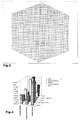
Figur 12 : Elektronenmikroskopische Untersuchung beschichteter Quarze. Beschichtung bei Normaldruck (links) und im reduzierten Umgebungsdruck (rechts) - In der Vorrichtung gemäß Aspekt (1) der Erfindung werden die Sensoren zur Erreichung einer chemischen Selektivität mit affinen Akzeptorsubstanzen, in definierten Schichtdicken, beschichtet. Dadurch erfolgt gemäß dem Schlüssel-Schloss-Prinzip eine Vorselektion der Analytmoleküle (
Figur 2 ). Üblicherweise sprechen so geartete Sensoren nicht nur auf eine einzige Substanz, sondern auch auf chemisch ähnliche Substanzen an. Zur Eliminierung dieser Querempfindlichkeiten und zum sicheren Nachweis einzelner Substanzen werden mehrere Sensoren in einem Sensorarray kombiniert. Entsprechende Systeme sind in der Literatur bereits als "chemische Nasen" beschrieben. - Aufgrund dieser Erfahrungen werden mehrere Sensoren, welche verschiedenartig beschichtet sind, genutzt und deren Signale mit chemometrischen Methoden ausgewertet. Je unspezifischer die Sensorantworten sind, desto mehr Sensoren werden nötig. Die meisten in der Literatur beschrieben Arrays müssen sich allerdings zusätzlich verschiedener Anreicherungsverfahren bedienen, um die nötige Nachweisgrenze zu erreichen.
- Die Erfindung bedient sich einer ähnlichen Technologie wie die beschriebene, allerdings entfällt - bedingt durch die spezielle Sensorkombination - eine zeitaufwändige Anreicherung. In Kombination mit leistungsfähigen Auswertroutinen ist ein schneller Nachweis in einem einzigen Messschritt ohne zusätzliche Anreicherung möglich.
- Die vorliegende Erfindung beruht auf der Entwicklung einer Kombination von Beschichtungen, die hoch selektiv und reversibel auf TATP-Spuren ein Messsignal ergeben. Diese Selektivität sowie Sensitivität vereinfacht die Detektion von TATP gravierend.
- Als Affinitätsmaterialien (Detektorsubstanzen) kommen nur Substanzen in Betracht, die lipophile Hohlraumstrukturen erzeugen (Arrays sind dann möglich wenn orthogonale Querempfindlichkeiten vorhanden sind). Die sichere Identifikation von TATP ist nur mit einer Kombination von mehreren unterschiedlich beschichteten Sensoren zu einem Sensorarray möglich. Die minimale Anzahl der benötigten Sensoren beträgt bei den hier mit untersuchten Querempfindlichkeiten drei.
- Die Kombination an Affinitätsmaterialien, die bei den Sensoren der vorliegenden Erfindung eingesetzt werden, besteht aus einem Cyclodextrinderivat, einem formstabilen Dendrimer und einem Cholsäurederivat. Die auf die sensitive Fläche des Quarzes aufgetragenen Menge an Affinitätsmaterial ist dabei abhängig von der Art des Affinitätsmaterials, vorzugsweise sind die sensitiven Flächen der Quarze mit 10 bis 350 ng; vorzugsweise 25 bis 150 ng Detektorsubstanz beschichtet, was einer Frequenzerniedrigung von 100 bis 300 kHz entspricht.
- Es ist dabei bevorzugt, dass das Cyclodextrinderivat ein β- oder γ-Cyclodextrinderivat, vorzugsweise Perallyl-γ-cyclodextrin ist.
- Weiterhin ist bevorzugt, dass das formstabile Dendrimer ein Phenylen-Dendrimer, vorzugsweise ein pyridinhaltiges Terphenylen-Dendrimer der 4. Generation (Shifrina et al., Macromolecules 38(24) :9920-9932 (2005)) ist. Schließlich ist bevorzugt, dass das Cholsäurederivat ein Cholsäuresalz, vorzugsweise Natriumcholat ist.
- Als leistungsstärkste Kombination hat sich eine Zusammenstellung von Natriumcholat (vorzugsweise mit einer Beschichtung des Quarzes von etwa 70 ng), Octakis(2,3,6-tri-O-allyl)-y-cyclodextrin (vorzugsweise mit einer Beschichtung des Quarzes von etwa 35 ng) und das pyridinhaltige Terphenylendendrimer MPI-7, d.h. das in Shifrina et al., Macromolecules 38(24):9920-9932 (2005)) beschriebene Dendrimer der 4. Generation mit der nachfolgend gezeigten Formel (Td-Gr-Ph)

- Weitere Schwingquarzsensoren können z.B. mit nicht-quervernetztem Polyurethanen (z. B. solche die aus konventionellen Diisocyanaten wie Toluol-2,4-diisocyanat und Polyethylenglycol oder Polypropylenglycol hergestellt sind), Triphenylenketale (z.B. Triketale von Hexahydroxytriphenylen (Waldvogel et al., Angew. Chem. 112(14), 2580-83 (2000)) und/oder Porphyrinen (z. B. Metalloporphyrine wie Zn-Porphyrine) beschichtet sein.
- Das Sensorarray der vorliegenden Erfindung ist sehr selektiv und sehr empfindlich. Die Kombination mit der HFF-Schwingquarztechnologie und leistungsfähigen Auswertalgorithmen (
Figur 3 ) erlaubt eine schnelle Online-Messung. Dies ermöglicht sehr einfach die Unterscheidung zwischen TATP und sowohl chemisch ähnlichen (Bis-tert-butylperoxid) als auch strukturell unähnlichen Querempfindlichkeiten (Figur 4 ). Die Erfindung ist damit schnell, kontinuierlich und selektiv. - Spezifische Ausführungsformen sind beispielsweise dadurch gekennzeichnet, dass die Signale der einzelnen Sensoren zur Minderung der Querempfindlichkeit (z.B. Aceton oder andere Peroxide) herangezogen werden. Der Auswertealgorithmus sorgt anschließend für ein selektives Messsignal zur Quantifizierung von TATP.
- Zusätzlich sind die Arrays (Messeinheiten) sehr klein, so dass diese in bestehende Systeme integriert werden können. Auch eine Massenproduktion ist denkbar, da der geltende Materialpreis inkl. Elektronik wahrscheinlich unter € 500,- liegen wird.
- Die Beschichtung der sensitiven Flächen der Quarze erfolgte mit einem modifizierten Elektrosprayverfahren (
DE-A-103 44 135 ). InFig. 5 ist der schematische Aufbau einer für solch ein Verfahren geeigneten Beschichtungseinheit für Schwingquarze (QCM) gezeigt. Der Ablauf des Verfahrens erfolgt folgendermaßen: Die aufzutragende Substanz wird zunächst in einem flüchtigen, polaren Lösungsmittel, meist Methanol, gelöst, die Lösung in eine Hamilton-Spritze (7) aufgenommen und dann auf einem Schrittmotor (12) fixiert. Typischerweise werden Konzentration von 30 µg/l in einer 100 µl Spritze verwendet. An der Spritzenkanüle wird der Pluspol angelegt und an der Elektrode des Zielquarzes (15) der Minuspol. Zwischen diesen wird via Potentiometer (11) eine Hochspannung von etwa 5 - 6 kV angelegt. Der Schrittmotor drückt die Lösung langsam aus der Spritze. Dabei wird die Lösung durch die angelegte Spannung positiv aufgeladen und zur Elektrode des Quarzes (14) beschleunigt. Gemäß der in Coulombexplosion nach Doyle (DE-A-103 44 135 ; J. B. Fenn, Angew. Chem. 115, 3999 - 4024 (2003), s.Fig. 6 ) werden auf der Strecke zwischen Nadel und Elektrode die Tröpfchen durch den Verlust von Lösungsmittelmolekülen verkleinert, wodurch die Ladungsdichte im Tropfen kontinuierlich erhöht wird und Satelliten-Tropfen entstehen. Dies hat zur Folge, dass ab einem kritischen Radius die Coulomb-Abstoßung die Oberflächenspannung überwiegt und die Tröpfchen regelrecht explodieren. Es bilden sich dadurch Mikrotröpfchen. Auf diese Weise gelangt nur noch die reine Substanz auf die Elektrode. Bei dieser Art der Beschichtung sind die Schichten selbstheilend, da durch die als erstes aufgetroffenen Rezeptormoleküle eine isolierende Schicht auf der negativ geladenen Elektrode gebildet wird. - Bei den verwendeten HFF-Quarzen kommt ein weiteres geringfügig geändertes Verfahren zum tragen. Der Spraykegel wird wie oben beschrieben erzeugt, wobei der eigentlich zu beschichtende Quarz 10 - 15 cm neben dem Zentrum des Spraykegels platziert wird. Dies ist immer dann nötig, wenn die große Massenempfindlichkeit der HFF-Quarze beim direkten Beschichten zum sofortigen Zusammenbruch der Schwingung führen würde. Durch die geeignete Wahl eines der beiden Verfahren ist es möglich auf den Quarzen Beschichtungen zwischen 0 und 1000 kHz zu erzeugen. Mit diesem Verfahren können auf den Quarzen Beschichtungen zwischen 0 und etwa 350 ng erzeugen werden. Die Beschichtungsstärke kann kontinuierlich mit einem Frequenzzähler (13) überwacht werden. Dies ermöglicht hoch reproduzierbare und vergleichbare Beschichtungen.
- In einer bevorzugten Ausführungsform des Beschichtungsverfahren erfolgt die Elektrospraybeschichtung bei reduziertem Druck (bei etwa 200 mbar) wodurch die Tropfenbildung reduziert wird.
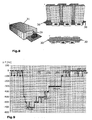
- Zum Vergleich von unterschiedlichen Affinitäten sowie der Kalibrierung zwischen Analyt und Wirtssubstanz sind reproduzierbare Bedingungen essentiell. Daher wurde eine Gasmischanlage (siehe
Figur 7 ) aus zwei Baugruppen (I, II) konstruiert, die diese Reproduzierbarkeit gewährleistet. Der erste Teil der Anlage (I) wird genutzt, um streng definierte Analytgasströme (20) zu erzeugen und bei Teil II handelt es sich um eine temperierte Messzelle (28) für sechs Quarzmikrowaagen, die an den Analytgasstrom (20) angeschlossen ist. Die Baugruppe I ist aus vier Mass-Flow-Controllern 5850S (21 = 200 ml/min, 22 = 20 ml/min) der Firma Brooks Instrument B.V. und einer auswechselbaren, auf 20 °C temperierten Gaswaschflasche aufgebaut. Mit den Mass-Flow-Controllern (21, 22) können aus einer Stickstoffflasche (16) zwei steuerbare Stickstoffgasströme (siehe 18 und 17) mit einem Volumen zwischen 1 - 200 ml/min entnommen werden. Während Strom (17) in Temperatur und Zusammensetzung unverändert bleibt, wird Strom (18) auf 20 °C temperiert (26) und durch die Gaswaschflasche (25) geführt. Durch die Rekombination beider Gasströme lässt sich ein Analytgasstrom (17) mit einem großen Spektrum an Analytkonzentrationen erzeugen. Die genaue Zusammensetzung des Gasstroms ist mit Hilfe einer seriellen Schnittstelle über einen Personal-Computer steuerbar. - Für Messungen von Proben, die über einen hohen Dampfdruck (∼100 ppm) verfügen beziehungsweise in großen Mengen eingesetzt werden können, wird folgendes Verfahren eingesetzt. Die Probengaserzeugung (20), indem der Stickstoffstrom (18) durch die mit Analyt gefüllte Gaswaschflasche geführt wird und hinter diesen mit dem reinen Stickstoffstrom (17) gemischt wird. Die Gaswaschflasche (25) wird auf 20 °C temperiert, da für die meisten Substanzen nur bei dieser Temperatur der genaue Dampfdruck bekannt ist, wodurch Berechnungen der Konzentration ermöglicht werden. Durch die Regelbarkeit der beiden Stickstoffströme (17, 18) mittels der Mass-Flow-Controller (21, 22) können Konzentrationen mit einem Volumenanteil zwischen 0,5 % und 100 % der maximalen Analytsättigung des Gasstroms erzeugt werden. Aus dem Mischungsverhältnis kann sehr leicht die volumenbezogene Konzentration in ppm berechnet werden.
- Die eigentliche Sensoreinheit (
Fig. 8 , III) setzt sich aus einem Stahlrohr (V) und sechs Sensormodulen (IV) zusammen. Die Sensormodule enthalten jeweils einen Oszillatorschaltkreis, mit dessen Hilfe der darauf montierbare Quarz (29) zum Schwingen anregt wird. Weiterhin bestehen sie aus über die USB-Schnittstelle digital auslesbaren Frequenzzählern. Diese Sensormodule werden in den Metallkorpus eingeführt und dicht verschraubt. Die so gebildete Messzelle besitzt an den Ausgängen Swagelok-Anschlüsse (30), über die sie mit Baugruppe I verbunden werden kann. Da die Quarzmikrowaagen (29) eine Temperaturabhängigkeit zeigen, wird die Messzelle konstant auf 35 °C gehalten. Durch die Wahl dieser Temperatur ist gewährleistet, dass sie immer oberhalb der Raumtemperatur ist. Diese Maßnahme verhindert Kondensationseffekte und gleichzeitig bleibt die Dynamik der Sorptionvorgänge vergleichbar. - Die verwendete Elektronik besteht aus einer Halterung für den Quarz (29), einem Oszillator (31), der den Quarz zum Schwingen anregt und einer Messeinheit (31), die mittels eines Prozessors die genaue Schwingungsfrequenz des Quarzes bestimmen kann (G. Sauerbrey, Verwendung von Schwingquarzen zur Wägung dünner Schichten und zur Mikrowägung, Z. Phys. 155, 206-222 (1959); Neubig, W. Briese, Das Grosse Quarzkochbuch, Franzis-Verlag Feldkirchen (1997)). Die Bauteile können über RJ 45 Anschlüsse in Reihe geschaltet werden und mittels eines USB-Adapters mit einem Personal-Computer ausgelesen werden.
- In einer besonderen Ausführungsform der Erfindung ist vorgesehen, dass pro Quarz zwei Frequenzzähler vorgesehen sind. Es hat sich herausgestellt, dass bei heutzutage verfügbaren Frequenzzählern eine Torzeit von einer Sekunde für eine genaue Angabe ganzzahliger Frequenzen notwendig ist. Um eine höhere Abtastrate zu erzielen, werden daher die pro Quarz vorgesehenen Frequenzzähler im Abstand von 0,5 Sekunden gestartet und zeitversetzt ausgelesen. Selbstverständlich ist es möglich, auch mehr als zwei Frequenzzähler pro Quarz vorzusehen, die im unterschiedlichen Zeitabstand gestartet werden, um eine noch höhere Abtastrate zu erreichen.
- Als Elektronik hat sich die Verwendung eines FPGA (field-programmable gate array) in 90 Nanometer-Technik als besonders vorteilhaft erwiesen, um die Zählergebnisse zu verarbeiten. Der Zählalgorithmus und die Weiterverarbeitung der Zählergebnisse werden innerhalb des FPGA durch die Kombination von einem VHDL-Design (Very High Speed Integrated Circuit Hardware Description Language) und eines IP-Softcores implementiert. Eine derartige Schaltung ermöglicht beispielsweise die parallele, asynchrone 28-bit Zählung von drei Sensoren mit einer Genauigkeit von ± ein bit. Dadurch ist eine Auflösung von bis zu einem Hertz möglich.
- Die Vorrichtung zum Online-Nachweis von Triacetontriperoxid (TATP) kann beispielsweise ein Gehäuse mit innenliegendem Luftkanal aufweisen, wobei der Luftkanal mit einer Öffnung in dem Gehäuse verbunden ist. Durch diese Öffnung kann die mit Analyt behaftete Luft eingelassen werden. In dem Luftkanal können sich die Schwingquarze befinden, die mit der Elektronik verbunden sind.
- Um eine verbesserte Ansaugung der Luft zu ermöglichen, kann eine Ansaugvorrichtung vorgesehen sein, die einen Unterdruck in dem Gehäuse erzeugt. Die Ansaugvorrichtung kann beispielsweise aus einem am Gehäuserücken angebrachten Ventilator oder durch eine an das Gehäuse angeschlossene externe Pumpe ermöglicht werden.
- Da es notwendig ist, dass einströmende Luft ausschließlich über den Luftkanal den Schwingquarzen hinzugeführt wird, sollte das Gehäuse weitestgehend luftdicht ausgeführt sein.
- Die erfindungsgemäße Vorrichtung kann auch als mobiles Gerät vorgesehen sein, die eine mobile Stromversorgung sowie eine drahtlose Datenübermittlung zur Übermittlung von Daten an einen Computer, beispielsweise einen WLAN-Adapter, aufweist.
- Da Temperaturschwankungen zu Störungen im Signalverlauf führen können, kann vorgesehen sein, dass an der Öffnung des Luftkanals ein Aufsatz angeordnet ist, der einen Temperaturausgleich der einströmenden Luft ermöglicht. Dieser Aufsatz kann beispielsweise beheizbar sein, so dass die in den Luftkanal einströmende Luft durch Zuführung von externer Energie auf eine konstante Temperatur gebracht wird. Alternativ kann vorgesehen sein, dass in dem Aufsatz ein wärmeleitendes Material mit großer Oberfläche eingebracht ist, so dass die durch den Aufsatz einströmende Luft großflächig Kontakt mit dem Material bekommt, wodurch kleine Temperaturschwankungen durch intensiven Wärmeaustausch zwischen einzelnen Bereichen der einströmenden Luft erfolgreich reduziert werden können. Dafür kann beispielsweise vorgesehen sein, dass in dem Aufsatz mehrere Lochplatten aus Metall, beispielsweise Aluminium, angeordnet sind, durch die die einströmende Luft geleitet wird.
- Die Erfindung wird anhand der nachfolgenden Beispiele näher erläutert. Diese schränken jedoch die Erfindung nicht ein.
- Verwendete Quarze: HFF-Quarze im AT-Schnitt mit einer Grundfrequenz von 195 MHz auf einer HC-52/U Fassung. (Produkt Bezeichnung: Quarz * XA 1600 (ed. 06/05) RoHS-compliant Product, HC-52/U, QF: 195 MHz; Hersteller: KVG Quartz Crystal Technology GmbH, Neckarbischofsheim)
- Beschichtungsverfahren: Die Beschichtung erfolgte mit einem modifizierten Elektrosprayverfahren (
DE-A-103 44 135 ) mit der inFig. 5 gezeigten Beschichtungseinheit für Schwingquarze (QCM). Die aufzutragende Substanz wurde zunächst in einem flüchtigen, polaren Lösungsmittel (Methanol) gelöst, die Lösung in eine Hamilton-Spritze mit einer Konzentration von 30 µg/l in einer 100 µl Spritze aufgenommen. An der Spritzenkanüle wurde der Pluspol angelegt und an der Elektrode des Zielquarzes der Minuspol. Zwischen diesen wurde via Potentiometer eine Hochspannung von etwa 5 - 6 kV angelegt, wobei der Schrittmotor die Lösung langsam aus der Spritze drückt. Dabei wurde die Lösung durch die angelegte Spannung positiv aufgeladen und zur Elektrode des Quarzes beschleunigt. - Der zu beschichtende Quarz wurde 10 - 15 cm neben dem Zentrum des Spraykegels platziert. Dies ist erforderlich, da die große Massenempfindlichkeit der HFF-Quarze beim direkten Beschichten zum sofortigen Zusammenbruch der Schwingung führen würde. Die Beschichtungsstärke wurde kontinuierlich mit einem Frequenzzähler überwacht.
- Das vorstehend beschriebene Beschichtungsverfahren birgt das Problem, das es kann zu erheblicher Tropfenbildung kommen kann, welche letztlich in einem inhomogenen Beschichtungsbild resultiert. Da dieses der Güte und Reproduzierbarkeit des Quarzes nicht zuträglich sein kann, wurde die Beschichtung bei reduziertem Druck durchgeführt. Hierzu wird die Spritzenkanüle in den Einlass eines evakuierbaren Glasgefäßes gebracht, der durch eine kontinuierlich laufende Pumpe auf einen Druck von 200 mbar gebracht wird. In diesem Glasgefäß befindet sich der zu beschichtende Quarz sowie die Gegenelektrode. Der weitere Aufbau bleibt wie dem vorstehend beschriebenen konventionellen Beschichtungsverfahren. In
Fig. 12 wird ein durch dies modifizierte Verfahren beschichteter Quarz mit einem durch das konventionelle Verfahren hergestellten verglichen. Beschichtungen, welche mit dem modifizierten Verfahren hergestellt wurden, zeichnen sich durch eine deutlich geringere Zahl an großen Tropfenspuren auf der Oberfläche aus. - Aufbau der Messanlage: Zum Vergleich von unterschiedlichen Affinitäten sowie der Kalibrierung zwischen Analyt und Wirtssubstanz sind reproduzierbare Bedingungen essentiell. Daher wurde die in
Figur 7 gezeigte, aus zwei Baugruppen (I, II) bestehende Anlage und die inFig. 7 , III Sensoreinheit verwendet. - Messverfahren: Das Prüfgas wurde mittels Verdünnung auf Konzentrationen zwischen 0,5 % und 100 % des maximal möglichen mit Analyt gesättigten Gasstroms eingestellt. Dadurch war es möglich die Isotherme bei 35°C zu bestimmen, deren Steigung in Hz/Vol.ppm mit den Isothermen anderer Analyten verglichen werden konnte.
- Alle nachfolgenden ppm-Angaben beziehen sich auf diese Volumenverhältnisse. TATP-Probenerzeugung: Als TATP Quelle wurden "Echtstoff-Mikromengen-Prüfkörper (EMPK)" der Firma "Dülsner Sicherheitstechnik (Köln)" in zwei Ausführungen - 0,5 mg und 2,0 mg TATP - genutzt. Aufgrund dieser geringen Substanzmenge in Kombination mit der langsamen Desorptionsrate von den EMPK war es notwendig Gasproben einer definierten Konzentration zu erzeugen. Dazu wurden im Falle der mit 0,5 mg TATP beschichteten EMPK zwei Prüfkörper für mindestens 6 h in ein geschlossenes Glasgefäß (Lösungsmittelkugel aus der Säulenchromatographie) mit einem Volumen von 2,3 I gegeben. In dieser Zeit desorbiert das auf den Prüfkörpern befindliche TATP vollständig und es bildet sich eine Gasprobe mit einer definierten Konzentration von 44 ppm. Dieses Verfahren konnte genutzt werden, solange sich die Zielkonzentration unter dem Dampfdruck des TATPs von 68,5 ppm bei 25°C liegt. Bei den mit 2,0 mg TATP beschichteten EMPK wird nur ein Prüfkörper in ein Gefäß mit einem Volumen von 4,5 I gegeben. Durch die Desorption bildet sich ebenfalls ein Gasgemisch mit einer Konzentration von 44 ppm TATP. Diese Probengasbehälter können im Versuchsaufbau gegen die Gaswaschflasche ausgetauscht und durch Zumischen von Gasstrom (m) verdünnt werden.
- Datenauswertung: Die Auswertung der Daten erfolgt in Echtzeit mittels Matlab (R2007b) der Firma "MathWorks" Hierbei werden die aufgenommenen Daten direkt normiert und damit nicht die absoluten Signale, sondern ihre Verhältnisse zueinander betrachtet werden können. Anschließend werden die so bearbeiteten Daten einer Hauptkomponentenanalyse (implementierte Funktion im Programm) unterzogen mit der die Signale einem Bereich in einem zweidimensionalen Koordinatensystem zugeordnet werden. Zur Substanzidentifikation des Analyten wird dieser so ermittelte Bereich mit denen definierter Analytproben verglichen. Affine Materialien: Es wird eine Komibination von Sensoren eingesetzt, die mit Natriumcholat (70 ng; kommerziell erhältlich von FLUKA), Octakis(2,3,6-tri-O-allyl)-γ-cyclodextrin (35 ng; A. Leydet et al., J. Med. Chem. 41, 4927-4932 (1998) und J. Ni et al., Carbohydr. Res. 337, 217-220 (2002)) bzw. Phenylendendrimer MPI-7 (105 ng; z. B. Shifrina et al., Macromolecules 38, 9920-9932 (2005)) beschichtet sind.
- Messergebnisse: Für die Messung wurden kontinuierlich die Signale der einzelnen Sensorelemente aufgezeichnet und die Frequenzveränderung im Vergleich zur Grundlinie beobachtet. Für die Erstellung der Referenzdatensätze zur Analytidentifikation wurden mit den Rezeptorsubstanzen, in der beschriebenen Messanlage, Konzentrationsreihen für die Analyten gemessen und jeweils das Signal im Gleichgewicht bestimmt. Eine Konzentrationsreihe eines mit 10 ng Octakis(2,3,6-tri-O-allyl)-y-cyclodextrin beschichteten Quarzsensor TATP ist in
Fig. 9 gezeigt. - Es wurde die Affinität verschiedener Beschichtungen bezüglich TATP untersucht. Hierfür wurde neben Triacetontriperoxid (TATP) noch Wasser, Wasserstoffperoxidlösung (30%ig) und Aceton als potentielle Querempfindlichkeiten und außerdem Bis-tert-butylperoxid aufgrund seiner strukturellen Ähnlichkeit zum TATP betrachtet. Für diese fünf Analyten wurden Konzentrationsreihen bei einer Sensortemperatur von 35°C gemessen und jeweils die Isotherme bestimmt.
- Der Konzentrationsbereich, in welchem die Analyten vermessen wurden, ergibt sich hauptsächlich aus seinem Dampfdruck bei 20°C. Eine Übersicht über die verwendeten Analyten, ihren Dampfdruck und die gemessenen Konzentrationsbereiche zeigt Tabelle 1.
Tabelle 1: Übersicht über die untersuchten Analyten Analyt Dampfdruck [Vol. ppm] Konz.-Bereich [Vol. ppm] Wasser 23000 (bei 20°C)* 1150 - 6900 H2O2 (30 %) 14500 (bei 20°C)** 725 - 4350 Aceton 245310(bei 20°C)*** 12265 - 73593 Bis-tert-butylperoxid 53329 (bei 20°C)*** 2666 - 15999 Triacetontriperoxid 68.5 (bei 25°C)**** 3 - 44 *Herstellerangabe, Chemikalien Reagenzien, Merck (2003); **W. Schumb et al., Hydrogen Peroxide, Reinhold Publishing Corporation, New York (1955);
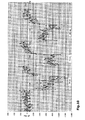
***Herstellerangabe, Handbuch Feinchemikalien, Aldrich (2007);**** J.C. Oxley, et al., Propellants, Explosives, Pyrotechnics 30, 2, 127-130 (2005). - Für Messungen in einem offenen System mit einem Abstand zwischen Analytquelle und Sensorarray wurde ein offenes System konzipiert. Hierbei wird in einem Gang oder einer Schleuse gegenüber vom Sensor ein Gebläse installiert und ein auf den Sensor gerichteter Luftstrom erzeugt (ca. 2 m/s). Durch diesen Luftstrom werden Analytstoffe über eine Entfernung von ∼1 m sehr schnell und mit einer relativ kleinen Verdünnung zum Sensor befördert. Nachfolgend ist der Modellanalyt Phenol gezeigt, der einen vergleichbaren Dampfdruck wie TATP aufweist. Die Untersuchungen zeigen nahezu unabhängig von der Distanz ein Signalaufbau innerhalb von 2-4 Sekunden (
Fig. 10 ). - Das in diesem Patent beschriebene Sensorarray verfügt über sehr schnelle Ansprechzeiten zur sicheren Identifikation eines Signals. Drei Sekunden nach der Zugabe (s) ist bereits ein erstes Ansprechen (t) der Sensoren zu sehen. Bei diesen drei Sekunden handelt es sich um die apparativ bedingte Totzeit des Systems. Zum Zeitpunkt (u) (5 s später) sind die Signale bereits weit genug ausgeprägt für eine sichere Identifikation. Dieser Zeitpunkt liegt weit vor dem Gleichgewicht der Einlagerung, (v). Die Ergebnisse sind in
Figur 11 zusammengefasst.
Claims (12)
- Vorrichtung zum Online-Nachweis von Triacetontriperoxid (TATP) umfassend eine Messzelle mit wenigstens drei unterschiedlich beschichteten HFF-Schwingquarzsensoren (29), wobei jeweils eine der sensitiven Flächen der Schwingquarze mit einem Cyclodextrinderivat, einem formstabilen Dendrimer und einem Cholsäurederivat als Detektorsubstanz beschichtet sind.
- Vorrichtung nach Anspruch 1, wobei(i) das Cyclodextrinderivat ein β- oder γ-Cyclodextrinderivat, vorzugsweise Perallyl-γ-cyclodextrin ist; und/oder(ii) das formstabile Dendrimer ein Phenylen-Dendrimer, vorzugsweise ein Terphenylen-Dendrimer der 4. Generation ist; und/oder(iii) das Cholsäurederivat ein Cholsäuresalz, vorzugsweise Natriumcholat ist.
- Vorrichtung nach Anspruch 1 oder 2, wobei die Messzelle einen oder mehrere weitere HFF- Schwingquarzsensoren enthält, die an den sensitiven Flächen mit nicht-quervernetzten Polyurethanen, Triphenylenketalen und/oder Porphyrinen beschichtet sind.
- Vorrichtung nach einem oder mehreren der Ansprüche 1 bis 3, die einen mit Natriumcholat beschichteten HFF Schwingquarzsensor, vorzugsweise mit einer Beschichtung von etwa 70 ng, einen mit Octakis(2,3,6-tri-O-allyl)-γ-cyclodextrin beschichteten HFF Schwingquarzsensor, vorzugsweise mit einer Beschichtung von etwa 35 ng, und einen mit Phenylendendrimer (MPI-7) beschichteten HFF Schwingquarzsensor, vorzugsweise mit einer Beschichtung von etwa 105 ng, aufweist.
- Vorrichtung nach einem oder mehreren der Ansprüche 1 bis 4, wobei die sensitiven Flächen der Quarze mit 10 bis 350 ng Detektorsubstanz beschichtet sind, was einer Frequenzerniedrigung der Quarze von 100 bis 300 kHz entspricht.
- Vorrichtung nach Anspruch 5, wobei die Beschichtung durch ein Elektrosprayverfahren erfolgt, in dem das Auftragen der Substanz, gelöst in einem flüchtigen, polaren Lösungsmittel, durch Anlegen eine Hochspannung zur sensitiven Flächen des Quarzes beschleunigt wird.
- Vorrichtung nach Anspruch 6, wobei das Elektrosprayverfahren unter reduziertem Druck erfolgt.
- Vorrichtung nach einem oder mehreren der Ansprüche 1 bis 7, die weiterhin mindestens einen Frequenzzähler und mindestens eine Auswerteeinheit (31) enthält.
- Vorrichtung nach Anspruch 8, wobei mindestens zwei Frequenzzähler pro Quarz vorgesehen sind, die vorzugsweise zeitlich versetzt betreibbar sind.
- Verfahren zum Online-Nachweis von Triacetontriperoxid (TATP) umfassend In-Kontakt-Bringen einer Vorrichtung nach einem oder mehreren der Ansprüche 1 bis 9 mit dem zu überprüfenden Medium.
- Verfahren nach Anspruch 10, das eine TATP-Empfindlichkeit von <10 ppm, vorzugsweise <3 ppm in der Raumluft aufweist, und keine Anreicherung des TATP erfordert.
- Verfahren nach Anspruch 10 oder 11, das weiterhin den Abgleich mit einer Referenzsubstanz oder einem Referenzsubstanzgemisch umfasst.
Applications Claiming Priority (2)
| Application Number | Priority Date | Filing Date | Title |
|---|---|---|---|
| DE102008008660A DE102008008660A1 (de) | 2008-02-11 | 2008-02-11 | Vorrichtung und Verfahren zum Nachweis von Triacetontriperoxid |
| PCT/EP2009/051594 WO2009101118A1 (de) | 2008-02-11 | 2009-02-11 | Vorrichtung und verfahren zum nachweis von triacetontriperoxid |
Publications (2)
| Publication Number | Publication Date |
|---|---|
| EP2243022A1 EP2243022A1 (de) | 2010-10-27 |
| EP2243022B1 true EP2243022B1 (de) | 2012-01-04 |
Family
ID=40601134
Family Applications (1)
| Application Number | Title | Priority Date | Filing Date |
|---|---|---|---|
| EP09709690A Not-in-force EP2243022B1 (de) | 2008-02-11 | 2009-02-11 | Vorrichtung und verfahren zum nachweis von triacetontriperoxid |
Country Status (6)
| Country | Link |
|---|---|
| US (1) | US8288163B2 (de) |
| EP (1) | EP2243022B1 (de) |
| JP (1) | JP5341918B2 (de) |
| AT (1) | ATE540310T1 (de) |
| DE (1) | DE102008008660A1 (de) |
| WO (1) | WO2009101118A1 (de) |
Families Citing this family (4)
| Publication number | Priority date | Publication date | Assignee | Title |
|---|---|---|---|---|
| WO2010010547A2 (en) * | 2008-07-21 | 2010-01-28 | Yeda Research And Development Co. Ltd | Detector for peroxide-based explosives |
| CN103472117B (zh) * | 2012-07-23 | 2015-02-25 | 西安工业大学 | 基于纳米分子印记压电传感器的便携式炸药痕量探测仪 |
| FR3048776B1 (fr) | 2016-03-09 | 2020-02-07 | Commissariat A L'energie Atomique Et Aux Energies Alternatives | Dispositif de detection d'au moins un compose chimique dans un fluide |
| CN113776978A (zh) * | 2021-10-12 | 2021-12-10 | 中电科技集团重庆声光电有限公司 | 一种三过氧化三丙酮检测传感器及其制备方法 |
Family Cites Families (8)
| Publication number | Priority date | Publication date | Assignee | Title |
|---|---|---|---|---|
| US6316268B1 (en) * | 1996-11-22 | 2001-11-13 | The Regents Of The University Of California | Chemical microsensors for detection of explosives and chemical warfare agents |
| DE10109534A1 (de) | 2001-02-28 | 2002-09-12 | Basf Ag | Verfahren und Vorrichtung zum Nachweis von Fuimigantien in Luftproben |
| US6526828B1 (en) * | 2001-06-20 | 2003-03-04 | M.S. Tech Ltd. | Sensitive and selective method and device for the detection of trace amounts of a substance |
| ATE521887T1 (de) | 2001-06-20 | 2011-09-15 | M S Tech Ltd | Anordnung von piezoelektrischen resonatoren zum nachweis von spuren einer substanz |
| DE10344135A1 (de) | 2003-09-24 | 2005-05-04 | Karlsruhe Forschzent | Vorrichtung zum Aufbringen von Elektrospraybeschichtungen auf elektrisch nicht leitfähigen Oberflächen |
| US7207206B2 (en) * | 2004-02-19 | 2007-04-24 | Ut-Battelle, Llc | Chemically-functionalized microcantilevers for detection of chemical, biological and explosive material |
| US20060188399A1 (en) * | 2005-02-04 | 2006-08-24 | Jadi, Inc. | Analytical sensor system for field use |
| WO2010010547A2 (en) * | 2008-07-21 | 2010-01-28 | Yeda Research And Development Co. Ltd | Detector for peroxide-based explosives |
-
2008
- 2008-02-11 DE DE102008008660A patent/DE102008008660A1/de not_active Withdrawn
-
2009
- 2009-02-11 EP EP09709690A patent/EP2243022B1/de not_active Not-in-force
- 2009-02-11 JP JP2010546324A patent/JP5341918B2/ja not_active Expired - Fee Related
- 2009-02-11 AT AT09709690T patent/ATE540310T1/de active
- 2009-02-11 US US12/865,412 patent/US8288163B2/en not_active Expired - Fee Related
- 2009-02-11 WO PCT/EP2009/051594 patent/WO2009101118A1/de not_active Ceased
Also Published As
| Publication number | Publication date |
|---|---|
| WO2009101118A1 (de) | 2009-08-20 |
| JP5341918B2 (ja) | 2013-11-13 |
| ATE540310T1 (de) | 2012-01-15 |
| EP2243022A1 (de) | 2010-10-27 |
| US20110020944A1 (en) | 2011-01-27 |
| DE102008008660A1 (de) | 2009-08-13 |
| US8288163B2 (en) | 2012-10-16 |
| JP2011512530A (ja) | 2011-04-21 |
Similar Documents
| Publication | Publication Date | Title |
|---|---|---|
| EP0456787B1 (de) | Selektive gasdetektion durch feldseparation und schallgeschwindigkeitsmessung: sauerstoff-detektion | |
| Kanu et al. | Ion mobility spectrometry detection for gas chromatography | |
| DE60023005T2 (de) | Vielfach-sensor-system und -gerät | |
| DE69814035T2 (de) | Verfahren un vorrichtung zur charakterisierung von materialien mittels einem mechanischem resonator | |
| Du et al. | Development of a plug-type IMS-MS instrument and its applications in resolving problems existing in in-situ detection of illicit drugs and explosives by IMS | |
| CH645989A5 (de) | Verfahren und vorrichtung zur optoakustischen spektroskopie. | |
| Ochoa et al. | Detection of methamphetamine in the presence of nicotine using in situ chemical derivatization and ion mobility spectrometry | |
| Mayer et al. | Accuracy of ion mobility measurements dependent on the influence of humidity | |
| DE1498713B2 (de) | Geraet zur anzeige der konzentration eines anteils eines gasgemisches mittels piezoelektrischer kristalle | |
| JP4782801B2 (ja) | 化学物質蒸気検出用のタンデム式の微分型移動性イオン電気移動度計 | |
| EP2243022B1 (de) | Vorrichtung und verfahren zum nachweis von triacetontriperoxid | |
| Pitman et al. | Desorption atmospheric pressure chemical ionization: A review | |
| Murray et al. | Sensors for chemical weapons detection | |
| US7956323B2 (en) | Ion mobility spectrometer and method for determining an analyte substance or an analyte substance mixture in the presence of a dopant mixture by means of an ion mobility spectrometer | |
| EP0829718A1 (de) | Gasanalysegerät mit einem Halbleiter-Gassensor | |
| Liu et al. | Dopant for detection of methamphetamine in the presence of nicotine with ion mobility spectrometry | |
| DE60119969T2 (de) | Nachweis von infektionen durch nachweis von fettsäuren im kopfraum von flüssigkeitsproben | |
| Vasilyev et al. | Ion mobility spectrometer for rapid simultaneous detection of positive and negative ions | |
| Yang et al. | Determination of nickel in human urine by ion chromatography with series bulk acoustic wave detection | |
| WO2007096301A1 (de) | Kontrolleinrichtung für einen behälter, anordnung eines behälters und der kontrolleinrichtung und verfahren zum kontrollieren des behälters | |
| WO2007096293A1 (de) | Vorrichtung und verfahren zur untersuchung einer chemischen zusammensetzung im innern eines behälters | |
| DE29825207U1 (de) | Vorrichtung zur Charakterisierung von Materialien mittels eines mechanischen Resonators | |
| Steer et al. | Diffusive motions in living cytoplasm probed by Laser Doppler microscopy | |
| Kidwell | Analysis of cocaine, heroin, and their metabolites in saliva | |
| DE60224679T2 (de) | Detektion von bakterieller vaginose |
Legal Events
| Date | Code | Title | Description |
|---|---|---|---|
| PUAI | Public reference made under article 153(3) epc to a published international application that has entered the european phase |
Free format text: ORIGINAL CODE: 0009012 |
|
| 17P | Request for examination filed |
Effective date: 20100824 |
|
| AK | Designated contracting states |
Kind code of ref document: A1 Designated state(s): AT BE BG CH CY CZ DE DK EE ES FI FR GB GR HR HU IE IS IT LI LT LU LV MC MK MT NL NO PL PT RO SE SI SK TR |
|
| AX | Request for extension of the european patent |
Extension state: AL BA RS |
|
| DAX | Request for extension of the european patent (deleted) | ||
| GRAP | Despatch of communication of intention to grant a patent |
Free format text: ORIGINAL CODE: EPIDOSNIGR1 |
|
| GRAS | Grant fee paid |
Free format text: ORIGINAL CODE: EPIDOSNIGR3 |
|
| GRAA | (expected) grant |
Free format text: ORIGINAL CODE: 0009210 |
|
| AK | Designated contracting states |
Kind code of ref document: B1 Designated state(s): AT BE BG CH CY CZ DE DK EE ES FI FR GB GR HR HU IE IS IT LI LT LU LV MC MK MT NL NO PL PT RO SE SI SK TR |
|
| REG | Reference to a national code |
Ref country code: GB Ref legal event code: FG4D Free format text: NOT ENGLISH |
|
| REG | Reference to a national code |
Ref country code: CH Ref legal event code: EP |
|
| REG | Reference to a national code |
Ref country code: AT Ref legal event code: REF Ref document number: 540310 Country of ref document: AT Kind code of ref document: T Effective date: 20120115 |
|
| REG | Reference to a national code |
Ref country code: IE Ref legal event code: FG4D |
|
| REG | Reference to a national code |
Ref country code: CH Ref legal event code: NV Representative=s name: BOHEST AG |
|
| REG | Reference to a national code |
Ref country code: DE Ref legal event code: R096 Ref document number: 502009002373 Country of ref document: DE Effective date: 20120315 |
|
| REG | Reference to a national code |
Ref country code: NL Ref legal event code: T3 |
|
| PG25 | Lapsed in a contracting state [announced via postgrant information from national office to epo] |
Ref country code: SI Free format text: LAPSE BECAUSE OF FAILURE TO SUBMIT A TRANSLATION OF THE DESCRIPTION OR TO PAY THE FEE WITHIN THE PRESCRIBED TIME-LIMIT Effective date: 20120104 |
|
| LTIE | Lt: invalidation of european patent or patent extension |
Effective date: 20120104 |
|
| PG25 | Lapsed in a contracting state [announced via postgrant information from national office to epo] |
Ref country code: IS Free format text: LAPSE BECAUSE OF FAILURE TO SUBMIT A TRANSLATION OF THE DESCRIPTION OR TO PAY THE FEE WITHIN THE PRESCRIBED TIME-LIMIT Effective date: 20120504 Ref country code: NO Free format text: LAPSE BECAUSE OF FAILURE TO SUBMIT A TRANSLATION OF THE DESCRIPTION OR TO PAY THE FEE WITHIN THE PRESCRIBED TIME-LIMIT Effective date: 20120404 Ref country code: BG Free format text: LAPSE BECAUSE OF FAILURE TO SUBMIT A TRANSLATION OF THE DESCRIPTION OR TO PAY THE FEE WITHIN THE PRESCRIBED TIME-LIMIT Effective date: 20120404 Ref country code: LT Free format text: LAPSE BECAUSE OF FAILURE TO SUBMIT A TRANSLATION OF THE DESCRIPTION OR TO PAY THE FEE WITHIN THE PRESCRIBED TIME-LIMIT Effective date: 20120104 Ref country code: HR Free format text: LAPSE BECAUSE OF FAILURE TO SUBMIT A TRANSLATION OF THE DESCRIPTION OR TO PAY THE FEE WITHIN THE PRESCRIBED TIME-LIMIT Effective date: 20120104 |
|
| REG | Reference to a national code |
Ref country code: IE Ref legal event code: FD4D |
|
| BERE | Be: lapsed |
Owner name: MAX-PLANCK-GESELLSCHAFT ZUR FORDERUNG DER WISSENS Effective date: 20120228 Owner name: RHEINISCHE FRIEDRICH-WILHELMS-UNIVERSITAT BONN Effective date: 20120228 |
|
| PG25 | Lapsed in a contracting state [announced via postgrant information from national office to epo] |
Ref country code: GR Free format text: LAPSE BECAUSE OF FAILURE TO SUBMIT A TRANSLATION OF THE DESCRIPTION OR TO PAY THE FEE WITHIN THE PRESCRIBED TIME-LIMIT Effective date: 20120405 Ref country code: PL Free format text: LAPSE BECAUSE OF FAILURE TO SUBMIT A TRANSLATION OF THE DESCRIPTION OR TO PAY THE FEE WITHIN THE PRESCRIBED TIME-LIMIT Effective date: 20120104 Ref country code: PT Free format text: LAPSE BECAUSE OF FAILURE TO SUBMIT A TRANSLATION OF THE DESCRIPTION OR TO PAY THE FEE WITHIN THE PRESCRIBED TIME-LIMIT Effective date: 20120504 Ref country code: LV Free format text: LAPSE BECAUSE OF FAILURE TO SUBMIT A TRANSLATION OF THE DESCRIPTION OR TO PAY THE FEE WITHIN THE PRESCRIBED TIME-LIMIT Effective date: 20120104 Ref country code: FI Free format text: LAPSE BECAUSE OF FAILURE TO SUBMIT A TRANSLATION OF THE DESCRIPTION OR TO PAY THE FEE WITHIN THE PRESCRIBED TIME-LIMIT Effective date: 20120104 |
|
| PG25 | Lapsed in a contracting state [announced via postgrant information from national office to epo] |
Ref country code: CY Free format text: LAPSE BECAUSE OF FAILURE TO SUBMIT A TRANSLATION OF THE DESCRIPTION OR TO PAY THE FEE WITHIN THE PRESCRIBED TIME-LIMIT Effective date: 20120104 Ref country code: MC Free format text: LAPSE BECAUSE OF NON-PAYMENT OF DUE FEES Effective date: 20120229 |
|
| PG25 | Lapsed in a contracting state [announced via postgrant information from national office to epo] |
Ref country code: RO Free format text: LAPSE BECAUSE OF FAILURE TO SUBMIT A TRANSLATION OF THE DESCRIPTION OR TO PAY THE FEE WITHIN THE PRESCRIBED TIME-LIMIT Effective date: 20120104 Ref country code: DK Free format text: LAPSE BECAUSE OF FAILURE TO SUBMIT A TRANSLATION OF THE DESCRIPTION OR TO PAY THE FEE WITHIN THE PRESCRIBED TIME-LIMIT Effective date: 20120104 Ref country code: SE Free format text: LAPSE BECAUSE OF FAILURE TO SUBMIT A TRANSLATION OF THE DESCRIPTION OR TO PAY THE FEE WITHIN THE PRESCRIBED TIME-LIMIT Effective date: 20120104 Ref country code: IE Free format text: LAPSE BECAUSE OF FAILURE TO SUBMIT A TRANSLATION OF THE DESCRIPTION OR TO PAY THE FEE WITHIN THE PRESCRIBED TIME-LIMIT Effective date: 20120104 Ref country code: CZ Free format text: LAPSE BECAUSE OF FAILURE TO SUBMIT A TRANSLATION OF THE DESCRIPTION OR TO PAY THE FEE WITHIN THE PRESCRIBED TIME-LIMIT Effective date: 20120104 Ref country code: EE Free format text: LAPSE BECAUSE OF FAILURE TO SUBMIT A TRANSLATION OF THE DESCRIPTION OR TO PAY THE FEE WITHIN THE PRESCRIBED TIME-LIMIT Effective date: 20120104 |
|
| PLBE | No opposition filed within time limit |
Free format text: ORIGINAL CODE: 0009261 |
|
| STAA | Information on the status of an ep patent application or granted ep patent |
Free format text: STATUS: NO OPPOSITION FILED WITHIN TIME LIMIT |
|
| PG25 | Lapsed in a contracting state [announced via postgrant information from national office to epo] |
Ref country code: SK Free format text: LAPSE BECAUSE OF FAILURE TO SUBMIT A TRANSLATION OF THE DESCRIPTION OR TO PAY THE FEE WITHIN THE PRESCRIBED TIME-LIMIT Effective date: 20120104 Ref country code: IT Free format text: LAPSE BECAUSE OF FAILURE TO SUBMIT A TRANSLATION OF THE DESCRIPTION OR TO PAY THE FEE WITHIN THE PRESCRIBED TIME-LIMIT Effective date: 20120104 |
|
| 26N | No opposition filed |
Effective date: 20121005 |
|
| PG25 | Lapsed in a contracting state [announced via postgrant information from national office to epo] |
Ref country code: BE Free format text: LAPSE BECAUSE OF NON-PAYMENT OF DUE FEES Effective date: 20120228 |
|
| REG | Reference to a national code |
Ref country code: DE Ref legal event code: R097 Ref document number: 502009002373 Country of ref document: DE Effective date: 20121005 |
|
| PG25 | Lapsed in a contracting state [announced via postgrant information from national office to epo] |
Ref country code: MK Free format text: LAPSE BECAUSE OF FAILURE TO SUBMIT A TRANSLATION OF THE DESCRIPTION OR TO PAY THE FEE WITHIN THE PRESCRIBED TIME-LIMIT Effective date: 20120104 |
|
| PG25 | Lapsed in a contracting state [announced via postgrant information from national office to epo] |
Ref country code: ES Free format text: LAPSE BECAUSE OF FAILURE TO SUBMIT A TRANSLATION OF THE DESCRIPTION OR TO PAY THE FEE WITHIN THE PRESCRIBED TIME-LIMIT Effective date: 20120415 |
|
| PG25 | Lapsed in a contracting state [announced via postgrant information from national office to epo] |
Ref country code: MT Free format text: LAPSE BECAUSE OF FAILURE TO SUBMIT A TRANSLATION OF THE DESCRIPTION OR TO PAY THE FEE WITHIN THE PRESCRIBED TIME-LIMIT Effective date: 20120104 |
|
| PG25 | Lapsed in a contracting state [announced via postgrant information from national office to epo] |
Ref country code: TR Free format text: LAPSE BECAUSE OF FAILURE TO SUBMIT A TRANSLATION OF THE DESCRIPTION OR TO PAY THE FEE WITHIN THE PRESCRIBED TIME-LIMIT Effective date: 20120104 |
|
| PG25 | Lapsed in a contracting state [announced via postgrant information from national office to epo] |
Ref country code: LU Free format text: LAPSE BECAUSE OF NON-PAYMENT OF DUE FEES Effective date: 20120211 |
|
| REG | Reference to a national code |
Ref country code: CH Ref legal event code: PCAR Free format text: NEW ADDRESS: HOLBEINSTRASSE 36-38, 4051 BASEL (CH) |
|
| PG25 | Lapsed in a contracting state [announced via postgrant information from national office to epo] |
Ref country code: HU Free format text: LAPSE BECAUSE OF FAILURE TO SUBMIT A TRANSLATION OF THE DESCRIPTION OR TO PAY THE FEE WITHIN THE PRESCRIBED TIME-LIMIT Effective date: 20090211 |
|
| REG | Reference to a national code |
Ref country code: FR Ref legal event code: PLFP Year of fee payment: 7 |
|
| PGFP | Annual fee paid to national office [announced via postgrant information from national office to epo] |
Ref country code: NL Payment date: 20150223 Year of fee payment: 7 |
|
| REG | Reference to a national code |
Ref country code: AT Ref legal event code: MM01 Ref document number: 540310 Country of ref document: AT Kind code of ref document: T Effective date: 20140211 |
|
| PGFP | Annual fee paid to national office [announced via postgrant information from national office to epo] |
Ref country code: CH Payment date: 20150223 Year of fee payment: 7 |
|
| PG25 | Lapsed in a contracting state [announced via postgrant information from national office to epo] |
Ref country code: AT Free format text: LAPSE BECAUSE OF NON-PAYMENT OF DUE FEES Effective date: 20140211 |
|
| PGFP | Annual fee paid to national office [announced via postgrant information from national office to epo] |
Ref country code: GB Payment date: 20150223 Year of fee payment: 7 Ref country code: FR Payment date: 20150217 Year of fee payment: 7 |
|
| REG | Reference to a national code |
Ref country code: CH Ref legal event code: PL |
|
| GBPC | Gb: european patent ceased through non-payment of renewal fee |
Effective date: 20160211 |
|
| PG25 | Lapsed in a contracting state [announced via postgrant information from national office to epo] |
Ref country code: CH Free format text: LAPSE BECAUSE OF NON-PAYMENT OF DUE FEES Effective date: 20160229 Ref country code: LI Free format text: LAPSE BECAUSE OF NON-PAYMENT OF DUE FEES Effective date: 20160229 |
|
| REG | Reference to a national code |
Ref country code: NL Ref legal event code: MM Effective date: 20160301 |
|
| REG | Reference to a national code |
Ref country code: FR Ref legal event code: ST Effective date: 20161028 |
|
| PG25 | Lapsed in a contracting state [announced via postgrant information from national office to epo] |
Ref country code: FR Free format text: LAPSE BECAUSE OF NON-PAYMENT OF DUE FEES Effective date: 20160229 Ref country code: NL Free format text: LAPSE BECAUSE OF NON-PAYMENT OF DUE FEES Effective date: 20160301 Ref country code: GB Free format text: LAPSE BECAUSE OF NON-PAYMENT OF DUE FEES Effective date: 20160211 |
|
| PGFP | Annual fee paid to national office [announced via postgrant information from national office to epo] |
Ref country code: DE Payment date: 20220225 Year of fee payment: 14 |
|
| REG | Reference to a national code |
Ref country code: DE Ref legal event code: R119 Ref document number: 502009002373 Country of ref document: DE |
|
| PG25 | Lapsed in a contracting state [announced via postgrant information from national office to epo] |
Ref country code: DE Free format text: LAPSE BECAUSE OF NON-PAYMENT OF DUE FEES Effective date: 20230901 |