EP2243115B9 - Korrektur von aufgenommenen und stabilisierten bildern - Google Patents
Korrektur von aufgenommenen und stabilisierten bildern Download PDFInfo
- Publication number
- EP2243115B9 EP2243115B9 EP09710568.8A EP09710568A EP2243115B9 EP 2243115 B9 EP2243115 B9 EP 2243115B9 EP 09710568 A EP09710568 A EP 09710568A EP 2243115 B9 EP2243115 B9 EP 2243115B9
- Authority
- EP
- European Patent Office
- Prior art keywords
- image
- images
- captured
- motion
- psf
- Prior art date
- Legal status (The legal status is an assumption and is not a legal conclusion. Google has not performed a legal analysis and makes no representation as to the accuracy of the status listed.)
- Active
Links
Images


Classifications
-
- G—PHYSICS
- G06—COMPUTING OR CALCULATING; COUNTING
- G06T—IMAGE DATA PROCESSING OR GENERATION, IN GENERAL
- G06T5/00—Image enhancement or restoration
- G06T5/50—Image enhancement or restoration using two or more images, e.g. averaging or subtraction
-
- G—PHYSICS
- G06—COMPUTING OR CALCULATING; COUNTING
- G06T—IMAGE DATA PROCESSING OR GENERATION, IN GENERAL
- G06T7/00—Image analysis
- G06T7/20—Analysis of motion
- G06T7/223—Analysis of motion using block-matching
-
- H—ELECTRICITY
- H04—ELECTRIC COMMUNICATION TECHNIQUE
- H04N—PICTORIAL COMMUNICATION, e.g. TELEVISION
- H04N23/00—Cameras or camera modules comprising electronic image sensors; Control thereof
- H04N23/60—Control of cameras or camera modules
- H04N23/68—Control of cameras or camera modules for stable pick-up of the scene, e.g. compensating for camera body vibrations
-
- H—ELECTRICITY
- H04—ELECTRIC COMMUNICATION TECHNIQUE
- H04N—PICTORIAL COMMUNICATION, e.g. TELEVISION
- H04N23/00—Cameras or camera modules comprising electronic image sensors; Control thereof
- H04N23/60—Control of cameras or camera modules
- H04N23/68—Control of cameras or camera modules for stable pick-up of the scene, e.g. compensating for camera body vibrations
- H04N23/682—Vibration or motion blur correction
- H04N23/683—Vibration or motion blur correction performed by a processor, e.g. controlling the readout of an image memory
-
- H—ELECTRICITY
- H04—ELECTRIC COMMUNICATION TECHNIQUE
- H04N—PICTORIAL COMMUNICATION, e.g. TELEVISION
- H04N23/00—Cameras or camera modules comprising electronic image sensors; Control thereof
- H04N23/60—Control of cameras or camera modules
- H04N23/68—Control of cameras or camera modules for stable pick-up of the scene, e.g. compensating for camera body vibrations
- H04N23/682—Vibration or motion blur correction
- H04N23/685—Vibration or motion blur correction performed by mechanical compensation
-
- H—ELECTRICITY
- H04—ELECTRIC COMMUNICATION TECHNIQUE
- H04N—PICTORIAL COMMUNICATION, e.g. TELEVISION
- H04N25/00—Circuitry of solid-state image sensors [SSIS]; Control thereof
- H04N25/48—Increasing resolution by shifting the sensor relative to the scene
Definitions
- the present invention relates to a processing of images captured by an image capture device, such as a camera or binoculars for example, and more particularly, a correction of a 'shake' effect on the captured images, or 'motion blur' or 'spun'.
- image quality impairments that are related to defects in the image sensor itself, such as defects related to an integration of image. the light captured at the sensor, or degradations that are related to elements outside the sensor, such as a camera shake.
- a camera shake is a degradation that can affect an image captured when the line of sight is moving when the image is captured. This degradation can be materialized on the image by a visible yarn that introduces a fuzzy area on a captured scene.
- the camera shake is usually caused by a movement of the sensor's line of sight during image capture.
- the captured images may have a blur that corresponds to visual effects harmful to the quality of images .
- the captured image which is affected by motion blur, can be represented by a convolution product between a Point Spead Function, or PSF, associated with motion blur and the original scene. O captured within the captured image.
- PSF Point Spead Function
- PSF Point Spead Function
- Such a step may require complex calculations.
- Image capture systems are adapted to reduce such visual effects. Indeed, some of these systems stabilize the line of sight by integrating a mechanical module for inertial stabilization in the camera or by arranging the camera on a mechanical module such as a platform that allows inertial stabilization.
- the mechanics of these systems can be controlled based on information from gyroscopes. They thus make it possible to stabilize the line of sight of a camera in an inertial reference frame. In such a context, it is then possible to capture images completely independently of the irregular movements that are imposed on the support of the camera used.
- Such a system of shooting based on an inertial reference system effectively avoids the visual effects due to irregular movements of the camera support, that is to say, the motion blur.
- image capture systems may include a digital stabilization module that aims to stabilize the captured images by applying digital processing thereto.
- spatial noise is understood to mean an unwanted offset (or offset) between the values of the pixels of the same image which should theoretically be equal, that is to say in the case where the pixels correspond to the same signal input. This type of degradation may be related to intrinsic characteristics of the sensor considered.
- a digital image is represented by a matrix of pixels, each corresponding to a color level or a gray level of the image.
- An image corresponds to a scene captured by a matrix of flux detectors, then the light energies received respectively by these detectors are transformed into respective electrical signals.
- the different detectors of the detector array are generally theoretically identical but, in practice, they have differences which induce undesired shifts, as defined above, between different pixels of a captured image of a scene which corresponds to an input stream that is identical in every point of the captured image, and therefore a spatial noise in this image.
- the offsets between the values of the pixels of the same image which are due to the spatial noise, can vary over time, in particular as a function of the temperature, it may be advantageous to repeat a correction step of these offsets regularly during the capture of images, without having to interrupt the operation of capturing images.
- the spatial noise is an annoying disturbance, since disturbances relating to the movement of the line of sight are avoided. It is therefore all the more interesting in such a context to be able to correct this spatial noise.
- the captured images can be affected by motion blur, and, on the other hand, in an image capture system in which the movement of the line of sight is stabilized in an inertial manner, the images captured are affected by spatial noise disturbances.
- the present invention aims to overcome the aforementioned drawbacks.
- stabilization module is intended here to mean a module that makes it possible to stabilize the line of sight of the captured images either numerically or mechanically or again in a combined digital and mechanical manner.
- the terms 'line of sight' of a captured image correspond to the center of this captured image.
- the stabilization module When the stabilization module stabilizes the line of sight of the images captured by digital image processing, it can rely on a selection function of best stabilized image estimation.
- the spatial noise affecting the captured images can be advantageously corrected on the basis of the movement imposed on the line of sight, since this movement allows the same detector of the matrix of detectors to be exposed to different points of the scene. captured during the cycle of the movement considered.
- the offsets of each of the detectors can be corrected while still capturing images. Due to the fact that the line of sight of an image capture device is animated by a defined movement, it is then advantageously possible to set up an offset correction of pixel values, in order to correct the spatial noise. , based on the captured images that succeed each other. Thus, it is not required, to make such a correction, to interrupt the capture of images in progress.
- the stabilization module is adapted to stabilize the images successively captured either numerically or by mechanisms of the inertial gyroscope type controlling the axis of sight initially.
- Such a movement of the axis of view of the sensor introduces a blur of shake in the captured images.
- This motion blur can be appropriately corrected in the captured images according to one embodiment of the present invention.
- the defined movement can be performed at constant speed or constant acceleration.
- the motion blur can be corrected on a series of captured images corresponding at least to those captured during the period during which the line of sight describes the complete cycle of motion imposed upon it. .
- This series of images is noted N i for i between 1 and K.
- a spread function of the PSF point corresponds to the accumulated motion blur on this series of captured images.
- major common part the same part that is found in several images and occupies in these images a majority.
- This defined movement is a cyclic movement, that is, it implies that the line of sight is periodically oriented in the same orientation. Thus, one is able to apply a spatial noise correction that converges.
- this defined movement has an amplitude between a number n greater than 2, so as to allow browse the neighboring pixels around a pixel for which we seek to correct the value.
- this defined amplitude of motion remains smaller than a maximum number which must make it possible to find in a series of successive images captured during a cycle of the movement a predominantly common part, in particular in order to be able to apply a correction over a large area. images.
- This correction point spreading function is adapted to correct the motion blur introduced by the defined motion.
- the stabilization module can be adapted to stabilize captured images based on digital image processing.
- the stabilization module may correspond to a mechanical inertial stabilization module.
- Such a defined movement may for example correspond to a circle having a diameter of a value greater than or equal to 3 pixels at the flux detector matrix.
- the movement imposed on the line of sight is controlled, it is possible to predict its speed as a function of the value of the integration time of the flux detectors of the matrix of the detectors of the image capture device.
- the pixel values of the common portion of the previous image and the next image are successively corrected from the determined offset by traversing a pixel string comprising, from of the reference pixel in the preceding image, pixels that correspond alternately in the next image and in the previous image, a pixel of the following image corresponding to a pixel of the preceding image when said pixels correspond to the same point of the captured scene, and a pixel of the previous image corresponding to a pixel of the next image when said pixels correspond to the same flux detector of the matrix of detectors.
- the position of the reference pixel in the common part may be advantageous to determine the position of the reference pixel in the common part according to the defined motion and a period of time elapsed between the captured images. Indeed, depending on the position of the selected reference pixel, and the movement defined therefrom a direction of travel of the images by the correction pixel chain. It is therefore advantageous to choose a pixel that makes it possible to obtain a long chain of pixels.
- the motion animating the line of sight since the motion animating the line of sight is defined, it is possible to correct the spatial noise by applying a movement that is inverse to the movement defined to the images successively captured, so as to counterbalance the movement of the line of sight and thus allow the images to be correctly repositioned.
- the position of the next pixel in the next image can then be determined from the position of the reference pixel in the previous image based on the characteristics of the defined motion applied to the line of sight and a period of time elapsed. between successive images. Then, this can be done all along the correction pixel chain.
- the measurement of the defined motion is performed by applying a digital processing of the previous and next images.
- the movement that is imposed on the line of sight can advantageously be defined as a function of the integration time of the detectors used.
- a method according to an embodiment of the present invention may be particularly advantageous in the case where no movement animates the support of the camera capturing the series of images considered, and where the scene captured is a static scene. Indeed, in this case, the defined movement applied to the line of sight makes it possible to obtain a good quality of the processed images according to an embodiment of the present invention.
- a second aspect of the present invention provides a system for capturing a series of images adapted for carrying out an image processing method according to the first aspect of the present invention.
- a third aspect of the present invention provides a computer program for installation in a capture system according to the second aspect of the present invention, including instructions for carrying out the method according to the first aspect of the present invention. invention, during a program execution by processing means of the capture system.
- the figure 1 illustrates an image capture system according to an embodiment of the present invention.
- a system 10 thus comprises an image capture device 11 having a matrix of flux detectors oriented along an axis of sight z. This axis of view has an orientation that is controlled by a stabilization module 12.
- This stabilization module 12 may be an inertial mechanical stabilization module or a stabilization module by digital processing of the captured images.
- the present invention covers any type of image stabilization module and no limitation is attached thereto.
- such a stabilization module corresponds to inertial gyroscopes, which are well known to those skilled in the art. Subsequently, the present invention is described in application to an inertial stabilization module, without however limiting the application of this invention to other types of stabilization modules.
- the gyroscopes impose on the axis of sight an orientation which is independent of the angular and linear vibrations which animate the support and which, therefore, makes it possible to benefit from mechanical stabilization inertial and all the advantages, well known to those skilled in the art, which derive therefrom.
- the present invention covers any type of support on which such an image capture system can be installed.
- This support can be in particular a man, or any type of air vehicle, land or sea.
- the support of this capture system 10 may be in motion along any trajectory, or may be stationary.
- an embodiment of the present invention may be applied in the case where the orientation of the line of sight is maintained so that, despite the movement of the carrier, the same scene is captured at the same time. over time.
- This image capture system with inertial stabilization further comprises a motion control module 13 which is adapted to apply to the axis of sight a defined movement.
- the present invention covers any type of motion control module that can apply a defined motion to the line of sight of the image capture device.
- This motion control module 13 may for example correspond to an opto mechanical mechanism well known to those skilled in the art.
- the defined motion imposed by the motion control module 13 on the line of sight z is a cyclic motion.
- the line of sight periodically resumes the same orientations relative to the support on which the image capture system 10 is positioned.
- Such a convolution product corresponds to a multiplication in the Fourier space.
- it is intended to capture a series of images respectively represented by the indices N 1 to N k , k being an integer greater than 1, these k images being captured while the line of sight of the sensor describes a complete cycle of the defined motion.
- the figure 2 illustrates the main steps of a processing method according to an embodiment of the present invention.
- a variable N i is initialized to the value N 1 corresponding to the first image of the series of images captured during a cycle according to one embodiment of the present invention.
- the image is shifted according to this image N 1 , it is in the image N 2 in the image N 1 , on the basis of the defined movement imposed on the axis of sight of the sensor.
- N i in the series of images considered one thus proceeds to an image registration on the previous one, or a successive stabilization of two images with respect to each other.
- This stabilization step aims to recalibrate two images successively captured, these two successive captured images having been shifted based on the movement of the line of sight.
- a step 22 it corrects a spatial noise that can be detected with respect to these two images N 1 and N 2 .
- Steps 21 and 22 are repeated on the next current image. For all current images in the series of images N 1-k , with the exception of the last image N k .
- This intermediate image corresponds to an image obtained from the images of the series N 1-k , by accumulation of the latter and correction of fixed spatial noise affecting this series of images.
- this intermediate intermediate image I apply a global PSF correction point spreading function by a convolution product at a step 26.
- the rectangle representing the yarn function then has a height 1 / L, the yarn function representing the displacement of a point of the image during the integration time.
- the defined motion is made at the line of sight not at constant speed but at constant acceleration.
- the yarn function corresponds to a trapezoidal speed.
- the motion blur can then be considered as a cylinder of surface S and of height 1 / S.
- the application of such a motion blur to the captured image may be equivalent to the application of a defocus of radius L.
- the speed V of the defined motion is considered to be constant, and has a component V x on the X axis and a component V y on the Y axis, X and Y being the coordinate axes. considered in the sensor array of sensors.
- a correction point spreading function is advantageously determined on the basis of which it is possible to obtain a captured image in which several types of damage are obtained. are corrected easily.
- the temporal noise is also reduced in a root ratio of k, where k is the number of images in the series of images N 1 -k . This reduction of the temporal noise makes it possible to improve the result obtained after deconvolution.
- correction point spreading function may advantageously be determined, not on the basis of motion assumptions that could animate the line of sight during image capture, but on the basis of the actual motion which animates this line of sight.
- the figure 3 illustrates a matrix 52 of flux detectors D (i, j) of an image capture device in an image capture system according to an embodiment of the present invention, where i represents the line index of the matrix and the column index of the matrix.
- the defined movement applied by the motion control module 13 advantageously allows different detectors D (i, j) of the detector array 52, to capture the same point of a scene captured by the image capture system.
- This defined movement preferably has, at the level of the matrix of flux detectors 52, an amplitude of n pixels, n being an integer greater than 2, and less than n max , n max being determined so that the captured images during a cycle have a predominantly common part.
- correction module 14 adapted to provide a corrected image capture of the scene by applying a convolution product between the intermediate image and a global PSF correction point spreading function. correction being determined on the basis of the defined motion.
- the motion control module 13 may be adapted to apply a defined motion corresponding to a circle having a diameter of a value greater than or equal to 3 pixels at the level of the flow detector array.
- the motion control module 13 may be adapted to apply a defined motion having a speed which is determined according to an integration time of the flux detectors of the image capture device.
- the correction module can be adapted to successively correct, from the determined offset, the pixel values of the common part of the previous image 31 and the following image 32, as illustrated in FIG. figure 4 , by traversing a pixel chain comprising, from the reference pixel P 1 in the preceding image, pixels which correspond alternately in the following image and in the preceding image, a pixel of the following image corresponding to a pixel of the preceding image when said pixels correspond to the same point of the captured scene, and a pixel of the previous image corresponding to a pixel of the next image when said pixels correspond to the same flux detector of the image matrix. detectors.
- the correction module can then be further adapted to determine the position of the reference pixel P 1 in the common part according to the defined movement and a period of time elapsed between the two images.
- the correction module can be adapted to determine the position of the pixel P 2 in the following image 32 from the position of the reference pixel P 1 in the previous image as a function of information relating to the defined motion that are provided by the motion control module and a period of time elapsed between the previous and next images.
- the correction module 14 can be adapted to determine the movement defined by applying a digital processing of the previous and successive images, such as that described for example in the document FR 2,828,315 .
- the figure 3 illustrates a defined motion according to one embodiment of the present invention with respect to the flow sensor array of the image capture device. This defined movement imposes on the line of sight, at the level of the detector array, a displacement along a square of pixels having sides of a length of 3 pixels.
- the line of sight z describes a circle of diameter greater than or equal to 3 pixels.
- the aiming axis is imposed on the detector array with a minimum amplitude of movement so as to ensure that the spatial noise correction is relevant, since it is then performed on a representative sample of detectors of the detector array. Then, on the other hand, it imposes the fact that this amplitude of movement is less than a maximum value which is determined so as to ensure that a large common part of the captured scene is present on all the images that are captured. during a cycle of defined motion applied to the line of sight.
- the figure 4 illustrates a spatial noise correction applied to a previous image and a subsequent image of the series of captured images.
- Two successive images, a previous image 31 and a subsequent image 32, are captured according to an embodiment of the present invention.
- a balloon B is represented in the center of the previous image 31, then, it is represented in the right angle on the following image 32, since the line of sight has been displaced between the respective moments of capture of the two successive images. 31 and 32, according to the defined movement imposed by the motion control module 13.
- the pixels within a captured image are referenced in the repository of the detector matrix 52, which comprises the detectors D (i, j) for i ranging from 1 to the total number of rows of the matrix 52 and for including j between 1 and the total number of columns of the matrix 52.
- the central detector D (x, y) of the detector array senses a central point of the balloon B for the previous image 31. Then, the sighting axis z having been oriented differently for capturing the next image 32, the central point of the balloon B is then picked up by another detector D (x ', y') of the matrix of the detectors.
- the pixels representing the center point of the balloon B respectively in the previous image 31 and in the next image 32 should be positioned at the same value.
- in the first place is determined the movement that all the detectors of the detector matrix have undergone between the moment of capture of the previous image 31 and that of the next image 32.
- this movement corresponds to the defined movement controlled by the motion control module 13, within the image capture system 10, this movement, that is, its shape, as well as its speed, is known.
- Such a method of spatial noise correction can be applied to all the pixels that correspond to the same scene in the two images considered.
- the shift ⁇ is transferred to the value of the pixel of the image 31 which has been picked up by the detector D (x ", y") of the detector matrix 52. It is thus possible to traverse a string of pixels that the it is possible to correct successively and alternatively between the preceding image 31 and the following image 32.
- a pixel of the next image corresponds to a pixel of the previous image when it represents the same point of the captured scene; and, a pixel of the following image corresponds to a pixel of the preceding image, when these two pixels correspond to the same flux detector in the detector matrix 52.
- the motion of a pixel from a previous image to a next image is determined from the knowledge that the image capture system 10 has of this mechanical motion.
- the defined motion that is theoretically applied to the line of sight z differs from the movement actually applied to it.
- An embodiment of the present invention may advantageously be implemented in a context of capturing a substantially static scene, since it makes it possible to improve the quality of the captured images by reducing both the spatial noise and the temporal noise. .
- system configuration data such as, for example, the temperature can also be taken into account. of operation, or a scaling factor between the angular dimensions of the image space and the linear dimensions of the array of detectors.
- the yarn function when represented in polar coordinates, it may be a one-dimensional function, this one-dimensional function being different at each frame.
Landscapes
- Engineering & Computer Science (AREA)
- Multimedia (AREA)
- Signal Processing (AREA)
- Physics & Mathematics (AREA)
- General Physics & Mathematics (AREA)
- Theoretical Computer Science (AREA)
- Computer Vision & Pattern Recognition (AREA)
- Studio Devices (AREA)
- Image Processing (AREA)
- Closed-Circuit Television Systems (AREA)
- Picture Signal Circuits (AREA)
Claims (16)
- Verfahren zum Verarbeiten von Bildern in einem System zum Erfassen (10) einer Reihe von Bildern einer Szene, umfassend eine Bilderfassungsvorrichtung (11) mit einer Matrix (52) von Flussdetektoren, die entlang einer Sichtachse (z) ausgerichtet sind,
wobei die Bilderfassungsvorrichtung ein Stabilisierungsmodul (12) umfasst, das die Sichtachse der aufgenommenen Bilder stabilisiert, wobei die Sichtachse durch eine definierte, zyklische Bewegung animiert wird und über einen Zyklus auf der Ebene der Matrix der Flussdetektoren eine Amplitude von n Pixeln aufweist, wobei n eine ganze Zahl größer als 2 und kleiner als nmax ist, wobei nmax so bestimmt wird, dass die Bilder, die während eines Zyklus aufgenommen wurden, einen mehrheitlich gemeinsamen Teil aufweisen;
wobei das Verfahren die folgenden Schritte umfasst, die auf eine Reihe von Bildern (N1-k) anzuwenden sind, die während eines Zyklus erfasst werden:/1/ Wiederholen der Schritte /i/ und /ii/ vom ersten aufgenommenen Bild bis zum letzten aufgenommenen Bild der Reihe und Erhalten eines Zwischenbildes (Iintermédiaire):- /i/ Abstimmen (21) eines nachfolgenden Bildes (Ni+1) der Reihe von Bildern auf ein vorheriges Bild (Ni) gemäß der definierten Bewegung;- /ii/ Korrigieren (22) eines räumlichen Rauschens in Bezug auf die Flussdetektoren, das den gemeinsamen Abschnitt des nachfolgenden und des vorherigen Bildes beeinflusst, als Funktion mindestens eines bestimmten Versatzes zwischen einem Wert eines Referenzpixels (P1) im gemeinsamen Abschnitt des vorherigen Bildes (31) und einem Wert eines nachfolgenden Pixels (P2), der den gleichen Punkt der Szene darstellt wie das Referenzpixel in dem gemeinsamen Teil des nachfolgenden Bildes (32);/2/ Erhalten (25) eines korrigierten erfassten Bildes der Szene durch Aufbringen eines Faltungsprodukts (26) zwischen dem Zwischenbild und einer Korrekturpunkt-Spreizfunktion (PSFglobal), wobei die Korrekturpunkt-Spreizfunktion auf der Grundlage der definierten Bewegung bestimmt wird. - Verfahren zum Verarbeiten von Bildern nach Anspruch 1, wobei die definierte Bewegung mit konstanter Geschwindigkeit oder konstanter Beschleunigung ausgeführt wird.
- Verfahren zur Verarbeitung von Bildern nach Anspruch 1 oder 2, wobei die Korrekturpunkt-Spreizfunktion die folgende Gleichung überprüft
 wobei PSFglobal die Korrekturpunkt-Spreizfunktion ist;wobei x und y Koordinaten eines Detektors innerhalb der Detektormatrix sind;wobei N1-k die Reihe der aufgenommenen Bilder ist, wobei jedes aufgenommene Bild durch einen Index Ni mit i zwischen 1 und k dargestellt ist, wobei k größer als 1 ist;wobei PSFcapt eine Punktspreizfunktion in Bezug auf den Sensor am Detektor mit x- und y-Koordinaten in der Matrix ist;wobei PSFmotion eine Punktspreizfunktion in Bezug auf die definierte Bewegung der Sichtachse ist; undwobei B(x,y) die folgende Gleichung überprüft:
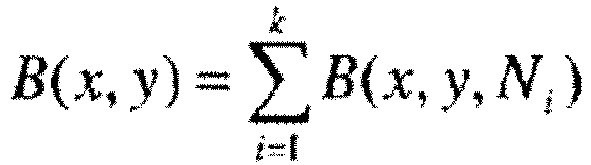 wobei B(x,y,Ni) die Summe des zeitlichen und räumlichen Rauschens ist, das ein aufgenommenes Bild des Index Ni beeinflusst.
 - Verfahren zum Verarbeiten von Bildern nach einem der vorherigen Ansprüche, wobei das Stabilisierungsmodul angepasst ist, um die auf der Grundlage der digitalen Bildverarbeitung aufgenommenen Bilder zu stabilisieren.
- Verfahren zum Verarbeiten von Bildern nach einem der vorherigen Ansprüche, wobei das Stabilisierungsmodul ein mechanisches Trägheitsstabilisierungsmodul ist.
- Verfahren zum Verarbeiten von Bildern nach einem der vorherigen Ansprüche, wobei die definierte Bewegung ein Kreis mit einem Durchmesser von 3 Pixeln oder mehr an der Matrix von Flussdetektoren ist.
- Verfahren zum Verarbeiten von Bildern nach einem der vorherigen Ansprüche, wobei die Geschwindigkeit der definierten Bewegung als Funktion einer Integrationszeit der Flussdetektoren der Matrix (52) von Flussdetektoren der Bilderfassungsvorrichtung (11) bestimmt wird.
- Verfahren zum Verarbeiten von Bildern nach einem der vorherigen Ansprüche, bei dem Pixelwerte des gemeinsamen Abschnitts des vorherigen Bildes (31) und des nachfolgenden Bildes (32) nacheinander aus dem bestimmten Versatz durch Durchlaufen einer Pixelkette korrigiert werden, die ausgehend vom Referenzpixel (P1) im vorherigen Bild, Pixel, die abwechselnd im nachfolgenden Bild und im vorherigen Bild übereinstimmen, ein Pixel des nächsten Bildes, der einem Pixel des vorherigen Bildes entspricht, wenn die Pixel dem gleichen Punkt in der aufgenommenen Szene entsprechen, und ein Pixel des vorherigen Bildes, der einem Pixel des nächsten Bildes entspricht, wenn die Pixel dem gleichen Flussdetektor der Matrix (52) von Flussdetektoren entsprechen, umfasst.
- Bildverarbeitungsverfahren nach Anspruch 8, wobei die Position des Referenzpixels (P1) im gemeinsamen Teil als Funktion der definierten Bewegung und einer zwischen den Bildern verstrichenen Zeitspanne bestimmt wird.
- Verfahren zum Verarbeiten von Bildern gemäß einem der vorherigen Ansprüche, wobei die Position des n Pixels im nachfolgenden Bild aus der Position des Referenzpixels im vorherigen Bild gemäß den Eigenschaften der definierten Bewegung, die auf die Sichtachse angewendet wird, und einer Zeitspanne, die zwischen den Bildern verstrichen ist, bestimmt wird.
- Verfahren zur Verarbeitung von Bildern nach einem der vorherigen Ansprüche, bei dem die definierte Bewegung durch Anwendung einer digitalen Verarbeitung des vorherigen und des nachfolgenden Bildes bestimmt wird.
- System zum Erfassen einer Reihe von Bildern einer Szene, umfassend eine Bilderfassungsvorrichtung (11) mit einer Matrix von Flussdetektoren, die entlang einer Sichtachse ausgerichtet sind,
wobei das Erfassungssystem umfasst:- ein Stabilisierungsmodul (12), das die Sichtachse der aufgenommen Bilder stabilisiert;- ein Bewegungssteuerungsmodul (13), das angepasst ist, um auf die Sichtachse eine definierte, zyklische Bewegung mit einer Amplitude von n Pixeln über einen Zyklus auf der Ebene der Matrix der Flussdetektoren anzuwenden, wobei n eine ganze Zahl größer als 2 und kleiner als nmax ist, wobei nmax so bestimmt wird, dass die während eines Zyklus aufgenommenen Bilder einen mehrheitlich gemeinsamen Teil aufweisen;- ein Zwischenverarbeitungsmodul (15), das angepasst ist, um ein Zwischenbild aus der Reihe von Bildern bereitzustellen, das während eines Zyklus der definierten Bewegung aufgenommen wird, basierend auf einer Wiederholung der nachfolgenden Vorgänge:- Abstimmen eines nachfolgenden Bildes (Ni+1) der Reihe von Bildern auf ein vorheriges Bild (Ni) als Funktion der definierten Bewegung; und- Korrigieren eines räumlichen Rauschens in Bezug auf die Flussdetektoren, das den gemeinsamen Abschnitt des nachfolgenden und des vorherigen Bildes beeinflusst, basierend auf der definierten Bewegung, als Funktion mindestens eines bestimmten Versatzes zwischen einem Wert eines Referenzpixels (P1) im gemeinsamen Teil eines vorherigen Bildes (31) und einem Wert eines nachfolgenden Pixels (P2), das den gleichen Punkt der Szene wie das Referenzpixel in dem gemeinsamen Abschnitt eines nachfolgenden Bildes (32) darstellt;- ein Korrekturmodul (14), das angepasst ist, um ein korrigiertes erfasstes Bild der Szene bereitzustellen, indem ein Faltungsprodukt (26) zwischen dem Zwischenbild und einer Korrekturpunkt-Spreizfunktion (PSFglobal) angewandt wird, wobei die Korrekturpunkt-Spreizfunktion auf der Grundlage der definierten Bewegung bestimmt wird. - Bildverarbeitungssystem nach Anspruch 12, wobei das Bewegungssteuerungsmodul (13) angepasst ist, um die definierte Bewegung mit konstanter Geschwindigkeit oder konstanter Beschleunigung anzuwenden.
- Bildverarbeitungssystem nach Anspruch 12 oder 13, in dem die Korrekturpunkt-Spreizfunktion die folgende Gleichung überprüft:
 wobei PSFglobal die Korrekturpunkt-Spreizfunktion ist;wobei x und y Koordinaten eines Detektors innerhalb der Detektormatrix sind;wobei N1-k die Reihe der aufgenommenen Bilder ist, wobei jedes aufgenommene Bild durch einen Index Ni mit i zwischen 1 und k dargestellt ist, wobei k größer als 1 ist;wobei PSFcapt eine Punktspreizfunktion in Bezug auf den Sensor am Detektor mit x- und y-Koordinaten in der Matrix ist;wobei PSFmotion eine Punktspreizfunktion in Bezug auf die definierte Bewegung der Sichtachse ist; undwobei B(x,y) die folgende Gleichung überprüft:
 wobei B(x,y,Ni) die Summe des zeitlichen und räumlichen Rauschens ist, das ein aufgenommenes Bild des Index Ni beeinflusst.
 - Erfassungssystem nach einem der Ansprüche 12 bis 14, dadurch gekennzeichnet, dass das Bewegungssteuerungsmodul (13) angepasst ist, um eine definierte Bewegung entsprechend einem Kreis mit einem Durchmesser von 3 Pixeln oder mehr an der Matrix von Flussdetektoren anzuwenden.
- Computerprogramm zur Installation in einem Erfassungssystem (10) nach einem der Ansprüche 12 bis 15, umfassend Anweisungen zur Ausführung des Verfahrens nach einem der Ansprüche 1 bis 11, wenn das Programm durch Verarbeitungsmittel des Erfassungssystems ausgeführt wird.
Applications Claiming Priority (2)
| Application Number | Priority Date | Filing Date | Title |
|---|---|---|---|
| FR0850880A FR2927448B1 (fr) | 2008-02-12 | 2008-02-12 | Correction d'images captees et stabilisees |
| PCT/EP2009/051661 WO2009101151A1 (fr) | 2008-02-12 | 2009-02-12 | Correction d'images captees et stabilisees |
Publications (3)
| Publication Number | Publication Date |
|---|---|
| EP2243115A1 EP2243115A1 (de) | 2010-10-27 |
| EP2243115B1 EP2243115B1 (de) | 2019-04-03 |
| EP2243115B9 true EP2243115B9 (de) | 2019-09-11 |
Family
ID=39711135
Family Applications (1)
| Application Number | Title | Priority Date | Filing Date |
|---|---|---|---|
| EP09710568.8A Active EP2243115B9 (de) | 2008-02-12 | 2009-02-12 | Korrektur von aufgenommenen und stabilisierten bildern |
Country Status (5)
| Country | Link |
|---|---|
| US (1) | US8654202B2 (de) |
| EP (1) | EP2243115B9 (de) |
| FR (1) | FR2927448B1 (de) |
| IL (1) | IL207574A (de) |
| WO (1) | WO2009101151A1 (de) |
Families Citing this family (9)
| Publication number | Priority date | Publication date | Assignee | Title |
|---|---|---|---|---|
| FR2958486B1 (fr) * | 2010-03-30 | 2013-02-08 | Sagem Defense Securite | Stabilisation d'images captees |
| US9336574B2 (en) * | 2013-01-07 | 2016-05-10 | GM Global Technology Operations LLC | Image super-resolution for dynamic rearview mirror |
| US9070180B2 (en) * | 2013-02-21 | 2015-06-30 | Applied Materials Israel, Ltd. | Method, system, and computer program product for detection of defects based on multiple references |
| FR3024627B1 (fr) * | 2014-07-30 | 2016-08-19 | Mbda France | Procede pour diminuer la composante basse frequence du bruit de mesure d'un imageur photosensible et ses applications |
| WO2016106347A1 (en) * | 2014-12-22 | 2016-06-30 | The Research Foundation For The State University Of New York | Determination of spatial distribution of charged particle beams |
| CN104811588B (zh) * | 2015-04-10 | 2018-04-20 | 浙江工业大学 | 一种基于陀螺仪的船载稳像控制方法 |
| US10495518B2 (en) * | 2016-06-23 | 2019-12-03 | Panasonic Intellectual Property Management Co., Ltd. | Infrared detection apparatus |
| JP6765064B2 (ja) | 2016-06-23 | 2020-10-07 | パナソニックIpマネジメント株式会社 | 赤外線検出装置 |
| FR3085081A1 (fr) | 2018-08-16 | 2020-02-21 | Psa Automobiles Sa | Procede de correction en temps reel d’images alterees provenant d’une camera embarquee presentant des salissures |
Family Cites Families (7)
| Publication number | Priority date | Publication date | Assignee | Title |
|---|---|---|---|---|
| GB9217098D0 (en) | 1992-08-12 | 1992-09-23 | British Broadcasting Corp | Derivation of studio camera position and motion from the camera image |
| US6778210B1 (en) * | 1999-07-15 | 2004-08-17 | Olympus Optical Co., Ltd. | Image pickup apparatus with blur compensation |
| FR2828315B1 (fr) | 2001-07-31 | 2005-08-05 | Sagem | Stabilisation des images d'une scene, correction des offsets de niveaux de gris, detection d'objets mobiles et harmonisation de deux appareils de prise de vues fondes sur la stabilisation des images |
| US7657123B2 (en) * | 2001-10-03 | 2010-02-02 | Microsoft Corporation | Text document capture with jittered digital camera |
| US6642497B1 (en) * | 2002-06-14 | 2003-11-04 | Hewlett-Packard Development Company, Lp. | System for improving image resolution via sensor rotation |
| WO2004001667A2 (en) * | 2002-06-21 | 2003-12-31 | The Trustees Of Columbia University In The City Of New York | Systems and methods for de-blurring motion blurred images |
| JP4536641B2 (ja) * | 2005-11-02 | 2010-09-01 | ルネサスエレクトロニクス株式会社 | 画像ぶれ補正装置、画像ぶれ補正方法及び画像ぶれ補正プログラム |
-
2008
- 2008-02-12 FR FR0850880A patent/FR2927448B1/fr not_active Expired - Fee Related
-
2009
- 2009-02-12 WO PCT/EP2009/051661 patent/WO2009101151A1/fr not_active Ceased
- 2009-02-12 EP EP09710568.8A patent/EP2243115B9/de active Active
- 2009-02-12 US US12/867,173 patent/US8654202B2/en active Active
-
2010
- 2010-08-12 IL IL207574A patent/IL207574A/en active IP Right Grant
Also Published As
| Publication number | Publication date |
|---|---|
| US20110037860A1 (en) | 2011-02-17 |
| WO2009101151A1 (fr) | 2009-08-20 |
| FR2927448B1 (fr) | 2011-03-04 |
| US8654202B2 (en) | 2014-02-18 |
| IL207574A0 (en) | 2010-12-30 |
| FR2927448A1 (fr) | 2009-08-14 |
| EP2243115B1 (de) | 2019-04-03 |
| EP2243115A1 (de) | 2010-10-27 |
| IL207574A (en) | 2015-10-29 |
Similar Documents
| Publication | Publication Date | Title |
|---|---|---|
| EP2243115B9 (de) | Korrektur von aufgenommenen und stabilisierten bildern | |
| EP3171589B1 (de) | Drohne, die mit einer videokamera ausgestattet ist, die wobble-effekt-korrigierte bildsequenzen liefert | |
| EP2795580B1 (de) | Verfahren zur schätzung des optischen flusses auf basis eines asynchronen lichtsensors | |
| EP1298592B1 (de) | Stabilisierung von Bildern einer Szene, Korrigierung der Grauwertverschiebung, Erfassung bewegender Objekte und auf Bildstabilisierung basierter Abgleich von zwei Bildaufnahmevorrichtungen | |
| EP2753971B1 (de) | Sichtlinienstabilisierung eines satelliten-gestützten abbildungssystems | |
| EP3007429B1 (de) | Mobiles gerät, insbesondere drehflügeldrone, die mit einem videogerät ausgestattet ist, das dynamisch korrigierte bildsequenzen des wobble-effekts liefert | |
| FR2952744A1 (fr) | Procede d'estimation du mouvement d'un instrument d'observation a defilement survolant un corps celeste | |
| WO2011012663A1 (fr) | Procédé d'estimation de décalages d'images lignes obtenues par un capteur à défilement spatial ou aéroporté | |
| EP1927953B1 (de) | Rauschkorrektur in Bildern, die von einem System mit Trägheitsstabilisierung aufgenommen wurden | |
| EP2375724B1 (de) | Stabilisierung eines erfassten Bildes | |
| EP2733929B1 (de) | Verfahren und System zur Echtzeitbestimmung einer Anzahl zu summierender Signale | |
| EP1845403B1 (de) | System und Verfahren zur Stabilisierung einer Visierlinie | |
| EP2210059A1 (de) | Verfahren zum integrieren eines vibrationssignals aus signaldifferenzen und entsprechendes verfahren zum korrigieren eines durch einen bildsensor erfassten signals | |
| EP3963539B1 (de) | Verfahren und vorrichtung zum entfernen von remanenz in einem infrarotbild einer sich ändernden szene | |
| EP2113460B1 (de) | Charakterisierungsverfahren von Schwingungen für einen Beobachtungssatelliten | |
| EP0629082B1 (de) | Verfahren zur räumlichen Korrektur von digitalen Bildern | |
| EP3963540B1 (de) | Verfahren und vorrichtung zum entfernen von remanenz in einem infrarotbild einer statischen szene | |
| EP2649789A1 (de) | Verfahren zur verwendung eines bildsensors | |
| WO2023047036A1 (fr) | Systeme d'imagerie a balayage pour saisir des images selon deux valeurs d'inclinaison de ligne de visee | |
| EP3402178B1 (de) | Bewegungssensor und bildsensor | |
| FR2918530A1 (fr) | Procede et dispositif d'observation | |
| FR2952195A1 (fr) | Procede d'acquisition d'une image numerique stabilisee par un appareil photo | |
| FR2737071A1 (fr) | Procede et dispositif de selection de prises de vues effectuees par une camera video mobile |
Legal Events
| Date | Code | Title | Description |
|---|---|---|---|
| PUAI | Public reference made under article 153(3) epc to a published international application that has entered the european phase |
Free format text: ORIGINAL CODE: 0009012 |
|
| 17P | Request for examination filed |
Effective date: 20100811 |
|
| AK | Designated contracting states |
Kind code of ref document: A1 Designated state(s): AT BE BG CH CY CZ DE DK EE ES FI FR GB GR HR HU IE IS IT LI LT LU LV MC MK MT NL NO PL PT RO SE SI SK TR |
|
| AX | Request for extension of the european patent |
Extension state: AL BA RS |
|
| DAX | Request for extension of the european patent (deleted) | ||
| RAP1 | Party data changed (applicant data changed or rights of an application transferred) |
Owner name: SAGEM DEFENSE SECURITE |
|
| RAP1 | Party data changed (applicant data changed or rights of an application transferred) |
Owner name: SAFRAN ELECTRONICS & DEFENSE |
|
| STAA | Information on the status of an ep patent application or granted ep patent |
Free format text: STATUS: EXAMINATION IS IN PROGRESS |
|
| 17Q | First examination report despatched |
Effective date: 20170912 |
|
| GRAP | Despatch of communication of intention to grant a patent |
Free format text: ORIGINAL CODE: EPIDOSNIGR1 |
|
| STAA | Information on the status of an ep patent application or granted ep patent |
Free format text: STATUS: GRANT OF PATENT IS INTENDED |
|
| RIC1 | Information provided on ipc code assigned before grant |
Ipc: H04N 5/232 20060101AFI20180731BHEP |
|
| INTG | Intention to grant announced |
Effective date: 20180903 |
|
| GRAJ | Information related to disapproval of communication of intention to grant by the applicant or resumption of examination proceedings by the epo deleted |
Free format text: ORIGINAL CODE: EPIDOSDIGR1 |
|
| STAA | Information on the status of an ep patent application or granted ep patent |
Free format text: STATUS: EXAMINATION IS IN PROGRESS |
|
| INTC | Intention to grant announced (deleted) | ||
| GRAR | Information related to intention to grant a patent recorded |
Free format text: ORIGINAL CODE: EPIDOSNIGR71 |
|
| GRAS | Grant fee paid |
Free format text: ORIGINAL CODE: EPIDOSNIGR3 |
|
| STAA | Information on the status of an ep patent application or granted ep patent |
Free format text: STATUS: GRANT OF PATENT IS INTENDED |
|
| RIC1 | Information provided on ipc code assigned before grant |
Ipc: H04N 5/232 20060101ALI20190103BHEP Ipc: H04N 5/349 20110101ALI20190103BHEP Ipc: G06T 5/50 20060101AFI20190103BHEP Ipc: G06T 7/223 20170101ALI20190103BHEP Ipc: H04N 5/365 20110101ALI20190103BHEP |
|
| INTG | Intention to grant announced |
Effective date: 20190116 |
|
| GRAA | (expected) grant |
Free format text: ORIGINAL CODE: 0009210 |
|
| STAA | Information on the status of an ep patent application or granted ep patent |
Free format text: STATUS: THE PATENT HAS BEEN GRANTED |
|
| AK | Designated contracting states |
Kind code of ref document: B1 Designated state(s): AT BE BG CH CY CZ DE DK EE ES FI FR GB GR HR HU IE IS IT LI LT LU LV MC MK MT NL NO PL PT RO SE SI SK TR |
|
| REG | Reference to a national code |
Ref country code: GB Ref legal event code: FG4D Free format text: NOT ENGLISH |
|
| REG | Reference to a national code |
Ref country code: CH Ref legal event code: EP Ref country code: AT Ref legal event code: REF Ref document number: 1116668 Country of ref document: AT Kind code of ref document: T Effective date: 20190415 |
|
| REG | Reference to a national code |
Ref country code: DE Ref legal event code: R096 Ref document number: 602009057707 Country of ref document: DE |
|
| REG | Reference to a national code |
Ref country code: IE Ref legal event code: FG4D Free format text: LANGUAGE OF EP DOCUMENT: FRENCH |
|
| REG | Reference to a national code |
Ref country code: SE Ref legal event code: TRGR |
|
| REG | Reference to a national code |
Ref country code: NL Ref legal event code: MP Effective date: 20190403 |
|
| REG | Reference to a national code |
Ref country code: CH Ref legal event code: PK Free format text: RECTIFICATION B9 |
|
| REG | Reference to a national code |
Ref country code: LT Ref legal event code: MG4D |
|
| REG | Reference to a national code |
Ref country code: AT Ref legal event code: MK05 Ref document number: 1116668 Country of ref document: AT Kind code of ref document: T Effective date: 20190403 |
|
| PG25 | Lapsed in a contracting state [announced via postgrant information from national office to epo] |
Ref country code: NL Free format text: LAPSE BECAUSE OF FAILURE TO SUBMIT A TRANSLATION OF THE DESCRIPTION OR TO PAY THE FEE WITHIN THE PRESCRIBED TIME-LIMIT Effective date: 20190403 |
|
| PG25 | Lapsed in a contracting state [announced via postgrant information from national office to epo] |
Ref country code: ES Free format text: LAPSE BECAUSE OF FAILURE TO SUBMIT A TRANSLATION OF THE DESCRIPTION OR TO PAY THE FEE WITHIN THE PRESCRIBED TIME-LIMIT Effective date: 20190403 Ref country code: PT Free format text: LAPSE BECAUSE OF FAILURE TO SUBMIT A TRANSLATION OF THE DESCRIPTION OR TO PAY THE FEE WITHIN THE PRESCRIBED TIME-LIMIT Effective date: 20190803 Ref country code: CZ Free format text: LAPSE BECAUSE OF FAILURE TO SUBMIT A TRANSLATION OF THE DESCRIPTION OR TO PAY THE FEE WITHIN THE PRESCRIBED TIME-LIMIT Effective date: 20190403 Ref country code: HR Free format text: LAPSE BECAUSE OF FAILURE TO SUBMIT A TRANSLATION OF THE DESCRIPTION OR TO PAY THE FEE WITHIN THE PRESCRIBED TIME-LIMIT Effective date: 20190403 Ref country code: LT Free format text: LAPSE BECAUSE OF FAILURE TO SUBMIT A TRANSLATION OF THE DESCRIPTION OR TO PAY THE FEE WITHIN THE PRESCRIBED TIME-LIMIT Effective date: 20190403 Ref country code: NO Free format text: LAPSE BECAUSE OF FAILURE TO SUBMIT A TRANSLATION OF THE DESCRIPTION OR TO PAY THE FEE WITHIN THE PRESCRIBED TIME-LIMIT Effective date: 20190703 Ref country code: FI Free format text: LAPSE BECAUSE OF FAILURE TO SUBMIT A TRANSLATION OF THE DESCRIPTION OR TO PAY THE FEE WITHIN THE PRESCRIBED TIME-LIMIT Effective date: 20190403 |
|
| PG25 | Lapsed in a contracting state [announced via postgrant information from national office to epo] |
Ref country code: LV Free format text: LAPSE BECAUSE OF FAILURE TO SUBMIT A TRANSLATION OF THE DESCRIPTION OR TO PAY THE FEE WITHIN THE PRESCRIBED TIME-LIMIT Effective date: 20190403 Ref country code: PL Free format text: LAPSE BECAUSE OF FAILURE TO SUBMIT A TRANSLATION OF THE DESCRIPTION OR TO PAY THE FEE WITHIN THE PRESCRIBED TIME-LIMIT Effective date: 20190403 Ref country code: BG Free format text: LAPSE BECAUSE OF FAILURE TO SUBMIT A TRANSLATION OF THE DESCRIPTION OR TO PAY THE FEE WITHIN THE PRESCRIBED TIME-LIMIT Effective date: 20190703 Ref country code: GR Free format text: LAPSE BECAUSE OF FAILURE TO SUBMIT A TRANSLATION OF THE DESCRIPTION OR TO PAY THE FEE WITHIN THE PRESCRIBED TIME-LIMIT Effective date: 20190704 |
|
| PG25 | Lapsed in a contracting state [announced via postgrant information from national office to epo] |
Ref country code: IS Free format text: LAPSE BECAUSE OF FAILURE TO SUBMIT A TRANSLATION OF THE DESCRIPTION OR TO PAY THE FEE WITHIN THE PRESCRIBED TIME-LIMIT Effective date: 20190803 Ref country code: AT Free format text: LAPSE BECAUSE OF FAILURE TO SUBMIT A TRANSLATION OF THE DESCRIPTION OR TO PAY THE FEE WITHIN THE PRESCRIBED TIME-LIMIT Effective date: 20190403 |
|
| REG | Reference to a national code |
Ref country code: DE Ref legal event code: R097 Ref document number: 602009057707 Country of ref document: DE |
|
| PG25 | Lapsed in a contracting state [announced via postgrant information from national office to epo] |
Ref country code: DK Free format text: LAPSE BECAUSE OF FAILURE TO SUBMIT A TRANSLATION OF THE DESCRIPTION OR TO PAY THE FEE WITHIN THE PRESCRIBED TIME-LIMIT Effective date: 20190403 Ref country code: SK Free format text: LAPSE BECAUSE OF FAILURE TO SUBMIT A TRANSLATION OF THE DESCRIPTION OR TO PAY THE FEE WITHIN THE PRESCRIBED TIME-LIMIT Effective date: 20190403 Ref country code: EE Free format text: LAPSE BECAUSE OF FAILURE TO SUBMIT A TRANSLATION OF THE DESCRIPTION OR TO PAY THE FEE WITHIN THE PRESCRIBED TIME-LIMIT Effective date: 20190403 Ref country code: RO Free format text: LAPSE BECAUSE OF FAILURE TO SUBMIT A TRANSLATION OF THE DESCRIPTION OR TO PAY THE FEE WITHIN THE PRESCRIBED TIME-LIMIT Effective date: 20190403 |
|
| PLBE | No opposition filed within time limit |
Free format text: ORIGINAL CODE: 0009261 |
|
| STAA | Information on the status of an ep patent application or granted ep patent |
Free format text: STATUS: NO OPPOSITION FILED WITHIN TIME LIMIT |
|
| 26N | No opposition filed |
Effective date: 20200106 |
|
| PG25 | Lapsed in a contracting state [announced via postgrant information from national office to epo] |
Ref country code: TR Free format text: LAPSE BECAUSE OF FAILURE TO SUBMIT A TRANSLATION OF THE DESCRIPTION OR TO PAY THE FEE WITHIN THE PRESCRIBED TIME-LIMIT Effective date: 20190403 |
|
| PG25 | Lapsed in a contracting state [announced via postgrant information from national office to epo] |
Ref country code: SI Free format text: LAPSE BECAUSE OF FAILURE TO SUBMIT A TRANSLATION OF THE DESCRIPTION OR TO PAY THE FEE WITHIN THE PRESCRIBED TIME-LIMIT Effective date: 20190403 |
|
| REG | Reference to a national code |
Ref country code: CH Ref legal event code: PL |
|
| REG | Reference to a national code |
Ref country code: BE Ref legal event code: MM Effective date: 20200229 |
|
| PG25 | Lapsed in a contracting state [announced via postgrant information from national office to epo] |
Ref country code: MC Free format text: LAPSE BECAUSE OF FAILURE TO SUBMIT A TRANSLATION OF THE DESCRIPTION OR TO PAY THE FEE WITHIN THE PRESCRIBED TIME-LIMIT Effective date: 20190403 Ref country code: LU Free format text: LAPSE BECAUSE OF NON-PAYMENT OF DUE FEES Effective date: 20200212 |
|
| PG25 | Lapsed in a contracting state [announced via postgrant information from national office to epo] |
Ref country code: CH Free format text: LAPSE BECAUSE OF NON-PAYMENT OF DUE FEES Effective date: 20200229 Ref country code: LI Free format text: LAPSE BECAUSE OF NON-PAYMENT OF DUE FEES Effective date: 20200229 |
|
| PG25 | Lapsed in a contracting state [announced via postgrant information from national office to epo] |
Ref country code: IE Free format text: LAPSE BECAUSE OF NON-PAYMENT OF DUE FEES Effective date: 20200212 |
|
| PG25 | Lapsed in a contracting state [announced via postgrant information from national office to epo] |
Ref country code: BE Free format text: LAPSE BECAUSE OF NON-PAYMENT OF DUE FEES Effective date: 20200229 |
|
| PG25 | Lapsed in a contracting state [announced via postgrant information from national office to epo] |
Ref country code: MT Free format text: LAPSE BECAUSE OF FAILURE TO SUBMIT A TRANSLATION OF THE DESCRIPTION OR TO PAY THE FEE WITHIN THE PRESCRIBED TIME-LIMIT Effective date: 20190403 Ref country code: CY Free format text: LAPSE BECAUSE OF FAILURE TO SUBMIT A TRANSLATION OF THE DESCRIPTION OR TO PAY THE FEE WITHIN THE PRESCRIBED TIME-LIMIT Effective date: 20190403 |
|
| PG25 | Lapsed in a contracting state [announced via postgrant information from national office to epo] |
Ref country code: MK Free format text: LAPSE BECAUSE OF FAILURE TO SUBMIT A TRANSLATION OF THE DESCRIPTION OR TO PAY THE FEE WITHIN THE PRESCRIBED TIME-LIMIT Effective date: 20190403 |
|
| PGFP | Annual fee paid to national office [announced via postgrant information from national office to epo] |
Ref country code: SE Payment date: 20260218 Year of fee payment: 18 |
|
| PGFP | Annual fee paid to national office [announced via postgrant information from national office to epo] |
Ref country code: GB Payment date: 20260219 Year of fee payment: 18 |
|
| PGFP | Annual fee paid to national office [announced via postgrant information from national office to epo] |
Ref country code: DE Payment date: 20260217 Year of fee payment: 18 |
|
| PGFP | Annual fee paid to national office [announced via postgrant information from national office to epo] |
Ref country code: IT Payment date: 20260227 Year of fee payment: 18 |
|
| PGFP | Annual fee paid to national office [announced via postgrant information from national office to epo] |
Ref country code: FR Payment date: 20260219 Year of fee payment: 18 |