EP2243838A1 - Verfahren zur Herstellung von Methan durch Fermentation von Biomasse, wobei während der Versäuerung freigesetzte Wasserstoffionen an einer Kathode reduziert werden und gasförmiger Wasserstoff abgezogen wird - Google Patents
Verfahren zur Herstellung von Methan durch Fermentation von Biomasse, wobei während der Versäuerung freigesetzte Wasserstoffionen an einer Kathode reduziert werden und gasförmiger Wasserstoff abgezogen wird Download PDFInfo
- Publication number
- EP2243838A1 EP2243838A1 EP10450065A EP10450065A EP2243838A1 EP 2243838 A1 EP2243838 A1 EP 2243838A1 EP 10450065 A EP10450065 A EP 10450065A EP 10450065 A EP10450065 A EP 10450065A EP 2243838 A1 EP2243838 A1 EP 2243838A1
- Authority
- EP
- European Patent Office
- Prior art keywords
- acidification
- hydrogen
- biomass
- reactor
- methane
- Prior art date
- Legal status (The legal status is an assumption and is not a legal conclusion. Google has not performed a legal analysis and makes no representation as to the accuracy of the status listed.)
- Granted
Links
- 239000001257 hydrogen Substances 0.000 title claims abstract description 40
- 229910052739 hydrogen Inorganic materials 0.000 title claims abstract description 40
- VNWKTOKETHGBQD-UHFFFAOYSA-N methane Chemical compound C VNWKTOKETHGBQD-UHFFFAOYSA-N 0.000 title claims abstract description 37
- 230000020477 pH reduction Effects 0.000 title claims abstract description 32
- UFHFLCQGNIYNRP-UHFFFAOYSA-N Hydrogen Chemical compound [H][H] UFHFLCQGNIYNRP-UHFFFAOYSA-N 0.000 title claims abstract description 26
- 239000002028 Biomass Substances 0.000 title claims abstract description 21
- -1 hydrogen ions Chemical class 0.000 title claims abstract description 21
- 238000000034 method Methods 0.000 title claims abstract description 13
- 238000000855 fermentation Methods 0.000 title description 3
- 230000004151 fermentation Effects 0.000 title description 3
- CURLTUGMZLYLDI-UHFFFAOYSA-N Carbon dioxide Chemical compound O=C=O CURLTUGMZLYLDI-UHFFFAOYSA-N 0.000 claims abstract description 44
- 239000001569 carbon dioxide Substances 0.000 claims abstract description 22
- 229910002092 carbon dioxide Inorganic materials 0.000 claims abstract description 22
- 230000007062 hydrolysis Effects 0.000 claims abstract description 16
- 238000006460 hydrolysis reaction Methods 0.000 claims abstract description 16
- 230000015572 biosynthetic process Effects 0.000 claims abstract description 14
- 230000000035 biogenic effect Effects 0.000 claims abstract description 12
- 238000003786 synthesis reaction Methods 0.000 claims abstract description 11
- 150000002431 hydrogen Chemical class 0.000 claims abstract description 6
- 230000029087 digestion Effects 0.000 claims abstract 2
- 230000005684 electric field Effects 0.000 claims description 8
- 238000011144 upstream manufacturing Methods 0.000 claims 1
- 230000002879 macerating effect Effects 0.000 abstract 1
- QTBSBXVTEAMEQO-UHFFFAOYSA-N Acetic acid Chemical compound CC(O)=O QTBSBXVTEAMEQO-UHFFFAOYSA-N 0.000 description 12
- 239000000758 substrate Substances 0.000 description 11
- 235000014113 dietary fatty acids Nutrition 0.000 description 5
- 229930195729 fatty acid Natural products 0.000 description 5
- 239000000194 fatty acid Substances 0.000 description 5
- 150000004665 fatty acids Chemical class 0.000 description 5
- 238000004519 manufacturing process Methods 0.000 description 5
- 239000001301 oxygen Substances 0.000 description 5
- 229910052760 oxygen Inorganic materials 0.000 description 5
- MYMOFIZGZYHOMD-UHFFFAOYSA-N Dioxygen Chemical compound O=O MYMOFIZGZYHOMD-UHFFFAOYSA-N 0.000 description 3
- PEDCQBHIVMGVHV-UHFFFAOYSA-N Glycerine Chemical compound OCC(O)CO PEDCQBHIVMGVHV-UHFFFAOYSA-N 0.000 description 3
- 238000006243 chemical reaction Methods 0.000 description 3
- 229910001882 dioxygen Inorganic materials 0.000 description 3
- 235000001014 amino acid Nutrition 0.000 description 2
- 150000001413 amino acids Chemical class 0.000 description 2
- 235000014633 carbohydrates Nutrition 0.000 description 2
- 150000001720 carbohydrates Chemical class 0.000 description 2
- 230000015556 catabolic process Effects 0.000 description 2
- 238000006731 degradation reaction Methods 0.000 description 2
- 239000003925 fat Substances 0.000 description 2
- GPRLSGONYQIRFK-UHFFFAOYSA-N hydron Chemical compound [H+] GPRLSGONYQIRFK-UHFFFAOYSA-N 0.000 description 2
- 239000000543 intermediate Substances 0.000 description 2
- 239000000463 material Substances 0.000 description 2
- 230000002093 peripheral effect Effects 0.000 description 2
- 102000004169 proteins and genes Human genes 0.000 description 2
- 108090000623 proteins and genes Proteins 0.000 description 2
- 238000003756 stirring Methods 0.000 description 2
- 239000000126 substance Substances 0.000 description 2
- 241000894006 Bacteria Species 0.000 description 1
- 102000004190 Enzymes Human genes 0.000 description 1
- 108090000790 Enzymes Proteins 0.000 description 1
- 206010020601 Hyperchlorhydria Diseases 0.000 description 1
- 150000004729 acetoacetic acid derivatives Chemical class 0.000 description 1
- 125000004429 atom Chemical group 0.000 description 1
- 230000001580 bacterial effect Effects 0.000 description 1
- 238000003776 cleavage reaction Methods 0.000 description 1
- 150000001875 compounds Chemical class 0.000 description 1
- 238000007872 degassing Methods 0.000 description 1
- 238000006356 dehydrogenation reaction Methods 0.000 description 1
- 238000009795 derivation Methods 0.000 description 1
- 238000010586 diagram Methods 0.000 description 1
- 238000009826 distribution Methods 0.000 description 1
- 230000002349 favourable effect Effects 0.000 description 1
- 238000011049 filling Methods 0.000 description 1
- 239000012634 fragment Substances 0.000 description 1
- 239000007789 gas Substances 0.000 description 1
- 235000011187 glycerol Nutrition 0.000 description 1
- 238000005984 hydrogenation reaction Methods 0.000 description 1
- 238000010348 incorporation Methods 0.000 description 1
- 238000012423 maintenance Methods 0.000 description 1
- 230000000696 methanogenic effect Effects 0.000 description 1
- 230000002906 microbiologic effect Effects 0.000 description 1
- 244000005700 microbiome Species 0.000 description 1
- 238000002156 mixing Methods 0.000 description 1
- 230000007935 neutral effect Effects 0.000 description 1
- 150000002894 organic compounds Chemical class 0.000 description 1
- 238000011946 reduction process Methods 0.000 description 1
- 230000007017 scission Effects 0.000 description 1
- 235000021309 simple sugar Nutrition 0.000 description 1
- 239000010802 sludge Substances 0.000 description 1
- 235000000346 sugar Nutrition 0.000 description 1
- 150000008163 sugars Chemical class 0.000 description 1
- 230000001629 suppression Effects 0.000 description 1
- 231100000331 toxic Toxicity 0.000 description 1
- 230000002588 toxic effect Effects 0.000 description 1
- 238000009827 uniform distribution Methods 0.000 description 1
- XLYOFNOQVPJJNP-UHFFFAOYSA-N water Substances O XLYOFNOQVPJJNP-UHFFFAOYSA-N 0.000 description 1
- 239000002916 wood waste Substances 0.000 description 1
Images

Classifications
-
- C—CHEMISTRY; METALLURGY
- C12—BIOCHEMISTRY; BEER; SPIRITS; WINE; VINEGAR; MICROBIOLOGY; ENZYMOLOGY; MUTATION OR GENETIC ENGINEERING
- C12P—FERMENTATION OR ENZYME-USING PROCESSES TO SYNTHESISE A DESIRED CHEMICAL COMPOUND OR COMPOSITION OR TO SEPARATE OPTICAL ISOMERS FROM A RACEMIC MIXTURE
- C12P5/00—Preparation of hydrocarbons or halogenated hydrocarbons
- C12P5/02—Preparation of hydrocarbons or halogenated hydrocarbons acyclic
- C12P5/023—Methane
-
- C—CHEMISTRY; METALLURGY
- C02—TREATMENT OF WATER, WASTE WATER, SEWAGE, OR SLUDGE
- C02F—TREATMENT OF WATER, WASTE WATER, SEWAGE, OR SLUDGE
- C02F1/00—Treatment of water, waste water, or sewage
- C02F1/46—Treatment of water, waste water, or sewage by electrochemical methods
- C02F1/461—Treatment of water, waste water, or sewage by electrochemical methods by electrolysis
- C02F1/46104—Devices therefor; Their operating or servicing
-
- C—CHEMISTRY; METALLURGY
- C02—TREATMENT OF WATER, WASTE WATER, SEWAGE, OR SLUDGE
- C02F—TREATMENT OF WATER, WASTE WATER, SEWAGE, OR SLUDGE
- C02F11/00—Treatment of sludge; Devices therefor
- C02F11/02—Biological treatment
- C02F11/04—Anaerobic treatment; Production of methane by such processes
-
- C—CHEMISTRY; METALLURGY
- C02—TREATMENT OF WATER, WASTE WATER, SEWAGE, OR SLUDGE
- C02F—TREATMENT OF WATER, WASTE WATER, SEWAGE, OR SLUDGE
- C02F3/00—Biological treatment of water, waste water, or sewage
- C02F3/28—Anaerobic digestion processes
- C02F3/286—Anaerobic digestion processes including two or more steps
-
- C—CHEMISTRY; METALLURGY
- C12—BIOCHEMISTRY; BEER; SPIRITS; WINE; VINEGAR; MICROBIOLOGY; ENZYMOLOGY; MUTATION OR GENETIC ENGINEERING
- C12M—APPARATUS FOR ENZYMOLOGY OR MICROBIOLOGY; APPARATUS FOR CULTURING MICROORGANISMS FOR PRODUCING BIOMASS, FOR GROWING CELLS OR FOR OBTAINING FERMENTATION OR METABOLIC PRODUCTS, i.e. BIOREACTORS OR FERMENTERS
- C12M21/00—Bioreactors or fermenters specially adapted for specific uses
- C12M21/04—Bioreactors or fermenters specially adapted for specific uses for producing gas, e.g. biogas
-
- C—CHEMISTRY; METALLURGY
- C12—BIOCHEMISTRY; BEER; SPIRITS; WINE; VINEGAR; MICROBIOLOGY; ENZYMOLOGY; MUTATION OR GENETIC ENGINEERING
- C12M—APPARATUS FOR ENZYMOLOGY OR MICROBIOLOGY; APPARATUS FOR CULTURING MICROORGANISMS FOR PRODUCING BIOMASS, FOR GROWING CELLS OR FOR OBTAINING FERMENTATION OR METABOLIC PRODUCTS, i.e. BIOREACTORS OR FERMENTERS
- C12M23/00—Constructional details, e.g. recesses, hinges
- C12M23/44—Multiple separable units; Modules
-
- C—CHEMISTRY; METALLURGY
- C12—BIOCHEMISTRY; BEER; SPIRITS; WINE; VINEGAR; MICROBIOLOGY; ENZYMOLOGY; MUTATION OR GENETIC ENGINEERING
- C12P—FERMENTATION OR ENZYME-USING PROCESSES TO SYNTHESISE A DESIRED CHEMICAL COMPOUND OR COMPOSITION OR TO SEPARATE OPTICAL ISOMERS FROM A RACEMIC MIXTURE
- C12P3/00—Preparation of elements or inorganic compounds except carbon dioxide
-
- C—CHEMISTRY; METALLURGY
- C02—TREATMENT OF WATER, WASTE WATER, SEWAGE, OR SLUDGE
- C02F—TREATMENT OF WATER, WASTE WATER, SEWAGE, OR SLUDGE
- C02F1/00—Treatment of water, waste water, or sewage
- C02F1/66—Treatment of water, waste water, or sewage by neutralisation; pH adjustment
-
- C—CHEMISTRY; METALLURGY
- C02—TREATMENT OF WATER, WASTE WATER, SEWAGE, OR SLUDGE
- C02F—TREATMENT OF WATER, WASTE WATER, SEWAGE, OR SLUDGE
- C02F1/00—Treatment of water, waste water, or sewage
- C02F1/46—Treatment of water, waste water, or sewage by electrochemical methods
- C02F1/461—Treatment of water, waste water, or sewage by electrochemical methods by electrolysis
- C02F1/46104—Devices therefor; Their operating or servicing
- C02F1/46109—Electrodes
- C02F2001/46152—Electrodes characterised by the shape or form
-
- C—CHEMISTRY; METALLURGY
- C02—TREATMENT OF WATER, WASTE WATER, SEWAGE, OR SLUDGE
- C02F—TREATMENT OF WATER, WASTE WATER, SEWAGE, OR SLUDGE
- C02F3/00—Biological treatment of water, waste water, or sewage
- C02F3/005—Combined electrochemical biological processes
-
- Y—GENERAL TAGGING OF NEW TECHNOLOGICAL DEVELOPMENTS; GENERAL TAGGING OF CROSS-SECTIONAL TECHNOLOGIES SPANNING OVER SEVERAL SECTIONS OF THE IPC; TECHNICAL SUBJECTS COVERED BY FORMER USPC CROSS-REFERENCE ART COLLECTIONS [XRACs] AND DIGESTS
- Y02—TECHNOLOGIES OR APPLICATIONS FOR MITIGATION OR ADAPTATION AGAINST CLIMATE CHANGE
- Y02E—REDUCTION OF GREENHOUSE GAS [GHG] EMISSIONS, RELATED TO ENERGY GENERATION, TRANSMISSION OR DISTRIBUTION
- Y02E50/00—Technologies for the production of fuel of non-fossil origin
- Y02E50/30—Fuel from waste, e.g. synthetic alcohol or diesel
Definitions
- the invention relates to a process for the biogenic synthesis of methane from biomass, which is digested by a hydrolysis and an acidification and subjected to methanogenesis, and to an apparatus for carrying out the method.
- the invention is therefore based on the object to improve a method for the biogenic synthesis of methane from biomass of the type described so that the production rate can be increased, especially in small plants.
- the invention achieves the stated object in that excess hydrogen ions released during the acidification are collected in a DC electric field at a cathode and withdrawn as molecular hydrogen.
- the oxygen ions liberated upon acidification release electrons to an anode, causing molecular oxygen to escape from the substrate along with the carbon dioxide produced.
- the effective electric fields must be kept sufficiently small so as not to jeopardize the microbiological degradation of the cleavage products from hydrolysis by acidogenesis and acetogenesis.
- the biomass subjected to acidification can be supplied with carbon dioxide which, due to its affinity for hydrogen, releases the excess hydrogen ions released binds, so that the concentration of hydrogen ions can be lowered to a level favorable for subsequent methanogenesis. Since taking place during the methanogenesis conversion of acetic acid in addition to methane and carbon dioxide, this carbon dioxide can be separated from the biogas and fed to the biomass.
- this reactor having a coaxial central electrode as anode and concentrically surrounding the central electrode along the reactor jacket arranged electrodes are provided as cathodes for establishing a DC electric field, so that the hydrogen ions liberated in the reactor during the acidification are attracted by the peripheral cathodes due to the building up between the central anode and the peripheral cathodes electric DC field, while at the same time released oxygen ions migrate in the opposite direction to the anode.
- the molecular hydrogen forming in the region of the cathodes, which rises in the substrate along the reactor jacket, can be collected in an annular chamber arranged above the electrodes arranged along the reactor jacket and drawn off via a hydrogen line connected to the annular chamber.
- the central electrode can advantageously be formed as an agitator provided with agitating blades, which not only ensures a uniform distribution of the fermentation substrate conveyed into the reactor, but also destroys floating layers with corresponding stirring arms, which hinder a continuous degassing of the substrate.
- the acidification reactor in the bottom region may be connected to a carbon dioxide line so that the carbon dioxide passes through the reactor from bottom to top in a sufficiently uniform extent and thus creates advantageous conditions for the addition of the liberated hydrogen ions.
- the in the Fig. 1 Apparatus for the biogenic synthesis of methane shown essentially comprises a hydrolysis tank 1, a reactor 2 downstream of this hydrolysis tank 1 for the acidification of the biomass digested in the hydrolysis tank 1 and a reactor 3 connected to the reactor 2 for the acidification for the actual methane conversion.
- the mixed and comminuted 4 discontinued, mixed with water, biogenic substances, for example, composed of two-thirds of an agricultural green mass and one-third of wood waste are promoted by means of a screw conveyor 7 in the hydrolysis 1, where long-chain carbohydrates, proteins and Fats are enzymatically decomposed by hydrolysis into short-chain water-soluble fragments, such as simple sugars, glycerol and fatty acids and amino acids.
- the carbon dioxide liberated during the hydrolysis is withdrawn from the hydrolysis vessel 1 via a discharge line 8.
- the hydrolytically split substrate is then conveyed via a feed line 9 into the acidification reactor 2 to convert the monomeric hydrolysis intermediates by acidogenesis and acetogenesis into lower fatty acids and then to acetic acid, hydrogen and carbon dioxide. So that the hydrogen ions released during the acidification can not hinder the subsequent methanogenesis due to a higher concentration, they are withdrawn from the reactor 2 by means of a DC electric field in which the positive hydrogen ions migrate to the cathode, while at the same time liberated, negative oxygen ions of the anode are attracted.
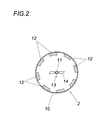
- a central, coaxial to the reactor 2 effective as an anode electrode 11 is used, which is concentrically surrounded with cathode serving as electrodes 12, as in particular the Fig. 2 can be removed.
- the electrodes 12 are arranged along the reactor shell 10 and distributed uniformly over its circumference, so that a uniform DC field can be formed within the reactor 2 distributed over the substrate volume.
- the electrodes 12 are held stationary on the reactor jacket 10 and can only be pulled out of the reactor 2 for maintenance purposes.
- the central electrode 11 is designed as a stirrer 13 and has schematically indicated stirring blades 14. Above the electrodes 12 provided along the reactor shell 10, the reactor 2 forms an annular chamber 15, which is connected to a hydrogen line 16.
- the hydrogen ions released during acidification become collected on the electrodes 12 with the inclusion of electrons and form in sequence molecular hydrogen, which rises along the electrodes 12 in the annular chamber 15 and is withdrawn via the hydrogen line 16 from the reactor 2.
- the delivery line provided for this purpose is designated by 18.
- the biogas which is composed essentially of methane and carbon dioxide, is withdrawn via a biogas line 19 from the reactor 3, while the remaining digested sludge is discharged in a conventional manner via a discharge line 20.
- the reactor 2 is supplied with carbon dioxide via a carbon dioxide line 21, which is introduced via a distribution device 22 in the bottom area in the reactor 2 and therefore uniformly intersperses the substrate, so that the excess hydrogen ions to the carbon dioxide can accumulate, whereby the hydrogen ion concentration can be reduced accordingly.
- the methane formation from carbon dioxide and hydrogen is promoted, which leads to a suppression of methane formation from acetic acid in favor of methane formation from carbon dioxide and hydrogen, which is energetically unequally cheaper.
- devices according to the invention for the biogenic synthesis of methane from biomass can be built much smaller than conventional systems, they allow comparable throughputs because of the permissible high degree of acidification, which allows a correspondingly high space load.
- the excess hydrogen can additionally be withdrawn as valuable material and used directly, for example for hydrogenation or reduction processes.
Landscapes
- Chemical & Material Sciences (AREA)
- Life Sciences & Earth Sciences (AREA)
- Engineering & Computer Science (AREA)
- Organic Chemistry (AREA)
- Health & Medical Sciences (AREA)
- Wood Science & Technology (AREA)
- Zoology (AREA)
- Bioinformatics & Cheminformatics (AREA)
- Microbiology (AREA)
- General Chemical & Material Sciences (AREA)
- Genetics & Genomics (AREA)
- General Health & Medical Sciences (AREA)
- General Engineering & Computer Science (AREA)
- Biotechnology (AREA)
- Biochemistry (AREA)
- Chemical Kinetics & Catalysis (AREA)
- Molecular Biology (AREA)
- Water Supply & Treatment (AREA)
- Environmental & Geological Engineering (AREA)
- Hydrology & Water Resources (AREA)
- Biomedical Technology (AREA)
- Oil, Petroleum & Natural Gas (AREA)
- Sustainable Development (AREA)
- Clinical Laboratory Science (AREA)
- Electrochemistry (AREA)
- Biodiversity & Conservation Biology (AREA)
- Organic Low-Molecular-Weight Compounds And Preparation Thereof (AREA)
- Preparation Of Compounds By Using Micro-Organisms (AREA)
Abstract
Description
- Die Erfindung bezieht sich auf ein Verfahren zur biogenen Synthese von Methan aus Biomasse, die durch eine Hydrolyse und eine Versäuerung aufgeschlossen und einer Methanogenese unterworfen wird, sowie auf eine Vorrichtung zur Durchführung des Verfahrens.
- Bei der biogenen Synthese von Methan aus Biomasse wird zunächst die zerkleinerte Biomasse, die komplexe Verbindungen, wie Kohlenhydrate, Eiweiße und Fette aufweist, durch eine Hydrolyse in einfachere organische Verbindungen, z. B. Zucker, Aminosäuren und Fettsäuren, zerlegt, und zwar mit Hilfe bakterieller Enzyme, die die Biomasse auf einem biochemischen Weg abbauen. In einer anschließenden Versäuerungsphase werden diese Zwischenprodukte durch eine Acidogenese zu niederen Fettsäuren, Kohlenstoffdioxid und Wasserstoff umgesetzt, bevor in einer Acetogenese die niederen Fettsäuren zu Essigsäure, Wasserstoff und Kohlendioxid abgebaut werden. In der Methanogenese erfolgt dann die Bildung von Methan aus den während der Versäuerung erhaltenen Produkten. Diese Verfahrensschritte laufen üblicherweise in einem einzigen Reaktor oder räumlich getrennt in zwei Reaktoren ab, wobei die Hydrolyse und die Acidogenese zu einer und die Acetogenese und die Methanogenese zu einer davon getrennten Verfahrensstufe zusammengefasst werden. Unabhängig davon, ob ein ein- oder zweistufiges Verfahren eingesetzt wird, ergibt sich das Problem, dass einerseits die Versäuerung rascher als die Methanogenese abläuft und anderseits die methanogenen Bakterien empfindlich auf eine Übersäuerung reagieren, sodass die Methanogenese im Wesentlichen die zuführbare Menge an Biomasse und damit die Produktivität der Biogaserzeugung bestimmt, was insbesondere Kleinanlagen zur Biogaserzeugung unwirtschaftlich macht, wie sie im Zuge landwirtschaftlicher Betriebe erfolgreich zum Einsatz kommen könnten.
- Darüber hinaus ist es bekannt (
AT 505 400 B1 - Der Erfindung liegt somit die Aufgabe zugrunde, ein Verfahren zur biogenen Synthese von Methan aus Biomasse der eingangs geschilderten Art so zu verbessern, dass die Produktionsrate insbesondere bei Kleinanlagen gesteigert werden kann.
- Die Erfindung löst die gestellte Aufgabe dadurch, dass während der Versäuerung freigesetzte, überschüssige Wasserstoffionen in einem elektrischen Gleichfeld an einer Kathode gesammelt und als molekularer Wasserstoff abgezogen werden.
- Da durch den laufenden Abzug von freiwerdendem Wasserstoff eine für Mikroorganismen toxische Wasserstoffkonzentration vermieden wird, kann die im Vergleich zur eigentlichen Methanogenese erheblich rascher ablaufende Acidogenese und Acetogenese für eine Produktionssteigerung genützt werden, weil durch den Abzug überschüssiger Wasserstoffionen der pH-Wert steigt und trotz der rascher ablaufenden Versäuerung vorteilhafte Bedingungen für die Methanogenese eingehalten werden können. Zusätzlich fällt molekularer Wasserstoff als Wertstoff an. Die Ableitung des Wasserstoffs aus der Versäuerungsphase kann in an sich bekannter Weise durch ein elektrisches Gleichfeld sichergestellt werden, weil sich die positiv geladenen Wasserstoffionen an der Kathode sammeln und durch Aufnahme von Elektronen in neutrale Atome übergehen, die sich zu Wasserstoffmolekülen verbinden und als Gas entweichen. In einer ähnlichen Reaktion geben die bei der Versäuerung freiwerdenden Sauerstoffionen Elektronen an eine Anode ab, sodass molekularer Sauerstoff zusammen mit dem anfallenden Kohlendioxid aus dem Substrat entweicht. Die wirksamen elektrischen Felder müssen allerdings ausreichend klein gehalten werden, um den mikrobiologischen Abbau der Spaltprodukte aus der Hydrolyse durch die Acidogenese und Acetogenese nicht zu gefährden.
- Damit die Methanogenese nicht aufgrund einer zu hohen Wasserstoffkonzentration zum Erliegen kommt, wenn die Abfuhr des überschüssigen Wasserstoffs unterbrochen wird, kann in diesem Fall der einem Aufschluss durch Versäuerung unterworfenen Biomasse Kohlendioxid zugeführt werden, das aufgrund seiner Affinität zu Wasserstoff die frei werdenden überschüssigen Wasserstoffionen an sich bindet, sodass die Konzentration der Wasserstoffionen auf ein für die nachfolgende Methanogenese günstiges Maß abgesenkt werden kann. Da bei der während der Methanogenese stattfindenden Umwandlung der Essigsäure neben Methan auch Kohlendioxid anfällt, kann dieses Kohlendioxid aus dem Biogas abgetrennt und der Biomasse zugeführt werden.
- Um vorteilhafte Verfahrensbedingungen sicherstellen zu können, kann von einer Vorrichtung mit einem gesonderten, zylindrischen Reaktor für die Versäuerung der durch Hydrolyse aufgeschlossenen Biomasse ausgegangen werden, wobei dieser Reaktor mit einer koaxialen, mittigen Elektrode als Anode und mit die mittige Elektrode konzentrisch umgebenden, entlang des Reaktormantels angeordneten Elektroden als Kathoden zum Aufbau eines elektrischen Gleichfeldes versehen wird, sodass die im Reaktor während der Versäuerung freiwerdenden Wasserstoffionen aufgrund des sich zwischen der mittigen Anode und den randseitigen Kathoden aufbauenden elektrischen Gleichfelds von den randseitigen Kathoden angezogen werden, während zugleich die freigesetzten Sauerstoffionen gegensinnig zur Anode wandern. Der sich im Bereich der Kathoden bildende molekulare Wasserstoff, der entlang des Reaktormantels im Substrat aufsteigt, kann in einer oberhalb der entlang des Reaktormantels angeordneten Elektroden angeordneten Ringkammer gesammelt und über eine an die Ringkammer angeschlossene Wasserstoffleitung abgezogen werden.
- Die mittige Elektrode kann vorteilhaft als mit Rührflügeln versehenes Rührwerk ausgebildet werden, das nicht nur für eine gleichmäßige Verteilung des in den Reaktor geförderten Gärsubstrats sorgt, sondern auch mit entsprechenden Rührarmen Schwimmschichten zerstört, die eine laufende Entgasung des Substrats behindern.
- Zur Zuführung von Kohlendioxid zum Gärsubstrat kann der Reaktor für die Versäuerung im Bodenbereich an eine Kohlendioxidleitung angeschlossen sein, sodass das Kohlendioxid den Reaktor in einem ausreichend gleichmäßigen Ausmaß von unten nach oben durchsetzt und damit vorteilhafte Voraussetzungen zur Anlagerung der freiwerdenden Wasserstoffionen schafft.
- Das erfindungsgemäße Verfahren wird anhand der Zeichnung näher erklärt. Es zeigen:
-
Fig. 1 eine erfindungsgemäße Vorrichtung zur biogenen Synthese von Methan aus Biomasse in einem schematischen Blockschaltbild und -
Fig. 2 einen schematischen Querschnitt durch den Reaktor für die Versäuerung in einem größeren Maßstab. - Die in der
Fig. 1 dargestellte Vorrichtung zur biogenen Synthese von Methan umfasst im Wesentlichen einen Hydrolysebehälter 1, einen diesen Hydrolysebehälter 1 nachgeordneten Reaktor 2 für die Versäuerung der im Hydrolysebehälter 1 aufgeschlossenen Biomasse und einen an den Reaktor 2 für die Versäuerung angeschlossenen Reaktor 3 für die eigentliche Methanumsetzung. Die Befüllung des Hydrolysebehälters 1 erfolgt über eine Misch- und Zerkleinerungseinrichtung 4, die ein Rührwerk 5 sowie eine Schneidmühle 6 aufweist. Die der Misch- und Zerkleinerungseinrichtung 4 aufgegebenen, mit Wasser versetzten, biogenen Stoffe, die sich beispielsweise aus zwei Drittel einer landwirtschaftlichen Grünmasse und einem Drittel an Holzabfällen zusammensetzen, werden mit Hilfe einer Förderschnecke 7 in den Hydrolysebehälter 1 gefördert, wo langkettige Kohlenhydrate, Eiweiße und Fette durch Hydrolyse enzymatisch in kurzkettige wasserlösliche Bruchstücke, wie Einfachzucker, Glycerin sowie Fettsäuren und Aminosäuren, zerlegt werden. Das während der Hydrolyse freigesetzte Kohlendioxid wird aus dem Hydrolysebehälter 1 über eine Ableitung 8 abgezogen. - Das hydrolytisch aufgespaltene Substrat wird dann über eine Förderleitung 9 in den Reaktor 2 für die Versäuerung gefördert, um die monomeren Zwischenprodukte der Hydrolyse durch eine Acidogenese und Acetogenese in niedere Fettsäuren und dann zu Essigsäure, Wasserstoff und Kohlendioxid umzusetzen. Damit die während der Versäuerung freigesetzten Wasserstoffionen aufgrund einer höheren Konzentration nicht die nachfolgende Methanogenese behindern können, werden sie aus dem Reaktor 2 abgezogen, und zwar mit Hilfe eines elektrischen Gleichfeldes, in dem die positiven Wasserstoffionen zur Kathode wandern, während zugleich freigesetzte, negative Sauerstoffionen von der Anode angezogen werden. Zu diesem Zweck wird in den Reaktor 2, der einen zylindrischen Mantel 10 besitzt, eine mittige, zum Reaktor 2 koaxiale, als Anode wirksame Elektrode 11 eingesetzt, die konzentrisch mit als Kathode dienenden Elektroden 12 umgeben ist, wie dies insbesondere der
Fig. 2 entnommen werden kann. Die Elektroden 12 sind entlang des Reaktormantels 10 angeordnet und über dessen Umfang gleichmäßig verteilt, sodass sich innerhalb des Reaktors 2 ein gleichmäßig über das Substratvolumen verteiltes, elektrisches Gleichfeld ausbilden kann. Die Elektroden 12 werden am Reaktormantel 10 ortsfest gehalten und können lediglich zu Wartungszwecken aus dem Reaktor 2 gezogen werden. Die mittige Elektrode 11 ist als Rührwerk 13 ausgebildet und weist schematisch angedeutete Rührflügel 14 auf. Oberhalb der entlang des Reaktormantels 10 vorgesehenen Elektroden 12 bildet der Reaktor 2 eine Ringkammer 15, die an eine Wasserstoffleitung 16 angeschlossen ist. Die während der Versäuerung freigesetzten Wasserstoffionen werden an den Elektroden 12 unter Aufnahme von Elektronen gesammelt und bilden in Folge molekularen Wasserstoff, der entlang der Elektroden 12 in die Ringkammer 15 aufsteigt und über die Wasserstoffleitung 16 aus dem Reaktor 2 abgezogen wird. - Die ebenfalls freigesetzten, negativen Sauerstoffionen wandern gegensinnig zu den Wasserstoffionen gegen die mittige Elektrode 11, wo sie Elektronen abgeben und molekularen Sauerstoff bilden, der mit dem freigesetzten Kohlendioxid aus dem Substrat aufsteigt und über eine Abgasleitung 17 aus dem Reaktor 2 abgezogen werden kann. Da aufgrund der Wasserstoffabfuhr die Wasserstoffionenkonzentration im Substrat auf ein für die nachfolgende Methanogenese vorteilhaftes Maß beschränkt werden kann, kann das Substrat nach der Versäuerung trotz der im Vergleich zur Methanogenese höheren Versäuerungsgeschwindigkeit dem Reaktor 3 für die Methanogenese zugefördert werden. Die hiefür vorgesehene Förderleitung ist mit 18 bezeichnet. Das Biogas, das im Wesentlichen aus Methan und Kohlendioxid zusammengesetzt ist, wird über eine Biogasleitung 19 aus dem Reaktor 3 abgezogen, während der verbleibende Faulschlamm in herkömmlicher Weise über eine Austragsleitung 20 ausgetragen wird.
- Wird kein Wasserstoff benötigt, so würde die steigende Wasserstoffionenkonzentration im Reaktor 2 die anschließende Mathanisierung gefährden. Mit der Unterbrechung der Wasserstoffableitung aus dem Reaktor 2 wird daher dem Reaktor 2 Kohlendioxid über eine Kohlendioxidleitung 21 zugeführt, das über eine Verteileinrichtung 22 verteilt im Bodenbereich in den Reaktor 2 eingeleitet wird und daher das Substrat gleichmäßig durchsetzt, sodass sich die überschüssigen Wasserstoffionen an das Kohlendioxid anlagern können, wodurch die Wasserstoffionenkonzentration entsprechend gesenkt werden kann. Außerdem wird die Methanbildung aus Kohlendioxid und Wasserstoff gefördert, was zu einer Zurückdrängung der Methanbildung aus Essigsäure zugunsten der Methanbildung aus Kohlendioxid und Wasserstoff führt, die energetisch ungleich günstiger ist.
- Obwohl erfindungsgemäße Vorrichtungen zur biogenen Synthese von Methan aus Biomasse erheblich kleiner als konventionelle Anlagen gebaut werden können, ermöglichen sie vergleichbare Durchsätze wegen des zulässigen hohen Versäuerungsgrads, der eine entsprechend hohe Raumbelastung ermöglicht. Der überschüssige Wasserstoff kann zusätzlich als Wertstoff abgezogen und unmittelbar, zum Beispiel für Hydrierungs- oder Reduktionsprozesse, verwendet werden.
Claims (5)
- Verfahren zur biogenen Synthese von Methan aus Biomasse, die durch eine Hydrolyse und eine Versäuerung aufgeschlossen und einer Methanogenese unterworfen wird, dadurch gekennzeichnet, dass während der Versäuerung freigesetzte, überschüssige Wasserstoffionen in einem elektrischen Gleichfeld an einer Kathode gesammelt und als molekularer Wasserstoff abgezogen werden.
- Verfahren nach Anspruch 1, dadurch gekennzeichnet, dass der einem Aufschluss durch Versäuerung unterworfenen Biomasse zum Beenden der Wasserstoffableitung Kohlendioxid zugeführt wird.
- Vorrichtung zur biogenen Synthese von Methan aus Biomasse mit einem einem Reaktor für die Methanogenese vorgelagerten, zylindrischen Reaktor für die Versäuerung der durch Hydrolyse aufgeschlossenen Biomasse, dadurch gekennzeichnet, dass der Reaktor (2) für die Versäuerung eine koaxiale, mittige Elektrode (11) als Anode und die mittige Elektrode (11) konzentrisch umgebende, entlang des Reaktormantels (10) angeordnete Elektroden (12) als Kathoden zum Aufbau eines elektrischen Gleichfelds aufweist und dass oberhalb der entlang des Reaktormantels (10) angeordneten Elektroden (12) eine an eine Wasserstoffleitung (16) angeschlossene Ringkammer (15) vorgesehen ist.
- Vorrichtung nach Anspruch 3, dadurch gekennzeichnet, dass die mittige Elektrode (11) als mit Rührflügeln (14) versehenes Rührwerk (13) ausgebildet ist.
- Vorrichtung nach Anspruch 3 oder 4, dadurch gekennzeichnet, dass der Reaktor (2) für die Versäuerung im Bodenbereich an eine Kohlendioxidleitung (21) angeschlossen ist.
Applications Claiming Priority (1)
| Application Number | Priority Date | Filing Date | Title |
|---|---|---|---|
| AT0061309A AT507421B1 (de) | 2009-04-22 | 2009-04-22 | Verfahren zur biogenen synthese von methan aus biomasse |
Publications (2)
| Publication Number | Publication Date |
|---|---|
| EP2243838A1 true EP2243838A1 (de) | 2010-10-27 |
| EP2243838B1 EP2243838B1 (de) | 2012-03-21 |
Family
ID=42140280
Family Applications (1)
| Application Number | Title | Priority Date | Filing Date |
|---|---|---|---|
| EP10450065A Not-in-force EP2243838B1 (de) | 2009-04-22 | 2010-04-22 | Verfahren zur Herstellung von Methan durch Fermentation von Biomasse, wobei während der Versäuerung freigesetzte Wasserstoffionen an einer Kathode reduziert werden und gasförmiger Wasserstoff abgezogen wird |
Country Status (2)
| Country | Link |
|---|---|
| EP (1) | EP2243838B1 (de) |
| AT (2) | AT507421B1 (de) |
Cited By (3)
| Publication number | Priority date | Publication date | Assignee | Title |
|---|---|---|---|---|
| WO2012055405A1 (en) * | 2010-10-28 | 2012-05-03 | Westcome Renewable A/S | Method for staged treatment of biomass |
| CN109554282A (zh) * | 2018-03-01 | 2019-04-02 | 高节义 | 制氧机与产甲烷设备结合的设置 |
| CN115213191A (zh) * | 2022-05-17 | 2022-10-21 | 深圳市盘龙环境技术有限公司 | 厨余垃圾资源化处理水解酸化分段发酵工艺处理技术 |
Citations (3)
| Publication number | Priority date | Publication date | Assignee | Title |
|---|---|---|---|---|
| US4090940A (en) * | 1974-08-22 | 1978-05-23 | Alpha Systems Corporation | Apparatus for producing methane gas by processing waste materials |
| JPH06182397A (ja) * | 1992-12-16 | 1994-07-05 | Toshiba Corp | メタン生成菌培養方法 |
| AT505400A4 (de) * | 2008-01-14 | 2009-01-15 | Joas Elisabeth Mag | Verfahren zur wasserstoffgewinnung durch einen partiellen anaeroben abbau biogener stoffe |
-
2009
- 2009-04-22 AT AT0061309A patent/AT507421B1/de not_active IP Right Cessation
-
2010
- 2010-04-22 EP EP10450065A patent/EP2243838B1/de not_active Not-in-force
- 2010-04-22 AT AT10450065T patent/ATE550435T1/de active
Patent Citations (4)
| Publication number | Priority date | Publication date | Assignee | Title |
|---|---|---|---|---|
| US4090940A (en) * | 1974-08-22 | 1978-05-23 | Alpha Systems Corporation | Apparatus for producing methane gas by processing waste materials |
| JPH06182397A (ja) * | 1992-12-16 | 1994-07-05 | Toshiba Corp | メタン生成菌培養方法 |
| AT505400A4 (de) * | 2008-01-14 | 2009-01-15 | Joas Elisabeth Mag | Verfahren zur wasserstoffgewinnung durch einen partiellen anaeroben abbau biogener stoffe |
| AT505400B1 (de) | 2008-01-14 | 2009-01-15 | Joas Elisabeth Mag | Verfahren zur wasserstoffgewinnung durch einen partiellen anaeroben abbau biogener stoffe |
Non-Patent Citations (1)
| Title |
|---|
| DATABASE WPI Week 199431, Derwent World Patents Index; AN 1994-251982, XP002597170 * |
Cited By (4)
| Publication number | Priority date | Publication date | Assignee | Title |
|---|---|---|---|---|
| WO2012055405A1 (en) * | 2010-10-28 | 2012-05-03 | Westcome Renewable A/S | Method for staged treatment of biomass |
| CN109554282A (zh) * | 2018-03-01 | 2019-04-02 | 高节义 | 制氧机与产甲烷设备结合的设置 |
| CN115213191A (zh) * | 2022-05-17 | 2022-10-21 | 深圳市盘龙环境技术有限公司 | 厨余垃圾资源化处理水解酸化分段发酵工艺处理技术 |
| CN115213191B (zh) * | 2022-05-17 | 2024-04-09 | 深圳市盘龙环境技术有限公司 | 厨余垃圾资源化处理水解酸化分段发酵工艺处理技术 |
Also Published As
| Publication number | Publication date |
|---|---|
| EP2243838B1 (de) | 2012-03-21 |
| AT507421B1 (de) | 2010-05-15 |
| AT507421A4 (de) | 2010-05-15 |
| ATE550435T1 (de) | 2012-04-15 |
Similar Documents
| Publication | Publication Date | Title |
|---|---|---|
| EP2183374B1 (de) | Verfahren zur Konversion von Biomasse aus nachwachsenden Rohstoffen zu Biogas in anaeroben Fermentern | |
| EP1929024B1 (de) | Verfahren zur herstellung von biogas unter verwendung eines substrats mit hohem feststoff- und stickstoffanteil | |
| DE102007000834B4 (de) | Verfahren zur Vergärung silierter nachwachsender Rohstoffe | |
| EP0566056B1 (de) | Verfahren zur biologischen Aufbereitung organischer Substanzen, insbesondere zur anaeroben biologischen Hydrolyse zur anschliessenden Biomethanisierung, und Vorrichtungen zur Durchführung des Verfahrens | |
| DE69200918T2 (de) | Prozess und ausstattung zur biologischen behandlung von festen organischen materialien. | |
| WO2009117754A1 (de) | Verfahren zur herstellung von biogas | |
| DE102009009985A1 (de) | Verfahren zur Aufkonzentration von Mikroorganismen in wässrigen Substraten | |
| EP2586868B1 (de) | Verfahren und Biogasanlage zum Erzeugen von Biogas | |
| EP2243838B1 (de) | Verfahren zur Herstellung von Methan durch Fermentation von Biomasse, wobei während der Versäuerung freigesetzte Wasserstoffionen an einer Kathode reduziert werden und gasförmiger Wasserstoff abgezogen wird | |
| EP3041925A1 (de) | Verfahren und anlage zur erzeugung von biogas | |
| EP1972602B1 (de) | Verfahren zur Erzeugung von Biomasse unter Verwendung photosynthetischer Algenmischkulturen | |
| DE20121701U1 (de) | Vorrichtung zum Abbau organischer Substanzen | |
| WO2007104418A1 (de) | Verfahren und vorrichtung zur gewinnung von biogas | |
| DE102010033442A1 (de) | Verfahren zur Aufkonzentration von Mikroorganismen in wässrigen Substraten | |
| DE102011015611B4 (de) | Verfahren zur Erzeugung von Biogas aus organischen Substraten | |
| DE102014103660A1 (de) | Einrichtung und Verfahren zum biologischen Abbau eines Substrats | |
| DE10157347A1 (de) | Verfahren und Vorrichtung zum Abbau organischer Substanzen | |
| EP4396326A1 (de) | Verfahren und anlage zur verarbeitung von biologischem substrat | |
| AT505400B1 (de) | Verfahren zur wasserstoffgewinnung durch einen partiellen anaeroben abbau biogener stoffe | |
| DE19518234C2 (de) | Verfahren zur weitestgehenden Aufbereitung von organischen Reststoffen | |
| EP3017052B1 (de) | Verfahren zur initialisierung des fermentationsprozesses in biogasanlagen | |
| AT509051B1 (de) | Verfahren zur gewinnung von methanhaltigem biogas aus biomasse | |
| DE102011018912A1 (de) | Verfahren zur Biogasherstellung und Biogasanlage | |
| AT507861A1 (de) | Verfahren zur biogenen synthese von methan aus biomasse | |
| DE102011118068A1 (de) | Verfahren zum Erzeugen von Biogas aus Biomasse unter Bildung von Essigsäure |
Legal Events
| Date | Code | Title | Description |
|---|---|---|---|
| PUAI | Public reference made under article 153(3) epc to a published international application that has entered the european phase |
Free format text: ORIGINAL CODE: 0009012 |
|
| AK | Designated contracting states |
Kind code of ref document: A1 Designated state(s): AT BE BG CH CY CZ DE DK EE ES FI FR GB GR HR HU IE IS IT LI LT LU LV MC MK MT NL NO PL PT RO SE SI SK SM TR |
|
| AX | Request for extension of the european patent |
Extension state: AL BA ME RS |
|
| 17P | Request for examination filed |
Effective date: 20110221 |
|
| GRAP | Despatch of communication of intention to grant a patent |
Free format text: ORIGINAL CODE: EPIDOSNIGR1 |
|
| RIC1 | Information provided on ipc code assigned before grant |
Ipc: C12P 3/00 20060101ALI20110523BHEP Ipc: C12P 5/02 20060101AFI20110523BHEP Ipc: C12M 1/107 20060101ALI20110523BHEP Ipc: C12M 1/113 20060101ALI20110523BHEP |
|
| GRAS | Grant fee paid |
Free format text: ORIGINAL CODE: EPIDOSNIGR3 |
|
| GRAA | (expected) grant |
Free format text: ORIGINAL CODE: 0009210 |
|
| AK | Designated contracting states |
Kind code of ref document: B1 Designated state(s): AT BE BG CH CY CZ DE DK EE ES FI FR GB GR HR HU IE IS IT LI LT LU LV MC MK MT NL NO PL PT RO SE SI SK SM TR |
|
| REG | Reference to a national code |
Ref country code: GB Ref legal event code: FG4D Free format text: NOT ENGLISH |
|
| REG | Reference to a national code |
Ref country code: CH Ref legal event code: EP |
|
| REG | Reference to a national code |
Ref country code: IE Ref legal event code: FG4D Free format text: LANGUAGE OF EP DOCUMENT: GERMAN |
|
| REG | Reference to a national code |
Ref country code: AT Ref legal event code: REF Ref document number: 550435 Country of ref document: AT Kind code of ref document: T Effective date: 20120415 |
|
| REG | Reference to a national code |
Ref country code: DE Ref legal event code: R096 Ref document number: 502010000549 Country of ref document: DE Effective date: 20120516 |
|
| REG | Reference to a national code |
Ref country code: NL Ref legal event code: VDEP Effective date: 20120321 |
|
| PG25 | Lapsed in a contracting state [announced via postgrant information from national office to epo] |
Ref country code: HR Free format text: LAPSE BECAUSE OF FAILURE TO SUBMIT A TRANSLATION OF THE DESCRIPTION OR TO PAY THE FEE WITHIN THE PRESCRIBED TIME-LIMIT Effective date: 20120321 Ref country code: LT Free format text: LAPSE BECAUSE OF FAILURE TO SUBMIT A TRANSLATION OF THE DESCRIPTION OR TO PAY THE FEE WITHIN THE PRESCRIBED TIME-LIMIT Effective date: 20120321 Ref country code: NO Free format text: LAPSE BECAUSE OF FAILURE TO SUBMIT A TRANSLATION OF THE DESCRIPTION OR TO PAY THE FEE WITHIN THE PRESCRIBED TIME-LIMIT Effective date: 20120621 |
|
| LTIE | Lt: invalidation of european patent or patent extension |
Effective date: 20120321 |
|
| PG25 | Lapsed in a contracting state [announced via postgrant information from national office to epo] |
Ref country code: GR Free format text: LAPSE BECAUSE OF FAILURE TO SUBMIT A TRANSLATION OF THE DESCRIPTION OR TO PAY THE FEE WITHIN THE PRESCRIBED TIME-LIMIT Effective date: 20120622 Ref country code: FI Free format text: LAPSE BECAUSE OF FAILURE TO SUBMIT A TRANSLATION OF THE DESCRIPTION OR TO PAY THE FEE WITHIN THE PRESCRIBED TIME-LIMIT Effective date: 20120321 Ref country code: LV Free format text: LAPSE BECAUSE OF FAILURE TO SUBMIT A TRANSLATION OF THE DESCRIPTION OR TO PAY THE FEE WITHIN THE PRESCRIBED TIME-LIMIT Effective date: 20120321 |
|
| PG25 | Lapsed in a contracting state [announced via postgrant information from national office to epo] |
Ref country code: CY Free format text: LAPSE BECAUSE OF FAILURE TO SUBMIT A TRANSLATION OF THE DESCRIPTION OR TO PAY THE FEE WITHIN THE PRESCRIBED TIME-LIMIT Effective date: 20120321 |
|
| BERE | Be: lapsed |
Owner name: MUHR-KROPFEL, ELISABETH Effective date: 20120430 Owner name: SCHWARZLMULLER-KROPFEL, MARTINA Effective date: 20120430 Owner name: JOAS, ELISABETH Effective date: 20120430 Owner name: PICKHARDT-KROPFEL, SONJA Effective date: 20120430 |
|
| PG25 | Lapsed in a contracting state [announced via postgrant information from national office to epo] |
Ref country code: IS Free format text: LAPSE BECAUSE OF FAILURE TO SUBMIT A TRANSLATION OF THE DESCRIPTION OR TO PAY THE FEE WITHIN THE PRESCRIBED TIME-LIMIT Effective date: 20120721 Ref country code: PL Free format text: LAPSE BECAUSE OF FAILURE TO SUBMIT A TRANSLATION OF THE DESCRIPTION OR TO PAY THE FEE WITHIN THE PRESCRIBED TIME-LIMIT Effective date: 20120321 Ref country code: SE Free format text: LAPSE BECAUSE OF FAILURE TO SUBMIT A TRANSLATION OF THE DESCRIPTION OR TO PAY THE FEE WITHIN THE PRESCRIBED TIME-LIMIT Effective date: 20120321 Ref country code: EE Free format text: LAPSE BECAUSE OF FAILURE TO SUBMIT A TRANSLATION OF THE DESCRIPTION OR TO PAY THE FEE WITHIN THE PRESCRIBED TIME-LIMIT Effective date: 20120321 Ref country code: CZ Free format text: LAPSE BECAUSE OF FAILURE TO SUBMIT A TRANSLATION OF THE DESCRIPTION OR TO PAY THE FEE WITHIN THE PRESCRIBED TIME-LIMIT Effective date: 20120321 Ref country code: RO Free format text: LAPSE BECAUSE OF FAILURE TO SUBMIT A TRANSLATION OF THE DESCRIPTION OR TO PAY THE FEE WITHIN THE PRESCRIBED TIME-LIMIT Effective date: 20120321 Ref country code: SI Free format text: LAPSE BECAUSE OF FAILURE TO SUBMIT A TRANSLATION OF THE DESCRIPTION OR TO PAY THE FEE WITHIN THE PRESCRIBED TIME-LIMIT Effective date: 20120321 |
|
| PG25 | Lapsed in a contracting state [announced via postgrant information from national office to epo] |
Ref country code: PT Free format text: LAPSE BECAUSE OF FAILURE TO SUBMIT A TRANSLATION OF THE DESCRIPTION OR TO PAY THE FEE WITHIN THE PRESCRIBED TIME-LIMIT Effective date: 20120723 Ref country code: MC Free format text: LAPSE BECAUSE OF NON-PAYMENT OF DUE FEES Effective date: 20120430 Ref country code: SK Free format text: LAPSE BECAUSE OF FAILURE TO SUBMIT A TRANSLATION OF THE DESCRIPTION OR TO PAY THE FEE WITHIN THE PRESCRIBED TIME-LIMIT Effective date: 20120321 |
|
| REG | Reference to a national code |
Ref country code: IE Ref legal event code: MM4A |
|
| PLBE | No opposition filed within time limit |
Free format text: ORIGINAL CODE: 0009261 |
|
| STAA | Information on the status of an ep patent application or granted ep patent |
Free format text: STATUS: NO OPPOSITION FILED WITHIN TIME LIMIT |
|
| PG25 | Lapsed in a contracting state [announced via postgrant information from national office to epo] |
Ref country code: DK Free format text: LAPSE BECAUSE OF FAILURE TO SUBMIT A TRANSLATION OF THE DESCRIPTION OR TO PAY THE FEE WITHIN THE PRESCRIBED TIME-LIMIT Effective date: 20120321 Ref country code: BE Free format text: LAPSE BECAUSE OF NON-PAYMENT OF DUE FEES Effective date: 20120430 Ref country code: NL Free format text: LAPSE BECAUSE OF FAILURE TO SUBMIT A TRANSLATION OF THE DESCRIPTION OR TO PAY THE FEE WITHIN THE PRESCRIBED TIME-LIMIT Effective date: 20120321 Ref country code: IE Free format text: LAPSE BECAUSE OF NON-PAYMENT OF DUE FEES Effective date: 20120422 |
|
| REG | Reference to a national code |
Ref country code: DE Ref legal event code: R119 Ref document number: 502010000549 Country of ref document: DE Effective date: 20121101 |
|
| REG | Reference to a national code |
Ref country code: FR Ref legal event code: ST Effective date: 20130104 |
|
| 26N | No opposition filed |
Effective date: 20130102 |
|
| PG25 | Lapsed in a contracting state [announced via postgrant information from national office to epo] |
Ref country code: FR Free format text: LAPSE BECAUSE OF NON-PAYMENT OF DUE FEES Effective date: 20120521 Ref country code: MK Free format text: LAPSE BECAUSE OF FAILURE TO SUBMIT A TRANSLATION OF THE DESCRIPTION OR TO PAY THE FEE WITHIN THE PRESCRIBED TIME-LIMIT Effective date: 20120321 Ref country code: IT Free format text: LAPSE BECAUSE OF FAILURE TO SUBMIT A TRANSLATION OF THE DESCRIPTION OR TO PAY THE FEE WITHIN THE PRESCRIBED TIME-LIMIT Effective date: 20120321 |
|
| PG25 | Lapsed in a contracting state [announced via postgrant information from national office to epo] |
Ref country code: BG Free format text: LAPSE BECAUSE OF FAILURE TO SUBMIT A TRANSLATION OF THE DESCRIPTION OR TO PAY THE FEE WITHIN THE PRESCRIBED TIME-LIMIT Effective date: 20120621 Ref country code: MT Free format text: LAPSE BECAUSE OF FAILURE TO SUBMIT A TRANSLATION OF THE DESCRIPTION OR TO PAY THE FEE WITHIN THE PRESCRIBED TIME-LIMIT Effective date: 20120321 |
|
| PG25 | Lapsed in a contracting state [announced via postgrant information from national office to epo] |
Ref country code: TR Free format text: LAPSE BECAUSE OF FAILURE TO SUBMIT A TRANSLATION OF THE DESCRIPTION OR TO PAY THE FEE WITHIN THE PRESCRIBED TIME-LIMIT Effective date: 20120321 |
|
| PG25 | Lapsed in a contracting state [announced via postgrant information from national office to epo] |
Ref country code: SM Free format text: LAPSE BECAUSE OF FAILURE TO SUBMIT A TRANSLATION OF THE DESCRIPTION OR TO PAY THE FEE WITHIN THE PRESCRIBED TIME-LIMIT Effective date: 20120321 Ref country code: LU Free format text: LAPSE BECAUSE OF NON-PAYMENT OF DUE FEES Effective date: 20120422 |
|
| PG25 | Lapsed in a contracting state [announced via postgrant information from national office to epo] |
Ref country code: HU Free format text: LAPSE BECAUSE OF FAILURE TO SUBMIT A TRANSLATION OF THE DESCRIPTION OR TO PAY THE FEE WITHIN THE PRESCRIBED TIME-LIMIT Effective date: 20100422 Ref country code: ES Free format text: LAPSE BECAUSE OF FAILURE TO SUBMIT A TRANSLATION OF THE DESCRIPTION OR TO PAY THE FEE WITHIN THE PRESCRIBED TIME-LIMIT Effective date: 20120321 |
|
| PG25 | Lapsed in a contracting state [announced via postgrant information from national office to epo] |
Ref country code: DE Free format text: LAPSE BECAUSE OF FAILURE TO SUBMIT A TRANSLATION OF THE DESCRIPTION OR TO PAY THE FEE WITHIN THE PRESCRIBED TIME-LIMIT Effective date: 20121101 |
|
| REG | Reference to a national code |
Ref country code: CH Ref legal event code: PL |
|
| GBPC | Gb: european patent ceased through non-payment of renewal fee |
Effective date: 20140422 |
|
| PG25 | Lapsed in a contracting state [announced via postgrant information from national office to epo] |
Ref country code: GB Free format text: LAPSE BECAUSE OF NON-PAYMENT OF DUE FEES Effective date: 20140422 Ref country code: LI Free format text: LAPSE BECAUSE OF NON-PAYMENT OF DUE FEES Effective date: 20140430 Ref country code: CH Free format text: LAPSE BECAUSE OF NON-PAYMENT OF DUE FEES Effective date: 20140430 |
|
| REG | Reference to a national code |
Ref country code: AT Ref legal event code: MM01 Ref document number: 550435 Country of ref document: AT Kind code of ref document: T Effective date: 20150422 |
|
| PG25 | Lapsed in a contracting state [announced via postgrant information from national office to epo] |
Ref country code: AT Free format text: LAPSE BECAUSE OF NON-PAYMENT OF DUE FEES Effective date: 20150422 |