EP2244310A1 - Lichtemittierende vorrichtung - Google Patents
Lichtemittierende vorrichtung Download PDFInfo
- Publication number
- EP2244310A1 EP2244310A1 EP09708602A EP09708602A EP2244310A1 EP 2244310 A1 EP2244310 A1 EP 2244310A1 EP 09708602 A EP09708602 A EP 09708602A EP 09708602 A EP09708602 A EP 09708602A EP 2244310 A1 EP2244310 A1 EP 2244310A1
- Authority
- EP
- European Patent Office
- Prior art keywords
- light emitting
- emitting device
- package
- lead electrodes
- face
- Prior art date
- Legal status (The legal status is an assumption and is not a legal conclusion. Google has not performed a legal analysis and makes no representation as to the accuracy of the status listed.)
- Granted
Links
Images





Classifications
-
- H—ELECTRICITY
- H10—SEMICONDUCTOR DEVICES; ELECTRIC SOLID-STATE DEVICES NOT OTHERWISE PROVIDED FOR
- H10H—INORGANIC LIGHT-EMITTING SEMICONDUCTOR DEVICES HAVING POTENTIAL BARRIERS
- H10H20/00—Individual inorganic light-emitting semiconductor devices having potential barriers, e.g. light-emitting diodes [LED]
- H10H20/80—Constructional details
- H10H20/85—Packages
- H10H20/857—Interconnections, e.g. lead-frames, bond wires or solder balls
-
- H—ELECTRICITY
- H10—SEMICONDUCTOR DEVICES; ELECTRIC SOLID-STATE DEVICES NOT OTHERWISE PROVIDED FOR
- H10H—INORGANIC LIGHT-EMITTING SEMICONDUCTOR DEVICES HAVING POTENTIAL BARRIERS
- H10H20/00—Individual inorganic light-emitting semiconductor devices having potential barriers, e.g. light-emitting diodes [LED]
- H10H20/80—Constructional details
-
- H—ELECTRICITY
- H10—SEMICONDUCTOR DEVICES; ELECTRIC SOLID-STATE DEVICES NOT OTHERWISE PROVIDED FOR
- H10H—INORGANIC LIGHT-EMITTING SEMICONDUCTOR DEVICES HAVING POTENTIAL BARRIERS
- H10H20/00—Individual inorganic light-emitting semiconductor devices having potential barriers, e.g. light-emitting diodes [LED]
- H10H20/80—Constructional details
- H10H20/85—Packages
-
- H—ELECTRICITY
- H10—SEMICONDUCTOR DEVICES; ELECTRIC SOLID-STATE DEVICES NOT OTHERWISE PROVIDED FOR
- H10H—INORGANIC LIGHT-EMITTING SEMICONDUCTOR DEVICES HAVING POTENTIAL BARRIERS
- H10H20/00—Individual inorganic light-emitting semiconductor devices having potential barriers, e.g. light-emitting diodes [LED]
- H10H20/80—Constructional details
- H10H20/85—Packages
- H10H20/8506—Containers
-
- H—ELECTRICITY
- H10—SEMICONDUCTOR DEVICES; ELECTRIC SOLID-STATE DEVICES NOT OTHERWISE PROVIDED FOR
- H10W—GENERIC PACKAGES, INTERCONNECTIONS, CONNECTORS OR OTHER CONSTRUCTIONAL DETAILS OF DEVICES COVERED BY CLASS H10
- H10W72/00—Interconnections or connectors in packages
-
- H—ELECTRICITY
- H10—SEMICONDUCTOR DEVICES; ELECTRIC SOLID-STATE DEVICES NOT OTHERWISE PROVIDED FOR
- H10H—INORGANIC LIGHT-EMITTING SEMICONDUCTOR DEVICES HAVING POTENTIAL BARRIERS
- H10H20/00—Individual inorganic light-emitting semiconductor devices having potential barriers, e.g. light-emitting diodes [LED]
- H10H20/01—Manufacture or treatment
- H10H20/036—Manufacture or treatment of packages
-
- H—ELECTRICITY
- H10—SEMICONDUCTOR DEVICES; ELECTRIC SOLID-STATE DEVICES NOT OTHERWISE PROVIDED FOR
- H10W—GENERIC PACKAGES, INTERCONNECTIONS, CONNECTORS OR OTHER CONSTRUCTIONAL DETAILS OF DEVICES COVERED BY CLASS H10
- H10W90/00—Package configurations
- H10W90/701—Package configurations characterised by the relative positions of pads or connectors relative to package parts
- H10W90/751—Package configurations characterised by the relative positions of pads or connectors relative to package parts of bond wires
- H10W90/756—Package configurations characterised by the relative positions of pads or connectors relative to package parts of bond wires between a chip and a stacked lead frame, conducting package substrate or heat sink
Definitions
- the present invention relates to a light emitting device, and more particularly to a light emitting device which is a surface-mounted type with thin and small size
- a lead for supporting a package up until the end of a process of bending outer lead electrodes of a light emitting device, is provided to part of a lead frame.
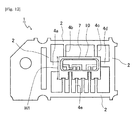
- Fig. 12 shows the state midway through the manufacture of the light emitting device discussed in Patent Document 1.
- a package 7 has leads 4b and 4c provided to the top face 10 of the package, leads 4a and 4d provided to the side faces of the package 7, and leads 4e; provided to the bottom face of the package.
- the ends of the leads 4a to 4d are embedded in the package 7, thereby supporting the package 7.
- the leads 4e are cut and bent at the broken line portions in the drawing, and are portions that serve as outer lead electrodes. Cutting the leads 4e at the broken line portions results in a state in which the package 7 is supported by the leads 4a to 4d. The leads 4e are subjected to bending in this state. After this, the now-unnecessary leads 4a to 4d are removed from the package to obtain a light emitting device. However, depending on the conditions under which the package is formed, the package molding material may flow along the leads 4a to 4d and form flash when the leads 4a to 4d are removed. Consequently, the external size of the package 7 ends up being larger than the designed dimensions, albeit only partially.
- the thickness H1 of the package must be reduced, so such flash is undesirable on the top face. Flash that does occur can be taken off by cutting in a subsequent step, for example, but this adds another step and adversely affects production efficiency. Furthermore, since this flash is not always formed in the same size, its removal is difficult to manage with a computer program or the like, so it is not suited to mass production.
- the leads that support the package (hereinafter referred to as support leads) are usually disposed where any flash that should occur will have little effect, that is, only on the side faces of the package.
- outer lead electrodes are extended from the side face-side of the bottom face of the package, and concave components are provided that can accommodate the outer lead electrodes. This does minimize the increase in thickness of the light emitting device attributable to the thickness of the lead frame, but there is a corresponding decrease in the thickness of the side faces of the package.
- the support leads In the manufacturing process, the support leads must be wide enough for the package to the stably supported by the lead frame. However, if the above-mentioned light emitting device is made smaller with its shape left unchanged, the package side faces also become thinner, so the support leads embedded therein become finer.
- a mounting defect known as the Manhattan phenomenon may occur, in which a difference in surface tension when the solder melts, or shrinkage stress when the solder solidifies, or the like results in the outer lead electrode on one side being fixed in a state of being lifted up.
- a light emitting device comprises; a package equipped on a front face with a window for installing a light emitting element, and outer lead electrodes that protrude from a bottom face of the package, the package having, on the bottom face, two side face convex components provided on the side faces side and a center convex component provided at a center, the outer lead electrodes being housed in a concave components defined by the side face convex components and the center convex component, the side face convex component having groove provided on the side face.
- the package has at least two cut-outs, and the outer lead electrodes are disposed directly under the two cut-outs, respectively.
- the thickness of the side face convex components and the center convex component is substantially the same as the thickness of the outer lead electrodes.
- the thickness of the package is no more than 1.5 mm.
- the light emitting device of the present invention a thinner and smaller light emitting device with which a package can be stably supported in the manufacturing process can be provided. Also, with the light emitting device of the present invention, mounting defects can be minimized in the mounting of the light emitting device to a substrate or the like.
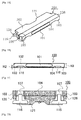
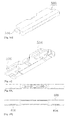
- a light emitting device 100 of the present invention has a package 102 equipped on its front face with a window 101 for installing a light emitting element, and outer lead electrodes 116 that protrude from the bottom face of the package 102.
- the package 102 has on its bottom face two side face convex components 103 and a center convex component 104.
- the outer lead electrodes 116 are bent and housed in the concave components 107 formed by the side face convex components 103 and the center convex component 104.
- Grooves 106 are provided on the side faces of the side face convex components 103.
- the grooves 106 are portions where the support leads are embedded up until the completion of the bending of the outer lead electrodes 116 in the light emitting device manufacturing process.
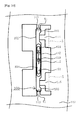
- support leads 113 are embedded in the side faces of the side face convex components 103 and the side faces of the package 102.
- the portions where the support leads 113 were embedded become grooves.
- These portions that become grooves lie in substantially the same plane as an inner lead electrode 834 disposed inside the package 102, and the width W2 of the grooves (shown in Fig. 1D ) is substantially the same as the thickness of the inner lead electrode 834.
- the side face convex components 103 are provide on the side face 126 side of the bottom face of the package.
- the result of this configuration is that there can be grooves 106 not only on the side faces 126 of the package, but also on the side faces of the side face convex components 103, and as shown in Fig. 10 , the width W1 of the support leads 113 does not have to be reduced with this layout.
- the side face convex components 103 minimize mounting defects.
- the weight of the light emitting device increases and gravity comes into play as a result of the side face convex component 103 being provided to the side face on the lifted up side prior to the outer lead electrode 116 on one side being soldered in place in a lifted up state. Consequently, lifting up of the outer lead electrodes is suppressed. This allows mounting defects to be minimized.
- the lifting up of the outer lead electrodes can be further suppressed if side face convex components 803 are provided contiguously from the end on the front face side to the end on the back face side. Also, as shown in Fig.
- convex components are provided so as to cover the outer lead electrodes as viewed from the side face side, then even if some kind of force should be exerted from the side face side of the light emitting device, problems such as the outer lead electrodes being pushed and bent can be avoided.
- the convex components that protect the outer lead electrodes may be provided integrally with the side face convex components 103 (see the side face convex components 803 in Fig. 8H ), or may be provided separately. In this case, at least one of them functions as a side face convex component, and the other convex component serves to protect the outer lead electrodes.
- the width W3 of the side faces of the side face convex components 103 is preferably greater than the thickness of the lead electrodes, the effect of which is that the light emitting device can be installed stably when mounted on a substrate or the like.
- the width W4 of the side face convex components 103 as seen from the front face of the package is preferably greater than the depth W5 of the grooves 106. This is because the grooves 106 are the portions where the support leads are embedded, so the package can be securely supported by the lead frame.
- the side faces of the side face convex components 103 need not be in the same plane as the side faces 126 of the package. Specifically, the side faces of the side face convex components 103 may be formed so that they stick out from the side faces 126 of the package 102, or so that they are recessed.
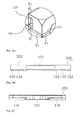
- the side face convex components 103 in Fig. 1B have a trapezoidal shape in plan view, but may instead have some other shape, so long as the grooves 106 can still be formed. Also, with the present invention, the side face convex components 103 each preferably have approximately the same thickness H2.
- the phrase "have approximately the same thickness” here means that the thickness is substantially the same, and a height difference of from 0 to 0.05 mm is permitted. A configuration such as this allows the light emitting device to be installed stably on a mounting substrate or the like.
- the center convex component 104 is formed in the center of the light emitting device 100 as seen in a front view.
- the window 101 is formed in the center convex component 104.
- the bottom face of the center convex component 104 may be formed flat, or it may have an uneven structure.
- the side face convex components 103 and the center convex component 104 refer to portions that stick out from a reference face, using the bottom face of the package where the outer lead electrodes 116 protrude as this reference face.
- the side face convex components and the center convex component are indicated by the shaded regions in Figs. 1B and 1C .
- the thickness H2 of the side face convex components 103 and the center convex component 104 is substantially the same as the thickness of the outer lead electrodes 116 in order to improve electrical connection between the mounting substrate and the light emitting device.
- the thickness is substantially the same.
- the phrase "the thickness is substantially the same” means that there is substantially to height difference between part of the surface of the outer lead electrodes and the side face convex components 103 and the center convex component 104 on the bottom face of the package. Nevertheless, a height difference of 0 to 0.05 mm is permitted.
- the concave components 107 are formed by being sandwiched between the side face convex components 103 and the center convex component 104.
- the concave components 107 house the outer lead electrodes 116 that are bent along the bottom face of the package. This allows the outer lead electrodes to be disposed on the package bottom face while reducing the overall thickness of the light emitting device.
- two cut-outs 230 are formed in the package, and the bent outer lead electrodes 116 are preferably disposed directly under these two cut-outs 230.
- the outer lead electrodes 116 are exposed by the cut-outs 230 as viewed from the top face. This makes it possible to check where the outer lead electrodes are disposed. Also, since the outer lead electrodes 116 can be checked from the top face, it is possible to check the mounting state on the substrate when the light emitting device is mounted on a mounting substrate.
- a cut-out may be formed in the back face of the package in addition to the cut-outs 230.
- This cut-out can be formed, for example, at the place where the package molding material is poured in (hereinafter referred to as a gate). This keeps the gate from sticking out beyond the outermost part of the back face of the package.
- the package 102 of the present invention has the above-mentioned side face convex components 103, the center convex component 104. and the grooves 106.
- the front face of the package 102 is further equipped with the window 101 for installing the light emitting element, serves as a support that fixes and supports the outer lead electrodes 116, etc., protruding from the bottom face of the package 102, and also has the function of protecting the light emitting element from the external environment.
- thermoplastic resin there are no particular restrictions on the package molding material used in the present invention, but a liquid crystal polymer, a polyphthalamide resin, a polybutylene terephthalate (PBT), or any other known thermoplastic resin can be used.
- Known thermosetting resins can also be used.
- a semicrystalline polymer resin containing high-melting point crystals, such as a polyphthalamide resin is used, the resulting package will have high surface energy and good adhesion to the sealing member (discussed below) that fills the inside of the window of the package. This prevents separation at the interface between the package and the sealing member in the cooling step in the course of adding and curing the sealing member.
- a white pigment such as titanium oxide may be mixed into the package molding material, or the package may be left translucent without mixing in a white pigment, so that the resulting light emitting device has broad light distribution.
- the window 101 for installing the light emitting element 118 is formed on the front face of the package 102.
- the shape of this window may be circular, elliptical, triangular, quadrangular, a shape similar to these, etc.
- the inner walls of the window are preferably inclined. This allows light from the light emitting element to be reflected by the inner walls of the window, and be taken out in the front face direction more efficiently.
- the depth of the window 101 can be suitably adjusted according to the number of light emitting elements to be installed, the bonding method, and so forth.
- the size of the window 101 is preferably larger, so as to obtain a broader light distribution.
- the bottom face and/or inner walls of the window 101 are preferably embossed, subjected to plasma treatment, etc., to increase the contact surface area and improve adhesion with the sealing member discussed below.
- the front face may be formed in a single plane as shown in Fig. 4A , or it may have stepped portions as shown in Fig. 1A .
- projections 332 can also be provided to the bottom face of the window. Providing these projections 332 keeps a bonding member (not shown) from leaking out to the wire bonding area when a light emitting element 318 is bonded via this bonding member.
- the thickness H3 of the package refers to the distance from the upper face of the package to the bottom face of the side face convex components 103 of the package, and in the present invention thinner is better for the purpose of achieving a thinner product.
- the thickness H3 in the present invention is preferably no more than 1.5 mm.
- the top and bottom faces of a package 202 can be formed so that the thickness decreases from the front face side toward the back face side.
- a gate 234 that leads to the back face of the package can also be formed on the bottom face of the package 202. With this constitution, the gate diameter can be increased, and a light emitting device 200 that is compact, has less flash, and is suited to mass production can be obtained.
- the lead electrodes consist of the inner lead electrode 834 disposed inside the package 102, and portions that become the outer lead electrodes 116 when cut off from a lead frame 117 at a later.
- the material of the lead electrodes there are no particular restrictions on the material of the lead electrodes as long as it is electroconductive, but it needs to have electrical conductivity and adhesion with the conductive wires and so forth that are the members electrically connected with the light emitting element.
- a specific electrical resistance is 300 ⁇ cm or less.
- materials that satisfy these requirements are iron, copper, iron-containing copper, tin-containing copper, and aluminum, iron, copper, or the like that has been plated with copper, gold, silver, or palladium.
- the gloss of the plated surface is preferably between 0.2 and 2.0 from the standpoints of light take-off efficiency and manufacturing cost.
- the plating thickness is preferably 0.5 to 10 ⁇ m.
- the outer lead electrodes 116 are provided to supply electricity from the outside to the light emitting element 118 installed in the window 101. With the present invention, the outer lead electrodes 116 stick out from the bottom face of the package 102, and are bent along the bottom face of the package and housed in the concave components 107.
- the outer lead electrodes 116 can be such that their distal ends branch in two parts.
- the mode can be such that the two distal ends extend in opposite directions from each other, with one distal end extending toward the side face 126 of the package.
- the surface area of the outer lead electrodes 116 can be enlarged, and outer lead electrodes with good heat diffusion can be obtained even with a thinner package.
- the mode can also be such that outer lead electrodes 616 have distal ends that branch in three parts.
- the width W6 and the width W7 of the outer lead electrodes can be varied as appropriate, such as having them be substantially the same.
- the outer lead electrodes are preferably disposed so that they stick out beyond the widest portion of the package. If the outer lead electrodes are disposed so that they do not stick out beyond the side faces 326 on the back face side of the package, this prevents external force from being exerted on the outer lead electrodes during the mounting of the light emitting device or during the shipping of the light emitting device, so deformation of the outer lead electrodes can be prevented. If the outer lead electrodes 316 are disposed so that they do not stick out beyond the side faces on the back face side of the package, it is preferable to provide cut-outs 330 (see Fig. 3C ) in the back face of the package as discussed above. This makes it possible to check where the outer lead electrodes 316 are disposed, and also allows connections during mounting to be checked from the top face.
- Inner lead electrodes 834 are disposed on the inside of the package 102, and are provided in order to supply the light emitting element with electricity obtained from the outside by the outer lead electrodes 116.
- the light emitting element 118 installed in the window 101 may be any element so long as it is called the light emitting diode and is formed from any semiconductor material.
- the element include one that have the laminated structure containing an active layer and may be formed from various semiconductor such as nitride semiconductor, InN, AlN, GaN InGaN, AlGaN, InGaAlN and the like; group III-V compound semiconductor, and group I-VI compound semiconductor on a substrate.
- the light emitting element 118 may consist of just one element or a plurality of elements. In the latter case, a plurality of light emitting elements that emit the same color of light may be combined in order to improve luminosity. Also, color reproducibility can be improved by combining a plurality of light emitting elements that emit different colors of light in order to accommodate RGB.
- these light emitting elements are fixed by a bonding member (not shown) to the surface of the inner lead electrodes 834 or the bottom face of the window 101 of the package 102.
- the bonding member can be an epoxy resin, a silicone resin, or the like in the case of a light emitting element formed by growing a nitride semiconductor on an insulating substrate (such as a sapphire substrate).
- the rear face of the light emitting element may be plated with aluminum, and a conductive paste, a low-melting point metal or other such brazing material, an Au-Sn eutectic material or other such solder, or the like may be used.
- a light emitting element in which electrodes are formed on both sides, such as with a light emitting element comprising a conductive substrate (such as GaAs) and emitting red light, the element is fixed by silver, gold, palladium, or another such conductive paste.
- a conductive substrate such as GaAs
- conductive wires 112 electrically connect the inner lead electrode 834 with the positive and negative electrodes of the light emitting element 118.
- the conductive wires 112 need to have good thermal conductivity, electrical conductivity, mechanical connectability, and ohmic properties with the electrodes of the light emitting element.
- a thermal conductivity is preferably at least 0.01 cal/(s)(cm 2 )(°C/cm), and more preferably at least 0.5 cal/(s)(cm 2 )(°C/cm).
- the diameter of the conductive wires is preferably 10 ⁇ m or more, and 45 ⁇ m or less, and more preferably 25 ⁇ m or more, from the standpoints of ease of handling and ensuring adequate light emitting surface area for the light emitting element, no more than 35 ⁇ m is still more preferable.
- Specific examples of such conductive wires include those made of gold, copper, platinum, aluminum, and other such metals, and alloys thereof.
- the window 101 may be sealed by a sealing member.
- This sealing member protects the light emitting element 118 and the conductive wire 112 from the external environment.
- the light emitting element 118 and the conductive wires 112 are covered by the sealing member by curing the material of the sealing member that has filled the inside of the window 101 of the package so as to cover the light emitting element 118 and the conductive wires 112.
- the sealing member is not limited to being an organic material, and can also be glass, silica gel, or another such inorganic material with excellent light resistance.
- thickeners, light diffusers, pigments, fluorescent substances, and the like can be added to the sealing member of the present invention as dictated by the application. Examples of light diffusers include barium titanate, titanium oxide, aluminum oxide, silicon dioxide, calcium carbonate, and mixtures containing one or more of these.
- the sealing member can also be given a lens effect by putting its light emission face into the desired shape. More specifically, this face can have a convex or concave lens shape, or it can have an elliptical shape as seen from the emitted light observation face, or a plurality of these shapes may be combined.
- the sealing member used in the light emitting device of the present invention can also contain a fluorescent substance that changes the wavelength of the light from the light emitting element.
- a fluorescent substance that contains one of the following rare earth elements.
- examples include garnet type fluorescent materials having at least one element selected from a group consisting of Y, Lu, Sc, La, Gd, Tb and Sm, and at least one element selected from a group consisting of Al, Ga, and In.
- an aluminum-garnet-based fluorescent material contains Al and at least one element selected from a group consisting of Y, Lu, Sc, La, Gd, Tb, Eu, Ga, In and Sm, and is activated by at least one element selected from among the rare earth elements, and is a fluorescent material that emits light when excited by UV rays or visible light emitted from the light emitting element.
- yttrium-aluminum oxide-based fluorescent material YAG fluorescent material
- Tb 2.95 Ce 0.05 AlO 5 O 12 Y 2.90 Ce 0 . 05 Tb 0 . 05 Al 5 O 12
- Y 2.94 Ce 0.05 Pr 0.01 Al 5 O 12 Y 2.90 Ce 0.05 Pra 0.05 Al 5 O 12 .
- the use of two or more kinds of yttrium-aluminum oxide-based fluorescent material with different compositions, containing yttrium, and activated by cerium or praseodymium is particularly favorable for the purposes of the present invention.
- a nitride-based fluorescent material is one that contains nitrogen, also contains at least one element selected from a group consisting of Be, Mg, Ca, Sr, Ba and Zn, and at least one element selected from a group consisting of C, Si, Ge, Sn, Ti, Zr and Hf, and is activated by at least one element selected from among the rare earth elements.
- the nitride-based fluorescent include (Sr 0.97 Eu 0.03 ) 2 Si 5 N 8 , (Ca 0.985 Eu 0.015 ) 2 Si 5 N 8 , (Sr 0.679 Ca 0.291 Eu 0.03 ) 2 Si 5 N 8 and the like.
- a method for manufacturing the light emitting device of the present invention will now be described through reference to Figs. 9A to 9D .
- a piece of sheet metal is punched out, and the surface thereof is metal plated, which forms a lead frame (not shown) having inner lead electrodes, support leads and a portion that later becomes the outer lead electrodes.
- the inner lead electrodes 834, the support leads 856, and the portion that later becomes the outer lead electrodes are placed between metal molds 846 and 848 for molding a package and which are split into upper and lower parts.
- the support leads 856 and the inner lead electrodes 834 that are placed inside the package here are positioned so as to be disposed in a cavity 862 between the molds 846 and 848 that have the shape of the package 102, and are sandwiched between the molds 846 and 848.
- the ends of the support leads 856 remain embedded in the side faces of the package 102 until the package is removed.
- the upper mold 846 has a protrusion 866 for forming a window in the package, and concave components (not shown) corresponding to the center convex component 104 and the side face convex components 103 formed on the bottom face of the package in a subsequent step.
- the lower mold 848 is provided with a material pouring gate 864 and concave components (not shown) corresponding to the center convex component 104 and the side face convex components 103 formed on the bottom face of the package in a subsequent step.
- a molding material 868 is poured into the cavity 862 between the molds 846 and 848 from the material pouring gate 864 of the lower mold 848.
- the molding material 868 is cured, and as shown in Fig. 2D , first the lower mold 848 is removed, and then the upper mold 846 is removed.
- the molded package 102 has the side face convex components 1.03 on its bottom face, and is equipped with the inner lead electrode 834 exposed on the inside of the window 101.
- the inner lead electrode 834 is linked to the portion that becomes the outer lead electrodes 116 at a later by cutting from the lead frame.
- the support leads 113 are embedded in the side faces of the package 102 and in the side faces of the side face convex components 103. In this state, the package 102 is supported on the lead frame 11'7 by the support leads 113 and the portion that sticks out from the bottom face of the package, and later becomes the outer lead electrodes 116.
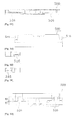
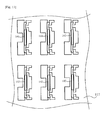
- Fig. 10 just one package 102 was used in the description, but as shown in Fig. 11 , usually there are numerous packages 102. 102.... (in this drawling, three vertically and two horizontally, for a total of six) formed on a single lead frame 117.
- molds 846 and 848 having numerous package cavities 862 are used, and molding material is poured in simultaneously through these cavities 862, which allows all the packages 102, 102.... to be formed at the same time.
- a method for manufacturing the light emitting device 100 using the package 102 obtained in the above manufacturing method will now be described through reference to Figs. 10 and 11 .
- the positive and negative electrodes of the light emitting element 118, and the inner lead electrode 834 disposed inside the package are electrically connected to each other by the conductive wires 112.
- the window 101 of the package 102 is filled with a sealing member to seal the light emitting element 118 and the conductive wires 112.
- the lead frame 117 is then cut away at the positions marked by the dotted lines X in Fig. 10 , resulting in a state in which the package 102 is supported by the support leads 113.
- the portions that have become the outer lead electrodes 116 after this cutting are bent along the bottom face of the package 102.
- the outer lead electrodes 116 may be further bent along the side faces 126.
- a plurality of packages 102 is formed on a single lead frame 117, then the bending of the outer lead electrodes can be performed simultaneously for the plurality of packages 102, which improves the manufacturing efficiency of the light emitting device.
- the package 102 is removed from the support leads 1.3 to obtain the light emitting device 100 shown in Fig. 1 .
- the light emitting device 100 of the present invention has a package 102 equipped on its front face with a window 101 for installing a light emitting element, and outer lead electrodes 116 that protrude from the bottom face of the package 102.
- the package 102 has on its bottom face two side face convex components 103 and a center convex component 104.
- the outer lead electrodes 116 are housed in the concave components 107 formed by the side face convex components 103 and the center convex component 104.
- Grooves 106 are provided on the side faces of the side face convex components 103.
- a lead frame is formed in which the surface of a piece of sheet metal composed of iron-containing copper with a thickness of 0.11 mm is plated with silver.
- the lead frame thus obtained is placed in a metal mold, a polyphthalamide molding material is poured in and cured, and the mold is removed.
- the package-attached lead frame formed in this series of steps is such that, as shown in Fig. 10 , the support leads 113 are embedded in the side faces of the package 102 and in the side faces of the side face convex components 103, which allows the package to be stably supported up until the completion of the bending step.
- the light emitting element 118 composed of a nitride semiconductor is bonded and fixed with an epoxy resin to the inner lead electrode 834 exposed on the inside of the window 101 of the package 102 formed as above.
- the electrodes of the fixed light emitting element and the inner lead electrodes 834 disposed inside the window of the package 102 are connected to each other with the conductive wires 112, whose main material is gold.
- the window 101 of the package 102 is filled with a sealing member obtained by adding a diffusing agent to a silicone resin, and the sealing member is cured.
- the portions that will become the outer lead electrodes 116 are then cut away from the lead frame 117, bent along the bottom face of the package in the direction of the back face 121, and housed in the concave components 107.
- the distal ends of the outer lead electrodes 116 are branched in two parts and extend in mutually opposing directions, and one end extends toward the side face 126 of the package 102.
- the support leads embedded in the side faces 126 of the package 102 are removed, which separates the light emitting device 100 from the lead frame.
- grooves 106 are formed in the side face convex components 103 and the side faces 126 of the package.
- the light emitting device 100 formed in this manner has the grooves 106 in the side faces of the side face convex components 103, and the outer lead electrodes 116 are housed in the concave components 107, which allows the package fixed to the lead frame to be stably supported in the manufacturing process, and allows mounting defects to be reduced in mounting to a substrate or the like.
- Figs. 2A to 2I show an Example of the light emitting device 200 of the present invention.
- the top face and bottom face are formed so that the thickness decreases from the front face side toward the back face side.
- a gate 234 is formed on the bottom face of the package so as to lead to the back face of the package. Consequently, the gate diameter can be larger, molten resin can be supplied into the mold at a lower mold internal pressure, and moldability is better, so a light emitting device 200 that has less flash, is compact, and is well suited to mass production can be realized.
- the same effect is obtained as with the light emitting device in Example 1 above.
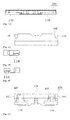
- Figs. 3A to 3I show an Example of the light emitting device 300 of the present invention.
- the outer lead electrodes 316 of the light emitting device of Example 3 are housed in concave components 307 on the bottom face of the package so that they do not stick out from the side faces 326 of the package.
- the light emitting device of Example 3 has cut-outs 330 on the back face of the package, and the outer lead electrodes 316 are disposed directly under these cut-outs 330. Consequently, the places where the outer lead electrodes 316 are disposed can be checked from the top face direction.
- protrusions 332 on the bottom face of the window. Providing these protrusions 332 keeps a bonding member (not shown) from leaking out to the wire bonding area when the light emitting element 318 is bonded via this bonding member. According to the light emitting device 300 of Example 3, the same effect is obtained as with the light emitting device in Example 1 above.
- Figs. 4A to 4I show an Example of the light emitting device 400 of the present invention.
- the light emitting device of Example 4 is such that concave components 407 are not provided up to the front face. According to the light emitting device 400 of Example 4, the same effect is obtained as with the light emitting device in Example 1 above.
- Figs. 5A to 5I show an Example of the light emitting device 500 of the present invention.
- the width W6 and the width W7 are formed are formed to be substantially the same. According to the light emitting device 500 of Example 5, the same effect is obtained as with the light emitting device in Example 1 above.
- Figs. 6A to 6I show an Example of the light emitting device 600 of the present invention. As shown in Fig. 6H , with the outer lead electrodes 616, the distal ends are branched in three parts. According to the light emitting device 600 of Example 6, the same effect is obtained as with the light emitting device in Example 1 above.
- Figs. 7A to 7H show an Example of the light emitting device 700 of the present invention.
- the side face convex components 703 of the package are rectangular in shape as seen from the front face. According to the light emitting device 700 of Example 7, the same effect is obtained as with the light emitting device in Example 1 above.
- Figs. 8A to 8I show an Example of the light emitting device 800 of the present invention.
- the side face convex components 803 on the side faces of the package are provided from the end of the package on the front face side to the end on the back face side, and outer lead electrodes 816 that are bent along the bottom face are housed in concave components 807.
- the outer lead electrodes 816 are formed so that they do not stick out from the package side faces when viewed from the top face and from the bottom face. Also, in this example, as shown in Figs.
- the outer lead electrodes 816 arc formed so that more than half of each one is covered by the side face convex components 803 on the back face side of the package (see Fig. 8H ) in side face view.
- the result of this constitution is that if some force should be applied in the side face direction, it will be less likely that problems will occur, such as the outer lead electrodes 816 being pushed and bent.
- the same effect is obtained as with the light emitting device in Example 1 above due to the side face convex components 803.
- the present invention can be utilized as a light source that is used in liquid crystal display backlights, panel gauges, display lights, portable electronic devices, and so forth.
Landscapes
- Led Device Packages (AREA)
Applications Claiming Priority (3)
| Application Number | Priority Date | Filing Date | Title |
|---|---|---|---|
| JP2008029267 | 2008-02-08 | ||
| JP2008225506 | 2008-09-03 | ||
| PCT/JP2009/051238 WO2009098967A1 (ja) | 2008-02-08 | 2009-01-27 | 発光装置 |
Publications (3)
| Publication Number | Publication Date |
|---|---|
| EP2244310A1 true EP2244310A1 (de) | 2010-10-27 |
| EP2244310A4 EP2244310A4 (de) | 2013-06-12 |
| EP2244310B1 EP2244310B1 (de) | 2016-06-29 |
Family
ID=40952045
Family Applications (1)
| Application Number | Title | Priority Date | Filing Date |
|---|---|---|---|
| EP09708602.9A Active EP2244310B1 (de) | 2008-02-08 | 2009-01-27 | Lichtemittierende vorrichtung |
Country Status (8)
| Country | Link |
|---|---|
| US (3) | US8314442B2 (de) |
| EP (1) | EP2244310B1 (de) |
| JP (1) | JP5333237B2 (de) |
| KR (1) | KR101635650B1 (de) |
| CN (1) | CN101939858B (de) |
| AU (1) | AU2009211784B2 (de) |
| TW (1) | TWI484666B (de) |
| WO (1) | WO2009098967A1 (de) |
Cited By (1)
| Publication number | Priority date | Publication date | Assignee | Title |
|---|---|---|---|---|
| EP3200249A1 (de) * | 2016-01-28 | 2017-08-02 | LG Innotek Co., Ltd. | Lichtemittierende vorrichtungsverpackung |
Families Citing this family (16)
| Publication number | Priority date | Publication date | Assignee | Title |
|---|---|---|---|---|
| US7697827B2 (en) | 2005-10-17 | 2010-04-13 | Konicek Jeffrey C | User-friendlier interfaces for a camera |
| TWD139992S1 (zh) * | 2009-03-13 | 2011-04-11 | 日亞化學工業股份有限公司 | 發光二極體 |
| JP5251788B2 (ja) * | 2009-08-25 | 2013-07-31 | 豊田合成株式会社 | サイドビュータイプの発光装置及びその製造方法 |
| JP2011066302A (ja) * | 2009-09-18 | 2011-03-31 | Showa Denko Kk | 半導体発光装置およびその製造方法 |
| KR101049488B1 (ko) | 2010-06-28 | 2011-07-15 | 주식회사 루멘스 | 측면 발광형 발광소자 패키지 및 백라이트 모듈 |
| KR101725221B1 (ko) * | 2011-01-20 | 2017-04-11 | 삼성전자 주식회사 | 발광 다이오드 패키지용 몰드 구조체 |
| CN103460416B (zh) * | 2011-02-10 | 2016-11-09 | 日亚化学工业株式会社 | 发光装置、发光装置的制造方法及封装阵列 |
| JP6395045B2 (ja) | 2014-11-18 | 2018-09-26 | 日亜化学工業株式会社 | 複合基板並びに発光装置及びその製造方法 |
| DE102014118349B4 (de) * | 2014-12-10 | 2023-07-20 | OSRAM Opto Semiconductors Gesellschaft mit beschränkter Haftung | Halbleiterbauelement und Verfahren zur Herstellung einer Mehrzahl von Halbleiterbauelementen |
| JP7065381B2 (ja) * | 2016-07-19 | 2022-05-12 | パナソニックIpマネジメント株式会社 | 光反射体、ベース体、発光装置及びベース体の製造方法 |
| JP6465160B2 (ja) * | 2016-08-03 | 2019-02-06 | 日亜化学工業株式会社 | 複合基板および発光装置 |
| JP6354809B2 (ja) * | 2016-08-16 | 2018-07-11 | 日亜化学工業株式会社 | 発光装置の製造方法及び複合基板 |
| JP6583297B2 (ja) * | 2017-01-20 | 2019-10-02 | 日亜化学工業株式会社 | 発光装置用複合基板および発光装置の製造方法 |
| JP7057512B2 (ja) * | 2019-08-30 | 2022-04-20 | 日亜化学工業株式会社 | 発光装置 |
| JP7545030B2 (ja) * | 2020-08-21 | 2024-09-04 | 日亜化学工業株式会社 | 発光装置及び光源装置 |
| JP7460911B2 (ja) * | 2020-12-21 | 2024-04-03 | 日亜化学工業株式会社 | 発光装置及びそれを用いたディスプレイ |
Family Cites Families (31)
| Publication number | Priority date | Publication date | Assignee | Title |
|---|---|---|---|---|
| US194601A (en) * | 1877-08-28 | Improvement in tobacco-harvesters | ||
| US43879A (en) * | 1864-08-16 | Improvement in lamp-burners | ||
| US187709A (en) * | 1877-02-27 | Improvement in stump-extractors | ||
| US46242A (en) * | 1865-02-07 | Improved machine for pointing wires in the coil | ||
| US42844A (en) * | 1864-05-24 | Improved process of refining and softening lead | ||
| US120155A (en) * | 1871-10-24 | Improvement in machines for nailing shoe-soles | ||
| US277216A (en) * | 1883-05-08 | Horse-power and capstan | ||
| US247841A (en) * | 1881-10-04 | Art of attaching rubber to metal | ||
| JPH0621258Y2 (ja) * | 1987-04-07 | 1994-06-01 | 日本デンヨ−株式会社 | Ledランプ |
| JP3472450B2 (ja) * | 1997-09-04 | 2003-12-02 | シャープ株式会社 | 発光装置 |
| KR100378917B1 (ko) * | 1998-05-20 | 2003-04-07 | 로무 가부시키가이샤 | 반도체장치 |
| US6521916B2 (en) * | 1999-03-15 | 2003-02-18 | Gentex Corporation | Radiation emitter device having an encapsulant with different zones of thermal conductivity |
| US6685975B2 (en) | 2000-05-19 | 2004-02-03 | Biozyme Systems Inc. | Process for recovering bone and oil from animal byproducts |
| JP3891115B2 (ja) | 2001-04-17 | 2007-03-14 | 日亜化学工業株式会社 | 発光装置 |
| JP2006303548A (ja) * | 2001-04-17 | 2006-11-02 | Nichia Chem Ind Ltd | 発光装置 |
| JP2003078172A (ja) | 2001-09-03 | 2003-03-14 | Toyoda Gosei Co Ltd | Ledリードフレーム |
| US6812481B2 (en) * | 2001-09-03 | 2004-11-02 | Toyoda Gosei Co., Ltd. | LED device and manufacturing method thereof |
| USD497349S1 (en) * | 2001-11-21 | 2004-10-19 | Nichia Corporation | Light emitting diode |
| JP4239509B2 (ja) * | 2002-08-02 | 2009-03-18 | 日亜化学工業株式会社 | 発光ダイオード |
| TWI292961B (en) * | 2002-09-05 | 2008-01-21 | Nichia Corp | Semiconductor device and an optical device using the semiconductor device |
| JP4026659B2 (ja) * | 2002-09-05 | 2007-12-26 | 日亜化学工業株式会社 | 側面発光型発光装置 |
| TWI249864B (en) | 2003-03-20 | 2006-02-21 | Toyoda Gosei Kk | LED lamp |
| JP2005277374A (ja) | 2004-02-26 | 2005-10-06 | Toyoda Gosei Co Ltd | Iii族窒化物系化合物半導体発光素子及びその製造方法 |
| JP5081370B2 (ja) * | 2004-08-31 | 2012-11-28 | 日亜化学工業株式会社 | 発光装置 |
| JP4654639B2 (ja) * | 2004-09-09 | 2011-03-23 | 日亜化学工業株式会社 | 発光装置及びその製造方法 |
| JP4857791B2 (ja) | 2006-02-01 | 2012-01-18 | 日亜化学工業株式会社 | 半導体装置の製造方法 |
| JP5119621B2 (ja) * | 2006-04-21 | 2013-01-16 | 日亜化学工業株式会社 | 発光装置 |
| KR100735432B1 (ko) * | 2006-05-18 | 2007-07-04 | 삼성전기주식회사 | 발광소자 패키지 및 발광소자 패키지 어레이 |
| JP2008198807A (ja) * | 2007-02-14 | 2008-08-28 | Nichia Corp | 半導体装置 |
| JP5426091B2 (ja) | 2007-12-27 | 2014-02-26 | 豊田合成株式会社 | 発光装置 |
| JP4683053B2 (ja) * | 2008-01-28 | 2011-05-11 | 日亜化学工業株式会社 | 射出成形用金型及びこれによって成形される半導体パッケージ並びに半導体パッケージの製造方法 |
-
2009
- 2009-01-27 EP EP09708602.9A patent/EP2244310B1/de active Active
- 2009-01-27 CN CN200980104437.7A patent/CN101939858B/zh active Active
- 2009-01-27 JP JP2009552437A patent/JP5333237B2/ja active Active
- 2009-01-27 KR KR1020107019927A patent/KR101635650B1/ko active Active
- 2009-01-27 AU AU2009211784A patent/AU2009211784B2/en active Active
- 2009-01-27 US US12/866,383 patent/US8314442B2/en not_active Expired - Fee Related
- 2009-01-27 WO PCT/JP2009/051238 patent/WO2009098967A1/ja not_active Ceased
- 2009-02-05 TW TW098103616A patent/TWI484666B/zh active
-
2012
- 2012-10-31 US US13/665,362 patent/US8610164B2/en active Active
-
2013
- 2013-11-12 US US14/077,643 patent/US8847272B2/en active Active
Cited By (2)
| Publication number | Priority date | Publication date | Assignee | Title |
|---|---|---|---|---|
| EP3200249A1 (de) * | 2016-01-28 | 2017-08-02 | LG Innotek Co., Ltd. | Lichtemittierende vorrichtungsverpackung |
| US10608153B2 (en) | 2016-01-28 | 2020-03-31 | Lg Innotek Co., Ltd. | Light emitting device package and light emitting apparatus having the same |
Also Published As
| Publication number | Publication date |
|---|---|
| TWI484666B (zh) | 2015-05-11 |
| US20100314658A1 (en) | 2010-12-16 |
| EP2244310A4 (de) | 2013-06-12 |
| US8610164B2 (en) | 2013-12-17 |
| CN101939858A (zh) | 2011-01-05 |
| US20130056787A1 (en) | 2013-03-07 |
| AU2009211784B2 (en) | 2013-10-10 |
| KR20100115365A (ko) | 2010-10-27 |
| TW200940874A (en) | 2009-10-01 |
| JP5333237B2 (ja) | 2013-11-06 |
| WO2009098967A1 (ja) | 2009-08-13 |
| US8847272B2 (en) | 2014-09-30 |
| CN101939858B (zh) | 2013-02-13 |
| US8314442B2 (en) | 2012-11-20 |
| AU2009211784A1 (en) | 2009-08-13 |
| KR101635650B1 (ko) | 2016-07-01 |
| EP2244310B1 (de) | 2016-06-29 |
| US20140070262A1 (en) | 2014-03-13 |
| JPWO2009098967A1 (ja) | 2011-05-26 |
Similar Documents
| Publication | Publication Date | Title |
|---|---|---|
| EP2244310B1 (de) | Lichtemittierende vorrichtung | |
| EP2315263B1 (de) | Lichtemittierende vorrichtung | |
| EP2784833B1 (de) | Lichtemittierende Vorrichtung und Verfahren zu deren Herstellung | |
| TWI635629B (zh) | 發光裝置及其製造方法 | |
| CN104282674B (zh) | 发光装置 | |
| US8026533B2 (en) | Light emitting device and method of manufacturing the same | |
| US20060054913A1 (en) | Light emitting device and method of producing same | |
| CN102479910A (zh) | Led模块 | |
| CN102478172A (zh) | 照明装置 | |
| JP5034686B2 (ja) | 半導体装置 | |
| JP4059293B2 (ja) | 発光装置 | |
| JP6064396B2 (ja) | 発光装置 | |
| TWI680592B (zh) | 發光裝置 | |
| JPWO2008117737A1 (ja) | 発光装置 | |
| JP5233478B2 (ja) | 発光装置 | |
| JP2010129985A (ja) | 半導体装置 | |
| JP4026659B2 (ja) | 側面発光型発光装置 | |
| JP2004179430A (ja) | 半導体装置およびその製造方法 |
Legal Events
| Date | Code | Title | Description |
|---|---|---|---|
| PUAI | Public reference made under article 153(3) epc to a published international application that has entered the european phase |
Free format text: ORIGINAL CODE: 0009012 |
|
| 17P | Request for examination filed |
Effective date: 20100902 |
|
| AK | Designated contracting states |
Kind code of ref document: A1 Designated state(s): AT BE BG CH CY CZ DE DK EE ES FI FR GB GR HR HU IE IS IT LI LT LU LV MC MK MT NL NO PL PT RO SE SI SK TR |
|
| AX | Request for extension of the european patent |
Extension state: AL BA RS |
|
| DAX | Request for extension of the european patent (deleted) | ||
| A4 | Supplementary search report drawn up and despatched |
Effective date: 20130515 |
|
| RIC1 | Information provided on ipc code assigned before grant |
Ipc: H01L 33/00 20100101AFI20130508BHEP |
|
| REG | Reference to a national code |
Ref country code: DE Ref legal event code: R079 Ref document number: 602009039436 Country of ref document: DE Free format text: PREVIOUS MAIN CLASS: H01L0033000000 Ipc: H01L0033480000 |
|
| GRAP | Despatch of communication of intention to grant a patent |
Free format text: ORIGINAL CODE: EPIDOSNIGR1 |
|
| RIC1 | Information provided on ipc code assigned before grant |
Ipc: H01L 33/62 20100101ALI20151009BHEP Ipc: H01L 33/48 20100101AFI20151009BHEP |
|
| INTG | Intention to grant announced |
Effective date: 20151028 |
|
| GRAS | Grant fee paid |
Free format text: ORIGINAL CODE: EPIDOSNIGR3 |
|
| GRAJ | Information related to disapproval of communication of intention to grant by the applicant or resumption of examination proceedings by the epo deleted |
Free format text: ORIGINAL CODE: EPIDOSDIGR1 |
|
| GRAP | Despatch of communication of intention to grant a patent |
Free format text: ORIGINAL CODE: EPIDOSNIGR1 |
|
| GRAP | Despatch of communication of intention to grant a patent |
Free format text: ORIGINAL CODE: EPIDOSNIGR1 |
|
| GRAS | Grant fee paid |
Free format text: ORIGINAL CODE: EPIDOSNIGR3 |
|
| INTG | Intention to grant announced |
Effective date: 20160502 |
|
| GRAA | (expected) grant |
Free format text: ORIGINAL CODE: 0009210 |
|
| AK | Designated contracting states |
Kind code of ref document: B1 Designated state(s): AT BE BG CH CY CZ DE DK EE ES FI FR GB GR HR HU IE IS IT LI LT LU LV MC MK MT NL NO PL PT RO SE SI SK TR |
|
| REG | Reference to a national code |
Ref country code: GB Ref legal event code: FG4D |
|
| REG | Reference to a national code |
Ref country code: CH Ref legal event code: EP |
|
| REG | Reference to a national code |
Ref country code: AT Ref legal event code: REF Ref document number: 809712 Country of ref document: AT Kind code of ref document: T Effective date: 20160715 |
|
| REG | Reference to a national code |
Ref country code: IE Ref legal event code: FG4D |
|
| REG | Reference to a national code |
Ref country code: DE Ref legal event code: R096 Ref document number: 602009039436 Country of ref document: DE |
|
| REG | Reference to a national code |
Ref country code: LT Ref legal event code: MG4D |
|
| PG25 | Lapsed in a contracting state [announced via postgrant information from national office to epo] |
Ref country code: NO Free format text: LAPSE BECAUSE OF FAILURE TO SUBMIT A TRANSLATION OF THE DESCRIPTION OR TO PAY THE FEE WITHIN THE PRESCRIBED TIME-LIMIT Effective date: 20160929 Ref country code: FI Free format text: LAPSE BECAUSE OF FAILURE TO SUBMIT A TRANSLATION OF THE DESCRIPTION OR TO PAY THE FEE WITHIN THE PRESCRIBED TIME-LIMIT Effective date: 20160629 Ref country code: LT Free format text: LAPSE BECAUSE OF FAILURE TO SUBMIT A TRANSLATION OF THE DESCRIPTION OR TO PAY THE FEE WITHIN THE PRESCRIBED TIME-LIMIT Effective date: 20160629 |
|
| REG | Reference to a national code |
Ref country code: NL Ref legal event code: MP Effective date: 20160629 |
|
| PG25 | Lapsed in a contracting state [announced via postgrant information from national office to epo] |
Ref country code: HR Free format text: LAPSE BECAUSE OF FAILURE TO SUBMIT A TRANSLATION OF THE DESCRIPTION OR TO PAY THE FEE WITHIN THE PRESCRIBED TIME-LIMIT Effective date: 20160629 Ref country code: LV Free format text: LAPSE BECAUSE OF FAILURE TO SUBMIT A TRANSLATION OF THE DESCRIPTION OR TO PAY THE FEE WITHIN THE PRESCRIBED TIME-LIMIT Effective date: 20160629 Ref country code: GR Free format text: LAPSE BECAUSE OF FAILURE TO SUBMIT A TRANSLATION OF THE DESCRIPTION OR TO PAY THE FEE WITHIN THE PRESCRIBED TIME-LIMIT Effective date: 20160930 Ref country code: NL Free format text: LAPSE BECAUSE OF FAILURE TO SUBMIT A TRANSLATION OF THE DESCRIPTION OR TO PAY THE FEE WITHIN THE PRESCRIBED TIME-LIMIT Effective date: 20160629 Ref country code: SE Free format text: LAPSE BECAUSE OF FAILURE TO SUBMIT A TRANSLATION OF THE DESCRIPTION OR TO PAY THE FEE WITHIN THE PRESCRIBED TIME-LIMIT Effective date: 20160629 |
|
| REG | Reference to a national code |
Ref country code: FR Ref legal event code: PLFP Year of fee payment: 9 Ref country code: AT Ref legal event code: MK05 Ref document number: 809712 Country of ref document: AT Kind code of ref document: T Effective date: 20160629 |
|
| PG25 | Lapsed in a contracting state [announced via postgrant information from national office to epo] |
Ref country code: IT Free format text: LAPSE BECAUSE OF FAILURE TO SUBMIT A TRANSLATION OF THE DESCRIPTION OR TO PAY THE FEE WITHIN THE PRESCRIBED TIME-LIMIT Effective date: 20160629 Ref country code: EE Free format text: LAPSE BECAUSE OF FAILURE TO SUBMIT A TRANSLATION OF THE DESCRIPTION OR TO PAY THE FEE WITHIN THE PRESCRIBED TIME-LIMIT Effective date: 20160629 Ref country code: RO Free format text: LAPSE BECAUSE OF FAILURE TO SUBMIT A TRANSLATION OF THE DESCRIPTION OR TO PAY THE FEE WITHIN THE PRESCRIBED TIME-LIMIT Effective date: 20160629 Ref country code: IS Free format text: LAPSE BECAUSE OF FAILURE TO SUBMIT A TRANSLATION OF THE DESCRIPTION OR TO PAY THE FEE WITHIN THE PRESCRIBED TIME-LIMIT Effective date: 20161029 Ref country code: CZ Free format text: LAPSE BECAUSE OF FAILURE TO SUBMIT A TRANSLATION OF THE DESCRIPTION OR TO PAY THE FEE WITHIN THE PRESCRIBED TIME-LIMIT Effective date: 20160629 Ref country code: SK Free format text: LAPSE BECAUSE OF FAILURE TO SUBMIT A TRANSLATION OF THE DESCRIPTION OR TO PAY THE FEE WITHIN THE PRESCRIBED TIME-LIMIT Effective date: 20160629 |
|
| PG25 | Lapsed in a contracting state [announced via postgrant information from national office to epo] |
Ref country code: PL Free format text: LAPSE BECAUSE OF FAILURE TO SUBMIT A TRANSLATION OF THE DESCRIPTION OR TO PAY THE FEE WITHIN THE PRESCRIBED TIME-LIMIT Effective date: 20160629 Ref country code: BE Free format text: LAPSE BECAUSE OF FAILURE TO SUBMIT A TRANSLATION OF THE DESCRIPTION OR TO PAY THE FEE WITHIN THE PRESCRIBED TIME-LIMIT Effective date: 20160629 Ref country code: AT Free format text: LAPSE BECAUSE OF FAILURE TO SUBMIT A TRANSLATION OF THE DESCRIPTION OR TO PAY THE FEE WITHIN THE PRESCRIBED TIME-LIMIT Effective date: 20160629 Ref country code: ES Free format text: LAPSE BECAUSE OF FAILURE TO SUBMIT A TRANSLATION OF THE DESCRIPTION OR TO PAY THE FEE WITHIN THE PRESCRIBED TIME-LIMIT Effective date: 20160629 Ref country code: PT Free format text: LAPSE BECAUSE OF FAILURE TO SUBMIT A TRANSLATION OF THE DESCRIPTION OR TO PAY THE FEE WITHIN THE PRESCRIBED TIME-LIMIT Effective date: 20161031 |
|
| REG | Reference to a national code |
Ref country code: DE Ref legal event code: R097 Ref document number: 602009039436 Country of ref document: DE |
|
| PLBE | No opposition filed within time limit |
Free format text: ORIGINAL CODE: 0009261 |
|
| STAA | Information on the status of an ep patent application or granted ep patent |
Free format text: STATUS: NO OPPOSITION FILED WITHIN TIME LIMIT |
|
| PG25 | Lapsed in a contracting state [announced via postgrant information from national office to epo] |
Ref country code: DK Free format text: LAPSE BECAUSE OF FAILURE TO SUBMIT A TRANSLATION OF THE DESCRIPTION OR TO PAY THE FEE WITHIN THE PRESCRIBED TIME-LIMIT Effective date: 20160629 |
|
| 26N | No opposition filed |
Effective date: 20170330 |
|
| PG25 | Lapsed in a contracting state [announced via postgrant information from national office to epo] |
Ref country code: SI Free format text: LAPSE BECAUSE OF FAILURE TO SUBMIT A TRANSLATION OF THE DESCRIPTION OR TO PAY THE FEE WITHIN THE PRESCRIBED TIME-LIMIT Effective date: 20160629 Ref country code: BG Free format text: LAPSE BECAUSE OF FAILURE TO SUBMIT A TRANSLATION OF THE DESCRIPTION OR TO PAY THE FEE WITHIN THE PRESCRIBED TIME-LIMIT Effective date: 20160929 |
|
| REG | Reference to a national code |
Ref country code: CH Ref legal event code: PL |
|
| PG25 | Lapsed in a contracting state [announced via postgrant information from national office to epo] |
Ref country code: MC Free format text: LAPSE BECAUSE OF FAILURE TO SUBMIT A TRANSLATION OF THE DESCRIPTION OR TO PAY THE FEE WITHIN THE PRESCRIBED TIME-LIMIT Effective date: 20160629 |
|
| PG25 | Lapsed in a contracting state [announced via postgrant information from national office to epo] |
Ref country code: LI Free format text: LAPSE BECAUSE OF NON-PAYMENT OF DUE FEES Effective date: 20170131 Ref country code: CH Free format text: LAPSE BECAUSE OF NON-PAYMENT OF DUE FEES Effective date: 20170131 |
|
| REG | Reference to a national code |
Ref country code: IE Ref legal event code: MM4A |
|
| PG25 | Lapsed in a contracting state [announced via postgrant information from national office to epo] |
Ref country code: LU Free format text: LAPSE BECAUSE OF NON-PAYMENT OF DUE FEES Effective date: 20170127 |
|
| REG | Reference to a national code |
Ref country code: FR Ref legal event code: PLFP Year of fee payment: 10 |
|
| PG25 | Lapsed in a contracting state [announced via postgrant information from national office to epo] |
Ref country code: IE Free format text: LAPSE BECAUSE OF NON-PAYMENT OF DUE FEES Effective date: 20170127 |
|
| PG25 | Lapsed in a contracting state [announced via postgrant information from national office to epo] |
Ref country code: MT Free format text: LAPSE BECAUSE OF NON-PAYMENT OF DUE FEES Effective date: 20170127 |
|
| PG25 | Lapsed in a contracting state [announced via postgrant information from national office to epo] |
Ref country code: HU Free format text: LAPSE BECAUSE OF FAILURE TO SUBMIT A TRANSLATION OF THE DESCRIPTION OR TO PAY THE FEE WITHIN THE PRESCRIBED TIME-LIMIT; INVALID AB INITIO Effective date: 20090127 |
|
| PG25 | Lapsed in a contracting state [announced via postgrant information from national office to epo] |
Ref country code: CY Free format text: LAPSE BECAUSE OF NON-PAYMENT OF DUE FEES Effective date: 20160629 |
|
| PG25 | Lapsed in a contracting state [announced via postgrant information from national office to epo] |
Ref country code: MK Free format text: LAPSE BECAUSE OF FAILURE TO SUBMIT A TRANSLATION OF THE DESCRIPTION OR TO PAY THE FEE WITHIN THE PRESCRIBED TIME-LIMIT Effective date: 20160629 |
|
| PG25 | Lapsed in a contracting state [announced via postgrant information from national office to epo] |
Ref country code: TR Free format text: LAPSE BECAUSE OF FAILURE TO SUBMIT A TRANSLATION OF THE DESCRIPTION OR TO PAY THE FEE WITHIN THE PRESCRIBED TIME-LIMIT Effective date: 20160629 |
|
| REG | Reference to a national code |
Ref country code: DE Ref legal event code: R082 Ref document number: 602009039436 Country of ref document: DE Representative=s name: HL KEMPNER PATENTANWAELTE, SOLICITORS (ENGLAND, DE Ref country code: DE Ref legal event code: R082 Ref document number: 602009039436 Country of ref document: DE Representative=s name: HL KEMPNER PATENTANWALT, RECHTSANWALT, SOLICIT, DE Ref country code: DE Ref legal event code: R082 Ref document number: 602009039436 Country of ref document: DE Representative=s name: HL KEMPNER PARTG MBB, DE |
|
| P01 | Opt-out of the competence of the unified patent court (upc) registered |
Effective date: 20230522 |
|
| REG | Reference to a national code |
Ref country code: DE Ref legal event code: R079 Ref document number: 602009039436 Country of ref document: DE Free format text: PREVIOUS MAIN CLASS: H01L0033480000 Ipc: H10H0020850000 |
|
| PGFP | Annual fee paid to national office [announced via postgrant information from national office to epo] |
Ref country code: GB Payment date: 20251204 Year of fee payment: 18 |
|
| PGFP | Annual fee paid to national office [announced via postgrant information from national office to epo] |
Ref country code: FR Payment date: 20251128 Year of fee payment: 18 |
|
| PGFP | Annual fee paid to national office [announced via postgrant information from national office to epo] |
Ref country code: DE Payment date: 20251203 Year of fee payment: 18 |