EP2244447A2 - Méthode de communication entre appareils électroniques portables situés à moins d'une distance prédéterminée. - Google Patents
Méthode de communication entre appareils électroniques portables situés à moins d'une distance prédéterminée. Download PDFInfo
- Publication number
- EP2244447A2 EP2244447A2 EP10160920A EP10160920A EP2244447A2 EP 2244447 A2 EP2244447 A2 EP 2244447A2 EP 10160920 A EP10160920 A EP 10160920A EP 10160920 A EP10160920 A EP 10160920A EP 2244447 A2 EP2244447 A2 EP 2244447A2
- Authority
- EP
- European Patent Office
- Prior art keywords
- message
- communication
- electronic device
- electronic devices
- characterization
- Prior art date
- Legal status (The legal status is an assumption and is not a legal conclusion. Google has not performed a legal analysis and makes no representation as to the accuracy of the status listed.)
- Withdrawn
Links
Images


Classifications
-
- G—PHYSICS
- G08—SIGNALLING
- G08B—SIGNALLING SYSTEMS, e.g. PERSONAL CALLING SYSTEMS; ORDER TELEGRAPHS; ALARM SYSTEMS
- G08B21/00—Alarms responsive to a single specified undesired or abnormal condition and not otherwise provided for
- G08B21/02—Alarms for ensuring the safety of persons
- G08B21/0202—Child monitoring systems using a transmitter-receiver system carried by the parent and the child
- G08B21/0277—Communication between units on a local network, e.g. Bluetooth®, piconet, Zigbee®, Wireless Personal Area Networks [WPAN]
-
- H—ELECTRICITY
- H04—ELECTRIC COMMUNICATION TECHNIQUE
- H04W—WIRELESS COMMUNICATION NETWORKS
- H04W4/00—Services specially adapted for wireless communication networks; Facilities therefor
- H04W4/02—Services making use of location information
- H04W4/029—Location-based management or tracking services
-
- H—ELECTRICITY
- H04—ELECTRIC COMMUNICATION TECHNIQUE
- H04L—TRANSMISSION OF DIGITAL INFORMATION, e.g. TELEGRAPHIC COMMUNICATION
- H04L67/00—Network arrangements or protocols for supporting network services or applications
- H04L67/2866—Architectures; Arrangements
- H04L67/30—Profiles
- H04L67/306—User profiles
-
- H—ELECTRICITY
- H04—ELECTRIC COMMUNICATION TECHNIQUE
- H04L—TRANSMISSION OF DIGITAL INFORMATION, e.g. TELEGRAPHIC COMMUNICATION
- H04L67/00—Network arrangements or protocols for supporting network services or applications
- H04L67/50—Network services
- H04L67/52—Network services specially adapted for the location of the user terminal
-
- H—ELECTRICITY
- H04—ELECTRIC COMMUNICATION TECHNIQUE
- H04M—TELEPHONIC COMMUNICATION
- H04M1/00—Substation equipment, e.g. for use by subscribers
- H04M1/72—Mobile telephones; Cordless telephones, i.e. devices for establishing wireless links to base stations without route selection
- H04M1/724—User interfaces specially adapted for cordless or mobile telephones
- H04M1/72403—User interfaces specially adapted for cordless or mobile telephones with means for local support of applications that increase the functionality
- H04M1/72409—User interfaces specially adapted for cordless or mobile telephones with means for local support of applications that increase the functionality by interfacing with external accessories
- H04M1/72412—User interfaces specially adapted for cordless or mobile telephones with means for local support of applications that increase the functionality by interfacing with external accessories using two-way short-range wireless interfaces
-
- H—ELECTRICITY
- H04—ELECTRIC COMMUNICATION TECHNIQUE
- H04W—WIRELESS COMMUNICATION NETWORKS
- H04W4/00—Services specially adapted for wireless communication networks; Facilities therefor
- H04W4/02—Services making use of location information
-
- H—ELECTRICITY
- H04—ELECTRIC COMMUNICATION TECHNIQUE
- H04W—WIRELESS COMMUNICATION NETWORKS
- H04W4/00—Services specially adapted for wireless communication networks; Facilities therefor
- H04W4/02—Services making use of location information
- H04W4/023—Services making use of location information using mutual or relative location information between multiple location based services [LBS] targets or of distance thresholds
-
- G—PHYSICS
- G08—SIGNALLING
- G08B—SIGNALLING SYSTEMS, e.g. PERSONAL CALLING SYSTEMS; ORDER TELEGRAPHS; ALARM SYSTEMS
- G08B1/00—Systems for signalling characterised solely by the form of transmission of the signal
- G08B1/08—Systems for signalling characterised solely by the form of transmission of the signal using electric transmission ; transformation of alarm signals to electrical signals from a different medium, e.g. transmission of an electric alarm signal upon detection of an audible alarm signal
- G08B2001/085—Partner search devices
-
- H—ELECTRICITY
- H04—ELECTRIC COMMUNICATION TECHNIQUE
- H04L—TRANSMISSION OF DIGITAL INFORMATION, e.g. TELEGRAPHIC COMMUNICATION
- H04L51/00—User-to-user messaging in packet-switching networks, transmitted according to store-and-forward or real-time protocols, e.g. e-mail
- H04L51/58—Message adaptation for wireless communication
-
- H—ELECTRICITY
- H04—ELECTRIC COMMUNICATION TECHNIQUE
- H04M—TELEPHONIC COMMUNICATION
- H04M2250/00—Details of telephonic subscriber devices
- H04M2250/02—Details of telephonic subscriber devices including a Bluetooth® interface
-
- H—ELECTRICITY
- H04—ELECTRIC COMMUNICATION TECHNIQUE
- H04W—WIRELESS COMMUNICATION NETWORKS
- H04W8/00—Network data management
- H04W8/005—Discovery of network devices, e.g. terminals
Definitions
- the present invention relates to a method of communication among portable electronic devices located at less than a predetermined distance from one another.
- the present invention relates to a method as mentioned above in which the portable electronic devices have a short-distance wireless communication interface.
- the present invention also relates to a method of communication among portable electronic devices located at less than a predetermined distance from one another and connected to a GSM network of a telephone service provider.
- a first portable electronic device such as a cell phone, a notebook, a PDT, etc. equipped with an integrated circuit for transmitting and receiving information
- a second portable electronic device which is also equipped with a corresponding integrated circuit.
- the integrated circuit comprises a transceiver operating at a predetermined frequency and according to a predetermined communication protocol, such as a frequency of 2.4 GHz and a Bluetooth® protocol.
- two or more portable electronic devices as mentioned above share a communication channel through which they may transmit and receive even in high-interference environments at a data rate of about 1 Mbps, even with low powers, in the milliwatt range.
- portable electronic devices may communicate with a different communication protocol, such as the Zigbee® protocol.
- One drawback of the above methods is that they cannot select the portable electronic devices of a friend or a known person, with which communication , e.g. via phone, SMS or chat, is desired.
- the invention is based on the technical problem of providing a method of communication that can automatically recognize, among a plurality of portable electronic devices located at less than a predetermined distance from one another, the devices associated with users that might want to communicate, thereby solving the technical problems that still affect prior art communication methods.
- the solution suggested by the present invention is to store a characterization profile of a user in a portable electronic device, which profile comprises distinctive features of the user and distinctive features of people with whom such user wants to communicate, transmit the characterization profile among devices placed at less than a predetermined distance from one another and select, among the received characterization profiles, those that correspond to the desired descriptive features.
- the suggested solution consists in storing the characterization profile in a memory of the device and transmitting the profile to a plurality of portable electronic devices connected thereto by a wireless connection and having respective characterization profiles, comparing the received characterization profile with the stored characterization profile in the receiving devices and only displaying connections to portable electronic devices having a selected characterization profile on a display of the device.
- a method of communication among portable electronic devices located at less than a predetermined distance, each comprising a characterization profile of a user including the steps of: - sending a broadcast message at a preset frequency from a first electronic device, which message comprises a device ID and the characterization profile of its user; - receiving the broadcast message in a second electronic device and comparing the characterization profile of the broadcast message with the characterization profile of the second electronic device, and providing an affinity value of the characterization profiles; - establishing communication between respective users of the electronic devices if the affinity value exceeds a predetermined threshold.
- the broadcast message is sent to all the portable electronic devices located at less than the predetermined distance and does not indicate a receiver device.
- the communication method that is carried out in a plurality of portable electronic devices located in a predetermined geographical area and at less than the preset distance allows the display of each device to only display the available connections to devices having a selected characterization profile, i.e. similar to one's own preset characterization profile.
- the characterization profile comprises information such as sex of user, sex of prospective communicating users, date of birth, minimum age and maximum age of the prospective communicating users.
- the preset threshold may be manually set to select a larger or smaller number of portable electronic devices, and make comparison more or less selective.
- the method of the invention comprises a step of transmitting a response message to the broadcast message from the second electronic device to the first electronic device, which response message comprises the characterization profile of the second electronic device, hereinafter referred to as match request.
- the automatic comparison step is also carried out in the portable electronic device that sent the broadcast message, after reception of the response message.
- the characterization profile transmitted in the response message may contain more information than the characterization profile in the broadcast message.
- the match request allows the user of the portable electronic device that sent the broadcast message to automatically check the characterization profile/s of one or more devices that responded to the broadcast message. Particularly, if automatic comparison of the characterization profile in the response message provides an affinity value below the preset threshold, the connection with the corresponding device is not displayed.
- the step of checking the affinity value in the first electronic device comprises a further step of comparing the characterization profile of the response message with the characterization profile of the first electronic device and a further step of transmitting an acknowledgement message comprising the characterization profile of the first electronic device from the first electronic device to the second electronic device, said message being also referred to hereinafter as response to the match request.
- the response to the match request allows the device that sent the response message to check the characterization profile of the device that sent the broadcast message, the latter profile preferably comprising additional information that were not transmitted with the broadcast message.
- the step of establishing communication occurs by transmission of a communication proposal message from the second electronic device to the first electronic device, after reception of the acknowledgement message, and later transmission of a communication acceptance message from the first electronic device to the second electronic device, after reception of the communication proposal message.
- the communication proposal message and the communication acceptance message are manually sent by the users of the corresponding electronic devices.
- the comparison step selects the most relevant characterization profiles, but the communication request is manually actuated by the user; this allows refusal of communication with a device having a characterization profile with an affinity value exceeding the preset threshold.
- the response message, the acknowledgement message, the communication proposal message and the communication acceptance message include the device ID of the electronic device that sends the corresponding message, such ID being also referred to as sender ID.
- the response message, the acknowledgement message, the communication proposal message and the communication acceptance message further include the device ID of the electronic device that is intended to receive the corresponding message, also referred to as receiver ID.
- the above messages are added to a transmission queue or stack, comprising a plurality of records, each record including a message transmission state of predetermined value and associated with a request for message transmission, a request for record deletion from the queue or a request for record relocation in the queue.
- the addition of the message to the transmission queue allows repeated message transmission until the addressed device acknowledges receipt thereof, with a number of sending attempts being possibly set above which the message is removed from the queue.
- the broadcast message that is not addressed to a particular device, is directly removed from the queue after transmission.
- the queue also acts as a buffer storage for messages that cannot be immediately sent, e.g. because the available transmission channel is saturated or no connection is available.
- the queue processing step comprises accessing a message to be processed in the queue, reading the transmission state for the first message and transmitting the message if the transmission state value matches the transmission request, deleting the record if the value matches the deletion request or relocating the message-containing record if the value matches the relocation request.
- the queue may be handled in FIFO mode (first in first out), with the highest transmission priority being given to messages that were added first.
- Each record of the queue further comprises a number of message transmission attempts, which has a predetermined value and is decreased at each execution of the message transmission step.
- an unsent message e.g. a message for which no corresponding response message was received, is not removed from the queue but relocated for a later sending attempt.
- the message is not relocated indefinitely in the queue, and is removed after a predetermined number of sending attempts.
- the message transmission step is not executed if the number of transmission attempts is lower than a preset number.
- the step of establishing communication among users and electronic devices may establish communications of different types, such as a telephone communication, a SMS communication or a chat communication.
- communications of different types such as a telephone communication, a SMS communication or a chat communication.
- such communication is established by selecting an icon on the display of the corresponding portable electronic devices, like in a telephone call.
- a method of communication among portable electronic devices connected to a GSM network of a telephone service provider and each associated with a characterization profile of a user including the steps of: - locating at least two portable electronic devices situated at less than a predetermined distance (d) within the telephone service provider; - comparing the characterization profiles of two portable electronic devices and providing an affinity value for said characterization profiles; - sending a device ID of further located portable electronic devices from the telephone service provider to each located portable electronic device; - establishing communication among users of the electronic devices, if the affinity value of their respective characterization profiles exceeds a preset threshold.
- communication is established through the GSM network of the telephone service provider.
- the provider stores and compares the characterization profiles of the portable electronic devices.
- the devices only receive the ID of the device with which they can communicate and the comparison step is executed centrally, at the provider.
- a profile updating step is also provided, in which the portable electronic device transmits its updated characterization profile to the provider.
- the sending step includes transmission of the characterization profile of further located portable electronic devices, from the provider to each located portable electronic device, and the comparison step is carried out separately in each portable electronic device.
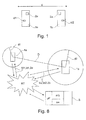
- a communication is shown between two portable electronic devices 1a, 1b located at less than a predetermined distance d and comprising a characterization profile 2a, 2b of a corresponding user.
- the portable electronic devices are, for instance, cell phones, notebooks, PDAs, etc. equipped with an integrated circuit comprising a transceiver that can transmit and receive at a predetermined frequency and according to a predetermined communication protocol.
- the transceiver may communicate, for example, at a frequency of 2.4 GHz, with a Bluetooth® protocol, even in high-interference environments, at high data rates and with low absorption powers.
- portable electronic devices may communicate with a different communication protocol, such as the Zigbee® protocol.
- the communication method of the present invention may be implemented by a so-called “mesh” or “wireless mesh” network comprising a plurality of portable electronic devices that act as nodes, i.e. receivers, transmitters and repeaters of the mesh network.
- the mesh network is decentralized, because it requires no server, and is particularly flexible because each node shall simply transmit a signal to the next node.
- the nodes act as repeaters to transmit the signal from the closest nodes to the nodes that are too far to be reached.
- the characterization profile comprises information such as a nickname, the user's sex, his/her date of birth, the sex of a prospective communicating user, his/her minimum and maximum ages and the date of change of the characterization profile.
- the method comprises the steps of:
- the information of each characterization profile is associated with fields and the comparison step includes reading a first field A of the characterization profile 2a and a second field B of the characterization profile 2b, comparing the fields and increasing the affinity value 3 if the fields match.
- the comparison step includes reading of the value "F” from the field B of the characterization profile 2a, reading the field A of the characterization profile 2b of a second user Y, e.g. having a value "F", and increasing the affinity value 3, because these values "F" match.
- the comparison step includes "matching" of the fields of the characterization profiles associated with different users.
- the comparison step includes assignment of a weight to each field of the characterization profile, as a function of the importance of such field in determining the affinity value 3.
- field weights allow prioritization of certain features or tastes of the users of interest.
- the field B or "sex of a prospective communicating user” may have a numeric weight of ten and the field C or "age of a prospective communicating user” may have a numeric weight of two; in this case, the affinity value 3 is increased, e.g. increased by ten units, if the field "sex" of the user Y matches the field "sex of a prospective communicating user" of the user X and is increased, e.g. by two units, if the field "age” of the user Y matches the field "age of a prospective communicating user” of the user X.
- the step of comparing and providing an affinity value 3 is carried out using an algorithm or a neural network.
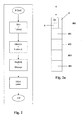
- a transmission of a broadcast message M1 is schematically shown, which comprises the step of adding such message M1 to a transmission queue or stack 4 having a plurality of records 400, 401, 402, ....
- Each record of the queue 4 comprises a transmission state 5 for the broadcast message M1, having a predetermined value, associated with a request for transmission of the broadcast message M1, a request for deletion of the record 400, 401, 402, ... from the queue 4 or a request for relocation of the record 400, 401, 402, .. in the queue 4 for later transmission, respectively.
- Figure 2a schematically shows the queue 4, with a record 400 comprising the broadcast message M1 and the transmission state 5 and Figure 2 is a block diagram of the transmission of the broadcast message M1, which includes adding the message M1 to a record of the queue, setting its transmission state 5 (ToSend) and queuing the record.
- the method of the invention includes a queue 4 processing step, which comprises accessing the broadcast message M1 to be processed, reading the transmission state 5 for the message M1 and transmitting the message M1 if the value of the state 5 matches the transmission request. After transmission, the broadcast message M1 is deleted by removal of its record from the queue.
- the second portable electronic device 1b transmits a response message M2 to the broadcast message M1, comprising the characterization profile 2b of the second electronic device 1b, to the first electronic device 1.
- the first portable electronic device 1a receives the response message M2 and performs a check on the affinity value 3, which comprises a further step of comparing the characterization profile 2b of the response message M2 with the characterization profile 2a of the first electronic device 1a.
- the comparison step is performed in both portable electronic devices 1a and 1b and may result in two different affinity values 3, e.g. because the user X is interested to the characterization profile 2b of the user Y and not vice versa.
- the field A or "sex" of the characterization profile 2b of the user Y has a value "M”
- the field B or "sex of a prospective communicating user" of the profile 2a of such user X may have a value "F”.
- the comparison step in the portable electronic device 1b of the user Y in does not increase the affinity value, and excludes any communication with the device 1a, because the user X of the latter is of male sex "M".
- An additional step is provided in which an acknowledgement message M3 is transmitted from the first electronic device 1a to the second electronic device 2b, which message comprises the characterization profile 2a of the first electronic device 1a.
- Communication is established by the transmission of a communication proposal message M4 from the second electronic device 1b to the first electronic device 1a, after reception of the acknowledgement message M3, and a later transmission of a communication acceptance message M5 from the first electronic device 1a to the second electronic device 1b, after reception of the communication proposal message M4.
- the communication proposal message M4 and the communication acceptance message M5 are manually sent by the users of the corresponding electronic devices 1a, 1b. Particularly, the messages M1, M2, M3 are automatically sent to select devices of users having similar characterization profiles. Nevertheless, the user may choose whether to establish a communication or not by sending the messages M4 and M5. Particularly, the communication proposal message M4 and the communication acceptance message M5 include a phone call by a telephone service provider and a corresponding call answer respectively.
- the response message M2, the acknowledgement message M3, the communication proposal message M4 and the communication acceptance message M5 include the device ID id1, id2 of the electronic device 1a, 1b that sends the corresponding message M2, M3, M4, M5, also referred to as sender ID, and the device ID id1, id2 of the portable electronic device 1a, 1b that is intended to receive the corresponding message M2, M3, M4, M5, also referred to as receiver ID.
- step of adding the broadcast message to the transmission queue is carried out for each message M1, M2, M3, M4, M5 to be sent between the devices.
- the messages M1, M2, M3, M4, M5 are added to the transmission queue or stack 4, in a record 400, 401, 402, ..., each record 400, 401, 402, ... including a transmission state 5 of the message M1, M2, M3, M4, M5.
- each record has a predetermined value, associated with a request for transmission of the message M1, M2, M3, M4, M5 a request for deletion of the record 400, 401, 402, ... from the queue 4 or a request for relocation of the record 400, 401, 402, ... in the queue 4, respectively.
- the processing step accesses a message to be processed, reads the transmission state 5 of the message to be processed M1, M2, M4, M4, M5 and transmits the message M1, M2, M3, M4, M5 if the state value matches a transmission request. If the state value matches a deletion request, the record 400, 401, 402, ... is deleted from the queue 4 and if the transmission state matches a relocation request, the record is requeued.
- the transmission state is a single byte and is used both as a flag to indicate whether the message has been sent and the device is waiting for a response, and as a transmission attempt counter.
- its values may be "0", if the message is be sent (ToSend), "FF”, if the message is to be deleted (ToDel) and "X", with X>0, if the message is to be added to the queue again (ToDec).
- the record 400, 401, 402, ... further comprises a number of transmission attempts 6 for the message M1, M2, M3, M4, M5, such number 6 having a predetermined value 6b and being decreased in the message transmission step, as it will appear below.
- the message transmission step is not executed if the number of transmission attempts 6 is lower than a preset number 6a.
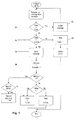
- a transmission queue handling flowchart is shown, in which the transmission queue is handled as a function of the possible values of the transmission state 5, the number of attempts 6, as well as a state of the portable electronic device.
- the state of the device may be "free” when it is available for communication, “matching”, during the comparison step, “connected”, when it is in communication with another device and “unavailable” when it is not available to establish a communication.
- deletion block 31 of a message from the queue, if the state of the record is "to be deleted” (block 32), requeuing of the message (block 33), if the state of the record is not “to be sent” (block 34), transmission of the message (block 35), if the state of the message is "to be sent”.
- the block 36 indicates the decrease of the number of sending attempts
- the block 38 indicates the setting of the "to be requeued" state in a record containing a message M2, M3, M4, M5 differing from the broadcast message.
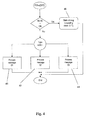
- a message receiving step in a portable electronic device is diagrammatically shown.
- the transceiver of the receiving device detects a message and transmits an interrupt signal. If the device is in an "unavailable" state, i.e. is not available for reception, the interrupt is disabled and all detected messages are removed, as shown in block 41 whereas, if the device is in a "free” state, the messages are added to a reception queue and processed, as shown in the blocks 42, 43, 44.
- the characterization profiles are grouped by preferences, e.g. by storing the profiles in classes such as "Stranger”, “Friend”, “Enemy” and “Vip” in an archive of the device.
- the comparison step may be avoided.
- an icon appears on the display of the device to only establish the corresponding communication if the characterization profile is "Friend” or "Vip".
- Figure 5 schematically shows a user status checking step, where the "Stranger”, “Friend”, “Enemy”, “Vip” statuses are designated as 0, 1, 2, 3 in the block 52 and a step in which the message is stored in an archive of the portable electronic device (block 51).
- the present invention includes message transmission safety control; particularly, the hardware of each portable electronic device stores a unique identification code - shared by all devices - which allows coding and decoding of sent messages, as well as an unchangeable protection certificate.
- the device is also equipped with a SIM Card associated with the user.
- the broadcast message M1 is encrypted through the single unique ID code, whereas all the other messages M2, M3, M4, M5 are encrypted both by the unique ID code and by the protection certificate.
- Unique ID code and protection certificate encryption prevents decryption of messages transmitted between two electronic devices by a third device, or interference of such device in their communication.
- Such safety control also includes tracking of messages M1, M2, M3, M4, M5 transmitted between two portable electronic devices 1a, 1b, by storage in a central server.
- the method of communication between portable electronic devices 1a, 1b is managed by a telephone service provider that can locate devices situated at less than a predetermined geographical area.
- the portable electronic devices are connected to a GSM network of the telephone service provider and are associated with a characterization profile 2a, 2b of a corresponding user.
- the method includes the steps of:
- the provider determines the position of the devices by locating a cell of the GSM network with which the devices are connected.
- the characterization profiles 2a, 2b are stored in the telephone service provider and the comparison step is carried out by the provider.
- the provider only sends the ID id2 of a second device 1b to a first device 1a, if the affinity value 3 for their characterization profiles 2a, 2b exceeds the preset threshold 3a.
- the portable electronic device receives a list of possible prospective communicating users from the provider, but communication proposals and communication acceptances are manually performed by the user.
- the sending step includes transmission of the characterization profile of further located portable electronic devices, from the provider to each located portable electronic device 1a, and the comparison step is carried out in each portable electronic device 1a.
- the list of possible prospective communicating users is processed by the portable electronic device; communication proposals and communication acceptances are manually performed by the user.
- the devices require no transceiver for short-distance wireless communication and profile matching is carried out either in the service provider or in the devices.
- the communication method that is carried out in a plurality of portable electronic devices located at less than the preset distance allows the display of each device to only display the available connections to devices having a selected characterization profile.
- the match request allows the user of the portable electronic device that sent the broadcast message to automatically check the characterization profile/s of one or more devices that responded to the broadcast message. Particularly, if automatic comparison of the characterization profile in the response message provides an affinity value below the preset threshold, the connection with the corresponding device is not displayed.
- the response to the match request allows the device that sent the response message to check the characterization profile of the device that sent the broadcast message, the latter profile preferably comprising additional information that were not transmitted with the broadcast message.
- the comparison step selects the most relevant characterization profiles, but the communication request is manually actuated by the user; this allows refusal of communication with a device having a characterization profile with an affinity value exceeding the preset threshold.
- FIG. 8 which shows a further embodiment of the present invention, here communication among electronic devices as mentioned above, i.e. handheld devices, occurs through a RT telecommunication network.
- electronic devices can establish a radio-frequency two-way signal communication M1, M2 to exchange data with a web server S.
- the RT communication network may be of any type known to those of ordinary skill in the art.
- Such RT communication network is, for instance, designed to support data and/or voice communication using any one of the multiplicity of commercially available communication protocols, such as TCP/IP, SNA (Systems Network Architecture), IPX (Internetwork Packet Exchange), AppleTalk, and so on.
- the RT communication network may be a wide-area network, the Internet, a telephone network, such as a public switched telephone network (PSTN), a wireless telephone network, a private branch exchange (PBX) and/or the like, an infrared network, a wireless network including, without limitation, a communication network implemented according to any specification of IEEE 802.11 protocols, such as the Bluetooth protocol, and/or any other wireless communication network and/or any combination of these and/or other communication networks.
- PSTN public switched telephone network
- PBX private branch exchange
- IEEE 802.11 protocols such as the Bluetooth protocol
- server computer or server S are provided, which may act as data processing systems.
- the servers S include all the electric and electronic devices required for their operation and interconnection with the RT network, which are well known to the skilled person and will not be further described.
- each of the servers S includes one or more processors ⁇ P, one or more memory banks mS, one or more input/output communication adapters, one or more mass storage devices and a memory (mS) resident program code sw.
- the server S may also be a web server, that may be used to process requests for web pages or other electronic documents, generated by the portable devices 1a and/or 1b.
- the server has its own operating system O.S. and said one or more processors ⁇ P can execute the instructions of both the O.S. and other locally resident and/or remote computer products, such as the program code sw.
- the server S may also be able to execute a variety of server applications, including HTTP servers, FTP servers, CGI servers, database servers, Java, etc.
- the server S may also implement one or more file servers, application servers and/or transaction processing servers which include, in addition to the operating system O.S. one or more client accessible applications running on one or more of the portable devices 1a and/or 1b.
- the server S may also include the database servers, such as those sold by Oracle, Microsoft, Sybase, IBM and the like. Such database servers may process client database requests running on a device, e.g. of the type designated by numeral 2, of the user/s.
- program code sw in the server S is adapted to carry out the steps of the method to allow the electronic devices to communicate when they are situated at less than a particular distance.
- characterization profiles 2a, 2b may be recorded and/or changed even when the electronic devices are not used.
- the steps of the method may be advantageously implemented through the program code sw, which is configured for:
- Such values identify the maximum distance within which each user authorizes signal communication between said two portable handheld electronic devices, i.e. the value within which the user wants to locate the other electronic device.
- Maximum distance values may be selected as desired by users from a pre-sorted list provided, for instance, when the users register on the web site S.
- the maximum distance values d1 and/or d2 may range from a minimum to a maximum predetermined values.
- the first value d1 is selected to be 50 m
- the second value d2 is selected to be 500 m. This shows that the user that selected a d1 of 50 m wants to locate another device within a distance from his/her device, of not more than 50 m (i.e. in an area having a diameter of 100 m).
- the program code sw determines the distance D between the first electronic device 1a and the second electronic device 1b and checks that such distance D is smaller than both said first maximum distance value d1 and said second maximum distance value d2.
- the distance between the two devices 1a and 1b is equal to or smaller than 50 m.
- the method provides comparison between the first characterization profile 2a and the second characterization profile 2b, which have been, for instance, previously stored by the corresponding users in the memory mS of the server S.
- the user at distance d1 may be notified of the existence of a compatible user at a greater distance than that selected in his/her profile (i.e. greater than the maximum preset distance d1), and allow the user to choose whether to contact such user or not.
- the portable electronic devices 1a and/or 1b may include a GPS device and/or a GSM transceiver apparatus.
- the step of determining the distance D between the first and the second electronic devices is based on the geographical coordinates received from said GPS device and transmitted to the web server S.
- the step of determining the distance D between the first and the second electronic devices is based on the coordinates of the radio cell of the GSM architecture and transmitted to the web server S.
- the step of determining the distance D between the first and the second electronic devices in the case implemented by the coordinates of the radio cell of the GSM architecture includes estimating the average distance of the portable electronic devices 1a, 1b from the base station of the cell of interest.
Landscapes
- Engineering & Computer Science (AREA)
- Computer Networks & Wireless Communication (AREA)
- Signal Processing (AREA)
- Human Computer Interaction (AREA)
- Health & Medical Sciences (AREA)
- Child & Adolescent Psychology (AREA)
- General Health & Medical Sciences (AREA)
- Business, Economics & Management (AREA)
- Emergency Management (AREA)
- Physics & Mathematics (AREA)
- General Physics & Mathematics (AREA)
- Mobile Radio Communication Systems (AREA)
Applications Claiming Priority (1)
| Application Number | Priority Date | Filing Date | Title |
|---|---|---|---|
| IT000694A ITMI20090694A1 (it) | 2009-04-23 | 2009-04-23 | Metodo di comunicazione tra dispositivi elettronici portatili situati a meno di una predeterminata distanza |
Publications (2)
| Publication Number | Publication Date |
|---|---|
| EP2244447A2 true EP2244447A2 (fr) | 2010-10-27 |
| EP2244447A3 EP2244447A3 (fr) | 2010-11-24 |
Family
ID=42026322
Family Applications (1)
| Application Number | Title | Priority Date | Filing Date |
|---|---|---|---|
| EP10160920A Withdrawn EP2244447A3 (fr) | 2009-04-23 | 2010-04-23 | Méthode de communication entre appareils électroniques portables situés à moins d'une distance prédéterminée. |
Country Status (2)
| Country | Link |
|---|---|
| EP (1) | EP2244447A3 (fr) |
| IT (1) | ITMI20090694A1 (fr) |
Cited By (1)
| Publication number | Priority date | Publication date | Assignee | Title |
|---|---|---|---|---|
| DE102012003889A1 (de) * | 2012-02-28 | 2013-08-29 | Sedat Ayvaz | Verfahren zur Kommunikation |
Family Cites Families (9)
| Publication number | Priority date | Publication date | Assignee | Title |
|---|---|---|---|---|
| SE9903571L (sv) * | 1999-10-05 | 2001-04-06 | Ariad Ventures Ab | Mobilmatchning |
| US6618593B1 (en) * | 2000-09-08 | 2003-09-09 | Rovingradar, Inc. | Location dependent user matching system |
| SE523564C2 (sv) * | 2000-09-20 | 2004-04-27 | Mahmood Valadi | Matchning av användarprofiler och positionering av mobiltelefoner i ett mobilt kommunikationsnät |
| WO2002028125A2 (fr) * | 2000-09-29 | 2002-04-04 | Telefonaktiebolaget L.M. Ericsson (Publ) | Procedes, systemes et produits-programmes informatiques destines a identifier un individu compatible dans une zone geographique |
| FI111781B (fi) * | 2001-01-29 | 2003-09-15 | Esa Runola | Menetelmä partnerin löytämiseksi |
| DE10149496A1 (de) * | 2001-10-06 | 2003-04-30 | Michael Wilk | Verfahren zur Kontaktanbahnung über ein Kommunikationssystem und Kommunikationssystem |
| DE60139014D1 (de) * | 2001-11-22 | 2009-07-30 | Sony Deutschland Gmbh | Mobile Sendeeinrichtung zur richtungsabhängigen Nachrichtenübertragung |
| DE10339466B3 (de) * | 2003-08-27 | 2005-02-17 | Siemens Ag | Verfahren sowie Computerprogramm mit Programmcode-Mitteln und Computerprogramm-Produkt zum Austauschen von Daten |
| ITTO20030852A1 (it) * | 2003-10-30 | 2005-04-30 | Domenico Lopreiato | Sistema per monitorare e segnalare presenze di utenze in una regione spaziale. |
-
2009
- 2009-04-23 IT IT000694A patent/ITMI20090694A1/it unknown
-
2010
- 2010-04-23 EP EP10160920A patent/EP2244447A3/fr not_active Withdrawn
Non-Patent Citations (1)
| Title |
|---|
| None |
Cited By (1)
| Publication number | Priority date | Publication date | Assignee | Title |
|---|---|---|---|---|
| DE102012003889A1 (de) * | 2012-02-28 | 2013-08-29 | Sedat Ayvaz | Verfahren zur Kommunikation |
Also Published As
| Publication number | Publication date |
|---|---|
| EP2244447A3 (fr) | 2010-11-24 |
| ITMI20090694A1 (it) | 2010-10-24 |
Similar Documents
| Publication | Publication Date | Title |
|---|---|---|
| US7877082B2 (en) | Combined short range radio network and cellular telephone network for interpersonal communications | |
| KR0179413B1 (ko) | 송신 우선 순위 선택 방법 | |
| EP1083482A2 (fr) | Méthode d'actualisation des données installées d'un client en réponse à un événement déclenché par utilisateur | |
| CA2356823A1 (fr) | Systeme et methode d'auto-approvisionnement en temps reel pour dispositif de communication | |
| US9572095B2 (en) | Intelligent selection of message delivery mechanism | |
| JP2001520816A (ja) | 双方向メッセージング・システムにおける柔軟な移動管理およびその方法 | |
| CA2495093A1 (fr) | Fourniture de donnees de routage dans un systeme de communication | |
| RU2007121029A (ru) | Устройство и способ предоставления услуг в системе мобильной связи | |
| WO2006107161A1 (fr) | Systeme et procede de service de messages multimedia | |
| CN102077673A (zh) | 用于在对等网络中提供服务质量的方法和装置 | |
| EP3742710A1 (fr) | Procédé de fourniture de demandes d'accès d'informations de localisation | |
| CN1322784C (zh) | 移动通信终端、移动通信系统和内容传递方法 | |
| EP3370401B1 (fr) | Système de mise à jour de données, dispositif de réglage à distance et procédé de mise à jour de données | |
| CN109275197B (zh) | 一种通信连接建立方法及基站、终端、存储介质 | |
| EP1694089A2 (fr) | Procédé et appareil de gestion de messages multimédia dans un système de communication mobile | |
| KR101584363B1 (ko) | 사회적 친밀도를 이용한 미디어 전송 장치 및 방법 | |
| EP2244447A2 (fr) | Méthode de communication entre appareils électroniques portables situés à moins d'une distance prédéterminée. | |
| EP1685501A1 (fr) | Procede, dispositif terminal source, dispositif terminal cible, serveur de contenu de donnees, systeme et programmes informatiques permettant de conserver et de mettre a jour des contenus de donnees | |
| US8238270B2 (en) | Communication system, communication control device, communication method, communication control method and recording medium | |
| JP2002368883A (ja) | 情報提供システム及び情報提供サーバ | |
| CN117640220A (zh) | 一种数据传输安全管理方法及装置 | |
| JP5651075B2 (ja) | プロフィールサーバ、管理システム、及びプロフィール情報管理方法 | |
| KR20080054737A (ko) | 휴대 단말기의 메시지 전송 방법 | |
| KR101823510B1 (ko) | 무전기 모듈을 이용한 스마트폰 채팅 제공 방법 | |
| WO2011141344A1 (fr) | Procédé et appareil permettant d'insérer des données de localisation dans des messages au niveau d'une passerelle de communication |
Legal Events
| Date | Code | Title | Description |
|---|---|---|---|
| PUAI | Public reference made under article 153(3) epc to a published international application that has entered the european phase |
Free format text: ORIGINAL CODE: 0009012 |
|
| PUAL | Search report despatched |
Free format text: ORIGINAL CODE: 0009013 |
|
| AK | Designated contracting states |
Kind code of ref document: A2 Designated state(s): AT BE BG CH CY CZ DE DK EE ES FI FR GB GR HR HU IE IS IT LI LT LU LV MC MK MT NL NO PL PT RO SE SI SK SM TR |
|
| AX | Request for extension of the european patent |
Extension state: AL BA ME RS |
|
| AK | Designated contracting states |
Kind code of ref document: A3 Designated state(s): AT BE BG CH CY CZ DE DK EE ES FI FR GB GR HR HU IE IS IT LI LT LU LV MC MK MT NL NO PL PT RO SE SI SK SM TR |
|
| AX | Request for extension of the european patent |
Extension state: AL BA ME RS |
|
| STAA | Information on the status of an ep patent application or granted ep patent |
Free format text: STATUS: THE APPLICATION IS DEEMED TO BE WITHDRAWN |
|
| 18D | Application deemed to be withdrawn |
Effective date: 20110525 |