EP2245870B1 - Intelligente interaktion zwischen einer drahtlosen tragbaren vorrichtung und mediengeräten in einem lokalen netzwerk - Google Patents
Intelligente interaktion zwischen einer drahtlosen tragbaren vorrichtung und mediengeräten in einem lokalen netzwerk Download PDFInfo
- Publication number
- EP2245870B1 EP2245870B1 EP08807248A EP08807248A EP2245870B1 EP 2245870 B1 EP2245870 B1 EP 2245870B1 EP 08807248 A EP08807248 A EP 08807248A EP 08807248 A EP08807248 A EP 08807248A EP 2245870 B1 EP2245870 B1 EP 2245870B1
- Authority
- EP
- European Patent Office
- Prior art keywords
- media device
- media
- output
- network
- mobile device
- Prior art date
- Legal status (The legal status is an assumption and is not a legal conclusion. Google has not performed a legal analysis and makes no representation as to the accuracy of the status listed.)
- Not-in-force
Links
- 230000003993 interaction Effects 0.000 title description 3
- 230000008859 change Effects 0.000 claims description 29
- 238000000034 method Methods 0.000 claims description 25
- 230000004044 response Effects 0.000 claims description 10
- 238000004891 communication Methods 0.000 abstract description 15
- 238000010586 diagram Methods 0.000 description 7
- 230000008569 process Effects 0.000 description 7
- 230000006870 function Effects 0.000 description 4
- 230000007246 mechanism Effects 0.000 description 4
- 238000005562 fading Methods 0.000 description 3
- 230000001413 cellular effect Effects 0.000 description 2
- 230000001419 dependent effect Effects 0.000 description 2
- 238000002156 mixing Methods 0.000 description 2
- 230000006399 behavior Effects 0.000 description 1
- 230000005540 biological transmission Effects 0.000 description 1
- 230000003139 buffering effect Effects 0.000 description 1
- 230000003247 decreasing effect Effects 0.000 description 1
- 230000002452 interceptive effect Effects 0.000 description 1
- 239000004973 liquid crystal related substance Substances 0.000 description 1
- 238000012986 modification Methods 0.000 description 1
- 230000004048 modification Effects 0.000 description 1
- 230000002093 peripheral effect Effects 0.000 description 1
- 230000003068 static effect Effects 0.000 description 1
- 230000000007 visual effect Effects 0.000 description 1
Images




Classifications
-
- H—ELECTRICITY
- H04—ELECTRIC COMMUNICATION TECHNIQUE
- H04L—TRANSMISSION OF DIGITAL INFORMATION, e.g. TELEGRAPHIC COMMUNICATION
- H04L12/00—Data switching networks
- H04L12/28—Data switching networks characterised by path configuration, e.g. LAN [Local Area Networks] or WAN [Wide Area Networks]
- H04L12/2803—Home automation networks
- H04L12/2823—Reporting information sensed by appliance or service execution status of appliance services in a home automation network
- H04L12/2827—Reporting to a device within the home network; wherein the reception of the information reported automatically triggers the execution of a home appliance functionality
Definitions
- Computers, communication devices, and/or media devices may interact with one another in a local media network.
- the devices may share multimedia content in the local media network.
- WO2006/084841 published on 17.08.2006 , describes a device for automatically adjusting the operating parameters of a controlled device.
- a mobile control device that can be carried by a user, is adapted to identify its temporary spatial position and automatically transmits, depending on this position, a control signal to the controlled device for the automatic location-dependent adjustment of the device.
- WO 2007/125512 published on 08.11.2007 , describes a system for situational end-user authoring of distributed media presentations based on a mobile programming device which could be incorporated into a portable media player.
- a method may include detecting a change in video or audio output of a mobile device, obtaining a physical location of the mobile device and a physical location of a media device, determining a distance between the mobile device and the media device based on the physical locations of the mobile device and the media device, determining whether the distance is within a predetermined range, and modifying output of the media device when the distance is within the predetermined range.
- modifying output of the media device may include at least one of sending a command from the mobile device to the media device to fade out or reduce an audio output of the media device, sending a command from the mobile device to the media device to pause the output of the media device, sending a command from the mobile device to the media device to buffer the output of the media device, or sending a command from the mobile device to the media device to store information that indicates what part of content in the output of the media device has been played.
- sending a command to the media device may include sending a Simple Object Access Protocol command.
- the method may further include detecting a change in the distance between the mobile device and the media device, determining whether the mobile device is within the predetermined range of the media device, and modifying the output of the media device when the mobile device is not within the predetermined range.
- detecting a change in video or audio output of a mobile device may include one of detecting an incoming phone call, detecting a termination of a call, or detecting a playing of an audio file, a video file, an audio disk, or a video disk.
- the method may further include discovering the media device in a local media network in accordance with Universal Plug and Play protocol.
- the method may further include obtaining a service description and a device description of the media device via a local media network.
- obtaining a physical location of the mobile device and a physical location of the media device may include requesting the media device to provide the physical location of the media device.
- modifying output includes at least one of restoring an audio output of the media device to a level prior to the detected change in the output of the mobile device, causing the media device to resume the output of the media device, causing the media device to play buffered output of the media device, or causing the media device to play un-played part of content based on information that has been stored and that indicates what part of content in the output of the media device has been played.
- the method may further include receiving from a user a desired level of volume to which the audio output is to be set when a change is detected in the audio output of the mobile device.
- the method may further include exchanging multimedia content with the media device in accordance with Digital Living Network Alliance protocols.
- a device may include a network interface through which the device communicates with a media device in a local network.
- the device may further include a processor to detect whether the device receives a call, determine whether the device is within a predetermined range of the media device based on communication between the device and the media device, and send a message to the media device via the network interface to request the media device to reduce an audio output of the media device when the device is within the predetermined range of the media device and when the device has received the call.
- the device may include a universal plug and play (UPnP) compliant device.
- UnP universal plug and play
- the local network may include a network that is compliant with Digital Living Network Alliance guidelines.
- the media device may include one of a speaker, a television, a personal computer, a laptop, a receiver, a digital video disk player, or a game playing device.
- the processor may be further configured to detect the media device via a discovery protocol.
- the message may include a Simple Object Access Protocol message.
- the device may further include an accelerometer for determining a position of the device, or a Global Positioning System receiver for determining a position of the device.
- the processor may be further configured to receive user input for setting a desired level of volume for reducing the output of the media device when the media device is within the predetermined range, and receive user input indicating the predetermined range.
- a device may include means for detecting whether the device receives a call, means for discovering a media device in a local media network, means for sending a request for a physical location of the media device to the media device, means for determining whether the device is within a predetermined range of the media device based on a response from the media device, and means for sending a request to the media device to turn off audio output or reduce the audio output of the media device when the device moves into a predetermined range of the media device while the device is engaged in the call.
- a device e.g., a portable phone
- the device may interact intelligently with other devices in the local media network (e.g., cause a pair of speakers in the local media network to decrease the volume).
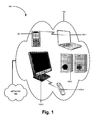
- Fig. 1 is an exemplary network 100 in which concepts described herein may be implemented.
- network 100 may include local media network 102 and network 104.
- Local media network 102 may include a local area network (LAN), a wireless local area network (WLAN), a scatter net (e.g., a collection of one or more wireless personal area networks (WPANs)), and/or other types of networks that are capable of conveying multimedia content and/or other types of information.
- Network 104 may include the Internet, an ad hoc network, a local area network (LAN), a wide area network (WAN), a metropolitan area network (MAN), a cellular network, a public switched telephone network (PSTN), an intranet, any other network, or a combination of networks.
- Local media network 102 may be connected to network 104 by devices such as a firewall, a gateway, etc. (not shown).
- local media network 102 may include a mobile device 106 and media devices 108-1 through 108-4.
- Mobile device 106 may include, for example, a radio telephone or a mobile telephone with ultra wide band (UWB) communication capability, Wireless Fidelity (Wi-Fi), or Bluetooth capability; a game console or device; a global positioning system (GPS) receiver, a Cell positioning system (CPS) receiver, a Global Navigation Satellite System receiver, and/or a Beidou Navigation system receiver; a personal communications system (PCS) terminal that may combine a cellular radiotelephone with, data processing, facsimile, and/or data communications capabilities; a wearable computing devices (e.g., calculator-watch); an electronic notepad, a laptop, and/or a personal computer that communicate with wireless peripherals (e.g., a wireless keyboard, speakers, mouse, etc.); a personal digital assistant (PDA) that can include a telephone; or any other device that has the ability to or is adapted to communicate wirelessly
- UWB ultra wide
- Each of media devices 108-1 through 108-4 may include a device such as a personal computer, a laptop computer, a digital video disk (DVD) player, a receiver, a speaker, a television, etc.
- Media device 108-x may exchange multimedia content with other devices and/or present the multimedia content to an audience.
- media device 108-x may discover other devices, control a delivery of multimedia content to the other devices, and/or control a presentation of the multimedia content to the audience.
- local media network 102 may include additional, fewer, or different devices than the ones that are illustrated.
- local media network 102 may include other mobile devices (e.g., a wireless mouse, a mobile telephone accessory, a gaming device, a wearable computing device (e.g., watch), a GPS receiver, a television, etc.) or media devices (e.g., a copier machine, a television, etc.) that can communicate with each other.
- each device in local media network 102 may include other nested devices.
- a digital video disk (DVD) player may include a digital clock as well as a multimedia player.
- DVD digital video disk
- the device of one type may function or operate as a device of another type (e.g., a media device 108-2).
- a media device 108-1 e.g., a laptop
- media device 108-1 may operate as a mobile device.
- each device in network 102 may conform to one or more communication or network standards.
- mobile device 106 and media device 108 may conform to the Digital Living Network Alliance (DLNA) guidelines.
- DLNA Digital Living Network Alliance
- each of the devices in local media network 104 may provide a basic set of functionalities for controlling and/or interacting with one another, transporting multimedia content, and/or presenting the multimedia content.
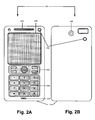
- Fig. 2A and 2B are front and rear views, respectively, of mobile device 106.
- mobile device 106 may take the form of a portable phone (e.g., a cell phone).
- mobile device 106 may include a speaker 202, a display 204, control buttons 206, a keypad 208, a microphone 210, sensors 212, a lens assembly 214, and housing 216.
- Speaker 202 may provide audible information to a user of mobile device 106.
- Display 204 may provide visual information to the user, such as an image of a caller, text information, video images, or pictures.
- Control buttons 206 may permit the user to interact with mobile device 106 to cause mobile device 106 to perform one or more operations, such as placing or receiving a telephone call.
- Keypad 208 may include a standard telephone keypad.
- Microphone 210 may receive audible information from the user.
- Sensors 212 may collect and provide information (e.g., acoustic, infrared, etc.) that is used to aid the user in capturing images.
- Lens assembly 214 may include a device for manipulating light rays from a given or a selected range, so that images in the range can be captured in a desired manner.
- Housing 216 may provide a casing for components of mobile device 106 and may protect the components from outside elements.
- Fig. 3 is a block diagram of exemplary components of a network device 300, which may represent mobile device 106 or media device 108-x.
- the term "component,” as used herein, may refer to a hardware component, a software component, or a combination of the two.
- network device 300 may include a memory 302, processing unit 304, network interface 306, input/output components 308, and communication path(s) 310. In other implementations, network device 300 may include more, fewer, or different components.
- Memory 302 may include static memory, such as read only memory (ROM), and/or dynamic memory, such as random access memory (RAM), or onboard cache, for storing data and machine-readable instructions. Memory 302 may also include storage devices, such as a floppy disk, Compact Disk (CD) ROM, CD read/write (R/W) disc, and/or flash memory, as well as other types of storage devices.
- Processing unit 304 may include a processor, a microprocessor, an Application Specific Integrated Circuit (ASIC), a Field Programmable Gate Array (FPGA), and/or other processing logic capable of controlling network device 300.
- ASIC Application Specific Integrated Circuit
- FPGA Field Programmable Gate Array
- Network interface 306 may include any transceiver-like mechanism that enables network device 300 to communicate with other devices and/or systems.
- network interface 306 may include mechanisms for communicating via a network, such as the Internet, a terrestrial wireless network (e.g., wireless local area network (WLAN)), a satellite-based network, a WPAN, etc.
- network interface 306 may include a modem, an Ethernet interface to a LAN, and/or an interface/connection for connecting network device 300 to other devices (e.g., a Bluetooth interface).
- network interface 306 may include one or more receivers, such as a Global Positioning System (GPS) receiver for determining its own physical location.
- GPS Global Positioning System
- Input/output components 308 may include a keypad (e.g., keypad 208 of Fig. 2 ), a button (e.g., control buttons 206), a mouse, a speaker (e.g., speaker 202), a microphone (e.g., microphone 210), a Digital Video Disk (DVD) writer, a DVD reader, Universal Serial Bus (USB) lines, and/or other types of devices for converting physical events or phenomena to and/or from digital signals that pertain to network device 300.
- a keypad e.g., keypad 208 of Fig. 2
- a button e.g., control buttons 206
- a mouse e.g., a mouse
- a speaker e.g., speaker 202
- a microphone e.g., microphone 210
- DVD Digital Video Disk
- DVD Universal Serial Bus
- input/output components 308 may include a display (e.g., display 204).
- the display may include a component that can display signals generated by network device 300 as images on a screen and/or that can accept inputs in the form of taps or touches on the screen. Examples of the display include a liquid crystal display (LCD), organic light-emitting diode (OLED) display, bistable display, and/or a touch screen.
- LCD liquid crystal display
- OLED organic light-emitting diode
- Communication path 310 may provide an interface through which components of network device 300 can communicate with one another.
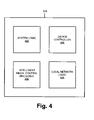
- Fig. 4 is a functional block diagram of network device 300.
- device 300 may include system logic 402, a device controller 404, intelligent media control (IMC) logic 406, and local network logic 408.
- IMC intelligent media control
- network device 300 may include fewer, additional, or different types of functional blocks than those illustrated in Fig. 4 .
- System logic 402 may be included in processing unit 304 and/or memory 302, and may include hardware and/or software for performing various support functions for other components in Fig. 4 (e.g., local network logic 408, device controller 404, etc.) and for performing application functions.
- system logic 402 may provide a Transmission Control Protocol (TCP)/Internet Protocol (IP) stack to support local network logic 408 on different devices.
- system logic 402 may provide a browser 408 to allow network device 300 to, for example, access the Internet.
- TCP Transmission Control Protocol
- IP Internet Protocol
- Device controller 404 may include one or more components that supports specific functionalities of network device 300. For example, if network device 300 is implemented as a DVD player, device controller 404 may include a component to control the playing of multimedia content on a DVD, fast forwarding through the multimedia content, pausing a presentation of the multimedia content, etc.
- IMC logic 406 may include components for a network device 300 (e.g., a mobile device 106) to intelligently interact with other devices. For example, using an external speaker may cause IMC logic 406 within media device 108-x that controls an entertainment speaker to send a command to the entertainment speaker. In response to the command, the entertainment speaker may lower the volume of its audio output.
- a network device 300 e.g., a mobile device 106
- Local network logic 408 may include components that support standard communication protocols for controlling devices in local media network 102 and for transporting multimedia content in local media network 102. Furthermore, the components of local network logic 408 may conform to one or more standards. For example, local network logic 408 may include components that support the DLNA guidelines, a High Definition Audio-video Network Alliance (HANA) specification, etc. In the descriptions that follow, however, components of network device 300 will be described in the context of interacting with other devices in accordance with the DLNA guidelines.
- HANA High Definition Audio-video Network Alliance
- local network logic 408 When local network logic 408 operates in accordance with the DLNA guidelines, local network logic 408 may provide a mechanism for responding to network service requests. For example, media player 108-x (e.g., a DVD player) may respond to requests that are issued over local media network communication channels in accordance with Universal Plug and Play (UPnP) protocol and/or Simple Object Access Protocol (SOAP).
- UPF Universal Plug and Play
- SOAP Simple Object Access Protocol
- local network logic 408 may respond to requests that include: a command to provide a physical location of media player 108-x; commands to adjust an audio output (e.g., turn off, mute, fade in, or fade out the audio output, restore a previous volume of the audio output before the volume has been changed, etc.); commands to adjust video outputs (e.g., black out, dim or brighten a video output, restore a previous brightness level of the video output, etc.); commands to buffer/store audio/video output; commands to play the buffered audio/video; commands to store information that indicates what portion of content of the audio/video output has been played (e.g., particular scene or freeze-frame); commands to play the un-played portion of the content of the audio/video output; etc.
- local network logic 408 may respond to additional or different network requests or commands, based on the particular network and media devices 108.
- IMC logic 406 may 406 include position logic 502 and media fade logic 504.
- IMC logic 406 may include additional, fewer, or different components than those illustrated in Fig. 5 .
- IMC logic 406 may include logic for controlling a television (e.g., adjusting volume, turning off the television, changing channel, etc.) that is connected to local media network 102.
- Position logic 502 may determine physical locations of different devices in local media network 102.
- position logic 502 may include host position logic for determining the physical location of network device 300 that hosts IMC logic 406 and network device position logic for determining physical locations of media devices 108 in local media network 102,
- the host position logic may rely on one or more mechanisms to determine the physical location of network device 300. For example, in one implementation, the host position logic may use a GPS receiver within network device 300 to determine its physical location. In another implementation, the host position logic may exchange messages with nearby location sensors to triangulate the physical location of network device 300. In yet another implementation, the host position logic may accept inputs from sensors in network device 300 (e.g., an accelerometer and a gyroscope) to track network device 300.
- sensors in network device 300 e.g., an accelerometer and a gyroscope
- the network device position logic may determine physical locations of other devices in local media network 102 based on messages from the other devices and/or user input.
- network device 300 e.g., mobile device 106
- network device 300 may discover network addresses of media devices 108 in local media network 102.
- the network device position logic may send a request to each of media devices 108 to identify media device 108-x's physical location.
- Media device 108-x may include a GPS receiver and/or location sensors that enable media device 108-x to determine its physical location and allow media device 108-x to answer the request with its location information.
- Media fade logic 504 may determine distances between network device 300 and media devices 108 based on outputs from the host position logic in network device 300 and network device position logic in network device 300. Depending on the distances, media fade logic 504 may cause a set of media devices 108 to change their operating parameters. For example, when network device 300 receives a phone call and media fade logic 504 in network device 300 determines that network device 300 is physically close to media device 108-3, media fade logic 504 may send a request to media device 108-3 to turn down the volume of its audio output.
- media fade logic 504 may send a request to media device 108-3 to restore the volume of its audio output prior to the call.
- media fade logic 504 may be capable of issuing one or more of commands that pertain to turning on/off (e.g., black out a video output, mute an audio output, etc.) or turning down (e.g., fading out, fading in) audio/video output of media devices 108, restoring the audio/video output of media devices 108, buffering a audio/video output of media devices 108, playing the buffered audio/video output, storing information that indicates what part of content in the audio/video output has been played when the phone call is received, and playing the un-played portion of the content, etc.
- turning on/off e.g., black out a video output, mute an audio output, etc.
- turning down e.g., fading out, fading in
- the user may configure one or more of such commands to be issued by mobile device 106, via the user interface on mobile device 106, depending on the relative locations of network device 300 (e.g., mobile device 106) and media devices 108. Furthermore, via the user interface, the user may be able to modify different parameters that pertain to the commands, such as the rate of a fade out/fade in.
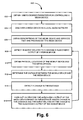
- Fig. 6 illustrates an exemplary process 600 that is capable of being performed by one or more of the devices and/or components described above.
- Process 600 may begin at block 602, where user's desired parameters for controlling media device 108-x may be obtained (block 602).
- media fade logic 504 in mobile device 106 may provide a user interface via which a user may input the desired parameters.
- the parameters may include, for example, a desired level of volume/brightness of a audio/video output of media device 108-x when mobile device 106 that is generating and/or receiving audio/video input/output moves into or is within a particular range from media device 108-x; the range within which mobile device 106 may cause the volume/brightness of the audio/video output of media device 108-x to be reduced or fade out to a desired level; a rate at which the volume/brightness is to be reduced, fade, or restored; etc. If the user does not provide input, mobile device 106 may use default values.
- the user may be able to select/configure, via the user interface, which commands (e.g., turn off audio/video output, fade in/fade out, etc.) mobile device 106 may issue to media device 108-x, depending on the relative locations and/or the audio output of mobile device 106 and media devices 108.
- commands e.g., turn off audio/video output, fade in/fade out, etc.
- Mobile device 106 may discover media device 108-x in local media network 102 (block 604).
- Mobile device 106 may discover media device 108-x when mobile device 106 enters local media network 102, by either physically becoming attached to local media network 102 or by entering a region in which mobile device 106 may establish a wireless communication link with a wireless access point (WAP) for local media network 102.
- WAP wireless access point
- Mobile device 106 may enter the region by physically being carried into the region while mobile device 106 is powered on, or, alternatively, by being turned on when mobile device 106 is within the region.
- mobile device 106 may discover media device 108-x in accordance with a network communication protocol. For example, mobile device 106 may discover media device 108-x in accordance with UPnP specifications that are part of the DLNA guidelines/protocols.
- local network logic 408 in mobile device 106 may advertise or broadcast mobile device 106's presence to media devices 108 in local media network 102, and obtain responses to the advertisements/broadcasts from one or more media devices 108.
- the responses may include identification information, such as a universally unique identifier (UUID), a Uniform Resource Locator (URL), or more detailed information, etc.
- UUID universally unique identifier
- URL Uniform Resource Locator
- Mobile device 106 may obtain descriptions of media device 108-x and services that are provided by media device 108-x (block 606). Upon receiving the UUID and/or the URL as described above, mobile device 106 may access the URL to obtain an extensible markup language (XML) description of media device 108-x and services that are provided by media device 108-x. For example, the description of media device 108-3 may indicate that media device 108-3 corresponds to stereo speakers.
- XML extensible markup language
- the services may include responding to requests that are described above in connection with local network logic 408 (e.g., a command to fade out the volume of an audio output of media device 108-x; a command to fade in the volume of the audio output; a command to restore a previous volume of the audio output before the volume has been changed; a command to pause video/audio output; a command to resume the video/audio output; a command to buffer the audio/video output; a command to play the buffered audio/video output; a command to store information that indicates what part of content in the audio/video output has been played when the phone call is received; and a command to play the un-played portion of the content.
- local network logic 408 e.g., a command to fade out the volume of an audio output of media device 108-x; a command to fade in the volume of the audio output; a command to restore a previous volume of the audio output before the volume has been changed; a command to pause video/audio output; a command to resume the video
- the requests may be issued in accordance with SOAP or a protocol compatible with mobile device 106 and media devices 108.
- Mobile device 106 may detect an event related to a change in audio/video output of mobile device 106 (block 608). For example, mobile device 106 may detect an incoming phone call, which initiates the audio/video output of mobile device 106, or the end of a call, which terminates the audio/video output. In another example, mobile device 106 may detect when an audio file is being played (e.g., playing a sound clip, a song, etc.).
- Media fade logic 504 may obtain physical locations of host mobile device 106 and media device 108-x (block 610). Media fade logic 504 may obtain the physical location of mobile device 106 from position logic 502 in mobile device 106. In addition, media fade logic 504 may obtain the physical location of media device 108-x from position logic 502 in media device 108-x via a communication link.
- media fade logic 504 may determine the distance between host mobile device 106 and media device 108-x (block 612).
- media fade logic 504 may detect a change in the distance between mobile device 106 and media device 108-x (block 614).
- Media fade logic 504 may cause media device 108-x to fade out or restore the audio/video output of media device 108-x based on the distance and/or the change in distance and the event related to the change in audio/video output of mobile device (block 616).
- Fig. 7 illustrates a table 700 of actions that media fade logic 504 may perform depending on the event and the distance and/or the change in distance between mobile device 106 and media device 108-x.
- table 700 may include columns 702-706 that represent the event related to the audio/video output of mobile device 106.
- Column 702 may represent the audio/video output being "on” (e.g., no event);
- column 704 may represent a change in the audio/video output, from being “on” to "off” (e.g., the end of a phone call); and
- column 706 may represent a change in the audio/video output, from being “off' to "on” (e.g., receiving an incoming call).
- table 700 may include rows 708-712 that represent a distance or a change in the distance between mobile device 106 and media device 108-x.
- Row 708 may represent mobile device 106 staying within the range (obtained at block 602) of media device 108-x.
- Row 710 may represent mobile device 106 moving from within the range to outside the range of media device 108-x.
- Row 712 may represent mobile device 106 moving from outside the range to within the range of media device 108-x.
- Table 700 may summarize actions/commands that mobile device 106 may perform/issue to media devices 108 when mobile device 106 moves in or of the range of media device 108-x, when the audio/video output of mobile device 106 turns on or off, or when the audio/video output remains turned on and mobile device 106 remains within the range.
- mobile device moves from an area outside the range to within the range of media device 108-x (e.g., row 712 of table 700), and that mobile device 106 receives a call when mobile device 106 is within the range (e.g., column 706 of table 700).
- table 700 may include an instruction or command of FADE, indicating that mobile device 106 may cause media device 108-x to fade out/reduce/turn off the audio/video output of media device 108-x. Fading out the audio or video output of media device 108-x may prevent media device 108-x from interfering with the audio output of mobile device 106, or prevent the sound from media device 108-x from making it difficult for the user of mobile device 106 from communicating with another party.
- table 700 may include an instruction/command of NOTHING, indicating that mobile device 700 may not cause media device 108-x to modify the audio/video output of media device 108-x. Because mobile device 106 has not moved out of the range or changed its audio/video output, media device 108-x's volume, which may already be faded, may not change.
- table 700 may include an instruction/command to RESTORE, indicating that mobile device 106 may restore a level of audio/video output prior to mobile device 106's arrival inside the range.
- mobile device 106 may store the level of audio/video output prior to the fade out.
- mobile device 106 may use the stored value of the audio/video output and signal media device 108-x to restore the audio output level to the previous level. If there is no stored value of the level (e.g., media device 108-x is turned off when a phone call is received), mobile device 106 may not restore or change the audio/video output of media device 108-x.
- media device 108-x may store the previous level and return media device 108-x to the previous level in response to a command or signal from mobile device 106.
- mobile device 106 when mobile device 106 detects an event related to audio/video output of mobile device 106 and/or a change in the distance between mobile device 106 and media device 108-x, mobile device 106 may cause (e.g., by sending a command) media device 108-x to perform actions other than those related to increasing/decreasing volume of an audio output, brightness of video output, etc. For example, in one implementation, mobile device 106 may cause media device 108-x to pause/resume outputting audio/video when an audio/video event associated with mobile device 106 occurs.
- mobile device 106 may cause media device 108-x to buffer a video/audio output from a source (e.g., from an Internet content provider) and/or to resume playing the buffered video/audio output when an audio/video event associated with mobile device 106 occurs.
- a source e.g., from an Internet content provider
- mobile device 106 may cause media device 108-x to store information that indicates what part of content in the audio/video output has been played and/or to play the un-played part of the content when the video/audio event associated with mobile device 106 occurs. For example, assume that three people are watching a DVD, and one of them receives a call on a mobile device. In such a case, the people may not want to pause playing the DVD when the call starts or ends. Instead, information about what part of the DVD has been played may be stored, so that the person who receives the call may later watch the un-played portion of the DVD.
- Process 600 may return to block 604 and/or 608 to continue to detect media devices 108 and/or an event related to a change in the audio/video output of mobile device 106.
- Fig. 8 illustrates above described process 600 in which a device interacts intelligently with other devices in local media network 102.
- Fig. 8 illustrates an exemplary environment in which the concepts described herein may be implemented.
- user 802 e.g., Max
- digital television 804 and speaker 806 have connected a digital television 804 and speaker 806 to a local media network (not shown) in his house.
- digital television 804, speaker 806, and cell phone 808 are compliant with the DLNA guidelines and UPnP protocol.
- digital television 804, speaker 806, and cell phone 808 provide services in which they respond to requests from other devices in the local media network to provide their physical locations and to change volumes of their audio output.
- the position or location services are published in an XML document at a URL that are exchanged between devices in the local media network.
- Max inputs into cell phone 808 a level of volume of sound he expects from a media player when Max receives or places a call on cell phone 808 and a particular range between cell phone 808 and digital television 804 and/or speaker 806 (e.g., 20 feet).
- cell phone 808 initiates a discovery of media devices on the local media network.
- Cell phone 808 discovers television 804 and speaker 806 on the local media network. From URLs that cell phone 808 obtains from digital television 804 and speaker 806, cell phone 708 obtains device and service descriptions of digital television 804 and speaker 806.
- cell phone 808 detects an incoming call, cell phone 808 obtains the physical locations of cell phone 808, digital television 804, and speakers 806.
- cell phone 808 determines a distance between cell phone 808 and digital television 804 and a distance between cell phone 808 and speaker 806.
- cell phone 804 After determining that cell phone 808 is within the particular range of digital television 804 (e.g., 20 feet in this example), cell phone 804 exchanges one or more messages with digital television 804 over the local media network to fade out the sound of digital television 804.
- Cell phone 808 continues to change audio outputs of digital television 804 and speaker 806, as Max 802 roams inside his house and converses with the caller.
- mobile device 106 may be able to detect the level of ambient noise and use the detected noise level to adjust the audio/video output of media devices 108.
- mobile device 106 may issue commands for transferring (e.g., blending in or blending out) the audio/video output to/from mobile device 106 from/to media device 108-x (e.g., a television with speakers, an entertainment center with a microphone, a laptop computer with speakers and a display, etc.).
- media device 108-x e.g., a television with speakers, an entertainment center with a microphone, a laptop computer with speakers and a display, etc.
- Some of such commands may pertain to a telephone call, as described above, and other commands may pertain to different types of audio/video output, such as playing a song or a movie, displaying text, etc.
- non-dependent blocks may represent acts that can be performed in parallel to other blocks.
- logic that performs one or more functions.
- This logic may include hardware, such as a processor, a microprocessor, an application specific integrated circuit, or a field programmable gate array, software, or a combination of hardware and software.
Landscapes
- Engineering & Computer Science (AREA)
- Automation & Control Theory (AREA)
- Computer Networks & Wireless Communication (AREA)
- Signal Processing (AREA)
- Telephone Function (AREA)
- Mobile Radio Communication Systems (AREA)
- Two-Way Televisions, Distribution Of Moving Picture Or The Like (AREA)
- Optical Communication System (AREA)
Claims (14)
- Verfahren, das durch eine Mobileinrichtung (106) durchgeführt wird, wobei das Verfahren gekennzeichnet ist durch:Erfassen (608) eines Abspielens einer Audiodatei, einer Videodatei, einer Audio-Disk, oder einer Video-Disk auf der Mobileinrichtung (106), wobei die Mobileinrichtung (106) mit einem Netz (104) assoziiert ist;Erlangen (610) eines physikalischen Orts der Mobileinrichtung (106) und eines physikalischen Orts einer Medieneinrichtung, in Antwort auf das Erfassen des Abspielens der Audiodatei, der Videodatei, der Audio-Disk oder der Video-Disk auf der Mobileinrichtung (106), wobei die Medieneinrichtung mit dem Netz (104) assoziiert ist;Bestimmen (612) eines Abstands zwischen der Mobileinrichtung und der Medieneinrichtung, basierend auf den erlangten physikalischen Orten der Mobileinrichtung und der Medieneinrichtung;Bestimmen, ob die Distanz innerhalb eines vorbestimmten Bereichs ist; undModifizieren einer Ausgabe der Medieneinrichtung, wenn bestimmt wird, dass die Distanz innerhalb des vorbestimmten Bereichs ist, wobei Modifizieren der Ausgabe mindestens eines beinhaltet von:Senden eines Befehls, über das Netz, von der Mobileinrichtung (106) direkt zu der Medieneinrichtung, um die Ausgabe der Medieneinrichtung zu puffern,Senden eines Befehls, über das Netz, von der Mobileinrichtung (106) direkt zu der Medieneinrichtung, um Information zu speichern, welche anzeigt, welcher Teil des Inhalts in der Ausgabe der Medieneinrichtung abgespielt wurde,Senden eines Befehls, über das Netz, von der Mobileinrichtung (106) direkt zu der Medieneinrichtung, um zu verursachen, dass die Medieneinrichtung gepufferte Ausgabe der Medieneinrichtung abspielt, oderSenden eines Befehls, über das Netz, von der Mobileinrichtung (106) direkt zu der Medieneinrichtung, um zu verursachen, dass die Medieneinrichtung einen unabgespielten Teil von Inhalt abspielt, basierend auf Information, welche gespeichert wurde und, welche anzeigt, welcher Teil des Inhalts in der Ausgabe der Medieneinrichtung gespielt wurde.
- Verfahren nach Anspruch 1, wobei Erfassen des Abspielens der Audiodatei, der Videodatei, der Audio-Disk oder der Video-Disk auf der Mobileinrichtung (106) assoziiert ist mit Erfassen einer ersten Änderung in einer Video- oder Audioausgabe der Mobileinrichtung (106),
wobei das Verfahren ferner umfasst:Erfassen einer zweiten Änderung in der Video- oder der Audioausgabe der Mobileinrichtung (106); undModifizieren der Ausgabe der Medieneinrichtung in Antwort auf die erfasste zweite Änderung, wobei Modifizieren der Ausgabe der Medieneinrichtung in Antwort auf die erfasste zweite Änderung mindestens eines beinhaltet von:Senden eines Befehls von der Mobileinrichtung (106) zu der Medieneinrichtung, um eine Audioausgabe der Medieneinrichtung auszublenden oder zu reduzieren;Senden eines Befehls von der Mobileinrichtung (106) zu der Medieneinrichtung, um die Ausgabe der Medieneinrichtung zu pausieren;Wiederherstellen einer Audioausgabe der Medieneinrichtung zu einem Niveau vor der erfassten zweiten Änderung in der Ausgabe der Mobileinrichtung (106); oderVerursachen, dass die Medieneinrichtung die Ausgabe der Medieneinrichtung wieder aufnimmt. - Verfahren nach Anspruch 1 oder 2, wobei Senden eines Befehls zu der Medieneinrichtung, um die Audioausgabe der Medieneinrichtung auszublenden oder zu reduzieren oder Senden eines Befehls zu der Medieneinrichtung, um die Ausgabe der Medieneinrichtung zu pausieren, beinhaltet:Senden eines Simple-Object-Access-Protocol-Befehls.
- Verfahren nach einem der Ansprüche 1 bis 3, ferner umfassend:Erfassen (614) einer Änderung in der Distanz zwischen der Mobileinrichtung und der Medieneinrichtung;Bestimmen, ob die Mobileinrichtung innerhalb des vorbestimmten Bereichs der Medieneinrichtung ist; und Modifizieren der Ausgabe der Medieneinrichtung, wenn die Medieneinrichtung nicht innerhalb des vorbestimmten Bereichs ist.
- Verfahren nach einem der Ansprüche 1 bis 4, ferner umfassend:Auffinden der Medieneinrichtung in einem Lokalmediennetz in Übereinstimmung mit dem Universal-Plug-And-Play-Protokoll.
- Verfahren nach einem der Ansprüche 1 bis 5, ferner umfassend:Erlangen einer Dienstbeschreibung und einer Einrichtungsbeschreibung der Medieneinrichtung über ein Lokalmediennetz.
- Verfahren nach einem der Ansprüche 1 bis 6, wobei Erlangen eines physikalischen Orts der Mobileinrichtung (106) und eines physikalischen Orts der Medieneinrichtung beinhaltend:Anfragen an die Medieneinrichtung, den physikalischen Ort der Medieneinrichtung bereitzustellen.
- Verfahren nach einem der Ansprüche 1 bis 7, wobei Erfassen des Abspielens der Audiodatei, der Videodatei, der Audio-Disk oder der Video-Disk auf der Mobileinrichtung (106) assoziiert ist mit Erfassen einer ersten Änderung in einer Video- oder Audioausgabe der Mobileinrichtung (106),
wobei das Verfahren ferner umfasst:Empfangen, von einem Benutzer, eines gewünschten Lautstärke-Niveaus, auf welches die Audioausgabe zu setzen ist, wenn eine Änderung in der Audioausgabe der Mobileinrichtung erfasst wird. - Verfahren nach einem der Ansprüche 1 bis 8, ferner umfassend:Austauschen von Multimedia-Inhalt mit der Medieneinrichtung in Übereinstimmung mit den Digital-Living-Network-Alliance-Protokollen.
- Einrichtung (300), umfassend:einen Prozessor (304), der dadurch konfiguriert ist, dass er programmiert ist zum:Erfassen eines Abspielens einer Audiodatei, einer Videodatei, einer Audio-Disk oder einer Video-Disk auf der Einrichtung (300), wobei die Einrichtung (300) mit einem Netz (104) assoziiert ist;Erlangen eines physikalischen Orts der Einrichtung (300) und eines physikalischen Orts einer Medieneinrichtung, in Antwort auf das Erfassen des Abspielens der Audiodatei, der Videodatei, der Audio-Disk oder der Video-Disk auf der Einrichtung (300), wobei die Medieneinrichtung mit dem Netz (104) assoziiert ist;Bestimmen eines Abstands zwischen der Einrichtung (300) und der Medieneinrichtung basierend auf den erlangten physikalischen Orten der Einrichtung (300) und der Medieneinrichtung;Bestimmen, ob die Distanz innerhalb eines vorbestimmten Bereichs ist; undModifizieren einer Ausgabe der Medieneinrichtung, wenn bestimmt wird, dass die Distanz innerhalb des vorbestimmten Bereichs ist, wobei, wenn die Ausgabe modifiziert wird, der Prozessor (304) programmiert ist für mindestens eines von:Senden eines Befehls, über das Netz, von der Einrichtung (300) direkt zu der Medieneinrichtung, um die Ausgabe der Medieneinrichtung zu puffern,Senden eines Befehls, über das Netz, von der Einrichtung (300) direkt zu der Medieneinrichtung, um Information zu speichern, welche anzeigt, welcher Teil des Inhalts in der Ausgabe der Medieneinrichtung abgespielt wurde,Senden eines Befehls, über das Netz, von der Einrichtung (300) direkt zu der Medieneinrichtung, um zu verursachen, dass die Medieneinrichtung eine gepufferte Ausgabe der Medieneinrichtung abspielt, oderSenden eines Befehls, über das Netz (104), von der Einrichtung (300) direkt zu der Medieneinrichtung, um zu verursachen, dass die Medieneinrichtung einen unabgespielten Teil des Inhalts abspielt, basierend auf Information, welche gespeichert wurde und, welche anzeigt, welcher Teil von Inhalt in der Ausgabe der Medieneinrichtung abgespielt wurde.
- Einrichtung (300) nach Anspruch 10, wobei der Prozessor (304) ferner programmiert ist zum:Erlangen mindestens eines von einer Dienstbeschreibung oder einer Einrichtungsbeschreibung, welcher mit der Medieneinrichtung assoziiert ist.
- Einrichtung (300) nach Anspruch 10 oder 11, wobei der Prozessor (304) ferner programmiert ist zum:Erfassen einer Änderung in der Distanz zwischen der Mobileinrichtung (106) und der Medieneinrichtung,Bestimmen, ob die Mobileinrichtung innerhalb des vorbestimmten Bereichs der Medieneinrichtung ist, undModifizieren der Ausgabe der Medieneinrichtung, wenn die Mobileinrichtung (106) nicht innerhalb des vorbestimmten Bereichs ist.
- Einrichtung (300) nach einem der Ansprüche 10 bis 12, wobei der Prozessor (304) ferner programmiert ist zum:Empfangen, von einem Benutzer, eines gewünschten Lautstärke-Niveaus, auf welcher eine Audioausgabe der Einrichtung (300) zu setzen ist, wenn das Abspielen der Audiodatei, der Videodatei, der Audio-Disk oder der Video-Disk erfasst wird.
- Einrichtung (300) nach einem der Ansprüche 10 bis 13, ferner umfassend mindestens eines von:einem Beschleunigungsmesser zum Erfassen einer Position der Einrichtung (300);eines Global-Positioning-System-Empfängers zum Erfassen eines Orts der Einrichtung (300);eines Cell-Positioning-System- (CPS) Empfängers zum Erfassen eines Orts der Einrichtung (300);eines Global-Navigation-Satellite-System-(GLONASS)-Empfängers zum Bestimmen eines Orts der Einrichtung (300), odereines Beidou-Navigation-System-Empfängers zum Bestimmen eines Orts der Einrichtung (300).
Applications Claiming Priority (2)
| Application Number | Priority Date | Filing Date | Title |
|---|---|---|---|
| US12/025,155 US8072905B2 (en) | 2008-02-04 | 2008-02-04 | Intelligent interaction between devices in a local network |
| PCT/IB2008/053083 WO2009098550A1 (en) | 2008-02-04 | 2008-07-31 | Intelligent interaction between a wireless portable device and media devices in a local network |
Publications (2)
| Publication Number | Publication Date |
|---|---|
| EP2245870A1 EP2245870A1 (de) | 2010-11-03 |
| EP2245870B1 true EP2245870B1 (de) | 2011-11-02 |
Family
ID=40262050
Family Applications (1)
| Application Number | Title | Priority Date | Filing Date |
|---|---|---|---|
| EP08807248A Not-in-force EP2245870B1 (de) | 2008-02-04 | 2008-07-31 | Intelligente interaktion zwischen einer drahtlosen tragbaren vorrichtung und mediengeräten in einem lokalen netzwerk |
Country Status (4)
| Country | Link |
|---|---|
| US (1) | US8072905B2 (de) |
| EP (1) | EP2245870B1 (de) |
| AT (1) | ATE532353T1 (de) |
| WO (2) | WO2009098550A1 (de) |
Families Citing this family (117)
| Publication number | Priority date | Publication date | Assignee | Title |
|---|---|---|---|---|
| US8509678B2 (en) * | 2008-03-03 | 2013-08-13 | Qualcomm Incorporated | Method and system of activating display of multimedia data on a mobile device |
| US8902868B2 (en) * | 2008-08-15 | 2014-12-02 | Qualcomm Incorporated | Method and apparatus for wirelessly distributing multiplex signal comprising multimedia data over a local area network |
| US8358665B2 (en) * | 2008-08-15 | 2013-01-22 | Qualcomm Incorporated | Method and apparatus for controlling the presentation of multimedia data from a multiplex signal between devices in a local area network |
| US9519772B2 (en) | 2008-11-26 | 2016-12-13 | Free Stream Media Corp. | Relevancy improvement through targeting of information based on data gathered from a networked device associated with a security sandbox of a client device |
| US9961388B2 (en) | 2008-11-26 | 2018-05-01 | David Harrison | Exposure of public internet protocol addresses in an advertising exchange server to improve relevancy of advertisements |
| US10631068B2 (en) | 2008-11-26 | 2020-04-21 | Free Stream Media Corp. | Content exposure attribution based on renderings of related content across multiple devices |
| US8180891B1 (en) | 2008-11-26 | 2012-05-15 | Free Stream Media Corp. | Discovery, access control, and communication with networked services from within a security sandbox |
| US10567823B2 (en) | 2008-11-26 | 2020-02-18 | Free Stream Media Corp. | Relevant advertisement generation based on a user operating a client device communicatively coupled with a networked media device |
| US9154942B2 (en) | 2008-11-26 | 2015-10-06 | Free Stream Media Corp. | Zero configuration communication between a browser and a networked media device |
| US10880340B2 (en) | 2008-11-26 | 2020-12-29 | Free Stream Media Corp. | Relevancy improvement through targeting of information based on data gathered from a networked device associated with a security sandbox of a client device |
| US10334324B2 (en) | 2008-11-26 | 2019-06-25 | Free Stream Media Corp. | Relevant advertisement generation based on a user operating a client device communicatively coupled with a networked media device |
| US10977693B2 (en) | 2008-11-26 | 2021-04-13 | Free Stream Media Corp. | Association of content identifier of audio-visual data with additional data through capture infrastructure |
| US9986279B2 (en) | 2008-11-26 | 2018-05-29 | Free Stream Media Corp. | Discovery, access control, and communication with networked services |
| US10419541B2 (en) | 2008-11-26 | 2019-09-17 | Free Stream Media Corp. | Remotely control devices over a network without authentication or registration |
| EP2497203A1 (de) * | 2009-11-03 | 2012-09-12 | Nokia Siemens Networks OY | Messung von akkumulierter chromatischer dispersion in einem optischen datenübertragungsnetz |
| US20110216915A1 (en) * | 2010-03-08 | 2011-09-08 | Verizon Patent And Licensing, Inc. | Providing audible information to a speaker system via a mobile communication device |
| US8667100B2 (en) | 2010-07-07 | 2014-03-04 | Comcast Interactive Media, Llc | Device communication, monitoring and control architecture and method |
| US10187509B2 (en) * | 2010-09-14 | 2019-01-22 | At&T Intellectual Property I, L.P. | Enhanced video sharing |
| CN102340354A (zh) * | 2011-09-23 | 2012-02-01 | 中国科学院国家授时中心 | 光纤时间传递波分复用不对称延迟的消除方法 |
| US8892088B2 (en) * | 2011-12-16 | 2014-11-18 | Htc Corporation | Systems and methods for handling incoming calls on a media device |
| US9654821B2 (en) | 2011-12-30 | 2017-05-16 | Sonos, Inc. | Systems and methods for networked music playback |
| US20130204962A1 (en) * | 2012-02-02 | 2013-08-08 | Texas Instruments Incorporated | Network and peripheral interface circuits, systems and processes |
| US9674587B2 (en) | 2012-06-26 | 2017-06-06 | Sonos, Inc. | Systems and methods for networked music playback including remote add to queue |
| US9715365B2 (en) | 2012-06-27 | 2017-07-25 | Sonos, Inc. | Systems and methods for mobile music zones |
| US8712328B1 (en) | 2012-09-27 | 2014-04-29 | Google Inc. | Surround sound effects provided by cell phones |
| US9769512B2 (en) * | 2012-11-08 | 2017-09-19 | Time Warner Cable Enterprises Llc | System and method for delivering media based on viewer behavior |
| US9501533B2 (en) | 2013-04-16 | 2016-11-22 | Sonos, Inc. | Private queue for a media playback system |
| US9361371B2 (en) | 2013-04-16 | 2016-06-07 | Sonos, Inc. | Playlist update in a media playback system |
| US9247363B2 (en) | 2013-04-16 | 2016-01-26 | Sonos, Inc. | Playback queue transfer in a media playback system |
| US9495076B2 (en) | 2013-05-29 | 2016-11-15 | Sonos, Inc. | Playlist modification |
| US9684484B2 (en) | 2013-05-29 | 2017-06-20 | Sonos, Inc. | Playback zone silent connect |
| US9735978B2 (en) | 2013-05-29 | 2017-08-15 | Sonos, Inc. | Playback queue control via a playlist on a mobile device |
| US9798510B2 (en) | 2013-05-29 | 2017-10-24 | Sonos, Inc. | Connected state indicator |
| US9703521B2 (en) | 2013-05-29 | 2017-07-11 | Sonos, Inc. | Moving a playback queue to a new zone |
| US10715973B2 (en) | 2013-05-29 | 2020-07-14 | Sonos, Inc. | Playback queue control transition |
| US9953179B2 (en) | 2013-05-29 | 2018-04-24 | Sonos, Inc. | Private queue indicator |
| US10296884B2 (en) * | 2013-09-30 | 2019-05-21 | Sonos, Inc. | Personalized media playback at a discovered point-of-sale display |
| CN103546794A (zh) * | 2013-10-30 | 2014-01-29 | 乐视致新电子科技(天津)有限公司 | 一种遥控装置和智能电视 |
| CN104052539A (zh) * | 2014-06-11 | 2014-09-17 | 北京神州天鸿数码技术有限公司 | 智能手机利用北斗终端使用卫星通讯的方法和装置 |
| US10149090B2 (en) | 2014-06-27 | 2018-12-04 | Google Llc | Mobile cast receivers for computing and entertainment devices |
| US9678579B2 (en) | 2014-06-27 | 2017-06-13 | Google Inc. | Mobile cast receivers for computing and entertainment devices |
| JP6038848B2 (ja) * | 2014-09-01 | 2016-12-07 | ヤフー株式会社 | 再生プログラム、配信装置、再生方法および情報処理装置 |
| US9844023B2 (en) * | 2014-10-03 | 2017-12-12 | Echostar Technologies L.L.C. | System and method to silence other devices in response to an incoming audible communication |
| US9900735B2 (en) | 2015-12-18 | 2018-02-20 | Federal Signal Corporation | Communication systems |
| US10095470B2 (en) | 2016-02-22 | 2018-10-09 | Sonos, Inc. | Audio response playback |
| US10264030B2 (en) | 2016-02-22 | 2019-04-16 | Sonos, Inc. | Networked microphone device control |
| US10509626B2 (en) | 2016-02-22 | 2019-12-17 | Sonos, Inc | Handling of loss of pairing between networked devices |
| US9820039B2 (en) | 2016-02-22 | 2017-11-14 | Sonos, Inc. | Default playback devices |
| US9965247B2 (en) | 2016-02-22 | 2018-05-08 | Sonos, Inc. | Voice controlled media playback system based on user profile |
| US9947316B2 (en) | 2016-02-22 | 2018-04-17 | Sonos, Inc. | Voice control of a media playback system |
| US10097939B2 (en) | 2016-02-22 | 2018-10-09 | Sonos, Inc. | Compensation for speaker nonlinearities |
| US9978390B2 (en) | 2016-06-09 | 2018-05-22 | Sonos, Inc. | Dynamic player selection for audio signal processing |
| US10134399B2 (en) | 2016-07-15 | 2018-11-20 | Sonos, Inc. | Contextualization of voice inputs |
| US10152969B2 (en) | 2016-07-15 | 2018-12-11 | Sonos, Inc. | Voice detection by multiple devices |
| US9693164B1 (en) | 2016-08-05 | 2017-06-27 | Sonos, Inc. | Determining direction of networked microphone device relative to audio playback device |
| EP3494715A4 (de) * | 2016-08-05 | 2019-12-18 | D&M Holdings, Inc. | System und verfahren zur vorrichtungssteuerung auf basis der heim- oder ferndetektion einer mobilen vorrichtung |
| US10115400B2 (en) | 2016-08-05 | 2018-10-30 | Sonos, Inc. | Multiple voice services |
| US9794720B1 (en) | 2016-09-22 | 2017-10-17 | Sonos, Inc. | Acoustic position measurement |
| US9942678B1 (en) | 2016-09-27 | 2018-04-10 | Sonos, Inc. | Audio playback settings for voice interaction |
| US9743204B1 (en) | 2016-09-30 | 2017-08-22 | Sonos, Inc. | Multi-orientation playback device microphones |
| US10181323B2 (en) | 2016-10-19 | 2019-01-15 | Sonos, Inc. | Arbitration-based voice recognition |
| US10057880B2 (en) * | 2016-12-11 | 2018-08-21 | Qualcomm Incorporated | Smart notifications between devices |
| US11183181B2 (en) | 2017-03-27 | 2021-11-23 | Sonos, Inc. | Systems and methods of multiple voice services |
| CN107193675A (zh) * | 2017-06-30 | 2017-09-22 | 山东超越数控电子有限公司 | 一种基于安卓系统北斗中间件的实现装置与方法 |
| US10475449B2 (en) | 2017-08-07 | 2019-11-12 | Sonos, Inc. | Wake-word detection suppression |
| US10048930B1 (en) | 2017-09-08 | 2018-08-14 | Sonos, Inc. | Dynamic computation of system response volume |
| US10446165B2 (en) | 2017-09-27 | 2019-10-15 | Sonos, Inc. | Robust short-time fourier transform acoustic echo cancellation during audio playback |
| US10621981B2 (en) | 2017-09-28 | 2020-04-14 | Sonos, Inc. | Tone interference cancellation |
| US10482868B2 (en) | 2017-09-28 | 2019-11-19 | Sonos, Inc. | Multi-channel acoustic echo cancellation |
| US10051366B1 (en) | 2017-09-28 | 2018-08-14 | Sonos, Inc. | Three-dimensional beam forming with a microphone array |
| US10466962B2 (en) | 2017-09-29 | 2019-11-05 | Sonos, Inc. | Media playback system with voice assistance |
| CN107942360A (zh) * | 2017-11-22 | 2018-04-20 | 余仪琳 | 一种物联网通信与定位融合系统及其方法 |
| US10880650B2 (en) | 2017-12-10 | 2020-12-29 | Sonos, Inc. | Network microphone devices with automatic do not disturb actuation capabilities |
| US10818290B2 (en) | 2017-12-11 | 2020-10-27 | Sonos, Inc. | Home graph |
| US11343614B2 (en) | 2018-01-31 | 2022-05-24 | Sonos, Inc. | Device designation of playback and network microphone device arrangements |
| US11175880B2 (en) | 2018-05-10 | 2021-11-16 | Sonos, Inc. | Systems and methods for voice-assisted media content selection |
| US10847178B2 (en) | 2018-05-18 | 2020-11-24 | Sonos, Inc. | Linear filtering for noise-suppressed speech detection |
| US10959029B2 (en) | 2018-05-25 | 2021-03-23 | Sonos, Inc. | Determining and adapting to changes in microphone performance of playback devices |
| US10681460B2 (en) | 2018-06-28 | 2020-06-09 | Sonos, Inc. | Systems and methods for associating playback devices with voice assistant services |
| US11076035B2 (en) | 2018-08-28 | 2021-07-27 | Sonos, Inc. | Do not disturb feature for audio notifications |
| US10461710B1 (en) | 2018-08-28 | 2019-10-29 | Sonos, Inc. | Media playback system with maximum volume setting |
| US10587430B1 (en) | 2018-09-14 | 2020-03-10 | Sonos, Inc. | Networked devices, systems, and methods for associating playback devices based on sound codes |
| US10878811B2 (en) | 2018-09-14 | 2020-12-29 | Sonos, Inc. | Networked devices, systems, and methods for intelligently deactivating wake-word engines |
| US11024331B2 (en) | 2018-09-21 | 2021-06-01 | Sonos, Inc. | Voice detection optimization using sound metadata |
| US10811015B2 (en) | 2018-09-25 | 2020-10-20 | Sonos, Inc. | Voice detection optimization based on selected voice assistant service |
| US11100923B2 (en) | 2018-09-28 | 2021-08-24 | Sonos, Inc. | Systems and methods for selective wake word detection using neural network models |
| US10692518B2 (en) | 2018-09-29 | 2020-06-23 | Sonos, Inc. | Linear filtering for noise-suppressed speech detection via multiple network microphone devices |
| US11899519B2 (en) | 2018-10-23 | 2024-02-13 | Sonos, Inc. | Multiple stage network microphone device with reduced power consumption and processing load |
| EP3654249A1 (de) | 2018-11-15 | 2020-05-20 | Snips | Erweiterte konvolutionen und takt zur effizienten schlüsselwortauffindung |
| US11183183B2 (en) | 2018-12-07 | 2021-11-23 | Sonos, Inc. | Systems and methods of operating media playback systems having multiple voice assistant services |
| US11132989B2 (en) | 2018-12-13 | 2021-09-28 | Sonos, Inc. | Networked microphone devices, systems, and methods of localized arbitration |
| US10602268B1 (en) | 2018-12-20 | 2020-03-24 | Sonos, Inc. | Optimization of network microphone devices using noise classification |
| US10867604B2 (en) | 2019-02-08 | 2020-12-15 | Sonos, Inc. | Devices, systems, and methods for distributed voice processing |
| US11315556B2 (en) | 2019-02-08 | 2022-04-26 | Sonos, Inc. | Devices, systems, and methods for distributed voice processing by transmitting sound data associated with a wake word to an appropriate device for identification |
| US11120794B2 (en) | 2019-05-03 | 2021-09-14 | Sonos, Inc. | Voice assistant persistence across multiple network microphone devices |
| US11200894B2 (en) | 2019-06-12 | 2021-12-14 | Sonos, Inc. | Network microphone device with command keyword eventing |
| US11361756B2 (en) | 2019-06-12 | 2022-06-14 | Sonos, Inc. | Conditional wake word eventing based on environment |
| US10586540B1 (en) | 2019-06-12 | 2020-03-10 | Sonos, Inc. | Network microphone device with command keyword conditioning |
| US11138975B2 (en) | 2019-07-31 | 2021-10-05 | Sonos, Inc. | Locally distributed keyword detection |
| US10871943B1 (en) | 2019-07-31 | 2020-12-22 | Sonos, Inc. | Noise classification for event detection |
| US11138969B2 (en) | 2019-07-31 | 2021-10-05 | Sonos, Inc. | Locally distributed keyword detection |
| US11189286B2 (en) | 2019-10-22 | 2021-11-30 | Sonos, Inc. | VAS toggle based on device orientation |
| US11200900B2 (en) | 2019-12-20 | 2021-12-14 | Sonos, Inc. | Offline voice control |
| US11562740B2 (en) | 2020-01-07 | 2023-01-24 | Sonos, Inc. | Voice verification for media playback |
| US11556307B2 (en) | 2020-01-31 | 2023-01-17 | Sonos, Inc. | Local voice data processing |
| US11308958B2 (en) | 2020-02-07 | 2022-04-19 | Sonos, Inc. | Localized wakeword verification |
| US11308962B2 (en) | 2020-05-20 | 2022-04-19 | Sonos, Inc. | Input detection windowing |
| US11482224B2 (en) | 2020-05-20 | 2022-10-25 | Sonos, Inc. | Command keywords with input detection windowing |
| US11727919B2 (en) | 2020-05-20 | 2023-08-15 | Sonos, Inc. | Memory allocation for keyword spotting engines |
| US12387716B2 (en) | 2020-06-08 | 2025-08-12 | Sonos, Inc. | Wakewordless voice quickstarts |
| US11698771B2 (en) | 2020-08-25 | 2023-07-11 | Sonos, Inc. | Vocal guidance engines for playback devices |
| US12283269B2 (en) | 2020-10-16 | 2025-04-22 | Sonos, Inc. | Intent inference in audiovisual communication sessions |
| US20220132248A1 (en) * | 2020-10-28 | 2022-04-28 | Sling Media Pvt Ltd. | Devices, systems and processes for an adaptive audio environment based on user location |
| US11984123B2 (en) | 2020-11-12 | 2024-05-14 | Sonos, Inc. | Network device interaction by range |
| US11551700B2 (en) | 2021-01-25 | 2023-01-10 | Sonos, Inc. | Systems and methods for power-efficient keyword detection |
| CN118303040A (zh) | 2021-09-30 | 2024-07-05 | 搜诺思公司 | 启用和禁用麦克风和语音助手 |
| US12327549B2 (en) | 2022-02-09 | 2025-06-10 | Sonos, Inc. | Gatekeeping for voice intent processing |
Family Cites Families (19)
| Publication number | Priority date | Publication date | Assignee | Title |
|---|---|---|---|---|
| US4677618A (en) * | 1985-04-04 | 1987-06-30 | International Business Machines Corporation | Method and apparatus for deskewing WDM data transmitted through a dispersive medium |
| US6694143B1 (en) * | 2000-09-11 | 2004-02-17 | Skyworks Solutions, Inc. | System for using a local wireless network to control a device within range of the network |
| US7184522B2 (en) * | 2001-05-16 | 2007-02-27 | Comverse, Inc. | Method and apparatus for managing calls through an entertainment center |
| JP3957136B2 (ja) * | 2001-10-16 | 2007-08-15 | 富士通株式会社 | 波長分散量の測定方法及び光伝送システム |
| US6690778B2 (en) * | 2002-01-16 | 2004-02-10 | Matsushita Electric Industrial Co., Ltd. | Method and apparatus for automatically adjusting an electronic device output in response to an incoming telephone call |
| EP1347589A1 (de) * | 2002-03-21 | 2003-09-24 | Alcatel | Optisches Wellenlängen-Multiplex-Übertragungssystem oder Polarisations-Multiplexsystem zur Messung der Dispersion, ein optischer Sender, ein optischer Empfänger und Verfahren zu dessen Herstellung |
| US20050071439A1 (en) * | 2003-09-29 | 2005-03-31 | Peter Bookman | Mobility device platform |
| IL160429A0 (en) | 2004-02-16 | 2005-11-20 | Home Comfort Technologies Ltd | Environmental control system |
| JP4207900B2 (ja) | 2004-12-22 | 2009-01-14 | ソニー株式会社 | リモコン・システム、リモート・コマンダ、並びにリモコン・サーバ |
| DE102005006662A1 (de) | 2005-02-14 | 2006-08-24 | Siemens Audiologische Technik Gmbh | Mobile Ansteuervorrichtung |
| US8880047B2 (en) * | 2005-08-03 | 2014-11-04 | Jeffrey C. Konicek | Realtime, location-based cell phone enhancements, uses, and applications |
| US20070049197A1 (en) * | 2005-08-31 | 2007-03-01 | Andre Klein | Control device for audio players |
| KR100694155B1 (ko) | 2005-10-12 | 2007-03-12 | 삼성전자주식회사 | 웹서비스를 통해 홈 네트워크 기기의 서비스를 홈 네트워크외부에 제공하는 방법 및 장치 |
| JP2007193777A (ja) * | 2005-12-21 | 2007-08-02 | Ntt Docomo Inc | 移動端末及び通信システム |
| WO2007125512A2 (en) | 2006-05-01 | 2007-11-08 | Koninklijke Philips Electronics, N.V. | Method for situational end-user authoring of distributed media presentations |
| FR2898719A1 (fr) | 2006-07-07 | 2007-09-21 | France Telecom | Procede de parametrisation d'une interface de commande adaptable,et systeme d'adaptation associe. |
| US8838152B2 (en) * | 2007-11-30 | 2014-09-16 | Microsoft Corporation | Modifying mobile device operation using proximity relationships |
| US8615593B2 (en) * | 2007-12-21 | 2013-12-24 | Airvana Llc | Providing zone indications for wireless networking |
| US20090169023A1 (en) * | 2007-12-27 | 2009-07-02 | Ching-Chieh Wang | Method for controlling volume of a multimedia player |
-
2008
- 2008-02-04 US US12/025,155 patent/US8072905B2/en not_active Expired - Fee Related
- 2008-07-31 EP EP08807248A patent/EP2245870B1/de not_active Not-in-force
- 2008-07-31 AT AT08807248T patent/ATE532353T1/de active
- 2008-07-31 WO PCT/IB2008/053083 patent/WO2009098550A1/en not_active Ceased
-
2009
- 2009-02-04 WO PCT/US2009/033103 patent/WO2009100148A1/en not_active Ceased
Also Published As
| Publication number | Publication date |
|---|---|
| WO2009098550A9 (en) | 2009-12-23 |
| WO2009100148A1 (en) | 2009-08-13 |
| US20090197524A1 (en) | 2009-08-06 |
| US8072905B2 (en) | 2011-12-06 |
| WO2009098550A1 (en) | 2009-08-13 |
| ATE532353T1 (de) | 2011-11-15 |
| EP2245870A1 (de) | 2010-11-03 |
Similar Documents
| Publication | Publication Date | Title |
|---|---|---|
| US8072905B2 (en) | Intelligent interaction between devices in a local network | |
| JP5259730B2 (ja) | 携帯型電子デバイス用移動体メディアプレゼンテーションドッキングステーションの装置および方法 | |
| CN104270668B (zh) | 一种视频内容续播方法与系统 | |
| US8797999B2 (en) | Dynamically adjustable communications services and communications links | |
| KR101511881B1 (ko) | 원격 장치 상에서의 적응성 미디어 콘텐츠 스크러빙 | |
| EP2080349B1 (de) | Gemeinsame benutzung von multimedia-inhalt in einer peer-to-peer-konfiguration | |
| JP5379131B2 (ja) | インタネット・プロトコル・テレビネットワークおよびその操作方法 | |
| US20180077461A1 (en) | Electronic device, interractive mehotd therefor, user terminal and server | |
| EP2120224A2 (de) | Verfahren und Kommunikationssystem zur Steuerung einer Gerätevorrichtung mittels mobiler Vorrichtung | |
| JP6383109B2 (ja) | ネットワーク接続方法、ネットワーク接続機器、端末、通信機器、ネットワーク接続システム、プログラム及び記録媒体 | |
| KR101297190B1 (ko) | 멀티미디어 컨텐츠 리디렉션 방법 | |
| US20160162015A1 (en) | Electronic device, audio device, and methods of controlling electronic device and audio device power supply | |
| WO2018059352A1 (zh) | 直播视频流远程控制方法及装置 | |
| MX2008015700A (es) | Utilizacion de informacion de una red local para determinar estado de presencia. | |
| KR101218294B1 (ko) | 이동 단말기 및 이의 화면 공유 방법 | |
| US10572113B2 (en) | Apparatus for notification of incoming communication | |
| CN111596885A (zh) | 音频数据处理方法、服务器及存储介质 | |
| JP2011504635A (ja) | 移動体メディアプレゼンテーション携帯型電子デバイスの装置および方法 | |
| US11800173B1 (en) | Voice interaction with digital signage using mobile device | |
| KR20170043319A (ko) | 전자 장치 및 전자 장치의 오디오 출력 방법 | |
| GB2460219A (en) | Interaction between Audio/Visual Display Appliances and Mobile Devices | |
| CN113691790A (zh) | 多媒体数据处理方法及装置、电子设备及存储介质 | |
| JP4452186B2 (ja) | メディアを経路指定する装置、並びにその方法及びコンピュータ・プログラム | |
| JP2006516837A5 (de) | ||
| JP2007036911A (ja) | 携帯端末装置、ネットワーク放送受信プログラム及びネットワーク放送受信方法 |
Legal Events
| Date | Code | Title | Description |
|---|---|---|---|
| PUAI | Public reference made under article 153(3) epc to a published international application that has entered the european phase |
Free format text: ORIGINAL CODE: 0009012 |
|
| 17P | Request for examination filed |
Effective date: 20100722 |
|
| AK | Designated contracting states |
Kind code of ref document: A1 Designated state(s): AT BE BG CH CY CZ DE DK EE ES FI FR GB GR HR HU IE IS IT LI LT LU LV MC MT NL NO PL PT RO SE SI SK TR |
|
| AX | Request for extension of the european patent |
Extension state: AL BA MK RS |
|
| RIN1 | Information on inventor provided before grant (corrected) |
Inventor name: HAFF, OLLE Inventor name: CAHNE, MAX |
|
| 17Q | First examination report despatched |
Effective date: 20101222 |
|
| DAX | Request for extension of the european patent (deleted) | ||
| GRAP | Despatch of communication of intention to grant a patent |
Free format text: ORIGINAL CODE: EPIDOSNIGR1 |
|
| GRAS | Grant fee paid |
Free format text: ORIGINAL CODE: EPIDOSNIGR3 |
|
| GRAA | (expected) grant |
Free format text: ORIGINAL CODE: 0009210 |
|
| AK | Designated contracting states |
Kind code of ref document: B1 Designated state(s): AT BE BG CH CY CZ DE DK EE ES FI FR GB GR HR HU IE IS IT LI LT LU LV MC MT NL NO PL PT RO SE SI SK TR |
|
| REG | Reference to a national code |
Ref country code: GB Ref legal event code: FG4D |
|
| REG | Reference to a national code |
Ref country code: CH Ref legal event code: EP |
|
| REG | Reference to a national code |
Ref country code: IE Ref legal event code: FG4D |
|
| REG | Reference to a national code |
Ref country code: DE Ref legal event code: R096 Ref document number: 602008011135 Country of ref document: DE Effective date: 20120105 |
|
| REG | Reference to a national code |
Ref country code: NL Ref legal event code: T3 |
|
| LTIE | Lt: invalidation of european patent or patent extension |
Effective date: 20111102 |
|
| PG25 | Lapsed in a contracting state [announced via postgrant information from national office to epo] |
Ref country code: IS Free format text: LAPSE BECAUSE OF FAILURE TO SUBMIT A TRANSLATION OF THE DESCRIPTION OR TO PAY THE FEE WITHIN THE PRESCRIBED TIME-LIMIT Effective date: 20120302 Ref country code: NO Free format text: LAPSE BECAUSE OF FAILURE TO SUBMIT A TRANSLATION OF THE DESCRIPTION OR TO PAY THE FEE WITHIN THE PRESCRIBED TIME-LIMIT Effective date: 20120202 Ref country code: LT Free format text: LAPSE BECAUSE OF FAILURE TO SUBMIT A TRANSLATION OF THE DESCRIPTION OR TO PAY THE FEE WITHIN THE PRESCRIBED TIME-LIMIT Effective date: 20111102 |
|
| PG25 | Lapsed in a contracting state [announced via postgrant information from national office to epo] |
Ref country code: GR Free format text: LAPSE BECAUSE OF FAILURE TO SUBMIT A TRANSLATION OF THE DESCRIPTION OR TO PAY THE FEE WITHIN THE PRESCRIBED TIME-LIMIT Effective date: 20120203 Ref country code: SI Free format text: LAPSE BECAUSE OF FAILURE TO SUBMIT A TRANSLATION OF THE DESCRIPTION OR TO PAY THE FEE WITHIN THE PRESCRIBED TIME-LIMIT Effective date: 20111102 Ref country code: HR Free format text: LAPSE BECAUSE OF FAILURE TO SUBMIT A TRANSLATION OF THE DESCRIPTION OR TO PAY THE FEE WITHIN THE PRESCRIBED TIME-LIMIT Effective date: 20111102 Ref country code: PL Free format text: LAPSE BECAUSE OF FAILURE TO SUBMIT A TRANSLATION OF THE DESCRIPTION OR TO PAY THE FEE WITHIN THE PRESCRIBED TIME-LIMIT Effective date: 20111102 Ref country code: PT Free format text: LAPSE BECAUSE OF FAILURE TO SUBMIT A TRANSLATION OF THE DESCRIPTION OR TO PAY THE FEE WITHIN THE PRESCRIBED TIME-LIMIT Effective date: 20120302 Ref country code: SE Free format text: LAPSE BECAUSE OF FAILURE TO SUBMIT A TRANSLATION OF THE DESCRIPTION OR TO PAY THE FEE WITHIN THE PRESCRIBED TIME-LIMIT Effective date: 20111102 Ref country code: BE Free format text: LAPSE BECAUSE OF FAILURE TO SUBMIT A TRANSLATION OF THE DESCRIPTION OR TO PAY THE FEE WITHIN THE PRESCRIBED TIME-LIMIT Effective date: 20111102 Ref country code: LV Free format text: LAPSE BECAUSE OF FAILURE TO SUBMIT A TRANSLATION OF THE DESCRIPTION OR TO PAY THE FEE WITHIN THE PRESCRIBED TIME-LIMIT Effective date: 20111102 |
|
| PG25 | Lapsed in a contracting state [announced via postgrant information from national office to epo] |
Ref country code: CY Free format text: LAPSE BECAUSE OF FAILURE TO SUBMIT A TRANSLATION OF THE DESCRIPTION OR TO PAY THE FEE WITHIN THE PRESCRIBED TIME-LIMIT Effective date: 20111102 |
|
| PG25 | Lapsed in a contracting state [announced via postgrant information from national office to epo] |
Ref country code: DK Free format text: LAPSE BECAUSE OF FAILURE TO SUBMIT A TRANSLATION OF THE DESCRIPTION OR TO PAY THE FEE WITHIN THE PRESCRIBED TIME-LIMIT Effective date: 20111102 Ref country code: BG Free format text: LAPSE BECAUSE OF FAILURE TO SUBMIT A TRANSLATION OF THE DESCRIPTION OR TO PAY THE FEE WITHIN THE PRESCRIBED TIME-LIMIT Effective date: 20120202 Ref country code: EE Free format text: LAPSE BECAUSE OF FAILURE TO SUBMIT A TRANSLATION OF THE DESCRIPTION OR TO PAY THE FEE WITHIN THE PRESCRIBED TIME-LIMIT Effective date: 20111102 Ref country code: SK Free format text: LAPSE BECAUSE OF FAILURE TO SUBMIT A TRANSLATION OF THE DESCRIPTION OR TO PAY THE FEE WITHIN THE PRESCRIBED TIME-LIMIT Effective date: 20111102 Ref country code: CZ Free format text: LAPSE BECAUSE OF FAILURE TO SUBMIT A TRANSLATION OF THE DESCRIPTION OR TO PAY THE FEE WITHIN THE PRESCRIBED TIME-LIMIT Effective date: 20111102 |
|
| PG25 | Lapsed in a contracting state [announced via postgrant information from national office to epo] |
Ref country code: RO Free format text: LAPSE BECAUSE OF FAILURE TO SUBMIT A TRANSLATION OF THE DESCRIPTION OR TO PAY THE FEE WITHIN THE PRESCRIBED TIME-LIMIT Effective date: 20111102 |
|
| PLBE | No opposition filed within time limit |
Free format text: ORIGINAL CODE: 0009261 |
|
| STAA | Information on the status of an ep patent application or granted ep patent |
Free format text: STATUS: NO OPPOSITION FILED WITHIN TIME LIMIT |
|
| REG | Reference to a national code |
Ref country code: AT Ref legal event code: MK05 Ref document number: 532353 Country of ref document: AT Kind code of ref document: T Effective date: 20111102 |
|
| 26N | No opposition filed |
Effective date: 20120803 |
|
| REG | Reference to a national code |
Ref country code: DE Ref legal event code: R097 Ref document number: 602008011135 Country of ref document: DE Effective date: 20120803 |
|
| PG25 | Lapsed in a contracting state [announced via postgrant information from national office to epo] |
Ref country code: AT Free format text: LAPSE BECAUSE OF FAILURE TO SUBMIT A TRANSLATION OF THE DESCRIPTION OR TO PAY THE FEE WITHIN THE PRESCRIBED TIME-LIMIT Effective date: 20111102 |
|
| PG25 | Lapsed in a contracting state [announced via postgrant information from national office to epo] |
Ref country code: MC Free format text: LAPSE BECAUSE OF NON-PAYMENT OF DUE FEES Effective date: 20120731 |
|
| REG | Reference to a national code |
Ref country code: CH Ref legal event code: PL |
|
| PG25 | Lapsed in a contracting state [announced via postgrant information from national office to epo] |
Ref country code: LI Free format text: LAPSE BECAUSE OF NON-PAYMENT OF DUE FEES Effective date: 20120731 Ref country code: ES Free format text: LAPSE BECAUSE OF FAILURE TO SUBMIT A TRANSLATION OF THE DESCRIPTION OR TO PAY THE FEE WITHIN THE PRESCRIBED TIME-LIMIT Effective date: 20120213 Ref country code: CH Free format text: LAPSE BECAUSE OF NON-PAYMENT OF DUE FEES Effective date: 20120731 |
|
| REG | Reference to a national code |
Ref country code: IE Ref legal event code: MM4A |
|
| PG25 | Lapsed in a contracting state [announced via postgrant information from national office to epo] |
Ref country code: FI Free format text: LAPSE BECAUSE OF FAILURE TO SUBMIT A TRANSLATION OF THE DESCRIPTION OR TO PAY THE FEE WITHIN THE PRESCRIBED TIME-LIMIT Effective date: 20111102 |
|
| PG25 | Lapsed in a contracting state [announced via postgrant information from national office to epo] |
Ref country code: MT Free format text: LAPSE BECAUSE OF FAILURE TO SUBMIT A TRANSLATION OF THE DESCRIPTION OR TO PAY THE FEE WITHIN THE PRESCRIBED TIME-LIMIT Effective date: 20111102 Ref country code: IE Free format text: LAPSE BECAUSE OF NON-PAYMENT OF DUE FEES Effective date: 20120731 |
|
| PG25 | Lapsed in a contracting state [announced via postgrant information from national office to epo] |
Ref country code: TR Free format text: LAPSE BECAUSE OF FAILURE TO SUBMIT A TRANSLATION OF THE DESCRIPTION OR TO PAY THE FEE WITHIN THE PRESCRIBED TIME-LIMIT Effective date: 20111102 |
|
| PG25 | Lapsed in a contracting state [announced via postgrant information from national office to epo] |
Ref country code: LU Free format text: LAPSE BECAUSE OF NON-PAYMENT OF DUE FEES Effective date: 20120731 |
|
| PG25 | Lapsed in a contracting state [announced via postgrant information from national office to epo] |
Ref country code: HU Free format text: LAPSE BECAUSE OF FAILURE TO SUBMIT A TRANSLATION OF THE DESCRIPTION OR TO PAY THE FEE WITHIN THE PRESCRIBED TIME-LIMIT Effective date: 20080731 |
|
| REG | Reference to a national code |
Ref country code: FR Ref legal event code: PLFP Year of fee payment: 9 |
|
| PGFP | Annual fee paid to national office [announced via postgrant information from national office to epo] |
Ref country code: FR Payment date: 20160628 Year of fee payment: 9 |
|
| PGFP | Annual fee paid to national office [announced via postgrant information from national office to epo] |
Ref country code: NL Payment date: 20160711 Year of fee payment: 9 |
|
| PGFP | Annual fee paid to national office [announced via postgrant information from national office to epo] |
Ref country code: IT Payment date: 20160720 Year of fee payment: 9 Ref country code: GB Payment date: 20160727 Year of fee payment: 9 Ref country code: DE Payment date: 20160726 Year of fee payment: 9 |
|
| REG | Reference to a national code |
Ref country code: DE Ref legal event code: R119 Ref document number: 602008011135 Country of ref document: DE |
|
| REG | Reference to a national code |
Ref country code: NL Ref legal event code: MM Effective date: 20170801 |
|
| GBPC | Gb: european patent ceased through non-payment of renewal fee |
Effective date: 20170731 |
|
| REG | Reference to a national code |
Ref country code: FR Ref legal event code: ST Effective date: 20180330 |
|
| PG25 | Lapsed in a contracting state [announced via postgrant information from national office to epo] |
Ref country code: GB Free format text: LAPSE BECAUSE OF NON-PAYMENT OF DUE FEES Effective date: 20170731 Ref country code: NL Free format text: LAPSE BECAUSE OF NON-PAYMENT OF DUE FEES Effective date: 20170801 Ref country code: DE Free format text: LAPSE BECAUSE OF NON-PAYMENT OF DUE FEES Effective date: 20180201 |
|
| PG25 | Lapsed in a contracting state [announced via postgrant information from national office to epo] |
Ref country code: FR Free format text: LAPSE BECAUSE OF NON-PAYMENT OF DUE FEES Effective date: 20170731 |
|
| PG25 | Lapsed in a contracting state [announced via postgrant information from national office to epo] |
Ref country code: IT Free format text: LAPSE BECAUSE OF NON-PAYMENT OF DUE FEES Effective date: 20170731 |