EP2246473B1 - Verfahren zur Herstellung eines heissen Asphaltmischguts mit einem geringen Gehalt an Binder. - Google Patents
Verfahren zur Herstellung eines heissen Asphaltmischguts mit einem geringen Gehalt an Binder. Download PDFInfo
- Publication number
- EP2246473B1 EP2246473B1 EP10305419.3A EP10305419A EP2246473B1 EP 2246473 B1 EP2246473 B1 EP 2246473B1 EP 10305419 A EP10305419 A EP 10305419A EP 2246473 B1 EP2246473 B1 EP 2246473B1
- Authority
- EP
- European Patent Office
- Prior art keywords
- binder
- mix
- aggregates
- hydrocarbon binder
- process according
- Prior art date
- Legal status (The legal status is an assumption and is not a legal conclusion. Google has not performed a legal analysis and makes no representation as to the accuracy of the status listed.)
- Not-in-force
Links
Images
Classifications
-
- E—FIXED CONSTRUCTIONS
- E01—CONSTRUCTION OF ROADS, RAILWAYS, OR BRIDGES
- E01C—CONSTRUCTION OF, OR SURFACES FOR, ROADS, SPORTS GROUNDS, OR THE LIKE; MACHINES OR AUXILIARY TOOLS FOR CONSTRUCTION OR REPAIR
- E01C7/00—Coherent pavings made in situ
- E01C7/08—Coherent pavings made in situ made of road-metal and binders
- E01C7/18—Coherent pavings made in situ made of road-metal and binders of road-metal and bituminous binders
- E01C7/22—Binder incorporated in hot state, e.g. heated bitumen
-
- C—CHEMISTRY; METALLURGY
- C04—CEMENTS; CONCRETE; ARTIFICIAL STONE; CERAMICS; REFRACTORIES
- C04B—LIME, MAGNESIA; SLAG; CEMENTS; COMPOSITIONS THEREOF, e.g. MORTARS, CONCRETE OR LIKE BUILDING MATERIALS; ARTIFICIAL STONE; CERAMICS; REFRACTORIES; TREATMENT OF NATURAL STONE
- C04B26/00—Compositions of mortars, concrete or artificial stone, containing only organic binders, e.g. polymer or resin concrete
- C04B26/02—Macromolecular compounds
- C04B26/26—Bituminous materials, e.g. tar, pitch
-
- C—CHEMISTRY; METALLURGY
- C04—CEMENTS; CONCRETE; ARTIFICIAL STONE; CERAMICS; REFRACTORIES
- C04B—LIME, MAGNESIA; SLAG; CEMENTS; COMPOSITIONS THEREOF, e.g. MORTARS, CONCRETE OR LIKE BUILDING MATERIALS; ARTIFICIAL STONE; CERAMICS; REFRACTORIES; TREATMENT OF NATURAL STONE
- C04B2111/00—Mortars, concrete or artificial stone or mixtures to prepare them, characterised by specific function, property or use
- C04B2111/00474—Uses not provided for elsewhere in C04B2111/00
- C04B2111/0075—Uses not provided for elsewhere in C04B2111/00 for road construction
Definitions
- the present invention relates to a method for preparing a hot mix to obtain mixes comprising a reduced binder content according to the preamble of claim 1 while retaining excellent mechanical performance.
- the invention also relates to the mixes obtained by this method as well as the layers or building coatings made with these mixes.
- the invention therefore has applications in the field of civil engineering and in particular the construction or renovation of tracks or runways.
- the term "coated" aggregates mixed with a hydrocarbon binder such as bitumen or synthetic binders made from raw materials of petroleum origin or from biomass used to make layers and and / or road construction and / or civil engineering coatings.
- Bitumen is the main hydrocarbon binder used in the field of road construction or civil engineering. It can be used pure or modified by adding polymers, it is then called modified bitumen.
- the processes for producing mixtures of aggregates and bituminous products currently in use can be classified into two distinct classes: the processes for producing asphalt or cold and hot mix asphalt.
- the invention is concerned with hot-coating processes carried out at temperatures above 100 ° C. using bitumen in anhydrous form, in a state of fluidity sufficient to ensure a good coating of the aggregates.
- the traditional method of manufacturing a hot mix consists in injecting, at once, the hydrocarbon binder on a pre-heated granular mixture and kneading the assembly.
- the manufacturing temperature is set according to the viscosity of the bituminous binder used. In this process, the entire binder encapsulates the entire skeleton and the manufacturing is done in a single step.
- DEUTAG patent DE 43 08 567 which describes a process for the manufacture of bituminous mix at reduced temperature using a two-phase coating process successively involving a soft binder and then a hard binder.
- the present invention relates to a method for preparing hot mixes for obtaining asphalt formulations comprising a reduced content of hydrocarbon binder. These compositions are optimized in terms of performance and consumption of bituminous binders.
- the method of the invention consists in incorporating a single bituminous binder in two successive stages at a single manufacturing temperature.
- the first part of the determined amount of binder in total weight is less than 100% by weight and also greater than 0% by weight of the quantity determined and that the second part is the complement to 100% by weight of the quantity determined so that there are two successive incorporations of binder.
- the step of incorporating the first part of hydrocarbon binder is done on the whole of the granular mixture.
- the term “together” means that all the constituents forming the granular mixture, that is to say the coarse aggregates and the fine elements are present during this first step.
- the terms “granular mixture” and “granular skeleton” are equivalent.
- the first incorporation of binder leads to an agglomeration of the finest elements and the chippings are only very partially coated.
- the mastic thus obtained is enriched in fine elements.
- the mastic usually defines the mixture consisting of the bituminous binder and the finer elements of the granular skeleton.
- the mastic usually defines the mixture consisting of the bituminous binder and the finer elements of the granular skeleton.
- the maximum size of elements in its composition one can make the following reasoning.
- the surface of the elements of diameter smaller than 125 ⁇ m constitute the majority of the surface contact developed by the granular skeleton, typically more than 80%. This limit can therefore be used for the maximum size of the components of the mastic.
- the first incorporation of binder therefore agglomerates all the fine elements of the granular mixture, including those present on the surface of the coarser elements of sand and gravel.
- the enrichment of the first portion of hydrocarbon binder fines limits its subsequent mixing with the remaining amount of binder.
- the remaining amount of binder can then finally coat all the chippings of the skeleton, and as the fines have disappeared (they were taken by the binder in the first step), its viscosity is little changed.
- a mixture of bituminous binder and mineral fines exhibits significantly different characteristics from those of the binder alone, in particular a modulus multiplied by a factor of about five to ten, and a strongly increased viscosity, which reduces its coating capacity.
- the second incorporation of binder gives the mixture a pure bitumen , which does not load in fines, thus preserving its own characteristics.
- the coating devices do not require major modifications. Compared to the process for reducing the preparation temperature of the mixes producing an injection of two binders of different nature, the device of the invention is even simplified since a single binder tank can be implemented.
- the method of the invention is therefore a process that is easy to implement and has certain economic advantages. This method does not require modifying the existing coating structures, but above all it allows significant savings in terms of the amounts of hydrocarbon binder.
- asphalt mixes include all types of bituminous mix, for bedding and rolling. In all cases, it is a mixture of hydrocarbon binder and a granular skeleton optionally comprising dopes and / or additives.
- the different types of mixes are distinguished by their binder content and their field of use.
- bituminous mixes which can be prepared according to the process of the invention, high-density bituminous mixes (EME), high-modulus bituminous concretes (BBME), semi-grinded bituminous concretes (BBSG), thin asphalt concrete (BBM) and very thin bituminous concrete (BBTM).
- EME high-density bituminous mixes
- BBME high-modulus bituminous concretes
- BBSG semi-grinded bituminous concretes
- BBM thin asphalt concrete
- BBTM very thin bituminous concrete
- the mixes obtained according to the invention comprise at least 4%, preferably 4.5% by weight of hydrocarbon binder (representing the determined amount of hydrocarbon binder).
- EME, BBME, BBSG, BBM are defined in EN 13108-1: Bituminous mixtures - Specification of Part 1 Bituminous mixes, of February 2007.
- BBTM are defined in EN 13108-2.
- BBSG and BBME concern the mechanical performance of modulus and fatigue resistance.
- the table below recalls the characteristics recommended in the foreword of the standard EN 13108-1 in the case of the fundamental approach which imposes the determination of the module and the fatigue strength, determined respectively according to Annex A of EN 12697-26 of December 2004 and Annex A of EN 12697-24 of September 2007.
- Table 1 Comparison of the recommended characteristics for BBSG and BBME in the national draft of the standard NF EN 13108-1 Bituminous mix.
- BBSG Class 2 5-10 4-9 ⁇ 7.5 ⁇ 7,000 ⁇ 100.10 -6
- the class of BBSG or BBME results from the level of performance in rutting behavior. It is even higher as the rut depth measured in the test decreases.
- the method of the invention reducing the binder content promotes obtaining better performance in resistance to rutting. In fact, the resistance to rutting decreases when the content of hydrocarbon binder of the mixture increases. On the other hand, it is remarkable that this improvement is made without loss in the fatigue resistance which is a characteristic also related to the binder content, but which varies in the opposite direction, namely that it increases with the content of binder.
- EME The formulation of EME is based on the use of a hard binder, typically a special binder or a binder class 10/20, in large quantities, quite commonly with a dosage greater than 5.66% to ensure high fatigue.
- EME class 1 EME class 2 rutting % average voids of the plates Depth of rut in% at 30 000 cycles 60 ° C 7% ⁇ V ⁇ 10% ⁇ 7.5% 3% ⁇ V ⁇ 6% ⁇ 7.5%
- Complex module - at the% of gaps between - Module at 15 ° C, 10 Hz 7% ⁇ V ⁇ 10% ⁇ 14,000 MPa 3% ⁇ V ⁇ 6% ⁇ 14,000 MPa Fatigue resistance - percentage of voids between 10 6 cycles relative strain 7% ⁇ V ⁇ 10% ⁇ 100 ⁇ defs 3% ⁇ V ⁇ 6% ⁇ 130 ⁇ defs
- the process of the invention can also be used to prepare thin asphalt concrete (BBM) and very thin asphalt concrete.
- BBM is a family of asphalt surfacing that has no real structuring characteristics, unlike BBME and EME. Their application thickness is 3 to 4 cm for 0/10 formulations and 3.5 to 5 cm for 0/14.
- the minimum binder content of these mixtures is 5%, with the exception of BBMc for which it is 4.8%.
- the manufacturing temperature in the case of a traditional hot mix will be according to the conditions stipulated by the standard NF P 98-150-1 of January 2008.
- the manufacturing temperature will be that defined by the binder producer.
- the invention consists in incorporating the bituminous binder in two successive steps to produce a bituminous binder economical hot mix.
- the first step (or time) in which is introduced into the mixer granular mixture and only a portion of the bituminous binder leads to agglomeration of the finest elements and the realization of a mastic.
- the aggregates are then only very partially coated and the mastic thus formed is enriched in fine elements.
- Enriching the binder to fine mastic formers limits the possibility of subsequent mixing of the fines with the rest of the binder during the second stage.
- the rest of the binder introduced during the second step can then easily coat all the large aggregates of the skeleton. As the free fines disappeared (the fines were incorporated into the mastic made in the first step), the viscosity of the remainder of the binder which is introduced in the second step is little changed.
- Fixing the thinnest elements by the first binder injection (first step) generally leads to a mix which has at the end of mixing a more "fat" appearance.
- This greater gloss of the binder film can be attributed to the absence of fines in the bituminous binder which coats the larger elements of the granular skeleton. It also reflects the different distribution of the bituminous binder within the granular skeleton.
- wet mixing corresponds to mixing the hydrocarbon binder with granules as opposed to “dry” mixing. corresponding to the mixture of different aggregates before introduction of the binder.
- Asphalt mix preparation processes There are two main types of asphalt mix preparation processes, continuous and batch processes. In order to ensure a good coating and good final mechanical performance, it is conventional to dry the aggregates and bring them to a temperature close to that of the bitumen. Similarly, the bitumen is generally injected hot.
- the introduction of the bituminous binder in two successive sequences can be done in an industrial environment on a discontinuous station.
- the process of the invention slightly lengthens the production time of a batch, since this process requires two binder introduction sequences and two wet mixing periods.
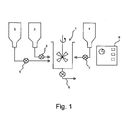
- This plant comprises a mixer 1 able to receive in its tank discontinuously the various granulometric fractions of the granulate including fines from a storage means 2, coarse aggregates from a storage means 3 and a hydrocarbon binder derived from storage means 4.
- An outlet 8 with valve for recovery of the coated product is provided.
- Valves 5, 6 and 7, respectively, make it possible to regulate the dosage of these elements by means of a control means 9 comprising sequential control means for the valves, mixer motor and other elements (for example for tank heating and / or medium heating). storage) of the installation not shown to simplify the Figure.
- the sequencing of the controls allows the realization in two stages of the mix with an intermediate realization of a putty using in the first time a part of the hydrocarbon binder.
- the granules enter continuously into a drum comprising a drying zone comprising means for heating and drying the aggregates.
- the aggregates from the drying zone are coated with the liquid bitumen before being discharged and conveyed to a buffer storage hopper.
- the method of the invention can also be implemented in a continuous position in putting in place a second binder feed circuit and a second injection rod offset from the first injection rod.
- the hydrocarbon-based binder is preferably bitumen, either a mixture of hydrocarbonaceous substances of natural origin derived from the heavy fraction obtained during the distillation of petroleum, or coming from natural deposits in solid or liquid form, with a density of between 0, 8 and 1,2.
- bitumens of the invention may be prepared by any conventional technique. Bitumen within the meaning of the invention are also admitted binders of plant origin such as Vegecol®, marketed by Colas and described in the patent application.
- FR 2,853,647 synthetic binders of petroleum origin such as the range of Bituclair® binders marketed by Colas
- modified bitumens by incorporating additives of any kind, such as additives with a view to improving tack characteristics, liquid additives for the production of reduced temperature asphalt, by incorporation of elastomers, in the form of rubber crumb or the like, or else bitumens improved by the addition of polymers of different types, such as copolymers of ethylene and vinyl acetate, or random or block copolymers of styrene and conjugated dienes, for example SBS block copolymers.
- SBS block copolymers for example SBS block copolymers.
- This first example describes the performances measured in a laboratory formulation study according to a fundamental approach in the sense of the EN 13108-20 standard, that is to say involving the determination of the modulus and fatigue characteristics.
- the three compositions are expressed in kilograms, which makes it possible to verify that the only variable is the total binding of the mixture.
- Granular mixture 6/10 Diorite 360 kg 2/6 Diorite 300 kg 0/2 Diorite 320 kg Filler limestone 20 kg Pure bitumen class 20/30: 57 kg
- This composition corresponds to a total binder dosage of 5.39% by weight, based on the total weight of the hydrocarbon binder and the granular mixture.
- Granular mixture 6/10 Diorite 360 kg 2/6 Diorite 300 kg 0/2 Diorite 320 kg Filler limestone 20 kg Pure bitumen class 20/30: 55 kg
- This second composition corresponds to a total binder dosage of 5.21% by weight, based on the total weight of the hydrocarbon binder and the granular mixture.
- Granular mixture 6/10 Diorite 360 kg 2/6 Diorite 300 kg 0/2 Diorite 320 kg Filler limestone 20 kg Pure bitumen class 20/30: 52 kg
- This third composition corresponds to a total binder dosage of 4.94%.
- the traditional method consists of forming the granular mixture and adding in a single step all of the hydrocarbon binder.
- the granular mixture is heated to 180 ° C.
- all the bitumen is incorporated which is itself at 180 ° C.
- the kneading is carried out for 120 seconds at 180 ° C.
- the process of the invention consists in forming the granular mixture. This granular mixture is brought to 180 ° C.
- the bitumen is stored at 180 ° C. 50% by weight of the determined quantity of bitumen is incorporated in the kneader. It is kneaded for 60 seconds at 180 ° C. The rest of the bitumen (thus 50%) is then incorporated and kneaded again for 60 seconds at 180 ° C.
- each injection of binder in the production corresponds to the introduction of half of the total binder required for the manufacture of the mix.
- Appendix D 15 ° C 0.02s 12900 14000 12500
- Appendix A 15 ° C 10 Hz % of empty specimens 6.5 6.9 6.9 Fatigue resistance (EN 12697-24 March 2005) ⁇ 6 ( ⁇ defs) 115 114 111 % of empty specimens 6 7.4 7.4
- This second example shows the characteristics measured on a control formulation of EME 0/14, incorporating 20% of asphalt aggregates, and on the same mixture prepared by double coating with reduction of the binder content.
- the two compositions are expressed in kilograms, which makes it possible to verify that the only variable is the total binding of the mixture. Only the results of waterproof, PCG maneuverability, module and fatigue resistance are presented
- Granular mixture 10/14 Limestone 315 kg 6/10 Limestone 130 kg 2/6 Limestone 130 kg 0/2 Limestone 200 kg Asphalt aggregates 200 kg Filler limestone 25 kg Pure bitumen of intake of class 10/20: 50 kg Total bitumen (Aggregates + Intake) 60 kg
- This composition corresponds to a total binder dosage of 5.71% by weight, based on the total weight of the hydrocarbon binder and the granular mixture.
- Granular mixture 10/14 Limestone 315 kg 6/10 Limestone 130 kg 2/6 Limestone 130 kg 0/2 Limestone 200 kg Asphalt aggregates 200 kg Filler limestone 25 kg Pure bitumen of intake of class 10/20: 45 kg Total bitumen (Aggregates + Intake) 55 kg
- This composition corresponds to a total binder dosage of 5.27% by weight, based on the total weight of the hydrocarbon binder and the granular mixture.
- This third example describes the performance measured in a laboratory formulation study including the determination of of the PCG maneuverability, Duriez test water resistance and rut resistance, that is to say including the determination of the general characteristics required in the prediction of EN 13108-1 for this type of formulation.
- the three compositions are expressed in kilograms, which makes it possible to verify that the only variable is the total binding of the mixture.
- Granular mixture 6/10 Diorite 680 kg 0/2 Diorite 300 kg Filler limestone 20 kg Binder modified: 55 kg
- This composition corresponds to a total binder dosage of 5.21% by weight, based on the total weight of the hydrocarbon binder and the granular mixture.
- Granular mixture 6/10 Diorite 680 kg 0/2 Diorite 300 kg Filler limestone 20 kg Binder modified: 52 kg
- This second composition corresponds to a total binder dosage of 4.94% by weight, based on the total weight of the hydrocarbon binder and the granular mixture.
- Granular mixture 6/10 Diorite 680 kg 0 / 2Diorite 300 kg Filler limestone 20 kg Binder modified: 50 kg
- This latter composition corresponds to a total binder dosage of 4.76%.
- the laboratory manufacturing process is the same as that of the previous example the only variation on the temperature, adapted to the nature of the modified binder used here, and set at 170 ° C.
Landscapes
- Engineering & Computer Science (AREA)
- Chemical & Material Sciences (AREA)
- Structural Engineering (AREA)
- Ceramic Engineering (AREA)
- Architecture (AREA)
- Civil Engineering (AREA)
- Materials Engineering (AREA)
- Organic Chemistry (AREA)
- Compositions Of Macromolecular Compounds (AREA)
- Road Paving Structures (AREA)
Claims (9)
- Verfahren zur Herstellung eines heißen Mischguts mit einem geringen Gehalt an kohlenwasserstoffhaltigem Binder, wobei das Mischgut eine bestimmte Menge eines kohlenwasserstoffhaltigen Binders und ein Granulatgemisch umfasst, das mindestens Feinanteile, wie beispielsweise Feinstoffe und Grobgranulat, wie beispielsweise Splitt, Kies und/oder Sand, umfasst, wobei das Verfahren mindestens die folgende Abfolge von Schritten umfasst:- erstens, Einmischen, in die Gesamtheit des Granulatgemischs, nur eines ersten Teils der bestimmten Menge an kohlenwasserstoffhaltigem Binder in einem Mischer (1),- Nassmischen um einen Mastix zu bilden,- zweitens, Einmischen der verbleibenden Menge an kohlenwasserstoffhaltigem Binder,- Mischen,
dadurch gekennzeichnet, dass der erste Teil der eingemischten Menge an kohlenwasserstoffhaltigem Binder, in Gewichtsanteilen bezogen auf das Gesamtgewicht der bestimmten Menge an kohlenwasserstoffhaltigem Binder, im Bereich zwischen 30 % und 70 % liegt. - Verfahren nach Anspruch 1, dadurch gekennzeichnet, dass der erste Teil der eingemischten Menge an kohlenwasserstoffhaltigem Binder, in Gewichtsanteilen bezogen auf das Gesamtgewicht der bestimmten Menge an kohlenwasserstoffhaltigem Binder, bevorzugt im Bereich zwischen 40 und 60 % und stärker bevorzugt bei 50 % liegt.
- Verfahren nach Anspruch 1 oder 2, dadurch gekennzeichnet, dass bei beiden Schritten die gleiche Temperatur verwendet wird.
- Verfahren nach einem der vorhergehenden Ansprüche, dadurch gekennzeichnet, dass das Mischgut ausgewählt ist aus Asphaltmischgut mit hohem Steifigkeitsmodul (französische Abkürzung EME = enrobes bitumineux à module élevé), Asphaltbeton mit hohem Steifigkeitsmodul (franz. Abk. BBME = bétons bitumineux à module élevé), mittelgrober Splittmastixasphalt (franz. Abk. BBSG = betons bitumineux semi-grenus), Asphaltbeton für dünne Schichten (franz. Abk. BBM = betons bitumineux minces) und Asphaltbeton für sehr dünne Schichten (franz. Abk. BBTM = betons bitumineux tres minces).
- Verfahren nach einem der vorhergehenden Ansprüche, dadurch gekennzeichnet, dass das Granulatgemisch Mischgutaggregate umfasst.
- Verfahren nach einem der vorhergehenden Ansprüche, dadurch gekennzeichnet, dass der kohlenwasserstoffhaltige Binder einen Penetrationswert bei 25 °C, gemessen gemäß der Norm NF EN 1426, von 0 bis 70 (1/10 mm), bevorzugt von 0 bis 35 (1/10 mm), im Fall von BBME und EME aufweist.
- Verfahren nach Anspruch 4, dadurch gekennzeichnet, dass das Mischgut ein Asphaltbeton mit hohem Steifigkeitsmodul ist, der, in Gewichtsanteilen bezogen auf das Gesamtgewicht des Mischguts, Folgendes umfasst:- 1 bis 5 % Feinstoffe, bevorzugt Kalksteinfüller,- 90 bis 95 % Granulat, bevorzugt Granulat 0/10, und- 4,9 bis 5,25 % kohlenwasserstoffhaltigen Binder, bevorzugt ein reines Bitumen der Klasse 20/30.
- Verfahren nach Anspruch 4, dadurch gekennzeichnet, dass das Mischgut ein Mischgut mit hohem Steifigkeitsmodul ist, das, in Gewichtsanteilen bezogen auf das Gesamtgewicht des Mischguts, Folgendes umfasst:- 1 bis 5 % Feinstoffe, bevorzugt Kalksteinfüller,- 90 bis 95 % Granulat, bevorzugt Granulat 0/14, und- 5 bis 5,3 % kohlenwasserstoffhaltigen Binder, bevorzugt ein reines Bitumen der Klasse 10/20.
- Verfahren nach Anspruch 4, dadurch gekennzeichnet, dass das Mischgut ein Asphaltbeton für dünne Schichten ist, der, in Gewichtsanteilen bezogen auf das Gesamtgewicht des Mischguts, Folgendes umfasst:- 1 bis 5 % Feinstoffe, bevorzugt Kalksteinfüller,- 90 bis 95 % Granulat, bevorzugt Granulat 0/10, und- 4,6 bis 4,9 % kohlenwasserstoffhaltigen Binder, bevorzugt ein polymermodifiziertes Bitumen.
Priority Applications (2)
| Application Number | Priority Date | Filing Date | Title |
|---|---|---|---|
| PL10305419T PL2246473T3 (pl) | 2009-04-22 | 2010-04-21 | Sposób wytwarzania powłoki bitumicznej na gorąco o zmniejszonej zawartości lepiszcza |
| HRP20150914TT HRP20150914T1 (hr) | 2009-04-22 | 2015-09-01 | Postupak za pripravu vruä†e bitumenske mješavine sa smanjenom koliäśinom vezivnog sredstva |
Applications Claiming Priority (1)
| Application Number | Priority Date | Filing Date | Title |
|---|---|---|---|
| FR0952641A FR2944811B1 (fr) | 2009-04-22 | 2009-04-22 | Procede de preparation d'un enrobe a chaud permettant d'obtenir des enrobes comprenant une teneur reduite en liant |
Publications (2)
| Publication Number | Publication Date |
|---|---|
| EP2246473A1 EP2246473A1 (de) | 2010-11-03 |
| EP2246473B1 true EP2246473B1 (de) | 2015-07-15 |
Family
ID=41328654
Family Applications (1)
| Application Number | Title | Priority Date | Filing Date |
|---|---|---|---|
| EP10305419.3A Not-in-force EP2246473B1 (de) | 2009-04-22 | 2010-04-21 | Verfahren zur Herstellung eines heissen Asphaltmischguts mit einem geringen Gehalt an Binder. |
Country Status (6)
| Country | Link |
|---|---|
| EP (1) | EP2246473B1 (de) |
| DK (1) | DK2246473T3 (de) |
| FR (1) | FR2944811B1 (de) |
| HR (1) | HRP20150914T1 (de) |
| HU (1) | HUE027802T2 (de) |
| PL (1) | PL2246473T3 (de) |
Families Citing this family (2)
| Publication number | Priority date | Publication date | Assignee | Title |
|---|---|---|---|---|
| DE102009007301B4 (de) * | 2009-02-03 | 2013-08-22 | Landesbetrieb Straßenbau NRW | Gußasphaltmischgut für Fahrbahndeckschichten |
| CN112252108B (zh) * | 2020-10-23 | 2021-04-20 | 邱旸 | 一种沥青路面就地冷再生的道路施工方法 |
Family Cites Families (6)
| Publication number | Priority date | Publication date | Assignee | Title |
|---|---|---|---|---|
| US4993839A (en) * | 1989-03-20 | 1991-02-19 | Astec Industries, Inc. | Method and apparatus for producing asphaltic mix |
| FR2686630A1 (fr) | 1992-01-24 | 1993-07-30 | Screg Routes & Travaux | Procede de fabrication d'enrobes routiers par double enrobage. |
| DE4308567C1 (de) | 1993-03-18 | 1994-08-25 | Deutag Ag | Verfahren zur Herstellung von Asphaltmischgut |
| NO311140B1 (no) * | 2000-02-25 | 2001-10-15 | Kolo Veidekke As | Prosess og system for produksjon av en lunken skumblandingsasfalt, samt anvendelse av denne |
| SE525421C2 (sv) | 2002-10-11 | 2005-02-15 | Karl Gunnar Ohlson | Förfarande för framställning av asfaltmassor samt anordning för dess genomförande |
| FR2853647B1 (fr) | 2003-04-08 | 2006-06-23 | Colas Sa | Liant de nature vegetale pour la realisation de materiaux pour le batiment et/ou les travaux publics |
-
2009
- 2009-04-22 FR FR0952641A patent/FR2944811B1/fr not_active Expired - Fee Related
-
2010
- 2010-04-21 EP EP10305419.3A patent/EP2246473B1/de not_active Not-in-force
- 2010-04-21 HU HUE10305419A patent/HUE027802T2/en unknown
- 2010-04-21 DK DK10305419.3T patent/DK2246473T3/en active
- 2010-04-21 PL PL10305419T patent/PL2246473T3/pl unknown
-
2015
- 2015-09-01 HR HRP20150914TT patent/HRP20150914T1/hr unknown
Also Published As
| Publication number | Publication date |
|---|---|
| HRP20150914T1 (hr) | 2015-09-25 |
| FR2944811B1 (fr) | 2015-04-17 |
| DK2246473T3 (en) | 2015-10-12 |
| PL2246473T3 (pl) | 2015-11-30 |
| EP2246473A1 (de) | 2010-11-03 |
| HUE027802T2 (en) | 2016-11-28 |
| FR2944811A1 (fr) | 2010-10-29 |
Similar Documents
| Publication | Publication Date | Title |
|---|---|---|
| EP3559136B1 (de) | Gussasphaltzusammensetzung zur herstellung von beschichtungen | |
| EP2576911B1 (de) | Verfahren zur herstellung von kalten bituminösen gemischen, kalte bituminöse gemische mit kontrollierter bearbeitbarkeit und ihre verwendung zur herstellung von strassenpflasterungen | |
| EP3510105B1 (de) | Bitumenzusammensetzung für hochmodulares beschichtetes material | |
| EP3612616B1 (de) | Feste bitumen bei umgebungstemperatur | |
| EP2072562B1 (de) | Verfahren zur Herstellung von Doppelphasen-Mischgut | |
| EP2963000A1 (de) | Zusammensetzung aus agglomeriertem versiegeltem kies für fundamentschicht, die einen grossen bestandteil an grobgranulaten enthält | |
| EP2246473A1 (de) | Verfahren zur Herstellung eines heissen Asphaltmischguts mit einem geringen Gehalt an Binder | |
| EP3898805B1 (de) | Petrolkoks enthaltende beschichtung | |
| FR2927094A1 (fr) | Procede pour fabriquer un enrobe bitumineux avec introduction simultanee du liant et d'une partie des fractions minerales solides dans le melangeur. | |
| EP4314163B1 (de) | Bituminöse bindemittel mit erhöhter beständigkeit gegen chemische angriffe | |
| EP2935442A1 (de) | Bitumenbindezusammensetzung zur herstellung von beschichtungsmaterialien bei tiefen temperaturen | |
| EP3491069B1 (de) | Flussmittel für bituminöse bindemittel | |
| FR3065462A1 (fr) | Procede de preparation de bitume solide a temperature ambiante en lit d’air fluidise | |
| FR3050210A1 (fr) | Procede de preparation d'une composition bitume / polymere presentant des proprietes ameliorees | |
| EP1794234B1 (de) | Verfahren zur herstellung eines festen polymer/bitumen zusammensetzung; feste polymer/bitumen zusammensetzung und daraus erhaltenes bitumen/polymer | |
| EP3898838A1 (de) | Baublock mit petrolkoks | |
| FR2803608A1 (fr) | Enrobe bitumineux a chaud comportant du caoutchouc, procede de fabrication d'un tel enrobe et procede de realisation d'une couche de roulement avec un tel enrobe | |
| EP3440130A1 (de) | Verfahren zur herstellung einer bitumen-/polymerzusammensetzung mit verbesserten eigenschaften | |
| CA3205587A1 (fr) | Compositions pour la realisation de membranes d'etancheite, procedes et membranes associes | |
| EP3464473A1 (de) | Bei raumtemperatur festes bitumen | |
| FR3085169A1 (fr) | Composition bitumineuse thermoreversible | |
| CH694860A5 (fr) | Liant bitumineux pour enrobés à chaud destinés à la réalisation de couches de roulement de chaussées ainsi qu'enrobés à chaud fabriqués à partir d'un tel liant bitumineux. | |
| OA19429A (fr) | Procédé de préparation de bitume solide à température ambiante en lit d'air fluidisé. | |
| WO2024153538A1 (fr) | Liant organo-minéral, composition pour revêtement de voies de circulation, et revêtement routier | |
| CA2807365A1 (fr) | Composition de beton bitumineux et procede pour couche de roulement de chaussee a adherence elevee |
Legal Events
| Date | Code | Title | Description |
|---|---|---|---|
| PUAI | Public reference made under article 153(3) epc to a published international application that has entered the european phase |
Free format text: ORIGINAL CODE: 0009012 |
|
| AK | Designated contracting states |
Kind code of ref document: A1 Designated state(s): AT BE BG CH CY CZ DE DK EE ES FI FR GB GR HR HU IE IS IT LI LT LU LV MC MK MT NL NO PL PT RO SE SI SK SM TR |
|
| AX | Request for extension of the european patent |
Extension state: AL BA ME RS |
|
| 17P | Request for examination filed |
Effective date: 20101013 |
|
| GRAP | Despatch of communication of intention to grant a patent |
Free format text: ORIGINAL CODE: EPIDOSNIGR1 |
|
| RIC1 | Information provided on ipc code assigned before grant |
Ipc: C04B 111/00 20060101ALI20150313BHEP Ipc: C04B 26/26 20060101ALI20150313BHEP Ipc: E01C 7/22 20060101AFI20150313BHEP |
|
| INTG | Intention to grant announced |
Effective date: 20150410 |
|
| GRAS | Grant fee paid |
Free format text: ORIGINAL CODE: EPIDOSNIGR3 |
|
| GRAA | (expected) grant |
Free format text: ORIGINAL CODE: 0009210 |
|
| AK | Designated contracting states |
Kind code of ref document: B1 Designated state(s): AT BE BG CH CY CZ DE DK EE ES FI FR GB GR HR HU IE IS IT LI LT LU LV MC MK MT NL NO PL PT RO SE SI SK SM TR |
|
| REG | Reference to a national code |
Ref country code: CH Ref legal event code: EP Ref country code: GB Ref legal event code: FG4D Free format text: NOT ENGLISH |
|
| REG | Reference to a national code |
Ref country code: IE Ref legal event code: FG4D Free format text: LANGUAGE OF EP DOCUMENT: FRENCH |
|
| REG | Reference to a national code |
Ref country code: AT Ref legal event code: REF Ref document number: 736862 Country of ref document: AT Kind code of ref document: T Effective date: 20150815 |
|
| REG | Reference to a national code |
Ref country code: DE Ref legal event code: R096 Ref document number: 602010025881 Country of ref document: DE |
|
| REG | Reference to a national code |
Ref country code: HR Ref legal event code: TUEP Ref document number: P20150914 Country of ref document: HR |
|
| REG | Reference to a national code |
Ref country code: CH Ref legal event code: NV Representative=s name: KIRKER AND CIE S.A., CH |
|
| REG | Reference to a national code |
Ref country code: HR Ref legal event code: T1PR Ref document number: P20150914 Country of ref document: HR |
|
| REG | Reference to a national code |
Ref country code: DK Ref legal event code: T3 Effective date: 20151006 |
|
| REG | Reference to a national code |
Ref country code: PL Ref legal event code: T3 |
|
| REG | Reference to a national code |
Ref country code: RO Ref legal event code: EPE |
|
| REG | Reference to a national code |
Ref country code: AT Ref legal event code: MK05 Ref document number: 736862 Country of ref document: AT Kind code of ref document: T Effective date: 20150715 |
|
| REG | Reference to a national code |
Ref country code: NL Ref legal event code: MP Effective date: 20150715 |
|
| REG | Reference to a national code |
Ref country code: LT Ref legal event code: MG4D |
|
| PG25 | Lapsed in a contracting state [announced via postgrant information from national office to epo] |
Ref country code: GR Free format text: LAPSE BECAUSE OF FAILURE TO SUBMIT A TRANSLATION OF THE DESCRIPTION OR TO PAY THE FEE WITHIN THE PRESCRIBED TIME-LIMIT Effective date: 20151016 Ref country code: NO Free format text: LAPSE BECAUSE OF FAILURE TO SUBMIT A TRANSLATION OF THE DESCRIPTION OR TO PAY THE FEE WITHIN THE PRESCRIBED TIME-LIMIT Effective date: 20151015 Ref country code: LT Free format text: LAPSE BECAUSE OF FAILURE TO SUBMIT A TRANSLATION OF THE DESCRIPTION OR TO PAY THE FEE WITHIN THE PRESCRIBED TIME-LIMIT Effective date: 20150715 Ref country code: LV Free format text: LAPSE BECAUSE OF FAILURE TO SUBMIT A TRANSLATION OF THE DESCRIPTION OR TO PAY THE FEE WITHIN THE PRESCRIBED TIME-LIMIT Effective date: 20150715 Ref country code: FI Free format text: LAPSE BECAUSE OF FAILURE TO SUBMIT A TRANSLATION OF THE DESCRIPTION OR TO PAY THE FEE WITHIN THE PRESCRIBED TIME-LIMIT Effective date: 20150715 |
|
| REG | Reference to a national code |
Ref country code: SK Ref legal event code: T3 Ref document number: E 19415 Country of ref document: SK |
|
| PG25 | Lapsed in a contracting state [announced via postgrant information from national office to epo] |
Ref country code: PT Free format text: LAPSE BECAUSE OF FAILURE TO SUBMIT A TRANSLATION OF THE DESCRIPTION OR TO PAY THE FEE WITHIN THE PRESCRIBED TIME-LIMIT Effective date: 20151116 Ref country code: SE Free format text: LAPSE BECAUSE OF FAILURE TO SUBMIT A TRANSLATION OF THE DESCRIPTION OR TO PAY THE FEE WITHIN THE PRESCRIBED TIME-LIMIT Effective date: 20150715 Ref country code: ES Free format text: LAPSE BECAUSE OF FAILURE TO SUBMIT A TRANSLATION OF THE DESCRIPTION OR TO PAY THE FEE WITHIN THE PRESCRIBED TIME-LIMIT Effective date: 20150715 Ref country code: AT Free format text: LAPSE BECAUSE OF FAILURE TO SUBMIT A TRANSLATION OF THE DESCRIPTION OR TO PAY THE FEE WITHIN THE PRESCRIBED TIME-LIMIT Effective date: 20150715 |
|
| REG | Reference to a national code |
Ref country code: FR Ref legal event code: PLFP Year of fee payment: 7 |
|
| REG | Reference to a national code |
Ref country code: DE Ref legal event code: R097 Ref document number: 602010025881 Country of ref document: DE |
|
| PG25 | Lapsed in a contracting state [announced via postgrant information from national office to epo] |
Ref country code: EE Free format text: LAPSE BECAUSE OF FAILURE TO SUBMIT A TRANSLATION OF THE DESCRIPTION OR TO PAY THE FEE WITHIN THE PRESCRIBED TIME-LIMIT Effective date: 20150715 Ref country code: IT Free format text: LAPSE BECAUSE OF FAILURE TO SUBMIT A TRANSLATION OF THE DESCRIPTION OR TO PAY THE FEE WITHIN THE PRESCRIBED TIME-LIMIT Effective date: 20150715 |
|
| PLBE | No opposition filed within time limit |
Free format text: ORIGINAL CODE: 0009261 |
|
| STAA | Information on the status of an ep patent application or granted ep patent |
Free format text: STATUS: NO OPPOSITION FILED WITHIN TIME LIMIT |
|
| 26N | No opposition filed |
Effective date: 20160418 |
|
| PG25 | Lapsed in a contracting state [announced via postgrant information from national office to epo] |
Ref country code: IS Free format text: LAPSE BECAUSE OF FAILURE TO SUBMIT A TRANSLATION OF THE DESCRIPTION OR TO PAY THE FEE WITHIN THE PRESCRIBED TIME-LIMIT Effective date: 20150715 |
|
| PG25 | Lapsed in a contracting state [announced via postgrant information from national office to epo] |
Ref country code: SI Free format text: LAPSE BECAUSE OF FAILURE TO SUBMIT A TRANSLATION OF THE DESCRIPTION OR TO PAY THE FEE WITHIN THE PRESCRIBED TIME-LIMIT Effective date: 20150715 |
|
| REG | Reference to a national code |
Ref country code: DE Ref legal event code: R119 Ref document number: 602010025881 Country of ref document: DE |
|
| REG | Reference to a national code |
Ref country code: HU Ref legal event code: AG4A Ref document number: E027802 Country of ref document: HU |
|
| PG25 | Lapsed in a contracting state [announced via postgrant information from national office to epo] |
Ref country code: LU Free format text: LAPSE BECAUSE OF FAILURE TO SUBMIT A TRANSLATION OF THE DESCRIPTION OR TO PAY THE FEE WITHIN THE PRESCRIBED TIME-LIMIT Effective date: 20160421 |
|
| REG | Reference to a national code |
Ref country code: IE Ref legal event code: MM4A |
|
| PG25 | Lapsed in a contracting state [announced via postgrant information from national office to epo] |
Ref country code: RO Free format text: LAPSE BECAUSE OF NON-PAYMENT OF DUE FEES Effective date: 20150715 Ref country code: DE Free format text: LAPSE BECAUSE OF NON-PAYMENT OF DUE FEES Effective date: 20161101 |
|
| REG | Reference to a national code |
Ref country code: FR Ref legal event code: PLFP Year of fee payment: 8 |
|
| PG25 | Lapsed in a contracting state [announced via postgrant information from national office to epo] |
Ref country code: IE Free format text: LAPSE BECAUSE OF NON-PAYMENT OF DUE FEES Effective date: 20160421 |
|
| PG25 | Lapsed in a contracting state [announced via postgrant information from national office to epo] |
Ref country code: NL Free format text: LAPSE BECAUSE OF FAILURE TO SUBMIT A TRANSLATION OF THE DESCRIPTION OR TO PAY THE FEE WITHIN THE PRESCRIBED TIME-LIMIT Effective date: 20150715 |
|
| REG | Reference to a national code |
Ref country code: FR Ref legal event code: PLFP Year of fee payment: 9 |
|
| REG | Reference to a national code |
Ref country code: HR Ref legal event code: ODRP Ref document number: P20150914 Country of ref document: HR Payment date: 20180511 Year of fee payment: 9 |
|
| PG25 | Lapsed in a contracting state [announced via postgrant information from national office to epo] |
Ref country code: SM Free format text: LAPSE BECAUSE OF FAILURE TO SUBMIT A TRANSLATION OF THE DESCRIPTION OR TO PAY THE FEE WITHIN THE PRESCRIBED TIME-LIMIT Effective date: 20150715 Ref country code: CY Free format text: LAPSE BECAUSE OF FAILURE TO SUBMIT A TRANSLATION OF THE DESCRIPTION OR TO PAY THE FEE WITHIN THE PRESCRIBED TIME-LIMIT Effective date: 20150715 |
|
| PG25 | Lapsed in a contracting state [announced via postgrant information from national office to epo] |
Ref country code: MT Free format text: LAPSE BECAUSE OF FAILURE TO SUBMIT A TRANSLATION OF THE DESCRIPTION OR TO PAY THE FEE WITHIN THE PRESCRIBED TIME-LIMIT Effective date: 20150715 Ref country code: MC Free format text: LAPSE BECAUSE OF FAILURE TO SUBMIT A TRANSLATION OF THE DESCRIPTION OR TO PAY THE FEE WITHIN THE PRESCRIBED TIME-LIMIT Effective date: 20150715 Ref country code: MK Free format text: LAPSE BECAUSE OF FAILURE TO SUBMIT A TRANSLATION OF THE DESCRIPTION OR TO PAY THE FEE WITHIN THE PRESCRIBED TIME-LIMIT Effective date: 20150715 Ref country code: TR Free format text: LAPSE BECAUSE OF FAILURE TO SUBMIT A TRANSLATION OF THE DESCRIPTION OR TO PAY THE FEE WITHIN THE PRESCRIBED TIME-LIMIT Effective date: 20150715 |
|
| PG25 | Lapsed in a contracting state [announced via postgrant information from national office to epo] |
Ref country code: BG Free format text: LAPSE BECAUSE OF FAILURE TO SUBMIT A TRANSLATION OF THE DESCRIPTION OR TO PAY THE FEE WITHIN THE PRESCRIBED TIME-LIMIT Effective date: 20150715 |
|
| PGFP | Annual fee paid to national office [announced via postgrant information from national office to epo] |
Ref country code: CH Payment date: 20180430 Year of fee payment: 9 Ref country code: CZ Payment date: 20180517 Year of fee payment: 9 Ref country code: DK Payment date: 20180430 Year of fee payment: 9 Ref country code: HR Payment date: 20180511 Year of fee payment: 9 |
|
| PGFP | Annual fee paid to national office [announced via postgrant information from national office to epo] |
Ref country code: BE Payment date: 20180426 Year of fee payment: 9 Ref country code: PL Payment date: 20180426 Year of fee payment: 9 |
|
| PGFP | Annual fee paid to national office [announced via postgrant information from national office to epo] |
Ref country code: HU Payment date: 20180515 Year of fee payment: 9 |
|
| PGFP | Annual fee paid to national office [announced via postgrant information from national office to epo] |
Ref country code: GB Payment date: 20180426 Year of fee payment: 9 |
|
| PGFP | Annual fee paid to national office [announced via postgrant information from national office to epo] |
Ref country code: SK Payment date: 20180904 Year of fee payment: 9 |
|
| REG | Reference to a national code |
Ref country code: BE Ref legal event code: PD Owner name: COLAS; FR Free format text: DETAILS ASSIGNMENT: CHANGE OF OWNER(S), AUTRE, ADRESSE; FORMER OWNER NAME: COLAS Effective date: 20190109 |
|
| REG | Reference to a national code |
Ref country code: HU Ref legal event code: HC9C Owner name: COLAS, FR Free format text: FORMER OWNER(S): COLAS, FR |
|
| PGFP | Annual fee paid to national office [announced via postgrant information from national office to epo] |
Ref country code: FR Payment date: 20190301 Year of fee payment: 10 |
|
| REG | Reference to a national code |
Ref country code: CH Ref legal event code: PCOW Free format text: NEW ADDRESS: 1, RUE DU COLONEL PIERRE AVIA, 75015 PARIS (FR) |
|
| REG | Reference to a national code |
Ref country code: HR Ref legal event code: PNAN Ref document number: P20150914 Country of ref document: HR Owner name: COLAS, FR |
|
| REG | Reference to a national code |
Ref country code: SK Ref legal event code: TE4A Ref document number: E 19415 Country of ref document: SK Owner name: COLAS, PARIS, FR Effective date: 20190828 |
|
| REG | Reference to a national code |
Ref country code: HR Ref legal event code: PBON Ref document number: P20150914 Country of ref document: HR Effective date: 20190421 |
|
| REG | Reference to a national code |
Ref country code: CH Ref legal event code: PL |
|
| REG | Reference to a national code |
Ref country code: DK Ref legal event code: EBP Effective date: 20190430 |
|
| REG | Reference to a national code |
Ref country code: BE Ref legal event code: MM Effective date: 20190430 |
|
| GBPC | Gb: european patent ceased through non-payment of renewal fee |
Effective date: 20190421 |
|
| REG | Reference to a national code |
Ref country code: SK Ref legal event code: MM4A Ref document number: E 19415 Country of ref document: SK Effective date: 20190421 |
|
| PG25 | Lapsed in a contracting state [announced via postgrant information from national office to epo] |
Ref country code: CH Free format text: LAPSE BECAUSE OF NON-PAYMENT OF DUE FEES Effective date: 20190430 Ref country code: SK Free format text: LAPSE BECAUSE OF NON-PAYMENT OF DUE FEES Effective date: 20190421 Ref country code: CZ Free format text: LAPSE BECAUSE OF NON-PAYMENT OF DUE FEES Effective date: 20190421 Ref country code: LI Free format text: LAPSE BECAUSE OF NON-PAYMENT OF DUE FEES Effective date: 20190430 Ref country code: HR Free format text: LAPSE BECAUSE OF NON-PAYMENT OF DUE FEES Effective date: 20190421 Ref country code: GB Free format text: LAPSE BECAUSE OF NON-PAYMENT OF DUE FEES Effective date: 20190421 Ref country code: HU Free format text: LAPSE BECAUSE OF NON-PAYMENT OF DUE FEES Effective date: 20190422 |
|
| PG25 | Lapsed in a contracting state [announced via postgrant information from national office to epo] |
Ref country code: BE Free format text: LAPSE BECAUSE OF NON-PAYMENT OF DUE FEES Effective date: 20190430 |
|
| PG25 | Lapsed in a contracting state [announced via postgrant information from national office to epo] |
Ref country code: DK Free format text: LAPSE BECAUSE OF NON-PAYMENT OF DUE FEES Effective date: 20190430 |
|
| PG25 | Lapsed in a contracting state [announced via postgrant information from national office to epo] |
Ref country code: FR Free format text: LAPSE BECAUSE OF NON-PAYMENT OF DUE FEES Effective date: 20200430 |
|
| PG25 | Lapsed in a contracting state [announced via postgrant information from national office to epo] |
Ref country code: PL Free format text: LAPSE BECAUSE OF NON-PAYMENT OF DUE FEES Effective date: 20190421 |