EP2246580A1 - Commande de l'alimentation de lubrifiant d'un palier lisse et dispositif correspondant - Google Patents
Commande de l'alimentation de lubrifiant d'un palier lisse et dispositif correspondant Download PDFInfo
- Publication number
- EP2246580A1 EP2246580A1 EP09005871A EP09005871A EP2246580A1 EP 2246580 A1 EP2246580 A1 EP 2246580A1 EP 09005871 A EP09005871 A EP 09005871A EP 09005871 A EP09005871 A EP 09005871A EP 2246580 A1 EP2246580 A1 EP 2246580A1
- Authority
- EP
- European Patent Office
- Prior art keywords
- sliding bearing
- lubricant
- friction
- detection device
- signals
- Prior art date
- Legal status (The legal status is an assumption and is not a legal conclusion. Google has not performed a legal analysis and makes no representation as to the accuracy of the status listed.)
- Withdrawn
Links
- 239000000314 lubricant Substances 0.000 title claims abstract description 61
- 238000001514 detection method Methods 0.000 claims abstract description 30
- 238000000034 method Methods 0.000 claims abstract description 21
- 230000001419 dependent effect Effects 0.000 claims abstract description 6
- 230000001050 lubricating effect Effects 0.000 claims description 13
- 239000007788 liquid Substances 0.000 claims description 11
- 238000011156 evaluation Methods 0.000 claims description 7
- 239000012530 fluid Substances 0.000 claims description 4
- 230000007704 transition Effects 0.000 claims description 2
- 238000005538 encapsulation Methods 0.000 claims 1
- 238000012544 monitoring process Methods 0.000 abstract description 2
- 230000002265 prevention Effects 0.000 abstract 1
- 230000001276 controlling effect Effects 0.000 description 6
- 238000005461 lubrication Methods 0.000 description 6
- 230000006399 behavior Effects 0.000 description 5
- 230000032683 aging Effects 0.000 description 2
- 238000010586 diagram Methods 0.000 description 2
- 238000011089 mechanical engineering Methods 0.000 description 2
- 239000002184 metal Substances 0.000 description 2
- 230000001105 regulatory effect Effects 0.000 description 2
- 230000005236 sound signal Effects 0.000 description 2
- 230000003068 static effect Effects 0.000 description 2
- 230000006978 adaptation Effects 0.000 description 1
- 230000018109 developmental process Effects 0.000 description 1
- 238000003745 diagnosis Methods 0.000 description 1
- 230000004044 response Effects 0.000 description 1
- 238000009420 retrofitting Methods 0.000 description 1
- 238000001228 spectrum Methods 0.000 description 1
Images
Classifications
-
- F—MECHANICAL ENGINEERING; LIGHTING; HEATING; WEAPONS; BLASTING
- F16—ENGINEERING ELEMENTS AND UNITS; GENERAL MEASURES FOR PRODUCING AND MAINTAINING EFFECTIVE FUNCTIONING OF MACHINES OR INSTALLATIONS; THERMAL INSULATION IN GENERAL
- F16C—SHAFTS; FLEXIBLE SHAFTS; ELEMENTS OR CRANKSHAFT MECHANISMS; ROTARY BODIES OTHER THAN GEARING ELEMENTS; BEARINGS
- F16C17/00—Sliding-contact bearings for exclusively rotary movement
- F16C17/12—Sliding-contact bearings for exclusively rotary movement characterised by features not related to the direction of the load
- F16C17/24—Sliding-contact bearings for exclusively rotary movement characterised by features not related to the direction of the load with devices affected by abnormal or undesired positions, e.g. for preventing overheating, for safety
-
- F—MECHANICAL ENGINEERING; LIGHTING; HEATING; WEAPONS; BLASTING
- F01—MACHINES OR ENGINES IN GENERAL; ENGINE PLANTS IN GENERAL; STEAM ENGINES
- F01M—LUBRICATING OF MACHINES OR ENGINES IN GENERAL; LUBRICATING INTERNAL COMBUSTION ENGINES; CRANKCASE VENTILATING
- F01M1/00—Pressure lubrication
- F01M1/18—Indicating or safety devices
-
- F—MECHANICAL ENGINEERING; LIGHTING; HEATING; WEAPONS; BLASTING
- F16—ENGINEERING ELEMENTS AND UNITS; GENERAL MEASURES FOR PRODUCING AND MAINTAINING EFFECTIVE FUNCTIONING OF MACHINES OR INSTALLATIONS; THERMAL INSULATION IN GENERAL
- F16C—SHAFTS; FLEXIBLE SHAFTS; ELEMENTS OR CRANKSHAFT MECHANISMS; ROTARY BODIES OTHER THAN GEARING ELEMENTS; BEARINGS
- F16C33/00—Parts of bearings; Special methods for making bearings or parts thereof
- F16C33/02—Parts of sliding-contact bearings
- F16C33/04—Brasses; Bushes; Linings
- F16C33/06—Sliding surface mainly made of metal
- F16C33/10—Construction relative to lubrication
-
- F—MECHANICAL ENGINEERING; LIGHTING; HEATING; WEAPONS; BLASTING
- F16—ENGINEERING ELEMENTS AND UNITS; GENERAL MEASURES FOR PRODUCING AND MAINTAINING EFFECTIVE FUNCTIONING OF MACHINES OR INSTALLATIONS; THERMAL INSULATION IN GENERAL
- F16N—LUBRICATING
- F16N29/00—Special means in lubricating arrangements or systems providing for the indication or detection of undesired conditions; Use of devices responsive to conditions in lubricating arrangements or systems
-
- G—PHYSICS
- G01—MEASURING; TESTING
- G01M—TESTING STATIC OR DYNAMIC BALANCE OF MACHINES OR STRUCTURES; TESTING OF STRUCTURES OR APPARATUS, NOT OTHERWISE PROVIDED FOR
- G01M13/00—Testing of machine parts
- G01M13/04—Bearings
- G01M13/045—Acoustic or vibration analysis
Definitions
- the invention relates to a method for controlling the lubricant supply of a sliding bearing with a controlled by a control unit metering device for the lubricant and a detection device for detecting acoustic emissions and a device for this purpose and a sliding bearing with such a device.
- Lubricated sliding bearings are essential components in mechanical engineering, especially in large machines such as large diesel engines such as marine diesel engines, turbines, paper making machines, printing machines and the like.
- the sliding bearing components are rotated on a lubricating film.
- the plain bearings are operated by appropriate provision of lubricant in a frictional state of the liquid friction by means of a lubricating film. If this is used up, the sliding bearing moves from a friction state of the liquid friction into a state of mixed friction, which leads to rapid wear between the components of the sliding bearing which are rotated relative to one another and finally to the failure of the sliding bearing.
- a diagnosis of the frictional behavior of sliding couples by means of a sound emission analysis is from the publication Storm, A .; Uhlemann, S .: “Diagnostics on sliding pairings by acoustic emission analysis” in Mechanical Engineering 34 (1985), No. 3, pages 129-132 known. It shows how disturbances of sliding pairings can be differentiated by means of a changed sound emission behavior compared to a perfect sliding pairing. Measures to prevent the disturbances are not explicitly shown.
- the object is achieved by a method for controlling the lubricant supply of a slide bearing with a controlled by a control unit metering device for the lubricant and a detection device for detecting acoustic emissions, wherein detected by the control unit from the detection device detected, dependent on friction conditions of the sliding bearing signals, a control signal is controlled and by means of the control signal, the metering device.
- the method uses directly generated by acoustic emissions, characteristic of the friction state of the sliding bearing structure-borne sound signals to control the lubricant supply.
- an evaluation of these structure-borne noise signals by the detection device for example by comparison with empirical data an imminent leaving a frictional state with liquid friction, ie a loss of lubricant formed by the lubricant between the two mutually rotatable components of the sliding bearing formed lubricant film is detected.
- the temperature of the bearing or of a lubricant outflow can be determined. Should this be above a predetermined value of an operating temperature without wear, emergency measures can be initiated, for example, a warning signal and / or an unregulated by the process supply of lubricant can take place.
- control of the lubricant supply in particular a “control” with a for the supply of the lubricant from the structure-borne sound signals and, where appropriate, further influencing variables determined control variable is to be understood in a control loop.
- control unit an electronic unit that may include hardware and software components that can perform the necessary for controlling the metering arithmetic operations, via inputs at least for the detection device and outputs for controlling the metering devices and optionally storage devices for storing relevant data and display devices for displaying and printing relevant information.
- the metering device may include a pressure supply device, such as a pump, which pressurizes the lubricant.
- the pressure medium thus compressed is added to the sliding bearing in the dosing device, for example by means of an oiler or a supply channel, wherein the pressure supply device can be followed by a valve which is controlled by the control unit.
- the pressure generated by the pressure supply device can be set by the control unit directly at the pressure supply device.
- Other types of wiring and execution of the metering device are encompassed by the invention.
- a friction state of the slide bearing takes place in an advantageous manner on the basis of sound emissions, which are detected intermittently, for example, continuously or at short intervals by means of the detection device.
- a transition of the sliding bearing is determined by a friction state of a mixed friction in a friction state of a fluid friction by the discrete acoustic emission phenomena are assigned to the individual friction states.
- the development of the coefficient of friction on the relative speed of the mutually rotating components of a sliding bearing - represented for example by the Stribeck curve - are represented by the individual pairings of the friction coefficient and the relative velocity is associated with a sound emission behavior, so that depending on the type of noise emissions, a frictional state the liquid friction with intact lubricating film and a mixed friction with a dissolving lubricating film and an intermediate Ausklinkddling can be detected and determined.
- the determination of the control signal can be done by comparing empirically determined and stored in a memory reference signals with currently detected by the detection device signals.
- sound emission quantities determined as reference signals in the new state can be stored in a memory or as a formula, which are compared with current signals of the detection device for detecting acoustic emissions.
- the reference values can be adapted by adaptation to the aging state of the slide bearing, for example, by laying an aging-typical acoustic emission behavior over the service life of the sliding bearing.
- the detection device for detecting the sound emissions may be formed from one or more, for example, connected to an array sound sensors. It has proved due to the occurring, typical for the change of friction conditions frequencies detection of acoustic emissions in the ultrasonic range to be advantageous. It is therefore preferred to use one or more ultrasonic sensors. Preferably, sound emissions are included at frequencies in a frequency range of 20 kHz to 500 kHz, preferably 50 kHz to 150 kHz. In an advantageous manner, an evaluation of the sound emissions by means of a fast Fourier analysis can be carried out to determine the control signals for the metering device. In this case, it can be limited to one or more reference frequencies of the Fourier spectrum, so that in correspondingly short evaluation rates with associated short control paths in real time or only a small dead time lubricant can be replenished if necessary.
- the object is further achieved by a device for controlling the lubricant supply of a sliding bearing with a controlled by a control unit metering device for lubricating the sliding bearing, a detection device for detecting acoustic emissions, by means of the inventive method described above is performed.
- a detection device for detecting acoustic emissions by means of the inventive method described above is performed.
- the sensor or sensors for detecting the acoustic emissions are arranged adjacent to the sliding bearing. It has been found that the detection of the signals of the sound emissions can also be carried out sufficiently, if the sensors are not arranged directly on the sliding bearing. Consequently, the plain bearings without structural restrictions be provided with such a device, which allows a wide free creative possibility of new bearings and the retrofitting already built plain bearings. Furthermore, plain bearings can be completely enclosed, for example provided without cable bushings and the like. An arrangement of a detection device outside the enclosure is particularly advantageous.
- a sliding bearing with two components rotatable coaxially to each other, wherein between the two components a lubricating film formed of lubricant is provided and the sliding bearing has a device for supplying lubricant as previously described.
- a sliding bearing can advantageously be large in size and used in corresponding applications such as diesel engines, turbines, generators and other machines. These may, for example, have a stationary bearing sleeve and a shaft rotating in it, wherein the shaft diameter of the shaft may be greater than 50 mm.
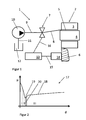
- FIG. 1 shows a device 1 for controlling a lubricant supply of the sliding bearing 2.
- the formed of a bearing sleeve 3 and a rotating shaft 4 in this slide bearing 2 has a lubricating gap 5, in which forms a lubricant film with sufficient amount of lubricant on which the shaft 4 in the bearing sleeve 3, which may be formed for example from two bearing shells, slides.
- existing lubricant layers in which the lubricant can be stored and allow the emergency running properties in the absence of lubricant with respect to metal / metal friction reduced coefficient of friction are not shown.
- the sliding bearing 2 is accommodated on a housing 6 and can be encapsulated with respect to this.
- the sliding bearing is supplied with lubricant by means of the metering device 7, which may be a hydraulic valve such as a stepped or proportional valve. It is preferred between the metering device 7 and the lubrication gap 5, preferably via a opening into the lubrication gap 5, provided in the bearing sleeve 3 pressure port a dosing. 8 provided, which presses the lubricant under pressure into the lubrication gap.
- the lubricant is supplied to the metering device 7 via the pressure line 9, which is connected at its other side to the pressure supply device 10, for example a hydraulic pump.
- the pressure supply device 10 may be provided centrally for several of the metering devices 7 for supplying a plurality of plain bearings 2 with lubricant. Via the suction line 11, the lubricant is sucked from a lubricant reservoir 12.
- the lubricant can be oil, a hydraulic fluid or another fluid with a viscosity adapted to the operating temperature of the sliding bearing 2.
- the control of the metering device 7 by means of the control unit 13, which reads in via the data line 15, which may be a wire or radio line, signals of the detection device 14 and processes.
- the detection device is preferably spaced from the sliding bearing 2, for example - as shown here - arranged on the housing 6.
- the detection device 14 detects sound emissions in the ultrasonic range and transmits them to the control unit 13.
- the control unit 13 and the detection device 14 may be integrally formed.
- the signals transmitted by the detection device 14 are processed and a control signal is determined which controls the metering device 7, ie the inflow of lubricant via the metering line 8 into the lubrication gap 5 via the control line 16.
- FIG. 2 shows the graph 17 with a graph 18, which represents an embodiment of a typical dependence of the coefficient of friction ⁇ of the lubricant film thickness d and which is similar in shape to the Stribeck curve, in contrast, the coefficient of friction ⁇ against the relative speed of the two mutually rotatable components a sliding bearing reproduces.
- the coefficient of friction ⁇ in the frictional state of the static friction region I is determined by a wear-induced static friction, while in the mixed friction region II adhesion and liquid friction is observed, which still causes a strong increase in temperature with an associated increased wear of the sliding linings of the sliding bearing 2.
- the mixed friction is in the state of friction with liquid friction on, which is referred to as liquid friction region III.
- the lubricating properties of the sliding bearing 2 are ideal.
- the friction coefficient ⁇ increases as a result of hydrodynamic friction, so that operation of the sliding bearing with large lubricant film thicknesses d considerably reduces the efficiency of the sliding bearing.
- the lubricant supply can be controlled so that the lubricating film thickness d regulated to the Ausklinkddling 19 become.
- the lubricating film can be adjusted to a lubricant film thickness d in the control range 20, in which the hydrodynamic friction is still low, but a drifting of the control into a wear-prone mixed friction is excluded.
- the corresponding signals of the sound emissions are detected by the detection device 14 and evaluated in the control unit 13.
- relatively determined signals of the detection device 14 can be calibrated or adjusted by means of reference signals stored in the control unit 13.
- the reference signals may be empirically determined, estimated or simulated by models signals that can be tracked according to the aging state of the sliding bearing.
Landscapes
- Engineering & Computer Science (AREA)
- General Engineering & Computer Science (AREA)
- Mechanical Engineering (AREA)
- Physics & Mathematics (AREA)
- Acoustics & Sound (AREA)
- General Physics & Mathematics (AREA)
- Sliding-Contact Bearings (AREA)
Priority Applications (1)
| Application Number | Priority Date | Filing Date | Title |
|---|---|---|---|
| EP09005871A EP2246580A1 (fr) | 2009-04-28 | 2009-04-28 | Commande de l'alimentation de lubrifiant d'un palier lisse et dispositif correspondant |
Applications Claiming Priority (1)
| Application Number | Priority Date | Filing Date | Title |
|---|---|---|---|
| EP09005871A EP2246580A1 (fr) | 2009-04-28 | 2009-04-28 | Commande de l'alimentation de lubrifiant d'un palier lisse et dispositif correspondant |
Publications (1)
| Publication Number | Publication Date |
|---|---|
| EP2246580A1 true EP2246580A1 (fr) | 2010-11-03 |
Family
ID=41118854
Family Applications (1)
| Application Number | Title | Priority Date | Filing Date |
|---|---|---|---|
| EP09005871A Withdrawn EP2246580A1 (fr) | 2009-04-28 | 2009-04-28 | Commande de l'alimentation de lubrifiant d'un palier lisse et dispositif correspondant |
Country Status (1)
| Country | Link |
|---|---|
| EP (1) | EP2246580A1 (fr) |
Cited By (5)
| Publication number | Priority date | Publication date | Assignee | Title |
|---|---|---|---|---|
| CN105531576A (zh) * | 2013-09-12 | 2016-04-27 | 西门子公司 | 用于监测技术上的装置、如机器或设备的方法和布置 |
| WO2021104748A1 (fr) * | 2019-11-25 | 2021-06-03 | Zf Friedrichshafen Ag | Palier lisse autoréparant |
| DE102013021676B4 (de) | 2013-12-18 | 2022-04-21 | Fraunhofer-Gesellschaft zur Förderung der angewandten Forschung e.V. | Gleitlagerung für eine Umformmaschine |
| DE102012100574B4 (de) | 2011-07-27 | 2022-05-12 | Schuler Pressen Gmbh | Presse mit einer pressenzustandsabhängigen Gleitlagerschmierung und Verfahren zu deren Betrieb |
| DE112021001477B4 (de) | 2020-12-09 | 2026-05-07 | Nikolay Ovcharenko | Verfahren zur steuerung des betriebs eines gleitlagers mittels der temperatur und gleitlager zu seiner durchführung |
Citations (6)
| Publication number | Priority date | Publication date | Assignee | Title |
|---|---|---|---|---|
| DE2904060A1 (de) * | 1979-02-02 | 1980-08-14 | Loher Gmbh | Nachschmiereinrichtung fuer waelzlager |
| US5350040A (en) * | 1992-02-12 | 1994-09-27 | Gribble Douglas L | Vibration monitoring lubrication device |
| DE19722970A1 (de) * | 1997-05-31 | 1998-12-10 | Rebs Zentralschmiertech Gmbh | Vorrichtung zum Verteilen eines Schmierstoff-Luft-Gemischs auf verschiedene Schmierkanäle des Maschinengehäuses |
| US6339961B1 (en) * | 1996-11-15 | 2002-01-22 | Ue Systems, Inc. | Ultrasonic detecting lubrication apparatus with acoustically isolated transducer |
| WO2002061297A1 (fr) | 2001-02-02 | 2002-08-08 | Alstom (Switzerland) Ltd. | Procede et dispositif pour surveiller le fonctionnement d'un palier lisse |
| DE102006051441A1 (de) * | 2006-10-31 | 2008-05-08 | Siemens Ag | Mechanische Einrichtung mit Schmiermittelsensor für schmiermittelmengenunabhängige Eigenschaft des Schmiermittels |
-
2009
- 2009-04-28 EP EP09005871A patent/EP2246580A1/fr not_active Withdrawn
Patent Citations (6)
| Publication number | Priority date | Publication date | Assignee | Title |
|---|---|---|---|---|
| DE2904060A1 (de) * | 1979-02-02 | 1980-08-14 | Loher Gmbh | Nachschmiereinrichtung fuer waelzlager |
| US5350040A (en) * | 1992-02-12 | 1994-09-27 | Gribble Douglas L | Vibration monitoring lubrication device |
| US6339961B1 (en) * | 1996-11-15 | 2002-01-22 | Ue Systems, Inc. | Ultrasonic detecting lubrication apparatus with acoustically isolated transducer |
| DE19722970A1 (de) * | 1997-05-31 | 1998-12-10 | Rebs Zentralschmiertech Gmbh | Vorrichtung zum Verteilen eines Schmierstoff-Luft-Gemischs auf verschiedene Schmierkanäle des Maschinengehäuses |
| WO2002061297A1 (fr) | 2001-02-02 | 2002-08-08 | Alstom (Switzerland) Ltd. | Procede et dispositif pour surveiller le fonctionnement d'un palier lisse |
| DE102006051441A1 (de) * | 2006-10-31 | 2008-05-08 | Siemens Ag | Mechanische Einrichtung mit Schmiermittelsensor für schmiermittelmengenunabhängige Eigenschaft des Schmiermittels |
Non-Patent Citations (1)
| Title |
|---|
| STURM, A.; UHLEMANN, S.: "Diagnostik an Gleitpaarungen durch Schallemissionsanalyse", MASCHINENBAUTECHNIK, vol. 34, no. 3, 1985, pages 129 - 132 |
Cited By (5)
| Publication number | Priority date | Publication date | Assignee | Title |
|---|---|---|---|---|
| DE102012100574B4 (de) | 2011-07-27 | 2022-05-12 | Schuler Pressen Gmbh | Presse mit einer pressenzustandsabhängigen Gleitlagerschmierung und Verfahren zu deren Betrieb |
| CN105531576A (zh) * | 2013-09-12 | 2016-04-27 | 西门子公司 | 用于监测技术上的装置、如机器或设备的方法和布置 |
| DE102013021676B4 (de) | 2013-12-18 | 2022-04-21 | Fraunhofer-Gesellschaft zur Förderung der angewandten Forschung e.V. | Gleitlagerung für eine Umformmaschine |
| WO2021104748A1 (fr) * | 2019-11-25 | 2021-06-03 | Zf Friedrichshafen Ag | Palier lisse autoréparant |
| DE112021001477B4 (de) | 2020-12-09 | 2026-05-07 | Nikolay Ovcharenko | Verfahren zur steuerung des betriebs eines gleitlagers mittels der temperatur und gleitlager zu seiner durchführung |
Similar Documents
| Publication | Publication Date | Title |
|---|---|---|
| DE602004012500T2 (de) | Verfahren zur Diagnose eines zyklischen Systems | |
| EP1423827B1 (fr) | Dispositif et procede de detection precoce et de prediction de deteriorations d'unites | |
| DE102010050619B4 (de) | Verfahren zum Bestimmen einer einsetzenden vollen Einrückung einer Reibungskupplung und Verfahren zum Bestimmen eines Gefüllt-Zustandes eines Hydraulikzylinders zum Betätigen dieser | |
| DE102007017823B4 (de) | Turbolader mit einer Einrichtung zum Feststellen einer Fehlfunktion des Turboladers und ein Verfahren zum Feststellen einer solchen Fehlfunktion | |
| DE112008001779T5 (de) | Motorvorschmiersystem | |
| DE112014000544T5 (de) | Virtueller Filterzustandssensor | |
| AT511148A2 (de) | Arbeitsfahrzeug, arbeitsmaschine und verfahren zur reduktion parasitärer lasten während des anlaufens | |
| DE102010061093A1 (de) | System zum Steuern des hydraulischen Drucks und des Volumenstroms von Öl in einem Motor und Steuerungsverfahren davon | |
| WO2009006927A1 (fr) | Procédé en vue d'éviter le fonctionnement à sec d'une pompe centrifuge, module de surveillance de pompe et système | |
| WO2019120870A1 (fr) | Ensemble de palier lisse pour un arbre lourd, en particulier d'une éolienne, ainsi que système de commande et procédé d'alimentation en huile de lubrification dudit ensemble | |
| DE102011115650B4 (de) | Verfahren zur Diagnose des Zustandes einer hydrostatischen Verdrängermaschine und hydraulische Anordnung mit hydrostatischer Verdrängermaschine | |
| EP2246580A1 (fr) | Commande de l'alimentation de lubrifiant d'un palier lisse et dispositif correspondant | |
| DE102019117820A1 (de) | Verfahren und Vorrichtung zur Zustandsüberwachung einer Hydraulikpumpe | |
| WO2002061297A1 (fr) | Procede et dispositif pour surveiller le fonctionnement d'un palier lisse | |
| EP1268075B1 (fr) | Centrifugeuse a jet libre avec moyens de surveillance, et procede de surveillance de cette centrifugeuse | |
| DE102020127285B3 (de) | Verfahren zur Feststellung von Leckagen einer Verdrängerpumpe | |
| DE102015111829A1 (de) | Wälzlageranordnung und Schmiereinheit | |
| DE102008063924A1 (de) | Verfahren zur Erkennung von Fehlern und Zuordnung zu Fehlerursachen in einem hydrostatischen System und entsprechendes Steuergerät | |
| DE102008063925B4 (de) | Verfahren zur Ermittlung einer Restlebensdauer einer hydrostatischen Maschine und Steuergerät | |
| DE102020200388A1 (de) | Vorrichtung und Verfahren zum Ermitteln des Beladezustands eines Filters | |
| DE102020133020A1 (de) | Verfahren zur Überwachung eines elektrohydrostatischen Aktuators | |
| DE102010051290A1 (de) | Regelvorrichtung für eine Umlaufschmierung | |
| DE102005032636A1 (de) | Verfahren und Vorrichtung zur Erkennung von Fehlern in einem Kraftstoffversorgungssystem eines Kraftfahrzeugs | |
| DE102015219152B4 (de) | Schwingungsdämpfer für eine Kraftstoffhochdruckpumpe, Kraftstoffhochdruckpumpe mit Schwingungsdämpfer und Verfahren zur Steuerung eines solchen Schwingungsdämpfers | |
| DE102011119769B4 (de) | Aggregatsystem und Verfahren zum Betreiben eines Aggregatsystems |
Legal Events
| Date | Code | Title | Description |
|---|---|---|---|
| PUAI | Public reference made under article 153(3) epc to a published international application that has entered the european phase |
Free format text: ORIGINAL CODE: 0009012 |
|
| AK | Designated contracting states |
Kind code of ref document: A1 Designated state(s): AT BE BG CH CY CZ DE DK EE ES FI FR GB GR HR HU IE IS IT LI LT LU LV MC MK MT NL NO PL PT RO SE SI SK TR |
|
| AX | Request for extension of the european patent |
Extension state: AL BA RS |
|
| 17P | Request for examination filed |
Effective date: 20110205 |
|
| 17Q | First examination report despatched |
Effective date: 20110308 |
|
| STAA | Information on the status of an ep patent application or granted ep patent |
Free format text: STATUS: THE APPLICATION HAS BEEN WITHDRAWN |
|
| 18W | Application withdrawn |
Effective date: 20131212 |