EP2246729A1 - Procédé pour évaluer une propriété optique d'un dessin de lentille ophtalmique - Google Patents
Procédé pour évaluer une propriété optique d'un dessin de lentille ophtalmique Download PDFInfo
- Publication number
- EP2246729A1 EP2246729A1 EP09305389A EP09305389A EP2246729A1 EP 2246729 A1 EP2246729 A1 EP 2246729A1 EP 09305389 A EP09305389 A EP 09305389A EP 09305389 A EP09305389 A EP 09305389A EP 2246729 A1 EP2246729 A1 EP 2246729A1
- Authority
- EP
- European Patent Office
- Prior art keywords
- design
- prescription
- lens
- particularity
- domain
- Prior art date
- Legal status (The legal status is an assumption and is not a legal conclusion. Google has not performed a legal analysis and makes no representation as to the accuracy of the status listed.)
- Withdrawn
Links
- 230000003287 optical effect Effects 0.000 title claims abstract description 44
- 238000000034 method Methods 0.000 title claims abstract description 37
- 230000001953 sensory effect Effects 0.000 claims abstract description 7
- 230000006870 function Effects 0.000 claims description 24
- 201000009310 astigmatism Diseases 0.000 claims description 23
- 230000000750 progressive effect Effects 0.000 claims description 22
- 230000004438 eyesight Effects 0.000 claims description 19
- 208000001491 myopia Diseases 0.000 claims description 13
- 230000000007 visual effect Effects 0.000 claims description 10
- 238000004590 computer program Methods 0.000 claims description 6
- 238000012800 visualization Methods 0.000 claims description 3
- 230000001339 gustatory effect Effects 0.000 claims description 2
- 230000004048 modification Effects 0.000 claims description 2
- 238000012986 modification Methods 0.000 claims description 2
- 230000015654 memory Effects 0.000 description 6
- 238000004364 calculation method Methods 0.000 description 5
- 230000007547 defect Effects 0.000 description 3
- 238000003754 machining Methods 0.000 description 3
- 238000004519 manufacturing process Methods 0.000 description 3
- 238000010586 diagram Methods 0.000 description 2
- 201000006318 hyperopia Diseases 0.000 description 2
- 230000004305 hyperopia Effects 0.000 description 2
- 230000004379 myopia Effects 0.000 description 2
- 229940023490 ophthalmic product Drugs 0.000 description 2
- 230000008569 process Effects 0.000 description 2
- 208000014733 refractive error Diseases 0.000 description 2
- 238000003860 storage Methods 0.000 description 2
- 230000002123 temporal effect Effects 0.000 description 2
- FGUUSXIOTUKUDN-IBGZPJMESA-N C1(=CC=CC=C1)N1C2=C(NC([C@H](C1)NC=1OC(=NN=1)C1=CC=CC=C1)=O)C=CC=C2 Chemical compound C1(=CC=CC=C1)N1C2=C(NC([C@H](C1)NC=1OC(=NN=1)C1=CC=CC=C1)=O)C=CC=C2 FGUUSXIOTUKUDN-IBGZPJMESA-N 0.000 description 1
- 206010020675 Hypermetropia Diseases 0.000 description 1
- 230000009471 action Effects 0.000 description 1
- 230000032683 aging Effects 0.000 description 1
- 238000004458 analytical method Methods 0.000 description 1
- 238000013473 artificial intelligence Methods 0.000 description 1
- 238000013528 artificial neural network Methods 0.000 description 1
- 230000005540 biological transmission Effects 0.000 description 1
- 238000005266 casting Methods 0.000 description 1
- 230000008859 change Effects 0.000 description 1
- 210000004087 cornea Anatomy 0.000 description 1
- 230000007812 deficiency Effects 0.000 description 1
- 230000001419 dependent effect Effects 0.000 description 1
- 230000009977 dual effect Effects 0.000 description 1
- 230000006872 improvement Effects 0.000 description 1
- 238000001746 injection moulding Methods 0.000 description 1
- 238000007620 mathematical function Methods 0.000 description 1
- 238000005457 optimization Methods 0.000 description 1
- 201000010041 presbyopia Diseases 0.000 description 1
- 239000011265 semifinished product Substances 0.000 description 1
- 230000004304 visual acuity Effects 0.000 description 1
- 230000004382 visual function Effects 0.000 description 1
Images




Classifications
-
- G—PHYSICS
- G02—OPTICS
- G02C—SPECTACLES; SUNGLASSES OR GOGGLES INSOFAR AS THEY HAVE THE SAME FEATURES AS SPECTACLES; CONTACT LENSES
- G02C7/00—Optical parts
- G02C7/02—Lenses; Lens systems ; Methods of designing lenses
- G02C7/06—Lenses; Lens systems ; Methods of designing lenses bifocal; multifocal ; progressive
- G02C7/061—Spectacle lenses with progressively varying focal power
-
- G—PHYSICS
- G02—OPTICS
- G02C—SPECTACLES; SUNGLASSES OR GOGGLES INSOFAR AS THEY HAVE THE SAME FEATURES AS SPECTACLES; CONTACT LENSES
- G02C7/00—Optical parts
- G02C7/02—Lenses; Lens systems ; Methods of designing lenses
- G02C7/024—Methods of designing ophthalmic lenses
-
- G—PHYSICS
- G02—OPTICS
- G02C—SPECTACLES; SUNGLASSES OR GOGGLES INSOFAR AS THEY HAVE THE SAME FEATURES AS SPECTACLES; CONTACT LENSES
- G02C7/00—Optical parts
- G02C7/02—Lenses; Lens systems ; Methods of designing lenses
- G02C7/024—Methods of designing ophthalmic lenses
- G02C7/028—Special mathematical design techniques
-
- G—PHYSICS
- G02—OPTICS
- G02C—SPECTACLES; SUNGLASSES OR GOGGLES INSOFAR AS THEY HAVE THE SAME FEATURES AS SPECTACLES; CONTACT LENSES
- G02C2202/00—Generic optical aspects applicable to one or more of the subgroups of G02C7/00
- G02C2202/08—Series of lenses, lens blanks
Definitions
- the invention relates generally to the field of vision improvement and more specifically concerns a method for assessing an optical feature of a spectacle ophthalmic lens design.
- the ophthalmic lens can be, e.g., a progressive lens, a unifocal lens.
- the unifocal lens can be for example an aspheric lens.
- the invention also concerns a method for calculating or optimizing an ophthalmic lens design and a method for manufacturing a spectacle ophthalmic lens.
- the invention concerns a piece of software set up for implementing the methods of the invention, and graphical interface.
- Spectacle ophthalmic lenses are worn and widely used for correcting many different types of vision deficiencies. These include defects such as near-sightedness (myopia) and farsightedness (hypermetropia), astigmatism, and defects in near-range vision usually associated with aging (presbyopia).
- Ophthalmologists or optometrists routinely improve the visual acuity of a wearer by correcting refractive errors of his eyes in terms of sphere (SPH), cylinder (CYL) and cylinder axis (AXE).
- Near vision zone addition power (ADD) is also prescribed when the wearer is presbyotic.
- Other data may be prescribed, in particular a prism in certain specific cases.
- a lens design in this document, is what characterises an ophthalmic product.
- the wording "ophthalmic product” refers to a lens family for all prescriptions where all the lenses of the lens family have common features.
- a "design" of a spectacle ophthalmic lens has to be understood as the features of the optical system of said lens which are not directly determined by the wearer standard prescription parameters consisting of sphere, cylinder, cylinder axis and power addition values determined for said wearer.
- a "design” is a widely used wording known from the man skilled in the art to designate the set of parameters, except here above mentioned wearer standard prescription parameters, allowing defining an optical function of a generic optical system; each ophthalmic lens manufacturer has its own designs, particularly for aspherical lenses and for progressive addition lenses (PAL).
- PAL progressive addition lenses
- a PAL "design” results of an optimization of the progressive surface so as to restore a presbyope's ability to see clearly at all distances but also to optimally respect all physiological visual functions such as foveal vision, extra-foveal vision, binocular vision and to minimize unwanted astigmatisms.
- PAL "designs" are tested through rigorous clinical trials before being commercialized.
- Ophthalmic lens manufacturers do continuously improve the optical performances of their lens designs.
- designs may also be suitable to take into account a number of design particularities, including for example personalization parameters.
- optical features of an ophthalmic lens design within given prescription ranges are not easy to determine because numerous parameters have to be taken into account. Furthermore, it is also difficult to compare on a reliable way different ophthalmic lens designs within given prescription ranges. Said optical features determinations or design comparisons are done, up to now, on a point by point basis where only some characteristic points of a lens and a very limited number of prescription data are chosen.
- a problem that the invention aims to solve is to better assess optical features of an ophthalmic lens design over at least a prescription domain.
- a subject of the invention is a method of assessing at least a selected optical feature of an ophthalmic lens design over a prescription and optionally design particularity domain comprising the steps of:
- the vocabulary used in the present document mainly refers to the International Standard ISO 13666, "Ophthalmic Optics - spectacle lenses - vocabulary” reference number ISO 13666: 1998 (E/F).
- the present method of assessing selected features of an ophthalmic lens design one can obtain a representation of assessment criterion values over a whole prescription and optionally design particularity domain on a reliable way.
- a lens designer or an eye care practitioner can thus evaluate desired features of a given lens design, or compare different lens designs, for a specified prescription and optionally design particularity domain.
- the invention also relates to a graphical interface for the visualization of the assessment criterion values calculated according to preceding method of assessing where said values are visualized over the prescription and optionally design particularity domain according to a 2D or 3D representation.
- the invention is also directed to a method for calculating or optimizing an ophthalmic lens design comprising the steps of:
- the present invention also relates to a method of manufacturing an ophthalmic lens according to a given prescription comprising the steps of:
- the lens blank can be a semi-finished product with a front face fitting the calculated or optimized design; in this case, only the back face is machined so as to fit the given prescription.
- the invention also relates to a computer program product comprising one or more stored sequence of instruction that is accessible to a processor and which, when executed by the processor, causes the processor to carry out at least one of the steps of the different embodiments of the preceding methods.
- the invention also relates to a computer-readable medium carrying one or more sequences of instructions of the preceding computer program product.
- Embodiments of the present invention may include apparatuses for performing the operations herein.
- This apparatus may be specially constructed for the desired purposes, or it may comprise a general purpose computer or Digital Signal Processor ("DSP") selectively activated or reconfigured by a computer program stored in the computer.
- DSP Digital Signal Processor
- Such a computer program may be stored in a computer readable storage medium, such as, but is not limited to, any type of disk including floppy disks, optical disks, CD-ROMs, magnetic-optical disks, read-only memories (ROMs), random access memories (RAMs) electrically programmable read-only memories (EPROMs), electrically erasable and programmable read only memories (EEPROMs), magnetic or optical cards, or any other type of media suitable for storing electronic instructions, and capable of being coupled to a computer system bus.
- a computer readable storage medium such as, but is not limited to, any type of disk including floppy disks, optical disks, CD-ROMs, magnetic-optical disks, read-only memories (ROMs), random access memories (RAMs) electrically programmable read-only memories (EPROMs), electrically erasable and programmable read only memories (EEPROMs), magnetic or optical cards, or any other type of media suitable for storing electronic instructions, and capable of being coupled to a computer system bus.
- Figures 1 and 2 show a power contour plot map of a progressive addition lens 10 where conventionally the power iso-curves are drafted according to two gaze direction angles, named ALPHA (vertical angle) and BETA (lateral angle).
- ALPHA vertical angle
- BETA lateral angle
- the power difference between two lines is 0.25 Diopter.
- the line 11 corresponds to the "angular meridian line" which corresponds to the path of the gaze from top to down.
- FIG. 1 Examples of characteristic points where lens surface parameters can be assessed according to the present invention are shown on figure 1 where point A is the distance reference point, point B is the mounting cross, point C is the near visual point.
- Points D and E are situated in the distance-vision zone on the line 12 at the same ALPHA value. Points D and E are respectively situated on the temporal and the nasal side of the lens at the same power value which corresponds to + 0.25 Diopter compared to power value at the point that intersects the angular meridian line 11 and the line 12. The distance between D and E defines a 0.25 Diopter vision field in the distance vision region.
- Points F, G, H, I are situated in a zone situated laterally to a direction of the angular meridian line 11 where a specified addition value is reached along line 13, at the same ALPHA value.
- Points F and G, H and I are situated on the temporal, respectively the nasal side of the lens.
- Points G and H are situated at + 0.25 Diopter compared to the power value at the point that intersects the angular meridian line 11 and the line 13, whereas points F and I are situated at + 0.50 Diopter compared to the same point. Fields in this region are accordingly defined.
- Points J, K, L, M are situated in a zone situated laterally to the near vision zone along line 14 at the same ALPHA value. Points J and K, L and M are situated on the temporal, respectively the nasal side of the lens. Points K and L are situated at + 0.25 Diopter compared to the power value at the point that intersects the angular meridian line 11 and the line 13, whereas points J and M are situated at + 0.50 Diopter compared to the same point. Fields in the progressive region are accordingly defined.
- Figures 3 to 6 relate to presentations of assessment values regarding progressive addition lens designs.
- a lens design is implemented by a lens manufacturer according to a limited number of base-curves series.
- Semi-finished lens blanks are manufactured according to said base-curves with the chosen design.
- Each base-curve is characterized by its curvature.
- the "curvature" of an optical surface is the curvature in a zone or at a specific point of said surface. If the surface is spherical, the curvature is constant and can be determined everywhere. If the surface is a single vision aspheric surface, its curvature is usually measured or determined at the optical center. If the surface is a progressive addition surface, its curvature is usually measured or determined at the distance-vision point.
- the here above mentioned points are preferred but not limiting points where a curvature according to the present invention can be measured or determined;
- the base-curves are usually expressed referring to a standard refraction index of 1.53, whereas other refraction index may also be used to refer and express base-curves.
- the front face of a semi-finished lens blank is usually intended to be the final front surface of the final lens and the other face is machined so as the optical system of the final lens fits the wearer ophthalmic prescriptions. Some minor machining of the front face may occur, but without modifying its curvature.
- Semi-finished lens blanks are usually obtained by injection moulding or by casting into moulds. They also can be produced by machining a blank.
- This "base-curve series” is a system of semi-finished lens blanks that front faces increase incrementally in curvature.
- the front surface of a semi-finished lens blank of a base-curve series serves as the starting point from which the optical surface of the back surface will be calculated and the final lens be manufactured according to a wearer prescription (or focal power).
- the front surfaces of the semi-finished lens blanks of a "base-curve series" may be spheres, aspheric surfaces, progressive addition surfaces.
- progressive addition lenses may be manufactured thanks to semi-finished lens blanks with spherical or aspheric front surfaces and the progressive addition surface is machined to form the rear face of the final lens. They can also be manufactured thanks to semi-finished lens blanks with progressive addition surfaces and the rear face of the blank is machined so as to form a spherical or toric surface. It is also possible to manufacture PAL thanks to semi-finished lens blanks with progressive addition surfaces and to machine the rear face of the lens blank so as to obtain a second progressive addition surface and provide "dual add" PAL.
- Each base-curve in a series is conventionally used for producing a range of prescription, as specified by the manufacturer.
- Manufacturers use base-curve selection charts that provide the recommended prescription ranges for each base-curve in the series.
- the selection chart indicates one base-curve to be chosen according to a given prescription as a function of the spherical power SPH and of the cylindrical power CYL for curing an astigmatic vision.
- Figures 3 to 6 illustrate a representation based on a selection chart which relates to a progressive addition lens (PAL) in which a power continuously changes between a distance portion and a near portion.
- PAL progressive addition lens
- the same type of selection chart is widely used for every kind of ophthalmic lenses such as for example single vision lenses (such as spherical and/or torical, aspherical lenses), bi-focal lenses, PAL.
- the selection chart of figures 3 to 6 comprises 6 base-curves where the curvature of the different base-curves for a refractive index of 1.53 is 1.75 Diopter in zone 1; 2.75 Diopter in zone 2; 3.75 Diopter in zone 3; 5.25 Diopter in zone 4; 6.6. Diopter in zone 5; 8.0 Diopter in zone 6.
- Figures 3 to 6 represent variations of differences between two design values of an assessment criterion, where the two designs have the same selection chart according to sphere (SPH) and cylinder (CYL).
- Figure 3 represents the variation of the difference between two lens designs values of an assessment criterion example consisting of the resulting astigmatism width measured at the distance vision point (A of figure 1 ) for a cylinder axis equal to 0 and an addition equal to 1.50 Diopter.
- the variation scale 30 represents the variation of said value in grey levels. Said variation scale can also be a colour chart.
- difference in resulting astigmatism at the distant vision point has a positive value for example when the cylinder value is less than 2 Diopter and for the 8 Diopter base-curve domain (zone 6).
- the lens designer wishes that the difference in resulting astigmatism at the distant point between the two designs to be homogeneous over the whole prescription domain. He will thus make a new design calculation, and will focus his effort on cylinder values less than 2 Diopter and zone 6 so as to obtain homogeneously a negative value over the whole prescription domain.
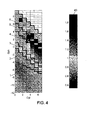
- Figure 4 represents the variation of the difference between two lens designs values of another assessment criterion example regarding the design symmetry, for a cylinder axis of zero and an addition of 1.50 Diopter.
- Said criterion is calculated as following: one calculates the difference between two iso-astigmatism half width for a + 0.25 Diopter variation at the alpha position of the distance vision point (points D and E of figure 2 , on line 12). Results are presented in percentages of the difference between the half width values according to scale 40. One can then compare the iso-astigmatism half width between two designs and estimate the best "symmetry" between the two designs.
- Said optimal symmetry may vary from a zone to another.
- the lens designer will determine and select the most symmetric design in the different zones of the prescription domain. Said selection will help the designer to optimize the symmetry between the nasal and the temporal part of a lens according to a resulting design on the whole domain.
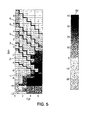
- Figure 5 represents the variations of the difference between two lens design values of another assessment criterion example regarding the power width for iso power values at points of a zone situated laterally to a direction of the angular meridian line 11 where a specified addition value is reached along line 13, at the same ALPHA value for a 0.50 Diopter variation (point F and I of figure 2 , on line 13), for a cylinder axis of zero and an addition of 1.5 Diopter. Results are presented according to scale 50.
- Figure 6 represents the variation of the difference between two lens design values of another assessment criterion example regarding the power width for iso power values at points in a zone situated laterally to the distance vision region for a 0.25 Diopter variation (points D and E of figure 2 , on line 12) where the cylinder axis is 90° and the addition is 2.5 Diopter.
- a zone 65 is of particular interest.
- the difference of said assessment criterion is very important for the prescription of zone 1 corresponding to the base-curve of 1.75 Diopter.
- the lens designer will use this information to optimize the second design in said zone in order to obtain a relatively uniform value of the power width for iso power values between points D and E over the whole prescription range.
- Figure 7 shows a schematic block diagram enlightening steps of a method according to the present invention, where input data are the choice of a first design D1, step 101, the choice of a second design D2, step 102, the choice of the analysis type, A_S, step 103, according to the chosen prescription and optionally design particularity parameters.
- Other input data are the choice of a customization criterion C1, step 107, and C2, step 109 respectively for the first and second design.
- Wearing conditions W1, W2, such as wrap, pantoscopic angle can also be introduced for each design in steps 111, 113.
- the selection charts D1_SC, step 103, D2_SC, step 104 of respectively the first and the second design are taken into account so as to define a selection chart D1 D2_SC, in step 105, suitable for both designs.
- the prescription and optionally design particularity domain for the chosen prescription and optionally design particularity parameters is defined and meshed so as to obtain a representative sample of coordinates within the prescription and optionally design particularity domain.
- Calculation of the assessment criterion is done in step 106, CALC, comprising steps 108, 110 where the calculation of the optical features of the lenses L1, L2 according to customization criterions C1, C2, and wearing conditions W1, W2 of respectively the first and second design are made, steps 112, 114 where the assessment criteria A-D1, A-D2 are calculated for each design and combined thanks to a comparison function COMP, step 115. Said calculation is made for the meshing coordinates of the prescription and optionally design particularity domain.
- An assessment scale, SCA is determined in step 116 so as to optimize visualisation of the results.
- Said scale may be for example defined so as to cover a range between the maximum and the minimum values of COMP (A-D1, A-D2).
- the results are then displayed in step 117, DISP, for example according to the selection chart D1 D2_SC, or a zone of said selection chart, and the values of COMP (A-D1, A-D2) are visualised accordingly, using for example a colour chart.
- the user can then easily take into account the visualised information to compare the two lens designs and for example can also use said information to optimize one of the two designs.
Landscapes
- Physics & Mathematics (AREA)
- Health & Medical Sciences (AREA)
- Ophthalmology & Optometry (AREA)
- General Health & Medical Sciences (AREA)
- General Physics & Mathematics (AREA)
- Optics & Photonics (AREA)
- Mathematical Physics (AREA)
- Eyeglasses (AREA)
Priority Applications (7)
| Application Number | Priority Date | Filing Date | Title |
|---|---|---|---|
| EP09305389A EP2246729A1 (fr) | 2009-04-30 | 2009-04-30 | Procédé pour évaluer une propriété optique d'un dessin de lentille ophtalmique |
| EP10714029.5A EP2425293B1 (fr) | 2009-04-30 | 2010-04-22 | Procédé pour évaluer une propriété optique d'un dessin de lentille ophtalmique |
| US13/318,339 US8870375B2 (en) | 2009-04-30 | 2010-04-22 | Method for assessing an optical feature of an ophthalmic lens design |
| PCT/EP2010/055377 WO2010124991A1 (fr) | 2009-04-30 | 2010-04-22 | Procédé d'évaluation d'une caractéristique optique d'une conception de lentille ophtalmique |
| BRPI1013907-9A BRPI1013907B1 (pt) | 2009-04-30 | 2010-04-22 | Método implementado por meio de computador de avaliação pelo menos uma característica ótica e mídia legível por computador |
| JP2012507689A JP5738276B2 (ja) | 2009-04-30 | 2010-04-22 | 眼科用レンズの設計の光学特性を評価するための方法 |
| CN201080023614.1A CN102439511B (zh) | 2009-04-30 | 2010-04-22 | 评估眼科镜片设计的光学特征的方法 |
Applications Claiming Priority (1)
| Application Number | Priority Date | Filing Date | Title |
|---|---|---|---|
| EP09305389A EP2246729A1 (fr) | 2009-04-30 | 2009-04-30 | Procédé pour évaluer une propriété optique d'un dessin de lentille ophtalmique |
Publications (1)
| Publication Number | Publication Date |
|---|---|
| EP2246729A1 true EP2246729A1 (fr) | 2010-11-03 |
Family
ID=41060036
Family Applications (2)
| Application Number | Title | Priority Date | Filing Date |
|---|---|---|---|
| EP09305389A Withdrawn EP2246729A1 (fr) | 2009-04-30 | 2009-04-30 | Procédé pour évaluer une propriété optique d'un dessin de lentille ophtalmique |
| EP10714029.5A Not-in-force EP2425293B1 (fr) | 2009-04-30 | 2010-04-22 | Procédé pour évaluer une propriété optique d'un dessin de lentille ophtalmique |
Family Applications After (1)
| Application Number | Title | Priority Date | Filing Date |
|---|---|---|---|
| EP10714029.5A Not-in-force EP2425293B1 (fr) | 2009-04-30 | 2010-04-22 | Procédé pour évaluer une propriété optique d'un dessin de lentille ophtalmique |
Country Status (6)
| Country | Link |
|---|---|
| US (1) | US8870375B2 (fr) |
| EP (2) | EP2246729A1 (fr) |
| JP (1) | JP5738276B2 (fr) |
| CN (1) | CN102439511B (fr) |
| BR (1) | BRPI1013907B1 (fr) |
| WO (1) | WO2010124991A1 (fr) |
Cited By (4)
| Publication number | Priority date | Publication date | Assignee | Title |
|---|---|---|---|---|
| EP3037869A1 (fr) * | 2014-12-23 | 2016-06-29 | Essilor International (Compagnie Generale D'optique) | Procédé permettant de comparer une première lentille ophtalmique avec une seconde lentille ophtalmique |
| WO2018071835A1 (fr) * | 2016-10-14 | 2018-04-19 | Carl Zeiss Vision International Gmbh | Verre de lunettes à déformation réduite |
| WO2018099656A1 (fr) * | 2016-11-30 | 2018-06-07 | Essilor International | Procédé permettant de fournir un graphique de sélection de lentilles ophtalmiques sans ordonnance |
| WO2019105906A1 (fr) * | 2017-11-30 | 2019-06-06 | Essilor International | Jeu de lentilles ophtalmiques |
Families Citing this family (17)
| Publication number | Priority date | Publication date | Assignee | Title |
|---|---|---|---|---|
| EP2624740A1 (fr) * | 2010-10-06 | 2013-08-14 | Shamir Optical Industry Ltd | Ordonnance de vue, procédé et appareil de mesure, et procédé de production de lentille |
| US10613347B2 (en) | 2012-01-11 | 2020-04-07 | Rodenstock Gmbh | Population of an eye model for optimizing spectacle lenses with measurement data |
| DE102012000390A1 (de) * | 2012-01-11 | 2013-07-11 | Rodenstock Gmbh | Brillenglasoptimierung mit individuellem Augenmodell |
| EP2752703A1 (fr) * | 2013-01-07 | 2014-07-09 | ESSILOR INTERNATIONAL (Compagnie Générale d'Optique) | Lentille ophtalmique présentant au moins une zone stable |
| US20140240470A1 (en) * | 2013-02-28 | 2014-08-28 | Codi Comercio Design Industrial, Lda | Method, system and device for improving optical measurement of ophthalmic spectacles |
| US9980638B2 (en) * | 2014-05-12 | 2018-05-29 | Essilor International (Compagnie Generale D'optique) | Systems and methods for measuring refractive error and ophthalmic lenses provided therefrom |
| US10983365B2 (en) * | 2014-05-15 | 2021-04-20 | Essilor International | Method of modifying an dioptric function of an ophthalmic lens surface |
| FR3059436B1 (fr) * | 2016-11-28 | 2019-01-25 | Laure PICHEREAU-BASLE | Procede et dispositif de bilan intermediaire d’une optique |
| DE102017007990B4 (de) | 2017-01-27 | 2023-01-19 | Rodenstock Gmbh | Computerimplementierte Verfahren und Vorrichtungen zum Ermitteln individueller Aberrationsdaten oder zum Berechnen oder Optimieren eines Brillenglases für zumindest ein Auge eines Brillenträgers, Computerimplementiertes Verfahren zum Ermitteln optimierter sphärozylindrischer Werte für zumindest ein Auge eines Brillenträgers, Verfahren und Vorrichtung zum Herstellen eines Brillenglases, Brillengläser und Computerprogrammerzeugnis |
| CN106901685B (zh) * | 2017-03-06 | 2019-01-22 | 云视野(北京)科技有限公司 | 一种获取屈光度的方法、装置及电子设备 |
| EP3454110B1 (fr) * | 2017-09-11 | 2022-10-05 | Rupp + Hubrach Optik GmbH | Lentille à addition progressive et son procédé de fabrication |
| US10007128B1 (en) * | 2017-10-02 | 2018-06-26 | Carl Zeiss Vision International Gmbh | Method and device for establishing a target design |
| DE102018115412B4 (de) * | 2018-06-27 | 2023-08-03 | Carl Zeiss Vision International Gmbh | Computerimplementiertes Verfahren, Datenverarbeitungssystem zum Erzeugen eines Zieldesigns sowie Computerprogramm, Speichermedium mit Instruktionen zum Erzeugen eines Zieldesigns, Verfahren zum Bereitstellen eines Brillenglases, Speichermedium mit einer numerischen Darstellung eines Brillenglases und Verfahren zum Herstellen eines Brillenglases |
| FR3097422B1 (fr) * | 2019-06-19 | 2024-11-08 | SiVIEW | Procede d’evaluation automatique de l’etat accommodatif en vision de pres d’un individu non-presbyte et dispositif associe |
| EP3985428A1 (fr) * | 2020-10-14 | 2022-04-20 | Essilor International | Procédé mis en uvre par ordinateur permettant de fournir une lentille ophtalmique finie à vision unique |
| DE102020128958B4 (de) * | 2020-11-03 | 2022-07-28 | Rodenstock Gmbh | Verfahren zum Bestimmen eines Brillenglases, Vorrichtung zum Bestimmen von individuellen biometrischen Daten sowie Vorrichtung zum Herstellen eines Brillenglases |
| CN121117274B (zh) * | 2025-11-14 | 2026-02-24 | 深圳市慧明眼镜有限公司 | 智能镜片数据管理方法、系统、计算机设备及存储介质 |
Citations (4)
| Publication number | Priority date | Publication date | Assignee | Title |
|---|---|---|---|---|
| DE19701312A1 (de) * | 1997-01-16 | 1998-07-23 | Zeiss Carl Fa | Brillenglas mit sphärischer Vorderseite und multifokaler Rückseite, sowie Verfahren zu seiner Herstellung |
| US6074062A (en) * | 1996-04-04 | 2000-06-13 | Sola International Holdings, Inc. | Progressive lens elements and methods for designing and using same |
| WO2001025837A1 (fr) * | 1999-10-01 | 2001-04-12 | Sola International Holdings Ltd | Lentille progressive |
| WO2004086125A1 (fr) * | 2003-03-24 | 2004-10-07 | Rodenstock Gmbh | Procede pour calculer un verre progressif individuel |
Family Cites Families (15)
| Publication number | Priority date | Publication date | Assignee | Title |
|---|---|---|---|---|
| US3960442A (en) * | 1974-08-05 | 1976-06-01 | American Optical Corporation | Ophthalmic lens series |
| GB2393409B (en) * | 2000-07-05 | 2004-09-15 | Pentax Corp | Supplying method of spectacle lenses |
| GB2423839A (en) | 2005-02-28 | 2006-09-06 | Spelthorne Borough Council | Method of assessing energy efficiency of buildings |
| EP1727088A1 (fr) | 2005-05-25 | 2006-11-29 | Thomson Licensing | Procédé de déterminer la qualité d'un image. |
| CN101356469B (zh) * | 2005-11-15 | 2011-03-30 | 卡尔蔡司视觉澳大利亚控股有限公司 | 眼镜片设计和/或配制 |
| FR2895092B1 (fr) * | 2005-12-16 | 2008-02-29 | Essilor Int | Procede de determination d'une lentille ophtalmique. |
| WO2007109760A2 (fr) | 2006-03-22 | 2007-09-27 | The Curators Of The University Of Missouri | Appareil et procede d'evaluation de la neutralisation visuelle |
| WO2007118030A2 (fr) | 2006-04-03 | 2007-10-18 | Vocollect, Inc. | Procédés et systèmes d'optimisation de l'adaptation d'un modèle pour un système de reconnaissance vocale |
| US20070269557A1 (en) | 2006-05-19 | 2007-11-22 | Hannaford Licensing Corp. | Method and system for assessing, scoring, grouping and presenting nutritional value information of food products |
| FR2911696B1 (fr) * | 2007-01-24 | 2009-10-30 | Essilor Int | Verre ophtalmique progressif a inset personnalise. |
| US7970175B2 (en) | 2007-04-30 | 2011-06-28 | Delphi Technologies, Inc. | Method and apparatus for assessing head pose of a vehicle driver |
| JP5088030B2 (ja) | 2007-07-26 | 2012-12-05 | ヤマハ株式会社 | 演奏音の類似度を評価する方法、装置およびプログラム |
| EP2034078B1 (fr) | 2007-09-05 | 2011-02-16 | Whirlpool Corporation | Procédé pour évaluer rapidement la quantité d'eau à charger dans une machine à laver dotée d'un système de recirculation d'eau et machine à laver capable de réaliser ledit procédé |
| EP2034468A1 (fr) | 2007-09-05 | 2009-03-11 | Nederlandse Organisatie voor toegepast- natuurwetenschappelijk onderzoek TNO | Procédé d'évaluation de la performance d'un simulateur en mouvement et indicateur de performance obtenu avec un tel procédé |
| CN101821663B (zh) * | 2007-10-10 | 2012-02-08 | Hoya株式会社 | 渐进多焦镜片的制造方法和渐进多焦镜片 |
-
2009
- 2009-04-30 EP EP09305389A patent/EP2246729A1/fr not_active Withdrawn
-
2010
- 2010-04-22 JP JP2012507689A patent/JP5738276B2/ja not_active Expired - Fee Related
- 2010-04-22 BR BRPI1013907-9A patent/BRPI1013907B1/pt not_active IP Right Cessation
- 2010-04-22 WO PCT/EP2010/055377 patent/WO2010124991A1/fr not_active Ceased
- 2010-04-22 US US13/318,339 patent/US8870375B2/en not_active Expired - Fee Related
- 2010-04-22 EP EP10714029.5A patent/EP2425293B1/fr not_active Not-in-force
- 2010-04-22 CN CN201080023614.1A patent/CN102439511B/zh not_active Expired - Fee Related
Patent Citations (4)
| Publication number | Priority date | Publication date | Assignee | Title |
|---|---|---|---|---|
| US6074062A (en) * | 1996-04-04 | 2000-06-13 | Sola International Holdings, Inc. | Progressive lens elements and methods for designing and using same |
| DE19701312A1 (de) * | 1997-01-16 | 1998-07-23 | Zeiss Carl Fa | Brillenglas mit sphärischer Vorderseite und multifokaler Rückseite, sowie Verfahren zu seiner Herstellung |
| WO2001025837A1 (fr) * | 1999-10-01 | 2001-04-12 | Sola International Holdings Ltd | Lentille progressive |
| WO2004086125A1 (fr) * | 2003-03-24 | 2004-10-07 | Rodenstock Gmbh | Procede pour calculer un verre progressif individuel |
Cited By (13)
| Publication number | Priority date | Publication date | Assignee | Title |
|---|---|---|---|---|
| EP3037869A1 (fr) * | 2014-12-23 | 2016-06-29 | Essilor International (Compagnie Generale D'optique) | Procédé permettant de comparer une première lentille ophtalmique avec une seconde lentille ophtalmique |
| WO2016102553A1 (fr) * | 2014-12-23 | 2016-06-30 | Essilor International (Compagnie Generale D'optique) | Procédé de comparaison d'une première lentille ophtalmique à une deuxième lentille ophtalmique |
| US10928655B2 (en) | 2016-10-14 | 2021-02-23 | Carl Zeiss Vision International Gmbh | Reduced distortion spectacle lens |
| WO2018071042A1 (fr) * | 2016-10-14 | 2018-04-19 | Carl Zeiss Vision International Gmbh | Verre de lunettes à distorsion réduite |
| EP3526641B1 (fr) | 2016-10-14 | 2020-03-18 | Carl Zeiss Vision International GmbH | Lentilles de lunettes avec une distortion réduite |
| WO2018071835A1 (fr) * | 2016-10-14 | 2018-04-19 | Carl Zeiss Vision International Gmbh | Verre de lunettes à déformation réduite |
| WO2018099656A1 (fr) * | 2016-11-30 | 2018-06-07 | Essilor International | Procédé permettant de fournir un graphique de sélection de lentilles ophtalmiques sans ordonnance |
| KR20190086439A (ko) * | 2016-11-30 | 2019-07-22 | 에씰로 앙터나시오날 | 비-처방 안과 렌즈의 선택 차트를 제공하기 위한 방법 |
| US11194175B2 (en) | 2016-11-30 | 2021-12-07 | Essilor International | Method for providing a selection chart of nonprescription ophthalmic lenses |
| WO2019105906A1 (fr) * | 2017-11-30 | 2019-06-06 | Essilor International | Jeu de lentilles ophtalmiques |
| CN111263912A (zh) * | 2017-11-30 | 2020-06-09 | 依视路国际公司 | 眼科镜片组 |
| CN111263912B (zh) * | 2017-11-30 | 2022-07-19 | 依视路国际公司 | 眼科镜片组 |
| US11460717B2 (en) | 2017-11-30 | 2022-10-04 | Essilor International | Set of ophthalmic lenses |
Also Published As
| Publication number | Publication date |
|---|---|
| WO2010124991A1 (fr) | 2010-11-04 |
| BRPI1013907A8 (pt) | 2018-08-14 |
| JP2012525599A (ja) | 2012-10-22 |
| US20120188504A1 (en) | 2012-07-26 |
| EP2425293B1 (fr) | 2017-11-01 |
| CN102439511A (zh) | 2012-05-02 |
| BRPI1013907A2 (pt) | 2016-10-11 |
| EP2425293A1 (fr) | 2012-03-07 |
| BRPI1013907B1 (pt) | 2020-07-14 |
| CN102439511B (zh) | 2014-01-29 |
| US8870375B2 (en) | 2014-10-28 |
| JP5738276B2 (ja) | 2015-06-24 |
Similar Documents
| Publication | Publication Date | Title |
|---|---|---|
| US8870375B2 (en) | Method for assessing an optical feature of an ophthalmic lens design | |
| EP2028527B1 (fr) | Procédé de sélection de base d'un verre pour lentille ophtalmique et procédé associé de fabrication de verres de lunettes | |
| US8540367B2 (en) | Method of selecting a semi-finished ophthalmic lens according to a given spectacle frame | |
| CN108139603B (zh) | 确定眼科镜片的三维性能的方法、计算眼科镜片的相关方法 | |
| JP6845795B2 (ja) | 装用者に適合された光学レンズのレンズ設計を決定する方法 | |
| EP2780759B1 (fr) | Procédé pour fournir un système optique d'un verre de lunette ophtalmique et procédé de fabrication de verre de lunette ophtalmique | |
| KR102580793B1 (ko) | 근시 또는 정시 노안 착용자를 위한 안과용 누진 가법 렌즈 및 그러한 렌즈를 제공하는 방법 | |
| CA2969491C (fr) | Procede de comparaison d'une premiere lentille ophtalmique a une deuxieme lentille ophtalmique | |
| CN111133369B (zh) | 用于评估眼科镜片的方法、相关联的评估系统以及用于制造眼科镜片的工业组件 | |
| CN108292049B (zh) | 用于老花眼配戴者的渐变多焦点眼科镜片、用于提供此类镜片的方法 | |
| CN104884999B (zh) | 多焦点眼镜片 | |
| CN103930823B (zh) | 用于提供眼镜片的光学系统的方法和用于制造眼镜片的方法 | |
| CN107003543B (zh) | 渐进屈光力镜片组 | |
| JP2022532028A (ja) | 装用者に適合する眼用累進多焦点レンズ | |
| EP2780761B1 (fr) | Procédé pour fournir un système optique d'un verre de lunette ophtalmique et procédé de fabrication de verre de lunette ophtalmique |
Legal Events
| Date | Code | Title | Description |
|---|---|---|---|
| PUAI | Public reference made under article 153(3) epc to a published international application that has entered the european phase |
Free format text: ORIGINAL CODE: 0009012 |
|
| AK | Designated contracting states |
Kind code of ref document: A1 Designated state(s): AT BE BG CH CY CZ DE DK EE ES FI FR GB GR HR HU IE IS IT LI LT LU LV MC MK MT NL NO PL PT RO SE SI SK TR |
|
| STAA | Information on the status of an ep patent application or granted ep patent |
Free format text: STATUS: THE APPLICATION IS DEEMED TO BE WITHDRAWN |
|
| 18D | Application deemed to be withdrawn |
Effective date: 20110504 |