EP2246779A2 - Printing system, printing device, and printer driver - Google Patents
Printing system, printing device, and printer driver Download PDFInfo
- Publication number
- EP2246779A2 EP2246779A2 EP10003226A EP10003226A EP2246779A2 EP 2246779 A2 EP2246779 A2 EP 2246779A2 EP 10003226 A EP10003226 A EP 10003226A EP 10003226 A EP10003226 A EP 10003226A EP 2246779 A2 EP2246779 A2 EP 2246779A2
- Authority
- EP
- European Patent Office
- Prior art keywords
- printing
- sheet
- jamming
- double
- occurrence probability
- Prior art date
- Legal status (The legal status is an assumption and is not a legal conclusion. Google has not performed a legal analysis and makes no representation as to the accuracy of the status listed.)
- Granted
Links
Images


Classifications
-
- G—PHYSICS
- G06—COMPUTING OR CALCULATING; COUNTING
- G06F—ELECTRIC DIGITAL DATA PROCESSING
- G06F3/00—Input arrangements for transferring data to be processed into a form capable of being handled by the computer; Output arrangements for transferring data from processing unit to output unit, e.g. interface arrangements
- G06F3/12—Digital output to print unit, e.g. line printer, chain printer
- G06F3/1201—Dedicated interfaces to print systems
- G06F3/1278—Dedicated interfaces to print systems specifically adapted to adopt a particular infrastructure
- G06F3/1285—Remote printer device, e.g. being remote from client or server
-
- B—PERFORMING OPERATIONS; TRANSPORTING
- B41—PRINTING; LINING MACHINES; TYPEWRITERS; STAMPS
- B41J—TYPEWRITERS; SELECTIVE PRINTING MECHANISMS, i.e. MECHANISMS PRINTING OTHERWISE THAN FROM A FORME; CORRECTION OF TYPOGRAPHICAL ERRORS
- B41J13/00—Devices or arrangements of selective printing mechanisms, e.g. ink-jet printers or thermal printers, specially adapted for supporting or handling copy material in short lengths, e.g. sheets
- B41J13/0009—Devices or arrangements of selective printing mechanisms, e.g. ink-jet printers or thermal printers, specially adapted for supporting or handling copy material in short lengths, e.g. sheets control of the transport of the copy material
-
- B—PERFORMING OPERATIONS; TRANSPORTING
- B41—PRINTING; LINING MACHINES; TYPEWRITERS; STAMPS
- B41J—TYPEWRITERS; SELECTIVE PRINTING MECHANISMS, i.e. MECHANISMS PRINTING OTHERWISE THAN FROM A FORME; CORRECTION OF TYPOGRAPHICAL ERRORS
- B41J3/00—Typewriters or selective printing or marking mechanisms characterised by the purpose for which they are constructed
- B41J3/60—Typewriters or selective printing or marking mechanisms characterised by the purpose for which they are constructed for printing on both faces of the printing material
-
- G—PHYSICS
- G03—PHOTOGRAPHY; CINEMATOGRAPHY; ANALOGOUS TECHNIQUES USING WAVES OTHER THAN OPTICAL WAVES; ELECTROGRAPHY; HOLOGRAPHY
- G03G—ELECTROGRAPHY; ELECTROPHOTOGRAPHY; MAGNETOGRAPHY
- G03G15/00—Apparatus for electrographic processes using a charge pattern
- G03G15/22—Apparatus for electrographic processes using a charge pattern involving the combination of more than one step according to groups G03G13/02 - G03G13/20
- G03G15/23—Apparatus for electrographic processes using a charge pattern involving the combination of more than one step according to groups G03G13/02 - G03G13/20 specially adapted for copying both sides of an original or for copying on both sides of a recording or image-receiving material
- G03G15/231—Arrangements for copying on both sides of a recording or image-receiving material
- G03G15/232—Arrangements for copying on both sides of a recording or image-receiving material using a single reusable electrographic recording member
- G03G15/234—Arrangements for copying on both sides of a recording or image-receiving material using a single reusable electrographic recording member by inverting and refeeding the image receiving material with an image on one face to the recording member to transfer a second image on its second face, e.g. by using a duplex tray; Details of duplex trays or inverters
-
- G—PHYSICS
- G03—PHOTOGRAPHY; CINEMATOGRAPHY; ANALOGOUS TECHNIQUES USING WAVES OTHER THAN OPTICAL WAVES; ELECTROGRAPHY; HOLOGRAPHY
- G03G—ELECTROGRAPHY; ELECTROPHOTOGRAPHY; MAGNETOGRAPHY
- G03G15/00—Apparatus for electrographic processes using a charge pattern
- G03G15/65—Apparatus which relate to the handling of copy material
- G03G15/6555—Handling of sheet copy material taking place in a specific part of the copy material feeding path
- G03G15/6579—Refeeding path for composite copying
-
- G—PHYSICS
- G03—PHOTOGRAPHY; CINEMATOGRAPHY; ANALOGOUS TECHNIQUES USING WAVES OTHER THAN OPTICAL WAVES; ELECTROGRAPHY; HOLOGRAPHY
- G03G—ELECTROGRAPHY; ELECTROPHOTOGRAPHY; MAGNETOGRAPHY
- G03G15/00—Apparatus for electrographic processes using a charge pattern
- G03G15/70—Detecting malfunctions relating to paper handling, e.g. jams
-
- G—PHYSICS
- G06—COMPUTING OR CALCULATING; COUNTING
- G06F—ELECTRIC DIGITAL DATA PROCESSING
- G06F3/00—Input arrangements for transferring data to be processed into a form capable of being handled by the computer; Output arrangements for transferring data from processing unit to output unit, e.g. interface arrangements
- G06F3/12—Digital output to print unit, e.g. line printer, chain printer
- G06F3/1201—Dedicated interfaces to print systems
- G06F3/1202—Dedicated interfaces to print systems specifically adapted to achieve a particular effect
- G06F3/121—Facilitating exception or error detection and recovery, e.g. fault, media or consumables depleted
-
- G—PHYSICS
- G06—COMPUTING OR CALCULATING; COUNTING
- G06F—ELECTRIC DIGITAL DATA PROCESSING
- G06F3/00—Input arrangements for transferring data to be processed into a form capable of being handled by the computer; Output arrangements for transferring data from processing unit to output unit, e.g. interface arrangements
- G06F3/12—Digital output to print unit, e.g. line printer, chain printer
- G06F3/1201—Dedicated interfaces to print systems
- G06F3/1223—Dedicated interfaces to print systems specifically adapted to use a particular technique
- G06F3/1229—Printer resources management or printer maintenance, e.g. device status, power levels
- G06F3/1234—Errors handling and recovery, e.g. reprinting
-
- G—PHYSICS
- G03—PHOTOGRAPHY; CINEMATOGRAPHY; ANALOGOUS TECHNIQUES USING WAVES OTHER THAN OPTICAL WAVES; ELECTROGRAPHY; HOLOGRAPHY
- G03G—ELECTROGRAPHY; ELECTROPHOTOGRAPHY; MAGNETOGRAPHY
- G03G2215/00—Apparatus for electrophotographic processes
- G03G2215/00362—Apparatus for electrophotographic processes relating to the copy medium handling
- G03G2215/00367—The feeding path segment where particular handling of the copy medium occurs, segments being adjacent and non-overlapping. Each segment is identified by the most downstream point in the segment, so that for instance the segment labelled "Fixing device" is referring to the path between the "Transfer device" and the "Fixing device"
- G03G2215/00417—Post-fixing device
- G03G2215/0043—Refeeding path
-
- G—PHYSICS
- G03—PHOTOGRAPHY; CINEMATOGRAPHY; ANALOGOUS TECHNIQUES USING WAVES OTHER THAN OPTICAL WAVES; ELECTROGRAPHY; HOLOGRAPHY
- G03G—ELECTROGRAPHY; ELECTROPHOTOGRAPHY; MAGNETOGRAPHY
- G03G2215/00—Apparatus for electrophotographic processes
- G03G2215/00362—Apparatus for electrophotographic processes relating to the copy medium handling
- G03G2215/00535—Stable handling of copy medium
- G03G2215/00548—Jam, error detection, e.g. double feeding
-
- G—PHYSICS
- G03—PHOTOGRAPHY; CINEMATOGRAPHY; ANALOGOUS TECHNIQUES USING WAVES OTHER THAN OPTICAL WAVES; ELECTROGRAPHY; HOLOGRAPHY
- G03G—ELECTROGRAPHY; ELECTROPHOTOGRAPHY; MAGNETOGRAPHY
- G03G2215/00—Apparatus for electrophotographic processes
- G03G2215/00362—Apparatus for electrophotographic processes relating to the copy medium handling
- G03G2215/00535—Stable handling of copy medium
- G03G2215/00556—Control of copy medium feeding
- G03G2215/00586—Control of copy medium feeding duplex mode
Definitions
- the present invention relates to a printing system having a double-side printing function, a printing device, and a printer driver.
- a double-side printing method of a printing device printing on one side and printing on the other side are continuously performed for each sheet.
- this method is referred to as a double side continuous printing method.
- a printing device adopting a method in which between printing on one side and printing on the other side of one sheet, one side of another sheet is printed.
- the method includes a method of continuously performing printing on one side for a plurality of sheets (refer to JP11-284818A ).
- this method is referred to as a one sided continuous printing method.
- a period from printing on one side of one sheet to printing on the other side of the sheet may be used for printing another sheet. Accordingly, it is possible to perform the printing processing at a higher speed than in the double side continuous printing method.
- the above-described one sided continuous printing method has an advantage in that the printing processing can be performed at a higher speed than in the double side continuous printing method.
- a larger number of sheets may exist in a sheet conveyance path inside the printing device at the same time compared to the double side continuous printing method. Therefore, in the one sided continuous printing method, when the double-side printing processing is stopped by sheet jamming or blackout, a larger number of sheets may be held in the sheet conveyance path than in the double side continuous printing method. Therefore, it may take a lot of time to remove the sheets.
- the one sided continuous printing method should be used or should not be used. In image forming devices according to the related art, however, such an aspect is not sufficiently considered. Therefore, there is a demand for the improvement of convenience.
- An object of the present invention is that it provides a printing system capable of performing double-side printing processing in accordance with a method depending on the state of a printing device, a printing device, and a printer driver.
- a printing system includes:
- the double-side printing processing is performed in accordance with the method whereby the maximum sheet number of sheets existing in the conveyance mechanism at the same time is small, compared with when the probability of sheet jamming occurring is low. Accordingly, it is possible to perform the double-side printing processing in accordance with the method depending on the state of the printing device. For example, when the occurrence probability is relatively low, the double-side printing processing may be performed in accordance with the method whereby the maximum sheet number is large, which makes it possible to perform the printing at a high speed.
- the double-side printing processing may be performed in accordance with the method whereby the maximum sheet number is small, which makes it possible to reduce the effort of a sheet removing operation which would be performed if sheet jamming occurs.
- the printing system may further include a detection unit that detects the sheet jamming, wherein the determination unit determines the jamming occurrence probability based on the detection result by the detection unit.
- the double-side printing processing with the method coinciding with the actual situation of the printing system can be performed.
- the determination unit determines the probability of sheet jamming occurring for at least each of the two methods among the plurality of methods, and even when the determination unit determines that the jamming occurrence probability is high, if a relative difference in the individual occurrence probability between a method whereby the maximum sheet number is large and a method whereby the maximum sheet number is small is high, the control unit selects the method in which the maximum sheet number is small, and if the relative difference is small, the control unit selects the method in which the maximum sheet number is large.
- the method whereby the maximum sheet number may be selected to perform the double-side printing processing at a high speed.
- the determination unit determines a level of the jamming occurrence probability in the reverse path, and the control unit selects a non-reversing method in which the reverse path is not used and performs the double-side printing processing in accordance with the selected non-reversing method when the determination unit determines that the jamming occurrence probability is high.
- the non-reversing method may be selected without using the reverse path, which makes it possible to reduce the sheet jamming occurrence.
- the printing system may further include a changing unit that changes the method of the double-side printing processing in the middle of the double-side printing processing performed by the printing unit.
- the method of the double-side printing processing may be changed in the middle of the double-side printing processing, depending on the probability of sheet jamming.
- the control unit selects the method in which the maximum sheet number is large, if the number of sheets to be double-side printed is equal to or larger than a reference number of sheets.
- the method whereby the maximum sheet number is large may be selected to perform the double-side printing processing at a high speed.
- a printing device includes:
- a printer driver of a printing device having a conveyance mechanism and performing double-side printing processing depending on a plurality of methods in which maximum numbers of sheets existing in the conveyance mechanism at the same time are different from each other, the printer driver causing an information processing device which is connected to communicate with the printing device to perform:
- Fig. 1 is a block diagram illustrating the electrical configuration of a printing system 1 according to an embodiment of the present invention.
- the printing system 1 includes a terminal device 10 as an example of a personal computer and an information processing device and a printer 30 as an example of a printing apparatus.
- the terminal device 10 includes a CPU 11 as an example of an acquisition unit, a ROM 12, a RAM 13, a hard disk drive (HDD) 14 as an example of a memory, an operation unit 15 having a keyboard or pointing device, a display unit 16 having a liquid crystal display or the like, and a network interface 17 connected to a communication line 20.
- the HDD 14 stores an operating system (OS), application software capable of writing printing data, and various programs such as a printer driver for controlling the printer 30.
- OS operating system
- application software capable of writing printing data
- various programs such as a printer driver for controlling the printer 30.
- the printer 30 includes a CPU 31 (an example of a control unit, and a changing unit), a ROM 32, a PAM 33, a HDD 34, an operation unit 35, a display unit 36, a printing unit 37, a conveyance mechanism 38, a network interface 39, and a sheet detection unit 40.
- the ROM 32 stores various programs for controlling the operation of the printer 30.
- the CPU 31 controls the operation of the printer 30 in accordance with a program read from the ROM 32, while storing the processing result into the RAM 33.
- the operation unit 35 includes a plurality of buttons through which a variety of input operations such as a printing start instruction can be made by a user.
- the display unit 36 includes a liquid crystal display or lamp to display various setting screens or operation states.
- the printing unit 37 performs printing on a sheet W such as a paper.
- the network interface 39 is connected to the external terminal device 10 or the like through the communication line 20 such that interactive data communication can be performed.
- the conveyance mechanism 38 and the sheet detection unit 40 will be described below.
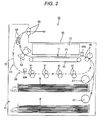
- Fig. 2 is a schematic view illustrating the internal configuration of the printer 30.
- the printer 30 includes a housing unit 41, the conveyance mechanism 38, the printing unit 37, a fixing unit 43, and a discharge tray 45.
- the housing unit 41 is provided in the bottom portion of the printer 30, and includes a plurality (for example, two) of trays T, each of which accommodates sheets W.
- a plurality for example, two
- trays T each of which accommodates sheets W.
- the respective trays T are discriminated, they are sequentially referred to as a first tray T1 and a second tray T2 from the uppermost tray.
- the conveyance mechanism 38 includes a pickup roller 47, a pair of registration rollers 49, 49, a sheet conveyance belt 51, and a reversing mechanism 53.
- the pickup roller 47 picks up the sheets W accommodated in the tray T one by one, and then conveys the sheet W to the registration rollers 49, 49.
- the registration rollers 49, 49 adjust the posture of the conveyed sheet W to deliver onto the sheet conveyance belt 51 at predetermined timing.
- the printing unit 37 forms an image (monochrome image or color image) at a predetermined printing position X on the sheet W conveyed by the sheet conveyance belt 51, based on printing data received from the terminal device 10, for example.
- the sheet W having the image formed thereon is thermally fixed by the fixing unit 43 and then discharged onto the discharge tray 45.
- a path for guiding the sheet W from the tray T to the printing position X, which is indicated by a solid arrow of Fig. 2 is referred to as a printing conveyance path P1 as an example of printing paths.
- the reversing mechanism 53 includes a discharge roller 55, a reverse conveyance path P2 as an example of reverse paths, which is indicated by the dotted-line arrow in Fig. 2 , a flapper 59, and a plurality of reversing conveyance rollers 61.
- a discharge roller 55 a reverse conveyance path P2 as an example of reverse paths, which is indicated by the dotted-line arrow in Fig. 2 .
- a flapper 59 a plurality of reversing conveyance rollers 61.
- the sheet W is conveyed through the flapper 59, the reverse conveyance path P2, the plurality of reversing conveyance rollers 61, and the registration rollers 49, 49 by the reverse rotation of the discharge roller 55, and then delivered onto the tray 51 in a state in which the front and rear surfaces are reversed. Then, an image is printed on the front surface of the sheet W by the printing unit 37, which corresponds to an upper surface of the sheet W when the sheet W is accommodated in the tray T, and the sheet W is discharged onto the discharge tray 45.
- the sheet detection unit 40 includes a plurality of sensors 40A which outputs a detection signal depending on whether or not a sheet W is present at the respective conveyance positions inside the conveyance mechanism 38.
- the CPU 31 consecutively receives a detection signal indicating the presence of the sheet W from the respective sensors 40A for a predetermined time or more or does not receive a detection signal for a predetermined time or more, the CPU 31 determines that jamming (sheet jamming) occurred at the respective positions.
- one or more sensors 40A are provided in the printing conveyance path P1 and the reverse conveyance path P2, respectively. Therefore, the CPU 31 also can determine whether or not jamming occurs in any one of the printing conveyance path P1 and the reverse conveyance path P2.
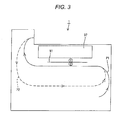
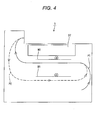
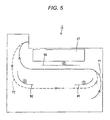
- Figs. 3 to 5 are pattern diagrams explaining methods of the double-side printing processing.
- a number surrounded by a circle means that an image corresponding to the sequence of the number is formed on the surface of sheet W at the side where the number is attached.
- the printer 30 can perform the double-side printing method depending on a plurality of methods.
- the plurality of methods are classified into a reversing method which uses the reversing mechanism 53 and a non-reversing method which does not use the reversing mechanism 53.
- the reversing method is classified depending on a difference in the maximum number of sheets W existing in the conveyance mechanism 38 at the same time.
- the sheets W have an image formed on one surface thereof, and does not have an image formed on the other surface thereof.
- examples of the methods will be described.
- the 21 method is a double-side continuous printing method in which printing on one surface and printing on the other surface for each sheet W1 are continuously performed from the beginning to the end of the printing. For example, when six page images are printed on both surfaces of three sheets W, the printer 30 performs printing in the following sequence:
- the 2413 method includes a process in which while printing is performed on the front surface of a sheet W after printing is performed on the rear surface of the sheet W, printing is performed on the rear surface of another sheet W. For example, when six page images are printed on both surfaces of three sheets W, the printer 30 performs printing in the following sequence:
- the 246135 method includes a process in which while printing is performed on the front surface of a sheet W after printing is performed on the rear surface of the sheet W, printing is performed on the rear surfaces of two other sheets W. For example, when six page images are printed on both surfaces of three sheets W, the printer 30 performs printing in the following sequence:
- the manual method one or more sheets W are discharged to the discharge tray 45 without passing through the reverse conveyance path P2, in a state in which only the rear surfaces thereof are printed.
- the discharged sheets W are reset on the tray T by a user such that the rear surfaces (printed surfaces) thereof face upward.
- the front surface of the reset sheets W are printed, and the sheets W are discharged to the discharge tray 45 without passing through the reverse conveyance path P2.
- the maximum sheet number is 1 or 2 which is the number of sheets which can be accommodated in the printing conveyance path P1, but the sheets do not pass through the reverse conveyance path P2.
- the printing system 1 performs printing control processing which will be described below, such that double-side printing processing can be performed in accordance with a method selected automatically from the above-described methods according to jamming occurrence probability of the printer 30.
- printing control processing will be divided into processing at the terminal device 10 and processing at the printer 30.
- Fig. 6 is a diagram illustrating a double-side printing setting screen.
- the CPU 11 reads the printer driver from the HDD 14 to selectively display a basic setting screen for setting general printing conditions such as sheet size and image quality, extended function screens, and a support screen on the display unit 16.
- the double-side printing setting screen is one of the extended function screens.
- the double side setting screen includes a tray selection field, a double-side printing field, a reversing method field, and a maximum sheet number field.
- the double-side printing field as a user switches over between ON and OFF buttons, any one of the double-side printing processing and the one side printing processing can be selectively performed. Furthermore, when the one side printing processing is selected, that is, the OFF button is clicked, the other fields may be grayed out so as not to be selected.
- any one of the reversing method and the non-reversing method may be selected. Furthermore, when the non-reversing method is selected, that is, the OFF button is clicked, the maximum sheet number field and the manual method auto-switching field may be grayed out so as not to be selected.
- the user can select a reversing method corresponding to the selected sheet number.
- the double-side printing setting screen may display jamming information on the methods of the double-side printing processing which can be performed by the printer 30.
- the jamming information includes a required time, an individual jamming occurrence probability, and an individual reversing jamming occurrence probability for each of the methods whereby the maximum sheet numbers are different from each other.
- the required time is the average required time when a reference number (for example, ten) of sheets W are printed.
- the reference number of sheets may be a fixed value, or the number of printed sheets for each printing data. In the latter, a time obtained by multiplying the reference number by a unit required time per sheet W1 for each of the methods may be set to the required time.
- the individual jamming occurrence probability refers to an occurrence probability of jamming (hereinafter, referred to as individual jamming) which occurs in the printer 30 including the printing conveyance path P1 and the reverse conveyance path P2, when the double-side printing processing is performed using each of the methods.
- the individual jamming occurrence probability is calculated by dividing the number of occurrences of individual jamming by the accumulative number of printed sheets W in the printer 30. Especially, it is preferable to use the accumulative number of double-side printed sheets.
- the individual reversing jamming occurrence probability refers to an occurrence probability of jamming (hereinafter, referred to as individual reversing jamming) which occurs only in the reverse conveyance path P2. In this embodiment, the individual reversing jamming occurrence probability is calculated by dividing the number of occurrences of individual reversing jamming by the accumulative number of printed sheets.
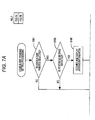
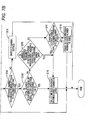
- Fig. 7 is a flow chart showing the double-side printing setting processing.
- the CPU 11 performs the double-side printing setting processing.
- the jamming information is not displayed on the double-side printing setting screen.
- step S101: NO when it is determined that a user selects the one sided printing and then clicks an OK button or application button on the printing setting screen (step S101: NO), the double-side printing setting processing is terminated.
- step S101: YES and step S103: NO the double-side printing setting processing is terminated.
- step S103 when it is determined that a reversing method is selected (step S103: YES), the latest jamming information is received from the printer 30 and then displayed on the double-side printing setting screen (step S105) (refer to Fig. 6 ). Accordingly, the user can check the jamming occurrence probabilities of the respective methods by referring to the displayed jamming information.
- the CPU 11 determines whether or not an average occurrence probability of reversing jamming is equal to or lower than a first upper limit (for example, 5%), by referring to the jamming information (step S107).
- the average occurrence probability of reversing jamming refers to an average of individual reversing jamming occurrence probabilities in the respective reversing methods. Instead of the average occurrence probability of reverse jamming, an occurrence probability of individual reversing jamming in a method predetermined as a default value may be set to a determination target.
- step S107 NO
- the double-side printing processing is performed in accordance with the reversing method, and the method is forcibly switched to the manual method (step S113). Then, the double-side printing setting processing is terminated.
- step S107 when it is determined that the average occurrence probability of reversing jamming is equal to or lower than the first upper limit (step S107: YES), it is determined whether or not the total jamming occurrence probability is equal to or lower than a second upper limit (for example, 1%), by referring to the jamming information (step S109).
- a second upper limit for example, 1%
- An average occurrence probability of total jamming refers to an average of individual jamming occurrence probabilities in the respective reversing methods.
- the occurrence probability of reversing jamming in a method predetermined as a default value for example, a method whereby the maximum sheet number is large
- a default value for example, a method whereby the maximum sheet number is large
- step S109 When it is determined that the total jamming occurrence probability is equal to or lower than the second upper limit (step S109: YES), a method (2413 method) is selected whereby the maximum sheet number is large (step S111), and the double-side printing setting processing is terminated. Furthermore, when the occurrence probability of reversing jamming in the default method is set to a determination target, the default method is selected.
- step S109: NO it is determined whether or not the individual jamming occurrence probability of the method whereby the maximum sheet number is large is equal to or lower than a third upper limit (for example, 2%) (step S115).
- the CPU 11 functions as a determination unit.
- step S115: YES it is considered that there is a low risk of jamming occurrence even though the double-side printing processing is performed in accordance with the method (2413 method) whereby the maximum sheet number is large, and the method is selected whereby the maximum sheet number is large (stop S111).
- the double-side printing setting processing is terminated.
- a relative difference in individual jamming occurrence probability between the method whereby the maximum sheet number is large and the method whereby the maximum sheet number is small is less than a reference value (for example, 0.5%), the method may be selected whereby the maximum sheet number is large.
- step S115: NO the method whereby the maximum sheet number is large is selected in preference to high-speed processing rather than jamming avoidance (step S111), when the number of sheets W (corresponding to the page number of printing data) which are printed by the double-side printing processing based on printing data of the currently-set target is equal to or more than a reference sheet number of sheets (for example, 30 sheets) (step S117: YES). Then, the double-side printing setting processing is terminated in preference to high-speed processing rather than jamming avoidance.
- step S117: NO when the number of sheets W printed by the double-side printing processing is less than the reference number (step S117: NO), a method (21 method) whereby the maximum sheet number is small is selected in preference to jamming avoidance (step S119), and the double-side printing setting processing is terminated.
- the CPU 11 transmits printing data and the variety of printing setting information set on the printing setting screen to the printer 30.
- the printing data includes image data to be printed, and the variety of printing setting information includes the method of the double-side printing processing.
- the CPU 31 of the printer 30 controls the printing unit 37 and the conveyance mechanism 38 based on the printing data, and starts the double-side printing processing of the method depending on the printing setting information. At this time, the CPU 31 functions as the control unit. Furthermore, when the double-side printing processing starts, the CPU 31 starts jamming monitoring processing.
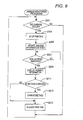
- Fig. 8 is a flow chart showing jamming monitoring processing.
- the CPU 31 monitors whether jamming occurred or not, based on detection signals from the respective sensors 40A (step S201). When it is determined that jamming occurred (step S201 : YES), the CPU stops the double-side printing processing (step S203), and updates the jamming information table (step S205).
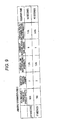
- Fig. 9 is a diagram showing an example of the contents of the jamming information table.
- the jamming information table is original data for generating the jamming information transmitted to the terminal device 10, and is stored in the HDD 34.
- the CPU 31 calculates the total jamming occurrence probability whenever jamming occurs, and updates the jamming information table.
- step S207 it is determined whether the jamming was removed or not. For example, when detection signals indicating no sheet exists are received from all of the sensors 40A, it is determined that the jamming was removed.
- step S207 the jamming information the same as shown in Fig. 6 , for example, is displayed on the display unit 36 (step S209).
- the user can determine whether or not to continue the method which is being performed.
- step S211 NO
- step S211 NO
- step S211 YES
- step S211 YES
- step S215 the double-side printing processing is resumed as the changed method
- step S215 the operation returns to step S201.
- the CPU 31 functions as the changing unit.
- the double-side printing processing is performed in accordance with a method whereby the maximum sheet number of sheets existing in the conveyance mechanism 38 at the same time is small, compared with when the jamming occurrence probability is low. Accordingly, it is possible to perform the double-side printing processing in accordance with the method depending on the jamming occurrence state of the printer 30. For example, when the occurrence probability is relatively low, the printing can be performed at a high speed by performing the double-side printing processing in accordance with the method whereby the maximum sheet number is large. Meanwhile, when the occurrence probability is relatively high, the double-side printing processing may be performed in accordance with the method whereby the maximum sheet number is small. In this case, it is possible to reduce the effort of a sheet removing operation which would be performed if jamming occurs.
- the non-reversing method may be selected without using the reverse conveyance path P2, which makes it possible to reduce the jamming occurrence.
- the jamming management processing may be performed to change the method of the double-side printing processing at this point of time. Furthermore, when the number of sheets W to be double-side printed is relatively large, the method whereby the maximum sheet number is large may be selected to perform the double-side printing processing at a high speed.
- the 21 method, the 2413 method, and so on have been described as methods of the double-side printing processing, but the present invention is not limited thereto.
- a 24163857 method of which the maximum sheet number is three may be adopted. That is, while one surface of a sheet is printed and the other surface thereof is then printed, one surfaces of N other sheets (equal to or more than zero) may be printed.
- the number of N sheets is not necessarily constant (refer to the 2413 method), but the number of sheets W which exist in the conveyance mechanism 38 when the number of N sheets is the highest may be set to the maximum sheet number.
- the CPU 31 of the printer 30 may execute the setting processing by utilizing the operation unit 35 and the display unit 36.
- the CPU 31 functions as the "determination unit".
- the tray T is provided in the bottom portion of the printer 30, but the present invention is not limited thereto.
- a manual feed tray (not shown) for guiding sheets to the registration rollers 49 from an insertion port (not shown) opened in the front surface of the printer 30 may be provided.
- the manual feed tray may be used.
- the level of the jamming occurrence probability is determined in the respective methods, based on the detection signals from the respective sensors 40A, but the present invention is not limited thereto.
- the respective methods (the maximum sheet numbers) and the jamming occurrence probabilities may be experimentally obtained, and the correspondence relation table thereof may be stored in the HDD 14. Then, the CPU 11 may determine the level of the jamming occurrence probability by referring to the correspondence table.
- the CPU 11 may determine the level of the jamming occurrence probability by referring to the correspondence relation table.
- the method when the reversing jamming occurrence probability is higher than the first upper limit in the double-side printing setting processing, the method is switched to the manual method (refer to steps S107 and S113 of Fig. 7 ), but the present invention is not limited thereto.
- the CPU 31 may automatically switch the method into the reversing method.
- step S107 the operation after step S105 proceeds to step S109.
- step S109 the operation proceeds to step S115 in the case of YES in step S107.
- step S115 the operation proceeds to S115 in the case of NO in step S109.
- step S117 the double-side printing setting processing is terminated in the case of NO in step S115,
- the method of the double-side printing processing is changed by the intention of a user, after the jamming is removed in the jamming monitoring processing, but the present invention is not limited thereto.
- the CPU 31 may refer to the jamming information after the jamming occurrence, and automatically change the method into another method of which the jamming occurrence probability is low, under a condition in which it is determined that the jamming occurrence probability of the currently-selected method is higher than a predetermined upper limit.
- the display of the jamming information and the operation of the method switching are performed at the printer 30, but the present invention is not limited thereto.
- the jamming information may be displayed on the display unit 16 at the terminal device 10, and the method changing may be performed by the operation unit 15.
- the CPU 31 monitors the accumulative number of printed sheets and the existence/nonexistence of jamming occurrence, and creates jamming information data for each tray T when double-side printing has been performed utilizing the tray T for each tray T.
- the CPU 11 performs the determination of high or low jamming occurrence probability, with reference to the jamming information data corresponding to the tray T selected in the doubled sided printing setting screen.
Landscapes
- Engineering & Computer Science (AREA)
- Physics & Mathematics (AREA)
- General Physics & Mathematics (AREA)
- Theoretical Computer Science (AREA)
- Human Computer Interaction (AREA)
- General Engineering & Computer Science (AREA)
- Accessory Devices And Overall Control Thereof (AREA)
- Control Or Security For Electrophotography (AREA)
- Paper Feeding For Electrophotography (AREA)
- Conveyance By Endless Belt Conveyors (AREA)
- Separation, Sorting, Adjustment, Or Bending Of Sheets To Be Conveyed (AREA)
Abstract
Description
- The present invention relates to a printing system having a double-side printing function, a printing device, and a printer driver.
- In a method which is well-known as a double-side printing method of a printing device, printing on one side and printing on the other side are continuously performed for each sheet. Hereinafter, this method is referred to as a double side continuous printing method. On the other hand, there is provided a printing device adopting a method in which between printing on one side and printing on the other side of one sheet, one side of another sheet is printed. In other words, the method includes a method of continuously performing printing on one side for a plurality of sheets (refer to
JP11-284818A - The above-described one sided continuous printing method has an advantage in that the printing processing can be performed at a higher speed than in the double side continuous printing method. In the one sided continuous printing method, however, a larger number of sheets may exist in a sheet conveyance path inside the printing device at the same time compared to the double side continuous printing method. Therefore, in the one sided continuous printing method, when the double-side printing processing is stopped by sheet jamming or blackout, a larger number of sheets may be held in the sheet conveyance path than in the double side continuous printing method. Therefore, it may take a lot of time to remove the sheets. In some cases, the one sided continuous printing method should be used or should not be used. In image forming devices according to the related art, however, such an aspect is not sufficiently considered. Therefore, there is a demand for the improvement of convenience.
- An object of the present invention is that it provides a printing system capable of performing double-side printing processing in accordance with a method depending on the state of a printing device, a printing device, and a printer driver.
- According to a first aspect of the present invention, a printing system includes:
- a printing unit that performs printing on a sheet;
- a conveyance mechanism that has a printing path for guiding a sheet to a printing position of the printing unit and a reverse path for reversing the sheet passing through the printing position and guiding the sheet again to the printing position;
- a control unit that performs double-side printing processing depending on a plurality of methods in which maximum numbers of the sheets existing in the conveyance mechanism at the same time are different from each other; and
- a determination unit that determines a probability of sheet jamming occurring in the conveyance mechanism,
- wherein when the determination unit determines that the jamming occurrence probability is high, the control unit selects the method in which the maximum sheet number is small compared with when it is determined that the occurrence probability is low, and performs the double-side printing processing in accordance with the selected method.
- In accordance with this aspect, when the probability of sheet jamming occurring is high, the double-side printing processing is performed in accordance with the method whereby the maximum sheet number of sheets existing in the conveyance mechanism at the same time is small, compared with when the probability of sheet jamming occurring is low. Accordingly, it is possible to perform the double-side printing processing in accordance with the method depending on the state of the printing device. For example, when the occurrence probability is relatively low, the double-side printing processing may be performed in accordance with the method whereby the maximum sheet number is large, which makes it possible to perform the printing at a high speed. On the other hand, when the occurrence probability is relatively low, the double-side printing processing may be performed in accordance with the method whereby the maximum sheet number is small, which makes it possible to reduce the effort of a sheet removing operation which would be performed if sheet jamming occurs.
- According to a second aspect of the present invention, the printing system may further include a detection unit that detects the sheet jamming, wherein the determination unit determines the jamming occurrence probability based on the detection result by the detection unit.
In accordance with this aspect, due to the probability of sheet jamming occurring being actually measured, the double-side printing processing with the method coinciding with the actual situation of the printing system can be performed. - According to a third aspect of the present invention, the determination unit determines the probability of sheet jamming occurring for at least each of the two methods among the plurality of methods, and even when the determination unit determines that the jamming occurrence probability is high, if a relative difference in the individual occurrence probability between a method whereby the maximum sheet number is large and a method whereby the maximum sheet number is small is high, the control unit selects the method in which the maximum sheet number is small, and if the relative difference is small, the control unit selects the method in which the maximum sheet number is large.
- In accordance with this aspect, when there is a relatively small difference in the probability of sheet jamming occurring in the method whereby the maximum sheet number is large and the method whereby the maximum sheet number is small, the method whereby the maximum sheet number may be selected to perform the double-side printing processing at a high speed.
- According to a fourth aspect of the present invention, the determination unit determines a level of the jamming occurrence probability in the reverse path, and the control unit selects a non-reversing method in which the reverse path is not used and performs the double-side printing processing in accordance with the selected non-reversing method when the determination unit determines that the jamming occurrence probability is high.
- In accordance with this aspect, when the probability of sheet jamming occurring in the reverse path is relatively high, the non-reversing method may be selected without using the reverse path, which makes it possible to reduce the sheet jamming occurrence.
- According to a fifth aspect of the present invention, the printing system may further include a changing unit that changes the method of the double-side printing processing in the middle of the double-side printing processing performed by the printing unit.
- In accordance with this aspect, the method of the double-side printing processing may be changed in the middle of the double-side printing processing, depending on the probability of sheet jamming.
- According to a sixth aspect of the present invention, even when the method in which the maximum sheet number is small is to be selected on the basis of the determination result of the determination unit, the control unit selects the method in which the maximum sheet number is large, if the number of sheets to be double-side printed is equal to or larger than a reference number of sheets.
- In accordance with this aspect, when the number of sheet to be double-side printed is relatively large, the method whereby the maximum sheet number is large may be selected to perform the double-side printing processing at a high speed.
- According to a seventh aspect of the present invention, a printing device includes:
- a printing unit that performs printing on a sheet;
- a conveyance mechanism that has a printing path for guiding a sheet to a printing position of the printing unit and a reverse path for reversing the sheet passing through the printing position and guiding the sheet again to the printing position;
- a control unit that controls the printing unit and the reversing mechanism to perform double-side printing processing depending on a plurality of methods in which maximum numbers of the sheets existing in the reversing mechanism at the same time are different from each other; and
- a determination unit that determines a level of an probability of sheet jamming occurring in the conveyance mechanism,
- wherein when the determination unit determines that the occurrence probability is high, the control unit selects the method in which the maximum sheet number is small, compared with when it is determined that the occurrence probability is low and performs double-side printing processing in accordance with the selected method.
- According to an eighth aspect of the present invention, there is provided a printer driver of a printing device having a conveyance mechanism and performing double-side printing processing depending on a plurality of methods in which maximum numbers of sheets existing in the conveyance mechanism at the same time are different from each other, the printer driver causing an information processing device which is connected to communicate with the printing device to perform:
- determining a level of a probability of sheet jamming occurring in the conveyance mechanism; and
- when it is determined that the jamming occurrence probability is high, selecting the method in which the maximum sheet number is small, compared with when it is determined that the occurrence probability is low; and
- instructing the printing device to perform the double-side printing processing according to the selected method.
- According to the present invention, it is possible to perform the double-side printing processing in accordance with the method depending on the state of the printing device.
-
-
Fig. 1 is a block diagram illustrating the electrical configuration of a printing system according to an embodiment of the present invention. -
Fig. 2 is a schematic view illustrating the internal configuration of the printer. -
Fig. 3 is a pattern diagram explaining a 21 method. -
Fig. 4 is a pattern diagram explaining a 2413 method. -
Fig. 5 is a pattern diagram explaining a 246135 method. -
Fig. 6 is a diagram showing a double-side printing setting screen. -
Fig. 7 is a flow chart showing double-side printing setting processing. -
Fig. 8 is a flow chart showing jamming monitoring processing. -
Fig. 9 is a diagram showing an example of contents of a jamming information table. - Exemplary embodiments of the present invention will be described with reference to the drawings.
-
Fig. 1 is a block diagram illustrating the electrical configuration of aprinting system 1 according to an embodiment of the present invention. Theprinting system 1 includes aterminal device 10 as an example of a personal computer and an information processing device and aprinter 30 as an example of a printing apparatus. - The
terminal device 10 includes aCPU 11 as an example of an acquisition unit, aROM 12, aRAM 13, a hard disk drive (HDD) 14 as an example of a memory, anoperation unit 15 having a keyboard or pointing device, adisplay unit 16 having a liquid crystal display or the like, and anetwork interface 17 connected to acommunication line 20. TheHDD 14 stores an operating system (OS), application software capable of writing printing data, and various programs such as a printer driver for controlling theprinter 30. - The
printer 30 includes a CPU 31 (an example of a control unit, and a changing unit), aROM 32, aPAM 33, aHDD 34, anoperation unit 35, adisplay unit 36, aprinting unit 37, aconveyance mechanism 38, anetwork interface 39, and asheet detection unit 40. TheROM 32 stores various programs for controlling the operation of theprinter 30. TheCPU 31 controls the operation of theprinter 30 in accordance with a program read from theROM 32, while storing the processing result into theRAM 33. - The
operation unit 35 includes a plurality of buttons through which a variety of input operations such as a printing start instruction can be made by a user. Thedisplay unit 36 includes a liquid crystal display or lamp to display various setting screens or operation states. Theprinting unit 37 performs printing on a sheet W such as a paper. Thenetwork interface 39 is connected to the externalterminal device 10 or the like through thecommunication line 20 such that interactive data communication can be performed. Theconveyance mechanism 38 and thesheet detection unit 40 will be described below. -
Fig. 2 is a schematic view illustrating the internal configuration of theprinter 30.
Theprinter 30 includes ahousing unit 41, theconveyance mechanism 38, theprinting unit 37, a fixingunit 43, and adischarge tray 45. - The
housing unit 41 is provided in the bottom portion of theprinter 30, and includes a plurality (for example, two) of trays T, each of which accommodates sheets W. Hereinafter, when the respective trays T are discriminated, they are sequentially referred to as a first tray T1 and a second tray T2 from the uppermost tray. - The
conveyance mechanism 38 includes apickup roller 47, a pair ofregistration rollers sheet conveyance belt 51, and a reversingmechanism 53. Thepickup roller 47 picks up the sheets W accommodated in the tray T one by one, and then conveys the sheet W to theregistration rollers registration rollers sheet conveyance belt 51 at predetermined timing. - The
printing unit 37 forms an image (monochrome image or color image) at a predetermined printing position X on the sheet W conveyed by thesheet conveyance belt 51, based on printing data received from theterminal device 10, for example. The sheet W having the image formed thereon is thermally fixed by the fixingunit 43 and then discharged onto thedischarge tray 45. A path for guiding the sheet W from the tray T to the printing position X, which is indicated by a solid arrow ofFig. 2 , is referred to as a printing conveyance path P1 as an example of printing paths. - The reversing
mechanism 53 includes adischarge roller 55, a reverse conveyance path P2 as an example of reverse paths, which is indicated by the dotted-line arrow inFig. 2 , aflapper 59, and a plurality of reversingconveyance rollers 61. For example, when double-side printing is performed by the double-side continuous printing method, an image is printed on the rear surface of the sheet W by theprinting unit 37. The rear surface corresponds to a lower surface of the sheet W when the sheet W is accommodated. Then, the sheet W is conveyed to thedischarge roller 55. The sheet W is conveyed through theflapper 59, the reverse conveyance path P2, the plurality of reversingconveyance rollers 61, and theregistration rollers discharge roller 55, and then delivered onto thetray 51 in a state in which the front and rear surfaces are reversed. Then, an image is printed on the front surface of the sheet W by theprinting unit 37, which corresponds to an upper surface of the sheet W when the sheet W is accommodated in the tray T, and the sheet W is discharged onto thedischarge tray 45. - The
sheet detection unit 40 includes a plurality ofsensors 40A which outputs a detection signal depending on whether or not a sheet W is present at the respective conveyance positions inside theconveyance mechanism 38. When theCPU 31 consecutively receives a detection signal indicating the presence of the sheet W from therespective sensors 40A for a predetermined time or more or does not receive a detection signal for a predetermined time or more, theCPU 31 determines that jamming (sheet jamming) occurred at the respective positions. In this embodiment, as illustrated inFig. 2 , one ormore sensors 40A are provided in the printing conveyance path P1 and the reverse conveyance path P2, respectively. Therefore, theCPU 31 also can determine whether or not jamming occurs in any one of the printing conveyance path P1 and the reverse conveyance path P2. -
Figs. 3 to 5 are pattern diagrams explaining methods of the double-side printing processing. In the respective drawings, a number surrounded by a circle means that an image corresponding to the sequence of the number is formed on the surface of sheet W at the side where the number is attached. Theprinter 30 can perform the double-side printing method depending on a plurality of methods. The plurality of methods are classified into a reversing method which uses the reversingmechanism 53 and a non-reversing method which does not use the reversingmechanism 53. The reversing method is classified depending on a difference in the maximum number of sheets W existing in theconveyance mechanism 38 at the same time. The sheets W have an image formed on one surface thereof, and does not have an image formed on the other surface thereof. Hereinafter, examples of the methods will be described. - Method of which the maximum sheet number is 2 : 2413 method (an example of a definite loop type in which an operation of performing printing on the front surfaces of a plurality of sheets after performing printing on the rear surfaces of the sheets is repeated) and 241635 method (an example of an infinite loop type in which while printing is performed on the front surface of a sheet after printing is performed on the rear surface of the sheet, printing is performed on a new sheet W)
- The 21 method is a double-side continuous printing method in which printing on one surface and printing on the other surface for each sheet W1 are continuously performed from the beginning to the end of the printing. For example, when six page images are printed on both surfaces of three sheets W, the
printer 30 performs printing in the following sequence: - Second image (rear surface of first sheet W1)
- First image (front surface of first sheet W1)
- Fourth image (rear surface of second sheet W2)
- Third image (front surface of second sheet W2)
- Sixth image (rear surface of third sheet W3)
- Fifth image (front surface of third sheet W3)
- The 2413 method includes a process in which while printing is performed on the front surface of a sheet W after printing is performed on the rear surface of the sheet W, printing is performed on the rear surface of another sheet W. For example, when six page images are printed on both surfaces of three sheets W, the
printer 30 performs printing in the following sequence: - Second image (rear surface of first sheet W1)
- Fourth image (rear surface of second sheet W2)
- First image (front surface of first sheet W1)
- Third image (front surface of second sheet W2)
- Sixth image (rear surface of third sheet W3)
- Fifth image (front surface of third sheet W3)
- The 246135 method includes a process in which while printing is performed on the front surface of a sheet W after printing is performed on the rear surface of the sheet W, printing is performed on the rear surfaces of two other sheets W. For example, when six page images are printed on both surfaces of three sheets W, the
printer 30 performs printing in the following sequence: - Second image (rear surface of first sheet W1)
- Fourth image (rear surface of second sheet W2)
- Sixth image (rear surface of third sheet W3)
- First image (front surface of first sheet W1)
- Third image (front surface of second sheet W2)
- Fifth image (front surface of third sheet W3)
- In the manual method, one or more sheets W are discharged to the
discharge tray 45 without passing through the reverse conveyance path P2, in a state in which only the rear surfaces thereof are printed. The discharged sheets W are reset on the tray T by a user such that the rear surfaces (printed surfaces) thereof face upward. Then, the front surface of the reset sheets W are printed, and the sheets W are discharged to thedischarge tray 45 without passing through the reverse conveyance path P2. Accordingly, in the manual method, the maximum sheet number is 1 or 2 which is the number of sheets which can be accommodated in the printing conveyance path P1, but the sheets do not pass through the reverse conveyance path P2. - The
printing system 1 performs printing control processing which will be described below, such that double-side printing processing can be performed in accordance with a method selected automatically from the above-described methods according to jamming occurrence probability of theprinter 30. Hereinafter, the following descriptions of the printing control processing will be divided into processing at theterminal device 10 and processing at theprinter 30. -
Fig. 6 is a diagram illustrating a double-side printing setting screen. When a user inputs a printing request on application software handling a document or image through theoperation unit 15, theCPU 11 reads the printer driver from theHDD 14 to selectively display a basic setting screen for setting general printing conditions such as sheet size and image quality, extended function screens, and a support screen on thedisplay unit 16. The double-side printing setting screen is one of the extended function screens. - The double side setting screen includes a tray selection field, a double-side printing field, a reversing method field, and a maximum sheet number field. In the double-side printing field, as a user switches over between ON and OFF buttons, any one of the double-side printing processing and the one side printing processing can be selectively performed. Furthermore, when the one side printing processing is selected, that is, the OFF button is clicked, the other fields may be grayed out so as not to be selected.
- In the reversing method field, as the user switches over between ON and OFF buttons, any one of the reversing method and the non-reversing method may be selected. Furthermore, when the non-reversing method is selected, that is, the OFF button is clicked, the maximum sheet number field and the manual method auto-switching field may be grayed out so as not to be selected.
- In the maximum sheet number field, due to the user selecting a sheet number (one or two), the user can select a reversing method corresponding to the selected sheet number.
- In the tray selection field, the number of the tray T (the first tray T1 or the second tray T2) is pull-down displayed so that the user can select a tray.
The double-side printing setting screen may display jamming information on the methods of the double-side printing processing which can be performed by theprinter 30. The jamming information includes a required time, an individual jamming occurrence probability, and an individual reversing jamming occurrence probability for each of the methods whereby the maximum sheet numbers are different from each other. The required time is the average required time when a reference number (for example, ten) of sheets W are printed. The reference number of sheets may be a fixed value, or the number of printed sheets for each printing data. In the latter, a time obtained by multiplying the reference number by a unit required time per sheet W1 for each of the methods may be set to the required time. - The individual jamming occurrence probability refers to an occurrence probability of jamming (hereinafter, referred to as individual jamming) which occurs in the
printer 30 including the printing conveyance path P1 and the reverse conveyance path P2, when the double-side printing processing is performed using each of the methods. In this embodiment, the individual jamming occurrence probability is calculated by dividing the number of occurrences of individual jamming by the accumulative number of printed sheets W in theprinter 30. Especially, it is preferable to use the accumulative number of double-side printed sheets. The individual reversing jamming occurrence probability refers to an occurrence probability of jamming (hereinafter, referred to as individual reversing jamming) which occurs only in the reverse conveyance path P2. In this embodiment, the individual reversing jamming occurrence probability is calculated by dividing the number of occurrences of individual reversing jamming by the accumulative number of printed sheets. -
Fig. 7 is a flow chart showing the double-side printing setting processing. When the double-side printing setting screen is displayed on thedisplay unit 16, theCPU 11 performs the double-side printing setting processing. In the beginning of the double-side printing setting processing, the jamming information is not displayed on the double-side printing setting screen. - First, when it is determined that a user selects the one sided printing and then clicks an OK button or application button on the printing setting screen (step S101: NO), the double-side printing setting processing is terminated. When it is determined that the user selects the double side printing and the non-reversing method and then clicks the OK button or application button on the printing setting screen (step S101: YES and step S103: NO), the double-side printing setting processing is terminated.
- Meanwhile, when it is determined that a reversing method is selected (step S103: YES), the latest jamming information is received from the
printer 30 and then displayed on the double-side printing setting screen (step S105) (refer toFig. 6 ). Accordingly, the user can check the jamming occurrence probabilities of the respective methods by referring to the displayed jamming information. - Next, the
CPU 11 determines whether or not an average occurrence probability of reversing jamming is equal to or lower than a first upper limit (for example, 5%), by referring to the jamming information (step S107). The average occurrence probability of reversing jamming refers to an average of individual reversing jamming occurrence probabilities in the respective reversing methods. Instead of the average occurrence probability of reverse jamming, an occurrence probability of individual reversing jamming in a method predetermined as a default value may be set to a determination target. When it is determined that the average occurrence probability of reversing jamming is higher than the first upper limit (step S107: NO), it is considered that there is a high risk of jamming occurrence if the double-side printing processing is performed in accordance with the reversing method, and the method is forcibly switched to the manual method (step S113). Then, the double-side printing setting processing is terminated. - On the other hand, when it is determined that the average occurrence probability of reversing jamming is equal to or lower than the first upper limit (step S107: YES), it is determined whether or not the total jamming occurrence probability is equal to or lower than a second upper limit (for example, 1%), by referring to the jamming information (step S109). An average occurrence probability of total jamming refers to an average of individual jamming occurrence probabilities in the respective reversing methods. Instead of the average occurrence probability of total jamming, the occurrence probability of reversing jamming in a method predetermined as a default value (for example, a method whereby the maximum sheet number is large) may be set to a determination target.
- When it is determined that the total jamming occurrence probability is equal to or lower than the second upper limit (step S109: YES), a method (2413 method) is selected whereby the maximum sheet number is large (step S111), and the double-side printing setting processing is terminated. Furthermore, when the occurrence probability of reversing jamming in the default method is set to a determination target, the default method is selected.
- When it is determined that the total jamming occurrence probability is higher than the second upper limit (step S109: NO), it is determined whether or not the individual jamming occurrence probability of the method whereby the maximum sheet number is large is equal to or lower than a third upper limit (for example, 2%) (step S115). At this time, the
CPU 11 functions as a determination unit. When it is determined that the individual jamming occurrence probability is equal to or lower than the third upper limit (step S115: YES), it is considered that there is a low risk of jamming occurrence even though the double-side printing processing is performed in accordance with the method (2413 method) whereby the maximum sheet number is large, and the method is selected whereby the maximum sheet number is large (stop S111). Then, the double-side printing setting processing is terminated. When a relative difference in individual jamming occurrence probability between the method whereby the maximum sheet number is large and the method whereby the maximum sheet number is small is less than a reference value (for example, 0.5%), the method may be selected whereby the maximum sheet number is large. - On the other hand, although it is determined that the individual sheet jamming occurrence is higher than the third upper limit (step S115: NO), the method whereby the maximum sheet number is large is selected in preference to high-speed processing rather than jamming avoidance (step S111), when the number of sheets W (corresponding to the page number of printing data) which are printed by the double-side printing processing based on printing data of the currently-set target is equal to or more than a reference sheet number of sheets (for example, 30 sheets) (step S117: YES). Then, the double-side printing setting processing is terminated in preference to high-speed processing rather than jamming avoidance.
- Meanwhile, when the number of sheets W printed by the double-side printing processing is less than the reference number (step S117: NO), a method (21 method) whereby the maximum sheet number is small is selected in preference to jamming avoidance (step S119), and the double-side printing setting processing is terminated.
When the user clicks the OK button or application button of the printing setting screen after the double-side printing setting processing is terminated, theCPU 11 transmits printing data and the variety of printing setting information set on the printing setting screen to theprinter 30. The printing data includes image data to be printed, and the variety of printing setting information includes the method of the double-side printing processing. - When receiving the printing data and the printing setting information form the
terminal device 10, theCPU 31 of theprinter 30 controls theprinting unit 37 and theconveyance mechanism 38 based on the printing data, and starts the double-side printing processing of the method depending on the printing setting information. At this time, theCPU 31 functions as the control unit. Furthermore, when the double-side printing processing starts, theCPU 31 starts jamming monitoring processing. -
Fig. 8 is a flow chart showing jamming monitoring processing. TheCPU 31 monitors whether jamming occurred or not, based on detection signals from therespective sensors 40A (step S201). When it is determined that jamming occurred (step S201 : YES), the CPU stops the double-side printing processing (step S203), and updates the jamming information table (step S205). -
Fig. 9 is a diagram showing an example of the contents of the jamming information table. The jamming information table is original data for generating the jamming information transmitted to theterminal device 10, and is stored in theHDD 34. The jamming information table stores the accumulative number of printed sheets, the total number of jamming, the total jamming occurrence probability (= (the total number of jamming / the total jamming occurrence probability × 100), the number of reversing jamming, and the reversing jamming occurrence probability (= (the number of reversing jamming / the reversing jamming occurrence probability × 100) for each of the reversing methods. TheCPU 31 calculates the total jamming occurrence probability whenever jamming occurs, and updates the jamming information table. - Next, it is determined whether the jamming was removed or not (step S207). For example, when detection signals indicating no sheet exists are received from all of the
sensors 40A, it is determined that the jamming was removed. When it is determined that the jamming was removed (step S207 : YES), the jamming information the same as shown inFig. 6 , for example, is displayed on the display unit 36 (step S209). When checking the displayed contents (the jamming occurrence probability and the required time), the user can determine whether or not to continue the method which is being performed. - The user can change the method of the double-side printing processing through the
operation unit 35. When the method is not changed (step S211 : NO), the double-side printing processing is resumed as the method before the jamming occurrence (step s215), and the operation returns to step S201. When the method is changed into another method (step S211 : YES), the double-side printing processing is resumed as the changed method (step S215), and the operation returns to step S201. At this time, theCPU 31 functions as the changing unit. When the double-side printing processing is terminated, the jamming monitoring processing is also terminated. - According to the embodiment of the present invention, when the jamming occurrence probability is high, the double-side printing processing is performed in accordance with a method whereby the maximum sheet number of sheets existing in the
conveyance mechanism 38 at the same time is small, compared with when the jamming occurrence probability is low. Accordingly, it is possible to perform the double-side printing processing in accordance with the method depending on the jamming occurrence state of theprinter 30. For example, when the occurrence probability is relatively low, the printing can be performed at a high speed by performing the double-side printing processing in accordance with the method whereby the maximum sheet number is large. Meanwhile, when the occurrence probability is relatively high, the double-side printing processing may be performed in accordance with the method whereby the maximum sheet number is small. In this case, it is possible to reduce the effort of a sheet removing operation which would be performed if jamming occurs. - When the reversing jamming occurrence probability is relatively high, the non-reversing method may be selected without using the reverse conveyance path P2, which makes it possible to reduce the jamming occurrence.
- When jamming has occurred in the middle of the double-side printing processing, the jamming management processing may be performed to change the method of the double-side printing processing at this point of time. Furthermore, when the number of sheets W to be double-side printed is relatively large, the method whereby the maximum sheet number is large may be selected to perform the double-side printing processing at a high speed.
- The present invention is not limited to the exemplary embodiment explained with reference to the above descriptions and the drawings, but the following various embodiments are also included in the technical scope of the present invention. In particular, components other than those of the most significant invention among the components of the respective embodiments are additional components, and thus may be properly omitted.
- (1) In the above-described embodiment, the 21 method, the 2413 method, and so on have been described as methods of the double-side printing processing, but the present invention is not limited thereto. For example, a 24163857 method of which the maximum sheet number is three may be adopted. That is, while one surface of a sheet is printed and the other surface thereof is then printed, one surfaces of N other sheets (equal to or more than zero) may be printed. In the respective methods, the number of N sheets is not necessarily constant (refer to the 2413 method), but the number of sheets W which exist in the
conveyance mechanism 38 when the number of N sheets is the highest may be set to the maximum sheet number. - Although the example in which the double-side printing setting processing is performed at the
terminal device 10 has been described in the above-described embodiment, the invention is not limited thereto. For example, theCPU 31 of theprinter 30 may execute the setting processing by utilizing theoperation unit 35 and thedisplay unit 36. In this case, theCPU 31 functions as the "determination unit". - (3) In the above-described embodiment, it has been described that the tray T is provided in the bottom portion of the
printer 30, but the present invention is not limited thereto. For example, a manual feed tray (not shown) for guiding sheets to theregistration rollers 49 from an insertion port (not shown) opened in the front surface of theprinter 30 may be provided. Furthermore, in the manual method, the manual feed tray may be used. - (4) In the above-described embodiment, the level of the jamming occurrence probability is determined in the respective methods, based on the detection signals from the
respective sensors 40A, but the present invention is not limited thereto. For example, the respective methods (the maximum sheet numbers) and the jamming occurrence probabilities may be experimentally obtained, and the correspondence relation table thereof may be stored in theHDD 14. Then, theCPU 11 may determine the level of the jamming occurrence probability by referring to the correspondence table. Furthermore, at least any one of temperature, humidity, color, the color number (color or monochrome), a material of the sheets W (thick paper, regular paper, or OHP paper), the type of the tray T, the accumulative number of printed sheets, the number of roller rotations and so on and the jamming occurrence probability may be experimentally obtained, and the correspondence relation table thereof may be stored in theHDD 14. Then, theCPU 11 may determine the level of the jamming occurrence probability by referring to the correspondence relation table. - (5) In the above-described embodiment, when the reversing jamming occurrence probability is higher than the first upper limit in the double-side printing setting processing, the method is switched to the manual method (refer to steps S107 and S113 of
Fig. 7 ), but the present invention is not limited thereto. When there is a reversing method having a lower individual reversing jamming occurrence probability than the method selected in the double-side printing setting processing, theCPU 31 may automatically switch the method into the reversing method. - In the above-described embodiment, all the determinations of steps S107, S109, S115, and S117 are performed in the double-side printing setting processing, but the present invention is not limited thereto. There may be a configuration where at least one of them is performed. For example, in the configuration in which step S107 is omitted, the operation after step S105 proceeds to step S109. In the configuration in which step S109 is omitted, the operation proceeds to step S115 in the case of YES in step S107. In the configuration in which S115 is omitted, operation proceeds to S115 in the case of NO in step S109. In the configuration in which step S117 is omitted, the double-side printing setting processing is terminated in the case of NO in step S115,
- (7) In the above-described embodiment, the method of the double-side printing processing is changed by the intention of a user, after the jamming is removed in the jamming monitoring processing, but the present invention is not limited thereto. For example, the
CPU 31 may refer to the jamming information after the jamming occurrence, and automatically change the method into another method of which the jamming occurrence probability is low, under a condition in which it is determined that the jamming occurrence probability of the currently-selected method is higher than a predetermined upper limit. - (8) In the above-described embodiment, when jamming occurs in the jamming monitoring processing, the display of the jamming information and the operation of the method switching are performed at the
printer 30, but the present invention is not limited thereto. For example, the jamming information may be displayed on thedisplay unit 16 at theterminal device 10, and the method changing may be performed by theoperation unit 15. - (9) In the above-described embodiment, the following configuration may be adopted. The
CPU 31 monitors the accumulative number of printed sheets and the existence/nonexistence of jamming occurrence, and creates jamming information data for each tray T when double-side printing has been performed utilizing the tray T for each tray T. TheCPU 11 performs the determination of high or low jamming occurrence probability, with reference to the jamming information data corresponding to the tray T selected in the doubled sided printing setting screen.
Claims (8)
- A printing system comprising:a printing unit that performs printing on a sheet;a conveyance mechanism that has a printing path for guiding a sheet to a printing position of the printing unit and a reverse path for reversing the sheet passing through the printing position and guiding the sheet again to the printing position;a control unit that performs double-side printing processing depending on a plurality of methods in which maximum numbers of the sheets existing in the conveyance mechanism at the same time are different from each other; anda determination unit that determines a probability of sheet jamming occurring in the conveyance mechanism,wherein when the determination unit determines that the jamming occurrence probability is high, the control unit selects the method in which the maximum sheet number is small compared with when it is determined that the occurrence probability is low, and performs the double-side printing processing in accordance with the selected method.
- The printing system according to claim 1 further comprising a detection unit that detects the sheet jamming,
wherein the determination unit determines the jamming occurrence probability based on the detection result by the detection unit. - The printing system according to claim 1 or 2, wherein the determination unit determines the probability of sheet jamming occurring for at least each of the two methods among the plurality of methods, and
even when the determination unit determines that the jamming occurrence probability is high, if a relative difference in the individual occurrence probability between a method whereby the maximum sheet number is large and a method whereby the maximum sheet number is small is high, the control unit selects the method in which the maximum sheet number is small, and if the relative difference is small, the control unit selects the method in which the maximum sheet number is large. - The printing system according to any one of claims 1 to 3, wherein
the determination unit determines a level of the jamming occurrence probability in the reverse path, and
the control unit selects a non-reversing method in which the reverse path is not used and performs the double-side printing processing in accordance with the selected non-reversing method when the determination unit determines that the jamming occurrence probability is high. - The printing system according to any one of claims 1 to 4 further comprising a changing unit that changes the method of the double-side printing processing in the middle of the double-side printing processing performed by the printing unit.
- The printing system according to any one of claims 1 to 5, wherein even when the method in which the maximum sheet number is small is to be selected on the basis of the determination result of the determination unit, the control unit selects the method in which the maximum sheet number is large, if the number of sheets to be double-side printed is equal to or larger than a reference number of sheets.
- A printing device comprising:a printing unit that performs printing on a sheet;a conveyance mechanism that has a printing path for guiding a sheet to a printing position of the printing unit and a reverse path for reversing the sheet passing through the printing position and guiding the sheet again to the printing position;a control unit that controls the printing unit and the reversing mechanism to perform double-side printing processing depending on a plurality of methods in which maximum numbers of the sheets existing in the reversing mechanism at the same time are different from each other; anda determination unit that determines a level of an probability of sheet jamming occurring in the conveyance mechanism,wherein when the determination unit determines that the occurrence probability is high, the control unit selects the method in which the maximum sheet number is small, compared with when it is determined that the occurrence probability is low and performs double-side printing processing in accordance with the selected method.
- A printer driver of a printing device having a conveyance mechanism and performing double-side printing processing depending on a plurality of methods in which maximum numbers of sheets existing in the conveyance mechanism at the same time are different from each other, the printer driver causing an information processing device which is connected to communicate with the printing device to perform:determining a level of a probability of sheet jamming occurring in the conveyance mechanism; andwhen it is determined that the jamming occurrence probability is high, selecting the method in which the maximum sheet number is small, compared with when it is determined that the occurrence probability is low; andinstructing the printing device to perform the double-side printing processing according to the selected method.
Applications Claiming Priority (1)
| Application Number | Priority Date | Filing Date | Title |
|---|---|---|---|
| JP2009111607A JP4863096B2 (en) | 2009-04-30 | 2009-04-30 | Printing system, printing apparatus and printer driver |
Publications (3)
| Publication Number | Publication Date |
|---|---|
| EP2246779A2 true EP2246779A2 (en) | 2010-11-03 |
| EP2246779A3 EP2246779A3 (en) | 2012-04-25 |
| EP2246779B1 EP2246779B1 (en) | 2018-05-09 |
Family
ID=42197737
Family Applications (1)
| Application Number | Title | Priority Date | Filing Date |
|---|---|---|---|
| EP10003226.7A Not-in-force EP2246779B1 (en) | 2009-04-30 | 2010-03-25 | Printing system, printing device, and printer driver |
Country Status (4)
| Country | Link |
|---|---|
| US (1) | US9031423B2 (en) |
| EP (1) | EP2246779B1 (en) |
| JP (1) | JP4863096B2 (en) |
| CN (1) | CN101875265B (en) |
Families Citing this family (15)
| Publication number | Priority date | Publication date | Assignee | Title |
|---|---|---|---|---|
| JP4863096B2 (en) | 2009-04-30 | 2012-01-25 | ブラザー工業株式会社 | Printing system, printing apparatus and printer driver |
| JP4894883B2 (en) * | 2009-04-30 | 2012-03-14 | ブラザー工業株式会社 | Printing system, printing apparatus and printer driver |
| JP5278459B2 (en) * | 2011-01-31 | 2013-09-04 | ブラザー工業株式会社 | Printing apparatus and duplex printing control program |
| JP6129785B2 (en) * | 2013-09-30 | 2017-05-17 | 京セラドキュメントソリューションズ株式会社 | Image forming apparatus and printer driver |
| JP6366370B2 (en) * | 2014-06-04 | 2018-08-01 | キヤノン株式会社 | RECORDING DEVICE, RECORDING DEVICE CONTROL METHOD, PROGRAM, AND STORAGE MEDIUM |
| US9912832B2 (en) * | 2014-08-14 | 2018-03-06 | Kabushiki Kaisha Toshiba | Image forming apparatus and control method of the same |
| JP6939146B2 (en) * | 2017-06-29 | 2021-09-22 | ブラザー工業株式会社 | Image forming device and sheet transfer method |
| JP2019072893A (en) * | 2017-10-13 | 2019-05-16 | 京セラドキュメントソリューションズ株式会社 | Image forming apparatus |
| US10998514B2 (en) | 2017-12-01 | 2021-05-04 | Samsung Electronics Co., Ltd. | Photoelectric devices and image sensors and electronic devices |
| CN108001049A (en) * | 2017-12-28 | 2018-05-08 | 北京摩数教育科技有限公司 | A kind of improved printer |
| JP2020071442A (en) * | 2018-11-02 | 2020-05-07 | コニカミノルタ株式会社 | Image forming apparatus, conveyance number adjustment method, and computer program |
| CN110228723A (en) * | 2019-07-10 | 2019-09-13 | 威海新北洋技术服务有限公司 | Sheet delivery and printer |
| JP7422559B2 (en) * | 2020-02-27 | 2024-01-26 | キヤノン株式会社 | image forming device |
| CN112659762B (en) * | 2020-12-30 | 2025-06-24 | 宁波得力科贝技术有限公司 | A double-sided printer |
| CN116405605B (en) * | 2023-03-29 | 2025-08-19 | 珠海奔图电子有限公司 | Card paper processing method and system, image forming device and storage medium |
Citations (1)
| Publication number | Priority date | Publication date | Assignee | Title |
|---|---|---|---|---|
| JPH11284818A (en) | 1998-03-27 | 1999-10-15 | Fuji Xerox Co Ltd | Image processing unit |
Family Cites Families (24)
| Publication number | Priority date | Publication date | Assignee | Title |
|---|---|---|---|---|
| US5557367A (en) * | 1995-03-27 | 1996-09-17 | Xerox Corporation | Method and apparatus for optimizing scheduling in imaging devices |
| JP3725203B2 (en) * | 1995-06-05 | 2005-12-07 | 富士通株式会社 | Image forming apparatus |
| JP3768785B2 (en) * | 2000-07-19 | 2006-04-19 | キヤノン株式会社 | Image forming apparatus and storage medium |
| JP2003098910A (en) | 2001-09-25 | 2003-04-04 | Konica Corp | Image forming device having function for informing of remaining time and method of calculating remaining time |
| JP2003274081A (en) | 2002-03-13 | 2003-09-26 | Ricoh Co Ltd | Image forming apparatus and image forming method |
| US6778787B2 (en) * | 2002-04-05 | 2004-08-17 | Canon Kabushiki Kaisha | Image forming apparatus with control to divert sheet to usable path |
| JP2004164618A (en) * | 2002-10-14 | 2004-06-10 | Oce Technol Bv | Selection mechanism in portable terminal |
| JP2005221821A (en) | 2004-02-06 | 2005-08-18 | Fuji Xerox Co Ltd | Image forming apparatus |
| JP4538845B2 (en) * | 2004-04-21 | 2010-09-08 | 富士ゼロックス株式会社 | FAILURE DIAGNOSIS METHOD, FAILURE DIAGNOSIS DEVICE, IMAGE FORMING DEVICE, PROGRAM, AND STORAGE MEDIUM |
| JP4200127B2 (en) * | 2004-09-27 | 2008-12-24 | 富士通株式会社 | Image forming apparatus |
| JP4468154B2 (en) * | 2004-12-22 | 2010-05-26 | シャープ株式会社 | Image forming apparatus and manual sheet feeder |
| JP4617981B2 (en) | 2005-04-18 | 2011-01-26 | コニカミノルタビジネステクノロジーズ株式会社 | Image forming system |
| JP2007030476A (en) | 2005-07-29 | 2007-02-08 | Canon Inc | Printing system |
| JP2007058027A (en) | 2005-08-26 | 2007-03-08 | Konica Minolta Business Technologies Inc | Image forming method and image forming apparatus |
| EP1857921A3 (en) * | 2006-05-12 | 2010-06-09 | Ricoh Company, Ltd. | Managing recording sheet type information |
| JP2008090219A (en) | 2006-10-05 | 2008-04-17 | Seiko Epson Corp | Image forming apparatus and method for controlling image forming apparatus |
| JP2009006484A (en) | 2007-06-26 | 2009-01-15 | Kyocera Mita Corp | Image forming device |
| JP5366428B2 (en) * | 2007-07-23 | 2013-12-11 | 理想科学工業株式会社 | Duplex printing device |
| WO2009014033A1 (en) | 2007-07-23 | 2009-01-29 | Riso Kagaku Corporation | Double-side printing apparatus |
| JP2009075153A (en) | 2007-09-18 | 2009-04-09 | Ricoh Co Ltd | Image forming apparatus |
| JP5081638B2 (en) * | 2008-01-11 | 2012-11-28 | 理想科学工業株式会社 | Printing device |
| JP4575482B2 (en) | 2008-09-05 | 2010-11-04 | 富士通株式会社 | Image forming apparatus |
| JP4863096B2 (en) | 2009-04-30 | 2012-01-25 | ブラザー工業株式会社 | Printing system, printing apparatus and printer driver |
| JP2011004267A (en) * | 2009-06-19 | 2011-01-06 | Konica Minolta Business Technologies Inc | Image forming apparatus, fault predicting method to be executed in the same, and control program of the same |
-
2009
- 2009-04-30 JP JP2009111607A patent/JP4863096B2/en active Active
-
2010
- 2010-03-25 EP EP10003226.7A patent/EP2246779B1/en not_active Not-in-force
- 2010-03-26 US US12/732,867 patent/US9031423B2/en active Active
- 2010-03-30 CN CN201010156867.8A patent/CN101875265B/en active Active
Patent Citations (1)
| Publication number | Priority date | Publication date | Assignee | Title |
|---|---|---|---|---|
| JPH11284818A (en) | 1998-03-27 | 1999-10-15 | Fuji Xerox Co Ltd | Image processing unit |
Also Published As
| Publication number | Publication date |
|---|---|
| EP2246779B1 (en) | 2018-05-09 |
| JP4863096B2 (en) | 2012-01-25 |
| US20100276870A1 (en) | 2010-11-04 |
| CN101875265B (en) | 2014-07-30 |
| CN101875265A (en) | 2010-11-03 |
| US9031423B2 (en) | 2015-05-12 |
| EP2246779A3 (en) | 2012-04-25 |
| JP2010262085A (en) | 2010-11-18 |
Similar Documents
| Publication | Publication Date | Title |
|---|---|---|
| EP2246779A2 (en) | Printing system, printing device, and printer driver | |
| EP2246780A2 (en) | Printing system, printing apparatus, and printer driver | |
| US7377506B2 (en) | Image forming apparatus and control method therefor | |
| US20070014614A1 (en) | Image forming apparatus and program for outputting error information of image forming apparatus | |
| US9344591B2 (en) | Display method, display method of image forming apparatus, display device and image forming apparatus | |
| US20110002721A1 (en) | Printing device | |
| US9998617B2 (en) | Control program for providing automatic notifications regarding setting change events | |
| US10075599B2 (en) | Image processing device | |
| JP6351431B2 (en) | Control device, control method, and program | |
| JP5009632B2 (en) | Image forming apparatus | |
| US9203985B2 (en) | Function setting control system and image forming apparatus | |
| JP2018171931A (en) | Printer | |
| CN106339184B (en) | Information processing apparatus and control method thereof | |
| US7327477B2 (en) | Image forming apparatus and image forming method | |
| JP2009256076A (en) | Image forming apparatus | |
| US8831458B2 (en) | Image forming apparatus | |
| US10209860B2 (en) | Display input device capable of detecting operation performed on display portion, image processing apparatus, display input method | |
| JP2020095116A (en) | Image forming apparatus, image forming system, and method for controlling image forming system, and program | |
| US8253964B2 (en) | Image forming apparatus with superior print canceling | |
| KR100465323B1 (en) | Duplex printing apparatus indicating recycled paper loaded | |
| US7391985B2 (en) | Image forming apparatus with power saving features | |
| JP2026006889A (en) | electronic equipment | |
| JP2003040466A (en) | Image forming device | |
| JP2019147257A (en) | Image formation apparatus | |
| JP2005215593A (en) | Image forming apparatus |
Legal Events
| Date | Code | Title | Description |
|---|---|---|---|
| PUAI | Public reference made under article 153(3) epc to a published international application that has entered the european phase |
Free format text: ORIGINAL CODE: 0009012 |
|
| AK | Designated contracting states |
Kind code of ref document: A2 Designated state(s): AT BE BG CH CY CZ DE DK EE ES FI FR GB GR HR HU IE IS IT LI LT LU LV MC MK MT NL NO PL PT RO SE SI SK SM TR |
|
| AX | Request for extension of the european patent |
Extension state: AL BA ME RS |
|
| PUAL | Search report despatched |
Free format text: ORIGINAL CODE: 0009013 |
|
| AK | Designated contracting states |
Kind code of ref document: A3 Designated state(s): AT BE BG CH CY CZ DE DK EE ES FI FR GB GR HR HU IE IS IT LI LT LU LV MC MK MT NL NO PL PT RO SE SI SK SM TR |
|
| AX | Request for extension of the european patent |
Extension state: AL BA ME RS |
|
| RIC1 | Information provided on ipc code assigned before grant |
Ipc: G06F 3/12 20060101AFI20120320BHEP |
|
| 17P | Request for examination filed |
Effective date: 20121025 |
|
| 17Q | First examination report despatched |
Effective date: 20141014 |
|
| STAA | Information on the status of an ep patent application or granted ep patent |
Free format text: STATUS: EXAMINATION IS IN PROGRESS |
|
| RIC1 | Information provided on ipc code assigned before grant |
Ipc: B41J 3/60 20060101ALI20171019BHEP Ipc: B41J 13/00 20060101ALI20171019BHEP Ipc: G06F 3/12 20060101AFI20171019BHEP Ipc: G03G 15/23 20060101ALI20171019BHEP Ipc: G03G 15/00 20060101ALI20171019BHEP |
|
| GRAP | Despatch of communication of intention to grant a patent |
Free format text: ORIGINAL CODE: EPIDOSNIGR1 |
|
| STAA | Information on the status of an ep patent application or granted ep patent |
Free format text: STATUS: GRANT OF PATENT IS INTENDED |
|
| INTG | Intention to grant announced |
Effective date: 20171128 |
|
| GRAS | Grant fee paid |
Free format text: ORIGINAL CODE: EPIDOSNIGR3 |
|
| GRAA | (expected) grant |
Free format text: ORIGINAL CODE: 0009210 |
|
| STAA | Information on the status of an ep patent application or granted ep patent |
Free format text: STATUS: THE PATENT HAS BEEN GRANTED |
|
| AK | Designated contracting states |
Kind code of ref document: B1 Designated state(s): AT BE BG CH CY CZ DE DK EE ES FI FR GB GR HR HU IE IS IT LI LT LU LV MC MK MT NL NO PL PT RO SE SI SK SM TR |
|
| REG | Reference to a national code |
Ref country code: GB Ref legal event code: FG4D |
|
| RIN1 | Information on inventor provided before grant (corrected) |
Inventor name: YAMADA, AKIHIRO |
|
| REG | Reference to a national code |
Ref country code: CH Ref legal event code: EP Ref country code: AT Ref legal event code: REF Ref document number: 998163 Country of ref document: AT Kind code of ref document: T Effective date: 20180515 |
|
| REG | Reference to a national code |
Ref country code: IE Ref legal event code: FG4D |
|
| REG | Reference to a national code |
Ref country code: DE Ref legal event code: R096 Ref document number: 602010050455 Country of ref document: DE |
|
| REG | Reference to a national code |
Ref country code: NL Ref legal event code: MP Effective date: 20180509 |
|
| REG | Reference to a national code |
Ref country code: LT Ref legal event code: MG4D |
|
| PG25 | Lapsed in a contracting state [announced via postgrant information from national office to epo] |
Ref country code: LT Free format text: LAPSE BECAUSE OF FAILURE TO SUBMIT A TRANSLATION OF THE DESCRIPTION OR TO PAY THE FEE WITHIN THE PRESCRIBED TIME-LIMIT Effective date: 20180509 Ref country code: SE Free format text: LAPSE BECAUSE OF FAILURE TO SUBMIT A TRANSLATION OF THE DESCRIPTION OR TO PAY THE FEE WITHIN THE PRESCRIBED TIME-LIMIT Effective date: 20180509 Ref country code: NO Free format text: LAPSE BECAUSE OF FAILURE TO SUBMIT A TRANSLATION OF THE DESCRIPTION OR TO PAY THE FEE WITHIN THE PRESCRIBED TIME-LIMIT Effective date: 20180809 Ref country code: FI Free format text: LAPSE BECAUSE OF FAILURE TO SUBMIT A TRANSLATION OF THE DESCRIPTION OR TO PAY THE FEE WITHIN THE PRESCRIBED TIME-LIMIT Effective date: 20180509 Ref country code: BG Free format text: LAPSE BECAUSE OF FAILURE TO SUBMIT A TRANSLATION OF THE DESCRIPTION OR TO PAY THE FEE WITHIN THE PRESCRIBED TIME-LIMIT Effective date: 20180809 Ref country code: ES Free format text: LAPSE BECAUSE OF FAILURE TO SUBMIT A TRANSLATION OF THE DESCRIPTION OR TO PAY THE FEE WITHIN THE PRESCRIBED TIME-LIMIT Effective date: 20180509 |
|
| PG25 | Lapsed in a contracting state [announced via postgrant information from national office to epo] |
Ref country code: GR Free format text: LAPSE BECAUSE OF FAILURE TO SUBMIT A TRANSLATION OF THE DESCRIPTION OR TO PAY THE FEE WITHIN THE PRESCRIBED TIME-LIMIT Effective date: 20180810 Ref country code: LV Free format text: LAPSE BECAUSE OF FAILURE TO SUBMIT A TRANSLATION OF THE DESCRIPTION OR TO PAY THE FEE WITHIN THE PRESCRIBED TIME-LIMIT Effective date: 20180509 Ref country code: NL Free format text: LAPSE BECAUSE OF FAILURE TO SUBMIT A TRANSLATION OF THE DESCRIPTION OR TO PAY THE FEE WITHIN THE PRESCRIBED TIME-LIMIT Effective date: 20180509 Ref country code: HR Free format text: LAPSE BECAUSE OF FAILURE TO SUBMIT A TRANSLATION OF THE DESCRIPTION OR TO PAY THE FEE WITHIN THE PRESCRIBED TIME-LIMIT Effective date: 20180509 |
|
| REG | Reference to a national code |
Ref country code: AT Ref legal event code: MK05 Ref document number: 998163 Country of ref document: AT Kind code of ref document: T Effective date: 20180509 |
|
| PG25 | Lapsed in a contracting state [announced via postgrant information from national office to epo] |
Ref country code: DK Free format text: LAPSE BECAUSE OF FAILURE TO SUBMIT A TRANSLATION OF THE DESCRIPTION OR TO PAY THE FEE WITHIN THE PRESCRIBED TIME-LIMIT Effective date: 20180509 Ref country code: AT Free format text: LAPSE BECAUSE OF FAILURE TO SUBMIT A TRANSLATION OF THE DESCRIPTION OR TO PAY THE FEE WITHIN THE PRESCRIBED TIME-LIMIT Effective date: 20180509 Ref country code: PL Free format text: LAPSE BECAUSE OF FAILURE TO SUBMIT A TRANSLATION OF THE DESCRIPTION OR TO PAY THE FEE WITHIN THE PRESCRIBED TIME-LIMIT Effective date: 20180509 Ref country code: EE Free format text: LAPSE BECAUSE OF FAILURE TO SUBMIT A TRANSLATION OF THE DESCRIPTION OR TO PAY THE FEE WITHIN THE PRESCRIBED TIME-LIMIT Effective date: 20180509 Ref country code: CZ Free format text: LAPSE BECAUSE OF FAILURE TO SUBMIT A TRANSLATION OF THE DESCRIPTION OR TO PAY THE FEE WITHIN THE PRESCRIBED TIME-LIMIT Effective date: 20180509 Ref country code: RO Free format text: LAPSE BECAUSE OF FAILURE TO SUBMIT A TRANSLATION OF THE DESCRIPTION OR TO PAY THE FEE WITHIN THE PRESCRIBED TIME-LIMIT Effective date: 20180509 Ref country code: SK Free format text: LAPSE BECAUSE OF FAILURE TO SUBMIT A TRANSLATION OF THE DESCRIPTION OR TO PAY THE FEE WITHIN THE PRESCRIBED TIME-LIMIT Effective date: 20180509 |
|
| REG | Reference to a national code |
Ref country code: DE Ref legal event code: R097 Ref document number: 602010050455 Country of ref document: DE |
|
| PG25 | Lapsed in a contracting state [announced via postgrant information from national office to epo] |
Ref country code: IT Free format text: LAPSE BECAUSE OF FAILURE TO SUBMIT A TRANSLATION OF THE DESCRIPTION OR TO PAY THE FEE WITHIN THE PRESCRIBED TIME-LIMIT Effective date: 20180509 Ref country code: SM Free format text: LAPSE BECAUSE OF FAILURE TO SUBMIT A TRANSLATION OF THE DESCRIPTION OR TO PAY THE FEE WITHIN THE PRESCRIBED TIME-LIMIT Effective date: 20180509 |
|
| PLBE | No opposition filed within time limit |
Free format text: ORIGINAL CODE: 0009261 |
|
| STAA | Information on the status of an ep patent application or granted ep patent |
Free format text: STATUS: NO OPPOSITION FILED WITHIN TIME LIMIT |
|
| 26N | No opposition filed |
Effective date: 20190212 |
|
| PG25 | Lapsed in a contracting state [announced via postgrant information from national office to epo] |
Ref country code: SI Free format text: LAPSE BECAUSE OF FAILURE TO SUBMIT A TRANSLATION OF THE DESCRIPTION OR TO PAY THE FEE WITHIN THE PRESCRIBED TIME-LIMIT Effective date: 20180509 |
|
| PG25 | Lapsed in a contracting state [announced via postgrant information from national office to epo] |
Ref country code: MC Free format text: LAPSE BECAUSE OF FAILURE TO SUBMIT A TRANSLATION OF THE DESCRIPTION OR TO PAY THE FEE WITHIN THE PRESCRIBED TIME-LIMIT Effective date: 20180509 |
|
| REG | Reference to a national code |
Ref country code: CH Ref legal event code: PL |
|
| GBPC | Gb: european patent ceased through non-payment of renewal fee |
Effective date: 20190325 |
|
| PG25 | Lapsed in a contracting state [announced via postgrant information from national office to epo] |
Ref country code: LU Free format text: LAPSE BECAUSE OF NON-PAYMENT OF DUE FEES Effective date: 20190325 |
|
| REG | Reference to a national code |
Ref country code: BE Ref legal event code: MM Effective date: 20190331 |
|
| PG25 | Lapsed in a contracting state [announced via postgrant information from national office to epo] |
Ref country code: LI Free format text: LAPSE BECAUSE OF NON-PAYMENT OF DUE FEES Effective date: 20190331 Ref country code: CH Free format text: LAPSE BECAUSE OF NON-PAYMENT OF DUE FEES Effective date: 20190331 Ref country code: IE Free format text: LAPSE BECAUSE OF NON-PAYMENT OF DUE FEES Effective date: 20190325 Ref country code: GB Free format text: LAPSE BECAUSE OF NON-PAYMENT OF DUE FEES Effective date: 20190325 |
|
| PG25 | Lapsed in a contracting state [announced via postgrant information from national office to epo] |
Ref country code: FR Free format text: LAPSE BECAUSE OF NON-PAYMENT OF DUE FEES Effective date: 20190331 Ref country code: BE Free format text: LAPSE BECAUSE OF NON-PAYMENT OF DUE FEES Effective date: 20190331 |
|
| PG25 | Lapsed in a contracting state [announced via postgrant information from national office to epo] |
Ref country code: TR Free format text: LAPSE BECAUSE OF FAILURE TO SUBMIT A TRANSLATION OF THE DESCRIPTION OR TO PAY THE FEE WITHIN THE PRESCRIBED TIME-LIMIT Effective date: 20180509 |
|
| PG25 | Lapsed in a contracting state [announced via postgrant information from national office to epo] |
Ref country code: PT Free format text: LAPSE BECAUSE OF FAILURE TO SUBMIT A TRANSLATION OF THE DESCRIPTION OR TO PAY THE FEE WITHIN THE PRESCRIBED TIME-LIMIT Effective date: 20180910 Ref country code: MT Free format text: LAPSE BECAUSE OF NON-PAYMENT OF DUE FEES Effective date: 20190325 |
|
| PG25 | Lapsed in a contracting state [announced via postgrant information from national office to epo] |
Ref country code: CY Free format text: LAPSE BECAUSE OF FAILURE TO SUBMIT A TRANSLATION OF THE DESCRIPTION OR TO PAY THE FEE WITHIN THE PRESCRIBED TIME-LIMIT Effective date: 20180509 |
|
| PG25 | Lapsed in a contracting state [announced via postgrant information from national office to epo] |
Ref country code: IS Free format text: LAPSE BECAUSE OF FAILURE TO SUBMIT A TRANSLATION OF THE DESCRIPTION OR TO PAY THE FEE WITHIN THE PRESCRIBED TIME-LIMIT Effective date: 20180909 |
|
| PG25 | Lapsed in a contracting state [announced via postgrant information from national office to epo] |
Ref country code: HU Free format text: LAPSE BECAUSE OF FAILURE TO SUBMIT A TRANSLATION OF THE DESCRIPTION OR TO PAY THE FEE WITHIN THE PRESCRIBED TIME-LIMIT; INVALID AB INITIO Effective date: 20100325 |
|
| PG25 | Lapsed in a contracting state [announced via postgrant information from national office to epo] |
Ref country code: MK Free format text: LAPSE BECAUSE OF FAILURE TO SUBMIT A TRANSLATION OF THE DESCRIPTION OR TO PAY THE FEE WITHIN THE PRESCRIBED TIME-LIMIT Effective date: 20180509 |
|
| PGFP | Annual fee paid to national office [announced via postgrant information from national office to epo] |
Ref country code: DE Payment date: 20240130 Year of fee payment: 15 |
|
| REG | Reference to a national code |
Ref country code: DE Ref legal event code: R119 Ref document number: 602010050455 Country of ref document: DE |
|
| PG25 | Lapsed in a contracting state [announced via postgrant information from national office to epo] |
Ref country code: DE Free format text: LAPSE BECAUSE OF NON-PAYMENT OF DUE FEES Effective date: 20251001 |