EP2246800A1 - Prozessverteilungssystem, authentifikationsserver, verteilungsserver und prozessverteilungsverfahren - Google Patents
Prozessverteilungssystem, authentifikationsserver, verteilungsserver und prozessverteilungsverfahren Download PDFInfo
- Publication number
- EP2246800A1 EP2246800A1 EP09710803A EP09710803A EP2246800A1 EP 2246800 A1 EP2246800 A1 EP 2246800A1 EP 09710803 A EP09710803 A EP 09710803A EP 09710803 A EP09710803 A EP 09710803A EP 2246800 A1 EP2246800 A1 EP 2246800A1
- Authority
- EP
- European Patent Office
- Prior art keywords
- authentication
- server
- identification information
- user
- user identification
- Prior art date
- Legal status (The legal status is an assumption and is not a legal conclusion. Google has not performed a legal analysis and makes no representation as to the accuracy of the status listed.)
- Withdrawn
Links
- 238000000034 method Methods 0.000 title claims abstract description 92
- 230000008569 process Effects 0.000 title claims abstract description 65
- 238000012546 transfer Methods 0.000 claims abstract description 38
- 239000000284 extract Substances 0.000 claims description 10
- 238000010586 diagram Methods 0.000 description 20
- 238000004891 communication Methods 0.000 description 11
- 230000004044 response Effects 0.000 description 5
- 230000007246 mechanism Effects 0.000 description 2
- 238000012545 processing Methods 0.000 description 2
- 241001522296 Erithacus rubecula Species 0.000 description 1
- 230000008901 benefit Effects 0.000 description 1
- 230000006835 compression Effects 0.000 description 1
- 238000007906 compression Methods 0.000 description 1
- 230000001771 impaired effect Effects 0.000 description 1
- 238000012905 input function Methods 0.000 description 1
- 238000012986 modification Methods 0.000 description 1
- 230000004048 modification Effects 0.000 description 1
Images



Classifications
-
- H—ELECTRICITY
- H04—ELECTRIC COMMUNICATION TECHNIQUE
- H04L—TRANSMISSION OF DIGITAL INFORMATION, e.g. TELEGRAPHIC COMMUNICATION
- H04L63/00—Network architectures or network communication protocols for network security
- H04L63/08—Network architectures or network communication protocols for network security for authentication of entities
-
- H—ELECTRICITY
- H04—ELECTRIC COMMUNICATION TECHNIQUE
- H04L—TRANSMISSION OF DIGITAL INFORMATION, e.g. TELEGRAPHIC COMMUNICATION
- H04L63/00—Network architectures or network communication protocols for network security
- H04L63/16—Implementing security features at a particular protocol layer
- H04L63/166—Implementing security features at a particular protocol layer at the transport layer
-
- H—ELECTRICITY
- H04—ELECTRIC COMMUNICATION TECHNIQUE
- H04L—TRANSMISSION OF DIGITAL INFORMATION, e.g. TELEGRAPHIC COMMUNICATION
- H04L9/00—Cryptographic mechanisms or cryptographic arrangements for secret or secure communications; Network security protocols
- H04L9/32—Cryptographic mechanisms or cryptographic arrangements for secret or secure communications; Network security protocols including means for verifying the identity or authority of a user of the system or for message authentication, e.g. authorization, entity authentication, data integrity or data verification, non-repudiation, key authentication or verification of credentials
- H04L9/321—Cryptographic mechanisms or cryptographic arrangements for secret or secure communications; Network security protocols including means for verifying the identity or authority of a user of the system or for message authentication, e.g. authorization, entity authentication, data integrity or data verification, non-repudiation, key authentication or verification of credentials involving a third party or a trusted authority
-
- H—ELECTRICITY
- H04—ELECTRIC COMMUNICATION TECHNIQUE
- H04L—TRANSMISSION OF DIGITAL INFORMATION, e.g. TELEGRAPHIC COMMUNICATION
- H04L9/00—Cryptographic mechanisms or cryptographic arrangements for secret or secure communications; Network security protocols
- H04L9/32—Cryptographic mechanisms or cryptographic arrangements for secret or secure communications; Network security protocols including means for verifying the identity or authority of a user of the system or for message authentication, e.g. authorization, entity authentication, data integrity or data verification, non-repudiation, key authentication or verification of credentials
- H04L9/3271—Cryptographic mechanisms or cryptographic arrangements for secret or secure communications; Network security protocols including means for verifying the identity or authority of a user of the system or for message authentication, e.g. authorization, entity authentication, data integrity or data verification, non-repudiation, key authentication or verification of credentials using challenge-response
Definitions
- the present invention relates to a process distribution system that distributes authentication processes, an authentication server, a distribution server, and a process distribution method.
- the authentication processes for authenticating a lot of users places a heavy processing load on authentication servers. Therefore, in order to lighten the processing load, there is a scheme where authentication servers are provided, a user profile database is divided, the authentication servers store the respective divided parts of the database, and the corresponding authentication servers perform the authentication processes.
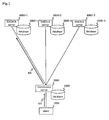
- Figure 1 shows a configuration of a typical process distribution system.
- Distribution server 2000 receives an authentication request signal transmitted from client 1000 for the sake of the authentication request.
- Distribution server 2000 extracts a user ID, which is user identification information for identifying a user and which is stored in a USER-NAME attribute in the RADIUS included in the received authentication request signal.
- the authentication server for authenticating the user (connected to the database storing the piece of user profile data of the user) is selected from among RADIUS servers 4000-1 to 4000-3 on the basis of the extracted user ID. This selection is made on the basis of an association between the user ID and authentication server identification information for identifying each of RADIUS servers 4000-1 to 4000-3, which have preliminarily been stored in database 3000 connected to distribution server 2000.
- the authentication server that authenticates the user who issued the authentication request is RADIUS server 4000-1.
- Distribution server 2000 selects RADIUS server 4000-1.
- the authentication request signal transmitted from client 1000 is transferred to RADIUS server 4000-1 (arrow BB).
- RADIUS server 4000-1 then authenticates the user.
- the distribution server cannot recognize the user ID. That is, if the pseudo ID is stored in the USER-NAME attribute of the RADIUS, the distribution server cannot recognize the original user ID of the client. Accordingly, this presents a problem in which the distribution server cannot select the authentication server, which is a destination and for identifying the user having transmitted the authentication request signal.
- An object of the present invention is to provide a process distribution system, an authentication server, a distribution server, and a process distribution method that resolve the above problem.
- a process distribution system comprises: a terminal operated by a user; authentication servers performing an authentication process to authenticate the user with the terminal by means of a TLS authentication in tunnel using a TLS parameter that has been preliminarily acquired; and a distribution server distributing the authentication process to one of the authentication servers, wherein the authentication server determines whether user identification information, that has been uniquely assigned to the user and that has been transmitted from the terminal via the distribution server, exists in an authentication database connected to the authentication server, and includes the user identification information and the TLS parameter into a transfer request signal indicating a transfer request of the user identification information and transmits the signal to the distribution server when determining that the user identification information does not exist in the authentication database, and the distribution server searches a distribution server database connected to the distribution server for authentication server identification information associated with the user identification information on the basis of the user identification information included in the transfer request signal transmitted from the authentication server, and transmits the user identification information and the TLS parameter to the authentication server assigned with the authentication server identification information that has
- An authentication server performing an authentication process to authenticate a user, who is operating a terminal, by means of TLS authentication in tunnel with the terminal using a TLS parameter that has been preliminarily acquired comprises:
- a distribution server connected to a terminal operated by a user and authentication servers performing an authentication process to authenticate the user with the terminal by means of TLS authentication in tunnel using a TLS parameter having preliminarily been acquired, and distributing the authentication process to one of the authentication servers, comprises:
- a process distribution method in a process distribution system including a terminal operated by a user, in which authentication servers perform an authentication process to authenticate the user with the terminal by means of a TLS authentication in tunnel using a TLS parameter that has been preliminarily acquired, and in which a distribution server distributes the authentication process to one of the authentication servers, the authentication server determines whether user identification information, which has been uniquely assigned to the user and which was transmitted from the terminal via the distribution server, exists in an authentication database connected to the authentication server, the authentication server includes the user identification information and the TLS parameter in a transfer request signal indicating a transfer request of the user identification information and transmits the signal to the distribution server when determining that the user identification information does not exist in the authentication database, the distribution server searches a distribution server database connected to the distribution server for authentication server identification information associated with the user identification information on the basis of the user identification information included in the transfer request signal transmitted from the authentication server, and the distribution server transmits the user identification information and the TLS parameter to the authentication server assigned with the authentication server identification information that has been searched for
- the present invention adopts a configuration where authentication servers, which perform an authentication process to authenticate a user using a terminal with the terminal by means of a TLS authentication in tunnel using a TLS parameter having preliminarily been acquired, include user identification information and the TLS parameter in the transfer request signal and transmit the signal to the distribution server connected to the authentication servers when the user identification information transmitted from the terminal does not exist in an authentication database connected to the authentication server, and the distribution server searches a distribution server database connected to the distribution server for authentication server identification information associated with the user identification information included in the transfer request signal and transmits the user identification information and the TLS parameter to the authentication server assigned with the authentication server identification information that has been searched for.
- This configuration is capable of performing efficient authentication process distribution.
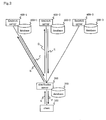
- Figure 2 is a diagram showing an exemplary embodiment of a process distribution system of the present invention.
- this exemplary embodiment includes client 100, distribution server 200, database 300, RADIUS servers 400-1 to 400-3 and databases 500-1 to 500-3.
- client 100 distribution server 200, database 300, RADIUS servers 400-1 to 400-3 and databases 500-1 to 500-3.
- database 300 RADIUS servers 400-1 to 400-3 and databases 500-1 to 500-3.
- RADIUS servers 400-1 to 400-3 an example including three RADIUS servers 400-1 to 400-3 and three databases 500-1 to 500-3 is described.
- the number of elements may be two or four or more for each type of element.
- Client 100 is a terminal that a user operates to issue an authentication request, and includes an input function for inputting information and a communication function for performing communication.
- Distribution server 200 distributes authentication processes to authenticate users among RADIUS servers 400-1 to 400-3.
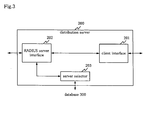
- Figure 3 is a diagram showing an example of a configuration of distribution server 200 shown in Figure 2 .
- Distribution server 200 shown in Figure 2 includes client interface 201, RADIUS server interface 202 and server selector 203, as shown in Figure 3.
- Figure 3 only shows elements related to the present invention.
- Client interface 201 includes an interface function interfacing with client 100 shown in Figure 2 , and transmits and receives a signal to and from client 100.
- Client interface 201 outputs the signal transmitted from client 100 to RADIUS server interface 202.
- Client interface 201 transmits a signal to be transmitted to client 100 among the signals outputted from RADIUS server interface 202, to client 100.
- RADIUS server interface 202 includes an interface function interfacing with RADIUS servers 400-1 to 400-3 shown in Figure 2 , and is an authentication server interface that transmits and receives a signal to and from RADIUS servers 400-1 to 400-3.
- RADIUS server interface 202 extracts a user ID, which is user identification information included in the transfer request signal for identifying the user, and transmits the user ID to server selector 203.
- RADIUS server interface 202 transfers authentication request signal to any one of RADIUS servers 400-1 to 400-3 on the basis of a search result on the RADIUS servers at server selector 203.
- RADIUS server interface 202 transmits the signal outputted from client interface 201 to the appropriate server from among RADIUS servers 400-1 to 400-3.
- RADIUS server interface 202 outputs a signal other than the transfer request signals, transmitted from RADIUS servers 400-1 to 400-3, to client interface 201.
- Server selector 203 searches for information stored in database 300 on the basis of the user ID outputted from RADIUS server interface 202, and selects the RADIUS server to which the authentication request signal is transferred, from among RADIUS servers 400-1 to 400-3.
- Database 300 is connected to distribution server 200, and is a distribution server database storing information for determining to which server, from among RADIUS servers 400-1 to 400-3, distribution server 200 distributes the authentication process for authenticating the user.
- Database 300 stores, as this information, association information and authentication server information.
- Figure 4 is a diagram showing an example of the association information stored in database 300 shown in Figure 2 .
- Figure 5 is a diagram showing an example of the authentication server information stored in database 300 shown in Figure 2 .
- the association information stored in database 300 shown in Figure 2 associates the user ID, which is user identification information uniquely assigned to the user for identifying the user, and an authentication server number, which is authentication server identification information uniquely assigned to the RADIUS server for identifying RADIUS servers 400-1 to 400-3, with each other, as shown in Figure 4 .
- This information indicates which database, from among databases 500-1 to 500-3, connected to respective RADIUS servers 400-1 to 400-3 stores the piece of user profile data of the user. That is, this information indicates the server at which the user can be authenticated from among RADIUS servers 400-1 to 400-3.
- user ID "user 1" is associated with authentication server number “server 1”; this indicates that the RADIUS server that is to authenticate the user whose user ID is “user 1” is the RADIUS server whose authentication server number is “server 1".
- User ID "user 2” is associated with authentication server number “server 1”; this indicates that the RADIUS server that is to authenticate the user whose user ID is “user 2” is the RADIUS server whose authentication server number is “server 1".
- User ID "user 3” is associated with authentication server number "server 1”; this indicates that the RADIUS server that is to authenticate the user whose user ID is “user 3” is the RADIUS server whose authentication server number is “server 1".
- User ID "user 4" is associated with authentication server number "server 2"; this indicates that the RADIUS server that is to authenticate the user whose user ID is “user 4" is the RADIUS server whose authentication server number is "server 2".
- User ID "user 5" is associated with authentication server number "server 2"; this indicates that the RADIUS server that is to authenticate the user whose user ID is “user 5" is the RADIUS server whose authentication server number is "server 2".
- User ID "user 6” is associated with authentication server number "server 3”; this indicates that the RADIUS server that is to authenticate the user whose user ID is “user 6” is the RADIUS server whose authentication server number is "server 3".
- User ID "user 7" is associated with authentication server number "server 3"; this indicates that the RADIUS server that is to authenticate the user whose user ID is “user 7” is the RADIUS server whose authentication server number is "server 3".
- User ID "user 8" is associated with authentication server number "server 3"; this indicates that the RADIUS server that is to authenticate the user whose user ID is “user 8” is the RADIUS server whose authentication server number is "server 3".
- Server selector 203 refers to this association information, thereby can select allowing the RADIUS server for authenticating the user with the user ID on the basis of the user ID outputted from RADIUS server interface 202.
- the authentication server information stored in database 300 shown in Figure 2 associates the above-mentioned authentication server number with the IP address of the authentication server, as shown in Figure 5 .
- This information indicates the IP address of the RADIUS server performing the authentication process for authenticating the user.
- authentication server number "server 1" is associated with the IP address "x.y.z.w1”; this indicates the IP address of the RADIUS server whose authentication server number is “server 1” is “x.y.z.w1".
- Authentication server number "server 2” is associated with the IP address "x.y.z.w2”; this indicates the IP address of the RADIUS server whose authentication server number is “server 2” is “x.y.z.w2”.
- Authentication server number “server 3” is associated with the IP address "x.y.z.w3”; this indicates the IP address of the RADIUS server whose authentication server number is “server 3” is "x.y.z.w3".
- Server selector 203 refers to this association information, and selects the RADIUS server for authenticating the user with the user ID concerned. Subsequently, the IP address of the RADIUS server concerned can be acquired.
- RADIUS servers 400-1 to 400-3 are authentication servers for authenticating the users.
- FIG 6 is a diagram showing an example of a configuration of RADIUS server 400-1 shown in Figure 2 . Note that RADIUS servers 400-2 to 400-3 shown in Figure 2 have the same configuration as that of RADIUS server 400-1.
- RADIUS server 400-1 shown in Figure 2 includes distribution server interface 411, encryptor/decryptor 412 and authenticator 413, as shown in Figure 6.
- Figure 6 only shows the elements related to the present invention.
- Distribution server interface 411 includes an interface function interfacing with distribution server 200 shown in Figure 2 , and transmits and receives a signal to and from distribution server 200.
- Distribution server interface 411 outputs the authentication request signal, which has been encrypted and transmitted from client 100 via distribution server 200, to encryptor/decryptor 412, when distribution server interface 411 performs a TLS (Transport Layer Security) tunnel communication, which is an encrypted communication, with client 100.
- Distribution server interface 411 includes a TLS parameter and the user ID outputted from authenticator 413 into the above-mentioned transfer request signal, and transmits the signal to server 200.
- the TLS parameter which is a parameter for encrypting and decrypting a signal such as the authentication request signal during the TLS tunnel communication, has already been acquired by means of a TLS handshake between RADIUS server 400-1 and client 100 in advance of the authentication.
- the Master-Secret a random number for generating a cryptographic key
- Cipher-Suite a pair of an encryption algorithm and a hash algorithm
- Compression-Method compression method
- Distribution server interface 411 transmits (tunnel communication) the signal outputted from encryptor/decryptor 412 to client 100 via distribution server 200.
- Encryptor/decryptor 412 decrypts the signal such as authentication request signal outputted from distribution server interface 411 using the TLS parameter. Encryptor/decryptor 412 extracts the user ID from the decrypted authentication request signal, and outputs the user ID to authenticator 413. Encryptor/decryptor 412 encrypts an authentication response signal outputted from authenticator 413, and outputs the signal to distribution server interface 411.
- Authenticator 413 authenticates the authentication request signal outputted from encryptor/decryptor 412. More specifically, authenticator 413 refers to database 500-1, and outputs a password request signal, which requests a password as one of authentication response signals, to encryptor/decryptor 412 when the identical user ID to that included in the authentication request signal exists in database 500-1.
- authenticator 413 authenticates the user ID by determining whether or not the password is associated with the user ID by database 500-1.
- authenticator 413 When the password outputted from encryptor/decryptor 412 is associated with the user ID by database 500-1, authenticator 413 outputs an authentication response signal indicating a successful authentication, to encryptor/decryptor 412. When the identical user ID to that included in the authentication request signal does not exist in database 500-1, authenticator 413 outputs the user ID to distribution server interface 411.
- Databases 500-1 to 500-3 are authentication server databases that store the user IDs of the users and the passwords in association with each other.
- database 300 shown in Figure 2 stores the association information shown in Figure 4 is described as an example.
- Figure 7 is a diagram showing an example of information stored in database 500-1 shown in Figure 2 .
- database 500-1 shown in Figure 2 associates user ID "user 1" with password “password 1", as shown in Figure 7 ; this indicates that the password of the user whose user ID is “user 1" is “password 1".
- User ID "user 2" is associated with password “password 2”; this indicates that the password of the user whose user ID is “user 2” is “password 2”.
- User ID "user 3” is associated with password “password 3”; this indicates that the password of the user whose user ID is "user 3” is "password 3”.
- Database 500-1 stores the pieces of user profile data of user 1, user 2 and user 3.
- Figure 8 is a diagram showing an example of information stored in database 500-2 shown in Figure 2 .
- Database 500-2 stores the pieces of user profile data of user 4 and user 5.
- Figure 9 is a diagram showing an example of information stored in database 500-3 shown in Figure 2 .
- database 500-3 shown in Figure 2 associates user ID "user 6" with password "password 6", as shown in Figure 9 ; this indicates that the password of the user whose user ID is “user 6" is “password 6".
- User ID "user 7” is associated with password “password 7”; this indicates that the password of the user whose user ID is “user 7” is “password 7”.
- User ID "user 8” is associated with password “password 8”; this indicates that the password of the user whose user ID is "user 8” is "password 8".
- Database 500-3 stores the pieces of user profile data of user 6, user 7 and user 8.
- Figure 10 is a sequence diagram for illustrating a process distribution method in the case where the user has the user ID "user 1" in the process distribution method in the configuration shown in Figures 2 to 9 .
- a TLS handshake is preliminarily established between client 100 and any one of RADIUS servers 400-1 to 400-3. This is a preparation for a cryptographic communication referred to as the TLS tunnel communication between client 100 and RADIUS servers 400-1 to 400-3.
- Access-Request which is a request signal
- RADIUS server interface 202 of distribution server 200 determines one RADIUS server, from among RADIUS servers 400-1 to 400-3, as the RADIUS server that will be a destination for Access-Request, and Access-Request is transferred to the RADIUS server that has been determined to be the destination in steps 1 and 3.
- a method of determining the destination may be a method of random determination or a method of determination having a prescribed regularity such as a round robin.
- a case where the destination is determined to be RADIUS server 400-1 is described as an example.
- Access-Challenge which is a response signal corresponding to received Access-Request
- the TLS handshake is similar to a typical one.
- the Master-Secret, Cipher-Suite and Compression-Method which are TLS parameters required when the TLS tunnel communication is performed, are exchanged between client 100 and RADIUS server 400-l, and acquired by client 100 and RADIUS server 400-1.
- step 5 when Access-Request as the authentication request signal is transmitted from client 100 via distribution server 200, the authentication request signal received by distribution server interface 411 of RADIUS server 400-1 is decrypted by encryptor/decryptor 412 using the TLS parameter.
- the user ID is extracted from the authentication request signal decrypted by encryptor/decryptor 412; the user ID is identified at this stage for the first time.
- the extracted user ID is outputted from encryptor/decryptor 412 to authenticator 413.
- Authenticator 413 refers to database 500-1, and searches database 500-1 for a user ID identical to the user ID outputted from encryptor/decryptor 412.
- the user ID is searched for from database 500-1.
- Access-Challenge as the authentication response signal, is transmitted from distribution server interface 411 to client 100 via distribution server 200, in step 6.
- steps 7 and 8 a packet including the password is exchanged between client 100 and RADIUS server 400-1, and the authentication is completed.
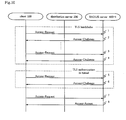
- FIG 11 is a sequence diagram for illustrating the process distribution method in the case where the user has user ID "user 4" in the process distribution method in the configuration shown in Figures 2 to 9 .
- the server whose authentication server number stored in database 300 is "server 2”, is RADIUS server 400-2.
- the preparation for the cryptographic communication referred to as the TLS tunnel communication is performed between client 100 and any one of RADIUS servers 400-1 to 400-3 using the TLS handshake in steps 11 to 14. These processes are identical to those of the above steps 1 to 4. As with the above example, a case where the destination is determined to be RADIUS server 400-1 is described as an example.
- step 15 when Access-Request as the authentication request signal is transmitted from client 100 via distribution server 200 (arrows A and B shown in Figure 2 ), the authentication request signal received by distribution server interface 411 of RADIUS server 400-1 is decrypted by encryptor/decryptor 412 using the TLS parameter. The user ID is extracted from the authentication request signal decrypted by encryptor/decryptor 412. The extracted user ID is outputted from encryptor/decryptor 412 to authenticator 413.
- Authenticator 413 refers to database 500-1, and searches database 500-1 for a user ID identical to the user ID outputted from encryptor/decryptor 412.
- the user ID is not searched for from database 500-1.
- the user ID is outputted from authenticator 413 to distribution server interface 411.
- a transfer request signal where an attribute indicating a transfer request has been added to Access-Reject including the user ID and the above TLS parameter, is transmitted from distribution server interface 411 to distribution server 200 (arrow C shown in C). Since the attribute here is not supported by the standard attributes of RADIUS, an attribute specific to Vendor Specific Attribute is used. The contents of the required attribute are as follows:
- RADIUS server interface 202 of distribution server 200 receives the transfer request signal transmitted from distribution server interface 411 of RADIUS server 400-1, the user ID is extracted from the received transfer request signal by RADIUS server interface 202. The extracted user ID is outputted from RADIUS server interface 202 to server selector 203.
- Server selector 203 searches for the RADIUS server as the destination from among RADIUS servers 400-1 to 400-3 on the basis of the extracted user ID. More specifically, server selector 203 refers to database 300, and acquires the authentication server number associated with the extracted user ID, from the association information of database 300. Server selector 203 acquires the IP address of the acquired authentication server number from the authentication server information of database 300.
- server selector 203 since user ID is "user 4", authentication server number "server 2" (RADIUS server 400-2) is acquired. Since “server 2" is acquired as the authentication server number, the IP address "x.y.z.w2" is acquired. The acquired IP address is outputted from server selector 203 to RADIUS server interface 202.
- RADIUS server interface 202 adds the attribute that stores the TLS parameter and the attribute that stores the user ID to Access-Request. Subsequently, in step 17, this Access-Request is transmitted from RADIUS server interface 202 to RADIUS server 400-2, which has the IP address outputted from server selector 203 (arrow D shown in Figure 2 ).
- RADIUS server 400-2 determines the presence of the added attribute, diversion of the TLS parameter added together negates the need for reestablishing the handshake between client 100 and RADIUS server 400-2; an authentication packet after the TLS handshake is regarded as the beginning of the TLS authentication in tunnel.
- an authentication result is transmitted from RADIUS server 400-2 to client 100 via distribution server 200 (arrows E and F shown in Figure 2 ).
- steps 19 and 20 a packet is exchanged among client 100, distribution server 200 and RADIUS server 400-2, and the authentication is completed.
- the user ID is described using the example in which the user ID is uniquely assigned. However, the user ID may be assigned in a manner specific to the terminal of client 100.
- Database 300 may be included in distribution server 200.
- Databases 500-1 to 500-3 may be included in RADIUS servers 400-1 to 400-3, respectively.
- transfer of the information acquired by the TLS handshake negates the need for repeating the authentication procedures from the beginning and can continue the authentication by another authentication server, thereby allowing the distribution of the process to be efficiently performed.
Landscapes
- Engineering & Computer Science (AREA)
- Computer Security & Cryptography (AREA)
- Computer Networks & Wireless Communication (AREA)
- Signal Processing (AREA)
- Computer Hardware Design (AREA)
- Computing Systems (AREA)
- General Engineering & Computer Science (AREA)
- Storage Device Security (AREA)
- Information Retrieval, Db Structures And Fs Structures Therefor (AREA)
Applications Claiming Priority (2)
| Application Number | Priority Date | Filing Date | Title |
|---|---|---|---|
| JP2008033333A JP4344957B2 (ja) | 2008-02-14 | 2008-02-14 | 処理分散システム、認証サーバ、分散サーバ及び処理分散方法 |
| PCT/JP2009/050923 WO2009101848A1 (ja) | 2008-02-14 | 2009-01-22 | 処理分散システム、認証サーバ、分散サーバ及び処理分散方法 |
Publications (1)
| Publication Number | Publication Date |
|---|---|
| EP2246800A1 true EP2246800A1 (de) | 2010-11-03 |
Family
ID=40956878
Family Applications (1)
| Application Number | Title | Priority Date | Filing Date |
|---|---|---|---|
| EP09710803A Withdrawn EP2246800A1 (de) | 2008-02-14 | 2009-01-22 | Prozessverteilungssystem, authentifikationsserver, verteilungsserver und prozessverteilungsverfahren |
Country Status (6)
| Country | Link |
|---|---|
| US (1) | US20110010544A1 (de) |
| EP (1) | EP2246800A1 (de) |
| JP (1) | JP4344957B2 (de) |
| CN (1) | CN101939751A (de) |
| TW (1) | TW200948016A (de) |
| WO (1) | WO2009101848A1 (de) |
Cited By (1)
| Publication number | Priority date | Publication date | Assignee | Title |
|---|---|---|---|---|
| EP3654609A4 (de) * | 2017-08-23 | 2021-04-14 | SK Holdings Co., Ltd. | Blockchain-basiertes one-id-dienstsystem und -verfahren |
Families Citing this family (8)
| Publication number | Priority date | Publication date | Assignee | Title |
|---|---|---|---|---|
| JP4937302B2 (ja) * | 2009-07-10 | 2012-05-23 | 日本電信電話株式会社 | 認証装置、認証方法、認証プログラムおよび認証システム |
| US9430291B2 (en) | 2010-12-30 | 2016-08-30 | International Business Machines Corporation | Distributed topology enabler for identity manager |
| TWI512453B (zh) * | 2011-01-10 | 2015-12-11 | Hon Hai Prec Ind Co Ltd | 主備伺服器切換系統及方法 |
| JP5492146B2 (ja) * | 2011-06-13 | 2014-05-14 | 日本電信電話株式会社 | データベースシステム及び制御方法 |
| US10320842B1 (en) * | 2017-03-24 | 2019-06-11 | Symantec Corporation | Securely sharing a transport layer security session with one or more trusted devices |
| US11316829B2 (en) | 2017-05-05 | 2022-04-26 | Royal Bank Of Canada | Distributed memory data repository based defense system |
| US10972455B2 (en) * | 2018-04-24 | 2021-04-06 | International Business Machines Corporation | Secure authentication in TLS sessions |
| US20230362009A1 (en) * | 2022-05-04 | 2023-11-09 | John Charles Schwinn | User identification and authentication method and system |
Family Cites Families (4)
| Publication number | Priority date | Publication date | Assignee | Title |
|---|---|---|---|---|
| JP2001273257A (ja) * | 2000-03-23 | 2001-10-05 | Nippon Telegr & Teleph Corp <Ntt> | 代理認証サーバ |
| US8341700B2 (en) * | 2003-10-13 | 2012-12-25 | Nokia Corporation | Authentication in heterogeneous IP networks |
| JP2006011989A (ja) | 2004-06-28 | 2006-01-12 | Ntt Docomo Inc | 認証方法、端末装置、中継装置及び認証サーバ |
| JP4742903B2 (ja) * | 2006-02-17 | 2011-08-10 | 日本電気株式会社 | 分散認証システム及び分散認証方法 |
-
2008
- 2008-02-14 JP JP2008033333A patent/JP4344957B2/ja not_active Expired - Fee Related
-
2009
- 2009-01-22 US US12/811,904 patent/US20110010544A1/en not_active Abandoned
- 2009-01-22 CN CN2009801044894A patent/CN101939751A/zh active Pending
- 2009-01-22 EP EP09710803A patent/EP2246800A1/de not_active Withdrawn
- 2009-01-22 WO PCT/JP2009/050923 patent/WO2009101848A1/ja not_active Ceased
- 2009-02-10 TW TW098104185A patent/TW200948016A/zh unknown
Non-Patent Citations (1)
| Title |
|---|
| See references of WO2009101848A1 * |
Cited By (2)
| Publication number | Priority date | Publication date | Assignee | Title |
|---|---|---|---|---|
| EP3654609A4 (de) * | 2017-08-23 | 2021-04-14 | SK Holdings Co., Ltd. | Blockchain-basiertes one-id-dienstsystem und -verfahren |
| US11483303B2 (en) | 2017-08-23 | 2022-10-25 | Sk Holdings Co., Ltd. | Blockchain-based one ID service system and method |
Also Published As
| Publication number | Publication date |
|---|---|
| WO2009101848A1 (ja) | 2009-08-20 |
| JP4344957B2 (ja) | 2009-10-14 |
| CN101939751A (zh) | 2011-01-05 |
| JP2009193336A (ja) | 2009-08-27 |
| US20110010544A1 (en) | 2011-01-13 |
| TW200948016A (en) | 2009-11-16 |
Similar Documents
| Publication | Publication Date | Title |
|---|---|---|
| CN110493261B (zh) | 基于区块链的验证码获取方法、客户端、服务器及存储介质 | |
| US20230421394A1 (en) | Secure authentication of remote equipment | |
| EP2246800A1 (de) | Prozessverteilungssystem, authentifikationsserver, verteilungsserver und prozessverteilungsverfahren | |
| US7325133B2 (en) | Mass subscriber management | |
| CA2619420C (en) | Distributed single sign-on service | |
| US7992193B2 (en) | Method and apparatus to secure AAA protocol messages | |
| JP4000111B2 (ja) | 通信装置および通信方法 | |
| CN100477833C (zh) | 认证方法 | |
| US20030070069A1 (en) | Authentication module for an enterprise access management system | |
| WO2022100356A1 (zh) | 身份认证系统、方法、装置、设备及计算机可读存储介质 | |
| JP2013243553A (ja) | サービス要求装置、サービス提供システム、サービス要求方法およびサービス要求プログラム | |
| JP2005102163A (ja) | 機器認証システム、機器認証サーバ、端末機器、機器認証方法、機器認証プログラム、及び記憶媒体 | |
| CN108809633B (zh) | 一种身份认证的方法、装置及系统 | |
| KR102146940B1 (ko) | 토큰 위변조 검증 방법 | |
| US20110162053A1 (en) | Service assisted secret provisioning | |
| JP7648771B2 (ja) | ブロックチェーンに基づくsdpアクセス制御方法及び装置 | |
| JP2001177513A (ja) | 通信システムにおける認証方法、センタ装置、認証プログラムを記録した記録媒体 | |
| CN108270561A (zh) | 数据发送方法及装置、密钥索引的生成方法及装置 | |
| JP2024501728A (ja) | ブロックチェーンベースのsdpアクセス制御方法及びシステム | |
| JP2000339270A (ja) | ユーザ相互認証システム、ユーザ相互認証方法、および記録媒体 | |
| KR100659972B1 (ko) | 홈네트워크 디바이스들의 상호인증 방법 | |
| US20250131422A1 (en) | Key Exchange Through a Plurality of Non-Trusted Third Parties | |
| CN117156433B (zh) | 卫星互联网密钥管理分发方法、装置和部署架构 | |
| KR101836134B1 (ko) | 경량 장치를 위한 공개키 기반 인증 대행 방법 | |
| WO2025107709A1 (zh) | 明文数据的获取方法和系统、存储介质及电子装置 |
Legal Events
| Date | Code | Title | Description |
|---|---|---|---|
| PUAI | Public reference made under article 153(3) epc to a published international application that has entered the european phase |
Free format text: ORIGINAL CODE: 0009012 |
|
| 17P | Request for examination filed |
Effective date: 20100730 |
|
| AK | Designated contracting states |
Kind code of ref document: A1 Designated state(s): AT BE BG CH CY CZ DE DK EE ES FI FR GB GR HR HU IE IS IT LI LT LU LV MC MK MT NL NO PL PT RO SE SI SK TR |
|
| AX | Request for extension of the european patent |
Extension state: AL BA RS |
|
| STAA | Information on the status of an ep patent application or granted ep patent |
Free format text: STATUS: THE APPLICATION HAS BEEN WITHDRAWN |
|
| DAX | Request for extension of the european patent (deleted) | ||
| 18W | Application withdrawn |
Effective date: 20110506 |