EP2246846A1 - Système à filtrage de traquage pour un filtrage MIMO adaptatif aveugle quasi-indéterminé - Google Patents
Système à filtrage de traquage pour un filtrage MIMO adaptatif aveugle quasi-indéterminé Download PDFInfo
- Publication number
- EP2246846A1 EP2246846A1 EP09159035A EP09159035A EP2246846A1 EP 2246846 A1 EP2246846 A1 EP 2246846A1 EP 09159035 A EP09159035 A EP 09159035A EP 09159035 A EP09159035 A EP 09159035A EP 2246846 A1 EP2246846 A1 EP 2246846A1
- Authority
- EP
- European Patent Office
- Prior art keywords
- filter coefficient
- mimo
- coefficient set
- filter
- signals
- Prior art date
- Legal status (The legal status is an assumption and is not a legal conclusion. Google has not performed a legal analysis and makes no representation as to the accuracy of the status listed.)
- Granted
Links
- 238000001914 filtration Methods 0.000 title claims description 50
- 230000003044 adaptive effect Effects 0.000 title description 7
- 238000000034 method Methods 0.000 claims abstract description 46
- 230000006978 adaptation Effects 0.000 claims abstract description 30
- 238000012545 processing Methods 0.000 claims abstract description 16
- 238000003860 storage Methods 0.000 claims abstract description 10
- 238000004590 computer program Methods 0.000 claims abstract description 8
- 238000012546 transfer Methods 0.000 claims description 18
- 230000008859 change Effects 0.000 claims description 16
- 238000001514 detection method Methods 0.000 claims description 10
- 239000002131 composite material Substances 0.000 claims description 3
- 230000003111 delayed effect Effects 0.000 claims description 2
- 238000011156 evaluation Methods 0.000 claims description 2
- 230000003139 buffering effect Effects 0.000 claims 1
- 238000000926 separation method Methods 0.000 description 17
- 238000012880 independent component analysis Methods 0.000 description 14
- 230000004807 localization Effects 0.000 description 9
- 238000005204 segregation Methods 0.000 description 6
- 230000008901 benefit Effects 0.000 description 5
- 239000000203 mixture Substances 0.000 description 5
- 230000004044 response Effects 0.000 description 4
- 238000013459 approach Methods 0.000 description 3
- 241001136792 Alle Species 0.000 description 2
- 238000011161 development Methods 0.000 description 2
- 230000000694 effects Effects 0.000 description 2
- 230000005284 excitation Effects 0.000 description 2
- 230000008569 process Effects 0.000 description 2
- 230000009471 action Effects 0.000 description 1
- 238000003491 array Methods 0.000 description 1
- 230000001934 delay Effects 0.000 description 1
- 230000006870 function Effects 0.000 description 1
- 230000004886 head movement Effects 0.000 description 1
- 238000012432 intermediate storage Methods 0.000 description 1
- 239000011159 matrix material Substances 0.000 description 1
- 238000005457 optimization Methods 0.000 description 1
- 238000000638 solvent extraction Methods 0.000 description 1
- 230000002123 temporal effect Effects 0.000 description 1
- 230000001960 triggered effect Effects 0.000 description 1
Images

Classifications
-
- G—PHYSICS
- G10—MUSICAL INSTRUMENTS; ACOUSTICS
- G10L—SPEECH ANALYSIS TECHNIQUES OR SPEECH SYNTHESIS; SPEECH RECOGNITION; SPEECH OR VOICE PROCESSING TECHNIQUES; SPEECH OR AUDIO CODING OR DECODING
- G10L21/00—Speech or voice signal processing techniques to produce another audible or non-audible signal, e.g. visual or tactile, in order to modify its quality or its intelligibility
- G10L21/02—Speech enhancement, e.g. noise reduction or echo cancellation
- G10L21/0272—Voice signal separating
-
- H—ELECTRICITY
- H04—ELECTRIC COMMUNICATION TECHNIQUE
- H04L—TRANSMISSION OF DIGITAL INFORMATION, e.g. TELEGRAPHIC COMMUNICATION
- H04L25/00—Baseband systems
- H04L25/02—Details ; arrangements for supplying electrical power along data transmission lines
- H04L25/03—Shaping networks in transmitter or receiver, e.g. adaptive shaping networks
- H04L25/03006—Arrangements for removing intersymbol interference
- H04L2025/0335—Arrangements for removing intersymbol interference characterised by the type of transmission
- H04L2025/03426—Arrangements for removing intersymbol interference characterised by the type of transmission transmission using multiple-input and multiple-output channels
Definitions
- the present invention relates to a method, a device, a computer program and a digital storage medium having a computer program for processing a plurality of received mixed signals for generating a plurality of component signals for different scenarios, wherein the plurality of mixed signals in a scenario with a plurality of in one room signal sources of several sensors are received.
- the methods for blind adaptive multiple-input / multiple-output (MIMO) filtering are applied to mixtures of signals derived from multiple independent point sources that are not individually accessible to measure.
- the signal mixtures are recorded by means of several spatially separated sensors ("sensor arrays").
- sensor arrays A practically important and technically demanding example are acoustic human-machine interfaces with a microphone array, in front of which the users (speech signal sources) can move freely.
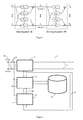
- MIMO mixing system H (see Fig. 1 ) can be modeled with finite impulse response (FIR) filters.
- the downstream MIMO-FIR segregation system W represents the digital signal processing of the sensor signals. Its filter coefficients are adjusted adaptively by means of a specific optimization criterion. The estimation The filter coefficients of the demixing system are generally carried out iteratively over time in order to be able to temporally follow possible changes in the mixing system (eg variations of speaker positions).
- the blind signal separation is closely related to the blind system identification of H : From the estimated demixing coefficients one can directly deduce the physical mixing system [1], and from this, for example, the spatial one Source localization [1].
- the blind signal processing problems are in principle not ideally solved system-theoretically. Instead, many of the known approaches can be attributed to classification problems. However, an advantage of these methods is that, in principle, they can also be applied in the case of more sources than sensors (underdetermined case).
- the present invention relates to the improved signal processing of a plurality of received composite signals for generating a plurality of component signals for different scenarios.
- the respective scenarios are determined, for example, by the arrangement and / or the number of signal sources and sensors.
- the scenarios may relate to the propagation conditions of the signals in space, for example any pronounced dominant reflections.
- the multiple mixed signals of a scenario with several signal sources present in space are received by several sensors.
- the signal sources are statistically independent and / or point sources.
- the generated component signals preferably track the respective separate, scaled and delayed and / or linearly filtered versions of the signals from the multiple signal sources.
- the plurality of received mixed signals are preferably received by at least two, more preferably at least three, spatially separated sensors, which are preferably microphones, sensor array or sensor matrix.
- At most P of the plurality of signal sources are active simultaneously when P sensors are present.
- the filter coefficient set used for MIMO filtering preferably sets at least one FIR filter.
- the overwriting of the filter coefficient set used for MIMO filtering is preferably carried out by means of an intermediate storage in a transfer logic. It is further preferred that the preferred caching in the transfer logic only after at least one adaptation step for filter coefficient adaptation of the most suitable filter coefficient set overwrites the filter coefficient set used for MIMO filtering.
- the filter coefficient set used for filter coefficient adaptation of the filter coefficient set used for MIMO filtering is at least one adaptation step, a step of blind filter coefficient adaptation.
- the method of the invention preferably includes a step of detecting an abrupt change of a scenario.
- the step of detecting an abrupt change of a scenario comprises detecting an abrupt change in the spatial arrangement and / or the number of at least one of the plurality of signal sources and / or sensors.
- a step is further preferably carried out for evaluating the filter coefficient set used for MIMO filtering.
- the filter coefficient set used prior to detection of an abrupt change for the current MIMO filtering scenario is stored as a pattern filter coefficient set, the number of stored pattern filter coefficient sets being preferably N, where N is further preferably is at least 50.
- the step of the method according to the invention for determining the suitability of the filter coefficient set used for MIMO filtering and for determining the respective suitability of the plurality of stored pattern filter coefficient sets preferably comprises a step for determining the spatial arrangement of the signal sources active at a time.
- a step is preferably carried out for evaluating the filter coefficients used for MIMO filtering.
- the step of determining the suitability of the pattern filter coefficient sets comprises a step of determining the Euclidean distances between the current positions of the signal sources and the associated positions of the signal sources additionally stored to the respective pattern filter coefficient sets.
- a step for comparing the Euclidean distances with at least one threshold value is preferably carried out.
- the step of the method according to the invention for determining the respective suitability of the plurality of stored pattern filter coefficient sets comprises a step for determining the transit time differences in the received mixed signals. It is preferred that the transit time differences are determined by evaluating the corresponding impulse responses of the transfer functions.
- the step of determining the respective suitability of the plurality of stored pattern filter coefficient sets preferably comprises a comparing step wherein the propagation time differences of the impulse responses associated with the respective pattern filter coefficient sets are compared with the determined transit time differences of the received mixed signals.
- the step of the method according to the invention for determining the respective suitability of the plurality of stored pattern filter coefficient sets comprises a step of comparing the filter coefficients used for MIMO filtering with the respective filter coefficients of the stored pattern filter coefficient sets.
- At least two of the stored pattern flicker coefficient sets may preferably have different numbers of filter coefficients.
- aspects of the present invention relate to a computer program for carrying out the inventive method described above, and to a storage medium having such a computer program.
- the present invention advantageously covers a practically relevant application, according to which at P sensors in the different time periods only ever maximally P sources (with pure separation) or less than P sources (with development) are simultaneously active. Overall, however, there may be several signal sources whose activity alternates. In principle, the above-described ICA-based method could be used in this scenario. However, now, for example, every change of speaker would have to be completely adapted to the MIMO demixing filter. However, in the case of fast speaker changes, ie rapid successive abrupt changes in the MIMO mixing system, this is generally not possible sufficiently quickly with sufficient accuracy, since, for example, in the acoustic case, the demixing system can have several thousand filter coefficients.
- the invention described herein combines the advantages of Classes 1 and 2 by extending ICA-based Class 1 methods for practically relevant applications.
- the embodiments of the present invention described herein relate to exemplary embodiments of the aforementioned MIMO segregation system method.
- the realization of the detection according to the invention of abrupt mixing system changes and the search process for a suitable coefficient set in the memory are based on a spatial localization of the signal sources.
- FIG. 2 shows the structure of an embodiment of a system 1 according to the invention, wherein a foreground filter 2 comprises a plurality of mixed signals 9 from a plurality of sensors 6 receives.
- the received mixed signals 9 are filtered by the foreground filter 2, whereby a plurality of component signals 7 are generated and output.
- the filter coefficients set for the foreground filtering 2 can be updated by means of a data connection with a transfer logic 3, the transfer logic 3 overwriting the filter coefficients of the foreground filter 2 by background filter coefficients 8.
- the background filter coefficients 8 are adapted stepwise in an adaptation loop with an adaptation device 4, wherein the adaptation device 4 also receives the multiple mixed signals 9 in addition to the background filter coefficients 8.
- the filter coefficients adapted by the adaptation device 4 are then transmitted to the transfer logic 4 via a data link as adapted background filter coefficients 8a, the transfer logic 4 deciding whether to transfer the received adapted background filter coefficients 8a to the foreground filter 2 transfers or not.
- the transfer logic 4 is further connected to the plurality of mixed signals 9 and a memory 5.
- the memory 5 stores a number N of pattern filter coefficient sets, each associated with different scenarios with multiple active signal sources and sensors 6 present in space.
- FIG. 2 thus, the structure of an embodiment of a system 1 according to the invention, according to which an adaptation initially runs in the background, that is, filter coefficients 8 are adapted, which are not initially applied to the actual output signals.
- the coefficients of the background filter 8 are first copied into the foreground filter 2 according to a further aspect of the invention by a transfer logic 3 described below.
- the in Fig. 2 1 also shows the memory 5 for further coefficient sets for the MIMO segregation system.
- transfer logic 3 shown now checks for a certain predetermined criterion, whether each of the further signal processing, the coefficient set of the adaptive background system, or one of the stored in the memory 5 coefficient sets is better suited. This decision may be coupled to a detection of an abrupt mixing system change previously performed within the transfer logic 3.
- the coefficients of the background demixing system can also be used for the foreground demixing system.
- This coefficient transfer may also include the transfer logic 3 of the "conventional" shadow filter structure without memory (see eg [10]).
- the coefficient set which for example was present before detection of an abrupt mixing system change in the foreground demixing system, is taken into the memory 5 become.
- the memory 5 preferably each includes the time last N sent to the memory demixing coefficients sets, where N is preferably at least 50.
- the invention can also be used without problems for convolution mixtures, for example in reverberant environments in acoustics.
- a further advantage is that the invention can be used in a uniform manner for all above-mentioned blind adaptation problems, ie not only for separation but also, for example, for deployment and blind system identification.
- Fig. 3 shows a further embodiment of the in Fig. 2 illustrated embodiment, based on a spatial source localization with a source localization unit 10. As far as both embodiments are the same on the above description of Fig. 2 with reference.
- the source localization unit 10 receives the adapted background filter coefficients 8a output from the adaptation device 4, and determines the associated arrangement of the signal sources and / or sensors 6.
- the determined source position data 11 of the source location unit 10 is a detection unit 12, a search unit 13, and a filter coefficient storage unit 15 fed.
- the detection unit 12 is used for rapidly responding change detection of the mixing system, wherein, for example, abrupt changes in the arrangement of the signal sources and / or sensors 6 can be taken into account. If a fast-reacting change of the mixing system is detected, the search unit 13 and filter coefficient storage unit 15 are triggered by the detection unit 12 via a trigger line 19. It follows by triggering that the filter coefficient storage unit 15 sets the current filter coefficient set 8m and the corresponding current source position data 11m used before the detection of the fast response change of the foreground filtering mixing system 2 as a pattern coefficient set in the memory 5, for example stores.
- the memory 5 can consist of two memory units or two memory areas.
- a storage unit 5 may store the filter coefficient sets for N previous stored source location scenarios.
- the other storage unit stores the N previous source position data.
- the search unit 13 is also connected to the memory 5 and is activated by the above-explained triggering to determine the pattern coefficient set best suited in the memory 5 for the current scenario.
- the current scenario is assigned to the source position data 11m output from the source locating unit 10.
- the pattern coefficient set determined by the search unit 13 is supplied to a comparison unit 14, which determines, for example by means of a threshold value comparison, whether the present pattern coefficient set is to replace the filter coefficient set of the foreground filter 2.
- the corresponding pattern coefficient set is read out of the memory 5 by a read-out unit 18 and forwarded to the transfer logic 3.
- the source position data 11 of the source localization unit 10 is supplied to the search unit 13, and may be used, for example, as indexes for searching for matching coefficient sets in the memory 5.
- the Euclidean distances between the current source positions 11 and the source positions in the stored scenarios may be used in conjunction with the threshold comparison 14.
- the search could be simplified and / or accelerated by partitioning the memory 5.
- Fig. 3 shows how the source position data 11 are used by a filter coefficient storage unit 15 to include new pattern filter coefficients 8m and the associated source positions 11m in the memory 5. Thereafter, the stored pattern coefficients can be read out of the memory 5, for example by means of the read-out unit 18.
Landscapes
- Engineering & Computer Science (AREA)
- Computational Linguistics (AREA)
- Quality & Reliability (AREA)
- Signal Processing (AREA)
- Health & Medical Sciences (AREA)
- Audiology, Speech & Language Pathology (AREA)
- Human Computer Interaction (AREA)
- Physics & Mathematics (AREA)
- Acoustics & Sound (AREA)
- Multimedia (AREA)
- Circuit For Audible Band Transducer (AREA)
Priority Applications (1)
| Application Number | Priority Date | Filing Date | Title |
|---|---|---|---|
| EP09159035.6A EP2246846B1 (fr) | 2009-04-29 | 2009-04-29 | Système de filtrage à l'ombre pour un filtrage MIMO adaptatif aveugle quasi-indéterminé |
Applications Claiming Priority (1)
| Application Number | Priority Date | Filing Date | Title |
|---|---|---|---|
| EP09159035.6A EP2246846B1 (fr) | 2009-04-29 | 2009-04-29 | Système de filtrage à l'ombre pour un filtrage MIMO adaptatif aveugle quasi-indéterminé |
Publications (2)
| Publication Number | Publication Date |
|---|---|
| EP2246846A1 true EP2246846A1 (fr) | 2010-11-03 |
| EP2246846B1 EP2246846B1 (fr) | 2018-06-06 |
Family
ID=41226366
Family Applications (1)
| Application Number | Title | Priority Date | Filing Date |
|---|---|---|---|
| EP09159035.6A Not-in-force EP2246846B1 (fr) | 2009-04-29 | 2009-04-29 | Système de filtrage à l'ombre pour un filtrage MIMO adaptatif aveugle quasi-indéterminé |
Country Status (1)
| Country | Link |
|---|---|
| EP (1) | EP2246846B1 (fr) |
Cited By (1)
| Publication number | Priority date | Publication date | Assignee | Title |
|---|---|---|---|---|
| US10693511B1 (en) | 2019-03-01 | 2020-06-23 | Sprint Communications Company L.P. | Wireless user signal reception based on multiple directions-of-arrival |
Citations (3)
| Publication number | Priority date | Publication date | Assignee | Title |
|---|---|---|---|---|
| EP1400814A2 (fr) * | 2002-09-17 | 2004-03-24 | Kabushiki Kaisha Toshiba | Appareil, systeme, methode et logiciel pour ajustage directionnel |
| EP1070390B1 (fr) | 1998-04-08 | 2005-06-22 | Sarnoff Corporation | Separation convolutive aveugle de sources par un procede de decorrelation multiple |
| US20050216258A1 (en) * | 2003-02-07 | 2005-09-29 | Nippon Telegraph And Telephone Corporation | Sound collecting mehtod and sound collection device |
-
2009
- 2009-04-29 EP EP09159035.6A patent/EP2246846B1/fr not_active Not-in-force
Patent Citations (3)
| Publication number | Priority date | Publication date | Assignee | Title |
|---|---|---|---|---|
| EP1070390B1 (fr) | 1998-04-08 | 2005-06-22 | Sarnoff Corporation | Separation convolutive aveugle de sources par un procede de decorrelation multiple |
| EP1400814A2 (fr) * | 2002-09-17 | 2004-03-24 | Kabushiki Kaisha Toshiba | Appareil, systeme, methode et logiciel pour ajustage directionnel |
| US20050216258A1 (en) * | 2003-02-07 | 2005-09-29 | Nippon Telegraph And Telephone Corporation | Sound collecting mehtod and sound collection device |
Non-Patent Citations (14)
| Title |
|---|
| A. HYVÄRINEN; J. KARHUNEN; E. OJA: "Independent Component Analysis", 2001, WILEY & SONS |
| BUCHNER ET AL.: "Simultaneous localization of multiple sound sources using blind adaptive MIMO filtering", IEEE CONFERENCE ON ACOUSTICS, SPEECH, AND SIGNAL PROCESSING, March 2005 (2005-03-01), Piscataway, US, XP002554116 * |
| BUCHNER ET AL: "Relation between blind system indentification and convolutive blind source separation", JOINT WORKSHOP FOR HANDS-FREE SPEECH COMMUNICATION AND MICROPHONE ARRAYS, 17 March 2005 (2005-03-17), Piscataway, US, pages D-3 - D-4, XP002554115 * |
| H. BUCHNER ET AL.: "Audio Signal Processing for Next-Generation Multimedia Communication Systems", February 2004, KLUWER ACADEMIC PUBLISHERS, article "Blind source separation for convolutive mixtures: A unified treatment", pages: 255 - 293 |
| H. BUCHNER ET AL.: "Blind Speech Separation", September 2007, SPRINGER-VERLAG, article "TRINICON-based blind system identification with application to multiple-source localization and separation", pages: 101 - 147 |
| H. BUCHNER; R. AICHNER; W. KELLENNANN: "The TRINICON framework for adaptive MIMO signal processing with focus on the generic Sylvester constraint", PROC. ITG CONF ON SPEECH COMMUNICATION, October 2008 (2008-10-01) |
| J. KARLSEN; A. ERIKSSON, AN ADAPTIVE DUAL FILTER ECHO CANCELLATION METHOD, October 1996 (1996-10-01) |
| K. OCHIAI; T. ARASEKI; T. OGIHARA: "Echo canceler with two echo path models", IEEE TRANSACTIONS ON COMMUNICATIONS, vol. COM-25, no. 6, June 1977 (1977-06-01), pages 589 - 595, XP002927500, DOI: doi:10.1109/TCOM.1977.1093869 |
| KELLERMANN: "A self-steering digital microphone array", IEEE CONFERENCE ON ACOUSTICS, SPEECH & SIGNAL PROCESSINGSPEECH PROCESSING, 14 April 1991 (1991-04-14), New York, US, pages 3581 - 3584, XP010043800, ISBN: 978-0-7803-0003-3 * |
| M. MIYOSHI; Y. KANEDA: "Inverse filtering of room acoustics", IEEE TRANS. ACOUST., SPEECH, SIGNAL PROCESSING, vol. 36, no. 2, February 1988 (1988-02-01), pages 145 - 152, XP000005739, DOI: doi:10.1109/29.1509 |
| OCHIAI ET AL.: "Echo canceler with two echo path models", IEEE TRANSACTIONS ON COMMUNICATIONS, vol. 25, no. 6, June 1977 (1977-06-01), Piscataway, US, pages 589 - 595, XP000570738, ISSN: 0090-6778 * |
| S. ARAKI ET AL.: "Underdetermined blind sparse source separation for arbitrarily arranged multiple sensors", SIGNAL PROCESSING, vol. 87, 2007, pages 1833 - 1847, XP022034408, DOI: doi:10.1016/j.sigpro.2007.02.003 |
| S. WEHR ET AL.: "Shadow BSS' for blind source separation in rapidly time-varying acoustic scenes", PROC. INT. CONF. ON INDEPENDENT COMPONENT ANALYSIS AND SIGNAL SEPARATION (ICA), September 2007 (2007-09-01), pages 560 - 568, XP008114389, DOI: doi:10.1007/978-3-540-74494-8_70 |
| WEHR ET AL.: "'Shadow BSS' for Blind Source Separation in Rapidly Time-Varying Acoustic Scenes", INDEPENDENT COMPONENT ANALYSIS AND SIGNAL SEPARATION (LECTURE NOTES IN COMPUTER SCIENCE), vol. 4666, 9 September 2007 (2007-09-09), Heidelberg, pages 560 - 568, XP019080862 * |
Cited By (2)
| Publication number | Priority date | Publication date | Assignee | Title |
|---|---|---|---|---|
| US10693511B1 (en) | 2019-03-01 | 2020-06-23 | Sprint Communications Company L.P. | Wireless user signal reception based on multiple directions-of-arrival |
| US11095328B2 (en) | 2019-03-01 | 2021-08-17 | Sprint Communications Company L.P. | Wireless user signal reception based on multiple directions-of-arrival |
Also Published As
| Publication number | Publication date |
|---|---|
| EP2246846B1 (fr) | 2018-06-06 |
Similar Documents
| Publication | Publication Date | Title |
|---|---|---|
| EP1680910B1 (fr) | Dispositif et procede pour traiter un signal d'entree | |
| EP1251493B1 (fr) | Procédé pour la réduction du bruit avec fréquence parasite auto-adaptative | |
| DE112017006486T5 (de) | Online-enthallungsalgorithmus basierend auf gewichtetem vorhersagefehler für lärmbehaftete zeitvariante umgebungen | |
| DE69531136T2 (de) | Verfahren und Einrichtung zur mehrkanaligen Kompensation eines akustischen Echos | |
| DE112009002617B4 (de) | Wahlweises Schalten zwischen mehreren Mikrofonen | |
| DE60316704T2 (de) | Mehrkanalige spracherkennung in ungünstigen umgebungen | |
| DE69908463T2 (de) | Verfahren und Einrichtung zur mehrkanaligen Kompensation eines akustischen Echos | |
| DE112009001003T5 (de) | Geräuschunterdrückungssystem mit zwei Mikrophonen | |
| DE112015007019B4 (de) | Echolöscheinrichtung und Sprachtelekommunikationseinrichtung | |
| DE102014002899A1 (de) | Verfahren, Vorrichtung und Herstellung zur Zwei-Mikrofon-Array-Sprachverbesserung für eine Kraftfahrzeugumgebung | |
| EP3375204B1 (fr) | Traitement de signal audio dans un véhicule | |
| DE102006027673A1 (de) | Signaltrenner, Verfahren zum Bestimmen von Ausgangssignalen basierend auf Mikrophonsignalen und Computerprogramm | |
| EP3726529A1 (fr) | Procédé et appareil permettant de déterminer un filtre profond | |
| DE112007000974B4 (de) | Verfahren zum Verringern akustischer Echos bei Kommunikationssystemen | |
| DE102018122438A1 (de) | Akustische Echounterdrückung mit Raumänderungserfassung | |
| DE102014017293A1 (de) | Verfahren zur Verzerrungskompensation im Hörfrequenzbereich und damit zu verwendendes Verfahren zur Schätzung akustischer Kanäle | |
| EP3454572A1 (fr) | Procédé de reconnaissance d'un défaut dans un appareil auditif | |
| DE102018117558A1 (de) | Adaptives nachfiltern | |
| EP3065417A1 (fr) | Procede de suppression d'un bruit parasite dans un systeme acoustique | |
| DE69817461T2 (de) | Verfahren und Vorrichtung zur optimierten Verarbeitung eines Störsignals während einer Tonaufnahme | |
| EP2246846B1 (fr) | Système de filtrage à l'ombre pour un filtrage MIMO adaptatif aveugle quasi-indéterminé | |
| DE112018003068T5 (de) | Fortgeschrittene paketbasierte probenaudioverdeckung | |
| DE112021000178T5 (de) | Erzeugen von synchronisierten tönen aus videos | |
| DE102018117556B4 (de) | Einzelkanal-rauschreduzierung | |
| EP2466864B1 (fr) | Décorrélation transparente des signaux de haut-parleurs dans des compensateurs d'écho à plusieurs canaux |
Legal Events
| Date | Code | Title | Description |
|---|---|---|---|
| PUAI | Public reference made under article 153(3) epc to a published international application that has entered the european phase |
Free format text: ORIGINAL CODE: 0009012 |
|
| AK | Designated contracting states |
Kind code of ref document: A1 Designated state(s): AT BE BG CH CY CZ DE DK EE ES FI FR GB GR HR HU IE IS IT LI LT LU LV MC MK MT NL NO PL PT RO SE SI SK TR |
|
| 17P | Request for examination filed |
Effective date: 20110317 |
|
| 17Q | First examination report despatched |
Effective date: 20110428 |
|
| GRAP | Despatch of communication of intention to grant a patent |
Free format text: ORIGINAL CODE: EPIDOSNIGR1 |
|
| STAA | Information on the status of an ep patent application or granted ep patent |
Free format text: STATUS: GRANT OF PATENT IS INTENDED |
|
| INTG | Intention to grant announced |
Effective date: 20170712 |
|
| GRAS | Grant fee paid |
Free format text: ORIGINAL CODE: EPIDOSNIGR3 |
|
| GRAJ | Information related to disapproval of communication of intention to grant by the applicant or resumption of examination proceedings by the epo deleted |
Free format text: ORIGINAL CODE: EPIDOSDIGR1 |
|
| GRAL | Information related to payment of fee for publishing/printing deleted |
Free format text: ORIGINAL CODE: EPIDOSDIGR3 |
|
| STAA | Information on the status of an ep patent application or granted ep patent |
Free format text: STATUS: EXAMINATION IS IN PROGRESS |
|
| RAP1 | Party data changed (applicant data changed or rights of an application transferred) |
Owner name: DEUTSCHE TELEKOM AG |
|
| INTC | Intention to grant announced (deleted) | ||
| GRAP | Despatch of communication of intention to grant a patent |
Free format text: ORIGINAL CODE: EPIDOSNIGR1 |
|
| STAA | Information on the status of an ep patent application or granted ep patent |
Free format text: STATUS: GRANT OF PATENT IS INTENDED |
|
| INTG | Intention to grant announced |
Effective date: 20180314 |
|
| GRAA | (expected) grant |
Free format text: ORIGINAL CODE: 0009210 |
|
| STAA | Information on the status of an ep patent application or granted ep patent |
Free format text: STATUS: THE PATENT HAS BEEN GRANTED |
|
| AK | Designated contracting states |
Kind code of ref document: B1 Designated state(s): AT BE BG CH CY CZ DE DK EE ES FI FR GB GR HR HU IE IS IT LI LT LU LV MC MK MT NL NO PL PT RO SE SI SK TR |
|
| REG | Reference to a national code |
Ref country code: GB Ref legal event code: FG4D Free format text: NOT ENGLISH |
|
| REG | Reference to a national code |
Ref country code: CH Ref legal event code: EP Ref country code: AT Ref legal event code: REF Ref document number: 1006939 Country of ref document: AT Kind code of ref document: T Effective date: 20180615 |
|
| REG | Reference to a national code |
Ref country code: IE Ref legal event code: FG4D Free format text: LANGUAGE OF EP DOCUMENT: GERMAN |
|
| REG | Reference to a national code |
Ref country code: DE Ref legal event code: R096 Ref document number: 502009015008 Country of ref document: DE |
|
| REG | Reference to a national code |
Ref country code: NL Ref legal event code: MP Effective date: 20180606 |
|
| REG | Reference to a national code |
Ref country code: LT Ref legal event code: MG4D |
|
| PG25 | Lapsed in a contracting state [announced via postgrant information from national office to epo] |
Ref country code: NO Free format text: LAPSE BECAUSE OF FAILURE TO SUBMIT A TRANSLATION OF THE DESCRIPTION OR TO PAY THE FEE WITHIN THE PRESCRIBED TIME-LIMIT Effective date: 20180906 Ref country code: BG Free format text: LAPSE BECAUSE OF FAILURE TO SUBMIT A TRANSLATION OF THE DESCRIPTION OR TO PAY THE FEE WITHIN THE PRESCRIBED TIME-LIMIT Effective date: 20180906 Ref country code: LT Free format text: LAPSE BECAUSE OF FAILURE TO SUBMIT A TRANSLATION OF THE DESCRIPTION OR TO PAY THE FEE WITHIN THE PRESCRIBED TIME-LIMIT Effective date: 20180606 Ref country code: FI Free format text: LAPSE BECAUSE OF FAILURE TO SUBMIT A TRANSLATION OF THE DESCRIPTION OR TO PAY THE FEE WITHIN THE PRESCRIBED TIME-LIMIT Effective date: 20180606 Ref country code: CY Free format text: LAPSE BECAUSE OF FAILURE TO SUBMIT A TRANSLATION OF THE DESCRIPTION OR TO PAY THE FEE WITHIN THE PRESCRIBED TIME-LIMIT Effective date: 20180606 Ref country code: ES Free format text: LAPSE BECAUSE OF FAILURE TO SUBMIT A TRANSLATION OF THE DESCRIPTION OR TO PAY THE FEE WITHIN THE PRESCRIBED TIME-LIMIT Effective date: 20180606 Ref country code: SE Free format text: LAPSE BECAUSE OF FAILURE TO SUBMIT A TRANSLATION OF THE DESCRIPTION OR TO PAY THE FEE WITHIN THE PRESCRIBED TIME-LIMIT Effective date: 20180606 |
|
| PG25 | Lapsed in a contracting state [announced via postgrant information from national office to epo] |
Ref country code: HR Free format text: LAPSE BECAUSE OF FAILURE TO SUBMIT A TRANSLATION OF THE DESCRIPTION OR TO PAY THE FEE WITHIN THE PRESCRIBED TIME-LIMIT Effective date: 20180606 Ref country code: LV Free format text: LAPSE BECAUSE OF FAILURE TO SUBMIT A TRANSLATION OF THE DESCRIPTION OR TO PAY THE FEE WITHIN THE PRESCRIBED TIME-LIMIT Effective date: 20180606 Ref country code: GR Free format text: LAPSE BECAUSE OF FAILURE TO SUBMIT A TRANSLATION OF THE DESCRIPTION OR TO PAY THE FEE WITHIN THE PRESCRIBED TIME-LIMIT Effective date: 20180907 |
|
| PG25 | Lapsed in a contracting state [announced via postgrant information from national office to epo] |
Ref country code: NL Free format text: LAPSE BECAUSE OF FAILURE TO SUBMIT A TRANSLATION OF THE DESCRIPTION OR TO PAY THE FEE WITHIN THE PRESCRIBED TIME-LIMIT Effective date: 20180606 |
|
| PG25 | Lapsed in a contracting state [announced via postgrant information from national office to epo] |
Ref country code: IS Free format text: LAPSE BECAUSE OF FAILURE TO SUBMIT A TRANSLATION OF THE DESCRIPTION OR TO PAY THE FEE WITHIN THE PRESCRIBED TIME-LIMIT Effective date: 20181006 Ref country code: PL Free format text: LAPSE BECAUSE OF FAILURE TO SUBMIT A TRANSLATION OF THE DESCRIPTION OR TO PAY THE FEE WITHIN THE PRESCRIBED TIME-LIMIT Effective date: 20180606 Ref country code: EE Free format text: LAPSE BECAUSE OF FAILURE TO SUBMIT A TRANSLATION OF THE DESCRIPTION OR TO PAY THE FEE WITHIN THE PRESCRIBED TIME-LIMIT Effective date: 20180606 Ref country code: CZ Free format text: LAPSE BECAUSE OF FAILURE TO SUBMIT A TRANSLATION OF THE DESCRIPTION OR TO PAY THE FEE WITHIN THE PRESCRIBED TIME-LIMIT Effective date: 20180606 Ref country code: RO Free format text: LAPSE BECAUSE OF FAILURE TO SUBMIT A TRANSLATION OF THE DESCRIPTION OR TO PAY THE FEE WITHIN THE PRESCRIBED TIME-LIMIT Effective date: 20180606 Ref country code: SK Free format text: LAPSE BECAUSE OF FAILURE TO SUBMIT A TRANSLATION OF THE DESCRIPTION OR TO PAY THE FEE WITHIN THE PRESCRIBED TIME-LIMIT Effective date: 20180606 |
|
| PG25 | Lapsed in a contracting state [announced via postgrant information from national office to epo] |
Ref country code: IT Free format text: LAPSE BECAUSE OF FAILURE TO SUBMIT A TRANSLATION OF THE DESCRIPTION OR TO PAY THE FEE WITHIN THE PRESCRIBED TIME-LIMIT Effective date: 20180606 |
|
| REG | Reference to a national code |
Ref country code: DE Ref legal event code: R097 Ref document number: 502009015008 Country of ref document: DE |
|
| PLBE | No opposition filed within time limit |
Free format text: ORIGINAL CODE: 0009261 |
|
| STAA | Information on the status of an ep patent application or granted ep patent |
Free format text: STATUS: NO OPPOSITION FILED WITHIN TIME LIMIT |
|
| 26N | No opposition filed |
Effective date: 20190307 |
|
| PG25 | Lapsed in a contracting state [announced via postgrant information from national office to epo] |
Ref country code: SI Free format text: LAPSE BECAUSE OF FAILURE TO SUBMIT A TRANSLATION OF THE DESCRIPTION OR TO PAY THE FEE WITHIN THE PRESCRIBED TIME-LIMIT Effective date: 20180606 Ref country code: DK Free format text: LAPSE BECAUSE OF FAILURE TO SUBMIT A TRANSLATION OF THE DESCRIPTION OR TO PAY THE FEE WITHIN THE PRESCRIBED TIME-LIMIT Effective date: 20180606 |
|
| REG | Reference to a national code |
Ref country code: CH Ref legal event code: PL |
|
| REG | Reference to a national code |
Ref country code: BE Ref legal event code: MM Effective date: 20190430 |
|
| PG25 | Lapsed in a contracting state [announced via postgrant information from national office to epo] |
Ref country code: LU Free format text: LAPSE BECAUSE OF NON-PAYMENT OF DUE FEES Effective date: 20190429 Ref country code: MC Free format text: LAPSE BECAUSE OF FAILURE TO SUBMIT A TRANSLATION OF THE DESCRIPTION OR TO PAY THE FEE WITHIN THE PRESCRIBED TIME-LIMIT Effective date: 20180606 |
|
| PG25 | Lapsed in a contracting state [announced via postgrant information from national office to epo] |
Ref country code: LI Free format text: LAPSE BECAUSE OF NON-PAYMENT OF DUE FEES Effective date: 20190430 Ref country code: CH Free format text: LAPSE BECAUSE OF NON-PAYMENT OF DUE FEES Effective date: 20190430 |
|
| PG25 | Lapsed in a contracting state [announced via postgrant information from national office to epo] |
Ref country code: BE Free format text: LAPSE BECAUSE OF NON-PAYMENT OF DUE FEES Effective date: 20190430 |
|
| PG25 | Lapsed in a contracting state [announced via postgrant information from national office to epo] |
Ref country code: TR Free format text: LAPSE BECAUSE OF FAILURE TO SUBMIT A TRANSLATION OF THE DESCRIPTION OR TO PAY THE FEE WITHIN THE PRESCRIBED TIME-LIMIT Effective date: 20180606 |
|
| PG25 | Lapsed in a contracting state [announced via postgrant information from national office to epo] |
Ref country code: IE Free format text: LAPSE BECAUSE OF NON-PAYMENT OF DUE FEES Effective date: 20190429 |
|
| PG25 | Lapsed in a contracting state [announced via postgrant information from national office to epo] |
Ref country code: PT Free format text: LAPSE BECAUSE OF FAILURE TO SUBMIT A TRANSLATION OF THE DESCRIPTION OR TO PAY THE FEE WITHIN THE PRESCRIBED TIME-LIMIT Effective date: 20181008 |
|
| REG | Reference to a national code |
Ref country code: AT Ref legal event code: MM01 Ref document number: 1006939 Country of ref document: AT Kind code of ref document: T Effective date: 20190429 |
|
| PG25 | Lapsed in a contracting state [announced via postgrant information from national office to epo] |
Ref country code: AT Free format text: LAPSE BECAUSE OF NON-PAYMENT OF DUE FEES Effective date: 20190429 |
|
| PG25 | Lapsed in a contracting state [announced via postgrant information from national office to epo] |
Ref country code: HU Free format text: LAPSE BECAUSE OF FAILURE TO SUBMIT A TRANSLATION OF THE DESCRIPTION OR TO PAY THE FEE WITHIN THE PRESCRIBED TIME-LIMIT; INVALID AB INITIO Effective date: 20090429 Ref country code: MT Free format text: LAPSE BECAUSE OF FAILURE TO SUBMIT A TRANSLATION OF THE DESCRIPTION OR TO PAY THE FEE WITHIN THE PRESCRIBED TIME-LIMIT Effective date: 20180606 |
|
| PGFP | Annual fee paid to national office [announced via postgrant information from national office to epo] |
Ref country code: FR Payment date: 20210421 Year of fee payment: 13 Ref country code: DE Payment date: 20210421 Year of fee payment: 13 |
|
| PGFP | Annual fee paid to national office [announced via postgrant information from national office to epo] |
Ref country code: GB Payment date: 20210422 Year of fee payment: 13 |
|
| PG25 | Lapsed in a contracting state [announced via postgrant information from national office to epo] |
Ref country code: MK Free format text: LAPSE BECAUSE OF FAILURE TO SUBMIT A TRANSLATION OF THE DESCRIPTION OR TO PAY THE FEE WITHIN THE PRESCRIBED TIME-LIMIT Effective date: 20180606 |
|
| REG | Reference to a national code |
Ref country code: DE Ref legal event code: R119 Ref document number: 502009015008 Country of ref document: DE |
|
| GBPC | Gb: european patent ceased through non-payment of renewal fee |
Effective date: 20220429 |
|
| PG25 | Lapsed in a contracting state [announced via postgrant information from national office to epo] |
Ref country code: GB Free format text: LAPSE BECAUSE OF NON-PAYMENT OF DUE FEES Effective date: 20220429 Ref country code: FR Free format text: LAPSE BECAUSE OF NON-PAYMENT OF DUE FEES Effective date: 20220430 Ref country code: DE Free format text: LAPSE BECAUSE OF NON-PAYMENT OF DUE FEES Effective date: 20221103 |