EP2247043A1 - Verfahren zur Steuerung einer Paket-Router-Vorrichtung über das Computernetz - Google Patents
Verfahren zur Steuerung einer Paket-Router-Vorrichtung über das Computernetz Download PDFInfo
- Publication number
- EP2247043A1 EP2247043A1 EP09305374A EP09305374A EP2247043A1 EP 2247043 A1 EP2247043 A1 EP 2247043A1 EP 09305374 A EP09305374 A EP 09305374A EP 09305374 A EP09305374 A EP 09305374A EP 2247043 A1 EP2247043 A1 EP 2247043A1
- Authority
- EP
- European Patent Office
- Prior art keywords
- network node
- information base
- network
- operating system
- path
- Prior art date
- Legal status (The legal status is an assumption and is not a legal conclusion. Google has not performed a legal analysis and makes no representation as to the accuracy of the status listed.)
- Withdrawn
Links
- 238000000034 method Methods 0.000 title claims abstract description 31
- 230000004044 response Effects 0.000 claims abstract description 4
- 241000721662 Juniperus Species 0.000 claims 2
- 238000004891 communication Methods 0.000 description 5
- 238000012545 processing Methods 0.000 description 5
- 230000008569 process Effects 0.000 description 4
- 230000000694 effects Effects 0.000 description 2
- 230000006870 function Effects 0.000 description 2
- 238000000926 separation method Methods 0.000 description 2
- 230000011664 signaling Effects 0.000 description 2
- 238000004088 simulation Methods 0.000 description 2
- 238000013519 translation Methods 0.000 description 2
- 235000008694 Humulus lupulus Nutrition 0.000 description 1
- 238000010887 ISOL method Methods 0.000 description 1
- 108700010388 MIBs Proteins 0.000 description 1
- 238000013459 approach Methods 0.000 description 1
- 230000003190 augmentative effect Effects 0.000 description 1
- 230000006399 behavior Effects 0.000 description 1
- 230000008901 benefit Effects 0.000 description 1
- 230000005540 biological transmission Effects 0.000 description 1
- 230000007812 deficiency Effects 0.000 description 1
- 230000001419 dependent effect Effects 0.000 description 1
- 238000011161 development Methods 0.000 description 1
- 230000018109 developmental process Effects 0.000 description 1
- 238000005516 engineering process Methods 0.000 description 1
- 238000003306 harvesting Methods 0.000 description 1
- 230000010354 integration Effects 0.000 description 1
- 238000002955 isolation Methods 0.000 description 1
- 230000007246 mechanism Effects 0.000 description 1
- 239000002184 metal Substances 0.000 description 1
- 230000006855 networking Effects 0.000 description 1
- 239000013307 optical fiber Substances 0.000 description 1
- 230000008520 organization Effects 0.000 description 1
Images
Classifications
-
- H—ELECTRICITY
- H04—ELECTRIC COMMUNICATION TECHNIQUE
- H04L—TRANSMISSION OF DIGITAL INFORMATION, e.g. TELEGRAPHIC COMMUNICATION
- H04L45/00—Routing or path finding of packets in data switching networks
-
- H—ELECTRICITY
- H04—ELECTRIC COMMUNICATION TECHNIQUE
- H04L—TRANSMISSION OF DIGITAL INFORMATION, e.g. TELEGRAPHIC COMMUNICATION
- H04L45/00—Routing or path finding of packets in data switching networks
- H04L45/56—Routing software
-
- H—ELECTRICITY
- H04—ELECTRIC COMMUNICATION TECHNIQUE
- H04L—TRANSMISSION OF DIGITAL INFORMATION, e.g. TELEGRAPHIC COMMUNICATION
- H04L45/00—Routing or path finding of packets in data switching networks
- H04L45/60—Router architectures
Definitions
- the invention relates to a method for controlling a networking device through a computer network according to the preamble of claim 1.
- routing is the process of selecting paths in a network along which to send network traffic. Routing is performed for many kinds of networks, including the telephone network, electronic data networks such as the Internet, and transportation networks (transport networks).
- This patent application is concerned primarily with the control aspects (including the routing, signaling, link management) of telecommunications networks.
- routing directs forwarding, the transit of logically addressed packets from their source toward their ultimate destination through intermediate nodes; typically hardware devices called routers, bridges, gateways, firewalls, or switches. Ordinary computers with multiple network cards can also forward packets and perform routing, though they are not specialized hardware and may suffer from limited performance.
- the routing process usually directs forwarding on the basis of a routing information base (RIB, commonly called routing table) which maintains a record of the routes to various network destinations.
- RDB routing information base
- a control plane In routing, a control plane is the part of the router architecture that is concerned with drawing the network map, or the information in a possibly augmented routing table that defines what to do with incoming packets. Control plane functions, such as participating in routing protocols, run in an architectural component called a control element. In most cases, the routing table will contain a list of destination addresses and the outgoing interfaces associated with them. Control plane logic also can define certain packets to be discarded, as well as preferential treatment of other packets for which a high quality of service is defined by such mechanisms as differentiated services.
- FIB Forwarding Information Base
- a separate forwarding plane uses either this FIB or accesses the routing table directly to look up a destination address for a packet arriving on an inbound interface.
- a downside of this state-of-the-art router architecture is the lack of control plane capabilities in many conventional network nodes.
- a simple network node may be based on a specialized network processor or application-specific integrated circuit (ASIC).
- ASIC application-specific integrated circuit
- Such an element is ideally suited for hosting forwarding plane functionality such as per-packet processing and handling, but unable to provide control plane functionality such as the execution of control and signaling protocols.
- Transmission speed or bandwidth of a network node may be additional obstacles to the provisioning of a control plane. Also, the operating system of the node may prevent such use.
- a main idea of the invention is to shift control plane functionality to an adjacent network node comprising suitable hardware and software, the adjacent network node hosting an appropriate operating system for performing the tasks at hand.
- a routing of network traffic through a computer network a network node and an adjacent network node are attached to the computer network, the adjacent network node hosting an operating system for managing a routing information base.
- This routing information base contains a record of routes from the network node to a plurality of destinations.
- the network node selects, based on the routing information base, a path in the computer network along which to send the data packet toward a destination address. Finally, the network node forwards the data packet to a next network node contained in this path. The aforementioned steps of selecting the path and forwarding the data packet are repeated for at least two data packets.
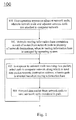
- the flowchart 100 of Fig. 1 comprises a first step 101, a second step 102, a third step 103, and a forth step 104 mutually connected by arrows indicating a preferred order of execution.
- An additional forward arrow connects the forth step 104 with the third step 103, indicating a subsequent repetition of those steps.
- an adjacent network node hosts an operating system, wherein a network node and the adjacent network node are attached to a computer network.
- a node is an active electronic device that is attached to a network, and is capable of sending, receiving, or forwarding information over a communications channel.
- a computer network is meant a group of interconnected computers, that is, a collection of network nodes connected to each other. The network allows its elements to mutually communicate and share resources and information.
- the computer network connecting the network node and the adjacent network node may take the form of, inter alia, a local area network (LAN), a wide area network (WAN), a metropolitan area network (MAN), or a personal area network (PAN). Physically, the computer network may be based on, inter alia, optical fiber, Ethernet, wireless LAN, HomePNA, or power line communication. In terms of its topological layout, the computer network may take the form of, inter alia, a bus network, star network, ring network, mesh network, star-bus network, or hierarchical topology network, sometimes called a tree network.
- the network node takes the form of a physical forwarding element (PFE), that is, an addressable entity that includes hardware used to provide per-packet processing and handling.
- PFE physical forwarding element
- the PFE at hand is based on ASIC technology.
- the adjacent network node takes the form of a physical control element (PCE), that is, an addressable entity that includes hardware used to provided control functionality.
- PCE physical control element
- the PCE at hand is based on a general-purpose processor and capable of executing arbitrary operating systems and applications.
- the network node and the adjacent network node may be directly coupled or connected via a number of intermediate hops, i.e. further network nodes, of the computer network.
- the operating system hosted in the first step 101 manages a routing information base containing a record of routes from the network node to a plurality of network destinations.
- the adjacent network node hosts a further operating system, which is configured for managing a further RIB of the adjacent network node itself.
- the adjacent network node may host even further operating systems for managing even further RIBs of other unrelated network nodes.
- the adjacent network node is configured to execute a system virtual machine.
- a system virtual machine sometimes called hardware virtual machines, allows the sharing of the underlying physical machine resources of the adjacent network node between different virtual machines, each running its own operating system.
- the software layer providing the virtualization is called a virtual machine monitor or hypervisor.
- the hypervisor takes the form of a type 1 hypervisor, sometimes called a native or bare-metal hypervisor.
- a type 1 hypervisor is meant a virtualization platform that runs directly on the general-purpose processor of the adjacent network node as an operating system control program and allows the operating system and further operating system to run at the second level above the hardware.
- the type 1 hypervisor may be embedded in a firmware of the adjacent network node.
- an alternative embodiment may make use of a type 2 hypervisor, sometimes called a hosted hypervisor.
- the operating system and the further operating system run at the third level above the hardware.
- the operating system and further operating system are typically referred to as guest operating systems, whereas the even further operating system hosting the hypervisor itself is typically referred to as a host operating system.
- a further benefit of this approach is the independence of the further operating system from the operating system.
- the guest operating systems hosted by the system virtual machine of the adjacent network node may be different operating systems.
- the operating system may be Linux
- the further operating system may be Microsoft Windows, both running on the same underlying hardware of the adjacent network node.
- the hypervisor makes use of a virtualization technique commonly called full virtualization or native execution.
- the system virtual machine provides a complete simulation of the underlying hardware of the adjacent network node.
- a key challenge for full virtualization is the interception and simulation of privileged operations, such as input or output (I/O) instructions. This is to ensure that the effects of every operation performed within a given guest operating system must be kept within that guest operating system.
- virtual operations performed within the operating system cannot be allowed to alter the state of the further operating system, any other virtual machine, the hypervisor, or the hardware.
- Some machine instructions can be executed directly by the hardware of the adjacent network node, since their effects are entirely contained within the elements managed by the hypervisor, such as memory locations and arithmetic registers.
- the adjacent network node used in the given embodiment comprises a microprocessor enabling virtualization in hardware, such as an Intel VT or AMD-V processor.
- an alternative embodiment may make use of emulation to execute the non-native operating system on the system virtual machine of the adjacent network node.
- emulation is meant the duplication of functions of the network node using the adjacent network node, so that the adjacent network node behaves like and, to the operating system, appears to be the network node.
- the system virtual machine effectively imitates properties of the network node, such that the adjacent network node can work with any operating system or other software designed for the network node itself.
- the emulator of the alternative embodiment interprets the operating system and any further software based thereon in the light of the platform architecture that they were designed for. Apart from this interpretation of the network node's instruction set, specific hardware such as I/O devices of the network node is emulated as well to duplicate its behavior on the adjacent network node. In case of very similar platforms of the network node and adjacent network node, a simple compatibility layer translating system calls for the network node into native system calls for the adjacent network node may be sufficient to provide the emulation described above.
- Bochs and QEMU are examples of system virtual machines that possess the ability to emulate a variety of guest CPU architectures on different host platforms.
- the adjacent network node To populate the RIB initially, the adjacent network node first collects configuration information for operating the network node. This step may be referred to as an auto-discovery or harvesting of the network node's configuration, and includes identifying the capabilities and constraints of that node. To this end, the network node maintains a management information base (MIB) comprising a collection of objects used to manage the network node.
- MIB Objects in the MIB are defined using a subset of Abstract Syntax Notation One (ASN.1) that is described in Request for Comments 2578, "Structure of Management Information Version 2 (SMIv2)”. See Request for Comments 1213, "Management Information Base for Network Management of TCP/IP-based internets", for a detailed discussion of MIBs.
- ASN.1 Abstract Syntax Notation One
- SIv2 Structure of Management Information Version 2
- the MIB may reside outside the network node without deviating from the spirit of the invention.
- the MIB may be a virtual database whose contents are distributed among multiple nodes of the computer network.
- the adjacent network node creates a model of the network node to which the information pertains.
- the collected specifications of the network node are mapped to the control plane functionalities to be deployed on the adjacent network node.
- the RIB is ultimately based on the model thus generated. This technique may be referred to as auto-modeling.
- the configuration information contained in the MIB is collected in band, that is, through the same channel that employed for user data packets.
- This in-band communication requires that the MIB be reachable through the computer network to which the network element and adjacent network element are attached. Since the computer network used with the embodiment is based on the Internet protocol suite (TCP/IP), the MIB is queried by means of the Simple Network Management Protocol (SNMP) as defined by the IETF.
- SNMP Simple Network Management Protocol
- the network node in response to receiving a data packet, selects a path in the computer network along which to send the data packet toward a destination address, wherein the path is selected based on the routing information base.
- the traffic path is provisioned by means of Generalized Multiprotocol Label Switching (GMPLS).
- GPLS Generalized Multiprotocol Label Switching
- the network nodes forwards the data packet to a next network node contained in the path.
- the given embodiment makes use of an FIB.
- the network node is equipped with a Ternary Content-Addressable Memory (TCAM), that is, a special type of computer memory designed to be searched in a single processor operation.
- TCAM Ternary Content-Addressable Memory
- the third step 103 and the forth step 104 are repeated for at least two data packets, i.e., at least twice.
- these steps are repeated as often as necessary to process any inbound data packet received by the network node, unless processing is terminated by an operator.
- the method is implemented in a preferred embodiment through or together with a software program written in e.g. Very high speed integrated circuit Hardware Description Language (VHDL) or C, C++, Java, or using another programming language, or implemented by one or more VHDL, C, C++, or Java processes or routines, or several software modules being executed on at least one hardware device.
- VHDL Very high speed integrated circuit Hardware Description Language
- the method is implemented in hardware only, e.g. making use of an ASIC.
- the described embodiments are to be considered in all respects only as illustrative and not restrictive.
- the order of the steps for performing the invention is not critical, and as can be understood by those skilled in the art, the order may vary without departing from the scope of the invention.
- the network node and adjacent network node can be any kind of device which can be programmed including e.g. any kind of computer like a server or a personal computer, an FPGA, a processor, or the like, or any combination thereof, e.g. one processor and two FPGAs.
Landscapes
- Engineering & Computer Science (AREA)
- Computer Networks & Wireless Communication (AREA)
- Signal Processing (AREA)
- Data Exchanges In Wide-Area Networks (AREA)
Priority Applications (1)
| Application Number | Priority Date | Filing Date | Title |
|---|---|---|---|
| EP09305374A EP2247043A1 (de) | 2009-04-29 | 2009-04-29 | Verfahren zur Steuerung einer Paket-Router-Vorrichtung über das Computernetz |
Applications Claiming Priority (1)
| Application Number | Priority Date | Filing Date | Title |
|---|---|---|---|
| EP09305374A EP2247043A1 (de) | 2009-04-29 | 2009-04-29 | Verfahren zur Steuerung einer Paket-Router-Vorrichtung über das Computernetz |
Publications (1)
| Publication Number | Publication Date |
|---|---|
| EP2247043A1 true EP2247043A1 (de) | 2010-11-03 |
Family
ID=40849229
Family Applications (1)
| Application Number | Title | Priority Date | Filing Date |
|---|---|---|---|
| EP09305374A Withdrawn EP2247043A1 (de) | 2009-04-29 | 2009-04-29 | Verfahren zur Steuerung einer Paket-Router-Vorrichtung über das Computernetz |
Country Status (1)
| Country | Link |
|---|---|
| EP (1) | EP2247043A1 (de) |
Citations (3)
| Publication number | Priority date | Publication date | Assignee | Title |
|---|---|---|---|---|
| EP1653687A1 (de) * | 2004-11-01 | 2006-05-03 | Lucent Technologies Inc. | Getrenntes Kontrollnetz für einen Softrouter |
| WO2008093174A1 (en) * | 2007-02-02 | 2008-08-07 | Groupe Des Ecoles Des Telecommuinications (Get) Institut National Des Telecommunications (Int) | Autonomic network node system |
| US20090086734A1 (en) * | 2007-09-27 | 2009-04-02 | Thyagarajan Nandagopal | Method and Apparatus for Providing a Distributed Forwarding Plane for a Mobility Home Agent |
-
2009
- 2009-04-29 EP EP09305374A patent/EP2247043A1/de not_active Withdrawn
Patent Citations (3)
| Publication number | Priority date | Publication date | Assignee | Title |
|---|---|---|---|---|
| EP1653687A1 (de) * | 2004-11-01 | 2006-05-03 | Lucent Technologies Inc. | Getrenntes Kontrollnetz für einen Softrouter |
| WO2008093174A1 (en) * | 2007-02-02 | 2008-08-07 | Groupe Des Ecoles Des Telecommuinications (Get) Institut National Des Telecommunications (Int) | Autonomic network node system |
| US20090086734A1 (en) * | 2007-09-27 | 2009-04-02 | Thyagarajan Nandagopal | Method and Apparatus for Providing a Distributed Forwarding Plane for a Mobility Home Agent |
Non-Patent Citations (1)
| Title |
|---|
| YANG INTEL CORP R DANTU UNIV OF NORTH TEXAS T ANDERSON INTEL CORP R GOPAL NOKIA L: "Forwarding and Control Element Separation (ForCES) Framework; rfc3746.txt", IETF STANDARD, INTERNET ENGINEERING TASK FORCE, IETF, CH, 1 April 2004 (2004-04-01), XP015009526, ISSN: 0000-0003 * |
Similar Documents
| Publication | Publication Date | Title |
|---|---|---|
| US11190424B2 (en) | Container-based connectivity check in software-defined networking (SDN) environments | |
| US10944691B1 (en) | Container-based network policy configuration in software-defined networking (SDN) environments | |
| US9379973B2 (en) | Binary compatible extension architecture in an openflow compliant network environment | |
| TWI821463B (zh) | 具有分解式網路元件的邏輯路由器 | |
| Keller et al. | Live migration of an entire network (and its hosts) | |
| Azodolmolky | Software defined networking with OpenFlow | |
| US9876756B2 (en) | Network access method and device for equipment | |
| EP2891282B1 (de) | System und verfahren zur bereitstellung eines verteilten virtuellen routings und schaltens (dvrs) | |
| CN103444143B (zh) | 网络系统及策略路由设置方法 | |
| EP3937438B1 (de) | Dienstverkettung mit physischen netzwerkfunktionen und virtualisierten netzwerkfunktionen | |
| CN102195803B (zh) | 数据通信方法和数据通信系统 | |
| US11050647B1 (en) | Simulation-based cross-cloud connectivity checks | |
| Fichera et al. | On experimenting 5G: Testbed set-up for SDN orchestration across network cloud and IoT domains | |
| CN104270464A (zh) | 一种云计算虚拟化网络架构及优化方法 | |
| CN104468162A (zh) | 网络管理方法及系统、虚拟网络实体、网络设备 | |
| JP6570033B2 (ja) | 仮想スイッチ制御システム及び方法 | |
| Lospoto et al. | Rethinking virtual private networks in the software-defined era | |
| Sinha et al. | MPLS based hybridization in SDN | |
| Desmouceaux et al. | Zero-loss virtual machine migration with IPv6 segment routing | |
| Wang et al. | VROOM: Virtual ROuters On the Move. | |
| CN111371608A (zh) | 一种部署sfc业务链的方法、装置和介质 | |
| Cox et al. | Ryuretic: A modular framework for Ryu | |
| EP2247043A1 (de) | Verfahren zur Steuerung einer Paket-Router-Vorrichtung über das Computernetz | |
| Fernandez et al. | Software Defined Networking (SDN) with OpenFlow 1.3, Open vSwitch and Ryu | |
| JP5063726B2 (ja) | 仮想ノード装置のコンフィグ制御方法 |
Legal Events
| Date | Code | Title | Description |
|---|---|---|---|
| PUAI | Public reference made under article 153(3) epc to a published international application that has entered the european phase |
Free format text: ORIGINAL CODE: 0009012 |
|
| AK | Designated contracting states |
Kind code of ref document: A1 Designated state(s): AT BE BG CH CY CZ DE DK EE ES FI FR GB GR HR HU IE IS IT LI LT LU LV MC MK MT NL NO PL PT RO SE SI SK TR |
|
| STAA | Information on the status of an ep patent application or granted ep patent |
Free format text: STATUS: THE APPLICATION IS DEEMED TO BE WITHDRAWN |
|
| 18D | Application deemed to be withdrawn |
Effective date: 20110919 |