EP2247131A1 - Procédé, dispositif et système pour un accès d'authentification de réseau à sauts multiples sans fil basé sur id - Google Patents
Procédé, dispositif et système pour un accès d'authentification de réseau à sauts multiples sans fil basé sur id Download PDFInfo
- Publication number
- EP2247131A1 EP2247131A1 EP09706805A EP09706805A EP2247131A1 EP 2247131 A1 EP2247131 A1 EP 2247131A1 EP 09706805 A EP09706805 A EP 09706805A EP 09706805 A EP09706805 A EP 09706805A EP 2247131 A1 EP2247131 A1 EP 2247131A1
- Authority
- EP
- European Patent Office
- Prior art keywords
- coordinator
- terminal device
- public key
- authentication
- revocation query
- Prior art date
- Legal status (The legal status is an assumption and is not a legal conclusion. Google has not performed a legal analysis and makes no representation as to the accuracy of the status listed.)
- Withdrawn
Links
Images


Classifications
-
- H—ELECTRICITY
- H04—ELECTRIC COMMUNICATION TECHNIQUE
- H04W—WIRELESS COMMUNICATION NETWORKS
- H04W12/00—Security arrangements; Authentication; Protecting privacy or anonymity
- H04W12/06—Authentication
-
- H—ELECTRICITY
- H04—ELECTRIC COMMUNICATION TECHNIQUE
- H04L—TRANSMISSION OF DIGITAL INFORMATION, e.g. TELEGRAPHIC COMMUNICATION
- H04L12/00—Data switching networks
- H04L12/28—Data switching networks characterised by path configuration, e.g. LAN [Local Area Networks] or WAN [Wide Area Networks]
-
- H—ELECTRICITY
- H04—ELECTRIC COMMUNICATION TECHNIQUE
- H04L—TRANSMISSION OF DIGITAL INFORMATION, e.g. TELEGRAPHIC COMMUNICATION
- H04L63/00—Network architectures or network communication protocols for network security
- H04L63/06—Network architectures or network communication protocols for network security for supporting key management in a packet data network
- H04L63/062—Network architectures or network communication protocols for network security for supporting key management in a packet data network for key distribution, e.g. centrally by trusted party
-
- H—ELECTRICITY
- H04—ELECTRIC COMMUNICATION TECHNIQUE
- H04L—TRANSMISSION OF DIGITAL INFORMATION, e.g. TELEGRAPHIC COMMUNICATION
- H04L63/00—Network architectures or network communication protocols for network security
- H04L63/20—Network architectures or network communication protocols for network security for managing network security; network security policies in general
- H04L63/205—Network architectures or network communication protocols for network security for managing network security; network security policies in general involving negotiation or determination of the one or more network security mechanisms to be used, e.g. by negotiation between the client and the server or between peers or by selection according to the capabilities of the entities involved
-
- H—ELECTRICITY
- H04—ELECTRIC COMMUNICATION TECHNIQUE
- H04L—TRANSMISSION OF DIGITAL INFORMATION, e.g. TELEGRAPHIC COMMUNICATION
- H04L9/00—Cryptographic mechanisms or cryptographic arrangements for secret or secure communications; Network security protocols
- H04L9/32—Cryptographic mechanisms or cryptographic arrangements for secret or secure communications; Network security protocols including means for verifying the identity or authority of a user of the system or for message authentication, e.g. authorization, entity authentication, data integrity or data verification, non-repudiation, key authentication or verification of credentials
- H04L9/321—Cryptographic mechanisms or cryptographic arrangements for secret or secure communications; Network security protocols including means for verifying the identity or authority of a user of the system or for message authentication, e.g. authorization, entity authentication, data integrity or data verification, non-repudiation, key authentication or verification of credentials involving a third party or a trusted authority
-
- H—ELECTRICITY
- H04—ELECTRIC COMMUNICATION TECHNIQUE
- H04L—TRANSMISSION OF DIGITAL INFORMATION, e.g. TELEGRAPHIC COMMUNICATION
- H04L9/00—Cryptographic mechanisms or cryptographic arrangements for secret or secure communications; Network security protocols
- H04L9/32—Cryptographic mechanisms or cryptographic arrangements for secret or secure communications; Network security protocols including means for verifying the identity or authority of a user of the system or for message authentication, e.g. authorization, entity authentication, data integrity or data verification, non-repudiation, key authentication or verification of credentials
- H04L9/3263—Cryptographic mechanisms or cryptographic arrangements for secret or secure communications; Network security protocols including means for verifying the identity or authority of a user of the system or for message authentication, e.g. authorization, entity authentication, data integrity or data verification, non-repudiation, key authentication or verification of credentials involving certificates, e.g. public key certificate [PKC] or attribute certificate [AC]; Public key infrastructure [PKI] arrangements
- H04L9/3268—Cryptographic mechanisms or cryptographic arrangements for secret or secure communications; Network security protocols including means for verifying the identity or authority of a user of the system or for message authentication, e.g. authorization, entity authentication, data integrity or data verification, non-repudiation, key authentication or verification of credentials involving certificates, e.g. public key certificate [PKC] or attribute certificate [AC]; Public key infrastructure [PKI] arrangements using certificate validation, registration, distribution or revocation, e.g. certificate revocation list [CRL]
-
- H—ELECTRICITY
- H04—ELECTRIC COMMUNICATION TECHNIQUE
- H04W—WIRELESS COMMUNICATION NETWORKS
- H04W12/00—Security arrangements; Authentication; Protecting privacy or anonymity
- H04W12/04—Key management, e.g. using generic bootstrapping architecture [GBA]
- H04W12/043—Key management, e.g. using generic bootstrapping architecture [GBA] using a trusted network node as an anchor
- H04W12/0431—Key distribution or pre-distribution; Key agreement
-
- H—ELECTRICITY
- H04—ELECTRIC COMMUNICATION TECHNIQUE
- H04W—WIRELESS COMMUNICATION NETWORKS
- H04W12/00—Security arrangements; Authentication; Protecting privacy or anonymity
- H04W12/08—Access security
-
- H—ELECTRICITY
- H04—ELECTRIC COMMUNICATION TECHNIQUE
- H04W—WIRELESS COMMUNICATION NETWORKS
- H04W84/00—Network topologies
- H04W84/18—Self-organising networks, e.g. ad-hoc networks or sensor networks
Definitions
- the present invention relates to a method for authenticating a network access and particularly to a method, terminal device and system for ID-based authentication access of a wireless multi-hop network.
- the terminal device can communication with the other devices in the network but can not forward data for the other devices in the network, that is, it can not perform a routing function.
- the route coordinator is also responsible for forwarding data for the other devices in the network, that is, it can perform the routing function.
- the network coordinator is responsible for transmitting a network beacon, setting up a network, managing a network node, storing network node information, searching for a route message between a pair of nodes and constantly receiving information and also can forward data for the other devices in the network, that is, it can perform the routing function.
- the network coordinator and the route coordinator can be referred collectively to as a coordinator.
- the trusted center is a key management center of the network responsible for configuring key information for all the devices in the network.
- the network coordinator or another device designated in the network by the network coordinator can act as the trusted center.
- a first security solution is in the form of a self-organized network.
- a device firstly is connected into the wireless multi-hop network and then acquires key information dynamically from the wireless multi-hop network, e.g., an ID-based private key (identity-based cryptography) acquired from a distributed Certification Authority (CA) in the wireless multi-hop network, and finally communicates securely by using a pair of ID-based public and private keys.
- key information dynamically from the wireless multi-hop network
- ID-based private key identity-based cryptography
- CA distributed Certification Authority
- a second security solution is in the form of connecting and then authentication. Firstly a device is connected into the wireless multi-hop network, then authenticated by the network coordinator and finally communicates securely by using a negotiated session key, e.g., in the standard ofIEEE802.15.4/ZigBee.
- any device can be a member of the wireless multi-hop network without distinguishing between legal and illegal devices, which apparently would be insecure.
- the network coordinator since the network coordinator does not authenticate the device until the device is connected into the wireless multi-hop network, any device may be connected into the wireless multi-hop network and it can communicate with another device in the network before the network coordinator removes it from the network, which also would be insecure and result in a waste of communication as well.
- the invention provides a method, terminal device and system for ID-based authentication access of a wireless multi-hop network to address the technical problem of a hidden security danger of the method for authentication access of a wireless multi-hop network in the prior art.
- a method for ID-based authentication access of a wireless multi-hop network includes the steps of:
- the method further includes:
- the method further includes:
- the process of authenticating the terminal device includes:
- the process of authenticating the terminal device further includes:
- the process of authenticating the terminal device further includes:
- the process of authenticating the terminal device further includes:
- the process of authenticating the terminal device further includes:
- the process of authenticating the terminal device further includes:
- the process of authenticating the terminal device further includes:
- the process of authenticating the terminal device further includes:
- the process of authenticating the terminal device further includes:
- the method further includes:
- the process of the coordinator performing unicast key negotiation with the terminal device includes:
- the method further includes:
- the process of multi-cast key notification includes:
- the invention further provides a coordinator including:
- the coordinator further includes:
- the invention further provides a terminal device including:
- the invention further provides a system for ID-based authentication of a wireless multi-hop network access, including a coordinator and a terminal device, wherein:
- the advantages of the invention include:
- the terminal device can be connected to the coordinator only after being authenticated to thereby enable an authenticated access of the terminal device to the wireless multi-hop network.
- the terminal device can also authenticate the coordinator to thereby decide from an authentication result whether to be connected to the coordinator. Therefore, the terminal device can access the wireless multi-hop network with improved security and performance.
- Uncontrolled and controlled ports are defined for both the terminal device and the coordinator and controlled in response to an authentication result to thereby form a port access control architecture and improve security of an access of the terminal device to the wireless multi-hop network.
- the terminal device and the coordinator define a unicast key negotiation process and a multi-cast key notification process for different security services to thereby ensure communication security between the terminal device and the coordinator.
- the trusted center can provide the terminal device and the coordinator with a public key revocation table to enable bidirectional authentication between the terminal device and the coordinator and improve security of an access of the terminal device to the wireless multi-hop network.
- both the number of revocation queries of the public key and communication traffic in transmission can be reduced to thereby improve performance of an access of the terminal device to the wireless multi-hop network.
- the information is transmitted from the trusted center to the coordinator over the secure channel which can be set up using the pair of public and private keys of the coordinator and the trusted center in noninteraction manner to thereby eliminate a key negotiation process therebetween and reduce complexity of the information transmitted from the trusted center to the coordinator, thus improving performance of an access of the terminal device to the wireless multi-hop network.
- Fig.1 is a structural diagram of a network topology of a wireless multi-hop network
- Fig.1A is a structural diagram of a star network topology
- Fig.1B is a structural diagram of a mesh network topology
- Fig. 1C is a structural diagram of a cluster network topology, and where "•” represents a coordinator, " ⁇ " represents a terminal device, and " ⁇ " represents a communication channel;
- Fig.2 is a schematic structural diagram of an system for authentication access of a wireless multi-hop network, where A represents a terminal device requesting for an authentication access, B represents a coordinator associated with A, and S represents a trusted center in the wireless multi-hop network;
- Fig.3 is a schematic diagram of an authentication process in a method of the invention.
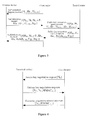
- Fig.4 is a schematic diagram of a unicast key negotiation process in a method of the invention.
- Fig.5 is a schematic diagram of a multi-cast key negotiation process in a method of the invention.
- Fig.6 is a schematic flow diagram of an authentication process in a method of the invention.
- the invention is applicable to a secure application protocol by which the WLAN Authentication Privacy Infrastructure (WAPI) framework method (an access control method based upon Tri-element Peer Authentication (TePA)) is applied to a specific network including a wireless local area network, a wireless metropolitan area network, etc.
- WAPI WLAN Authentication Privacy Infrastructure
- TePA Tri-element Peer Authentication
- authentication is for the purpose of setting up trustiness between a terminal device and a coordinator associated therewith and of securing data passed over a link therebetween.
- the terminal device and the coordinator associated therewith belong to the same management domain, i.e., a specific wireless multi-hop network, and a trusted center of the wireless multi-hop network shall configure all the devices in the wireless multi-hop network, for example, with key information under various suites of authentication and key management.
- the coordinator broadcasts a beacon frame in which suites of authentication and key management supported by the coordinator are suites of ID-based authentication and key management.
- the terminal device identifies the suites of authentication and key management supported by the coordinator from the beacon frame of the coordinator and then verifies whether the suites of ID-based authentication and key management in the beacon frame of the coordinator are supported, and if the terminal device supports one of them and is provided with key information for this suite, then it transmits a connection request command to the coordinator.
- the coordinator Upon reception of the connection request command of the terminal device, if the coordinator knows from the connection request command that the terminal device also supports the suite of ID-based authentication and key management, then it performs an authentication process with the terminal device under the suite of ID-based authentication and key management and then transmits a connection response command to the terminal device.
- the coordinator Upon successful authentication, the coordinator provides the terminal device with an access to the wireless multi-hop network while transmitting the connection response command including some access information, e.g., an allocated network address. If authentication is successful and the coordinator is to perform unicast key negotiation with the terminal device, then the coordinator performs a unicast key negotiation process with the terminal device. If unicast key negotiation is passed and the coordinator is to perform multi-cast key negotiation with the terminal device, then the coordinator performs a multi-cast key notification process with the terminal device.
- the terminal device will receive the connection response command transmitted from the coordinator after performing the authentication process with the coordinator, and upon reception of the connection response command of the coordinator, the terminal device is connected to the coordinator and thus accesses the wireless multi-hop network if authentication between the terminal device and the coordinator is successful and the connection response command transmitted from the coordinator includes some access information. If the terminal device receives a unicast key negotiation request command transmitted from the coordinator after accessing the network, then the terminal device performs a unicast key negotiation process with the coordinator. If the terminal device receives a multi-cast key notification request command transmitted from the coordinator upon successful completion of the unicast key negotiation process, then the terminal device performs a multi-cast key notification process with the coordinator.
- Uncontrolled and controlled ports are defined for both the terminal device and the coordinator capable of controlling the ports.
- the uncontrolled ports can only pass an authentication protocol data packet as well as management information prior to successful authentication, and the controlled ports can pass an application data packet.
- the terminal device and the coordinator can only communicate via the uncontrolled ports prior to successful authentication and will not enable the controlled ports for communication until they perform successful authentication.
- Fig.2 illustrates a system for authentication access of a wireless multi-hop network, where A represents a terminal device requesting for authentication access, B represents a coordinator associated with A, S represents a trusted center in the wireless multi-hop network, both A and B are provided with key information configured by S, a solid line represents an authenticated access status, and a dotted line represents an access to be authenticated.
- This access authentication method can be applicable to LR-WPAN, HR-WPAN and WSN because all of them support such a topology structure of the wireless multi-hop network.
- FIG.3 A specific authentication process is performed as follows with reference to Fig.3 .
- the coordinator When the coordinator knows from a connection request command transmitted from the terminal device that a suite of authentication and key management selected by the terminal device is an suite of ID-based authentication and key management, the coordinator performs the following process:
- An authentication inquiry N 1 also referred to as a challenge word, a random number, etc., of the coordinator is generated using a random number generator;
- the terminal device performs the following process upon reception of the information transmitted in the step 1] from the coordinator:
- a temporary private key x and a temporary public key x ⁇ P for an ECDH exchange are generated from a preinstalled parameter P ECC in the ECC domain;
- the terminal device If the terminal device is to request for a revocation query of a public key PK ID-C of the coordinator, then the terminal device sets the value of bit 0 of a public key revocation query identifier QF PK as 1; otherwise, the value is set as 0;
- the terminal device uses a private key SK ID-T of the terminal device to perform calculation of a signature on the public key revocation query identifier QF PK , the authentication inquiry N 1 of the coordinator, the authentication inquiry N 2 of the terminal device, the temporary public key x ⁇ P, the identifier ID C of the coordinator, an identifier ID T of the terminal device and the period of validity TL T-PK of the public key of the terminal device to generate an authentication request signature Sig T of the terminal device; and
- the public key revocation query identifier QF PK the authentication inquiry N 1 of the coordinator, the authentication inquiry N 2 of the terminal device, the temporary public key x ⁇ P, the identifier ID C of the coordinator, the last two fields in a public key PK ID-T of the terminal device and the authentication request signature Sig T of the terminal device generated by the terminal device are transmitted to the coordinator.
- the coordinator performs the following process upon reception of the information transmitted in the step 2] from the terminal device:
- a public key revocation query inquiry N 3 of the coordinator is generated in a random number generation algorithm. If the coordinator is also to request for a revocation query of the public key PK ID-T of the terminal device, then the coordinator sets the value of bit 1 of the public key revocation query identifier QF PK as 1 and transmits to the trusted center the public key revocation query identifier QF PK , the authentication inquiry N 2 of the terminal device, the public key revocation query inquiry N 3 of the coordinator, the identifier ID T of the terminal device, the period of validity TL T-PK of the public key of the terminal device, the identifier ID C of the coordinator and the period of validity TL C-PK of the public key of the coordinator; otherwise, the coordinator sets the value of bit 1 of the public key revocation query identifier QF PK as 0 and transmits to the trusted center the public key revocation query identifier QF PK , the authentication inquiry N 2 of the terminal device, the public key revocation query inquiry N 3 of
- the coordinator sets the value of bit 1 of the public key revocation query identifier QF PK as 1, generates the public key revocation query inquiry N 3 of the coordinator in the random number generation algorithm and transmits to the trusted center the public key revocation query identifier QF PK , the public key revocation query inquiry N 3 of the coordinator, the identifier ID T of the terminal device and the period of validity TL T-PK of the public key of the terminal device; otherwise, the coordinator sets the value of bit 1 of the public key revocation query identifier QF PK as 0, generates a temporary private key y and a temporary public key y ⁇ P for an ECDH exchange from the preinstalled parameter in the ECC domain P ECC , uses its own temporary private key y and the temporary public key x ⁇ P transmitted in the step 2 from the terminal device to perform ECDH calculation, derives a master key seed (x ⁇
- the trusted center performs the following process upon reception of the information transmitted in the step 3] from the coordinator:
- bits 0 and 1 of the public key revocation query identifier QF PK are checked, and if both the values of the bits 0 and 1 are 1, then the process performs the operation b); if the value of bit 0 is 1 and the value of bit 1 is 0, then the process performs the operation c); or if the value of bit 0 is 0 and the value of bit 1 is 1, then the process performs the operation d);
- the public key revocation query result Result C-PK of the coordinator is constituted of the authentication inquiry N 2 of the terminal device, a public key revocation result Re C of the coordinator, the identifier ID C of the coordinator and the period of validity TL C-PK of the public key of the coordinator;
- the body identity ID S-CA of the CA certificate of the trusted center in the wireless multi-hop network, the identifier ID Net of the wireless multi-hop network, the identifier ID C of the coordinator and the period of validity TL C-PK of the public key of the coordinator are cascaded as the public key PK ID-C of the coordinator, and then the identity-based public key revocation table of the wireless multi-hop network is searched in the trusted center to generate the public key revocation query result Result C-PK of the coordinator, the private key SK ID-S of the trusted center is used to perform calculation of a signature on the public key revocation query result Result C-PK of the coordinator to generate the public key revocation query signature Sig S , and the public key revocation query identifier QF PK , the public key revocation query inquiry N 3 of the coordinator, the public key revocation query result Result C-PK of the coordinator and the public key revocation query signature Sig S are transmitted to the coordinator; and
- the body identity ID S-CA of the CA certificate of the trusted center in the wireless multi-hop network, the identifier ID Net of the wireless multi-hop network, the identifier ID T of the terminal device and the period of validity TL T-PK of the public key of the terminal device are cascaded as the public key PK ID-T of the terminal device, and then the identity-based public key revocation table of the wireless multi-hop network is searched in the trusted center to generate the public key revocation result Re T of the terminal device, and the public key revocation query identifier QF PK , the public key revocation query inquiry N 3 of the coordinator and the public key revocation result Re T of the terminal device are transmitted to the coordinator.
- the information transmitted from the trusted center to the coordinator is transmitted between the coordinator and the trusted center over a secure channel which can be set up by the coordinator and the trusted center in noninteraction manner, for example, the coordinator generates a session key from its own private key and a public key of the trusted center, while the trusted center generates a session key from its own private key and the public key of the coordinator.
- the coordinator performs the following process upon reception of the information transmitted in the step 4] from the trusted center:
- the coordinator uses the private key SK ID-C of the coordinator to perform calculation of a signature on the public key revocation query identifier QF PK , the authentication inquiry N 2 of the terminal device, the temporary public key y ⁇ P, the identifier ID T of the terminal device, the access result Re I , the public key revocation query result Result C-PK of the coordinator and the public key revocation query signature Sig S to generate the authentication response signature Sig C of the coordinator and transmits to the terminal device the public key revocation query identifier QF PK , the authentication inquiry N 2 of the terminal device, the temporary public key y ⁇ P, the identifier ID T of the terminal device, the access result Re I , the public key revocation query result Result C-PK of the coordinator, the public key revocation query signature Sig
- the coordinator uses the private key SK ID-C of the coordinator to perform calculation of a signature on the public key revocation query identifier QF PK , the authentication inquiry N 2 of the terminal device, the temporary public key y ⁇ P, the identifier ID T of the terminal device, the access result Re I , the public key revocation query result Result C-PK of the coordinator and the public key revocation query signature Sig S to generate the authentication response signature Sig C of the coordinator and transmits to the terminal device the public key revocation query identifier QF PK , the authentication inquiry N 2 of the terminal device, the temporary public key y ⁇ P, the identifier ID T of the terminal device, the access result Re I , the public key revocation query result Result C-PK of the coordinator, the public key revocation query signature Sig S and the authentication response signature Sig C of the coordinator;
- the public key revocation result Re T of the terminal device is verified. If the public key PK ID-T of the terminal device has been cancelled, then the authentication process is terminated; otherwise, after performing the operation e), the coordinator uses the private key SK ID-C of the coordinator to perform calculation of a signature on the public key revocation query identifier QF PK , the authentication inquiry N 2 of the terminal device, the temporary public key y ⁇ P, the identifier ID T of the terminal device and the access result Re I to generate the authentication response signature Sig C of the coordinator and transmits to the terminal device the public key revocation query identifier QF PK , the authentication inquiry N 2 of the terminal device, the temporary public key y ⁇ P, the identifier ID T of the terminal device, the access result Re I and the authentication response signature Sig C of the coordinator generated by the coordinator;
- the temporary private key y and the temporary public key y ⁇ P for an ECDH exchange are generated from the preinstalled parameter P ECC in the ECC domain, and its own temporary private key y and the temporary public key x ⁇ P transmitted in the step 2 from the terminal device are used to perform ECDH calculation to derive the master key seed (x ⁇ y ⁇ P) abscissa which is expanded through KD-HMAC-SHA256 ((x ⁇ y ⁇ P) abscissa , N 1 ⁇ N 2 ⁇ "base key expansion for key and additional nonce”) into the base key BK between the terminal device and the coordinator while generating the access result Re I .
- the terminal device performs the following process upon reception of the information in the step 3] or the step 5] from the coordinator:
- the body identity ID S-CA of the CA certificate of the trusted center in the wireless multi-hop network, the identifier ID Net of the wireless multi-hop network, the identifier ID C of the coordinator and the period of validity TL C-PK of the public key of the coordinator are cascaded as the public key PK ID-C of the coordinator, the public key PK ID-C of the coordinator and the preinstalled identity-based public parameter P ID is used to verify the authentication response signature Sig C of the coordinator, and if signature verification is not successful, then the information is discarded;
- the public key revocation query signature Sig S is verified against a public key PK ID-S of the trusted center and the preinstalled identity-based public parameter P ID , and if signature verification is not successful, then the information is discarded; otherwise, consistency on the authentication inquiry N 2 of the terminal device, the identifier ID C of the coordinator and the period of validity TL C-PK of the public key of the coordinator in the public key revocation query result Result C-PK of the coordinator are verified along with the public key revocation result Re C of the coordinator. If consistency is satisfied and the public key of the coordinator has not been cancelled, then the process performs the operation e); otherwise, the information is discarded;
- the terminal devices uses its own temporary private key x and the temporary public key y ⁇ P of the coordinator to perform ECDH operation to derive the master key seed (x ⁇ y ⁇ P) abscissa which is expanded through KD-HMAC-SHA256 ((x ⁇ y ⁇ P) abscissa , N 1 ⁇ N 2 ⁇ "base key expansion for key and additional nonce”) into the base key BK between the terminal device and the coordinator.
- the coordinator performs the following process when creating or updating a unicast key upon successful authentication:
- the coordinator generates a unicast key negotiation inquiry N 4 of the coordinator by the random number generator and transmits the unicast key negotiation inquiry N 4 of the coordinator to the terminal device;
- the terminal device performs the following process upon reception of the information transmitted in the step 1] from the coordinator:
- the terminal device generates a unicast key negotiation inquiry N 5 of the terminal device by the random number generator and then calculates KD-HMAC-SHA256 (BK, ADDID ⁇ N 4 ⁇ N 5 ⁇ "pairwise key expansion for uni-cast and additional keys and nonce") to generate a unicast encryption key UEK, a unicast integrity check key UCK and a unicast message authentication key UMAK.
- the BK is the base key BK between the terminal device and the coordinator generated by the terminal device during authentication; and
- the unicast message authentication key UMAK is used to perform calculation of a message authentication code on the unicast key negotiation inquiry N 4 of the coordinator and the unicast key negotiation inquiry N 5 of the terminal device in the HMAC-SHA256 algorithm to generate a message authentication code HMAC TU of the terminal device in unicast key negotiation, and then the unicast key negotiation inquiry N 4 of the coordinator, the unicast key negotiation inquiry N 5 of the terminal device and the message authentication code HMAC TU of the terminal device in unicast key negotiation are transmitted to the coordinator.
- the coordinator performs the following process upon reception of the information transmitted in the step 2] from the terminal device.
- KD-HMAC-SHA256 (BK, ADDID ⁇ N 4 ⁇ N 5 ⁇ "pairwise key expansion for uni-cast and additional keys and nonce") is calculated to generate the unicast encryption key UEK, the unicast integrity check key UCK and the unicast message authentication key UMAK.
- the BK is the base key BK between the terminal device and the coordinator generated by the terminal device during authentication.
- a message authentication code of the unicast key negotiation inquiry N 4 of the coordinator and the uni-cast key negotiation inquiry N 5 of the terminal device is calculated locally from the generated unicast message authentication key UMAK in the HMAC-SHA256 algorithm and compared with the message authentication code HMAC TU of the terminal device in unicast key negotiation in the received information, and if they are identical, then the process performs the operation d); otherwise, the information is discarded; and
- the unicast message authentication key UMAK generated by the coordinator is used to perform calculation of a message authentication code on the unicast key negotiation inquiry N 5 of the terminal device in the HMAC-SHA256 algorithm to generate a message authentication code HMAC CU of the coordinator in unicast key negotiation, and then the unicast key negotiation inquiry N 5 of the terminal device and the message authentication code HMAC CU of the coordinator in unicast key negotiation are transmitted to the terminal device.
- the terminal device performs the following process upon reception of the information transmitted in the step 3] from the coordinator.
- the message authentication code of the unicast key negotiation inquiry N 5 of the terminal device is calculated locally in the HMAC-SHA256 algorithm from the locally generated unicast message authentication key UMAK and compared with the message authentication code HMAC CU of the coordinator in unicast key negotiation in the received information, and if they are identical, then unicast key negotiation is successful; otherwise, the information is discarded.
- the coordinator performs the following process when creating or updating a multi-cast key upon successful uni-cast key negotiation:
- a multi-cast key notification identifier N M and a multi-cast notification master key NMK are generated using the random number generator;
- the multi-cast notification master key NMK is encrypted with the unicast encryption key UEK between the coordinator and the terminal device;
- the unicast message authentication key UMAK between the coordinator and the terminal device is used to perform calculation of a message authentication code on the multi-cast key notification identifier N M and the encrypted multi-cast notification master key NMK E in the HMAC-SHA256 algorithm to derive a message authentication code HMAC CM of the coordinator in multi-cast key negotiation, wherein the multi-cast key notification identifier N M is an integer with an initial value which is incremented by one upon each key update notification but which will be unchanged if the notified key is unchanged; and
- the terminal device performs the following process upon reception of the information transmitted in the step 1] from the coordinator:
- the encrypted multi-cast notification master key NMK E is calculated locally from the unicast message authentication key UMAK between the coordinator and the terminal device in the HMAC-SHA256 algorithm and compared with the message authentication code HMAC CM of the coordinator in multi-cast key negotiation in the received information, and if they are different, then the information is discarded;
- the encrypted multi-cast notification master key NMK E is decrypted with the unicast encryption key UEK between the coordinator and the terminal device into the multi-cast notification master key NMK which is further expanded in the KD-HMAC-SHA256 algorithm into a multi-cast encryption key MEK and a multi-cast integrity check key MCK;
- a message authentication code of the multi-cast key notification identifier N M is calculated locally from the unicast message authentication key UMAK between the coordinator and the terminal device in the HMAC-SHA256 algorithm to derive a message authentication code HMAC TM of the terminal device in multi-cast key negotiation;
- the multi-cast key notification identifier N M and the message authentication code HMAC TM of the terminal device in multi-cast key negotiation are transmitted to the coordinator.
- the coordinator performs the following process upon reception of the information transmitted in the step 2] from the terminal device:
- a message authentication code of the multi-cast key notification identifier N M is calculated locally from the unicast message authentication key UMAK between the coordinator and the terminal device in the HMAC-SHA256 algorithm and compared with the message authentication code HMAC TM of the terminal device in multi-cast key negotiation in the received information, and if they are different, then the information is discarded;
- the multi-cast key notification identifier N M is compared with the corresponding value transmitted in the step 1 from the coordinator, and if they are identical, then the present multi-cast key negotiation is successful; otherwise, the information is discarded; and
- the generated multi-cast notification master key NMK is expanded in the KD-HMAC-SHA256 algorithm into the multi-cast encryption key MEK and the multi-cast integrity check key MCK.
- a pair of the terminal device and the trusted center uses the public and private keys to set up a secure channel in ID-based noninteracting cipher share manner.
- the setup secure channel can thus secure communication between the coordinator and the trusted center during authentication.
- the invention further provides a coordinator including a broadcast unit, an authentication unit and a transmission unit, wherein the broadcast unit is adapted to broadcast a beacon frame including a suite of ID-based authentication and key management, the authentication unit is adapted to authenticate a terminal device supporting the suite of ID-based authentication and key management upon reception of a connection request command transmitted from the terminal device, and the transmission unit is adapted to transmit to the terminal device a connection response command for instructing the terminal device to access a wireless multi-hop network.
- a coordinator including a broadcast unit, an authentication unit and a transmission unit, wherein the broadcast unit is adapted to broadcast a beacon frame including a suite of ID-based authentication and key management, the authentication unit is adapted to authenticate a terminal device supporting the suite of ID-based authentication and key management upon reception of a connection request command transmitted from the terminal device, and the transmission unit is adapted to transmit to the terminal device a connection response command for instructing the terminal device to access a wireless multi-hop network.
- a process for authenticating the terminal device by the authentication unit is the same as the process of authenticating the terminal device, and reference can be made to the foregoing disclosure for detailed thereof, repeated descriptions of which will be omitted here.
- the coordinator further includes a defining unit adapted to predefine uncontrolled and controlled ports for the coordinator and the terminal device so that the coordinator and the terminal device have their uncontrolled ports passing an authentication protocol data packet and management information and controlled ports passing an application data packet.
- the invention further provides a terminal device including a connection request transmission unit and an access unit, wherein the connection request transmission unit is adapted to transmit a connection request command to a coordinator upon reception of a beacon frame transmitted from the coordinator, wherein the beacon frame includes a suite of ID-based authentication and key management, and the access unit is adapted to enable a controlled port and access the wireless multi-hop network upon reception of a connection response command transmitted from the coordinator.
- the invention further provides a system for ID-based authentication access of a wireless multi-hop network, which includes a coordinator and a terminal device, where the coordinator includes a broadcast unit, an authentication unit and a transmission unit, and the terminal device includes a connection request transmission unit and an access unit, wherein reference can be made to the foregoing disclosure for details of processes of performing the functions of and playing the roles of the respective units in the coordinator and the terminal device, repeated descriptions of which will be omitted here.
- the coordinator authenticates the terminal device, and then only the terminal device passing authentication can be connected to the coordinator, thereby performing an authenticated access of the terminal device to the wireless multi-hop network.
- the terminal device can also authenticate the coordinator to thereby decide from an authentication result whether to be connected to the coordinator. Therefore, the terminal device can access the wireless multi-hop network with improved security and performance.
- the uncontrolled and controlled ports are defined for the terminal device and the coordinator and controlled in response to an authentication result to thereby form a port access control architecture and improve security of an access of the terminal device to the wireless multi-hot network.
- the terminal device and the coordinator define the unicast key negotiation process and the multi-cast key notification process for different security services to thereby ensure communication security between the terminal device and the coordinator.
- the invention adopts the tri-element peer authentication protocol so that the trusted center provides the terminal device and the coordinator with the public key revocation table to thereby perform bidirectional authentication between the terminal device and the coordinator and improve security of an access of the terminal device to the wireless multi-hop network. Since the ID-based public key per se is both cancellable and short in length, both the number of revocation queries of the public key and communication traffic in transmission can be reduced to thereby improve performance of an access of the terminal device to the wireless multi-hop network.
- the information is transmitted from the trusted center to the coordinator over the secure channel which can be set up using the pair of public and private keys of the coordinator and the trusted center in noninteraction manner to thereby eliminate a key negotiation process therebetween and reduce complexity of the information transmitted from the trusted center to the coordinator, thus improving performance of an access of the terminal device to the wireless multi-hop network.
Landscapes
- Engineering & Computer Science (AREA)
- Computer Security & Cryptography (AREA)
- Computer Networks & Wireless Communication (AREA)
- Signal Processing (AREA)
- Computer Hardware Design (AREA)
- Computing Systems (AREA)
- General Engineering & Computer Science (AREA)
- Mobile Radio Communication Systems (AREA)
- Computer And Data Communications (AREA)
Applications Claiming Priority (2)
| Application Number | Priority Date | Filing Date | Title |
|---|---|---|---|
| CN2008100173857A CN101222772B (zh) | 2008-01-23 | 2008-01-23 | 一种基于id的无线多跳网络认证接入方法 |
| PCT/CN2009/070270 WO2009094941A1 (fr) | 2008-01-23 | 2009-01-22 | Procédé, dispositif et système pour un accès d'authentification de réseau à sauts multiples sans fil basé sur id |
Publications (2)
| Publication Number | Publication Date |
|---|---|
| EP2247131A1 true EP2247131A1 (fr) | 2010-11-03 |
| EP2247131A4 EP2247131A4 (fr) | 2012-12-19 |
Family
ID=39632290
Family Applications (1)
| Application Number | Title | Priority Date | Filing Date |
|---|---|---|---|
| EP09706805A Withdrawn EP2247131A4 (fr) | 2008-01-23 | 2009-01-22 | Procédé, dispositif et système pour un accès d'authentification de réseau à sauts multiples sans fil basé sur id |
Country Status (6)
| Country | Link |
|---|---|
| US (1) | US20100293378A1 (fr) |
| EP (1) | EP2247131A4 (fr) |
| JP (1) | JP2011514032A (fr) |
| KR (1) | KR101198570B1 (fr) |
| CN (1) | CN101222772B (fr) |
| WO (1) | WO2009094941A1 (fr) |
Cited By (3)
| Publication number | Priority date | Publication date | Assignee | Title |
|---|---|---|---|---|
| US9300468B2 (en) | 2009-01-14 | 2016-03-29 | Entropic Communications, Llc | Secure node admission in a communication network |
| WO2021188377A1 (fr) * | 2020-03-17 | 2021-09-23 | Qualcomm Incorporated | Communication sécurisée d'informations de diffusion relatives à un accès cellulaire |
| EP3902300A1 (fr) * | 2020-04-24 | 2021-10-27 | Nokia Technologies Oy | Éviter la distribution inefficiente des cléfs publiques dans le réseau mobile publique |
Families Citing this family (51)
| Publication number | Priority date | Publication date | Assignee | Title |
|---|---|---|---|---|
| CN101232378B (zh) * | 2007-12-29 | 2010-12-08 | 西安西电捷通无线网络通信股份有限公司 | 一种无线多跳网络的认证接入方法 |
| CN101222772B (zh) * | 2008-01-23 | 2010-06-09 | 西安西电捷通无线网络通信有限公司 | 一种基于id的无线多跳网络认证接入方法 |
| CN101222325B (zh) | 2008-01-23 | 2010-05-12 | 西安西电捷通无线网络通信有限公司 | 一种基于id的无线多跳网络密钥管理方法 |
| US11985155B2 (en) * | 2009-01-28 | 2024-05-14 | Headwater Research Llc | Communications device with secure data path processing agents |
| CN101521881A (zh) * | 2009-03-24 | 2009-09-02 | 刘建 | 一种无线局域网接入方法及系统 |
| CN101631113B (zh) * | 2009-08-19 | 2011-04-06 | 西安西电捷通无线网络通信股份有限公司 | 一种有线局域网的安全访问控制方法及其系统 |
| CA2694500C (fr) * | 2010-02-24 | 2015-07-07 | Diversinet Corp. | Procede et systeme de communication securisee |
| CN102202302B (zh) * | 2010-03-23 | 2016-01-20 | 中兴通讯股份有限公司 | 结合网络及无线传感器网络终端加入网络的方法 |
| CN102202298B (zh) * | 2010-03-23 | 2016-02-10 | 中兴通讯股份有限公司 | 结合网络及无线传感器网络终端加入网络的方法 |
| US11026169B2 (en) | 2010-11-09 | 2021-06-01 | Qualcomm Incorporated | Physical layer power save facility |
| US9992738B2 (en) | 2010-11-17 | 2018-06-05 | Qualcomm Incorporated | Physical layer power save facility with random offset |
| KR101299698B1 (ko) * | 2010-12-06 | 2013-08-26 | 광주과학기술원 | 계층 구조를 갖는 무선 센서 네트워크에서 통신량에 따른 키 갱신 방법 |
| FR2969439B1 (fr) * | 2010-12-17 | 2018-06-22 | Cryptoexperts Sas | Procede et systeme d'acces conditionnel a un contenu numerique, terminal et dispositif d'abonne associes |
| CN102065430B (zh) * | 2010-12-28 | 2013-07-24 | 上海华御信息技术有限公司 | 实现物联网终端安全接入的方法 |
| US8630411B2 (en) | 2011-02-17 | 2014-01-14 | Infineon Technologies Ag | Systems and methods for device and data authentication |
| CN102892115B (zh) * | 2011-07-20 | 2017-10-24 | 中兴通讯股份有限公司 | Wsn中网关之间通信的方法和发起方网关、目标方网关 |
| US20130235757A1 (en) * | 2012-03-07 | 2013-09-12 | Samsung Electronics Co. Ltd. | Apparatus and method for a biology inspired topological phase transition for wireless sensor network |
| US9054863B2 (en) * | 2012-09-04 | 2015-06-09 | Rockwell Automation Asia Pacific Business Center Pte. Ltd. | Industrial protocol system authentication and firewall |
| US9100395B2 (en) | 2013-09-24 | 2015-08-04 | International Business Machines Corporation | Method and system for using a vibration signature as an authentication key |
| US9450682B2 (en) | 2013-10-07 | 2016-09-20 | International Business Machines Corporation | Method and system using vibration signatures for pairing master and slave computing devices |
| KR102139997B1 (ko) * | 2014-03-21 | 2020-08-12 | 에스케이플래닛 주식회사 | 비콘장치의 보안 강화 방법, 이를 위한 시스템 및 장치 |
| JP2016081169A (ja) * | 2014-10-14 | 2016-05-16 | 富士通株式会社 | 情報処理装置、データ処理システム、データ処理管理プログラム、及び、データ処理管理方法 |
| KR101691113B1 (ko) * | 2014-12-30 | 2016-12-30 | 주식회사 시큐아이 | 비콘 장치 및 그것과 통신하는 휴대용 단말 장치의 인증 방법 |
| WO2017006630A1 (fr) * | 2015-07-07 | 2017-01-12 | ソニー株式会社 | Dispositif de traitement d'informations, procédé de traitement d'informations, programme, système de traitement d'informations et dispositif de communication |
| CN105577699B (zh) * | 2016-03-03 | 2018-08-24 | 山东航天电子技术研究所 | 一种双向动态无中心鉴权的安全接入认证方法 |
| CN108780602B (zh) * | 2017-08-21 | 2021-09-07 | 庄铁铮 | 一种具有智能辨识功能的电子装置控制方法及系统 |
| CN108173641B (zh) * | 2018-02-11 | 2021-12-21 | 福州大学 | 一种基于RSA的Zigbee安全通信方法 |
| US10942788B2 (en) | 2018-06-15 | 2021-03-09 | Vmware, Inc. | Policy constraint framework for an sddc |
| US10812337B2 (en) | 2018-06-15 | 2020-10-20 | Vmware, Inc. | Hierarchical API for a SDDC |
| US11165592B2 (en) * | 2018-08-21 | 2021-11-02 | Lg Electronics, Inc. | Systems and methods for a butterfly key exchange program |
| US11086700B2 (en) | 2018-08-24 | 2021-08-10 | Vmware, Inc. | Template driven approach to deploy a multi-segmented application in an SDDC |
| PL3915289T3 (pl) * | 2019-01-21 | 2023-08-07 | Telefonaktiebolaget Lm Ericsson (Publ) | Sposoby uwierzytelniania i zarządzania kluczami w sieci komunikacji bezprzewodowej i powiązane aparaty |
| CN110891273B (zh) * | 2019-11-19 | 2022-09-02 | 成都亿佰特电子科技有限公司 | 一种基于ZigBee3.0的无线透传模组互联互通方法 |
| CN111083169B (zh) * | 2019-12-31 | 2022-10-14 | 国网新疆电力有限公司电力科学研究院 | 一种用于工控网络的通信方法和系统 |
| WO2021196080A1 (fr) | 2020-04-01 | 2021-10-07 | Vmware Information Technology (China) Co., Ltd. | Déploiement automatique d'éléments de réseau pour éléments de calcul hétérogènes |
| US11803408B2 (en) | 2020-07-29 | 2023-10-31 | Vmware, Inc. | Distributed network plugin agents for container networking |
| US11863352B2 (en) | 2020-07-30 | 2024-01-02 | Vmware, Inc. | Hierarchical networking for nested container clusters |
| JP7197630B2 (ja) * | 2021-05-19 | 2022-12-27 | ヤフー株式会社 | 端末装置、認証サーバ、認証方法及び認証プログラム |
| US11621963B2 (en) * | 2021-05-27 | 2023-04-04 | Western Digital Technologies, Inc. | Fleet health management corrective action communication exchange |
| US11606254B2 (en) | 2021-06-11 | 2023-03-14 | Vmware, Inc. | Automatic configuring of VLAN and overlay logical switches for container secondary interfaces |
| US11968215B2 (en) | 2021-12-16 | 2024-04-23 | Bank Of America Corporation | Distributed sensor grid for intelligent proximity-based clustering and authentication |
| US11902245B2 (en) | 2022-01-14 | 2024-02-13 | VMware LLC | Per-namespace IP address management method for container networks |
| WO2023173404A1 (fr) | 2022-03-18 | 2023-09-21 | Vmware Information Technology (China) Co., Ltd. | Mappage du vlan du réseau de conteneurs à un réseau logique dans un hyperviseur pour prendre en charge un ipam flexible et acheminer un trafic de conteneurs |
| CN115529127B (zh) * | 2022-09-23 | 2023-10-03 | 中科海川(北京)科技有限公司 | 基于sd-wan场景的设备认证方法、装置、介质、设备 |
| US12177124B2 (en) | 2022-10-04 | 2024-12-24 | VMware LLC | Using CRDs to create externally routable addresses and route records for pods |
| US11848910B1 (en) | 2022-11-11 | 2023-12-19 | Vmware, Inc. | Assigning stateful pods fixed IP addresses depending on unique pod identity |
| US12683864B2 (en) | 2022-11-29 | 2026-07-14 | VMware LLC | Defining service policies for third-party container clusters |
| US12199833B2 (en) | 2022-11-29 | 2025-01-14 | VMware LLC | Network controller as a service (NCaaS) to define network policies for third-party container clusters |
| US12267212B2 (en) | 2022-11-29 | 2025-04-01 | VMware LLC | Implementing defined service policies in a third-party container cluster |
| US11831511B1 (en) | 2023-01-17 | 2023-11-28 | Vmware, Inc. | Enforcing network policies in heterogeneous systems |
| WO2024254734A1 (fr) | 2023-06-12 | 2024-12-19 | Vmware Information Technology (China) Co., Ltd. | Sécurité de réseau de couche 7 pour charges de travail de conteneur |
Family Cites Families (27)
| Publication number | Priority date | Publication date | Assignee | Title |
|---|---|---|---|---|
| US5303393A (en) * | 1990-11-06 | 1994-04-12 | Radio Satellite Corporation | Integrated radio satellite response system and method |
| US5153919A (en) * | 1991-09-13 | 1992-10-06 | At&T Bell Laboratories | Service provision authentication protocol |
| WO2000038392A2 (fr) * | 1998-12-23 | 2000-06-29 | Nortel Networks Limited | Appareil et procede de distribution de cles d'authentification de dispositifs de reseau dans un systeme multidestinataire |
| US6577609B2 (en) * | 2000-09-29 | 2003-06-10 | Symbol Technologies, Inc. | Local addressing of mobile units in a WLAN with multicast packet addressing |
| US7194622B1 (en) * | 2001-12-13 | 2007-03-20 | Cisco Technology, Inc. | Network partitioning using encryption |
| US8289936B2 (en) * | 2002-05-13 | 2012-10-16 | Thomson Licensing | Seamless public wireless local area network user authentication |
| US7634230B2 (en) * | 2002-11-25 | 2009-12-15 | Fujitsu Limited | Methods and apparatus for secure, portable, wireless and multi-hop data networking |
| JP4578917B2 (ja) * | 2003-10-03 | 2010-11-10 | 富士通株式会社 | 自己組織化マルチホップ無線アクセスネットワーク用の装置、方法及び媒体 |
| US7805603B2 (en) * | 2004-03-17 | 2010-09-28 | Intel Corporation | Apparatus and method of protecting management frames in wireless LAN communications |
| CN100373843C (zh) * | 2004-03-23 | 2008-03-05 | 中兴通讯股份有限公司 | 一种无线局域网中密钥协商方法 |
| US8050409B2 (en) * | 2004-04-02 | 2011-11-01 | University Of Cincinnati | Threshold and identity-based key management and authentication for wireless ad hoc networks |
| ITTV20040073A1 (it) * | 2004-06-24 | 2004-09-24 | Alpinestars Res Srl | Indumento con nuovo sistema di ventilazione. |
| EP1615381A1 (fr) * | 2004-07-07 | 2006-01-11 | Thomson Multimedia Broadband Belgium | Dispositif et méthode pour la registration dans un réseau local sans fil |
| CN1225942C (zh) * | 2004-11-04 | 2005-11-02 | 西安西电捷通无线网络通信有限公司 | 一种改善无线ip系统移动终端越区切换性能的方法 |
| JP4715239B2 (ja) * | 2005-03-04 | 2011-07-06 | 沖電気工業株式会社 | 無線アクセス装置、無線アクセス方法及び無線ネットワーク |
| JP2006332788A (ja) * | 2005-05-23 | 2006-12-07 | Toshiba Corp | 基地局装置、無線通信システム、基地局制御プログラムおよび基地局制御方法 |
| JP4533258B2 (ja) * | 2005-06-29 | 2010-09-01 | 株式会社日立製作所 | アドホックネットワーク用の通信端末および通信制御方法 |
| US7676676B2 (en) * | 2005-11-14 | 2010-03-09 | Motorola, Inc. | Method and apparatus for performing mutual authentication within a network |
| US8023478B2 (en) * | 2006-03-06 | 2011-09-20 | Cisco Technology, Inc. | System and method for securing mesh access points in a wireless mesh network, including rapid roaming |
| JP4806721B2 (ja) * | 2006-03-15 | 2011-11-02 | パナソニック株式会社 | アドホックネットワークのための分散型無線メディアアクセス制御プロトコル |
| EP1860819B1 (fr) * | 2006-05-23 | 2013-09-11 | Nokia Siemens Networks GmbH & Co. KG | Procédé et système pour la construction et la gestion des groupes de communication de courte durée avec transmission securisée |
| WO2008088052A1 (fr) * | 2007-01-19 | 2008-07-24 | Panasonic Corporation | Procédé de communication radio et dispositif de communication radio |
| CN101068143B (zh) * | 2007-02-12 | 2012-04-11 | 中兴通讯股份有限公司 | 一种网络设备认证方法 |
| CN100534036C (zh) * | 2007-08-01 | 2009-08-26 | 西安西电捷通无线网络通信有限公司 | 一种基于三元对等鉴别的可信网络连接方法 |
| CN101232378B (zh) * | 2007-12-29 | 2010-12-08 | 西安西电捷通无线网络通信股份有限公司 | 一种无线多跳网络的认证接入方法 |
| CN101232419B (zh) * | 2008-01-18 | 2010-12-08 | 西安西电捷通无线网络通信股份有限公司 | 一种基于原语的无线个域网接入方法 |
| CN101222772B (zh) * | 2008-01-23 | 2010-06-09 | 西安西电捷通无线网络通信有限公司 | 一种基于id的无线多跳网络认证接入方法 |
-
2008
- 2008-01-23 CN CN2008100173857A patent/CN101222772B/zh not_active Expired - Fee Related
-
2009
- 2009-01-22 US US12/864,401 patent/US20100293378A1/en not_active Abandoned
- 2009-01-22 KR KR1020107018360A patent/KR101198570B1/ko not_active Expired - Fee Related
- 2009-01-22 EP EP09706805A patent/EP2247131A4/fr not_active Withdrawn
- 2009-01-22 JP JP2010543365A patent/JP2011514032A/ja active Pending
- 2009-01-22 WO PCT/CN2009/070270 patent/WO2009094941A1/fr not_active Ceased
Cited By (5)
| Publication number | Priority date | Publication date | Assignee | Title |
|---|---|---|---|---|
| US9300468B2 (en) | 2009-01-14 | 2016-03-29 | Entropic Communications, Llc | Secure node admission in a communication network |
| US9906508B2 (en) | 2009-01-14 | 2018-02-27 | Entropic Communications, Llc | Secure node admission in a communication network |
| WO2021188377A1 (fr) * | 2020-03-17 | 2021-09-23 | Qualcomm Incorporated | Communication sécurisée d'informations de diffusion relatives à un accès cellulaire |
| US12701409B2 (en) | 2020-03-17 | 2026-08-04 | Qualcomm Incorporated | Secure communication of broadcast information related to cell access |
| EP3902300A1 (fr) * | 2020-04-24 | 2021-10-27 | Nokia Technologies Oy | Éviter la distribution inefficiente des cléfs publiques dans le réseau mobile publique |
Also Published As
| Publication number | Publication date |
|---|---|
| KR101198570B1 (ko) | 2012-11-06 |
| KR20100112176A (ko) | 2010-10-18 |
| JP2011514032A (ja) | 2011-04-28 |
| US20100293378A1 (en) | 2010-11-18 |
| EP2247131A4 (fr) | 2012-12-19 |
| CN101222772A (zh) | 2008-07-16 |
| CN101222772B (zh) | 2010-06-09 |
| WO2009094941A1 (fr) | 2009-08-06 |
Similar Documents
| Publication | Publication Date | Title |
|---|---|---|
| US20100293378A1 (en) | Method, device and system of id based wireless multi-hop network authentication access | |
| US8656153B2 (en) | Authentication access method and authentication access system for wireless multi-hop network | |
| CN101371491B (zh) | 提供无线网状网络的方法和装置 | |
| EP2442602B1 (fr) | Procédé et système d'accès pour un réseau de communication mobile cellulaire | |
| CN101222331B (zh) | 一种认证服务器及网状网中双向认证的方法及系统 | |
| CN100389555C (zh) | 一种适合有线和无线网络的接入认证方法 | |
| US7809354B2 (en) | Detecting address spoofing in wireless network environments | |
| US9515824B2 (en) | Provisioning devices for secure wireless local area networks | |
| JP2009533932A (ja) | キー導出におけるパラメータ結合に基づくチャネル結合機構 | |
| KR20100103721A (ko) | 무선 통신 네트워크에서 노드들의 상호 인증을 위한 방법 및 시스템 | |
| BRPI0716621A2 (pt) | Gerenciamento de chave de rede ad-hoc | |
| WO2011006341A1 (fr) | Procédé permettant de combiner des mécanismes de gestion de clé d'authentification et de clé secrète dans un réseau de capteurs | |
| BRPI0711079B1 (pt) | Métodos para fornecer comunicação segura entre dispositivos ad-hoc e para operação de um dispositivo de comunicação e dispositivo de comunicação de modo dual | |
| JP2013502762A (ja) | 有線lanのセキュリティアクセス制御方法及びそのシステム | |
| WO2009103214A1 (fr) | Procédé de communication à authentification de réseau et système de réseau maillé | |
| BRPI0710765A2 (pt) | método e sistema para a propagação de dados de autenticação mútua em redes de comunicação sem fio | |
| CN101911637A (zh) | 在无线网状通信网络中用于发射组播数据的方法和设备 | |
| CN103888940B (zh) | 多级加密与认证的wia‑pa网络手持设备的通讯方法 | |
| US20070283153A1 (en) | Method and system for mutual authentication of wireless communication network nodes | |
| JP5472977B2 (ja) | 無線通信装置 |
Legal Events
| Date | Code | Title | Description |
|---|---|---|---|
| PUAI | Public reference made under article 153(3) epc to a published international application that has entered the european phase |
Free format text: ORIGINAL CODE: 0009012 |
|
| 17P | Request for examination filed |
Effective date: 20100812 |
|
| AK | Designated contracting states |
Kind code of ref document: A1 Designated state(s): AT BE BG CH CY CZ DE DK EE ES FI FR GB GR HR HU IE IS IT LI LT LU LV MC MK MT NL NO PL PT RO SE SI SK TR |
|
| AX | Request for extension of the european patent |
Extension state: AL BA RS |
|
| DAX | Request for extension of the european patent (deleted) | ||
| A4 | Supplementary search report drawn up and despatched |
Effective date: 20121120 |
|
| RIC1 | Information provided on ipc code assigned before grant |
Ipc: H04W 12/08 20090101AFI20121114BHEP |
|
| STAA | Information on the status of an ep patent application or granted ep patent |
Free format text: STATUS: THE APPLICATION IS DEEMED TO BE WITHDRAWN |
|
| 18D | Application deemed to be withdrawn |
Effective date: 20130618 |