EP2247138A1 - Appareil et procédé de coordination et équipement utilisateur - Google Patents
Appareil et procédé de coordination et équipement utilisateur Download PDFInfo
- Publication number
- EP2247138A1 EP2247138A1 EP09722395A EP09722395A EP2247138A1 EP 2247138 A1 EP2247138 A1 EP 2247138A1 EP 09722395 A EP09722395 A EP 09722395A EP 09722395 A EP09722395 A EP 09722395A EP 2247138 A1 EP2247138 A1 EP 2247138A1
- Authority
- EP
- European Patent Office
- Prior art keywords
- user
- processing scheme
- signal processing
- coordination
- signaling
- Prior art date
- Legal status (The legal status is an assumption and is not a legal conclusion. Google has not performed a legal analysis and makes no representation as to the accuracy of the status listed.)
- Granted
Links
Images


Classifications
-
- H—ELECTRICITY
- H04—ELECTRIC COMMUNICATION TECHNIQUE
- H04L—TRANSMISSION OF DIGITAL INFORMATION, e.g. TELEGRAPHIC COMMUNICATION
- H04L5/00—Arrangements affording multiple use of the transmission path
- H04L5/003—Arrangements for allocating sub-channels of the transmission path
- H04L5/0037—Inter-user or inter-terminal allocation
-
- H—ELECTRICITY
- H04—ELECTRIC COMMUNICATION TECHNIQUE
- H04L—TRANSMISSION OF DIGITAL INFORMATION, e.g. TELEGRAPHIC COMMUNICATION
- H04L5/00—Arrangements affording multiple use of the transmission path
- H04L5/0091—Signalling for the administration of the divided path, e.g. signalling of configuration information
-
- H—ELECTRICITY
- H04—ELECTRIC COMMUNICATION TECHNIQUE
- H04W—WIRELESS COMMUNICATION NETWORKS
- H04W28/00—Network traffic management; Network resource management
- H04W28/16—Central resource management; Negotiation of resources or communication parameters, e.g. negotiating bandwidth or QoS [Quality of Service]
- H04W28/18—Negotiating wireless communication parameters
Definitions
- the present invention relates to a wireless communication technology, and more particularly to a method, an apparatus and a user equipment for coordination of signal processing schemes of users.
- cells in different geographical locations may use same time-frequency resources, so as to improve the utilization efficiency of a frequency spectrum.
- mutual interference exists when the time-frequency resources of two users in different cells overlap, and the mutual interference is especially strong for users at the junction of two or more cells, which affects the throughput rate at cell borders.
- a coordination technology of inter-cell time-frequency resources can be used to reduce the interference.
- the allocation of time-frequency resources for three cells under one Node B can be coordinated by the Node B in a unified manner, so that resources allocated for users in different cells are frequency division orthogonal or time division orthogonal.
- a Node B can perform combined multi-user processing, such as a serial interference cancellation technique, on these users to reduce or cancel the interference among the users.
- Time-frequency resources allocated for users include resources of data channels and resources occupied by reference signals which are also known as pilot signals.
- reference signals which are also known as pilot signals.
- Such reference signals are also known as reference signals for channel estimation.
- uplink reference signals which are used for channel quality measurement to measure the channel quality on a broader frequency band, in which the channel quality is provided to a base station for multi-user scheduling or adjustment of user modulation and coding modes.
- Such reference signals are called reference signals for channel quality measurement.
- the time-frequency resources can be divided through code division.
- a sequence used by reference signals is similar to a constant amplitude zero auto correlation (CAZAC) sequence
- CAZAC constant amplitude zero auto correlation
- different time shifts of the same sequence can be distributed to different users, and orthogonal code division of the reference signals can be obtained using the characteristics of the sequence.
- the same sequence group used by reference signals is allocated for several cells, which can be referred to as a sequence group specific to a cell group.
- One special case is a sequence group specific to a Node B, for example, three cells under one Node B use the same sequence group.
- the orthogonal code division of reference signals can only be used when time-frequency resources occupied by reference signals of two users are exactly the same.
- the orthogonal code division can not be obtained when the time-frequency resources occupied by the reference signals of the two users partially overlap.
- different from data channels when time-frequency resources occupied by uplink reference signals of two users partially overlap, there is no simple and practical combined processing method for reducing the interference between the uplink reference signals.
- one method is to allocate a sequence group used by reference signals for each cell under a Node B; since different sequence groups have little correlation, the interference between the uplink reference signals of the users in different cells is weak or random; however, compared with that of orthogonal code division, the interference is still strong.
- the reference signals and the data occupy the same frequency resources.
- resource allocation for data channels of users is flexible, so that partial overlapping of time-frequency resources occupied by two users in different cells may occur easily.
- how to coordinate the users to reduce the limitations on resource scheduling, improve the performance, and reduce the interference is a problem to be solved.
- Embodiments of the present invention provide a coordination method, a coordination apparatus and a user equipment, so as to flexibly coordinate signal processing schemes of users and reduce the interference.
- An embodiment of the present invention provides a coordination method, which includes:
- An embodiment of the present invention provides a coordination apparatus, which includes:
- An embodiment of the present invention provides a user equipment, which includes: an acquiring module, configured to acquire indication information about a signal processing scheme of a user contained in user-oriented signaling; and a signal processing module, configured to process a signal according to the indication information about the signal processing scheme of the user.
- the coordination method, the coordination apparatus and the user equipment according to embodiments of the present invention flexibly coordinate signal processing schemes of users, reduce the interference, and improve the utilization efficiency of time-frequency resources.
- the user-oriented signaling may be signaling oriented to a single user or a group of users.
- the signaling oriented to a single user includes medium access control (MAC) signaling or radio resource control (RRC) signaling; and the signaling oriented to a group of users includes dynamic broadcast signaling.
- MAC medium access control
- RRC radio resource control
- Such a coordination method can dynamically coordinate signal processing schemes of users to reduce mutual interference, and is applicable no matter whether time-frequency resources of the users to be coordinated completely or partially overlap.
- FIG. 3 is a flow chart of a coordination method based on a reference signal according to an embodiment of the present invention.
- a specific process of the coordination method based on a reference signal according to the embodiment of the present invention includes:
- the references signal of the user is a reference signal for channel estimation or a reference signal for channel quality measurement.
- the user-oriented signaling may be signaling oriented to a single user or a group of users.
- the signaling oriented to a single user includes, for example, MAC signaling or RRC signaling.
- the coordination method based on a reference signal reduces inter-cell interference to the reference signals, and can dynamically instruct the user to perform coordination based on the reference signals
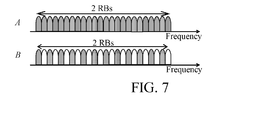
- two types of reference signals are reference signals of different resource-occupying modes.
- One type of the reference signals are shown in FIG. 7A , which occupy continuous subcarriers.
- the other type of the reference signals occupy discontinuous subcarriers, and a common discontinuous subcarriers are "comb" subcarriers, as shown in FIG. 7B .
- a gray “comb” is a first subcarrier set
- a white “comb” is a second subcarrier set
- the two "combs" are frequency division orthogonal.
- users in Cell 1 may occupy subcarriers in the first subcarrier set, and users in Cell 2 may occupy subcarriers in the second subcarrier set.
- Users not requiring coordination may use reference signals of continuous subcarriers. A specific processing operation performed by users according to resources of the reference signals is transmitting or receiving the reference signals.
- Comb subcarriers occupied by a reference signal may include two or more comb subcarrier sets.
- subcarrier sets obtained by taking one subcarrier from every three subcarriers are used as comb subcarriers occupied by the reference signals, so that the comb subcarriers may include three subcarrier sets which can be distributed to three user sets.
- R subcarrier sets may exist, in which R is corresponding to an interval of subcarriers. R may be static, semi-static or even dynamic.
- a sequence modulating reference signals in different cells may come from a sequence group specific to a cell.
- the sequence group specific to a cell includes a sequence specific to a cell corresponding to a possible time-frequency resource-occupying mode. Therefore, when users of two cells do not require coordination, the users can be instructed to use reference signals occupying continuous subcarriers. For example, for two users located inside their own cells, since the interference between different sequence groups is weak or random, that is, is whitened, the interference between the reference signals of the users is also weak or random. When reference signals of users in different cells are coordinated, comb subcarriers are used, and since the comb subcarriers are frequency division, the interference between the reference signals of the users is weak.
- resources occupied by data of users can also be used to determine whether the coordination is required.
- a part of resources can be defined for coordination for users at borders of cells.
- a reference signal thereof require coordination
- the user using this part of the time-frequency resources use a reference signal occupying comb subcarriers.
- Users not using this part of the time-frequency resources use reference signals occupying continuous subcarriers.
- This part of the time-frequency resources may instruct the users to use a type of the reference signals through RRC signaling, such as RRC signaling dedicated to a user, or through signaling oriented to a group of users, such as dynamic broadcast signaling.
- a virtual multiple input multiple output (MIMO) technique can also be used to determine whether coordination is required.
- MIMO multiple input multiple output
- the network side schedules a user for virtual MIMO transmission, so a reference signal of the user are coordinated. So that the user using the virtual MIMO technique uses a reference signal occupying comb subcarriers.
- a user not using the virtual MIMO technique uses a reference signal occupying continuous subcarriers.
- the virtual MIMO technique allows a plurality of users to occupy the same or overlapping time-frequency resources when sending data, so as to improve the utilization efficiency of the resources and increase the system capacity.
- reference signals require being orthogonal, or else, the demodulation performance for data of a plurality of users at the receiving end will be affected.
- comb frequency division reference signals are used for virtual MIMO users, which ensures the reference signals to be orthogonal no matter whether time-frequency resources of the users are exactly the same or not, and improves the flexibility in applying virtual MIMO. Since it is clear to a user whether the user uses virtual MIMO transmission, MAC signaling of n (n ⁇ 1) bits can generally be used to instruct the user to use a type of reference signal.
- an interval of comb subcarrier numbers can be dynamically determined according to the number of users using virtual MIMO transmission on the same time-frequency resources.
- the interval of the comb subcarriers is at least 2 when 2 users occupy overlapping time-frequency resources
- the interval of the comb subcarriers is at least 3 when 3 users occupy overlapping time-frequency resources, that is, the same resources are used three times.
- a modulation sequence of one type of the reference signals comes from a sequence group specific to a cell
- a modulation sequence of another type of the reference signals comes from a sequence group specific to a cell group, such as a sequence group specific to a Node B.
- a specific processing operation performed by users according to the sequence used by reference signals is transmitting or receiving the reference signals.
- a reference signal is modulated by using a sequence in a sequence group specific to a cell.
- a reference signal is modulated by using a sequence in a sequence group specific to a cell group, for example, in a sequence group specific to a Node B.
- all three cells under one Node B use a sequence group of one of the cells, and the two users are distinguished by different time shifts of the same sequence, so as to obtain an orthogonal sequence.
- MAC signaling or RRC signaling of n bits can be used to instruct the user to use a type of reference signal, in which n can be 1.
- n can be 1.
- specific subcarrier information of the used discontinuous subcarriers for example, a particular "comb” in comb subcarriers, and possible time cyclic shift signals of the reference signals corresponding to the "comb", need to be indicated to the users.
- Coordination based on a reference signal may dynamically instruct users to coordinate a reference signal, so as to reduce cell interference.
- a preamble signal in uplink random access there are some physical layer signals, for example, a preamble signal in uplink random access.
- the preamble signal is also modulated by using a sequence of certain characteristics, so that a receiving end can distinguish the preamble signal using the characteristics of the sequence. Similar to the problem of the above reference signal, inter-cell interference of these signals also need to be reduced, so that the coordination method according to the embodiment of the present invention also is also applicable to such signals.
- the coordination method is applicable to users undergoing cell handover, so as to reduce the interference to the signals.
- FIG. 4 is a flow chart of a coordination method based on a modulation scheme according to an embodiment of the present invention.
- a specific process of the coordination method based on modulation schemes according to the embodiment of the present invention includes:
- the user-oriented signaling may be signaling oriented to a single user or a group of users.
- the signaling oriented to a single user includes MAC signaling or RRC signaling; and the signaling oriented to a group of users includes dynamic broadcast signaling.
- the coordination method can dynamically instruct some users to coordinate modulation, which enables the users to flexibly coordinate the modulation.
- Two types of modulation schemes may exist for the coordination method based on a modulation scheme according to the embodiment of the present invention.
- One is superimposing of modulation constellation of two users, and the other is modulating independently without superimposing of the modulation constellation.
- many other modulation schemes that can be coordinated may also exist.
- a specific constellation superimposing method is as follows.
- QPSK quad
- the user at the border of the cell demodulates c 2 s 2 ( t ) as interference.
- the user inside the cell may treat c 2 s 2 ( t ) as interference first, demodulate the signal of the user at the border for interference cancellation so as to cancel the interference of the user at the border, and then demodulate c 2 s 2 ( t ).
- the coordination method based on modulation schemes is applied in downlink to coordinate users at a border of and inside a cell, and to perform constellation superimposing when the two users occupy the same resources, for example, occupy the same subcarriers.
- An indication to users through MAC signaling or RRC signaling of whether to coordinate modulation or not can flexibly notify the user inside the cell of whether the modulation is coordinated, so that the user inside the cell uses a corresponding demodulation scheme to reduce the interference of the cell.
- the coordination method according to the embodiment of present invention is applicable to coordination of users in two cells, which requires neither coordination of all adjacent cells, nor coordination of all users in the two cells. Little interference between coordinated users exists, and the interference between users that are not coordinated and the coordinated users is still random and is not affected.
- An embodiment of the present invention further provides a coordination apparatus 500, which includes a determining module 501, configured to determine a signal processing scheme for a user, and an indicating module 502, configured to indicate to the user the signal processing scheme through user-oriented signaling.
- a coordination apparatus 500 which includes a determining module 501, configured to determine a signal processing scheme for a user, and an indicating module 502, configured to indicate to the user the signal processing scheme through user-oriented signaling.
- the indicating module 502 may further include any one or any combination of the following units:
- the determining module 501 may further include at least one of the following units:
- the coordination apparatus 500 may be located in a base station (Node B).
- An embodiment of the present invention further provides a user equipment 600, which includes an acquiring module 601, configured to acquire indication information about a signal processing scheme of a user contained in user-oriented signaling, and a signal processing module 602, configured to process a signal according to the indication information about the signal processing scheme of the user.
- a user equipment 600 which includes an acquiring module 601, configured to acquire indication information about a signal processing scheme of a user contained in user-oriented signaling, and a signal processing module 602, configured to process a signal according to the indication information about the signal processing scheme of the user.
- the signal processing module 602 may further include at least one of the following units:
- a signal processing scheme is determined for a user according to whether the signal processing scheme of the user requires coordination, and the determined signal processing scheme is indicated to the user through user-oriented signaling.
- the coordination method can dynamically coordinate the users to reduce mutual interference.
- the present invention may be accomplished through hardware, or through software plus a necessary universal hardware platform.
- the technical solutions of the present invention may be embodied in the form of a software product.
- the software product may be stored in a nonvolatile storage media (for example, CD-ROM, USB flash drive, or removable hard disk), and contains several instructions adapted to instruct computer equipment (for example, a personal computer, a server, or network equipment) to perform the method according to the embodiments of the present invention.
Landscapes
- Engineering & Computer Science (AREA)
- Signal Processing (AREA)
- Computer Networks & Wireless Communication (AREA)
- Quality & Reliability (AREA)
- Mobile Radio Communication Systems (AREA)
- Selective Calling Equipment (AREA)
- Circuits Of Receivers In General (AREA)
- Two-Way Televisions, Distribution Of Moving Picture Or The Like (AREA)
Priority Applications (1)
| Application Number | Priority Date | Filing Date | Title |
|---|---|---|---|
| EP14171155.6A EP2806686A1 (fr) | 2008-03-20 | 2009-03-13 | Procédé de coordination, dispositif et équipement utilisateur |
Applications Claiming Priority (2)
| Application Number | Priority Date | Filing Date | Title |
|---|---|---|---|
| CN2008100658843A CN101541011B (zh) | 2008-03-20 | 2008-03-20 | 一种协调方法、装置及用户设备 |
| PCT/CN2009/070773 WO2009115022A1 (fr) | 2008-03-20 | 2009-03-13 | Appareil et procédé de coordination et équipement utilisateur |
Related Child Applications (2)
| Application Number | Title | Priority Date | Filing Date |
|---|---|---|---|
| EP14171155.6A Division-Into EP2806686A1 (fr) | 2008-03-20 | 2009-03-13 | Procédé de coordination, dispositif et équipement utilisateur |
| EP14171155.6A Division EP2806686A1 (fr) | 2008-03-20 | 2009-03-13 | Procédé de coordination, dispositif et équipement utilisateur |
Publications (3)
| Publication Number | Publication Date |
|---|---|
| EP2247138A1 true EP2247138A1 (fr) | 2010-11-03 |
| EP2247138A4 EP2247138A4 (fr) | 2011-08-03 |
| EP2247138B1 EP2247138B1 (fr) | 2014-07-16 |
Family
ID=41090500
Family Applications (2)
| Application Number | Title | Priority Date | Filing Date |
|---|---|---|---|
| EP09722395.2A Not-in-force EP2247138B1 (fr) | 2008-03-20 | 2009-03-13 | Appareil, équipement utilisateur et procédé de coordination |
| EP14171155.6A Ceased EP2806686A1 (fr) | 2008-03-20 | 2009-03-13 | Procédé de coordination, dispositif et équipement utilisateur |
Family Applications After (1)
| Application Number | Title | Priority Date | Filing Date |
|---|---|---|---|
| EP14171155.6A Ceased EP2806686A1 (fr) | 2008-03-20 | 2009-03-13 | Procédé de coordination, dispositif et équipement utilisateur |
Country Status (4)
| Country | Link |
|---|---|
| EP (2) | EP2247138B1 (fr) |
| CN (1) | CN101541011B (fr) |
| BR (1) | BRPI0910305B8 (fr) |
| WO (1) | WO2009115022A1 (fr) |
Cited By (3)
| Publication number | Priority date | Publication date | Assignee | Title |
|---|---|---|---|---|
| EP3068060A4 (fr) * | 2013-11-04 | 2017-11-01 | LG Electronics Inc. | Procédé et appareil de transmission de signal dans un système de communications sans fil |
| US10461913B2 (en) | 2014-12-22 | 2019-10-29 | Huawei Technologies Co., Ltd. | Indication information transmission method and apparatus |
| US10470188B2 (en) | 2014-12-22 | 2019-11-05 | Huawei Technologies Co., Ltd. | Transmission of one or more codebooks between network and terminal devices |
Families Citing this family (9)
| Publication number | Priority date | Publication date | Assignee | Title |
|---|---|---|---|---|
| CN102404267B (zh) * | 2010-09-09 | 2015-11-18 | 南京创达特网络科技有限公司 | 多载波接收机、多载波发射机及多载波收发系统 |
| JP6504509B2 (ja) * | 2014-03-19 | 2019-04-24 | シャープ株式会社 | 端末装置及び通信方法 |
| CN105634654B (zh) * | 2014-10-27 | 2019-12-17 | 中兴通讯股份有限公司 | 多用户信息传输的叠加编码、解调方法及装置 |
| CN105634659B (zh) * | 2014-10-30 | 2019-04-05 | 中兴通讯股份有限公司 | 双传输块的数据发送、接收方法、装置、发射机及接收机 |
| JP6517346B2 (ja) | 2014-12-22 | 2019-05-22 | 華為技術有限公司Huawei Technologies Co.,Ltd. | 指示情報を伝送するための方法および装置 |
| EP3226636B1 (fr) | 2014-12-22 | 2020-07-29 | Huawei Technologies Co., Ltd. | Procédé et dispositif de transmission d'informations d'indication |
| CN106357579B (zh) * | 2015-07-17 | 2020-02-18 | 中兴通讯股份有限公司 | 一种正交频分复用系统频谱资源的使用方法及相应的基站 |
| CN108633054A (zh) | 2017-03-24 | 2018-10-09 | 华为技术有限公司 | 一种参考信号发送方法及其装置 |
| CN116418474A (zh) * | 2021-12-31 | 2023-07-11 | 维沃移动通信有限公司 | 通信方法、装置、通信设备及可读存储介质 |
Family Cites Families (6)
| Publication number | Priority date | Publication date | Assignee | Title |
|---|---|---|---|---|
| US7773535B2 (en) * | 2004-08-12 | 2010-08-10 | Motorola, Inc. | Method and apparatus for closed loop transmission |
| CN1946227B (zh) * | 2005-10-08 | 2011-06-01 | 华为技术有限公司 | 一种基于多载波系统的公共控制信息传输方法 |
| CN100536447C (zh) * | 2005-10-31 | 2009-09-02 | 华为技术有限公司 | 一种抑制干扰的上行导频方法 |
| CN101018220B (zh) * | 2006-02-09 | 2011-02-16 | 华为技术有限公司 | 避免小区间出现干扰的实现方法及装置 |
| US7701919B2 (en) * | 2006-05-01 | 2010-04-20 | Alcatel-Lucent Usa Inc. | Method of assigning uplink reference signals, and transmitter and receiver thereof |
| US8094638B2 (en) * | 2006-08-22 | 2012-01-10 | Texas Instruments Incorporated | Adaptive selection of transmission parameters for reference signals |
-
2008
- 2008-03-20 CN CN2008100658843A patent/CN101541011B/zh not_active Expired - Fee Related
-
2009
- 2009-03-13 BR BRPI0910305A patent/BRPI0910305B8/pt not_active IP Right Cessation
- 2009-03-13 EP EP09722395.2A patent/EP2247138B1/fr not_active Not-in-force
- 2009-03-13 EP EP14171155.6A patent/EP2806686A1/fr not_active Ceased
- 2009-03-13 WO PCT/CN2009/070773 patent/WO2009115022A1/fr not_active Ceased
Cited By (4)
| Publication number | Priority date | Publication date | Assignee | Title |
|---|---|---|---|---|
| EP3068060A4 (fr) * | 2013-11-04 | 2017-11-01 | LG Electronics Inc. | Procédé et appareil de transmission de signal dans un système de communications sans fil |
| US10084521B2 (en) | 2013-11-04 | 2018-09-25 | Lg Electronics Inc. | Method and apparatus for transmitting signal in wireless communication system |
| US10461913B2 (en) | 2014-12-22 | 2019-10-29 | Huawei Technologies Co., Ltd. | Indication information transmission method and apparatus |
| US10470188B2 (en) | 2014-12-22 | 2019-11-05 | Huawei Technologies Co., Ltd. | Transmission of one or more codebooks between network and terminal devices |
Also Published As
| Publication number | Publication date |
|---|---|
| EP2247138B1 (fr) | 2014-07-16 |
| EP2806686A1 (fr) | 2014-11-26 |
| CN101541011A (zh) | 2009-09-23 |
| BRPI0910305A2 (pt) | 2015-09-29 |
| BRPI0910305B8 (pt) | 2021-05-18 |
| WO2009115022A1 (fr) | 2009-09-24 |
| CN101541011B (zh) | 2011-09-14 |
| EP2247138A4 (fr) | 2011-08-03 |
| BRPI0910305B1 (pt) | 2020-04-28 |
Similar Documents
| Publication | Publication Date | Title |
|---|---|---|
| EP2247138B1 (fr) | Appareil, équipement utilisateur et procédé de coordination | |
| US9398584B2 (en) | Method and apparatus of configuring sounding reference signal for coordinated multi-point transmission | |
| US9544776B2 (en) | Transmission and reception of dedicated reference signals | |
| JP6517710B2 (ja) | アップリンク基準信号の特徴を向上させるための装置及び方法 | |
| RU2454017C2 (ru) | Совместное использование схем мультиплексирования с несколькими несущими и с одной несущей для беспроводной связи | |
| RU2467481C2 (ru) | Передающее устройство, приемное устройство и способ приема сигнала в системе мобильной связи, использующей схему ofdm | |
| US7873010B2 (en) | Control signaling resource assignment in wireless communication networks | |
| EP1985041B1 (fr) | Appareil et procede pour l'attribution des ressources et de communication dans un systeme de communication sans fil | |
| US8144731B2 (en) | Control channel signaling in wireless communications | |
| EA027814B1 (ru) | Система мобильной связи, устройство базовой станции, устройство мобильной станции и способ мобильной связи | |
| EP1411668A2 (fr) | Transmission d'information sur les conditions de canal | |
| EP1740008A1 (fr) | Transfert sans interruption dans le sens descendant dans un système OFDM | |
| RU2507720C2 (ru) | Мобильный терминал, базовая станция радиосвязи и способ передачи сигнала общего канала | |
| KR20090130291A (ko) | 무선 통신 시스템에서의 시그널링 송신 및 수신 | |
| US20110292906A1 (en) | Method, apparatus, and system for coordinated multi-point transmission | |
| US8897219B2 (en) | Method and user equipment for transmitting ranging signal, and method and base station for receiving ranging signal | |
| JP4912878B2 (ja) | Ofdmaシステムおよび方法 | |
| EP1811794A1 (fr) | Appareil terminal de communication, station de contrôle et méthode de communication multiporteuse | |
| US8189558B2 (en) | Method and apparatus for creating common physical channel | |
| JP2005005781A (ja) | パイロット信号送信方法及び基地局装置 | |
| KR20080097360A (ko) | 무선통신 시스템에서 ack/nak 제어정보의 송수신방법 및 장치 | |
| US20120294247A1 (en) | Method and a user equipment for transmitting a signal, and a method and a base station for receiving a signal | |
| JP2014116952A (ja) | アップリンク基準信号の特徴を向上させるための装置及び方法 | |
| EP1777869B1 (fr) | Procédé et appareil de planification des canaux dans un système OFDM | |
| CN104767601A (zh) | 在多天线环境下指派参考信号的方法及系统 |
Legal Events
| Date | Code | Title | Description |
|---|---|---|---|
| PUAI | Public reference made under article 153(3) epc to a published international application that has entered the european phase |
Free format text: ORIGINAL CODE: 0009012 |
|
| 17P | Request for examination filed |
Effective date: 20100921 |
|
| AK | Designated contracting states |
Kind code of ref document: A1 Designated state(s): AT BE BG CH CY CZ DE DK EE ES FI FR GB GR HR HU IE IS IT LI LT LU LV MC MK MT NL NO PL PT RO SE SI SK TR |
|
| AX | Request for extension of the european patent |
Extension state: AL BA RS |
|
| DAX | Request for extension of the european patent (deleted) | ||
| A4 | Supplementary search report drawn up and despatched |
Effective date: 20110705 |
|
| RIC1 | Information provided on ipc code assigned before grant |
Ipc: H04W 28/18 20090101AFI20110629BHEP |
|
| 17Q | First examination report despatched |
Effective date: 20130816 |
|
| GRAP | Despatch of communication of intention to grant a patent |
Free format text: ORIGINAL CODE: EPIDOSNIGR1 |
|
| INTG | Intention to grant announced |
Effective date: 20140207 |
|
| GRAS | Grant fee paid |
Free format text: ORIGINAL CODE: EPIDOSNIGR3 |
|
| GRAA | (expected) grant |
Free format text: ORIGINAL CODE: 0009210 |
|
| AK | Designated contracting states |
Kind code of ref document: B1 Designated state(s): AT BE BG CH CY CZ DE DK EE ES FI FR GB GR HR HU IE IS IT LI LT LU LV MC MK MT NL NO PL PT RO SE SI SK TR |
|
| REG | Reference to a national code |
Ref country code: GB Ref legal event code: FG4D |
|
| REG | Reference to a national code |
Ref country code: CH Ref legal event code: EP |
|
| REG | Reference to a national code |
Ref country code: IE Ref legal event code: FG4D |
|
| REG | Reference to a national code |
Ref country code: AT Ref legal event code: REF Ref document number: 678264 Country of ref document: AT Kind code of ref document: T Effective date: 20140815 |
|
| REG | Reference to a national code |
Ref country code: DE Ref legal event code: R096 Ref document number: 602009025315 Country of ref document: DE Effective date: 20140828 |
|
| REG | Reference to a national code |
Ref country code: NL Ref legal event code: VDEP Effective date: 20140716 |
|
| REG | Reference to a national code |
Ref country code: AT Ref legal event code: MK05 Ref document number: 678264 Country of ref document: AT Kind code of ref document: T Effective date: 20140716 |
|
| REG | Reference to a national code |
Ref country code: LT Ref legal event code: MG4D |
|
| PG25 | Lapsed in a contracting state [announced via postgrant information from national office to epo] |
Ref country code: PT Free format text: LAPSE BECAUSE OF FAILURE TO SUBMIT A TRANSLATION OF THE DESCRIPTION OR TO PAY THE FEE WITHIN THE PRESCRIBED TIME-LIMIT Effective date: 20141117 Ref country code: BG Free format text: LAPSE BECAUSE OF FAILURE TO SUBMIT A TRANSLATION OF THE DESCRIPTION OR TO PAY THE FEE WITHIN THE PRESCRIBED TIME-LIMIT Effective date: 20141016 Ref country code: ES Free format text: LAPSE BECAUSE OF FAILURE TO SUBMIT A TRANSLATION OF THE DESCRIPTION OR TO PAY THE FEE WITHIN THE PRESCRIBED TIME-LIMIT Effective date: 20140716 Ref country code: FI Free format text: LAPSE BECAUSE OF FAILURE TO SUBMIT A TRANSLATION OF THE DESCRIPTION OR TO PAY THE FEE WITHIN THE PRESCRIBED TIME-LIMIT Effective date: 20140716 Ref country code: LT Free format text: LAPSE BECAUSE OF FAILURE TO SUBMIT A TRANSLATION OF THE DESCRIPTION OR TO PAY THE FEE WITHIN THE PRESCRIBED TIME-LIMIT Effective date: 20140716 Ref country code: SE Free format text: LAPSE BECAUSE OF FAILURE TO SUBMIT A TRANSLATION OF THE DESCRIPTION OR TO PAY THE FEE WITHIN THE PRESCRIBED TIME-LIMIT Effective date: 20140716 Ref country code: NO Free format text: LAPSE BECAUSE OF FAILURE TO SUBMIT A TRANSLATION OF THE DESCRIPTION OR TO PAY THE FEE WITHIN THE PRESCRIBED TIME-LIMIT Effective date: 20141016 Ref country code: GR Free format text: LAPSE BECAUSE OF FAILURE TO SUBMIT A TRANSLATION OF THE DESCRIPTION OR TO PAY THE FEE WITHIN THE PRESCRIBED TIME-LIMIT Effective date: 20141017 |
|
| PG25 | Lapsed in a contracting state [announced via postgrant information from national office to epo] |
Ref country code: IS Free format text: LAPSE BECAUSE OF FAILURE TO SUBMIT A TRANSLATION OF THE DESCRIPTION OR TO PAY THE FEE WITHIN THE PRESCRIBED TIME-LIMIT Effective date: 20141116 Ref country code: AT Free format text: LAPSE BECAUSE OF FAILURE TO SUBMIT A TRANSLATION OF THE DESCRIPTION OR TO PAY THE FEE WITHIN THE PRESCRIBED TIME-LIMIT Effective date: 20140716 Ref country code: NL Free format text: LAPSE BECAUSE OF FAILURE TO SUBMIT A TRANSLATION OF THE DESCRIPTION OR TO PAY THE FEE WITHIN THE PRESCRIBED TIME-LIMIT Effective date: 20140716 Ref country code: PL Free format text: LAPSE BECAUSE OF FAILURE TO SUBMIT A TRANSLATION OF THE DESCRIPTION OR TO PAY THE FEE WITHIN THE PRESCRIBED TIME-LIMIT Effective date: 20140716 Ref country code: LV Free format text: LAPSE BECAUSE OF FAILURE TO SUBMIT A TRANSLATION OF THE DESCRIPTION OR TO PAY THE FEE WITHIN THE PRESCRIBED TIME-LIMIT Effective date: 20140716 Ref country code: CY Free format text: LAPSE BECAUSE OF FAILURE TO SUBMIT A TRANSLATION OF THE DESCRIPTION OR TO PAY THE FEE WITHIN THE PRESCRIBED TIME-LIMIT Effective date: 20140716 |
|
| REG | Reference to a national code |
Ref country code: DE Ref legal event code: R097 Ref document number: 602009025315 Country of ref document: DE |
|
| PG25 | Lapsed in a contracting state [announced via postgrant information from national office to epo] |
Ref country code: SK Free format text: LAPSE BECAUSE OF FAILURE TO SUBMIT A TRANSLATION OF THE DESCRIPTION OR TO PAY THE FEE WITHIN THE PRESCRIBED TIME-LIMIT Effective date: 20140716 Ref country code: RO Free format text: LAPSE BECAUSE OF FAILURE TO SUBMIT A TRANSLATION OF THE DESCRIPTION OR TO PAY THE FEE WITHIN THE PRESCRIBED TIME-LIMIT Effective date: 20140716 Ref country code: IT Free format text: LAPSE BECAUSE OF FAILURE TO SUBMIT A TRANSLATION OF THE DESCRIPTION OR TO PAY THE FEE WITHIN THE PRESCRIBED TIME-LIMIT Effective date: 20140716 Ref country code: CZ Free format text: LAPSE BECAUSE OF FAILURE TO SUBMIT A TRANSLATION OF THE DESCRIPTION OR TO PAY THE FEE WITHIN THE PRESCRIBED TIME-LIMIT Effective date: 20140716 Ref country code: DK Free format text: LAPSE BECAUSE OF FAILURE TO SUBMIT A TRANSLATION OF THE DESCRIPTION OR TO PAY THE FEE WITHIN THE PRESCRIBED TIME-LIMIT Effective date: 20140716 Ref country code: EE Free format text: LAPSE BECAUSE OF FAILURE TO SUBMIT A TRANSLATION OF THE DESCRIPTION OR TO PAY THE FEE WITHIN THE PRESCRIBED TIME-LIMIT Effective date: 20140716 |
|
| PLBE | No opposition filed within time limit |
Free format text: ORIGINAL CODE: 0009261 |
|
| STAA | Information on the status of an ep patent application or granted ep patent |
Free format text: STATUS: NO OPPOSITION FILED WITHIN TIME LIMIT |
|
| 26N | No opposition filed |
Effective date: 20150417 |
|
| PG25 | Lapsed in a contracting state [announced via postgrant information from national office to epo] |
Ref country code: LU Free format text: LAPSE BECAUSE OF FAILURE TO SUBMIT A TRANSLATION OF THE DESCRIPTION OR TO PAY THE FEE WITHIN THE PRESCRIBED TIME-LIMIT Effective date: 20150313 Ref country code: MC Free format text: LAPSE BECAUSE OF FAILURE TO SUBMIT A TRANSLATION OF THE DESCRIPTION OR TO PAY THE FEE WITHIN THE PRESCRIBED TIME-LIMIT Effective date: 20140716 |
|
| REG | Reference to a national code |
Ref country code: CH Ref legal event code: PL |
|
| PG25 | Lapsed in a contracting state [announced via postgrant information from national office to epo] |
Ref country code: SI Free format text: LAPSE BECAUSE OF FAILURE TO SUBMIT A TRANSLATION OF THE DESCRIPTION OR TO PAY THE FEE WITHIN THE PRESCRIBED TIME-LIMIT Effective date: 20140716 |
|
| REG | Reference to a national code |
Ref country code: FR Ref legal event code: ST Effective date: 20151130 |
|
| REG | Reference to a national code |
Ref country code: IE Ref legal event code: MM4A |
|
| PG25 | Lapsed in a contracting state [announced via postgrant information from national office to epo] |
Ref country code: LI Free format text: LAPSE BECAUSE OF NON-PAYMENT OF DUE FEES Effective date: 20150331 Ref country code: CH Free format text: LAPSE BECAUSE OF NON-PAYMENT OF DUE FEES Effective date: 20150331 Ref country code: IE Free format text: LAPSE BECAUSE OF NON-PAYMENT OF DUE FEES Effective date: 20150313 |
|
| PG25 | Lapsed in a contracting state [announced via postgrant information from national office to epo] |
Ref country code: FR Free format text: LAPSE BECAUSE OF NON-PAYMENT OF DUE FEES Effective date: 20150331 |
|
| PG25 | Lapsed in a contracting state [announced via postgrant information from national office to epo] |
Ref country code: BE Free format text: LAPSE BECAUSE OF FAILURE TO SUBMIT A TRANSLATION OF THE DESCRIPTION OR TO PAY THE FEE WITHIN THE PRESCRIBED TIME-LIMIT Effective date: 20140716 |
|
| PG25 | Lapsed in a contracting state [announced via postgrant information from national office to epo] |
Ref country code: MT Free format text: LAPSE BECAUSE OF FAILURE TO SUBMIT A TRANSLATION OF THE DESCRIPTION OR TO PAY THE FEE WITHIN THE PRESCRIBED TIME-LIMIT Effective date: 20140716 |
|
| PG25 | Lapsed in a contracting state [announced via postgrant information from national office to epo] |
Ref country code: HU Free format text: LAPSE BECAUSE OF FAILURE TO SUBMIT A TRANSLATION OF THE DESCRIPTION OR TO PAY THE FEE WITHIN THE PRESCRIBED TIME-LIMIT; INVALID AB INITIO Effective date: 20090313 |
|
| PG25 | Lapsed in a contracting state [announced via postgrant information from national office to epo] |
Ref country code: HR Free format text: LAPSE BECAUSE OF FAILURE TO SUBMIT A TRANSLATION OF THE DESCRIPTION OR TO PAY THE FEE WITHIN THE PRESCRIBED TIME-LIMIT Effective date: 20140716 |
|
| PG25 | Lapsed in a contracting state [announced via postgrant information from national office to epo] |
Ref country code: TR Free format text: LAPSE BECAUSE OF FAILURE TO SUBMIT A TRANSLATION OF THE DESCRIPTION OR TO PAY THE FEE WITHIN THE PRESCRIBED TIME-LIMIT Effective date: 20140716 |
|
| PG25 | Lapsed in a contracting state [announced via postgrant information from national office to epo] |
Ref country code: MK Free format text: LAPSE BECAUSE OF FAILURE TO SUBMIT A TRANSLATION OF THE DESCRIPTION OR TO PAY THE FEE WITHIN THE PRESCRIBED TIME-LIMIT Effective date: 20140716 |
|
| PGFP | Annual fee paid to national office [announced via postgrant information from national office to epo] |
Ref country code: GB Payment date: 20220203 Year of fee payment: 14 Ref country code: DE Payment date: 20220203 Year of fee payment: 14 |
|
| REG | Reference to a national code |
Ref country code: DE Ref legal event code: R119 Ref document number: 602009025315 Country of ref document: DE |
|
| GBPC | Gb: european patent ceased through non-payment of renewal fee |
Effective date: 20230313 |
|
| PG25 | Lapsed in a contracting state [announced via postgrant information from national office to epo] |
Ref country code: GB Free format text: LAPSE BECAUSE OF NON-PAYMENT OF DUE FEES Effective date: 20230313 |
|
| PG25 | Lapsed in a contracting state [announced via postgrant information from national office to epo] |
Ref country code: GB Free format text: LAPSE BECAUSE OF NON-PAYMENT OF DUE FEES Effective date: 20230313 Ref country code: DE Free format text: LAPSE BECAUSE OF NON-PAYMENT OF DUE FEES Effective date: 20231003 |