EP2247202B1 - Composition pre-fibrillaire et fibrilles à partir de matériaux protéiques - Google Patents
Composition pre-fibrillaire et fibrilles à partir de matériaux protéiques Download PDFInfo
- Publication number
- EP2247202B1 EP2247202B1 EP08864689.8A EP08864689A EP2247202B1 EP 2247202 B1 EP2247202 B1 EP 2247202B1 EP 08864689 A EP08864689 A EP 08864689A EP 2247202 B1 EP2247202 B1 EP 2247202B1
- Authority
- EP
- European Patent Office
- Prior art keywords
- lactobacillus
- fibril
- fibrils
- hydrolysis
- peptide
- Prior art date
- Legal status (The legal status is an assumption and is not a legal conclusion. Google has not performed a legal analysis and makes no representation as to the accuracy of the status listed.)
- Not-in-force
Links
Images

Classifications
-
- A—HUMAN NECESSITIES
- A23—FOODS OR FOODSTUFFS; TREATMENT THEREOF, NOT COVERED BY OTHER CLASSES
- A23K—FODDER
- A23K20/00—Accessory food factors for animal feeding-stuffs
- A23K20/10—Organic substances
- A23K20/142—Amino acids; Derivatives thereof
- A23K20/147—Polymeric derivatives, e.g. peptides or proteins
-
- A—HUMAN NECESSITIES
- A23—FOODS OR FOODSTUFFS; TREATMENT THEREOF, NOT COVERED BY OTHER CLASSES
- A23C—DAIRY PRODUCTS, e.g. MILK, BUTTER OR CHEESE; MILK OR CHEESE SUBSTITUTES; PREPARATION THEREOF
- A23C19/00—Cheese; Cheese preparations; Making thereof
- A23C19/06—Treating cheese curd after whey separation; Products obtained thereby
- A23C19/09—Other cheese preparations; Mixtures of cheese with other foodstuffs
- A23C19/0921—Addition, to cheese or curd, of minerals, including organic salts thereof, trace elements, amino acids, peptides, protein hydrolysates, nucleic acids, yeast extracts or autolysate, vitamins or derivatives of these compounds
-
- A—HUMAN NECESSITIES
- A23—FOODS OR FOODSTUFFS; TREATMENT THEREOF, NOT COVERED BY OTHER CLASSES
- A23C—DAIRY PRODUCTS, e.g. MILK, BUTTER OR CHEESE; MILK OR CHEESE SUBSTITUTES; PREPARATION THEREOF
- A23C9/00—Milk preparations; Milk powder or milk powder preparations
- A23C9/12—Fermented milk preparations; Treatment using microorganisms or enzymes
- A23C9/13—Fermented milk preparations; Treatment using microorganisms or enzymes using additives
- A23C9/1322—Inorganic compounds; Minerals, including organic salts thereof, oligo-elements; Amino-acids, peptides, protein-hydrolysates or derivatives; Nucleic acids or derivatives; Yeast extract or autolysate; Vitamins; Antibiotics; Bacteriocins
-
- A—HUMAN NECESSITIES
- A23—FOODS OR FOODSTUFFS; TREATMENT THEREOF, NOT COVERED BY OTHER CLASSES
- A23J—PROTEIN COMPOSITIONS FOR FOODSTUFFS; WORKING-UP PROTEINS FOR FOODSTUFFS; PHOSPHATIDE COMPOSITIONS FOR FOODSTUFFS
- A23J3/00—Working-up of proteins for foodstuffs
- A23J3/30—Working-up of proteins for foodstuffs by hydrolysis
-
- A—HUMAN NECESSITIES
- A23—FOODS OR FOODSTUFFS; TREATMENT THEREOF, NOT COVERED BY OTHER CLASSES
- A23J—PROTEIN COMPOSITIONS FOR FOODSTUFFS; WORKING-UP PROTEINS FOR FOODSTUFFS; PHOSPHATIDE COMPOSITIONS FOR FOODSTUFFS
- A23J3/00—Working-up of proteins for foodstuffs
- A23J3/30—Working-up of proteins for foodstuffs by hydrolysis
- A23J3/32—Working-up of proteins for foodstuffs by hydrolysis using chemical agents
- A23J3/34—Working-up of proteins for foodstuffs by hydrolysis using chemical agents using enzymes
- A23J3/341—Working-up of proteins for foodstuffs by hydrolysis using chemical agents using enzymes of animal proteins
- A23J3/343—Working-up of proteins for foodstuffs by hydrolysis using chemical agents using enzymes of animal proteins of dairy proteins
-
- A—HUMAN NECESSITIES
- A23—FOODS OR FOODSTUFFS; TREATMENT THEREOF, NOT COVERED BY OTHER CLASSES
- A23J—PROTEIN COMPOSITIONS FOR FOODSTUFFS; WORKING-UP PROTEINS FOR FOODSTUFFS; PHOSPHATIDE COMPOSITIONS FOR FOODSTUFFS
- A23J3/00—Working-up of proteins for foodstuffs
- A23J3/30—Working-up of proteins for foodstuffs by hydrolysis
- A23J3/32—Working-up of proteins for foodstuffs by hydrolysis using chemical agents
- A23J3/34—Working-up of proteins for foodstuffs by hydrolysis using chemical agents using enzymes
- A23J3/346—Working-up of proteins for foodstuffs by hydrolysis using chemical agents using enzymes of vegetable proteins
-
- A—HUMAN NECESSITIES
- A23—FOODS OR FOODSTUFFS; TREATMENT THEREOF, NOT COVERED BY OTHER CLASSES
- A23L—FOODS, FOODSTUFFS OR NON-ALCOHOLIC BEVERAGES, NOT OTHERWISE PROVIDED FOR; PREPARATION OR TREATMENT THEREOF
- A23L33/00—Modifying nutritive qualities of foods; Dietetic products; Preparation or treatment thereof
- A23L33/10—Modifying nutritive qualities of foods; Dietetic products; Preparation or treatment thereof using additives
- A23L33/17—Amino acids, peptides or proteins
- A23L33/18—Peptides; Protein hydrolysates
Definitions
- the invention pertains to the making of fibrils from proteinaceous materials such as obtained from whey protein.
- the invention pertains to the making of fibrils from proteinaceous material obtained from a ⁇ -lactoglobulin, glycinin or patatin
- ⁇ -lactoglobulin can be subjected to a process resulting in fibrils.
- the process comprises dissolving the ⁇ -lactoglobulin in aqueous hydrochloric acid, repeatedly diluting and filtering the protein solution, and subjecting the resulting solution to elevated temperature (e.g. 80°C) for an extended period of time (e.g. 10 hours).
- elevated temperature e.g. 80°C
- extended period of time e.g. 10 hours
- fibrils can be used as an additive in a wide range of food and non-food products, wherein the fibrils can have varying different functions, such as foam stabilisation, enhancing of water-binding and/or texture in meat or meat-like products, general texturizing properties including viscosity improvement, gelling ability enhancement.
- the fibrils have improved functional properties comprising thickening capability, gelling capability, foaming capability, and emulsifying capability.
- the invention in one aspect, provides a method of making a peptide pre-fibril composition, by the hydrolysis of a protein selected from the group consisting of ⁇ -lactoglobulin-containing whey protein preparation, glycinin-containing soy bean protein preparation, patatin, and mixtures thereof, comprising providing a solution of the protein in an aqueous acidic solvent, heating the solution under fibril-inhibiting conditions, and terminating the hydrolysis conditions by increasing the pH to neutral.
- the hydrolysis is conducted under acidic conditions at elevated temperature, and is terminated when the hydrolysis has occurred in a sufficient manner so as to form the peptide building blocks for the fibrils, but not yet the fibrils themselves.
- This typically refers to making a peptide pre-fibril composition by the hydrolysis of a protein selected from the group consisting of ⁇ -lactoglobulin-containing whey protein preparation, glycinin-containing soy bean protein preparation, patatin, and mixtures thereof, wherein the hydrolysis is conducted at pH 0.5-4 at a temperature higher than 20°C, and wherein the pH is increased to neutral after at most 5 hours.
- the peptide pre-fibril compositions made by the invention have a variety of uses, including uses in which the pre-fibril composition is turned into fibrils in an end-product - that can then be used as described in WO 2004/049819 , and uses in which the pre-fibril composition per se is contained in end product, e.g. with the aim of forming fibrils (fibrillary aggregation) upon use or consumption of the end-product.
- the pre-fibril composition made by the invention can be used in a diet food for human or animal body weight control.
- the elevated temperature generally means a temperature above 20°C, preferably of from 35 °C to 140 °C, and more preferably of from 80 °C to 120 °C.
- the acidic conditions can refer to any acid pH, but preferably a relatively strongly acidic pH, of from 0.5 to 4, more preferably of from 0.5 to 3, and most preferably of from 1 to 2.
- a higher temperature, above 80°C and more preferably above 100°C, is particularly preferred in view of the possibility to separate hydrolysis from fibril formation, as a higher temperature will lead to an increased rate of hydrolysis.
- ⁇ -lactoglobulin fibrils are not in fact made up of intact ⁇ -lactoglobulin protein molecules as a building block, but are made of peptide components derived from the ⁇ -lactoglobulin.
- This novel insight into the nature of the aforementioned proteinaceous fibrils opens up the wide range of useful possibilities now proffered by the invention.
- fibrils of soy bean protein and potato protein are made up of peptides.
- an intermediate step can be defined in the aforementioned process, viz. a step in which the hydrolysis has occurred in a sufficient manner so as to form the peptide building blocks for the fibrils, but not yet the fibrils themselves. This is referred to as a "pre-fibril composition.”
- the pre-fibril composition made by the process of the invention can be characterized as obtainable in an acid hydrolysis process under conditions allowing peptide formation, or resulting in peptide formation at a relatively high rate, with fibril formation absent or at a relatively low rate. If, e.g. the process as described in WO 2004/049819 is followed, the pre-fibrils are formed if the step in which the protein is allowed to stand in a solution at low pH and high temperature, is terminated at an early point in time.
- the process time should be sufficiently long to allow hydrolysis in the acid environment to take place. Although within a few minutes some hydrolysis will have taken place, this preferably means a process time of at least 15 minutes, and more preferably at least 30 minutes.
- the process time should be short enough to avoid too high an extent of stable fibril formation. Although even within 15 minutes fibril formation might occur, these fibrils will not be stable. In fact, for a period of up to 5 hours fibrils will be formed, but these will disintegrate upon increasing pH to neutral.
- the hydrolyzed protein is allowed to stand for a period of time of 2.5 hours or less, more preferably 1.5 hour or less. Most preferably, a period of 30-60 minutes is taken to obtain sufficient peptide formation without undue formation of stable fibrils.
- the temperature can be adapted. It will be apparent to the skilled person that a lower temperature will generally require a longer standing time for adequate hydrolysis, and will generally allow a longer standing time until fibril formation occurs.
- pH can also be tuned. A lower pH will lead to a higher rate of hydrolysis, which aids in obtaining a process in which hydrolysis can occur separately from fibril formation.
- the object of forming peptides without forming fibrils can be realized with the aid of further measures so as to provide fibril inhibiting conditions (i.e. conditions under which fibril formation is relatively slow, is retarded or is avoided, or conditions under which fibril formation, if occurring, is at least partially reversed).
- fibril inhibiting conditions i.e. conditions under which fibril formation is relatively slow, is retarded or is avoided, or conditions under which fibril formation, if occurring, is at least partially reversed.
- the invention can be realised on the basis of ⁇ -lactoglobulin-containing whey protein preparations, i.e. a composition comprising whey protein, with the whey protein comprising ⁇ -lactoglobulin.
- Whey proteins can be described as those milk proteins that remain after curdling of milk, i.e. precipitation of casein, generally upon the addition of rennet to cheese milk.
- the term "whey protein" is sometimes used to indicate the entire protein composition of whey, but usually indicates any protein or combination of proteins present in whey.
- the invention pertains to any and all whey protein compositions comprising ⁇ -lactoglobulin, which is one of the main whey proteins.
- the ⁇ -lactoglobulin- containing whey protein preparation is whey protein isolate, comprising a substantial fraction (preferably, based on total proteinaceous material, at least 50% and more preferably at least 80%) of ⁇ -lactoglobulin, and most preferably it is ⁇ -lactoglobulin itself.
- the invention can also be realized on the basis of glycinin (soy bean protein) or patatin (protein originating from members of the Solanaceae plant family, such as potato protein).
- the pre-fibril composition made by the process of the invention may comprise a wide range of peptide fragments of various molecular weights, generally between 1,000 and 10,000 Da and preferably consists of peptide fragments having molecular weights between 2,000 and 8,000 Da.
- the pre-fibril composition comprises, as the dominant fragment, i.e. the fragment that of all fragments is present most, defined by amino acids nos. 12 to 32(f 12-33 ) of from ⁇ -lactoglobulin, i.e. IQKVAGTWYSLAMAASDISLL.
- This fragment can be present, as such, as part of larger fragments, or both.
- the following peptides are preferred.
- the fragment is preferably present, as defined hereinbefore, to the extent of more than 40% of all peptides present
- the peptide composition preferably further comprises one or more of the following peptides:
- compositions as obtained by the aforementioned process of acidic hydrolysis typically refers to compositions as obtained by the aforementioned process of acidic hydrolysis.
- Other preferred characteristics of the prefibril peptide composition so obtained is that the majority of the peptide fragments result from cleavage of the peptide bonds before or after aspartic acid.
- the pre-fibril peptide composition is further characterized, preferably, by a comprising the more hydrophobic peptides obtained from hydrolysis of the ⁇ -lactoglobulin-containing protein preparation, by a low charge at pH 2, and by the absence of proline.
- preferred fibril-forming peptide fragments on the basis of glycinin and patatin are based on the following: Glycinin G1 Accession number: P04776 f42-128 f42-127 f43-128 f43-127 f 128-140 DRHQKIYNFREGD f 128-139 DRHQKIYNFREG f 129-140 RHQKIYNFREGD f 129-139 RHQKIYNFREG f 140-157 DLIAVPTGVAWWMYNNED f 140-156 DLIAVPTGVAWWMYNNE f 141-157 LIAVPTGVAWWMYNNED f 141-156 LIAVPTGVAWWMYNNE f 157-167 DTPWAVSIID f 157-166 DTPWAVSII f l58-167 TPVVAVSIID f 158-166 TPWAVSII f 176-236 f 176-235 f 177-236 f 177-235 f
- the pre-fibril peptide composition can also be formed by peptide synthesis.
- the peptides synthesized are relatively hydrophobic and, more preferably are peptides capable of undergoing ⁇ -sheet interaction.
- Peptide synthesis can be executed chemically in known manners, particularly using solid-phase peptide synthesis methods as are well known to the skilled person. Particularly for relatively long peptides, such as a the peptides indicated above, it is preferred to perform the synthesis thereof by means of microbiological methods. Suitable micro-organisms the genome of which encodes for the appropriate peptides, and which thus can be employed to form these peptides, are known to the skilled person. Particularly, microorganisms are to be selected that satisfy the following requirements:
- the pre-fibril composition as formed by microbiological peptide formation can be set to form fibrils upon acidification. This preferably is done to an extent comparable with the pH resulting from the aforementioned acidic hydrolysis.
- the rate of fibril formation may be increased by subjecting the mixture to shear or ultrasonic treatment.
- One of the advantages of this route is a shorter duration of the low pH heat treatment.
- the fibrils formed according to the present invention preferably have an aspect ratio of greater than 5, i.e. defining the longest dimension of the fibril as its length, this length is at least 5 times larger than the diameter or width of the fibril.
- the length is of from 10 nm to 1 mm, and the diameter is of from 2 to 10 nm. More preferably the aspect ratio is greater than 50.
- the invention provides the advantageous possibility to tailor the aspect ratio by steering the peptide composition towards the presence of peptides that facilitate the formation of fibrils (which will generally lead to a higher aspect ratio) or the presence of peptides that inhibit fibril formation, such as the aforementioned ⁇ -sheet blockers, which will generally lead to a lower aspect ratio.
- the pre-fibril composition made by the method of the invention is suitable for a variety of uses. This includes uses of the pre-fibril composition itself as an additive in food and non-food products, e.g. as a structuring agent, and particularly as a texturizing agent, i.e. for viscosity or gelation. It also includes the use of the pre-fibril composition to make fibrils which then can be used int. al. in the same manner as described in WO 2004/049819 . In addition, the invention opens up the possibility to end up with fibrils as described before, but then formed in situ and/or at a chosen point in time. Thus, the peptide pre-fibril composition can int.al.
- the peptide pre-fibril composition is capable of fibrillary aggregation at these interfaces, which results in a robust boundary layer, and hence a highly stable emulsion or foam (as a result of a decreased disproportioning of the foam).
- Another use in which the peptide pre-fibril composition made by the method of the invention is used for its ability to form fibrils, is by adding the composition as an ingredient to an acidic liquid (e.g.
- fibrillary aggregation of varying extent, depending on conditions as will be apparent to the skilled person.
- fibrillary aggregation of varying extent, depending on conditions as will be apparent to the skilled person.
- This will result in a viscosity enhancement or gelation (the effect depending on concentration).
- the rate at which this occurs can be steered with reference to variable parameters such as pH and concentration, so as to obtain immediate or retarded fibrillary aggregation.
- Retarded fibril formation provides a particular advantage in production, as the product can be maintained as a low-viscous mass during processing steps, such as pumping, in which a low viscosity can be beneficial.
- the pre-fibril peptide composition has a great advantage in that it does not itself have a substantial influence on the texture of foods and drinks. This enables making a solid or liquid food product that has a built-in effect of satisfying the stomach (satiation). Thus, when consumed by a person, the peptide composition will not disturb mouthfeel, as it will remain intact until it arrives in the gastric juice. Due to the pH thereof, and the benefit of elevated (body) temperature, fibrillary aggregation will occur almost instantaneously. Due to the gelation occurring in situ there, the person consuming the food product containing the pre-fibril composition of the invention, will experience satiety, i.e. the impression of a relatively larger meal than actually consumed.
- pre-fibril composition in taste-masked or encapsulated form, particularly if relatively small hydrophobic peptides are substantially present.
- pre-fibril composition in which pre-fibril composition are chosen that are enriched in respect of the aforementioned relatively large peptides, an advantage is a decreased need for taste-masking measures.
- the invention also pertains to making fibrils of a proteinaceous material based on a ⁇ -lactoglobulin-containing whey protein preparation obtainable by a process as substantially described hereinbefore. I.e. the process of two steps, comprising first subjecting the protein to hydrolysis so as to form peptides, and then allowing fibril formation to occur at acidic pH.
- the resulting products by tailoring the peptide composition, are distinguished from a process in which the ⁇ -lactoglobulin-containing whey protein preparation is subjected to a concerted process of hydrolysis and fibrillary aggregation.
- the pre-fibril compositions made by the method of the invention, as well as the fibrils obtained in accordance with the invention, can be used in food products, particularly in acidic dairy products such as yoghurt or cheese. This use serves the aforementioned purposes, such as providing structuring properties.
- Combinations of the various fibrils can be made. Further, combinations can be made with peptides obtainable from lysozyme, which are also fibril-forming.
- the pH of a 3% protein solution of bovine ⁇ -lactoglobulin was set to 2 by adding a concentrated HCl solution and heated for 20 hours at 85°C in a shearing device at a constant shear rate of 323 s-1. During this heat treatment fibrillar aggregates were formed.
- the heated sample was diluted to a protein concentration of 0.8 g/l.
- Fibrils and non-aggregated protein material of the sample were separated using centrifugal filters (MWCO 100,000).
- the retentate contained fibrillar aggregates, as was shown by Thioflavin T fluorescence measurements, high-performance size-exclusion-chromatography under non-dissociating condition, and transmission electron microscopy.
- the filtrate did not contain fibrils.
- the retentate was washed and centrifuged twice with a pH 2 HCl solution to remove non-aggregated proteinaceous material left in the retentate.
- the proportion of proteinaceous material present in the fibrils in the heated ⁇ -lactoglobulin solution was approximately 28 wt%.
- Molecular masses of the peptides present in the heated sample, retentate and filtrate were characterized using MALDI-TOF mass-spectrometry.
- the peptides had molecular masses between 2,000 and 8,000 Da, which means that the fibrils are composed of peptide fragments.
- the majority of the peptide fragments (both aggregated and non-aggregated) were a result of cleavage of the peptide bonds before or after aspartic acid.
- Four peptide fragments were present in the retentate and the total heated sample and not present in the filtrate, viz. [f1-32], [f1-33], [f1-52] and [f1-53].
- the peptide fragment dominantly present in the fibrils was [f12-33], i.e., IQKVAGTWYSLAMAASDISLL. This peptide was also present in the filtrate.
- FIG. 1 shows a transmission electron microscopy image of the ⁇ -lactoglobulin solution after enzymatic hydrolysis and incubation at pH 2. Fibrillar aggregates with a length of ⁇ 1 ⁇ m can be observed in this picture, which shows that the enzymatic hydrolysis is an alternative route to obtain fibrillar aggregates of ⁇ -lactoglobulin.
- Fibrils of protein like ⁇ -lactoglobulin and soy glycinin can be prepared by heating the protein at pH 2.
- the peptides present after heating at pH 2 were a result of hydrolysis of the bonds between an aspartic acid residue and any other amino acid residue.
- Fibrils of soy glycinin are also predominantly composed of peptides.
- An isolate of soy glycinin was prepared from soy bean meal using isoelectric precipitation at pH 6.4.
- Fibrils of soy glycinin were prepared by heating (85 °C, 20 h) and shearing (shear rate of 323 s-1) a 2 wt% soy glycinin solution at pH 2.
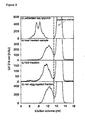
- FIG. 2 depicts HP-SEC (fibril dissociating conditions) elution profiles of (a) unheated soy glycinin, (b) total heated sample, (c) fibril fraction, and (d) non-aggregated protein material.
- Fibrils were dissociated using 8 M guanidine chloride and 0.1 M DTT (pH 8). The increase in UV signal of the elution profile after 11.5 ml (indicated by the dotted line) is due to the elution of guanidine chloride.
- Fibrils were obtained from patatin by heating and stirring a 2 wt% protein solution for 24 h at 70 °C and pH 2.
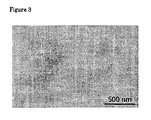
- Figure 3 shows a TEM picture of the fibrils obtained from patatin. These fibrils were shorter ( ⁇ 500 nm) and more flexible than fibrils formed from soy protein or ⁇ -lactoglobulin.
- Example 1 The conditions described for Example 1 were used with the exception that 8 M urea was added to the starting mixture.
- the presence of urea in the mixture affects the formation of fibrils, but does not affect the hydrolysis of the of the bovine ⁇ -lactoglobulin. Urea counteract the formation of hydrogen bonds and hydrophobic interactions which interactions are believed to be the initial force for fibril formation.
- the solution was cooled to room temperature, and the pH was increased from pH 2 to pH 7 by drop-wise addition of NaOH (aq).
- the urea was removed by chromatography (anion exchange). Thioflavin T fluorescence measurement and transmission electron microscopy was used to confirm the absence of fibrils.
Landscapes
- Life Sciences & Earth Sciences (AREA)
- Chemical & Material Sciences (AREA)
- Polymers & Plastics (AREA)
- Engineering & Computer Science (AREA)
- Food Science & Technology (AREA)
- Health & Medical Sciences (AREA)
- Nutrition Science (AREA)
- Proteomics, Peptides & Aminoacids (AREA)
- Biochemistry (AREA)
- Molecular Biology (AREA)
- Zoology (AREA)
- Chemical Kinetics & Catalysis (AREA)
- General Chemical & Material Sciences (AREA)
- Animal Husbandry (AREA)
- Microbiology (AREA)
- Mycology (AREA)
- Peptides Or Proteins (AREA)
- Medicines That Contain Protein Lipid Enzymes And Other Medicines (AREA)
- Coloring Foods And Improving Nutritive Qualities (AREA)
- Preparation Of Compounds By Using Micro-Organisms (AREA)
Claims (8)
- Procédé de fabrication d'une composition pré-fibrillaire peptidique par l'hydrolyse d'une protéine sélectionnée dans le groupe consistant en une préparation de protéine lactosérique contenant de la β-lactoglobuline, une préparation de protéine de soja contenant de la glycinine, la patatine, et des mélanges de celles-ci, qui comprend la mise à disposition d'une solution de la protéine dans un solvant acide aqueux, le chauffage de la solution dans des conditions inhibant les fibrilles, et l'arrêt des conditions d'hydrolyse en augmentant le pH jusqu'à la plage neutre.
- Procédé selon la revendication 1, dans lequel l'hydrolyse dans des conditions acides est réalisée à une température supérieure à 20 °C.
- Procédé selon la revendication 1 ou 2, dans lequel l'hydrolyse est réalisée à un pH de 0,5-4, de préférence 0,5-3.
- Procédé selon l'une quelconque des revendications précédentes, dans lequel l'hydrolyse est réalisée à une température de 80 à 120 °C.
- Procédé selon l'une quelconque des revendications précédentes, dans lequel la protéine est la β-lactoglobuline.
- Procédé selon la revendication 5, dans lequel le peptide dominant dans le matériel protéique est le peptide IQKVAGTWYSLAMAASDISLL.
- Procédé de fabrication d'une composition pré-fibrillaire peptidique pouvant être obtenue par un procédé selon l'une quelconque des revendications 1 à 6, qui comprend la mise à disposition d'un ou plusieurs micro-organismes capables de former les peptides appropriés, de préférence sélectionnés dans le groupe consistant en BACILLUS_WEIHENSTEPHANENSIS, BIFIDOBACTERIUM_ADOLESCENTIS, BIFIDOBACTERIUM_LONGUM, BIFIDOBACTERIUM_LONGUM, BREVIBACTERIUM_LINENS, LACTOBACILLUS_ACIDOPHILUS, LACTOBACILLUS_BREVIS, LACTOBACILLUS_CASEI, LACTOBACILLUS_DELBRUECKII_SUBSP_BULGARICUS, LACTOBACILLUS_GASSERI, LACTOBACILLUS_JOHNSONII, LACTOBACILLUS_PLANTARUM, LACTOBACILLUS_REUTERI, LACTOBACILLUS_SAKEI, LACTOBACILLUS_SALIVARIUS, LACTOCOCCUS_LACTIS_CREMORIS, LACTOCOCCUS_LACTIS_LACTIS, LEUCONOSTOC_MESENTEROIDES, OENOCOCCUS_OENI, et PEDIOCOCCUS_PENTOSACEUS, STREPTOCOCCUS_THERMOPHILUS, en permettant aux micro-organismes de former ces peptides, et la récolte des peptides.
- Procédé de fabrication d'une composition fibrillaire protéique, qui comprend la fabrication d'une composition pré-fibrillaire peptidique par un procédé selon l'une quelconque des revendications précédentes et, au cours d'une étape suivante, la soumission de la composition pré-fibrillaire à un pH acide et à une température élevée pendant une durée suffisante pour permettre à l'agrégation fibrillaire de débuter.
Priority Applications (1)
| Application Number | Priority Date | Filing Date | Title |
|---|---|---|---|
| EP08864689.8A EP2247202B1 (fr) | 2007-12-21 | 2008-12-22 | Composition pre-fibrillaire et fibrilles à partir de matériaux protéiques |
Applications Claiming Priority (4)
| Application Number | Priority Date | Filing Date | Title |
|---|---|---|---|
| NL2001123 | 2007-12-21 | ||
| EP08156298A EP2123177B1 (fr) | 2008-05-15 | 2008-05-15 | Composition pre-fibrillaire et fibrilles à partir de matériaux protéiques |
| EP08864689.8A EP2247202B1 (fr) | 2007-12-21 | 2008-12-22 | Composition pre-fibrillaire et fibrilles à partir de matériaux protéiques |
| PCT/NL2008/050845 WO2009082229A2 (fr) | 2007-12-21 | 2008-12-22 | Composition et fibrilles provenant de matières protéinacées |
Publications (2)
| Publication Number | Publication Date |
|---|---|
| EP2247202A2 EP2247202A2 (fr) | 2010-11-10 |
| EP2247202B1 true EP2247202B1 (fr) | 2014-03-19 |
Family
ID=40651795
Family Applications (1)
| Application Number | Title | Priority Date | Filing Date |
|---|---|---|---|
| EP08864689.8A Not-in-force EP2247202B1 (fr) | 2007-12-21 | 2008-12-22 | Composition pre-fibrillaire et fibrilles à partir de matériaux protéiques |
Country Status (2)
| Country | Link |
|---|---|
| EP (1) | EP2247202B1 (fr) |
| WO (1) | WO2009082229A2 (fr) |
Cited By (1)
| Publication number | Priority date | Publication date | Assignee | Title |
|---|---|---|---|---|
| US20140335255A1 (en) * | 2011-12-13 | 2014-11-13 | Nestec S.A. | Aerated food products with improved foam stability |
Families Citing this family (7)
| Publication number | Priority date | Publication date | Assignee | Title |
|---|---|---|---|---|
| EP2347658A1 (fr) | 2010-01-20 | 2011-07-27 | Nestec S.A. | Gel à base d'huile |
| WO2017144730A1 (fr) * | 2016-02-26 | 2017-08-31 | Danmarks Tekniske Universitet | Prévention et traitement de l'allergie au lait |
| WO2019212330A1 (fr) * | 2018-04-30 | 2019-11-07 | N.V. Nutricia | Formule avec un peptide bêta-lactoglobuline spécifique |
| WO2019212329A1 (fr) * | 2018-04-30 | 2019-11-07 | N.V. Nutricia | Formule avec des peptides de bêta-lactoglobuline spécifiques |
| PL3813549T3 (pl) | 2018-06-27 | 2026-03-09 | Arla Foods Amba | Preparat napoju z beta-laktoglobuliną o obojętnym ph |
| JP7777923B2 (ja) * | 2018-06-27 | 2025-12-01 | アーラ フーズ エイエムビーエイ | 酸性βラクトグロブリン飲料調製物 |
| US20220046949A1 (en) * | 2019-02-26 | 2022-02-17 | Conopco Inc., D/B/A Unilever | Edible composition comprising a structured aqueous phase |
Family Cites Families (3)
| Publication number | Priority date | Publication date | Assignee | Title |
|---|---|---|---|---|
| JP3475221B2 (ja) * | 1994-09-05 | 2003-12-08 | 明治乳業株式会社 | 免疫原性が低下された変異体タンパク質 |
| EP1565067A2 (fr) * | 2002-11-29 | 2005-08-24 | Campina B.V. | Methode d'amelioration des proprietes fonctionnelles d'une proteine globulaire, proteine ainsi preparee, utilisation associee et produits contenant la proteine |
| WO2008088472A2 (fr) * | 2006-12-20 | 2008-07-24 | Danisco A/S | Hydrolysats de protéines de lait présentant un potentiel immunogénique réduit |
-
2008
- 2008-12-22 EP EP08864689.8A patent/EP2247202B1/fr not_active Not-in-force
- 2008-12-22 WO PCT/NL2008/050845 patent/WO2009082229A2/fr not_active Ceased
Cited By (1)
| Publication number | Priority date | Publication date | Assignee | Title |
|---|---|---|---|---|
| US20140335255A1 (en) * | 2011-12-13 | 2014-11-13 | Nestec S.A. | Aerated food products with improved foam stability |
Also Published As
| Publication number | Publication date |
|---|---|
| WO2009082229A3 (fr) | 2009-08-27 |
| WO2009082229A2 (fr) | 2009-07-02 |
| WO2009082229A9 (fr) | 2009-10-15 |
| EP2247202A2 (fr) | 2010-11-10 |
Similar Documents
| Publication | Publication Date | Title |
|---|---|---|
| Hafeez et al. | Strategies of producing bioactive peptides from milk proteins to functionalize fermented milk products | |
| Fenelon et al. | The effect of fat content on the microbiology and proteolysis in Cheddar cheese during ripening | |
| Parente et al. | Starter cultures: general aspects | |
| Pescuma et al. | Functional fermented whey-based beverage using lactic acid bacteria | |
| De Noni et al. | Occurrence of β-casomorphins 5 and 7 in commercial dairy products and in their digests following in vitro simulated gastro-intestinal digestion | |
| Pescuma et al. | Whey fermentation by thermophilic lactic acid bacteria: Evolution of carbohydrates and protein content | |
| Gagnaire et al. | Peptides identified during Emmental cheese ripening: origin and proteolytic systems involved | |
| Baig et al. | Technological challenges in production of camel milk cheese and ways to overcome them–A review | |
| CN1246456C (zh) | 能够减小个体发展变态反应的倾向的乳酸菌 | |
| EP2247202A2 (fr) | Composition pre-fibrillaire et fibrilles à partir de matériaux protéiques | |
| Singh et al. | Production and sensory characterization of a bitter peptide from β-casein | |
| Sahingil et al. | Changes of proteolysis and angiotensin-I converting enzyme-inhibitory activity in white-brined cheese as affected by adjunct culture and ripening temperature | |
| Abdel-Hamid et al. | Yogurt fortified with various protein hydrolysates: Texture and functional properties | |
| Guldfeldt et al. | Effect of starter cultures with a genetically modified peptidolytic or lytic system on Cheddar cheese ripening | |
| Koutinas | Fermented dairy products | |
| JP7680201B2 (ja) | Dpp-4阻害用組成物 | |
| Anastasiou et al. | The performance of Streptococcus macedonicus ACA-DC 198 as starter culture in Kasseri cheese production | |
| AU624004B2 (en) | Protein hydrolysis | |
| Koka et al. | Investigation of the ability of a purified protease from Pseudomonas fluorescens RO98 to hydrolyze bitter peptides from cheese | |
| Pescuma et al. | Effect of Exopolysaccharides on the Hydrolysis of β-Lactoglobulin by Lactobacillus acidophilus CRL 636 in an in Vitro Gastric/Pancreatic System | |
| EP2123177A1 (fr) | Composition pre-fibrillaire et fibrilles à partir de matériaux protéiques | |
| JP7523898B2 (ja) | 発酵工程中の機能性ペプチド含有量の減少が抑制された、はっ酵乳の製造方法 | |
| Zhang et al. | Isolation and characterization of three novel peptides from casein hydrolysates that stimulate the growth of mixed cultures of Streptococcus thermophilus and Lactobacillus delbrueckii subsp. bulgaricus | |
| Masotti et al. | Occurrence, origin and fate of pyroglutamyl-γ3-casein in cheese | |
| JP6194304B2 (ja) | コラーゲンを配合した発酵乳及びその製造方法 |
Legal Events
| Date | Code | Title | Description |
|---|---|---|---|
| PUAI | Public reference made under article 153(3) epc to a published international application that has entered the european phase |
Free format text: ORIGINAL CODE: 0009012 |
|
| 17P | Request for examination filed |
Effective date: 20100720 |
|
| AK | Designated contracting states |
Kind code of ref document: A2 Designated state(s): AT BE BG CH CY CZ DE DK EE ES FI FR GB GR HR HU IE IS IT LI LT LU LV MC MT NL NO PL PT RO SE SI SK TR |
|
| AX | Request for extension of the european patent |
Extension state: AL BA MK RS |
|
| RAP1 | Party data changed (applicant data changed or rights of an application transferred) |
Owner name: FRIESLAND BRANDS B.V. |
|
| RIN1 | Information on inventor provided before grant (corrected) |
Inventor name: VAN DER GROOT, ATZE JAN Inventor name: VENEMA, PAUL Inventor name: ZIJTVELD-VAN DER WIEL, JOHANNA HENRIETTE Inventor name: PAQUES, MARCEL Inventor name: AKKERMANS, CYNTHIA Inventor name: NIEUWENHUIJSE, JOHANNES ANDRIES Inventor name: SCHOKKER, ERIK PETER |
|
| DAX | Request for extension of the european patent (deleted) | ||
| 17Q | First examination report despatched |
Effective date: 20110401 |
|
| REG | Reference to a national code |
Ref country code: DE Ref legal event code: R079 Ref document number: 602008031020 Country of ref document: DE Free format text: PREVIOUS MAIN CLASS: A23L0001305000 Ipc: A23C0019090000 |
|
| RIC1 | Information provided on ipc code assigned before grant |
Ipc: A23L 1/305 20060101ALI20120829BHEP Ipc: A23C 19/09 20060101AFI20120829BHEP Ipc: A23C 9/13 20060101ALI20120829BHEP Ipc: A23J 3/30 20060101ALI20120829BHEP Ipc: A23J 3/34 20060101ALI20120829BHEP Ipc: A23K 1/16 20060101ALI20120829BHEP |
|
| GRAP | Despatch of communication of intention to grant a patent |
Free format text: ORIGINAL CODE: EPIDOSNIGR1 |
|
| GRAP | Despatch of communication of intention to grant a patent |
Free format text: ORIGINAL CODE: EPIDOSNIGR1 |
|
| INTG | Intention to grant announced |
Effective date: 20130410 |
|
| GRAP | Despatch of communication of intention to grant a patent |
Free format text: ORIGINAL CODE: EPIDOSNIGR1 |
|
| INTG | Intention to grant announced |
Effective date: 20131004 |
|
| GRAS | Grant fee paid |
Free format text: ORIGINAL CODE: EPIDOSNIGR3 |
|
| GRAA | (expected) grant |
Free format text: ORIGINAL CODE: 0009210 |
|
| AK | Designated contracting states |
Kind code of ref document: B1 Designated state(s): AT BE BG CH CY CZ DE DK EE ES FI FR GB GR HR HU IE IS IT LI LT LU LV MC MT NL NO PL PT RO SE SI SK TR |
|
| REG | Reference to a national code |
Ref country code: GB Ref legal event code: FG4D |
|
| REG | Reference to a national code |
Ref country code: CH Ref legal event code: EP |
|
| REG | Reference to a national code |
Ref country code: IE Ref legal event code: FG4D |
|
| REG | Reference to a national code |
Ref country code: AT Ref legal event code: REF Ref document number: 657040 Country of ref document: AT Kind code of ref document: T Effective date: 20140415 |
|
| REG | Reference to a national code |
Ref country code: DE Ref legal event code: R096 Ref document number: 602008031020 Country of ref document: DE Effective date: 20140430 |
|
| PG25 | Lapsed in a contracting state [announced via postgrant information from national office to epo] |
Ref country code: LT Free format text: LAPSE BECAUSE OF FAILURE TO SUBMIT A TRANSLATION OF THE DESCRIPTION OR TO PAY THE FEE WITHIN THE PRESCRIBED TIME-LIMIT Effective date: 20140319 Ref country code: NO Free format text: LAPSE BECAUSE OF FAILURE TO SUBMIT A TRANSLATION OF THE DESCRIPTION OR TO PAY THE FEE WITHIN THE PRESCRIBED TIME-LIMIT Effective date: 20140619 |
|
| REG | Reference to a national code |
Ref country code: NL Ref legal event code: VDEP Effective date: 20140319 |
|
| REG | Reference to a national code |
Ref country code: AT Ref legal event code: MK05 Ref document number: 657040 Country of ref document: AT Kind code of ref document: T Effective date: 20140319 |
|
| REG | Reference to a national code |
Ref country code: LT Ref legal event code: MG4D |
|
| PG25 | Lapsed in a contracting state [announced via postgrant information from national office to epo] |
Ref country code: SE Free format text: LAPSE BECAUSE OF FAILURE TO SUBMIT A TRANSLATION OF THE DESCRIPTION OR TO PAY THE FEE WITHIN THE PRESCRIBED TIME-LIMIT Effective date: 20140319 Ref country code: CY Free format text: LAPSE BECAUSE OF FAILURE TO SUBMIT A TRANSLATION OF THE DESCRIPTION OR TO PAY THE FEE WITHIN THE PRESCRIBED TIME-LIMIT Effective date: 20140319 Ref country code: FI Free format text: LAPSE BECAUSE OF FAILURE TO SUBMIT A TRANSLATION OF THE DESCRIPTION OR TO PAY THE FEE WITHIN THE PRESCRIBED TIME-LIMIT Effective date: 20140319 |
|
| PG25 | Lapsed in a contracting state [announced via postgrant information from national office to epo] |
Ref country code: HR Free format text: LAPSE BECAUSE OF FAILURE TO SUBMIT A TRANSLATION OF THE DESCRIPTION OR TO PAY THE FEE WITHIN THE PRESCRIBED TIME-LIMIT Effective date: 20140319 Ref country code: LV Free format text: LAPSE BECAUSE OF FAILURE TO SUBMIT A TRANSLATION OF THE DESCRIPTION OR TO PAY THE FEE WITHIN THE PRESCRIBED TIME-LIMIT Effective date: 20140319 |
|
| PG25 | Lapsed in a contracting state [announced via postgrant information from national office to epo] |
Ref country code: BG Free format text: LAPSE BECAUSE OF FAILURE TO SUBMIT A TRANSLATION OF THE DESCRIPTION OR TO PAY THE FEE WITHIN THE PRESCRIBED TIME-LIMIT Effective date: 20140619 Ref country code: RO Free format text: LAPSE BECAUSE OF FAILURE TO SUBMIT A TRANSLATION OF THE DESCRIPTION OR TO PAY THE FEE WITHIN THE PRESCRIBED TIME-LIMIT Effective date: 20140319 Ref country code: CZ Free format text: LAPSE BECAUSE OF FAILURE TO SUBMIT A TRANSLATION OF THE DESCRIPTION OR TO PAY THE FEE WITHIN THE PRESCRIBED TIME-LIMIT Effective date: 20140319 Ref country code: IS Free format text: LAPSE BECAUSE OF FAILURE TO SUBMIT A TRANSLATION OF THE DESCRIPTION OR TO PAY THE FEE WITHIN THE PRESCRIBED TIME-LIMIT Effective date: 20140719 Ref country code: EE Free format text: LAPSE BECAUSE OF FAILURE TO SUBMIT A TRANSLATION OF THE DESCRIPTION OR TO PAY THE FEE WITHIN THE PRESCRIBED TIME-LIMIT Effective date: 20140319 Ref country code: BE Free format text: LAPSE BECAUSE OF FAILURE TO SUBMIT A TRANSLATION OF THE DESCRIPTION OR TO PAY THE FEE WITHIN THE PRESCRIBED TIME-LIMIT Effective date: 20140319 Ref country code: NL Free format text: LAPSE BECAUSE OF FAILURE TO SUBMIT A TRANSLATION OF THE DESCRIPTION OR TO PAY THE FEE WITHIN THE PRESCRIBED TIME-LIMIT Effective date: 20140319 |
|
| PG25 | Lapsed in a contracting state [announced via postgrant information from national office to epo] |
Ref country code: SK Free format text: LAPSE BECAUSE OF FAILURE TO SUBMIT A TRANSLATION OF THE DESCRIPTION OR TO PAY THE FEE WITHIN THE PRESCRIBED TIME-LIMIT Effective date: 20140319 Ref country code: ES Free format text: LAPSE BECAUSE OF FAILURE TO SUBMIT A TRANSLATION OF THE DESCRIPTION OR TO PAY THE FEE WITHIN THE PRESCRIBED TIME-LIMIT Effective date: 20140319 Ref country code: AT Free format text: LAPSE BECAUSE OF FAILURE TO SUBMIT A TRANSLATION OF THE DESCRIPTION OR TO PAY THE FEE WITHIN THE PRESCRIBED TIME-LIMIT Effective date: 20140319 Ref country code: PL Free format text: LAPSE BECAUSE OF FAILURE TO SUBMIT A TRANSLATION OF THE DESCRIPTION OR TO PAY THE FEE WITHIN THE PRESCRIBED TIME-LIMIT Effective date: 20140319 |
|
| REG | Reference to a national code |
Ref country code: DE Ref legal event code: R097 Ref document number: 602008031020 Country of ref document: DE |
|
| PG25 | Lapsed in a contracting state [announced via postgrant information from national office to epo] |
Ref country code: PT Free format text: LAPSE BECAUSE OF FAILURE TO SUBMIT A TRANSLATION OF THE DESCRIPTION OR TO PAY THE FEE WITHIN THE PRESCRIBED TIME-LIMIT Effective date: 20140721 |
|
| PLBE | No opposition filed within time limit |
Free format text: ORIGINAL CODE: 0009261 |
|
| STAA | Information on the status of an ep patent application or granted ep patent |
Free format text: STATUS: NO OPPOSITION FILED WITHIN TIME LIMIT |
|
| PG25 | Lapsed in a contracting state [announced via postgrant information from national office to epo] |
Ref country code: DK Free format text: LAPSE BECAUSE OF FAILURE TO SUBMIT A TRANSLATION OF THE DESCRIPTION OR TO PAY THE FEE WITHIN THE PRESCRIBED TIME-LIMIT Effective date: 20140319 |
|
| 26N | No opposition filed |
Effective date: 20141222 |
|
| PG25 | Lapsed in a contracting state [announced via postgrant information from national office to epo] |
Ref country code: IT Free format text: LAPSE BECAUSE OF FAILURE TO SUBMIT A TRANSLATION OF THE DESCRIPTION OR TO PAY THE FEE WITHIN THE PRESCRIBED TIME-LIMIT Effective date: 20140319 |
|
| REG | Reference to a national code |
Ref country code: DE Ref legal event code: R097 Ref document number: 602008031020 Country of ref document: DE Effective date: 20141222 |
|
| REG | Reference to a national code |
Ref country code: DE Ref legal event code: R119 Ref document number: 602008031020 Country of ref document: DE |
|
| PG25 | Lapsed in a contracting state [announced via postgrant information from national office to epo] |
Ref country code: SI Free format text: LAPSE BECAUSE OF FAILURE TO SUBMIT A TRANSLATION OF THE DESCRIPTION OR TO PAY THE FEE WITHIN THE PRESCRIBED TIME-LIMIT Effective date: 20140319 Ref country code: LU Free format text: LAPSE BECAUSE OF FAILURE TO SUBMIT A TRANSLATION OF THE DESCRIPTION OR TO PAY THE FEE WITHIN THE PRESCRIBED TIME-LIMIT Effective date: 20141222 |
|
| REG | Reference to a national code |
Ref country code: CH Ref legal event code: PL |
|
| GBPC | Gb: european patent ceased through non-payment of renewal fee |
Effective date: 20141222 |
|
| REG | Reference to a national code |
Ref country code: IE Ref legal event code: MM4A |
|
| REG | Reference to a national code |
Ref country code: FR Ref legal event code: ST Effective date: 20150831 |
|
| PG25 | Lapsed in a contracting state [announced via postgrant information from national office to epo] |
Ref country code: DE Free format text: LAPSE BECAUSE OF NON-PAYMENT OF DUE FEES Effective date: 20150701 Ref country code: LI Free format text: LAPSE BECAUSE OF NON-PAYMENT OF DUE FEES Effective date: 20141231 Ref country code: IE Free format text: LAPSE BECAUSE OF NON-PAYMENT OF DUE FEES Effective date: 20141222 Ref country code: GB Free format text: LAPSE BECAUSE OF NON-PAYMENT OF DUE FEES Effective date: 20141222 Ref country code: CH Free format text: LAPSE BECAUSE OF NON-PAYMENT OF DUE FEES Effective date: 20141231 |
|
| PG25 | Lapsed in a contracting state [announced via postgrant information from national office to epo] |
Ref country code: FR Free format text: LAPSE BECAUSE OF NON-PAYMENT OF DUE FEES Effective date: 20141231 |
|
| PG25 | Lapsed in a contracting state [announced via postgrant information from national office to epo] |
Ref country code: MC Free format text: LAPSE BECAUSE OF FAILURE TO SUBMIT A TRANSLATION OF THE DESCRIPTION OR TO PAY THE FEE WITHIN THE PRESCRIBED TIME-LIMIT Effective date: 20140319 |
|
| PG25 | Lapsed in a contracting state [announced via postgrant information from national office to epo] |
Ref country code: GR Free format text: LAPSE BECAUSE OF FAILURE TO SUBMIT A TRANSLATION OF THE DESCRIPTION OR TO PAY THE FEE WITHIN THE PRESCRIBED TIME-LIMIT Effective date: 20140620 |
|
| PG25 | Lapsed in a contracting state [announced via postgrant information from national office to epo] |
Ref country code: MT Free format text: LAPSE BECAUSE OF FAILURE TO SUBMIT A TRANSLATION OF THE DESCRIPTION OR TO PAY THE FEE WITHIN THE PRESCRIBED TIME-LIMIT Effective date: 20140319 Ref country code: HU Free format text: LAPSE BECAUSE OF FAILURE TO SUBMIT A TRANSLATION OF THE DESCRIPTION OR TO PAY THE FEE WITHIN THE PRESCRIBED TIME-LIMIT; INVALID AB INITIO Effective date: 20081222 Ref country code: TR Free format text: LAPSE BECAUSE OF FAILURE TO SUBMIT A TRANSLATION OF THE DESCRIPTION OR TO PAY THE FEE WITHIN THE PRESCRIBED TIME-LIMIT Effective date: 20140319 |