EP2247564B1 - Cyclohexénones substituées - Google Patents
Cyclohexénones substituées Download PDFInfo
- Publication number
- EP2247564B1 EP2247564B1 EP09705574A EP09705574A EP2247564B1 EP 2247564 B1 EP2247564 B1 EP 2247564B1 EP 09705574 A EP09705574 A EP 09705574A EP 09705574 A EP09705574 A EP 09705574A EP 2247564 B1 EP2247564 B1 EP 2247564B1
- Authority
- EP
- European Patent Office
- Prior art keywords
- amino acid
- optically active
- salt
- primary amino
- methyl
- Prior art date
- Legal status (The legal status is an assumption and is not a legal conclusion. Google has not performed a legal analysis and makes no representation as to the accuracy of the status listed.)
- Active
Links
- 0 *C(C(C1)=O)=C(CN)CC1O Chemical compound *C(C(C1)=O)=C(CN)CC1O 0.000 description 1
Classifications
-
- C—CHEMISTRY; METALLURGY
- C07—ORGANIC CHEMISTRY
- C07C—ACYCLIC OR CARBOCYCLIC COMPOUNDS
- C07C45/00—Preparation of compounds having >C = O groups bound only to carbon or hydrogen atoms; Preparation of chelates of such compounds
- C07C45/61—Preparation of compounds having >C = O groups bound only to carbon or hydrogen atoms; Preparation of chelates of such compounds by reactions not involving the formation of >C = O groups
- C07C45/65—Preparation of compounds having >C = O groups bound only to carbon or hydrogen atoms; Preparation of chelates of such compounds by reactions not involving the formation of >C = O groups by splitting-off hydrogen atoms or functional groups; by hydrogenolysis of functional groups
- C07C45/66—Preparation of compounds having >C = O groups bound only to carbon or hydrogen atoms; Preparation of chelates of such compounds by reactions not involving the formation of >C = O groups by splitting-off hydrogen atoms or functional groups; by hydrogenolysis of functional groups by dehydration
Definitions
- the present invention relates to the field of organic synthesis and more specifically it concerns a method of preparation of an optically active cyclohexenone derivative of formula wherein R 1 and R 2 are as defined below.
- Optically active cyclohexenone derivatives are useful intermediates or building-blocks for the synthesis of various more complex compounds, such as steroids or macrocyclic ketones, which are known to be useful musk odorants like some C 14 , C 15 or C 16 3-methyl cycloalkenones.
- an optically active compound (I) can be prepared in catalytic manner using some amino acids derivatives to promote the reaction.
- a first object of the present invention is a process for the preparation of a compound of formula wherein the asterisk means that said compound (I) is in an optically active form;
- the R 1 taken separately, are identical and represent an achiral C 1-7 linear, branched or cyclic alkyl, alkenyl or alkynyl group optionally substituted, or alternatively said two R', taken together, represent a linear C 2 -C 12 alkanediyl, alkenediyl or alkyndiyl group optionally substituted;
- R 2 represents an achiral C 1-7 linear, branched or cyclic alkyl or alkenyl group optionally substituted or a phenyl or benzyl group optionally substituted; by treating a ketone of one of formulae wherein the asterisk, R 1 and R 2 have the meaning indicated above and compound (II) can be in the form of any one of its stereoisomers, diasteroisomers or of a mixture thereof; with
- the two R 1 are taken together and represent a linear C 6 -C 12 alkanediyl, or alkenediyl group optionally substituted.
- R 2 represents an achiral C 1-3 linear or branched, or a C 5-6 cyclic, alkyl or alkenyl group or a phenyl or benzyl group. More particularly, said R 2 may represent a methyl or phenyl group.
- R 1 and R 2 can be substituted, for example by one or two groups.
- said groups are C 1-5 alkyl, alkoxy or cycloalkyl group.
- ketones (II) or (III) are those having the same meaning for R 1 and R 2 .
- said compound is of formulae (II') or (II") wherein the OH and R 2 substituents are in a trans relative configuration and the asterisk means that said compound (II") is in an optically active form.
- Examples of specific embodiments of said compound (I) is (S)-14-methyl-bicyclo[9.4.0]pentadec-1(11)-en-12-one or (R)-14-methyl-bicyclo[9.4.0]pentadec-1(11)-en-12-one or an optically active mixture of said stereoisomers and the starting ketone is 3-methyl-1,5-cyclopentadecanedione.
- said compound (I) is 15-methylbicyclo[ 10.4.0]hexadec-1(12)-en-13-one and the starting ketone is 3-methyl-1,5-cyclohexadecanedione.
- the invention's process is also useful for the preparation of the optically active 13-methylbicydol[8.4.0]tetradec-1(10)-en-11-one or 15-melhylbicyclo[10.4.0]hexadec-1(12)-en-13-one which are intermediates for the preparation of the known musk ingredients 3-methyl-5-cyclotetradecen-1-one or 3-melhyl-5-cyclohexadecen-1-one respectively.
- the reacting system required to carry out the invention's process comprises, as anticipated above, either an optically active primary amino acid in the form of salt or an optically active primary amino acid, or a mixture thereof.
- optically active primary amino acid we mean here an ⁇ -amino acid wherein the amino group is a NH 2 group, and wherein said amino acid possesses an enantiomeric excess (e.e.) comprised between 100% and 5%.
- optically active primary amino acids or salts having a higher e.e. provided compounds (I) with higher e.e. Therefore, according to a particular embodiment of the invention, in said invention's process there is used an optically active primary amino acid having e.e. of at least 50% or even of at least 90%.
- Said salt of an optically active primary amino acid can be in the form of a carboxylate salt or of an ammonium salt.
- said salt can be a compound of formula wherein R 3 represents C 6 -C 11 hydrocarbon group comprising 3 to 7 nitrogen and/or oxygen atoms or a C 1 -C 16 hydrocarbon group optionally comprising from one to four heteroatoms such as oxygen, nitrogen, sulfur, phosphorous, halogen and/or selen; and M represents
- said group R 3 can be the residue of a nature occurring amino acid or of a derivative thereof, in other words, said salt is derived from a natural amino acid.
- R 3 may represent a C 1 -C 10 hydrocarbon group optionally comprising one, two or three oxygen, nitrogen and/or sulfur atoms.
- R 3 may represent one of the following groups :
- said R 3 group represents:
- M is an alkaline cation, Ba 2+ , a C 6 -C 10 quaternary ammonium, La 3+ .
- said M can be advantageously chosen amongst Li + , Na + , K + , Rb + , Cs + , Ba 2+ , La 3+ or (C 6 H 5 CH 2 )(Me) 3 N + .
- said salt can be a compound of formula wherein R 3 has the same meaning as in formula (III) and X represents
- X is Cl - , C 0 -C 7 sulfonate, BF 4 - , B(C 6 H 5 ) 4 - , (R 4 O) 2 P(O)O - , R 4 2 P(O)O - or R 4 P(O)(OH)O - , wherein R 4 represents a C 1 -C 7 hydrocarbon group, a C 1 -C 6 mono carboxylate, a C 2 -C 6 di-carboxylate or HPO 3 2- .
- said X can be advantageously chosen amongst CF 3 SO 3 - , nC 18 H 30 SO 3 - , HSO 4 - , CH 3 CO 2 - , ClCH 2 CO 2 - , camphor sulfonate, C 6 H 5 SO 3 - , MeC 6 H 5 SO 3 - , BF 4 - , (C 6 H 5 O) 2 P(O)O - , (BUO) 2 P(O)O - , (C 6 H 5 ) 2 P(O)O - , (tBu)P(OH) 2 O - , (C 6 H 5 )P(OH) 2 O - , a C 1 -C 3 alkyl carboxylate, CF 3 COO - , (CF 3 SO 3 ) 2 N - , oxalate or phthalate.
- the amino acid salt can be used in the form of a preformed salt or it can be formed in situ prior to its use, e.g. by pre-mixing a primary amino acid and an appropriate salt of cation M or anion X, such as a basic salt of M or an acidic salt of X.
- an appropriate salt of cation M or anion X such as a basic salt of M or an acidic salt of X.
- Typical examples of said salt of cation M or X are provided in the Example herein below.
- the reacting system may also comprise an optical active primary amino acid, i.e. a compound of formula R 3 CH(NH 2 )COOH, wherein R 3 has, preferably, the same meaning as above.
- the salts of formula (III) or (IV) can he obtained from a compound of formula R 3 CH(NH 2 )COOH.
- said optical active primary amino acid used to generate the salts of formula (III) or (IV) or as components of the reacting system, one may cite, as non-limiting examples the following:
- the reacting system comprises:
- only one type of amino acid salt is used and optionally only one type of amino acid.
- an amino acid salt of formula (III) is used.
- the salt of an optically active primary amino acid (amino acid salt) or the optically active primary amino acid (amino acid) can be added to the reaction medium in a large range of concentrations, relative to the starting material (II) or (III). Said amounts can be stoechiometric ones, or above stoechiometry or even in catalytic amounts, i.e sub-stoechiometric amounts.
- amino acid salt total amount values ranging from 0 to 3 molar equivalents, relative to the starting ketone (II) or (III).
- the optically active primary amino acid salt total concentration will be comprised between 0.05 and 1.5 molar equivalents.
- the amino acid salt total concentration will be comprised between 0.1 and 1.0 molar equivalents. It goes without saying that the optimum concentration of said amino acid salt will depend on the nature of the latter and on the desired time of reaction.
- amino acid total concentration values ranging from 0.0 to 3 molar equivalents, relative to the starting ketone (II) or (III).
- the optically active primary amino acid total concentration will be comprised between 0.05 and 1.0 molar equivalents.
- the amino acid total concentration will he comprised between 0.1 and 10 molar equivalents relative to the amino acid salt total concentration.
- a by-product of the invention's process is water.
- the process can be performed in the presence of a means of removing water.
- the process is carried out in the presence of said water-removing means.
- a means of removing water we mean here a compound or a substance capable of trapping the water which is formed during the reaction (chemical means), or any experimental conditions capable of removing water from a reaction medium (physical means).
- said means can remove from the reaction medium the water formed during the reaction either by a chemical mechanism (e.g absorption mechanism or by means of a chemical reaction) or by a physical mechanism (e.g normal distillation or azeotropic distillation).
- the chemical water-removing means can be added to the reaction medium in a large range of amounts which depend on the exact nature of the water-removing means. In general, it has been observed that the higher the amount of means of removing water employed, or the more effective, the better it is for the process. However, the addition of amounts which exceed three times the amount theoretically needed to trap all the water which can theoretically be formed does not provide any appreciable additional benefit. The same reasoning applies also when there is used a physical means to remove water.
- the invention's process can be carried out in the presence of a solvent.
- Said solvent must be chemically compatible with the reaction and does not deactivate the catalytic system.
- a suitable solvent is one which is an organic protic or aprotic solvent which possesses a boiling point compatible with the experimental conditions.
- a suitable solvent are C 3 -C 9 ethers, esters, amides, aromatic hydrocarbons, linear or branched or cyclic hydrocarbons, chlorinated solvents and mixtures thereof.
- the solvent is a C 4 -C 6 ether such as THF, 2-methyl-THF, or dioxane, C 3 -C 6 amides such as DMF or N-Methyl pyrrolidone, methylene chloride, toluene, p-xylene, N-methyl morpholine, tetronic, sulfolane, DMSO, tetraglyme and mixtures thereof.
- C 4 -C 6 ether such as THF, 2-methyl-THF, or dioxane
- C 3 -C 6 amides such as DMF or N-Methyl pyrrolidone
- methylene chloride toluene
- p-xylene N-methyl morpholine
- tetronic sulfolane
- DMSO tetraglyme and mixtures thereof.
- the temperature, at which this process of the invention can be carried out, in any of its embodiments, is comprised between 10°C and 150°C, preferably between 20°C and 100°C.
- a person skilled in the art is also able to select the preferred temperature as a function of the melting and boiling point of the starting and final products and/or an eventual solvent.
- the catalytic system was formed in situ by stirring the optically active primary amino acid with an appropriate salt of the cation M or anion X, at 60-70°C in 0.5 ml DMSO under vacuum (8 mbar) for 18 hours. Then 250 mg of 3-methyl-1,5-cyclopentadecanedione were introduced in 0.7 ml of DMSO. The total amount of DMSO present was calculated in order to keep the concentration of the starting diketone between 0.1 and 1 M at the beginning of the reaction.
- reaction mixture was stirred under vacuum (8 mbar) at 60°C and followed by GC. To stop the reaction, the mixture was hydrolyzed with water or an aqueous saturated NH 4 Cl solution. After extraction of the aqueous layer with diethyl ether, the organic layer was dried over MgSO 4 and filtered. The solvent was removed under vacuum and the residue was purified either by flash chromatography or by bulb to bulb distillation to yield in the desired product, i.e.
- Table 1 yields and e.e. of the final product as a function of the catalytic system used Catalytic system a) t 2) Yield 3) e.e 4) Amino acid b) Eq. 1) Salt of the cation M or anion X Eq.
- the catalytic system was formed in situ by stirring the optically active primary amino acid with an appropriate salt of the cation M or of the anion X, at 60°C in 0.13 ml DMSO under vacuum (8 mbar) for 18 hours. After cooling down to 40°C, 50 mg of 3-methyl-1,5-cyclohexadecanedione were introduced in 0.1 ml of DMSO. The total amount of DMSO present was calculated in order to keep the concentration of the starting diketone between 0.1 and I M at the beginning of the reaction.
- the reaction mixture was stirred under vacuum (8 mbar) at 40°C and followed by GC. To stop the reaction, the mixture was hydrolyzed with water or an aqueous saturated NH 4 Cl solution. After extraction of the aqueous layer with diethyl ether, the organic layer was dried over MgSO 4 and filtered. The solvent was removed under vacuum and the residue was purified either by Hash chromatography or by bulb to bulb distillation to yield in the desired product, i.e.
- Table 2 yields and e.e. of the final product as a function of the amino acid used Catalytic system a) t 2) Yield 3) e.e 4) Amino acid b) Eq. 1) Salt of the cation M or anion X Eq.
- the catalytic system was formed in situ by stirring the optically active primary amino acid with an appropriate salt of the anion X, at 60°C in 16 ml DMSO. Then 4 g of (11RS, 14RS)-1-hydroxy-14-methyl-bicyclo[9.4.0]pentadecan-12-one were introduced in 10 ml of DMSO. The total amount of DMSO present was calculated in order to keep the concentration of the starting ketone between 0.1 and 1 M at the beginning of the reaction.
- the reaction mixture was stirred at 60°C and followed by GC. To stop the reaction, the mixture was hydrolyzed with water or an aqueous saturated NH 4 Cl solution. After extraction of the aqueous layer with diethyl ether, the organic layer was dried over MgSO 4 and filtered. The solvent was removed under vacuum and the residue was purified either by flash chromatography or by bulb to bulb distillation to yield in the desired product, i.e. (S)-14-methyl-hicyclo[9.4.0]pentadec-1(11)-en-12-one or (R)-14-methyl-bicyclo[9.4.0]pentadec-1(11)-en-12-one or an optically active mixture of said stereoisomers depending on the configuration of the amino acid.
- Table 3 yields and e.e. of the final product as a function of the amino acid used Catalytic system a) t 2) Yield 3) e.e 4) Amino acid b) Eq. 1) Salt of the anion X Eq.
- the catalytic system was formed in situ by stirring the optically active primary amino acid with an appropriate salt of the anion X or cation M, in 0.3 ml DMSO. Then 50 mg of 7-methyl-5,9-tridecanedione were introduced in 0.3 ml of DMSO. The total amount of DMSO present was calculated in order to keep the concentration of the starting diketone between 0.1 and 1 mol/L at the beginning of the reaction.
- the reaction mixture was stirred at 25°C and followed by GC. To stop the reaction, the mixture was hydrolyzed with water or an aqueous saturated NH 4 Cl solution. After extraction of the aqueous layer with diethyl ether, the organic layer was dried over MgSO 4 and filtered. The solvent was removed under vacuum and the residue was purified by flash chromatography to yield in the desired product, i.e. (S)-3-butyl-5-methyl-2-propyl-2-cyclohexen-1-one or (R)-3-butyl-5-methy]-2-propyl-2-cyclohexen-1-one, or an optically active mixture of said stereoisomers depending on the configuration of the amino acid.
- Table 4 yields and e.e. of the final product as a function of the amino acid used Catalytic system a) t 2) Yield 3) e.e 4) Amino acid b) Eq. 1) Salt of the cation M or anion X Eq.
- the catalytic system was formed in situ by stirring the optically active primary amino acid with an appropriate salt of the cation M or of the anion X, at 60°C in 0.15 ml DMSO under vacuum (8 mbar) for 18 hours. Then 50 mg of 3-methyl-1,5-cyclotetradecanedione were introduced in 0.15 ml of DMSO. The total amount of DMSO present was calculated in order to keep the concentration of the starting diketone between 0.1 and I M at the beginning of the reaction.
- reaction mixture was stirred under vacuum (8 mbar) at 60°C and followed by GC. To stop the reaction, the mixture was hydrolyzed with water or an aqueous saturated NH 4 Cl solution. After extraction of the aqueous layer with diethyl ether, the organic layer was dried over MgSO 4 and filtered. The solvent was removed under vacuum and the residue was purified either by flash chromatography or by bulb to bulb distillation to yield in the desired product, i.e.
- Table 5 yields and e.e. of the final product as a function of the amino acid used Catalytic system a) t 2) Yield 3) e.e 4) Amino acid b) Eq. 1) Salt of the cation M or anion X Eq. 1) D-Met 1 CsOH ⁇ H 2 O 0.5 3 95% 90%ee (S) L-Phe 1 Oxalic acid 0.5 7 47% 26%ee (R) a), b), 1), 2), 3) and 4) are as explained in Example 1
- the catalytic system was formed in situ by stirring the optically active primary amino acid with an appropriate salt of the anion X or cation M, in 0.3 ml DMSO. Then 50 mg of 7-phenyl-5,9-tridecanedione were introduced in 0.3 ml of DMSO. The total amount of DMSO present was calculated in order to keep the concentration of the starting diketone between 0.1 and 1 mol/L at the beginning of the reaction.
- the reaction mixture was stirred at 25°C and followed by GC. To stop the reaction, the mixture was hydrolyzed with water or an aqueous saturated NH 4 Cl solution. After extraction of the aqueous layer with diethyl ether, the organic layer was dried over MgSO 4 and filtered. The solvent was removed under vacuum and the residue was purified by flash chromatography to yield in the desired product, i.e. (S)-3-butyl-5-phenyl-2-propyl-2-cyclohexen-1-one or (R)-3-butyl-5-phenyl-2-propyl-2-cyclohexen-1-one , or an optically active mixture of said stereoisomers depending on the configuration of the amino acid.
- Table 6 yields and e.e. of the final product as a function of the amino acid used Catalytic system a) t 2) Yield 3) e.e 4) Amino acid b) Eq. 1) Salt of the cation M or anion X Eq- 1) L-Trp 0.3 CSA 0.15 7 92% 81%(R) L-Trp 0.3 CsF 0.15 7 98% 77%(R) L-Phe 0.3 CSA 0.15 14 84% 81%ee(R) L-Phe 0.3 CsF 0.15 3 70% 81%ee (R) a), b), 1), 2), 3) and 4) are as explained in Example 1.
- the catalytic system was formed in situ by stirring the optically active primary amino acid with an appropriate salt of the anion X or cation M, in 0.3 ml DMSO. Then 50 mg of 6-methyl-4,8-undecanedione were introduced in 0.3 ml of DMSO. The total amount of DMSO present was calculated in order to keep the concentration of the starting diketone between 0.1 and 1 mol/L at the beginning of the reaction.
- the reaction mixture was stirred at 25°C and followed by GC. To stop the reaction, the mixture was hydrolyzed with water or an aqueous saturated NH 4 Cl solution. After extraction of the aqueous layer with diethyl ether, the organic layer was dried over MgSO 4 and filtered. The solvent was removed under vacuum and the residue was purified by flash chromatography to yield in the desired product, i.e. (S)-2-ethyl-5-methyl-3-propyl-2-cyclohexen-1-one or (R)-2-ethyl-5-methyl-3-propyl-2-cyclohexen-1-one, or an optically active mixture of said stereoisomers depending on the configuration of the amino acid.
- Table 7 yields and e.e. of the final product as a function of the amino acid used Catalytic system a) t 2) Yield 3) e.e 4) Amino acid b) Eq. 1) Salt of the cation M or anion X Eq. 1) L-Trp 0.3 CSA 0.15 7 96% 59%ee (R) L-Trp 0.3 CsF 0.15 7 89% 44%ee (R) L-Phe 0.3 ----- 15 12% 69%ee (R) L-Phe 0.3 CSA 0.15 7 80% 68%ee (R) a), b), 1), 2), 3) and 4) are as explained in Example 1.
- the amino acid, the salt of the cation M or anion X and the starting diketone (10Z)-3-methyl-10-cyclopentadecene-1,5-dione were reacted directly under vacuum in 0.5 ml of DMSO at 60°C.
- the reaction mixture was stirred under vacuum (8 mbar) at 60°C and followed by GC. To stop the reaction, the mixture was hydrolyzed with water or an aqueous saturated NH 4 Cl solution. After extraction of the aqueous layer with diethyl ether, the organic layer was dried over MgSO 4 and filtered. The solvent was removed under vacuum and the residue was purified either by flash chromatography or by bulb to bulb distillation to yield in the desired product, i.e. cis-(S)-3-methyl-2,3,4,5,6,7,8,11,12,13-decahydro-1H-benzocyclo-undecen-1-one or an optically active mixture of said stereoisomers depending on the configuration of the amino acid.
- Table 8 yields and e.e. of the final product as a function of the catalytic system used Catalytic system a) t 2) Yield 3) e.e 4) Amino acid b) Eq. 1) Salt of the cation M or anion X Eq. 1) D-Met 1 CsOH ⁇ H 2 O 0.5 1 95% 44 %ee (S) a), b), 1), 2), 3) and 4) are as explained in Example 1.
- the amino acid, the salt of the cation M or anion X and the starting diketone (10E)-3-methyl-10-cyclopentadecene-1,5-dione were reacted directly under vacuum in 0.5 ml of DMSO at 60°C.
- reaction mixture was stirred under vacuum (8 mbar) at 60°C and followed by GC. To stop the reaction, the mixture was hydrolyzed with water or an aqueous saturated NH 4 Cl solution. After extraction of the aqueous layer with diethyl ether, the organic layer was dried over MgSO 4 and filtered. The solvent was removed under vacuum and the residue was purified either by flash chromatography or by bulb to bulb distillation to yield in the desired product, i.e.
- Table 9 yields and e.e. of the final product as a function of the catalytic system used Catalytic system a) t 2) Yield 3) e.e 4) Amino acid b) Eq. 1) Salt of the cation M or anion X Eq. 1) D-Phe 1 Oxalic acid 0.5 4 97% 73%ee (S) D-Meth 1 CsOH ⁇ H 2 O 0.5 2 100% 80%ee (S) L-Phe 1 CSA 0.5 30 15% 89%ee (R) a), b), 1 ), 2), 3) and 4) are as explained in Example 1.
- the catalytic system was formed in situ by stirring the optically active primary amino acid with an appropriate salt of the anion X, in 0.3 ml DMSO. Then 50 mg of 9-methyl-1,16-heptadecadiene-7,1 1-dione were introduced in 0.3 ml of DMSO. The total amount of DMSO present was calculated in order to keep the concentration of the starting diketone between 0.1 and 1 mol/L at the beginning of the reaction.
- reaction mixture was stirred at 25°C and followed by GC. To stop the reaction, the mixture was hydrolyzed with water or an aqueous saturated NH 4 Cl solution. After extraction of the aqueous layer with diethyl ether, the organic layer was dried over MgSO 4 and filtered. The solvent was removed under vacuum and the residue was purified by flash chromatography to yield in the desired product, i.e.
- Table 10 yields and e.e. of the final product as a function of the amino acid used Catalytic system a) t 2) Yield 3) e.e 4) Amino acid b) Eq. 1) Salt of the cation M or anion X Eq. 1) L-Phe 0.3 CSA 0.15 7 67% 77%ee(R) D-Phe 0.3 CSA 0.15 7 83% 71%ee (S) a), b), 1), 2), 3) and 4) are as explained in Example 1.
- the catalytic system was formed in situ by stirring the optically active primary amino acid with an appropriate salt of the anion X, at 60°C in 0.2 ml DMSO. Then 50 mg of (10RS,13RS)-1-hydroxy-13-methyl-bicyclo[8.4.0]tetradecan-11-one were introduced. The total amount of DMSO present was calculated in order to keep the concentration of the starting ketone between 0.1 and 1 M at the beginning of the reaction.
- Table 11 yields and e.e. of the final product as a function of the amino acid used Catalytic system a) t 2) Yield 3) e.e 4) Amino acid b) Eq. 1) Salt of the anion X Eq. 1) o-Met-L-Tyr 1 pTsOH 0.5 1 20% 55%ee (R) a), b), 1), 2), 3) and 4) are as explained in Example 1.
Landscapes
- Chemical & Material Sciences (AREA)
- Organic Chemistry (AREA)
- Chemical Kinetics & Catalysis (AREA)
- Organic Low-Molecular-Weight Compounds And Preparation Thereof (AREA)
- Low-Molecular Organic Synthesis Reactions Using Catalysts (AREA)
- Fats And Perfumes (AREA)
Claims (9)
- Procédé de préparation d'un composé de formule

les R1, pris séparément, sont identiques et représentent un groupe alkyle, alcényle ou alcynyle linéaire, ramifié ou cyclique en C1-7 achiral, éventuellement substitué, ou en variante lesdits deux R1, pris ensemble, représentent un groupe alcanediyle, alcènediyle ou alcynediyle en C2-12 linéaire, éventuellement substitué;
R2 représente un groupe alkyle ou alcényle linéaire, ramifié ou cyclique en C1-7 achiral, éventuellement substitué, ou un groupe phényle ou benzyle éventuellement substitué;
par traitement d'une cétone répondant à l'une des formules suivantes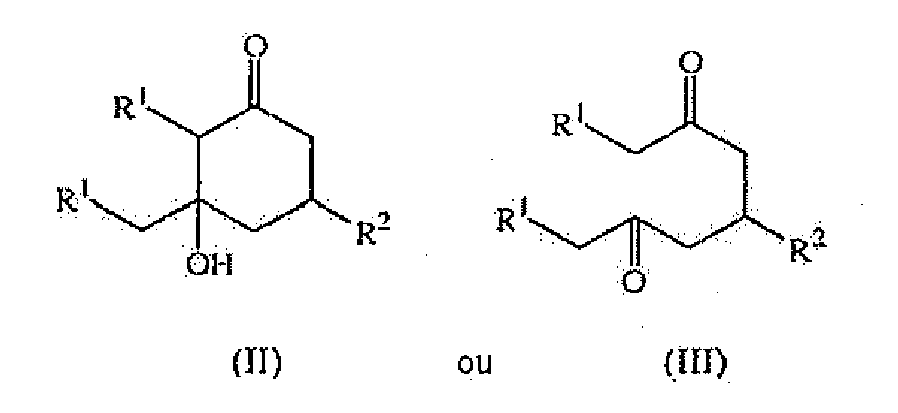
avec un système réactionnel comprenant- au moins un sel d'un acide aminé primaire optiquement actif, ou- au moins un acide aminé primaire optiquement actif, ouun mélange de ceux-ci. - Procédé selon la revendication 1, caractérisé en ce que ledit composé (I) est la (S)-14-méthyl-bicyclo[9.4.0]pentadéc-1(11)-én-12-one ou la (R)-14-méthyl-bicyclo[9.4.0] pentadéc-1(11)-én-12-one ou un mélange optiquement actif desdits stéréoisomères et la cétone de départ est la 3-méthyl-1,5-cyclopentadécanedione, ou ledit composé (I) est la 15-méthylbicyclo[10.4.0]hexadéc-1(12)-én-13-one et la cétone de départ est la 3-méthyl-1,5-cyclohexadécanedione, ou ledit composé (I) est la (R)-13-méthyl-bicyclo[8.4.0]tétradéc-1(10)-én-11-one ou la (S)-13-méthylbicyclo[8.4.0]tétradéc-1(10)-én-11-one ou un mélange optiquement actif desdits stéréoisomères et la cétone de départ est la 3-méthyl-1,5-cyclotétradécanedione, ou ledit composé (I) est la (R)-15-méthylbicyclo[10.4.0]hexadéc-1(12)-én-13-one ou la (S)-15-méthylbicyclo[10.4.0]hexadéc-1(12)-én-13-one ou un mélange optiquement actif desdits stéréoisomères et la cétone de départ est la 3-méthyl-1,5-cyclohexadécanedione.
- Procédé selon la revendication 1, caractérisé en ce que ledit sel d'un acide aminé primaire optiquement actif est un composé de formule

M représente- un cation alcalin ou un ammonium quaternaire en C4-C15, et n vaut 1;- un cation alcalino-terreux, et n vaut 2; ou- un lanthanide ou un cation du groupe (III), et n vaut 3. - Procédé selon la revendication 3, caractérisé en ce que ledit M est un cation alcalin, Ba2+, un ammonium quaternaire en C6-C10 ou La3+.
- Procédé selon la revendication 1, caractérisé en ce que ledit sel d'un acide aminé primaire optiquement actif est un composé de formule

X représente- un nitrate, hydrogénosulfate, hydrogénocarbonate, halogénure, sulfonate en C0-C18, borate en C0-C24, phosphinate ou phosphate ou phosphonate en C2-C18, ou monocarboxylate en C1-C12, et m vaut 1; ou- un sulfate, un carbonate, ou un dicarboxylate en C2-C12, et m vaut 2,- ou un anion de formule HvPO3 (3-v)-, v valant 0, 1 ou 2, et m valant 1, 2 ou 3. - Procédé selon la revendication 1, caractérisé en ce que le système réactionnel comprend:- au moins un sel d'un acide aminé primaire optiquement actif; et- éventuellement, au moins un acide aminé primaire optiquement actif.
- Procédé selon la revendication 6, caractérisé en ce que l'acide aminé primaire optiquement actif est ajouté au milieu réactionnel à une concentration totale comprise entre 0,1 et 10 équivalents molaires, par rapport à la concentration totale du sel d'acide aminé primaire optiquement actif.
- Procédé selon les revendications 3-5, caractérisé en ce que le sel d'acide aminé primaire optiquement actif est formé in situ par réaction d'au moins un acide aminé primaire optiquement actif avec un sel approprié du cation M ou de l'anion X.
- Procédé selon la revendication 1, caractérisé en ce que le procédé est effectué en présence d'un moyen d'élimination d'eau.
Applications Claiming Priority (2)
| Application Number | Priority Date | Filing Date | Title |
|---|---|---|---|
| IB2008050389 | 2008-02-01 | ||
| PCT/IB2009/050070 WO2009095804A1 (fr) | 2008-02-01 | 2009-01-08 | Cyclohexénones substituées |
Publications (2)
| Publication Number | Publication Date |
|---|---|
| EP2247564A1 EP2247564A1 (fr) | 2010-11-10 |
| EP2247564B1 true EP2247564B1 (fr) | 2011-06-29 |
Family
ID=39228475
Family Applications (1)
| Application Number | Title | Priority Date | Filing Date |
|---|---|---|---|
| EP09705574A Active EP2247564B1 (fr) | 2008-02-01 | 2009-01-08 | Cyclohexénones substituées |
Country Status (8)
| Country | Link |
|---|---|
| US (1) | US8173846B2 (fr) |
| EP (1) | EP2247564B1 (fr) |
| JP (1) | JP5479368B2 (fr) |
| CN (1) | CN101932545B (fr) |
| AT (1) | ATE514671T1 (fr) |
| ES (1) | ES2367229T3 (fr) |
| IL (1) | IL207171A (fr) |
| WO (1) | WO2009095804A1 (fr) |
Families Citing this family (3)
| Publication number | Priority date | Publication date | Assignee | Title |
|---|---|---|---|---|
| US9115163B2 (en) | 2007-10-19 | 2015-08-25 | The Trustees Of Columbia University In The City Of New York | DNA sequence with non-fluorescent nucleotide reversible terminators and cleavable label modified nucleotide terminators |
| US9732035B2 (en) * | 2015-07-24 | 2017-08-15 | Newlink Genetics Corporation | Salts and prodrugs of 1-methyl-D-tryptophan |
| US10800724B2 (en) * | 2016-07-15 | 2020-10-13 | Basf Se | Preparation of 14-methyl-16-oxabicyclo[10.3.1]pentadecenes from 3-methyl-1,5-cyclopentadecanedione |
Family Cites Families (3)
| Publication number | Priority date | Publication date | Assignee | Title |
|---|---|---|---|---|
| JP4324670B2 (ja) * | 2004-01-26 | 2009-09-02 | 独立行政法人産業技術総合研究所 | 環化化合物の製造方法 |
| ATE411270T1 (de) | 2004-02-16 | 2008-10-15 | Firmenich & Cie | Verfahren zur herstellung von optisch aktiven cyclohexenonen |
| ES2334391T3 (es) * | 2005-07-19 | 2010-03-09 | Firmenich Sa | Ciclohexanonas sustituidas. |
-
2009
- 2009-01-08 AT AT09705574T patent/ATE514671T1/de not_active IP Right Cessation
- 2009-01-08 CN CN200980103653XA patent/CN101932545B/zh active Active
- 2009-01-08 JP JP2010544819A patent/JP5479368B2/ja active Active
- 2009-01-08 EP EP09705574A patent/EP2247564B1/fr active Active
- 2009-01-08 ES ES09705574T patent/ES2367229T3/es active Active
- 2009-01-08 US US12/810,735 patent/US8173846B2/en active Active
- 2009-01-08 WO PCT/IB2009/050070 patent/WO2009095804A1/fr not_active Ceased
-
2010
- 2010-07-22 IL IL207171A patent/IL207171A/en active IP Right Grant
Also Published As
| Publication number | Publication date |
|---|---|
| EP2247564A1 (fr) | 2010-11-10 |
| WO2009095804A1 (fr) | 2009-08-06 |
| JP2011510973A (ja) | 2011-04-07 |
| US20100274059A1 (en) | 2010-10-28 |
| US8173846B2 (en) | 2012-05-08 |
| CN101932545B (zh) | 2013-08-28 |
| IL207171A0 (en) | 2010-12-30 |
| IL207171A (en) | 2014-04-30 |
| CN101932545A (zh) | 2010-12-29 |
| ATE514671T1 (de) | 2011-07-15 |
| ES2367229T3 (es) | 2011-10-31 |
| JP5479368B2 (ja) | 2014-04-23 |
Similar Documents
| Publication | Publication Date | Title |
|---|---|---|
| HU198437B (en) | Process for producing mono- or bis-carbonyl-compounds | |
| KR20180018749A (ko) | 치환 페닐 케톤의 제조 방법 | |
| EP2931709B1 (fr) | Procede de preparation de sels d'imidazolium dissymetriques | |
| EP3235801A1 (fr) | Procédé de production d'ester d'acide carboxylique | |
| EP1144346B1 (fr) | Procede de preparation de radicaux nitroxyde beta-phosphores | |
| US8173846B2 (en) | Substituted cyclohexenones | |
| US4723042A (en) | Alpha,beta-substituted acroleins and their preparation | |
| JP2776801B2 (ja) | N−モノ置換ヒドロキシルアミンの製造方法 | |
| KR102224090B1 (ko) | 특정 옥심과 옥심 에테르를 제조하는 개선된 방법 | |
| JP2007523077A (ja) | 中性から塩基性の水性またはアルコール性溶媒中でルイス酸またはプロトン酸を使用せずに求電子基質とπ求核剤との間にCC結合を形成する方法 | |
| Dannley et al. | Arylsulfonoxylation of aromatic compounds. VI. Decomposition of m-trifluoromethylbenzenesulfonyl peroxide in the absence of solvent and in the presence of ethylbenzene and cumene | |
| US7345206B2 (en) | Process for the dimerisation of alkyl glyoxals | |
| US7645908B2 (en) | Method for hydrogenation of α, β-unsaturated carbonyl compounds | |
| US4996377A (en) | Preparation of aliphatically substituted fluorobenzenes | |
| JP4651959B2 (ja) | シクロアルカノン類含有組成物 | |
| JPH08176053A (ja) | 3−置換−3−メチルブタナールの製造方法 | |
| JP4045795B2 (ja) | 2,6−ジクロロフェノール化合物の製造法 | |
| TWI414507B (zh) | 用以製備胺類之方法 | |
| EP3730475B1 (fr) | Procédé de préparation de l-menthone | |
| EP3492449B1 (fr) | Procédé pour la préparation de dihalobenzophénones, nouveaux produits chimiques utiles pour leur mise en oeuvre et procédés de préparation desdits produits chimiques | |
| Timoshenko et al. | Reactions of alkyl 1H, 1H-perfluoroalkyl Sulfones with Ammonia, Amines, and Hydrazines | |
| TWI610912B (zh) | 2-氯甲基苯甲醛之製造方法、含2-氯甲基苯甲醛之組成物及其保管方法 | |
| JP2005035939A (ja) | 酢酸エステル誘導体の製造法 | |
| WO2020189670A1 (fr) | PROCÉDÉ DE PRODUCTION DE CYCLOALCANONE α-ALLYLÉE | |
| JP4104863B2 (ja) | テトラヒドロピラニルオキシアミンの製造方法 |
Legal Events
| Date | Code | Title | Description |
|---|---|---|---|
| PUAI | Public reference made under article 153(3) epc to a published international application that has entered the european phase |
Free format text: ORIGINAL CODE: 0009012 |
|
| 17P | Request for examination filed |
Effective date: 20100901 |
|
| AK | Designated contracting states |
Kind code of ref document: A1 Designated state(s): AT BE BG CH CY CZ DE DK EE ES FI FR GB GR HR HU IE IS IT LI LT LU LV MC MK MT NL NO PL PT RO SE SI SK TR |
|
| AX | Request for extension of the european patent |
Extension state: AL BA RS |
|
| GRAP | Despatch of communication of intention to grant a patent |
Free format text: ORIGINAL CODE: EPIDOSNIGR1 |
|
| DAX | Request for extension of the european patent (deleted) | ||
| GRAS | Grant fee paid |
Free format text: ORIGINAL CODE: EPIDOSNIGR3 |
|
| GRAA | (expected) grant |
Free format text: ORIGINAL CODE: 0009210 |
|
| AK | Designated contracting states |
Kind code of ref document: B1 Designated state(s): AT BE BG CH CY CZ DE DK EE ES FI FR GB GR HR HU IE IS IT LI LT LU LV MC MK MT NL NO PL PT RO SE SI SK TR |
|
| REG | Reference to a national code |
Ref country code: GB Ref legal event code: FG4D |
|
| REG | Reference to a national code |
Ref country code: CH Ref legal event code: EP |
|
| REG | Reference to a national code |
Ref country code: IE Ref legal event code: FG4D |
|
| REG | Reference to a national code |
Ref country code: DE Ref legal event code: R096 Ref document number: 602009001688 Country of ref document: DE Effective date: 20110908 |
|
| REG | Reference to a national code |
Ref country code: NL Ref legal event code: VDEP Effective date: 20110629 |
|
| PG25 | Lapsed in a contracting state [announced via postgrant information from national office to epo] |
Ref country code: LT Free format text: LAPSE BECAUSE OF FAILURE TO SUBMIT A TRANSLATION OF THE DESCRIPTION OR TO PAY THE FEE WITHIN THE PRESCRIBED TIME-LIMIT Effective date: 20110629 Ref country code: SE Free format text: LAPSE BECAUSE OF FAILURE TO SUBMIT A TRANSLATION OF THE DESCRIPTION OR TO PAY THE FEE WITHIN THE PRESCRIBED TIME-LIMIT Effective date: 20110629 Ref country code: NO Free format text: LAPSE BECAUSE OF FAILURE TO SUBMIT A TRANSLATION OF THE DESCRIPTION OR TO PAY THE FEE WITHIN THE PRESCRIBED TIME-LIMIT Effective date: 20110929 Ref country code: HR Free format text: LAPSE BECAUSE OF FAILURE TO SUBMIT A TRANSLATION OF THE DESCRIPTION OR TO PAY THE FEE WITHIN THE PRESCRIBED TIME-LIMIT Effective date: 20110629 |
|
| REG | Reference to a national code |
Ref country code: ES Ref legal event code: FG2A Ref document number: 2367229 Country of ref document: ES Kind code of ref document: T3 Effective date: 20111031 |
|
| PG25 | Lapsed in a contracting state [announced via postgrant information from national office to epo] |
Ref country code: GR Free format text: LAPSE BECAUSE OF FAILURE TO SUBMIT A TRANSLATION OF THE DESCRIPTION OR TO PAY THE FEE WITHIN THE PRESCRIBED TIME-LIMIT Effective date: 20110930 Ref country code: FI Free format text: LAPSE BECAUSE OF FAILURE TO SUBMIT A TRANSLATION OF THE DESCRIPTION OR TO PAY THE FEE WITHIN THE PRESCRIBED TIME-LIMIT Effective date: 20110629 Ref country code: AT Free format text: LAPSE BECAUSE OF FAILURE TO SUBMIT A TRANSLATION OF THE DESCRIPTION OR TO PAY THE FEE WITHIN THE PRESCRIBED TIME-LIMIT Effective date: 20110629 Ref country code: SI Free format text: LAPSE BECAUSE OF FAILURE TO SUBMIT A TRANSLATION OF THE DESCRIPTION OR TO PAY THE FEE WITHIN THE PRESCRIBED TIME-LIMIT Effective date: 20110629 Ref country code: LV Free format text: LAPSE BECAUSE OF FAILURE TO SUBMIT A TRANSLATION OF THE DESCRIPTION OR TO PAY THE FEE WITHIN THE PRESCRIBED TIME-LIMIT Effective date: 20110629 |
|
| PG25 | Lapsed in a contracting state [announced via postgrant information from national office to epo] |
Ref country code: BE Free format text: LAPSE BECAUSE OF FAILURE TO SUBMIT A TRANSLATION OF THE DESCRIPTION OR TO PAY THE FEE WITHIN THE PRESCRIBED TIME-LIMIT Effective date: 20110629 |
|
| PG25 | Lapsed in a contracting state [announced via postgrant information from national office to epo] |
Ref country code: NL Free format text: LAPSE BECAUSE OF FAILURE TO SUBMIT A TRANSLATION OF THE DESCRIPTION OR TO PAY THE FEE WITHIN THE PRESCRIBED TIME-LIMIT Effective date: 20110629 Ref country code: EE Free format text: LAPSE BECAUSE OF FAILURE TO SUBMIT A TRANSLATION OF THE DESCRIPTION OR TO PAY THE FEE WITHIN THE PRESCRIBED TIME-LIMIT Effective date: 20110629 Ref country code: PT Free format text: LAPSE BECAUSE OF FAILURE TO SUBMIT A TRANSLATION OF THE DESCRIPTION OR TO PAY THE FEE WITHIN THE PRESCRIBED TIME-LIMIT Effective date: 20111031 Ref country code: CZ Free format text: LAPSE BECAUSE OF FAILURE TO SUBMIT A TRANSLATION OF THE DESCRIPTION OR TO PAY THE FEE WITHIN THE PRESCRIBED TIME-LIMIT Effective date: 20110629 Ref country code: IS Free format text: LAPSE BECAUSE OF FAILURE TO SUBMIT A TRANSLATION OF THE DESCRIPTION OR TO PAY THE FEE WITHIN THE PRESCRIBED TIME-LIMIT Effective date: 20111029 |
|
| PG25 | Lapsed in a contracting state [announced via postgrant information from national office to epo] |
Ref country code: CY Free format text: LAPSE BECAUSE OF FAILURE TO SUBMIT A TRANSLATION OF THE DESCRIPTION OR TO PAY THE FEE WITHIN THE PRESCRIBED TIME-LIMIT Effective date: 20110629 Ref country code: PL Free format text: LAPSE BECAUSE OF FAILURE TO SUBMIT A TRANSLATION OF THE DESCRIPTION OR TO PAY THE FEE WITHIN THE PRESCRIBED TIME-LIMIT Effective date: 20110629 Ref country code: SK Free format text: LAPSE BECAUSE OF FAILURE TO SUBMIT A TRANSLATION OF THE DESCRIPTION OR TO PAY THE FEE WITHIN THE PRESCRIBED TIME-LIMIT Effective date: 20110629 |
|
| PLBE | No opposition filed within time limit |
Free format text: ORIGINAL CODE: 0009261 |
|
| STAA | Information on the status of an ep patent application or granted ep patent |
Free format text: STATUS: NO OPPOSITION FILED WITHIN TIME LIMIT |
|
| PG25 | Lapsed in a contracting state [announced via postgrant information from national office to epo] |
Ref country code: IT Free format text: LAPSE BECAUSE OF FAILURE TO SUBMIT A TRANSLATION OF THE DESCRIPTION OR TO PAY THE FEE WITHIN THE PRESCRIBED TIME-LIMIT Effective date: 20110629 |
|
| 26N | No opposition filed |
Effective date: 20120330 |
|
| PG25 | Lapsed in a contracting state [announced via postgrant information from national office to epo] |
Ref country code: DK Free format text: LAPSE BECAUSE OF FAILURE TO SUBMIT A TRANSLATION OF THE DESCRIPTION OR TO PAY THE FEE WITHIN THE PRESCRIBED TIME-LIMIT Effective date: 20110629 |
|
| REG | Reference to a national code |
Ref country code: DE Ref legal event code: R097 Ref document number: 602009001688 Country of ref document: DE Effective date: 20120330 |
|
| PG25 | Lapsed in a contracting state [announced via postgrant information from national office to epo] |
Ref country code: MC Free format text: LAPSE BECAUSE OF NON-PAYMENT OF DUE FEES Effective date: 20120131 |
|
| REG | Reference to a national code |
Ref country code: IE Ref legal event code: MM4A |
|
| PG25 | Lapsed in a contracting state [announced via postgrant information from national office to epo] |
Ref country code: IE Free format text: LAPSE BECAUSE OF NON-PAYMENT OF DUE FEES Effective date: 20120108 |
|
| PG25 | Lapsed in a contracting state [announced via postgrant information from national office to epo] |
Ref country code: MK Free format text: LAPSE BECAUSE OF FAILURE TO SUBMIT A TRANSLATION OF THE DESCRIPTION OR TO PAY THE FEE WITHIN THE PRESCRIBED TIME-LIMIT Effective date: 20110629 |
|
| PG25 | Lapsed in a contracting state [announced via postgrant information from national office to epo] |
Ref country code: BG Free format text: LAPSE BECAUSE OF FAILURE TO SUBMIT A TRANSLATION OF THE DESCRIPTION OR TO PAY THE FEE WITHIN THE PRESCRIBED TIME-LIMIT Effective date: 20110929 |
|
| PG25 | Lapsed in a contracting state [announced via postgrant information from national office to epo] |
Ref country code: MT Free format text: LAPSE BECAUSE OF FAILURE TO SUBMIT A TRANSLATION OF THE DESCRIPTION OR TO PAY THE FEE WITHIN THE PRESCRIBED TIME-LIMIT Effective date: 20110629 |
|
| PG25 | Lapsed in a contracting state [announced via postgrant information from national office to epo] |
Ref country code: TR Free format text: LAPSE BECAUSE OF FAILURE TO SUBMIT A TRANSLATION OF THE DESCRIPTION OR TO PAY THE FEE WITHIN THE PRESCRIBED TIME-LIMIT Effective date: 20110629 |
|
| PG25 | Lapsed in a contracting state [announced via postgrant information from national office to epo] |
Ref country code: LU Free format text: LAPSE BECAUSE OF NON-PAYMENT OF DUE FEES Effective date: 20120108 |
|
| PG25 | Lapsed in a contracting state [announced via postgrant information from national office to epo] |
Ref country code: HU Free format text: LAPSE BECAUSE OF FAILURE TO SUBMIT A TRANSLATION OF THE DESCRIPTION OR TO PAY THE FEE WITHIN THE PRESCRIBED TIME-LIMIT Effective date: 20090108 |
|
| REG | Reference to a national code |
Ref country code: FR Ref legal event code: PLFP Year of fee payment: 8 |
|
| REG | Reference to a national code |
Ref country code: FR Ref legal event code: PLFP Year of fee payment: 9 |
|
| REG | Reference to a national code |
Ref country code: FR Ref legal event code: PLFP Year of fee payment: 10 |
|
| PGFP | Annual fee paid to national office [announced via postgrant information from national office to epo] |
Ref country code: GB Payment date: 20200102 Year of fee payment: 12 |
|
| REG | Reference to a national code |
Ref country code: DE Ref legal event code: R082 Ref document number: 602009001688 Country of ref document: DE Representative=s name: MARKS & CLERK (LUXEMBOURG) LLP, LU Ref country code: DE Ref legal event code: R081 Ref document number: 602009001688 Country of ref document: DE Owner name: FIRMENICH SA, CH Free format text: FORMER OWNER: FIRMENICH S.A., GENF/GENEVE, CH |
|
| REG | Reference to a national code |
Ref country code: CH Ref legal event code: PCOW Free format text: NEW ADDRESS: 7, RUE DE LA BERGERE, 1242 SATIGNY (CH) |
|
| GBPC | Gb: european patent ceased through non-payment of renewal fee |
Effective date: 20210108 |
|
| PG25 | Lapsed in a contracting state [announced via postgrant information from national office to epo] |
Ref country code: GB Free format text: LAPSE BECAUSE OF NON-PAYMENT OF DUE FEES Effective date: 20210108 |
|
| P01 | Opt-out of the competence of the unified patent court (upc) registered |
Effective date: 20230518 |
|
| REG | Reference to a national code |
Ref country code: CH Ref legal event code: U11 Free format text: ST27 STATUS EVENT CODE: U-0-0-U10-U11 (AS PROVIDED BY THE NATIONAL OFFICE) Effective date: 20260201 |
|
| PGFP | Annual fee paid to national office [announced via postgrant information from national office to epo] |
Ref country code: ES Payment date: 20260210 Year of fee payment: 18 |
|
| PGFP | Annual fee paid to national office [announced via postgrant information from national office to epo] |
Ref country code: DE Payment date: 20260127 Year of fee payment: 18 |
|
| PGFP | Annual fee paid to national office [announced via postgrant information from national office to epo] |
Ref country code: FR Payment date: 20260127 Year of fee payment: 18 |
|
| PGFP | Annual fee paid to national office [announced via postgrant information from national office to epo] |
Ref country code: CH Payment date: 20260201 Year of fee payment: 18 |