EP2247579B1 - Sulfoximinsubstituierte chinazolinderivate als immunmodulatoren, ihre herstellung und ihre verwendung als medikamente - Google Patents
Sulfoximinsubstituierte chinazolinderivate als immunmodulatoren, ihre herstellung und ihre verwendung als medikamente Download PDFInfo
- Publication number
- EP2247579B1 EP2247579B1 EP08773585A EP08773585A EP2247579B1 EP 2247579 B1 EP2247579 B1 EP 2247579B1 EP 08773585 A EP08773585 A EP 08773585A EP 08773585 A EP08773585 A EP 08773585A EP 2247579 B1 EP2247579 B1 EP 2247579B1
- Authority
- EP
- European Patent Office
- Prior art keywords
- alkyl
- cyano
- ring
- mmol
- hydroxyl
- Prior art date
- Legal status (The legal status is an assumption and is not a legal conclusion. Google has not performed a legal analysis and makes no representation as to the accuracy of the status listed.)
- Not-in-force
Links
- 0 **c1c(cc(*)c(*)c2)c2ncn1 Chemical compound **c1c(cc(*)c(*)c2)c2ncn1 0.000 description 9
- OGDCGPGCWIFCKX-UHFFFAOYSA-N CC(C)Nc1c(cc(c(O)c2)C#N)c2ncn1 Chemical compound CC(C)Nc1c(cc(c(O)c2)C#N)c2ncn1 OGDCGPGCWIFCKX-UHFFFAOYSA-N 0.000 description 1
- JFIARVILXDRVTN-UHFFFAOYSA-N CC(C)Nc1c(cc(c(OCc(cc2)ccc2S(C)(=N)=O)c2)Br)c2ncn1 Chemical compound CC(C)Nc1c(cc(c(OCc(cc2)ccc2S(C)(=N)=O)c2)Br)c2ncn1 JFIARVILXDRVTN-UHFFFAOYSA-N 0.000 description 1
- KUWKZXLKKXCAEQ-UHFFFAOYSA-N COc1cc2c(Nc3nnc[s]3)ncnc2cc1OCc(cc1)ccc1S(C)(=N)=O Chemical compound COc1cc2c(Nc3nnc[s]3)ncnc2cc1OCc(cc1)ccc1S(C)(=N)=O KUWKZXLKKXCAEQ-UHFFFAOYSA-N 0.000 description 1
- XJLLIKHGZHTIHR-UHFFFAOYSA-N CS(c1cccc(CNc2cc3ncnc(Nc4nnc[s]4)c3cc2)c1)(=N)=O Chemical compound CS(c1cccc(CNc2cc3ncnc(Nc4nnc[s]4)c3cc2)c1)(=N)=O XJLLIKHGZHTIHR-UHFFFAOYSA-N 0.000 description 1
- NAGFUKIDMWZTSI-UHFFFAOYSA-N CS(c1cccc(COc2cc3ncnc(NC4CC4)c3cc2Br)c1)NC=O Chemical compound CS(c1cccc(COc2cc3ncnc(NC4CC4)c3cc2Br)c1)NC=O NAGFUKIDMWZTSI-UHFFFAOYSA-N 0.000 description 1
Classifications
-
- C—CHEMISTRY; METALLURGY
- C07—ORGANIC CHEMISTRY
- C07D—HETEROCYCLIC COMPOUNDS
- C07D239/00—Heterocyclic compounds containing 1,3-diazine or hydrogenated 1,3-diazine rings
- C07D239/70—Heterocyclic compounds containing 1,3-diazine or hydrogenated 1,3-diazine rings condensed with carbocyclic rings or ring systems
- C07D239/72—Quinazolines; Hydrogenated quinazolines
- C07D239/86—Quinazolines; Hydrogenated quinazolines with hetero atoms directly attached in position 4
- C07D239/94—Nitrogen atoms
-
- A—HUMAN NECESSITIES
- A61—MEDICAL OR VETERINARY SCIENCE; HYGIENE
- A61P—SPECIFIC THERAPEUTIC ACTIVITY OF CHEMICAL COMPOUNDS OR MEDICINAL PREPARATIONS
- A61P1/00—Drugs for disorders of the alimentary tract or the digestive system
- A61P1/04—Drugs for disorders of the alimentary tract or the digestive system for ulcers, gastritis or reflux esophagitis, e.g. antacids, inhibitors of acid secretion, mucosal protectants
-
- A—HUMAN NECESSITIES
- A61—MEDICAL OR VETERINARY SCIENCE; HYGIENE
- A61P—SPECIFIC THERAPEUTIC ACTIVITY OF CHEMICAL COMPOUNDS OR MEDICINAL PREPARATIONS
- A61P1/00—Drugs for disorders of the alimentary tract or the digestive system
- A61P1/16—Drugs for disorders of the alimentary tract or the digestive system for liver or gallbladder disorders, e.g. hepatoprotective agents, cholagogues, litholytics
-
- A—HUMAN NECESSITIES
- A61—MEDICAL OR VETERINARY SCIENCE; HYGIENE
- A61P—SPECIFIC THERAPEUTIC ACTIVITY OF CHEMICAL COMPOUNDS OR MEDICINAL PREPARATIONS
- A61P11/00—Drugs for disorders of the respiratory system
-
- A—HUMAN NECESSITIES
- A61—MEDICAL OR VETERINARY SCIENCE; HYGIENE
- A61P—SPECIFIC THERAPEUTIC ACTIVITY OF CHEMICAL COMPOUNDS OR MEDICINAL PREPARATIONS
- A61P11/00—Drugs for disorders of the respiratory system
- A61P11/02—Nasal agents, e.g. decongestants
-
- A—HUMAN NECESSITIES
- A61—MEDICAL OR VETERINARY SCIENCE; HYGIENE
- A61P—SPECIFIC THERAPEUTIC ACTIVITY OF CHEMICAL COMPOUNDS OR MEDICINAL PREPARATIONS
- A61P11/00—Drugs for disorders of the respiratory system
- A61P11/06—Antiasthmatics
-
- A—HUMAN NECESSITIES
- A61—MEDICAL OR VETERINARY SCIENCE; HYGIENE
- A61P—SPECIFIC THERAPEUTIC ACTIVITY OF CHEMICAL COMPOUNDS OR MEDICINAL PREPARATIONS
- A61P11/00—Drugs for disorders of the respiratory system
- A61P11/08—Bronchodilators
-
- A—HUMAN NECESSITIES
- A61—MEDICAL OR VETERINARY SCIENCE; HYGIENE
- A61P—SPECIFIC THERAPEUTIC ACTIVITY OF CHEMICAL COMPOUNDS OR MEDICINAL PREPARATIONS
- A61P11/00—Drugs for disorders of the respiratory system
- A61P11/16—Central respiratory analeptics
-
- A—HUMAN NECESSITIES
- A61—MEDICAL OR VETERINARY SCIENCE; HYGIENE
- A61P—SPECIFIC THERAPEUTIC ACTIVITY OF CHEMICAL COMPOUNDS OR MEDICINAL PREPARATIONS
- A61P13/00—Drugs for disorders of the urinary system
- A61P13/12—Drugs for disorders of the urinary system of the kidneys
-
- A—HUMAN NECESSITIES
- A61—MEDICAL OR VETERINARY SCIENCE; HYGIENE
- A61P—SPECIFIC THERAPEUTIC ACTIVITY OF CHEMICAL COMPOUNDS OR MEDICINAL PREPARATIONS
- A61P15/00—Drugs for genital or sexual disorders; Contraceptives
-
- A—HUMAN NECESSITIES
- A61—MEDICAL OR VETERINARY SCIENCE; HYGIENE
- A61P—SPECIFIC THERAPEUTIC ACTIVITY OF CHEMICAL COMPOUNDS OR MEDICINAL PREPARATIONS
- A61P17/00—Drugs for dermatological disorders
-
- A—HUMAN NECESSITIES
- A61—MEDICAL OR VETERINARY SCIENCE; HYGIENE
- A61P—SPECIFIC THERAPEUTIC ACTIVITY OF CHEMICAL COMPOUNDS OR MEDICINAL PREPARATIONS
- A61P17/00—Drugs for dermatological disorders
- A61P17/02—Drugs for dermatological disorders for treating wounds, ulcers, burns, scars, keloids, or the like
-
- A—HUMAN NECESSITIES
- A61—MEDICAL OR VETERINARY SCIENCE; HYGIENE
- A61P—SPECIFIC THERAPEUTIC ACTIVITY OF CHEMICAL COMPOUNDS OR MEDICINAL PREPARATIONS
- A61P17/00—Drugs for dermatological disorders
- A61P17/04—Antipruritics
-
- A—HUMAN NECESSITIES
- A61—MEDICAL OR VETERINARY SCIENCE; HYGIENE
- A61P—SPECIFIC THERAPEUTIC ACTIVITY OF CHEMICAL COMPOUNDS OR MEDICINAL PREPARATIONS
- A61P17/00—Drugs for dermatological disorders
- A61P17/06—Antipsoriatics
-
- A—HUMAN NECESSITIES
- A61—MEDICAL OR VETERINARY SCIENCE; HYGIENE
- A61P—SPECIFIC THERAPEUTIC ACTIVITY OF CHEMICAL COMPOUNDS OR MEDICINAL PREPARATIONS
- A61P17/00—Drugs for dermatological disorders
- A61P17/14—Drugs for dermatological disorders for baldness or alopecia
-
- A—HUMAN NECESSITIES
- A61—MEDICAL OR VETERINARY SCIENCE; HYGIENE
- A61P—SPECIFIC THERAPEUTIC ACTIVITY OF CHEMICAL COMPOUNDS OR MEDICINAL PREPARATIONS
- A61P19/00—Drugs for skeletal disorders
- A61P19/02—Drugs for skeletal disorders for joint disorders, e.g. arthritis, arthrosis
-
- A—HUMAN NECESSITIES
- A61—MEDICAL OR VETERINARY SCIENCE; HYGIENE
- A61P—SPECIFIC THERAPEUTIC ACTIVITY OF CHEMICAL COMPOUNDS OR MEDICINAL PREPARATIONS
- A61P19/00—Drugs for skeletal disorders
- A61P19/04—Drugs for skeletal disorders for non-specific disorders of the connective tissue
-
- A—HUMAN NECESSITIES
- A61—MEDICAL OR VETERINARY SCIENCE; HYGIENE
- A61P—SPECIFIC THERAPEUTIC ACTIVITY OF CHEMICAL COMPOUNDS OR MEDICINAL PREPARATIONS
- A61P21/00—Drugs for disorders of the muscular or neuromuscular system
-
- A—HUMAN NECESSITIES
- A61—MEDICAL OR VETERINARY SCIENCE; HYGIENE
- A61P—SPECIFIC THERAPEUTIC ACTIVITY OF CHEMICAL COMPOUNDS OR MEDICINAL PREPARATIONS
- A61P25/00—Drugs for disorders of the nervous system
-
- A—HUMAN NECESSITIES
- A61—MEDICAL OR VETERINARY SCIENCE; HYGIENE
- A61P—SPECIFIC THERAPEUTIC ACTIVITY OF CHEMICAL COMPOUNDS OR MEDICINAL PREPARATIONS
- A61P25/00—Drugs for disorders of the nervous system
- A61P25/28—Drugs for disorders of the nervous system for treating neurodegenerative disorders of the central nervous system, e.g. nootropic agents, cognition enhancers, drugs for treating Alzheimer's disease or other forms of dementia
-
- A—HUMAN NECESSITIES
- A61—MEDICAL OR VETERINARY SCIENCE; HYGIENE
- A61P—SPECIFIC THERAPEUTIC ACTIVITY OF CHEMICAL COMPOUNDS OR MEDICINAL PREPARATIONS
- A61P27/00—Drugs for disorders of the senses
- A61P27/02—Ophthalmic agents
-
- A—HUMAN NECESSITIES
- A61—MEDICAL OR VETERINARY SCIENCE; HYGIENE
- A61P—SPECIFIC THERAPEUTIC ACTIVITY OF CHEMICAL COMPOUNDS OR MEDICINAL PREPARATIONS
- A61P27/00—Drugs for disorders of the senses
- A61P27/02—Ophthalmic agents
- A61P27/14—Decongestants or antiallergics
-
- A—HUMAN NECESSITIES
- A61—MEDICAL OR VETERINARY SCIENCE; HYGIENE
- A61P—SPECIFIC THERAPEUTIC ACTIVITY OF CHEMICAL COMPOUNDS OR MEDICINAL PREPARATIONS
- A61P27/00—Drugs for disorders of the senses
- A61P27/16—Otologicals
-
- A—HUMAN NECESSITIES
- A61—MEDICAL OR VETERINARY SCIENCE; HYGIENE
- A61P—SPECIFIC THERAPEUTIC ACTIVITY OF CHEMICAL COMPOUNDS OR MEDICINAL PREPARATIONS
- A61P29/00—Non-central analgesic, antipyretic or antiinflammatory agents, e.g. antirheumatic agents; Non-steroidal antiinflammatory drugs [NSAID]
-
- A—HUMAN NECESSITIES
- A61—MEDICAL OR VETERINARY SCIENCE; HYGIENE
- A61P—SPECIFIC THERAPEUTIC ACTIVITY OF CHEMICAL COMPOUNDS OR MEDICINAL PREPARATIONS
- A61P3/00—Drugs for disorders of the metabolism
- A61P3/08—Drugs for disorders of the metabolism for glucose homeostasis
- A61P3/10—Drugs for disorders of the metabolism for glucose homeostasis for hyperglycaemia, e.g. antidiabetics
-
- A—HUMAN NECESSITIES
- A61—MEDICAL OR VETERINARY SCIENCE; HYGIENE
- A61P—SPECIFIC THERAPEUTIC ACTIVITY OF CHEMICAL COMPOUNDS OR MEDICINAL PREPARATIONS
- A61P35/00—Antineoplastic agents
-
- A—HUMAN NECESSITIES
- A61—MEDICAL OR VETERINARY SCIENCE; HYGIENE
- A61P—SPECIFIC THERAPEUTIC ACTIVITY OF CHEMICAL COMPOUNDS OR MEDICINAL PREPARATIONS
- A61P35/00—Antineoplastic agents
- A61P35/02—Antineoplastic agents specific for leukemia
-
- A—HUMAN NECESSITIES
- A61—MEDICAL OR VETERINARY SCIENCE; HYGIENE
- A61P—SPECIFIC THERAPEUTIC ACTIVITY OF CHEMICAL COMPOUNDS OR MEDICINAL PREPARATIONS
- A61P37/00—Drugs for immunological or allergic disorders
-
- A—HUMAN NECESSITIES
- A61—MEDICAL OR VETERINARY SCIENCE; HYGIENE
- A61P—SPECIFIC THERAPEUTIC ACTIVITY OF CHEMICAL COMPOUNDS OR MEDICINAL PREPARATIONS
- A61P37/00—Drugs for immunological or allergic disorders
- A61P37/02—Immunomodulators
- A61P37/06—Immunosuppressants, e.g. drugs for graft rejection
-
- A—HUMAN NECESSITIES
- A61—MEDICAL OR VETERINARY SCIENCE; HYGIENE
- A61P—SPECIFIC THERAPEUTIC ACTIVITY OF CHEMICAL COMPOUNDS OR MEDICINAL PREPARATIONS
- A61P37/00—Drugs for immunological or allergic disorders
- A61P37/08—Antiallergic agents
-
- A—HUMAN NECESSITIES
- A61—MEDICAL OR VETERINARY SCIENCE; HYGIENE
- A61P—SPECIFIC THERAPEUTIC ACTIVITY OF CHEMICAL COMPOUNDS OR MEDICINAL PREPARATIONS
- A61P43/00—Drugs for specific purposes, not provided for in groups A61P1/00-A61P41/00
-
- A—HUMAN NECESSITIES
- A61—MEDICAL OR VETERINARY SCIENCE; HYGIENE
- A61P—SPECIFIC THERAPEUTIC ACTIVITY OF CHEMICAL COMPOUNDS OR MEDICINAL PREPARATIONS
- A61P5/00—Drugs for disorders of the endocrine system
- A61P5/14—Drugs for disorders of the endocrine system of the thyroid hormones, e.g. T3, T4
-
- A—HUMAN NECESSITIES
- A61—MEDICAL OR VETERINARY SCIENCE; HYGIENE
- A61P—SPECIFIC THERAPEUTIC ACTIVITY OF CHEMICAL COMPOUNDS OR MEDICINAL PREPARATIONS
- A61P5/00—Drugs for disorders of the endocrine system
- A61P5/38—Drugs for disorders of the endocrine system of the suprarenal hormones
-
- A—HUMAN NECESSITIES
- A61—MEDICAL OR VETERINARY SCIENCE; HYGIENE
- A61P—SPECIFIC THERAPEUTIC ACTIVITY OF CHEMICAL COMPOUNDS OR MEDICINAL PREPARATIONS
- A61P7/00—Drugs for disorders of the blood or the extracellular fluid
- A61P7/02—Antithrombotic agents; Anticoagulants; Platelet aggregation inhibitors
-
- A—HUMAN NECESSITIES
- A61—MEDICAL OR VETERINARY SCIENCE; HYGIENE
- A61P—SPECIFIC THERAPEUTIC ACTIVITY OF CHEMICAL COMPOUNDS OR MEDICINAL PREPARATIONS
- A61P7/00—Drugs for disorders of the blood or the extracellular fluid
- A61P7/04—Antihaemorrhagics; Procoagulants; Haemostatic agents; Antifibrinolytic agents
-
- A—HUMAN NECESSITIES
- A61—MEDICAL OR VETERINARY SCIENCE; HYGIENE
- A61P—SPECIFIC THERAPEUTIC ACTIVITY OF CHEMICAL COMPOUNDS OR MEDICINAL PREPARATIONS
- A61P7/00—Drugs for disorders of the blood or the extracellular fluid
- A61P7/06—Antianaemics
-
- A—HUMAN NECESSITIES
- A61—MEDICAL OR VETERINARY SCIENCE; HYGIENE
- A61P—SPECIFIC THERAPEUTIC ACTIVITY OF CHEMICAL COMPOUNDS OR MEDICINAL PREPARATIONS
- A61P7/00—Drugs for disorders of the blood or the extracellular fluid
- A61P7/10—Antioedematous agents; Diuretics
-
- A—HUMAN NECESSITIES
- A61—MEDICAL OR VETERINARY SCIENCE; HYGIENE
- A61P—SPECIFIC THERAPEUTIC ACTIVITY OF CHEMICAL COMPOUNDS OR MEDICINAL PREPARATIONS
- A61P9/00—Drugs for disorders of the cardiovascular system
- A61P9/14—Vasoprotectives; Antihaemorrhoidals; Drugs for varicose therapy; Capillary stabilisers
-
- C—CHEMISTRY; METALLURGY
- C07—ORGANIC CHEMISTRY
- C07C—ACYCLIC OR CARBOCYCLIC COMPOUNDS
- C07C381/00—Compounds containing carbon and sulfur and having functional groups not covered by groups C07C301/00 - C07C337/00
- C07C381/10—Compounds containing sulfur atoms doubly-bound to nitrogen atoms
-
- C—CHEMISTRY; METALLURGY
- C07—ORGANIC CHEMISTRY
- C07D—HETEROCYCLIC COMPOUNDS
- C07D401/00—Heterocyclic compounds containing two or more hetero rings, having nitrogen atoms as the only ring hetero atoms, at least one ring being a six-membered ring with only one nitrogen atom
- C07D401/02—Heterocyclic compounds containing two or more hetero rings, having nitrogen atoms as the only ring hetero atoms, at least one ring being a six-membered ring with only one nitrogen atom containing two hetero rings
- C07D401/12—Heterocyclic compounds containing two or more hetero rings, having nitrogen atoms as the only ring hetero atoms, at least one ring being a six-membered ring with only one nitrogen atom containing two hetero rings linked by a chain containing hetero atoms as chain links
-
- C—CHEMISTRY; METALLURGY
- C07—ORGANIC CHEMISTRY
- C07D—HETEROCYCLIC COMPOUNDS
- C07D403/00—Heterocyclic compounds containing two or more hetero rings, having nitrogen atoms as the only ring hetero atoms, not provided for by group C07D401/00
- C07D403/02—Heterocyclic compounds containing two or more hetero rings, having nitrogen atoms as the only ring hetero atoms, not provided for by group C07D401/00 containing two hetero rings
- C07D403/12—Heterocyclic compounds containing two or more hetero rings, having nitrogen atoms as the only ring hetero atoms, not provided for by group C07D401/00 containing two hetero rings linked by a chain containing hetero atoms as chain links
-
- C—CHEMISTRY; METALLURGY
- C07—ORGANIC CHEMISTRY
- C07D—HETEROCYCLIC COMPOUNDS
- C07D413/00—Heterocyclic compounds containing two or more hetero rings, at least one ring having nitrogen and oxygen atoms as the only ring hetero atoms
- C07D413/02—Heterocyclic compounds containing two or more hetero rings, at least one ring having nitrogen and oxygen atoms as the only ring hetero atoms containing two hetero rings
- C07D413/12—Heterocyclic compounds containing two or more hetero rings, at least one ring having nitrogen and oxygen atoms as the only ring hetero atoms containing two hetero rings linked by a chain containing hetero atoms as chain links
-
- C—CHEMISTRY; METALLURGY
- C07—ORGANIC CHEMISTRY
- C07D—HETEROCYCLIC COMPOUNDS
- C07D417/00—Heterocyclic compounds containing two or more hetero rings, at least one ring having nitrogen and sulfur atoms as the only ring hetero atoms, not provided for by group C07D415/00
- C07D417/02—Heterocyclic compounds containing two or more hetero rings, at least one ring having nitrogen and sulfur atoms as the only ring hetero atoms, not provided for by group C07D415/00 containing two hetero rings
- C07D417/12—Heterocyclic compounds containing two or more hetero rings, at least one ring having nitrogen and sulfur atoms as the only ring hetero atoms, not provided for by group C07D415/00 containing two hetero rings linked by a chain containing hetero atoms as chain links
Definitions
- the present invention relates to sulphoximine-substituted quinazoline derivatives, processes for their preparation, and their use as a medicament for the treatment of various diseases.
- An over-reacting immune system is co-responsible for numerous chronic inflammatory diseases, such as, for example, rheumatoid arthritis, Crohn's disease, asthma and multiple sclerosis. Owing to an increased release of proinflammatory cytokines, damage to endogenous tissue structures results.
- the interplay of the innate and adaptive immune system is of central importance in this context (Akira et al., 2001). Modulation of the immune system by substances which interfere with the activation of cells of the innate and/or of the adaptive immune system has an anti-inflammatory action and can thus attenuate the pathological phenotype in the diseases mentioned by way of example above.
- Innate immunity is based on the fact that microorganisms such as bacteria and viruses have certain inherent features by means of which they are recognized by the immune system and subsequently activate.
- Certain pathogen-associated molecular patterns are recognized.
- PAMPs are recognized by the pattern recognition receptors (PRR), which also include toll-like receptors (TLR) (Janeway and Medzhitov, 2002).
- PRR pattern recognition receptors
- TLR toll-like receptors
- TLRs are homologues of the Drosophila receptor protein toll. Humans have ten different TLRs. TLR one and six are co-receptors for TLR2.
- TLR2 recognizes, inter alia, lipoproteins and lipopeptides.
- TLR3 recognizes doublestranded RNA.
- TLR4 recognizes, inter alia, LPS of gram-negative bacteria and lipoteichoic acid of gram-positive bacteria.
- TLR5 recognizes flagellin.
- TLR9 recognizes CpG motifs in bacterial DANN (O'Neill, 2006). Co-receptors can further modify the recognition capabilities of TLRs (Jiang et al., 2005).
- TLRs are related to IL-1 / IL-18 cytokine receptors in signal transmission.
- IL-1 endogenous pyrogen
- Members of the IL-1 R/TLR superfamily have a TIR domain (toll/IL1 receptor).
- the TIR domain is approximately 200 amino acids long and contains three conserved sequence motifs. Proteins bearing TIR domains bind by means of a protein-protein interaction (O'Neill et al., 2005).
- the subclass one (IL-1 R family) contains three Ig-like domains; the receptor is a heterodimer. These include the IL-1 receptors one and two, the co-receptor IL-1RAcP and the corresponding proteins of the IL-18 system.
- the subclass two (TLR family) contains leucine-rich motifs. Toll-like receptors form homo- or heterodimers.
- TLR or IL-1, -18 receptors After activation of the TLR or IL-1, -18 receptors by the appropriate ligands, a multistage signal cascade is set in motion.
- the TLR or IL-1/-18 receptor complex interacts with the adaptor protein MyD88 by means of TIR/TIR contacts.
- the IL-1 associated receptor kinase (IRAK-1) normally has Tollip (toll interacting protein) bound, which probably acts as an alleviating molecule (“silencer").
- IRAK/Tollip binds to the active TLR/IL-1R complex.
- MyD88 displaces Tollip whereby IRAK1 and IRAK-4 are activated, very highly probably as a dimer by transphosphorylation.
- TRAF a MAP kinase kinasekinase
- TAK1 a MAP kinase kinasekinase
- I ⁇ B NF- ⁇ B activation
- MKK6 MKK6
- NF- ⁇ B is retained in the cytoplasm in the inactive state, where it is bound to the inhibitor I ⁇ B (Deng et al., 2000). Phosphorylation of I ⁇ B causes the inhibitor I ⁇ B to be proteolytically degraded and the transcription factor can migrate into the core.
- NF- ⁇ B is a heterodimer of the subunits p65 (Rel) and p50 (Bäuerle and Henkel, 1994). There are a number of members of this family which can interact in different ways. NF- ⁇ B on its own cannot induce transcription. For gene activation, transcriptional co-activators are necessary, such as, for example, p300 or CBT (Akira and Takeda, 2004).
- the object of the present invention consists in preparing further structures for therapy, in particular for immunomodulation.
- Monovalent, straight-chain or branched, saturated hydrocarbon radical having n carbon atoms Monovalent, straight-chain or branched, saturated hydrocarbon radical having n carbon atoms.
- a C 1 -C 6 alkyl radical comprises, inter alia, for example:
- a methyl, ethyl, propyl or isopropyl radical is preferred.
- Monovalent, straight-chain or branched hydrocarbon radical having n carbon atoms and at least one double bond.
- a C 2 -C 6 alkenyl radical comprises, inter alia, for example:
- a vinyl or allyl radical is preferred.
- Monovalent, straight-chain or branched hydrocarbon radical having n carbon atoms and at least one triple bond.
- a C 2 -C 6 alkynyl radical comprises, inter alia, for example:
- An ethynyl-, prop-1-ynyl- or prop-2-ynyl- radical is preferred.
- C 3 -C 7 -Cycloalkyl ring comprises:
- a cyclopropyl, cyclobutyl, cyclopentyl or a cyclohexyl ring is preferred.
- Aryl is a monovalent, aromatic ring system without a heteroatom.
- C 6 -aryl is equal to phenyl.
- aryl comprises only phenyl and napthyl.
- Phenyl is preferred.
- Heteroatoms are to be understood as meaning oxygen, nitrogen or sulphur atoms.
- Heteroaryl is a monovalent, aromatic ring system having at least one heteroatom different from a carbon. Heteroatoms which can occur are nitrogen atoms, oxygen atoms and/or sulphur atoms.
- the bond valency can be on any desired aromatic carbon atom or on a nitrogen atom.
- heteroaryl comprises only monocyclic and bicyclic rings.
- a monocyclic heteroaryl ring according to the present invention has 5 or 6 ring atoms.
- Heteroaryl rings having 5 ring atoms comprise, for example, the rings:
- Heteroaryl rings having 6 ring atoms comprise, for example, the rings:
- a bicyclic heteroaryl ring according to the present invention has 9 or 10 ring atoms.
- Heteroaryl rings having 9 ring atoms comprise, for example, the rings:
- Heteroaryl rings having 10 ring atoms comprise, for example, the rings: isoquinolinyl-, quinolinyl-, benzoxazinonyl-, phthalazinonyl, quinolonyl-, isoquinolonyl-, quinazolinyl-, quinoxalinyl-, cinnolinyl-, phthalazinyl-, 1,7- or 1,8-naphthyridinyl-, quinolinyl-, isoquinolinyl-, quinazolinyl- or quinoxalinyl-.
- Monocyclic heteroaryl rings having 5 or 6 ring atoms are preferred.
- Heteroatoms which can occur are nitrogen atoms, oxygen atoms and/or sulphur atoms.
- the bond valency can be on any desired carbon atom or on a nitrogen atom.
- Heterocyclyl ring having 3 ring atoms comprises, for example:
- heterocyclyl denotes a heterocyclyl ring having 3 to 8 ring atoms.
- halogen comprises fluorine, chlorine, bromine and iodine.
- R 1 can represent
- R 1 represents
- R 1 represents:
- R 1 also represents:
- R 2 can represent
- R 2 represents:
- R 2 represents:
- R 2 also represents hydrogen, halogen, -C(O)OR 11 , -C(O)OH or a C 1 -C 6 -alkoxy radical.
- R 3 can represent a C 1 -C 6 -alkyl, C 2 -C 6 -alkenyl or C 2 -C 6 -alkynyl radical, a C 3 -C 7 -cycloalkyl or aryl ring, a heterocyclyl ring having 3 to 8 ring atoms or a monocyclic heteroaryl ring, in each case optionally itself identically or differently mono- or polysubstituted by hydroxyl, -C(O)OR 11 , -C(O)NR 7 R 8 , -NR 7 R 8 , cyano, halogen, -CF 3 , C 1 -C 6 -alkoxy, -OCF 3 and/or C 1 -C 6 -alkyl.
- R 3 represents a C 1 -C 6 -alkyl radical or a C 3 -C 7 -cycloalkyl ring, optionally itself identically or differently mono- or polysubstituted by hydroxyl, -C(O)OR 11 , -C(O)NR 7 R 8 , -NR 7 R 8 , cyano, halogen, -CF 3 , C 1 -C 6 -alkoxy, -OCF 3 and/or C 1 -C 6 -alkyl,
- R 3 represents a C 1 -C 3 -alkyl radical
- R 4 can represent hydrogen, -SO 2 R 11 ,-C(O)R 11 , -C(O)OR 11 , -C(O)NR 7 R 8 , -C(S)OR 11 , -C(S)NR 7 R 8 or -R 11 ,
- R 4 represents hydrogen, -SO 2 R 11 , -C(O)OR 11 or -C(O)NR 7 R 8
- R 4 represents: hydrogen, -SO 2 R 11 or -C(O)OR 11
- X and Y independently of one another represent: -O- or the group -NR 5 -.
- X represents the group -NR 5 -.
- X represents -NH-.
- Y represents -O-, or the group -NR 5 -.
- Y represents -O- or -NH-.
- Y represents -O-.
- A can represent
- A represents:
- A represents: a bond or a phenyl or monocyclic heteroaryl ring.
- A also represents: a bond or a phenyl ring.
- n can represent 1-6.
- n represents 1-5.
- n represents 1-4.
- R 5 can represent
- R 5 represents:
- R 6 can represent hydrogen or a C 1 -C 6 -alkyl radical. Particularly preferably, R 6 represents hydrogen.
- R 7 and R 8 independently of one another can represent
- R 7 and R 8 independently of one another represent:
- R 7 and R 8 independently of one another represent:
- R 9 and R 10 independently of one another represent:
- R 11 can represent for a C 1 -C 6 -alkyl, C 2 -C 6 -alkenyl or C 2 -C 6 -alkynyl radical, a C 3 -C 8 -cycloalkyl or aryl ring, a heterocyclyl ring having 3 to 8 ring atoms or a heteroaryl ring, in each case optionally itself identically or differently mono- or polysubstituted by hydroxyl, halogen, cyano, nitro, -NR 7 R 8 , C 1 -C 6 -alkyl, -CF 3 , C 1 -C 6 -alkoxy and/or -OCF 3 .
- R 11 represents a C 1 -C 3 -alkyl, a C 3 -C 8 -cycloalkyl or aryl ring, a heterocyclyl ring having 3 to 8 ring atoms or a heteroaryl ring, in each case optionally itself identically or differently mono- or polysubstituted by hydroxyl, halogen, cyano, nitro, -NR 7 R 8 , C 1 -C 6 -alkyl ,-CF 3 , C 1 -C 6 -alkoxy and/or -OCF 3 .
- R 11 represents:
- the salts of the compounds are likewise to be regarded as covered by the present invention.
- the formulation of the compounds according to the invention to give pharmaceutical preparations is carried out in a manner known per se, by converting the active compound or compounds into the desired administration form using the excipients customary in galenics.
- Excipients which can be used here are, for example, vehicles, fillers, disintegrants, binders, moisturizers, lubricants, absorbents and adsorbents, diluents, solvents, cosolvents, emulsifiers, solubilizers, taste corrigents, colourants, preservatives, stabilizers, wetting agents, salts for changing the osmotic pressure or buffers.
- vehicles fillers, disintegrants, binders, moisturizers, lubricants, absorbents and adsorbents, diluents, solvents, cosolvents, emulsifiers, solubilizers, taste corrigents, colourants, preservatives, stabilizers, wetting agents, salts for changing the osmotic pressure or buffers.
- Remington's Pharmaceutical Science 15th ed. Mack Publishing Company, East Pennsylvania (1980).
- the pharmaceutical formulations can be present in solid form, for example as tablets, coated tablets, pills, suppositories, capsules, transdermal systems or in semi-solid form, for example as ointments, creams, gels, suppositories, emulsions or in liquid form, for example as solutions, tinctures, suspensions or emulsions.
- Excipients within the meaning of the invention can be, for example, salts, saccharides (mono-, di-, tri-, oligo-, and/or polysaccharides), proteins, amino acids, peptides, fats, waxes, oils, hydrocarbons and their derivatives, where the excipients can be of natural origin or can be obtained synthetically or partially synthetically.
- Tablets, coated tablets, capsules, pills, powders, granules, pastilles, suspensions, emulsions or solutions, in particular, are suitable for oral or peroral administration.
- Suspensions, emulsions and especially solutions, in particular, are suitable for parenteral administration.
- the compounds of the general formula (I) according to the invention can be used for local and systemic administration as medicaments for the treatment or prophylaxis of the following disease states in mammals and humans:
- One subject of the invention is the use of the compounds of the general formula (I) according to the invention for the production of a medicament.
- a further subject of the invention is the use of the compounds according to the invention for the treatment of diseases which involve inflammatory, allergic and/or proliferative processes.
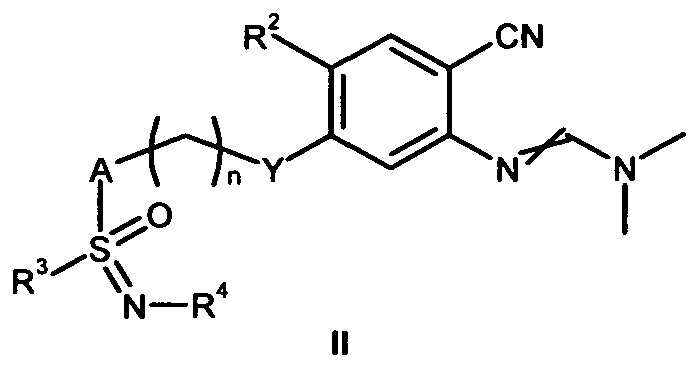
- the preparation of the compounds of the general formula (I) according to the invention is carried out by reaction of the intermediates as in formula (II) with compounds R 1 -XH in the presence of acetic acid in acetonitrile as a solvent in a microwave, where R 1 , R 2 , R 3 and X, Y, A and n have the meanings indicated in the general formula (I) according to Claims 1 to 13.
- R 1 , R 2 , R 3 and X, Y, A and n have the meanings indicated in the general formula (I) according to Claims 1 to 13.
- R 2 , R 3 and Y, A and n have the meanings indicated in the general formula (I) according to Claims 1 to 13, where R 4 next to R 4 is unequal to hydrogen.
- Intermediates of the formula (II) are obtained by a nucleophilic substitution reaction of intermediates of the formula (III) with intermediates of the formula (IV).
- Intermediates of the formula (IV) are functionalized here using a group LG suitable for this purpose. Halogen and a mesylate, tosylate or triflate group, for example, are suitable as an LG.
- Suitable solvents are, for example, acetone or dimethylformamide.
- a thioether of the formula (VI) is initially converted to the corresponding sulphoxide, where A and R 3 have the meanings indicated in the general formula (I) according to Claims 1 to 13.
- Suitable oxidizing agents for this transformation are, for example, sodium periodate, meta-chloroperbenzoic acid or hydrogen peroxide.
- sulphoximines One of the most important methods of preparation of sulphoximines is the reaction of a sulphoxide with hydrazoic acid, which is generated in situ, for example from the reaction of sodium azide and conc. sulphuric acid ( M. Reggelin, C. Zur, Synthesis 2000, 1, 1 ).
- the reaction can be carried out in an organic solvent, such as chloroform.
- the preparation of the sulphoximine is carried out, for example, by means of sodium azide and sulphuric acid or by means of o-mesitylenesulphonylhydroxylamine (MSH), further derivatizations can subsequently be performed on the nitrogen of the sulphoximine group.
- the sulphoximine nitrogen can be alkylated, acylated, arylated or the reaction can be carried out using ethyl chloroformate (for derivatization on the sulphoximine nitrogen, for this see M. Reggelin, C. Zur, Synthesis 2000, 1, 1-64 . C. Bolm, J. Sedelmeier, J. Org. Chem. 2005, 70, 6904-6906 ).
- Functional groups FG are, for example, carboxylic acid and ester. These groups can be reduced to the corresponding alcohol. In a subsequent step, the alcohol is converted to a mesylate, tosylate and triflate group belonging to the LG group.
- FG can be, for example, a hydroxyl group or hydrogen optionally present in protected form.
- this hydrogen can be replaced by a halogen substituent.
- Sulphimides can be oxidized to the sulphoximine (for this see N. Pesa, C. J. Welch, A. N. Boa J. Heterocycl. Chem. 2005, 599-607 ).
- Functional groups FG are, for example, carboxylic acid and ester. These groups can be reduced to the corresponding alcohol. In a subsequent step, the alcohol is converted to a mesylate, tosylate and triflate group belonging to the LG group.
- FG can be, for example, a hydroxyl group or hydrogen optionally present in protected form.
- this hydrogen can be replaced by a halogen substituent.
- the preparation of the compounds of the general formula (I) according to the invention is carried out in this variant by the reaction of the quinazolines of the formula (VII) with intermediates of the formula (IV), where R 1 , R 2 , R 3 and X, Y, A and n have the meanings indicated in the general formula (I) according to Claims 1 to 13.
- R 1 , R 2 , R 3 and X, Y, A and n have the meanings indicated in the general formula (I) according to Claims 1 to 13.
- R 4 can be removed with the obtainment of compounds with R 4 equal to hydrogen.
- the reaction is carried out analogously to the reaction of the intermediates of the formula (III) with intermediates of the formula (IV) (see Scheme 2).
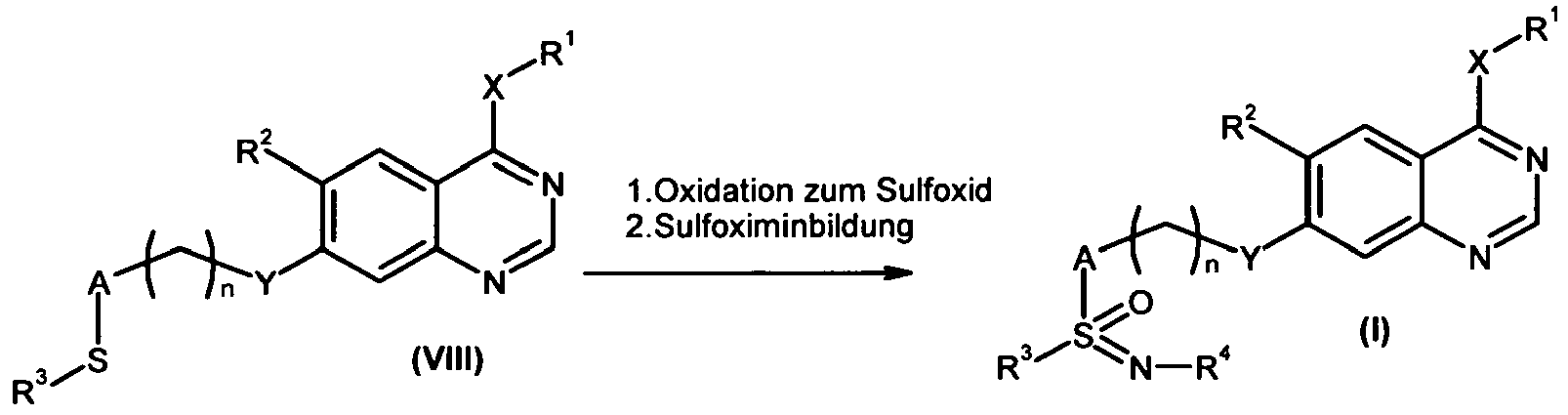
- the compounds of the general formula (I) according to the invention can be prepared in two ways. Starting from compounds of the formula (VIII), the sulphur centre is converted to the sulphoxide, followed by the formation of the corresponding sulphoximine, where R 1 , R 2 , R 3 , R 4 and X, Y, A and n have the meanings indicated in the general formula (I) according to Claims 1 to 13.
- compounds of the formula (VIII) can initially be converted by an imination reaction on the sulphur centre to a sulphimide, which is subsequently oxidized to the sulphoximine.
- intermediates of the formula (VIII) can be prepared by reaction of the intermediates of the formula (VII) with intermediates of the formula (X).
- Halogen and a mesylate, tosylate or triflate group and in this case also a hydroxyl group are suitable, for example, as LG.
- the linkage of the intermediates of the formula (V) with intermediates of the formula (X) can be carried out, for example, by means of a Mitsunobu reaction ( O. Mitsunobu Synthesis 1981, 1-27 ).
- the compound prepared by means of GWP3 (1.0 eq) is introduced into carbon tetrachloride (1 ml/1 mmol), treated with N-bromosuccinimide (1.0 eq) and azobisisobutyronitrile (0.1 eq) and subsequently refluxed for 5 hours. After cooling to RT, precipitated crystals are filtered off with suction and washed with CCl 4 . The filtrate is concentrated to dryness and the residue is purified by chromatography.
- the intermediate of the formula (II) (1.0 eq) is introduced into acetonitrile (1mL/0.1 mmol)) and acetic acid (6.0 eq), treated with amine (1.2 eq) and irradiated with microwaves at 160°C with stirring for 10 minutes.
- the reaction mixture is subsequently concentrated.
- the residue is treated with saturated NaHCO 3 solution.
- the aqueous phase is extracted with ethyl acetate. After drying the combined organic phases over sodium sulphate and removing the solvents, the residue is purified by means of chromatography.
- the compound prepared according to GWP 5 (1.0 eq) is dissolved in ethanol (10 ml/1 mmol). After addition of sodium ethoxide (3.6 eq), the reaction mixture is stirred at 60°C for 6 hours and is subsequently added to dilute aqueous sodium carbonate solution. The aqueous phase is extracted with ethyl acetate and the combined organic phases are dried over sodium sulphate. After removing the solvents, the residue is purified by means of chromatography.
- the desired product is obtained after removing the solvent and after chromatographic purification (silica gel, hexane/ethyl acetate: 0 ⁇ 100% ethyl acetate, then ethyl acetate/methanol: 4/1) in 46% yield (620 mg).
- ethyl 5-cyano-4- ⁇ (E/Z)-[(dimethylamino)methylene]amino ⁇ -2-( ⁇ (RS)-3-[N-(ethoxycarbonyl)-S-methylsulphonimidoyl]benzyl ⁇ oxy)benzoate (60 mg, 0.12 mmol) is reacted with isopropylamine (9.2 mg, 0.16 mmol). After cooling, the reaction mixture was diluted with water and sodium hydroxide solution (1 N). The organic phase is separated off and dried over sodium sulphate. After concentrating the solvent, the residue (55mg, 72%) is employed in the next reaction without further purification.
- ethyl 7-( ⁇ (RS)-3-[N-(ethoxycarbonyl)-S-methylsulphonimidoyl]-benzyl ⁇ oxy)-4-(isopropylamino)quinazoline-6-carboxylate (100 mg, 0.194 mmol) is reacted at 80°C for 2 hours with sodium ethoxide (59 mg, 0.9 mmol).
- the reaction mixture is concentrated to dryness. The residue is taken up in ethyl acetate and water and acidified. The organic phase is separated off and subsequently concentrated. After chromatographic purification, the desired product is obtained in 35% yield (28 mg).
- the batch is diluted with ethyl acetate and the organic phase is washed with water and dried over sodium sulphate to obtain, after removal of the solvent and also chromatographic purification (silica gel, hexane, dichloromethane/methanol: 0 ⁇ 10% methanol), the desired product in 88% yield (1.57 g).
- reaction of N'-(2-cyano-5- ⁇ 3-[(RS)-N-(ethoxycarbonyl)-S-methylsulphonimidoyl]benzyloxy ⁇ -4-methoxyphenyl)-N,N-dimethylformimidamide 72 mg, 0.16 mmol
- cyclopropylamine 13 ⁇ L, 0.19 mmol
- chromatographic purification sica gel, amino column, hexane, dichloromethane/methanol: 0 ⁇ 5% methanol
- the batch is diluted with ethyl acetate and the organic phase is washed with water and dried over sodium sulphate to obtain, after removal of the solvent and also chromatographic purification (silica gel, hexane/ethyl acetate: 0 ⁇ 100% ethyl acetate, followed by ethyl acetate/methanol: 4/1), the desired product in 85% yield (1.77 g).
- the batch is diluted with ethyl acetate and the organic phase is washed with water and dried over sodium sulphate to obtain, after removal of the solvent and also chromatographic purification (silica gel, hexane/ethyl acetate: 0 ⁇ 70% ethyl acetate, followed by ethyl acetate/methanol: 0 ⁇ 20% methanol), the desired product in 32% yield (180 mg).
- N'-(2-Cyano-5-nitrophenyl)-N,N-dimethylformimidamide (1.0 g, 4.58 mmol) is dissolved in 100 mL of tetrahydrofuran, cooled to 0°C and admixed with titanium trichloride solution (69 mL of a 15% solution in 10% aqueous HCl). Then, the batch is stirred at room temperature for 4 hours and adjusted at 0°C to pH 9 with 2N aqueous sodium hydroxide solution. The mixture is diluted with water and ethyl acetate. The aqueous phase is saturated with sodium chloride and stirred out three times with ethyl acetate.
- N'-(5-Amino-2-cyanophenyl)-N,N-dimethylformimidamide 50 mg, 0.27 mmol
- (RS)-S-[3-(bromomethyl)phenyl]-N-(ethoxycarbonyl)-S-methylsulphoximide 85 mg, 0.27 mmol
- potassium carbonate 68 mg, 0.49 mmol
- the batch is diluted with ethyl acetate and the organic phase is washed with water and dried over sodium sulphate to leave, after removal of the solvent and also after chromatographic purification (silica gel, hexane/ethyl acetate: 0 ⁇ 100% ethyl acetate), the desired product in 36% yield (40 mg).
- reaction of N'-(2-cyano-5- ⁇ 3-[(RS)-N-(ethoxycarbonyl)-S-methylsulphonimidoyl]benzylamino ⁇ phenyl)-N,N-dimethylformimidamide 80 mg, 0.19 mmol
- cyclopropylamine 13 mg, 0.22 mmol
- chromatographic purification sica gel, n-hexane/ethyl acetate: 0 ⁇ 100% ethyl acetate, followed by dichloromethane/methanol: 0 ⁇ 20% methanol
- N'-(4-Bromo-2-cyano-5-nitrophenyl)-N,N-dimethylformimidamide (1.1 g, 3.7 mmol) is dissolved in 500 mL of tetrahydrofuran, cooled to 0°C and admixed with titanium trichloride solution (51 mL of a 15% solution in 10% aqueous HCl). This is followed by stirring at room temperature for 4 hours. The batch is adjusted to pH 9 at 0°C by means of 2N aqueous sodium hydroxide solution. The mixture is diluted with water and ethyl acetate. The aqueous phase is saturated with sodium chloride and stirred out three times with ethyl acetate.
- N'-(5-Amino-4-bromo-2-cyanophenyl)-N,N-dimethylformimidamide (580 mg, 2.17 mmol) is dissolved in 15 mL of dimethylformamide and admixed with potassium carbonate (556 mg, 4.02 mmol) and also (RS)-S-[3-(bromomethyl)phenyl]-N-(ethoxycarbonyl)-S-methylsulphoximide (696 mg, 2.17 mmol). This is followed by 9 hours' stirring at 110°C. After cooling to room temperature, the reaction solution is diluted with ethyl acetate and the organic phase is washed with water.
- ethyl-7-( ⁇ (RS)-3-[N-(ethoxycarbonyl)-S-methyl-sulphonimidoyl]-benzyl ⁇ oxy)-4-(thiazol-2-ylamino)quinazoline-6-carboxylate (175 mg, 0.182 mmol) is reacted at 80°C for 2 hours with sodium ethoxide (55 mg, 0.8 mmol). After cooling, the reaction mixture is concentrated to dryness. The residue is taken up in ethyl acetate and water. The organic phase is separated off, dried over sodium sulphate and subsequently concentrated.
- 6-Bromo-7-methoxy-3H-quinazolin-4-one (1.01 g, 3.96 mmol) and N,N-(diisopropylethylamine (1.78 ml, 10.4 mmol) are introduced into 1,2-dichloroethane (19 ml), treated dropwise with POCl 3 (0.46 ml, 4.95 mmol) and then stirred at 80°C for 2h. The reaction mixture is subsequently concentrated to dryness. The residue is taken up in isopropanol (10 ml), treated with isopropylamine (0.34 ml, 3.96 mmol) and stirred for 30 minutes at 80°C.
- 6-Bromo-4-(isopropylamino)quinazolin-7-ol 50 mg, 0.18 mmol
- (RS)-S-[4-(bromomethyl)phenyl]-N-(ethoxycarbonyl)-S-methylsulphoximide 86 mg, 0.27 mmol
- acetone 10 ml
- potassium carbonate 45 mg, 0.33 mmol
- the batch is diluted with ethyl acetate and washed with water.
- the organic phase is dried over sodium sulphate and subsequently concentrated.
- the batch is diluted with ethyl acetate and the organic phase is washed with water and dried over sodium sulphate to leave, after removal of the solvent and also after chromatographic purification (silica gel, hexane/ethyl acetate: 0 ⁇ 100% ethyl acetate, followed by ethyl acetate/methanol: 9/1) the desired product in 62% yield (65 mg).
- Acetate salt of the compound 3.5.a.1 (1.05 g, 3.13 mmol) is presented as an initial charge in 60 mL of tetrahydrofuran and at 0°C admixed portionwise with lithium aluminium hydride (590 mg, 15.7 mmol). This is followed by stirring at room temperature for 90 minutes. The reaction is discontinued by addition of 10% aqueous ammonium chloride solution at 0°C. The batch is diluted with water and extracted with ethyl acetate, and the combined organic phases are dried over sodium sulphate to leave, after removal of the solvent, the desired product in 70% yield (510 mg).
- 6-(Hydroxymethyl)-4-(isopropylamino)quinazoline-7-ol 510 mg, 2.19 mmol
- the batch is filtered through Celite and washed with dichloromethane/methanol 9/1. Removal of the solvent and also chromatographic purification (silica gel, dichloromethane/methanol: 0 ⁇ 50% methanol) gives the desired product in 56% yield (280 mg).
- Isopropyl-[6-methoxy-7-(4-methylsulphanylpropoxy)quinazolin-4-yl]amine (95 mg, 0.296 mmol) is dissolved in acetonitrile (2 ml) under an argon atmosphere, treated with iodosylbenzene (104 mg, 0.47 mmol), 4-nitrobenzenesulphonamide (90 mg, 0.44 mmol) and iron(III) acetylacetonate (5.2 mg, 0.015 mmol) and stirred at room temperature for 2 hours.
- a 3-(4-tritylmercapto)-phenylpropionyl AM resin is used, which is prepared for the reaction in the following way (based on 89 mg, 0.078 mmol of resin): a) The resin is suspended 1/1 in 2 ml of methylene chloride/trifluoroacetic acid, shaken for 5 minutes and the solution is separated off. This process is repeated five times until the solution is colourless. The resin is in each case washed with methylene chloride and tetrahydrofuran.
- ethyl 5-cyano-4- ⁇ (E/Z)-[(dimethylamino)methylene]amino ⁇ -2-hydroxybenzoate (1.9 g, 7.27 mmol) is reacted with isopropylamine (516 mg, 8.73 mmol) in acetonitrile (10 ml) and acetic acid (5 ml). After cooling, the batch is diluted with water, rendered alkaline with concentrated sodium hydroxide solution, and extracted with ethyl acetate and methanol as a solubilizer. The organic phase is dried over sodium sulphate. After removal of the solvent, the residue is triturated a number of times with methylene chloride and employed in the next reaction without further purification.
- Ethyl 4-(isopropylamino)-7-[(RS)-3- ⁇ S-methyl-N-[(4-nitrophenyl)sulphonyl]-sulphinimidoyl ⁇ propoxy]quinazoline-6-carboxylate (340 mg, 0.6 mmol) is suspended in acetonitrile (0.7 ml) and ethanol (10 ml), treated with potassium carbonate (188 g, 1.36 mmol) and a solution of ethanol (8 ml) and hydrogen peroxide (0.66 ml) and stirred at room temperature for 20 hours. The reaction batch is diluted with water. After removing ethanol and acetonitrile, the aqueous phase is extracted with methylene chloride.
- Methyl 5-methylsulphanylnicotinate (916 mg, 5 mmol) is dissolved in 150 mL of diethyl ether, admixed at 0°C with lithium aluminium hydride (660 mg, 18 mmol) and subsequently stirred at room temperature for 90 minutes. The reaction is discontinued by addition of 10% ammonium chloride solution at 0°C. The batch is diluted with water and the aqueous phase is extracted with ether. Drying of the organic phase over sodium sulphate, concentrating the solvent and also chromatographic purification of the residue (silica gel, n-hexane/ethy) acetate: 50 ⁇ 100% ethyl acetate) gives the desired product in 7% yield (50 mg).
- 6-Bromo-N-isopropyl-7- ⁇ [5-(methylsulphanyl)pyridin-3-yl]methoxy ⁇ quinazolin-4-amine (430 mg, 1.03 mmol) is presented as an initial charge in 20 mL of chloroform and at 0°C and at 0°C admixed with meta-chloroperbenzoic acid (260 mg, 1.13 mmol). The batch is subsequently stirred at 0°C for 45 minutes. The batch is introduced into 2N aqueous sodium hydroxide solution. The mixture is extracted with dichloromethane, the organic phase is dried over sodium sulphate and the solvent is concentrated.
- PBMC peripheral blood mononuclear cells
- PBMCs isolated from human whole blood are stimulated using a TLR ligand.
- the cytokine determination is carried out by means of ELISA kits; a proliferation/cell metabolism determination is carried out using Alamar Blue.
- the cell preparation about 200 ml of blood are treated with an anticoagulant (e.g. citrate Monovettes).
- an anticoagulant e.g. citrate Monovettes.
- Per Leucosep tube 15ml of Histopaque (room temperature, RT) are poured in and pressed downwards through the frit employed by brief initial centrifugation (one minute at 1000 x g, RT). 20ml of blood are added to the tubes prepared in this way and centrifuged at 800xg for 15 minutes (RT). After centrifugation, the following layered arrangement results from the top to the bottom: plasma - PBMC - Histopaque - filter disc - Histopaque - erythrocytes and granulocytes. The supernatant plasma is aspirated.
- an anticoagulant e.g. citrate Monovettes.
- the PBMC are transferred together with the underlying Histopaque to a new 50ml tube, the contents of two Leucosep tubes always being added to one 50ml tube.
- the 50ml tubes are then filled to 50ml with PBS.
- This cell suspension is centrifuged at 300xg (RT) for 10 minutes.
- the liquid supernatant is tipped off and the cell pellet is resuspended with a little PBS and subsequently filled to 50ml with PBS.
- This washing step is repeated twice.
- the resulting pellet is taken up in a defined volume of medium (with additives).
- PBMC are incubated for 18 hours with titrated concentrations of the test substances, e.g.
- the supernatants are investigated for the content of IL-12, TNF-alpha or other chemokines by means of specific ELISA.
- the metabolic activity of the treated cells is determined with the aid of Alamar Blue.
Landscapes
- Health & Medical Sciences (AREA)
- Organic Chemistry (AREA)
- Chemical & Material Sciences (AREA)
- Engineering & Computer Science (AREA)
- Bioinformatics & Cheminformatics (AREA)
- Nuclear Medicine, Radiotherapy & Molecular Imaging (AREA)
- Medicinal Chemistry (AREA)
- Pharmacology & Pharmacy (AREA)
- Life Sciences & Earth Sciences (AREA)
- Animal Behavior & Ethology (AREA)
- General Health & Medical Sciences (AREA)
- Public Health (AREA)
- Veterinary Medicine (AREA)
- General Chemical & Material Sciences (AREA)
- Chemical Kinetics & Catalysis (AREA)
- Diabetes (AREA)
- Pulmonology (AREA)
- Hematology (AREA)
- Immunology (AREA)
- Dermatology (AREA)
- Endocrinology (AREA)
- Neurology (AREA)
- Biomedical Technology (AREA)
- Physical Education & Sports Medicine (AREA)
- Neurosurgery (AREA)
- Orthopedic Medicine & Surgery (AREA)
- Rheumatology (AREA)
- Ophthalmology & Optometry (AREA)
- Heart & Thoracic Surgery (AREA)
- Pain & Pain Management (AREA)
- Hospice & Palliative Care (AREA)
- Obesity (AREA)
- Emergency Medicine (AREA)
- Psychiatry (AREA)
- Transplantation (AREA)
- Cardiology (AREA)
- Vascular Medicine (AREA)
- Urology & Nephrology (AREA)
- Oncology (AREA)
- Reproductive Health (AREA)
Claims (23)
- Verbindungen der allgemeinen Formel (I)
 R1 für(i) einen gegebenenfalls mit Hydroxy, -NR7R8, -NR6-C(O)-R11, -NR6-C(O)-OR11, -NR6-C(O)-NR7R8, -NR7-SO2-R11, Cyano, Halogen, C1-C6-Alkoxy, -OCF3, -CF3, C1-C6-Alkyl, C3-C6-Cycloalkyl und/oder Heterocyclyl mit 3 bis 8 Ringatomen ein- oder mehrfach, gleich oder verschieden substituierten Aryl- oder Heteroarylring, oder(ii) einen gegebenenfalls mit Hydroxy, -NR7R8, -NR6-C(O)R11, -NR6-C(O)-OR11, -NR6-C(O)-NR7R8, -NR6-SO2-R11, Cyano, Halogen, C1-C6-Alkoxy, -OCF3, -CF3, C1-C6-Alkyl, C3-C6-Cycloalkyl und/oder Heterocyclyl mit 3 bis 8 Ringatomen ein- oder mehrfach, gleich oder verschieden substituierten C1-C6-Alkyl-, C2-C6-Alkenyl- oder C2-C6-Alkinylrest, oder(iii) einen gegebenenfalls mit Hydroxy, -NR7R8, -NR6-C(O)-R11, -NR6-C(O)-OR11, -NR6-C(O)-NR7R8, -NR6-SO2-R11, Cyano, Halogen, C1-C6-Alkoxy, -OCF3, -CF3, C1-C6-Alkyl, C3-C6-Cycloalkyl und/oder Heterocyclyl mit 3 bis 8 Ringatomen ein- oder mehrfach, gleich oder verschieden substituierten C3-C8 Cycloalkyl- oder Heterocyclylring mit 3 bis 8 Ringatomen steht,R2 für(i) Wasserstoff,(ii) Hydroxy, Halogen, Cyano, Nitro, -CF3, -OCF3, -C(O)OR11, -C(O)OH, -C(O)NR7R8, -C(S)NR7R8, -NR7R8, -NR6-C(O)-R11, -NR6-C(O)-OR11, -NR6-C(O)-NR7R8, -NR6-SO2-R11, oder(iii) einen gegebenenfalls mit Halogen, Hydroxy, C1-C6-Alkoxy, -CF3, -OCF3 oder -NR7R8 ein- oder mehrfach, gleich oder verschieden substituierten C1-C6-Alkyl- oder C1-C6-Alkoxyrest, oder(iv) einen gegebenenfalls mit Halogen, Hydroxy, C1-C6-Alkoxy, -CF3, -OCF3, -NR7R8 und/oder C1-C6-Alkyl ein-oder mehrfach, gleich oder verschieden substituierten C3-C8-Cycloalkylringsteht,R3 für
einen C1-C6-Alkyl-, C2-C6-Alkenyl-, C2-C6-Alkinylrest, einen C3-C7-Cycloalkyl- oder Arylring, einen Heterocyclylring mit 3 bis 8 Ringatomen oder einen monocyclischen Heteroarylring steht, jeweils gegebenenfalls selbst mit Hydroxy, -C(O)OR11, -C(O)NR7R8, -NR7R8, Cyano, Halogen, -CF3, C1-C6-Alkoxy, -OCF3 und/oder C1-C6-Alkyl ein- oder mehrfach, gleich oder verschieden substituiert,R4 für
Wasserstoff, -SO2R11,-C(O)R11, -C(O)OR11, -C(O)NR7R8, -C(S)OR11, -C(S)NR7R8 oder -R11 steht,X, Y unabhängig voneinander für -O- oder die Gruppe -NR5- steht,A für(i) eine Bindung oder(ii) einen gegebenenfalls mit Hydroxy, -NR7R8, -NR6-C(O)-R11, -C(O)NR7R8, -NR6-C(O)-OR11, -NR6-C(O)-NR7R8, -NR6-SO2-R11, Cyano, Halogen, C1-C6-Alkoxy, -OCF3, -CF3, C1-C6-Alkyl, C3-C6-Cycloalkyl und/oder Heterocyclyl mit 3 bis 8 Ringatomen ein- oder mehrfach, gleich oder verschieden substituierten Aryl- oder Heteroarylring steht,n für 1-6 steht,R5 für(i) Wasserstoff,(ii) einen C1-C6-Alkylrest, C3-C8-Cycloalkyl- oder Arylring, einen Heterocyclylring mit 3 bis 8 Ringatomen oder einen Heteroarylring, oder(iii) -C(O)-(C1-C6)-Alkyl, -C(O)-Phenyl, oder -C(O)-Benzyl steht, wobei (ii) und (iii) gegebenenfalls mit Hydroxy, -NR9R10, Cyano, Halogen, -CF3, C1-C6-Alkoxy und/oder -OCF3 ein- oder mehrfach, gleich oder verschieden substituiert sind,oder, wenn X für -NR5- steht, alternativ X, R1 und R5 gemeinsam einen 3 bis 8 gliedrigen Ring bilden, der gegebenenfalls zusätzlich zum Stickstoffatom ein oder mehrere weitere Heteroatome enthält, gegebenenfalls ein- oder mehrfach, gleich oder verschieden mit Hydroxy, C1-C6-Alkyl, C1-C6-Alkoxy, -C(O)R11, -SO2R11, Halogen oder der Gruppe -NR8R9 substituiert ist, gegebenenfalls 1 bis 3 Doppelbindungen enthält und/oder gegebenenfalls durch eine oder mehrere -C(O)-Gruppen unterbrochen ist,R6 für Wasserstoff oder einen C1-C6-Alkylrest steht,R7 und R8 unabhängig voneinander stehen für(i) Wasserstoff und/oder(ii) einen C1-C6-Alkylrest, C2-C6-Alkenyl-, C3-C8-Cycloalkyl-und/oder Arylring, einen Heterocyclylring mit 3 bis 8 Ringatomen und/oder einen Heteroarylring, gegebenenfalls mit Hydroxy, -NR9R10, Cyano, Halogen, -CF3, C1-C6-Alkoxy und/oder -OCF3 ein- oder mehrfach, gleich oder verschieden substituiert sind, stehen oderR7 und R8 gemeinsam mit dem Stickstoffatom einen 5- bis 7-gliedrigen Ring bilden, der gegebenenfalls zusätzlich zum Stickstoffatom 1 oder 2 weitere Heteroatome enthält und der mit Hydroxy, -NR9R10, Cyano, Halogen, -CF3, C1-C6-Alkyl, C1-C6-Alkoxy und/oder -OCF3 ein- oder mehrfach, gleich oder verschieden substituiert sein kann,R9 und R10 unabhängig voneinander für Wasserstoff oder einen C1-C6-Alkylrest stehen, der gegebenenfalls mit Hydroxy ein- oder mehrfach, gleich oder verschieden substituiert ist,R11 für einen C1-C6-Alkyl, C2-C6-Alkenyl- oder C2-C6-Alkinylrest, einen C3-C8-Cycloalkyl- oder Arylring , einen Heterocyclylring mit 3 bis 8 Ringatomen oder einen Heteroarylring steht, jeweils gegebenenfalls selbst mit Hydroxy, Halogen, Cyano, Nitro, -NR7R8, C1-C6-Alkyl ,-CFs, C1-C6-Alkoxy und/oder -OCF3 ein- oder mehrfach, gleich oder verschieden substituiert,sowie deren Salze, Diastereomere und Enantiomere. - Verbindungen der allgemeinen Formel (I) gemäß Anspruch 1, in derR1 für(i) einen gegebenenfalls mit Hydroxy, -NR7R8, Cyano, Halogen, C1-C6-Alkoxy, -NR6-C(O)R11, -OCF3, -CF3, C1-C6-Alkyl, ein- oder mehrfach, gleich oder verschieden substituierten Aryl- oder Heteroarylring, oder(ii) einen gegebenenfalls mit Hydroxy, -NR7R8, Cyano, Halogen, C1-C6-Alkoxy, -NR6-C(O)R11, -OCF3, -CF3, C1-C6-Alkyl, ein- oder mehrfach, gleich oder verschieden substituierten C1-C6-Alkylrest, oder(iii) einen gegebenenfalls mit Hydroxy, -NR7R8, Cyano, Halogen, C1-C6-Alkoxy, -OCF3, -CF3, C1-C6-Alkyl ein-oder mehrfach, gleich oder verschieden substituierten C3-C8 Cycloalkyl- oder Heterocyclylring mit 3 bis 8 Ringatomen steht,R2 für Wasserstoff, Halogen, Cyano, -C(O)OR11, -C(O)OH, -C(O)NR7R8 oder einen gegebenenfalls mit Halogen, Hydroxy, C1-C6-Alkoxy, -CF3, -OCF3 oder -NR7R8 ein- oder mehrfach, gleich oder verschieden substituierten C1-C6-Alkyl- oder C1-C6-Alkoxyrest steht,R3 für einen C1-C6-Alkylrest oder einen C3-C7-Cycloalkylring steht, gegebenenfalls selbst mit Hydroxy, -C(O)OR11, -C(O)NR7R8, -NR7R8, Cyano, Halogen, -CF3, C1-C6-Alkoxy, -OCF3 und/oder C1-C6-Alkyl ein- oder mehrfach, gleich oder verschieden substituiert,R4 für
Wasserstoff, -SO2R11, -C(O)OR11, -C(O)NR7R8 steht,X für die Gruppe -NR5- steht,Y für -O-, NR5 steht,A für(i) eine Bindung oder(ii) einen gegebenenfalls mit Hydroxy, -NR7R8, -C(O)NR7R8, Cyano, Halogen, C1-C6-Alkoxy, -OCF3, -CF3, C1-C6-Alkyl, C3-C6-Cycloalkyl und/oder Heterocyclyl mit 3 bis 8 Ringatomen ein- oder mehrfach, gleich oder verschieden substituierten Aryl- oder Heteroarylring steht,n für 1-5 steht,R5 für
Wasserstoff, einen C1-C6-Alkylrest, einen C3-C8-Cycloalkylring oder -C(O)-(C1-C6)-Alkyl steht, jeweils gegebenenfalls mit Hydroxy, -NR9R10, Cyano, Halogen, -CF3, C1-C6-Alkoxy und/oder -OCF3 ein- oder mehrfach, gleich oder verschieden substituiert sind,R7 und R8 unabhängig voneinander stehen für(i) Wasserstoff und/oder(ii) einen C1-C6-Alkylrest, einen C3-C8-Cycloalkyl- und/oder Arylring, einen Heterocyclylring mit 3 bis 8 Ringatomen und/oder einen Heteroarylring, gegebenenfalls mit Hydroxy, -NR9R10, Cyano, Halogen, -CF3, C1-C6-Alkoxy und/oder -OCF3 ein- oder mehrfach, gleich oder verschieden substituiert sind,R11 für einen C1-C3-Alkyl, einen C3-C8-Cycloalkyl- oder Arylring , einen Heterocyclylring mit 3 bis 8 Ringatomen oder einen Heteroarylring steht, jeweils gegebenenfalls selbst mit Hydroxy, Halogen, Cyano, Nitro, -NR7R8, C1-C6-Alkyl ,-CF3, C1-C6-Alkoxy und/oder -OCF3 ein- oder mehrfach, gleich oder verschieden substituiert,sowie deren Salze, Diastereomere und Enantiomere. - Verbindungen der allgemeinen Formel (I) gemäß Anspruch 1 oder 2, in der R1 für(i) einen gegebenenfalls mit Hydroxy, -NR6-C(O)-R11, Cyano, C1-C6-Alkyl ein- oder mehrfach, gleich oder verschieden substituierten Phenyl- oder monocyclischen Heteroarylring oder(ii) einen gegebenenfalls mit Hydroxy, -NR7R8, C1-C6-Alkoxy, und/oder C3-C6-Cycloalkyl ein- oder mehrfach, gleich oder verschieden substituierten C1-C6-Alkylrest, oder(iii) einen C3-C8 Cycloalkylring steht"sowie deren Salze, Diastereomere und Enantiomere.
- Verbindungen der allgemeinen Formel (I) gemäß einem der Ansprüche 1 bis 3, in der
R2 für Wasserstoff, Halogen, Cyano,-C(O)OR11, -C(O)OH, oder einen C1-C6-Alkoxyrest steht,
sowie deren Salze, Diastereomere und Enantiomere. - Verbindungen der allgemeinen Formel (I) gemäß einem der Ansprüche 1 bis 4, in der
R3 für einen C1-C3-Alkylrest steht,
sowie deren Salze, Diastereomere und Enantiomere. - Verbindungen der allgemeinen Formel (I) gemäß einem der Ansprüche 1 bis 5, in der
R4 für Wasserstoff, -SO2R11 oder-C(O)OR11 steht,
sowie deren Salze, Diastereomere und Enantiomere. - Verbindungen der allgemeinen Formel (I) gemäß einem der Ansprüche 1 bis 6, in der
R4 für Wasserstoff steht,
sowie deren Salze, Diastereomere und Enantiomere. - Verbindungen der allgemeinen Formel (I) gemäß einem der Ansprüche 1 bis 7, in der
A für eine Bindung oder einen Phenyl- oder monocyclischen Heteroarylring steht,
sowie deren Salze, Diastereomere und Enantiomere. - Verbindungen der allgemeinen Formel (I) gemäß einem der Ansprüche 1 bis 8, in der
X für-NH- steht,
sowie deren Salze, Diastereomere und Enantiomere. - Verbindungen der allgemeinen Formel (I) gemäß einem der Ansprüche 1 bis 9, in der
Y für -O- oder -NH- steht,
sowie deren Salze, Diastereomere und Enantiomere. - Verbindungen der allgemeinen Formel (I) gemäß einem der Ansprüche 1 bis 10, in der
R7 und R8 unabhängig voneinander stehen für einen C1-C6-Alkylrest,
sowie deren Salze, Diastereomere und Enantiomere. - Verbindungen der allgemeinen Formel (I) gemäß einem der Ansprüche 1 bis 11, in der
n für 1-4 steht,
sowie deren Salze, Diastereomere und Enantiomere. - Verbindungen gemäß Anspruch 1 der allgemeinen Formel (I)
in derR1 für(i) einen gegebenenfalls mit Hydroxy, -NR6-C(O)-R11, Cyano, C1-C6-Alkyl ein- oder mehrfach, gleich oder verschieden substituierten Phenyl- oder monocyclischen Heteroarylring oder(ii) einen gegebenenfalls mit Hydroxy, -NR7R8, C1-C6-Alkoxy, und/oder C3-C6-Cycloalkyl ein- oder mehrfach, gleich oder verschieden substituierten C1-C6-Alkylrest, oder(iii) einen C3-C8 Cycloalkylring steht,R2 für Wasserstoff, Halogen, Cyano,-C(O)OR11, -C(O)OH, oder einen C1-C6-Alkoxyrest steht,R3 für einen C1-C6-Alkylrest steht,R4 für Wasserstoff, -SO2R11 oder -C(O)OR11 steht,X, für -NH- steht,Y für -O- oder -NH- steht,A für eine Bindung oder einen Phenyl- oder monocyclischen Heteroarylring steht,n für 1-4 steht,R6 für Wasserstoff steht,R7 und R8 für einen einen C1-C6-Alkylrest stehen,R11 für einen C1-C6-Alkylrest oder Phenyllring steht, jeweils gegebenenfalls selbst mit Nitro substituiert,sowie deren Salze, Diastereomere und Enantiomere. - Verfahren zur Herstellung der Verbindungen gemäß einem der Ansprüche 1 bis 13, umfassend den Schritt, der

wobei R1, R2, R3 sowie X, Y, A und n die in der allgemeinen Formel (I) gemäß der Ansprüche 1 bis 13 angegebenen Bedeutungen haben und R4 ungleich Wasserstoff ist. - Verfahren zur Herstellung der Verbindungen gemäß einem der Ansprüche 1 bis 13, umfassend den Schritt, der

wobei R1, R2, R3 sowie X, Y, A und n die in der allgemeinen Formel (I) gemäß der Ansprüche 1 bis 13 angegebenen Bedeutungen haben und R4 ungleich Wasserstoff ist. - Verfahren zur Herstellung der Verbindungen gemäß einem der Ansprüche 1 bis 13, umfassend die Schrittea) Iminierung von Intermediaten der Formel (VIII) am Schwefelzentrum und nachfolgendb) Oxidation zum Sulfoximinwobei R1, R2, R3 sowie X, Y, A und n die in der allgemeinen Formel (I) gemäß der Ansprüche 1 bis 13 angegebenen Bedeutungen haben und R4 ungleich Wasserstoff ist.

- Verfahren nach einem der Ansprüche 14 bis 16 zur Herstellung von Verbindungen mit R4 gleich Wasserstoff, gekennzeichnet durch eine nachfolgende Abspaltung von R4 ungleich Wasserstoff.
- Verfahren zur Herstellung der Verbindungen gemäß einem der Ansprüche 1 bis 13, umfassend die Schrittea) Oxidation von Intermediaten der Formel (VIII) zum entsprechenden Sulfoxid und nachfolgendb) Sulfoximinbildungwobei R1, R2, R3 , R4 sowie X, Y, A und n die in der allgemeinen Formel (I) gemäß der Ansprüche 1 bis 13 angegebenen Bedeutungen haben.
- Intermediate der Formel (II) :
- Intermediate der Formel (IV) :

- Verbindungen gemäß einem der Ansprüche 1 bis 13 zur Verwendung als Arzneimittel.
- Verwendung einer Verbindung gemäß einem der Ansprüche 1 bis 13 zur Herstellung eines Medikamentes zur Behandlung von Erkrankungen, die mit entzündlichen, allergischen und / oder proliferativen Prozessen einhergehen.
- Pharmazeutische Formulierung enthaltend eine Verbindung gemäß einem der Ansprüche 1 bis 13.
Priority Applications (1)
| Application Number | Priority Date | Filing Date | Title |
|---|---|---|---|
| EP08773585A EP2247579B1 (de) | 2008-01-17 | 2008-06-13 | Sulfoximinsubstituierte chinazolinderivate als immunmodulatoren, ihre herstellung und ihre verwendung als medikamente |
Applications Claiming Priority (3)
| Application Number | Priority Date | Filing Date | Title |
|---|---|---|---|
| EP08075043 | 2008-01-17 | ||
| PCT/EP2008/005045 WO2009089851A1 (en) | 2008-01-17 | 2008-06-13 | Sulphoximine-substituted quinazoline derivatives as immunomodulators, their preparation and use as medicaments |
| EP08773585A EP2247579B1 (de) | 2008-01-17 | 2008-06-13 | Sulfoximinsubstituierte chinazolinderivate als immunmodulatoren, ihre herstellung und ihre verwendung als medikamente |
Publications (2)
| Publication Number | Publication Date |
|---|---|
| EP2247579A1 EP2247579A1 (de) | 2010-11-10 |
| EP2247579B1 true EP2247579B1 (de) | 2012-04-18 |
Family
ID=39735498
Family Applications (1)
| Application Number | Title | Priority Date | Filing Date |
|---|---|---|---|
| EP08773585A Not-in-force EP2247579B1 (de) | 2008-01-17 | 2008-06-13 | Sulfoximinsubstituierte chinazolinderivate als immunmodulatoren, ihre herstellung und ihre verwendung als medikamente |
Country Status (7)
| Country | Link |
|---|---|
| US (1) | US7863283B2 (de) |
| EP (1) | EP2247579B1 (de) |
| JP (1) | JP5529757B2 (de) |
| AT (1) | ATE554076T1 (de) |
| CA (1) | CA2712367C (de) |
| ES (1) | ES2385118T3 (de) |
| WO (1) | WO2009089851A1 (de) |
Cited By (2)
| Publication number | Priority date | Publication date | Assignee | Title |
|---|---|---|---|---|
| US9353122B2 (en) | 2013-02-15 | 2016-05-31 | Kala Pharmaceuticals, Inc. | Therapeutic compounds and uses thereof |
| US9833453B2 (en) | 2013-02-20 | 2017-12-05 | Kala Pharmaceuticals, Inc. | Therapeutic compounds and uses thereof |
Families Citing this family (10)
| Publication number | Priority date | Publication date | Assignee | Title |
|---|---|---|---|---|
| ES2385118T3 (es) | 2008-01-17 | 2012-07-18 | Bayer Pharma Aktiengesellschaft | Derivados de quinazolina sustituida con sulfoximina como inmunomoduladores, su preparación y uso como medicamentos |
| CN102971313A (zh) | 2010-04-14 | 2013-03-13 | 百时美施贵宝公司 | 新颖的葡糖激酶激活剂及其使用方法 |
| US9688688B2 (en) | 2013-02-20 | 2017-06-27 | Kala Pharmaceuticals, Inc. | Crystalline forms of 4-((4-((4-fluoro-2-methyl-1H-indol-5-yl)oxy)-6-methoxyquinazolin-7-yl)oxy)-1-(2-oxa-7-azaspiro[3.5]nonan-7-yl)butan-1-one and uses thereof |
| US9458169B2 (en) | 2013-11-01 | 2016-10-04 | Kala Pharmaceuticals, Inc. | Crystalline forms of therapeutic compounds and uses thereof |
| US9890173B2 (en) | 2013-11-01 | 2018-02-13 | Kala Pharmaceuticals, Inc. | Crystalline forms of therapeutic compounds and uses thereof |
| US10336767B2 (en) | 2016-09-08 | 2019-07-02 | Kala Pharmaceuticals, Inc. | Crystalline forms of therapeutic compounds and uses thereof |
| EP3509423A4 (de) | 2016-09-08 | 2020-05-13 | Kala Pharmaceuticals, Inc. | Kristalline formen von therapeutischen verbindungen und verwendungen davon |
| AU2017324713B2 (en) | 2016-09-08 | 2020-08-13 | KALA BIO, Inc. | Crystalline forms of therapeutic compounds and uses thereof |
| MX2021008984A (es) | 2019-01-30 | 2021-09-08 | Felicamed Biotechnology Co Ltd | Inhibidor jak y metodo de preparacion del mismo. |
| WO2024148272A1 (en) * | 2023-01-06 | 2024-07-11 | Riboscience Llc | Aza bicyclic heteroaryl derivatives as ectonucleotide pyrophosphatase phosphodiesterase 1 inhibitors |
Family Cites Families (11)
| Publication number | Priority date | Publication date | Assignee | Title |
|---|---|---|---|---|
| DE3129444A1 (de) * | 1981-07-25 | 1983-02-10 | Dr. Karl Thomae Gmbh, 7950 Biberach | "sulfoximine, deren herstellung und diese verbindungen enthaltende arzneimittel" |
| DE3217012A1 (de) * | 1982-05-06 | 1983-11-10 | Dr. Karl Thomae Gmbh, 7950 Biberach | Benzoxazin-2-one, deren herstellung und diese verbindungen enthaltende arzneimittel |
| JPH06157626A (ja) * | 1992-11-26 | 1994-06-07 | Nippon Oil & Fats Co Ltd | カチオン重合硬化性組成物 |
| GB9718972D0 (en) * | 1996-09-25 | 1997-11-12 | Zeneca Ltd | Chemical compounds |
| ATE356117T1 (de) * | 1999-01-22 | 2007-03-15 | Kirin Brewery | Derivate des n-((chinolinyl)oxy)-phenyl)- harnstoffs und des n-((chinazolinyl)oxy)-phenyl)- harnstoffs mit antitumor aktivität |
| PT1154774E (pt) * | 1999-02-10 | 2005-10-31 | Astrazeneca Ab | Derivados de quinazolina como inibidores de angiogenese |
| GB9922173D0 (en) | 1999-09-21 | 1999-11-17 | Zeneca Ltd | Chemical compounds |
| DE10349423A1 (de) * | 2003-10-16 | 2005-06-16 | Schering Ag | Sulfoximinsubstituierte Parimidine als CDK- und/oder VEGF-Inhibitoren, deren Herstellung und Verwendung als Arzneimittel |
| EP1705177A1 (de) * | 2005-03-23 | 2006-09-27 | Schering Aktiengesellschaft | N-Aryl-sulfoximin-substituierte Pyrimidine als CDK- und VEGF Inhibitoren, ihre Herstellung und Verwendung als Pharmazeutika |
| EP1710246A1 (de) * | 2005-04-08 | 2006-10-11 | Schering Aktiengesellschaft | Sulfoximine-Pyrimidine Makrozyklus und deren Salzen, Verfahren zur ihrer Herstellung, und deren pharmazeutische Verwendung gegen Krebs |
| ES2385118T3 (es) | 2008-01-17 | 2012-07-18 | Bayer Pharma Aktiengesellschaft | Derivados de quinazolina sustituida con sulfoximina como inmunomoduladores, su preparación y uso como medicamentos |
-
2008
- 2008-06-13 ES ES08773585T patent/ES2385118T3/es active Active
- 2008-06-13 WO PCT/EP2008/005045 patent/WO2009089851A1/en not_active Ceased
- 2008-06-13 JP JP2010542518A patent/JP5529757B2/ja not_active Expired - Fee Related
- 2008-06-13 AT AT08773585T patent/ATE554076T1/de active
- 2008-06-13 CA CA2712367A patent/CA2712367C/en not_active Expired - Fee Related
- 2008-06-13 US US12/138,879 patent/US7863283B2/en not_active Expired - Fee Related
- 2008-06-13 EP EP08773585A patent/EP2247579B1/de not_active Not-in-force
Cited By (7)
| Publication number | Priority date | Publication date | Assignee | Title |
|---|---|---|---|---|
| US9353122B2 (en) | 2013-02-15 | 2016-05-31 | Kala Pharmaceuticals, Inc. | Therapeutic compounds and uses thereof |
| US9827248B2 (en) | 2013-02-15 | 2017-11-28 | Kala Pharmaceuticals, Inc. | Therapeutic compounds and uses thereof |
| US9877970B2 (en) | 2013-02-15 | 2018-01-30 | Kala Pharmaceuticals, Inc. | Therapeutic compounds and uses thereof |
| US10398703B2 (en) | 2013-02-15 | 2019-09-03 | Kala Pharmaceuticals, Inc. | Therapeutic compounds and uses thereof |
| US10966987B2 (en) | 2013-02-15 | 2021-04-06 | Kala Pharmaceuticals, Inc. | Therapeutic compounds and uses thereof |
| US9833453B2 (en) | 2013-02-20 | 2017-12-05 | Kala Pharmaceuticals, Inc. | Therapeutic compounds and uses thereof |
| US9861634B2 (en) | 2013-02-20 | 2018-01-09 | Kala Pharmaceuticals, Inc. | Therapeutic compounds and uses thereof |
Also Published As
| Publication number | Publication date |
|---|---|
| JP5529757B2 (ja) | 2014-06-25 |
| CA2712367C (en) | 2016-01-19 |
| WO2009089851A1 (en) | 2009-07-23 |
| ES2385118T3 (es) | 2012-07-18 |
| ATE554076T1 (de) | 2012-05-15 |
| US20090186911A1 (en) | 2009-07-23 |
| US7863283B2 (en) | 2011-01-04 |
| EP2247579A1 (de) | 2010-11-10 |
| JP2011509952A (ja) | 2011-03-31 |
| CA2712367A1 (en) | 2009-07-23 |
Similar Documents
| Publication | Publication Date | Title |
|---|---|---|
| EP2247579B1 (de) | Sulfoximinsubstituierte chinazolinderivate als immunmodulatoren, ihre herstellung und ihre verwendung als medikamente | |
| US11046713B2 (en) | Androgen receptor modulating compounds | |
| EP2718284B1 (de) | Triazolonverbindungen als mpges-1-inhibitoren | |
| CN108290879B (zh) | 用作irak抑制剂的杂芳基化合物及其用途 | |
| US8841311B2 (en) | Sulphone-substituted quinazoline derivatives as immuno-modulators, their preparation and use as medicaments | |
| TWI488851B (zh) | 作為鉀離子通道抑制劑之喹唑啉 | |
| DE68919195T2 (de) | Antitumormittel. | |
| JP2005536533A (ja) | 置換ベンゾイミダゾール化合物 | |
| CN104470917A (zh) | 作为RORc调节剂的芳基磺内酰胺衍生物 | |
| US8163739B2 (en) | 2-arylthiazole-4-carboxamide derivatives, their preparation and use as pharmaceuticals | |
| KR20130143076A (ko) | 6아미노2페닐아미노1h벤즈이미다졸5카복스아미드 유도체 및 마이크로솜 프로스타글란딘 e2 신타제1 억제제로서의 이들의 용도 | |
| EP2744501A1 (de) | Aminochinoline als kinasehemmer | |
| CA2689607A1 (en) | Kinase inhibitor compounds | |
| CA2507425A1 (en) | Novel quinoxalinone derivatives as bradykinin b1 antagonists | |
| JP2016522240A (ja) | RORcモジュレーターとしてのアリールスルタム誘導体 | |
| WO2020153434A1 (ja) | ピラゾール化合物 | |
| JP2023515197A (ja) | ヘテロサイクリックアミン誘導体の製造方法 | |
| CN116768877B (zh) | Isr抑制剂及其制备方法和应用 | |
| EP3089974B1 (de) | Neuartige imidazolidin-2,4-dion-derivate | |
| CN120289428A (zh) | 一种1-氧代异吲哚啉衍生物及其应用 | |
| HK1196614B (en) | Triazolone compounds as mpges-1 inhibitors | |
| HK1230615B (en) | Novel imidazolidine-2,4-dione derivatives |
Legal Events
| Date | Code | Title | Description |
|---|---|---|---|
| PUAI | Public reference made under article 153(3) epc to a published international application that has entered the european phase |
Free format text: ORIGINAL CODE: 0009012 |
|
| 17P | Request for examination filed |
Effective date: 20100817 |
|
| AK | Designated contracting states |
Kind code of ref document: A1 Designated state(s): AT BE BG CH CY CZ DE DK EE ES FI FR GB GR HR HU IE IS IT LI LT LU LV MC MT NL NO PL PT RO SE SI SK TR |
|
| AX | Request for extension of the european patent |
Extension state: AL BA MK RS |
|
| DAX | Request for extension of the european patent (deleted) | ||
| RAP1 | Party data changed (applicant data changed or rights of an application transferred) |
Owner name: BAYER PHARMA AKTIENGESELLSCHAFT |
|
| GRAP | Despatch of communication of intention to grant a patent |
Free format text: ORIGINAL CODE: EPIDOSNIGR1 |
|
| GRAS | Grant fee paid |
Free format text: ORIGINAL CODE: EPIDOSNIGR3 |
|
| GRAA | (expected) grant |
Free format text: ORIGINAL CODE: 0009210 |
|
| AK | Designated contracting states |
Kind code of ref document: B1 Designated state(s): AT BE BG CH CY CZ DE DK EE ES FI FR GB GR HR HU IE IS IT LI LT LU LV MC MT NL NO PL PT RO SE SI SK TR |
|
| REG | Reference to a national code |
Ref country code: GB Ref legal event code: FG4D |
|
| REG | Reference to a national code |
Ref country code: CH Ref legal event code: EP |
|
| REG | Reference to a national code |
Ref country code: IE Ref legal event code: FG4D |
|
| REG | Reference to a national code |
Ref country code: AT Ref legal event code: REF Ref document number: 554076 Country of ref document: AT Kind code of ref document: T Effective date: 20120515 |
|
| REG | Reference to a national code |
Ref country code: DE Ref legal event code: R096 Ref document number: 602008014964 Country of ref document: DE Effective date: 20120614 |
|
| REG | Reference to a national code |
Ref country code: ES Ref legal event code: FG2A Ref document number: 2385118 Country of ref document: ES Kind code of ref document: T3 Effective date: 20120718 |
|
| REG | Reference to a national code |
Ref country code: NL Ref legal event code: VDEP Effective date: 20120418 |
|
| REG | Reference to a national code |
Ref country code: AT Ref legal event code: MK05 Ref document number: 554076 Country of ref document: AT Kind code of ref document: T Effective date: 20120418 |
|
| LTIE | Lt: invalidation of european patent or patent extension |
Effective date: 20120418 |
|
| RAP2 | Party data changed (patent owner data changed or rights of a patent transferred) |
Owner name: BAYER INTELLECTUAL PROPERTY GMBH |
|
| PG25 | Lapsed in a contracting state [announced via postgrant information from national office to epo] |
Ref country code: SE Free format text: LAPSE BECAUSE OF FAILURE TO SUBMIT A TRANSLATION OF THE DESCRIPTION OR TO PAY THE FEE WITHIN THE PRESCRIBED TIME-LIMIT Effective date: 20120418 Ref country code: IS Free format text: LAPSE BECAUSE OF FAILURE TO SUBMIT A TRANSLATION OF THE DESCRIPTION OR TO PAY THE FEE WITHIN THE PRESCRIBED TIME-LIMIT Effective date: 20120818 Ref country code: FI Free format text: LAPSE BECAUSE OF FAILURE TO SUBMIT A TRANSLATION OF THE DESCRIPTION OR TO PAY THE FEE WITHIN THE PRESCRIBED TIME-LIMIT Effective date: 20120418 Ref country code: LT Free format text: LAPSE BECAUSE OF FAILURE TO SUBMIT A TRANSLATION OF THE DESCRIPTION OR TO PAY THE FEE WITHIN THE PRESCRIBED TIME-LIMIT Effective date: 20120418 Ref country code: NO Free format text: LAPSE BECAUSE OF FAILURE TO SUBMIT A TRANSLATION OF THE DESCRIPTION OR TO PAY THE FEE WITHIN THE PRESCRIBED TIME-LIMIT Effective date: 20120718 Ref country code: CY Free format text: LAPSE BECAUSE OF FAILURE TO SUBMIT A TRANSLATION OF THE DESCRIPTION OR TO PAY THE FEE WITHIN THE PRESCRIBED TIME-LIMIT Effective date: 20120418 Ref country code: PL Free format text: LAPSE BECAUSE OF FAILURE TO SUBMIT A TRANSLATION OF THE DESCRIPTION OR TO PAY THE FEE WITHIN THE PRESCRIBED TIME-LIMIT Effective date: 20120418 |
|
| PG25 | Lapsed in a contracting state [announced via postgrant information from national office to epo] |
Ref country code: SI Free format text: LAPSE BECAUSE OF FAILURE TO SUBMIT A TRANSLATION OF THE DESCRIPTION OR TO PAY THE FEE WITHIN THE PRESCRIBED TIME-LIMIT Effective date: 20120418 Ref country code: GR Free format text: LAPSE BECAUSE OF FAILURE TO SUBMIT A TRANSLATION OF THE DESCRIPTION OR TO PAY THE FEE WITHIN THE PRESCRIBED TIME-LIMIT Effective date: 20120719 Ref country code: LV Free format text: LAPSE BECAUSE OF FAILURE TO SUBMIT A TRANSLATION OF THE DESCRIPTION OR TO PAY THE FEE WITHIN THE PRESCRIBED TIME-LIMIT Effective date: 20120418 Ref country code: PT Free format text: LAPSE BECAUSE OF FAILURE TO SUBMIT A TRANSLATION OF THE DESCRIPTION OR TO PAY THE FEE WITHIN THE PRESCRIBED TIME-LIMIT Effective date: 20120820 Ref country code: HR Free format text: LAPSE BECAUSE OF FAILURE TO SUBMIT A TRANSLATION OF THE DESCRIPTION OR TO PAY THE FEE WITHIN THE PRESCRIBED TIME-LIMIT Effective date: 20120418 |
|
| PG25 | Lapsed in a contracting state [announced via postgrant information from national office to epo] |
Ref country code: BE Free format text: LAPSE BECAUSE OF FAILURE TO SUBMIT A TRANSLATION OF THE DESCRIPTION OR TO PAY THE FEE WITHIN THE PRESCRIBED TIME-LIMIT Effective date: 20120418 |
|
| PG25 | Lapsed in a contracting state [announced via postgrant information from national office to epo] |
Ref country code: DK Free format text: LAPSE BECAUSE OF FAILURE TO SUBMIT A TRANSLATION OF THE DESCRIPTION OR TO PAY THE FEE WITHIN THE PRESCRIBED TIME-LIMIT Effective date: 20120418 Ref country code: RO Free format text: LAPSE BECAUSE OF FAILURE TO SUBMIT A TRANSLATION OF THE DESCRIPTION OR TO PAY THE FEE WITHIN THE PRESCRIBED TIME-LIMIT Effective date: 20120418 Ref country code: EE Free format text: LAPSE BECAUSE OF FAILURE TO SUBMIT A TRANSLATION OF THE DESCRIPTION OR TO PAY THE FEE WITHIN THE PRESCRIBED TIME-LIMIT Effective date: 20120418 Ref country code: MC Free format text: LAPSE BECAUSE OF NON-PAYMENT OF DUE FEES Effective date: 20120630 Ref country code: CZ Free format text: LAPSE BECAUSE OF FAILURE TO SUBMIT A TRANSLATION OF THE DESCRIPTION OR TO PAY THE FEE WITHIN THE PRESCRIBED TIME-LIMIT Effective date: 20120418 Ref country code: NL Free format text: LAPSE BECAUSE OF FAILURE TO SUBMIT A TRANSLATION OF THE DESCRIPTION OR TO PAY THE FEE WITHIN THE PRESCRIBED TIME-LIMIT Effective date: 20120418 Ref country code: SK Free format text: LAPSE BECAUSE OF FAILURE TO SUBMIT A TRANSLATION OF THE DESCRIPTION OR TO PAY THE FEE WITHIN THE PRESCRIBED TIME-LIMIT Effective date: 20120418 Ref country code: AT Free format text: LAPSE BECAUSE OF FAILURE TO SUBMIT A TRANSLATION OF THE DESCRIPTION OR TO PAY THE FEE WITHIN THE PRESCRIBED TIME-LIMIT Effective date: 20120418 |
|
| REG | Reference to a national code |
Ref country code: CH Ref legal event code: PL |
|
| REG | Reference to a national code |
Ref country code: CH Ref legal event code: PL |
|
| PLBE | No opposition filed within time limit |
Free format text: ORIGINAL CODE: 0009261 |
|
| STAA | Information on the status of an ep patent application or granted ep patent |
Free format text: STATUS: NO OPPOSITION FILED WITHIN TIME LIMIT |
|
| 26N | No opposition filed |
Effective date: 20130121 |
|
| REG | Reference to a national code |
Ref country code: IE Ref legal event code: MM4A |
|
| PG25 | Lapsed in a contracting state [announced via postgrant information from national office to epo] |
Ref country code: CH Free format text: LAPSE BECAUSE OF NON-PAYMENT OF DUE FEES Effective date: 20120630 Ref country code: IE Free format text: LAPSE BECAUSE OF NON-PAYMENT OF DUE FEES Effective date: 20120613 Ref country code: LI Free format text: LAPSE BECAUSE OF NON-PAYMENT OF DUE FEES Effective date: 20120630 |
|
| REG | Reference to a national code |
Ref country code: DE Ref legal event code: R097 Ref document number: 602008014964 Country of ref document: DE Effective date: 20130121 |
|
| REG | Reference to a national code |
Ref country code: DE Ref legal event code: R081 Ref document number: 602008014964 Country of ref document: DE Owner name: BAYER INTELLECTUAL PROPERTY GMBH, DE Free format text: FORMER OWNER: BAYER PHARMA AG, 13353 BERLIN, DE Effective date: 20130410 Ref country code: DE Ref legal event code: R081 Ref document number: 602008014964 Country of ref document: DE Owner name: BAYER INTELLECTUAL PROPERTY GMBH, DE Free format text: FORMER OWNER: BAYER PHARMA AG, 13353 BERLIN, DE Effective date: 20120423 |
|
| PG25 | Lapsed in a contracting state [announced via postgrant information from national office to epo] |
Ref country code: MT Free format text: LAPSE BECAUSE OF FAILURE TO SUBMIT A TRANSLATION OF THE DESCRIPTION OR TO PAY THE FEE WITHIN THE PRESCRIBED TIME-LIMIT Effective date: 20120418 Ref country code: BG Free format text: LAPSE BECAUSE OF FAILURE TO SUBMIT A TRANSLATION OF THE DESCRIPTION OR TO PAY THE FEE WITHIN THE PRESCRIBED TIME-LIMIT Effective date: 20120718 |
|
| PG25 | Lapsed in a contracting state [announced via postgrant information from national office to epo] |
Ref country code: TR Free format text: LAPSE BECAUSE OF FAILURE TO SUBMIT A TRANSLATION OF THE DESCRIPTION OR TO PAY THE FEE WITHIN THE PRESCRIBED TIME-LIMIT Effective date: 20120418 |
|
| PG25 | Lapsed in a contracting state [announced via postgrant information from national office to epo] |
Ref country code: LU Free format text: LAPSE BECAUSE OF NON-PAYMENT OF DUE FEES Effective date: 20120613 |
|
| PG25 | Lapsed in a contracting state [announced via postgrant information from national office to epo] |
Ref country code: HU Free format text: LAPSE BECAUSE OF FAILURE TO SUBMIT A TRANSLATION OF THE DESCRIPTION OR TO PAY THE FEE WITHIN THE PRESCRIBED TIME-LIMIT Effective date: 20080613 |
|
| REG | Reference to a national code |
Ref country code: FR Ref legal event code: PLFP Year of fee payment: 9 |
|
| REG | Reference to a national code |
Ref country code: GB Ref legal event code: 732E Free format text: REGISTERED BETWEEN 20160901 AND 20160907 |
|
| REG | Reference to a national code |
Ref country code: FR Ref legal event code: PLFP Year of fee payment: 10 |
|
| PGFP | Annual fee paid to national office [announced via postgrant information from national office to epo] |
Ref country code: DE Payment date: 20170606 Year of fee payment: 10 Ref country code: FR Payment date: 20170530 Year of fee payment: 10 Ref country code: GB Payment date: 20170607 Year of fee payment: 10 |
|
| PGFP | Annual fee paid to national office [announced via postgrant information from national office to epo] |
Ref country code: IT Payment date: 20170619 Year of fee payment: 10 |
|
| PGFP | Annual fee paid to national office [announced via postgrant information from national office to epo] |
Ref country code: ES Payment date: 20170704 Year of fee payment: 10 |
|
| REG | Reference to a national code |
Ref country code: DE Ref legal event code: R119 Ref document number: 602008014964 Country of ref document: DE |
|
| GBPC | Gb: european patent ceased through non-payment of renewal fee |
Effective date: 20180613 |
|
| PG25 | Lapsed in a contracting state [announced via postgrant information from national office to epo] |
Ref country code: GB Free format text: LAPSE BECAUSE OF NON-PAYMENT OF DUE FEES Effective date: 20180613 Ref country code: FR Free format text: LAPSE BECAUSE OF NON-PAYMENT OF DUE FEES Effective date: 20180630 Ref country code: IT Free format text: LAPSE BECAUSE OF NON-PAYMENT OF DUE FEES Effective date: 20180613 Ref country code: DE Free format text: LAPSE BECAUSE OF NON-PAYMENT OF DUE FEES Effective date: 20190101 |
|
| REG | Reference to a national code |
Ref country code: ES Ref legal event code: FD2A Effective date: 20190916 |
|
| PG25 | Lapsed in a contracting state [announced via postgrant information from national office to epo] |
Ref country code: ES Free format text: LAPSE BECAUSE OF NON-PAYMENT OF DUE FEES Effective date: 20180614 |