EP2247718B1 - Surfaces synthétiques pour la culture de cardiomyocytes issus de cellules souches - Google Patents
Surfaces synthétiques pour la culture de cardiomyocytes issus de cellules souches Download PDFInfo
- Publication number
- EP2247718B1 EP2247718B1 EP09705923.2A EP09705923A EP2247718B1 EP 2247718 B1 EP2247718 B1 EP 2247718B1 EP 09705923 A EP09705923 A EP 09705923A EP 2247718 B1 EP2247718 B1 EP 2247718B1
- Authority
- EP
- European Patent Office
- Prior art keywords
- dimethacrylate
- stem cell
- cells
- cell
- glycerol dimethacrylate
- Prior art date
- Legal status (The legal status is an assumption and is not a legal conclusion. Google has not performed a legal analysis and makes no representation as to the accuracy of the status listed.)
- Not-in-force
Links
- 210000004413 cardiac myocyte Anatomy 0.000 title claims description 68
- 210000000130 stem cell Anatomy 0.000 title claims description 45
- 238000012258 culturing Methods 0.000 title claims description 17
- 239000000463 material Substances 0.000 claims description 48
- UKMBKKFLJMFCSA-UHFFFAOYSA-N [3-hydroxy-2-(2-methylprop-2-enoyloxy)propyl] 2-methylprop-2-enoate Chemical compound CC(=C)C(=O)OCC(CO)OC(=O)C(C)=C UKMBKKFLJMFCSA-UHFFFAOYSA-N 0.000 claims description 42
- NIXOWILDQLNWCW-UHFFFAOYSA-M Acrylate Chemical compound [O-]C(=O)C=C NIXOWILDQLNWCW-UHFFFAOYSA-M 0.000 claims description 33
- LYCAIKOWRPUZTN-UHFFFAOYSA-N Ethylene glycol Chemical compound OCCO LYCAIKOWRPUZTN-UHFFFAOYSA-N 0.000 claims description 33
- 239000002609 medium Substances 0.000 claims description 24
- 238000000034 method Methods 0.000 claims description 19
- 229920001577 copolymer Polymers 0.000 claims description 18
- XOJWAAUYNWGQAU-UHFFFAOYSA-N 4-(2-methylprop-2-enoyloxy)butyl 2-methylprop-2-enoate Chemical compound CC(=C)C(=O)OCCCCOC(=O)C(C)=C XOJWAAUYNWGQAU-UHFFFAOYSA-N 0.000 claims description 17
- 238000004113 cell culture Methods 0.000 claims description 16
- 210000001671 embryonic stem cell Anatomy 0.000 claims description 16
- 229920001519 homopolymer Polymers 0.000 claims description 12
- HCLJOFJIQIJXHS-UHFFFAOYSA-N 2-[2-[2-(2-prop-2-enoyloxyethoxy)ethoxy]ethoxy]ethyl prop-2-enoate Chemical compound C=CC(=O)OCCOCCOCCOCCOC(=O)C=C HCLJOFJIQIJXHS-UHFFFAOYSA-N 0.000 claims description 11
- 239000001963 growth medium Substances 0.000 claims description 9
- 239000006143 cell culture medium Substances 0.000 claims description 6
- 238000000151 deposition Methods 0.000 claims description 2
- 239000000725 suspension Substances 0.000 claims description 2
- 210000004027 cell Anatomy 0.000 description 73
- 239000000178 monomer Substances 0.000 description 62
- 239000010410 layer Substances 0.000 description 30
- 239000002904 solvent Substances 0.000 description 27
- 229920001059 synthetic polymer Polymers 0.000 description 27
- -1 poly(vinyl chloride) Polymers 0.000 description 26
- 239000000203 mixture Substances 0.000 description 22
- 238000000576 coating method Methods 0.000 description 21
- LFQSCWFLJHTTHZ-UHFFFAOYSA-N Ethanol Chemical compound CCO LFQSCWFLJHTTHZ-UHFFFAOYSA-N 0.000 description 18
- 239000011248 coating agent Substances 0.000 description 18
- 239000000758 substrate Substances 0.000 description 14
- 238000010009 beating Methods 0.000 description 12
- 230000004069 differentiation Effects 0.000 description 11
- 108010082117 matrigel Proteins 0.000 description 10
- 229920000642 polymer Polymers 0.000 description 10
- 241001465754 Metazoa Species 0.000 description 8
- 101150114527 Nkx2-5 gene Proteins 0.000 description 8
- 101100460507 Xenopus laevis nkx-2.5 gene Proteins 0.000 description 8
- 239000003999 initiator Substances 0.000 description 8
- 230000036755 cellular response Effects 0.000 description 7
- 125000004386 diacrylate group Chemical group 0.000 description 7
- 238000009472 formulation Methods 0.000 description 7
- IJGRMHOSHXDMSA-UHFFFAOYSA-N Atomic nitrogen Chemical compound N#N IJGRMHOSHXDMSA-UHFFFAOYSA-N 0.000 description 6
- ZMXDDKWLCZADIW-UHFFFAOYSA-N N,N-Dimethylformamide Chemical compound CN(C)C=O ZMXDDKWLCZADIW-UHFFFAOYSA-N 0.000 description 6
- 150000001875 compounds Chemical class 0.000 description 6
- 239000011521 glass Substances 0.000 description 6
- CERQOIWHTDAKMF-UHFFFAOYSA-M methacrylate group Chemical group C(C(=C)C)(=O)[O-] CERQOIWHTDAKMF-UHFFFAOYSA-M 0.000 description 6
- 239000003504 photosensitizing agent Substances 0.000 description 6
- 210000002381 plasma Anatomy 0.000 description 6
- HWSSEYVMGDIFMH-UHFFFAOYSA-N 2-[2-[2-(2-methylprop-2-enoyloxy)ethoxy]ethoxy]ethyl 2-methylprop-2-enoate Chemical compound CC(=C)C(=O)OCCOCCOCCOC(=O)C(C)=C HWSSEYVMGDIFMH-UHFFFAOYSA-N 0.000 description 5
- 230000014509 gene expression Effects 0.000 description 5
- 230000003993 interaction Effects 0.000 description 5
- 238000006116 polymerization reaction Methods 0.000 description 5
- 102000010825 Actinin Human genes 0.000 description 4
- 108010063503 Actinin Proteins 0.000 description 4
- IAZDPXIOMUYVGZ-UHFFFAOYSA-N Dimethylsulphoxide Chemical compound CS(C)=O IAZDPXIOMUYVGZ-UHFFFAOYSA-N 0.000 description 4
- 239000011247 coating layer Substances 0.000 description 4
- 238000009832 plasma treatment Methods 0.000 description 4
- 210000001778 pluripotent stem cell Anatomy 0.000 description 4
- 229920001223 polyethylene glycol Polymers 0.000 description 4
- 239000000126 substance Substances 0.000 description 4
- 230000001225 therapeutic effect Effects 0.000 description 4
- 238000011282 treatment Methods 0.000 description 4
- WKBPZYKAUNRMKP-UHFFFAOYSA-N 1-[2-(2,4-dichlorophenyl)pentyl]1,2,4-triazole Chemical compound C=1C=C(Cl)C=C(Cl)C=1C(CCC)CN1C=NC=N1 WKBPZYKAUNRMKP-UHFFFAOYSA-N 0.000 description 3
- XFCMNSHQOZQILR-UHFFFAOYSA-N 2-[2-(2-methylprop-2-enoyloxy)ethoxy]ethyl 2-methylprop-2-enoate Chemical compound CC(=C)C(=O)OCCOCCOC(=O)C(C)=C XFCMNSHQOZQILR-UHFFFAOYSA-N 0.000 description 3
- CURLTUGMZLYLDI-UHFFFAOYSA-N Carbon dioxide Chemical compound O=C=O CURLTUGMZLYLDI-UHFFFAOYSA-N 0.000 description 3
- 229920000089 Cyclic olefin copolymer Polymers 0.000 description 3
- PEDCQBHIVMGVHV-UHFFFAOYSA-N Glycerine Chemical compound OCC(O)CO PEDCQBHIVMGVHV-UHFFFAOYSA-N 0.000 description 3
- DAKWPKUUDNSNPN-UHFFFAOYSA-N Trimethylolpropane triacrylate Chemical compound C=CC(=O)OCC(CC)(COC(=O)C=C)COC(=O)C=C DAKWPKUUDNSNPN-UHFFFAOYSA-N 0.000 description 3
- QVGXLLKOCUKJST-UHFFFAOYSA-N atomic oxygen Chemical compound [O] QVGXLLKOCUKJST-UHFFFAOYSA-N 0.000 description 3
- 230000008901 benefit Effects 0.000 description 3
- ISAOCJYIOMOJEB-UHFFFAOYSA-N benzoin Chemical compound C=1C=CC=CC=1C(O)C(=O)C1=CC=CC=C1 ISAOCJYIOMOJEB-UHFFFAOYSA-N 0.000 description 3
- 230000010261 cell growth Effects 0.000 description 3
- 239000002299 complementary DNA Substances 0.000 description 3
- 238000011109 contamination Methods 0.000 description 3
- 238000010586 diagram Methods 0.000 description 3
- 230000006870 function Effects 0.000 description 3
- 239000007789 gas Substances 0.000 description 3
- 230000007246 mechanism Effects 0.000 description 3
- 229910052757 nitrogen Inorganic materials 0.000 description 3
- 239000001301 oxygen Substances 0.000 description 3
- 229910052760 oxygen Inorganic materials 0.000 description 3
- 229920000058 polyacrylate Polymers 0.000 description 3
- 239000002861 polymer material Substances 0.000 description 3
- 108090000765 processed proteins & peptides Proteins 0.000 description 3
- 102000004196 processed proteins & peptides Human genes 0.000 description 3
- 108090000623 proteins and genes Proteins 0.000 description 3
- 210000002966 serum Anatomy 0.000 description 3
- 230000007480 spreading Effects 0.000 description 3
- 238000003892 spreading Methods 0.000 description 3
- LTHJXDSHSVNJKG-UHFFFAOYSA-N 2-[2-[2-[2-(2-methylprop-2-enoyloxy)ethoxy]ethoxy]ethoxy]ethyl 2-methylprop-2-enoate Chemical compound CC(=C)C(=O)OCCOCCOCCOCCOC(=O)C(C)=C LTHJXDSHSVNJKG-UHFFFAOYSA-N 0.000 description 2
- FWBHETKCLVMNFS-UHFFFAOYSA-N 4',6-Diamino-2-phenylindol Chemical compound C1=CC(C(=N)N)=CC=C1C1=CC2=CC=C(C(N)=N)C=C2N1 FWBHETKCLVMNFS-UHFFFAOYSA-N 0.000 description 2
- WFDIJRYMOXRFFG-UHFFFAOYSA-N Acetic anhydride Chemical compound CC(=O)OC(C)=O WFDIJRYMOXRFFG-UHFFFAOYSA-N 0.000 description 2
- KWOLFJPFCHCOCG-UHFFFAOYSA-N Acetophenone Chemical compound CC(=O)C1=CC=CC=C1 KWOLFJPFCHCOCG-UHFFFAOYSA-N 0.000 description 2
- QGZKDVFQNNGYKY-UHFFFAOYSA-N Ammonia Chemical compound N QGZKDVFQNNGYKY-UHFFFAOYSA-N 0.000 description 2
- XKRFYHLGVUSROY-UHFFFAOYSA-N Argon Chemical compound [Ar] XKRFYHLGVUSROY-UHFFFAOYSA-N 0.000 description 2
- 102100024505 Bone morphogenetic protein 4 Human genes 0.000 description 2
- 239000004713 Cyclic olefin copolymer Substances 0.000 description 2
- 239000006144 Dulbecco’s modified Eagle's medium Substances 0.000 description 2
- 101000762379 Homo sapiens Bone morphogenetic protein 4 Proteins 0.000 description 2
- KFZMGEQAYNKOFK-UHFFFAOYSA-N Isopropanol Chemical compound CC(C)O KFZMGEQAYNKOFK-UHFFFAOYSA-N 0.000 description 2
- MWUXSHHQAYIFBG-UHFFFAOYSA-N Nitric oxide Chemical compound O=[N] MWUXSHHQAYIFBG-UHFFFAOYSA-N 0.000 description 2
- GQPLMRYTRLFLPF-UHFFFAOYSA-N Nitrous Oxide Chemical compound [O-][N+]#N GQPLMRYTRLFLPF-UHFFFAOYSA-N 0.000 description 2
- 229930040373 Paraformaldehyde Natural products 0.000 description 2
- 239000004743 Polypropylene Substances 0.000 description 2
- VYPSYNLAJGMNEJ-UHFFFAOYSA-N Silicium dioxide Chemical compound O=[Si]=O VYPSYNLAJGMNEJ-UHFFFAOYSA-N 0.000 description 2
- 244000028419 Styrax benzoin Species 0.000 description 2
- 235000000126 Styrax benzoin Nutrition 0.000 description 2
- 235000008411 Sumatra benzointree Nutrition 0.000 description 2
- 150000001252 acrylic acid derivatives Chemical class 0.000 description 2
- NIXOWILDQLNWCW-UHFFFAOYSA-N acrylic acid group Chemical group C(C=C)(=O)O NIXOWILDQLNWCW-UHFFFAOYSA-N 0.000 description 2
- 108010023082 activin A Proteins 0.000 description 2
- 238000004458 analytical method Methods 0.000 description 2
- HUMNYLRZRPPJDN-UHFFFAOYSA-N benzaldehyde Chemical compound O=CC1=CC=CC=C1 HUMNYLRZRPPJDN-UHFFFAOYSA-N 0.000 description 2
- 229960002130 benzoin Drugs 0.000 description 2
- 210000002459 blastocyst Anatomy 0.000 description 2
- 229910002092 carbon dioxide Inorganic materials 0.000 description 2
- 125000002915 carbonyl group Chemical group [*:2]C([*:1])=O 0.000 description 2
- 230000000747 cardiac effect Effects 0.000 description 2
- 125000002091 cationic group Chemical group 0.000 description 2
- 238000006243 chemical reaction Methods 0.000 description 2
- 239000003636 conditioned culture medium Substances 0.000 description 2
- 238000004132 cross linking Methods 0.000 description 2
- 230000003013 cytotoxicity Effects 0.000 description 2
- 231100000135 cytotoxicity Toxicity 0.000 description 2
- 230000000694 effects Effects 0.000 description 2
- 210000001654 germ layer Anatomy 0.000 description 2
- 230000012010 growth Effects 0.000 description 2
- 235000019382 gum benzoic Nutrition 0.000 description 2
- 239000012535 impurity Substances 0.000 description 2
- 238000011534 incubation Methods 0.000 description 2
- 238000012423 maintenance Methods 0.000 description 2
- 239000003550 marker Substances 0.000 description 2
- 210000000107 myocyte Anatomy 0.000 description 2
- 231100000252 nontoxic Toxicity 0.000 description 2
- 230000003000 nontoxic effect Effects 0.000 description 2
- 210000000056 organ Anatomy 0.000 description 2
- 229920002866 paraformaldehyde Polymers 0.000 description 2
- 239000004033 plastic Substances 0.000 description 2
- 229920003023 plastic Polymers 0.000 description 2
- 239000003505 polymerization initiator Substances 0.000 description 2
- 229920001155 polypropylene Polymers 0.000 description 2
- 238000002360 preparation method Methods 0.000 description 2
- 230000008569 process Effects 0.000 description 2
- 102000004169 proteins and genes Human genes 0.000 description 2
- 150000003254 radicals Chemical class 0.000 description 2
- 230000008439 repair process Effects 0.000 description 2
- 210000001519 tissue Anatomy 0.000 description 2
- 239000002699 waste material Substances 0.000 description 2
- JNELGWHKGNBSMD-UHFFFAOYSA-N xanthone Chemical compound C1=CC=C2C(=O)C3=CC=CC=C3OC2=C1 JNELGWHKGNBSMD-UHFFFAOYSA-N 0.000 description 2
- DGVVWUTYPXICAM-UHFFFAOYSA-N β‐Mercaptoethanol Chemical compound OCCS DGVVWUTYPXICAM-UHFFFAOYSA-N 0.000 description 2
- QNODIIQQMGDSEF-UHFFFAOYSA-N (1-hydroxycyclohexyl)-phenylmethanone Chemical compound C=1C=CC=CC=1C(=O)C1(O)CCCCC1 QNODIIQQMGDSEF-UHFFFAOYSA-N 0.000 description 1
- KWVGIHKZDCUPEU-UHFFFAOYSA-N 2,2-dimethoxy-2-phenylacetophenone Chemical compound C=1C=CC=CC=1C(OC)(OC)C(=O)C1=CC=CC=C1 KWVGIHKZDCUPEU-UHFFFAOYSA-N 0.000 description 1
- KJSGODDTWRXQRH-UHFFFAOYSA-N 2-(dimethylamino)ethyl benzoate Chemical compound CN(C)CCOC(=O)C1=CC=CC=C1 KJSGODDTWRXQRH-UHFFFAOYSA-N 0.000 description 1
- VIIZJXNVVJKISZ-UHFFFAOYSA-N 2-(n-methylanilino)ethanol Chemical compound OCCN(C)C1=CC=CC=C1 VIIZJXNVVJKISZ-UHFFFAOYSA-N 0.000 description 1
- UHFFVFAKEGKNAQ-UHFFFAOYSA-N 2-benzyl-2-(dimethylamino)-1-(4-morpholin-4-ylphenyl)butan-1-one Chemical compound C=1C=C(N2CCOCC2)C=CC=1C(=O)C(CC)(N(C)C)CC1=CC=CC=C1 UHFFVFAKEGKNAQ-UHFFFAOYSA-N 0.000 description 1
- FPYUJUBAXZAQNL-UHFFFAOYSA-N 2-chlorobenzaldehyde Chemical compound ClC1=CC=CC=C1C=O FPYUJUBAXZAQNL-UHFFFAOYSA-N 0.000 description 1
- RIWRBSMFKVOJMN-UHFFFAOYSA-N 2-methyl-1-phenylpropan-2-ol Chemical compound CC(C)(O)CC1=CC=CC=C1 RIWRBSMFKVOJMN-UHFFFAOYSA-N 0.000 description 1
- RTNUTCOTGVKVBR-UHFFFAOYSA-N 4-chlorotriazine Chemical class ClC1=CC=NN=N1 RTNUTCOTGVKVBR-UHFFFAOYSA-N 0.000 description 1
- RZVHIXYEVGDQDX-UHFFFAOYSA-N 9,10-anthraquinone Chemical compound C1=CC=C2C(=O)C3=CC=CC=C3C(=O)C2=C1 RZVHIXYEVGDQDX-UHFFFAOYSA-N 0.000 description 1
- 229940076442 9,10-anthraquinone Drugs 0.000 description 1
- RZVAJINKPMORJF-UHFFFAOYSA-N Acetaminophen Chemical compound CC(=O)NC1=CC=C(O)C=C1 RZVAJINKPMORJF-UHFFFAOYSA-N 0.000 description 1
- 101000993093 Arabidopsis thaliana Heat stress transcription factor B-2a Proteins 0.000 description 1
- 108091003079 Bovine Serum Albumin Proteins 0.000 description 1
- 108060005980 Collagenase Proteins 0.000 description 1
- 102000029816 Collagenase Human genes 0.000 description 1
- 108010010803 Gelatin Proteins 0.000 description 1
- 102000018997 Growth Hormone Human genes 0.000 description 1
- 108010051696 Growth Hormone Proteins 0.000 description 1
- 102100032606 Heat shock factor protein 1 Human genes 0.000 description 1
- 101710190344 Heat shock factor protein 1 Proteins 0.000 description 1
- 101150094793 Hes3 gene Proteins 0.000 description 1
- 101150029234 Hes5 gene Proteins 0.000 description 1
- 101000843556 Homo sapiens Transcription factor HES-1 Proteins 0.000 description 1
- 206010061216 Infarction Diseases 0.000 description 1
- ZDXPYRJPNDTMRX-VKHMYHEASA-N L-glutamine Chemical compound OC(=O)[C@@H](N)CCC(N)=O ZDXPYRJPNDTMRX-VKHMYHEASA-N 0.000 description 1
- 229930182816 L-glutamine Natural products 0.000 description 1
- 241000124008 Mammalia Species 0.000 description 1
- 241000699670 Mus sp. Species 0.000 description 1
- AKNUHUCEWALCOI-UHFFFAOYSA-N N-ethyldiethanolamine Chemical compound OCCN(CC)CCO AKNUHUCEWALCOI-UHFFFAOYSA-N 0.000 description 1
- 239000004952 Polyamide Substances 0.000 description 1
- 229920002873 Polyethylenimine Polymers 0.000 description 1
- 239000004642 Polyimide Substances 0.000 description 1
- 239000004793 Polystyrene Substances 0.000 description 1
- 241000288906 Primates Species 0.000 description 1
- 241000700159 Rattus Species 0.000 description 1
- 101100016889 Rattus norvegicus Hes2 gene Proteins 0.000 description 1
- 238000011579 SCID mouse model Methods 0.000 description 1
- BLRPTPMANUNPDV-UHFFFAOYSA-N Silane Chemical compound [SiH4] BLRPTPMANUNPDV-UHFFFAOYSA-N 0.000 description 1
- 229920000147 Styrene maleic anhydride Polymers 0.000 description 1
- 108010017842 Telomerase Proteins 0.000 description 1
- 206010043276 Teratoma Diseases 0.000 description 1
- 102100030798 Transcription factor HES-1 Human genes 0.000 description 1
- GSEJCLTVZPLZKY-UHFFFAOYSA-N Triethanolamine Chemical compound OCCN(CCO)CCO GSEJCLTVZPLZKY-UHFFFAOYSA-N 0.000 description 1
- 102100036859 Troponin I, cardiac muscle Human genes 0.000 description 1
- 101710128251 Troponin I, cardiac muscle Proteins 0.000 description 1
- 238000005411 Van der Waals force Methods 0.000 description 1
- 241000700605 Viruses Species 0.000 description 1
- 108010076089 accutase Proteins 0.000 description 1
- 239000012190 activator Substances 0.000 description 1
- 150000001266 acyl halides Chemical class 0.000 description 1
- 238000007792 addition Methods 0.000 description 1
- 239000003570 air Substances 0.000 description 1
- 229910021529 ammonia Inorganic materials 0.000 description 1
- PYKYMHQGRFAEBM-UHFFFAOYSA-N anthraquinone Natural products CCC(=O)c1c(O)c2C(=O)C3C(C=CC=C3O)C(=O)c2cc1CC(=O)OC PYKYMHQGRFAEBM-UHFFFAOYSA-N 0.000 description 1
- 239000000427 antigen Substances 0.000 description 1
- 102000036639 antigens Human genes 0.000 description 1
- 108091007433 antigens Proteins 0.000 description 1
- 229910052786 argon Inorganic materials 0.000 description 1
- 150000008365 aromatic ketones Chemical class 0.000 description 1
- 125000005410 aryl sulfonium group Chemical group 0.000 description 1
- 238000003556 assay Methods 0.000 description 1
- 125000000751 azo group Chemical group [*]N=N[*] 0.000 description 1
- 230000004888 barrier function Effects 0.000 description 1
- WURBFLDFSFBTLW-UHFFFAOYSA-N benzil Chemical compound C=1C=CC=CC=1C(=O)C(=O)C1=CC=CC=C1 WURBFLDFSFBTLW-UHFFFAOYSA-N 0.000 description 1
- RWCCWEUUXYIKHB-UHFFFAOYSA-N benzophenone Chemical group C=1C=CC=CC=1C(=O)C1=CC=CC=C1 RWCCWEUUXYIKHB-UHFFFAOYSA-N 0.000 description 1
- 239000012965 benzophenone Substances 0.000 description 1
- 230000003592 biomimetic effect Effects 0.000 description 1
- 239000001569 carbon dioxide Substances 0.000 description 1
- 230000003683 cardiac damage Effects 0.000 description 1
- 239000003054 catalyst Substances 0.000 description 1
- 150000001768 cations Chemical class 0.000 description 1
- 239000002458 cell surface marker Substances 0.000 description 1
- 230000001413 cellular effect Effects 0.000 description 1
- 230000007541 cellular toxicity Effects 0.000 description 1
- 239000000919 ceramic Substances 0.000 description 1
- 230000008859 change Effects 0.000 description 1
- 229960002424 collagenase Drugs 0.000 description 1
- 239000003431 cross linking reagent Substances 0.000 description 1
- 231100000433 cytotoxic Toxicity 0.000 description 1
- 230000001472 cytotoxic effect Effects 0.000 description 1
- 230000002950 deficient Effects 0.000 description 1
- 239000000412 dendrimer Substances 0.000 description 1
- 229920000736 dendritic polymer Polymers 0.000 description 1
- 206010012601 diabetes mellitus Diseases 0.000 description 1
- 125000005594 diketone group Chemical group 0.000 description 1
- 238000007876 drug discovery Methods 0.000 description 1
- 210000003981 ectoderm Anatomy 0.000 description 1
- 210000002253 embryonic cardiomyocyte Anatomy 0.000 description 1
- 210000001900 endoderm Anatomy 0.000 description 1
- 238000005516 engineering process Methods 0.000 description 1
- 210000002919 epithelial cell Anatomy 0.000 description 1
- 229920006334 epoxy coating Polymers 0.000 description 1
- 239000003797 essential amino acid Substances 0.000 description 1
- 235000020776 essential amino acid Nutrition 0.000 description 1
- 238000002474 experimental method Methods 0.000 description 1
- 239000012091 fetal bovine serum Substances 0.000 description 1
- 238000000684 flow cytometry Methods 0.000 description 1
- 229920002313 fluoropolymer Polymers 0.000 description 1
- 239000005350 fused silica glass Substances 0.000 description 1
- 229920000159 gelatin Polymers 0.000 description 1
- 239000008273 gelatin Substances 0.000 description 1
- 235000019322 gelatine Nutrition 0.000 description 1
- 235000011852 gelatine desserts Nutrition 0.000 description 1
- 239000003102 growth factor Substances 0.000 description 1
- 239000000122 growth hormone Substances 0.000 description 1
- 208000019622 heart disease Diseases 0.000 description 1
- SDWMXYYPUUUNGS-UHFFFAOYSA-N hexane-1,6-diol;2-methylprop-2-enoic acid Chemical compound CC(=C)C(O)=O.CC(=C)C(O)=O.OCCCCCCO SDWMXYYPUUUNGS-UHFFFAOYSA-N 0.000 description 1
- 150000007857 hydrazones Chemical class 0.000 description 1
- 239000001257 hydrogen Substances 0.000 description 1
- 229910052739 hydrogen Inorganic materials 0.000 description 1
- 230000002209 hydrophobic effect Effects 0.000 description 1
- 150000002460 imidazoles Chemical class 0.000 description 1
- 230000028993 immune response Effects 0.000 description 1
- 238000011065 in-situ storage Methods 0.000 description 1
- 239000011261 inert gas Substances 0.000 description 1
- 230000007574 infarction Effects 0.000 description 1
- 239000012678 infectious agent Substances 0.000 description 1
- 230000005764 inhibitory process Effects 0.000 description 1
- 230000000977 initiatory effect Effects 0.000 description 1
- 238000002955 isolation Methods 0.000 description 1
- 230000000366 juvenile effect Effects 0.000 description 1
- 210000004185 liver Anatomy 0.000 description 1
- 210000003716 mesoderm Anatomy 0.000 description 1
- CRVGTESFCCXCTH-UHFFFAOYSA-N methyl diethanolamine Chemical compound OCCN(C)CCO CRVGTESFCCXCTH-UHFFFAOYSA-N 0.000 description 1
- 210000002894 multi-fate stem cell Anatomy 0.000 description 1
- SLCVBVWXLSEKPL-UHFFFAOYSA-N neopentyl glycol Chemical compound OCC(C)(C)CO SLCVBVWXLSEKPL-UHFFFAOYSA-N 0.000 description 1
- 208000015122 neurodegenerative disease Diseases 0.000 description 1
- 150000002832 nitroso derivatives Chemical class 0.000 description 1
- 239000001272 nitrous oxide Substances 0.000 description 1
- 238000010899 nucleation Methods 0.000 description 1
- 150000001451 organic peroxides Chemical class 0.000 description 1
- 125000002524 organometallic group Chemical group 0.000 description 1
- QNGNSVIICDLXHT-UHFFFAOYSA-N para-ethylbenzaldehyde Natural products CCC1=CC=C(C=O)C=C1 QNGNSVIICDLXHT-UHFFFAOYSA-N 0.000 description 1
- 230000010412 perfusion Effects 0.000 description 1
- 229920003229 poly(methyl methacrylate) Polymers 0.000 description 1
- 229920002647 polyamide Polymers 0.000 description 1
- 229920001721 polyimide Polymers 0.000 description 1
- 230000000379 polymerizing effect Effects 0.000 description 1
- 239000004926 polymethyl methacrylate Substances 0.000 description 1
- 229920001184 polypeptide Polymers 0.000 description 1
- 229920002223 polystyrene Polymers 0.000 description 1
- 229920002451 polyvinyl alcohol Polymers 0.000 description 1
- 229920000915 polyvinyl chloride Polymers 0.000 description 1
- 239000004800 polyvinyl chloride Substances 0.000 description 1
- 239000013641 positive control Substances 0.000 description 1
- 230000001686 pro-survival effect Effects 0.000 description 1
- 239000005297 pyrex Substances 0.000 description 1
- WVIICGIFSIBFOG-UHFFFAOYSA-N pyrylium Chemical class C1=CC=[O+]C=C1 WVIICGIFSIBFOG-UHFFFAOYSA-N 0.000 description 1
- 150000004053 quinones Chemical class 0.000 description 1
- 230000005855 radiation Effects 0.000 description 1
- 230000004044 response Effects 0.000 description 1
- 150000003839 salts Chemical class 0.000 description 1
- 238000013341 scale-up Methods 0.000 description 1
- 239000012679 serum free medium Substances 0.000 description 1
- 229910000077 silane Inorganic materials 0.000 description 1
- 229910052710 silicon Inorganic materials 0.000 description 1
- 239000010703 silicon Substances 0.000 description 1
- 239000005361 soda-lime glass Substances 0.000 description 1
- 238000001179 sorption measurement Methods 0.000 description 1
- 241000894007 species Species 0.000 description 1
- 208000020431 spinal cord injury Diseases 0.000 description 1
- 230000002269 spontaneous effect Effects 0.000 description 1
- 238000004659 sterilization and disinfection Methods 0.000 description 1
- 239000004094 surface-active agent Substances 0.000 description 1
- 150000003512 tertiary amines Chemical class 0.000 description 1
- 125000001302 tertiary amino group Chemical group 0.000 description 1
- UWHCKJMYHZGTIT-UHFFFAOYSA-N tetraethylene glycol Chemical compound OCCOCCOCCOCCO UWHCKJMYHZGTIT-UHFFFAOYSA-N 0.000 description 1
- YRHRIQCWCFGUEQ-UHFFFAOYSA-N thioxanthen-9-one Chemical compound C1=CC=C2C(=O)C3=CC=CC=C3SC2=C1 YRHRIQCWCFGUEQ-UHFFFAOYSA-N 0.000 description 1
- 231100000027 toxicology Toxicity 0.000 description 1
- 238000001890 transfection Methods 0.000 description 1
- 239000013598 vector Substances 0.000 description 1
- 125000000391 vinyl group Chemical group [H]C([*])=C([H])[H] 0.000 description 1
- 229920002554 vinyl polymer Polymers 0.000 description 1
- 238000005406 washing Methods 0.000 description 1
- XLYOFNOQVPJJNP-UHFFFAOYSA-N water Chemical compound O XLYOFNOQVPJJNP-UHFFFAOYSA-N 0.000 description 1
- 239000000080 wetting agent Substances 0.000 description 1
- 229910052724 xenon Inorganic materials 0.000 description 1
- FHNFHKCVQCLJFQ-UHFFFAOYSA-N xenon atom Chemical compound [Xe] FHNFHKCVQCLJFQ-UHFFFAOYSA-N 0.000 description 1
Images


Classifications
-
- C—CHEMISTRY; METALLURGY
- C12—BIOCHEMISTRY; BEER; SPIRITS; WINE; VINEGAR; MICROBIOLOGY; ENZYMOLOGY; MUTATION OR GENETIC ENGINEERING
- C12N—MICROORGANISMS OR ENZYMES; COMPOSITIONS THEREOF; PROPAGATING, PRESERVING, OR MAINTAINING MICROORGANISMS; MUTATION OR GENETIC ENGINEERING; CULTURE MEDIA
- C12N5/00—Undifferentiated human, animal or plant cells, e.g. cell lines; Tissues; Cultivation or maintenance thereof; Culture media therefor
- C12N5/06—Animal cells or tissues; Human cells or tissues
- C12N5/0602—Vertebrate cells
- C12N5/0652—Cells of skeletal and connective tissues; Mesenchyme
- C12N5/0657—Cardiomyocytes; Heart cells
-
- C—CHEMISTRY; METALLURGY
- C12—BIOCHEMISTRY; BEER; SPIRITS; WINE; VINEGAR; MICROBIOLOGY; ENZYMOLOGY; MUTATION OR GENETIC ENGINEERING
- C12N—MICROORGANISMS OR ENZYMES; COMPOSITIONS THEREOF; PROPAGATING, PRESERVING, OR MAINTAINING MICROORGANISMS; MUTATION OR GENETIC ENGINEERING; CULTURE MEDIA
- C12N5/00—Undifferentiated human, animal or plant cells, e.g. cell lines; Tissues; Cultivation or maintenance thereof; Culture media therefor
- C12N5/0068—General culture methods using substrates
-
- C—CHEMISTRY; METALLURGY
- C12—BIOCHEMISTRY; BEER; SPIRITS; WINE; VINEGAR; MICROBIOLOGY; ENZYMOLOGY; MUTATION OR GENETIC ENGINEERING
- C12N—MICROORGANISMS OR ENZYMES; COMPOSITIONS THEREOF; PROPAGATING, PRESERVING, OR MAINTAINING MICROORGANISMS; MUTATION OR GENETIC ENGINEERING; CULTURE MEDIA
- C12N2500/00—Specific components of cell culture medium
- C12N2500/90—Serum-free medium, which may still contain naturally-sourced components
-
- C—CHEMISTRY; METALLURGY
- C12—BIOCHEMISTRY; BEER; SPIRITS; WINE; VINEGAR; MICROBIOLOGY; ENZYMOLOGY; MUTATION OR GENETIC ENGINEERING
- C12N—MICROORGANISMS OR ENZYMES; COMPOSITIONS THEREOF; PROPAGATING, PRESERVING, OR MAINTAINING MICROORGANISMS; MUTATION OR GENETIC ENGINEERING; CULTURE MEDIA
- C12N2506/00—Differentiation of animal cells from one lineage to another; Differentiation of pluripotent cells
- C12N2506/02—Differentiation of animal cells from one lineage to another; Differentiation of pluripotent cells from embryonic cells
-
- C—CHEMISTRY; METALLURGY
- C12—BIOCHEMISTRY; BEER; SPIRITS; WINE; VINEGAR; MICROBIOLOGY; ENZYMOLOGY; MUTATION OR GENETIC ENGINEERING
- C12N—MICROORGANISMS OR ENZYMES; COMPOSITIONS THEREOF; PROPAGATING, PRESERVING, OR MAINTAINING MICROORGANISMS; MUTATION OR GENETIC ENGINEERING; CULTURE MEDIA
- C12N2533/00—Supports or coatings for cell culture, characterised by material
- C12N2533/30—Synthetic polymers
Definitions
- the present disclosure relates to a cell culture of a stem cell-derived cardiomyocyte and a method for culturing such cells.
- Pluripotent stem cells such as human embryonic stem cells (hESCs) have the ability to differentiate into any of the three germ layers, giving rise to any adult cell type in the human body.
- This unique property provides a potential for developing new treatments for a number of serious cell degenerative diseases, such as diabetes, spinal cord injury, heart diseases and the like.
- the heart unlike organs such as the skin or liver, the heart is not capable of regenerate sufficient cardiomyocytes to undergo extensive repair. Therefore cardiac repair may benefit from cardiomyocytes, which can be differentiated from hESCs or other pluripotent stem cells, being transplanted into the heart.
- hESC-based treatments include obtaining and maintaining adequate numbers of undifferentiated hESCs in tissue culture and controlling their differentiation in order to produce specific cell types.
- Stem cell cultures such as hES cell cultures are typically seeded with a small number of cells from a cell bank or stock and then amplified in the undifferentiated state until differentiation is desired for a given therapeutic application.
- the hESC or their differentiated cells are currently cultured in the presence of surfaces or media containing animal-derived components, such as feeder layers, fetal bovine serum, or MATRIGEL.
- animal-derived additions to the culture environment expose the cells to potentially harmful viruses or other infectious agents which could be transferred to patients or compromise general culture and maintenance of the hESCs.
- biological products are vulnerable to batch variation, immune response and limited shelf-life.
- hESC-derived cardiomyocytes have been cultured in defined serum-free medium. While such culture systems are not completely xeno-free culture systems when the matrices employed contain animal-derived components, such as gelatin and MATRIGEL, they do provide a step toward the eventual clinical application of hESC-derived cardiomyocytes.
- some synthetic surfaces have been identified that can support differentiation of human epithelial stem cells into epithelial cells.
- the present disclosure describes, inter alia, synthetic surfaces useful in the culture of stem cell-derived cardiomyocytes in chemically defined media.
- a cell culture of a stem cell-derived cardiomyocyte comprising: an article comprising an acrylate material disposed on a surface; the stem cell-derived cardiomyocyte disposed on the acrylate material; and a culture medium in which the stem cell-derived cardiomyocyte is cultured, wherein the acrylate material comprises a
- the acrylate material may comprise a homopolymer formed from glycerol dimethacrylate or a copolymer formed from (i) glycerol dimethacrylate and tri(ethylene glycol) dimethacrylate, or (ii) glycerol dimethacrylate and 1,4-butanediol dimethacrylate.
- the acrylate material may consist essentially of a homopolymer formed from glycerol dimethacrylate or a copolymer formed from (i) glycerol dimethacrylate and tri(ethylene glycol) dimethacrylate, or (ii) glycerol dimethacrylate and 1,4-butanediol dimethacrylate.
- the culture medium can be a chemically defined medium.
- the stem cell-derived cardiomyocyte may be a human embryonic stem cell-derived cardiomyocyte.
- a stem cell-derived cardiomyocyte comprising:
- the culturing the deposited stem cell-derived cardiomyocyte in a cell culture medium may comprise culturing the cardiomyocyte in a chemically defined medium.
- the acrylate material may comprise a homopolymer formed from glycerol dimethacrylate.
- the acrylate material may comprise a copolymer formed from glycerol dimethacrylate and tri(ethylene glycol) dimethacrylate.
- the acrylate material may comprise a copolymer formed from glycerol dimethacrylate and 1,4-butanediol dimethacrylate.
- the stem cell-derived cardiomyocyte may be a human embryonic stem cell-derived cardiomyocyte.
- the synthetic surfaces reduce potential contamination issues associated with surfaces having components obtained from or derived from animal sources. Such surfaces may also provide for improved shelf life compared to those surfaces with biological components.
- the ability to culture stem cell-derived cardiomyocytes in chemically-defined media further reduces potential contamination issues.
- ratios of compounds in a composition are stated on a by volume basis.
- acrylate includes compounds containing an acrylate moiety or a methacrylate moiety.
- An acrylate moiety is moiety of the following formula: CH 2 CHC(O)O-.
- a methacrylate moiety is a moiety of the following formula: CH 2 C(CH 3 )C(O)O-.
- the term “acrylate” includes specific compounds disclosed in Table 1. "Acrylate” and “methacrylate” are used herein interchangeable, except when content clearly dictates otherwise; e.g. when a specific compound or group of compounds are named.
- the present disclosure describes, inter alia, articles having synthetic surfaces for culturing stem cell-derived cardiomyocytes and methods for culturing stem cell-derived cardiomyocytes on such surfaces.
- the synthetic surfaces are used in combination with a chemically defined medium to culture stem cell-derived cardiomyocytes.
- the surfaces may be useful in differentiating stem cells, such as hESCs, into cardiomyocytes.
- the article 100 includes a base material substrate 10 having a surface 15 .
- a synthetic polymer coating layer 20 is disposed on the surface 15 of the base material 10 . While not shown, it will be understood that synthetic polymer coating 20 may be disposed on a portion of base material 10 .
- the base material 10 may be any material suitable for culturing cells, including a ceramic substance, a glass, a plastic, a polymer or co-polymer, any combinations thereof, or a coating of one material on another.
- Such base materials 10 include glass materials such as soda-lime glass, pyrex glass, vycor glass, quartz glass; silicon; plastics or polymers, including dendritic polymers, such as poly(vinyl chloride), poly(vinyl alcohol), poly(methyl methacrylate), poly(vinyl acetate-maleic anhydride), poly(dimethylsiloxane) monomethacrylate, cyclic olefin polymers, fluorocarbon polymers, polystyrenes, polypropylene, polyethyleneimine; copolymers such as poly(vinyl acetate-co-maleic anhydride), poly(styrene-co-maleic anhydride), poly(ethylene-co-acrylic acid) or derivatives of these or the like.
- dendritic polymers such as poly(vinyl chloride), poly(vinyl alcohol), poly(methyl methacrylate), poly(vinyl acetate-maleic anhydride), poly(dimethylsiloxane)
- Examples of articles 100 suitable for cell culture include single and multi-well plates, such as 6, 12, 96, 384, and 1536 well plates, jars, petri dishes, flasks, beakers, plates, roller bottles, slides, such as chambered and multichambered culture slides, tubes, cover slips, cups, spinner bottles, perfusion chambers, bioreactors, and fermenters.
- single and multi-well plates such as 6, 12, 96, 384, and 1536 well plates, jars, petri dishes, flasks, beakers, plates, roller bottles, slides, such as chambered and multichambered culture slides, tubes, cover slips, cups, spinner bottles, perfusion chambers, bioreactors, and fermenters.
- Synthetic polymer coating 20 provides a surface 25 on which cells may be cultured.
- the synthetic polymer surface 20 includes polymerized (meth)acrylate monomers, selected from the group of monomers provided in Table 1 below. Other materials (not shown), such as peptides, may be incorporated into or conjugated to synthetic polymer surface to produce a biomimetic surface.
- Table 1 List of acrylate and methacrylate monomers. Acrylate material used in the invention is indicated “*" thus.
- Monomer name Monomer structure * Tetra(ethylene glycol) diacrylate * Glycerol dimethacrylate * Triethylene glycol dimethacrylate * 1,4-Butanediol dimethacrylate Poly(ethylene glycol) diacrylate (average M n ⁇ 258) Di(ethylene glycol) dimethacrylate Tetra(ethylene glycol) dimethacrylate 1,6-Hexanediol propoxylate diacrylate Neopentyl glycol diacrylate Neopentyl glycol dimethacrylate Trimethylolpropane benzoate diacrylate Trimethylolpropane ethoxylate (1 EO/OH) methyl Tricyclo[5.2.1.0 2,6 ]decanedimethanol diacrylate Neopentyl glycol ethoxylate diacrylate Trimethylolpropane triacrylate
- the acrylates listed in Table 1 may be synthesized as known in the art or obtained from a commercial vendor, such as Polysciences, Inc., Sigma Aldrich, Inc., and Sartomer, Inc.
- an intermediate layer 30 may be disposed between surface 15 of base material 10 and the synthetic polymer coating 20 .
- Intermediate layer 30 may be configured to improve binding of coating 20 to substrate 10 , to facilitate monomer spreading, to render portions of the surface 10 that are uncoated cytophobic to encourage cell growth on coated areas, to provide a substrate compatible with a monomer or solvent where the monomer or solvent is incompatible with the base material 10 , to provide topographical features if desired through, for example, patterned printing, or the like.
- substrate 10 is a glass substrate, it may be desirable to treat a surface of the glass substrate with an epoxy coating or a silane coating.
- intermediate layer 30 of polyamide, polyimide, polypropylene, polyethtylene, or polyacrylate. While not shown, it will be understood that synthetic polymer coating 20 may be disposed on a portion of intermediate layer 30 . It will be further understood that intermediate layer 30 may be disposed on a portion of base material 10 .
- Surface 15 of base material 10 is treated, either physically or chemically, to impart a desirable property or characteristic to the surface 15 .
- surface 15 may be corona treated or plasma treated.
- vacuum or atmospheric pressure plasma include radio frequency (RF) and microwave plasmas both primary and secondary, dielectric barrier discharge, and corona discharge generated in molecular or mixed gases including air, oxygen, nitrogen, argon, carbon dioxide, nitrous oxide, or water vapor.
- RF radio frequency
- microwave plasmas both primary and secondary, dielectric barrier discharge, and corona discharge generated in molecular or mixed gases including air, oxygen, nitrogen, argon, carbon dioxide, nitrous oxide, or water vapor.
- Synthetic polymer coating layer 20 whether disposed on an intermediate layer 30 or base material 10 , preferably uniformly coats the underlying substrate.
- uniformly coated it is meant that the layer 20 in a given area, for example a surface of a well of a culture plate, completely coats the area at a thickness of about 5 nm or greater. While the thickness of a uniformly coated surface may vary across the surface, there are no areas of the uniformly coated surfaces through which the underlying layer (either intermediate layer 30 or base material 10 ) is exposed. Cell responses across non-uniform surfaces tend to be more variable than cell responses across uniform surfaces.
- Synthetic polymer coating layer 20 may have any desirable thickness. However, it has been found that thicker coatings, e.g. coatings of greater than about 10 micrometers, tend to have unevenness around the periphery of the coating due to surface tension.
- the thickness of the coating layer 20 is less than about 10 micrometers.
- the thickness may be less than about 5 micrometers, less than about 2 micrometers, less than about 1 micrometers, less than about 0.5 micrometers or less than about 0.1 micrometers.
- the polymer material forming synthetic polymer layer 20 may be cross-linked to any suitable degree. Higher degrees of cross-linking may result in reduced waste product and reduced cell toxicity.
- Article 100 is cell culture ware having a well, such as a petri dish, a multi-well plate, a flask, a beaker or other container having a well.
- article 100 formed from base material 10 may include one or more wells 50 .
- Well 50 includes a sidewall 55 and a surface 15 .
- a synthetic polymer coating 20 may be disposed on surface 15 or sidewalls 55 (or, as discussed above with regard to FIG. 1 one or more intermediate layer 30 may be disposed between surface 15 or sidewall 55 and synthetic polymer coating 20 ) or a portion thereof.
- Article 100 includes a uniformly coated layer 20 having a surface 25 with an area greater than about 5 mm 2 .
- the area of the surface 15 is too small, reliable cell responses may not be readily observable because some cells, such as human embryonic stem cells, are seeded as colonies or clusters of cells (e.g., having a diameter of about 0.5 mm) and adequate surface is desirable to ensure attachment of sufficient numbers of colonies to produce a quantitative cell response.
- An article 100 has a well 50 having a uniformly coated surface 15 , where the surface 15 has an area greater than about 0.1 cm 2 , greater than about 0.3 cm 2 , greater than about 0.9 cm 2 , or greater than about 1cm 2 .
- a synthetic polymer layer may be disposed on a surface of a cell culture article via any known or future developed process.
- the synthetic polymer layer provides a uniform layer that does not delaminate during typical cell culture conditions.
- the synthetic polymer surface may be associated with the base material substrate via covalent or non-covalent interactions. Examples of non-covalent interactions that may associate the synthetic polymer surface with the substrate include chemical adsorption, hydrogen bonding, surface interpenetration, ionic bonding, van der Waals forces, hydrophobic interactions, dipole-dipole interactions, mechanical interlocking, and combinations thereof.
- Monomers are deposited on a surface of a cell culture article and polymerized in situ.
- the base material will be referred to herein as the "substrate" on which the synthetic polymer material is deposited.
- Polymerization may be done in solution phase or in bulk phase.
- the solvent is compatible with the material forming the cell culture article and the monomers. It may be desirable to select a monomer that is non-toxic to the cells to be cultured and that does not interfere with the polymerization reaction. Alternatively, or in addition, selection of a solvent that can be substantially completely removed or removed to an extent that it is non-toxic or no longer interferes with polymerization may be desirable. In such circumstances, it may be desirable that the solvent be readily removable without harsh conditions, such as vacuum or extreme heat. Volatile solvents are examples of such readily removable solvents.
- solvents that may be suitable in various situations for coating articles as described herein include ethanol, isopropanol, acetyl acetate, dimethylformamide (DMF), and dimethylsulfoxide (DMSO).
- Ethanol may be a particularly suitable solvent when it is desired to remove solvent prior to polymerization.
- the monomers may be diluted with solvent by any suitable amount to achieve the desired viscosity and monomer concentration.
- the monomer compositions used according to the teachings presented herein contain between about 1% to about 99% monomer.
- the monomer may be diluted with an ethanol solvent to provide a composition having between about 1% and about 50% monomer, or from about 1% to about 10% monomer by volume.
- the monomers may be diluted with solvent so that the polymer layer 20 achieves a desired thickness. As discussed above, if the deposited monomers are too thick, a non-uniform surface may result.
- non-uniform surfaces may be observed when the monomer-solvent composition is deposited on a surface 15 of a well 50 at a volume of greater than about 8 microliters per square centimeter of the surface 15 .
- the monomer-solvent compositions are deposited on a surface 15 of a well 50 in a volume of about 7 microliters or less per square centimeter of the surface 15 .
- the monomer-solvent compositions may be deposited on a surface 15 of a well 50 in a volume of about 5 microliters or less per square centimeter of the surface 15 , or about 2 microliters or less per square centimeter of the surface 15 .
- Synthetic polymer surface is deposited on a surface of an intermediate layer that is associated with the base material via covalent or non-covalent interactions, either directly or via one or more additional intermediate layers (not shown).
- the intermediate layer will be referred to herein as the "substrate" onto which the synthetic polymer surface is deposited.
- the surface of the base material is treated.
- the surface may be treated to improve binding of the synthetic polymer surface to the base material surface, to facilitate monomer spreading on the base material surface, or the like.
- the base material may be treated for similar purposes with regard to an intermediate layer.
- the surface is corona treated or vacuum plasma treated. High surface energy obtainable from such treatments may facilitate monomer spreading and uniform coating.
- vacuum plasma treatment examples include microwave vacuum plasma treatments and radio frequency vacuum plasma treatments.
- the vacuum plasma treatments may be performed in the presence of reactive gases, such as oxygen, nitrogen, ammonia or nitric oxide.
- one or more monomers presented in Table 1 above are polymerized. If one monomer is used, the polymer will be referred to as a homopolymer of the monomer. If two or more different monomers are used, the polymer will be referred to as a copolymer of the monomers.
- the monomers employed may be monofunctional, difunctional, or higher-functional. When two or more monomers are used, the ratio of the monomers may be varied. For example, two monomers are used and the ratio, by volume of the first monomer to the second monomer ranges from between about 5:95 to about 95:5.
- the ratio of the first monomer to the second monomer ranges from between about 10:90 to about 90:10, about 20:80 to about 80:20, from about 30:70 to about 70:30.
- the ratio of the first monomer to the second monomer is about 50:50, 30:70, or 10:90.
- the molecular weight of the polymer may be controlled by varying the concentration of monomers or the ratios of difunctional or higher-functional monomers to monofunctional monomers. Increased concentrations of difunctional or higher-functional monomers will increase the degree of cross-linking in the chains.
- a composition forming the layer may include one or more additional compounds such as surfactants, wetting agents, photoinitiators, thermal initiators, catalysts, activators, and cross-linking agents.
- Any suitable polymerization initiator may be employed.
- a suitable initiator e.g. a radical initiator or a cationic initiator, suitable for use with the monomers listed in Table 1 .
- UV light is used to generate free radical monomers to initiate chain polymerization.
- Any suitable initiator may be used.
- polymerization initiators include organic peroxides, azo compounds, quinones, nitroso compounds, acyl halides, hydrazones, mercapto compounds, pyrylium compounds, imidazoles, chlorotriazines, benzoin, benzoin alkyl ethers, diketones, phenones, or mixtures thereof.
- Suitable commercially available, ultraviolet-activated and visible light-activated photoinitiators have tradenames such as IRGACURE 651, IRGACURE 184, IRGACURE 369, IRGACURE 819, DAROCUR 4265 and DAROCUR 1173 commercially available from Ciba Specialty Chemicals, Tarrytown, N.Y. and LUCIRIN TPO and LUCIRIN TPO-L commercially available from BASF (Charlotte, N.C.)
- a photosensitizer may also be included in a suitable initiator system.
- Representative photosensitizers have carbonyl groups or tertiary amino groups or mixtures thereof.
- Photosensitizers having a carbonyl groups include benzophenone, acetophenone, benzil, benzaldehyde, o-chlorobenzaldehyde, xanthone, thioxanthone, 9,10-anthraquinone, and other aromatic ketones.
- Photosensitizers having tertiary amines include methyldiethanolamine, ethyldiethanolamine, triethanolamine, phenylmethylethanolamine, and dimethylaminoethylbenzoate.
- Commercially available photosensitizers include QUANTICURE ITX, QUANTICURE QTX, QUANTICURE PTX, QUANTICURE EPD from Biddle Sawyer Corp.
- the amount of photosensitizer or photoinitiator system may vary from about 0.01 to 10% by weight.
- cationic initiators include salts of onium cations, such as arylsulfonium salts, as well as organometallic salts such as ion arene systems.
- the solvent is removed prior to polymerizing.
- the solvent may be removed by any suitable mechanism or process.
- the monomers are polymerized via an appropriate initiation mechanism.
- initiation mechanism Many of such mechanisms are well known in the art. For example, temperature may be increased to activate a thermal initiator, photoinitiators may be activated by exposure to appropriate wavelength of light, or the like.
- the monomer or monomer mixture is cured using UV light.
- the curing preferably occurs under inert gas protection, such as nitrogen protection, to prevent oxygen inhibition. Suitable UV light combined with gas protection may increase polymer conversion, insure coating integrity and reduce cytotoxicity.
- the cured synthetic polymer layer may be washed with solvent one or more times to remove impurities such as unreacted monomers or low molecular weight polymer species.
- the layer is washed with an ethanol solvent, e.g. greater than about 70% ethanol, greater than about 90% ethanol, greater than about 95% ethanol or greater than about 99% ethanol. Washing with an ethanol solvent may not only serve to remove impurities, which may be cytotoxic, but also can serve to sterilize the surface prior to incubation with cells.
- Stem cell-derived cardiomyocytes may be cultured on a synthetic polymer layer, as described above, according to any suitable protocol.
- stem cell derived cardiomyocyte means a cardiomyocyte obtained from differentiation of a stem cell.
- the stem cells are multipotent, or pluripotent stem cells.
- the cells may be present in an organ or tissue of a subject.
- the stem cells are embryonic stem cells, such as reference human embryonic stem cells.
- hES human embryonic stem cells
- the hES cells may be obtained from an established cell line.
- Examples of reference human embryonic stem cell lines that have been established include, but are not limited to, H1, H7, H9, H13 or H14 (available from WiCell established by the University of Wisconsin) ( Thompson (1998) Science 282:1145 ); hESBGN-01, hESBGN-02, hESBGN-03 (BresaGen, Inc., Athens, GA); HES-1, HES-2, HES-3, HES-4, HES-5, HES-6 (from ES Cell International, Inc., Singapore); HSF-1, HSF-6 (from University of California at San Francisco); I 3, I 3.2, I 3.3, I 4, I 6, I 6.2, J 3, J 3.2 (derived at the Technion-Israel Institute of Technology, Haifa, Israel); UCSF-1 and UCSF-2 ( Genbacev et al.
- Cardiomyocytes may also be differentiated from induced primate pluripotent stem (iPS) cells.
- iPS cells refer to cells, obtained from a juvenile or adult mammal such as a human, that are genetically modified, e.g., by transfection with one or more appropriate vectors, such that they are reprogrammed to attain the phenotype of a pluripotent stem cell such as an hES cell.
- Phenotypic traits attained by these reprogrammed cells include morphology resembling stem cells isolated from a blastocyst as well as surface antigen expression, gene expression and telomerase activity resembling blastocyst derived embryonic stem cells.
- the iPS cells typically have the ability to differentiate into at least one cell type from each of the primary germ layers: ectoderm, endoderm and mesoderm and thus are suitable for differentiation into cardiomyocytes.
- the iPS cells like hES cells, also form teratomas when injected into immuno-deficient mice, e.g., SCID mice. ( Takahashi et al., (2007) Cell 131(5):861 ; Yu et al., (2007) Science318:5858 ).
- Stem cell derived cardiomyocytes may be obtained by any suitable methods. One way to obtain such cells is described in Laflamme et al., "Cardiomyocytes derived from human embryonic stem cells in pro-survival factors enhance function of infracted rats, Nature Biotechnology, 25: 1015 - 1024 (2007 ).
- undifferentiated human embryonic stem cells such as those derived from the reference female H7 human embryonic stem cell line, may be seeded on MATRIGEL-coated plates at a density of about 100,000 cells/cm 2 and refed daily with hES cell growth medium (KO DMEM + 20% Serum replacement, 1 mM 1-glutamine, 1% NEAA, 0.1 mM 2-ME plus hbFGF at 80 ng/ml and TGFb1 at 0.5 ng/ml)
- growth media may be replaced with RPMI-B27 medium (available from Invitrogen) supplemented with about 100 ng/ml human recombinant activin A (available from R&D Systems) for about 24 hours, followed by 10 ng/ml human recombinant BMP4 (available from R&D Systems) for four days.
- RPMI-B27 medium available from Invitrogen
- human recombinant activin A available from R&D Systems
- BMP4 available from R&D Systems
- the cells Prior to seeding cells, the cells may be harvested and suspended in a suitable medium, such as a growth medium in which the cells are to be cultured once seeded onto the surface.
- a suitable medium such as a growth medium in which the cells are to be cultured once seeded onto the surface.
- the cells may be suspended in and cultured in serum-containing medium, a conditioned medium, or a chemically-defined medium.
- chemically-defined medium means cell culture media that contains no components of unknown composition. Chemically defined media may contain no proteins, hydrosylates, or peptides of unknown origin.
- conditioned media contains polypeptides or proteins of known composition, such as recombinant growth hormones. Because all components of chemically-defined media have a known chemical structure and composition, variability in culture conditions can be reduced and thus cell response may be more reproducible.
- Chemically defined cell culture media are commercially available from Invitrogen (Invitrogen Corporation, 1600 Faraday Avenue, PO Box 6482, Carlsbad, California 92008) as StemPro® a fully defined, serum- and feeder-free medium (SFM) specially formulated for the growth and expansion of human embryonic stem cells (hESCs) and StemCell Technologies, Inc as mTeSRTM1 maintenance media for human embryonic stem cells.
- SFM serum- and feeder-free medium
- the cells may be seeded at any suitable concentration. Typically, the cells are seeded at about 10,000 cells/cm 2 of substrate to about 500,000 cells/cm 2 . For example, cells may be seeded at about 50,000 cells/cm 2 of substrate to about 150,000 cells/cm 2 . However, higher and lower concentrations may readily be used.
- the incubation time and conditions such as temperature CO 2 and O 2 levels, growth medium, and the like, will depend on the nature of the cells being cultured and can be readily modified. The amount of time that the cells are incubated on the surface may vary depending on the cell response being studied or the cell response desired.
- any suitable method may be used, if desired, to confirm that the stem cell derived cardiomyocytes are indeed cardiomyocytes or that the stem cells employed have successfully differentiated into cardiomyocytes.
- the presence of certain cardiomyocyte-selective markers may be investigated.
- markers include Nkx2.5 and ⁇ -actinin, cardiac troponin I.
- Antibodies to such markers may be used in standard immunocytochemical or flow cytometry techniques.
- cellular morphology or functionality by observing beating cardiomyocytes in culture or by performing various electrophysiological analyses to determine whether the cells have characteristics of cardiomyocytes.
- the cultured stem cell derived cardiomyocytes may be used for any suitable purpose, including investigational studies in culture, in animals, for developing therapeutic uses, for drug discovery and toxicology or for therapeutic purposes.
- One potential therapeutic or investigational purpose is repairing cardiac damage due to an infarct, e.g., as described in Laflamme et al., Nature Biotechnology, 25: 1015 - 1024 (2007 ).
- the cells may also be used to create cDNA libraries according to known methods.
- the cDNA libraries may be used to study gene expression in the differentiated cardiomyocytes.
- the library obtained from the differentiated cardiomyocytes may be compared to a cDNA library from the undifferentiated stem cells from which the cardiomyocytes were derived, thus allowing for the identification and isolation of genes related to the differentiation and development of cardiomyocytes.
- Acrylic coating surfaces were prepared from homomonomers or copolymers of various acrylate and methacrylate monomers.
- two different acrylate or methacrylate monomers were used. Briefly, the monomers were mixed with 1% w/w of photoinitiator Irgacure 819 (Ciba Specialty Chemiscals, Inc.) and used along or blended with other monomer formulation (monomer with 1% w/w of photoinitiator) according to volume ratio of 70:30. Then formulation was placed in a well of a vacuum plasma treated cyclic olefin copolymer plate (provided by Corning Life Science Development group) at a volume of 2.5 ⁇ L.
- the plate was allowed to lay horizontally flat for 30 min for the formulation to spread out.
- the coatings were cured with 13mW/cm 2 pulsed (100 Hz) UV light (Xenon RC-700) for 1 min in N 2 purged box (with fused silica window). All the plates were sterilized by 25-35 kGy Gamma radiation prior to cell culture.
- H7 hES cells were maintained in the undifferentiated state on MATRIGEL-coated plates in SR medium (KO-DMEM, 20 % KO-serum replacement, 1 mM L-glutamine, 0.1 mM ⁇ -mercaptoethanol, 1% non- essential amino acids, 80 ng/ml hbFGF and 0.5 ng/ml TGFb1).
- hESC-derived cardiomyocytes were generated using direct differentiation protocol. Briefly, undifferentiated H7 cells were harvested by 200 U/ml collagenase IV and seeded on MATRIGEL-coated plates at the density of 100,000 cells/cm 2 in SR medium. Cells were cultured for 6 days with daily medium exchange.
- Cardiac differentiation was initiated by replacing SR medium with RPMI-B27 medium, supplemented with 100 ng/ml human recombinant activin A for 24 h, followed by 10 ng/ml human recombinant BMP4 for 4 days.
- cells were detached by Accutase treatment, re-suspended in RPMI-B27 medium w/o growth factors, and seeded at the density of100,000 cells/cm 2 onto Corning CB/TOPAS 96-well plates coated with different binary mixtures of acrylates or MATRIGEL as positive control. Cells were cultured for another 2-3 weeks with the same medium exchange every 2-3 days. The wells were microscopically examined, and spontaneous beating activity was recorded.
- CM cardiomyocyte
- DAPI 4'-6-Diamidino-2-phenylindole
- “Sim MA” is a note that indicates that cells growing on that surface were similar to cells growing on MatrigelTM.
- Sim TOP is a note that indicates that the cells growing on that surface were similar to cells growing on plasma-treated cyclic olefin copolymer surface, sold as TOPAS® surface by TOPAS, Florence, Kentucky. The notes also indicate that some of the surfaces supported differentiated embryonic myocytes that began to beat in culture. Table 2 . Example compositions of acrylic polymers which support the culture of hES cell derived cardiomyocytes in chemically defined medium. Acrylate material used in the invention is indicated “*" thus.
- Formuation ID Monomer (1) Monomer (2) 95-1 Tetra(ethylene glycol) diacrylate 100% * 95-2 Glycerol dimethacrylate 100% 90-2 Triethylene glycol dimethacrylate 100% 90-4 1,4-Butanediol dimethacrylate 100% 95-3 Poly(ethylene glycol) diacrylate 100% 122-1 Tetra(ethylene glycol) diacrylate 70% Glycerol dimethacrylate 30% 122-3 Tetra(ethylene glycol) diacrylate 70% 1,4-Butanediol dimethacrylate 30% 27-2 Tetra(ethylene glycol) diacrylate 70% Trimethylolpropane triacrylate 30% * 123-1 Glycerol dimethacrylate 70% Tetra(ethylene glycol) diacrylate 30% * 123-2 Glycerol dimethacrylate 70% Tri(ethylene glycol) dimethacrylate 30% * 123-3 Glycerol dimethacrylate70% 1,4-Butanediol dimethacrylate 30% 123-4 Glycerol dimethacrylate 70% Poly(ethylene glycol
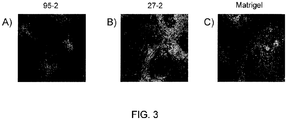
- FIG. 3 shows fluorescent images of differentiated cardiomyocytes cultured on surfaces of formulation 95-2 ( A ), formulation 27-2 ( B ), and MATRIGEL ( C ).
- Cell morphology, Nkx 2.5 marker expression (green) and alpha-actinin marker expression (red) are similar to MATRIGEL.
- the cells depicted in FIG. 3 exhibited beating prior to fixing with paraformaldehyde.
Landscapes
- Health & Medical Sciences (AREA)
- Engineering & Computer Science (AREA)
- Life Sciences & Earth Sciences (AREA)
- Biomedical Technology (AREA)
- Wood Science & Technology (AREA)
- Organic Chemistry (AREA)
- Chemical & Material Sciences (AREA)
- Zoology (AREA)
- Bioinformatics & Cheminformatics (AREA)
- Biotechnology (AREA)
- Genetics & Genomics (AREA)
- General Health & Medical Sciences (AREA)
- Microbiology (AREA)
- Biochemistry (AREA)
- General Engineering & Computer Science (AREA)
- Cell Biology (AREA)
- Rheumatology (AREA)
- Cardiology (AREA)
- Micro-Organisms Or Cultivation Processes Thereof (AREA)
- Apparatus Associated With Microorganisms And Enzymes (AREA)
- Polymerisation Methods In General (AREA)
- Immunology (AREA)
- Clinical Laboratory Science (AREA)
- Sustainable Development (AREA)
Claims (11)
- Culture de cellules d'un cardiomyocyte dérivé de cellule souche, comprenant :un article comprenant un matériau d'acrylate disposé sur une surface ;le cardiomyocyte dérivé de cellule souche disposé sur le matériau d'acrylate ; etun milieu de culture dans lequel le cardiomyocyte dérivé de cellule souche est cultivé, dans laquelle le matériau d'acrylate comprend(i) un homopolymère formé de diméthacrylate de glycérol, ou(ii) un copolymère formé de
diméthacrylate de glycérol et diacrylate de tétra(éthylène glycol),
diméthacrylate de glycérol et diméthacrylate de tri(éthylène glycol), ou
diméthacrylate de glycérol et diméthacrylate de 1,4-butanediol. - Culture selon la revendication 1, dans laquelle le matériau d'acrylate comprend un homopolymère formé de diméthacrylate de glycérol ou un copolymère formé de (i) diméthacrylate de glycérol et diméthacrylate de tri(éthylène glycol), ou (ii) diméthacrylate de glycérol et diméthacrylate de 1,4-butanediol.
- Culture selon la revendication 1, dans laquelle le matériau d'acrylate est essentiellement constitué d'un homopolymère formé de diméthacrylate de glycérol ou d'un copolymère formé de (i) diméthacrylate de glycérol et diméthacrylate de tri(éthylène glycol), ou (ii) diméthacrylate de glycérol et diméthacrylate de 1,4-butanediol.
- Culture selon la revendication 1, dans laquelle le milieu de culture est un milieu chimiquement défini.
- Culture selon la revendication 1, dans laquelle le cardiomyocyte dérivé de cellule souche est un cardiomyocyte dérivé de cellule souche embryonnaire humaine.
- Procédé de culture d'un cardiomyocyte dérivé de cellule souche, comprenant :le dépôt d'une suspension comprenant le cardiomyocyte dérivé de cellule souche sur un matériau d'acrylate ; etla culture du cardiomyocyte dérivé de cellule souche déposé dans un milieu de culture de cellules dans lequel le matériau d'acrylate comprend(i) un homopolymère formé de diméthacrylate de glycérol, ou(ii) un copolymère formé de
diméthacrylate de glycérol et diacrylate de tétra(éthylène glycol),
diméthacrylate de glycérol et diméthacrylate de tri(éthylène glycol), ou
diméthacrylate de glycérol et diméthacrylate de 1,4-butanediol. - Procédé selon la revendication 6, dans lequel la culture du cardiomyocyte dérivé de cellule souche déposé dans un milieu de culture de cellules comprend la culture du cardiomyocyte dans un milieu chimiquement défini.
- Procédé selon la revendication 6, dans lequel le matériau d'acrylate comprend un homopolymère formé de diméthacrylate de glycérol.
- Procédé selon la revendication 6, dans lequel le matériau d'acrylate comprend un copolymère formé de diméthacrylate de glycérol et de diméthacrylate de tri(éthylène glycol).
- Procédé selon la revendication 6, dans lequel le matériau d'acrylate comprend un copolymère formé de diméthacrylate de glycérol et de diméthacrylate de 1,4-butanediol.
- Procédé selon la revendication 6, dans lequel le cardiomyocyte dérivé de cellule souche est un cardiomyocyte dérivé de cellule souche embryonnaire humaine.
Applications Claiming Priority (2)
| Application Number | Priority Date | Filing Date | Title |
|---|---|---|---|
| US6292108P | 2008-01-30 | 2008-01-30 | |
| PCT/US2009/032411 WO2009097411A1 (fr) | 2008-01-30 | 2009-01-29 | Surfaces synthétiques pour la culture de cardiomyocytes issus de cellules souches |
Publications (3)
| Publication Number | Publication Date |
|---|---|
| EP2247718A1 EP2247718A1 (fr) | 2010-11-10 |
| EP2247718A4 EP2247718A4 (fr) | 2015-07-22 |
| EP2247718B1 true EP2247718B1 (fr) | 2019-01-16 |
Family
ID=40899641
Family Applications (1)
| Application Number | Title | Priority Date | Filing Date |
|---|---|---|---|
| EP09705923.2A Not-in-force EP2247718B1 (fr) | 2008-01-30 | 2009-01-29 | Surfaces synthétiques pour la culture de cardiomyocytes issus de cellules souches |
Country Status (10)
| Country | Link |
|---|---|
| US (4) | US8241907B2 (fr) |
| EP (1) | EP2247718B1 (fr) |
| JP (4) | JP2011510658A (fr) |
| KR (2) | KR101809863B1 (fr) |
| CN (2) | CN101939418A (fr) |
| AU (1) | AU2009209157B2 (fr) |
| CA (1) | CA2712891A1 (fr) |
| IL (1) | IL207083A (fr) |
| SG (1) | SG188098A1 (fr) |
| WO (1) | WO2009097411A1 (fr) |
Families Citing this family (23)
| Publication number | Priority date | Publication date | Assignee | Title |
|---|---|---|---|---|
| EP2247718B1 (fr) | 2008-01-30 | 2019-01-16 | Asterias Biotherapeutics, Inc. | Surfaces synthétiques pour la culture de cardiomyocytes issus de cellules souches |
| SG188096A1 (en) | 2008-01-30 | 2013-03-28 | Geron Corp | Synthetic surfaces for culturing stem cell derived oligodendrocyte progenitor cells |
| US9018010B2 (en) | 2009-11-12 | 2015-04-28 | Technion Research & Development Foundation Limited | Culture media, cell cultures and methods of culturing pluripotent stem cells in an undifferentiated state |
| US9453196B2 (en) | 2010-12-16 | 2016-09-27 | General Electric Company | Cell carrier, methods of making and use |
| US9453197B2 (en) | 2010-12-16 | 2016-09-27 | General Electric Company | Methods of making cell carrier |
| US9534206B2 (en) | 2010-12-16 | 2017-01-03 | General Electric Company | Cell carrier, associated methods for making cell carrier and culturing cells using the same |
| US9926523B2 (en) | 2010-12-16 | 2018-03-27 | General Electric Company | Cell carriers and methods for culturing cells |
| US9518249B2 (en) | 2010-12-16 | 2016-12-13 | General Electric Company | Cell carrier, associated methods for making cell carrier and culturing cells using the same |
| AU2012256403B2 (en) | 2011-03-17 | 2016-10-20 | Corning Incorporated | Synthetic coating for cell culture |
| WO2012135253A1 (fr) | 2011-03-29 | 2012-10-04 | Geron Corporation | Populations enrichies de cellules de lignée cardiomyocytaire issues de cellules souches pluripotentes |
| US10314594B2 (en) | 2012-12-14 | 2019-06-11 | Corquest Medical, Inc. | Assembly and method for left atrial appendage occlusion |
| US10813630B2 (en) | 2011-08-09 | 2020-10-27 | Corquest Medical, Inc. | Closure system for atrial wall |
| US10307167B2 (en) | 2012-12-14 | 2019-06-04 | Corquest Medical, Inc. | Assembly and method for left atrial appendage occlusion |
| US10512691B2 (en) * | 2012-04-23 | 2019-12-24 | The Regents Of The University Of Michigan | Systems and methods for targeted imaging and ablation of cardiac cells |
| US20140141503A1 (en) * | 2012-11-20 | 2014-05-22 | Corning Incorporated | Cell culture substrate having uniform surface coating |
| US20140142689A1 (en) | 2012-11-21 | 2014-05-22 | Didier De Canniere | Device and method of treating heart valve malfunction |
| US9566443B2 (en) | 2013-11-26 | 2017-02-14 | Corquest Medical, Inc. | System for treating heart valve malfunction including mitral regurgitation |
| JP2017521091A (ja) | 2014-05-15 | 2017-08-03 | ケルベンクス インコーポレイテッド | 診断試験用の胎児有核赤血球(nrbc)の調製 |
| US10842626B2 (en) | 2014-12-09 | 2020-11-24 | Didier De Canniere | Intracardiac device to correct mitral regurgitation |
| JP6865264B2 (ja) * | 2016-07-05 | 2021-04-28 | コリア アドバンスト インスティテュート オブ サイエンスアンド テクノロジーKorea Advanced Institute Of Science And Technology | 細胞シート製作方法及び応用のための高分子薄膜培養プレート製作方法及び用途 |
| WO2020223596A1 (fr) | 2019-05-02 | 2020-11-05 | Kellbenx Incorporated | Procédés basés sur la filtration pour préparer des globules rouges nucléés foetaux (nrbc) pour un test diagnostique |
| CN110791416A (zh) * | 2019-11-11 | 2020-02-14 | 浙江赛宁生物科技有限公司 | 培养皿和培养皿制作方法 |
| KR102553945B1 (ko) * | 2021-05-25 | 2023-07-11 | 서울대학교산학협력단 | 세포 배양용 소자 및 이의 제조 방법 |
Family Cites Families (130)
| Publication number | Priority date | Publication date | Assignee | Title |
|---|---|---|---|---|
| US3502545A (en) | 1968-09-27 | 1970-03-24 | Monsanto Co | Process for the separation of water-soluble polymeric materials from unbound protein or peptide using semiporous gel |
| AR208398A1 (es) | 1974-03-29 | 1976-12-27 | Smith & Nephew Res | Un copolimero hidrogel ligeramente entrelazado |
| JPS58146280A (ja) | 1982-02-26 | 1983-08-31 | Japan Atom Energy Res Inst | 増殖能を有する酵母固定化物の製造方法 |
| US4792525A (en) * | 1982-08-04 | 1988-12-20 | La Jolla Cancer Research Foundation | Tetrapeptide |
| US4578079A (en) * | 1982-08-04 | 1986-03-25 | La Jolla Cancer Research Foundation | Tetrapeptide |
| US5695997A (en) * | 1982-08-04 | 1997-12-09 | La Jolla Cancer Research Foundation | Tetrapeptide |
| JPS5993733A (ja) | 1982-11-19 | 1984-05-30 | Mitsui Petrochem Ind Ltd | 被覆用硬化型樹脂組成物 |
| US5916875A (en) * | 1983-11-22 | 1999-06-29 | La Jolla Cancer Research Foundation | Tetrapeptide |
| US4908236A (en) * | 1986-12-04 | 1990-03-13 | Millipore Corporation | Transparent porous membrane having hydrophilic surface and process |
| EP0355112A1 (fr) | 1987-04-22 | 1990-02-28 | Michael Bay | Procedes de culture de cellules, et produits |
| US5173421A (en) * | 1988-12-14 | 1992-12-22 | Mitsubishi Kasei Corporation | Cell culture carriers |
| US5330911A (en) * | 1989-09-28 | 1994-07-19 | Board Of Regents, The University Of Texas System | Surfaces having desirable cell adhesive effects |
| US5278063A (en) * | 1989-09-28 | 1994-01-11 | Board Of Regents The University Of Texas System | Chemical modification of promote animal cell adhesion on surfaces |
| EP0450254A1 (fr) | 1990-04-03 | 1991-10-09 | Ciba-Geigy Ag | Compositions photodurcissables |
| DE69118826T2 (de) | 1990-11-27 | 1996-11-14 | Fuji Photo Film Co Ltd | Propenamidderivate, deren Polymere, Copolymere und deren Verwendung |
| WO1992013066A1 (fr) | 1991-01-24 | 1992-08-06 | Loyola University Of Chicago | Ligne cellulaire de myocyte cardiaque de mammifere |
| US5543318A (en) * | 1991-06-12 | 1996-08-06 | Smith; David A. | Method of isolation, culture and proliferation of human atrial myocytes |
| JP3182662B2 (ja) | 1992-02-26 | 2001-07-03 | 三菱レイヨン株式会社 | 被覆材組成物 |
| AU673160B2 (en) * | 1992-02-28 | 1996-10-31 | Board Of Regents, The University Of Texas System | Photopolymerizable biodegradable hydrogels as tissue contacting materials and controlled-release carriers |
| EP0567886A3 (fr) * | 1992-04-21 | 1994-11-02 | Kurashiki Boseki Kk | Composition pour une couche pour la culture de cellules adhésives animales et procédé de culture des cellules dans un milieu sans sérum. |
| WO1994007931A1 (fr) * | 1992-09-29 | 1994-04-14 | Toray Industries, Inc. | Materiau hydrophile et membrane semi-permeable realisee a partir dudit materiau |
| US5523226A (en) * | 1993-05-14 | 1996-06-04 | Biotechnology Research And Development Corp. | Transgenic swine compositions and methods |
| JPH078273A (ja) * | 1993-06-14 | 1995-01-13 | Kurabo Ind Ltd | 接着性動物細胞の無血清培養法 |
| US6284503B1 (en) | 1993-08-20 | 2001-09-04 | University Of Utah Research Foundation | Composition and method for regulating the adhesion of cells and biomolecules to hydrophobic surfaces |
| US6015671A (en) * | 1995-06-07 | 2000-01-18 | Indiana University Foundation | Myocardial grafts and cellular compositions |
| US5602301A (en) * | 1993-11-16 | 1997-02-11 | Indiana University Foundation | Non-human mammal having a graft and methods of delivering protein to myocardial tissue |
| DE4441327C1 (de) * | 1994-11-22 | 1995-11-09 | Inst Pflanzengenetik & Kultur | Embryonale Herzmuskelzellen, ihre Herstellung und ihre Verwendung |
| US5843780A (en) * | 1995-01-20 | 1998-12-01 | Wisconsin Alumni Research Foundation | Primate embryonic stem cells |
| US6074614A (en) | 1995-06-07 | 2000-06-13 | Molecular Devices Corporation | Multi-assay plate cover for elimination of meniscus |
| US20020061837A1 (en) * | 1996-09-05 | 2002-05-23 | Lough John W. | Bone morphogenetic protein and fibroblast growth factor compositions and methods for the induction of cardiogenesis |
| US6261836B1 (en) * | 1996-10-01 | 2001-07-17 | Geron Corporation | Telomerase |
| US6331406B1 (en) * | 1997-03-31 | 2001-12-18 | The John Hopkins University School Of Medicine | Human enbryonic germ cell and methods of use |
| US6099832A (en) * | 1997-05-28 | 2000-08-08 | Genzyme Corporation | Transplants for myocardial scars |
| US6110459A (en) * | 1997-05-28 | 2000-08-29 | Mickle; Donald A. G. | Transplants for myocardial scars and methods and cellular preparations |
| US6387369B1 (en) * | 1997-07-14 | 2002-05-14 | Osiris Therapeutics, Inc. | Cardiac muscle regeneration using mesenchymal stem cells |
| US5986020A (en) * | 1997-08-05 | 1999-11-16 | Campbell; J. David | Process for producing hyperbranched polymers |
| US6121027A (en) * | 1997-08-15 | 2000-09-19 | Surmodics, Inc. | Polybifunctional reagent having a polymeric backbone and photoreactive moieties and bioactive groups |
| US6316522B1 (en) * | 1997-08-18 | 2001-11-13 | Scimed Life Systems, Inc. | Bioresorbable hydrogel compositions for implantable prostheses |
| CA2307807C (fr) | 1997-10-23 | 2008-09-02 | Andrea G. Bodnar | Procedes et matieres utiles pour la croissance de cellules souches primordiales de primate |
| EP1032475A1 (fr) * | 1997-11-20 | 2000-09-06 | E.I. Dupont De Nemours And Company | Procede de laquage multicouche de substrats |
| DE19755800A1 (de) | 1997-12-16 | 1999-06-17 | Merck Patent Gmbh | Cyclopeptidderivate |
| AU3112499A (en) | 1998-03-23 | 1999-10-18 | Zymogenetics Inc. | Cardiac-derived stem cells |
| DE69937888T2 (de) | 1998-07-31 | 2009-01-02 | Genzyme Corp., Cambridge | Verfahren zur Herstellung mesenchymaler Stammzellen |
| US7368420B1 (en) * | 1998-10-02 | 2008-05-06 | Caritas St. Elizabeth's Medical Center Of Boston, Inc. | Akt compositions for enhancing survival of cells |
| US6667176B1 (en) | 2000-01-11 | 2003-12-23 | Geron Corporation | cDNA libraries reflecting gene expression during growth and differentiation of human pluripotent stem cells |
| IL129966A (en) | 1999-05-14 | 2009-12-24 | Technion Res & Dev Foundation | ISOLATED HUMAN EMBRYOID BODIES (hEB) DERIVED FROM HUMAN EMBRYONIC STEM CELLS |
| AU783935B2 (en) | 1999-06-18 | 2006-01-05 | Indiana University Research And Technology Corporation | Cardiomyocytes with enhanced proliferative potential, and methods for preparing and using same |
| EP1221956A2 (fr) | 1999-09-30 | 2002-07-17 | McGILL UNIVERSITY | Transplantation de cellules souches (msc) de moelle osseuse autologues en vue de la regeneration myocardique |
| US20020142457A1 (en) * | 1999-12-28 | 2002-10-03 | Akihiro Umezawa | Cell having the potentiality of differentiation into cardiomyocytes |
| EP1254952A4 (fr) | 1999-12-28 | 2004-09-22 | Kyowa Hakko Kogyo Kk | Cellules pouvant induire une differenciation dans des cellules du muscle cardiaque |
| WO2001049240A2 (fr) * | 2000-01-05 | 2001-07-12 | Novartis Ag | Hydrogels |
| AU2001229731A1 (en) | 2000-01-21 | 2001-07-31 | The Johns Hopkins University School Of Medicine | Human embryoid body-derived cells |
| AU2001243551A1 (en) | 2000-03-10 | 2001-09-24 | Indiana University Research & Technology Corporation | Multipotent cell and cardiomyocyte cell populations, and routes to and uses of same |
| JP2001309682A (ja) | 2000-04-20 | 2001-11-02 | Matsushita Electric Ind Co Ltd | スピンドルモータ駆動方法およびスピンドルモータ駆動回路と磁気ディスク駆動方法および磁気ディスク装置 |
| US6458589B1 (en) * | 2000-04-27 | 2002-10-01 | Geron Corporation | Hepatocyte lineage cells derived from pluripotent stem cells |
| WO2002006373A1 (fr) | 2000-07-17 | 2002-01-24 | University Of Utah Research Foundation | Films d'hydrogel et procedes de fabrication et d'utilisation de ces films |
| US20020061587A1 (en) | 2000-07-31 | 2002-05-23 | Piero Anversa | Methods and compositions for the repair and/or regeneration of damaged myocardium |
| WO2002013760A2 (fr) | 2000-07-31 | 2002-02-21 | New York Medical College | Procedes et compositions permettant la reparation et/ou la regeneration de myocarde endommage |
| JP2004504834A (ja) | 2000-08-01 | 2004-02-19 | イスム リサーチ ディベロップメント カンパニー | 胚性細胞の定方向分化 |
| US6607720B1 (en) | 2000-09-05 | 2003-08-19 | Yong-Fu Xiao | Genetically altered mammalian embryonic stem cells, their living progeny, and their therapeutic application for improving cardiac function after myocardial infarction |
| US6534052B1 (en) * | 2000-09-05 | 2003-03-18 | Yong-Fu Xiao | Cardiac function comprising implantation of embryonic stem cell in which differentiation has been initiated |
| US20040224283A1 (en) | 2000-09-26 | 2004-11-11 | Sun Benjamin J. | Method of forming a dental product |
| JP2002191353A (ja) | 2000-10-17 | 2002-07-09 | Sanyo Chem Ind Ltd | 細胞培養支持体及びその製造方法 |
| US7575939B2 (en) | 2000-10-30 | 2009-08-18 | Sru Biosystems, Inc. | Optical detection of label-free biomolecular interactions using microreplicated plastic sensor elements |
| DE60230593D1 (de) | 2001-02-06 | 2009-02-12 | Massachusetts Inst Technology | Peptidgerüstverkapselung von gewebszellen und verwendungen davon |
| US20030031651A1 (en) | 2001-04-13 | 2003-02-13 | Lee Ike W. | Methods and reagents for cell transplantation |
| EP1423093A4 (fr) * | 2001-04-23 | 2005-11-30 | Wisconsin Alumni Res Found | Hydrogels modifies bifonctionnels |
| US20050276858A1 (en) * | 2001-04-23 | 2005-12-15 | Kao Weiyuan J | Bifunctional-modified hydrogels |
| US6844028B2 (en) * | 2001-06-26 | 2005-01-18 | Accelr8 Technology Corporation | Functional surface coating |
| WO2003006950A2 (fr) | 2001-07-12 | 2003-01-23 | Geron Corporation | Cellules de la lignee des cardiomyocytes produites a partir de cellules souches humaines pluripotentielles |
| US7732199B2 (en) * | 2001-07-12 | 2010-06-08 | Geron Corporation | Process for making transplantable cardiomyocytes from human embryonic stem cells |
| US6598586B2 (en) * | 2001-07-17 | 2003-07-29 | Murray, Inc. | Dual arm choke and throttle control |
| WO2003008535A2 (fr) * | 2001-07-20 | 2003-01-30 | Technion Research And Development Foundation Ltd. | Procedes pour realiser des cellules et des tissus cardiaques humains et applications associees |
| EP1421182A4 (fr) * | 2001-07-24 | 2005-03-23 | Es Cell Int Pte Ltd | Methodes destinees a induire une differenciation de cellules souches |
| JP2005506839A (ja) | 2001-10-02 | 2005-03-10 | ベクトン・ディキンソン・アンド・カンパニー | 細胞外マトリックスおよび他の分子を使用する幹細胞の増殖および分化 |
| WO2003053216A2 (fr) * | 2001-12-06 | 2003-07-03 | University Of Washington | Structures poreuses biodegradables utiles pour la croissance de tissus vivants et procedes de fabrication associes |
| US20030180268A1 (en) * | 2002-02-05 | 2003-09-25 | Anthony Atala | Tissue engineered construct for supplementing or replacing a damaged organ |
| US20070026518A1 (en) * | 2005-03-29 | 2007-02-01 | The Regents Of The University Of California | Controlling stem cell destiny with tunable matrices |
| NZ535243A (en) * | 2002-03-15 | 2008-05-30 | Wicell Res Inst Inc | Method for generating primate trophoblasts |
| US7247477B2 (en) | 2002-04-16 | 2007-07-24 | Technion Research & Development Foundation Ltd. | Methods for the in-vitro identification, isolation and differentiation of vasculogenic progenitor cells |
| EP1539799B1 (fr) | 2002-06-21 | 2013-12-11 | The University of Utah Research Foundation | Composés reticulés et leurs procédés de préparation et d'utilisation |
| US6898272B2 (en) * | 2002-08-01 | 2005-05-24 | Spirent Communications | System and method for testing telecommunication devices |
| US20050019747A1 (en) * | 2002-08-07 | 2005-01-27 | Anderson Daniel G. | Nanoliter-scale synthesis of arrayed biomaterials and screening thereof |
| DE60312525T2 (de) * | 2002-08-09 | 2007-12-06 | Ottawa Health Research Institute, Ottawa | Biosynthetische matrix und deren verwendung |
| JP2004129561A (ja) | 2002-10-10 | 2004-04-30 | Masahiro Sakanaka | 神経系前駆細胞及びその作製方法 |
| US7569222B2 (en) | 2002-11-18 | 2009-08-04 | Woerly Stephane | Hydrogel membrane composition and use thereof |
| WO2004055057A1 (fr) * | 2002-12-18 | 2004-07-01 | The University Of Melbourne | Preparation hydrogel et processus de fabrication de celle-ci |
| KR101113201B1 (ko) | 2003-02-19 | 2012-04-12 | 나트릭스 세퍼레이션즈, 인코포레이티드 | 지지된 다공성 젤을 함유하는 복합재 |
| WO2005021634A2 (fr) | 2003-02-20 | 2005-03-10 | Texas Research International, Inc. | Compositions a sechage ultraviolet destinees a la reparation de composites |
| AU2003901099A0 (en) | 2003-03-11 | 2003-03-27 | Es Cell International Pte Ltd. | Methods of inducing differentiation of stem cells |
| US8304238B2 (en) * | 2003-03-24 | 2012-11-06 | Nat'l Institute for Environmental Studies | Cell culture medium and immobilized preparation of cell adhesion protein or peptide |
| US20040197557A1 (en) | 2003-03-27 | 2004-10-07 | Eshraghi Ray R | Process for manufacturing hollow fibers |
| CN1835763B (zh) | 2003-06-20 | 2011-04-20 | 妙甯公司 | Ccn1组合物和方法 |
| AR046076A1 (es) * | 2003-07-18 | 2005-11-23 | Otsuka Pharma Co Ltd | Procedimiento para obtener una poblacion homogenea de celulas precursoras de oligodendrocitos y poblacion obtenida |
| EP1651706A1 (fr) * | 2003-08-06 | 2006-05-03 | The Procter & Gamble Company | Matiere gonflable dans l'eau revetue |
| US7074615B2 (en) * | 2003-08-15 | 2006-07-11 | Becton, Dickinson And Company | Peptides for enhanced cell attachment and cell growth |
| US20070167354A1 (en) * | 2003-08-28 | 2007-07-19 | Kennedy Chad E | Hydrogels for modulating cell migration and matrix deposition |
| EP1675943A4 (fr) * | 2003-09-15 | 2007-12-05 | Massachusetts Inst Technology | Synthese, a l'echelle du nanolitre, de biomateriaux en reseaux et criblage de ceux-ci |
| US20050136536A1 (en) * | 2003-09-15 | 2005-06-23 | Anderson Daniel G. | Embryonic epithelial cells |
| US20050059150A1 (en) * | 2003-09-17 | 2005-03-17 | Becton, Dickinson And Company | Environments that maintain function of primary liver cells |
| US7384984B2 (en) * | 2003-12-10 | 2008-06-10 | 3M Innovative Properties Company | Reactive hydrophilic oligomers |
| US20050266554A1 (en) * | 2004-04-27 | 2005-12-01 | D Amour Kevin A | PDX1 expressing endoderm |
| US20050214938A1 (en) * | 2004-03-26 | 2005-09-29 | Gold Joseph D | Cardiac bodies: clusters of spontaneously contracting cells for regenerating cardiac function |
| US7452718B2 (en) * | 2004-03-26 | 2008-11-18 | Geron Corporation | Direct differentiation method for making cardiomyocytes from human embryonic stem cells |
| JP2007536936A (ja) * | 2004-05-14 | 2007-12-20 | ベクトン・ディキンソン・アンド・カンパニー | 幹細胞集団および使用方法 |
| WO2005115490A2 (fr) * | 2004-05-25 | 2005-12-08 | Surmodics, Inc. | Procede et reactif destines a preparer des revetements contenant des molecules biologiques |
| JP2006042794A (ja) | 2004-06-28 | 2006-02-16 | Sanyo Chem Ind Ltd | 細胞培養用樹脂ビーズ |
| JP2006174826A (ja) | 2004-11-24 | 2006-07-06 | Sanyo Chem Ind Ltd | 細胞培養用感温膨潤性樹脂ビーズ |
| JPWO2006087809A1 (ja) | 2005-02-18 | 2008-07-03 | シーシーアイ株式会社 | 熱媒体液組成物 |
| US20060228386A1 (en) * | 2005-02-22 | 2006-10-12 | University Of Tennessee Research Foundation | Polymeric microstructures |
| JP4710008B2 (ja) * | 2005-04-20 | 2011-06-29 | 国立大学法人東北大学 | 高代謝能を有する培養筋細胞の作製方法 |
| WO2006138718A2 (fr) | 2005-06-17 | 2006-12-28 | Drexel University | Echafaudages en trois dimensions destines a modifier des tissus fabriques par traitement d'extraits complexes de matrices extracellulaires naturelles |
| WO2007012050A2 (fr) | 2005-07-20 | 2007-01-25 | Surmodics, Inc. | Structures nanofibrilaires revetues de polymere et procedes de maintenance et de differenciation cellulaire |
| GB2443370A (en) | 2005-07-29 | 2008-04-30 | Australian Stem Cell Ct Ltd | Compositions and methods for growth of pluripotent cells |
| US20070029924A1 (en) * | 2005-08-03 | 2007-02-08 | Nobuyuki Ushifusa | Image display device |
| WO2007120999A2 (fr) * | 2006-03-06 | 2007-10-25 | Bio-Rad Laboratories, Inc. | Chélation de monomères et de polymères |
| JP2009529589A (ja) | 2006-03-15 | 2009-08-20 | ザ・ユニバーシティ・オブ・シドニー | 生体分子に結合する活性化ポリマー |
| US8241908B2 (en) * | 2006-05-16 | 2012-08-14 | Becton, Dickinson And Company | Extracellular matrix coated surface for culturing cells |
| MX2009007101A (es) | 2006-12-29 | 2009-12-01 | Univ Washington | Superficies y materiales antibioincrustación bifuncionales. |
| CN101663600B (zh) | 2007-02-09 | 2011-06-15 | 三菱丽阳株式会社 | 透明成形体及使用其的防反射物品 |
| US8038013B2 (en) | 2007-03-06 | 2011-10-18 | E.I. Du Pont De Nemours And Company | Liquid filtration media |
| US8501905B2 (en) | 2007-03-22 | 2013-08-06 | The Regents Of The University Of California | Synthetic cell platforms and methods of use thereof |
| US8574906B2 (en) * | 2007-08-09 | 2013-11-05 | Corning Incorporated | Cell culture surfaces having hydrogel supported proteins |
| JP2010538108A (ja) | 2007-08-31 | 2010-12-09 | コーニング インコーポレイテッド | 高分子基板の反応表面 |
| US20090110907A1 (en) | 2007-10-29 | 2009-04-30 | Jiang Dayue D | Membranes Based On Poly (Vinyl Alcohol-Co-Vinylamine) |
| SG188096A1 (en) * | 2008-01-30 | 2013-03-28 | Geron Corp | Synthetic surfaces for culturing stem cell derived oligodendrocyte progenitor cells |
| EP2247718B1 (fr) | 2008-01-30 | 2019-01-16 | Asterias Biotherapeutics, Inc. | Surfaces synthétiques pour la culture de cardiomyocytes issus de cellules souches |
| US8329469B2 (en) * | 2008-01-30 | 2012-12-11 | Geron Corporation | Swellable (meth)acrylate surfaces for culturing cells in chemically defined media |
| US8354274B2 (en) | 2008-01-30 | 2013-01-15 | Geron Corporation | Synthetic surfaces for culturing cells in chemically defined media |
| TW201042038A (en) | 2009-05-28 | 2010-12-01 | Corning Inc | Synthetic microcarriers for culturing cells |
-
2009
- 2009-01-29 EP EP09705923.2A patent/EP2247718B1/fr not_active Not-in-force
- 2009-01-29 WO PCT/US2009/032411 patent/WO2009097411A1/fr not_active Ceased
- 2009-01-29 KR KR1020167026656A patent/KR101809863B1/ko not_active Expired - Fee Related
- 2009-01-29 CA CA2712891A patent/CA2712891A1/fr not_active Abandoned
- 2009-01-29 CN CN2009801039222A patent/CN101939418A/zh active Pending
- 2009-01-29 SG SG2013007612A patent/SG188098A1/en unknown
- 2009-01-29 KR KR1020107019066A patent/KR20110005682A/ko not_active Ceased
- 2009-01-29 JP JP2010545155A patent/JP2011510658A/ja active Pending
- 2009-01-29 AU AU2009209157A patent/AU2009209157B2/en not_active Ceased
- 2009-01-29 US US12/362,190 patent/US8241907B2/en not_active Expired - Fee Related
- 2009-01-29 CN CN201510866478.7A patent/CN105400735A/zh active Pending
-
2010
- 2010-07-19 IL IL207083A patent/IL207083A/en active IP Right Grant
-
2012
- 2012-07-11 US US13/546,381 patent/US8563312B2/en not_active Expired - Fee Related
-
2013
- 2013-09-17 US US14/028,808 patent/US9243229B2/en not_active Expired - Fee Related
-
2014
- 2014-08-04 JP JP2014158599A patent/JP5933647B2/ja not_active Expired - Fee Related
-
2016
- 2016-01-25 US US15/005,397 patent/US9745550B2/en not_active Expired - Fee Related
- 2016-05-02 JP JP2016092437A patent/JP6596381B2/ja not_active Expired - Fee Related
-
2019
- 2019-09-30 JP JP2019178458A patent/JP2020022466A/ja active Pending
Non-Patent Citations (1)
| Title |
|---|
| None * |
Also Published As
| Publication number | Publication date |
|---|---|
| US8563312B2 (en) | 2013-10-22 |
| KR20160117630A (ko) | 2016-10-10 |
| AU2009209157B2 (en) | 2015-06-11 |
| EP2247718A1 (fr) | 2010-11-10 |
| SG188098A1 (en) | 2013-03-28 |
| US20160137983A1 (en) | 2016-05-19 |
| JP2011510658A (ja) | 2011-04-07 |
| JP5933647B2 (ja) | 2016-06-15 |
| JP2016171808A (ja) | 2016-09-29 |
| CN101939418A (zh) | 2011-01-05 |
| JP6596381B2 (ja) | 2019-10-23 |
| US20090191633A1 (en) | 2009-07-30 |
| US9745550B2 (en) | 2017-08-29 |
| IL207083A0 (en) | 2010-12-30 |
| EP2247718A4 (fr) | 2015-07-22 |
| JP2014236741A (ja) | 2014-12-18 |
| JP2020022466A (ja) | 2020-02-13 |
| CA2712891A1 (fr) | 2009-08-06 |
| CN105400735A (zh) | 2016-03-16 |
| US20120276626A1 (en) | 2012-11-01 |
| US8241907B2 (en) | 2012-08-14 |
| KR101809863B1 (ko) | 2017-12-15 |
| WO2009097411A1 (fr) | 2009-08-06 |
| AU2009209157A1 (en) | 2009-08-06 |
| US20140134725A1 (en) | 2014-05-15 |
| KR20110005682A (ko) | 2011-01-18 |
| IL207083A (en) | 2017-10-31 |
| US9243229B2 (en) | 2016-01-26 |
Similar Documents
| Publication | Publication Date | Title |
|---|---|---|
| EP2247718B1 (fr) | Surfaces synthétiques pour la culture de cardiomyocytes issus de cellules souches | |
| US10221390B2 (en) | Synthetic surfaces for culturing stem cell derived oligodendrocyte progenitor cells | |
| AU2015203433B2 (en) | Synthetic surfaces for culturing stem cell derived oligodendrocyte progenitor cells | |
| HK1152727A (en) | Synthetic surfaces for culturing stem cell derived cardiomyocytes | |
| HK1148546A (en) | Synthetic surfaces for culturing stem cell derived oligodendrocyte progenitor cells | |
| HK1148546B (en) | Synthetic surfaces for culturing stem cell derived oligodendrocyte progenitor cells |
Legal Events
| Date | Code | Title | Description |
|---|---|---|---|
| PUAI | Public reference made under article 153(3) epc to a published international application that has entered the european phase |
Free format text: ORIGINAL CODE: 0009012 |
|
| 17P | Request for examination filed |
Effective date: 20100820 |
|
| AK | Designated contracting states |
Kind code of ref document: A1 Designated state(s): AT BE BG CH CY CZ DE DK EE ES FI FR GB GR HR HU IE IS IT LI LT LU LV MC MK MT NL NO PL PT RO SE SI SK TR |
|
| AX | Request for extension of the european patent |
Extension state: AL BA RS |
|
| DAX | Request for extension of the european patent (deleted) | ||
| RAP1 | Party data changed (applicant data changed or rights of an application transferred) |
Owner name: ASTERIAS BIOTHERAPEUTICS, INC. |
|
| RIC1 | Information provided on ipc code assigned before grant |
Ipc: C12N 5/077 20100101ALI20150312BHEP Ipc: C12N 5/00 20060101AFI20150312BHEP |
|
| RA4 | Supplementary search report drawn up and despatched (corrected) |
Effective date: 20150622 |
|
| RIC1 | Information provided on ipc code assigned before grant |
Ipc: C12N 5/00 20060101AFI20150616BHEP Ipc: C12N 5/077 20100101ALI20150616BHEP |
|
| 17Q | First examination report despatched |
Effective date: 20160603 |
|
| STAA | Information on the status of an ep patent application or granted ep patent |
Free format text: STATUS: EXAMINATION IS IN PROGRESS |
|
| GRAP | Despatch of communication of intention to grant a patent |
Free format text: ORIGINAL CODE: EPIDOSNIGR1 |
|
| STAA | Information on the status of an ep patent application or granted ep patent |
Free format text: STATUS: GRANT OF PATENT IS INTENDED |
|
| INTG | Intention to grant announced |
Effective date: 20180803 |
|
| GRAS | Grant fee paid |
Free format text: ORIGINAL CODE: EPIDOSNIGR3 |
|
| GRAA | (expected) grant |
Free format text: ORIGINAL CODE: 0009210 |
|
| STAA | Information on the status of an ep patent application or granted ep patent |
Free format text: STATUS: THE PATENT HAS BEEN GRANTED |
|
| RAP1 | Party data changed (applicant data changed or rights of an application transferred) |
Owner name: ASTERIAS BIOTHERAPEUTICS, INC. |
|
| AK | Designated contracting states |
Kind code of ref document: B1 Designated state(s): AT BE BG CH CY CZ DE DK EE ES FI FR GB GR HR HU IE IS IT LI LT LU LV MC MK MT NL NO PL PT RO SE SI SK TR |
|
| REG | Reference to a national code |
Ref country code: GB Ref legal event code: FG4D |
|
| REG | Reference to a national code |
Ref country code: CH Ref legal event code: EP |
|
| REG | Reference to a national code |
Ref country code: IE Ref legal event code: FG4D |
|
| REG | Reference to a national code |
Ref country code: DE Ref legal event code: R096 Ref document number: 602009056720 Country of ref document: DE |
|
| REG | Reference to a national code |
Ref country code: AT Ref legal event code: REF Ref document number: 1089713 Country of ref document: AT Kind code of ref document: T Effective date: 20190215 |
|
| PGFP | Annual fee paid to national office [announced via postgrant information from national office to epo] |
Ref country code: DE Payment date: 20190228 Year of fee payment: 11 Ref country code: GB Payment date: 20190131 Year of fee payment: 11 Ref country code: CH Payment date: 20190315 Year of fee payment: 11 Ref country code: IE Payment date: 20190319 Year of fee payment: 11 |
|
| REG | Reference to a national code |
Ref country code: NL Ref legal event code: MP Effective date: 20190116 |
|
| REG | Reference to a national code |
Ref country code: LT Ref legal event code: MG4D |
|
| PG25 | Lapsed in a contracting state [announced via postgrant information from national office to epo] |
Ref country code: NL Free format text: LAPSE BECAUSE OF FAILURE TO SUBMIT A TRANSLATION OF THE DESCRIPTION OR TO PAY THE FEE WITHIN THE PRESCRIBED TIME-LIMIT Effective date: 20190116 |
|
| REG | Reference to a national code |
Ref country code: AT Ref legal event code: MK05 Ref document number: 1089713 Country of ref document: AT Kind code of ref document: T Effective date: 20190116 |
|
| PG25 | Lapsed in a contracting state [announced via postgrant information from national office to epo] |
Ref country code: PL Free format text: LAPSE BECAUSE OF FAILURE TO SUBMIT A TRANSLATION OF THE DESCRIPTION OR TO PAY THE FEE WITHIN THE PRESCRIBED TIME-LIMIT Effective date: 20190116 Ref country code: SE Free format text: LAPSE BECAUSE OF FAILURE TO SUBMIT A TRANSLATION OF THE DESCRIPTION OR TO PAY THE FEE WITHIN THE PRESCRIBED TIME-LIMIT Effective date: 20190116 Ref country code: ES Free format text: LAPSE BECAUSE OF FAILURE TO SUBMIT A TRANSLATION OF THE DESCRIPTION OR TO PAY THE FEE WITHIN THE PRESCRIBED TIME-LIMIT Effective date: 20190116 Ref country code: LT Free format text: LAPSE BECAUSE OF FAILURE TO SUBMIT A TRANSLATION OF THE DESCRIPTION OR TO PAY THE FEE WITHIN THE PRESCRIBED TIME-LIMIT Effective date: 20190116 Ref country code: PT Free format text: LAPSE BECAUSE OF FAILURE TO SUBMIT A TRANSLATION OF THE DESCRIPTION OR TO PAY THE FEE WITHIN THE PRESCRIBED TIME-LIMIT Effective date: 20190516 Ref country code: NO Free format text: LAPSE BECAUSE OF FAILURE TO SUBMIT A TRANSLATION OF THE DESCRIPTION OR TO PAY THE FEE WITHIN THE PRESCRIBED TIME-LIMIT Effective date: 20190416 Ref country code: FI Free format text: LAPSE BECAUSE OF FAILURE TO SUBMIT A TRANSLATION OF THE DESCRIPTION OR TO PAY THE FEE WITHIN THE PRESCRIBED TIME-LIMIT Effective date: 20190116 |
|
| PG25 | Lapsed in a contracting state [announced via postgrant information from national office to epo] |
Ref country code: IS Free format text: LAPSE BECAUSE OF FAILURE TO SUBMIT A TRANSLATION OF THE DESCRIPTION OR TO PAY THE FEE WITHIN THE PRESCRIBED TIME-LIMIT Effective date: 20190516 Ref country code: BG Free format text: LAPSE BECAUSE OF FAILURE TO SUBMIT A TRANSLATION OF THE DESCRIPTION OR TO PAY THE FEE WITHIN THE PRESCRIBED TIME-LIMIT Effective date: 20190416 Ref country code: HR Free format text: LAPSE BECAUSE OF FAILURE TO SUBMIT A TRANSLATION OF THE DESCRIPTION OR TO PAY THE FEE WITHIN THE PRESCRIBED TIME-LIMIT Effective date: 20190116 Ref country code: GR Free format text: LAPSE BECAUSE OF FAILURE TO SUBMIT A TRANSLATION OF THE DESCRIPTION OR TO PAY THE FEE WITHIN THE PRESCRIBED TIME-LIMIT Effective date: 20190417 Ref country code: LV Free format text: LAPSE BECAUSE OF FAILURE TO SUBMIT A TRANSLATION OF THE DESCRIPTION OR TO PAY THE FEE WITHIN THE PRESCRIBED TIME-LIMIT Effective date: 20190116 |
|
| PG25 | Lapsed in a contracting state [announced via postgrant information from national office to epo] |
Ref country code: LU Free format text: LAPSE BECAUSE OF NON-PAYMENT OF DUE FEES Effective date: 20190129 |
|
| REG | Reference to a national code |
Ref country code: BE Ref legal event code: MM Effective date: 20190131 Ref country code: DE Ref legal event code: R097 Ref document number: 602009056720 Country of ref document: DE |
|
| PG25 | Lapsed in a contracting state [announced via postgrant information from national office to epo] |
Ref country code: SK Free format text: LAPSE BECAUSE OF FAILURE TO SUBMIT A TRANSLATION OF THE DESCRIPTION OR TO PAY THE FEE WITHIN THE PRESCRIBED TIME-LIMIT Effective date: 20190116 Ref country code: MC Free format text: LAPSE BECAUSE OF FAILURE TO SUBMIT A TRANSLATION OF THE DESCRIPTION OR TO PAY THE FEE WITHIN THE PRESCRIBED TIME-LIMIT Effective date: 20190116 Ref country code: DK Free format text: LAPSE BECAUSE OF FAILURE TO SUBMIT A TRANSLATION OF THE DESCRIPTION OR TO PAY THE FEE WITHIN THE PRESCRIBED TIME-LIMIT Effective date: 20190116 Ref country code: AT Free format text: LAPSE BECAUSE OF FAILURE TO SUBMIT A TRANSLATION OF THE DESCRIPTION OR TO PAY THE FEE WITHIN THE PRESCRIBED TIME-LIMIT Effective date: 20190116 Ref country code: CZ Free format text: LAPSE BECAUSE OF FAILURE TO SUBMIT A TRANSLATION OF THE DESCRIPTION OR TO PAY THE FEE WITHIN THE PRESCRIBED TIME-LIMIT Effective date: 20190116 Ref country code: IT Free format text: LAPSE BECAUSE OF FAILURE TO SUBMIT A TRANSLATION OF THE DESCRIPTION OR TO PAY THE FEE WITHIN THE PRESCRIBED TIME-LIMIT Effective date: 20190116 Ref country code: RO Free format text: LAPSE BECAUSE OF FAILURE TO SUBMIT A TRANSLATION OF THE DESCRIPTION OR TO PAY THE FEE WITHIN THE PRESCRIBED TIME-LIMIT Effective date: 20190116 Ref country code: EE Free format text: LAPSE BECAUSE OF FAILURE TO SUBMIT A TRANSLATION OF THE DESCRIPTION OR TO PAY THE FEE WITHIN THE PRESCRIBED TIME-LIMIT Effective date: 20190116 |
|
| PLBE | No opposition filed within time limit |
Free format text: ORIGINAL CODE: 0009261 |
|
| STAA | Information on the status of an ep patent application or granted ep patent |
Free format text: STATUS: NO OPPOSITION FILED WITHIN TIME LIMIT |
|
| PG25 | Lapsed in a contracting state [announced via postgrant information from national office to epo] |
Ref country code: BE Free format text: LAPSE BECAUSE OF NON-PAYMENT OF DUE FEES Effective date: 20190131 |
|
| 26N | No opposition filed |
Effective date: 20191017 |
|
| PG25 | Lapsed in a contracting state [announced via postgrant information from national office to epo] |
Ref country code: SI Free format text: LAPSE BECAUSE OF FAILURE TO SUBMIT A TRANSLATION OF THE DESCRIPTION OR TO PAY THE FEE WITHIN THE PRESCRIBED TIME-LIMIT Effective date: 20190116 |
|
| PG25 | Lapsed in a contracting state [announced via postgrant information from national office to epo] |
Ref country code: TR Free format text: LAPSE BECAUSE OF FAILURE TO SUBMIT A TRANSLATION OF THE DESCRIPTION OR TO PAY THE FEE WITHIN THE PRESCRIBED TIME-LIMIT Effective date: 20190116 |
|
| PG25 | Lapsed in a contracting state [announced via postgrant information from national office to epo] |
Ref country code: MT Free format text: LAPSE BECAUSE OF NON-PAYMENT OF DUE FEES Effective date: 20190129 |
|
| PGFP | Annual fee paid to national office [announced via postgrant information from national office to epo] |
Ref country code: FR Payment date: 20200526 Year of fee payment: 12 |
|
| REG | Reference to a national code |
Ref country code: DE Ref legal event code: R119 Ref document number: 602009056720 Country of ref document: DE |
|
| REG | Reference to a national code |
Ref country code: CH Ref legal event code: PL |
|
| GBPC | Gb: european patent ceased through non-payment of renewal fee |
Effective date: 20200129 |
|
| PG25 | Lapsed in a contracting state [announced via postgrant information from national office to epo] |
Ref country code: GB Free format text: LAPSE BECAUSE OF NON-PAYMENT OF DUE FEES Effective date: 20200129 Ref country code: DE Free format text: LAPSE BECAUSE OF NON-PAYMENT OF DUE FEES Effective date: 20200801 |
|
| PG25 | Lapsed in a contracting state [announced via postgrant information from national office to epo] |
Ref country code: LI Free format text: LAPSE BECAUSE OF NON-PAYMENT OF DUE FEES Effective date: 20200131 Ref country code: CH Free format text: LAPSE BECAUSE OF NON-PAYMENT OF DUE FEES Effective date: 20200131 |
|
| PG25 | Lapsed in a contracting state [announced via postgrant information from national office to epo] |
Ref country code: IE Free format text: LAPSE BECAUSE OF NON-PAYMENT OF DUE FEES Effective date: 20200129 |
|
| PG25 | Lapsed in a contracting state [announced via postgrant information from national office to epo] |
Ref country code: CY Free format text: LAPSE BECAUSE OF FAILURE TO SUBMIT A TRANSLATION OF THE DESCRIPTION OR TO PAY THE FEE WITHIN THE PRESCRIBED TIME-LIMIT Effective date: 20190116 |
|
| PG25 | Lapsed in a contracting state [announced via postgrant information from national office to epo] |
Ref country code: HU Free format text: LAPSE BECAUSE OF FAILURE TO SUBMIT A TRANSLATION OF THE DESCRIPTION OR TO PAY THE FEE WITHIN THE PRESCRIBED TIME-LIMIT; INVALID AB INITIO Effective date: 20090129 |
|
| PG25 | Lapsed in a contracting state [announced via postgrant information from national office to epo] |
Ref country code: FR Free format text: LAPSE BECAUSE OF NON-PAYMENT OF DUE FEES Effective date: 20210131 |
|
| PG25 | Lapsed in a contracting state [announced via postgrant information from national office to epo] |
Ref country code: MK Free format text: LAPSE BECAUSE OF FAILURE TO SUBMIT A TRANSLATION OF THE DESCRIPTION OR TO PAY THE FEE WITHIN THE PRESCRIBED TIME-LIMIT Effective date: 20190116 |