EP2248060B1 - Système de gestion de licences de logiciel qui fonctionne en mode déconnecté ou en mode connecté par intermittence - Google Patents
Système de gestion de licences de logiciel qui fonctionne en mode déconnecté ou en mode connecté par intermittence Download PDFInfo
- Publication number
- EP2248060B1 EP2248060B1 EP09715409.0A EP09715409A EP2248060B1 EP 2248060 B1 EP2248060 B1 EP 2248060B1 EP 09715409 A EP09715409 A EP 09715409A EP 2248060 B1 EP2248060 B1 EP 2248060B1
- Authority
- EP
- European Patent Office
- Prior art keywords
- license
- mode
- software
- borrowing
- network
- Prior art date
- Legal status (The legal status is an assumption and is not a legal conclusion. Google has not performed a legal analysis and makes no representation as to the accuracy of the status listed.)
- Active
Links
Images



Classifications
-
- H—ELECTRICITY
- H04—ELECTRIC COMMUNICATION TECHNIQUE
- H04L—TRANSMISSION OF DIGITAL INFORMATION, e.g. TELEGRAPHIC COMMUNICATION
- H04L63/00—Network architectures or network communication protocols for network security
- H04L63/10—Network architectures or network communication protocols for network security for controlling access to devices or network resources
-
- G—PHYSICS
- G06—COMPUTING OR CALCULATING; COUNTING
- G06F—ELECTRIC DIGITAL DATA PROCESSING
- G06F21/00—Security arrangements for protecting computers, components thereof, programs or data against unauthorised activity
- G06F21/10—Protecting distributed programs or content, e.g. vending or licensing of copyrighted material ; Digital rights management [DRM]
- G06F21/106—Enforcing content protection by specific content processing
- G06F21/1063—Personalisation
-
- G—PHYSICS
- G06—COMPUTING OR CALCULATING; COUNTING
- G06F—ELECTRIC DIGITAL DATA PROCESSING
- G06F2221/00—Indexing scheme relating to security arrangements for protecting computers, components thereof, programs or data against unauthorised activity
- G06F2221/21—Indexing scheme relating to G06F21/00 and subgroups addressing additional information or applications relating to security arrangements for protecting computers, components thereof, programs or data against unauthorised activity
- G06F2221/2105—Dual mode as a secondary aspect
-
- H—ELECTRICITY
- H04—ELECTRIC COMMUNICATION TECHNIQUE
- H04L—TRANSMISSION OF DIGITAL INFORMATION, e.g. TELEGRAPHIC COMMUNICATION
- H04L2463/00—Additional details relating to network architectures or network communication protocols for network security covered by H04L63/00
- H04L2463/101—Additional details relating to network architectures or network communication protocols for network security covered by H04L63/00 applying security measures for digital rights management
Definitions
- This disclosure relates generally to software license management systems and more specifically to a software license management system that functions in a disconnected or intermittently connected mode.
- Software license management is an essential service for any commercial software product to ensure the legitimate usage of the software product and to ensure the proper distribution of the software product.
- Software license providers (“license providers”) are typically located within software that is located on a computer server.
- Software license consumers (“license consumers”) are typically software applications that are located on a computer workstation or computer server.
- Existing software license management systems are based upon the ability of the software provider to communicate securely with the software license consumers.
- a license provider has a finite number of software licenses ("licenses") stored within the computer server on which the license provider is located.
- the license provider typically has an encrypted license file that contains the names of the licenses and the names of the customers (i.e., license consumers) that are authorized to receive the licenses.
- license consumer may attempt to acquire the licenses from one or more license providers.
- the license consumer sends a license request to one or more license providers.
- a license provider that can satisfy the license consumer's request (1) licenses the requested license (or licenses) to the license consumer, (2) marks the requested license (or licenses) as being in use by the license consumer, and (3) establishes and maintains a secure communication link with the license consumer.
- the license provider maintains the secure communication link with the license consumer until the license consumer releases the license (or licenses) or the link with the license consumer fails due to a hardware or software fault, thereby implicitly releasing the license (or licenses).
- a license that is marked as being in use is not available to other license consumers until the license has been released. Licenses that are released re-enter the available license pool of the license provider.
- the encrypted license file in the software license management system may be stored on a disk drive or other memory device such as a Univeral Serial Bus (USB) key or smartcard.
- the encrypted license file contains the names of the authorized license consumers and the names of the licenses that they are authorized to receive.
- the software license management system is capable of reading the authorization information in the encrypted license file and serving the requested licenses to the license consumers that have the proper authorization.
- the software license management system typically resides at a location that is remote from the location of the software applications that it licenses. This provides a more convenient centralized administration of the license process.
- the license provider located on a license server
- the license consumer located on a client server
- Dedicated license servers are not efficient in mobile computing scenarios. For example, dedicated license servers are not efficient at supporting software product demonstrations or training operations at remote non-fixed locations.
- Prior art approaches to providing software licenses in mobile computing scenarios include providing (for an additional fee) (1) short-term or dedicated entitlement to support mobile use, (2) portable entitlement in the form of hardware keys, (3) temporary offline stand-alone licenses, and (4) node-locked licenses that are not network-based.
- Web service architecture is a good example of this feature.
- Web services act as autonomous agents from which a software application is composed and connected through individual messages. Individual web services may need to be licensed. However, it is neither practical nor efficient to request a license from a license provider every time a web service is required. On the other hand, it is not fair or appropriate for a web service to hold a license any longer than is necessary. To allow a web service to hold a license longer than is necessary would very likely restrict another legitimate use that license.
- U.S. Patent Publication No. 2013/0075128 discloses a telecommunication system including a computational component operating in a first licensing mode.
- the system includes a license manager that identifies the occurrence of a predetermined licensing event and a mode setting agent that notifies a user of the predetermined licensing event and determines whether or not the user acknowledges receipt of the notice within a selected time period.
- the mode setting agent causes the computational component to operate in a second licensing mode, and, when the user acknowledges receipt of the notice within the selected time period, causes the computational component to operate in a third licensing mode.
- the first, second, and third licensing modes provide for first, second, and third sets of operations, respectively. Each of the first and third sets of operations differs from the second set of operations.
- the present invention provides for an apparatus for managing software licenses and a corresponding method as claimed in the accompanying claims.
- the present invention comprises a software license management system that comprises (1) a license borrowing mechanism that is capable of temporarily licensing the operation of software for a license consumer that subsequently goes offline with respect to the license provider, and (2) a mechanism for testing a communication link between the license consumer (the client server) and the license provider (the license server), and (3) an executive logic layer software module that is located on the license consumer (the client server).
- the executive logic layer software module comprises a set of fault tolerance rules, and a set of service licensing rules, a history of network interruptions that have recently occurred, and a user interface module.
- the executive logic layer consults the fault tolerance rules to determine whether to automatically initiate short term license borrowing using a fault tolerance mode of operation. If the fault tolerance mode of operation is used, the short term license borrowing continues as long as needed. Then the normal online mode of license borrowing is resumed.
- the executive logic layer then consults the service licensing rules to determine whether to automatically initiate short term license borrowing using a service licensing mode of operation. If the service licensing mode of operation is used, the short term license borrowing continues as long as needed. Then the normal online mode of license borrowing is resumed.
- FIGURES 1 through 8 and the various embodiments used to describe the principles of the present invention in this patent document are by way of illustration only and should not be construed in any way to limit the scope of the invention. Those skilled in the art will understand that the principles of the invention may be implemented in any type of suitably arranged device or system.
- Every computer that participates in the peer to peer software license management system of the invention is referred to as a node.
- each node can accept incoming connections from other nodes and each node can initiate outgoing connections to other nodes. This feature distinguishes a peer to peer system from a client-server system. In a client-server system, only client nodes can initiate outgoing connections and only server nodes can accept incoming connections.
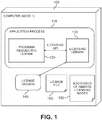
- FIGURE 1 illustrates a schematic representation of an exemplary first computer node 100 (also designated as node 1) of the peer to peer software license management system of the invention.
- First computer node 100 is representative of each of the other nodes in the system (not shown in FIGURE 1 ).
- first computer node 100 comprises an application process 110.
- Application process 110 comprises at least one program 120 and a licensing library 130.
- the licensing library 130 contains one or more software licenses.
- the program 120 is capable of accessing the licensing library 130 through a licensing application programming interface (designated as "Licensing API" in FIGURE 1 ).
- First computer node 100 also comprises a continuously running program that is referred to as a license service 140 or a license daemon 140.
- the license daemon 140 is connected to and in communication with the licensing library 130.
- the licensing library 130 is capable of accessing the license daemon 140 to pass on to the license daemon 140 any license requests that are made by the program 120.
- First computer node 100 also comprises an encrypted license file 150.
- the encrypted license file 150 contains the names of authorized license consumers and the names of the licenses that they are authorized to receive.
- the license daemon 140 is connected to and in communication with the encrypted license file 150.
- the license daemon 140 is capable of reading the authorization information in the encrypted license file 150 and serving the requested licenses to the license consumers that have the proper authorization.
- First computer node 100 also comprises an address file 160 that contains computer addresses of remotely located licensing nodes in the peer to peer system.
- the license daemon 140 is connected to and in communication with the address file 160.
- the license daemon 140 is capable of communicating with the remotely located nodes in the peer to peer system.
- the standard computer hardware of computer node 100 central processing unit, memory units, etc.
- the standard computer software of computer node 100 operating system, etc.
- the software of the peer to peer software license management system of the invention license daemon, license file, licensing library, etc.
- the standard computer hardware of computer node 100 central processing unit, memory units, etc.
- the standard computer software of computer node 100 operating system, etc.
- the software of the peer to peer software license management system of the invention (license daemon, license file, licensing library, etc.) comprises a software license management controller that performs the functions of the present invention.
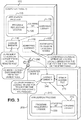
- FIGURE 2 illustrates a schematic representation of the first computer node 100 accessing a software license from a second computer node 200 of the peer to peer system of the invention.
- Second computer node 200 comprises an application process 210 that comprises at least one program 220 and a licensing library 230.
- Second computer node 200 also comprises its own license daemon 240 and encrypted license file 250.
- the second computer node 200 also comprises an address file that contains computer addresses of remotely located licensing nodes in the peer to peer system.
- FIGURE 2 illustrates how the first computer node 100 may access a software license from the second computer node 200 in the peer to peer system.
- the licensing library 130 sends the request to the license daemon 140.
- the license daemon 140 first attempts to access (or to "check out") the requested license from its own encrypted license file 150 (not shown in FIGURE 2 ). If the requested license is in the encrypted license file 150, then the license daemon 140 provides the requested license to the program 120 from the licensing library 130.
- FIGURE 2 illustrates the connection and communication between license daemon 140 of the first computer node 100 and the license daemon 240 of the second computer node 200.
- the license daemon 240 accesses its own encrypted license file 250 to determine whether the requested license is located within the second computer node 200. If the requested license is located within the encrypted license file 250, then the license daemon 240 marks the requested license as being in use and grants the license request. The license daemon 240 provides the requested license to the license daemon 140 from the licensing library 230. The license daemon 140 provides the requested license to the licensing library 130 and to the requesting program 120.
- the license daemon 240 reports that finding back to the license daemon 140 in the first computer node 100.
- the license daemon 140 When the license daemon 140 sends out a license request to the other nodes in the peer to peer network, the other nodes will cascade the request to other nodes in their local address list (if any) until the requested license is found or the license search fails due the lack of availability of the requested license on any node that is connected in the peer to peer network.
- a success or a failure will be reported back to the requesting program 120 via the API link.
- a successfully accessed license will eventually be returned to the remote computer node from which the license came (1) when the requesting program 120 releases the license via the API link or (2) when the requesting program 120 terminates.
- Returning the license to the remote computer node from which the license came requires the local license daemon 140 to track where the license originated and to communicate with the license daemon on the remote computer node (e.g., license daemon 240 in our present example) to inform the license daemon on the remote computer node of the eventual release of the requested license.
- the license daemon on the remote computer node that provided the requested license from its local encrypted license file releases the license back into the local pool of licenses that are eligible for a subsequent license.
- the license daemon of the computer node that provides the requested license generates and sends an occasional "all is well” signal (referred to as a "heartbeat") to all of the other computer nodes that are participating in a license access (also referred to as a license "checkout"). If for some reason the heartbeat signal is not acknowledged as expected, then the heartbeat signal is said to have failed. If the heartbeat signal fails, then all license daemons that are involved in the license checkout process immediately consider that the license checkout process has failed.
- the failure of the heartbeat signal results in the requesting program (e.g., program 120) being informed via the API link that a license that it had successfully requested is now unavailable and that the previously successful license request has been terminated.
- the license daemon that provided the requested license from its local encrypted license file then releases the license back into the local pool of licenses that are eligible for a subsequent license. No heartbeat signal is required when a license request is satisfied from a local license file.
- licenses can also be borrowed. Borrowing a license entails relocating a license from one license file to another license file for a predetermined (but finite) period of time.
- a license daemon in a computer node can request to borrow one or more licenses from another computer node.
- the license borrowing process is conceptually similar to a normal license check out process from one node to another. But there is no heartbeat signal maintained between the two nodes that are involved in the borrowing transaction. This is so that the borrowing node can be disconnected from the network of the donor node and continue to use the borrowed license while the borrowing node is offline (i.e., not connected to the peer to peer network).
- the donor node considers that the borrowed license has been checked out. But the borrowing node considers the borrowed license to be available for check out by programs that are running locally on the borrowing node.
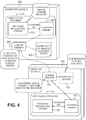
- FIGURE 3 illustrates how the first computer node 100 may temporarily borrow a software license from the second computer node 200 in the peer to peer system.
- the licensing library 130 sends the request to the license daemon 140.
- the license daemon 140 first attempts to access (or to "check out") the requested license from its own encrypted license file 150 (not shown in FIGURE 3 ). If the requested license is in the encrypted license file 150, then the license daemon 140 provides the requested license to the program 120 from the licensing library 130.
- FIGURE 3 illustrates the connection and communication between license daemon 140 of the first computer node 100 and the license daemon 240 of the second computer node 200.
- the second computer node 200 comprises a previously mentioned address file that contains computer addresses of remotely located licensing nodes in the peer to peer system.
- the license daemon 240 accesses a donor license file 270 to determine whether the requested license is a license that is authorized to be "loaned" out as a borrowed license. If the requested license is located within the donor license file 270, then the license daemon 240 marks the requested license as being in use for the requested time period and grants the license request. The license daemon 240 provides the requested borrowed license to the license daemon 140 from the licensing library 230. The license daemon 140 stores the requested borrowed license in a borrowed licenses file 170 and allows the requesting program 120 to access the requested borrowed license.
- the license daemon 240 reports that finding back to the license daemon 140 in the first computer node 100.
- the license daemon 140 When the license daemon 140 sends out a request to borrow a license to the other nodes in the peer to peer network, the other nodes will cascade the request to other nodes in their local address list (if any) until the requested license is found or the license search fails due the lack of availability of the requested license on any node that is connected in the peer to peer network.
- the license daemon 140 stores the borrowed license in the borrowed licenses file 170.
- the borrowed licenses that are stored in the borrowed licenses file 170 in the first computer node 100 appear as normal local licenses during the requested time period (i.e., the "lifetime" of the borrowed license).
- the network connection between the license daemon 140 of first computer node 100 and the license daemon 240 of the second computer node 200 is severed.
- the severance is schematically represented in FIGURE 3 with the scissors symbol 290.
- the borrowing node (first computer node 100 in our present example) may continue to use the borrowed license while offline (i.e., not connected to the peer to peer network).
- the borrowing node may check the borrowed license back into the donor node (second computer node 200 in our present example) at any time the borrowing node and the donor node are connected on a common network. Checking the borrowed license back into the donor node ends the period of borrowing.
- the maximum borrowing time limit (also referred to as the "timeout" value) is tracked independently by both the donor node and the borrowing node. If the timeout value expires before the borrowed license is returned to the donor node from the borrowing node, then the borrowed license will automatically be disabled on the borrower node and will automatically be enabled on the donor node (i.e., checked back into the donor node).
- the borrowed license remains valid. Furthermore, a valid borrowed license is considered to be available for checkout from the borrowing node. Due to the peer to peer capabilities of the network, the borrowed license is not restricted to checkout only by programs that are running on the borrowing node. That is, the borrowed license may be served to other connecting nodes that request it. This means that a license can be temporarily relocated from a donor node (that acts as a license server) to a borrowing node (that subsequently goes offline with respect to the donor node) and the borrowing node can subsequently act as a license server for the borrowed license.
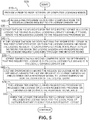
- FIGURE 4 illustrates how the first computer node 100 may act as a license server for a borrowed license and serve the borrowed license to a third computer node 300 in the peer to peer system.
- Third computer node 300 comprises an application process 310 that further comprises at least one program 320 and a licensing library 330.
- Third computer node 300 also comprises its own license daemon 340 and address file 360.
- the third computer node 300 also comprises an encrypted license file.
- the licensing library 330 sends the request to the license daemon 340.
- the license daemon 340 first attempts to access (or to "check out") the requested license from its own encrypted license file (not shown in FIGURE 4 ). If the requested license is in the encrypted license file, then the license daemon 340 provides the requested license to the program 320 from the licensing library 330.
- FIGURE 4 illustrates the connection and communication between license daemon 340 of the third computer node 300 and the license daemon 140 of the first computer node 100.
- the first computer node 100 comprises an encrypted license file 150 and an address file 160 that contains computer addresses of remotely located licensing nodes in the peer to peer system.
- the license daemon 140 accesses the borrowed licenses file 170 to determine whether the requested license is available. If the requested license is located within the borrowed licenses file 170, then the license daemon 140 marks the requested license as being in use and grants the license request. The license daemon 140 provides the requested license to the licensing daemon 340 from the borrowed licenses file 170. The license daemon 340 provides the borrowed license to the licensing library 330 and to the requesting program 320.
- the license daemon 140 reports that finding back to the license daemon 340 in the third computer node 300.
- the license daemon 340 When the license daemon 340 sends out a request to access a license to the other nodes in the peer to peer network, the other nodes will cascade the request to other nodes in their local address list (if any) until the requested license is found or the license search fails due the lack of availability of the requested license on any node that is connected in the peer to peer network.
- the license daemon 140 sends the borrowed license to the license daemon 340
- the license daemon 340 provides the borrowed license to the program 320.
- the first computer node 100 is a borrowing node that has gone offline with respect to the original donor node (second computer node 200). In this manner, the first computer node 100 acts in turn as a license server that serves the previously borrowed license to the third computer node 300.
- FIGURE 5 illustrates a flow chart 500 that shows the steps of an advantageous embodiment of a method of the present invention.
- a peer to peer network of computer licensing nodes is provided (step 510).
- a requesting program 120 in a first computer node 100 issues a license request to its license daemon 140 (step 520).
- the license daemon 140 searches for the requested license in a local license file 150 and in a local licensing library 130 and, if found, sends the requested license to the requesting program 120 (step 530).
- the license daemon 140 If the license daemon 140 does not find the requested license in the first computer node 100 then the license daemon 140 sends the license request to each computer node in the peer to peer network for which the license daemon 140 has an address and the license request cascades through the network nodes (step 540). Then a license daemon 240 in a second computer node 200 determines that the requested license is in its local license file 250 and is in its local licensing library 230 (step 550).
- the license daemon 240 (1) marks the requested license as being in use and (2) grants the license request to license daemon 140 and (3) sends out a heartbeat signal to license daemon 140 for the duration of the license grant (step 560).
- the license terminates when (1) requesting program 120 releases the license or (2) when requesting program 120 terminates or (3) when the heartbeat signal fails (step 570).
- license daemon 240 releases the license back into the local pool of licenses that are eligible for a subsequent license (step 580).
- FIGURE 6 illustrates a flow chart 600 that shows the steps of another advantageous embodiment of a method of the present invention.
- a peer to peer network of computer licensing nodes is provided (step 610).
- a requesting program 120 in a first computer node 100 issues a license request to its license daemon 140 (step 620).
- the license daemon 140 searches for the requested license in a local license file 150 and in a local licensing library 130 and, if found, sends the requested license to the requesting program 120 (step 630).
- the license daemon 140 If the license daemon 140 does not find the requested license in the first computer node 100 then the license daemon 140 sends a borrow request to each computer node in the peer to peer network for which the license daemon 140 has an address and the borrow request cascades through the network nodes (step 640). Then a license daemon 240 in a second computer node 200 determines that the requested license is in its local donor file 270 and is in its local licensing library 230 (step 650).
- the license daemon 240 (1) marks the requested license as being in use for a requested time limit and (2) sends the requested borrowed license to license daemon 140 and to the borrowed licenses file 270 in the first computer node 100 (step 660).
- the network connection between the first computer node 100 and the second computer node 200 is then severed and the first computer node 100 operates offline with the borrowed license (step 670).
- the first computer node 100 While operating offline the first computer node 100 then licenses the borrowed license to a third computer node 300 (step 680).
- the borrowed license automatically terminates when the original requested time limit expires (step 690).
- license daemon 240 releases the borrowed license back into the local pool of licenses that are eligible for a subsequent license or a subsequent borrowing (step 695).
- the present invention employs a mechanism that monitors network performance and, in response to the monitored level of network performance, automatically borrows and returns short-term licenses without user interaction or knowledge.
- the mechanism of the invention has two purposes. The first purpose is to ensure continuous licensing of executing software during periods of network instability. The second purpose is to enable efficient licensing of highly periodic software execution in systems that function in a disconnected or intermittently connected mode (such as web services).
- the duration of each borrowed license is adaptive and brief in order to fit actual usage as nearly as possible. This ensures fairness and avoids the disadvantage of the high cost of the normal mode of license borrowing.
- the present invention monitors the recent history of licenses that are lost due to network interruptions.
- the present invention changes the operational mode of the license borrowing process.
- the present invention switches to short term license borrowing in place of the normal online mode of license borrowing.
- the present invention switches to borrowing licenses as if for offline use for short time periods.
- the length of the short time periods is selected to cover the likely periods of intermittent usage typical of web services.
- the fault tolerance mode of operation and the service licensing mode of operation are mutually exclusive modes of operation.
- the present invention functions in either of the two modes of operation of license borrowing (in addition to being able to function in the normal mode of operation of online license borrowing). That is, there are three mutually exclusive modes of operation. The first is "fault tolerance" mode of operation of license borrowing. The second is “service licensing” mode of operation of license borrowing. The third is the normal mode of online license borrowing.
- the software license management system of the present invention comprises (1) a license borrowing mechanism that is capable of temporarily licensing the operation of software for a license consumer that subsequently goes offline with respect to the license provider, and (2) a mechanism for testing a communication link between the license consumer (the client server) and the license provider (the license server), and (3) an executive logic layer software module that is located on the license consumer (the client server).
- the operation of the executive logic layer software module will be described more fully below.
- FIGURE 7 illustrates a schematic representation of exemplary software modules in accordance with the principles of the present invention.
- the exemplary software modules that are represented in FIGURE 7 are located within a computer node 100.
- the computer node 100 comprises a memory 710 that contains the exemplary software modules.
- the license borrowing software that has been previously described in this document is designated with the reference numeral 720.
- the mechanism for testing a communication link between the license consumer (the client server) and the license provider (the license server) comprises a communications link test module that is designated with the reference numeral 730.
- the executive logic layer software module is designated with the reference numeral 740.
- the operating system software of computer node 100 is designated with the reference numeral 750.
- the executive logic layer software module 740 comprises a set of fault tolerance rules 760, and a set of service licensing rules 770, a history of network interruptions 780, and a user interface module 790.
- the individual modules will also be described more fully below.
- the standard computer hardware of computer node 100 central processing unit, memory units, etc.
- the standard computer software of computer node 100 operating system software 750, etc.
- the software modules of the software license management system of the invention comprising borrowing software 720, communications link test module 730, executive logic layer software 740, etc.
- a software license management controller that performs the functions of the present invention.
- the executive logic layer software module 740 employs the communication link test module 730 to monitor the level of network performance of the link between the license consumer (here, computer node 100) and the license provider (not shown in FIGURE 7 ).
- the executive logic layer software module 740 will sometimes be referred to using the letters ELL.
- the letters ELL stand for and represent the "executive logic layer.”
- the ELL can be implemented as an adjunct to an existing software licensing manager. Alternatively, the ELL can be implemented as an integrated component of a software licensing manager.
- the ELL When network interruptions occur, the ELL records the network interruptions in the history of network interruptions 780. When a network interruption occurs, the software licensing manager causes the ELL to apply the fault tolerance rules 760 (described below) and to apply the service licensing rules 770 (described below) to determine which license borrowing mode of operation to initiate in response to the network interruption.
- the ELL enables the fault tolerance mode of operation. Then the ELL will automatically execute the short term borrowing of software licenses in place of the normal online license borrowing mode of operation. This will ensure the continuous licensing of the executing software during periods of network instability and provide the necessary fault tolerance.
- the ELL continues to monitor the level of network performance while the fault tolerance mode of operation is active. When the ELL determines that the fault tolerance mode of operation is no longer needed, the ELL enables the normal mode of operation. The software license manager then resumes the normal online mode of license borrowing.
- the ELL enables the service licensing mode of operation. Then the ELL will automatically borrow licenses as if for offline use for short periods.
- the service licensing mode of operation the length of the short time periods is selected to cover the likely periods of intermittent usage typical of web services.
- the service licensing mode of operation is used in place of the normal online license borrowing mode of operation. This will ensure the efficient licensing of highly periodic software execution in systems that function in a disconnected or intermittently connected mode (such as web services).
- the ELL continues to monitor the level of network performance while the service licensing mode of operation is active. When the ELL determines that the service licensing mode of operation is no longer needed, the ELL enables the normal mode of operation. The software license manager then resumes the normal online mode of license borrowing.
- the ELL When short term licenses are borrowed under the control of the ELL, the ELL independently monitors the network and tracks the remaining license timeout value in order to renew the short term licenses or return them and resume the normal online mode of license borrowing.
- the ELL makes its decisions independently of the software license manager. That is, the software license manager is unaware of the decisions that are being made and carried out by the ELL with regard to the short term license borrowing operations.
- the software license manager simply responds to application programming interface (API) calls to borrow or return licenses as if a user were instructing it through a software license manager graphical user interface (GUI).
- API application programming interface
- the fault tolerance rules 760 determine when the ELL will start and stop the automated short term license borrowing operations in place of the normal online network license borrowing operation.
- the fault tolerance rules 760 comprise the following: (1) a specified value of an average duration of recent network outages in order to qualify for fault tolerance operation (small outages on the order of fractions of a second will be ignored), (2) a specified value of a time window for past outage events to be considered for fault tolerance operation, (3) a specified value of a time duration of automatically borrowed (short term) licenses, (4) a specified value of a time between probes of the network during automatic borrowing to test if connectivity has stabilized and automatic borrowing can be terminated, and (5) whether to inform to user of the commencement and termination of automatic borrowing or operate quietly without informing the user of the status of the automatic borrowing operation.
- the service licensing rules 770 determine when the ELL will start and stop the automated service licensing borrowing operations in place of the normal online network license borrowing operation.
- the service licensing rules 770 comprise the following: (1) a specified value of an average time between recent network connections to a licensed web service (service invocations), (2) a specified value of a time window for past connections to qualify for inclusion in calculating an average time between web service invocations, (3) a specified initial value for time duration of automatically borrowed (short term) licenses when insufficient data exists in the specified time window to calculate a duration, and (4) whether to enable or suppress the operation of the executive logic layer (ELL).
- the executive logic layer (ELL) is visible to the end user as a rule set.
- the executive logic layer (ELL) is therefore customizable by the end user through the user interface module 790.
- FIGURE 8 illustrates a flow chart 800 showing the steps of an advantageous embodiment of a method of the present invention.
- the software license manager operates in a normal online mode of license borrowing (step 810).
- the executive logic layer (ELL) monitors the network performance (step 815).
- the ELL determines if a network interrupt occurs (step 820). If no network interrupt occurs, then control passes back to step 810 and the software license manager continues to operate in the normal mode of operation (step 810).
- the software license manager causes the ELL to begin alternate license borrowing operations.
- the ELL uses the fault tolerance rules 760 to determine if the fault tolerance mode is required (decision step 825). If the fault tolerance mode is required, then the ELL enables the fault tolerance mode (step 830). Then the ELL executes short term license borrowing in place of the normal online licensing (step 840).
- the ELL monitors the network performance to determine whether the short term license borrowing is still needed (decision step 840). If the short term license borrowing is still needed, control passes back to step 835. If the short term license borrowing is no longer needed, then control passes to step 865 where the ELL enables the normal mode of operation (step 865). Control then passes back to step 810.
- the ELL uses the service licensing rules 770 to determine if the service licensing mode is required (decision step 845). If the service licensing mode is required, then the ELL enables the service licensing mode (step 850). Then the ELL executes short term license borrowing as if for offline use for short time periods (step 855). In the service licensing mode of operation, the length of the short time periods is selected to cover the likely periods of intermittent usage typical of web services.
- the ELL monitors the network performance to determine whether the short term license borrowing using the service mode of operation is still needed (decision step 860). If the short term license borrowing is still needed, control passes back to step 855. If the short term license borrowing is no longer needed, then control passes to step 865 where the ELL enables the normal mode of operation (step 865). Control then passes back to step 810.
- application refers to one or more computer programs, sets of instructions, procedures, functions, objects, classes, instances, or related data adapted for implementation in a suitable computer language.
- program refers to one or more computer programs, sets of instructions, procedures, functions, objects, classes, instances, or related data adapted for implementation in a suitable computer language.
- couple refers to any direct or indirect communication between two or more elements, whether or not those elements are in physical contact with one another.
- controller means any device, system, or part thereof that controls at least one operation.
- a controller may be implemented in hardware, firmware, software, or some combination of at least two of the same. The functionality associated with any particular controller may be centralized or distributed, whether locally or remotely.
Landscapes
- Engineering & Computer Science (AREA)
- General Engineering & Computer Science (AREA)
- Computer Hardware Design (AREA)
- Computer Security & Cryptography (AREA)
- Signal Processing (AREA)
- Computer Networks & Wireless Communication (AREA)
- Computing Systems (AREA)
- Software Systems (AREA)
- Theoretical Computer Science (AREA)
- Multimedia (AREA)
- Technology Law (AREA)
- Physics & Mathematics (AREA)
- General Physics & Mathematics (AREA)
- Computer And Data Communications (AREA)
- Management, Administration, Business Operations System, And Electronic Commerce (AREA)
Claims (10)
- Appareil de gestion de licences de logiciel pour une pluralité de noeuds informatiques comprenant des ordinateurs (100, 200, 300) connectés ensemble dans un réseau informatique poste à poste, l'appareil comprenant:
un contrôleur de gestion de licences de logiciel comprenant au moins une unité de traitement (100, 200, 300) et au moins une unité de mémoire (710), dans lequel l'au moins une unité de traitement est configurée pour exécuter un code de programme (720, 740, 750) mémorisé dans l'au moins une unité de mémoire pour amener le contrôleur de gestion de licences de logiciel à :mémoriser un ensemble de règles de tolérance de pannes (760) pour déterminer qu'il convient de fonctionner ou non dans un mode opérationnel d'octroi de licence à tolérance de pannes et un ensemble de règles d'octroi de licence de service (770) pour déterminer qu'il convient de fonctionner ou non dans un mode opérationnel d'octroi de licence d'après un accord de licence de service ;surveiller une performance du réseau durant un fonctionnement dans un mode opérationnel d'octroi de licence en ligne normal ;déterminer, en réponse à une interruption de la performance de réseau, qu'il convient de fonctionner dans le mode opérationnel d'octroi de licences à tolérance de pannes ou le mode opérationnel d'octroi de licence d'après un accord de licence de service en fonction de la performance du réseau, de l'ensemble de règles de tolérance de pannes et de l'ensemble de règles d'octroi de licence de service ;fonctionner dans le mode déterminé ;surveiller la performance du réseau pour déterminer qu'il convient ou non de continuer le fonctionnement dans le mode déterminé ; etreprendre, en réponse à la détermination que le fonctionnement dans le mode déterminé n'est plus nécessaire, le fonctionnement dans le mode opérationnel en ligne normal. - Appareil selon la revendication 1, dans lequel le contrôleur de gestion de licences de logiciel comprend en outre :un module d'octroi de licences (720) ;un module de liaison de test de communications (730) configuré pour tester une liaison de communication entre un consommateur de licence et un fournisseur de licence ; etun module logiciel de couche logique exécutive (740).
- Appareil selon la revendication 2, dans lequel le module d'octroi de licences est configuré pour octroyer temporairement une licence d'exploitation d'une application logicielle (120) au consommateur de licence qui se déconnecte ensuite du fournisseur de licence.
- Appareil selon la revendication 2, dans lequel le module logiciel de couche logique exécutive comprend :l'ensemble de règles de tolérance de pannes ;l'ensemble de règles d'octroi de licence de service ; etun historique d'interruption de réseau.
- Appareil selon la revendication 4, dans lequel le module logiciel de couche logique exécutive est configuré pour employer le module de liaison de test de communications afin de surveiller la performance du réseau.
- Procédé de gestion de licences de logiciel pour une pluralité de noeuds informatiques comprenant des ordinateurs (100, 200, 300) dans un réseau informatique poste à poste, le procédé comprenant :l'exploitation, par une unité de traitement (100, 200, 300), d'un contrôleur de gestion de licences de logiciel ;la mémorisation d'un ensemble de règles de tolérance de pannes (760) pour déterminer qu'il convient de fonctionner ou non dans un mode opérationnel d'octroi de licences à tolérance de pannes et d'un ensemble de règles d'octroi de licence de service (770) pour déterminer qu'il convient de fonctionner ou non dans un mode opérationnel d'octroi de licence d'après un accord de licence de service ;la surveillance d'une performance du réseau tout en exploitant le contrôleur de gestion de licences de logiciel dans un mode opérationnel d'octroi de licence en ligne normal ;la détermination, en réponse à une interruption de la performance de réseau, qu'il convient de fonctionner dans le mode opérationnel d'octroi de licence à tolérance de pannes ou dans le mode opérationnel d'octroi de licence d'après un accord de licence de service en fonction de la performance du réseau, de l'ensemble de règles de tolérance de pannes et de l'ensemble de règles d'octroi de licence de service ;l'exploitation du contrôleur de gestion de licences de logiciel dans le mode déterminé ;la surveillance de la performance du réseau pour déterminer qu'il convient ou non de continuer le fonctionnement dans le mode déterminé ; etla reprise, en réponse à une détermination que le fonctionnement dans le mode déterminé n'est plus nécessaire, de l'exploitation dans le mode opérationnel en ligne normal.
- Procédé la revendication 6, dans lequel le contrôleur de gestion de licences de logiciel comprend :un module d'octroi de licences (720) ;un module de liaison de test de communications (730) configuré pour tester une liaison de communication entre un consommateur de licence et un fournisseur de licence ; etun module logiciel de couche logique exécutive (740) .
- Procédé selon la revendication 7, comprenant en outre:
l'utilisation (520-580, 620-695) du module d'octroi de licences pour céder temporairement une licence d'exploitation d'une application logicielle (120) au consommateur de licence qui se déconnecte ensuite du fournisseur de licence. - Procédé selon la revendication 7, dans lequel le module logiciel de couche logique exécutive comprend :l'ensemble de règles de tolérance de pannes ;l'ensemble de règles d'octroi de licence de service ; etun historique d'interruptions de réseau.
- Procédé selon la revendication 7, dans lequel la détermination qu'il convient de fonctionner dans le mode de tolérance de pannes ou dans le mode d'octroi de licence de service comprend :la réception de données de l'ensemble de règles de tolérance de pannes et de données de l'historique d'interruptions de réseau ; etla sélection du mode opérationnel d'octroi de licences à tolérance de pannes en réponse aux données reçues de l'ensemble de règles de tolérance de pannes et de l'historique d'interruptions de réseau.
Applications Claiming Priority (2)
| Application Number | Priority Date | Filing Date | Title |
|---|---|---|---|
| US12/039,572 US20090222926A1 (en) | 2008-02-28 | 2008-02-28 | Software license management system that functions in a disconnected or intermittently connected mode |
| PCT/US2009/033622 WO2009108485A1 (fr) | 2008-02-28 | 2009-02-10 | Système de gestion de licences de logiciel qui fonctionne en mode déconnecté ou en mode connecté par intermittence |
Publications (3)
| Publication Number | Publication Date |
|---|---|
| EP2248060A1 EP2248060A1 (fr) | 2010-11-10 |
| EP2248060A4 EP2248060A4 (fr) | 2016-12-21 |
| EP2248060B1 true EP2248060B1 (fr) | 2019-04-10 |
Family
ID=41014270
Family Applications (1)
| Application Number | Title | Priority Date | Filing Date |
|---|---|---|---|
| EP09715409.0A Active EP2248060B1 (fr) | 2008-02-28 | 2009-02-10 | Système de gestion de licences de logiciel qui fonctionne en mode déconnecté ou en mode connecté par intermittence |
Country Status (5)
| Country | Link |
|---|---|
| US (1) | US20090222926A1 (fr) |
| EP (1) | EP2248060B1 (fr) |
| CN (1) | CN102016861A (fr) |
| CA (1) | CA2716782A1 (fr) |
| WO (1) | WO2009108485A1 (fr) |
Families Citing this family (15)
| Publication number | Priority date | Publication date | Assignee | Title |
|---|---|---|---|---|
| US8874891B2 (en) | 2010-05-20 | 2014-10-28 | Hewlett-Packard Development Company, L.P. | Systems and methods for activation of applications using client-specific data |
| CN102497352A (zh) * | 2011-10-21 | 2012-06-13 | 张国 | 一种浮点型许可证的增效方法及系统 |
| US8555402B2 (en) * | 2012-01-26 | 2013-10-08 | Microsoft Corporation | Dynamic selection of authorization processes |
| US9165332B2 (en) | 2012-01-27 | 2015-10-20 | Microsoft Technology Licensing, Llc | Application licensing using multiple forms of licensing |
| US8756708B2 (en) * | 2012-07-13 | 2014-06-17 | NETFLIX Inc. | System and method for detecting active streams using a heartbeat and secure stop mechanism |
| US8682796B2 (en) * | 2012-08-23 | 2014-03-25 | Sirsi Corporation | Digital resource acquisition |
| TWI503696B (zh) * | 2013-06-06 | 2015-10-11 | Quanta Comp Inc | 授權平台 |
| US9674193B1 (en) * | 2013-07-30 | 2017-06-06 | Juniper Networks, Inc. | Aggregation and disbursement of licenses in distributed networks |
| US20150336005A1 (en) * | 2014-05-20 | 2015-11-26 | Cadillac Jack | Electronic gaming system with central game licensing |
| US10218817B2 (en) * | 2015-04-28 | 2019-02-26 | Microsoft Technology Licensing, Llc | Digital rights list for device groups |
| JP6519411B2 (ja) * | 2015-08-31 | 2019-05-29 | 富士通株式会社 | ライセンス管理装置及びライセンス管理プログラム |
| US9922176B2 (en) | 2015-10-16 | 2018-03-20 | International Business Machines Corporation | Borrowing software licenses in a license management system for time based usage |
| US11100199B2 (en) * | 2018-08-30 | 2021-08-24 | Servicenow, Inc. | Automatically detecting misuse of licensed software |
| US20210390645A1 (en) * | 2020-06-16 | 2021-12-16 | OSAAP America, LLC | Offline License Distribution Device |
| CN112417379B (zh) * | 2020-11-10 | 2022-02-22 | 迈普通信技术股份有限公司 | 一种集群许可证管理方法、装置、授权服务器及存储介质 |
Family Cites Families (16)
| Publication number | Priority date | Publication date | Assignee | Title |
|---|---|---|---|---|
| WO1992020021A1 (fr) * | 1991-05-08 | 1992-11-12 | Digital Equipment Corporation | Systeme de gestion de licences |
| US5629980A (en) * | 1994-11-23 | 1997-05-13 | Xerox Corporation | System for controlling the distribution and use of digital works |
| US5671412A (en) * | 1995-07-28 | 1997-09-23 | Globetrotter Software, Incorporated | License management system for software applications |
| JP3618917B2 (ja) * | 1996-08-05 | 2005-02-09 | 株式会社東芝 | 情報収集方法 |
| AU2001284907A1 (en) * | 2000-08-15 | 2002-02-25 | Nortel Networks Limited | System, device, and method for managing communication services in an optical communication system |
| US7162538B1 (en) * | 2000-10-04 | 2007-01-09 | Intel Corporation | Peer to peer software distribution system |
| WO2003094076A1 (fr) * | 2002-04-29 | 2003-11-13 | Contentguard Holdings, Inc. | Systeme de gestion de droits utilisant un langage d'expression de legalite |
| US7885896B2 (en) * | 2002-07-09 | 2011-02-08 | Avaya Inc. | Method for authorizing a substitute software license server |
| US7318171B2 (en) * | 2003-03-12 | 2008-01-08 | Intel Corporation | Policy-based response to system errors occurring during OS runtime |
| US7127442B2 (en) * | 2003-04-01 | 2006-10-24 | Avaya Technology Corp. | Ironclad notification of license errors |
| US20050289072A1 (en) * | 2004-06-29 | 2005-12-29 | Vinay Sabharwal | System for automatic, secure and large scale software license management over any computer network |
| US20060143134A1 (en) * | 2004-12-25 | 2006-06-29 | Nicol So | Method and apparatus for sharing a digital access license |
| US20070157308A1 (en) * | 2006-01-03 | 2007-07-05 | Bardsley Jeffrey S | Fail-safe network authentication |
| JP2007249804A (ja) * | 2006-03-17 | 2007-09-27 | Canon Software Inc | ライセンス管理システムおよび情報処理装置およびライセンス管理装置およびライセンス管理方法およびプログラムおよび記録媒体 |
| US20070233782A1 (en) * | 2006-03-28 | 2007-10-04 | Silentclick, Inc. | Method & system for acquiring, storing, & managing software applications via a communications network |
| JP5491472B2 (ja) | 2011-09-26 | 2014-05-14 | 株式会社椿本チエイン | ケーブル・配管類保護案内部材用取り付けブラケット |
-
2008
- 2008-02-28 US US12/039,572 patent/US20090222926A1/en not_active Abandoned
-
2009
- 2009-02-10 CA CA2716782A patent/CA2716782A1/fr not_active Abandoned
- 2009-02-10 WO PCT/US2009/033622 patent/WO2009108485A1/fr not_active Ceased
- 2009-02-10 CN CN2009801149877A patent/CN102016861A/zh active Pending
- 2009-02-10 EP EP09715409.0A patent/EP2248060B1/fr active Active
Non-Patent Citations (1)
| Title |
|---|
| None * |
Also Published As
| Publication number | Publication date |
|---|---|
| CN102016861A (zh) | 2011-04-13 |
| CA2716782A1 (fr) | 2009-09-03 |
| EP2248060A1 (fr) | 2010-11-10 |
| US20090222926A1 (en) | 2009-09-03 |
| EP2248060A4 (fr) | 2016-12-21 |
| WO2009108485A1 (fr) | 2009-09-03 |
Similar Documents
| Publication | Publication Date | Title |
|---|---|---|
| EP2248060B1 (fr) | Système de gestion de licences de logiciel qui fonctionne en mode déconnecté ou en mode connecté par intermittence | |
| EP2248058B1 (fr) | Système de gestion de licence de logiciel de poste-à-poste en vue de la réinstallation temporaire de licences de logiciel disponibles | |
| US11677860B2 (en) | Decentralization processing method, communication proxy, host, and storage medium | |
| US10169068B2 (en) | Live migration for virtual computing resources utilizing network-based storage | |
| US9591074B2 (en) | Monitoring resources in a cloud-computing environment | |
| US20070033395A1 (en) | Method and system for hierarchical license servers | |
| US20120072995A1 (en) | Systems and methods for managing software licenses | |
| US10432551B1 (en) | Network request throttling | |
| US20050097181A1 (en) | System and method for remote management | |
| US10355922B1 (en) | Automated computing architecture configuration service | |
| US20150142664A1 (en) | Planning Assignment of Software Licenses | |
| MXPA05000847A (es) | Arquitectura para controlar el acceso a un servicio a traves de clientes concurrentes. | |
| JP2005513838A (ja) | ストレージ管理アプリケーション、ネットワーク管理アプリケーション、およびデータ管理アプリケーションのポリシ情報の構造 | |
| US11196626B2 (en) | Method and system for virtual server dormancy | |
| US8578202B2 (en) | System and method for providing high availability for distributed application | |
| US10218659B1 (en) | Persistent connections for email web applications | |
| CN118550879A (zh) | 文件存储方法、装置、计算机设备及存储介质 | |
| US10884845B2 (en) | Increasing processing capacity of processor cores during initial program load processing | |
| US20050071281A1 (en) | Software license optimization | |
| US9319274B1 (en) | Method and system for dynamic provisioning using server dormant mode for virtual server dormancy | |
| KR100915533B1 (ko) | 미복귀 대기 리소스 이용량 결정 방법, 장치 및 컴퓨터 판독 가능한 기록 매체 | |
| US20050132237A1 (en) | Method, apparatus and program storage device for providing a remote power reset at a remote server through a network connection | |
| CN108200151A (zh) | 一种分布式存储系统中ISCSI Target负载均衡方法和装置 | |
| US10237341B1 (en) | Method and system for load balancing using server dormant mode | |
| KR102896573B1 (ko) | 자산 고유 속성 정보 기반의 변화 감지 및 중복 제거를 통한 자동화된 자산 관리 방법, 장치 및 컴퓨터-판독 가능 기록 매체 |
Legal Events
| Date | Code | Title | Description |
|---|---|---|---|
| PUAI | Public reference made under article 153(3) epc to a published international application that has entered the european phase |
Free format text: ORIGINAL CODE: 0009012 |
|
| 17P | Request for examination filed |
Effective date: 20100811 |
|
| AK | Designated contracting states |
Kind code of ref document: A1 Designated state(s): AT BE BG CH CY CZ DE DK EE ES FI FR GB GR HR HU IE IS IT LI LT LU LV MC MK MT NL NO PL PT RO SE SI SK TR |
|
| AX | Request for extension of the european patent |
Extension state: AL BA RS |
|
| DAX | Request for extension of the european patent (deleted) | ||
| RAP1 | Party data changed (applicant data changed or rights of an application transferred) |
Owner name: HONEYWELL INTERNATIONAL INC. |
|
| STAA | Information on the status of an ep patent application or granted ep patent |
Free format text: STATUS: EXAMINATION IS IN PROGRESS |
|
| RA4 | Supplementary search report drawn up and despatched (corrected) |
Effective date: 20161122 |
|
| RIC1 | Information provided on ipc code assigned before grant |
Ipc: G06F 11/00 20060101ALI20161116BHEP Ipc: G06F 15/16 20060101ALI20161116BHEP Ipc: H04L 9/32 20060101ALI20161116BHEP Ipc: G06F 17/00 20060101ALI20161116BHEP Ipc: G06F 21/00 20130101AFI20161116BHEP |
|
| 17Q | First examination report despatched |
Effective date: 20161201 |
|
| REG | Reference to a national code |
Ref country code: DE Ref legal event code: R079 Ref document number: 602009057829 Country of ref document: DE Free format text: PREVIOUS MAIN CLASS: G06F0021000000 Ipc: G06F0021100000 |
|
| GRAP | Despatch of communication of intention to grant a patent |
Free format text: ORIGINAL CODE: EPIDOSNIGR1 |
|
| STAA | Information on the status of an ep patent application or granted ep patent |
Free format text: STATUS: GRANT OF PATENT IS INTENDED |
|
| RIC1 | Information provided on ipc code assigned before grant |
Ipc: G06F 21/10 20101110AFI20181022BHEP Ipc: H04L 29/06 20060101ALI20181022BHEP |
|
| INTG | Intention to grant announced |
Effective date: 20181108 |
|
| RIC1 | Information provided on ipc code assigned before grant |
Ipc: G06F 21/10 20130101AFI20181022BHEP Ipc: H04L 29/06 20060101ALI20181022BHEP |
|
| RIC1 | Information provided on ipc code assigned before grant |
Ipc: H04L 29/06 20060101ALI20181022BHEP Ipc: G06F 21/10 20130101AFI20181022BHEP |
|
| GRAS | Grant fee paid |
Free format text: ORIGINAL CODE: EPIDOSNIGR3 |
|
| GRAA | (expected) grant |
Free format text: ORIGINAL CODE: 0009210 |
|
| STAA | Information on the status of an ep patent application or granted ep patent |
Free format text: STATUS: THE PATENT HAS BEEN GRANTED |
|
| AK | Designated contracting states |
Kind code of ref document: B1 Designated state(s): AT BE BG CH CY CZ DE DK EE ES FI FR GB GR HR HU IE IS IT LI LT LU LV MC MK MT NL NO PL PT RO SE SI SK TR |
|
| REG | Reference to a national code |
Ref country code: GB Ref legal event code: FG4D |
|
| REG | Reference to a national code |
Ref country code: CH Ref legal event code: EP Ref country code: AT Ref legal event code: REF Ref document number: 1119660 Country of ref document: AT Kind code of ref document: T Effective date: 20190415 |
|
| REG | Reference to a national code |
Ref country code: IE Ref legal event code: FG4D |
|
| REG | Reference to a national code |
Ref country code: DE Ref legal event code: R096 Ref document number: 602009057829 Country of ref document: DE |
|
| REG | Reference to a national code |
Ref country code: NL Ref legal event code: MP Effective date: 20190410 |
|
| REG | Reference to a national code |
Ref country code: LT Ref legal event code: MG4D |
|
| REG | Reference to a national code |
Ref country code: AT Ref legal event code: MK05 Ref document number: 1119660 Country of ref document: AT Kind code of ref document: T Effective date: 20190410 |
|
| PG25 | Lapsed in a contracting state [announced via postgrant information from national office to epo] |
Ref country code: NL Free format text: LAPSE BECAUSE OF FAILURE TO SUBMIT A TRANSLATION OF THE DESCRIPTION OR TO PAY THE FEE WITHIN THE PRESCRIBED TIME-LIMIT Effective date: 20190410 |
|
| PG25 | Lapsed in a contracting state [announced via postgrant information from national office to epo] |
Ref country code: HR Free format text: LAPSE BECAUSE OF FAILURE TO SUBMIT A TRANSLATION OF THE DESCRIPTION OR TO PAY THE FEE WITHIN THE PRESCRIBED TIME-LIMIT Effective date: 20190410 Ref country code: LT Free format text: LAPSE BECAUSE OF FAILURE TO SUBMIT A TRANSLATION OF THE DESCRIPTION OR TO PAY THE FEE WITHIN THE PRESCRIBED TIME-LIMIT Effective date: 20190410 Ref country code: ES Free format text: LAPSE BECAUSE OF FAILURE TO SUBMIT A TRANSLATION OF THE DESCRIPTION OR TO PAY THE FEE WITHIN THE PRESCRIBED TIME-LIMIT Effective date: 20190410 Ref country code: FI Free format text: LAPSE BECAUSE OF FAILURE TO SUBMIT A TRANSLATION OF THE DESCRIPTION OR TO PAY THE FEE WITHIN THE PRESCRIBED TIME-LIMIT Effective date: 20190410 Ref country code: SE Free format text: LAPSE BECAUSE OF FAILURE TO SUBMIT A TRANSLATION OF THE DESCRIPTION OR TO PAY THE FEE WITHIN THE PRESCRIBED TIME-LIMIT Effective date: 20190410 Ref country code: PT Free format text: LAPSE BECAUSE OF FAILURE TO SUBMIT A TRANSLATION OF THE DESCRIPTION OR TO PAY THE FEE WITHIN THE PRESCRIBED TIME-LIMIT Effective date: 20190910 Ref country code: NO Free format text: LAPSE BECAUSE OF FAILURE TO SUBMIT A TRANSLATION OF THE DESCRIPTION OR TO PAY THE FEE WITHIN THE PRESCRIBED TIME-LIMIT Effective date: 20190710 |
|
| PG25 | Lapsed in a contracting state [announced via postgrant information from national office to epo] |
Ref country code: GR Free format text: LAPSE BECAUSE OF FAILURE TO SUBMIT A TRANSLATION OF THE DESCRIPTION OR TO PAY THE FEE WITHIN THE PRESCRIBED TIME-LIMIT Effective date: 20190711 Ref country code: BG Free format text: LAPSE BECAUSE OF FAILURE TO SUBMIT A TRANSLATION OF THE DESCRIPTION OR TO PAY THE FEE WITHIN THE PRESCRIBED TIME-LIMIT Effective date: 20190710 Ref country code: LV Free format text: LAPSE BECAUSE OF FAILURE TO SUBMIT A TRANSLATION OF THE DESCRIPTION OR TO PAY THE FEE WITHIN THE PRESCRIBED TIME-LIMIT Effective date: 20190410 Ref country code: PL Free format text: LAPSE BECAUSE OF FAILURE TO SUBMIT A TRANSLATION OF THE DESCRIPTION OR TO PAY THE FEE WITHIN THE PRESCRIBED TIME-LIMIT Effective date: 20190410 |
|
| PG25 | Lapsed in a contracting state [announced via postgrant information from national office to epo] |
Ref country code: IS Free format text: LAPSE BECAUSE OF FAILURE TO SUBMIT A TRANSLATION OF THE DESCRIPTION OR TO PAY THE FEE WITHIN THE PRESCRIBED TIME-LIMIT Effective date: 20190810 Ref country code: AT Free format text: LAPSE BECAUSE OF FAILURE TO SUBMIT A TRANSLATION OF THE DESCRIPTION OR TO PAY THE FEE WITHIN THE PRESCRIBED TIME-LIMIT Effective date: 20190410 |
|
| REG | Reference to a national code |
Ref country code: DE Ref legal event code: R097 Ref document number: 602009057829 Country of ref document: DE |
|
| PG25 | Lapsed in a contracting state [announced via postgrant information from national office to epo] |
Ref country code: DK Free format text: LAPSE BECAUSE OF FAILURE TO SUBMIT A TRANSLATION OF THE DESCRIPTION OR TO PAY THE FEE WITHIN THE PRESCRIBED TIME-LIMIT Effective date: 20190410 Ref country code: EE Free format text: LAPSE BECAUSE OF FAILURE TO SUBMIT A TRANSLATION OF THE DESCRIPTION OR TO PAY THE FEE WITHIN THE PRESCRIBED TIME-LIMIT Effective date: 20190410 Ref country code: SK Free format text: LAPSE BECAUSE OF FAILURE TO SUBMIT A TRANSLATION OF THE DESCRIPTION OR TO PAY THE FEE WITHIN THE PRESCRIBED TIME-LIMIT Effective date: 20190410 Ref country code: CZ Free format text: LAPSE BECAUSE OF FAILURE TO SUBMIT A TRANSLATION OF THE DESCRIPTION OR TO PAY THE FEE WITHIN THE PRESCRIBED TIME-LIMIT Effective date: 20190410 Ref country code: RO Free format text: LAPSE BECAUSE OF FAILURE TO SUBMIT A TRANSLATION OF THE DESCRIPTION OR TO PAY THE FEE WITHIN THE PRESCRIBED TIME-LIMIT Effective date: 20190410 |
|
| PLBE | No opposition filed within time limit |
Free format text: ORIGINAL CODE: 0009261 |
|
| STAA | Information on the status of an ep patent application or granted ep patent |
Free format text: STATUS: NO OPPOSITION FILED WITHIN TIME LIMIT |
|
| PG25 | Lapsed in a contracting state [announced via postgrant information from national office to epo] |
Ref country code: IT Free format text: LAPSE BECAUSE OF FAILURE TO SUBMIT A TRANSLATION OF THE DESCRIPTION OR TO PAY THE FEE WITHIN THE PRESCRIBED TIME-LIMIT Effective date: 20190410 |
|
| 26N | No opposition filed |
Effective date: 20200113 |
|
| PG25 | Lapsed in a contracting state [announced via postgrant information from national office to epo] |
Ref country code: TR Free format text: LAPSE BECAUSE OF FAILURE TO SUBMIT A TRANSLATION OF THE DESCRIPTION OR TO PAY THE FEE WITHIN THE PRESCRIBED TIME-LIMIT Effective date: 20190410 |
|
| PGFP | Annual fee paid to national office [announced via postgrant information from national office to epo] |
Ref country code: GB Payment date: 20200226 Year of fee payment: 12 Ref country code: DE Payment date: 20200228 Year of fee payment: 12 |
|
| PG25 | Lapsed in a contracting state [announced via postgrant information from national office to epo] |
Ref country code: SI Free format text: LAPSE BECAUSE OF FAILURE TO SUBMIT A TRANSLATION OF THE DESCRIPTION OR TO PAY THE FEE WITHIN THE PRESCRIBED TIME-LIMIT Effective date: 20190410 |
|
| PGFP | Annual fee paid to national office [announced via postgrant information from national office to epo] |
Ref country code: FR Payment date: 20200225 Year of fee payment: 12 |
|
| REG | Reference to a national code |
Ref country code: CH Ref legal event code: PL |
|
| REG | Reference to a national code |
Ref country code: BE Ref legal event code: MM Effective date: 20200229 |
|
| PG25 | Lapsed in a contracting state [announced via postgrant information from national office to epo] |
Ref country code: MC Free format text: LAPSE BECAUSE OF FAILURE TO SUBMIT A TRANSLATION OF THE DESCRIPTION OR TO PAY THE FEE WITHIN THE PRESCRIBED TIME-LIMIT Effective date: 20190410 Ref country code: LU Free format text: LAPSE BECAUSE OF NON-PAYMENT OF DUE FEES Effective date: 20200210 |
|
| PG25 | Lapsed in a contracting state [announced via postgrant information from national office to epo] |
Ref country code: CH Free format text: LAPSE BECAUSE OF NON-PAYMENT OF DUE FEES Effective date: 20200229 Ref country code: LI Free format text: LAPSE BECAUSE OF NON-PAYMENT OF DUE FEES Effective date: 20200229 |
|
| PG25 | Lapsed in a contracting state [announced via postgrant information from national office to epo] |
Ref country code: IE Free format text: LAPSE BECAUSE OF NON-PAYMENT OF DUE FEES Effective date: 20200210 |
|
| PG25 | Lapsed in a contracting state [announced via postgrant information from national office to epo] |
Ref country code: BE Free format text: LAPSE BECAUSE OF NON-PAYMENT OF DUE FEES Effective date: 20200229 |
|
| REG | Reference to a national code |
Ref country code: DE Ref legal event code: R119 Ref document number: 602009057829 Country of ref document: DE |
|
| GBPC | Gb: european patent ceased through non-payment of renewal fee |
Effective date: 20210210 |
|
| PG25 | Lapsed in a contracting state [announced via postgrant information from national office to epo] |
Ref country code: FR Free format text: LAPSE BECAUSE OF NON-PAYMENT OF DUE FEES Effective date: 20210228 Ref country code: GB Free format text: LAPSE BECAUSE OF NON-PAYMENT OF DUE FEES Effective date: 20210210 Ref country code: DE Free format text: LAPSE BECAUSE OF NON-PAYMENT OF DUE FEES Effective date: 20210901 |
|
| PG25 | Lapsed in a contracting state [announced via postgrant information from national office to epo] |
Ref country code: MT Free format text: LAPSE BECAUSE OF FAILURE TO SUBMIT A TRANSLATION OF THE DESCRIPTION OR TO PAY THE FEE WITHIN THE PRESCRIBED TIME-LIMIT Effective date: 20190410 Ref country code: CY Free format text: LAPSE BECAUSE OF FAILURE TO SUBMIT A TRANSLATION OF THE DESCRIPTION OR TO PAY THE FEE WITHIN THE PRESCRIBED TIME-LIMIT Effective date: 20190410 |
|
| PG25 | Lapsed in a contracting state [announced via postgrant information from national office to epo] |
Ref country code: MK Free format text: LAPSE BECAUSE OF FAILURE TO SUBMIT A TRANSLATION OF THE DESCRIPTION OR TO PAY THE FEE WITHIN THE PRESCRIBED TIME-LIMIT Effective date: 20190410 |