EP2248266B1 - Systèmes et procédés de programmation de tâches dans des dispositifs de radio définis par logiciel multimode - Google Patents
Systèmes et procédés de programmation de tâches dans des dispositifs de radio définis par logiciel multimode Download PDFInfo
- Publication number
- EP2248266B1 EP2248266B1 EP09714980.1A EP09714980A EP2248266B1 EP 2248266 B1 EP2248266 B1 EP 2248266B1 EP 09714980 A EP09714980 A EP 09714980A EP 2248266 B1 EP2248266 B1 EP 2248266B1
- Authority
- EP
- European Patent Office
- Prior art keywords
- radio
- processing
- packet
- packets
- software
- Prior art date
- Legal status (The legal status is an assumption and is not a legal conclusion. Google has not performed a legal analysis and makes no representation as to the accuracy of the status listed.)
- Not-in-force
Links
- 238000000034 method Methods 0.000 title claims description 47
- 238000012545 processing Methods 0.000 claims description 106
- 230000008569 process Effects 0.000 claims description 19
- 230000001413 cellular effect Effects 0.000 claims description 7
- 230000004044 response Effects 0.000 claims description 5
- 230000005540 biological transmission Effects 0.000 claims description 3
- 238000012958 reprocessing Methods 0.000 claims 1
- 235000019800 disodium phosphate Nutrition 0.000 description 10
- 238000006243 chemical reaction Methods 0.000 description 4
- 238000005516 engineering process Methods 0.000 description 4
- 238000003491 array Methods 0.000 description 2
- 230000008859 change Effects 0.000 description 2
- 238000012986 modification Methods 0.000 description 2
- 230000004048 modification Effects 0.000 description 2
- 238000013459 approach Methods 0.000 description 1
- 230000006399 behavior Effects 0.000 description 1
- 238000004422 calculation algorithm Methods 0.000 description 1
- 230000001419 dependent effect Effects 0.000 description 1
- 238000011161 development Methods 0.000 description 1
- 238000010586 diagram Methods 0.000 description 1
- 230000006870 function Effects 0.000 description 1
- 238000007616 round robin method Methods 0.000 description 1
- 230000003068 static effect Effects 0.000 description 1
Images


Classifications
-
- H—ELECTRICITY
- H04—ELECTRIC COMMUNICATION TECHNIQUE
- H04B—TRANSMISSION
- H04B1/00—Details of transmission systems, not covered by a single one of groups H04B3/00 - H04B13/00; Details of transmission systems not characterised by the medium used for transmission
- H04B1/0003—Software-defined radio [SDR] systems, i.e. systems wherein components typically implemented in hardware, e.g. filters or modulators/demodulators, are implented using software, e.g. by involving an AD or DA conversion stage such that at least part of the signal processing is performed in the digital domain
Definitions
- the present invention relates generally to scheduling and prioritizing the processing of radio packets in multi-mode software defined radio terminals.
- SDR Software Defined Radio
- SDR technology can be defined as radios that provide software control of a variety of modulation techniques, wide-band or narrow-band operation, communications security functions (such as hopping), and waveform requirements of current and evolving standards over a broad frequency range.
- SDR technology implements the radio functionality as software modules running on a generic processor, and multiple software modules can be used to implement multiple standards presented in the same radio system. Because different standards are processed differently, task scheduling and switching are used in an attempt to meet the real time requirements.
- Scheduling methods used in certain operating systems include first-in, first out (FIFO) methods, round robin methods, and rate monotonic scheduling.
- Such scheduling methods generally involve managing different kinds of tasks of an operation system where the granularity and task processing time can vary greatly.
- the real time requirements of these tasks are generally not critical, which means that adding new tasks to the scheduling does not generally involve shuffling the processing order.
- the different radio tasks are relatively stable (that is, the number, sequence and run time of the tasks are generally fixed) but the real time requirements are more critical and the signal processing throughput is high.
- US2004123295 A1 describes a digital signal processor operating in conjunction with a scheduler hardware module and a scheduler software module in executing a highest priority runnable event among a plurality of events.
- the scheduler hardware module communicates an interrupt request signal to the DSP that is indicative of any change in a highest priority runnable event.
- the scheduler software module is executed by the DSP in response to the interrupt request signal indicating a change in highest priority runnable event.
- An execution of the scheduler software module by the DSP implements one of a various modes of an interrupt request routine.
- Various aspects of the present invention are directed to methods for use in a software-defined radio system for scheduling processing of received radio data packets from multiple radios. Such methods include assigning a priority value to each 30 received data packet, the assigned priority value being reflective of preset radio preferences and risk of data packet loss.
- Each received data packet has an associated processing deadline that is used to determine a processing execution order. For each received data packet, it is determined whether there is sufficient time to process the data packet in the processing execution order ahead of the associated processing deadline. Responsive to determining that there is insufficient time to process at least one of the received data packets, the data packet having the lowest assigned priority value is abandoned.
- the remaining data packets are then re-ordered and re-checked for processing time sufficiency, and in certain embodiments the assigned priority values are updated. Responsive to determining that there is sufficient time to process each of the received data packets, the received data packets are executed in the processing execution order.
- Such systems include an antenna to receive and transmit RF signals, an RF circuit connected to the antenna and including a receiver and a transmitter, a processing circuit to process radio packets, and a converter circuit coupled between the RF circuit and processing circuit to prepare received signals for processing and to prepare processed signals for transmission.
- the processing circuit may include a DSP and controller unit, and is operable to process concurrently received radio packets in order according to earliest associated processing deadline, assign priority values to each radio packet reflective of preset radio preferences and risk of data packet loss, abandon the radio packet having the lowest assigned priority value in response to determining that there is insufficient time to process each radio packet in the processing order ahead of the associated processing deadline, and process the radio packets in the processing order in response to determining that there is sufficient time to process each radio packet in the processing order ahead of the associated processing deadline.
- Various aspects of the present invention are further directed to dynamic scheduling tables for use in scheduling processing of multiple received radio data packets in a multi-mode software-defined radio system.
- Such dynamic scheduling tables are readable and updatable by a controller in the processing circuit, and tabulate a processing execution order for the received radio packets according to earliest associated processing deadline, an assigned priority value for each received radio packet, the assigned priority values reflective of preset radio preferences and risk of data packet loss, a remaining processing time for each received radio packet, and a time to associated processing deadline for each radio packet, the dynamic scheduling table being updated each time a radio packet is dropped or added.
- Embodiments of the present invention relate to systems and methods for dynamic scheduling of radio signals in multi-mode SDR terminals.
- dynamic scheduling tables are used to determine the processing order of multiple radio packets, and in the case of constraints on the processor, using assigned flexible priority values to determine which radio packets can be dropped in favor of higher priority signals.
- the dynamic scheduling table and flexible priority values can be updated (for example periodically and/or responsive to the receipt of a new radio packet) to promote efficiency and flexibility in task scheduling.
- the present invention provides for assigning higher and lower priority values to different radios of a multi-mode SDR terminal, for example to help ensure quality of service for higher priority signals and to assist in task scheduling when real time constraints restrict the processing of one or more data packets.
- the assigned priority values are provided with flexibility so that lower priority radios can occupy the processor to help sustain the basic connection when there is a risk that it would otherwise be lost.
- a scheduling table can be implemented that provides the execution order of received radio packet, and contains remaining processing time, deadline time, and flexible priority value for each radio.
- the flexible priority value includes a predefined fixed priority and a dynamic priority that can be calculated based on context-dependent factors such as packet loss ratio.
- the present invention provides methods for scheduling the processing of received radio data packets in a multi-mode software defined radio terminal where each radio packet has an associated processing deadline that defines a real time constraint.
- Such methods include (a) assigning a priority value to each received data packet, the assigned priority value reflective of preset radio preferences (fixed value) and risk of data packet loss (dynamic value), (b) determining a processing execution order for the received data packets according to earliest associated processing deadline, (c) determining whether there is sufficient time to process each received data packet in the processing execution order ahead of its associated processing deadline, and (d) responsive to determining that there is insufficient time to process at least one of the received data packets, removing the data packet having the lowest assigned priority value and repeating steps (b) through (d). Once it has been determined that there are no longer real time constraints in processing the remaining radio packets, the packets are processed in the determined order.
- the generic processor has radio interrupt and context switch capabilities so that if during the processing of one radio data packet a radio packet of another radio is received, the system can schedule processing in a desired manner.
- scheduling of radio tasks in SDR devices involves assigning priority values to the radio tasks and using the assigned priority when updating the processing schedule.
- each radio may be associated with different priority values depending on context, user preference, risk of packet loss, and the like. For example, during a voice call in a cellular system, the SDR terminal user may prefer that the cellular data packets have a higher priority value relative to other radio packets to maintain better signal quality in the phone call and to mitigate the risk of a dropped call.
- Priority values can be used to drop lower priority packets so that higher priority packets will be processed.
- the priority values are flexible and dynamic to allow for circumstances where it may be desirable to keep low priority packets that would otherwise be dropped. For example, repeated interruption of lower priority radios may result in a lost connection, and as such the priority of the lower priority signals can be adjusted to mitigate the risk of a lost connection even if the result is delaying or dropping an otherwise higher priority signal.
- Embodiments of the present invention may be suitably used in any SDR terminal and may be particularly useful in SDR terminals implementing a multiple radio system.
- Example radio systems include 2G, 3G/B3G cellular systems, WLAN series, Wi-Max, Bluetooth, ZigBee, Digital TV, GPS, and so forth. While various aspects of the present invention are described below in terms of multiple radio systems for the purposes of illustration, it will appreciated that the present invention is not so limited and that the methods disclosed herein are applicable to single radio systems in which different kinds of data packages are processed in parallel.
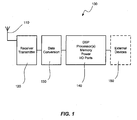
- Fig. 1 schematically illustrates SDR terminal 100 that includes an antenna 110 used to wirelessly communicate RF signals.
- the RF signals are received by and transmitted from an RF block 120 that includes a receiver and a transmitter.
- the RF block 120 interfaces with a data conversion block 130 that provides analog-to-digital conversion (e.g ., for signals received for processing) and digital-to-analog conversion (e.g ., for processed signals presented for transmission).
- the data conversion block 130 interfaces with the baseband processing block 140 that includes processors such as a DSP and controller, memory, and input/output ports for connecting to external devices 150 such as displays, input devices, USB devices, audio input and output devices, and so forth.
- an SDR terminal includes some programmable and reconfigurable processing device such as a powerful DSP. Most base band signal processing is carried out in programmable processor.
- an SDR terminal includes a controller (e.g ., an ARM controller) to control the behavior of DSP.
- the task scheduling method of the present invention may be implemented in the ARM controller.
- methods of the present invention are implemented in software/firmware.
- the dynamic scheduling tables used in accordance with the present invention may be stored in a memory of the ARM controller or in a system memory. The ARM controller reads and updates the scheduling table, and then controls the processing of the tasks in the DSP accordingly. While Fig. 1 shows a single antenna system, it will be appreciated that the present invention can be utilized in systems that include multiple antennas, multiple receivers and transmitters, as well as multiple DSPs and controllers.
- Fig. 2 illustrates the concepts of remaining processing time T P and deadline time T D of three radio packets.
- Radio Packet 1 was the only radio packet presented for processing.
- the remaining processing time is less than the deadline time (i.e., T P1 ⁇ T D1 )
- the processing of the Radio Packet 1 can be completed before Deadline 1.
- Receiving additional radio packets before processing of current packets can be completed may lead to an inability to process all the radio packets ahead of their respective deadlines.
- SDR SDR systems, every radio packet has a deadline that represents a real time constraint.
- Radio Packet 1 is received first, Radio Packet 2 is received second, and Radio Packet 3 is received third.
- Deadline 2 of Radio Packet 2 occurs first, and so Radio Packet 2 is scheduled to be executed first. Because the remaining processing time T P2 is less than the deadline time T D2 , the processing of Radio Packet 2 can be completed in time according to earliest deadline first scheduling. Deadline 1 of Radio Packet 1 occurs second, and so Radio Packet 1 is scheduled to be executed second. Because the remaining processing time T P1 plus the remaining processing time T P2 is still less than the deadline time T D1 , the processing of Radio Packet 1 can be completed in time according to earliest deadline first scheduling.
- Deadline 3 of Radio Packet 3 occurs third, and so Radio Packet 3 is scheduled to be executed third. Because the remaining processing time T P3 added to the remaining processing times T P1 and T P2 is greater than the deadline time T D3 , the processing of Radio Packet 3 cannot be completed in time according to earliest deadline first scheduling.
- Radio Packet 3 would be dropped, even if it would be undesirable to do so.
- priority values are assigned to each of the radios so that the radio packet associated with the lowest priority can be dropped in favor of the higher priority packets. In the situation illustrated in Fig. 2 , dropping any one of the radio packets would allow processing of the other two to be completed on time.
- dynamic scheduling based on flexible priority values in accordance with the present invention can be implemented by use of a dynamic scheduling table such as shown in Table 1.
- the dynamic scheduling table contains dynamic scheduling information such as Execution Order, the associated Radio Packet number, the associated Remaining Processing Time, the associated Time to Deadline, and the associated Flexible Priority Value.
- P Fi may be a fixed priority value that represents a user preference or other preset value such as a default fixed priority value. Taking into consideration that many users find dropped cellular calls to be unacceptable, the fixed priority of cellular radio packets could be set higher than any other. In this way, if the processor is overloaded, the packets of other radios may be ignored to help ensure the voice quality of cellular call.
- the dynamic priority value P Di can be a variable value that is calculated using factors such as radio packet loss ratio, which represents the risk of packet or radio connection loss if the packet is dropped.
- the dynamic radio priority PDi can be used to adjust the total priority in a dynamic fashion.
- the dynamic priority is also increased to mitigate risk of loss.
- Fig. 3 sets forth certain embodiments of methods of the present invention in the form of a flow chart.
- a check can be performed to determine whether the real time constraints for each of the radio packets can be met (e.g., in accordance with equation (1)). This check can be performed before or after updating the dynamic scheduling table to reflect the newly received radio packet. If the result of the check step is that the real time constraints for each of the received packets cannot be met, the packet with the lowest flexible priority is abandoned, the dynamic scheduling table is updated, and the check is performed again. This process continues until the check reveals that each of the radio packets can be processed in the scheduled order without time constraint, at which point the radio packets are processed according to the dynamic scheduling table. Note that at any time the processor may interrupt current radio packet processing and switch to processing another based on the dynamically updated schedule.
- processing approaches described herein can be implemented using a variety of devices and methods including general purpose processors implementing specialized software, digital signal processors, programmable logic arrays, discrete logic components and fully-programmable and semi-programmable circuits such as PLAs (programmable logic arrays).
- general purpose processors implementing specialized software
- digital signal processors programmable logic arrays
- discrete logic components programmable logic components
- fully-programmable and semi-programmable circuits such as PLAs (programmable logic arrays).
- PLAs programmable logic arrays
- the above algorithms are executed on a microcomputer (a.k.a. microprocessor) in connection with certain embodiments, and as may be implemented as part of one or more of the devices shown in the figures.
Landscapes
- Engineering & Computer Science (AREA)
- Computer Networks & Wireless Communication (AREA)
- Signal Processing (AREA)
- Mobile Radio Communication Systems (AREA)
- Data Exchanges In Wide-Area Networks (AREA)
Claims (20)
- Procédé de planification du traitement de paquets radio reçus possédant chacun une échéance de traitement associée, le procédé comprenant les étapes consistant à :A. attribuer une valeur de priorité à chaque paquet radio reçu, la valeur de priorité attribuée reflétant des préférences radio préétablies et un risque de perte de paquet radio ;B. déterminer un ordre d'exécution de traitement pour les paquets radio reçus selon l'échéance de traitement associée la plus proche ;C. déterminer s'il y a suffisamment de temps pour traiter le paquet radio dans l'ordre d'exécution de traitement avant l'échéance de traitement associée pour chaque paquet radio reçu ;
le procédé étant caractérisé par les étapes consistant àD. supprimer le paquet radio dont la valeur de priorité attribuée est la plus faible et répéter les étapes B à D s'il est déterminé qu'il n'y a pas suffisamment de temps pour traiter au moins un des paquets radio reçus ; etE. exécuter les paquets radio reçus dans l'ordre d'exécution de traitement s'il est déterminé qu'il y a suffisamment de temps pour traiter chacun des paquets radio reçus. - Procédé selon la revendication 1, comprenant en outre l'étape consistant à mettre en oeuvre les étapes A à D en réponse à la réception d'un paquet radio supplémentaire.
- Procédé selon la revendication 1, dans lequel les préférences radio préétablies comprennent des préférences radio définies par un utilisateur.
- Procédé selon la revendication 1, dans lequel le risque de perte de paquet radio pour un paquet radio donné comporte la possibilité que le paquet radio donné soit susceptible d'être présenté en vue d'un nouveau traitement.
- Procédé selon la revendication 1, dans lequel le risque de perte de paquet radio pour un paquet radio donné comporte la perte d'une connexion radio associée.
- Procédé selon la revendication 1, comprenant en outre l'étape consistant à stocker l'ordre d'exécution de traitement dans une table de planification dynamique qui contient, pour chaque paquet radio reçu, l'échéance de traitement associée, un temps de traitement restant égal à la différence entre l'échéance de traitement associée et un temps actuel et la valeur de priorité attribuée.
- Procédé selon la revendication 6, dans lequel la table de planification dynamique est mise à jour chaque fois que l'ordre d'exécution de traitement est déterminé.
- Procédé selon la revendication 6, dans lequel la table de planification dynamique est mise à jour en réponse à la réception d'un paquet radio supplémentaire.
- Procédé selon la revendication 1, comprenant en outre l'étape consistant à mettre à jour des valeurs de priorité attribuées en réponse à la suppression du paquet radio dont la valeur de priorité attribuée est la plus faible.
- Système de radio définie par logiciel permettant le traitement de signaux radio sur plusieurs radios, le système comprenant une antenne (110) servant à recevoir et à émettre des signaux RF, un circuit RF relié à l'antenne et comportant un récepteur et un émetteur (120), un circuit de traitement (140) servant à traiter des paquets radio et un circuit convertisseur (130) couplé entre le circuit RF et le circuit de traitement et adapté à préparer des signaux reçus en vue de leur traitement et à préparer des signaux traités en vue de leur transmission, le circuit de traitement étant adapté à mettre en oeuvre les étapes du procédé selon la revendication 1.
- Système de radio définie par logiciel selon la revendication 10, dans lequel au moins une des radios est une radio cellulaire.
- Système de radio définie par logiciel selon la revendication 10, dans lequel le circuit de traitement comporte un processeur DSP servant à traiter les paquets radio et un contrôleur servant à commander le processeur DSP selon l'ordre d'exécution de traitement.
- Système de radio définie par logiciel selon la revendication 12, dans lequel le contrôleur est un contrôleur ARM.
- Système de radio définie par logiciel selon la revendication 10, comprenant en outre plusieurs antennes.
- Système de radio définie par logiciel selon la revendication 10, comprenant en outre plusieurs récepteurs et émetteurs.
- Système de radio définie par logiciel selon la revendication 10, comprenant en outre plusieurs circuits de traitement.
- Système de radio définie par logiciel selon la revendication 10, comprenant en outre une table de planification dynamique susceptible d'être lue et mise à jour par un contrôleur du circuit de traitement, la table de planification dynamique étant adaptée à stockerI. un ordre d'exécution de traitement pour les paquets radio reçus selon l'échéance de traitement associée la plus proche,II. une valeur de priorité attribuée pour chaque paquet radio reçu, les valeurs de priorité attribuées reflétant des préférences radio préétablies et un risque de perte de paquet radio,III. un temps de traitement restant pour chaque paquet radio reçu, etIV. un temps jusqu'à l'échéance de traitement associée pour chaque paquet radio,la table de planification dynamique étant mise à jour chaque fois qu'un paquet radio est retiré ou ajouté.
- Système de radio définie par logiciel selon la revendication 17, dans lequel les valeurs de priorité attribuées servent à déterminer un ou plusieurs paquets radio à abandonner s'il ne reste pas suffisamment de temps de traitement pour traiter au moins un paquet radio reçu dans l'ordre d'exécution de traitement avant l'échéance de traitement associée pour ledit au moins un paquet radio reçu.
- Système de radio définie par logiciel selon la revendication 17, dans lequel la table de planification dynamique est stockée dans une mémoire du circuit de traitement.
- Système de radio définie par logiciel selon la revendication 17, dans lequel la table de planification dynamique est stockée dans une mémoire du système.
Applications Claiming Priority (2)
| Application Number | Priority Date | Filing Date | Title |
|---|---|---|---|
| US3153908P | 2008-02-26 | 2008-02-26 | |
| PCT/IB2009/050789 WO2009107094A2 (fr) | 2008-02-26 | 2009-02-26 | Systèmes et procédés de programmation de tâches dans des dispositifs de radio définis par logiciel multimode |
Publications (2)
| Publication Number | Publication Date |
|---|---|
| EP2248266A2 EP2248266A2 (fr) | 2010-11-10 |
| EP2248266B1 true EP2248266B1 (fr) | 2014-06-25 |
Family
ID=40941765
Family Applications (1)
| Application Number | Title | Priority Date | Filing Date |
|---|---|---|---|
| EP09714980.1A Not-in-force EP2248266B1 (fr) | 2008-02-26 | 2009-02-26 | Systèmes et procédés de programmation de tâches dans des dispositifs de radio définis par logiciel multimode |
Country Status (3)
| Country | Link |
|---|---|
| US (1) | US8630170B2 (fr) |
| EP (1) | EP2248266B1 (fr) |
| WO (1) | WO2009107094A2 (fr) |
Families Citing this family (7)
| Publication number | Priority date | Publication date | Assignee | Title |
|---|---|---|---|---|
| US9743379B2 (en) * | 2015-06-12 | 2017-08-22 | Motorola Solutions, Inc. | Method and server for broadcasting a data file to a plurality of radio talk groups |
| US10284417B2 (en) | 2015-06-22 | 2019-05-07 | Arista Networks, Inc. | Method and system for sharing state between network elements |
| US11671329B2 (en) | 2018-04-04 | 2023-06-06 | Arista Networks, Inc. | Computation of network flooding topologies |
| US11218399B2 (en) | 2018-06-20 | 2022-01-04 | Arista Networks, Inc. | Embedded area abstraction |
| US11296948B2 (en) | 2020-01-09 | 2022-04-05 | Arista Networks, Inc. | Topology partition detection |
| US11342947B1 (en) | 2020-11-19 | 2022-05-24 | Microsoft Technology Licensing, Llc | Packet prioritization for network-based software-defined radio |
| US12108319B2 (en) * | 2021-07-20 | 2024-10-01 | EdgeQ, Inc. | Systems and methods for hybrid hardware and software implementation of multiple wireless standards |
Family Cites Families (5)
| Publication number | Priority date | Publication date | Assignee | Title |
|---|---|---|---|---|
| US5889779A (en) * | 1996-12-02 | 1999-03-30 | Rockwell Science Center | Scheduler utilizing dynamic schedule table |
| US7111089B2 (en) * | 2002-12-23 | 2006-09-19 | Motorola, Inc. | Programmable scheduler for digital signal processor |
| GB2403823B (en) | 2003-07-08 | 2005-09-21 | Toshiba Res Europ Ltd | Controller for processing apparatus |
| KR100586884B1 (ko) * | 2004-07-06 | 2006-06-08 | 삼성전자주식회사 | 실시간 sdr 서비스 구현 방법 및 이를 이용한 sdr시스템 |
| US8305890B2 (en) * | 2008-09-15 | 2012-11-06 | At&T Intellectual Property I, L.P. | Method and apparatus for prioritizing voice over internet protocol signaling messages |
-
2009
- 2009-02-26 EP EP09714980.1A patent/EP2248266B1/fr not_active Not-in-force
- 2009-02-26 WO PCT/IB2009/050789 patent/WO2009107094A2/fr not_active Ceased
- 2009-02-26 US US12/919,470 patent/US8630170B2/en not_active Expired - Fee Related
Also Published As
| Publication number | Publication date |
|---|---|
| WO2009107094A3 (fr) | 2009-10-22 |
| WO2009107094A2 (fr) | 2009-09-03 |
| US20110116369A1 (en) | 2011-05-19 |
| EP2248266A2 (fr) | 2010-11-10 |
| US8630170B2 (en) | 2014-01-14 |
Similar Documents
| Publication | Publication Date | Title |
|---|---|---|
| US8630170B2 (en) | Systems and methods for task scheduling in multi-mode software defined radio devices | |
| US8340706B2 (en) | Co-existence between radio access units | |
| US9313825B2 (en) | Multi-mode handheld apparatus | |
| US9319210B2 (en) | Adaptive operational full-duplex and half-duplex FDD modes in wireless networks | |
| EP3817244A1 (fr) | Procédé de rétroaction de csi, appareil, terminal, et station de base, et support de stockage | |
| CN110418417B (zh) | 减少设备内共存干扰的方法、装置及存储介质 | |
| EP2354934A1 (fr) | Procédé de contrôle d'une plateforme RF multi-radio | |
| EP2749122B1 (fr) | Procédé et système de traitement de la bande de base pour les communications sans fil | |
| US20130163541A1 (en) | Resource allocation method and apparatus of base station in wireless communication system | |
| US20030166408A1 (en) | Method and system for priority-based state transition for high speed data transmission and wireless access networks | |
| EP3110089B1 (fr) | Appareil, système et procédé de communication par des modules de communication sans fil colocalisés | |
| EP3024264A1 (fr) | Procédé et dispositif d'envoi de données sur une base de canaux multiples | |
| CN114946142B (zh) | 用于传输反馈信息的方法和设备 | |
| US20110009058A1 (en) | Method and apparatus for managing sound volume of wireless connection device in mobile communication terminal | |
| US9819375B2 (en) | Wireless mobile device and transmission method | |
| CN111148270A (zh) | 基于服务质量的长距离多信道通信随机接入方法及系统 | |
| CN105517179A (zh) | 一种无线资源调度的方法以及调度器 | |
| WO2008024713A2 (fr) | Appareil portable multimode | |
| WO2010138293A1 (fr) | Système et procédé de planification de transmission de canal à base de crédit (cbcts) | |
| JP4358169B2 (ja) | 無線通信装置および無線通信方法 | |
| KR102152308B1 (ko) | Wlan에서 액세스 포인트의 스케줄링 방법 및 장치 | |
| US20140241277A1 (en) | Communication method and communications apparatus | |
| EP2371175A1 (fr) | Amélioration des performances de correction d'erreur | |
| EP1653683A2 (fr) | Algorithme dynamique des algorithmes de plannification de transmission | |
| US7283503B1 (en) | Communication apparatus including a buffer circuit having first and second portions for alternately storing results |
Legal Events
| Date | Code | Title | Description |
|---|---|---|---|
| PUAI | Public reference made under article 153(3) epc to a published international application that has entered the european phase |
Free format text: ORIGINAL CODE: 0009012 |
|
| 17P | Request for examination filed |
Effective date: 20100927 |
|
| AK | Designated contracting states |
Kind code of ref document: A2 Designated state(s): AT BE BG CH CY CZ DE DK EE ES FI FR GB GR HR HU IE IS IT LI LT LU LV MC MK MT NL NO PL PT RO SE SI SK TR |
|
| AX | Request for extension of the european patent |
Extension state: AL BA RS |
|
| DAX | Request for extension of the european patent (deleted) | ||
| 17Q | First examination report despatched |
Effective date: 20130215 |
|
| GRAP | Despatch of communication of intention to grant a patent |
Free format text: ORIGINAL CODE: EPIDOSNIGR1 |
|
| INTG | Intention to grant announced |
Effective date: 20131017 |
|
| GRAP | Despatch of communication of intention to grant a patent |
Free format text: ORIGINAL CODE: EPIDOSNIGR1 |
|
| GRAS | Grant fee paid |
Free format text: ORIGINAL CODE: EPIDOSNIGR3 |
|
| INTG | Intention to grant announced |
Effective date: 20140429 |
|
| GRAA | (expected) grant |
Free format text: ORIGINAL CODE: 0009210 |
|
| AK | Designated contracting states |
Kind code of ref document: B1 Designated state(s): AT BE BG CH CY CZ DE DK EE ES FI FR GB GR HR HU IE IS IT LI LT LU LV MC MK MT NL NO PL PT RO SE SI SK TR |
|
| REG | Reference to a national code |
Ref country code: GB Ref legal event code: FG4D |
|
| REG | Reference to a national code |
Ref country code: CH Ref legal event code: EP |
|
| REG | Reference to a national code |
Ref country code: AT Ref legal event code: REF Ref document number: 675234 Country of ref document: AT Kind code of ref document: T Effective date: 20140715 |
|
| REG | Reference to a national code |
Ref country code: IE Ref legal event code: FG4D |
|
| REG | Reference to a national code |
Ref country code: DE Ref legal event code: R096 Ref document number: 602009024897 Country of ref document: DE Effective date: 20140807 |
|
| PG25 | Lapsed in a contracting state [announced via postgrant information from national office to epo] |
Ref country code: GR Free format text: LAPSE BECAUSE OF FAILURE TO SUBMIT A TRANSLATION OF THE DESCRIPTION OR TO PAY THE FEE WITHIN THE PRESCRIBED TIME-LIMIT Effective date: 20140926 Ref country code: LT Free format text: LAPSE BECAUSE OF FAILURE TO SUBMIT A TRANSLATION OF THE DESCRIPTION OR TO PAY THE FEE WITHIN THE PRESCRIBED TIME-LIMIT Effective date: 20140625 Ref country code: FI Free format text: LAPSE BECAUSE OF FAILURE TO SUBMIT A TRANSLATION OF THE DESCRIPTION OR TO PAY THE FEE WITHIN THE PRESCRIBED TIME-LIMIT Effective date: 20140625 Ref country code: CY Free format text: LAPSE BECAUSE OF FAILURE TO SUBMIT A TRANSLATION OF THE DESCRIPTION OR TO PAY THE FEE WITHIN THE PRESCRIBED TIME-LIMIT Effective date: 20140625 Ref country code: NO Free format text: LAPSE BECAUSE OF FAILURE TO SUBMIT A TRANSLATION OF THE DESCRIPTION OR TO PAY THE FEE WITHIN THE PRESCRIBED TIME-LIMIT Effective date: 20140925 |
|
| REG | Reference to a national code |
Ref country code: AT Ref legal event code: MK05 Ref document number: 675234 Country of ref document: AT Kind code of ref document: T Effective date: 20140625 |
|
| REG | Reference to a national code |
Ref country code: NL Ref legal event code: VDEP Effective date: 20140625 |
|
| REG | Reference to a national code |
Ref country code: LT Ref legal event code: MG4D |
|
| PG25 | Lapsed in a contracting state [announced via postgrant information from national office to epo] |
Ref country code: HR Free format text: LAPSE BECAUSE OF FAILURE TO SUBMIT A TRANSLATION OF THE DESCRIPTION OR TO PAY THE FEE WITHIN THE PRESCRIBED TIME-LIMIT Effective date: 20140625 Ref country code: SE Free format text: LAPSE BECAUSE OF FAILURE TO SUBMIT A TRANSLATION OF THE DESCRIPTION OR TO PAY THE FEE WITHIN THE PRESCRIBED TIME-LIMIT Effective date: 20140625 Ref country code: LV Free format text: LAPSE BECAUSE OF FAILURE TO SUBMIT A TRANSLATION OF THE DESCRIPTION OR TO PAY THE FEE WITHIN THE PRESCRIBED TIME-LIMIT Effective date: 20140625 |
|
| PG25 | Lapsed in a contracting state [announced via postgrant information from national office to epo] |
Ref country code: SK Free format text: LAPSE BECAUSE OF FAILURE TO SUBMIT A TRANSLATION OF THE DESCRIPTION OR TO PAY THE FEE WITHIN THE PRESCRIBED TIME-LIMIT Effective date: 20140625 Ref country code: CZ Free format text: LAPSE BECAUSE OF FAILURE TO SUBMIT A TRANSLATION OF THE DESCRIPTION OR TO PAY THE FEE WITHIN THE PRESCRIBED TIME-LIMIT Effective date: 20140625 Ref country code: PT Free format text: LAPSE BECAUSE OF FAILURE TO SUBMIT A TRANSLATION OF THE DESCRIPTION OR TO PAY THE FEE WITHIN THE PRESCRIBED TIME-LIMIT Effective date: 20141027 Ref country code: RO Free format text: LAPSE BECAUSE OF FAILURE TO SUBMIT A TRANSLATION OF THE DESCRIPTION OR TO PAY THE FEE WITHIN THE PRESCRIBED TIME-LIMIT Effective date: 20140625 Ref country code: ES Free format text: LAPSE BECAUSE OF FAILURE TO SUBMIT A TRANSLATION OF THE DESCRIPTION OR TO PAY THE FEE WITHIN THE PRESCRIBED TIME-LIMIT Effective date: 20140625 Ref country code: EE Free format text: LAPSE BECAUSE OF FAILURE TO SUBMIT A TRANSLATION OF THE DESCRIPTION OR TO PAY THE FEE WITHIN THE PRESCRIBED TIME-LIMIT Effective date: 20140625 |
|
| PG25 | Lapsed in a contracting state [announced via postgrant information from national office to epo] |
Ref country code: NL Free format text: LAPSE BECAUSE OF FAILURE TO SUBMIT A TRANSLATION OF THE DESCRIPTION OR TO PAY THE FEE WITHIN THE PRESCRIBED TIME-LIMIT Effective date: 20140625 Ref country code: AT Free format text: LAPSE BECAUSE OF FAILURE TO SUBMIT A TRANSLATION OF THE DESCRIPTION OR TO PAY THE FEE WITHIN THE PRESCRIBED TIME-LIMIT Effective date: 20140625 Ref country code: PL Free format text: LAPSE BECAUSE OF FAILURE TO SUBMIT A TRANSLATION OF THE DESCRIPTION OR TO PAY THE FEE WITHIN THE PRESCRIBED TIME-LIMIT Effective date: 20140625 Ref country code: IS Free format text: LAPSE BECAUSE OF FAILURE TO SUBMIT A TRANSLATION OF THE DESCRIPTION OR TO PAY THE FEE WITHIN THE PRESCRIBED TIME-LIMIT Effective date: 20141025 |
|
| REG | Reference to a national code |
Ref country code: DE Ref legal event code: R097 Ref document number: 602009024897 Country of ref document: DE |
|
| PG25 | Lapsed in a contracting state [announced via postgrant information from national office to epo] |
Ref country code: IT Free format text: LAPSE BECAUSE OF FAILURE TO SUBMIT A TRANSLATION OF THE DESCRIPTION OR TO PAY THE FEE WITHIN THE PRESCRIBED TIME-LIMIT Effective date: 20140625 Ref country code: DK Free format text: LAPSE BECAUSE OF FAILURE TO SUBMIT A TRANSLATION OF THE DESCRIPTION OR TO PAY THE FEE WITHIN THE PRESCRIBED TIME-LIMIT Effective date: 20140625 |
|
| PLBE | No opposition filed within time limit |
Free format text: ORIGINAL CODE: 0009261 |
|
| STAA | Information on the status of an ep patent application or granted ep patent |
Free format text: STATUS: NO OPPOSITION FILED WITHIN TIME LIMIT |
|
| 26N | No opposition filed |
Effective date: 20150326 |
|
| PG25 | Lapsed in a contracting state [announced via postgrant information from national office to epo] |
Ref country code: BE Free format text: LAPSE BECAUSE OF FAILURE TO SUBMIT A TRANSLATION OF THE DESCRIPTION OR TO PAY THE FEE WITHIN THE PRESCRIBED TIME-LIMIT Effective date: 20140625 |
|
| PG25 | Lapsed in a contracting state [announced via postgrant information from national office to epo] |
Ref country code: LU Free format text: LAPSE BECAUSE OF FAILURE TO SUBMIT A TRANSLATION OF THE DESCRIPTION OR TO PAY THE FEE WITHIN THE PRESCRIBED TIME-LIMIT Effective date: 20150226 |
|
| REG | Reference to a national code |
Ref country code: CH Ref legal event code: PL |
|
| GBPC | Gb: european patent ceased through non-payment of renewal fee |
Effective date: 20150226 |
|
| PG25 | Lapsed in a contracting state [announced via postgrant information from national office to epo] |
Ref country code: MC Free format text: LAPSE BECAUSE OF FAILURE TO SUBMIT A TRANSLATION OF THE DESCRIPTION OR TO PAY THE FEE WITHIN THE PRESCRIBED TIME-LIMIT Effective date: 20140625 Ref country code: CH Free format text: LAPSE BECAUSE OF NON-PAYMENT OF DUE FEES Effective date: 20150228 Ref country code: LI Free format text: LAPSE BECAUSE OF NON-PAYMENT OF DUE FEES Effective date: 20150228 |
|
| REG | Reference to a national code |
Ref country code: IE Ref legal event code: MM4A |
|
| REG | Reference to a national code |
Ref country code: FR Ref legal event code: ST Effective date: 20151030 |
|
| PG25 | Lapsed in a contracting state [announced via postgrant information from national office to epo] |
Ref country code: SI Free format text: LAPSE BECAUSE OF FAILURE TO SUBMIT A TRANSLATION OF THE DESCRIPTION OR TO PAY THE FEE WITHIN THE PRESCRIBED TIME-LIMIT Effective date: 20140625 |
|
| PG25 | Lapsed in a contracting state [announced via postgrant information from national office to epo] |
Ref country code: IE Free format text: LAPSE BECAUSE OF NON-PAYMENT OF DUE FEES Effective date: 20150226 Ref country code: GB Free format text: LAPSE BECAUSE OF NON-PAYMENT OF DUE FEES Effective date: 20150226 |
|
| PG25 | Lapsed in a contracting state [announced via postgrant information from national office to epo] |
Ref country code: FR Free format text: LAPSE BECAUSE OF NON-PAYMENT OF DUE FEES Effective date: 20150302 |
|
| PG25 | Lapsed in a contracting state [announced via postgrant information from national office to epo] |
Ref country code: MT Free format text: LAPSE BECAUSE OF FAILURE TO SUBMIT A TRANSLATION OF THE DESCRIPTION OR TO PAY THE FEE WITHIN THE PRESCRIBED TIME-LIMIT Effective date: 20140625 |
|
| PG25 | Lapsed in a contracting state [announced via postgrant information from national office to epo] |
Ref country code: BG Free format text: LAPSE BECAUSE OF FAILURE TO SUBMIT A TRANSLATION OF THE DESCRIPTION OR TO PAY THE FEE WITHIN THE PRESCRIBED TIME-LIMIT Effective date: 20140625 Ref country code: HU Free format text: LAPSE BECAUSE OF FAILURE TO SUBMIT A TRANSLATION OF THE DESCRIPTION OR TO PAY THE FEE WITHIN THE PRESCRIBED TIME-LIMIT; INVALID AB INITIO Effective date: 20090226 |
|
| PG25 | Lapsed in a contracting state [announced via postgrant information from national office to epo] |
Ref country code: TR Free format text: LAPSE BECAUSE OF FAILURE TO SUBMIT A TRANSLATION OF THE DESCRIPTION OR TO PAY THE FEE WITHIN THE PRESCRIBED TIME-LIMIT Effective date: 20140625 |
|
| PG25 | Lapsed in a contracting state [announced via postgrant information from national office to epo] |
Ref country code: MK Free format text: LAPSE BECAUSE OF FAILURE TO SUBMIT A TRANSLATION OF THE DESCRIPTION OR TO PAY THE FEE WITHIN THE PRESCRIBED TIME-LIMIT Effective date: 20140625 |
|
| PGFP | Annual fee paid to national office [announced via postgrant information from national office to epo] |
Ref country code: DE Payment date: 20210120 Year of fee payment: 13 |
|
| REG | Reference to a national code |
Ref country code: DE Ref legal event code: R119 Ref document number: 602009024897 Country of ref document: DE |
|
| PG25 | Lapsed in a contracting state [announced via postgrant information from national office to epo] |
Ref country code: DE Free format text: LAPSE BECAUSE OF NON-PAYMENT OF DUE FEES Effective date: 20220901 |