EP2248464A1 - Utilisation du courant quantitatif de particules générées de manière endogène dans l'air d'expiration de l'homme pour le diagnostic de maladies des poumons - Google Patents
Utilisation du courant quantitatif de particules générées de manière endogène dans l'air d'expiration de l'homme pour le diagnostic de maladies des poumons Download PDFInfo
- Publication number
- EP2248464A1 EP2248464A1 EP09159666A EP09159666A EP2248464A1 EP 2248464 A1 EP2248464 A1 EP 2248464A1 EP 09159666 A EP09159666 A EP 09159666A EP 09159666 A EP09159666 A EP 09159666A EP 2248464 A1 EP2248464 A1 EP 2248464A1
- Authority
- EP
- European Patent Office
- Prior art keywords
- function
- particles
- lung
- determination
- volume
- Prior art date
- Legal status (The legal status is an assumption and is not a legal conclusion. Google has not performed a legal analysis and makes no representation as to the accuracy of the status listed.)
- Granted
Links
Images



Classifications
-
- A—HUMAN NECESSITIES
- A61—MEDICAL OR VETERINARY SCIENCE; HYGIENE
- A61B—DIAGNOSIS; SURGERY; IDENTIFICATION
- A61B5/00—Measuring for diagnostic purposes; Identification of persons
- A61B5/08—Measuring devices for evaluating the respiratory organs
- A61B5/087—Measuring breath flow
Definitions
- the invention relates to a method for analyzing the respiratory air, which in the context of the early, non-invasive diagnosis of pathological changes in the peripheral areas of the lung (PAD, Peripheral Airway Disease ) as for example in obstructive pulmonary diseases (bronchial asthma, chronic obstructive pulmonary diseases (COPD ) or bronchiolitis obliterans or bronchiolitis obliterans syndrome in the context of organ rejection after lung transplantation, the invention also relates to a device for analyzing respiratory air.
- PID Peripheral Airway Disease
- Nonvolatile molecules must necessarily pass out of the lung fluid into the exhaled air via a droplet formation process.
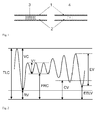
- the exhaled number flow is determined by the rate of droplet generation in the different lung compartments and by the redeposition of already generated particles in the complex lung structures during the exhalation process.
- Data from the literature as well as from own investigations from preliminary experiments indicate a particle size spectrum with a number maximum in the particle size range smaller than 1 ⁇ m.
- This drop formation process is to be differentiated from the processes, which eg become effective when speaking or coughing. The latter occur in the upper respiratory tract and lead to larger, but significantly fewer particles.
- the ventilated lung area where it can come to the airway closure, is referred to as closing volume (CV).
- CV closing volume
- EELV end of an exhalation process
- EELV ⁇ CV closing volume
- the particles or liquid droplets generated during the reopening are then carried out with the respiratory flow during the next exhalation process.
- the occlusion probability of the peripheral airways and therefore the particle flow can be influenced.
- this is in direct relation to the individually different lung function parameters, in particular the vital capacity and the residual volume, which in Fig. 2 are shown, which, as well as the closing volume for the healthy lung have a dependence on the age (see, eg Milic-Emili, Eur. J. Appl. Physiol., 2007, 99: 567-583 ).
- Fig. 2 Figure 5 shows common pulmonary function parameters determined, besides the occlusion volume CV, by conventional measurement methods such as spirometry or body plethysmography.
- the pulmonary function parameters shown are the pulmonary capacity TLC ("total lung capacity”), the lung volume VC ("vital capacity") available for respiration, the non-ventilatable residual volume RV, the tidal volume in tidal airway VT ("tidal volume "), the lung volume after respiratory distress after normal expiration FRC (" functional residual capacity "), the closure volume CV (“ closing volume "), the lung volume at the end of the expiration process EELV (“ end expiratory volume ”) and the exhalation volume EV ( "expired volume”).
- the occlusion volume can be measured by the administration and detection of noble gas boluses during pulmonary function examinations. It is used, for example, argon, the concentration of which is measured in the breathing air with a mass spectrometric method, or radioactive xenon gas 133, connected to a scintigraphic detection methods.
- the events of the reopening of the respiratory tract can also be detected and quantified by the analysis of acoustic signals. They develop in so-called crackling noise ( crackles ).
- the investigations (see eg Alencar et al, Physica, 2005, A 357: 18-26 ) further show that the opening processes increase avalanche-like when a critical pressure is exceeded in the ventilation of the explanted lung.
- the analysis of the crackles is suitable for the early detection of peripheral lung changes. Practically both the gas measurements due to the complex detection and the acoustic measurements are very expensive, in particular because of the superposition with other acoustic signals of the breathing.
- a further object of the present invention is to provide a device with which such a method can be carried out as efficiently as possible.
- the method is based on the analysis of the number concentration of particles that are generated during respiration in the lungs and can be measured exhaled.
- a connection between the occlusion probability of peripheral airways and abnormal lung changes and, on the other hand, the relationship between the amount of exhaled particles and the reopening processes of occluded respiratory tracts is exploited.
- Through a combination of clinical lung function measurements and the measurement of the concentration of exhaled particles with different Atusteustern can thus be concluded in the context of a subsequent diagnosis of the method according to the invention on pathological changes in the lungs.
- the number of particles emitted in the exhalation or exhalation volume is measured, since it has been recognized that this size can be used as a possible biomarker for pathological alteration of the small airways.
- the measurement of at least one pulmonary function parameter LFP which is preferably selected from the lung capacity TLC, the respiratory available lung volume VC, the non-ventilable residual volume RV, the tidal volume in tidal VT, the lung volume during respiratory distress after normal expiration FRC, the lung volume at the end of the expiration process EELV, or combinations thereof, on a subject P 1 by spirometry and / or body plethysmography.
- step (b) of the method according to the invention the simultaneous measurement of the respiratory flow and the concentration of particles in the exhaled air for n different average expiratory volumes EV x , where n ⁇ 1, preferably n ⁇ 2, more preferably n ⁇ 3, and x runs from 1 to n.
- the inhaled and exhaled tidal volume is recorded as a function of time.
- Such a measurement of the respiratory flow is known to the person skilled in the art, as are suitable measuring devices for carrying it out.
- the test person can generate different exhalation volumes or exhalation volumes EV x .
- the simultaneous measurement of the respiratory flow and the concentration of particles in the exhaled air in step (b) is preferably carried out for 4 exhalation volumes (ie EV 1 to EV 4 ).
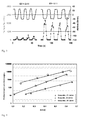
- FIG Fig. 3 An exemplary simultaneous measurement of the respiratory flow and the concentration of particles in the exhaled air is in FIG Fig. 3 shown.
- the respiratory flow in 1 / min
- the average exhaled volume or volume is the mean of the integrals over the respective half-waves of the volume flow curves (positive half wave: inhalation, negative half wave: exhalation).
- measuring example results for the first respiratory depth an exhalation volume of 2.4 1, while for the second breathing depth results in an exhalation volume of 3.1.
- the simultaneous particle measurement (see lower half of the Fig. 3 ) allows the determination of the number flow of particles in the exhaled air.
- the measurement of the respiratory flow for different average exhalation volumes EV x in step (b) by spirometry and / or body plethysmography Preference is given to using a pneumotachograph or an acoustic volume flow measuring device, for example an ultrasonic spirometer.
- the measurement of the particle concentration in the exhaled air can be done with such measuring devices that can detect even very small diameter particles.
- the particle concentration measuring device in step (b) should have a lower detection limit of 0.1 ⁇ m or less.
- particle refers to liquid droplets as exhaled with expiration. Their formation in the lungs has already been described above with reference to Fig. 1 discussed. They are preferably particles (or liquid droplets or liquid aerosol particles) with an average particle diameter of 2 ⁇ m or less, more preferably 1 ⁇ m or less.
- step (b) The measurement of the concentration of particles in the exhaled air in step (b) preferably takes place with a condensation nucleus counter.
- Condensation core counters are known per se to those skilled in the art and are also commercially available.
- Conventional condensation nucleus counters have a humidification zone in which a container of liquid is located and a condensation zone in which particle growth takes place by condensing the vapor of the humidification zone on the particle surface.
- the number of particles emitted per breath results by simply adding up all the count events during the half-wave exhalation and multiplying by the ratio of tidal volume and sample volume.
- the measurement process is controlled, recorded the resulting data and carried out the necessary calculations. He can also provide the subject with visual requirements for the execution of the breathing maneuver via the screen.
- condensation nucleus counters are commercially available. In many devices, however, the sampling volume flow at 0.11 rpm is so low that, given the overall low emission rates, the statistical reliability for the Recording the counting events can be negatively influenced. Furthermore, in the devices partly harmful vapors (such as butanol) are used, which then have to be filtered consuming. Moreover, commercial devices are expensive not least because of their high technical complexity for saturating the steam and subsequently controlled cooling.
- the condensation nucleus counter used in step (b) has no humidification zone (i.e., no liquid container). It is thus preferred that the increase in the particle diameter in the condensation nucleus counter essentially, more preferably exclusively by condensation of the water vapor of the exhaled air. This preferred embodiment thus utilizes the steam condensation of the already saturated with steam breathing air.
- step (b) the simultaneous measurement of the respiratory flow by spirometry and / or body plethysmography and the concentration of particles in the exhaled air with a condensation nucleus counter in the same device.
- this is a device, as will be defined in more detail below.
- step (a), if carried out, and / or step (b) are preferably stored on one or more data memories in order to be preferably fed to one or more arithmetic units in subsequent steps of the method according to the invention ,
- step (c) of the method according to the invention the determination of the average number N e of the particles in the exhaled air for each of the different average exhalation volumes EV x .
- the number N e of the particles in the exhaled air can be determined, for example, for each of the different exhalation volumes EV x by multiplying the volume flow and the particle concentration C e .
- Fig. 3 One recognizes the significant increase in the number flow (by about a factor of 7) with only a slight increase in breathing depth by 25%.
- this pulmonary function parameter LFP is preferably the respiratory-available lung volume VC.
- N e f (EV / VC) is shown in a diagram
- step (e) of the method according to the invention the determination of a particle emission index EKZ for the subject P 1 is carried out by selecting a defined function value ("y value”) or function argument ("x value”).
- the function value determined in this way or the function argument thus determined can be used directly as a particle emission number EKZ or, alternatively, can be subjected to a further conversion step, which then supplies the particle emission number EKZ of the relevant subject.
- the quotient EV / VC for a given exhaled number of particles can also be selected as a characteristic.
- the first method has been used as an example for the measurement data of different subjects, and the result is in Fig. 6 shown. Thereafter, the particle emission index shows a clear dependence on age (or other suitable biological-medical parameter BMP).
- step (e) the repetition of method steps (a) - (d) takes place on n subjects P x , where n ⁇ 1 and x runs from 2 to n + 1, and all subjects P x differ from each other and P 1 by at least one biological-medical parameter BMP.
- a biological-medical parameter BMP is understood to mean every property of a subject which is suitable for distinguishing him or her from a medical or biological point of view from another subject.
- a preferred biological-medical parameter BMP in the method according to the invention may be the age of the subject.
- step (g) of the method according to the invention the determination of the particle emission index EKZ is carried out for each subject P x .
- the particle emission index shows a clear dependency on a suitably selected, suitable biological-medical parameter, such as the age of the subjects.
- the biological-medical parameter BMP in step (h) is the same biological-medical parameter BMP as used in step (f).
- steps (c) - (e), (g) and (h) will each be performed using a computing unit. It is preferably the same arithmetic unit that is used in all process steps.
- the process according to the invention is preferably carried out using the device defined below.
- the tube has at least one branch.
- the tube having at least one branch is present as a T-piece or X-piece.
- At least one branch of the tube has a mouthpiece through which a subject can inhale or exhale.
- the spirometer is selected from a pneumotachograph, an ultrasonic spinner, or combinations thereof.
- a filter preferably an absolute filter attached.
- the absolute filter may be mounted in front of the check valve and optionally in front of the absolute filter of the pneumotachograph, and in the exhalation branch, viewed in the direction of flow of exhaled air, the check valve upstream of the absolute filter and optionally after the absolute filter of the pneumotachograph to be appropriate.
- the check valve upstream of the absolute filter and optionally after the absolute filter of the pneumotachograph to be appropriate.
- the condensation nucleus counter of the device according to the invention has no moistening zone, ie no area with a container for receiving a liquid which would cause particle growth in the downstream condensation zone.
- the condensation nucleus counter has a scattered light optical system for the detection of particles, which preferably includes a transmitting optics for generating a primary light beam and a receiving optics with a light trap.
- the nozzle for adiabatic expansion is mounted in a nozzle carrier made of a material having good thermal conductivity and optionally in thermal contact with a heating element.
- the material having good thermal conductivity may be brass, copper or combinations thereof.
- the device according to the invention preferably also comprises a computer unit and / or a data memory.
- the device according to the invention is preferably a device for the non-invasive diagnosis of pathological changes in the lung, in particular the peripheral regions of the lung (PAD), as described e.g. in obstructive pulmonary disease (bronchial asthma, chronic obstructive pulmonary disease (COPD) or in bronchiolitis obliterans or in bronchiolitis obliterans syndrome in the context of organ rejection after lung transplantation occur.
- PAD peripheral regions of the lung
- the device according to the invention is preferably used to carry out the method described above.
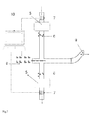
- the subject inhales via two check valves, 6, through a T-piece with mouthpiece, 9, in and out.
- the check valves ensure a clear distribution of the respiratory air into inhalation and exhalation volumes.
- Both the inhaled and the exhaled air are completely cleaned of particles by means of an absolute filter, 5.
- the respiratory flow can be measured either by two pneumotachographs, 7, in the inhalation and exhalation branch, or by an ultrasound spinner, 11, which can be mounted immediately behind the mouthpiece.
- the measurement of the particle concentration is carried out in a partial flow of the respiratory air by means of a so-called condensation core counter, 8. This measurement method allows, in contrast to pure scattered light particle counters and the detection of particles with diameters smaller than 0.1 microns.
- the number of particles emitted per breath results by simply adding up all the count events during the half-wave exhalation and multiplying by the ratio of tidal volume and sample volume.
- the measurement process is controlled, recorded the resulting data and performed the necessary calculations. He can also provide the subject with visual requirements for the execution of the breathing maneuver via the screen.
- Condensation core counters are commercially available. In many devices, however, the sampling volume flow at 0.11 rpm is so low that, given the overall low emission rates, counting events can only be recorded with less statistical certainty. Furthermore, in the devices partly harmful vapors (such as butanol) are used, which then have to be filtered consuming. Moreover, commercial devices are expensive not least because of their high technical complexity for saturating the steam and subsequently controlled cooling.
- the steam condensation from the already saturated with water vapor breathing air is utilized.
- the sampling volume flow characterized by a temperature of between 35 and 37 ° C and a relative humidity of nearly 100%, is adiabatically expanded via a nozzle.
- the cooling associated with the adiabatic expansion leads to a supersaturation of the water vapor and its condensation on the particles present in the sample air.
- the particles are detected by a simple scattered light optics and counted.
- An embodiment of this principle shows the Fig. 9 ,
- the expansion ratio P1lP2 is 1.11 ( P1 : pressure in front of the nozzle, P2 : pressure behind the nozzle)
- the primary light beam of the transmitting optics, 15, is absorbed in a light trap of the receiving optics, 16.
- the light scattered in a narrow angular range in the forward direction is directed by the receiving optics, 16, to a photodetector.
- the pulses are amplified and recorded by the PC. Via a pump 17, the constant sampling volume flow is set.
- the nozzle carrier consists of thermally highly conductive material and is heated with a Peltier element, 18. Water vapor condensation on the walls of the growth path is of no importance for the measurement.
Landscapes
- Health & Medical Sciences (AREA)
- Life Sciences & Earth Sciences (AREA)
- Biomedical Technology (AREA)
- Molecular Biology (AREA)
- Pulmonology (AREA)
- Biophysics (AREA)
- Pathology (AREA)
- Engineering & Computer Science (AREA)
- Physiology (AREA)
- Heart & Thoracic Surgery (AREA)
- Medical Informatics (AREA)
- Physics & Mathematics (AREA)
- Surgery (AREA)
- Animal Behavior & Ethology (AREA)
- General Health & Medical Sciences (AREA)
- Public Health (AREA)
- Veterinary Medicine (AREA)
- Measurement Of The Respiration, Hearing Ability, Form, And Blood Characteristics Of Living Organisms (AREA)
- Investigating Or Analysing Biological Materials (AREA)
Priority Applications (2)
| Application Number | Priority Date | Filing Date | Title |
|---|---|---|---|
| DK09159666.8T DK2248464T3 (da) | 2009-05-07 | 2009-05-07 | Benyttelse af mængdestrømmen af endogent genererede partikler i menneskets udåndingsluft til diagnose af lungesygdomme |
| EP09159666.8A EP2248464B1 (fr) | 2009-05-07 | 2009-05-07 | Utilisation du courant quantitatif de particules générées de manière endogène dans l'air d'expiration de l'homme pour le diagnostic de maladies des poumons |
Applications Claiming Priority (1)
| Application Number | Priority Date | Filing Date | Title |
|---|---|---|---|
| EP09159666.8A EP2248464B1 (fr) | 2009-05-07 | 2009-05-07 | Utilisation du courant quantitatif de particules générées de manière endogène dans l'air d'expiration de l'homme pour le diagnostic de maladies des poumons |
Publications (2)
| Publication Number | Publication Date |
|---|---|
| EP2248464A1 true EP2248464A1 (fr) | 2010-11-10 |
| EP2248464B1 EP2248464B1 (fr) | 2014-07-16 |
Family
ID=41066290
Family Applications (1)
| Application Number | Title | Priority Date | Filing Date |
|---|---|---|---|
| EP09159666.8A Active EP2248464B1 (fr) | 2009-05-07 | 2009-05-07 | Utilisation du courant quantitatif de particules générées de manière endogène dans l'air d'expiration de l'homme pour le diagnostic de maladies des poumons |
Country Status (2)
| Country | Link |
|---|---|
| EP (1) | EP2248464B1 (fr) |
| DK (1) | DK2248464T3 (fr) |
Cited By (2)
| Publication number | Priority date | Publication date | Assignee | Title |
|---|---|---|---|---|
| DE102011077772A1 (de) | 2011-06-17 | 2012-12-20 | Fraunhofer-Gesellschaft zur Förderung der angewandten Forschung e.V. | Verfahren zur Analyse der Ausatemluft |
| CN116113364A (zh) * | 2020-08-27 | 2023-05-12 | 帕拉斯颗粒及激光测量技术公司 | 用于表征呼出空气中的颗粒的设备和方法 |
Citations (3)
| Publication number | Priority date | Publication date | Assignee | Title |
|---|---|---|---|---|
| DE2938856A1 (de) * | 1979-09-26 | 1981-04-16 | Gesellschaft für Strahlen- und Umweltforschung mbH, 8000 München | Verfahren und vorrichtung zur ermittlung der ablagerung von partikeln im atemtrakt und/oder zur ueberpruefung der funktion des atemtraktes |
| US20050137491A1 (en) * | 2002-12-20 | 2005-06-23 | Paz Frederick M. | Breath aerosol management and collection system |
| DE102004044656A1 (de) | 2004-05-06 | 2005-12-01 | Inamed Gmbh | Verfahren und Anordnung zum Messen der Partikelproduktion der menschlichen Lunge |
-
2009
- 2009-05-07 DK DK09159666.8T patent/DK2248464T3/da active
- 2009-05-07 EP EP09159666.8A patent/EP2248464B1/fr active Active
Patent Citations (3)
| Publication number | Priority date | Publication date | Assignee | Title |
|---|---|---|---|---|
| DE2938856A1 (de) * | 1979-09-26 | 1981-04-16 | Gesellschaft für Strahlen- und Umweltforschung mbH, 8000 München | Verfahren und vorrichtung zur ermittlung der ablagerung von partikeln im atemtrakt und/oder zur ueberpruefung der funktion des atemtraktes |
| US20050137491A1 (en) * | 2002-12-20 | 2005-06-23 | Paz Frederick M. | Breath aerosol management and collection system |
| DE102004044656A1 (de) | 2004-05-06 | 2005-12-01 | Inamed Gmbh | Verfahren und Anordnung zum Messen der Partikelproduktion der menschlichen Lunge |
Non-Patent Citations (6)
| Title |
|---|
| "Model 3025A Ultrafine Condensation Particle Counter", 1999, TSI INCORPORATED,, U.S.A, XP002546627 * |
| ALENCAR ET AL., PHYSICA, vol. A 357, 2005, pages 18 - 26 |
| CHONG S.KIM ET AL., INHALATION TECHNOLOGY, vol. 17, 2005, pages 387 - 399 |
| FAIRCHILD C I ET AL: "PARTICLE CONCENTRATION IN EXHALED BREATH", AMERICAN INDUSTRIAL HYGIENE ASSOCIATION JOURNAL, AKRON, OH, US, vol. 48, no. 11, 1 January 1987 (1987-01-01), pages 948/949, XP008030992 * |
| KIM CHONG S ET AL: "Total lung deposition of ultrafine particles in elderly subjects during controlled breathing.", INHALATION TOXICOLOGY 2005 JUN-JUL, vol. 17, no. 7-8, June 2005 (2005-06-01), pages 387 - 399, XP009122807, ISSN: 0895-8378 * |
| PELOSI; ROCCO, CRITICAL CARE, vol. 11, 2007, pages 114 - 115 |
Cited By (4)
| Publication number | Priority date | Publication date | Assignee | Title |
|---|---|---|---|---|
| DE102011077772A1 (de) | 2011-06-17 | 2012-12-20 | Fraunhofer-Gesellschaft zur Förderung der angewandten Forschung e.V. | Verfahren zur Analyse der Ausatemluft |
| WO2012172011A1 (fr) | 2011-06-17 | 2012-12-20 | Fraunhofer-Gesellschaft zur Förderung der angewandten Forschung e. V. | Procédé d'analyse de l'air expiré |
| DE102011077772B4 (de) * | 2011-06-17 | 2015-10-01 | Fraunhofer-Gesellschaft zur Förderung der angewandten Forschung e.V. | Verfahren zur Analyse der Ausatemluft |
| CN116113364A (zh) * | 2020-08-27 | 2023-05-12 | 帕拉斯颗粒及激光测量技术公司 | 用于表征呼出空气中的颗粒的设备和方法 |
Also Published As
| Publication number | Publication date |
|---|---|
| DK2248464T3 (da) | 2014-10-27 |
| EP2248464B1 (fr) | 2014-07-16 |
Similar Documents
| Publication | Publication Date | Title |
|---|---|---|
| EP2134256B1 (fr) | Pneumotachographe transportable pour mesurer des composants du volume d'expiration, et procede correspondant | |
| EP2299901B1 (fr) | Pneumotachographe transportable destiné à la mesure de composantes d'un volume d'air expiré | |
| DE60204336T2 (de) | Atemfunktionsanalyse mittels kapnographie | |
| DE69801495T2 (de) | Vorrichtung und verfahren zur bestimmung des no-gehaltes in der ausatemluft | |
| DE102014004765B3 (de) | Gerät für die Messung und Analyse des Multiple-Breath-Stickstoff-Auswaschverfahrens | |
| EP2919649B1 (fr) | Dispositif et procédé de mesure de la fonction pulmonaire | |
| WO2019011750A1 (fr) | Nouveau système de collecte de particules expirées | |
| EP2066236B1 (fr) | Dispositif de fractionnement d'un volume d'expiration | |
| EP2248464B1 (fr) | Utilisation du courant quantitatif de particules générées de manière endogène dans l'air d'expiration de l'homme pour le diagnostic de maladies des poumons | |
| DE102007012210B4 (de) | Transportabler Pneumotachograph zur Messung von Bestandteilen des Exspirationsvolumens sowie ein Verfahren hierzu | |
| EP1036322B1 (fr) | Dispositif pour etudier les maladies des voies respiratoires et agents diagnostiques | |
| DE102007012330A1 (de) | Verfahren zum Klassifizieren von Messergebnissen einer Lungenfunktionsprüfung | |
| DE102006039140B4 (de) | Vorrichtung, deren Verwendung und Verfahren zum Fraktionieren des Exspirationsvolumens | |
| DE102005026933B4 (de) | Verfahren und Verwendung einer Vorrichtung zur Durchführung des Verfahrens zur Messung und Analyse von Bestandteilen von exhaliertem Atemgas | |
| DE202007003818U1 (de) | Transportabler Pneumotachograph zur Messung von Bestandteilen des Exspirationsvolumens | |
| CN204269593U (zh) | 一口气多参数呼气一氧化氮测量装置 | |
| DE102011077772B4 (de) | Verfahren zur Analyse der Ausatemluft | |
| EP2344036A1 (fr) | Procédé de mesure de l'espace mort pulmonaire | |
| DE102004044656A1 (de) | Verfahren und Anordnung zum Messen der Partikelproduktion der menschlichen Lunge | |
| EP2042866A1 (fr) | Analyse d'air inhalé | |
| WO2022002971A1 (fr) | Système d'échantillonnage et système d'examen d'air respiratoire ayant un système d'échantillonnage | |
| Altshuler et al. | Effect of depth of inhalation on aerosol persistence during breath holding. | |
| DE202006012837U1 (de) | Vorrichtung zum Fraktionieren des Exspirationsvolumens | |
| DE3037126A1 (de) | Einrichtung fuer ganzkoerperplethysmographische lungenfunktionsmessungen |
Legal Events
| Date | Code | Title | Description |
|---|---|---|---|
| PUAI | Public reference made under article 153(3) epc to a published international application that has entered the european phase |
Free format text: ORIGINAL CODE: 0009012 |
|
| AK | Designated contracting states |
Kind code of ref document: A1 Designated state(s): AT BE BG CH CY CZ DE DK EE ES FI FR GB GR HR HU IE IS IT LI LT LU LV MC MK MT NL NO PL PT RO SE SI SK TR |
|
| AX | Request for extension of the european patent |
Extension state: AL BA RS |
|
| 17P | Request for examination filed |
Effective date: 20110413 |
|
| 17Q | First examination report despatched |
Effective date: 20110819 |
|
| GRAP | Despatch of communication of intention to grant a patent |
Free format text: ORIGINAL CODE: EPIDOSNIGR1 |
|
| INTG | Intention to grant announced |
Effective date: 20140219 |
|
| GRAS | Grant fee paid |
Free format text: ORIGINAL CODE: EPIDOSNIGR3 |
|
| GRAA | (expected) grant |
Free format text: ORIGINAL CODE: 0009210 |
|
| AK | Designated contracting states |
Kind code of ref document: B1 Designated state(s): AT BE BG CH CY CZ DE DK EE ES FI FR GB GR HR HU IE IS IT LI LT LU LV MC MK MT NL NO PL PT RO SE SI SK TR |
|
| REG | Reference to a national code |
Ref country code: GB Ref legal event code: FG4D Free format text: NOT ENGLISH |
|
| REG | Reference to a national code |
Ref country code: CH Ref legal event code: EP |
|
| REG | Reference to a national code |
Ref country code: IE Ref legal event code: FG4D Free format text: LANGUAGE OF EP DOCUMENT: GERMAN |
|
| REG | Reference to a national code |
Ref country code: AT Ref legal event code: REF Ref document number: 677047 Country of ref document: AT Kind code of ref document: T Effective date: 20140815 |
|
| REG | Reference to a national code |
Ref country code: DE Ref legal event code: R096 Ref document number: 502009009646 Country of ref document: DE Effective date: 20140828 |
|
| REG | Reference to a national code |
Ref country code: DK Ref legal event code: T3 Effective date: 20141022 |
|
| REG | Reference to a national code |
Ref country code: SE Ref legal event code: TRGR |
|
| REG | Reference to a national code |
Ref country code: NL Ref legal event code: T3 |
|
| REG | Reference to a national code |
Ref country code: NO Ref legal event code: T2 Effective date: 20140716 |
|
| REG | Reference to a national code |
Ref country code: LT Ref legal event code: MG4D |
|
| PG25 | Lapsed in a contracting state [announced via postgrant information from national office to epo] |
Ref country code: PT Free format text: LAPSE BECAUSE OF FAILURE TO SUBMIT A TRANSLATION OF THE DESCRIPTION OR TO PAY THE FEE WITHIN THE PRESCRIBED TIME-LIMIT Effective date: 20141117 Ref country code: BG Free format text: LAPSE BECAUSE OF FAILURE TO SUBMIT A TRANSLATION OF THE DESCRIPTION OR TO PAY THE FEE WITHIN THE PRESCRIBED TIME-LIMIT Effective date: 20141016 Ref country code: GR Free format text: LAPSE BECAUSE OF FAILURE TO SUBMIT A TRANSLATION OF THE DESCRIPTION OR TO PAY THE FEE WITHIN THE PRESCRIBED TIME-LIMIT Effective date: 20141017 Ref country code: ES Free format text: LAPSE BECAUSE OF FAILURE TO SUBMIT A TRANSLATION OF THE DESCRIPTION OR TO PAY THE FEE WITHIN THE PRESCRIBED TIME-LIMIT Effective date: 20140716 Ref country code: FI Free format text: LAPSE BECAUSE OF FAILURE TO SUBMIT A TRANSLATION OF THE DESCRIPTION OR TO PAY THE FEE WITHIN THE PRESCRIBED TIME-LIMIT Effective date: 20140716 Ref country code: LT Free format text: LAPSE BECAUSE OF FAILURE TO SUBMIT A TRANSLATION OF THE DESCRIPTION OR TO PAY THE FEE WITHIN THE PRESCRIBED TIME-LIMIT Effective date: 20140716 |
|
| PG25 | Lapsed in a contracting state [announced via postgrant information from national office to epo] |
Ref country code: LV Free format text: LAPSE BECAUSE OF FAILURE TO SUBMIT A TRANSLATION OF THE DESCRIPTION OR TO PAY THE FEE WITHIN THE PRESCRIBED TIME-LIMIT Effective date: 20140716 Ref country code: IS Free format text: LAPSE BECAUSE OF FAILURE TO SUBMIT A TRANSLATION OF THE DESCRIPTION OR TO PAY THE FEE WITHIN THE PRESCRIBED TIME-LIMIT Effective date: 20141116 Ref country code: CY Free format text: LAPSE BECAUSE OF FAILURE TO SUBMIT A TRANSLATION OF THE DESCRIPTION OR TO PAY THE FEE WITHIN THE PRESCRIBED TIME-LIMIT Effective date: 20140716 Ref country code: PL Free format text: LAPSE BECAUSE OF FAILURE TO SUBMIT A TRANSLATION OF THE DESCRIPTION OR TO PAY THE FEE WITHIN THE PRESCRIBED TIME-LIMIT Effective date: 20140716 |
|
| REG | Reference to a national code |
Ref country code: DE Ref legal event code: R097 Ref document number: 502009009646 Country of ref document: DE |
|
| PG25 | Lapsed in a contracting state [announced via postgrant information from national office to epo] |
Ref country code: CZ Free format text: LAPSE BECAUSE OF FAILURE TO SUBMIT A TRANSLATION OF THE DESCRIPTION OR TO PAY THE FEE WITHIN THE PRESCRIBED TIME-LIMIT Effective date: 20140716 Ref country code: SK Free format text: LAPSE BECAUSE OF FAILURE TO SUBMIT A TRANSLATION OF THE DESCRIPTION OR TO PAY THE FEE WITHIN THE PRESCRIBED TIME-LIMIT Effective date: 20140716 Ref country code: RO Free format text: LAPSE BECAUSE OF FAILURE TO SUBMIT A TRANSLATION OF THE DESCRIPTION OR TO PAY THE FEE WITHIN THE PRESCRIBED TIME-LIMIT Effective date: 20140716 Ref country code: EE Free format text: LAPSE BECAUSE OF FAILURE TO SUBMIT A TRANSLATION OF THE DESCRIPTION OR TO PAY THE FEE WITHIN THE PRESCRIBED TIME-LIMIT Effective date: 20140716 |
|
| REG | Reference to a national code |
Ref country code: FR Ref legal event code: PLFP Year of fee payment: 7 |
|
| PLBE | No opposition filed within time limit |
Free format text: ORIGINAL CODE: 0009261 |
|
| STAA | Information on the status of an ep patent application or granted ep patent |
Free format text: STATUS: NO OPPOSITION FILED WITHIN TIME LIMIT |
|
| 26N | No opposition filed |
Effective date: 20150417 |
|
| PG25 | Lapsed in a contracting state [announced via postgrant information from national office to epo] |
Ref country code: SI Free format text: LAPSE BECAUSE OF FAILURE TO SUBMIT A TRANSLATION OF THE DESCRIPTION OR TO PAY THE FEE WITHIN THE PRESCRIBED TIME-LIMIT Effective date: 20140716 |
|
| PG25 | Lapsed in a contracting state [announced via postgrant information from national office to epo] |
Ref country code: MC Free format text: LAPSE BECAUSE OF FAILURE TO SUBMIT A TRANSLATION OF THE DESCRIPTION OR TO PAY THE FEE WITHIN THE PRESCRIBED TIME-LIMIT Effective date: 20140716 Ref country code: LU Free format text: LAPSE BECAUSE OF FAILURE TO SUBMIT A TRANSLATION OF THE DESCRIPTION OR TO PAY THE FEE WITHIN THE PRESCRIBED TIME-LIMIT Effective date: 20150507 |
|
| REG | Reference to a national code |
Ref country code: FR Ref legal event code: PLFP Year of fee payment: 8 |
|
| PG25 | Lapsed in a contracting state [announced via postgrant information from national office to epo] |
Ref country code: MT Free format text: LAPSE BECAUSE OF FAILURE TO SUBMIT A TRANSLATION OF THE DESCRIPTION OR TO PAY THE FEE WITHIN THE PRESCRIBED TIME-LIMIT Effective date: 20140716 |
|
| REG | Reference to a national code |
Ref country code: FR Ref legal event code: PLFP Year of fee payment: 9 |
|
| PG25 | Lapsed in a contracting state [announced via postgrant information from national office to epo] |
Ref country code: HU Free format text: LAPSE BECAUSE OF FAILURE TO SUBMIT A TRANSLATION OF THE DESCRIPTION OR TO PAY THE FEE WITHIN THE PRESCRIBED TIME-LIMIT; INVALID AB INITIO Effective date: 20090507 |
|
| PG25 | Lapsed in a contracting state [announced via postgrant information from national office to epo] |
Ref country code: HR Free format text: LAPSE BECAUSE OF FAILURE TO SUBMIT A TRANSLATION OF THE DESCRIPTION OR TO PAY THE FEE WITHIN THE PRESCRIBED TIME-LIMIT Effective date: 20140716 |
|
| PG25 | Lapsed in a contracting state [announced via postgrant information from national office to epo] |
Ref country code: TR Free format text: LAPSE BECAUSE OF FAILURE TO SUBMIT A TRANSLATION OF THE DESCRIPTION OR TO PAY THE FEE WITHIN THE PRESCRIBED TIME-LIMIT Effective date: 20140716 |
|
| REG | Reference to a national code |
Ref country code: FR Ref legal event code: PLFP Year of fee payment: 10 |
|
| PG25 | Lapsed in a contracting state [announced via postgrant information from national office to epo] |
Ref country code: MK Free format text: LAPSE BECAUSE OF FAILURE TO SUBMIT A TRANSLATION OF THE DESCRIPTION OR TO PAY THE FEE WITHIN THE PRESCRIBED TIME-LIMIT Effective date: 20140716 |
|
| P01 | Opt-out of the competence of the unified patent court (upc) registered |
Effective date: 20230524 |
|
| PGFP | Annual fee paid to national office [announced via postgrant information from national office to epo] |
Ref country code: NL Payment date: 20250522 Year of fee payment: 17 |
|
| PGFP | Annual fee paid to national office [announced via postgrant information from national office to epo] |
Ref country code: DE Payment date: 20250519 Year of fee payment: 17 |
|
| PGFP | Annual fee paid to national office [announced via postgrant information from national office to epo] |
Ref country code: DK Payment date: 20250521 Year of fee payment: 17 Ref country code: GB Payment date: 20250522 Year of fee payment: 17 |
|
| PGFP | Annual fee paid to national office [announced via postgrant information from national office to epo] |
Ref country code: NO Payment date: 20250520 Year of fee payment: 17 |
|
| PGFP | Annual fee paid to national office [announced via postgrant information from national office to epo] |
Ref country code: BE Payment date: 20250520 Year of fee payment: 17 Ref country code: IT Payment date: 20250530 Year of fee payment: 17 |
|
| PGFP | Annual fee paid to national office [announced via postgrant information from national office to epo] |
Ref country code: FR Payment date: 20250521 Year of fee payment: 17 |
|
| PGFP | Annual fee paid to national office [announced via postgrant information from national office to epo] |
Ref country code: CH Payment date: 20250601 Year of fee payment: 17 |
|
| PGFP | Annual fee paid to national office [announced via postgrant information from national office to epo] |
Ref country code: AT Payment date: 20250519 Year of fee payment: 17 |
|
| PGFP | Annual fee paid to national office [announced via postgrant information from national office to epo] |
Ref country code: IE Payment date: 20250521 Year of fee payment: 17 |
|
| PGFP | Annual fee paid to national office [announced via postgrant information from national office to epo] |
Ref country code: SE Payment date: 20250522 Year of fee payment: 17 |