EP2248645A1 - Article de graphite flexible et son procédé de fabrication - Google Patents
Article de graphite flexible et son procédé de fabrication Download PDFInfo
- Publication number
- EP2248645A1 EP2248645A1 EP20100171152 EP10171152A EP2248645A1 EP 2248645 A1 EP2248645 A1 EP 2248645A1 EP 20100171152 EP20100171152 EP 20100171152 EP 10171152 A EP10171152 A EP 10171152A EP 2248645 A1 EP2248645 A1 EP 2248645A1
- Authority
- EP
- European Patent Office
- Prior art keywords
- graphite
- particles
- flexible graphite
- graphite particles
- sheet
- Prior art date
- Legal status (The legal status is an assumption and is not a legal conclusion. Google has not performed a legal analysis and makes no representation as to the accuracy of the status listed.)
- Withdrawn
Links
- OKTJSMMVPCPJKN-UHFFFAOYSA-N Carbon Chemical compound [C] OKTJSMMVPCPJKN-UHFFFAOYSA-N 0.000 title claims abstract description 209
- 229910002804 graphite Inorganic materials 0.000 title claims abstract description 197
- 239000010439 graphite Substances 0.000 title claims abstract description 197
- 238000000034 method Methods 0.000 title claims abstract description 25
- 238000004519 manufacturing process Methods 0.000 title description 5
- 239000002245 particle Substances 0.000 claims abstract description 109
- 239000011347 resin Substances 0.000 claims abstract description 24
- 229920005989 resin Polymers 0.000 claims abstract description 24
- 239000007788 liquid Substances 0.000 claims abstract description 20
- 229910021382 natural graphite Inorganic materials 0.000 claims abstract description 10
- 238000010924 continuous production Methods 0.000 claims abstract description 6
- 230000001427 coherent effect Effects 0.000 claims abstract description 5
- 238000003490 calendering Methods 0.000 claims abstract description 4
- 239000000835 fiber Substances 0.000 claims description 24
- 239000000463 material Substances 0.000 claims description 20
- 239000000919 ceramic Substances 0.000 claims description 16
- 239000002904 solvent Substances 0.000 claims description 7
- 239000002253 acid Substances 0.000 description 21
- 239000000654 additive Substances 0.000 description 15
- QAOWNCQODCNURD-UHFFFAOYSA-N Sulfuric acid Chemical compound OS(O)(=O)=O QAOWNCQODCNURD-UHFFFAOYSA-N 0.000 description 14
- 239000010410 layer Substances 0.000 description 14
- 238000001035 drying Methods 0.000 description 11
- 239000012530 fluid Substances 0.000 description 11
- 230000001965 increasing effect Effects 0.000 description 11
- 229910052799 carbon Inorganic materials 0.000 description 10
- 239000007789 gas Substances 0.000 description 10
- 239000000203 mixture Substances 0.000 description 10
- GRYLNZFGIOXLOG-UHFFFAOYSA-N Nitric acid Chemical class O[N+]([O-])=O GRYLNZFGIOXLOG-UHFFFAOYSA-N 0.000 description 8
- 230000006835 compression Effects 0.000 description 8
- 238000007906 compression Methods 0.000 description 8
- 238000009792 diffusion process Methods 0.000 description 7
- CPLXHLVBOLITMK-UHFFFAOYSA-N Magnesium oxide Chemical compound [Mg]=O CPLXHLVBOLITMK-UHFFFAOYSA-N 0.000 description 6
- MCMNRKCIXSYSNV-UHFFFAOYSA-N Zirconium dioxide Chemical compound O=[Zr]=O MCMNRKCIXSYSNV-UHFFFAOYSA-N 0.000 description 6
- 239000000138 intercalating agent Substances 0.000 description 6
- 238000009830 intercalation Methods 0.000 description 6
- 230000002687 intercalation Effects 0.000 description 6
- 229910017604 nitric acid Inorganic materials 0.000 description 6
- 125000004432 carbon atom Chemical group C* 0.000 description 5
- 239000000126 substance Substances 0.000 description 5
- NBIIXXVUZAFLBC-UHFFFAOYSA-N Phosphoric acid Chemical compound OP(O)(O)=O NBIIXXVUZAFLBC-UHFFFAOYSA-N 0.000 description 4
- 230000000996 additive effect Effects 0.000 description 4
- 230000003247 decreasing effect Effects 0.000 description 4
- 239000007800 oxidant agent Substances 0.000 description 4
- VLTRZXGMWDSKGL-UHFFFAOYSA-N perchloric acid Chemical compound OCl(=O)(=O)=O VLTRZXGMWDSKGL-UHFFFAOYSA-N 0.000 description 4
- 229910052582 BN Inorganic materials 0.000 description 3
- PZNSFCLAULLKQX-UHFFFAOYSA-N Boron nitride Chemical compound N#B PZNSFCLAULLKQX-UHFFFAOYSA-N 0.000 description 3
- WKBOTKDWSSQWDR-UHFFFAOYSA-N Bromine atom Chemical compound [Br] WKBOTKDWSSQWDR-UHFFFAOYSA-N 0.000 description 3
- VYPSYNLAJGMNEJ-UHFFFAOYSA-N Silicium dioxide Chemical compound O=[Si]=O VYPSYNLAJGMNEJ-UHFFFAOYSA-N 0.000 description 3
- GDTBXPJZTBHREO-UHFFFAOYSA-N bromine Substances BrBr GDTBXPJZTBHREO-UHFFFAOYSA-N 0.000 description 3
- 229910052794 bromium Inorganic materials 0.000 description 3
- 229910052918 calcium silicate Inorganic materials 0.000 description 3
- 235000012241 calcium silicate Nutrition 0.000 description 3
- OYACROKNLOSFPA-UHFFFAOYSA-N calcium;dioxido(oxo)silane Chemical compound [Ca+2].[O-][Si]([O-])=O OYACROKNLOSFPA-UHFFFAOYSA-N 0.000 description 3
- KRVSOGSZCMJSLX-UHFFFAOYSA-L chromic acid Substances O[Cr](O)(=O)=O KRVSOGSZCMJSLX-UHFFFAOYSA-L 0.000 description 3
- IQDXNHZDRQHKEF-UHFFFAOYSA-N dialuminum;dicalcium;dioxido(oxo)silane Chemical compound [Al+3].[Al+3].[Ca+2].[Ca+2].[O-][Si]([O-])=O.[O-][Si]([O-])=O.[O-][Si]([O-])=O.[O-][Si]([O-])=O.[O-][Si]([O-])=O IQDXNHZDRQHKEF-UHFFFAOYSA-N 0.000 description 3
- 238000004049 embossing Methods 0.000 description 3
- 239000000446 fuel Substances 0.000 description 3
- AWJWCTOOIBYHON-UHFFFAOYSA-N furo[3,4-b]pyrazine-5,7-dione Chemical compound C1=CN=C2C(=O)OC(=O)C2=N1 AWJWCTOOIBYHON-UHFFFAOYSA-N 0.000 description 3
- 239000003365 glass fiber Substances 0.000 description 3
- 229910052500 inorganic mineral Inorganic materials 0.000 description 3
- 239000000395 magnesium oxide Substances 0.000 description 3
- 239000011707 mineral Substances 0.000 description 3
- 239000002557 mineral fiber Substances 0.000 description 3
- TWNQGVIAIRXVLR-UHFFFAOYSA-N oxo(oxoalumanyloxy)alumane Chemical compound O=[Al]O[Al]=O TWNQGVIAIRXVLR-UHFFFAOYSA-N 0.000 description 3
- 238000007493 shaping process Methods 0.000 description 3
- HBMJWWWQQXIZIP-UHFFFAOYSA-N silicon carbide Chemical compound [Si+]#[C-] HBMJWWWQQXIZIP-UHFFFAOYSA-N 0.000 description 3
- 229910010271 silicon carbide Inorganic materials 0.000 description 3
- XLYOFNOQVPJJNP-UHFFFAOYSA-N water Substances O XLYOFNOQVPJJNP-UHFFFAOYSA-N 0.000 description 3
- XTEGARKTQYYJKE-UHFFFAOYSA-M Chlorate Chemical compound [O-]Cl(=O)=O XTEGARKTQYYJKE-UHFFFAOYSA-M 0.000 description 2
- MHAJPDPJQMAIIY-UHFFFAOYSA-N Hydrogen peroxide Chemical compound OO MHAJPDPJQMAIIY-UHFFFAOYSA-N 0.000 description 2
- 229910021578 Iron(III) chloride Inorganic materials 0.000 description 2
- DTQVDTLACAAQTR-UHFFFAOYSA-N Trifluoroacetic acid Chemical compound OC(=O)C(F)(F)F DTQVDTLACAAQTR-UHFFFAOYSA-N 0.000 description 2
- 238000005411 Van der Waals force Methods 0.000 description 2
- 150000007513 acids Chemical class 0.000 description 2
- 229910000147 aluminium phosphate Inorganic materials 0.000 description 2
- 239000011230 binding agent Substances 0.000 description 2
- 230000005484 gravity Effects 0.000 description 2
- 238000005470 impregnation Methods 0.000 description 2
- 239000012535 impurity Substances 0.000 description 2
- RBTARNINKXHZNM-UHFFFAOYSA-K iron trichloride Chemical compound Cl[Fe](Cl)Cl RBTARNINKXHZNM-UHFFFAOYSA-K 0.000 description 2
- 238000012986 modification Methods 0.000 description 2
- 230000004048 modification Effects 0.000 description 2
- 150000007524 organic acids Chemical class 0.000 description 2
- 230000001590 oxidative effect Effects 0.000 description 2
- KMUONIBRACKNSN-UHFFFAOYSA-N potassium dichromate Chemical compound [K+].[K+].[O-][Cr](=O)(=O)O[Cr]([O-])(=O)=O KMUONIBRACKNSN-UHFFFAOYSA-N 0.000 description 2
- 239000012286 potassium permanganate Substances 0.000 description 2
- 238000003825 pressing Methods 0.000 description 2
- 239000000376 reactant Substances 0.000 description 2
- 230000000717 retained effect Effects 0.000 description 2
- -1 trifluoroacetic acid Chemical class 0.000 description 2
- 230000008016 vaporization Effects 0.000 description 2
- 238000005406 washing Methods 0.000 description 2
- QLOKJRIVRGCVIM-UHFFFAOYSA-N 1-[(4-methylsulfanylphenyl)methyl]piperazine Chemical compound C1=CC(SC)=CC=C1CN1CCNCC1 QLOKJRIVRGCVIM-UHFFFAOYSA-N 0.000 description 1
- 230000009471 action Effects 0.000 description 1
- 239000003963 antioxidant agent Substances 0.000 description 1
- 238000003491 array Methods 0.000 description 1
- 125000004429 atom Chemical group 0.000 description 1
- 230000008901 benefit Effects 0.000 description 1
- 230000015572 biosynthetic process Effects 0.000 description 1
- 239000000872 buffer Substances 0.000 description 1
- 239000007795 chemical reaction product Substances 0.000 description 1
- 150000001875 compounds Chemical class 0.000 description 1
- 238000005260 corrosion Methods 0.000 description 1
- 230000007797 corrosion Effects 0.000 description 1
- 239000013078 crystal Substances 0.000 description 1
- 238000005520 cutting process Methods 0.000 description 1
- 238000000280 densification Methods 0.000 description 1
- 230000001419 dependent effect Effects 0.000 description 1
- 239000003623 enhancer Substances 0.000 description 1
- 230000002708 enhancing effect Effects 0.000 description 1
- 239000011888 foil Substances 0.000 description 1
- 239000003517 fume Substances 0.000 description 1
- 150000004820 halides Chemical class 0.000 description 1
- 238000010438 heat treatment Methods 0.000 description 1
- 239000011229 interlayer Substances 0.000 description 1
- 230000007246 mechanism Effects 0.000 description 1
- 229910052751 metal Inorganic materials 0.000 description 1
- 239000002184 metal Substances 0.000 description 1
- 229910001507 metal halide Inorganic materials 0.000 description 1
- 150000005309 metal halides Chemical class 0.000 description 1
- 238000000465 moulding Methods 0.000 description 1
- 239000003960 organic solvent Substances 0.000 description 1
- KHIWWQKSHDUIBK-UHFFFAOYSA-N periodic acid Chemical class OI(=O)(=O)=O KHIWWQKSHDUIBK-UHFFFAOYSA-N 0.000 description 1
- VKJKEPKFPUWCAS-UHFFFAOYSA-M potassium chlorate Chemical compound [K+].[O-]Cl(=O)=O VKJKEPKFPUWCAS-UHFFFAOYSA-M 0.000 description 1
- 230000008569 process Effects 0.000 description 1
- 239000000047 product Substances 0.000 description 1
- 238000000926 separation method Methods 0.000 description 1
- 239000007787 solid Substances 0.000 description 1
- 239000007921 spray Substances 0.000 description 1
- 229910001220 stainless steel Inorganic materials 0.000 description 1
- 239000010935 stainless steel Substances 0.000 description 1
- 239000007858 starting material Substances 0.000 description 1
- 238000009834 vaporization Methods 0.000 description 1
Images




Classifications
-
- C—CHEMISTRY; METALLURGY
- C04—CEMENTS; CONCRETE; ARTIFICIAL STONE; CERAMICS; REFRACTORIES
- C04B—LIME, MAGNESIA; SLAG; CEMENTS; COMPOSITIONS THEREOF, e.g. MORTARS, CONCRETE OR LIKE BUILDING MATERIALS; ARTIFICIAL STONE; CERAMICS; REFRACTORIES; TREATMENT OF NATURAL STONE
- C04B14/00—Use of inorganic materials as fillers, e.g. pigments, for mortars, concrete or artificial stone; Treatment of inorganic materials specially adapted to enhance their filling properties in mortars, concrete or artificial stone
- C04B14/38—Fibrous materials; Whiskers
- C04B14/46—Rock wool ; Ceramic or silicate fibres
-
- B—PERFORMING OPERATIONS; TRANSPORTING
- B29—WORKING OF PLASTICS; WORKING OF SUBSTANCES IN A PLASTIC STATE IN GENERAL
- B29C—SHAPING OR JOINING OF PLASTICS; SHAPING OF MATERIAL IN A PLASTIC STATE, NOT OTHERWISE PROVIDED FOR; AFTER-TREATMENT OF THE SHAPED PRODUCTS, e.g. REPAIRING
- B29C70/00—Shaping composites, i.e. plastics material comprising reinforcements, fillers or preformed parts, e.g. inserts
- B29C70/04—Shaping composites, i.e. plastics material comprising reinforcements, fillers or preformed parts, e.g. inserts comprising reinforcements only, e.g. self-reinforcing plastics
- B29C70/28—Shaping operations therefor
- B29C70/40—Shaping or impregnating by compression not applied
- B29C70/50—Shaping or impregnating by compression not applied for producing articles of indefinite length, e.g. prepregs, sheet moulding compounds [SMC] or cross moulding compounds [XMC]
- B29C70/504—Shaping or impregnating by compression not applied for producing articles of indefinite length, e.g. prepregs, sheet moulding compounds [SMC] or cross moulding compounds [XMC] using rollers or pressure bands
-
- C—CHEMISTRY; METALLURGY
- C04—CEMENTS; CONCRETE; ARTIFICIAL STONE; CERAMICS; REFRACTORIES
- C04B—LIME, MAGNESIA; SLAG; CEMENTS; COMPOSITIONS THEREOF, e.g. MORTARS, CONCRETE OR LIKE BUILDING MATERIALS; ARTIFICIAL STONE; CERAMICS; REFRACTORIES; TREATMENT OF NATURAL STONE
- C04B14/00—Use of inorganic materials as fillers, e.g. pigments, for mortars, concrete or artificial stone; Treatment of inorganic materials specially adapted to enhance their filling properties in mortars, concrete or artificial stone
- C04B14/02—Granular materials, e.g. microballoons
- C04B14/022—Carbon
- C04B14/024—Graphite
-
- C—CHEMISTRY; METALLURGY
- C04—CEMENTS; CONCRETE; ARTIFICIAL STONE; CERAMICS; REFRACTORIES
- C04B—LIME, MAGNESIA; SLAG; CEMENTS; COMPOSITIONS THEREOF, e.g. MORTARS, CONCRETE OR LIKE BUILDING MATERIALS; ARTIFICIAL STONE; CERAMICS; REFRACTORIES; TREATMENT OF NATURAL STONE
- C04B26/00—Compositions of mortars, concrete or artificial stone, containing only organic binders, e.g. polymer or resin concrete
- C04B26/02—Macromolecular compounds
-
- C—CHEMISTRY; METALLURGY
- C04—CEMENTS; CONCRETE; ARTIFICIAL STONE; CERAMICS; REFRACTORIES
- C04B—LIME, MAGNESIA; SLAG; CEMENTS; COMPOSITIONS THEREOF, e.g. MORTARS, CONCRETE OR LIKE BUILDING MATERIALS; ARTIFICIAL STONE; CERAMICS; REFRACTORIES; TREATMENT OF NATURAL STONE
- C04B30/00—Compositions for artificial stone, not containing binders
-
- C—CHEMISTRY; METALLURGY
- C04—CEMENTS; CONCRETE; ARTIFICIAL STONE; CERAMICS; REFRACTORIES
- C04B—LIME, MAGNESIA; SLAG; CEMENTS; COMPOSITIONS THEREOF, e.g. MORTARS, CONCRETE OR LIKE BUILDING MATERIALS; ARTIFICIAL STONE; CERAMICS; REFRACTORIES; TREATMENT OF NATURAL STONE
- C04B35/00—Shaped ceramic products characterised by their composition; Ceramics compositions; Processing powders of inorganic compounds preparatory to the manufacturing of ceramic products
- C04B35/515—Shaped ceramic products characterised by their composition; Ceramics compositions; Processing powders of inorganic compounds preparatory to the manufacturing of ceramic products based on non-oxide ceramics
- C04B35/52—Shaped ceramic products characterised by their composition; Ceramics compositions; Processing powders of inorganic compounds preparatory to the manufacturing of ceramic products based on non-oxide ceramics based on carbon, e.g. graphite
- C04B35/536—Shaped ceramic products characterised by their composition; Ceramics compositions; Processing powders of inorganic compounds preparatory to the manufacturing of ceramic products based on non-oxide ceramics based on carbon, e.g. graphite based on expanded graphite or complexed graphite
-
- B—PERFORMING OPERATIONS; TRANSPORTING
- B29—WORKING OF PLASTICS; WORKING OF SUBSTANCES IN A PLASTIC STATE IN GENERAL
- B29C—SHAPING OR JOINING OF PLASTICS; SHAPING OF MATERIAL IN A PLASTIC STATE, NOT OTHERWISE PROVIDED FOR; AFTER-TREATMENT OF THE SHAPED PRODUCTS, e.g. REPAIRING
- B29C43/00—Compression moulding, i.e. applying external pressure to flow the moulding material; Apparatus therefor
- B29C43/32—Component parts, details or accessories; Auxiliary operations
- B29C43/44—Compression means for making articles of indefinite length
- B29C43/46—Rollers
- B29C2043/461—Rollers the rollers having specific surface features
- B29C2043/463—Rollers the rollers having specific surface features corrugated, patterned or embossed surface
-
- C—CHEMISTRY; METALLURGY
- C04—CEMENTS; CONCRETE; ARTIFICIAL STONE; CERAMICS; REFRACTORIES
- C04B—LIME, MAGNESIA; SLAG; CEMENTS; COMPOSITIONS THEREOF, e.g. MORTARS, CONCRETE OR LIKE BUILDING MATERIALS; ARTIFICIAL STONE; CERAMICS; REFRACTORIES; TREATMENT OF NATURAL STONE
- C04B2111/00—Mortars, concrete or artificial stone or mixtures to prepare them, characterised by specific function, property or use
- C04B2111/50—Flexible or elastic materials
-
- C—CHEMISTRY; METALLURGY
- C04—CEMENTS; CONCRETE; ARTIFICIAL STONE; CERAMICS; REFRACTORIES
- C04B—LIME, MAGNESIA; SLAG; CEMENTS; COMPOSITIONS THEREOF, e.g. MORTARS, CONCRETE OR LIKE BUILDING MATERIALS; ARTIFICIAL STONE; CERAMICS; REFRACTORIES; TREATMENT OF NATURAL STONE
- C04B2111/00—Mortars, concrete or artificial stone or mixtures to prepare them, characterised by specific function, property or use
- C04B2111/90—Electrical properties
- C04B2111/94—Electrically conducting materials
-
- Y—GENERAL TAGGING OF NEW TECHNOLOGICAL DEVELOPMENTS; GENERAL TAGGING OF CROSS-SECTIONAL TECHNOLOGIES SPANNING OVER SEVERAL SECTIONS OF THE IPC; TECHNICAL SUBJECTS COVERED BY FORMER USPC CROSS-REFERENCE ART COLLECTIONS [XRACs] AND DIGESTS
- Y10—TECHNICAL SUBJECTS COVERED BY FORMER USPC
- Y10T—TECHNICAL SUBJECTS COVERED BY FORMER US CLASSIFICATION
- Y10T428/00—Stock material or miscellaneous articles
- Y10T428/24—Structurally defined web or sheet [e.g., overall dimension, etc.]
-
- Y—GENERAL TAGGING OF NEW TECHNOLOGICAL DEVELOPMENTS; GENERAL TAGGING OF CROSS-SECTIONAL TECHNOLOGIES SPANNING OVER SEVERAL SECTIONS OF THE IPC; TECHNICAL SUBJECTS COVERED BY FORMER USPC CROSS-REFERENCE ART COLLECTIONS [XRACs] AND DIGESTS
- Y10—TECHNICAL SUBJECTS COVERED BY FORMER USPC
- Y10T—TECHNICAL SUBJECTS COVERED BY FORMER US CLASSIFICATION
- Y10T428/00—Stock material or miscellaneous articles
- Y10T428/249921—Web or sheet containing structurally defined element or component
- Y10T428/249953—Composite having voids in a component [e.g., porous, cellular, etc.]
-
- Y—GENERAL TAGGING OF NEW TECHNOLOGICAL DEVELOPMENTS; GENERAL TAGGING OF CROSS-SECTIONAL TECHNOLOGIES SPANNING OVER SEVERAL SECTIONS OF THE IPC; TECHNICAL SUBJECTS COVERED BY FORMER USPC CROSS-REFERENCE ART COLLECTIONS [XRACs] AND DIGESTS
- Y10—TECHNICAL SUBJECTS COVERED BY FORMER USPC
- Y10T—TECHNICAL SUBJECTS COVERED BY FORMER US CLASSIFICATION
- Y10T428/00—Stock material or miscellaneous articles
- Y10T428/25—Web or sheet containing structurally defined element or component and including a second component containing structurally defined particles
- Y10T428/252—Glass or ceramic [i.e., fired or glazed clay, cement, etc.] [porcelain, quartz, etc.]
-
- Y—GENERAL TAGGING OF NEW TECHNOLOGICAL DEVELOPMENTS; GENERAL TAGGING OF CROSS-SECTIONAL TECHNOLOGIES SPANNING OVER SEVERAL SECTIONS OF THE IPC; TECHNICAL SUBJECTS COVERED BY FORMER USPC CROSS-REFERENCE ART COLLECTIONS [XRACs] AND DIGESTS
- Y10—TECHNICAL SUBJECTS COVERED BY FORMER USPC
- Y10T—TECHNICAL SUBJECTS COVERED BY FORMER US CLASSIFICATION
- Y10T428/00—Stock material or miscellaneous articles
- Y10T428/29—Coated or structually defined flake, particle, cell, strand, strand portion, rod, filament, macroscopic fiber or mass thereof
- Y10T428/2913—Rod, strand, filament or fiber
- Y10T428/2927—Rod, strand, filament or fiber including structurally defined particulate matter
-
- Y—GENERAL TAGGING OF NEW TECHNOLOGICAL DEVELOPMENTS; GENERAL TAGGING OF CROSS-SECTIONAL TECHNOLOGIES SPANNING OVER SEVERAL SECTIONS OF THE IPC; TECHNICAL SUBJECTS COVERED BY FORMER USPC CROSS-REFERENCE ART COLLECTIONS [XRACs] AND DIGESTS
- Y10—TECHNICAL SUBJECTS COVERED BY FORMER USPC
- Y10T—TECHNICAL SUBJECTS COVERED BY FORMER US CLASSIFICATION
- Y10T428/00—Stock material or miscellaneous articles
- Y10T428/29—Coated or structually defined flake, particle, cell, strand, strand portion, rod, filament, macroscopic fiber or mass thereof
- Y10T428/2982—Particulate matter [e.g., sphere, flake, etc.]
-
- Y—GENERAL TAGGING OF NEW TECHNOLOGICAL DEVELOPMENTS; GENERAL TAGGING OF CROSS-SECTIONAL TECHNOLOGIES SPANNING OVER SEVERAL SECTIONS OF THE IPC; TECHNICAL SUBJECTS COVERED BY FORMER USPC CROSS-REFERENCE ART COLLECTIONS [XRACs] AND DIGESTS
- Y10—TECHNICAL SUBJECTS COVERED BY FORMER USPC
- Y10T—TECHNICAL SUBJECTS COVERED BY FORMER US CLASSIFICATION
- Y10T428/00—Stock material or miscellaneous articles
- Y10T428/30—Self-sustaining carbon mass or layer with impregnant or other layer
Definitions
- the present invention relates to planar flexible graphite articles, such as flexible graphite sheet, and to a system and method for continuously producing such articles. More particularly, the present invention relates to flexible graphite sheet material that exhibits enhanced isotropy with respect to thermal and electrical conductivity and fluid diffusion, as well as to a method for producing the sheet.
- Graphites are made up of layer planes of hexagonal arrays or networks of carbon atoms. These layer planes of hexagonally arranged carbon atoms are substantially flat and are oriented or ordered so as to be substantially parallel and equidistant to one another.
- the substantially flat, parallel equidistant sheets or layers of carbon atoms usually referred to as basal planes, are linked or bonded together and groups thereof are arranged in crystallites.
- Highly ordered graphites consist of crystallites of considerable size: the crystallites being highly aligned or oriented with respect to each other and having well ordered carbon layers. In other words, highly ordered graphites have a high degree of preferred crystallite orientation.
- graphites possess anisotropic structures and thus exhibit or possess many properties that are highly directional, e.g., thermal and electrical conductivity and fluid diffusion.
- graphites may be characterized as laminated structures of carbon, that is, structures consisting of superposed layers or laminae of carbon atoms joined together by weak van der Waals forces.
- two axes or directions are usually noted, to wit, the "c" axis or direction and the "a" axes or directions.
- the "c” axis or direction may be considered as the direction perpendicular to the carbon layers.
- the “a” axes or directions may be considered as the directions parallel to the carbon layers or the directions perpendicular to the "c” direction.
- the natural graphites suitable for manufacturing flexible graphite possess a very high degree of orientation.
- the bonding forces holding the parallel layers of carbon atoms together are only weak van der Waals forces.
- Graphites, especially natural graphites can be treated so that the spacing between the superposed carbon layers or laminae can be appreciably opened up so as to provide a marked expansion in the direction perpendicular to the layers, that is, in the "c" direction and thus form an expanded or intumesced graphite structure in which the laminar character of the carbon layers is substantially retained.
- Natural graphite flake which has been expanded and more particularly expanded so as to have a final thickness or "c" direction dimension which is at least about 80 or more times the original "c” direction dimension can be formed without the use of a binder into cohesive or integrated sheets, e . g ., webs, papers, strips, tapes, or the like.
- the formation of graphite particles which have been expanded to have a final thickness or "c" dimension which is at least 80 times the original "c” direction dimension into integrated sheets by compression, without the use of any binding material is possible. It is believed that this is due to the excellent mechanical interlocking, or cohesion that is achieved between the voluminously expanded graphite particles.
- the sheet material has also been found to possess a high degree of anisotropy with respect to thermal and electrical conductivity and fluid diffusion, comparable to the natural graphite starting material due to orientation of the expanded graphite particles substantially parallel to the opposed faces of the sheet resulting from very high compression, such as roll pressing. Sheet material thus produced has excellent flexibility, good strength and a very high degree of orientation.
- the process of producing flexible, binderless anisotropic graphite sheet material comprises compressing or compacting under a predetermined load and preferably in the absence of a binder, expanded graphite particles which have a "c" direction dimension which is at least 80 times that of the original particles so as to form a substantially flat, flexible, integrated graphite sheet.
- the expanded graphite particles are generally worm-like or vermiform in appearance, and once compressed, will maintain the compression set and alignment with the opposed major surfaces of the sheet.
- the density and thickness of the sheet material can be varied by controlling the degree of compression.
- the density of the sheet material can be within the range of from about 5 pounds per cubic foot to about 125 pounds per cubic foot.
- the flexible graphite sheet material exhibits an appreciable degree of anisotropy due to the alignment of graphite particles parallel to the major opposed, parallel surfaces of the sheet, with the degree of anisotropy increasing upon roll pressing of the sheet material to increased density.
- the thickness, i.e. the direction perpendicular to the opposed, parallel sheet surfaces comprises the "c” direction and the directions ranging along the length and width, i.e., along or parallel to the opposed, major surfaces comprises the "a” directions and the thermal, electrical and fluid diffusion properties of the sheet are very different, by orders of magnitude, for the "c" and "a” directions.
- the resistivity of anisotropic flexible graphite sheet is high in the direction transverse to the major surfaces ("c" direction) of the flexible graphite sheet, and very substantially less in the direction parallel to and between the major faces of the flexible graphite sheet ("a" direction).
- c major surfaces
- a major faces of the flexible graphite sheet
- the thermal conductivity of a flexible graphite sheet in a direction parallel to the upper and lower surfaces of the flexible graphite sheet is relatively high, while it is relatively very low in the "c" direction transverse to the upper and lower surfaces. At times, and in certain applications, such as thermal interfaces, it may be desirable to increase the thermal conductivity of the sheet in the "c" direction.
- a flexible graphite article in the form of a sheet having opposed, relatively planar, major surfaces.
- the article is formed of particles of expanded (or exfoliated) graphite, an optically detectable portion of which, at magnifications of 100X or less, are substantially unaligned with the opposed planar major surfaces of the flexible graphite article.
- at least a portion of the unaligned particles are transverse to the opposed major surfaces of the article.
- the flexible graphite article is characterized by having decreased electrical resistivity and increased thermal conductivity in a direction transverse to the opposed planar major surfaces of the flexible graphite sheet and increased resistance to fluid flow in a direction parallel to the opposed planar major faces of the flexible graphite sheet.
- the flexible graphite sheet, with or without additives and/or impregnants can be mechanically altered, such as by embossing, die molding and cutting to form components for electrochemical fuel cells, gaskets and heat conducting and heat resistant articles.
- the present invention also includes an apparatus, system and method for producing flexible graphite sheet articles, such as those having decreased electrical resistivity and increased thermal conductivity in a direction transverse to the opposed planar major surfaces of the flexible graphite sheet and increased resistance to fluid flow in a direction parallel to the opposed planar major faces of the flexible graphite sheet.
- the inventive method comprises reacting raw graphite particles with a liquid intercalant solution to form intercalated graphite particles; exposing the intercalated graphite particles to a temperature of at least about 700°C to expand the intercalated graphite particles to form a stream of exfoliated graphite particles; continuously compressing the stream of exfoliated graphite particles into a continuous coherent self-supporting mat of flexible graphite; continuously contacting the flexible graphite mat with liquid resin and impregnating the mat with liquid resin; and continuously calendering the flexible graphite mat to increase the density thereof to form a continuous flexible graphite sheet having a density of from about 5 to about 125 lbs/ft 3 and a thickness of from about 1.0 to 0.003 inches.
- the method also advantageously includes mechanically deforming a surface of the continuous flexible graphite sheet to provide a series of repeating patterns on a surface of the flexible graphite sheet or the removal of material from the flexible graphite sheet in a series of repeating patterns and vaporizing at least some of the solvent from the resin prior to mechanically deforming a surface of the continuous flexible graphite sheet.
- the present invention also includes an apparatus for the continuous production of resin-impregnated flexible graphite sheet, comprising a reactor vessel for containing as reactants graphite particles in mixture with a liquid intercalant solution to form intercalated graphite particles; an expansion chamber in operative connection with the reactor vessel, the interior of the expansion chamber being at a temperature of at least about 700°C (and preferably enclosing an open flame), such that passing intercalated graphite particles from the reactor vessel to the expansion chamber causes expansion of the intercalated graphite particles to form exfoliated graphite particles; a compression station positioned to receive exfoliated graphite particles for compressing such particles into a coherent self-supporting mat of flexible graphite; an impregnation chamber for contacting the flexible graphite mat with liquid resin and impregnating the mat with the liquid resin; a calender mill disposed to receive the flexible graphite mat for increasing the density of the mat to form a continuous flexible graphite sheet preferably having a density of from about 5 to
- the inventive apparatus also preferably includes a device for mechanically deforming a surface of the continuous flexible graphite sheet to provide a series of repeating patterns on a surface of the flexible graphite sheet or the removal of material from the flexible graphite sheet in a series of repeating patterns. It further advantageously has an oven for receiving the mat from the device for mechanically deforming a surface of the continuous flexible graphite sheet, to cure the resin with which the continuous flexible graphite sheet is impregnated.
- a system for the continuous production of surface patterned, resin-impregnated flexible graphite sheet is presented.
- the system includes:
- Graphite is a crystalline form of carbon comprising atoms covalently bonded in flat layered planes with weaker bonds between the planes.
- an intercalant of, e.g., a solution of sulfuric and nitric acid, the crystal structure of the graphite reacts to form a compound of graphite and the intercalant.
- the treated particles of graphite are often referred to as "particles of intercalated graphite.”
- the particles of intercalated graphite Upon exposure to high temperature, the particles of intercalated graphite expand in dimension as much as about 80 or more times its original volume in an accordion-like fashion in the "c" direction, i.e ., in the direction perpendicular to the crystalline planes of the graphite.
- the exfoliated graphite particles are vermiform in appearance, and are therefore commonly referred to as worms.
- the worms may be compressed together into flexible sheets that, unlike the original graphite flakes, can be formed and cut into various shapes.
- Shane et al. A common method for manufacturing graphite sheet or foil is described by Shane et al. in U.S. Pat. No. 3,404,061 , the disclosure of which is incorporated herein by reference.
- natural graphite flakes are intercalated by dispersing the flakes in a solution containing an oxidizing agent of, for instance, a mixture of nitric and sulfuric acid.
- the intercalation solution contains oxidizing and other intercalating agents known in the art.
- Examples include those containing oxidizing agents and oxidizing mixtures, such as solutions containing nitric acid, potassium chlorate, chromic acid, potassium permanganate, potassium chromate, potassium dichromate, perchloric acid, and the like, or mixtures, such as for example, concentrated nitric acid and chlorate, chromic acid and phosphoric acid, sulfuric acid and nitric acid, or mixtures of a strong organic acid, e.g. trifluoroacetic acid, and a strong oxidizing agent soluble in the organic acid.
- oxidizing agents and oxidizing mixtures such as solutions containing nitric acid, potassium chlorate, chromic acid, potassium permanganate, potassium chromate, potassium dichromate, perchloric acid, and the like, or mixtures, such as for example, concentrated nitric acid and chlorate, chromic acid and phosphoric acid, sulfuric acid and nitric acid, or mixtures of a strong organic acid, e.g. trifluor
- the intercalating agent is a solution of a mixture of sulfuric acid, or sulfuric acid and phosphoric acid, and an oxidizing agent like nitric acid, perchloric acid, chromic acid, potassium permanganate, hydrogen peroxide, iodic or periodic acids, or the like.
- the intercalation solutions may contain metal halides such as ferric chloride, and ferric chloride mixed with sulfuric acid, or a halide, such as bromine as a solution of bromine and sulfuric acid or bromine in an organic solvent.
- any excess solution is drained from the flakes and the flakes are water-washed.
- the quantity of intercalation solution retained on the flakes after draining may range from 20 to 150 parts of solution by weight per 100 parts by weight of graphite flakes (pph) and more typically about 50 to 120 pph.
- the quantity of the intercalation solution may be limited to between 10 to 50 parts of solution per hundred parts of graphite by weight (pph) which permits the washing step to be eliminated as taught and described in U.S. Pat. No. 4,895,713 , the disclosure of which is also herein incorporated by reference.
- intercalated graphite flakes are advantageously exfoliated into flexible graphite particles by passing a stream of intercalated graphite flakes 2 through a flame 3 for only a few seconds at temperature up to or greater than 700°C, more typically 1000°C or higher, to exfoliate, i.e. expand the particles, and a resulting stream of expanded graphite particles, or worms 5, are passed to the top 6 of a large open-topped vessel 7 into which the particles fall freely and are randomly dispersed. From about 1-30% by weight of ceramic additives, indicated at 4, can be blended with the intercalated graphite flakes 2 to provide enhanced properties in the final flexible graphite product.
- the additives include ceramic fiber particles having a length of 0.15 to 1.5 millimeters.
- the width of the particles is suitably from 0.04 to 0.004 mm.
- the ceramic fiber particles are non-reactive and non-adhering to graphite and are stable at temperatures up to 2000°F, preferably 2500°F.
- Suitable ceramic fiber particles are formed of macerated quartz glass fibers, carbon and graphite fibers, zirconia, boron nitride, silicon carbide and magnesia fibers, naturally occurring mineral fibers such as calcium metasilicate fibers, calcium aluminum silicate fibers, aluminum oxide fibers and the like.
- the dispersed expanded particles 5, with optional additive 4 are collected and confined in the large open-topped vessel as a layer 8 of pre-determined depth "d" and are to a large extent omnidirectionally oriented, with some horizontally aligned, as shown at 50 in FIG. 1(A) , and many extending in other directions, including vertically as shown at 500 in FIG. 1(A) , and in various directions other than vertical or horizontal as shown as 5000 in FIG. 1(A) .
- the large open-topped vessel used to collect the omnidirectionally oriented particles can be in the form of a mold as shown at 7 shaped to receive a die 9 which is used to compress the layer 8 of omnidirectionally oriented exfoliated graphite particles 50, 500, 5000 to a density of from about 0.1 to 25 pounds per cubic foot at a thickness of from 25 to 0.15 inches.
- the omnidirectional orientation of the exfoliated acid treated graphite is conserved to a substantial extent in the compressed planar flexible graphite article 100, having parallel opposed faces or major surfaces 101, 103, as shown in the sketch of the edge of the planar article illustrated in FIG. 2 and is also conserved when the material of Figure 2 is pressed into sheet having a density of 25 to 100 pounds per cubic foot and a thickness of 0.15 to 0.04 inch as shown in the similar sketch of Figure 2(A) .
- FIG. 3 shows the orientation of the exfoliated, expanded graphite particles 210 to be substantially parallel to the major opposed parallel surfaces 301, 303 of the planar sheet 200.
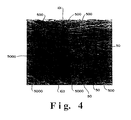
- Figure 4 is a photograph of the edge of a compressed (100 lb./cu. ft.) planar article in accordance with the present invention corresponding generally to the sketch of Figure 2 with the omnidirectionally oriented exfoliated, expanded graphite particles being correspondingly indicated at 50, 500,5000.
- the article of Figure 3 is highly anisotropic with respect to thermal and electrical conductivity; the articles of Figures 2, 2(A) and 4 exhibit enhanced isotropy with respect to thermal and electrical conductivity, as compared to the article of Figure 3 .
- the articles of Figures 2, 2(A) and the material shown in the photograph (100X) of Figure 4 can be shown to have increased thermal and electrical conductivity in the direction transverse to opposed planar surfaces 101, 103 as compared to the thermal and electrical conductivity in the direction transverse to surfaces 301, 303 of prior art material of Figure 3 in which particles of expanded natural graphite unaligned with the opposed planar surfaces are not optically detectable.
- a system for the continuous production of roll-pressed flexible graphite sheet.
- graphite flakes and a liquid intercalating agent are charged into reactor 404.
- a vessel 401 is provided for containing a liquid intercalating agent.
- Vessel 401 suitably made of stainless steel, can be continually replenished with liquid intercalant by way of conduit 406.
- Vessel 402 contains graphite flakes that, together with intercalating agents from vessel 401, are introduced into reactor 404.
- the respective rates of input into reactor 404 of intercalating agent and graphite flake are controlled, such as by valves 408, 407.
- Graphite flake in vessel 402 can be continually replenished by way of conduit 409.
- Additives, such as intercalation enhancers, e.g., trace acids, and organic chemicals may be added by way of dispenser 410 that is metered at its output by valve 411.
- the graphite flakes in reactor vessel 404 are subjected to interlayer attack by the acid mixture intercalant, as described in U.S.P. 3,404,061 to Shane et al .
- the resulting intercalated graphite particles are soggy and acid coated and are conducted (such as via conduit 412) to a wash tank 414 where the particles are washed, advantageously with water which enters and exits wash tank 414 at 416, 418.
- the washed intercalated graphite flakes are then passed to drying chamber 422 such as through conduit 420.
- Additives such as buffers, antioxidants, pollution reducing chemicals can be added from vessel 419 to the flow of intercalated graphite flake for the purpose of modifying the surface chemistry of the exfoliate during expansion and use and modifying the gaseous emissions which cause the expansion.
- the intercalated graphite flake is dried in dryer 422, preferably at temperatures of about 75 to about 150°C, generally avoiding any intumescence or expansion of the intercalated graphite flakes.
- the intercalated graphite flakes are fed as a stream into flame 300, by, for instance, being continually fed to collecting vessel 424 by way of conduit 426 and then fed as a stream into flame 300 in expansion vessel 428 as indicated at 2.
- Additives such as ceramic fiber particles formed of macerated quartz glass fibers, carbon and graphite fibers, zirconia, boron nitride, silicon carbide and magnesia fibers, naturally occurring mineral fibers such as calcium metasilicate fibers, calcium aluminum silicate fibers, aluminum oxide fibers and the like can be added from vessel 429 to the stream of intercalated graphite particles propelled by entrainment in a non-reactive gas introduced at 427.
- the intercalated graphite particles upon passage through flame 300 in expansion chamber 301, expand more than 80 times in the "c" direction and assume a "worm-like” expanded form; the additives introduced from 429 and blended with the stream of intercalated graphite particles are essentially unaffected by passage through the flame 300.
- the expanded graphite particles may pass through a gravity separator 430, in which heavy ash natural mineral particles are separated from the expanded graphite particles, and then into a wide topped hopper 432. Separator 430 can be by-passed when not needed.
- the expanded, i.e ., exfoliated graphite particles fall freely in hopper 432 together with any additives, and are randomly dispersed and passed into compression station 436, such as through trough 434.
- Compression station 436 comprises opposed, converging, moving porous belts 457, 458 spaced apart to receive the exfoliated, expanded graphite particles 50, 500, 5000. Due to the decreasing space between opposed moving belts 457, 458, the exfoliated expanded graphite particles are compressed into a mat of flexible graphite, indicated at 448 having thickness of, e.g ., from about 1.0 to 0.003, especially from about 1.0 to 0.1 inches, and a density of from about 5 to 125 lbs./ft 3 .
- Gas scrubber 449 may be used to remove and clean gases emanating from the expansion chamber 301 and hopper 432.
- the mat 448 is passed through vessel 450 and is impregnated with liquid resin from spray nozzles 438, the resin advantageously being “pulled through the mat” by means of vacuum chamber 439 and the resin is thereafter preferably dried in dryer 460 reducing the tack of the resin and the resin impregnated mat 443 is thereafter densified into roll pressed flexible graphite sheet 447 in calender mill 470. Gases and fumes from vessel 450 and dryer 460 are preferably collected and cleaned in scrubber 465.
- the calendered flexible graphite sheet 447 is passed through surface shaping unit 480 and is mechanically deformed at its surface by embossing die stamping or the like, and thereafter heated in oven 490 to cure the resin, to continuously provide a flexible graphite sheet 444 of repeated surface altered patterns such as the grooved patterns 600 shown in Figure 5A , which can be cut to provide flexible graphite components 650 of a fuel cell such as fluid flow plate shown at 650 in Figure 6A or gaskets 750 as shown at 700 in Figure 5B .
- a vaporization drying step may be included prior to the surface shaping (such as embossing) step.
- the resin impregnated flexible graphite sheet is exposed to heat to vaporize and thereby remove some or all of the solvent, without effecting cure of the resin system.
- blistering during the curing step which can be caused by vaopization of solvent trapped within the sheet by the densification of the sheet during surface shaping, is avoided.
- the degree and time of heating will vary with the nature and amount of solvent, and is preferably at a temperature of at least about 90°C and more preferably from about 90°C to about 125°C for about 3 to about 20 minutes for this purpose.
Landscapes
- Chemical & Material Sciences (AREA)
- Engineering & Computer Science (AREA)
- Ceramic Engineering (AREA)
- Materials Engineering (AREA)
- Structural Engineering (AREA)
- Organic Chemistry (AREA)
- Civil Engineering (AREA)
- Composite Materials (AREA)
- Mechanical Engineering (AREA)
- Manufacturing & Machinery (AREA)
- Carbon And Carbon Compounds (AREA)
Applications Claiming Priority (2)
| Application Number | Priority Date | Filing Date | Title |
|---|---|---|---|
| US28789999A | 1999-04-07 | 1999-04-07 | |
| EP00948492A EP1097106A4 (fr) | 1999-04-07 | 2000-04-07 | Article graphite flexible et son procede de fabrication |
Related Parent Applications (1)
| Application Number | Title | Priority Date | Filing Date |
|---|---|---|---|
| EP00948492.4 Division | 2000-04-07 |
Publications (1)
| Publication Number | Publication Date |
|---|---|
| EP2248645A1 true EP2248645A1 (fr) | 2010-11-10 |
Family
ID=23104848
Family Applications (3)
| Application Number | Title | Priority Date | Filing Date |
|---|---|---|---|
| EP20110151314 Ceased EP2308661A1 (fr) | 1999-04-07 | 2000-04-07 | Article de graphite flexible et son procédé de fabrication |
| EP20100171152 Withdrawn EP2248645A1 (fr) | 1999-04-07 | 2000-04-07 | Article de graphite flexible et son procédé de fabrication |
| EP00948492A Ceased EP1097106A4 (fr) | 1999-04-07 | 2000-04-07 | Article graphite flexible et son procede de fabrication |
Family Applications Before (1)
| Application Number | Title | Priority Date | Filing Date |
|---|---|---|---|
| EP20110151314 Ceased EP2308661A1 (fr) | 1999-04-07 | 2000-04-07 | Article de graphite flexible et son procédé de fabrication |
Family Applications After (1)
| Application Number | Title | Priority Date | Filing Date |
|---|---|---|---|
| EP00948492A Ceased EP1097106A4 (fr) | 1999-04-07 | 2000-04-07 | Article graphite flexible et son procede de fabrication |
Country Status (5)
| Country | Link |
|---|---|
| US (3) | US6432336B1 (fr) |
| EP (3) | EP2308661A1 (fr) |
| AU (1) | AU762158B2 (fr) |
| CA (1) | CA2344509C (fr) |
| WO (1) | WO2000064808A1 (fr) |
Families Citing this family (91)
| Publication number | Priority date | Publication date | Assignee | Title |
|---|---|---|---|---|
| US6923631B2 (en) * | 2000-04-12 | 2005-08-02 | Advanced Energy Technology Inc. | Apparatus for forming a resin impregnated flexible graphite sheet |
| US20020093121A1 (en) * | 1999-08-25 | 2002-07-18 | Graftech Inc. | Cover glass adhering device |
| US20030108731A1 (en) * | 2000-01-24 | 2003-06-12 | Mercuri Robert Angelo | Molding of fluid permeable flexible graphite components for fuel cells |
| DE10108469B4 (de) * | 2001-02-22 | 2007-01-18 | Nucellsys Gmbh | Verfahren zur Herstellung eines mikrostrukturierten Blechs sowie Verwendung des Verfahrens |
| US20020180088A1 (en) * | 2001-04-03 | 2002-12-05 | Mitsubishi Chemical Corporation | Process for producing separator for fuel cell |
| US20020164483A1 (en) | 2001-04-04 | 2002-11-07 | Mercuri Robert Angelo | Graphite article having predetermined anisotropic characteristics and process therefor |
| US20020157818A1 (en) * | 2001-04-04 | 2002-10-31 | Julian Norley | Anisotropic thermal solution |
| US6663807B2 (en) * | 2001-05-14 | 2003-12-16 | Advanced Energy Technology Inc. | Process for complex shape formation using flexible graphite sheets |
| JP2002343379A (ja) * | 2001-05-21 | 2002-11-29 | Aisin Seiki Co Ltd | 燃料電池、燃料電池用電極、燃料電池用電極の処理方法 |
| US7232601B2 (en) * | 2001-05-31 | 2007-06-19 | Advanced Energy Technology Inc. | Method for preparing composite flexible graphite material |
| US7094311B2 (en) * | 2001-06-01 | 2006-08-22 | Advanced Energy Technology Inc. | Assembling bipolar plates |
| US20030000640A1 (en) * | 2001-06-01 | 2003-01-02 | Graftech Inc. | Assembling bipolar plates |
| US6800328B2 (en) | 2001-07-31 | 2004-10-05 | Ballard Power Systems Inc. | Process for impregnating porous parts |
| US20060099406A1 (en) * | 2001-08-31 | 2006-05-11 | Julian Norley | Heat spreader for printed circuit boards |
| US6757154B2 (en) | 2001-12-13 | 2004-06-29 | Advanced Energy Technology Inc. | Double-layer capacitor components and method for preparing them |
| US7108055B2 (en) | 2002-03-29 | 2006-09-19 | Advanced Energy Technology Inc. | Optimized heat sink using high thermal conducting base and low thermal conducting fins |
| US20040216832A1 (en) * | 2002-05-30 | 2004-11-04 | Mercuri Robert A. | Assembling bipolar plates |
| US20050155743A1 (en) * | 2002-06-28 | 2005-07-21 | Getz George Jr. | Composite heat sink with metal base and graphite fins |
| US7292441B2 (en) | 2003-11-25 | 2007-11-06 | Advanced Energy Technology Inc. | Thermal solution for portable electronic devices |
| US20050136187A1 (en) * | 2003-12-23 | 2005-06-23 | Weber Thomas W. | Method of improving adhesion of a coating to a flexible graphite material |
| US7108917B2 (en) * | 2004-01-28 | 2006-09-19 | Advanced Energy Technology Inc. | Variably impregnated flexible graphite material and method |
| CN1330026C (zh) * | 2004-07-06 | 2007-08-01 | 中国科学院大连化学物理研究所 | 一种质子交换膜燃料电池双极板制备工艺 |
| US20060070720A1 (en) * | 2004-09-17 | 2006-04-06 | Capp Joseph P | Heat riser |
| US7241409B2 (en) * | 2004-10-29 | 2007-07-10 | Advanced Energy Technology Inc. | Gas permeable flexible graphite sheet material and process therefor |
| US7880121B2 (en) * | 2005-02-17 | 2011-02-01 | David Naylor | Modular radiant heating apparatus |
| US8258443B2 (en) * | 2005-02-17 | 2012-09-04 | 417 And 7/8, Llc | Heating unit for warming pallets |
| US9945080B2 (en) * | 2005-02-17 | 2018-04-17 | Greenheat Ip Holdings, Llc | Grounded modular heated cover |
| US10920379B2 (en) | 2005-02-17 | 2021-02-16 | Greenheat Ip Holdings Llc | Grounded modular heated cover |
| US20090107972A1 (en) * | 2005-02-17 | 2009-04-30 | David Naylor | Heating unit for warming propane tanks |
| US20090107975A1 (en) * | 2005-02-17 | 2009-04-30 | Thomas Caterina | Heating unit for warming pallets |
| US20090114633A1 (en) * | 2005-02-17 | 2009-05-07 | David Naylor | Portable Pouch Heating Unit |
| US20090114634A1 (en) | 2005-02-17 | 2009-05-07 | David Naylor | Heating unit for warming fluid conduits |
| US20070262073A1 (en) * | 2005-09-01 | 2007-11-15 | David Naylor | Modular heated cover |
| US20090101632A1 (en) * | 2005-02-17 | 2009-04-23 | David Naylor | Heating unit for direct current applications |
| US20090107986A1 (en) * | 2005-02-17 | 2009-04-30 | David Naylor | Three layer glued laminate heating unit |
| US8633425B2 (en) * | 2005-02-17 | 2014-01-21 | 417 And 7/8, Llc | Systems, methods, and devices for storing, heating, and dispensing fluid |
| US20090302023A1 (en) * | 2008-05-12 | 2009-12-10 | Thomas Caterina | Heating unit for warming pallets of materials |
| US9392646B2 (en) | 2005-02-17 | 2016-07-12 | 417 And 7/8, Llc | Pallet warmer heating unit |
| US7297399B2 (en) * | 2005-10-11 | 2007-11-20 | General Electric Company | Thermal transport structure and associated method |
| US7889502B1 (en) | 2005-11-04 | 2011-02-15 | Graftech International Holdings Inc. | Heat spreading circuit assembly |
| US7365988B2 (en) * | 2005-11-04 | 2008-04-29 | Graftech International Holdings Inc. | Cycling LED heat spreader |
| US7505275B2 (en) * | 2005-11-04 | 2009-03-17 | Graftech International Holdings Inc. | LED with integral via |
| US7303005B2 (en) * | 2005-11-04 | 2007-12-04 | Graftech International Holdings Inc. | Heat spreaders with vias |
| US20070257359A1 (en) * | 2006-05-03 | 2007-11-08 | Reis Bradley E | Thermal Management Device For A Memory Module |
| US7754184B2 (en) * | 2006-06-08 | 2010-07-13 | Directa Plus Srl | Production of nano-structures |
| US9034297B2 (en) | 2006-06-08 | 2015-05-19 | Directa Plus S.P.A. | Production of nano-structures |
| US8067091B2 (en) | 2006-12-20 | 2011-11-29 | Graftech International Holdings Inc. | Dimensionally stable, leak-free graphite substrate |
| CA2624352A1 (fr) * | 2007-03-06 | 2008-09-06 | Ballard Power Systems Inc. | Procede de faconnage de plaques de champ a ecoulement des fluides pour dispositifs electrochimiques |
| US8691129B2 (en) * | 2007-05-08 | 2014-04-08 | Nanotek Instruments, Inc. | Method of producing exfoliated graphite composite compositions for fuel cell flow field plates |
| US20080277628A1 (en) * | 2007-05-08 | 2008-11-13 | Aruna Zhamu | Exfoliated graphite composite compositions for fuel cell flow field plates |
| US8728679B2 (en) * | 2007-05-29 | 2014-05-20 | Nanotek Instruments, Inc. | Laminated exfoliated graphite composite-metal compositions for fuel cell flow field plate or bipolar plate applications |
| US20090057940A1 (en) * | 2007-09-04 | 2009-03-05 | Aruna Zhamu | Method of producing less anisotropic flexible graphite |
| US8501307B2 (en) * | 2007-09-04 | 2013-08-06 | Nanotek Instruments, Inc. | Recompressed exfoliated graphite articles |
| US7758783B2 (en) * | 2007-09-17 | 2010-07-20 | Nanotek Instruments, Inc. | Continious production of exfoliated graphite composite compositions and flow field plates |
| US20090151847A1 (en) * | 2007-12-17 | 2009-06-18 | Aruna Zhamu | Process for producing laminated exfoliated graphite composite-metal compositions for fuel cell bipolar plate applications |
| US20100009174A1 (en) * | 2008-07-10 | 2010-01-14 | Reis Bradley E | Heat Dissipation For Low Profile Devices |
| US8088697B2 (en) * | 2008-09-18 | 2012-01-03 | Fuelcell Energy, Inc. | Fibrous ceramic material and method for making the same |
| TW201035513A (en) * | 2009-03-25 | 2010-10-01 | Wah Hong Ind Corp | Method for manufacturing heat dissipation interface device and product thereof |
| US8955580B2 (en) * | 2009-08-14 | 2015-02-17 | Wah Hong Industrial Corp. | Use of a graphite heat-dissipation device including a plating metal layer |
| BRPI1006680B1 (pt) * | 2009-04-15 | 2020-10-27 | Dow Global Technologies Llc | processo para manufaturar um óxido de grafita isolado criogenicamente secado |
| US20100314081A1 (en) * | 2009-06-12 | 2010-12-16 | Reis Bradley E | High Temperature Graphite Heat Exchanger |
| US8405600B2 (en) * | 2009-12-04 | 2013-03-26 | Graftech International Holdings Inc. | Method for reducing temperature-caused degradation in the performance of a digital reader |
| BR112012033012A2 (pt) * | 2010-06-25 | 2016-12-20 | Univ Singapore | método de formação de grafeno por esfoliação de grafite |
| US8148189B2 (en) * | 2010-06-30 | 2012-04-03 | Twin Creeks Technologies, Inc. | Formed ceramic receiver element adhered to a semiconductor lamina |
| US9497804B2 (en) * | 2010-07-01 | 2016-11-15 | Graftech International Holdings Inc. | Graphite electrode |
| GB201104096D0 (en) | 2011-03-10 | 2011-04-27 | Univ Manchester | Production of graphene |
| CN102417177A (zh) * | 2011-08-20 | 2012-04-18 | 山东东昀石墨科技有限公司 | 一种导热用途的柔性石墨膜、板的各向异性调节方法 |
| CN104204315B (zh) | 2012-01-20 | 2019-03-15 | 自由形态纤维有限公司 | 高强度陶瓷纤维及其制造方法 |
| GB201204279D0 (en) | 2012-03-09 | 2012-04-25 | Univ Manchester | Production of graphene |
| US20140299820A1 (en) * | 2013-04-08 | 2014-10-09 | Michael Harandek | Graphene nanoparticles as conductive filler for resistor materials and a method of preparation |
| GB2516919B (en) | 2013-08-06 | 2019-06-26 | Univ Manchester | Production of graphene and graphane |
| EP2881970A1 (fr) * | 2013-12-04 | 2015-06-10 | Fei Company | Procédé de production d'un film mince autonome de carbone nanocristallin |
| US9706684B2 (en) | 2013-12-26 | 2017-07-11 | Terrella Energy Systems Ltd. | Exfoliated graphite materials and composite materials and devices for thermal management |
| US9700968B2 (en) | 2013-12-26 | 2017-07-11 | Terrella Energy Systems Ltd. | Apparatus and methods for processing exfoliated graphite materials |
| US9938393B2 (en) | 2015-01-23 | 2018-04-10 | Free Form Fibers, Llc | Radially graded fully dense inorganic filaments for enhanced strength and creep resistance |
| US9926427B2 (en) * | 2015-12-10 | 2018-03-27 | Nanotek Instruments, Inc. | Chemical-free production of graphene-reinforced polymer matrix composites |
| US12133465B2 (en) | 2016-05-11 | 2024-10-29 | Free Form Fibers, Llc | Multilayer functional fiber and method of making |
| US10676391B2 (en) | 2017-06-26 | 2020-06-09 | Free Form Fibers, Llc | High temperature glass-ceramic matrix with embedded reinforcement fibers |
| WO2019005911A1 (fr) | 2017-06-27 | 2019-01-03 | Free Form Fibers, Llc | Structure fibreuse fonctionnelle à haute performance |
| US11840013B2 (en) | 2018-02-27 | 2023-12-12 | Matthews International Corporation | Graphite materials and devices with surface micro-texturing |
| US12006605B2 (en) | 2019-09-25 | 2024-06-11 | Free Form Fibers, Llc | Non-woven micro-trellis fabrics and composite or hybrid-composite materials reinforced therewith |
| CN110690470B (zh) * | 2019-10-21 | 2021-02-02 | 北京新能源汽车技术创新中心有限公司 | 一种燃料电池双极板制造装置及方法 |
| US12312682B2 (en) | 2020-01-27 | 2025-05-27 | Free Form Fibers, Llc | High purity fiber feedstock for loose grain production |
| US12415763B2 (en) | 2020-01-27 | 2025-09-16 | Free Form Fibers, Llc | High purity ingot for wafer production |
| US11761085B2 (en) | 2020-08-31 | 2023-09-19 | Free Form Fibers, Llc | Composite tape with LCVD-formed additive material in constituent layer(s) |
| EP4359363A4 (fr) | 2021-06-21 | 2025-05-07 | Free Form Fibers, LLC | Structures de fibre à capteurs intégrés |
| EP4363630A4 (fr) | 2021-06-29 | 2025-07-09 | Free Form Fibers Llc | Dépôt chimique en phase vapeur par fil intégré (ewcvd) |
| CN116364839A (zh) * | 2021-12-21 | 2023-06-30 | 易德维能源科技(江苏)有限公司 | 制造双极性电池的双极板的方法和流水线系统 |
| CN115636689B (zh) * | 2022-09-09 | 2023-09-19 | 华能国际电力股份有限公司 | 火电机组用石墨密封件的抗氧化性浸渍处理方法及抗氧化性生产线 |
| CN116281998B (zh) * | 2023-04-14 | 2025-11-25 | 中国科学院宁波材料技术与工程研究所 | 一种高强度柔性石墨片及其制备方法 |
| CN116462509B (zh) * | 2023-05-04 | 2023-11-07 | 湖北东南佳特碳新材料有限公司 | 一种光伏用等静压石墨及其制备方法和应用 |
Citations (3)
| Publication number | Priority date | Publication date | Assignee | Title |
|---|---|---|---|---|
| US3404061A (en) | 1962-03-21 | 1968-10-01 | Union Carbide Corp | Flexible graphite material of expanded particles compressed together |
| US4895713A (en) | 1987-08-31 | 1990-01-23 | Union Carbide Corporation | Intercalation of graphite |
| WO1998045224A1 (fr) * | 1997-04-04 | 1998-10-15 | Ucar Carbon Technology Corporation | Composite de graphite flexible |
Family Cites Families (47)
| Publication number | Priority date | Publication date | Assignee | Title |
|---|---|---|---|---|
| US1137373A (en) * | 1913-05-29 | 1915-04-27 | Condensite Company Of America | Expanded graphite and composition thereof. |
| US1191383A (en) * | 1913-05-29 | 1916-07-18 | Condensite Company Of America | Expanded graphite. |
| GB1069573A (en) * | 1963-08-12 | 1967-05-17 | Mitsubishi Rayon Co | Moulding composition |
| US3492197A (en) * | 1965-03-22 | 1970-01-27 | Dow Chemical Co | Novel compressed cohered graphite structures and method of preparing same |
| US3718720A (en) * | 1971-01-12 | 1973-02-27 | Atomic Energy Commission | Method for manufacturing fibrous, carbonaceous composites having near isotropic properties |
| US3951190A (en) * | 1972-01-04 | 1976-04-20 | Goodyear Aerospace Corporation | Heat-resistant fuel cell |
| US4017664A (en) * | 1975-09-02 | 1977-04-12 | United Technologies Corporation | Silicon carbide electrolyte retaining matrix for fuel cells |
| US4064207A (en) * | 1976-02-02 | 1977-12-20 | United Technologies Corporation | Fibrillar carbon fuel cell electrode substrates and method of manufacture |
| US4416954A (en) * | 1976-07-12 | 1983-11-22 | Solomon Zaromb | Power generation apparatus |
| US4185145A (en) * | 1978-09-11 | 1980-01-22 | United Technologies Corporation | Fuel cell electrolyte reservoir layer and method for making |
| US4239802A (en) * | 1979-01-29 | 1980-12-16 | Westinghouse Electric Corp. | Anaerobic resin curing system |
| US4269642A (en) * | 1979-10-29 | 1981-05-26 | United Technologies Corporation | Method of forming densified edge seals for fuel cell components |
| US4414142A (en) * | 1980-04-18 | 1983-11-08 | Vogel F Lincoln | Organic matrix composites reinforced with intercalated graphite |
| US4478918A (en) * | 1981-12-25 | 1984-10-23 | Tokyo Shibaura Denki Kabushiki Kaisha | Fuel cell stack |
| US4521154A (en) * | 1982-01-13 | 1985-06-04 | Corbett Reg D | Centrifugal fans |
| US4416953A (en) * | 1982-03-25 | 1983-11-22 | Meidensha Electric Mfg. Co., Ltd. | Secondary battery |
| GB2128691B (en) * | 1982-10-01 | 1986-01-22 | T & N Materials Res Ltd | Making graphite gaskets |
| US4522895A (en) * | 1982-10-05 | 1985-06-11 | Kureha Kagaku Kogyo Kabushiki Kaisha | Multilayer fuel cell electrode substrate having elongated holes for feeding reactant gases |
| US4580337A (en) * | 1982-10-05 | 1986-04-08 | Kureha Kagaku Kogyo Kabushiki Kaisha | Process for producing electrode substrate for fuel cells |
| US4594297A (en) * | 1983-12-29 | 1986-06-10 | Uop Inc. | Fuel cell using novel electrolyte membrane |
| JPS60242041A (ja) * | 1984-04-10 | 1985-12-02 | Kureha Chem Ind Co Ltd | 可撓性黒鉛シ−トの補強方法 |
| US4797185A (en) * | 1985-07-19 | 1989-01-10 | Allied-Signal Inc. | Hydrogen separation and electricity generation using novel electrolyte membrane |
| JPS62109882A (ja) * | 1985-08-27 | 1987-05-21 | インタ−カル カンパニ− | シ−ル材 |
| US4642201A (en) * | 1985-08-27 | 1987-02-10 | Intercal Company | Compositions for improving the stability of intercalated graphite structural members |
| US4827495A (en) * | 1986-10-27 | 1989-05-02 | Siczek Aldona A | Pivoting motor drive for bucky |
| US4946892A (en) * | 1987-10-05 | 1990-08-07 | Ucar Carbon Technology Corporation | Composites of in-situ exfoliated graphite |
| US5169903A (en) * | 1987-12-28 | 1992-12-08 | Mitsubishi Rayon Company Ltd. | Methacrylic resin cast plate having transparency and impact resistance and process for preparation thereof |
| US4895774A (en) * | 1988-02-17 | 1990-01-23 | Kabushiki Kaisha Toshiba | Molten carbonate fuel cell |
| US4883497A (en) * | 1988-03-28 | 1989-11-28 | Arch Development Corporation | Formation of thin walled ceramic solid oxide fuel cells |
| US5149518A (en) * | 1989-06-30 | 1992-09-22 | Ucar Carbon Technology Corporation | Ultra-thin pure flexible graphite calendered sheet and method of manufacture |
| JP3396240B2 (ja) * | 1992-05-25 | 2003-04-14 | 住友化学工業株式会社 | メタアクリル樹脂組成物 |
| CA2153973A1 (fr) * | 1993-01-15 | 1994-07-21 | Christopher Andreola | Methode de fabrication de membranes echangeuses d'ions |
| JP3350167B2 (ja) * | 1993-09-03 | 2002-11-25 | 株式会社東芝 | 溶融炭酸塩型燃料電池 |
| US6217800B1 (en) * | 1996-01-25 | 2001-04-17 | Sgl Technic, Inc. | Graphite foam material and method of making same |
| JPH09102322A (ja) * | 1995-07-31 | 1997-04-15 | Imura Zairyo Kaihatsu Kenkyusho:Kk | 燃料電池用の固体高分子電解質膜およびその製造方法 |
| JPH0997620A (ja) * | 1995-10-03 | 1997-04-08 | Toshiba Corp | 溶融炭酸塩型燃料電池および溶融炭酸塩型燃料電池電解質板用保持材の製造方法 |
| US5885728A (en) * | 1997-04-04 | 1999-03-23 | Ucar Carbon Technology Corporation | Flexible graphite composite |
| US5902762A (en) * | 1997-04-04 | 1999-05-11 | Ucar Carbon Technology Corporation | Flexible graphite composite |
| DE69820622T2 (de) * | 1997-06-10 | 2004-12-23 | Ucar Carbon Technology Corp., Wilmington | Flexibler graphitverbundgegenstand zum schutz gegen hitzeschaden |
| US5846459A (en) * | 1997-06-26 | 1998-12-08 | Ucar Carbon Technology Corporation | Method of forming a flexible graphite sheet with decreased anisotropy |
| US5976727A (en) * | 1997-09-19 | 1999-11-02 | Ucar Carbon Technology Corporation | Electrically conductive seal for fuel cell elements |
| US6287694B1 (en) * | 1998-03-13 | 2001-09-11 | Superior Graphite Co. | Method for expanding lamellar forms of graphite and resultant product |
| US6248467B1 (en) * | 1998-10-23 | 2001-06-19 | The Regents Of The University Of California | Composite bipolar plate for electrochemical cells |
| US6468686B1 (en) * | 2000-01-24 | 2002-10-22 | Graftech Inc. | Fluid permeable flexible graphite fuel cell electrode with enhanced electrical and thermal conductivity |
| US6410128B1 (en) * | 2000-03-13 | 2002-06-25 | Graftech Inc. | Flexible graphite capacitor element |
| US6521369B1 (en) * | 2000-11-16 | 2003-02-18 | Graftech Inc. | Flooding-reducing fuel cell electrode |
| US7182898B2 (en) * | 2002-05-13 | 2007-02-27 | Advanced Energy Technology Inc. | Process for complex shape formation using flexible graphite sheets |
-
2000
- 2000-04-07 WO PCT/US2000/009402 patent/WO2000064808A1/fr not_active Ceased
- 2000-04-07 EP EP20110151314 patent/EP2308661A1/fr not_active Ceased
- 2000-04-07 EP EP20100171152 patent/EP2248645A1/fr not_active Withdrawn
- 2000-04-07 CA CA 2344509 patent/CA2344509C/fr not_active Expired - Fee Related
- 2000-04-07 AU AU61972/00A patent/AU762158B2/en not_active Ceased
- 2000-04-07 EP EP00948492A patent/EP1097106A4/fr not_active Ceased
- 2000-04-12 US US09/548,118 patent/US6432336B1/en not_active Expired - Lifetime
-
2001
- 2001-07-16 US US09/906,478 patent/US6706400B2/en not_active Expired - Lifetime
-
2008
- 2008-03-10 US US12/075,190 patent/US20080160284A1/en not_active Abandoned
Patent Citations (3)
| Publication number | Priority date | Publication date | Assignee | Title |
|---|---|---|---|---|
| US3404061A (en) | 1962-03-21 | 1968-10-01 | Union Carbide Corp | Flexible graphite material of expanded particles compressed together |
| US4895713A (en) | 1987-08-31 | 1990-01-23 | Union Carbide Corporation | Intercalation of graphite |
| WO1998045224A1 (fr) * | 1997-04-04 | 1998-10-15 | Ucar Carbon Technology Corporation | Composite de graphite flexible |
Also Published As
| Publication number | Publication date |
|---|---|
| US20080160284A1 (en) | 2008-07-03 |
| WO2000064808A1 (fr) | 2000-11-02 |
| CA2344509C (fr) | 2008-03-25 |
| US6706400B2 (en) | 2004-03-16 |
| AU762158B2 (en) | 2003-06-19 |
| EP1097106A1 (fr) | 2001-05-09 |
| CA2344509A1 (fr) | 2000-11-02 |
| US6432336B1 (en) | 2002-08-13 |
| EP1097106A4 (fr) | 2009-12-02 |
| EP2308661A1 (fr) | 2011-04-13 |
| AU6197200A (en) | 2000-11-10 |
| US20010038909A1 (en) | 2001-11-08 |
Similar Documents
| Publication | Publication Date | Title |
|---|---|---|
| US6432336B1 (en) | Flexible graphite article and method of manufacture | |
| US6923631B2 (en) | Apparatus for forming a resin impregnated flexible graphite sheet | |
| US5846459A (en) | Method of forming a flexible graphite sheet with decreased anisotropy | |
| US6413671B1 (en) | Flexible graphite article and fuel cell electrode with enhanced electrical and thermal conductivity | |
| AU2001268626A1 (en) | Fluid permeable flexible graphite fuel cell electrode | |
| WO2001068359A1 (fr) | Element de condensateur en graphite souple | |
| AU2001245505A1 (en) | Flexible graphite capacitor element | |
| CA2398174C (fr) | Article graphite souple permeable aux fluides, a conductivite electrique et thermique accrue | |
| US6620506B2 (en) | Fluid permeable flexible graphite article with enhanced electrical and thermal conductivity | |
| US20030022056A1 (en) | Fluid permeable flexible graphite fuel cell electrode with enhanced electrical and thermal conductivity | |
| AU2000243369B2 (en) | Flexible graphite article and fuel cell electrode with enhanced electrical and thermal conductivity | |
| WO1999067188A9 (fr) | Composites de graphite souple et façonnable conçu pour etancheifier | |
| AU2000243369A1 (en) | Flexible graphite article and fuel cell electrode with enhanced electrical and thermal conductivity | |
| CA2406315A1 (fr) | Article en graphite utilise en tant qu'electrode pour une cellule electrochimique | |
| AU2967301A (en) | Flexible graphite article |
Legal Events
| Date | Code | Title | Description |
|---|---|---|---|
| PUAI | Public reference made under article 153(3) epc to a published international application that has entered the european phase |
Free format text: ORIGINAL CODE: 0009012 |
|
| AC | Divisional application: reference to earlier application |
Ref document number: 1097106 Country of ref document: EP Kind code of ref document: P |
|
| AK | Designated contracting states |
Kind code of ref document: A1 Designated state(s): AT BE CH CY DE DK ES FI FR GB GR IE IT LI LU MC NL PT SE |
|
| STAA | Information on the status of an ep patent application or granted ep patent |
Free format text: STATUS: THE APPLICATION HAS BEEN WITHDRAWN |
|
| 18W | Application withdrawn |
Effective date: 20110118 |
|
| RIN1 | Information on inventor provided before grant (corrected) |
Inventor name: CAPP, JOSEPH PAUL Inventor name: MERCURI, ROBERT ANGELO Inventor name: WARDDRIP, MICHAEL LEE Inventor name: WEBER, THOMAS WILLIAM |