EP2248818A1 - Organisches halbleitermaterial - Google Patents
Organisches halbleitermaterial Download PDFInfo
- Publication number
- EP2248818A1 EP2248818A1 EP09708663A EP09708663A EP2248818A1 EP 2248818 A1 EP2248818 A1 EP 2248818A1 EP 09708663 A EP09708663 A EP 09708663A EP 09708663 A EP09708663 A EP 09708663A EP 2248818 A1 EP2248818 A1 EP 2248818A1
- Authority
- EP
- European Patent Office
- Prior art keywords
- substituted
- group
- carbon atoms
- hydrogen atom
- alkyl
- Prior art date
- Legal status (The legal status is an assumption and is not a legal conclusion. Google has not performed a legal analysis and makes no representation as to the accuracy of the status listed.)
- Granted
Links
- 0 Cc1ccc(-c2ccc(C3=CC(Cc4c5cc(Cc6c-7[s]c(C(*8)=CC=C8c8ccc(N)[s]8)c6)c-7c4)C5S3)[s]2)[s]1 Chemical compound Cc1ccc(-c2ccc(C3=CC(Cc4c5cc(Cc6c-7[s]c(C(*8)=CC=C8c8ccc(N)[s]8)c6)c-7c4)C5S3)[s]2)[s]1 0.000 description 16
- GCVFEWQOJXVBDO-UHFFFAOYSA-N CC(c1c-2[s]c(C=C)c1)(c1c-2c(C)c(C(c2c-3[s]c(F)c2)(F)F)c-3c1C)F Chemical compound CC(c1c-2[s]c(C=C)c1)(c1c-2c(C)c(C(c2c-3[s]c(F)c2)(F)F)c-3c1C)F GCVFEWQOJXVBDO-UHFFFAOYSA-N 0.000 description 1
- UKBOEGJFECBGSE-UHFFFAOYSA-N Cc(cc1)cc2c1[s]c(-c1cc(C(c(c(C)c3C4SC(c5cc(cc(cc6)N)c6[s]5)=CC44)c-5c(C)c3C4=O)=O)c-5[s]1)c2 Chemical compound Cc(cc1)cc2c1[s]c(-c1cc(C(c(c(C)c3C4SC(c5cc(cc(cc6)N)c6[s]5)=CC44)c-5c(C)c3C4=O)=O)c-5[s]1)c2 UKBOEGJFECBGSE-UHFFFAOYSA-N 0.000 description 1
- RSNCRHHOMQGCGR-UHFFFAOYSA-N Cc1cc(C(c2c(C)c(-c([s]c(C)c3)c3C3=O)c3c(C)c2-2)=O)c-2[s]1 Chemical compound Cc1cc(C(c2c(C)c(-c([s]c(C)c3)c3C3=O)c3c(C)c2-2)=O)c-2[s]1 RSNCRHHOMQGCGR-UHFFFAOYSA-N 0.000 description 1
Images

Classifications
-
- H—ELECTRICITY
- H10—SEMICONDUCTOR DEVICES; ELECTRIC SOLID-STATE DEVICES NOT OTHERWISE PROVIDED FOR
- H10K—ORGANIC ELECTRIC SOLID-STATE DEVICES
- H10K85/00—Organic materials used in the body or electrodes of devices covered by this subclass
- H10K85/60—Organic compounds having low molecular weight
- H10K85/649—Aromatic compounds comprising a hetero atom
- H10K85/657—Polycyclic condensed heteroaromatic hydrocarbons
- H10K85/6576—Polycyclic condensed heteroaromatic hydrocarbons comprising only sulfur in the heteroaromatic polycondensed ring system, e.g. benzothiophene
-
- C—CHEMISTRY; METALLURGY
- C07—ORGANIC CHEMISTRY
- C07D—HETEROCYCLIC COMPOUNDS
- C07D333/00—Heterocyclic compounds containing five-membered rings having one sulfur atom as the only ring hetero atom
- C07D333/02—Heterocyclic compounds containing five-membered rings having one sulfur atom as the only ring hetero atom not condensed with other rings
- C07D333/04—Heterocyclic compounds containing five-membered rings having one sulfur atom as the only ring hetero atom not condensed with other rings not substituted on the ring sulphur atom
- C07D333/06—Heterocyclic compounds containing five-membered rings having one sulfur atom as the only ring hetero atom not condensed with other rings not substituted on the ring sulphur atom with only hydrogen atoms, hydrocarbon or substituted hydrocarbon radicals, directly attached to the ring carbon atoms
- C07D333/24—Radicals substituted by carbon atoms having three bonds to hetero atoms with at the most one bond to halogen, e.g. ester or nitrile radicals
-
- C—CHEMISTRY; METALLURGY
- C07—ORGANIC CHEMISTRY
- C07D—HETEROCYCLIC COMPOUNDS
- C07D495/00—Heterocyclic compounds containing in the condensed system at least one hetero ring having sulfur atoms as the only ring hetero atoms
- C07D495/02—Heterocyclic compounds containing in the condensed system at least one hetero ring having sulfur atoms as the only ring hetero atoms in which the condensed system contains two hetero rings
- C07D495/04—Ortho-condensed systems
-
- H—ELECTRICITY
- H05—ELECTRIC TECHNIQUES NOT OTHERWISE PROVIDED FOR
- H05B—ELECTRIC HEATING; ELECTRIC LIGHT SOURCES NOT OTHERWISE PROVIDED FOR; CIRCUIT ARRANGEMENTS FOR ELECTRIC LIGHT SOURCES, IN GENERAL
- H05B33/00—Electroluminescent light sources
- H05B33/12—Light sources with substantially two-dimensional [2D] radiating surfaces
- H05B33/14—Light sources with substantially two-dimensional [2D] radiating surfaces characterised by the chemical or physical composition or the arrangement of the electroluminescent material, or by the simultaneous addition of the electroluminescent material in or onto the light source
-
- H—ELECTRICITY
- H05—ELECTRIC TECHNIQUES NOT OTHERWISE PROVIDED FOR
- H05B—ELECTRIC HEATING; ELECTRIC LIGHT SOURCES NOT OTHERWISE PROVIDED FOR; CIRCUIT ARRANGEMENTS FOR ELECTRIC LIGHT SOURCES, IN GENERAL
- H05B33/00—Electroluminescent light sources
- H05B33/12—Light sources with substantially two-dimensional [2D] radiating surfaces
- H05B33/20—Light sources with substantially two-dimensional [2D] radiating surfaces characterised by the chemical or physical composition or the arrangement of the material in which the electroluminescent material is embedded
-
- H—ELECTRICITY
- H10—SEMICONDUCTOR DEVICES; ELECTRIC SOLID-STATE DEVICES NOT OTHERWISE PROVIDED FOR
- H10K—ORGANIC ELECTRIC SOLID-STATE DEVICES
- H10K10/00—Organic devices specially adapted for rectifying, amplifying, oscillating or switching; Organic capacitors or resistors having potential barriers
- H10K10/40—Organic transistors
- H10K10/46—Field-effect transistors, e.g. organic thin-film transistors [OTFT]
- H10K10/462—Insulated gate field-effect transistors [IGFETs]
- H10K10/466—Lateral bottom-gate IGFETs comprising only a single gate
-
- H—ELECTRICITY
- H10—SEMICONDUCTOR DEVICES; ELECTRIC SOLID-STATE DEVICES NOT OTHERWISE PROVIDED FOR
- H10K—ORGANIC ELECTRIC SOLID-STATE DEVICES
- H10K10/00—Organic devices specially adapted for rectifying, amplifying, oscillating or switching; Organic capacitors or resistors having potential barriers
- H10K10/40—Organic transistors
- H10K10/46—Field-effect transistors, e.g. organic thin-film transistors [OTFT]
- H10K10/462—Insulated gate field-effect transistors [IGFETs]
- H10K10/484—Insulated gate field-effect transistors [IGFETs] characterised by the channel regions
-
- H—ELECTRICITY
- H10—SEMICONDUCTOR DEVICES; ELECTRIC SOLID-STATE DEVICES NOT OTHERWISE PROVIDED FOR
- H10K—ORGANIC ELECTRIC SOLID-STATE DEVICES
- H10K85/00—Organic materials used in the body or electrodes of devices covered by this subclass
- H10K85/60—Organic compounds having low molecular weight
- H10K85/649—Aromatic compounds comprising a hetero atom
- H10K85/655—Aromatic compounds comprising a hetero atom comprising only sulfur as heteroatom
-
- H—ELECTRICITY
- H10—SEMICONDUCTOR DEVICES; ELECTRIC SOLID-STATE DEVICES NOT OTHERWISE PROVIDED FOR
- H10K—ORGANIC ELECTRIC SOLID-STATE DEVICES
- H10K2102/00—Constructional details relating to the organic devices covered by this subclass
Definitions
- the present invention relates to polycyclic condensed ring compounds such as dihydroindacene compounds, methods for producing the polycyclic condensed ring compounds, and organic semiconductor materials containing the polycyclic condensed ring compounds.
- Organic semiconductor devices represented by organic thin film transistors have features, which none but organic molecules have, such as exhibiting energy saving, cost reduction and flexibility, and are expected as elements applicable to the next-generation technology such as electronic papers and large screen flat panel displays.
- the organic thin film transistor is constituted of several kinds of members including an organic semiconductor active layer, a substrate, an insulating layer and electrodes, but particularly the organic semiconductor active layer taking on the carrier transport has an important function in a device. Characteristics of a transistor depend largely on the carrier transport ability of an organic semiconductor material constituting the organic semiconductor active layer.
- organic semiconductor materials used for organic thin film transistors various types of organic compounds are proposed. For example, low molecular weight materials such as copper phthalocyanine and pentacene, oligomer materials obtained by linking aromatic 5-membered rings or 6-membered rings such as a thiophene hexamer, and polymer materials such as polyalkylthiophene are reported.
- low molecular weight materials such as copper phthalocyanine and pentacene
- oligomer materials obtained by linking aromatic 5-membered rings or 6-membered rings such as a thiophene hexamer
- polymer materials such as polyalkylthiophene
- Transistor characteristics of organic thin films are being studied aiming at levels of characteristics that amorphous silicon exhibits. Other required characteristics include the stable drivability, long service life and coatability. However, until now, no organic material satisfying all the conditions has come to be developed.
- Non-patent Document 1 It is reported, for example, that pentacene has as high a carrier mobility as amorphous silicon has, and develops excellent semiconductor device characteristics (see Non-patent Document 1). However, pentacene has strong cohesiveness and poor solubility, and has also problems with the stable drivability and service life. On the other hand, although oligomer or polymer materials have relatively high coatability, it is the present situation that these have an approximately one-digit lower carrier mobility (see Non-patent Documents 2 and 3).
- the incorporation of a heteroelement in a ⁇ -conjugated skeleton of a polycyclic condensed ring compound becomes one of means to control structural, electronic, optical and physical properties of an organic semiconductor material. It is reported, for example, that dinaphthothienothiophene having a sulfur atom incorporated in a ⁇ -conjugated skeleton is a transistor having a high carrier mobility and high stability (Non-patent Document 4). It is also reported that indolo[3,2-b]carbazole composed of 5 condensed rings having nitrogen atoms incorporated is an organic semiconductor material having coatability and stability (Non-patent Document 5). As seen in these examples, the incorporation of heteroelements in a polycyclic condensed ring compound can be said to be effective means in the molecular design of an organic semiconductor material.
- the present invention has an object to provide a polycyclic condensed ring compound composed of 5 condensed rings as a basic skeleton having a heteroelement(s) incorporated, a method for producing the compound, and an organic semiconductor material containing the compound.
- the present inventors have found novel heteroelement-containing dihydroindacenes and indacenedione derivatives, and methods for producing these. Additionally, the present inventors have found organic semiconductor materials containing the dihydroindacenes and the indacenedione derivatives, and thin films thereof. The present inventors have further found terephthalic acid derivatives and terephthalate ester derivatives being precursor compounds suitable for production of the dihydroindacenes and the indacenedione derivatives. These findings have led to the present invention.
- the present invention provides a dihydroindacene compound represented by the following formula (1), an intermediate thereof, a method for producing these, and applications of a dihydroindacene compound and an indacenedione compound.
- R 1 is identical or different from each other, and each denotes a hydrogen atom, alkyl which may be substituted, alkenyl which may be substituted, alkynyl which may be substituted, alkoxy which may be substituted, alkylthio which may be substituted, aryl which may be substituted, aryloxy which may be substituted, arylthio which may be substituted, arylalkyl which may be substituted, arylalkoxy which may be substituted, arylalkylthio which may be substituted, arylalkenyl which may be substituted, arylalkynyl which may be substituted, boryl which may be substituted, amino which may be substituted, silyl which may be substituted, silyloxy which may be substituted, arylsulfonyloxy which may be substituted, alkylsulfonyloxy which may be substituted, heteroaryl which may be substituted, heteroaryloxy which may be substituted
- the present invention can provide a polycyclic condensed ring compound composed of 5 condensed rings as a basic skeleton having a heteroelement(s) incorporated, a method for producing the compound, and an organic semiconductor material containing the compound.
- the production method according to the present invention can produce a polycyclic condensed ring compound having a substituent(s) introduced.
- alkyl of "alkyl which may be substituted” in R 1 may be any of a straight chain one, a branched chain one and a cyclic one, and examples thereof include straight chain or branched chain alkyls having 1 to 30 carbon atoms, or cyclic alkyls.
- alkyl groups having 1 to 30 carbon atoms include a methyl group, an ethyl group, a n-propyl group, an isopropyl group, a n-butyl group, an s-butyl group, a t-butyl group, a n-pentyl group, a neopentyl group, a n-hexyl group, a 2-ethylhexyl group, a cyclohexyl group, a n-heptyl group, a n-octyl group, a 2-hexyloctyl group, a n-nonyl group, a n-decyl group, a n-undecyl group, a n-dodecyl group, a n-tridecyl group, a n-tetradecyl group, a n-pentadecyl group,
- alkyl groups substituted with a halogen and having 1 to 30 carbon atoms include these alkyl groups substituted with a halogen atom such as a fluorine atom, a chlorine atom, a bromine atom or an iodine atom.
- Alkenyl of "alkenyl which may be substituted” in R 1 may be a straight chain one, a branched chain one or a cyclic one, and examples thereof include straight chain or branched chain alkenyls having 2 to 30 carbon atoms.
- alkenyl groups having 2 to 30 carbon atoms include an ethenyl group, a 1-propenyl group, a 1-butenyl group, a 1-pentenyl group, a 1-hexenyl group, a 1-cyclohexenyl group, a 1-heptenyl group, a 1-octenyl group, a 1-nonenyl group, a 1-decenyl group, a 1-undecenyl group, a 1-dodecenyl group, a 1-tridecenyl group, a 1-tetradecenyl group, a 1-pentadecenyl group, a 1-hexadecenyl group, a 1-heptadecenyl group, a 1-octadecenyl group, a 1-nonadecenyl group, a 1-icosenyl group, a 1-henicosenyl group, a 1-docosen
- alkenyl groups substituted with a halogen and having 2 to 30 carbon atoms in R 1 include these alkenyl groups substituted with a halogen atom such as a fluorine atom, a chlorine atom, a bromine atom or an iodine atom.
- Alkynyl of “alkynyl which may be substituted” in R 1 may be a straight chain one, a branched chain one or a cyclic one, and examples thereof include straight chain or branched chain alkynyls having 2 to 30 carbon atoms.
- alkynyl groups having 2 to 30 carbon atoms include an ethynyl group, a 1-propynyl group, a 1-butynyl group, a 1-pentynyl group, a 1-hexynyl group, a 1-heptynyl group, a 1-octynyl group, a 1-nonynyl group, a 1-decynyl group, a 1-undecynyl group, a 1-dodecynyl group, a 1-tridecynyl group, a 1-tetradecynyl group, a 1-pentadecynyl group, a 1-hexadecynyl group, a 1-heptadecynyl group, a 1-octadecynyl group, a 1-nonadecynyl group, a 1-icosynyl group, a 1-henicosynyl group,
- alkynyl groups substituted with a halogen and having 2 to 30 carbon atoms in R 1 include these alkynyl groups substituted with a halogen atom such as a fluorine atom, a chlorine atom, a bromine atom or an iodine atom.
- Alkoxy of "alkoxy which may be substituted” in R 1 may be any of a straight chain one, a branched chain one and a cyclic one, and examples thereof include straight chain or branched chain alkoxys having usually 1 to 30 carbon atoms.
- Specific examples thereof include a methoxy group, an ethoxy group, a n-propoxy group, an isopropoxy group, a n-butoxy group, an isobutoxy group, a t-butoxy group, a n-pentyloxy group, a neopentyloxy group, a n-hexyloxy group, a n-heptyloxy group, a n-octyloxy group, a 2-ethylhexyloxy group, a nonyloxy group, a decyloxy group, a 3,7-dimethyloctyloxy group, a n-undecyloxy group, a n-dodecyloxy group, a n-tridecyloxy group, a n-tetradecyloxy group, a 2-n-hexyl-n-octyloxy group, a n-pentadecyloxy
- alkoxy groups substituted with a halogen and having 1 to 30 carbon atoms include these alkyl groups substituted with a halogen atom such as a fluorine atom, a chlorine atom, a bromine atom or an iodine atom.
- Alkylthio of "alkylthio which may be substituted” in R 1 may be any of a straight chain one, a branched chain one and a cyclic one, and examples thereof include straight chain or branched chain alkylthios having usually 1 to 30 carbon atoms.
- a methylthio group an ethylthio group, a n-propylthio group, an isopropylthio group, a n-butylthio group, an isobutylthio group, an s-butylthio group, a t-butylthio group, a n-pentylthio group, a cyclopentylthio group, a n-hexylthio group, a cyclohexylthio group, a n-heptylthio group, a cycloheptylthio group, a n-octylthio group, a cyclooctylthio group, a 2-ethyl-n-hexylthio group, a n-nonylthio group, a n-decylthio group, a n-undecylthio group, a methylthio group
- alkylthio groups substituted with a halogen and having 1 to 30 carbon atoms include these alkyl groups substituted with a halogen atom such as a fluorine atom, a chlorine atom, a bromine atom or an iodine atom.
- Aryl of "aryl which may be substituted” in R 1 is an aryl group having 6 to 30 carbon atoms.
- aryls which may be substituted include a phenyl group, a 2-tolyl group, a 3-tolyl group, a 4-tolyl group, a 2,3-xylyl group, a 2,4-xylyl group, a 2,5-xylyl group, a 2,6-xylyl group, a 3,4-xylyl group, a 3,5-xylyl group, a 2,3,4-trimethylphenyl group, a 2,3,5-trimethylphenyl group, a 2,3,6-trimethylphenyl group, a 2,4,6-trimethylphenyl group, a 3.4,5-timethylphenyl group, a 2,3,4,5-tetramethylphenyl group, a 2,3,4,6-tetramethylphenyl group, a 2,3,5,6-tetramethylphenyl group,
- aryl groups substituted with a halogen and having 6 to 30 carbon atoms in R 1 include these aryl groups substituted with a halogen atom such as a fluorine atom, a chlorine atom, a bromine atom or an iodine atom.
- Aryloxy of "aryloxy which may be substituted” in R 1 includes aryloxy groups having 6 to 20 carbon atoms.
- aryloxys which may be substituted include a phenoxy group, a 2-methylphenoxy group, a 3-methylphenoxy group, a 4-methylphenoxy group, a 2,3-dimethylphenoxy group, a 2,4-dimethylphenoxy group, a 2,5-dimethylphenoxy group, a 2,6-dimethylphenoxy group, a 3,4-di-tnethylphenoxy group, a 3,5-dimethylphenoxy group, a 2,3,4-trimethylphenoxy group, a 2,3,5-Cmethylphenoxy group, a 2,3,6-trimethylphenoxy group, a 2,4,5-trimethylphenoxy group, a 2,4,6-trimethylphenoxy group, a 3,4,5--trimethylphenoxy group, a 2,3,4,5-tetramethylphenoxy group, a 2,3,4,6-tetramethylphenoxy group,
- aryloxy groups substituted with a halogen and having 6 to 20 carbon atoms in R 1 include the above-mentioned aryloxy groups having 6 to 20 carbon atoms and substituted with a halogen atom such as a fluorine atom, a chlorine atom, a bromine atom or an iodine atom.
- Arylthio of "arylthio which may be substituted” in R 1 includes arylthio groups having 6 to 30 carbon atoms.
- arylthios which may be substituted include a phenylthio group, a 2-methylphenylthio group, a 3-methylphenylthio group, a 4-methylphenylthio group, a 2,3-dimethylphenylthio group, a 2,4-dimethylphenylthio group, a 2,5-dimethylphenylthio group, a 2,6-dimethylphenylthio group, a 3,4-dimethylphenylthio group, a 3,5-dimethylphenylthio group, a 2,3,4-trimethylphenylthio group, a 2,3,5-trimethylphenylthio group, a 2,3,6-trimethylphenylthio group, a 2,4,5-tmnethylphenylthio group, a 2,4,6-trimethyl
- arylthio groups substituted with a halogen and having 6 to 30 carbon atoms in R 1 include the above-mentioned arylthio groups having 6 to 30 carbon atoms and substituted with a halogen atom such as a fluorine atom, a chlorine atom, a bromine atom or an iodine atom.
- arylalkyl of "arylalkyl which may be substituted” in R 1 includes arylalkyl groups having 7 to 50 carbon atoms, and examples thereof include arylalkyl groups such as arylmethyl, arylethyl, arylpropyl, arylbutyl, arylpentyl, arylhexyl, arylheptyl and aryloctyl.
- a benzyl group a (2-methylphenyl)methyl group, a (3-methylphenyl)methyl group, a (4-methylphenyl)methyl group, a (2,3-dimethylphenyl)methyl group, a (2,4-dimethylphenyl)methyl group, a (2,5-dimethylphenyl)methyl group, a (2,6-dimethylphenyl)methyl group, a (3,4-dimethylphenyl)methyl group, a (4,6-dimethylphenyl)methyl group, a (2,3,4-trimethylphenyl)methyl group, a (2,3,5-trimethylphenyl)methyl group, a (2,3,6-trimethylphenyl)methyl group, a (3,4,5-trimethylphenyl)methyl group, a (2,4,6-trimethylphenyl)methyl group, a (2,3,4,5-tetramethylphenyl)methyl group, a (2,3,4,6-tetramethylphenyl)methyl group
- Aryl of "arylalkyl” includes aryl groups having 6 to 30 carbon atoms of the above-mentioned “aryl which may be substituted", and "alkyl” of “arylalkyl” includes straight chain, branched chain or cyclic alkyl groups having 1 to 30 carbon atoms of the above-mentioned “alkyl which may be substituted”.
- arylalkyl groups substituted with a halogen and having 7 to 50 carbon atoms in R 1 include these arylalkyl groups substituted with a halogen atom such as a fluorine atom, a chlorine atom, a bromine atom or an iodine atom.
- Arylalkenyl of "arylalkenyl which may be substituted” in R 1 includes arylalkenyls having 8 to 50 carbon atoms, and examples thereof include arylalkenyl groups such as arylvinyl, arylpropenyl, arylbutenyl, arylpentenyl, arylhexenyl, arylheptenyl and aryloctynyl.
- a phenylvinyl group a (2-methylphenyl)vinyl group, a (3-methylphenyl)vinyl group, a (4-methylphenyl)vinyl group, a (2,3-dimethylphenyl)vinyl group, a (2,4-dimethylphenyl)vinyl group, a (2,5-dimethylphenyl)vinyl group, a (2,6-dimethylphenyl)vinyl group, a (3,4-dimethylphenyl)vinyl group, a (4,6-dimethylphenyl)vinyl group, a (2,3,4-trimethylphenyl)vinyl group, a (2,3,5-trimethylphenyl)vinyl group, a (2,3,6-trimethylphenyl)vinyl group, a (3,4,5-trimethylphenyl)vinyl group, a (2,4,6-trimethylphenyl)vinyl group, a
- Aryl of "arylalkenyl” includes aryl groups having 6 to 30 carbon atoms of the above-mentioned “aryl which may be substituted", and "alkenyl of "arylalkenyl” includes straight chain, branched chain or cyclic alkenyl groups having 2 to 30 carbon atoms of the above-mentioned “alkenyl which may be substituted”.
- arylalkynyl groups substituted with a halogen and having 8 to 50 carbon atoms in R 2 include these aryalkenyl groups substituted with a halogen atom such as a fluorine atom, a chlorine atom, a bromine atom or an iodine atom.
- Arylalkynyl of "arylalkynyl which may be substituted” in R 1 includes arylalkynyls having 8 to 50 carbon atoms, and examples thereof include arylalkynyl groups such as arylethynyl, arylpropynyl, arylbutynyl, arylpentynyl, arymexynyl, arylheptynyl and aryoctynyl.
- a phenylethynyl group a (2-methylphenyl)ethynyl group, a (3-methylphenyl)ethynyl group, a (4-methylphenyl)ethynyl group, a (2,3-dimethylphenyl)ethynyl group, a (2,4-dimethylphenyl)ethynyl group, a (2,5-dimethylphenyl)ethynyl group, a (2,6-dimethylphenyl)ethynyl group, a (3,4-dimethylphenyl)ethynyl group, a (4,6-dimethylphenyl)ethynyl group, a (2,3,4-trimethylphenyl)ethynyl group, a (2,3,5-trimethylphenyl)ethynyl group, a (2,3,6-trimethylphenyl)ethynyl group
- Aryl of "arylalkynyl” includes aryl groups having 6 to 30 carbon atoms of the above-mentioned “aryl which may be substituted", and "alkynyl” of “arylalkynyl” includes straight chain, branched chain or cyclic alkynyl groups having 2 to 30 carbon atoms of the above-mentioned “alkynyl which may be substituted”.
- arylalkynyl groups substituted with a halogen and having 8 to 50 carbon atoms in R 1 include these aryalkynyl groups substituted with a halogen atom such as a fluorine atom, a chlorine atom, a bromine atom or an iodine atom.
- “Boryl” of "boryl which may be substituted” in R 1 specifically includes diarylboryl groups such as diphenylboryl, 2-ditolylboryl, 3-ditolylboryl, 4-ditolylboryl, dimesitylboryl, 1-dianthrylboryl and 2-dianthrylboryl.
- Amino of "amino which may be substituted” in R 1 is amino groups substituted with two hydrocarbon groups; here, examples of hydrocarbon groups include alkyl groups having 1 to 30 carbon atoms, such as a methyl group, an ethyl group, a n-propyl group, an isopropyl group, a n-butyl group, an s-butyl group, a t-butyl group, an isobutyl group, a n-pentyl group, a n-hexyl group and a cyclohexyl group, and aryl groups such as a phenyl group, and these substituents may be mutually bonded to form rings.
- hydrocarbon groups include alkyl groups having 1 to 30 carbon atoms, such as a methyl group, an ethyl group, a n-propyl group, an isopropyl group, a n-butyl group, an s-butyl group
- amino groups substituted with such hydrocarbon groups having 1 to 30 carbon atoms include a dimethylamino group, a diethylamino group, a di-n-propylamino group, a diisopropylamino group, a di-n-butylamino group, a di-s-butylamino group, a di-t-butylamino group, a di-isobutylamino group, a t-butylisopropylamino group, a di-n-hexylamino group, a di-n-octylamino group, a di-n-decylamino group, a diphenylamino group, a bistrimethylsilylamino group, a bis-t-butyldimethylsilylamino group, a pyrrolyl group, a pyrrolidinyl group, a piperidinyl group, a carbazolyl group, a
- hydrocarbon groups constituting these substituted amino groups include, in addition to the hydrocarbon groups as described above, hydrocarbon groups substituted with a halogen atom such as a fluorine atom, a chlorine atom, a bromine atom or an iodine atom.
- a halogen atom such as a fluorine atom, a chlorine atom, a bromine atom or an iodine atom.
- hydrocarbon groups of a silyl group substituted with the hydrocarbon groups in "a silyl group which may be substituted" in R 1 include alkyl groups having 1 to 30 carbon atoms such as a methyl group, an ethyl group, a n-propyl group, an isopropyl group, a n-butyl group, an s-butyl group, a t-butyl group, an isobutyl group, a n-pentyl group, a n-hexyl group, a cyclohexyl group, a n-heptyl group, a n-octyl group, a n-nonyl group and a n-decyl group, and aryl groups such as a phenyl group.
- silyl groups substituted with such hydrocarbons having 1 to 30 carbon atoms include monosubstituted silyl groups having 1 to 30 carbon atoms, such as a methylsilyl group, an ethylsilyl group and a phenylsilyl group, disubstituted silyl groups substituted with hydrocarbon groups having 1 to 30 carbon atoms, such as a dimethylsilyl group, a diethylsilyl group and a diphenylsilyl group, and trisubstituted silyl groups substituted with hydrocarbon groups having 1 to 30 carbon atoms, such as a trimethylsilyl group, a triethylsilyl group, a tri-n-propylsilyl group, a triisopropylsilyl group, a tri-n-butylsilyl group, a tri-s-butylsilyl group, a tri-t-butylsilyl group, a tri-t-
- hydrocarbon groups constituting these substituted silyl groups include, in addition to the hydrocarbon groups as described above, hydrocarbon groups substituted with a halogen atom such as a fluorine atom, a chlorine atom, a bromine atom or an iodine atom.
- a halogen atom such as a fluorine atom, a chlorine atom, a bromine atom or an iodine atom.
- “Silyloxy which may be substituted” in R 1 includes trialkylsilyloxys (for example, trimethylsilyloxy, triethylsilyloxy, triisopropylsilyloxy, diethylisopropylsilyloxy, dimethylisopropylsilyloxy, di-t-butylmethylsilyloxy, isopropyldimethylsilyloxy, t-butyldimethylsilyloxy and texyldimethylsilyloxy), and trialkylarylsilyloxys (for example, diphenylmethylsilyloxy, t-butylphenylsilyloxy, t-butyldimethoxyphenylsilyloxy and triphenylsilyloxy).
- trialkylsilyloxys for example, trimethylsilyloxy, triethylsilyloxy, triisopropylsilyloxy, diethylisopropylsilyloxy, di
- Arylsulfonyloxy which may be substituted includes benzenesulfonyloxy, p-toluenesulfonyloxy, mesitylenesulfonyloxy and naphthalenesulfonyloxy.
- Alkylsulfonyloxy which may be substituted includes methanesulfonyloxy, ethanesulfonyloxy, butanesulfonyloxy, octanesulfonyloxy and trifluoromethanesulfonyloxy.
- heteroaryl of “heteroaryl which may be substituted” in R 1 include heterocyclic groups containing as ring-constituting atoms 1 to 5 heteroatoms selected from an oxygen atom, a sulfur atom, a nitrogen atom, a selenium atom and a tellurium atom, except carbon atoms.
- Heteroaryl of "heteroaryloxy” of “heteroaryloxy which may be substituted” in R 1 include heteroaryl groups composed of heterocyclic groups containing, as ring-constituting atoms of the above-mentioned "heteroaryl which may be substituted", 1 to 5 heteroatoms selected from an oxygen atom, a sulfur atom, a nitrogen atom, a selenium atom and a tellurium atom, except carbon atoms, and composed of other groups.
- Heteroaryl of “heteroarylthio” of “heteroarylthio which may be substituted” in R 1 include heteroaryl groups composed of heterocyclic groups containing, as ring-constituting atoms of the above-mentioned "heteroaryl which may be substituted", 1 to 5 heteroatoms selected from an oxygen atom, a sulfur atom, a nitrogen atom, a selenium atom and a tellurium atom, except carbon atoms, and composed of other groups.
- Heteroaryl of “heteroarylalkyl” of “heteroarylakyl which may be substituted” in R 1 includes heteroaryl groups composed of heterocyclic groups containing, as ring-constituting atoms of the above-mentioned “heteroaryl which may be substituted", 1 to 5 heteroatoms selected from an oxygen atom, a sulfur atom, a nitrogen atom, a selenium atom and a tellurium atom, except carbon atoms, and composed of other groups.
- “Alkyl” of “heteroarylalkyl” includes straight chain, branched chain or cyclic aryl groups having 1 to 30 carbon atoms of the above-mentioned "alkyl which may be substituted”.
- Heteroaryl of “heteroarylalkoxy” of “heteroarylalkoxy which may be substituted” in R 1 includes heteroaryl groups composed of heterocyclic groups containing, as ring-constituting atoms of the above-mentioned “heteroaryl which may be substituted", 1 to 5 heteroatoms selected from an oxygen atom, a sulfur atom, a nitrogen atom, a selenium atom and a tellurium atom, except carbon atoms, and composed of other groups.
- Alkoxy of “heteroarylalkoxy” includes straight chain, branched chain or cyclic alkoxy groups having 1 to 30 carbon atoms of the above-mentioned "alkoxy which may be substituted”.
- Heteroaryl of “heteroarylalkylthio” of “heteroarylalkylthio which may be substituted” in R 1 includes heteroaryl groups composed of heterocyclic groups containing, as ring-constituting atoms of the above-mentioned "heteroaryl which may be substituted", 1 to 5 heteroatoms selected from an oxygen atom, a sulfur atom, a nitrogen atom, a selenium atom and a tellurium atom, except carbon atoms, and composed of other groups.
- Alkylthio of “heteroarylalkylthio” includes straight chain, branched chain or cyclic alkylthio groups having 1 to 30 carbon atoms of the above-mentioned "alkylthio which may be substituted".
- Heteroaryl of “heteroarylalkenyl” of “heteroarylalkenyl which may be substituted” in R 1 includes heteroaryl groups composed of heterocyclic groups containing, as ring-constituting atoms of the above-mentioned “heteroaryl which may be substituted", 1 to 5 heteroatoms selected from an oxygen atom, a sulfur atom, a nitrogen atom, a selenium atom and a tellurium atom, except carbon atoms, and composed of other groups.
- “Alkenyl” of “heteroarylalkenyl” includes straight chain, branched chain or cyclic alkenyl groups having 2 to 30 carbon atoms of the above-mentioned "alkenyl which may be substituted”.
- Heteroaryl of “heteroarylalkynyl” of “heteroarylalkynyl which may be substituted” in R 1 includes heteroaryl groups composed of heterocyclic groups containing, as ring-constituting atoms of the above-mentioned "heteroaryl which may be substituted", 1 to 5 heteroatoms selected from an oxygen atom, a sulfur atom, a nitrogen atom, a selenium atom and a tellurium atom, except carbon atoms, and composed of other groups.
- Alkynyl of “heteroarylalkynyl” includes straight chain, branched chain or cyclic alkynyl groups having 2 to 30 carbon atoms of the above-mentioned "alkynyl which may be substituted".
- Halogen in R 1 includes a fluorine atom, a chlorine atom, a bromine atom and an iodine atom.
- R 2 to R 5 are identical or different from each other, and each denote a hydrogen atom, alkyl which may be substituted, alkenyl which may be substituted, alkynyl which may be substituted, aryl which may be substituted, arylalkyl which may be substituted, heteroaryl which may be substituted, heteroarylalkyl which may be substituted, cycloalkyl which may be substituted, a halogen, cyano, nitro, or hydroxyl, which all are included in the same substituents as shown for R 1 described above.
- the ring structures A and B are identical or different from each other, and include rings formed of 5- to 7-membered rings. Specific examples thereof include a benzene ring which may be substituted, a thiophene ring condensed at the 2,3-positions which may be substituted, a thiophene ring condensed at the 3,4-positions which may be substituted, a furan ring condensed at the 2,3-positions which may be substituted, a furan ring condensed at the 3,4-positions which may be substituted, a selenophene ring condensed at the 2,3-positions which may be substituted, a selenophene ring condensed at the 3,4-positions which may be substituted, a pyrrol ring condensed at the 2,3-positions which may be substituted, a pyrrol ring condensed at the 3,4-positions which may be substituted, a thiazole ring which may be substituted,
- the dihydroindacene compound (1) preferably includes a dihydroindacene compound represented by the following formula (3) (hereinafter, referred to as a dihydroindacene compound (3)).
- R 1 to R 5 and p are each the same as described in the representation of R 1 to R 5 and p in the formula (1); and R 6 to R 9 are identical or different from each other, and each denote a hydrogen atom, alkyl which may be substituted, alkenyl which may be substituted, alkynyl which may be substituted, alkoxy which may be substituted, alkylthio which may be substituted, aryl which may be substituted, aryloxy which may be substituted, arylthio which may be substituted, arylalkyl which may be substituted, arylalkoxy which may be substituted, arylalkylthio which may be substituted, arylalkenyl which may be substituted, arylalkynyl which may be substituted, boryl which may be substituted, amino which may be substituted, silyl which may be substituted, silyloxy which may be substituted, arylsulfonyloxy which may be substituted,
- X is identical or different from each other, and each denotes a sulfur atom, an oxygen atom, a selenium atom, a tellurium atom, or a group represented by SO 2 or N-R 10 , wherein R 10 denotes a hydrogen atom, alkyl which may be substituted, aryl which may be substituted, or heteroaryl which may be substituted, which all are included in the same substituents as shown for R 1 described above.
- the group of preferable compounds in the dihydroindacene compound (3) includes the following.
- X is preferably a sulfur atom.
- the dihydroindacene compound in which X is a sulfur atom includes the following.
- dihydroindacene compound (3) examples include compounds represented by the following formulae (3-1) to (3-144), but the compound is not limited thereto.
- n is identical or different from each other, and each denotes an integer of 0 to 30.
- the dihydroindacene compound (3) preferably includes compounds represented by the formulae (3-1), (3-4), (3-7), (3-10), (3-13), (3-16), (3-19), (3-22), (3-25), (3-28), (3-31), (3-34), (3-37), (3-40), (3-43), (3-46), (3-49), (3-52), (3-55), (3-58), (3-61), (3-64), (3-67), (3-70), (3-73), (3-76), (3-79), (3-82), (3-85), (3-88), (3-91), (3-94), (3-97), (3-100), (3-103), (3-106), (3-109), (3-111), (3-113), (3-115), (3-117), (3-119), (3-121), (3-123), (3-125), (3-127), (3-129), (3-131), (3-133), (3-135), (3-137), (3-139), (3-141) and (3-143), and more preferably includes compounds represented by the formulae (3-1), (3-7), (3-13), (3-19), (3-25), (3-
- the dihydroindacene compound (3) (provided that R 2 to R 5 are all hydrogen) can be produced by allowing a basic reagent to act on a dihydrazone compound (hereinafter, referred to as a dihydrazone compound (4)) represented by the following formula (4).
- R 1 and R 6 to R 9 are identical or different from each other, and each denote a hydrogen atom, alkyl which may be substituted, alkenyl which may be substituted, alkynyl which may be substituted, alkoxy which may be substituted, alkylthio which may be substituted, aryl which may be substituted, aryloxy which may be substituted, arylthio which may be substituted, arylalkyl which may be substituted, arylalkoxy which may be substituted, arylalkylthio which may be substituted, arylalkenyl which may be substituted, arylalkynyl which may be substituted, boryl which may be substituted, amino which may be substituted, silyl which may be substituted, silyloxy which may be substituted, arylsulfonyloxy which may be substituted, alkylsulfonyloxy which may be substituted, heteroaryl which may be substituted, heteroaryl
- R 1 and p are each the same as described in the representations of R 1 and p in the formula (1).
- R 6 to R 10 and X are each the same as described in the representations of R 6 to R 10 and X in the formula (3).
- R 11 to R 14 are identical or different from each other, and each denote a hydrogen atom, alkyl which may be substituted, aryl which may be substituted, arylsulfonyl which may be substituted, or silyl which may be substituted.
- arylsulfonyl of “arylsulfonyl which may be substituted” includes arylsulfonyl groups having 6 to 30 carbon atoms. Specific examples thereof include a phenylslufonyl group, a 2-tolylsulfonyl group, a 3-tolylsulfonyl group, a 4-tolylsulfonyl group, a 2,3-xylylsulfonyl group, a 2,4-xylylsulfonyl group, a 2,5-xylylsulfonyl group, a 2,6-xylylsulfonyl group, a 3,4-xylylsulfonyl group, a 3,5-xylylsulfonyl group, a 2,3,4-trimethylphenylsulfonyl group, a 2,3,5-trimethylphenylsulfonyl group,
- arylsulfonyl groups substituted with a halogen and having 6 to 30 carbon atoms include these arylsulfonyl groups substituted with a halogen atom such as a fluorine atom, a chlorine atom, a bromine atom and an iodine atom.
- a silyl group which may be substituted" in R 11 to R 14 includes silyl groups substituted with hydrocarbon groups, and examples of the hydrocarbon groups include alkyl groups having 1 to 30 carbon atoms, such as a methyl group, an ethyl group, a n-propyl group, an isopropyl group, a n-butyl group, an s-butyl group, a t-butyl group, an isobutyl group, a n-pentyl group, a n-hexyl group, a cyclohexyl group, a n-heptyl group, a n-octyl group, a n-nonyl group and n-decyl group, and aryl groups such as a phenyl group.
- silyl groups substituted with such hydrocarbons having 1 to 30 carbon atoms include monosubstituted silyl groups having 1 to 30 carbon atoms, such as a methylsilyl group, an ethylsilyl group and a phenylsilyl group, disubstituted silyl groups substituted with hydrocarbon groups having 1 to 30 carbon atoms, such as a dimethylsilyl group, a diethylsilyl group and a diphenylsilyl group, and substituted silyl groups substituted with hydrocarbon groups having 1 to 30 carbon atoms, such as a trimethylsilyl group, a triethylsilyl group, a tri-n-propylsilyl group, a triisopropylsilyl group, a tri-n-butylsilyl group, a tri-s-butylsilyl group, a tri-t-butylsilyl group, a tri-isobutyl group
- halogen-substituted silyl groups having 6 to 30 carbon atoms include, in addition to the hydrocarbon groups as described above, silyl groups substituted with a halogen atom such as a fluorine atom, a chlorine atom, a bromine atom and an iodine atom.
- the group of preferable compounds in the dihydrazone compound (4) includes the following.
- the dihydrazone compound (4) specifically includes compounds represented by the following formulae (4-1) to (4-74), but the compounds are not limited thereto.
- n is identical or different from each other, and each denotes an integer of 0 to 30.
- the dihydrazone compound (4) preferably includes compounds represented by the formulae (4-1), (4-3), (4-5), (4-7), (4-9), (4-11), (4-13), (4-15), (4-17), (4-19), (4-21), (4-23), (4-25), (4-27), (4-29), (4-31), (4-33), (4-35), (4-37), (4-39), (4-41), (4-43), (4-45), (4-47), (4-49), (4-51), (4-53), (4-55), (4-57), (4-59), (4-61), (4-63), (4-65), (4-67), (4-69), (4-71) and (4-73), and more preferably includes compounds represented by the formulae (4-1), (4-3), (4-5), (4-7), (4-9), (4-11), (4-13), (4-29), (4-31), (4-37), (4-39), (4-41), (4-43), (4-45), (4-47), (4-49), (4-67) and (4-69).
- reaction solvent examples include water, aliphatic hydrocarbons such as pentane, hexane, heptane, cyclopentane, cyclohexane, decalin, dichloromethane and chloroform, aromatic hydrocarbons such as benzene, toluene, xylene, cumene, ethylbenzene, monochlorobenzene and dichlorobenzene, ethers such as diethyl ether, methyl-t-butyl ether, THF, 1,3-dioxolane, 1,3-dioxane, 1,4-dioxane, diethylene glycol, ethylene glycol, triethylene glycol and propylene glycol, alcohols such as methanol, ethanol, n-propanol, isopropanol, n-butan
- solvents to be used include water, dichloromethane, chloroform, benzene, toluene, diethyl ether, methyl-t-butyl ether, THE, 1,3-dioxolane, 1,3-dioxane, 1.4-dioxane, diethylene glycol, ethylene glycol, triethylene glycol, propylene glycol, n-butanol, t-butanol and DMSO, and more preferable ones include toluene, 1,4-dioxane, diethylene glycol, ethylene glycol, triethylene glycol, t-butanol and DMSO. These solvents may be used singly or as a mixture of two or more.
- Examples of basic reagents to be used in the reaction include potassium hydroxide, sodium hydroxide, potassium carbonate, sodium carbonate, potassium t-butoxide, sodium t-butoxide, sodium, sodium methoxide, sodium ethoxide, potassium methoxide, potassium ethoxide and lithium hydrogenated aluminum.
- the basic reagents may be used singly or as a mixture of two or more.
- the use amount of a basic reagent is usually 0.5 mole time to 25 mole times, preferably 2 mole times to 20 mole times, and more preferably 5 mole times to 15 mole times, relative to a dihydrazone compound (4). If the use amount of a basic reagent is too small, the proportion of a compound in which only one hydrazone has been converted to methylene increases.
- the concentration of a reaction solution of a dihydrazone compound is not especially limited, but is usually in the range from 0.0001 mole to 10 moles, preferably from 0.001 mole to 5 moles, and more preferably from 0.01 mole to 1 mole, relative to 1 L of a solvent.
- the concentration of a solution of a basic reagent to be dropped is not especially limited, but is usually in the range from 0.001 mole to 20 moles, preferably from 0.01 mole to 10 moles, and more preferably from 0.1 mole to 5 mole, relative to 1 L of a solvent.
- the reaction of a basic reagent and a dihydrazone compound can usually be carried out by mixing a solution of the basic reagent and a solution of the dihydrazone compound.
- the mixing may be carried out by mixing up both the solutions at one time, but it is preferable from the viewpoint of control of the reaction that the mixing is carried out by dropping one of the solutions in the other solution.
- the dropping time is not especially limited, but it is preferable that the dropping be carried out in the range where the rise in the internal temperature due to the reaction heat can be controlled.
- the temperature during the dropping in the reaction of a basic reagent and a dihydrazone compound is usually in the range from -78°C to a boiling point of a solvent, preferably from 0°C to the boiling point of the solvent, and more preferably from 50°C to the boiling point of the solvent.
- the temperature after the completion of the dropping is not especially limited, but the reaction may be carried out while a temperature at dropping is being held, or the reaction may be carried out by raising the temperature to the boiling point of the solvent.
- the reaction time is not especially limited, but is usually 1 min to 72 hours.
- a crude product of a dihydroindacene compound can be obtained.
- the crude product of the dihydroindacene compound may be refined by an operation such as crystallization, sublimation, and various types of chromatographies.
- a dihydroindacene compound in which R 6 and R 8 are not hydrogen in the formula (3) include a cross-coupling production method using a dihydroindacene compound in which R 6 and R 8 are bromine or iodine.
- a dihydroindacene compound can be produced by using dibromoindenofluorene and carrying out the Suzuki coupling reaction.
- a dihydroindacene compound in which R 2 and R 5 are not hydrogen in the formula (3) As production methods of a dihydroindacene compound in which R 2 and R 5 are not hydrogen in the formula (3), various types of methods are used. For example, as described in " Journal of the American Chemical Society” (the U.S., 2005, vol. 127, pp. 11763-11768 ), a dihydroindacene compound in which R 2 to R 5 are alkyl groups can also be produced by allowing a halogen alkyl to act on a dihydroindacene compound in which R 2 to R 5 are hydrogen in the presence of a basic reagent.
- a dihydrazone compound (4) can be obtained by allowing a hydrazine reagent to act on an indacenedione compound (hereinafter, referred to as an indacenedione compound (5)) represented by the following formula (5).
- R 1 and R 6 to R 9 are identical or different from each other, and each denote a hydrogen atom, alkyl which may be substituted, alkenyl which may be substituted, alkynyl which may be substituted, alkoxy which may be substituted, alkylthio which may be substituted, aryl which may be substituted, aryloxy which may be substituted, arylthio which may be substituted, arylalkyl which may be substituted, arylalkoxy which may be substituted, arylalkylthio which may be substituted, arylalkenyl which may be substituted, arylalkynyl which may be substituted, boryl which may be substituted, amino which may be substituted, silyl which may be substituted, silyloxy which may be substituted, arylsulfonyloxy which may be substituted, alkylsulfonyloxy which may be substituted, heteroaryl which may be substituted, heteroaryl
- R 1 , p and X in the formula (5) include the same as described in the representations of R 1 , p and X in the formula (1), and are each preferably the same one.
- R 6 to R 10 include the same as described in the representation of R 6 to R 10 in the formula (3), and are each preferably the same one.
- the group of preferable compounds in the indacenedione compound of the formula (5) includes the following.
- R 1 is a hydrogen atom, alkyl which has 1 to 30 carbon atoms and may be substituted, alkenyl which has 2 to 30 carbon atoms and may be substituted, alkynyl which has 2 to 30 carbon atoms and may be substituted, or alkoxy which has 1 to 30 carbon atoms and may be substituted;
- R 6 to R 9 are identical or different from each other, and are each a hydrogen atom, alkyl which has 1 to 30 carbon atoms and may be substituted, alkenyl which has 2 to 30 carbon atoms and may be substituted, alkynyl which has 2 to 30 carbon atoms and may be substituted, alkoxy which has 1 to 30 carbon atoms and may be substituted, aryl which has 6 to 30 carbon atoms and may be substituted, silyl which may be substituted, a heteroaryl which may be substituted, or a halogen; and X is identical or different from each other, and is each sulfur
- the indacenedione compound represented by the formula (5) specifically includes compounds represented by the following formulae (5-1) to (5-36), but the compounds are not limited thereto.
- n is identical or different from each other, and each denotes an integer of 0 to 30.
- the indacenedione compound (5) preferably includes compounds represented by the formulae (5-1), (5-3), (5-5), (5-7), (5-9), (5-11), (5-13), (5-15), (5-17), (5-19), (5-21), (5-23), (5-25), (5-27), (5-29), (5-31), (5-33) and (5-35), and more preferably includes compounds represented by the formulae (5-1), (5-3), (5-5), (5-7), (5-9), (5-11), (5-13), (5-15), (5-17), (5-19), (5-21), (5-23), (5-25), (5-27), (5-29) and (5-31).
- the reaction condition of the hydrazonation reaction of an indacenedione compound (5) is not especially limited, but an indacenedione compound can be obtained, for example, as described in " Organic Letters” (the U.S., 2001, vol. 3, No. 23, pp. 3647-3650 ), by stirring a ketone compound and phenylhydrazine in acetic acid.
- the prepared hydrazone compound may be used for a following reaction after being isolated, or may be used as it is as described in " Organic Letters" (the U.S., 2002, vol. 4, No. 13, pp. 2157-2159 ).
- reaction solvents include water, aliphatic hydrocarbons such as pentane, hexane, heptane, cyclopentane, cyclohexane, decalin, dichloromethane and chloroform, aromatic hydrocarbons such as benzene, toluene, xylene, cumene, ethylbenzene, monochlorobenzene and dichlorobenzene, ethers such as diethyl ether, methyl-t-butyl ether, THF, 1,3-dioxolane, 1,3-dioxane, 1,4-dioxane, diethylene glycol, ethylene glycol, triethylene glycol and propylene glycol, alcohols such as methanol, ethanol, propanol, n-butanol and t-butanol, and DMSO.
- aliphatic hydrocarbons such as pentane, hexane, heptane,
- solvents to be used include dichloromethane, chloroform, benzene, toluene, diethyl ether, methyl-t-butyl ether, THF, 1,3-dioxolane, 1,3-dioxane, 1,4-dioxane, diethylene glycol, ethylene glycol, triethylene glycol, propylene glycol, n-butanol, t-butanol and DMSO, and more preferable ones include benzene, toluene, THY, 1,4-dioxane, diethylene glycol, ethylene glycol, triethylene glycol, n-butanol, t-butanol and DMSO. These solvents may be used singly or as a mixture of two or more.
- Hydrazines to be used in the reaction include hydrazine, hydrazine monohydrate, hydrazine hydrate, aryl-substituted hydrazines such as phenylhydrazine and tosylhydrazine, and N-t-butyldimethylsilylhydrazine.
- the use amount of a hydrazine is usually 1.5 mole times to 100 mole times, preferably 2 mole times to 50 mole times, and more preferably 2 mole times to 25 mole times, relative to an indacenedione compound (5). If the use amount of a hydrazine is too small, the proportion of a compound in which only one ketone is hydrazonated increases.
- the reaction temperature in the reaction of a hydrazine and an indacenedione compound (5) is usually in the range from -78°C to a boiling point of a solvent, preferably from 0°C to the boiling point of the solvent, and more preferably from 50°C to the boiling point of the solvent.
- the reaction time is not especially limited, but is usually 1 min to 24 hours.
- the reaction solution for example, water, a weakly acidic aqueous solution or the like is added to the reaction solution.
- an operation such as extraction or washing, a crude product of a dihydrazone compound can be obtained.
- the crude product of the dihydrazone compound may be supplied, or after the crude dihydrazone compound is refined by an operation such as crystallization, and various types of chromatographies, the refined dihydrazone compound may be supplied for the denitrification process.
- An indacenedione compound (5) can be obtained by allowing an acidic reagent to act on a terephthalic acid compound (hereinafter, referred to as a terephthalic acid compound) represented by the following formula (6).
- a terephthalic acid compound represented by the following formula (6).
- R 1 and R 6 to R 9 are identical or different from each other, and each denote a hydrogen atom, alkyl which may be substituted, alkenyl which may be substituted, alkynyl which may be substituted, alkoxy which may be substituted, alkylthio which may be substituted, aryl which may be substituted, aryloxy which may be substituted, arylthio which may be substituted, arylalkyl which may be substituted, arylalkoxy which may be substituted, arylalkylthio which may be substituted, arylalkenyl which may be substituted, arylalkynyl which may be substituted, boryl which may be substituted, amino which may be substituted, silyl which may be substituted, silyloxy which may be substituted, arylsulfonyloxy which may be substituted, alkylsulfonyloxy which may be substituted, heteroaryl which may be substituted, heteroaryl
- R 1 and p include the same as described in the representations of R 1 and p in the formula (1).
- R 6 to R 10 and X include the same as described in the representations of R 6 to R 10 and X in the formula (3).
- a group of compounds is preferable which have the same substituents as in a group of compounds indicated as the group of preferable compounds with respect to the formula (3).
- the group of preferable compounds in the terephthalic acid compound (6) includes the following.
- R 1 is a hydrogen atom, alkyl which has 1 to 30 carbon atoms and may be substituted, alkenyl which has 2 to 30 carbon atoms and may be substituted, alkynyl which has 2 to 30 carbon atoms and may be substituted, or alkoxy which has 1 to 30 carbon atoms and may be substituted;
- R 6 to R 9 are identical or different from each other, and are each a hydrogen atom, alkyl which has 1 to 30 carbon atoms and may be substituted, alkenyl which has 2 to 30 carbon atoms and may be substituted, alkynyl which has 2 to 30 carbon atoms and may be substituted, alkoxy which has 1 to 30 carbon atoms and may be substituted, aryl which has 6 to 30 carbon atoms and may be substituted, silyl which may be substituted, heteroaryl which may be substituted, or a halogen; and
- X is identical or different from each other, and
- the terephthalic acid compound specifically includes compounds represented by the following formulae (6-1) to (6-36), but the compounds are not limited thereto.
- n is identical or different from each other, and each denotes an integer of 0 to 30.
- the terephthalic acid compound (6) preferably includes compounds represented by the formulae (6-1), (6-3), (6-5), (6-7), (6-9), (6-11), (6-13), (6-15), (6-17), (6-19), (6-21), (6-23), (6-25), (6-27), (6-29), (6-31), (6-33) and (6-35), and more preferably includes compounds represented by the formulae (6-1), (6-3), (6-5), (6-7), (6-9), (6-11), (6-13), (6-15), (6-17), (6-19), (6-21), (6-23), (6-25), (6-27), (6-29) and (6-31).
- reaction condition of the intramolecular acylation reaction of a terephthalic acid compound (6) is not especially limited, but for example, as described in the above-cited literature " Organic Letters" (the U.S., 2002, vol. 4, No. 13, pp. 2157-2159 ), an indacenedione compound (5) can be obtained by stirring a terephthalic acid compound in sulfuric acid.
- acidic reagents to be used include zeolite, trifluoromethanesulfonic acid, sulfuric acid, phosphoric acid, polyphosphoric acid, diphosphorus pentaoxide, aluminum trihalides, lanthanide biftates, iron trichloride, zinc dichloride, titanium tetrachloride, tin tetrachloride, bismuth trichloride and mercury dichloride. These reagents may be used singly or as a mixture of two or more.
- solvents to be used include dichloromethane, chloroform, benzene, chlorobenzene, nitromethane, nitrobenzene, 1,2-dichloroethane, toluene, diethyl ether, methyl-t-butyl ether, THF, 1,3-dioxolane, 1,3-dioxane, 1,4-dioxane, diethylene glycol, ethylene glycol, triethylene glycol, propylene glycol, n-butanol, t-butanol and DMSO, and more preferable ones include benzene, chlorobenzene, toluene, THF, 1,4-dioxane, diethylene glycol, ethylene glycol, triethylene glycol, n-butanol, t-butanol and DMSO. These solvents may be used singly or as a mixture of two or more, or an acidic reagent may be used without using any solvent.
- the use amount of an acidic reagent is usually 1.5 or more mole times, and preferably 5 or more mole times, relative to a terephthalic acid compound (6). If the use amount of an acidic reagent is too small, the proportion of a compound in which only one acid group is intramolecularly acylated increases.
- the concentration of a solution of the acidic reagent is not especially limited.
- the reaction temperature in the reaction of an acidic reagent and a terephthalic acid compound (6) is usually in the range from -78°C to 250°C, preferably from 0°C to 225°C, and more preferably from 20°C to 200°C.
- the reaction time is not especially limited, but is usually 1 min to 48 hours.
- a crude product of an indacenedione compound can be obtained.
- the crude product of the indacenedione compound may be supplied, or after the crude indacenedione compound is refined by an operation such as crystallization, sublimation, and various types of chromatographies, the refined indacenedione compound may be supplied for the hydrazonation reaction.
- a terephthalic acid compound (6) can be obtained by allowing a basic reagent to act on a terephthalate compound (hereinafter, referred to as a terephthalate compound (7)) represented by the following formula (7).
- R 1 and R 6 to R 9 are identical or different from each other, and each denote a hydrogen atom, alkyl which may be substituted, alkenyl which may be substituted, alkynyl which may be substituted, alkoxy which may be substituted, alkylthio which may be substituted, aryl which may be substituted, aryloxy which may be substituted, arylthio which may be substituted, arylalkyl which may be substituted, arylalkoxy which may be substituted, arylalkylthio which may be substituted, arylalkenyl which may be substituted, arylalkynyl which may be substituted, boryl which may be substituted, amino which may be substituted, silyl which may be substituted, silyloxy which may be substituted, arylsulfonyloxy which may be substituted, alkylsulfonyloxy which may be substituted, heteroaryl which may be substituted, heteroaryl
- R 1 and p include the same as described in the representations of R 1 and p in the formula (1).
- R 6 to R 10 and X include the same as described in the representations of R 6 to R 10 and X in the formula (3).
- a group of compounds is preferable which have the same substituents as in a group of compounds indicated as the group of preferable compounds with respect to the formula (3).
- Alkyl of "alkyl which may be substituted" in R 15 and R 16 includes the same substituents as shown in R 1 described before.
- the group of preferable compounds in the terephthalate compound of the formula (7) includes the following.
- the terephthalate compound (7) specifically includes compounds represented by the following formulae (7-) to (7-), but the compounds are not limited thereto.
- n is identical or different from each other, and each denotes an integer of 0 to 30.
- the terephthalate compound (7) preferably includes compounds represented by the formulae (7-1), (7-3), (7-5), (7-7), (7-9), (7-11), (7-13), (7-15), (7-17), (7-19), (7-21), (7-23), (7-25), (7-27), (7-29), (7-31), (7-33) and (7-35), and more preferably includes compounds represented by the formulae (7-1), (7-3), (7-5), (7-7), (7-9), (7-11), (7-13), (7-15), (7-17), (7-19), (7-21), (7-23), (7-25), (7-27), (7-29) and (7-31).
- the reaction condition of the hydrolysis reaction of a terephthalate compound (7) is not especially limited, but for example, as described in " Journal of the Organic Chemistry” (the U.S., 2007, vol. 72, No. 17, pp. 6364-6371 ), a terephthalic acid compound (6) can be obtained by stirring a terephthalate and sodium hydroxide in water and ethanol.
- Examples of basic reagents to be used include sodium hydroxide, potassium hydroxide, barium hydroxide and lithium hydroxide. These reagents may be used singly or as a mixture of two or more.
- Solvents to be used include hydrophilic solvents such as water, acetone, methanol, ethanol, n-propanol, isopropanol, n-butanol and THF. These solvents may be used singly or as a mixture of two or more.
- the use amount of a basic reagent is usually 1.5 mole times to 100 mole times, preferably 2 mole times to 50 mole times, and more preferably 2 mole times to 30 mole times, relative to a terephthalate compound. If the use amount of a basic reagent is too small, the proportion of a compound in which only one ester group is hydrolyzed increases.
- the concentration of a solution of the basic reagent is not especially limited, but is usually in the range from 0.001 mol to 20 mol, preferably from 0.01 mol to 10 mol, and more preferably from 0.1 mol to 5 mol, relative to 1 L of a solvent.
- the reaction temperature in the reaction of an acidic reagent and a terephthalate compound is usually in the range from -78°C to 250°C, preferably from 0°C to 225°C, and more preferably from 25°C to 200°C.
- the reaction time is not especially limited, but is usually 1 min to 48 hours.
- a crude product of a terephthalic acid compound can be obtained.
- the crude product of the terephthalic acid compound may be supplied, or after the crude terephthalic acid compound is refined by an operation such as crystallization, sublimation, and various types of chromatographies, the refined terephthalic acid compound may be supplied for the intramolecular acylation reaction.
- the organic thin film device according to the present invention comprises an organic thin film transistor, that is, an organic thin film transistor having an organic semiconductor layer comprising a dihydroindacene compound or an indacenedione compound.
- the present invention can provide an organic thin film device comprising an organic thin film transistor having a high carrier mobility.
- the organic transistor according to the present invention includes an organic field-effect transistor.
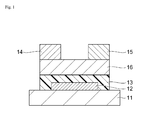
- an organic field-effect transistor With respect to the structure of the organic field-effect transistor, all that is needed is usually such that, as shown in Figure 1 , a source electrode 14 and a drain electrode 15 are provided contacting with an active layer (organic semiconductor layer 16), and a gate electrode 12 is further provided interposing an insulating layer (dielectric layer)(gate insulating film 13) contacting with the active layer 16 between the gate electrode 12 and the active layer 16.
- Examples of the element structure include the following structures (1) to (3).
- Methods for disposing the organic semiconductor material according to the present invention as an organic semiconductor film, and as a semiconductor layer of an organic semiconductor device or an organic thin film transistor include formation methods in a vacuum process such as a vacuum vapor deposition method, a sputtering method, a CVD method and a molecular beam epitaxial growth method, and preferably include the vacuum vapor deposition method.
- a method for disposing an organic semiconductor layer using the vacuum vapor deposition method is a method in which an organic semiconductor material is heated under vacuum in a crucible or a metal boat, and the evaporated organic semiconductor material is vapor deposited on a substrate or an insulator material.
- the degree of vacuum at vapor deposition is usually 1 ⁇ 10 -1 Pa or less, and preferably 1 ⁇ 10 -3 Pa or less.
- the temperature of the substrate at vapor deposition is usually 0°C to 300°C, and preferably 20°C to 200°C.
- the rate of vapor deposition is usually 0.001 nm/sec to 10 nm/sec, and preferably 0.01 nm/sec to 1 nm/sec.
- the film thickness of an organic semiconductor layer formed from the organic semiconductor material is usually 1 nm to 10 ⁇ m, and preferably 5 nm to 1 ⁇ m.
- a method for disposing an organic semiconductor film may use a solution process.
- the solution process is a method of dissolving or dispersing an organic semiconductor material in a solvent, and coating the solution or dispersion on a substrate or an insulator layer.
- Coating methods include those such as a casting method, a dip coating method, a die coater method, a roll coater method, a bar coater method and a spin coat method, an ink jet method, a screen printing method, an offset printing method and a microcontact printing method. These methods may be used singly or in combination of two or more.
- materials forming a source electrode, a drain electrode and a gate electrode are not especially limited as long as they are conductive materials, and platinum, gold, silver, nickel, chromium, copper, iron, tin, antimonial lead, tantalum, indium, palladium, tellurium, rhenium, iridium, aluminum, ruthenium, germanium, molybdenum, tungsten, tin-antimony oxide, indium-tin oxide (ITO), fluorine-doped zinc oxide, zinc, carbon, graphite, glassy carbon, silver paste and carbon paste, lithium, beryllium, sodium, magnesium, potassium, calcium, scandium, titanium, manganese, zirconium, gallium, niobium, sodium, a sodium-potassium alloy, magnesium, lithium, aluminum, a magnesium/copper mixture, a magnesium/silver mixture, a magnesium/aluminum mixture, a magnesium/indium mixture, an aluminum/aluminum oxide mixture, a
- conductive polymers improved in electric conductivity by doping or the like for example, conductive polyaniline, conductive polypyrrole and conductive polythiophene, a complex of a polyethylene dioxythiophene and a polystyrene sulfonic acid, and the like are suitably used. Particularly materials having a small electric resistance at the contact surface with a semiconductor layer are preferable. These electrode materials may be used singly or as a mixture of two or more.
- the film thickness of an electrode is, differing by the material, usually 0.1 nm to 10 ⁇ m, preferably 0.5 nm to 5 ⁇ m, and more preferably 1 nm to 3 ⁇ m. In the case of serving both as a gate electrode and a substrate, the film thickness may be larger than the above-mentioned film thickness.
- Formation methods of an electrode film to be used include various types of methods using the materials described above as raw materials.
- the methods specifically include a vacuum vapor deposition method, a sputtering method, a coating method, a thermal transfer method, a printing method and a sol-gel method.
- patterning is preferably carried out according to needs.
- Methods of patterning to be used include various types of methods.
- the methods specifically include a photolithography in combination of patterning and etching of a photoresist.
- the methods further include printing methods such as an ink jet printing, a screen printing, an offset printing and a letterpress printing, and a method of a soft lithography such as a microcontact printing method. Patterning may be carried out using these methods singly or by mixing two or more thereof.
- a gate insulating layer to be used includes various types of insulating films.
- Inorganic oxides include silicon oxide, aluminum oxide, tantalum oxide, titanium oxide, tin oxide, vanadium oxide, barium strontium titanate, barium zirconate titanate, lead zirconate titanate, lead lanthanum titanate, strontium titanate, barium titanate, barium magnesium fluoride, bismuth titanate, strontium bismuth titanate, strontium bismuth tantalate, bismuth niobate tantalate and yttrium trioxide, and preferable are silicon oxide, aluminum oxide, tantalum oxide, and titanium oxide.
- Inorganic nitrides such as silicon nitride and aluminum nitride are included.
- Organic compound films include polyimide, polyamide, polyester, polyacrylate, photocuring resins based on photoradical polymerization or photocationic polymerization, copolymers containing an acrylonitrile component, polyvinylphenol, polyvinyl alcohol, novolac resins and cyanoethylpullulans, and preferably include polyimide, polyvinylphenol and polyvinyl alcohol.
- These insulating layer materials may be used singly or in combination of two or more.
- the film thickness of an insulating layer is, differing by the material, usually 0.1 nm to 100 ⁇ m, preferably 0.5 nm to 50 ⁇ m, and more preferably 5 nm to 10 ⁇ m.
- Formation methods of an insulating layer to be used include various types of methods using the materials described above as raw materials.
- the methods specifically include coating methods such as spin coating, spray coating, dip coating, casting, bar coating and blade coating, printing methods such as screen printing, offset printing and ink jet printing, and dry process methods such as a vacuum vapor deposition method, a molecular beam epitaxial growth method, an ion cluster beam method, an ion plating method, a sputtering method, an atmospheric pressure plasma method and a CVD method.
- the methods besides include a sol-gel method and a method of forming an oxide film on a metal such as alumite on aluminum and a thermally oxidized film of silicon.
- Materials for a substrate include glass, paper, ceramics and flexible resin sheets.
- Resin films specifically include polyethylene terephthalate (PET), polyethylene naphthalate (PEN), polyether sulfone (PES), polyether imide, polyether ether ketone, polyphenylene sulfide, polyarylate, polyimide, polycarbonate (PC), cellulose triacetate (TAC) and cellulose acetate propionate (CAP).
- PET polyethylene terephthalate
- PEN polyethylene naphthalate
- PES polyether sulfone
- polyether imide polyether ether ketone
- polyphenylene sulfide polyarylate
- polyimide polycarbonate
- PC polycarbonate
- TAC cellulose triacetate
- CAP cellulose acetate propionate
- the thickness of a substrate is usually 1 ⁇ m to 10 mm, and preferably 5 ⁇ m to 5 mm.
- a surface treatment may be carried out on the insulator layer and the substrate.
- the surface treatment on an insulator layer on which an organic semiconductor layer is to be laminated allows improvement in transistor characteristics of an element.
- the surface treatment specifically includes a hydrophobizing treatment with hexamethyldisilazane, octadecyltrichlorosilane, octyltrichlorosilane or the like, an acid treatment with hydrochloric acid, sulfuric acid, a hydrogen peroxide solution or the like, an ammonia treatment with sodium hydroxide, potassium hydroxide, calcium hydroxide, ammonia or the like, an ozone treatment, a fluorinating treatment, a plasma treatment with oxygen, argon or the like, a treatment to form a Langmuir-Blodgett film, a treatment to form a thin film of another insulator or another semiconductor, a mechanical treatment, an electric treatment with corona discharge or the like, and a rubbing treatment utilizing fiber or the like.
- Examples of methods of surface treatments include a vacuum vapor deposition method, a sputtering method, a coating method, a printing method and a sol-gel method.
- a protective film composed of a resin or an inorganic compound may be disposed on an organic semiconductor layer.
- the formation of a protective film can suppress the influence of outside air and stabilize the driving of a transistor.
- reaction mixed liquid was allowed to cool to room temperature, water was added to the reaction mixed liquid, and the reaction mixed liquid was subjected to extraction with chloroform.
- the obtained organic layer was dried with magnesium sulfate, and filtered, and thereafter, the solvent was distilled out under reduced pressure.
- a mixed liquid of methyl p-dibromoterephthalate (Compound 1)(10.6 g, 30.0 mmol) synthesized according to the method of a literature (Macromolecules, 1999, 32, 2455), Compound 15 (made by Sigma-Aldrich Corp.)(24.8 g, 66.0 mmol), PdCl 2 (dppf) ⁇ CH 2 Cl 2 (2.45 g, 3.00 mmol), potassium carbonate (13.7 g, 13.7 mmol), water (60 mL) and THF (1.2 L) was refluxed under a nitrogen atmosphere for 16 hours. After the reaction mixed liquid was allowed to cool to room temperature, water was added to the reaction mixed liquid, and the reaction mixed liquid was subjected to extraction with chloroform.
- Compound 1 made by Sigma-Aldrich Corp.
- potassium carbonate (13.7 g, 13.7 mmol
- water 60
- the organic semiconductor layer composed of 2,7-dihexyl-4,9-dihydrothiopheno[2',3'-6,5]s-indaceno[1,2-b]thiophene (Compound 6) was formed under the following condition.
- the degree of vacuum in an apparatus chamber used in the vacuum vapor deposition method was 1 ⁇ 10 -4 Pa or lower.
- the temperature of a substrate was in the range of room temperature (24°C) or higher and 80°C or lower.
- a gold layer of 30 nm in thickness was formed on the organic semiconductor layer by the vacuum vapor deposition method using a metal mask to form a source electrode and a drain electrode.
- the channel width and the channel length of an organic transistor obtained by the formation of the source electrode and the drain electrode were 500 ⁇ m or more and 1,000 ⁇ m or less, and 50 ⁇ m, respectively.
- L and W represent a gate length and a gate width of an organic transistor, respectively; Ci represents a capacity per unit area of a gate insulating film; Vg represents a gate voltage; and Vt represents a threshold voltage of the gate voltage.
- a 0.5-wt% chloroform solution of the synthesized 2,7-dihexyl-4,9-dihydrothiopheno[2',3'-6,5]s-indaceno[1,2-b]thiophene (Compound 6) was spin coated on a n-doped silicon wafer with a SiO 2 thermally oxidized film subjected to an octadecyltrichlorosilane treatment by the spin coating method to form a thin film composed of Compound 6.
- the formed thin film was further kept at a temperature of 80°C for 30 min.
- Gold layers were formed as films on the obtained thin film by the vacuum vapor deposition method using a metal mask to form a source electrode and a drain electrode.
- the channel width and the channel length of an organic TFT obtained by forming the source electrode and the drain electrode were 2 mm and 20 ⁇ m, respectively.
- the field-effect mobility and the on/off ratio of the carrier were 0.007 cm 2 /Vs and 10 6 .
- the present invention can be applied to an organic thin film transistor having a higher carrier mobility, a method for producing the organic thin film transistor, and an organic thin film device containing the organic thin film transistor.
Landscapes
- Chemical & Material Sciences (AREA)
- Organic Chemistry (AREA)
- Physics & Mathematics (AREA)
- Spectroscopy & Molecular Physics (AREA)
- Engineering & Computer Science (AREA)
- Materials Engineering (AREA)
- Heterocyclic Carbon Compounds Containing A Hetero Ring Having Oxygen Or Sulfur (AREA)
- Thin Film Transistor (AREA)
- Electroluminescent Light Sources (AREA)
- Heterocyclic Compounds Containing Sulfur Atoms (AREA)
Applications Claiming Priority (2)
| Application Number | Priority Date | Filing Date | Title |
|---|---|---|---|
| JP2008026152 | 2008-02-06 | ||
| PCT/JP2009/051801 WO2009099070A1 (ja) | 2008-02-06 | 2009-02-03 | 有機半導体材料 |
Publications (3)
| Publication Number | Publication Date |
|---|---|
| EP2248818A1 true EP2248818A1 (de) | 2010-11-10 |
| EP2248818A4 EP2248818A4 (de) | 2011-04-27 |
| EP2248818B1 EP2248818B1 (de) | 2014-09-24 |
Family
ID=40952145
Family Applications (1)
| Application Number | Title | Priority Date | Filing Date |
|---|---|---|---|
| EP09708663.1A Not-in-force EP2248818B1 (de) | 2008-02-06 | 2009-02-03 | Organisches halbleitermaterial |
Country Status (7)
| Country | Link |
|---|---|
| US (1) | US20110087034A1 (de) |
| EP (1) | EP2248818B1 (de) |
| JP (1) | JP5581596B2 (de) |
| KR (1) | KR20100117068A (de) |
| CN (1) | CN101939325A (de) |
| TW (1) | TW200940519A (de) |
| WO (1) | WO2009099070A1 (de) |
Cited By (1)
| Publication number | Priority date | Publication date | Assignee | Title |
|---|---|---|---|---|
| WO2012017184A1 (en) * | 2009-08-05 | 2012-02-09 | Cambridge Display Technology Limited | Organic semiconductors |
Families Citing this family (29)
| Publication number | Priority date | Publication date | Assignee | Title |
|---|---|---|---|---|
| EP2315793B1 (de) * | 2008-08-18 | 2013-08-21 | Merck Patent GmbH | Indacenodithiophen- und indacenodiselenophenpolymere und ihre verwendung als organische halbleiter |
| JP2010083785A (ja) * | 2008-09-30 | 2010-04-15 | Chisso Corp | 平面性の高い分子構造を有する化合物およびこれを用いた有機トランジスタ |
| JP5792482B2 (ja) | 2010-03-04 | 2015-10-14 | 住友化学株式会社 | 含窒素縮合環化合物、含窒素縮合環重合体、有機薄膜及び有機薄膜素子 |
| CN101798310B (zh) * | 2010-03-05 | 2012-07-11 | 中国科学院长春应用化学研究所 | 一种有机半导体材料及使用该材料的有机薄膜晶体管 |
| EP2660264A4 (de) * | 2010-12-30 | 2016-04-20 | Ocean S King Lighting Science&Technology Co Ltd | Fotovoltaisches polymermaterial, verfahren zu seiner herstellung und verwendung |
| WO2012105511A1 (ja) * | 2011-01-31 | 2012-08-09 | 住友化学株式会社 | 含窒素縮合環化合物、含窒素縮合環重合体、有機薄膜及び有機薄膜素子 |
| CN102643284B (zh) * | 2011-02-17 | 2014-11-26 | 兰州大成科技股份有限公司 | 4,9-双亚烷基茚并二噻吩衍生物及其共轭聚合物的制备方法与用途 |
| CN106025099B (zh) | 2011-04-12 | 2018-09-07 | 精工爱普生株式会社 | 发光元件、发光装置、认证装置以及电子设备 |
| JP5765034B2 (ja) | 2011-04-18 | 2015-08-19 | セイコーエプソン株式会社 | チアジアゾール系化合物、発光素子用化合物、発光素子、発光装置、認証装置および電子機器 |
| EP2734528B1 (de) * | 2011-07-19 | 2017-03-29 | Merck Patent GmbH | Organische halbleiter |
| JP5790279B2 (ja) | 2011-08-09 | 2015-10-07 | セイコーエプソン株式会社 | 発光素子、発光装置および電子機器 |
| KR20130018547A (ko) | 2011-08-09 | 2013-02-25 | 세이코 엡슨 가부시키가이샤 | 티아디아졸계 화합물, 발광 소자, 발광 장치, 인증 장치, 전자 기기 |
| JP5970811B2 (ja) * | 2011-12-28 | 2016-08-17 | セイコーエプソン株式会社 | 発光素子、発光装置および電子機器 |
| US9324952B2 (en) | 2012-02-28 | 2016-04-26 | Seiko Epson Corporation | Thiadiazole, compound for light-emitting elements, light-emitting element, light-emitting apparatus, authentication apparatus, and electronic device |
| CN107011365A (zh) | 2012-10-18 | 2017-08-04 | 精工爱普生株式会社 | 噻二唑系化合物、发光元件用化合物、发光元件、发光装置、认证装置以及电子设备 |
| CN103848964A (zh) * | 2012-11-28 | 2014-06-11 | 海洋王照明科技股份有限公司 | 含噻吩-苯-噻吩单元的聚合物及其制备方法和太阳能电池器件 |
| JP6056498B2 (ja) * | 2013-01-21 | 2017-01-11 | 東ソー株式会社 | ジチエノベンゾジフラン誘導体及びその製造方法 |
| CN103408733B (zh) * | 2013-08-13 | 2015-09-30 | 武汉理工大学 | 二硒吩并苯并二茚类共轭聚合物半导体材料及其应用 |
| CN104557968B (zh) * | 2013-10-29 | 2017-04-05 | 中国科学院化学研究所 | 基于二噻吩并引达省的a‑d‑a共轭分子及其制备方法和应用 |
| KR102173046B1 (ko) | 2013-12-06 | 2020-11-03 | 삼성디스플레이 주식회사 | 축합환 화합물 및 이를 포함한 유기 발광 소자 |
| JP2015122383A (ja) * | 2013-12-20 | 2015-07-02 | 三星ディスプレイ株式會社Samsung Display Co.,Ltd. | 有機エレクトロルミネッセンス素子用材料及びそれを用いた有機エレクトロルミネッセンス素子 |
| JP6711272B2 (ja) * | 2014-07-23 | 2020-06-17 | 住友化学株式会社 | 高分子化合物およびそれを用いた有機半導体素子 |
| KR102502528B1 (ko) * | 2014-07-29 | 2023-02-21 | 메르크 파텐트 게엠베하 | 테트라-헤테로아릴 인다세노디티오펜계 폴리시클릭 중합체 및 이들의 용도 |
| US9299939B1 (en) * | 2014-12-09 | 2016-03-29 | International Business Machines Corporation | Formation of CMOS device using carbon nanotubes |
| EP3409722A1 (de) | 2016-01-29 | 2018-12-05 | Sumitomo Chemical Company Limited | Zusammensetzung und organischer dünnschichttransistor mit verwendung davon |
| WO2019171555A1 (ja) * | 2018-03-08 | 2019-09-12 | シャープ株式会社 | 可撓性表示装置の製造方法、および非可撓性基板 |
| KR102819927B1 (ko) * | 2018-11-26 | 2025-06-12 | 삼성전자주식회사 | 화합물, 박막 트랜지스터 및 전자 소자 |
| CN109678877A (zh) * | 2019-01-03 | 2019-04-26 | 兰州大学 | 具有电子迁移率的化合物及其制备方法、有机场效应器件及其制备方法 |
| WO2025182692A1 (ja) * | 2024-02-29 | 2025-09-04 | artience株式会社 | 化合物、化合物の製造方法、樹脂組成物、膜、有機半導体材料、光起電力デバイス、熱線吸収材料、フォトトランジスタ材料、光学フィルタ、固体撮像素子、赤外線カメラ、画像形成材料、静電荷像現像用トナー、及び印刷用インク |
Family Cites Families (2)
| Publication number | Priority date | Publication date | Assignee | Title |
|---|---|---|---|---|
| JP2008255097A (ja) * | 2007-03-09 | 2008-10-23 | Sumitomo Chemical Co Ltd | 含フッ素多環芳香族化合物、含フッ素重合体、有機薄膜及び有機薄膜素子 |
| JP2009133898A (ja) * | 2007-11-28 | 2009-06-18 | Kyocera Mita Corp | 電子写真感光体 |
-
2009
- 2009-02-03 CN CN2009801043694A patent/CN101939325A/zh active Pending
- 2009-02-03 US US12/866,664 patent/US20110087034A1/en not_active Abandoned
- 2009-02-03 JP JP2009022372A patent/JP5581596B2/ja active Active
- 2009-02-03 WO PCT/JP2009/051801 patent/WO2009099070A1/ja not_active Ceased
- 2009-02-03 EP EP09708663.1A patent/EP2248818B1/de not_active Not-in-force
- 2009-02-03 KR KR1020107017614A patent/KR20100117068A/ko not_active Withdrawn
- 2009-02-05 TW TW098103614A patent/TW200940519A/zh unknown
Non-Patent Citations (2)
| Title |
|---|
| No further relevant documents disclosed * |
| See also references of WO2009099070A1 * |
Cited By (3)
| Publication number | Priority date | Publication date | Assignee | Title |
|---|---|---|---|---|
| WO2012017184A1 (en) * | 2009-08-05 | 2012-02-09 | Cambridge Display Technology Limited | Organic semiconductors |
| US8853679B2 (en) | 2009-08-05 | 2014-10-07 | Cambridge Display Technology Limited | Organic semiconductors |
| EP3141551A1 (de) * | 2009-08-05 | 2017-03-15 | Cambridge Display Technology Limited | Organische halbleiter |
Also Published As
| Publication number | Publication date |
|---|---|
| KR20100117068A (ko) | 2010-11-02 |
| CN101939325A (zh) | 2011-01-05 |
| TW200940519A (en) | 2009-10-01 |
| US20110087034A1 (en) | 2011-04-14 |
| JP2009209134A (ja) | 2009-09-17 |
| EP2248818B1 (de) | 2014-09-24 |
| EP2248818A4 (de) | 2011-04-27 |
| JP5581596B2 (ja) | 2014-09-03 |
| WO2009099070A1 (ja) | 2009-08-13 |
Similar Documents
| Publication | Publication Date | Title |
|---|---|---|
| EP2248818A1 (de) | Organisches halbleitermaterial | |
| JP5524043B2 (ja) | 置換されたペンタセン類の調製方法 | |
| EP2341051A1 (de) | Neue verbindung und organisches halbleitermaterial | |
| CN102574868B (zh) | 取代苯并硫属并苯化合物、包含该化合物的薄膜以及包括该薄膜的有机半导体装置 | |
| TW201829410A (zh) | 有機薄膜電晶體、有機半導體膜、化合物、有機薄膜電晶體用組成物及有機薄膜電晶體的製造方法 | |
| JP2011201874A (ja) | 多環式化合物及び有機半導体デバイス | |
| JP2010043038A (ja) | ラダー型化合物及び有機半導体材料 | |
| CN101421862A (zh) | 作为有机半导体的醌型体系 | |
| JP7494456B2 (ja) | ビフェニレン誘導体、有機半導体層、及び有機薄膜トランジスタ | |
| JP7823568B2 (ja) | 芳香族化合物、有機半導体層、及び有機薄膜トランジスタ | |
| JP2014110347A (ja) | 有機半導体層形成用材料 | |
| WO2008120839A1 (en) | Novel organic semiconductor compound, and organic thin film transistor using the same | |
| JP2012111748A (ja) | 置換カルコゲノアセン化合物及び該化合物を含有する有機半導体デバイス | |
| JP5637985B2 (ja) | ジアザボロール化合物、およびそれを含有した電界効果トランジスタ | |
| US10043979B2 (en) | Organic semiconductor device that uses chrysene compound | |
| JP2018008885A (ja) | ヘテロアセン誘導体、有機半導体層、及び有機薄膜トランジスタ | |
| KR102114805B1 (ko) | 유기 트랜지스터용 유기 반도체 재료 및 유기 트랜지스터 소자 | |
| EP4647432A1 (de) | Aromatische verbindung, organische halbleiterschicht und organischer dünnschichttransistor | |
| WO2012111533A1 (ja) | 有機トランジスタ用化合物 | |
| JP2010229048A (ja) | 有機半導体材料 |
Legal Events
| Date | Code | Title | Description |
|---|---|---|---|
| PUAI | Public reference made under article 153(3) epc to a published international application that has entered the european phase |
Free format text: ORIGINAL CODE: 0009012 |
|
| 17P | Request for examination filed |
Effective date: 20100825 |
|
| AK | Designated contracting states |
Kind code of ref document: A1 Designated state(s): AT BE BG CH CY CZ DE DK EE ES FI FR GB GR HR HU IE IS IT LI LT LU LV MC MK MT NL NO PL PT RO SE SI SK TR |
|
| AX | Request for extension of the european patent |
Extension state: AL BA RS |
|
| RIN1 | Information on inventor provided before grant (corrected) |
Inventor name: MIYATA, YASUO Inventor name: HANAOKA, HIDENORI |
|
| A4 | Supplementary search report drawn up and despatched |
Effective date: 20110328 |
|
| DAX | Request for extension of the european patent (deleted) | ||
| 17Q | First examination report despatched |
Effective date: 20111208 |
|
| GRAP | Despatch of communication of intention to grant a patent |
Free format text: ORIGINAL CODE: EPIDOSNIGR1 |
|
| INTG | Intention to grant announced |
Effective date: 20140422 |
|
| GRAS | Grant fee paid |
Free format text: ORIGINAL CODE: EPIDOSNIGR3 |
|
| GRAA | (expected) grant |
Free format text: ORIGINAL CODE: 0009210 |
|
| AK | Designated contracting states |
Kind code of ref document: B1 Designated state(s): AT BE BG CH CY CZ DE DK EE ES FI FR GB GR HR HU IE IS IT LI LT LU LV MC MK MT NL NO PL PT RO SE SI SK TR |
|
| REG | Reference to a national code |
Ref country code: GB Ref legal event code: FG4D |
|
| REG | Reference to a national code |
Ref country code: CH Ref legal event code: EP |
|
| REG | Reference to a national code |
Ref country code: AT Ref legal event code: REF Ref document number: 688607 Country of ref document: AT Kind code of ref document: T Effective date: 20141015 |
|
| REG | Reference to a national code |
Ref country code: IE Ref legal event code: FG4D |
|
| REG | Reference to a national code |
Ref country code: DE Ref legal event code: R096 Ref document number: 602009026813 Country of ref document: DE Effective date: 20141106 |
|
| PG25 | Lapsed in a contracting state [announced via postgrant information from national office to epo] |
Ref country code: NO Free format text: LAPSE BECAUSE OF FAILURE TO SUBMIT A TRANSLATION OF THE DESCRIPTION OR TO PAY THE FEE WITHIN THE PRESCRIBED TIME-LIMIT Effective date: 20141224 Ref country code: SE Free format text: LAPSE BECAUSE OF FAILURE TO SUBMIT A TRANSLATION OF THE DESCRIPTION OR TO PAY THE FEE WITHIN THE PRESCRIBED TIME-LIMIT Effective date: 20140924 Ref country code: LT Free format text: LAPSE BECAUSE OF FAILURE TO SUBMIT A TRANSLATION OF THE DESCRIPTION OR TO PAY THE FEE WITHIN THE PRESCRIBED TIME-LIMIT Effective date: 20140924 Ref country code: GR Free format text: LAPSE BECAUSE OF FAILURE TO SUBMIT A TRANSLATION OF THE DESCRIPTION OR TO PAY THE FEE WITHIN THE PRESCRIBED TIME-LIMIT Effective date: 20141225 Ref country code: FI Free format text: LAPSE BECAUSE OF FAILURE TO SUBMIT A TRANSLATION OF THE DESCRIPTION OR TO PAY THE FEE WITHIN THE PRESCRIBED TIME-LIMIT Effective date: 20140924 |
|
| REG | Reference to a national code |
Ref country code: LT Ref legal event code: MG4D Ref country code: NL Ref legal event code: VDEP Effective date: 20140924 |
|
| PG25 | Lapsed in a contracting state [announced via postgrant information from national office to epo] |
Ref country code: CY Free format text: LAPSE BECAUSE OF FAILURE TO SUBMIT A TRANSLATION OF THE DESCRIPTION OR TO PAY THE FEE WITHIN THE PRESCRIBED TIME-LIMIT Effective date: 20140924 Ref country code: LV Free format text: LAPSE BECAUSE OF FAILURE TO SUBMIT A TRANSLATION OF THE DESCRIPTION OR TO PAY THE FEE WITHIN THE PRESCRIBED TIME-LIMIT Effective date: 20140924 Ref country code: HR Free format text: LAPSE BECAUSE OF FAILURE TO SUBMIT A TRANSLATION OF THE DESCRIPTION OR TO PAY THE FEE WITHIN THE PRESCRIBED TIME-LIMIT Effective date: 20140924 |
|
| REG | Reference to a national code |
Ref country code: AT Ref legal event code: MK05 Ref document number: 688607 Country of ref document: AT Kind code of ref document: T Effective date: 20140924 |
|
| PG25 | Lapsed in a contracting state [announced via postgrant information from national office to epo] |
Ref country code: NL Free format text: LAPSE BECAUSE OF FAILURE TO SUBMIT A TRANSLATION OF THE DESCRIPTION OR TO PAY THE FEE WITHIN THE PRESCRIBED TIME-LIMIT Effective date: 20140924 |
|
| PG25 | Lapsed in a contracting state [announced via postgrant information from national office to epo] |
Ref country code: PT Free format text: LAPSE BECAUSE OF FAILURE TO SUBMIT A TRANSLATION OF THE DESCRIPTION OR TO PAY THE FEE WITHIN THE PRESCRIBED TIME-LIMIT Effective date: 20150126 Ref country code: RO Free format text: LAPSE BECAUSE OF FAILURE TO SUBMIT A TRANSLATION OF THE DESCRIPTION OR TO PAY THE FEE WITHIN THE PRESCRIBED TIME-LIMIT Effective date: 20140924 Ref country code: IS Free format text: LAPSE BECAUSE OF FAILURE TO SUBMIT A TRANSLATION OF THE DESCRIPTION OR TO PAY THE FEE WITHIN THE PRESCRIBED TIME-LIMIT Effective date: 20150124 Ref country code: CZ Free format text: LAPSE BECAUSE OF FAILURE TO SUBMIT A TRANSLATION OF THE DESCRIPTION OR TO PAY THE FEE WITHIN THE PRESCRIBED TIME-LIMIT Effective date: 20140924 Ref country code: SK Free format text: LAPSE BECAUSE OF FAILURE TO SUBMIT A TRANSLATION OF THE DESCRIPTION OR TO PAY THE FEE WITHIN THE PRESCRIBED TIME-LIMIT Effective date: 20140924 Ref country code: EE Free format text: LAPSE BECAUSE OF FAILURE TO SUBMIT A TRANSLATION OF THE DESCRIPTION OR TO PAY THE FEE WITHIN THE PRESCRIBED TIME-LIMIT Effective date: 20140924 Ref country code: ES Free format text: LAPSE BECAUSE OF FAILURE TO SUBMIT A TRANSLATION OF THE DESCRIPTION OR TO PAY THE FEE WITHIN THE PRESCRIBED TIME-LIMIT Effective date: 20140924 |
|
| PG25 | Lapsed in a contracting state [announced via postgrant information from national office to epo] |
Ref country code: PL Free format text: LAPSE BECAUSE OF FAILURE TO SUBMIT A TRANSLATION OF THE DESCRIPTION OR TO PAY THE FEE WITHIN THE PRESCRIBED TIME-LIMIT Effective date: 20140924 Ref country code: AT Free format text: LAPSE BECAUSE OF FAILURE TO SUBMIT A TRANSLATION OF THE DESCRIPTION OR TO PAY THE FEE WITHIN THE PRESCRIBED TIME-LIMIT Effective date: 20140924 |
|
| REG | Reference to a national code |
Ref country code: DE Ref legal event code: R097 Ref document number: 602009026813 Country of ref document: DE |
|
| PG25 | Lapsed in a contracting state [announced via postgrant information from national office to epo] |
Ref country code: BE Free format text: LAPSE BECAUSE OF NON-PAYMENT OF DUE FEES Effective date: 20150228 |
|
| PG25 | Lapsed in a contracting state [announced via postgrant information from national office to epo] |
Ref country code: DK Free format text: LAPSE BECAUSE OF FAILURE TO SUBMIT A TRANSLATION OF THE DESCRIPTION OR TO PAY THE FEE WITHIN THE PRESCRIBED TIME-LIMIT Effective date: 20140924 |
|
| PLBE | No opposition filed within time limit |
Free format text: ORIGINAL CODE: 0009261 |
|
| STAA | Information on the status of an ep patent application or granted ep patent |
Free format text: STATUS: NO OPPOSITION FILED WITHIN TIME LIMIT |
|
| PG25 | Lapsed in a contracting state [announced via postgrant information from national office to epo] |
Ref country code: IT Free format text: LAPSE BECAUSE OF FAILURE TO SUBMIT A TRANSLATION OF THE DESCRIPTION OR TO PAY THE FEE WITHIN THE PRESCRIBED TIME-LIMIT Effective date: 20140924 |
|
| 26N | No opposition filed |
Effective date: 20150625 |
|
| PG25 | Lapsed in a contracting state [announced via postgrant information from national office to epo] |
Ref country code: LU Free format text: LAPSE BECAUSE OF FAILURE TO SUBMIT A TRANSLATION OF THE DESCRIPTION OR TO PAY THE FEE WITHIN THE PRESCRIBED TIME-LIMIT Effective date: 20150203 |
|
| REG | Reference to a national code |
Ref country code: CH Ref legal event code: PL |
|
| GBPC | Gb: european patent ceased through non-payment of renewal fee |
Effective date: 20150203 |
|
| PG25 | Lapsed in a contracting state [announced via postgrant information from national office to epo] |
Ref country code: CH Free format text: LAPSE BECAUSE OF NON-PAYMENT OF DUE FEES Effective date: 20150228 Ref country code: LI Free format text: LAPSE BECAUSE OF NON-PAYMENT OF DUE FEES Effective date: 20150228 Ref country code: MC Free format text: LAPSE BECAUSE OF FAILURE TO SUBMIT A TRANSLATION OF THE DESCRIPTION OR TO PAY THE FEE WITHIN THE PRESCRIBED TIME-LIMIT Effective date: 20140924 |
|
| REG | Reference to a national code |
Ref country code: IE Ref legal event code: MM4A |
|
| REG | Reference to a national code |
Ref country code: FR Ref legal event code: ST Effective date: 20151030 |
|
| PG25 | Lapsed in a contracting state [announced via postgrant information from national office to epo] |
Ref country code: IE Free format text: LAPSE BECAUSE OF NON-PAYMENT OF DUE FEES Effective date: 20150203 Ref country code: GB Free format text: LAPSE BECAUSE OF NON-PAYMENT OF DUE FEES Effective date: 20150203 |
|
| PG25 | Lapsed in a contracting state [announced via postgrant information from national office to epo] |
Ref country code: FR Free format text: LAPSE BECAUSE OF NON-PAYMENT OF DUE FEES Effective date: 20150302 Ref country code: SI Free format text: LAPSE BECAUSE OF FAILURE TO SUBMIT A TRANSLATION OF THE DESCRIPTION OR TO PAY THE FEE WITHIN THE PRESCRIBED TIME-LIMIT Effective date: 20140924 |
|
| PG25 | Lapsed in a contracting state [announced via postgrant information from national office to epo] |
Ref country code: MT Free format text: LAPSE BECAUSE OF FAILURE TO SUBMIT A TRANSLATION OF THE DESCRIPTION OR TO PAY THE FEE WITHIN THE PRESCRIBED TIME-LIMIT Effective date: 20140924 |
|
| PG25 | Lapsed in a contracting state [announced via postgrant information from national office to epo] |
Ref country code: BG Free format text: LAPSE BECAUSE OF FAILURE TO SUBMIT A TRANSLATION OF THE DESCRIPTION OR TO PAY THE FEE WITHIN THE PRESCRIBED TIME-LIMIT Effective date: 20140924 Ref country code: HU Free format text: LAPSE BECAUSE OF FAILURE TO SUBMIT A TRANSLATION OF THE DESCRIPTION OR TO PAY THE FEE WITHIN THE PRESCRIBED TIME-LIMIT; INVALID AB INITIO Effective date: 20090203 |
|
| PG25 | Lapsed in a contracting state [announced via postgrant information from national office to epo] |
Ref country code: TR Free format text: LAPSE BECAUSE OF FAILURE TO SUBMIT A TRANSLATION OF THE DESCRIPTION OR TO PAY THE FEE WITHIN THE PRESCRIBED TIME-LIMIT Effective date: 20140924 |
|
| PG25 | Lapsed in a contracting state [announced via postgrant information from national office to epo] |
Ref country code: MK Free format text: LAPSE BECAUSE OF FAILURE TO SUBMIT A TRANSLATION OF THE DESCRIPTION OR TO PAY THE FEE WITHIN THE PRESCRIBED TIME-LIMIT Effective date: 20140924 |
|
| PGFP | Annual fee paid to national office [announced via postgrant information from national office to epo] |
Ref country code: DE Payment date: 20210119 Year of fee payment: 13 |
|
| REG | Reference to a national code |
Ref country code: DE Ref legal event code: R119 Ref document number: 602009026813 Country of ref document: DE |
|
| PG25 | Lapsed in a contracting state [announced via postgrant information from national office to epo] |
Ref country code: DE Free format text: LAPSE BECAUSE OF NON-PAYMENT OF DUE FEES Effective date: 20220901 |