EP2248855A1 - Verfahren zur herstellung einer harzzusammensetzung mit teilentladungsresistenz, harzzusammensetzung mit teilentladungsresistenz und isoliermaterial mit teilentladungsresistenz - Google Patents
Verfahren zur herstellung einer harzzusammensetzung mit teilentladungsresistenz, harzzusammensetzung mit teilentladungsresistenz und isoliermaterial mit teilentladungsresistenz Download PDFInfo
- Publication number
- EP2248855A1 EP2248855A1 EP08872604A EP08872604A EP2248855A1 EP 2248855 A1 EP2248855 A1 EP 2248855A1 EP 08872604 A EP08872604 A EP 08872604A EP 08872604 A EP08872604 A EP 08872604A EP 2248855 A1 EP2248855 A1 EP 2248855A1
- Authority
- EP
- European Patent Office
- Prior art keywords
- partial discharge
- layer clay
- clay mineral
- epoxy resin
- discharge resistant
- Prior art date
- Legal status (The legal status is an assumption and is not a legal conclusion. Google has not performed a legal analysis and makes no representation as to the accuracy of the status listed.)
- Withdrawn
Links
Images


Classifications
-
- H—ELECTRICITY
- H05—ELECTRIC TECHNIQUES NOT OTHERWISE PROVIDED FOR
- H05K—PRINTED CIRCUITS; CASINGS OR CONSTRUCTIONAL DETAILS OF ELECTRIC APPARATUS; MANUFACTURE OF ASSEMBLAGES OF ELECTRICAL COMPONENTS
- H05K1/00—Printed circuits
- H05K1/02—Details
- H05K1/03—Use of materials for the substrate
- H05K1/0313—Organic insulating material
- H05K1/0353—Organic insulating material consisting of two or more materials, e.g. two or more polymers, polymer + filler, + reinforcement
- H05K1/0373—Organic insulating material consisting of two or more materials, e.g. two or more polymers, polymer + filler, + reinforcement containing additives, e.g. fillers
-
- C—CHEMISTRY; METALLURGY
- C08—ORGANIC MACROMOLECULAR COMPOUNDS; THEIR PREPARATION OR CHEMICAL WORKING-UP; COMPOSITIONS BASED THEREON
- C08G—MACROMOLECULAR COMPOUNDS OBTAINED OTHERWISE THAN BY REACTIONS ONLY INVOLVING UNSATURATED CARBON-TO-CARBON BONDS
- C08G59/00—Polycondensates containing more than one epoxy group per molecule; Macromolecules obtained by polymerising compounds containing more than one epoxy group per molecule using curing agents or catalysts which react with the epoxy groups
- C08G59/18—Macromolecules obtained by polymerising compounds containing more than one epoxy group per molecule using curing agents or catalysts which react with the epoxy groups ; e.g. general methods of curing
- C08G59/40—Macromolecules obtained by polymerising compounds containing more than one epoxy group per molecule using curing agents or catalysts which react with the epoxy groups ; e.g. general methods of curing characterised by the curing agents used
- C08G59/42—Polycarboxylic acids; Anhydrides, halides or low molecular weight esters thereof
-
- H—ELECTRICITY
- H01—ELECTRIC ELEMENTS
- H01B—CABLES; CONDUCTORS; INSULATORS; SELECTION OF MATERIALS FOR THEIR CONDUCTIVE, INSULATING OR DIELECTRIC PROPERTIES
- H01B3/00—Insulators or insulating bodies characterised by the insulating materials; Selection of materials for their insulating or dielectric properties
- H01B3/18—Insulators or insulating bodies characterised by the insulating materials; Selection of materials for their insulating or dielectric properties mainly consisting of organic substances
- H01B3/30—Insulators or insulating bodies characterised by the insulating materials; Selection of materials for their insulating or dielectric properties mainly consisting of organic substances plastics; resins; waxes
- H01B3/40—Insulators or insulating bodies characterised by the insulating materials; Selection of materials for their insulating or dielectric properties mainly consisting of organic substances plastics; resins; waxes epoxy resins
-
- C—CHEMISTRY; METALLURGY
- C08—ORGANIC MACROMOLECULAR COMPOUNDS; THEIR PREPARATION OR CHEMICAL WORKING-UP; COMPOSITIONS BASED THEREON
- C08K—Use of inorganic or non-macromolecular organic substances as compounding ingredients
- C08K3/00—Use of inorganic substances as compounding ingredients
- C08K3/34—Silicon-containing compounds
- C08K3/346—Clay
-
- H—ELECTRICITY
- H05—ELECTRIC TECHNIQUES NOT OTHERWISE PROVIDED FOR
- H05K—PRINTED CIRCUITS; CASINGS OR CONSTRUCTIONAL DETAILS OF ELECTRIC APPARATUS; MANUFACTURE OF ASSEMBLAGES OF ELECTRICAL COMPONENTS
- H05K1/00—Printed circuits
- H05K1/02—Details
- H05K1/0213—Electrical arrangements not otherwise provided for
- H05K1/0254—High voltage adaptations; Electrical insulation details; Overvoltage or electrostatic discharge protection ; Arrangements for regulating voltages or for using plural voltages
- H05K1/0256—Electrical insulation details, e.g. around high voltage areas
-
- H—ELECTRICITY
- H05—ELECTRIC TECHNIQUES NOT OTHERWISE PROVIDED FOR
- H05K—PRINTED CIRCUITS; CASINGS OR CONSTRUCTIONAL DETAILS OF ELECTRIC APPARATUS; MANUFACTURE OF ASSEMBLAGES OF ELECTRICAL COMPONENTS
- H05K1/00—Printed circuits
- H05K1/02—Details
- H05K1/0213—Electrical arrangements not otherwise provided for
- H05K1/0254—High voltage adaptations; Electrical insulation details; Overvoltage or electrostatic discharge protection ; Arrangements for regulating voltages or for using plural voltages
- H05K1/0257—Overvoltage protection
-
- H—ELECTRICITY
- H05—ELECTRIC TECHNIQUES NOT OTHERWISE PROVIDED FOR
- H05K—PRINTED CIRCUITS; CASINGS OR CONSTRUCTIONAL DETAILS OF ELECTRIC APPARATUS; MANUFACTURE OF ASSEMBLAGES OF ELECTRICAL COMPONENTS
- H05K2201/00—Indexing scheme relating to printed circuits covered by H05K1/00
- H05K2201/02—Fillers; Particles; Fibers; Reinforcement materials
- H05K2201/0203—Fillers and particles
- H05K2201/0206—Materials
- H05K2201/0209—Inorganic, non-metallic particles
Definitions
- the present invention relates to a fabrication method for partial discharge resistant resin composites, a partial discharge resistant resin composite, and a partial discharge resistant insulation material applicable to high voltage equipments such as electric generators, rotating machines, equipments for electric transmission and transformation, or equipments for electric distribution or reception, for instance.
- insulated coils incorporated in electric generators, rotating machines, or the like, and provided with insulation layers for isolation between current conducting conductors or between conductors and the ground.
- equipments for electric transmission or transformation such as sulfur hexafluoride gas-insulated switchgears or gas-insulated transmission lines, there are cast articles employed as insulation members for insulating and supporting high voltage conductors in metallic casings, for instance.
- insulation resin materials having epoxy resins as base materials.
- the present invention has been devised to cope with such issues, it thus being an object of the present invention to provide a fabrication method for partial discharge resistant resin composites, a partial discharge resistant resin composite, and a partial discharge resistant insulation material, allowing for fabrication of a partial discharge resistant resin composite with an excellent partial discharge resistance with a small density, in a simplified manner.
- a fabrication method for partial discharge resistant resin composites containing (A) an epoxy resin having two or more epoxy groups per one molecule, (B)an hardener for an epoxy resin, and (C) a layer clay mineral as indispensable ingredients
- the fabrication method for partial discharge resistant resin composites comprising steps of using an ion exchange treatment for intercalating an organic compound between layers of a layer clay mineral thereby providing the layer clay mineral with a swellability to at least one of a polar solvent and a non-polar solvent, having the layer clay mineral as provided with a swellability swollen in a swelling solvent comprising the polar solvent or the non-polar solvent, kneading a mixture of an epoxy resin and the swelling solvent including the layer clay mineral as swollen, making a removal of the swelling solvent from the mixture including the swelling solvent, the layer clay mineral, and the epoxy resin after the kneading, and mixing an epoxy resin addressing hardener with the mixture after the removal of the swelling solvent.
- a partial discharge resistant insulation material comprising a hardened material of a partial discharge resistant resin composite according to the other aspect of the present invention.
- an epoxy resin enabled to have a system of inorganic nanoparticles comprising a layer clay mineral and evenly dispersed therein, affording to obtain a partial discharge resistant resin composite as well as a partial discharge resistant insulation material with an excellent partial discharge resistance with a small density.
- a partial discharge resistant resin composite as well as a partial discharge resistant insulation material with an excellent partial discharge resistance with a favorable repeatability.
- a set of partial discharge resistant resin composites each containing (A) an epoxy resin having two or more epoxy groups per one molecule, (B) an hardener for an epoxy resin, and (C) a system of inorganic nanoparticles comprising a layer clay mineral or layer clay minerals, as indispensable ingredients thereof.
- the ingredient (A) should be an epoxy resin comprising an epoxy compound having two or more epoxy groups per one molecule.
- the epoxy compound employed as necessary without limitation to the kind may be any of those compounds having in one molecule tow or more three-membered rings each comprising two carbon elements and one oxygen element, and curable.
- epoxy resin cited may be such as glycidyl ether type epoxy resins obtainable by condensation between epichlorohydrin and any of polyalcohols or polyphenols such as bisphenols, including bisphenol A type epoxy resins, brominated bisphenol A type epoxy resins, hydrogenated bisphenol A type epoxy resins, bisphenol F type epoxy resins, bisphenol S type epoxy resins, bisphenol AF type epoxy resins, biphenyl type epoxy resins, naphthalene type epoxy resins, fluorene type epoxy resins, novolac type epoxy resins, phenol novolac type epoxy resins, orthocresol novolac type epoxy resins, tris(hydroxyphenyl)methane type epoxy resins, and tetraphenyrolethane type epoxy resins, glycidyl ester type epoxy resins obtainable by condensation between epichlorohydrin and a carboxylic acid, with triglycidyl isocyanate inclusive, or heterocyclic epoxy resins
- the ingredient (B) there may be used any of hardeners reactive with an epoxy resin or epoxy resins to harden the same, and selected as necessary without limitation to the kind.
- epoxy resin addressing hardeners there may be cited for instance amine series hardeners, acid anhydride series hardeners, imidazole series hardeners, polymercaptan series hardeners, phenol series hardeners, Lewis acid series hardeners, isocyanate series hardeners, and the like.
- amine series hardeners specific examples cited may be ethylenediamine, 1,3-diaminopropane, 1,4-diaminobutane, hexamethylenediamine, dipropylenediamine, polyetherdiamine, 2,5-dimethylhexamethylenediamine, trimethylhexamethylenediamine, diethylenetriamine, iminobispropylamine, bis(hexamethyl)triamine, triethylenetetramine, tetraethylenepentamine, pentaethylenehexamine, aminoethylethanolamine, tri(methylamino)texane, dimethylaminopropylamine, diethylaminopropylamine, methyliminobispropylamine, menthanediamine, isophoronediamine, bis(4-amino-3-methyldicyclohexyl)methane, diaminodicyclohexylmethane, bis(aminomethyl)cyclohe
- acid anhydride series hardeners specific examples cited may be dodecenyl succinic anhydrides, poly adipic anhydrides, polyazelaic polyanhydrides, poly sebacic anhydrides, poly (ethyloctadecanedioic) anhydrides, poly (phenylhexadecanedioic) anhydrides, methyltetrahydrophthalic anhydride, methylhexahydrophthalic anhydrides, methylhimic anhydrides, hexahydrophthalic anhydrides, tetrahydrophthalic anhydrides, trialkyltetrahydrophthalic anhydrides, methylcyclohexenedicarboxylic anhydrides, phthalic anhydrides, trimellitic anhydrides, pyromellitic anhydrides, benzophenontetracarboxylic acids, ethylene glycol bis trimellitates, glycerol tris trimellitates, het anhydrides, tetrab
- imidazole series hardeners specific examples cited may be 2-methylimidazole, 2-ethyl-4- methylimidazole, 2-heptadecylimidazole, and the like.
- polymercaptan series hardeners specific examples cited may be polysulfides, tioesters, and the like.
- the above-noted hardeners may be employed alone or in combination as a mixture of two or more kinds, as a hardener.
- the amount of hardener or hardeners blended may be set as necessary within a range of effective amounts such as those depending on the kind or kinds of hardener or hardeners in use, and typically, may preferably be within, a range of one half to two equivalents to an epoxy equivalent of the epoxy resin.
- the hardener blend amount is less than one half equivalents to the epoxy equivalent of the ingredient (A)
- the hardener blend amount exceeds two equivalents to the epoxy equivalent of the ingredient (A), there may be degraded basic physical properties such as heat resistances of hardened materials in partial discharge resistant resin composites (epoxy resin composites).
- the hardener in combination with use of curing accelerators adapted to accelerate or control hardening reactions of the epoxy resin.
- the use of curing accelerator may have an increased chance, in use of any of acid anhydride series hardeners that is slower in rate of hardening reaction than other hardeners such as amine series hardeners.
- curing accelerators used may preferably be tertiary amines or salts thereof, quaternary ammonium compounds, imidazoles, alkali metal alkoxides, or the like.
- the system of inorganic nanoparticles comprising a layer clay mineral or layer clay minerals may preferably have a blend amount thereof set within a range of 1 to 50 parts by weight to 100 parts by weight of the epoxy resin of the ingredient (A).
- the blend amount of inorganic nanoparticles is less than 1 part by weight to 100 parts by weight of the ingredient (A), there may be failures to provide hardened materials of epoxy resin with partial discharge resistant characteristics.
- the ingredient (C) if the blend amount of inorganic nanoparticles exceeds 50 parts by weight to 100 parts by weight of the ingredient (A), there may be an increase in viscosity of the epoxy resin, constituting a difficulty to provide a system of inorganic nanoparticles evenly dispersed in the epoxy resin. Also, there may be brittle hardened materials of epoxy resin provided as partial discharge resistant insulation materials with degraded basic characteristics.
- the system of inorganic nanoparticles comprising a layer clay mineral or layer clay minerals should have initial particle sizes of 500 nm or less.
- the system of inorganic nanoparticles if the system of inorganic nanoparticles has initial particle sizes greater than 500 nm, there may be failures to provide hardened materials of epoxy resin with partial discharge resistant characteristics within the range of 1 to 50 parts by weight to 100 parts by weight of the epoxy resin of the ingredient (A).
- layer clay minerals cited may belong to at least one of mineral groups including for instance the smectite group, mica group, vermiculite group, and groups in the mica family.
- layer clay minerals belonging to the smectite group there may be cited motmorillonite, hectorite, saponite, sauconite, beidellite, stevensite, nontronite, and the like.
- layer clay minerals belonging to the mica group there may be cited chlorite, phlogopite, lepidolite, muscovite, biotite, paragonite, margarite, taeniolite, tetrasilicicmica, and the like.
- layer clay minerals belonging to the vermiculite group there may be cited trioctahedral vermiculite, dioctahedral vermiculite, and the like.
- layer clay minerals belonging to the mica family groups there may be cited muscovite, biotite, paragonite, lepidolite, margarite, clintonite, anandite, and the like.
- those layer clay minerals belonging to the smectite group should be used in view of the tendency of dispersion to epoxy resins, or such.
- the above-noted layer clay minerals may be employed alone or in combination as a mixture of two or more kinds.
- Layer clay minerals have structures in which silicate layers are laminated, affording to hold various substances such as ions, molecules, or clusters intercalated between silicate layers by ion exchange reactions (intercalation). Such use of ion exchange treatments permit various metal ions or organic compounds to be intercalated between silicate layers. Such behaviors are utilized to permit various organic compounds to be used as interlayer substances intercalated to hold between silicate layers of layer clay minerals, allowing for selective use of such organic compounds to provide layer clay minerals (C) with swellability to polar solvents and/or non-polar solvents.
- C layer clay minerals
- Organic compounds intercalated between silicate layers of layer clay minerals may be selected without particular limitations subject to the swellability to a targeted solvent, while preferably primary to quaternary ammonium ions should be used in consideration of the degree of interlayer intercalation by use of ion exchange treatment.
- tetrabutylammonium ions tetrahexylammonium ions, dihexyldimethylamminium ions, dioctyldimethylammonium ions, hexatrimethylammonium ions, octatrimethylamminium ions, dodecyltrimethylammonium ions, hexadecyltrimethylammonium ions, stearyltrimethylammonium ions, docosenyltrimethylammonium ions, cetyltrimethylanunonium ions, cetyltriethylamminium ions, hexadecylammonium ions, tetradecyldimethylbenzylamminium ions, stearyldimethylbenzylammonium ions, dioleyldimethylammonium ions, N-methyldiethanollaurylammonium ions, N-methyldiethanollaurylammonium ions, N
- Such partial discharge resistant resin composites may have, besides the indispensable ingredients (A) to (C), the above-noted hardening accelerator and/or other additives blended as necessary within the range not to inhibit effects of the invention.
- the other additives blended there may be cited anti-dripping agents, anti-settling agents, anti-foaming agents, leveling agents, slip agents, dispersing agents, substrate wetting agents, and the like.
- an ion exchange treatment for intercalating an organic compound or organic compounds between layers of a layer clay mineral or layer clay minerals of the ingredient (C) described, thereby providing the layer clay mineral or layer clay minerals with swellability to at least one of a polar solvent and a non-polar solvent.
- the organic compound or organic compounds to be intercalated between layers of the layer clay mineral or layer clay minerals preferably, there should be used at least one kind selected from a set of primary to quaternary ammonium ions described. Also, for the reason described, preferably, there should be used any of layer clay minerals having initial particle sizes of 500 nm or less.
- the layer clay mineral or layer clay minerals as provided with swellability immersed in a swelling solvent comprising the polar solvent or the non-polar solvent, swelling by a stir, before additionally blending an epoxy resin of the ingredient (A), kneading the mixture.
- the layer clay mineral or layer clay minerals should have a blend amount thereof within a range of 1 to 50 parts by weight to 100 parts by weight of the epoxy resin.
- the kneading may preferably be performed with high shearing forces acting thereon. This affords in the mixture of epoxy resin to have high shearing forces kneading on the layer clay mineral or layer clay minerals swollen in the solvent with increased interlayer distances between silicate layers thereof, thus allowing for provision of a system of inorganic nanoperticles (of the layer clay mineral or layer clay minerals) the more uniformly dispersed in the epoxy resin.
- Such steps provides an amount of mixture including combination of an amount of the epoxy resin and an amount of the swelling solvent with a system of inorganic nanoparticles comprising the layer clay mineral or layer clay minerals.
- This mixture is let to undergo a process for a removal of the swelling solvent, such as by a vacuum stir drying.
- This process may include a prewashing employing a low boiling-point solvent incompatible with the epoxy resin but compatible with the swelling solvent used, allowing for a reduced amount of this solvent removed by the vacuum drying.
- the method described includes steps of mixing an epoxy resin of the ingredient (A) with a swelling solvent containing a layer clay mineral or layer clay minerals as swollen, kneading the mixture, obtaining a mixture containing the epoxy resin, the swelling solvent, and the layer clay mineral or layer clay minerals, making a removal of the swelling solvent from this mixture, having a resultant mixture containing the epoxy resin and the layer clay mineral or layer clay minerals, and adding thereto an epoxy resin addressing hardener of the ingredient (B) to mix therewith, while instead there may be steps of mixing an hardener for epoxy resin of the ingredient (B) with a swelling solvent containing a layer clay mineral or layer clay minerals as swollen, kneading the mixture, obtaining a mixture containing the hardener, the swelling solvent, and the layer clay mineral or layer clay minerals, making a removal of the swelling solvent from this mixture, having a resultant mixture containing the epoxy resin addressing hardener and the layer clay mineral or layer clay minerals, and adding thereto an epoxy resin of
- steps of mixing an epoxy resin of the ingredient (A) with a swelling solvent containing a layer clay mineral or layer clay minerals as swollen, and kneading the mixture producing a first mixture
- steps of mixing hardener of the ingredient (B) with a swelling solvent containing a layer clay mineral or layer clay minerals as swollen, and kneading the mixture producing a second mixture, followed by steps of making a removal of swelling solvent from the first mixture and the second mixture, and mixing the first mixture and the second mixture after the removal of swelling solvent, to thereby obtain a targeted partial discharge resistant resin composite.
- the foregoing partial discharge resistant resin composites undergo a variety of form making or molding processes, such as an impregnation, coating, casting, or sheet formation, to make forms or molds of desirable shapes in accordance with applications of insulation materials. Those forms or molds are cured or hardened through hardening processes corresponding to the kinds of hardeners, to obtain partial discharge resistant insulation materials. It is noted that in the foregoing steps for fabrication of partial discharge resistant resin composites, arbitrary ingredients described are added and mixed as necessary.
- partial discharge resistant insulation materials each have, as illustrated in Fig. 1 for instance, a structure in the form of a cross-linked network of epoxy resin molecular chains (hardened material) 1 constructed by reactions between the ingredient (A) being an epoxy resin and the ingredient (B) being an hardener, including the ingredient (C) as a system of inorganic nanoparticles 2 comprising a layer clay mineral or layer clay minerals evenly and precisely dispersed therein.
- a partial discharge resistant insulation material as a hardened epoxy resin with an enhanced partial discharge resistant characteristic due to inclusion of the system of inorganic nanoparticles 2.
- inorganic nanoparticles of nanometer sizes permitting various amounts of epoxy resin to be filled with smaller amounts of inorganic particles to exhibit excellent partial discharge resistant characteristics, the filled amounts being so small as affording for partial discharge resistant resin composites as well as partial discharge resistant insulation materials to have low-suppressed densities.
- the present embodiment affords to provide partial discharge resistant insulation materials well suitable for applications such as those to insulation layers of insulated coils employed in high voltage equipments including electric generators, rotating machines, and the like, insulation coatings of enamel wires employed in industrial motors or the like, and insulating support members for high voltage conductors employed in equipments for electric transmission and transformation (as high voltage equipments) including gas-insulated switchgears, gas-insulated transmission lines, and the like.
- Insulated coils employed in electric generators, rotating machines, or the like are configured with a coil conductor for conducting a high-voltage current, and an insulation layer for isolation between coil conductors and that of coil conductors to the ground.
- Insulation layers of insulated coils fabricated may have, for instance, mica papers impregnated and coated with insulating resin composites to be hardened.
- Insulating support members for high voltage conductors employed in high voltage equipments such as electric transmission and transformation equipments are configured for high voltage conductors to be insulated and supported in metal casings, in the form of an amount of insulating resin composite casted and hardened as a cast insulator, for instance.
- Enamel wires employed in industrial motors or the like are configured with an element wire for conducting a high-voltage current, and an insulation coating for isolation between element wires and that of element wires to the ground.
- Insulation coatings of enamel wires fabricated may comprise a hardened coat of partial discharge resistant resin composite.
- Such the partial discharge resistant insulation materials can be used for various applications including not simply those described such as insulation layers of insulated coils, insulation coatings of enamel wires, and insulating support members for high voltage conductors (cast insulators), but also as turbine end finish varnishes for generators, insulation rods for breakers, insulation paints, formed insulation components, impregnation resins for FRP, cable sheath materials, and the like. Further, in some cases, they may be applied as or to highly heat conductive insulation sheets for power unit insulating sealants, IC substrates, LSI device addressing interlayer insulation films, stacking substrates, semiconductor addressing sealants, and the like.
- the present invention provides partial discharge resistant insulation materials adapted for use in various applications.
- industrial and heavy electrical machinery as well as electric or electronic equipment has been exposed to recent trends such as those to implement smaller sizes, larger capacities, higher frequency bands, or higher voltages, under usage environments with augmented severities or such, and accompanied by desiderata such as those to implement higher performances, higher integrities, higher qualities, or higher stabilities, for instance such as those to improve partial discharge resistant characteristics in cast insulators, impregnated insulation materials, or the like.
- the present invention provides partial discharge resistant insulation materials meeting such demands, affording for selective use of those constituent materials described to apply as epoxy cast insulators, epoxy impregnated insulation materials, epoxy resin insulation covers, or the like, to various industrial and heavy electrical machinery and electric or electronic equipment.
- This mixture was washed by a plenty of distilled water for removing dimethylacetamide, before a pressure-reduced drying made to remove residual distilled water, obtaining a mixture of epoxy resin with a system of inorganic nanoparticles evenly dispersed therein.
- To this mixture there was made an addition of 86 parts by weight of an acid anhydride series hardener (New Japan Chemical Co. make, article name: Rikacid® MH-700) and 1 part by weight of a curing accelerator (Nihon Yushi Co. make, article name: M2-100), followed by a mixing made at 80°C for 10 minutes, preparing a partial discharge resistant resin composite.
- This insulating resin composite was poured into a mold preheated to 100°C, and vacuum-degassing, before a hardening process implemented under conditions of 100°C x 3 hours (primary hardening) + 150°C x 15 hours (secondary hardening), making a targeted partial discharge resistant insulation material.
- This partial discharge resistant insulation material was used in later-described characteristic evaluations.
- inorganic nanoparticles used in the above-noted embodiment example 1 and comparative examples 1 to 3 had differences in between, which are listed together in Table 1.
- dispersed states of their inorganic nanoparticles were observed and investigated by a TEM (transmission electron microscope) or XRD (X-ray diffraction measurement), with resultant dispersion states schematically illustrated in Figs. 2(a) to 2(d) .
- the embodiment example 1 Comparison is made between the embodiment example 1 and the comparative example 1.
- layer clay mineral prepared with an initial particle size of 100 nm, having octadecylamine ions as inorganic nanoparticles held in interlayer spaces by an intercalation treatment, which was subjected to a swelling in an organic solvent (dimethylacetamide) and filled by 10 parts by weight in an epoxy resin, kneading the mixture with high shearing forces before making a removal of the organic solvent.
- silica particles prepared with an initial particle size of 12 ⁇ m, which was filled by 10 parts by weight in an epoxy resin.
- the difference of initial particle size largely affects partial discharge resistant characteristics.
- the partial discharge resistant insulation material was fabricated with nanometer-sized particles of layer clay mineral 4 densely dispersed in an epoxy resin 3, so as illustrated in Fig. 5(a) , its erosion by partial discharges could be blocked to suppress.
- the insulation material was fabricated with micrometer-sized silica particles 5 dispersed in an epoxy resin 3, so as illustrated in Fig. 5(b) , the epoxy resin 3 was eroded by partial discharges between silica particles 5.
- the partial discharge resistant insulation material according to the embodiment example 1 using nanometer-sized inorganic particles, was provided with an excellent resistant property to partial discharges.
- such the partial discharge resistant insulation material using nanometer-sized inorganic particles, was enabled by filing mere 10 parts by weight of inorganic particles to exhibit a partial discharge resistant characteristic similar to what was given by filling 200 parts by weight of micrometer-sized inorganic particles, and could do with a reduced fill amount, having a material density successfully suppressed small, finally affording to have light-weighted insulated coils, enameled wires, and cast insulation materials.
- Layer clay minerals are fine particles having a structure of laminated sheets (silicate layers) each comprised of a two-dimensional array of SiO 4 tetrahedrons or octahedrons.
- Pieces or particles of layer clay mineral uniformly dispersed in an epoxy resin like the embodiment example 1 work to suppress deteriorations due to partial discharges, affording to provide the epoxy resin with an excellent partial discharge resistant property. This is why in Fig. 4 the surface roughness after partial discharge deterioration is reduced.
- Fig. 7 is an illustration of an insulated coil applicable to high voltage equipment such as electric generators or rotating machines.
- a set of high voltage current conducting coil conductors 11 there is provided an insulation layer 12 configured for isolation between the set of coil conductors 11 and the ground as well as between sets of coil conductors 11.
- the insulation layer 12 may be composed of e.g. mica paper impregnated and coated with a partial discharge resistant resin composite according to an aspect of the present invention, and hardened.
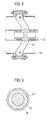
- Fig. 8 is an illustration of an insulation member applicable to gas-insulated switchgears.
- Fig. 8 there is a high voltage conductor 13 insulated and supported by the insulation member 15 in an insulating gas (sulfur hexafluoride gas) sealing metallic container 14.
- the insulation member 15 is comprised of a cast insulator made of a partial discharge resistant resin composite according to an aspect of the present invention as casted and hardened.
- Fig. 9 illustrates a section of an enameled wire applicable to industrial motors and the like.
- a set of high voltage current conducting element-wire conductors 16 it has an insulation clad 17 configured for isolation between the set of element-wire conductors 16 and the ground as well as between sets of element-wire conductors 16, and an insulating protection sheath 18 surrounding the insulation clad 17.
- the insulation clad 17 may be made up as a hardened coat of a partial discharge resistant resin composite according to an aspect of the present invention.
- partial discharge resistant insulation structures using partial discharge resistant insulation materials allow for enhanced characteristics or integrity of high voltage equipment.
- the present invention is not limited to implementing the foregoing embodiments as they are, and may be specifically implemented with modified components without departing from the scope in the stage of practice. Further, constituent components disclosed in any embodiment described may be combined as necessary to implement a certain aspect of the present invention. For instance, the embodiment may have a certain component or components omitted out of the whole components described. In addition, constituent components of different embodiments may be combined as necessary.
- partial discharge resistant resin composites and partial discharge resistant insulation materials obtainable with excellent partial discharge resistant properties and small densities
- partial discharge resistant insulation materials according to the present invention are applicable as epoxy-casted insulators, epoxy-impregnated insulators, epoxy resin insulating coatings, or the like to various industrial or heavy electric machinery, and electric or electronic equipment.
Landscapes
- Chemical & Material Sciences (AREA)
- Engineering & Computer Science (AREA)
- Microelectronics & Electronic Packaging (AREA)
- Physics & Mathematics (AREA)
- Spectroscopy & Molecular Physics (AREA)
- Health & Medical Sciences (AREA)
- Chemical Kinetics & Catalysis (AREA)
- Medicinal Chemistry (AREA)
- Polymers & Plastics (AREA)
- Organic Chemistry (AREA)
- Compositions Of Macromolecular Compounds (AREA)
- Organic Insulating Materials (AREA)
Applications Claiming Priority (2)
| Application Number | Priority Date | Filing Date | Title |
|---|---|---|---|
| JP2008036469A JP2009191239A (ja) | 2008-02-18 | 2008-02-18 | 耐部分放電性樹脂組成物の製造方法、耐部分放電性樹脂組成物、耐部分放電性絶縁材料、および耐部分放電性絶縁構造体 |
| PCT/JP2008/063965 WO2009104292A1 (ja) | 2008-02-18 | 2008-08-04 | 耐部分放電性樹脂組成物の製造方法、耐部分放電性樹脂組成物、および耐部分放電性絶縁材料 |
Publications (3)
| Publication Number | Publication Date |
|---|---|
| EP2248855A1 true EP2248855A1 (de) | 2010-11-10 |
| EP2248855A8 EP2248855A8 (de) | 2011-02-16 |
| EP2248855A4 EP2248855A4 (de) | 2017-05-17 |
Family
ID=40985187
Family Applications (1)
| Application Number | Title | Priority Date | Filing Date |
|---|---|---|---|
| EP08872604.7A Withdrawn EP2248855A4 (de) | 2008-02-18 | 2008-08-04 | Verfahren zur herstellung einer harzzusammensetzung mit teilentladungsresistenz, harzzusammensetzung mit teilentladungsresistenz und isoliermaterial mit teilentladungsresistenz |
Country Status (5)
| Country | Link |
|---|---|
| EP (1) | EP2248855A4 (de) |
| JP (1) | JP2009191239A (de) |
| KR (1) | KR20100115761A (de) |
| CN (1) | CN101970574A (de) |
| WO (1) | WO2009104292A1 (de) |
Cited By (2)
| Publication number | Priority date | Publication date | Assignee | Title |
|---|---|---|---|---|
| EP3208815A1 (de) * | 2016-02-19 | 2017-08-23 | Hitachi Automotive Systems Hanshin, Ltd. | Zündspule für verbrennungsmotor und verfahren zur herstellung einer zündspule für einen verbrennungsmotor |
| US10087198B2 (en) | 2013-02-04 | 2018-10-02 | Siemens Aktiengesellschaft | Reaction accelerator for a copolymerisation, electrical-insulation tape, electrical-insulation body, and consolidation body |
Families Citing this family (6)
| Publication number | Priority date | Publication date | Assignee | Title |
|---|---|---|---|---|
| WO2012147162A1 (ja) * | 2011-04-26 | 2012-11-01 | 日立オートモティブシステムズ株式会社 | インバータ駆動回転電機、絶縁検査方法および絶縁検査装置 |
| EP2863395A4 (de) | 2012-06-13 | 2016-03-23 | Hitachi Ltd | Isoliermaterial und hochspannungsvorrichtung damit |
| US9695293B2 (en) | 2012-10-26 | 2017-07-04 | Polyplastics Co., Ltd. | Corona-resistant member, corona-resistant resin composition, and method for developing corona resistance of resin molded article |
| WO2014065376A1 (ja) * | 2012-10-26 | 2014-05-01 | ポリプラスチックス株式会社 | 耐コロナ性部材、耐コロナ性樹脂組成物及び樹脂成形品の耐コロナ性発現方法 |
| JP2015074710A (ja) * | 2013-10-08 | 2015-04-20 | 株式会社日立製作所 | 樹脂組成物、樹脂組成物の製造方法、樹脂硬化物及び当該樹脂硬化物を用いた電気機器、電線、樹脂膜積層体、構造体 |
| JP6807276B2 (ja) * | 2017-05-19 | 2021-01-06 | 株式会社日立製作所 | 絶縁スペーサ及びそれを用いたガス絶縁開閉装置 |
Family Cites Families (14)
| Publication number | Priority date | Publication date | Assignee | Title |
|---|---|---|---|---|
| JPS5444106B2 (de) | 1973-08-21 | 1979-12-24 | ||
| JPS5857047B2 (ja) | 1979-05-24 | 1983-12-17 | 三菱電機株式会社 | 三相一括形絶縁スペ−サ |
| JP3167479B2 (ja) | 1993-02-09 | 2001-05-21 | 株式会社東芝 | 回転電機のコイル絶縁 |
| JP2003238771A (ja) * | 2002-02-21 | 2003-08-27 | Toshiba Corp | 注型用樹脂組成物 |
| JP4061981B2 (ja) | 2002-06-17 | 2008-03-19 | 日立電線株式会社 | 耐インバータサージ性コイル絶縁ワニス及び耐インバータサージ性コイル |
| JP2004161904A (ja) * | 2002-11-13 | 2004-06-10 | Sekisui Chem Co Ltd | エポキシ樹脂組成物 |
| JP2005171207A (ja) * | 2003-12-15 | 2005-06-30 | Sekisui Chem Co Ltd | 樹脂シート |
| JP4314112B2 (ja) * | 2003-12-22 | 2009-08-12 | 株式会社東芝 | 六フッ化硫黄ガス絶縁機器用繊維強化複合材料およびその製造方法 |
| JP4387786B2 (ja) * | 2003-12-22 | 2009-12-24 | 株式会社東芝 | エポキシ樹脂組成物および注型絶縁物 |
| JP4476646B2 (ja) * | 2004-03-03 | 2010-06-09 | 株式会社東芝 | 高電圧機器用の絶縁樹脂組成物、絶縁材料とその製造方法、および絶縁構造体 |
| JP2005259928A (ja) * | 2004-03-11 | 2005-09-22 | Toshiba Corp | 高電圧機器用絶縁コイルとそれを用いた高電圧機器 |
| JP4653443B2 (ja) * | 2004-08-20 | 2011-03-16 | 株式会社東芝 | 高電圧機器用樹脂組成物、絶縁材料及び絶縁構造体 |
| JP4679117B2 (ja) * | 2004-11-08 | 2011-04-27 | 株式会社東芝 | 防水用樹脂組成物及びそれを用いた防水金属製品 |
| JP2007146077A (ja) * | 2005-11-30 | 2007-06-14 | Denso Corp | 絶縁材料 |
-
2008
- 2008-02-18 JP JP2008036469A patent/JP2009191239A/ja active Pending
- 2008-08-04 CN CN2008801267313A patent/CN101970574A/zh active Pending
- 2008-08-04 WO PCT/JP2008/063965 patent/WO2009104292A1/ja not_active Ceased
- 2008-08-04 EP EP08872604.7A patent/EP2248855A4/de not_active Withdrawn
- 2008-08-04 KR KR1020107017945A patent/KR20100115761A/ko not_active Ceased
Non-Patent Citations (1)
| Title |
|---|
| See references of WO2009104292A1 * |
Cited By (3)
| Publication number | Priority date | Publication date | Assignee | Title |
|---|---|---|---|---|
| US10087198B2 (en) | 2013-02-04 | 2018-10-02 | Siemens Aktiengesellschaft | Reaction accelerator for a copolymerisation, electrical-insulation tape, electrical-insulation body, and consolidation body |
| EP3208815A1 (de) * | 2016-02-19 | 2017-08-23 | Hitachi Automotive Systems Hanshin, Ltd. | Zündspule für verbrennungsmotor und verfahren zur herstellung einer zündspule für einen verbrennungsmotor |
| US10190563B2 (en) | 2016-02-19 | 2019-01-29 | Hitachi Automotive Systems Hanshin, Ltd. | Internal combustion engine ignition coil and method for manufacturing internal combustion engine ignition coil |
Also Published As
| Publication number | Publication date |
|---|---|
| CN101970574A (zh) | 2011-02-09 |
| KR20100115761A (ko) | 2010-10-28 |
| WO2009104292A1 (ja) | 2009-08-27 |
| EP2248855A4 (de) | 2017-05-17 |
| EP2248855A8 (de) | 2011-02-16 |
| JP2009191239A (ja) | 2009-08-27 |
Similar Documents
| Publication | Publication Date | Title |
|---|---|---|
| JP4653443B2 (ja) | 高電圧機器用樹脂組成物、絶縁材料及び絶縁構造体 | |
| KR101119945B1 (ko) | 주형 수지 조성물 및 그것을 사용한 절연 재료, 절연 구조체 | |
| JP5185890B2 (ja) | 高電圧電気機器用絶縁注型樹脂及びこれを用いた高電圧電気機器 | |
| US6238790B1 (en) | Superdielectric high voltage insulation for dynamoelectric machinery | |
| WO2009104292A1 (ja) | 耐部分放電性樹脂組成物の製造方法、耐部分放電性樹脂組成物、および耐部分放電性絶縁材料 | |
| CN101821817B (zh) | 聚合物混凝土电绝缘体系 | |
| CN101506301A (zh) | 浇铸型树脂组合物及采用它的绝缘材料、绝缘结构体 | |
| WO2011095208A1 (en) | Electrical insulation system | |
| JP6202857B2 (ja) | 電気機器用コーティング材 | |
| RU2609914C2 (ru) | Изоляционные композитные материалы для систем передачи и распределения электроэнергии | |
| WO2010106084A1 (en) | Curable epoxy resin composition | |
| EP2195813A1 (de) | Elektrisches isolationssystem mit verbesserter elektrischer durchschlagsstärke | |
| JP4969816B2 (ja) | 樹脂組成物とその製造方法およびそれを用いた電気機器 | |
| US12580437B2 (en) | Powder coating formulation for an insulation system of an electric machine | |
| JP4476646B2 (ja) | 高電圧機器用の絶縁樹脂組成物、絶縁材料とその製造方法、および絶縁構造体 | |
| DE102010019723A1 (de) | Elektroisolationssystem für eine elektrische Hochspannungsrotationsmaschine | |
| EP2863395A1 (de) | Isoliermaterial und hochspannungsvorrichtung damit | |
| JP6275056B2 (ja) | 絶縁樹脂組成物、絶縁部材、回転電機及び発電機 | |
| JP4387786B2 (ja) | エポキシ樹脂組成物および注型絶縁物 | |
| Park | Electrical treeing and partial discharge characteristics of epoxy/silica nanocomposite under alternating current | |
| JP2005259928A (ja) | 高電圧機器用絶縁コイルとそれを用いた高電圧機器 | |
| JP4499353B2 (ja) | 回転電機のための超誘電耐高圧絶縁体 | |
| JP5659030B2 (ja) | 高電圧機器用絶縁樹脂組成物の製造方法 | |
| Saeedi et al. | On The Design of The Structure of Epoxy Resin Networks | |
| JP4434790B2 (ja) | 六弗化硫黄ガス絶縁機器用構造部材およびそれを用いた六弗化硫黄ガス絶縁機器 |
Legal Events
| Date | Code | Title | Description |
|---|---|---|---|
| PUAI | Public reference made under article 153(3) epc to a published international application that has entered the european phase |
Free format text: ORIGINAL CODE: 0009012 |
|
| 17P | Request for examination filed |
Effective date: 20100909 |
|
| AK | Designated contracting states |
Kind code of ref document: A1 Designated state(s): AT BE BG CH CY CZ DE DK EE ES FI FR GB GR HR HU IE IS IT LI LT LU LV MC MT NL NO PL PT RO SE SI SK TR |
|
| AX | Request for extension of the european patent |
Extension state: AL BA MK RS |
|
| RIN1 | Information on inventor provided before grant (corrected) |
Inventor name: TODO, YOKO Inventor name: OZAKI, TAMON Inventor name: IMAI, TAKAHIRO Inventor name: SAWA, FUMIO Inventor name: MURAYAMA, KIYOKO Inventor name: KOMIYA, GEN Inventor name: SHIMIZU, TOSHIO Inventor name: HOMMA, MITSUKAZU Inventor name: SAKAGUCHI, OSAMU Inventor name: OCHI. MITSUTAKA Inventor name: KURAYA, MIYUKI |
|
| RIN1 | Information on inventor provided before grant (corrected) |
Inventor name: OCHI. MITSUKAZU Inventor name: KURAYA, MIYUKI Inventor name: SAKAGUCHI, OSAMU Inventor name: HOMMA, MITSUTAKA Inventor name: TODO, YOKO Inventor name: SHIMIZU, TOSHIO Inventor name: KOMIYA, GEN Inventor name: MURAYAMA, KIYOKO Inventor name: SAWA, FUMIO Inventor name: IMAI, TAKAHIRO Inventor name: OZAKI, TAMON |
|
| DAX | Request for extension of the european patent (deleted) | ||
| RA4 | Supplementary search report drawn up and despatched (corrected) |
Effective date: 20170413 |
|
| RIC1 | Information provided on ipc code assigned before grant |
Ipc: H01B 3/40 20060101ALI20170408BHEP Ipc: C08K 3/34 20060101ALI20170408BHEP Ipc: C08G 59/42 20060101AFI20170408BHEP Ipc: H05K 1/02 20060101ALN20170408BHEP Ipc: H05K 1/03 20060101ALI20170408BHEP |
|
| STAA | Information on the status of an ep patent application or granted ep patent |
Free format text: STATUS: EXAMINATION IS IN PROGRESS |
|
| 17Q | First examination report despatched |
Effective date: 20180508 |
|
| STAA | Information on the status of an ep patent application or granted ep patent |
Free format text: STATUS: THE APPLICATION HAS BEEN WITHDRAWN |
|
| 18W | Application withdrawn |
Effective date: 20180918 |