EP2249029A2 - Windkraftanlage - Google Patents
Windkraftanlage Download PDFInfo
- Publication number
- EP2249029A2 EP2249029A2 EP10162100A EP10162100A EP2249029A2 EP 2249029 A2 EP2249029 A2 EP 2249029A2 EP 10162100 A EP10162100 A EP 10162100A EP 10162100 A EP10162100 A EP 10162100A EP 2249029 A2 EP2249029 A2 EP 2249029A2
- Authority
- EP
- European Patent Office
- Prior art keywords
- wind
- sector
- wind turbine
- power
- turbine
- Prior art date
- Legal status (The legal status is an assumption and is not a legal conclusion. Google has not performed a legal analysis and makes no representation as to the accuracy of the status listed.)
- Granted
Links
Images



Classifications
-
- F—MECHANICAL ENGINEERING; LIGHTING; HEATING; WEAPONS; BLASTING
- F03—MACHINES OR ENGINES FOR LIQUIDS; WIND, SPRING, OR WEIGHT MOTORS; PRODUCING MECHANICAL POWER OR A REACTIVE PROPULSIVE THRUST, NOT OTHERWISE PROVIDED FOR
- F03D—WIND MOTORS
- F03D7/00—Controlling wind motors
- F03D7/02—Controlling wind motors the wind motors having rotation axis substantially parallel to the air flow entering the rotor
- F03D7/04—Automatic control; Regulation
- F03D7/042—Automatic control; Regulation by means of an electrical or electronic controller
- F03D7/043—Automatic control; Regulation by means of an electrical or electronic controller characterised by the type of control logic
-
- F—MECHANICAL ENGINEERING; LIGHTING; HEATING; WEAPONS; BLASTING
- F03—MACHINES OR ENGINES FOR LIQUIDS; WIND, SPRING, OR WEIGHT MOTORS; PRODUCING MECHANICAL POWER OR A REACTIVE PROPULSIVE THRUST, NOT OTHERWISE PROVIDED FOR
- F03D—WIND MOTORS
- F03D7/00—Controlling wind motors
- F03D7/02—Controlling wind motors the wind motors having rotation axis substantially parallel to the air flow entering the rotor
- F03D7/022—Adjusting aerodynamic properties of the blades
- F03D7/0224—Adjusting blade pitch
-
- F—MECHANICAL ENGINEERING; LIGHTING; HEATING; WEAPONS; BLASTING
- F03—MACHINES OR ENGINES FOR LIQUIDS; WIND, SPRING, OR WEIGHT MOTORS; PRODUCING MECHANICAL POWER OR A REACTIVE PROPULSIVE THRUST, NOT OTHERWISE PROVIDED FOR
- F03D—WIND MOTORS
- F03D7/00—Controlling wind motors
- F03D7/02—Controlling wind motors the wind motors having rotation axis substantially parallel to the air flow entering the rotor
- F03D7/028—Controlling wind motors the wind motors having rotation axis substantially parallel to the air flow entering the rotor controlling wind motor output power
-
- F—MECHANICAL ENGINEERING; LIGHTING; HEATING; WEAPONS; BLASTING
- F05—INDEXING SCHEMES RELATING TO ENGINES OR PUMPS IN VARIOUS SUBCLASSES OF CLASSES F01-F04
- F05B—INDEXING SCHEME RELATING TO WIND, SPRING, WEIGHT, INERTIA OR LIKE MOTORS, TO MACHINES OR ENGINES FOR LIQUIDS COVERED BY SUBCLASSES F03B, F03D AND F03G
- F05B2260/00—Function
- F05B2260/82—Forecasts
- F05B2260/821—Parameter estimation or prediction
-
- F—MECHANICAL ENGINEERING; LIGHTING; HEATING; WEAPONS; BLASTING
- F05—INDEXING SCHEMES RELATING TO ENGINES OR PUMPS IN VARIOUS SUBCLASSES OF CLASSES F01-F04
- F05B—INDEXING SCHEME RELATING TO WIND, SPRING, WEIGHT, INERTIA OR LIKE MOTORS, TO MACHINES OR ENGINES FOR LIQUIDS COVERED BY SUBCLASSES F03B, F03D AND F03G
- F05B2270/00—Control
- F05B2270/10—Purpose of the control system
- F05B2270/1016—Purpose of the control system in variable speed operation
-
- F—MECHANICAL ENGINEERING; LIGHTING; HEATING; WEAPONS; BLASTING
- F05—INDEXING SCHEMES RELATING TO ENGINES OR PUMPS IN VARIOUS SUBCLASSES OF CLASSES F01-F04
- F05B—INDEXING SCHEME RELATING TO WIND, SPRING, WEIGHT, INERTIA OR LIKE MOTORS, TO MACHINES OR ENGINES FOR LIQUIDS COVERED BY SUBCLASSES F03B, F03D AND F03G
- F05B2270/00—Control
- F05B2270/10—Purpose of the control system
- F05B2270/103—Purpose of the control system to affect the output of the engine
- F05B2270/1033—Power (if explicitly mentioned)
-
- F—MECHANICAL ENGINEERING; LIGHTING; HEATING; WEAPONS; BLASTING
- F05—INDEXING SCHEMES RELATING TO ENGINES OR PUMPS IN VARIOUS SUBCLASSES OF CLASSES F01-F04
- F05B—INDEXING SCHEME RELATING TO WIND, SPRING, WEIGHT, INERTIA OR LIKE MOTORS, TO MACHINES OR ENGINES FOR LIQUIDS COVERED BY SUBCLASSES F03B, F03D AND F03G
- F05B2270/00—Control
- F05B2270/30—Control parameters, e.g. input parameters
- F05B2270/321—Wind directions
-
- Y—GENERAL TAGGING OF NEW TECHNOLOGICAL DEVELOPMENTS; GENERAL TAGGING OF CROSS-SECTIONAL TECHNOLOGIES SPANNING OVER SEVERAL SECTIONS OF THE IPC; TECHNICAL SUBJECTS COVERED BY FORMER USPC CROSS-REFERENCE ART COLLECTIONS [XRACs] AND DIGESTS
- Y02—TECHNOLOGIES OR APPLICATIONS FOR MITIGATION OR ADAPTATION AGAINST CLIMATE CHANGE
- Y02E—REDUCTION OF GREENHOUSE GAS [GHG] EMISSIONS, RELATED TO ENERGY GENERATION, TRANSMISSION OR DISTRIBUTION
- Y02E10/00—Energy generation through renewable energy sources
- Y02E10/70—Wind energy
- Y02E10/72—Wind turbines with rotation axis in wind direction
Definitions
- the present invention relates to a method of controlling a wind turbine which is erected on a specific location and which is designed for a specific nominal load, i.e. design load.
- the invention further relates to a control system in accordance with the method and to a wind turbine including such a control system.
- a wind turbine obtains power by converting the force of the wind into torque acting on the drive train, i.e. on the rotor blades and thus on the main shaft and thereby typically on an electrical generator rotated by the main shaft directly or through a gearbox.
- the amount of power which the wind turbine receives and which therefore potentially can be transferred to the drive train depends on several conditions including the wind speed and the density of the air, i.e. the site conditions.
- the structural limitations of the wind turbine i.e. the design loads, define safety limits for the allowed load on the wind turbine.
- the wind load depends on various weather conditions including the average wind speed, wind peaks, the density of the air, the turbulence, wind shear, and shift of wind, and the impact of the wind load on the wind turbine and thereby the load on the wind turbine can be adjusted for a current wind condition by changing various settings on the wind turbine.
- Improved wind turbine control is desired for several reasons including for providing a more continuous power production even at strong winds or similar difficult weather conditions, for preventing complete power production shut down and thus for improving the performance and thus the economy of the wind turbine, and for providing a wind turbine protection which is designed for a specific wind turbine on a specific location.
- the present invention in a first aspect, provides a method of controlling a wind turbine having a rotor and a generator for producing power, the wind turbine being erected on a location and designed for a nominal load, the method comprising:
- a wind turbine to which the invention pertains could be erected on any location and it could be designed for any condition. Due to the fact that the site conditions are greatly influenced by the surface and geographical location on the ground, the distance and angle to nearby obstacles such as other wind turbines in a farm of wind turbines etc, the method according to the invention uses predefined sector control strategies which are applied depending on predefined sectors of wind directions towards the wind turbine. In this way, the sector control strategies, as compared to the traditional shut down control based on a fixed wind speed, may utilise long term experiences regarding wind conditions from various directions.
- the wind turbine may potentially produce more power than traditional wind turbines even though the same safety limit is observed.
- Control of the wind turbine is herein meant as any kind of setting of the turbine blades, settings on electrical generators, transformers or other electronic equipment, and in general the use of any means for controlling loading of the blades, the power train, the rotation of the power train, and/or the power production of the wind turbine.
- the wind turbine to which the invention pertains could be of any commercially available kind, in particular of the kind which produces electrical energy based on rotation of an essentially horizontal main shaft, i.e. the so called "Horizontal Axis Wind Turbine", HAWT.
- Each sector control strategy could be defined based on an expected wind load from wind from the corresponding sector of wind directions towards the turbine for a specific geographical location.
- the wind conditions may be monitored over a period of time at a specific desired location for a new wind turbine to be erected or for an actually erected turbine, and based on the actually experienced site conditions or loads, expected wind load may be defined for different sectors around the wind turbine location.
- the expected wind load may represent an average energy content in the wind, extreme values of wind speed, average turbulence or extreme values of turbulence, frequency of wind from directions within a sector, deviation of wind speed from the average wind speed etc, and if no actually experienced data can be obtained on location, meteorological data, e.g. from a nearby weather station could be used.
- meteorological data e.g. from a nearby weather station could be used.
- the expected wind load will be determined before the wind turbine is erected by the use of a meteorological mast which will measure the wind conditions over a period of time.
- the sectors of wind directions may e.g. represent a fixed number of degrees in a compass rose, e.g. such that the 360 degrees around a location is divided into a number, e.g. 2-30, of sectors of equal or different size in degrees, and for each of these sectors, a sector control strategy could be defined based on the wind loads experienced therein.
- the sector control strategies may be defined based on a predetermined comparison between the expected wind load and a nominal load for which the wind turbine is designed. i.e. each of the sector control strategies may be selected based on knowledge about the expected load and the load for which the turbine has been designed.
- the step of actually controlling the wind turbine by use of a sector control strategy corresponding to an actually determined wind direction may include or may be combined with additional control and safety related steps e.g. of determining power output, determining actual wind speed, determining deflection of the tower, deflection of drive train or deflection of blades etc, or measuring loads on any other critical components of the wind turbine, and any such additional step may be used in the sector control strategy to improve the safety and power efficiency of the wind turbine, or any such step may form part of additional control procedures being executed in parallel with the wind turbine control according to the present invention.
- additional control and safety related steps e.g. of determining power output, determining actual wind speed, determining deflection of the tower, deflection of drive train or deflection of blades etc, or measuring loads on any other critical components of the wind turbine, and any such additional step may be used in the sector control strategy to improve the safety and power efficiency of the wind turbine, or any such step may form part of additional control procedures being executed in parallel with the wind turbine control according to the present invention
- the method may comprise a given power output of the wind turbine as a function of wind speed being defined for a range of wind speeds, the given power output as a function of wind speed being the same for all sectors; and the sector control strategy for each sector controls the wind turbine such that the power output of the wind turbine is either:
- the power output of the wind turbine may be controlled by at least one power control strategy selected from a group comprising: rotor blade pitch control, rotor speed control, generator power control.
- the power output may be regulated e.g. by controlling the speed of the rotor, or the speed of any rotating element coupled for rotation with the rotor.
- the rotor speed could be controlled as a function of wind speed, e.g. by controlling the resistance provided in the generator against rotation of the main shaft, or by controlling separate braking means for limiting rotation of the main shaft depending on the wind speed. Controlling the power output by controlling the rotor speed is typically done during part load operation.
- the method may comprise the step of defining a plurality of pitch control strategies where each is for setting a rotor blade pitch of the wind turbine as a function of wind speed or as a function of tip speed ratio, where the tip speed ratio defines a ratio between the speed of the tip of the blades and the speed of the wind.
- the pitch control strategies could regulate the output power of the wind turbine as a function of wind speed by changing the blade angle relative to the hub (where each blade is rotated about its longitudinal axis), whereby the loading of the turbine is controlled.
- a plurality of combinations between a wind speed and a pitch angle setting of the blades relative to the hub are predefined for two different situations.
- the method may also comprise the step of defining a plurality of power control strategies where each is for regulating a power output of the wind turbine as a function of wind speed thereby again controlling the loading of the turbine.
- a number of predefined modes each corresponding to combinations of a power output and a rotational speed (rpm) with different loads could be defined.
- the wind turbine can be controlled based on a choice of one of the modes depending on the sector within which a current wind direction is situated in a manner corresponding to that described already with respect to pitch modes.
- wind turbines have a rated wind speed which is the wind speed at which the rated generator power is reached. By regulating the power output above the rated wind speed, the turbine can be de-rated (to produce less than the rated power) or over-rated (to produce more than the rated power).
- the sector control strategy for each sector may determine a power curve relating to the power output of the wind turbine as a function of wind speed.
- the power curve for each sector may define a part load region where the wind speed is below a rated wind speed and a full load region where the wind speed is equal to, or above the rated wind speed.
- the wind turbine can be operated less aggressively to reduce loads and thereby power production when the turbine is in a condition which is more severe than the design conditions, and it can be operated more aggressively to increase power production and thereby loads when the turbine is in a condition which is milder than the conditions to which the turbine is designed.
- the sector control strategy for each sector could be defined by:
- the sector control strategy for each sector could be defined by:
- the sector control strategy for each sector could be defined by:
- the power output of the wind turbine in each sector is determined purely by one of either the pitch or power control strategies defined for that sector.
- the expected wind load may be defined based on at least one of: an average of actually measured or calculated wind speeds, an average of actually measured or calculated turbulences, extremes of actually measured or calculated wind speed, actually measured or calculated turbulence, and frequency of wind from wind directions within each sector.
- frequency may be included in the defined wind load mainly to incorporate fatigue loading in the control strategy.
- an expected power production from a specific wind turbine to be erected on a specific location may be determined based on the sector control strategies and expected future wind loads including expected future wind directions and wind loads.
- the expected power production may provide valuable forecasts of economical figures.
- the invention provides a control system for a wind turbine, the control system comprising a storage structure, and a control structure, wherein the storage structure contains data which defines a plurality of sectors each specifying a range of wind directions towards the wind turbine; and which defines for each sector, an expected wind load from the specified directions and a sector control strategy which is based on a predetermined comparison between the expected wind load and the nominal load, and wherein the control structure is adapted, based on a current wind direction, to control the wind turbine in accordance with the sector control strategy defined for the sector to which the current wind direction corresponds.
- control system may be adapted for performing any of the activities described relative to the first aspect of the invention.
- the invention provides a wind turbine, in particular a horizontal type wind turbine, which includes a control system according to the second aspect of the invention or which is controlled in whatever way in accordance with the method of the first aspect of the invention.
- Fig. 1 illustrates a schematic wind rose with yearly average wind speed for 12 sectors
- Fig. 2 illustrates a schematic wind rose with turbulence intensity for the 12 sectors.
- the wind rose is a graphic tool which gives a schematic view of how wind speed and direction are typically distributed at a particular location.
- the frequencies of winds are plotted by wind direction 360 degrees around the turbine.
- the directions of the rose with the longest spoke show the wind direction with the greatest frequency. Twelve sectors are shown in this example, each representing 30 degrees around the compass, although any other numbers of sectors can be used.
- the average wind speed in the sectors 0 to 120 degrees and 180 to 300 degrees can be said to be the average wind speed at that particular site.
- the average wind speed is higher than average wind speed for that site.
- the wind speed is lower than average wind speed for that site.
- the average turbulence intensity in the sectors 0 to 120 degrees and 180 to 300 degrees can be said to be the average turbulence intensity at that particular site.
- the average turbulence intensity is higher than average turbulence intensity for that site.
- the turbulence intensity is lower than average turbulence intensity for that site.
- the yearly average wind speed and the turbulence (both effective and extreme) intensity are the factors which determine in which mode a given turbine can operate.
- Figure 3 illustrates a power curve for a wind turbine plotting wind speed on the x axis against power on the y axis.
- Curve 5 is the nominal power curve for the wind turbine and defines the power output by the wind turbine generator as a function of wind speed.
- the wind turbine starts to generate power at a cut in wind speed Vmin.
- the turbine then operates under part load (also known as partial load) conditions until the rated wind speed is reached at point Vr.
- part load also known as partial load
- the rated wind speed at point Vr the rated (or nominal) generator power is reached.
- the cut in wind speed in a typical wind turbine is 3 m/s and the rated wind speed is 18 m/s.
- Vmax is the cut out wind speed, this is the highest wind speed at which the wind turbine may be operated while delivering power. At wind speeds equal to and above the cut out wind speed the wind turbine is shut down for safety reasons, in particular to reduce the loads acting on the wind turbine.
- the power curve 5 is the nominal power curve.
- a wind turbine is conventionally designed to withstand certain loads, such as the rotor blade root flap bending moment, the tower base bending moment and the main shaft design load. These are the "design or nominal loads” which should not be exceeded, and so the turbine has a nominal power curve, at which the turbine will be operated so that none of the defined loads are exceeded.
- the turbine is controlled such that it can produce more or less power than the nominal power curve in both the part load and the full load regions.
- the term “over-rating” is understood to mean producing more than the nominal power during full load operation.
- the term “de-rating” is understood to mean producing less than the nominal power during full load operation.
- the turbine can produce more or less power in both the full load and the part load regions.
- over-producing is used to refer to an increase in power production in both the part load and the full load region compared to the nominal power curve; and the term “under-producing” is used to refer to a decrease in power production in both the part load and the full load region compared to the nominal power curve.
- the turbine When the turbine is over-producing, the turbine is run more aggressive than normal and the generator has a power output which is higher than the nominal power for a given wind speed.
- the over-producing is shown in Figure 3 as area 6.
- the turbine When the turbine is under-producing, the turbine is run less aggressive than normal and the turbine generator has a power output which is lower than the nominal power for a given wind speed.
- the under-producing is shown in Figure 3 as area 7. It should be noted that the areas 6 and 7 extend into the part load region as well as the full load region.
- the turbine For each sector around the wind turbine, the turbine has an individual control strategy that determines the output power of the turbine.
- the power output of the turbine is determined based on the current wind speed and the sector towards which the wind turbine faces. Therefore, in each sector it is determined if the turbine should produce power according to the nominal power curve 5, or over-produce or under-produce.
- the decision of whether the turbine should produce power at its nominal level, over-produce or under-produce for each sector is programmed into the turbine when it is erected; this is based on the expected wind loads from each sector.
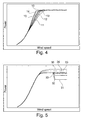
- Figure 4 illustrates a power curve for a wind turbine plotting wind speed on the x axis against power on the y axis.
- Curve 10 is a power curve for a standard pitch mode of a wind turbine.
- the power output in the part load region and the power output in the rated power (or full load) region is regulated by pitching the blades about their longitudinal axis, as is typically done in a pitch controlled or an active-stall wind turbine.
- the pitch modes will be used in part load operation to optimize the utilization of the design loads and thereby the power output from the turbine.
- the parameter to be altered in this example, is the pitch angle reference which sets the angle of the blades relative to the hub.
- FIG 4 illustrates five separate pitch modes 11 to 15 in addition to the standard pitch mode 10.
- Pitch modes 11, 12 and 13 are configured such that wind turbine blades are pitched so that turbine generates less power (in the part load region) compared to the standard pitch mode 10.
- Pitch modes 14 and 15 are configured such that the wind turbine blades are pitched so that the turbine generates more power (in the part load region) compared to the standard pitch mode 10.
- the power modes will be used in full load operation, again to optimize the utilization of the design loads and thereby the power output from the turbine.
- the parameters to be altered are the so called power reference and the rpm reference.
- Figure 5 illustrates a standard power mode 30.
- the standard power mode 30 corresponds to the rated (or nominal) power of the wind turbine, i.e. the power generated at the rated wind speed.
- Power modes 31, 32 and 33 are configured so that the wind turbine generates less than the rated power defined by the standard power mode 30, i.e. the turbine is de-rated.
- Power modes 34 and 35 are configured so that the wind turbine generates more than the rated power defined by the standard power mode 30, i.e. the turbine is over-rated.
- Figures 4 and 5 have been described with reference to “pitch modes” and “power modes”. However, they could also have been described with reference to “load operation modes” and “power operation modes”.
- a load operation mode is when the turbine operates according to a power curve below the standard power curve 10, 30, i.e. in the area 7 in Figure 3 .
- the power curves 11, 12, 13, 31, 32, 33 are load operation modes.
- a power operation mode is when the turbine operates according to a power curve above the standard power curve 10, 30, i.e. in the area 7 in Figure 3 .
- the power curves 14, 15, 34, 35 are power operation modes.
- the power generated by the turbine and the loads acting on the turbine are increased in comparison to when the turbine is operating at the standard power curve 10, 30.
- pitch mode and power mode are used in describing this example, the skilled person will recognise that the terms load operation mode and power operation mode could equally be used.
- each turbine model is designed for given loads and it is necessary to only place turbines in a site when they can cope with the loads that arise from that site - in other words, the loads acting on the wind turbine must be within the design loads.
- the wind rose is studied from which the maximum expected loads that the wind turbine will be subjected to are calculated from knowledge of the wind speed and the turbulence intensity.
- the particular turbine model is chosen which can withstand with the maximum loads determined from the wind rose.
- the turbine may be shut down regularly in certain sectors when the wind speed is above the cut out wind speed.
- a particular model of turbine is designed to be subjected to certain maximum loads - the "design loads".
- the site loads (the loads acting on the wind turbine at the actual site) are slightly below the design loads in the sectors 0 to 120 degrees and 180 to 300 degrees. In the sector 120 to 180 degrees, the site loads are well above design loads and in sector 300 to 360 degrees, the site loads are well below design loads.
- a sector control strategy For each sector around the wind turbine, a sector control strategy is defined.
- the sector control strategy relates to one of the pitch modes and one of the power modes.
- the sector control strategy for each sector is predetermined before the wind turbine is put into operation. To choose the correct sector control strategy for each sector, a comparison is carried out between the expected wind load in that particular sector and the design loads of the turbine.
- the design load of the turbine can also be referred to as the nominal load.
- the pitch and power modes can be used either (i) to run the wind turbine more aggressively to increase the power production, and consequently the loads acting on the turbine when the turbine is facing a sector with average site loads that are milder than the design loads of the turbine; or (ii) to run the turbine less aggressively when the turbine is facing a sector with average site loads which are more severe than the design loads for the turbine.
- a wind turbine implementing the pitch and power modes of the invention can be erected at a location where it would not be possible to site the same wind turbine which does not have the pitch and power modes. This is because in the sectors with a high expected wind load, the wind turbine underproduces power so that the loads acting on the wind turbine are reduced. Furthermore, the wind turbine can over-produce when facing sectors with a low expected wind load.
- pitch and power modes is advantageous not just because a turbine can be erected in locations for which it is not normally designed, but also because it can generate power for more of the time, i.e. it is not necessary to shut down the turbine.
- Figure 6 illustrates a schematic view of a wind turbine controller.
- a rotor is controlled by a controller 41.
- the controller 41 receives inputs from a direction monitoring means 42 and a wind speed measurement means 43.
- the direction monitoring means 42 determines in which sector the wind turbine is facing, and this can be measured by knowledge of the wind direction (as the rotor will always face into the oncoming wind) or by measuring the rotation of the nacelle (on which the hub is mounted) relative to the wind turbine tower (which supports the nacelle).
- the wind speed measurement means 43 is, in this example, an anemometer.
- the controller 41 has within it a data storage means for storing data about the pitch and power modes. This can be in the form of a look up table.
- a look up table is provided for each of the six pitch modes and will contain data specifying at what angles the blades should be pitched for a range of wind speeds up to the rated wind speed.
- a look up table is also provided for each of the six power modes and contains data for how the power output of the wind turbine is regulated above the rated wind speed.
- the controller is pre-programmed such that it knows what pitch and power mode is to be used for each sector.
- pitch and power modes are shown, but only pitch modes 12 and 15 and power modes 31 and 34 are used as described above. Accordingly, one pitch mode and one power mode is designated for each sector.
- the controller 41 receives information about what sector the wind rotor is facing and what the wind speed is. If the wind speed is below the rated wind speed, the controller 41 will set the rotor to operate at the particular pitch mode designated for that sector, and further, the controller 41 will consult the look up table for that pitch mode sector to determine what the pitch angle for the blades should be as a function of the wind speed. If the wind speed is above the rated wind speed, the controller 41 will set the wind turbine to operate at the particular power mode designated for that sector.
- the controller 41 may also monitor the current wind speed from an anemometer and implement the pitch mode or the power mode in dependence on the measured wind speed.
- the power modes 31, 32, 33 are only implemented above a predefined wind speed.
- the controller 41 can be programmed to a particular cut in wind speed and a particular cut out wind speed for each sector. This means that if a given site has very high turbulence in low wind speeds in one or more sectors the cut in wind speed could be specified to be 6 m/s rather than 3 m/s to avoid the turbine operating in highly turbulent wind. Similarly, if a given site has very low turbulence in high wind speeds in certain sectors, the cut out wind speed could be specified to be e.g. 27 m/s instead of 25 m/s to utilize high wind production without over loading the turbine.
- controller 41 can be programmed such that control strategies are defined for a particular time of day, or a particular time of year. For example, at night time or in the winter, the expected wind loads are higher than in the day time or the summer respectively, due to atmospheric conditions such as air density. Therefore, for a given sector, a different control strategy may be defined for different time periods.
Landscapes
- Engineering & Computer Science (AREA)
- Life Sciences & Earth Sciences (AREA)
- Sustainable Development (AREA)
- Sustainable Energy (AREA)
- Chemical & Material Sciences (AREA)
- Combustion & Propulsion (AREA)
- Mechanical Engineering (AREA)
- General Engineering & Computer Science (AREA)
- Physics & Mathematics (AREA)
- Fluid Mechanics (AREA)
- Wind Motors (AREA)
Applications Claiming Priority (2)
| Application Number | Priority Date | Filing Date | Title |
|---|---|---|---|
| US17624609P | 2009-05-07 | 2009-05-07 | |
| DKPA200900593 | 2009-05-07 |
Publications (3)
| Publication Number | Publication Date |
|---|---|
| EP2249029A2 true EP2249029A2 (de) | 2010-11-10 |
| EP2249029A3 EP2249029A3 (de) | 2014-04-16 |
| EP2249029B1 EP2249029B1 (de) | 2015-10-14 |
Family
ID=42224503
Family Applications (1)
| Application Number | Title | Priority Date | Filing Date |
|---|---|---|---|
| EP10162100.1A Active EP2249029B1 (de) | 2009-05-07 | 2010-05-06 | Windkraftanlage |
Country Status (4)
| Country | Link |
|---|---|
| US (1) | US8441138B2 (de) |
| EP (1) | EP2249029B1 (de) |
| CN (1) | CN101881254B (de) |
| ES (1) | ES2552692T3 (de) |
Cited By (16)
| Publication number | Priority date | Publication date | Assignee | Title |
|---|---|---|---|---|
| WO2012041326A3 (en) * | 2010-09-30 | 2012-06-14 | Vestas Wind Systems A/S | Over -rated output control in wind turbines and wind power plants |
| WO2012041327A3 (en) * | 2010-09-30 | 2012-06-14 | Vestas Wind Systems A/S | Over-rating control of wind turbines and power plants |
| CN103047081A (zh) * | 2011-10-11 | 2013-04-17 | 通用电气公司 | 控制风力涡轮机的方法和系统 |
| EP2597302A1 (de) * | 2011-11-23 | 2013-05-29 | Siemens Aktiengesellschaft | Bestimmung einer gesamten Belastung einer Windturbine in Winkelabschnitten |
| WO2014048583A1 (en) * | 2012-09-28 | 2014-04-03 | Siemens Aktiengesellschaft | Method and arrangement for controlling a wind turbine |
| ES2537476A1 (es) * | 2013-12-04 | 2015-06-08 | Acciona Windpower, S.A. | Sistema y método de control de aerogenerador |
| EP3199806A1 (de) * | 2016-01-29 | 2017-08-02 | Mitsubishi Heavy Industries, Ltd. | Windturbinenstromerzeugungsvorrichtung und verfahren zum betrieb davon |
| EP2679811B1 (de) * | 2011-02-23 | 2017-10-04 | Mitsubishi Heavy Industries, Ltd. | Steuervorrichtung für eine windenergieanlage, windenergieanlage und verfahren zur steuerung der windenergieanlage |
| EP3047143B1 (de) | 2013-09-17 | 2018-02-21 | Vestas Wind Systems A/S | Steuerungsverfahren für eine windturbine |
| EP2754890A3 (de) * | 2013-01-14 | 2018-03-21 | General Electric Company | Verfahren und Vorrichtung zur Steuerung eines Betriebsparameters einer Windturbine |
| EP3212927A4 (de) * | 2014-10-31 | 2018-06-27 | General Electric Company | System und verfahren zum steuerung des betriebs einer windturbine |
| EP3540214A4 (de) * | 2018-01-31 | 2020-01-22 | Beijing Goldwind Science & Creation Windpower Equipment Co., Ltd. | Verfahren und systeme zur steuerung einer windturbine auf der basis von sektoren |
| EP3702613A1 (de) * | 2019-02-28 | 2020-09-02 | General Electric Company | System und verfahren zur vorhersage von windturbinenabschaltungen aufgrund übermässiger vibration |
| CN112673168A (zh) * | 2018-09-17 | 2021-04-16 | 西门子歌美飒可再生能源公司 | 对超速事件的反应 |
| CN113309663A (zh) * | 2021-03-08 | 2021-08-27 | 新疆金风科技股份有限公司 | 用于风力发电机组的控制方法及控制装置 |
| WO2022171997A1 (en) * | 2021-02-11 | 2022-08-18 | Wind Farm Analytics Ltd | A turbine provided with data for parameter improvement |
Families Citing this family (36)
| Publication number | Priority date | Publication date | Assignee | Title |
|---|---|---|---|---|
| JP3918837B2 (ja) * | 2004-08-06 | 2007-05-23 | 株式会社日立製作所 | 風力発電装置 |
| JP6043501B2 (ja) * | 2011-04-13 | 2016-12-14 | Thk株式会社 | 風車方位制御装置、風力発電装置及び風車方位制御方法 |
| WO2012140757A1 (ja) * | 2011-04-14 | 2012-10-18 | 三菱重工業株式会社 | 風力発電設備の出力平準化方法及び風力発電設備の出力平準化装置 |
| CN103597206B (zh) * | 2011-05-06 | 2016-09-07 | 维斯塔斯风力系统集团公司 | 用于保护风力涡轮机不受极端状况影响的方法和装置 |
| US8622698B2 (en) * | 2011-12-22 | 2014-01-07 | Vestas Wind Systems A/S | Rotor-sector based control of wind turbines |
| US9331534B2 (en) | 2012-03-26 | 2016-05-03 | American Wind, Inc. | Modular micro wind turbine |
| US9062654B2 (en) | 2012-03-26 | 2015-06-23 | American Wind Technologies, Inc. | Modular micro wind turbine |
| US20150120193A1 (en) * | 2012-07-31 | 2015-04-30 | Jgc Corporation | Weather predicting method, water predicting apparatus, and air utilizing apparatus |
| EP2885534B1 (de) * | 2012-08-14 | 2017-03-22 | Vestas Wind Systems A/S | Teillastdrosselung für windturbinensteuerung |
| KR101425016B1 (ko) * | 2012-09-18 | 2014-08-01 | 한국전력공사 | 풍력터빈의 파워커브 모니터링을 위한 파워커브 리미트 자동 산출 방법 |
| JP6117011B2 (ja) * | 2013-06-18 | 2017-04-19 | 株式会社日立製作所 | 風力発電機の出力制御装置及び出力制御方法、並びに風力発電システム |
| US9551321B2 (en) | 2013-06-26 | 2017-01-24 | General Electric Company | System and method for controlling a wind turbine |
| US9624905B2 (en) | 2013-09-20 | 2017-04-18 | General Electric Company | System and method for preventing excessive loading on a wind turbine |
| US9835135B2 (en) | 2013-10-31 | 2017-12-05 | General Electric Company | System and method for controlling a wind turbine |
| WO2015074664A1 (en) * | 2013-11-21 | 2015-05-28 | Vestas Wind Systems A/S | Rotor blade control for high winds |
| US9920742B2 (en) * | 2014-02-20 | 2018-03-20 | General Electric Company | Dynamic cut-in wind speed for wind turbines |
| US9631606B2 (en) | 2014-04-14 | 2017-04-25 | General Electric Company | System and method for thrust-speed control of a wind turbine |
| WO2016023554A1 (en) * | 2014-08-15 | 2016-02-18 | Vestas Wind Systems A/S | Turbine over-rating using turbulence prediction |
| US9909563B2 (en) * | 2014-11-21 | 2018-03-06 | General Electric Company | System and method for monitoring and controlling wind turbine blade deflection |
| CN107110119B (zh) * | 2014-11-24 | 2020-08-04 | 维斯塔斯风力系统集团公司 | 风力涡轮发电机的过额定值运转控制 |
| ES2837129T3 (es) | 2015-03-27 | 2021-06-29 | Siemens Gamesa Renewable Energy As | Control para una turbina eólica |
| CN107820540B (zh) * | 2015-06-30 | 2020-03-17 | 维斯塔斯风力系统集团公司 | 基于预测的风力涡轮机控制 |
| CN106812658B (zh) * | 2015-11-27 | 2019-09-06 | 中国船舶重工集团海装风电股份有限公司 | 一种风力发电机组的控制方法及装置 |
| US10598151B2 (en) | 2016-05-26 | 2020-03-24 | General Electric Company | System and method for micrositing a wind farm for loads optimization |
| US10740507B2 (en) | 2016-12-20 | 2020-08-11 | General Electric Company | Wind turbine tower placement and orientation |
| US10634121B2 (en) | 2017-06-15 | 2020-04-28 | General Electric Company | Variable rated speed control in partial load operation of a wind turbine |
| DE102018100727A1 (de) * | 2018-01-15 | 2019-07-18 | Wobben Properties Gmbh | Verfahren zum Steuern einer Windenergieanlage und Windenergieanlage |
| US20200102931A1 (en) * | 2018-10-02 | 2020-04-02 | Edward John Koch | Wind Turbine |
| ES2969725T3 (es) | 2019-11-26 | 2024-05-22 | Vestas Wind Sys As | Método para evitar vibraciones en el sentido del borde durante períodos no operativos de una turbina eólica |
| CN113027675B (zh) * | 2019-12-24 | 2022-11-25 | 北京金风科创风电设备有限公司 | 风电场及风力发电机组的控制方法和控制装置 |
| US11199175B1 (en) | 2020-11-09 | 2021-12-14 | General Electric Company | Method and system for determining and tracking the top pivot point of a wind turbine tower |
| US11703033B2 (en) | 2021-04-13 | 2023-07-18 | General Electric Company | Method and system for determining yaw heading of a wind turbine |
| US11536250B1 (en) | 2021-08-16 | 2022-12-27 | General Electric Company | System and method for controlling a wind turbine |
| US12066010B2 (en) | 2022-04-04 | 2024-08-20 | Ge Infrastructure Technology Llc | Method and system for determining and tracking wind turbine tower deflection |
| CN115199471B (zh) * | 2022-06-24 | 2024-05-31 | 兰州理工大学 | 一种基于偏航变桨联动控制降载的功率控制方法和系统 |
| CN115306656A (zh) * | 2022-08-26 | 2022-11-08 | 华能新能源股份有限公司河北分公司 | 用于双馈风力发电机组的涡激振动抑制监测系统及方法 |
Family Cites Families (15)
| Publication number | Priority date | Publication date | Assignee | Title |
|---|---|---|---|---|
| JP4183406B2 (ja) * | 2001-09-06 | 2008-11-19 | 三菱重工業株式会社 | 風力発電制御装置およびその制御方法 |
| EP1744058A1 (de) * | 2004-05-07 | 2007-01-17 | Mitsubishi Denki Kabushiki Kaisha | Windkraftwerkbeurteilungssystem und vorhersagesteuerdienstsystem für windkraftwerk |
| CN1997823B (zh) * | 2004-07-23 | 2011-06-15 | 维斯塔斯风力系统有限公司 | 控制风轮机叶片的倾斜速度的方法及其控制系统 |
| US7309930B2 (en) * | 2004-09-30 | 2007-12-18 | General Electric Company | Vibration damping system and method for variable speed wind turbines |
| US20060082160A1 (en) * | 2004-10-14 | 2006-04-20 | Lee Tommy L | Wind powered generator platform |
| DE102004056254B4 (de) * | 2004-11-22 | 2006-11-09 | Repower Systems Ag | Verfahren zum Optimieren des Betriebs von Windenergieanlagen |
| US8649911B2 (en) * | 2005-06-03 | 2014-02-11 | General Electric Company | System and method for operating a wind farm under high wind speed conditions |
| US7476985B2 (en) * | 2005-07-22 | 2009-01-13 | Gamesa Innovation & Technology, S.L. | Method of operating a wind turbine |
| CN101022260A (zh) * | 2006-02-15 | 2007-08-22 | 中国科学院自动化研究所 | 多风轮风电机组装置及其控制方法 |
| ES2261100B1 (es) * | 2006-03-29 | 2007-08-01 | Gamesa Corporacion Tecnologica, S.A. | Aerogenerador anti-ruido. |
| EP1978246A1 (de) * | 2007-04-04 | 2008-10-08 | Siemens Aktiengesellschaft | Verfahren zum Verringern eines Unwuchts in einem Windturbinenrotor und Vorrichtung zur Ausführung des Verfahrens |
| SE531944C2 (sv) * | 2007-12-20 | 2009-09-15 | Liljeholm Konsult Ab | Anordning för att reglera anfallsvinkeln i vindturbiner samt metod för att kontrollera denna |
| DE102008009585B4 (de) | 2008-02-16 | 2017-06-22 | Nordex Energy Gmbh | Verfahren zum Betrieb einer Windenergieanlage |
| US20100283246A1 (en) * | 2009-05-07 | 2010-11-11 | Vestas Wind Systems A/S | Wind turbine |
| US8360723B2 (en) * | 2009-09-30 | 2013-01-29 | General Electric Company | Method for reducing vibrations in wind turbines and wind turbine implementing said method |
-
2010
- 2010-04-30 US US12/771,702 patent/US8441138B2/en active Active
- 2010-05-06 EP EP10162100.1A patent/EP2249029B1/de active Active
- 2010-05-06 ES ES10162100.1T patent/ES2552692T3/es active Active
- 2010-05-07 CN CN201010209809.7A patent/CN101881254B/zh active Active
Cited By (28)
| Publication number | Priority date | Publication date | Assignee | Title |
|---|---|---|---|---|
| US9018782B2 (en) | 2010-09-30 | 2015-04-28 | Vestas Wind Systems A/S | Over-rating control in wind turbines and wind power plants |
| WO2012041327A3 (en) * | 2010-09-30 | 2012-06-14 | Vestas Wind Systems A/S | Over-rating control of wind turbines and power plants |
| WO2012041326A3 (en) * | 2010-09-30 | 2012-06-14 | Vestas Wind Systems A/S | Over -rated output control in wind turbines and wind power plants |
| US9599096B2 (en) | 2010-09-30 | 2017-03-21 | Vestas Wind Systems A/S | Over-rating control of wind turbines and power plants |
| EP2679811B1 (de) * | 2011-02-23 | 2017-10-04 | Mitsubishi Heavy Industries, Ltd. | Steuervorrichtung für eine windenergieanlage, windenergieanlage und verfahren zur steuerung der windenergieanlage |
| EP2581600A3 (de) * | 2011-10-11 | 2015-02-25 | General Electric Company | Verfahren und System zur Steuerung von Windturbinen |
| CN103047081A (zh) * | 2011-10-11 | 2013-04-17 | 通用电气公司 | 控制风力涡轮机的方法和系统 |
| US8511182B2 (en) | 2011-11-23 | 2013-08-20 | Siemens Aktiengesellschaft | Determining an accumulated load of a wind turbine in angular sectors |
| EP2597302A1 (de) * | 2011-11-23 | 2013-05-29 | Siemens Aktiengesellschaft | Bestimmung einer gesamten Belastung einer Windturbine in Winkelabschnitten |
| WO2014048583A1 (en) * | 2012-09-28 | 2014-04-03 | Siemens Aktiengesellschaft | Method and arrangement for controlling a wind turbine |
| US9611834B2 (en) | 2012-09-28 | 2017-04-04 | Siemens Aktiengesellschaft | Method and arrangement for controlling a wind turbine |
| EP2754890A3 (de) * | 2013-01-14 | 2018-03-21 | General Electric Company | Verfahren und Vorrichtung zur Steuerung eines Betriebsparameters einer Windturbine |
| EP3047143B1 (de) | 2013-09-17 | 2018-02-21 | Vestas Wind Systems A/S | Steuerungsverfahren für eine windturbine |
| US9903340B2 (en) | 2013-12-04 | 2018-02-27 | Acciona Windpower, S.A. | System and method of controlling a wind turbine |
| ES2537476A1 (es) * | 2013-12-04 | 2015-06-08 | Acciona Windpower, S.A. | Sistema y método de control de aerogenerador |
| EP3212927A4 (de) * | 2014-10-31 | 2018-06-27 | General Electric Company | System und verfahren zum steuerung des betriebs einer windturbine |
| US11073133B2 (en) | 2014-10-31 | 2021-07-27 | General Electric Company | System and method for controlling the operation of a wind turbine |
| US10677220B2 (en) | 2016-01-29 | 2020-06-09 | Mitsubishi Heavy Industries, Ltd. | Wind turbine power generating apparatus and method of operating the same |
| EP3199806A1 (de) * | 2016-01-29 | 2017-08-02 | Mitsubishi Heavy Industries, Ltd. | Windturbinenstromerzeugungsvorrichtung und verfahren zum betrieb davon |
| US11434872B2 (en) | 2018-01-31 | 2022-09-06 | Beijing Goldwind Science & Creation Windpower Equipment Co., Ltd. | Method and system for controlling wind turbine based on sectors |
| EP3540214A4 (de) * | 2018-01-31 | 2020-01-22 | Beijing Goldwind Science & Creation Windpower Equipment Co., Ltd. | Verfahren und systeme zur steuerung einer windturbine auf der basis von sektoren |
| AU2018334593B2 (en) * | 2018-01-31 | 2020-04-30 | Beijing Goldwind Science & Creation Windpower Equipment Co., Ltd. | Method and system for controlling wind turbine based on sectors |
| CN112673168A (zh) * | 2018-09-17 | 2021-04-16 | 西门子歌美飒可再生能源公司 | 对超速事件的反应 |
| EP3702613A1 (de) * | 2019-02-28 | 2020-09-02 | General Electric Company | System und verfahren zur vorhersage von windturbinenabschaltungen aufgrund übermässiger vibration |
| US11261844B2 (en) | 2019-02-28 | 2022-03-01 | General Electric Company | System and method for predicting wind turbine shutdowns due to excessive vibration |
| WO2022171997A1 (en) * | 2021-02-11 | 2022-08-18 | Wind Farm Analytics Ltd | A turbine provided with data for parameter improvement |
| CN113309663A (zh) * | 2021-03-08 | 2021-08-27 | 新疆金风科技股份有限公司 | 用于风力发电机组的控制方法及控制装置 |
| US12129829B2 (en) | 2021-03-08 | 2024-10-29 | Goldwind Science & Technology Co., Ltd. | Control method and control device for wind turbine |
Also Published As
| Publication number | Publication date |
|---|---|
| CN101881254A (zh) | 2010-11-10 |
| CN101881254B (zh) | 2014-08-27 |
| EP2249029A3 (de) | 2014-04-16 |
| US8441138B2 (en) | 2013-05-14 |
| EP2249029B1 (de) | 2015-10-14 |
| US20100283245A1 (en) | 2010-11-11 |
| ES2552692T3 (es) | 2015-12-01 |
Similar Documents
| Publication | Publication Date | Title |
|---|---|---|
| US8441138B2 (en) | Wind turbine | |
| US9957951B2 (en) | Wind turbine | |
| EP2306003B1 (de) | Vorrichtung und Verfahren für die Regelung einer Windenergieanlage | |
| EP2273105B1 (de) | Verfahren und Vorrichtung zur geräuschoptimierten Steuerung einer Windkraftanlage | |
| EP2556249B1 (de) | Windturbine | |
| US9372201B2 (en) | Yaw and pitch angles | |
| EP2556248B1 (de) | Windturbine | |
| EP2719893B1 (de) | Verfahren zum Betrieb einer drehzahlvariablen Windturbine | |
| WO2011157271A2 (en) | A method and control unit for controlling a wind turbine in dependence on loading experienced by the wind turbine | |
| EP2484901A2 (de) | Windturbine und zugehöriges Steuerungsverfahren | |
| WO2016082838A1 (en) | Determination of wind turbine configuration | |
| CA2840441A1 (en) | Method and apparatus for wind turbine noise reduction | |
| CN111648916B (zh) | 对于风力涡轮的推力极限 | |
| US12098705B2 (en) | Method for operating a wind power installation, controller for operating a wind power installation, and wind farm | |
| US11835033B2 (en) | Method for operating a wind power installation, wind power installation and wind farm | |
| WO2017174612A1 (en) | Wind power installation and method for operating a wind power installation | |
| Sudhakar et al. | A review on design of low wind speed wind turbines” | |
| EP4459124B1 (de) | Windturbine, verfahren zur optimierung des betriebs einer windturbine, steuergerät zur steuerung des betriebs einer windturbine und computerprogramm | |
| JP2020002781A (ja) | 風力発電装置の制御方法 | |
| Ichikawa et al. | Electric load-brake control for a small wind-turbine operating in mountainous winds |
Legal Events
| Date | Code | Title | Description |
|---|---|---|---|
| PUAI | Public reference made under article 153(3) epc to a published international application that has entered the european phase |
Free format text: ORIGINAL CODE: 0009012 |
|
| AK | Designated contracting states |
Kind code of ref document: A2 Designated state(s): AL AT BE BG CH CY CZ DE DK EE ES FI FR GB GR HR HU IE IS IT LI LT LU LV MC MK MT NL NO PL PT RO SE SI SK SM TR |
|
| AX | Request for extension of the european patent |
Extension state: BA ME RS |
|
| RAP1 | Party data changed (applicant data changed or rights of an application transferred) |
Owner name: VESTAS WIND SYSTEMS A/S |
|
| PUAL | Search report despatched |
Free format text: ORIGINAL CODE: 0009013 |
|
| AK | Designated contracting states |
Kind code of ref document: A3 Designated state(s): AL AT BE BG CH CY CZ DE DK EE ES FI FR GB GR HR HU IE IS IT LI LT LU LV MC MK MT NL NO PL PT RO SE SI SK SM TR |
|
| AX | Request for extension of the european patent |
Extension state: BA ME RS |
|
| RIC1 | Information provided on ipc code assigned before grant |
Ipc: F03D 7/04 20060101ALI20140313BHEP Ipc: F03D 7/02 20060101AFI20140313BHEP |
|
| 17P | Request for examination filed |
Effective date: 20141002 |
|
| RBV | Designated contracting states (corrected) |
Designated state(s): AL AT BE BG CH CY CZ DE DK EE ES FI FR GB GR HR HU IE IS IT LI LT LU LV MC MK MT NL NO PL PT RO SE SI SK SM TR |
|
| GRAP | Despatch of communication of intention to grant a patent |
Free format text: ORIGINAL CODE: EPIDOSNIGR1 |
|
| RIC1 | Information provided on ipc code assigned before grant |
Ipc: F03D 7/02 20060101AFI20150128BHEP Ipc: F03D 7/04 20060101ALI20150128BHEP |
|
| INTG | Intention to grant announced |
Effective date: 20150212 |
|
| GRAP | Despatch of communication of intention to grant a patent |
Free format text: ORIGINAL CODE: EPIDOSNIGR1 |
|
| RAP1 | Party data changed (applicant data changed or rights of an application transferred) |
Owner name: VESTAS WIND SYSTEMS A/S |
|
| INTG | Intention to grant announced |
Effective date: 20150527 |
|
| GRAS | Grant fee paid |
Free format text: ORIGINAL CODE: EPIDOSNIGR3 |
|
| GRAA | (expected) grant |
Free format text: ORIGINAL CODE: 0009210 |
|
| AK | Designated contracting states |
Kind code of ref document: B1 Designated state(s): AL AT BE BG CH CY CZ DE DK EE ES FI FR GB GR HR HU IE IS IT LI LT LU LV MC MK MT NL NO PL PT RO SE SI SK SM TR |
|
| REG | Reference to a national code |
Ref country code: GB Ref legal event code: FG4D |
|
| REG | Reference to a national code |
Ref country code: AT Ref legal event code: REF Ref document number: 755333 Country of ref document: AT Kind code of ref document: T Effective date: 20151015 Ref country code: CH Ref legal event code: EP |
|
| REG | Reference to a national code |
Ref country code: IE Ref legal event code: FG4D |
|
| REG | Reference to a national code |
Ref country code: DE Ref legal event code: R096 Ref document number: 602010028178 Country of ref document: DE |
|
| REG | Reference to a national code |
Ref country code: ES Ref legal event code: FG2A Ref document number: 2552692 Country of ref document: ES Kind code of ref document: T3 Effective date: 20151201 |
|
| REG | Reference to a national code |
Ref country code: NL Ref legal event code: MP Effective date: 20151014 |
|
| REG | Reference to a national code |
Ref country code: LT Ref legal event code: MG4D |
|
| REG | Reference to a national code |
Ref country code: AT Ref legal event code: MK05 Ref document number: 755333 Country of ref document: AT Kind code of ref document: T Effective date: 20151014 |
|
| PG25 | Lapsed in a contracting state [announced via postgrant information from national office to epo] |
Ref country code: IS Free format text: LAPSE BECAUSE OF FAILURE TO SUBMIT A TRANSLATION OF THE DESCRIPTION OR TO PAY THE FEE WITHIN THE PRESCRIBED TIME-LIMIT Effective date: 20160214 Ref country code: NO Free format text: LAPSE BECAUSE OF FAILURE TO SUBMIT A TRANSLATION OF THE DESCRIPTION OR TO PAY THE FEE WITHIN THE PRESCRIBED TIME-LIMIT Effective date: 20160114 Ref country code: NL Free format text: LAPSE BECAUSE OF FAILURE TO SUBMIT A TRANSLATION OF THE DESCRIPTION OR TO PAY THE FEE WITHIN THE PRESCRIBED TIME-LIMIT Effective date: 20151014 Ref country code: IT Free format text: LAPSE BECAUSE OF FAILURE TO SUBMIT A TRANSLATION OF THE DESCRIPTION OR TO PAY THE FEE WITHIN THE PRESCRIBED TIME-LIMIT Effective date: 20151014 Ref country code: LT Free format text: LAPSE BECAUSE OF FAILURE TO SUBMIT A TRANSLATION OF THE DESCRIPTION OR TO PAY THE FEE WITHIN THE PRESCRIBED TIME-LIMIT Effective date: 20151014 Ref country code: HR Free format text: LAPSE BECAUSE OF FAILURE TO SUBMIT A TRANSLATION OF THE DESCRIPTION OR TO PAY THE FEE WITHIN THE PRESCRIBED TIME-LIMIT Effective date: 20151014 |
|
| REG | Reference to a national code |
Ref country code: FR Ref legal event code: PLFP Year of fee payment: 7 |
|
| PG25 | Lapsed in a contracting state [announced via postgrant information from national office to epo] |
Ref country code: GR Free format text: LAPSE BECAUSE OF FAILURE TO SUBMIT A TRANSLATION OF THE DESCRIPTION OR TO PAY THE FEE WITHIN THE PRESCRIBED TIME-LIMIT Effective date: 20160115 Ref country code: SE Free format text: LAPSE BECAUSE OF FAILURE TO SUBMIT A TRANSLATION OF THE DESCRIPTION OR TO PAY THE FEE WITHIN THE PRESCRIBED TIME-LIMIT Effective date: 20151014 Ref country code: AT Free format text: LAPSE BECAUSE OF FAILURE TO SUBMIT A TRANSLATION OF THE DESCRIPTION OR TO PAY THE FEE WITHIN THE PRESCRIBED TIME-LIMIT Effective date: 20151014 Ref country code: PL Free format text: LAPSE BECAUSE OF FAILURE TO SUBMIT A TRANSLATION OF THE DESCRIPTION OR TO PAY THE FEE WITHIN THE PRESCRIBED TIME-LIMIT Effective date: 20151014 Ref country code: LV Free format text: LAPSE BECAUSE OF FAILURE TO SUBMIT A TRANSLATION OF THE DESCRIPTION OR TO PAY THE FEE WITHIN THE PRESCRIBED TIME-LIMIT Effective date: 20151014 Ref country code: PT Free format text: LAPSE BECAUSE OF FAILURE TO SUBMIT A TRANSLATION OF THE DESCRIPTION OR TO PAY THE FEE WITHIN THE PRESCRIBED TIME-LIMIT Effective date: 20160215 Ref country code: FI Free format text: LAPSE BECAUSE OF FAILURE TO SUBMIT A TRANSLATION OF THE DESCRIPTION OR TO PAY THE FEE WITHIN THE PRESCRIBED TIME-LIMIT Effective date: 20151014 |
|
| REG | Reference to a national code |
Ref country code: DE Ref legal event code: R097 Ref document number: 602010028178 Country of ref document: DE |
|
| PG25 | Lapsed in a contracting state [announced via postgrant information from national office to epo] |
Ref country code: CZ Free format text: LAPSE BECAUSE OF FAILURE TO SUBMIT A TRANSLATION OF THE DESCRIPTION OR TO PAY THE FEE WITHIN THE PRESCRIBED TIME-LIMIT Effective date: 20151014 |
|
| PLBE | No opposition filed within time limit |
Free format text: ORIGINAL CODE: 0009261 |
|
| STAA | Information on the status of an ep patent application or granted ep patent |
Free format text: STATUS: NO OPPOSITION FILED WITHIN TIME LIMIT |
|
| PG25 | Lapsed in a contracting state [announced via postgrant information from national office to epo] |
Ref country code: BE Free format text: LAPSE BECAUSE OF NON-PAYMENT OF DUE FEES Effective date: 20160531 Ref country code: SK Free format text: LAPSE BECAUSE OF FAILURE TO SUBMIT A TRANSLATION OF THE DESCRIPTION OR TO PAY THE FEE WITHIN THE PRESCRIBED TIME-LIMIT Effective date: 20151014 Ref country code: RO Free format text: LAPSE BECAUSE OF FAILURE TO SUBMIT A TRANSLATION OF THE DESCRIPTION OR TO PAY THE FEE WITHIN THE PRESCRIBED TIME-LIMIT Effective date: 20151014 Ref country code: DK Free format text: LAPSE BECAUSE OF FAILURE TO SUBMIT A TRANSLATION OF THE DESCRIPTION OR TO PAY THE FEE WITHIN THE PRESCRIBED TIME-LIMIT Effective date: 20151014 Ref country code: EE Free format text: LAPSE BECAUSE OF FAILURE TO SUBMIT A TRANSLATION OF THE DESCRIPTION OR TO PAY THE FEE WITHIN THE PRESCRIBED TIME-LIMIT Effective date: 20151014 Ref country code: SM Free format text: LAPSE BECAUSE OF FAILURE TO SUBMIT A TRANSLATION OF THE DESCRIPTION OR TO PAY THE FEE WITHIN THE PRESCRIBED TIME-LIMIT Effective date: 20151014 |
|
| 26N | No opposition filed |
Effective date: 20160715 |
|
| PG25 | Lapsed in a contracting state [announced via postgrant information from national office to epo] |
Ref country code: SI Free format text: LAPSE BECAUSE OF FAILURE TO SUBMIT A TRANSLATION OF THE DESCRIPTION OR TO PAY THE FEE WITHIN THE PRESCRIBED TIME-LIMIT Effective date: 20151014 |
|
| PG25 | Lapsed in a contracting state [announced via postgrant information from national office to epo] |
Ref country code: LU Free format text: LAPSE BECAUSE OF FAILURE TO SUBMIT A TRANSLATION OF THE DESCRIPTION OR TO PAY THE FEE WITHIN THE PRESCRIBED TIME-LIMIT Effective date: 20160506 Ref country code: BE Free format text: LAPSE BECAUSE OF FAILURE TO SUBMIT A TRANSLATION OF THE DESCRIPTION OR TO PAY THE FEE WITHIN THE PRESCRIBED TIME-LIMIT Effective date: 20151014 |
|
| REG | Reference to a national code |
Ref country code: CH Ref legal event code: PL |
|
| PG25 | Lapsed in a contracting state [announced via postgrant information from national office to epo] |
Ref country code: LI Free format text: LAPSE BECAUSE OF NON-PAYMENT OF DUE FEES Effective date: 20160531 Ref country code: CH Free format text: LAPSE BECAUSE OF NON-PAYMENT OF DUE FEES Effective date: 20160531 |
|
| REG | Reference to a national code |
Ref country code: IE Ref legal event code: MM4A |
|
| REG | Reference to a national code |
Ref country code: FR Ref legal event code: PLFP Year of fee payment: 8 |
|
| PG25 | Lapsed in a contracting state [announced via postgrant information from national office to epo] |
Ref country code: IE Free format text: LAPSE BECAUSE OF NON-PAYMENT OF DUE FEES Effective date: 20160506 |
|
| REG | Reference to a national code |
Ref country code: FR Ref legal event code: PLFP Year of fee payment: 9 |
|
| PG25 | Lapsed in a contracting state [announced via postgrant information from national office to epo] |
Ref country code: HU Free format text: LAPSE BECAUSE OF FAILURE TO SUBMIT A TRANSLATION OF THE DESCRIPTION OR TO PAY THE FEE WITHIN THE PRESCRIBED TIME-LIMIT; INVALID AB INITIO Effective date: 20100506 Ref country code: CY Free format text: LAPSE BECAUSE OF FAILURE TO SUBMIT A TRANSLATION OF THE DESCRIPTION OR TO PAY THE FEE WITHIN THE PRESCRIBED TIME-LIMIT Effective date: 20151014 |
|
| PG25 | Lapsed in a contracting state [announced via postgrant information from national office to epo] |
Ref country code: MK Free format text: LAPSE BECAUSE OF FAILURE TO SUBMIT A TRANSLATION OF THE DESCRIPTION OR TO PAY THE FEE WITHIN THE PRESCRIBED TIME-LIMIT Effective date: 20151014 Ref country code: TR Free format text: LAPSE BECAUSE OF FAILURE TO SUBMIT A TRANSLATION OF THE DESCRIPTION OR TO PAY THE FEE WITHIN THE PRESCRIBED TIME-LIMIT Effective date: 20151014 Ref country code: MC Free format text: LAPSE BECAUSE OF FAILURE TO SUBMIT A TRANSLATION OF THE DESCRIPTION OR TO PAY THE FEE WITHIN THE PRESCRIBED TIME-LIMIT Effective date: 20151014 Ref country code: MT Free format text: LAPSE BECAUSE OF NON-PAYMENT OF DUE FEES Effective date: 20160531 |
|
| PG25 | Lapsed in a contracting state [announced via postgrant information from national office to epo] |
Ref country code: BG Free format text: LAPSE BECAUSE OF FAILURE TO SUBMIT A TRANSLATION OF THE DESCRIPTION OR TO PAY THE FEE WITHIN THE PRESCRIBED TIME-LIMIT Effective date: 20151014 |
|
| PG25 | Lapsed in a contracting state [announced via postgrant information from national office to epo] |
Ref country code: AL Free format text: LAPSE BECAUSE OF FAILURE TO SUBMIT A TRANSLATION OF THE DESCRIPTION OR TO PAY THE FEE WITHIN THE PRESCRIBED TIME-LIMIT Effective date: 20151014 |
|
| PGFP | Annual fee paid to national office [announced via postgrant information from national office to epo] |
Ref country code: DE Payment date: 20250528 Year of fee payment: 16 |
|
| PGFP | Annual fee paid to national office [announced via postgrant information from national office to epo] |
Ref country code: ES Payment date: 20250612 Year of fee payment: 16 |
|
| PGFP | Annual fee paid to national office [announced via postgrant information from national office to epo] |
Ref country code: FR Payment date: 20250526 Year of fee payment: 16 |
|
| PGFP | Annual fee paid to national office [announced via postgrant information from national office to epo] |
Ref country code: GB Payment date: 20260304 Year of fee payment: 17 |