EP2249197A1 - Hintergrundbeleuchtungseinheit und flüssigkristallanzeigevorrichtung - Google Patents
Hintergrundbeleuchtungseinheit und flüssigkristallanzeigevorrichtung Download PDFInfo
- Publication number
- EP2249197A1 EP2249197A1 EP08872277A EP08872277A EP2249197A1 EP 2249197 A1 EP2249197 A1 EP 2249197A1 EP 08872277 A EP08872277 A EP 08872277A EP 08872277 A EP08872277 A EP 08872277A EP 2249197 A1 EP2249197 A1 EP 2249197A1
- Authority
- EP
- European Patent Office
- Prior art keywords
- liquid crystal
- crystal display
- light
- backlight unit
- display element
- Prior art date
- Legal status (The legal status is an assumption and is not a legal conclusion. Google has not performed a legal analysis and makes no representation as to the accuracy of the status listed.)
- Withdrawn
Links
Images








Classifications
-
- G—PHYSICS
- G02—OPTICS
- G02F—OPTICAL DEVICES OR ARRANGEMENTS FOR THE CONTROL OF LIGHT BY MODIFICATION OF THE OPTICAL PROPERTIES OF THE MEDIA OF THE ELEMENTS INVOLVED THEREIN; NON-LINEAR OPTICS; FREQUENCY-CHANGING OF LIGHT; OPTICAL LOGIC ELEMENTS; OPTICAL ANALOGUE/DIGITAL CONVERTERS
- G02F1/00—Devices or arrangements for the control of the intensity, colour, phase, polarisation or direction of light arriving from an independent light source, e.g. switching, gating or modulating; Non-linear optics
- G02F1/01—Devices or arrangements for the control of the intensity, colour, phase, polarisation or direction of light arriving from an independent light source, e.g. switching, gating or modulating; Non-linear optics for the control of the intensity, phase, polarisation or colour
- G02F1/13—Devices or arrangements for the control of the intensity, colour, phase, polarisation or direction of light arriving from an independent light source, e.g. switching, gating or modulating; Non-linear optics for the control of the intensity, phase, polarisation or colour based on liquid crystals, e.g. single liquid crystal display cells
- G02F1/133—Constructional arrangements; Operation of liquid crystal cells; Circuit arrangements
- G02F1/1333—Constructional arrangements; Manufacturing methods
- G02F1/1335—Structural association of cells with optical devices, e.g. polarisers or reflectors
- G02F1/1336—Illuminating devices
- G02F1/133602—Direct backlight
- G02F1/133606—Direct backlight including a specially adapted diffusing, scattering or light controlling members
-
- G—PHYSICS
- G02—OPTICS
- G02B—OPTICAL ELEMENTS, SYSTEMS OR APPARATUS
- G02B6/00—Light guides; Structural details of arrangements comprising light guides and other optical elements, e.g. couplings
- G02B6/0001—Light guides; Structural details of arrangements comprising light guides and other optical elements, e.g. couplings specially adapted for lighting devices or systems
- G02B6/0011—Light guides; Structural details of arrangements comprising light guides and other optical elements, e.g. couplings specially adapted for lighting devices or systems the light guides being planar or of plate-like form
- G02B6/0033—Means for improving the coupling-out of light from the light guide
- G02B6/005—Means for improving the coupling-out of light from the light guide provided by one optical element, or plurality thereof, placed on the light output side of the light guide
- G02B6/0053—Prismatic sheet or layer; Brightness enhancement element, sheet or layer
-
- G—PHYSICS
- G02—OPTICS
- G02B—OPTICAL ELEMENTS, SYSTEMS OR APPARATUS
- G02B6/00—Light guides; Structural details of arrangements comprising light guides and other optical elements, e.g. couplings
- G02B6/0001—Light guides; Structural details of arrangements comprising light guides and other optical elements, e.g. couplings specially adapted for lighting devices or systems
- G02B6/0011—Light guides; Structural details of arrangements comprising light guides and other optical elements, e.g. couplings specially adapted for lighting devices or systems the light guides being planar or of plate-like form
- G02B6/0033—Means for improving the coupling-out of light from the light guide
- G02B6/005—Means for improving the coupling-out of light from the light guide provided by one optical element, or plurality thereof, placed on the light output side of the light guide
- G02B6/0051—Diffusing sheet or layer
-
- G—PHYSICS
- G02—OPTICS
- G02B—OPTICAL ELEMENTS, SYSTEMS OR APPARATUS
- G02B6/00—Light guides; Structural details of arrangements comprising light guides and other optical elements, e.g. couplings
- G02B6/0001—Light guides; Structural details of arrangements comprising light guides and other optical elements, e.g. couplings specially adapted for lighting devices or systems
- G02B6/0011—Light guides; Structural details of arrangements comprising light guides and other optical elements, e.g. couplings specially adapted for lighting devices or systems the light guides being planar or of plate-like form
- G02B6/0033—Means for improving the coupling-out of light from the light guide
- G02B6/0056—Means for improving the coupling-out of light from the light guide for producing polarisation effects, e.g. by a surface with polarizing properties or by an additional polarizing elements
-
- G—PHYSICS
- G02—OPTICS
- G02F—OPTICAL DEVICES OR ARRANGEMENTS FOR THE CONTROL OF LIGHT BY MODIFICATION OF THE OPTICAL PROPERTIES OF THE MEDIA OF THE ELEMENTS INVOLVED THEREIN; NON-LINEAR OPTICS; FREQUENCY-CHANGING OF LIGHT; OPTICAL LOGIC ELEMENTS; OPTICAL ANALOGUE/DIGITAL CONVERTERS
- G02F1/00—Devices or arrangements for the control of the intensity, colour, phase, polarisation or direction of light arriving from an independent light source, e.g. switching, gating or modulating; Non-linear optics
- G02F1/01—Devices or arrangements for the control of the intensity, colour, phase, polarisation or direction of light arriving from an independent light source, e.g. switching, gating or modulating; Non-linear optics for the control of the intensity, phase, polarisation or colour
- G02F1/13—Devices or arrangements for the control of the intensity, colour, phase, polarisation or direction of light arriving from an independent light source, e.g. switching, gating or modulating; Non-linear optics for the control of the intensity, phase, polarisation or colour based on liquid crystals, e.g. single liquid crystal display cells
- G02F1/133—Constructional arrangements; Operation of liquid crystal cells; Circuit arrangements
- G02F1/1333—Constructional arrangements; Manufacturing methods
- G02F1/1335—Structural association of cells with optical devices, e.g. polarisers or reflectors
- G02F1/1336—Illuminating devices
- G02F1/133602—Direct backlight
- G02F1/133606—Direct backlight including a specially adapted diffusing, scattering or light controlling members
- G02F1/133607—Direct backlight including a specially adapted diffusing, scattering or light controlling members the light controlling member including light directing or refracting elements, e.g. prisms or lenses
Definitions
- the present invention relates to a backlight unit and a liquid crystal display device, particularly to a backlight unit and a liquid crystal display device, which are capable of realizing a high-contrast display.
- Liquid crystal display devices have been widely used as display devices. These liquid crystal display devices generally include a liquid crystal display element and a backlight unit, mainly.
- the liquid crystal display element has such a structure that a liquid crystal layer is sandwiched between transparent substrates, each of which is provided with a polarizer.
- the backlight unit is configured to backlight a liquid crystal display panel included in the liquid crystal display element, and includes a light source, a light guide, a diffuser, and the like.
- Patent Literature 1 To begin with, an art described in Patent Literature 1 is explained below.
- a liquid crystal display element (liquid crystal display device) described in Patent Literature 1 includes BEF (product name: abbreviation of Brightness Enhancement Film), which is a reflective polarizer film with a brightness enhancement effect made by Sumitomo 3M Limited.
- BEF product name: abbreviation of Brightness Enhancement Film
- the BEF improves the liquid crystal display element in brightness, etc.
- a backlight-unit-side polarizing film (polarizer) is provided with light diffusing means.
- a liquid crystal display device 130 described in Patent Literature 1 is configured such that a TN (Twisted Nematic) mode liquid crystal layer 106 is sandwiched between substrates (transparent substrates) 102a and 102b, and polarizing films 101 a and 101 b are provided. Furthermore, a backlight unit 108 is provided on a back side of the liquid crystal display device 130.
- the backlight unit 108 is mainly constituted by a reflecting plate 113, a lower diffusing sheet 112, a light guiding plate 111, and a BEF 110.
- a scattering-matter-included film 109 is provided between the substrate 102b on backlight unit 108 side and the polarizing film 101b.
- Patent Literature 2 Next, an art described in Patent Literature 2 is explained below.
- a liquid crystal display device described in Patent Literature 2 is configured such that a liquid crystal display element (liquid crystal display element) in which a Twisted Nematic liquid crystal (liquid crystal layer) is sandwiched has a scattering layer between a polarizing plate and a light guiding plate, so that the scattering layer keeps a polarization state constant substantially.
- the liquid crystal display device described in Patent Literature 2 makes it possible to realize bright display.
- Patent Literature 3 (Patent Literature 3)
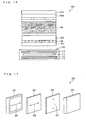
- FIG. 17 is a cross-sectional perspective view illustrating a configuration of a liquid crystal display device described in Patent Literature 3.
- a liquid crystal display device 230 described in Patent Literature 3 includes a liquid crystal display element 201 and a backlight (backlight unit) 204. Between the liquid crystal display element 201 and the backlight 204, two lens films 202 and 203 are provided. The lens films 202 and 203 are laminated so that their prism orientation directions 206 and 207 cross each other at the right angles, and the prism orientation direction 206 of the lens film 202, which is the lens film located closer to the liquid crystal display element 201, is parallel to a transmission axis 205 of a polarizing plate, which is located on an incident light side of the liquid crystal display element 201.
- the liquid crystal display device described in Patent Literature 3 makes it possible to realize display with a high brightness.
- Patent Literature 4 Patent Literature 4
- FIG. 18 is a cross-sectional perspective view illustrating a configuration of a liquid crystal display device described in Patent Literature 4.
- a liquid crystal display device 330 described in Patent literature 4 includes a light incidence polarizing plate (polarizer) 305, a light exit polarizing plate (polarizer) 306, a liquid crystal panel 304 between the light incidence polarizing plate 305 and the light exit polarizing plate 306, and a backlight source (light source) 301 provided behind the liquid crystal panel 304.
- the liquid crystal display device 330 further includes a prism sheet 308 between the light incidence polarizing plate 305 and the backlight source 301.
- a ridge-line direction A0 of the prism sheet 308 and a transmission axis direction B0 of the light incidence polarizing plate 305 cross each other at the right angles.
- the liquid crystal display device described in Patent Literature 4 makes it possible to realize display with a higher brightness.
- Patent Literature 5 (Patent Literature 5)
- a liquid crystal display device described in Patent Literature 5 is configured such that a polarized light-separating surface or the like is provided to face a light exit plane of a plane light guide (light guiding plate) of a backlight unit, and the polarized light-separating surface or the like can selectively reflect or transmit a polarization component.
- the liquid crystal display device described in Patent Literature 5 is improved in brightness in its normal direction of a display surface, especially.
- the conventional liquid crystal display devices have a problem of having an insufficient contrast.
- the problem is that, in a liquid crystal display device in which a liquid crystal display element capable of realizing a high-contrast display (e.g., an MVA mode liquid crystal display element) is used, it is difficult to cause the liquid crystal display element to fully show a high contrast characteristic which the liquid crystal display element is supposed to have.
- a liquid crystal display element capable of realizing a high-contrast display e.g., an MVA mode liquid crystal display element
- Fig. 15 is a cross-sectional view schematically illustrating an example of a configuration of a liquid crystal display device 10.
- the liquid crystal display device 10 includes a liquid crystal display element 20 and a backlight unit 60 provided behind the liquid crystal display element 20.
- the liquid crystal display element 20 is configured such that a liquid crystal layer 22 is sandwiched between a first substrate 24 and a second substrate 26.
- a first phase plate 30 and a first polarizing plate 34 are provided in this order.
- a second phase plate 32 and a second polarizing plate 36 are provided in this order.
- a reflective polarizer film with a brightness enhancement effect 40 is provided between the first polarizing plate 34 and the backlight unit 60.
- the backlight unit 60 includes a light source (not illustrated), a light guiding plate (not illustrated), two prism sheets (a first prism sheet 66 and a second prism sheet 68), and an upper diffusing sheet 70.
- Whether or not light vertically exiting from the backlight unit 60 toward the liquid crystal display element 20 (L1 illustrated in Fig. 15 ) is emitted to outside the liquid crystal display device 10 depends on whether the liquid crystal layer 22 is in an ON or OFF state. Namely, while the liquid crystal layer 22 is in the ON state, the light L1 is emitted to outside the liquid crystal display device 10 without being blocked by the liquid crystal display element 20.
- a ratio of (i) an amount of light emitted while the liquid crystal layer 22 is in the ON state (an ON light amount) to (ii) an amount of light emitted while the liquid crystal layer 22 is in the OFF state (an OFF light amount) is referred to as a contrast (ON light amount/OFF light amount).
- the light L1 which enters into the liquid crystal display element 20 from its normal direction can realize a high ON light amount and a low OFF light amount in accordance with whether the liquid crystal layer 22 is in the ON or OFF state.
- the liquid crystal display element 20 is an MVA mode liquid crystal display element capable of realizing a high-contrast display
- the light L1 incident from the normal direction can realize a contrast of, for example, several thousands.
- the light L1 which enters into the liquid crystal display element 20 from its normal direction is likely to realize a low OFF light amount.
- the light L1 which enters into the liquid crystal display element 20 from its normal direction changes and travels as originally designed since the light L1 vertically enters into the polarizing plates (the first polarizing plate 34 and the second polarizing plate 36), the phase plates (the first phase plate 30 and the second phase plate 32), the liquid crystal layer 22, and the like.
- the inclined light L2 is normally invisible to a viewer V who views the liquid crystal display device 10 from a normal direction of the liquid crystal display device 10.
- the inclined light L2 does not cause a reduction in contrast in principle.
- a direction in which the inclined light L2 travels may change. Specifically, a light path may bend toward the viewer V in the liquid crystal display element 20 (see an arrow L3 illustrated in Fig. 15 ).
- Examples of various reasons for such light bending occurring in the liquid crystal display element 20 include scattering in the liquid crystal layer 22, a color filter (not illustrated), and/or a TFT substrate (not illustrated).
- Light which diagonally enters into the liquid crystal display element 20 and diagonally travels through the liquid crystal display element 20 may exit from the liquid crystal display element 20 with a certain level of brightness (a certain amount of light) even while the liquid crystal layer 22 is in the OFF state. Such light causes a leakage of light while the liquid crystal layer 22 is in the OFF state.
- the liquid crystal display element 20 depends on an angle in terms of its optical characteristic, and this dependence causes a leakage of light.
- the phase plates (the first phase plate 30 and the second phase plate 32), the polarizing plates (the first polarizing plate 34 and the second polarizing plate 36), the liquid crystal layer 22, and the like are designed so that the ON light amount and the OFF light amount are optimized, that is, the ON light amount is large and the OFF light amount is small, with respect to light which enters into the liquid crystal display element 20 from its normal direction.
- the liquid crystal display element 20 is optically designed so that light which enters into the liquid crystal display element 20 from its normal direction is blocked at the maximum.
- the inclined light is insufficiently blocked even while the liquid crystal layer 22 is in the OFF state.
- the inclined light exits from inside to outside the liquid crystal display element 20 as a leakage of light.
- Such a leakage of light is a particularly serious problem in a liquid crystal display device including a liquid crystal display element capable of realizing a high-contrast display.
- the present invention has been made in view of the problems, and an object of the present invention is to provide a backlight unit and a liquid crystal display device, which are capable of realizing a higher-contrast display while constantly functioning as a surface light source.
- an object of the present invention is to provide a backlight unit and a liquid crystal display device, which are capable of suppressing an intensity of the inclined light which enters into a liquid crystal display element and causes a reduction in contrast.
- a backlight unit of the present invention includes: a light guiding plate; and a diffusing sheet, the backlight unit causing light exiting through a light exit plane thereof to backlight a liquid crystal display element, the light exiting through the light exit plane, having a half width of not more than 44°.
- the backlight unit of the present invention is preferably configured such that the half width is not less than 20° and not more than 40°.
- a half width is explained below.
- a measured sample e.g., a backlight unit
- a half width and the like an inclined angle at which light has an intensity which is half as high as an intensity of light exiting from the measured sample through its light exit plane and in its normal direction is referred to as a half width (degree). This is based on a characteristic that emitted light has a weaker intensity as the emitted light is more inclined from the normal direction.
- the backlight unit has a half width of not more than 44°, preferably of not less than 20° and not more than 40°. This can realize a backlight unit which is capable of realizing a higher-contrast display while constantly functioning as a surface light source. The following description discusses this point.
- a liquid crystal display element toward which light is emitted from a backlight unit is generally designed so that light which enters into the liquid crystal display element through its rear surface and from its normal direction and then exits from the liquid crystal display element through its front surface and in its normal direction has a maximum contrast.
- optical characteristics of optical members such as a polarizing plate and a phase plate, and a liquid crystal layer, each of which is included in the liquid crystal display element, are designed so that such light has a high contrast.
- a backlight unit is required to emit light which is uniform in its light exit plane so that a display which has an in-plane uniform brightness is realized by the liquid crystal display element.
- the backlight unit is required to have a function as a surface light source.
- the backlight unit In order to function as the surface light source, the backlight unit generally includes a diffusing sheet for causing light to be diffused.
- the backlight unit includes the diffusing sheet, light exiting from the backlight unit through its light exit plane is normally oriented in various directions.
- light which exits from the backlight unit and then enters into the liquid crystal display element encompasses not only light which enters into the liquid crystal display element from its normal direction but also light which enters into the liquid crystal display element from a direction which is inclined from the normal direction of the liquid crystal display element.
- the diffusing sheet is a generic term for a sheet which has a function of causing a light beam to be diffused.
- a contrast of the liquid crystal display element is designed on the premise of light which enters into the liquid crystal display element from its normal direction. Therefore, for example, in a case where the inclined light bends in the liquid crystal display element and is then emitted from the liquid crystal display element in its normal direction, the emitted light has no desired brightness (white or black). This is likely to cause a reduction in contrast.
- the backlight unit having the above configuration is designed such that a half width showing a diffusion (scattering) characteristic of emitted light is set to an appropriate value, the backlight unit secures a scattering characteristic of emitted light sufficient for enabling the backlight unit to serve as a surface light source while the backlight unit suppresses an intensity of inclined light which causes the reduction in contrast.
- this configuration brings about an effect of providing a backlight unit which is capable of realizing a higher-contrast display while constantly functioning as a surface light source. More specifically, this configuration brings about an effect of providing a backlight unit which is capable of suppressing an amount of the inclined light.
- the backlight unit of the present invention is preferably configured such that the diffusing sheet has a haze value of not more than 80%.
- the diffusing sheet has a haze value of not less than 50% and not more than 80%, it is easily possible to form a backlight unit in which light exiting from the backlight unit through its light exit plane has a half width of not less than 28° and not more than 44°.
- the backlight unit of the present invention is preferably configured such that the diffusing sheet has a haze value of not less than 30% and not more than 76%.
- the diffusing sheet has a haze value of not more than 80%, it is easily possible to form a backlight unit in which light exiting through its light exit plane has a half width of not less than 20° and not more than 40°.
- the backlight unit of the present invention is preferably configured to further include a prism sheet provided between the light guiding plate and the diffusing sheet.
- the backlight unit since the backlight unit includes the prism sheet, it is possible to realize emission of light with a higher brightness, for example in a normal direction of the backlight unit.
- the prism sheet refers to an optical sheet on a surface of which grooves are provided in a given direction so that a direction in which light having been transmitted through the prism sheet travels is controlled.
- a liquid crystal display device of the present invention is preferably configured to include: a liquid crystal display element; and a backlight unit as mentioned above, the backlight unit being provided on a back side of the liquid crystal display element.
- the liquid crystal display device includes the backlight unit in which a half width is appropriately set, it is possible to realize a high-contrast display.
- the liquid crystal display device of the present invention is preferably configured to further include a reflective polarizer film with a brightness enhancement effect provided between the liquid crystal display element and the backlight unit.
- the appropriately set half width of a backlight unit allows realizing a high-contrast display.
- the reflective polarizer film with a brightness enhancement effect refers to a film which, for example, in a case where polarized light which reaches the reflective polarizer film with a brightness enhancement effect includes a p-wave and an s-wave, causes an increase in incident light toward, for example, a polarizing plate adjacent to the reflective polarizer film with a brightness enhancement effect by causing one of the polarized waves such as the p-wave to be transmitted through the film and causing the remaining s-wave to be reflected on the film.
- the liquid crystal display device of the present invention is preferably configured such that: the liquid crystal display element is a vertical alignment mode liquid crystal display element; and a liquid crystal layer included in the liquid crystal display element is divided into a plurality of different alignment regions in plan view.
- the liquid crystal display element is configured to be a so-called MVA mode liquid crystal display element.
- the MVA mode liquid crystal display element is generally capable of realizing a high-contrast display.
- a combination of the liquid crystal display element and a backlight unit in which a half width is appropriately set makes it possible to realize a display in which a high contrast characteristic which the liquid crystal display element is supposed to have is not so impaired.
- the liquid crystal display device of the present invention is configured such that: the liquid crystal display element is a vertical alignment mode liquid crystal display element; liquid crystal molecules are omnidirectionally aligned in plan view in a liquid crystal layer included in the liquid crystal display element; and circularly polarizing plates are provided on both sides of the liquid crystal layer.
- the liquid crystal display device of the present invention may be configured such that the liquid crystal display element is a twisted nematic liquid crystal display element.
- the liquid crystal display element is configured to be (i) a circular polarization type liquid crystal display element of a vertical alignment mode or (ii) a so-called TN mode liquid crystal display element.
- a combination of the liquid crystal display element and a backlight unit in which a half width is appropriately set makes it possible to prevent a reduction in contrast of the liquid crystal display element.
- the backlight unit of the present invention is configured such that light exiting through its light exit plane has a half width of not more than 44°.
- the present invention brings about an effect of providing a backlight unit which is capable of realizing a higher-contrast display while constantly functioning as a surface light source. More specifically, the present invention brings about an effect of providing a backlight unit and a liquid crystal display device, which are capable of suppressing an intensity of the inclined light which enters into a liquid crystal display element so as to cause a reduction in contrast.
- a liquid crystal display device of the present invention has a configuration substantially similar to the configuration of the liquid crystal display device 10 already described, referring to Fig. 15 .
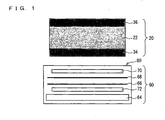
- the liquid crystal display device of the present invention is explained below, referring to Fig. 1 , which is a cross-sectional view schematically illustrating a liquid crystal display device of the present embodiment.
- a liquid crystal display device 10 mainly includes a liquid crystal display element 20 and a backlight unit 60. Light exiting from the backlight unit 60 through its light exit plane 80 enters into the liquid crystal display element 20, whereby a display is carried out.
- the liquid crystal display element 20 of the present embodiment is configured to be a so-called MVA mode liquid crystal display element.
- liquid crystal layer 22 sandwiched between two substrates (not illustrated) which face each other is sandwiched between a first polarizing plate 34 and a second polarizing plate 36.
- Liquid crystal molecules included in the liquid crystal layer 22 have a multi-domain alignment (e.g., a four-domain alignment) in plan view.
- the backlight unit 60 includes a light source (not illustrated), a light guiding plate 64, two diffusing sheets (an upper diffusing sheet 70 and a lower diffusing sheet 72), and two prism sheets (a first prism sheet 66 and a second prism sheet 68) (see Fig. 1 ). These members are laminated in the order of: the light guiding plate 64, the lower diffusing sheet 72, the first prism sheet 66, the second prism sheet 68, and the upper diffusing sheet 70.
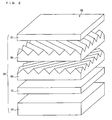
- the first and second prism sheets 66 and 68 have, on their respective top surfaces, linear grooves constituted by triangular peaks and valleys (see Fig. 2 ).
- the grooves of the first and second prism sheets 66 and 68, respectively, are provided so as to cross each other at right angles.
- Fig. 2 is a perspective cross-sectional view illustrating a configuration of the backlight unit 60 of the present embodiment.
- the upper diffusing sheet 70 of the present embodiment has a feature that light exiting from the backlight unit 60 in which the upper diffusing sheet 70 is used has a half width of 31°.
- FIG. 3 schematically illustrates a measuring system for measuring the half width.
- FIG. 3 illustrates a measuring system for measuring an intensity etc. of light exiting from a measured sample (e.g., the backlight unit 60).
- a measuring device for carrying out measurement as mentioned above is not particularly limited.
- EZcontrast 88 product name, made by ELDIM
- ELDIM is usable for such measurement.
- the backlight unit 60 serves as the measured sample, thereby measuring the half width in the backlight unit 60.
- a diffusing sheet in which light exiting from the backlight unit 60 has a half width of 31° is used for the upper diffusing sheet 70.
- the following description discusses this point.
- the half width was measured for the backlight unit 60 which is schematically illustrated in Fig. 2 and serves as the measured sample.
- the intensity of received light was measured in a state in which the light guiding plate 64, the lower diffusing sheet 72, the first prism sheet 66, the second prism sheet 68, and the upper diffusing sheet 70 were laminated in this order.
- an azimuth angle ( ⁇ ) of 0° is defined as illustrated in (c) of Fig. 3 .
- the grooves of the first and second prism sheets 66 and 68 are provided at an angle of 45° and 135°, respectively.
- the light exiting from the backlight unit 60 was measured under the foregoing conditions and found to have a half width (0° to 360°) of 31°.
- a diffusing sheet which has a haze value of 55.0% was used for the upper diffusing sheet 70 and a diffusing sheet which has a haze value of 74.5% was used for the lower diffusing sheet 72.
- the liquid crystal display device 10 of the present embodiment allows a high-definition and high-contrast display.
- the following description discusses this point.
- the liquid crystal display device 10 is preferably configured such that light which is uniformly bright in a plane of the backlight unit 60 exits from the backlight unit 60 so that a display which is uniformly bright in a plane of the liquid crystal display device 10 is realized.
- the backlight unit 60 is preferably a uniform surface light source.
- a diffusing sheet included in the backlight unit 60 is required to have a high diffusibility.
- the liquid crystal display device 10 is required to carry out not only (i) a display which is uniformly bright in its plane (already described) but also (ii) a high-contrast display.
- the liquid crystal display element 20 is designed so that a high-contrast display can be realized, the inclined light is likely to cause a reduction in contrast.
- liquid crystal display device 10 which is capable of realizing a high-contrast display and includes an MVA mode liquid crystal display element such as the liquid crystal display element 20.
- the liquid crystal display panel is obtained by removing the two polarizing plates (the first and second polarizing plates) from the liquid crystal display element 20.
- the liquid crystal display panel refers to a liquid crystal panel including the liquid crystal layer 22 which is sandwiched between two substrates on which a color filter, a switching element, and the like are provided.
- Fig. 4 is a graph illustrating, for two kinds of (first and second) measured samples, intensities of light transmitted in a normal direction to a display surface of each of the measured samples, with respect to the inclined light.
- the first measured sample is obtained by attaching polarizing plates to both sides of a glass substrate, respectively, so that absorption axes of the respective polarizing plates cross each other at right angles (see “glass + polarizing plates” of Fig. 4 ).
- the second measured sample is a liquid crystal display element obtained by attaching polarizing plates to the liquid crystal display panel (see “panel + polarizing plates” of Fig. 4 in which the liquid crystal display panel carries out a black display).
- Fig. 4 illustrates a relationship between an angle (a polar angle ( ⁇ )) of incident light and a transmitted light intensity for the two measured samples.
- the two polarizing plates are provided in a crossed Nicols relationship in which absorption axes of the respective two polarizing plates cross each other at right angles.
- the absorption axis of the back side polarizing plate (the polarizing plate located on a side on which light is incident during measurement) is oriented in a direction of the azimuth angle ( ⁇ ) of 0°.
- A-PCF Polarization Conversion Film
- product name made by NITTO DENKO CORPORATION
- an inclined angle from a normal direction of a plane of the measured sample is referred to as a polar angle ( ⁇ ) (see (b) of Fig. 3 ) and an angle of a left-handed rotation from a horizontal direction on the plane is referred to as an azimuth angle ( ⁇ ) (see (c) of Fig. 3 ).
- the measuring system allows (i) an incidence direction of incident light to be inclined in a direction of the polar angle ( ⁇ ) and (ii) the inclined incident light to rotate in a direction of the azimuth angle ( ⁇ ).
- the light receiving device is fixed at the polar angle ( ⁇ ) of 0° (azimuth angle ( ⁇ ) of 0°), i.e., in the normal direction of the plane of the measured sample.
- a measuring device for carrying out measurement as mentioned above is not particularly limited.
- LCD5200 product name, made by OTSUKA ELECTRONICS CO., LTD.
- LCD5200 is usable for such measurement.
- both of the two measured samples (“glass + polarizing plates” and “panel + polarizing plates”) have their respective lower transmitted light intensities as incident light is inclined from the normal direction of the respective measured samples.
- the transmitted light intensity decreases more sharply in "glass + polarizing plates".
- the inclined light is more likely to be emitted in the normal direction (a direction of the polar angle ( ⁇ ) of 0°) in "panel + polarizing plates” in which the liquid crystal display panel is added to "glass + polarizing plates”.
- the inclined light changes its traveling direction in the liquid crystal display panel and then exits in the normal direction, thereby causing a reduction in contrast.
- a measurement result illustrated in Fig. 4 is obtained by causing the incident light to be inclined in the direction of the azimuth angle ( ⁇ ) of 0°, i.e., in a direction parallel to the absorption axis of the back side polarizing plate.
- Fig. 5 is a graph in polar coordinates, showing the result of measuring incident light while changing an azimuth direction of the incident light from 0° to 360° in increments of 5° by use of the measuring system illustrated in (b) of Fig. 3 .
- Fig. 5 is a graph illustrating the transmitted light intensities for a measured sample similar to the "panel + polarizing plates" in a case where the polar angle ( ⁇ ) and the azimuth angle ( ⁇ ) of incident light are changed.
- the measured sample used for the measurement illustrated in Fig. 5 is obtained by attaching polarizing plates to both sides (front and rear surfaces) of a liquid crystal display panel, respectively, in a crossed Nicols relationship.
- the absorption axis of the back side polarizing plate (the polarizing plate located on a side on which light is incident during measurement) is oriented in a direction of the azimuth angle ( ⁇ ) of 90°.
- Fig. 5 shows that, in a range of the polar angle ( ⁇ ) of 0° to 70°, the inclined light is emitted in the normal direction at substantially all the azimuth angles ( ⁇ ).
- Fig. 5 also shows that the inclined light is likely to be emitted in the normal direction particularly at the azimuth angles ( ⁇ ) of 45°, 135°, 225°, and 315°.
- inclined light may change its traveling direction and be emitted in a normal direction, i.e., in a direction of the viewer V of the liquid crystal display device 10.
- the inclined light is likely to behave differently from light incident from the normal direction due to a difference in optical path length etc. during transmission through the liquid crystal display element 20.
- light may not be sufficiently blocked even, for example, even in a case where the liquid crystal layer 22 is in an OFF state (the OFF state of the liquid crystal layer 22 refers to a state in which a black display is carried out by a liquid crystal display element, i.e., a state in which the crystal display element has the lowest transmittance).
- the inclined light is emitted as a leakage of light in the normal direction, reaching the viewer V's eyes.
- the half width is 31°. Namely, a degree of scattering of light exiting from the backlight unit 60 is appropriately controlled.
- liquid crystal display device 10 light scatters so sufficiently as to realize a uniform brightness in a plane of the liquid crystal display element 20 (already described).
- the liquid crystal display device 10 can realize (i) a display which is uniformly bright in the plane of the liquid crystal display element 20 (already described) and (ii) a high-contrast display.
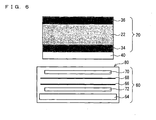
- a liquid crystal display device 10 of the present embodiment is configured to further include a reflective polarizer film with a brightness enhancement effect 40, as compared to the configuration of the liquid crystal display device 10 of the First Embodiment.
- the liquid crystal display device 10 of the present embodiment further includes A-PCF (Polarization Conversion Film) (product name, made by NITTO DENKO CORPORATION) as a reflective polarizer film with a brightness enhancement effect 40 between (i) a first polarizing plate 34 of two polarizing plates (the first polarizing plate 34 and a second polarizing plate 36) which is closer to a backlight unit 60 and (ii) the backlight unit 60.
- A-PCF Polarization Conversion Film
- the reflective polarizer film with a brightness enhancement effect 40 refers to a film in which, for example, a mechanism as described below causes an increase in light which enters into a polarizing plate adjacent to the film.
- the reflective polarizer film with a brightness enhancement effect 40 causes (i) only one of the polarized waves such as the p-wave to be transmitted therethrough and (ii) the remaining s-wave to be reflected thereon.
- the s-wave thus reflected is partially changed into the p-wave.
- the reflective polarizer film with a brightness enhancement effect 40 causes the p-wave thus changed to be transmitted therethrough.
- Such operation is repeatedly carried out, so that only the p-wave, for example is selectively transmitted through the reflective polarizer film with a brightness enhancement effect 40.
- the reflective polarizer film with a brightness enhancement effect 40 is not limited to the A-PCF (product name).
- D-BEF product name: abbreviation of Brightness Enhancement Film
- this reflective polarizer film with a brightness enhancement effect may be referred to as a polarized light reflecting film or a polarized light mirror film.
- the backlight unit 60 (see Fig. 1 ), i.e., a laminate of the light guiding plate 64, the lower diffusing sheet 72, the first prism sheet 66, the second prism sheet 68, and the upper diffusing sheet 70 serves as a measured sample.
- (a) of Fig. 7 illustrates azimuth angle ( ⁇ ) and polar angle ( ⁇ ) dependencies of light exiting from the measured sample.
- a measured sample is obtained by causing the A-PCF serving as the reflective polarizer film with a brightness enhancement effect 40 to be laminated on the measured sample of (a) of Fig. 7 .
- (b) of Fig. 7 illustrates angle distributions, i.e., azimuth angle ( ⁇ ) and polar angle ( ⁇ ) dependencies (similarly to (a) of Fig. 7 ) of light exiting from the measured sample.
- the liquid crystal display device 10 of the present embodiment including the reflective polarizer film with a brightness enhancement effect 40 i.e., transmission through the reflective polarizer film with a brightness enhancement effect 40 causes the light exiting from the backlight unit 60 in its normal direction to have a higher brightness with respect to incident light which is inclined in a wider range.
- the light exiting from the backlight unit 60 is emitted from a wide polar angle ( ⁇ ) range in a range of substantially all the azimuth angles ( ⁇ ).
- An increase in brightness of the backlight unit 60 in the case where the A-PCF (reflective polarizer film with a brightness enhancement effect 40) is provided is remarkable particularly in a range of an inclined angle (a polar angle ( ⁇ )) of 30° to 70°.
- the reflective polarizer film with a brightness enhancement effect 40 is provided between (i) the backlight unit 60 and (ii) the first polarizing plate (polarizing plate closer to the backlight unit 60) of the liquid crystal display element 20, more amount of inclined light enters into the liquid crystal display element 20.
- the liquid crystal display device 10 according to the First Embodiment whose configuration is schematically illustrated in Fig. 1 serves as a measured sample and intensities of received light were measured in the normal direction.
- the liquid crystal display device 10 of the present embodiment whose configuration is schematically illustrated in Fig. 6 (obtained by modifying the liquid crystal display device 10 of the First Embodiment to further include the A-PCF serving as the reflective polarizer film with a brightness enhancement effect 40) serves as a measured sample.
- FIG. 8 illustrate what difference exists between (i) the liquid crystal display device 10 including the reflective polarizer film with a brightness enhancement effect 40 and (ii) the liquid crystal display device 10 including no reflective polarizer film with a brightness enhancement effect 40, in terms of a dependency of light exiting from the liquid crystal display device 10 in its normal direction on azimuth angle ( ⁇ ) and polar angle ( ⁇ ) of incident light.
- the liquid crystal display device 10 including the reflective polarizer film with a brightness enhancement effect 40 is more likely to cause light incident at the azimuth angles ( ⁇ ) of 45°, 135°, 225°, and 315° and at polar angles ( ⁇ ) particularly of 30° to 70° to be emitted in the normal direction.
- Fig. 9 is a graph illustrating a difference, between (i) the liquid crystal display device 10 including the reflective polarizer film with a brightness enhancement effect 40 and (ii) the liquid crystal display device 10 including no reflective polarizer film with a brightness enhancement effect 40, in light exiting from the liquid crystal display device 10 in the normal direction (a subtraction under similar conditions of the intensity of light exiting from the liquid crystal display device 10 including the reflective polarizer film with a brightness enhancement effect 40 from the intensity of light exiting from the liquid crystal display device 10 including no reflective polarizer film with a brightness enhancement effect 40).
- the liquid crystal display device 10 including the reflective polarizer film with a brightness enhancement effect 40 is more likely to cause incident light at the azimuth angles ( ⁇ ) of 45°, 135°, 225°, and 315° and at the polar angle ( ⁇ ) of 50° in particular to be emitted in the normal direction.
- the liquid crystal display device 10 of the present embodiment employs the backlight unit 60 in which light exiting from the backlight unit 60 has a half width of 31°, similarly to the liquid crystal display device 10 of the First Embodiment.
- the liquid crystal display device 10 including the reflective polarizer film with a brightness enhancement effect 40 can realize (i) a display which has an in-plane uniform brightness and (ii) a high-contrast display.
- liquid crystal display devices 10 having the configurations of the First and Second Embodiment, i.e., the liquid crystal display device 10 including the reflective polarizer film with a brightness enhancement effect and the liquid crystal display device 10 including no reflective polarizer film with a brightness enhancement effect, referring to Examples and Comparative Examples.
- Fig. 10 is a chart illustrating, for the Examples and the Comparative Examples, brightness distributions and contrasts of (i) the backlight unit 60 alone and (ii) the backlight unit 60 for which the A-PCF serving as the reflective polarizer film with a brightness enhancement effect 40 is provided on a side of the backlight unit 60 on which side light exits from the backlight unit 60.
- the backlight units 60 and the liquid crystal display elements 20 are similarly configured and the diffusing sheets 70 are differently configured.
- the "D151SIII” has a haze value of 55.0%
- the “D120SIII” has a haze value of 76.0%
- the “D117UESIII” has a haze value of 32.5%
- the “D114SIII” has a haze value of 81.4%.
- Optical characteristics such as a half width were measured for, for example, the backlight units in which the diffusing sheets were made of the foregoing materials.
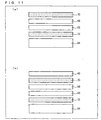
- the measured sample of "backlight unit alone” or “backlight unit with no A-PCF" shown in Fig. 10 has the cross-sectional configuration illustrated in (a) of Fig. 11 .
- the measured sample of "backlight unit + A-PCF" or “backlight unit with A-PCF” shown in Fig. 10 has the cross-sectional configuration illustrated in (b) of Fig. 11 .
- the measured sample illustrated in (a) of Fig. 11 and the measured sample illustrated in (b) of Fig. 11 are different in whether the measured samples include the A-PCF serving as the reflective polarizer film with a brightness enhancement effect 40 or not.
- the Example 1 had a half width of 31°, the Example 2 had a half width of 33°, the Comparative Example 1 had a half width of 25°, and the Comparative Example 2 had a half width of 45°.
- Fig. 10 shows that incident light from a wider polar angle ( ⁇ ) range tends to exit from the backlight unit 60 in its normal direction as light exiting from the backlight unit 60 has a larger half width and the upper diffusing sheet 70 has a larger haze value.
- Fig. 10 shows that incident light from a wider polar angle ( ⁇ ) range exits from the backlight unit 60 for which the reflective polarizer film with a brightness enhancement effect 40 is provided than from the backlight unit 60 alone.
- the backlight unit 60 tends to have a lower contrast as light exiting from the backlight unit 60 has a larger half width and the upper diffusing sheet 70 has a larger haze value.
- the backlight unit 60 for which the reflective polarizer film with a brightness enhancement effect 40 is provided tends to have a lower contrast than the backlight unit 60 alone.
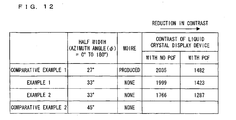
- Fig. 12 is a chart illustrating measured contrasts of the liquid crystal display devices 10 of the Examples and the Comparative Examples.
- Example 1 which has the half width of 31°, no moiré was produced. Further, the Example 1 was able to realize a contrast which was equivalent or by no means inferior to a contrast of the Comparative Example 1 which cannot be actually employed because a moiré is produced.
- the configurations in which the A-PCFs are provided generally have lower contrasts as compared to the configurations in which no reflective polarizer films with a brightness enhancement effect 40 are provided.
- the Examples 1 and 2 made it possible to realize contrasts which were equivalent or by no means inferior to the contrast of the Comparative Example 1 which cannot be used because a moiré is produced. Note also that the Comparative Example 2, in which no moiré was produced, had a low contrast, similarly to the case of the configuration in which no reflective polarizer film with a brightness enhancement effect 40 is provided.
- a liquid crystal display mode of the present invention is not limited to this.
- a so-called circular polarization type is also usable.
- the circular polarization type is configured such that: liquid crystal molecules are not subjected to a multi-domain alignment but are omnidirectionally aligned by use of a rivet or the like; and phase plates such as ⁇ /4 plates are provided between a liquid crystal layer and respective polarizing plates. Note that differences between the aforementioned linear polarization type and the circular polarization type are described later, referring to Fig. 14 .
- the present invention is also usable for, for example, a TN (Twisted Nematic) mode and an IPS (In Plane Switching) mode as well as the vertical alignment mode.
- TN Transmission Nematic
- IPS In Plane Switching
- control of a half width of light exiting from the backlight 60 can prevent a reduction in contrast as well as production of a moiré and the like, irrespective of a liquid crystal display mode.
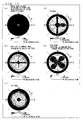
- liquid crystals (liquid crystal molecules) of the liquid crystal layer are omnidirectionally aligned centering around a protrusion such as a rivet in the circular polarization type of the vertical alignment mode.
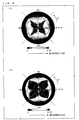
- the liquid crystal layer is divided into a plurality of alignment regions R in plan view in the linear polarization type of the vertical alignment mode.
- an alignment region refers to a region in which liquid crystals (liquid crystal molecules) are aligned in a direction different from a direction in which liquid crystals (liquid crystal molecules) of a part adjacent to the region are aligned.
- Fig. 14 illustrates an example of a four-domain alignment.
- the circular polarization type and the linear polarization type are different in configuration of a layer of a liquid crystal display element in accordance with the difference in configuration of the liquid crystal layer. Namely, in the linear polarization type, only polarizing plates are provided on both sides of the liquid crystal layer (a liquid crystal panel), respectively. In contrast, in the circular polarization type, phase plates such as ⁇ /4 plates (circularly polarizing plates) in addition to polarizing plates are provided on both sides of the liquid crystal layer (a liquid crystal panel), respectively.
- phase plates are provided on both sides of the liquid crystal layer (liquid crystal panel), respectively, and then polarizing plates are provided on outer sides of the respective phase plates.
- the linear polarization type of the vertical alignment mode generally has a higher contrast than the circular polarization type of the vertical alignment mode.
- a backlight of the present invention more effectively functions in the linear polarization type than in the circular polarization type.
- a prism sheet which has triangular grooves.
- Grooves of a prism sheet are not limited to this in shape, and can also be rounded and be constituted by semicircular peaks and valleys.
- the number of the prism sheets used is two. Prism sheets are not limited to this in number. For example, no prism sheet or one (1) prism sheet is also usable.
- two diffusing sheets i.e., the upper diffusing sheet 70 and the lower diffusing sheet 72 are provided in the backlight unit 60. Only one of the upper diffusing sheet 70 and the lower diffusing sheet 72 can be provided in the backlight unit 60.
- the upper diffusing sheet 70 and the lower diffusing sheet 72 are made of the same material.
- the upper diffusing sheet 70 and the lower diffusing sheet 72 can also be made of different materials.
- a backlight unit and a liquid crystal display device of the present invention which are capable of realizing a high-contrast display, are preferably usable for display applications which are required to realize a high-definition display.
Landscapes
- Physics & Mathematics (AREA)
- General Physics & Mathematics (AREA)
- Optics & Photonics (AREA)
- Nonlinear Science (AREA)
- Mathematical Physics (AREA)
- Chemical & Material Sciences (AREA)
- Crystallography & Structural Chemistry (AREA)
- Liquid Crystal (AREA)
- Planar Illumination Modules (AREA)
Applications Claiming Priority (2)
| Application Number | Priority Date | Filing Date | Title |
|---|---|---|---|
| JP2008035346 | 2008-02-15 | ||
| PCT/JP2008/072698 WO2009101746A1 (ja) | 2008-02-15 | 2008-12-12 | バックライトユニット及び液晶表示装置 |
Publications (2)
| Publication Number | Publication Date |
|---|---|
| EP2249197A1 true EP2249197A1 (de) | 2010-11-10 |
| EP2249197A4 EP2249197A4 (de) | 2011-10-26 |
Family
ID=40956784
Family Applications (1)
| Application Number | Title | Priority Date | Filing Date |
|---|---|---|---|
| EP08872277A Withdrawn EP2249197A4 (de) | 2008-02-15 | 2008-12-12 | Hintergrundbeleuchtungseinheit und flüssigkristallanzeigevorrichtung |
Country Status (6)
| Country | Link |
|---|---|
| US (1) | US20110102311A1 (de) |
| EP (1) | EP2249197A4 (de) |
| JP (1) | JPWO2009101746A1 (de) |
| CN (1) | CN101952770A (de) |
| RU (1) | RU2454689C2 (de) |
| WO (1) | WO2009101746A1 (de) |
Families Citing this family (5)
| Publication number | Priority date | Publication date | Assignee | Title |
|---|---|---|---|---|
| JP4998545B2 (ja) * | 2009-12-28 | 2012-08-15 | カシオ計算機株式会社 | 光源装置及び表示装置 |
| TWI556319B (zh) * | 2011-11-30 | 2016-11-01 | 半導體能源研究所股份有限公司 | 半導體裝置的製造方法 |
| JP6509482B2 (ja) * | 2013-08-22 | 2019-05-08 | 東洋鋼鈑株式会社 | 偏光子保護フィルムの製造方法及び偏光子保護フィルム |
| US10215368B2 (en) * | 2016-06-03 | 2019-02-26 | Applied Materials, Inc. | Energy efficient communication and display device |
| CN121028422A (zh) * | 2024-05-28 | 2025-11-28 | 京东方科技集团股份有限公司 | 背光模组及显示装置 |
Family Cites Families (20)
| Publication number | Priority date | Publication date | Assignee | Title |
|---|---|---|---|---|
| USRE37377E1 (en) * | 1992-10-09 | 2001-09-18 | Asahi Glass Company, Ltd. | LCD device including an illumination device having a polarized light separating sheet between a light guide and the display |
| TW594115B (en) * | 1992-10-09 | 2004-06-21 | Asahi Glass Co Ltd | A liquid crystal display device and an illumination device for a direct viewing type display element |
| JP2003084283A (ja) | 1992-10-09 | 2003-03-19 | Asahi Glass Co Ltd | 照明装置及び液晶表示装置 |
| JP3209001B2 (ja) | 1994-07-05 | 2001-09-17 | セイコーエプソン株式会社 | 液晶表示装置 |
| JPH08160204A (ja) * | 1994-12-12 | 1996-06-21 | Mitsubishi Rayon Co Ltd | プリズムシートおよびバックライト |
| JP2000122046A (ja) | 1998-10-16 | 2000-04-28 | Sharp Corp | 液晶表示装置 |
| US7525531B2 (en) * | 2000-07-31 | 2009-04-28 | Toshiba Matsushita Display Technology Co., Ltd. | Method for manufacturing lighting device, image display, liquid crystal monitor, liquid crystal television, liquid crystal information terminal, and light guide plate |
| JP4023079B2 (ja) * | 2000-08-31 | 2007-12-19 | 株式会社日立製作所 | 面状照明装置及びこれを備えた表示装置 |
| ATE396423T1 (de) * | 2000-12-13 | 2008-06-15 | Mitsubishi Rayon Co | Lichtquelleneinrichtung |
| JP2003015133A (ja) * | 2001-04-27 | 2003-01-15 | Citizen Watch Co Ltd | 液晶表示装置 |
| JP2003121847A (ja) | 2001-10-17 | 2003-04-23 | Matsushita Electric Ind Co Ltd | 液晶表示素子 |
| TWI258023B (en) * | 2001-11-07 | 2006-07-11 | Ibm | A prism sheet, a back-light unit using said prism sheet, and a transmission type liquid crystal display device |
| TW594108B (en) * | 2002-06-24 | 2004-06-21 | Mitsubishi Rayon Co | Light source device and light deflection element |
| US7578607B2 (en) * | 2002-12-06 | 2009-08-25 | Mitsubishi Rayon Co., Ltd. | Light deflector and light source device |
| JP4912562B2 (ja) * | 2003-04-22 | 2012-04-11 | シャープ株式会社 | 液晶表示装置及びテレビジョン受像機 |
| US20060164860A1 (en) * | 2005-01-26 | 2006-07-27 | Sanyo Epson Imaging Devices Corp. | Liquid crystal display device |
| JPWO2007015328A1 (ja) * | 2005-08-03 | 2009-02-19 | 日立化成工業株式会社 | 面光源装置及びプリズムシート |
| RU2297727C1 (ru) * | 2005-11-29 | 2007-04-20 | Самсунг Электроникс Ко., Лтд. | Система подсветки жидкокристаллического дисплея (варианты) |
| CN101004459A (zh) * | 2006-01-18 | 2007-07-25 | 颖台科技股份有限公司 | 增加光扩散及提高亮度的光扩散板 |
| KR20070109134A (ko) * | 2006-05-09 | 2007-11-15 | 엘지전자 주식회사 | 프리즘 시트, 이를 구비한 백라이트 유닛 및 액정표시장치 |
-
2008
- 2008-12-12 JP JP2009553345A patent/JPWO2009101746A1/ja active Pending
- 2008-12-12 RU RU2010137791/28A patent/RU2454689C2/ru not_active IP Right Cessation
- 2008-12-12 CN CN2008801268299A patent/CN101952770A/zh active Pending
- 2008-12-12 WO PCT/JP2008/072698 patent/WO2009101746A1/ja not_active Ceased
- 2008-12-12 US US12/867,593 patent/US20110102311A1/en not_active Abandoned
- 2008-12-12 EP EP08872277A patent/EP2249197A4/de not_active Withdrawn
Also Published As
| Publication number | Publication date |
|---|---|
| JPWO2009101746A1 (ja) | 2011-06-09 |
| WO2009101746A1 (ja) | 2009-08-20 |
| CN101952770A (zh) | 2011-01-19 |
| RU2010137791A (ru) | 2012-03-20 |
| RU2454689C2 (ru) | 2012-06-27 |
| EP2249197A4 (de) | 2011-10-26 |
| US20110102311A1 (en) | 2011-05-05 |
Similar Documents
| Publication | Publication Date | Title |
|---|---|---|
| US9261731B2 (en) | Liquid crystal display apparatus | |
| CN101512400B (zh) | 偏光控制系统和显示装置 | |
| US9261640B2 (en) | Liquid crystal display apparatus | |
| US6144430A (en) | Reflective-type liquid crystal display with single polarizer and an inner metallic reflector | |
| EP2508939A1 (de) | Flüssigkristallanzeigevorrichtung | |
| KR100870844B1 (ko) | 방현막을 포함하는 디스플레이 유닛 | |
| KR20010095177A (ko) | 액정표시장치 | |
| US8913217B2 (en) | Liquid crystal display device | |
| TW201502661A (zh) | 液晶顯示裝置 | |
| EP2249197A1 (de) | Hintergrundbeleuchtungseinheit und flüssigkristallanzeigevorrichtung | |
| TWI393927B (zh) | 用於液晶顯示器之包含非對稱的前稜鏡的導光面板 | |
| JP3557313B2 (ja) | 液晶表示スクリーン | |
| JP3431763B2 (ja) | 液晶表示装置 | |
| US20090185108A1 (en) | Polarizer and display device having the same | |
| JP2003005181A (ja) | 液晶表示装置 | |
| CN101743508A (zh) | 用于lcd背光单元的包括对称前棱柱和不对称前棱柱的光导面板 | |
| JP2013205688A (ja) | 液晶表示装置 | |
| EP2249198A1 (de) | Flüssigkristallanzeige | |
| JP4153674B2 (ja) | 液晶装置および電子機器 | |
| EP3644112A1 (de) | Flüssigkristalltafel | |
| KR20010021287A (ko) | 비정반사판을 구비한 액정표시장치 | |
| JP2007047206A (ja) | 光学シート、電界制御型パネル、照明装置、液晶表示装置、および光学シートの製造方法 | |
| JP2008064835A (ja) | 液晶映像表示装置 | |
| TWI499840B (zh) | 液晶顯示裝置 | |
| JPH09160027A (ja) | 液晶表示装置 |
Legal Events
| Date | Code | Title | Description |
|---|---|---|---|
| PUAI | Public reference made under article 153(3) epc to a published international application that has entered the european phase |
Free format text: ORIGINAL CODE: 0009012 |
|
| 17P | Request for examination filed |
Effective date: 20100825 |
|
| AK | Designated contracting states |
Kind code of ref document: A1 Designated state(s): AT BE BG CH CY CZ DE DK EE ES FI FR GB GR HR HU IE IS IT LI LT LU LV MC MT NL NO PL PT RO SE SI SK TR |
|
| AX | Request for extension of the european patent |
Extension state: AL BA MK RS |
|
| RIN1 | Information on inventor provided before grant (corrected) |
Inventor name: MATSUSHITA, TOMOHISA Inventor name: WADA, MASAKAZU Inventor name: HOHSHI, NORIKAZU Inventor name: FUJIMOTO, HIDEKI Inventor name: YABUTA, KOJI Inventor name: MATSUMOTO, KAZUHITO Inventor name: OKAMOTO, TAKAAKI Inventor name: HATA, MASAYUKI Inventor name: KUME, YASUHIRO Inventor name: KURIHARA, TAKASHI Inventor name: NANGO, TOMOKO |
|
| DAX | Request for extension of the european patent (deleted) | ||
| A4 | Supplementary search report drawn up and despatched |
Effective date: 20110927 |
|
| RIC1 | Information provided on ipc code assigned before grant |
Ipc: G02F 1/13357 20060101AFI20110921BHEP |
|
| STAA | Information on the status of an ep patent application or granted ep patent |
Free format text: STATUS: THE APPLICATION IS DEEMED TO BE WITHDRAWN |
|
| 18D | Application deemed to be withdrawn |
Effective date: 20130702 |